|
|
|
[Qur'an].
Kashmiri Qur'an manuscript. [Kashmir, ca. 1800].
Folio (205 x 312 mm). Arabic manuscript on paper. 53 ff., 33 lines to the page written in minute ghubar script in black ink, verse separated by a gold roundel, surah heading in red thuluth on gold background, margins illuminated with gilt discs or lozenges inscribed in red and enclosed within ornamental borders dotted in blue; fols. 1b-2a with a double-page illuminated frontispiece, lavishly coloured and gilt. Contemporary blindstamped and gilt black leather binding; spine rebacked. Marbled pastedowns. A fine, complete Qur'an manuscript, written in meticulous ghubar script and with pretty illumination, originating from the Kashmir region in the late 18th century. The characteristic calligraphy is known as "ghubar", or "dust script", for the minuscule size of its rounded letter forms. Created around the 10th century, it was first used for information and commands conveyed by carrier pigeon. Even the present, more generous form fits the entire Holy Qur'an into a slim folio of only fifty-odd pages. - Edges occasionally very slightly chipped but generally very fine. Binding well preserved with modern spine. The central compartment of the pretty binding shows a Qur'anic verse (Surah 56, verse 79: "to be touched only by the purified") stamped in blind three times on both covers.
|
|
|
[Qur'an].
Manuscript Qur'an commentary. Sultanate of Delhi, [ca. 1490 CE, or 15th century].
Folio (244 x 345 mm). Arabic manuscript, Bihari script on paper. 287 (instead of 292) ff., foliated 364-655 (lacking 550-551 and 622-624). Surah headings in gilt and colours, verse divisions marked by gold and black ink rosettes, numerous circular and tear-shaped markers in the margins, elaborately ornamented in gold and colours. Bound in modern oriental-style full leather with fore-edge flap and recessed cover decorations. Part four of a pre-Mughal Qur'an commentary, treating the text from Surah XXI, Al-Anbya (The Prophets) to Surah LXXV, Al-Qiyamah (The Resurrection). - Lacks five leaves according to the foliation; some dampstaining; several edge flaws (more severe near the end of the volume), often remargined. Traces of dust in the gutter throughout. In all a fine example of an early Qur'anic manuscript. - Provenance: 1950s private ownership stamp of the "Mohd. Halim Salimi Library", Kandahar, Afghanistan, on fol. 490v. Mohammed Halim Salimi of Kandahar worked in an administrative capacity for the USA's International Cooperation Administration (ICA) Mission to Afghanistan in 1959. In 1960 Salimi applied to the ICA for reimbursement of a lost sum of $123.88; the application was refused on the grounds that Salimi was not in fact an ICA employee but was sub-contracted by the agent Herman Klee (see report B-144148-O.M., 1 Nov 1960). Acquired from Hampel Auctions, Munich. Cf. S. A. Blair, Islamic Calligraphy (Edinburgh 2006), pp. 386-390; Qur‘an, exhibition catalogue (Istanbul 2010), pp. 350f., no. 92.
|
|
|
[Qur'an].
Separate leaf from a Kufic manuscript on vellum. Abbasidic (Near East), ca. 850 CE / 9th century.
187 x 276 mm. With a rosette gilt and in gouache colour. Diacritical marks added later in black ink, vocalization marks in red (as well as one in green and one in blue). 5 lines. Well-preserved leaf in monumental Kufic script (line height c. 30 mm), written in dark brown ink. The text is from the middle part of verse 109 of the second Quran sura. The script style belongs to group D (according to Déroche's classification, subtype D.III). Similar examples are usually dated to the 9th century C.E. (cf. François Déroche, The Abbasid Tradition, London 1992. The Nasser D. Khalili Collection of Islamic Art, Vol. I, nos. 25 [p. 76] and 34/35 [p. 84]). The polychromatic rosette shows an inscribed number: The red dots are vocalisation marks; the diacritics (in the form of small slashes) were added later in black ink. - Some browning and staining. Brittle in places due to ink corrosion (minor defects to vellum). Verso rubbed, but still legible. Cf. Fingernagel (ÖNB 2010), p. 33.
|
|
|
[Qur'an].
Separate leaf from a Kufic manuscript on vellum. Abbasidic (Near East or Northern Africa), ca. 850 CE / 9th century.
170 x 263 mm. With gilt rosette and numerous gilt floral ornaments between the letters and in the margins. Vocalisation marks (dots) in red. 5 lines. Illuminated leaf from a once-magnificent Quran manuscript with fine gilt flower and leaf illustrations as space fillers and ornamental border around the large Kufic script written in black ink (line height ca. 25-30 mm). The ornamentation mainly consists in leaf designs with the occasional blossom. Illumination of this type is exceedingly rarely encountered among the preserved Abbasid Kufic manuscripts pre-dating the year 1000. The script style belongs to subgroup D.I, according to Déroche's classification. Manuscripts in this style are normally dated to the 9th century CE (cf. François Déroche, The Abbasid Tradition, London 1992. The Nasser D. Khalili Collection of Islamic Art, Vol. I, nos. 19-23, pp. 67-71). The red dots are vocalisation marks: diacritic marks were not used until later. - Some browning and staining. Brittle in places due to ink corrosion (slight loss to individual letters). Verso rubbed, but still legible. Cf. Fingernagel (ÖNB 2010), p. 33.
|
|
|
[Qur'an]. Beck, Matthias Friedrich.
Specimen arabicum, hoc est, Bina capitula Alcorani XXX de Roma & XLIIX de Victoria [...]. Augsburg, Jakob Koppmayer for Lorenz Kroniger & Gottlieb Goebel's heirs, 1688.
4to. (12), 66, 41, (1) pp. Title-page printed in red and black. With a coin engraving in the text. 19th c. wrappers. Only edition thus: the 30th and the 48th sura (Ar-Rum and Al-Fath) in the original Arabic and with Latin parallel translation. An early and scholarly specimen of Qur'an translation in the West, with extensive commentary. The Arabic text is rendered in Hebrew letters, as Arabic types were unavailable to the printer. M. F. Beck (1649-1701) had studied history and oriental literature at Jena. In 1677 he settled in Ausgburg as a preacher, but kept his focus on the oriental languages. His linguistic proficiency ultimately earned him a pension from the King of Prussia (cf. ADB II, 218). - Some browning; title insignificantly dust- and waterstained, but altogether well preserved. VD 17, 12:128711C. Schnurrer 374. OCLC 13610797.
|
|
|
[Qur'an]. Lydis, Mariette.
42 Miniaturen zum Koran. Berlin, Brandussche Verlagsbuchhandlung, (1924).
Oblong 8vo. (4), 42 mounted colour printed plates, some of which heightened in gold, (4) pp. Each plate matted with the corresponding letterpress Qur'an verse with red border to versos opposite. Title-page printed in red and black. Contemporary green full calf with giltstamped title to cover and spine. Top edge gilt. Original stapled plain card slipcase. Only edition. A collection of 42 exquisite illustrations for selected suras from the Qur'an inspired by Persian miniatures. One of the earliest works by the Austrian-born painter and illustrator Lydis (1887-1970), a self-taught artist influenced by Islamic art as well as by the Japanese artist Tsuguharu Foujita. Lydis settled in Paris in 1926 and escaped the Nazis during the occupation, living briefly in England before emigrating to Buenos Aires. Today she is best known for her illustrations in de luxe editions of Boccaccio, Louÿs, Baudelaire, Mirbeau and Valéry. - The plates, in colours and gold, were printed by Ganymed in Berlin, the text by Proeschel & Trepte in Leipzig. - Extremities slightly rubbed. Interior in mint condition. Vollmer III, 278. OCLC 187048571.
|
|
|
[Quran - Dutch]. Ryer, André du.
Mahomets Alkoran, door du Ryer uit d'Arabische in de Fransche en door I. H. Glazemaker in de Nederlantsche taal vertaalt. Amsterdam, Timotheus ten Hoorn, 1696.
8vo. (10), 547, (1) pp. With additional engraved title page and 6 engraved plates. Contemporary vellum with handwritten spine title. Uncommon Dutch edition of du Ryer's version, in a translation by J. H. Glasemaker (previously published in 1658), with a Life of the Prophet and numerous engravings by Caspar Luyken (1672-1708). Du Ryer's 1647 French version served as the basis for further translations of the Qur'an (including English, German, and Russian), and was instrumental in introducing Europeans to the tenets of the Muslim faith. - Block somewhat loosened, but still a good copy. Chauvin X, p. 129 (phi). Cf. Schnurrer 428.
|
|
|
[Quran - French]. Ryer, André du.
L'Alcoran de Mahomet. Translaté d'Arabe en François. Paris, Antoine de Sommaville, 1647.
4to. (10), 648 [but: 598], (4) pp. Contemporary half calf with giltstamped spine. Rare first edition of "the oldest complete translation of the Qur'an into a European vernacular" (Encylopedia of the Qur'an). Du Ryer's work served as the basis for further translations of the Qur'an into English, German, Dutch, and Russian, and was instrumental in introducing Europeans to the tenets of the Muslim faith. Du Ryer was a celebrated linguist and had lived in Egypt and Turkey, where he studied classical Arabic. His introduction briefly summarizes the Muslim religion for Christian readers, noting customs such as Ramadan, circumcision, the practice of having as many as four wives, the significance of Mecca and Medina, Sufi brotherhoods and wandering ascetics, and finally the Islamic recognition of Jesus as a prophet but not the son of God. A prayer printed in Arabic is included on the verso of leaf e2. - "Du Ryer's translation of the Qur'an [...] became an unparalleled literary success [...] The easy availability of the Qur'an accompanied a newfound interest in the Orient; additionally, du Ryer's translation lacked the polemical tone of previous editions, an orientation which arose mainly in ecclesiastical contexts. Du Ryer used Islamic commentaries such as al-Bayawi's Anwar al-tanzil, the Tafsir al-Jalalayan by al-Mahalli (d. 864/1459) and al-Suyu i (d. 911/1505), or an excerpt from al-Razi's (d. 606/1210) great commentary made by al-Raghi al-Tunisi (d. 715/1315) entitled al-Tanwir fi l-tafsir, quite casually in his translation, merely noting them in the margins. The deprecatory tone present in the introductory chapter, 'Sommaire de la religion des Turcs,' can be understood as an attempt at camouflage (cf. Hamilton and Richard, André du Ryer, 94f)" (Encyclopedia of the Qur'an). - Some waterstaining throughout; occasional worming; more pronounced edge damage near end. Provenance: 1714 ms. ownership (partly stricken out) of the Castelnaudary Capuchins, dissolved in 1789; acquired by the notary J. L. E. Bauzit of Castelnaudary (his ownership on title and flyleaf). Chauvin X, p. 126. Schnurrer 427. Fück 74. Brunet III, 1309. Encyclopedia of the Qur'an V, 347.
|
|
|
[Quran - German]. Boysen, Friedrich Eberhard (ed.).
Der Koran, oder Das Gesetz für die Moslemer, durch Muhammed den Sohn Abdall. Nebst einigen feyerlichen koranischen Gebeten, unmittelbar aus dem Arabischen übersetzt [...]. Halle, J. J. Gebauers Wwe. und Johann Jakob Gebauer, 1775.
8vo. 42 (but: 40), 678 pp. With engraved frontispiece. Near-contemporary half calf with giltstamped red spine label. All edges red. Second edition of this German Qur'an translation, previously issued in 1773. Following Megerlin's ill-received effort of 1772, this is the second German translation to have been based immediately on the Arabic original. - Pagination of preliminaries agrees with NUC, with pp. 15f. skipped. Includes the frequently lacking engraved frontispiece depicting a Muslim in prayer. Contemporary ownership to flyleaf. Slightly browned as usual; a good, tighly bound copy. Zenker I, 1400. Schnurrer, p. 431. Graesse IV, 44. Woolworth 285. VD 18, 90017838. Not in Enay.
|
|
|
[R.G.S.].
Rub' al Khali from Dhufar to Doha. London, 1931.
Colour-printed map (56 x 40 cm). The route of Bertram Thomas’s epic traverse of the Empty Quarter from Dhufar to Doha. Al-Qasimi 286.
|
|
|
[RAF - Middle East Force].
Air Route books for pilots flying from Cairo to Karachi. Navigation Branch H.Q. 216 Group. No place, 1944.
Two 4to files of ca. 30 leaves each, including distress signal code tables, tips for forced landings, colour-printed route maps, radio beacon maps, emergency airfield maps (folded), and double-sided airfield leaves dedicated to single airfields along the designated route. Original printed wrappers. Perforated and handbound with cords. Two air route books for pilots of the Royal Air Force flying from Cairo to Karachi during World War II, "designed to help [them] to execute flights vital to our fronts in all theatres of war. The information which [they] contain is therefore also of use to the enemy, and must be safeguarded at all times" (p. 1). - The books are in fact useful guides to airports along the way, the plans depicting airfields in Egypt (Cairo West, Almaza, Payne, Heliopolis, Lydda and Luxor), as well as in Bahrein, Sharjah, Jiwani, Karachi, Wadi Halfa, Khartoum, Sheikh Othman, Khormaksar, Riyan and other places. For each airfield general information like coordinates, the length of the runways, the nature of ground signals, existing hangars, repair and fuel facilities, expectable weather conditions, distances to other places, radio aids, and local currency, as well as timetables of morning and evening twilight are given. The folding plans show emergency airfields in Egypt, Palestine and Syria, Iraq, Persia, and the Arabian Gulf area, as well as the routes between the Middle East and India. - Further, the booklets include instructions on what to do after a forced landing in unknown territory, advising to ration water and attract attention of rescue aircraft through a spread-out parachute or fires, including the order: "Don't drink the compass alcohol". - There is no standard collation for the books, as they were added to with monthly supplements. With the handwritten note "Compiled 21.2.45" as well as a signature to inner covers. The "from" and "to" fields on the title-pages (i.e., the front covers) are filled out by the same hand. - Covers show some small creases and edge tears; a few small ruststains, but on the whole well-preserved specimens from wartime Royal Air Force use.
|
|
|
[RAILROADS]. Missouri River, Fort Scott and Gulf Railraod Company
Report to the Bondholders and Stockholders.December 31 1877
Boston: The Company; Alfred Mudge & Son Printers 1878. . 8vo dusty pink wrappers front printed; some chips; slightly soiled One holding library in OCLC Boston: [The Company]; Alfred Mudge & Son, Printers, 1878. unknown
Référence libraire : 3003
|
|
|
[RAILROADS]. Missouri River, Fort Scott & Gulf Railroad Company
Report to the Bondholders and Stockholders.December 31 1877
Boston: The Company Alfred Mudge & son Printers 1878. . 8vo buff wrappers front printed some minor fragments missing from the bottom margin of the first few leaves not affecting text One holding library only in OCLC. Lists all capital expenditures for the year bridge building and other repairs; a breakdown of all shipments sent and the usual financial disclosures Boston: [The Company] Alfred Mudge & son Printers, 1878. unknown
Référence libraire : 2472
|
|
|
[Ras Tanura - Protestant Fellowship].
4 typed programmes. Ras Tanura, 1957-1961.
Small 4to. Together 15 pp. In stapled wrappers with handdrawn cover designs showing two angels, a shepherd with a lamb, and Bethlehem's star. Programmes of the Ras Tanura Protestant Fellowship, an organisation frequented by Aramco employees. The set includes schedules of the Sunday School, Vacation Bible School, and Christmas service. - Occasional small marginal flaws to wrappers.
|
|
|
[Ras Tanura - Thomas, Velma].
5 membership cards for country clubs and women's groups, one golf score card, and a programme of the Aramco Golf Banquet. Ras Tanura and Abqaiq, 1949-1962.
(Oblong) 12mo to small 4to. Together 14 pp. on 6 bifolia and 2 single sheets. The programme of the golf banquet stapled. Small archive of Velma Thomas, a golf enthusiast and wife of the Aramco engineer Orlin Orace Thomas, based at Ras Tanura. The programme of the 1953 golf banquet lists the members of the Aramco golf team of Ras Tanura, including team captain and Aramco administrator Karl Deloian. The other items document Velma Thomas's membership in the Rahimah Hollow Country Club of the Ras Tanura Golf Association, the Ras Tanura Women's Group of the Federation of American Women's Clubs overseas, and the Ain Nakhl country club in Abqaiq. - Small marginal flaws; occasional light brownstaining. Interesting collection documenting the thriving expat golf scene of Saudi Arabia.
|
|
|
[Razi, Abu Bakr Muhammad ibn Zakariyya al- (Rhazes)] / Giachini, Leonardo.
In nonum librum Rasis Arabis medici ad Almansorem regem, de partium morbis eruditißima commentaria. Basel, Peter Perna, 1563 - (1 Feb.) 1564.
4to. 2 parts in 1 volume. (24), 454, 134 pp., (1 blank leaf), (72) pp. Woodcut initials; printer's woodcut device in two sizes to title and last page. Contemporary limp vellum (spine and edges renewed). Author's name inked on lower edge of text block. First edition of this detailed commentary on the famous ninth book of the "Kitab al-tibb al-Mansuri", a treatise dedicated by al-Razi (also known as Rhazes; 850-923 or 932) to Almansor, the Prince of Chorosan. "The manual, known as 'Nonus Almansoris', was popular among mediaeval physicians" (cf. GAL S I, p. 419). The work discusses special pathology but excludes pyrology and was one of the most popular textbooks at medical schools and faculties well into the Middle Ages (cf. Hirsch/H. I, 171). Rhazes is considered the greatest mediaeval physician next to Avicenna; he also conducted alchemical experiments. According to his biographer al-Gildaki, he was blinded for refusing to share his secrets of chemistry. - The Italian physician Leonardo Giacchini (1501-47), who composed this commentary, practised at Lucca until 1543 and later taught at the University of Pisa. His other works are collected in part two of the volume, with its own title-page, dated 1563. - Vellum rippled, spine replaced, edges rebacked. Some light dampstaining, inkstains, and general soiling to interior; edges of some marginal notes have been trimmed. - From the library of the Italian physician Giambattista Giovanetto Morello from Tavagnasco (Piedmont), whose doctoral dissertation was published at Turin in 1779 (a single copy known, in the Biblioteca Nazionale Universitaria Torino); his autograph ownership inscription on the front free endpaper, "Joanettus medicus a Tavagnasco", is dated 10 February 1780. Numerous marginal notes throughout in two hands, one belonging to the 17th century, the other apparently that of Giovanetto. VD 16, G 1940. BM-STC German 359. Adams G 581 (part 2 only). Wellcome 2823. Durling 2094.
|
|
|
[Red Sea - Hunter, Frederick Fraser].
Arabia and the Persian Gulf. N.W. Section, S.W. Section. [Map of Arabia and the Persian Gulf with additions and corrections to 1916]. Dehra Dun, Survey of India Offices, published under the direction of Colonel Sir S. G. Burrard, Surveyor General of India, 1916.
Large folding heliozincographed colour map, 2 (of 4) sheets, each measuring 940 x 700 mm (lacking the eastern sections). Both sections with original printed covers. Two sections of Hunter's large and extremely detailed map of the Arabian Peninsula and Gulf, showing the Red Sea coast of Saudi Arabia with the 'Asir, Hejaz and Nejd regions, as well as most of Yemen, with Kuwait and Southern Iraq. The two eastern sections, which covered Oman, the UAE, Qatar, Bahrain and part of eastern Saudi Arabia, are not present. - The Canadian-born Hunter later became a major figure in British India's Intelligence Service. He initially compiled the map between 1905 and 1908, to accompany J. G. Lorimer's "Gazetteer of the Persian Gulf". As the author recalls in his 1919 "Reminiscences", "a great deal of the information on the map was from sources considered secret at the time" (p. 357). Special surveys of the country's interior areas were carried out to achieve a hitherto unprecedented degree of accuracy: "The map was a distinct advance on anything which existed, as in 1908 no general map of Arabia on such a large scale existed" (p. 360). The "Hunter" map was used (and praised) by St John Philby during his journey across Arabia. - Such was the detail of Hunter's map that the Survey of India reissued it, with corrections, several times during the First World War and interwar period. As the maps were issued in parts and used on active service it is not unusual for sections to be missing. Many of the surviving copies show signs of official use; this issue bears a flight route, sketched out in red ink, along the southern Gulf coast to Baghdad. - Some light browning, several small tears to folds, otherwise very good. - Scarce. OCLC locates complete copies at the Library of Congress, University of Wisconsin, National Library of Israel and the BNF. Cf. Macro 1228.
|
|
|
[Red Sea Algae Specimen Album]. Husson, Anne Henry, French naturalist (1814-1855).
Algae from the Red Sea. [Red Sea, ca. 1844-1845].
Album of 18 well-preserved algal specimens carefully mounted on individual sheets of white wove paper, each approximately 330 x 155 mm. Loosely laid in to folding portfolio, housed in a marble clamshell box. A rare and early ensemble of algae specimens collected from the Red Sea, from different areas between Suez and Yemen, including one specimen from Alexandria. All items identified with the Latin name and details of the location around the Red Sea and date of collection written in French on the mounts, e.g., "Caulerpa prolifera: très commune dans toute la mèr rouge á la prodondeur de 1½ mètre à 2 [...] Avril 1844", or "Mer rouge dans le Golfe de l'Acaba, Juillet 1844". - The French botanist A. H. Husson, a native of Nancy, was also a pioneer of early photography. He lived in Egypt, where he worked as the director of the botanical garden and conservator for the Museum of Natural History for the Qasr Al-Ainy, the Cairo University's Faculty of Medicine. - "The Red sea has been a region of natural history exploration by European scientists from about 240 years. The first record of marine algae in the Red Sea was by Strand (a pupil of Linnaeus's), who in his thesis on the flora of Palestine listed three species. The first person to collect marine algae from the Saudi Arabian Red Sea Coast was the Danish botanist and explorer Forsskal in the 18th century who, in the month of November 1762, made a collection of seaweeds from the Sea of Jeddah [...] In the early years of the 19th century a British admiral Viscount Valentia made collections of algae from the Red Sea [...] Several other workers, including medical doctors and amateurs, collected marine algae from the Red Sea during the rest of the 19th century" (Beni-Suef Univ. Journal of Basic and Applied Sciences, Vol. 3/4 [Dec. 2014], pp. 278-285). - Includes the offprint of a short biography of Husson: Christian Debize, "L'album photographique d'Anne-Henry Husson. Regards d'un colon nancéien dur l'Egypte moderne", Annales de l'Est (1985), no. 4, pp. 261-299. Stab-sewn in wrappers. - A most exceptional and scarce collection of preserved algal specimens from the Red Sea. Provenance: from the property of the botanist Dr. Eugene L. Vigil (b. 1941), of Lynden, Washington, USA.
|
|
|
[Red Sea] - British Admiralty.
Perim Island (or Meyún) and Bab-El-Mandeb Small Strait Surveyed by Lieutt. F. J. Gray, R.N., and the Officers of H.M.S. Nassau, 1874. London, Admiralty, 1874 (1919).
Engraved map. 860 x 690 mm. Extremely detailed chart of Perim Island (also called Mayyun in Arabic) in the Strait of Mandeb, at the southern entrance to the Red Sea. - Perim is a small but geopolitically important island at the entrance to the Red Sea. With the beginning of the French-backed Suez Canal project in the 1850s, the United Kingdom became convinced of the need to offset French power along the route. A number of options were undertaken to counter the French, including the occupation of Perim in 1856. The island was occupied by the Governor of Bombay, under the justification that it had been claimed by the East India Company in 1799 and was therefore already a dependency of India. Perim's inner harbour, as illustrated on the map, could accommodate very large vessels. It was consequently thought a good place for a coaling station, which was established in the 1880s. Water for the steam engine condensers was also provided on Perim (as labeled on the map). Shortly before this map was printed, during World War I, Ottoman forces landed on the island from Aden to attempt to take it and cut British communication through the Red Sea. The invasion was fought back and troops landed by the Royal Navy at Aden ended any future threat to the island. In 1967, the British attempted to have the island internationalized, to ensure the long-term security of the Red Sea-Suez route, but this was refused. In that year the island was handed over to the People's Republic of South Yemen. In 2008 the island was to be a component in the so-called Bridge of Horns, which was to link Yemen and Djibouti and be the largest bridge in the world. The Dubai-backed project did not proceed beyond the planning stage. The island was the site of a battle during the Yemeni Civil War, in which previously displaced Perim natives took the island back from Houthis with the aid of UAE forces.
|
|
|
[Reflections on Mohammedism].
Reflections on Mohammedism, and the conduct of Mohammed. Occasioned by a late learned translation and exposition of the Koran or Al Koran. London, J. Roberts, 1735.
8vo. (2), 54 pp. (wanting half title). - (Bound with) II: Henley, John. The Lord, He is God: or, The Atheist Tormented, by Sure Prognosticks of Hell Fire [...]. London, J. Roberts, 1730. 29, (1) pp. - (Bound with) III: [Lewis, Thomas. The nature of hell, the reality of hell-fire, and the eternity of hell-torments, explain'd and vindicated. London, J. Hooke & T. Bickerton, 1720]. 38 pp., (2 pp. of ads), wanting 4 pp. of prelimns including the title. - (Bound with) IV: [Oakes, Abraham]. The doctrine of hell-torments distinctly and impartially discussed. London, J. Noon, 1738. 72 pp. - (Bound with) V: [Fludger, John]. The absolute and proper eternity of hell torments fully proved from scripture, from reason, and from the natural attributes of God. London, T. Gardner, 1739. (2), 36 pp. - (Bound with) VI: Phileleutherus Dubliniensis [i.e., Patrick Delany]. Reflections upon polygamy, and the encouragement given to that practice in the scriptures of the Old Testament. London, J. Roberts, 1737. (2), 188 pp. - (Bound with) VII: [Booth, George, Earl of Warrington]. Considerations upon the institution of marriage. With some thoughts concerning the force and obligation of the matrimonial contract. Wherein is considered, how far divorces may, or ought to be allowed. London, John Whiston, 1739. VI, 154 pp. - (Bound with) VIII: [Clarke, Alured]. An essay towards the character of her late majesty Caroline, queen-consort of Great Britain, &c. London, J. & P. Knapton, 1738. (2), 46 pp. - (Bound with) IX: [Hildrop, John]. A letter to a member of Parliament, containing a proposal for bringing in a bill to revise, amend or repeal certain obsolete statutes, commonly called the ten commandments. London, R. Minors, 1738. (2), 61, (1) pp. Contemporary full calf, gilt. Only edition; rare: an apology of Islam and its Prophet, influenced by the writings of Pococke and Reland, and published a year after George Sale's "Koran", the first English Quran to be translated directly from the Arabic. The anonymous author counts among those "interested in revising 'imposture' theories by recasting Mahomet in a positive, Greco-Roman republican mold - a wise 'Arabian legislator' [...]. [This work,] occasioned by Sale's translation of the Qur'an, suggests that Islam anticipates the Protestant Reformation: Mahomet 'laid the foundations of a general and thorough Reformation, Conversion, and Re-Union in ages to come'" (H. Garcia, Islam and the English Enlightenment, 1670-1840 [2011], p. 256). From the beginning the author cautions that "no disputes ought to be conducted with more temper and moderation than those about religion, but, unluckily, none have been managed with such warmth, bitterness, and inequality" (p. 1); he defends the Prophet against unjust accusations levelled against him by his Christian detractors and closes with the admonition that young British scholars of theology would do well "to apply themselves, among their other exercises, to the study of the oriental tongues, which, upon an impartial survey of the present state of religion, seems to claim much of their attention" (p. 53f.). - Bound with this are eight other English theological works (all first or only editions) concerned with hell-fire and heresies, several written with a decidedly free-thinking slant. Binding severely rubbed and bumped; hinges cracked. Variously browned throughout with occasional staining; contemporary handwritten table of contents on loose flyleaf; second flyleaf clipped with a handwritten title "A Vol. of scarce & curious Tracts" on verso; first title page has 19th century ownership stamp "R. Blackwell". ESTC T91614. Chauvin XI, 680 (note).
|
|
|
[Reinaud, (Joseph-Toussaint)].
Extraits des historiens arabes, relatifs aux guerres des croisades, ouvrage formant, d'après les écrivains musulmans, un récit suivi des guerres saintes, nouvelle édition, entièrement refondue et considérablement augmentée. [Paris], Imprimerie royale, 1829.
8vo. XLVIII, 582 pp. Contemporary dark green half sheepskin, gold-tooled spine, marbled endpapers. First edition of a work on Islamic texts about the Christian crusades, by the French orientalist Joseph Toussaint Reinaud (1795-1867). It gives a French translation of numerous texts and extracts relating to the crusades originally written in Arabic from the 11th to the 15th century by Arab historians, with occasionally some passages in Arabic in the notes. Most of the texts deal with major battles and sieges, Saladin, and victories and deaths of important leaders. The preliminaries include brief biographies of some of the major authors, including Ali ibn al-Athir, Baha ad-Din ibn Shaddad, Imad ad-Din al-Isfahani, Ibn al-Adim and many more. The texts are arranged into different chapters, each devoted to a different stage of the crusades. - The book is in fact the publication of a part of the extensive manuscript by Georges-François Berthereau (1732-94), who collected numerous Arab texts on the crusades, but the publication was prohibited during years following the French Revolution. The book was published as a part of the Biblithèque des croisades, as an addition to the well-known Histoire des croisades, written by Joseph François Michaud (1767-1839). - With a stain on the half-title and some staining throughout, otherwise in very good condition. Hage Chahine 3963. Not in Blackmer.
|
|
|
[Reinegg, Jacob]
Tabula Itineraria a Sues usque ad Dsjabbel el Mokatteb et Montem Sinai. [Bildinschrift: Báhhr el Kolsum s. Báhhr es Sues; Báhhr el Akaba]. Kupferstichkarte mit Titelkartusche, Windrose u. 2 Meilenzeigern.
Kopenhagen, André Philippe de Pretot, 1772. Blattmaß 28 x 40 cm; Bildmaß 18 x 28,5 cm.
Référence libraire : 78798
|
|
|
[Request for horses].
Letter signed by the Government commissioner of Clichy (France). Clichy, "25 pluviose", c. 1795 (thus, 13 or 14 February).
Folio. 2 pp. Clichy provides 25 horses in fulfilment of a mandate issued on September 4, concerning the requisition of 40,000 horses. - Somewhat spotty and browned.

|
|
|
[Roobacker, Cornelis Cornelisz.] A. Hotz (ed.).
Cornelis Cornelisz Roobacker's scheepsjournaal Gamron-Basra (1645); de eerste reis der Nederlanders door de Perzische Golf. Uitgegeven, met inleiding en noten, door A. Hotz. In: Beekman, A.A. etc. (eds.), Tijdschrift van het Koninklijk Nederlandsch Aardrijkskundig Genootschap gevestigd te Amsterdam. Tweede serie Deel XXIV. No. 3 (15 Mei). Leiden, Brill, 1907.
8vo. 289-405 [= 117] pp. One folding table and 3 folding maps (1 belonging to another article in the journal). Brown paper wrappers, with title information of the journal on the front and spine, and the contents on the back wrapper. This issue of the journal of the Royal Dutch Geographical Society contains the first and only publication of the original text of the primary logbook documenting the first Dutch expedition to the Arabian Gulf in 1645. This logbook was kept by the leader of the expedition, Captain Cornelis Cornelisz Roobacker, and it is one of three logbooks to have survived the journey. They are kept at the National Archives of the Netherlands as part of the collection of the VOC official Wollebrand Geleynssen de Jongh (1594-1647). - Roobacker's logbook was the only one of the three to have been selected for publication; it was edited by Albert Paulus Hermanus Hotz (1855-1930), a Dutch businessman in Iran and consul in Beirut. Hotz also wrote other articles on Dutch activities in the Gulf region and formed a large collection of Arabic manuscripts, early photographs and books on the Middle East. - "In the year 1645, two small Dutch ships, the Delfshaven and the Schelvis, set out from Bandar Abbas [on the coast of Iran] on their first trading mission to Basra [Iraq]. Only small ships could be used to reach Basra. [...] As was the custom for shipping to Basra, the Dutch ships took a local pilot on board on Kharg island. The pilot took the ships directly to the Shatt al Arab, but there trouble began. The Shatt al Arab was very shallow at that time [...]" (Slot, Kuwait). In his logbook, Roobacker gives a detailed description of the expedition, including the various problems and navigational errors they faced due to the size of the two Dutch ships and - according to Roobacker - the inaccuracy of the English nautical charts that were used on board the ships. He ended up drawing his own charts of the region, which survived among the papers of VOC official Artus Gijsels (1577-1647) and are now kept at the Badische Landesbibliothek in Karlsruhe. The illustration of a chart Hotz added to his publication of Roobacker is one of a different Dutch nautical chart that was made during the second half of the 17th century, since Hotz did not know about the original in Karlsruhe. Regardless of what chart Hotz used, it is a useful addition to illustrate the locations in the Arabian Gulf region, mentioned in the text of Roobacker's logbook of the expedition. - Very slight foxing throughout, 2 of the 3 maps at the end of the work are loose, overall in very good condition. Slot, The Arabs of the Gulf, p. 11. Slot, The Origins of Kuwait, pp. 18-19.
|
|
|
[Roux, Joseph] / Allezard, Jean Joseph.
Recueil de 163 principaux plans des ports et rades de la Mediterranée. Leghorn, Giacopo Aliprandi, 1817.
Oblong 4to. Coloured engraving of flags (civil and war ensigns) as frontispiece, engraved title page and 163 engaved maps (some lightly coloured). With 2 letterpress pp. of index at the end and a folding engr. plan of the harbor of Odessa (not belonging to this work). Contemprary half calf. Pocket-size atlas of the principal harbour installations and bays of the Mediterranean, many of which at the time were still in Ottoman possession. They include numerous ports on the Barbary Coast (Tanger, Oran, Algiers, Tunis, Monastir, Sfax, Tripoli, Bengasi, Essaouira), the Greek islands, and the Eastern coast of the Mediterranean (Beirut, Tyre). - Long the principal route for merchants and travellers between Europe and the East, allowing for trade and cultural exchange between the many peoples of the region, the development of a sea route to the Indian Ocean from the late 15th century onwards made possible the importation of Asian spices and other goods through the Atlantic ports of western Europe and diminished the importance of the Mediterranean route. Only in the second half of the 19th century would it once more become an important passageway for goods and travellers: after the opening of the Suez Canal half a century after the present publication, it enabled ships to reach the Eastern world in record time, with dramatic effects on world trade. - Binding slightly rubbed; handwritten ownership "L. Falciola" on flyleaf. A good, clean copy, formerly in the Ottoman collection of the Swiss industrialist Herry W. Schaefer. Scheepvaart Mus. 62. OCLC 560616922. Cf. Phillips 196, 3974 & 5172; Zacharakis 1967-2040 (other eds.).

|
|
|
[Royal & Ancient Golf of St. Andrews]
OPEN GOLF CHAMPIONSHIP
Un ouvrage de 180 pages, format 155 x 240 mm, illustré, broché couverture couleurs, publié en 1990, bon état
Référence libraire : LFA-126741433
|
|
|
[Royal Air Force - Middle East].
Report on flight from Baghdad to Egypt. RAF 31st Wing Headquarters, Baghdad, 22. III. 1919.
Folio (210 x 340 mm). 4 pp. Typescript. Lively report of an eventful flight taken by Sir Arnold Talbot Wilson (1884-1940), Civil Commissioner of Mesopotamia, aboard one of two RAF aircraft leaving Baghdad on 25 February 1919 bound for Cairo. Bad weather conditions and repeated engine trouble resulted in several emergency landings and delayed the journey, which Wilson eventually had to complete by train. - The first day of the trip involved heavy wind and a failing petrol pump causing the pilots Boyd, Nuttall and Lapraik to land and fix the pump near Tadmur before carrying on to Damascus, where they remained for three days of heavy rain. Upon continuing the journey on 28 February, one of the engines failed and the planes were forced to land in "difficult country". As repair seemed hopeless, Boyd decided to fly Wilson on to Ramleh and then return for Nuttall and Lapraik: "The taking off proved a difficult undertaking as the machine was firmly bogged, and the engine fall out would not move it. The Arabs however rendered enthusiastic assistance. About 200 of them surrounded the machine, and in spite of the fact that most of them pulled in different directions [...] after an hour's work and much shouting, succeeded in moving it to a comparatively firm piece of ground, from which it was possible to take off [...]". - When the aircraft got hopelessely bogged again near Tulkarm, Wilson continued his journey by train. In the meantime, Nuttall and Lapraik, who "were hospitably entertained by the Arabs", succeeded in a makeshift repair of the first plane's engine and picked up Boyd. The return flight to Baghdad with two substitute aircraft proved much smoother, involving only minor repairs and no emergency landings off the runway. The 500 mile distance between Damascus and Baghdad was completed in a non-stop flight of 4 hours 10 minutes "which probably constitutes a World's Record". - Slightly dampstained near right margins; a little foxed and creased. Traces of a rusty paper pin. A rare survival.
|
|
|
[Royal Air Force].
Air Route Book. Cairo to Karachi via North Arabia and Persian Gulf (Cairo to Karachi via Habbaniya). [Cairo, Navigation Branch H.Q. 216 Group], The Printing and Stationery Services, MEF, 1943.
Small folio (208 x 284 mm). (2), 115, (1) pp. With 2 folding charts, 1 full-page sketch map, 84 small sketch maps and 48 b/w half-tone photo illustrations. Original black cloth printed with purple type. First edition. A confidential air route book, compiled for the use of pilots flying from Cairo to Karachi during WWII, covering the main air route of the time that passed through the Arabian Gulf at staging posts in Palestine, Iraq, Pakistan, Bahrain, Sharjah, and India. - The handbook covers all aspects for flying within the Middle East including distress signal code tables, tips for forced landings, colour-printed route maps, radio beacon maps, emergency airfield maps, and double-sided airfield leaves dedicated to single airfields along the designated route. Inserted stapled updates and small corrections show the importance of up-to-date information for navigation within the shifting sands of the country where the pilots were operating. - It is presumed that these hardbound versions were either used for office reference or as early print runs. Later, cord-bound copies were created for pilots' use in active service, presumably to minimise costs of production and tailor the information to strictly which flight the pilot was completing. - This edition is stamped number 498, suggesting a limited print-run. Boards a little water-stained and warped, two white stains to front board, otherwise good. Interior exceptionally clean and fresh. Institutionally rare: LibraryHub locates just a single holding at the IWM.
|
|
|
[Royal Geographical Society].
The Journal of the Royal Geographical Society. London, John Murray, 1831-1880[-1881].
56 volumes (vols. I-L in 51 volumes and 5 volumes of indices). Contemporary red/purple half morocco over marbled paper-covered boards, spines gilt. (With:) Proceedings of the Royal Geographical Society. London: Edward Stanford, 1857-1878. Vols. I-XXII. Contemporary red/purple half morocco over marbled paper-covered boards, spines gilt. (And:) Proceedings of the Royal Geographical Society and Monthly Record of Geography. London: Edward Stanford, 1879-1892. Vols. I-XIV. Title to first volume torn and laid down, map and facing p. 664 of text damaged. Contemporary red/purple half morocco over marbled paper-covered boards, spines gilt. (And:) Supplementary Papers of the Royal Geographical Society. London: John Murray, 1886-1890. Vols. I-IV. Contemporary red/purple half morocco over marbled paper-covered boards, spines gilt. (And:) The Geographical Journal including the Proceedings of the Royal Geographical Society. London: R.G.S., 1893-1948. Vols. I-CXII only (in 109 volumes). Vols. 1-28: contemporary red/purple half morocco over marbled paper-covered boards, spines gilt; vols. 29-112: original blue cloth, or contemporary cloth, gilt. Institutional bookplates to some pastedowns; blindstamps to some title-pages; ink stamps to some plates and maps. Complete set of all periodical publications of the Royal Geographical Society 1831 through 1948, comprising 203 volumes with thousands of plates and maps, many folding. - Founded in 1830, the Royal Geographical Society spearheaded efforts to accurately map and describe every corner of the known world. As lesser-known regions of the globe such as Africa and the Middle East began to emerge as major centres of global trade in the 19th century, the Society funded thousands of European expeditions to these areas in an effort to promote British commercial and scientific interests. Explorers of the Arabian Peninsula such as Henry St. John Philby (aka "Sheikh Abdullah"), Percy Cox, Theodore Bent, Gertrude Bell, Wilfred Thesiger (aka "Mubarak bin London"), and Bertram Thomas all reported directly to the Royal Geographical Society, and their accounts, often with accompanying maps, contributed enormously to the western interest in the economy and geography of these regions. Macro's "Bibliography of the Arabian Peninsula" - the only major attempt to date to itemize the most important publications on the Arab World - draws heavily on the papers published in the Journal of the Royal Geographical Society, especially for 19th century descriptions of the Arabian Gulf and its inhabitants. - Collected here is the entire run of publications issued by the Royal Geographical Society up to the mid-20th century - a full 203 volumes containing thousands of seminal articles, plates, and maps chronicling the modern mapping of the world. Its importance for the Arabian Peninsula is well-reflected in Macro's bibliography. Wilson's 1833 "Memorandum Respecting the Pearl Fisheries in the Persian Gulf", James Wellsted's "Observations on the Coast of Arabia between Rás Mohammed and Jiddah" (1836), and Felix Haig's "Memoirs of the Southeast Coast of Arabia" (1839) are among the earliest reports on those regions. Georg Wallin delivered a valuable report on the Hajj to the Society in 1854 in his "Narrative of a Journey from Cairo to Medina and Mecca"; William Palgrave is today regarded as one of the most important European explorers of the Peninsula, and his "Observations made in Central, Eastern and Southern Arabia, 1862-3" is found in the 1864 volume of the Journal. A lesser-known figure is Lewis Pelly, who in the Proceedings of the Royal Geographical Society (1863) delivered a remarkably prescient lecture, "On the Geographical Capabilities of the Persian Gulf as an Area of Trade" - highlighting the future importance of the tribes and territories of the Gulf as global commercial centres, from Kuwait down to the coasts mainly controlled by "Arab pirates". He also contributed "A Visit to the Wahabee Capital, Central Arabia" (1865) - a fascinating, early account of Riyadh. - The 1890s saw a spurt of accounts of the Gulf in the Journal by Theodore Bent including "The Bahrein Islands, in the Persian Gulf" (1890), "Expedition to the Hadhramaut" (1894), and "Exploration of the Frankincense Country, Southern Arabia" (1895). Also of note was an important study of the historical importance of Gulf ports such as Bahrain, discussed in Arthur Stiffe's 1897 article "Ancient Trading Centres of the Persian Gulf". From this point on contributions on the Peninsula become too numerous to list: among them are Frank Clemow's "A Visit to the Rock-Tombs of Medain Salih and the Southern Section of the Hejaz Railway" (1913); Sir Percy Cox's "Overland Journey to Maskat from the Persian Gulf" (1902) and his fascinating account of Abdul Aziz Ibn Saud, "The Wahabi King" (1928); Gertrude Bell's "A Journey in Northern Arabia" (1914); Lees's "The Physical Geography of Southeastern Arabia" (1928); Holt's "The Future of the North Arabian Desert" (1923); Harry St. John Philby's "Account of Explorations in the Great South Desert of Arabia" (1933); Cheesman's description of the Arabian coastline between Qatar and Bahrain, "From Oqair [Al Uqair] to the ruins of Salwa" (1923); Bertram Thomas's "A Journey into the Rub' al-Khali" (1931) and "The Southeastern Borderlands of the Rub' al-Khali" (1929); Lees's "The Physical Geography of Southeastern Arabia" (1928); and Cochrane's early aerial surveys of Southern Arabia ("Air Reconaissance of the Hadhramaut", 1931). We also find several papers by R. E. Leachman - "the second Lawrence", murdered in Iraq in 1920 - including his "Journey Across Arabia" (1913) and "A Journey through Central Arabia" (1914). Wilfred Thesiger, who drew attention to the borderlands between present day UAE and Oman, contributed "A New Journey in Southern Arabia" (1946); "Journey through the Tihama, the Asir and the Hijaz Mountains" (1948); and "Across the Empty Quarter" (1948) to the Journal, and we also find K. C. Jordan's "adjustments" to Thesiger's map of Southeastern Arabia in Vol. 111 (1948).
|
|
|
[Rycaut, Paul].
(Histoire de l'Etat Présent de l'Empire Ottoman.) Histoire de l'Empire Ottoman: Contenant les maximes Politiques des Turcs; Les principaux points de la Religion Mahometane [...]. Par Monsieur Briot. Amsterdam, David Mortier, 1714.
12mo. 498, (6) pp. Title page printed in red and black. With separate engr. title page (counted in the pagination), engr. title vignette, 18 folding engr. plates and one engraving in the text. Contemporary full morocco, covers and spine gilt with giltstamped green spine label. Leading edges gilt, gilt inner dentelle, marbled endpapers. All edges gilt. Beautiful French edition of Sir Paul Rycaut‘s famous Turkish chronicle: a page-for-page reprint of the - probably pirated - third edition in French, which had appeared at Amsterdam (under the imprint of Abraham Wolfgangk) in 1670. The 1714 edition, not noted in the relevant bibliographies, omits Rycaut's name, citing only that of the translator, but without the words "traduit de l'Anglois", thus falsely suggesting that the translator Briot is the author. "This work is regarded as one of the best of its kind with respect to the religious and military state of Turkey" (Cox). "[Rycaut's] most important work [...] presents an animated and, on the whole, faithful picture of Turkish manners" (DNB). "Provides an account of the society and political system of the Ottoman Empire with unprecedented thoroughness" (cf. Osterhammel, Die Entzauberung Asiens, 32). "An extremely important and influential work, which provides the fullest account of Ottoman affairs during the 17th century [...] Rycaut was appointed consul in Smyrna, where he resided for eleven years. His information on the Ottoman Empire was taken from several sources: original records, and from a Polish resident of some nineteen years at the Ottoman court" (Blackmer). The attractive engravings depict dignitaries and persons of various ranks in their costumes (several on Arabian horses), also including the illustration of a turban (in the letterpress on p. 115). A beautifully bound copy of a rare and appealingly produced edition. Provenance: removed from the library of the Talhouët family at the Château de la Lambardais in Brittany (armorial stamp to front flyleaf). OCLC 69067803. Cf. Weber II, 330f. Aboussouan 806f. Atabey 1069. Blackmer 1464. Brunet IV, 1275. Graesse VI/1, 108. Lipperheide Lb 19. Hiler 770. Howgego R 92. Cox I, 210. Not in Colas.

|
|
|
[Sahara].
Halte d'Arabes a l'Entrée du Sahara. [Paris, 1844].
Steel engraving (Henit del. / Lechard sculp.). Image size 134 x 91 mm, plate size 228 x 170 mm, leaf size 262 x 176 mm. From Gabriel de Lurcy's "Voyages autour du Monde et Naufrages célèbres". - Clean and well-preserveed.

|
|
|
[Sanusi, Muhammad ibn Yusuf].
Kitab al-sughra fi’ al-tawhid. [The Smaller Tract on the Principles of Faith, or, The Lesser Creed]. North Africa, [1780 CE =] 1194 H.
4to (152 x 210 mm). Arabic manuscript on paper. 57 ff. Leaves have been numbered in pencil, though incorrectly. Brown and red ink with occasional blue and yellow, ruled in red, gilt pointer in the margin marking the beginning, and ending with the name of the Prophet Muhammad written in yellow and black. Marginal notes in a modern red ink. Modern brown morocco with fore-edge flap. Modern endpapers. A theological treatise more commonly known as "Al-Sanusiyyah Al-Sughra" (The Short Version of As-Sanusiyyah) or as "Umm al-Barahin" (The Mother of All Proofs). Mohamed ibn Youssef Sanoussi (1435/36-1490) was a North African theologian who lived as a mystic in Tlemcen, Algeria. Unlike Averroes or al-Ghazali, Sanusi espoused a democratic and rational conception of theology that appealed not to the elite but to any man endowed with reason. He sought to establish practical faith through logical proof. - As stated in the colophon, the present manuscript was copied by one Ahmad ibn Ali. Recto of first leaf somewhat soiled, with later ink notes and paper repairs; the beginning of the text on the verso is only slightly affected. Light soiling and inkblots throughout, with a few marginal wormholes and dampstains. Later marginal notes; verso of f. 56 has text which is not contained in ruled margins and has thus been trimmed slightly along fore-edge. Cf. GAL II, 8.7.4.
|
|
|
[Saudi Arabia - Camels].
Collection of 17 photographs of camels. Saudi Arabia, 1960s.
Spiral-bound album with 6 large and 11 smaller photographs (1 image included in a duplicate print). The present album of black-and-white photographs, all taken by G. F. Larsen, later Vice President of General Services at Aramco, shows camels in the Arabian desert and the locals whom they accompany. - Occasional slight staining; well-preserved in general.

|
|
|
[Saudi Arabia - Freemasonry].
Arabian Shrine Club. [Saudi Arabia, 1960s/1970s].
13 original colour photographs (87 x 109 mm) and 6 original black-and-white photographs (75 x 104 mm), the latter captioned in English on verso. The bulk mounted on cardboard carriers. Inserted in protective sleeves in a green synthetic folder. Rare images of a Masonic society: private collection of photographs from a meeting of the Arabian Shriners in Saudi Arabia. The Shriners are seen in group pictures, alone or alongside their wives. Other pictures show the premises of the venue as well as the celebratory banquet. - In addition, the set comprises 6 black-and-white photographs, including group pictures of Westerners wearing Arabian attire, an image of the walls of the royal palace in Riyadh, a picture of the outskirts of Jeddah, and a view of the desert. - A unique survival.
|
|
|
[Saudi Arabia - Mineral Resources Bulletins].
Collection of 18 Mineral Resources Bulletins. Includes Professional Papers Nos. PP-1-3. Jeddah, Ministry of Petroleum and Mineral Resources, 1968-1984 and 1982-1989.
Mineral Resources Bulletins Nos. 1, 4, 7-9, 12-18, 22-26, 28. Includes maps and diagrams. Professional Papers Nos. PP-1-3. All in their original printed green wrappers or full cloth bindings. Extensive collection of rare geologic Bulletins issued by the Saudi Ministry of Petroleum and Mineral Resources (Directorate General of Mineral Resources; after 1980: Deputy Ministry for Mineral Resources), centering on the 1970s. Includes the "Professional Papers" periodical published from 1982 onwards (all three issues published). Bulletin No. 1 ("A Guide for Investment and Development") is the second printing (1968). - Occasional stamps of former holding libraries and handwritten ownerships, altogether very well preserved.

|
|
|
[Saudi Arabia - Mineral Resources Bulletins].
Collection of 23 Mineral Resources Bulletins. Includes Professional Papers Nos. PP-1-3 and Mineral Resources Research 1967-68. Jeddah, Ministry of Petroleum and Mineral Resources, 1965-1984 and 1982-1989.
Mineral Resources Bulletins Nos. 1, 4, 7-9, 12-29. Includes maps and diagrams. Professional Papers Nos. PP-1-3. Mineral Resources Research 1967-68. All in their original printed green wrappers or full cloth bindings. Extensive collection of rare geologic Bulletins issued by the Saudi Ministry of Petroleum and Mineral Resources (Directorate General of Mineral Resources; after 1980: Deputy Ministry for Mineral Resources), spanning two decades from the mid-1960s to the mid-1980s. Wants merely issue 5/6 and the slim issues 10-11, as well a a final vol. of bibliography (no. 3 was never published). Includes the "Professional Papers" periodical published from 1982 onwards (all three issues published) and the "Mineral Resources Research" volume for 1967/68. - Very clean and well-preserved throughout.

|
|
|
[Saudi Arabia - Ministry of Agriculture].
Annual report 1382-1383. Jeddah, Asfahany, [1964 CE = 1383 H].
8vo. With portraits of His Majesty King Saud Ben Abdulaziz and Prince Faisal Ben Abdulaziz, and 10 maps, including 2 folding. Original publisher’s decorated wrappers. The annual report of the Ministry of Agriculture of the Kingdom of Saudi Arabia for the fiscal year 1382–1383 AH, with text in Arabic and English. The most important topic is hydrology, including the Abha Dam project, the related Wadi Jizan and Irrigation project and the Al-Qatif water drainage project. Other topics covered include locust control, fertilizers, soil quality etc. The results of many tests are displayed on 10 maps. - With library stamps. Some minor stains and a small tear to the wrappers, but internally in very good condition.
|
|
|
[Saudi Arabia - Oil exploration].
Erdölgebiet in der Wüste Saudi-Arabiens. Kempen, Dr. te Neues & Co., [ca. 1950s].
635 x 910 mm (image); 680 x 990 mm (sheet). Colour-printed poster mounted on cloth with wooden rods for hanging. German teaching material on Saudi Arabia, stereotyping the symbiotic simultaneity of modern oil exploration and the traditional bedouin lifestyle. Prepared for introducing students to the economic value of desert landscapes for oil exploration, this large poster depicts an utterly idyllic scence with a resting caravan watering their camels near a pipeline and three oil rigs. Another caravan on the move, as well as two bedouin tents and an oasis are displayed in the background. - Chart number 7 from the series "Dr. te Neues Geographische Bilder" after a work by the German painter Michael Mathias Kiefer (1902-80), bearing his reproduced signature. - Vertical tear near upper margin (measuring ca. 9 cm); margins occasionally slightly waterstained, not affecting image.
|
|
|
[Saudi Arabia - Riyadh].
Riyadh. World (Asia). Sheet NG38, Series 1301. [London], Army Map Service, Corps of Engineers, 1951.
630 x 800 mm. Scale 1:1,000,000. Detailed map of the central quadrangle of the Arabian Peninsula, including Riyadh and its environs. Edition 3-GSGS, based on a 1945 Second Edition. - A few small dents, some pencilled numbers to lower right angle, otherwise very good. Provenance: Army Map Services stamp; stamp of Arizona State University and a red "Withdrawn" Stamp to the verso.
|
|
|
[Saudi Arabia - Transit Dues at Bahrain].
Treaty Series No. 7 (1936). Exchange of Notes between His Majesty's Government in the United Kingdom and the Government of Saudi Arabia regarding Transit Dues at Bahrein. Jedda, November 16, 1935. London, His Majesty's Stationery Office, 1936.
8vo. 7, (1) pp. Original wrapperless covers. Trade agreement regulating the trade of goods destined for or exported from ports in Saudi Arabia, and carried in ships calling at Bahrain. In English and Arabic. - Some rust-staining in gutter.
|
|
|
[Saudi Arabia].
Congressional Record. Proceedings and Debates of the 84th Congress, Second Session. The Saudi Arabian Policy of Discrimination Against Americans of Jewish Faith. [Washington, DC], U.S. Government Printing Office, 1956.
4to. 4 pp. Speech of Herbert H. Lehman in the Senate of the United States, March 1, 1956, on "The Saudi Arabian Policy of Discrimination Against Americans of Jewish Faith", including subsequent correspondence. - Folded.

|
|
|
[Saudi Arabia].
Mahd ahd Dhahab Gold Mine Saudi-Arabia. Mahd adh Dhahab, ca. 1940s-1950s.
Oblong 4to (240 x 168 mm). Photo album with 9 original black-and-white silver gelatin prints, mostly 125 x 180 mm. With English captions mounted on verso of the photographs as well as on the opposite pages. 8 blank ff. Contemporary half cloth over cardboard with title label mounted to front cover. Notable collection of historic images of the Mahd Al Thahab gold mine in the province of Al-Madinah, in the Hejaz region of Saudi Arabia. Photographs show the mining complex including the crushing plants, mills and storage tanks, as well as the camp with warehouses, shops, schools, hospital buildings, a mosque, and the living quarters of the Emir of Mahad. The last picture depicts the staff and office buildings at Jeddah. - Mining activities in the area date back to 961 BC, and the Mahd adh Dhahab deposit was rediscovered in 1932 by K. S. Twitchell. The Saudi Arabian Mining Syndicate (SAMS), a joint venture between the Government of Saudi Arabia and the American Smelting and Refining Company, started production in 1939, treating at first mainly the ancient tailings. SAMS produced 22 tonnes of gold and 28 tonnes of silver up to 1954. - Extremities slightly rubbed.
|
|
|
[Saudi Arabia].
Memorandum on the Radio Telecommunication Scheme on the Occasion of the Project Inauguration by His Majesty the King. Mecca, Ministry of Communications, 1956.
Large 4to (255 x 303 mm). (36) pp. With 6 mounted colour prints after watercolour drawings and numerous black-and-white illustrations. Original giltstamped green cloth. Exceedingly rare "memorandum", printed in Arabic and English throughout, documenting the telecommunication network scheme that was to modernise wireless telecommunications in Saudi Arabia, based on equipment manufactured and installed by the German engineering company Siemens & Halske. Also contains photoportraits of King Saud, Crown Prince Faisal (then Prime Minister, later to establish the first television broadcasting station in 1963), Prince Sultan (Minister of Communications), Sheikh Abdullah Al-Saad, Sheikh Ibrahim Silisilah, and Sheikh Abdullah Kazim, as well as maps, diagrams, and pictures of radio equipment in operation. - In perfect state of preservation. No copy listed in online library catalogues worldwide.

|
|
|
[Saudi Arabia].
Photograph album of a British or American family in Saudi Arabia. Saudi Arabia, 1955.
Small oblong folio album. 21 original silver-gelatin photographs. Various formats, most captioned on the mount. Contemporary blue cloth with wrap-around clasp, ms. title "Saudi Arabia 1955" to spine in white ink. An interesting album of photographs taken by a British or American engineer working on a construction project in Saudi Arabia. Though the project and specific location are not named, it was probably based somewhere in the Eastern Province on the Gulf coast. It was there that Saudi Arabian oil was first discovered and, as a result, the province became the focus of the growing oil industry. Thus is it quite likely the photographer's project was part of the infrastructure supporting the industry's rapid expansion. - The images show the building site, the completed buildings, the surrounding coastal area, a traditional house, old ceramic vessels and local people. Several photographs capture the photographer's family at work and play, exploring the beaches, going shopping ("Sue wasn't happy") and riding donkeys and camels. - A few photos stained at corners.
|
|
|
[Saudi Arabia].
Photograph of Abdulaziz, King of Nejd and Hejaz (later King of Saudi Arabia), at the Khabari Wadha meeting in January 1930. [Khabari Wadha, 22 January 1930].
Original silver-gelatin photograph (90 x 143 mm). Ms. pencil caption to verso "AVM Brook-Popham and Ibn Saud". A historically significant photograph of Abdulaziz bin Abdul Rahman Al Saud (1875-1953) at the Khabari Wadha meeting, where he discussed the surrender of rebel Ikhwan leaders with British officials. All original photographs of Abdulaziz are rare, especially those of him before the unification of the Kingdom of Saudi Arabia. - The Khabari Wadha meeting signalled the end of the Ikhwan revolt, a rebellion against the authority of the Al Saud which started in 1927. It was held approximately 150 miles south of Kuwait, where Faisal al-Duwaish and other Ikhwan leaders had sought refuge after suffering a string of military defeats. Over several days, Abdulaziz and British officials (responsible for political affairs in Kuwait and the Gulf) debated what to do with the rebels, finally settling on handing them over to Abdulaziz "on the condition that their lives should be spared and that the property which they looted from the people of Kuwait and Iraq should be returned" (Wahba, Arabian Days, p. 143). Abdulaziz was greatly relieved at the result, as it fatally weakened the Ikhwan and removed the main obstacle to unifying his Kingdom. Sheikh Hafiz Wahba recalls him saying "From today we live a new life" (ibid., p. 145). - The photograph shows Abdulaziz seated centrally at the front, with Sir Hugh Biscoe (British Resident, Persian Gulf) to his right and Charles Burnett (Air Vice-Marshal, RAF) to his left. Stood behind him, among other officials, are the important figures of H. R. P. Dickson (British Consul, Kuwait) and Sheikh Hafiz Wahba (diplomat and advisor to Abdulaziz). The caption on the verso suggests Robert Brooke-Popham is also present, but we cannot locate him. - For fuller descriptions of the Khabari Wadha meeting see Dickson's "Kuwait and her Neighbours" (London, 1956, pp. 318 ff.) and Hafiz Wahba's "Arabian Days" (London, 1964). The latter book also includes the present photograph (plate facing p. 113), described as "A meeting in the desert between the late King Ibn Saud and the British political agents in the Persian Gulf with the author standing behind the King (January 1930)". - A good strong image, with only a little fading toward the edges of the photograph. Reproduced in: V. Dickson, 40 Years in Kuwait, plate 5 (opposite p. 96).
|
|
|
[Saudi Arabia].
Qizan. North E-38. First edition. Sales copy. [London], War Office, 1946.
870 x 630 mm. Scale 1:1,000,000. First edition, showing Dharan, Abha, Chamis Mushait, a part of the desert Rub al-Chali, a part of Yemen, etc. - In excellent condition.
|
|
|
[Semi Joseph Begun, Thomas Bardeen, A P Palmer / Gulf Research & Development Company]
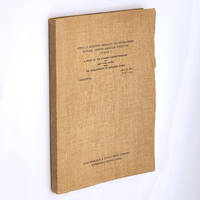
A Study of the Dynamic Characteristics of Anti-Tank Mines and the Development of Indicator Mines Office of Scientific Research and Development OSRD Report No. 3884 June 1 1944
Pittsburgh Pennsylvania: Gulf Research & Development Company 1944. Soft cover. Very Good. One of 65 copies this being copy 43 made and distributed by the Office of Scientific Research and Development. Covers lightly worn at edges; spot of soiling on rear cover. Interior unmarked and generally clean. Includes four pages of photographs of equipment on glossy paper six pages of mechanical diagrams and 35-pages of statistical graphs. 137 pages each printed on one side. 11 x 8.5 inches. No institutional copies located on OCLC. Rare. Confidential WWII-era technical report on the testing of anti-tank land mines including the German Tellermine. The report details the results of measuring of the dynamic characteristics of the mines when subjected to shock impulses including drop weight and blast tests essential to the comparison of various methods of clearing mine fields in which mines were detonated by means of the shock impulse from blast waves flails etc. The research was conducted by the contractor the Gulf Research & Development Company Pittsburgh Pennsylvania. ''It is the ultimate object of this investigation to obtain an indicator mine. Such an indicator mine is useful in comparing the relative effectiveness of various methods of clearing land mine fields. The German Teller mine TMi-43 is known to be the most difficult to explode by blast. Engineering data were provided the Engineering Board on the basis of which this German mine was substantially duplicated. This mine is known as the TMi-43 Indicator Mine'' - from the comments of the NDRC Project Supervisor Semi Joseph Begun 1905-1995. Begun was a German-American engineer and inventor who was at the time the Vice President of Research for the Brush Development Company Cleveland Ohio. The report was submitted by Thomas Bardeen and A. P. Palmer. Thomas Bardeen 1912-1980 was a Pittsburgh resident and engineer with Gulf. He received the President's Certificate of Merit on November 30 1948 for his contributions to the war effort. The mines tested were the M1B1 M1A2 M4 TMi-42 TMi-43 T6E1 C.I. Canadian Indicator and the T6-43. Gulf Research & Development Company paperback
Référence libraire : 015766
|
|
|
[Seymour, James, and Thomas Spencer (artists).
Portraits and Pedigrees of the Most Celebrated Racers from Paintings by Eminent Artists, with portraits of the Jockeys. Arundel and London, Thomas Butler, 1751-1753].
Oblong folio (310 x 370 mm). 30 engraved sheets, with 30 (of 34) portraits of thoroughbred race-horses (lacking nos. 10, 15, 31 and 34). Old half calf with marbled covers. A spectacular, exceedingly rare album illustrating the starting point of horse racing in England, when native mares were crossbred with imported oriental stallions. W. S. Sparrow notes, in 1922, "rare, no doubt, because so many copies have been broken up in order that the prints might be sold one by one". The integral engraved text surrounding the image of horse and jockey provides the history and breeding of the subjects of the portraits. The first three horses depicted in this charming album are direct descendants of the three foundation stallions of the modern Thoroughbred breed, namely the Godolphin Arabian (Bajazet, plate 2), the Darley Arabian (Childers, plate 3), and the Byerly Turk (Old Partner, plate 1). All of the other 23 race horses described here trace back to these three stallions just imported into England from the Middle East, as well. According to Pickerell, "all 500,000 of the world's thoroughbred racehorses are descended from 28 ancestors, born in the 18th century", of which, according to Peter Willett, about 50% have Arabian bloodlines, with the remainder evenly divided between Turkoman and Barb breeding. - James Seymour is recognized as one of the earliest English sporting artists. He was the son of a wealthy goldsmith and diamond merchant who supplied the plate for racing trophies. Seymour was passionate about racing and, in addition to drawing and painting them, he is believed to have owned racehorses himself; he was considered one of the most eminent horse painters of his age, and this important and rare album of charming engravings offers a true sampling of his work. - With armorial bookplate with cipher of George Simon Harcourt, Earl Harcourt (1736-1809) on front pastedown. Some early ms. annotations at beginning, some tears and repairs extending into text, first plate laid down. Sparrow, p. 77. Cf. Lane British Racing Prints Seymour 2, nos. 1-7, 11-18, 20-24, 26, 28-33. Mellon Sporting and Animal Prints Seymour 13, nos. 1-7, 11-18, 20-24, 26, 28-33. Cf. Siltzer British Sporting Prints, 389.

|
|
|
[Shaikhzade Ahmed Misri.
Kirk vezirin ve kirk hatunun hikayetleri nam ile meshur kitabdan / Contes Turcs en langue turque, extraits de roman intitulé, Les quarante vizirs. Paris, Imprimerie Impériale, 1812].
4to. 160 pp. Ottoman Turkish text set in Arabic characters. Half-title on the upper wrapper and the first page of text are set within a decorative printed frame. With an integral manuscript French translation of the text in the margins. Original publisher's printed paper wrappers. - With: (II) [Shaikhzade Ahmed Misri] / Belleteste, [Henri Nicolas]. Contes Turcs en langue turque, extraits du roman intitulé, les quarante vizirs. [= Kirk vezir hikâyeleri ...]. Ibid., 1812. 4to. (2), 258, (2) pp. The text is entirely in Ottoman Turkish except for an additional title-page in French. Both Arabic and French title-pages include the vignette of the French Imprimerie Impériale. Blue wrappers with a white printed title label on the spine, stored in a custom-made case: half red leather with the title in gold on the spine and white and green decorated sides. Two excellent examples of Arabic type printing by the French Imprimerie Impériale: the 1812 edition of "the history of the forty viziers" in Ottoman Turkish. This collection of Turkish folk tales is a variation of the Thousand and One Nights stories. These frame stories play an important role in the storytelling tradition of the Middle East and often form the basis (Middle) Eastern literature in general. Examples of these stories are found in early Indian, Iranian and Arabic sources, but the exact origin of the stories of the forty viziers is not clear. The stories and/or the first translations of the stories from Arabic were attributed to Ahmed-i Misri and/or Seyhzade (or Sheykh-Zada), about whom nothing is known. These names were possibly pseudonyms of the actual authors-translators who did not want to be associated with stories that were composed in prose, had suggestive or crude passages, and were compiled from other earlier frame stories. - According to extant sources, the entire collection of folk tales concerning the stories of the viziers could contain eighty stories, forty of the viziers during the day and forty of the women during the night. In addition, the stories could also include various advice sections, other small stories, Arabic, Persian and Turkish poems, verses, hadiths, dreams and their interpretations. Different compositions and adaptations would differ in size and would contain varying sets of stories from the complete collection. - I: A unique annotated early 19th century copy of "Kirk vezir hikâyeleri" (The stories of forty queens), known as the "History of the forty viziers", containing an integral and literal translation of the first 160 pages of the Ottoman Turkish work. The translation and further annotations on Ottoman Turkish syntax and vocabulary are written in a (near) contemporary hand in brown ink. The marginal annotations were probably written around the 1820s by a French orientalist. This particular manuscript translation is unique and one of the very first French translation of these stories. Another adaptation of the stories, containing 19 stories and the introduction, was translated into French by François Pétis de la Croix as "L'histoire de la sultane de Perse et des vizirs", published in Paris in 1722. - II: The present copy is a complete example of the 1812 edition. It contains forty stories, including the introduction, the story of (and dedication to) Sultan Mahmud, the frame story, twenty stories of the viziers, and twenty stories of the women. - Both works are compiled by the French orientalist Henri-Nicolas Belleteste (Belletête, ca. 1746-1808) and published posthumously. Belleteste was educated in Oriental languages and in 1798 he was appointed government interpreter. He subsequently served as a military interpreter during the Egyptian Campaign led by Napoleon Bonaparte (1798-1801). He published an Arabic vocabulary for military use and together with French orientalist Jean-Daniel Kieffer (1767-1833), Belleteste translated the Bulletins de la Grande Armée into Turkish for Napoleon's campaigns from 1805 to 1807. He had taken on the project of translating a collection of Turkish stories, entitled in French "Les Quarante Vizirs" (the forty viziers), allegedly from a manuscript found in Egypt. Unfortunately, he died unexpectedly at the age of 30 in 1808, thus leaving the work unfinished. Nevertheless, an edition of the Ottoman Turkish text Belleteste was translating was published in 1812, expertly printed in Arabic characters by the French Imprimerie Impériale, of which the present two works are examples. - I: With the integral manuscript translation of the text into French in a contemporary (ca. 1820s) hand in brown ink in the margins. Front wrapper detached, spine damaged, edges frayed, lacking the back wrapper and the last 96 pages of the work. - II: Without the frequently missing 48 pp. of Belleteste's unfinished French translation. Wrappers are slightly stained and slightly damaged, mainly around the spine and the edges, without affecting the integrity of the binding. The text has generous, uncut margins, thus the edges are slightly frayed. The custom-made case is slightly scuffed around the corners and edges. Otherwise in good condition. - Overall, these works present an extraordinary example of early 19th century Arabic printing by the French Imprimerie Impériale together with a unique manuscript translation of the text of the "history of the forty Viziers", into French by an unidentified early 19th-century orientalist. Atabey 908 (incomplete). Chauvin VIII, p. 18, no. 52. Zenker I, 729. Brunet 17781. Gay/Lemonnier I, 718. Not in Blackmer.
|
|
|
[Siege of Vienna].
Relation veritable du siège de Vienne. Lyon, Thomas Amaulry, 1684.
12mo. (8), 159 pp. With folding engraved portrait and folding engr. plan. Contemporary calf. First edition of this account of the 1683 Turkish siege of Vienna. The portrait shows Count Starhemberg. Owner's stamp to title page. Includes an additional engraving, captioned by a contemporary hand: "Mort du Grand Vizir, étranglé par l’ordre de Mehemed 4 pour n’avez pas pris Vienne". Old cancelled stamps. A clean, well-preserved copy, formerly in the Ottoman collection of the Swiss industrialist Herry W. Schaefer. Sturminger 2449. Kábdebo II, 182 ("1683" in error, not seen or located). Cf. Graesse VI/1, 76 (Brussels, 1684).

|
|
|

 Recevoir par e-mail
 Télécharger en PDF
 Flux RSS
 Lien permanent


