|
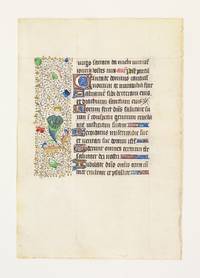
AN ILLUMINATED VELLUM MANUSCRIPT LEAF WITH DELIGHTFUL BORDER DECORATION
FROM A LARGE BOOK OF HOURS WITH TEXT IN LATIN
France probably Besançon 3rd quarter of 15th century. 239 x 165 mm. 9 3/8 x 6 1/2". Single column 15 lines in an elegant gothic book hand. <br/> Rubrics in dark pink line enders in pink and blue with white tracery and gold bezant several one-line initials and one two-line initial in burnished gold on dark pink and blue ground with white tracery each side with a panel border composed of hairline vines with gold ivy and bezants gold and blue acanthus and a few colorful flowers and EACH FEATURING THE TORSO OF A MAN EMERGING FROM A FLOWER. ◆A few faint marginal stains but IN BEAUTIFUL CONDITION.<br/> <br/> In addition to the acanthus and floral decoration often found in the borders of Books of Hours this leaf features a duo of delightful inhabitants in the form of laymen emerging from cup-like flowers. Each figure is individualized with the gentleman on the recto in a light brown tunic and dark hair his hands folded in front of him; on the verso is a blond gentleman in a teal tunic with bushy eyebrows arms akimbo and a stern look on his face. This kind of detailed work together with luxurious touches such as the many gilt initials several dozen gilt bezants and ivy leaves in each panel border and the unusually wide margins point to this manuscript having been a costly production. For additional leaves from this same manuscript at different price points please check our website. unknown
Bookseller reference : ST17060S
|
|
|
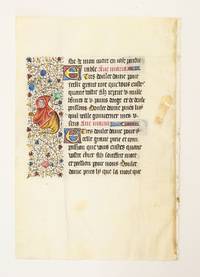
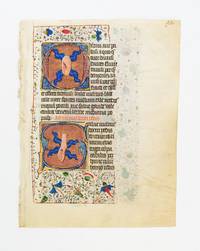
AN ILLUMINATED VELLUM MANUSCRIPT LEAF WITH ESPECIALLY CHARMING BORDER DECORATION
FROM A LARGE BOOK OF HOURS WITH TEXT IN FRENCH
France probably Besançon 3rd quarter of 15th century. 239 x 165 mm. 9 3/8 x 6 1/2". Single column 15 lines in an elegant gothic book hand. <br/> Rubrics in dark pink line enders in pink and blue with white tracery and gold bezant four two-line initials in burnished gold on dark pink and blue ground with white tracery each side with a panel border composed of hairline vines with gold ivy and bezants a few colorful flowers and EACH SIDE FEATURING AN UNUSUAL HUMAN HYBRID CREATURE. ◆Margins with a couple of wrinkles small stains and tiny holes lower part of one of the hybrids somewhat smudged but the remaining marginalia well preserved and on the whole an excellent specimen.<br/> <br/> In addition to the floral decoration and bezants often found in the borders of Books of Hours this leaf features a duo of delightful inhabitants in the form of two hybrid creatures with human faces. The bodies are indeterminate shaped rather like a cornucopia and each wears a red hooded cloak. The shading and coloring here are quite pleasing as is the perturbed expression painted onto each face--one of which looks directly out at the viewer. This kind of imaginative work together with luxurious touches such as the gilt initials several dozen gilt bezants and ivy leaves in each panel border and the unusually wide margins point to this manuscript having been a costly production. For additional leaves from this same manuscript at different price points please check our website. unknown
Bookseller reference : ST17060Q
|
|
|
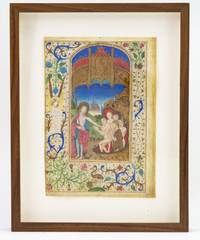
AN ILLUMINATED VELLUM MANUSCRIPT LEAF FROM A DUTCH BOOK OF HOURS, WITH A VERY FINE MINIATURE OF THE HARROWING OF HELL BY THE MAS
PROBABLY FROM THE OFFICE OF THE DEAD
Delft ca. 1470. Leaf: 175 x 122 mm. 6 7/8 x 4 3/4"; Frame: 250 x 195 mm. 9 3/4 x 7 3/4". No text on recto or verso. <br/> In an attractive wooden frame. A FINELY PAINTED MINIATURE OF THE HARROWING OF HELL within an arch-topped compartment the mouth of hell depicted on the left with a fiery red interior and five people emerging from it the figure of Christ on the left holding a cross on a long staff and half-clothed in a pink and blue robe the background with a castle in the distance ALL OF THIS BENEATH A VERY DETAILED ARCHITECTURAL CANOPY suspended in the sky AND THE WHOLE WITHIN A FULL BORDER of acanthus leaves and other foliage and flowers in reds blues greens yellows and brushed gold along with very many small burnished gold ivy leaves and buds on hairline stems a small stork in the bottom border and a large delicately shaded angel in the left border. â—†Left margin trimmed very close to decoration just escaping loss and the other three margins ample mild darkening right at fore and tail edge but not reaching into borders otherwise IN FINE CONDITION the colors rich and true and the burnished gold still shimmering.<br/> <br/> This extraordinary miniature notable for its uncommon subject matter memorable imagery and fine workmanship was produced by a talented artist belonging to the stylistic group known as the Masters of the Delft Half-Length Figures. The subject here is infrequently depicted in Books of Hours: the Harrowing of Hell appears as a full-page miniature in only three of the 119 prayer books described by Roger Wieck in his "Time Sanctified" and three others contain a Harrowing depiction inside an initial. Christian theological tradition tells us that after his crucifixion Christ went to liberate souls from Limbo--a location inhabited by those barred from entry into Heaven because they died before the Redemption. In our scene Christ wrapped in a regal cloak and carrying a long staff his hands and feet still bleeding from the wounds he received on the Cross reaches into an absolutely wonderful Hellmouth to extricate Adam and Eve and other naked souls while the recently deceased and original saint John the Baptist still clad in an animal skin garment waits patiently for his turn to emerge. The great maw of Hell as depicted here has bulging eyes a distended snout thickly matted hair and a bad complexion; his gaping mouth punctuated by sharp gray teeth glows red hot and one can tell from the creature's expression that he is loath to comply with this rescue of souls. In addition to its compelling subject matter there is a high level of artistic achievement here including delicately molded figures impressively detailed architectural elements and a lovely color palette. The elegance and quiet sophistication observed in this miniature distinguishes the artist responsible for this work as a particularly talented member of his circle. Active from about 1450-80 the Masters of the Delft Half-Length Figures were named by James Marrow after the angels and other figures whose upper bodies are typically found emerging from a cloud within the borders. Although the present leaf uncharacteristically contains a full-length angel in the border it shares other stylistic similarities such as the elaborate architectural canopy hovering over the main composition; and it particularly resembles the work of the artist of Keble College MS 77 an illuminator described in "The Golden Age of Dutch Manuscript Illumination" as "one of the more articulate of the group" whose "figures are more fully modelled and his palette . . . deeper and brighter" than that of his contemporaries. Because the subject of the present miniature goes beyond the standard image program seen in routine productions and because of the high level of artistic accomplishment seen here this leaf was almost certainly part of an elaborate Book of Hours produced in response to an important commission. unknown
Bookseller reference : ST17764
|
|
|
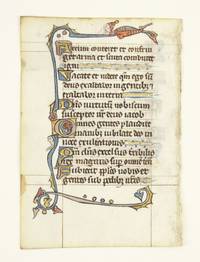
AN ILLUMINATED VELLUM MANUSCRIPT LEAF FROM A SMALL PSALTER IN LATIN, WITH DELIGHTFUL MARGINALIA
PSALMS 45:5-12 AND 46:1-4
France late 13th century. 125 x 88 mm. 4 7/8 x 3 1/2". Single column 15 lines in a gothic book hand. <br/> Attractively matted. Folio number in red several line enders in gold with blue penwork 10 one-line initials in gold on blue and pink ground one two-line initial painted pink and filled with blue and orange acanthus on gilt ground verso with a three-quarter border branching from the larger initial composed of pink and blue curling lines accentuated with gold spikes bezants and painted ivy leaves UPPER BRANCH TERMINATING IN A WONDERFUL HYBRID CREATURE WITH THE FACE OF A MAN AND THE BODY OF AN ORANGE BEAST AND THE LOWER BRANCH INCORPORATING ANOTHER FACE WITH A LONG BEARD. From the collection of Joseph Pope his MS Bergendal 116 about whom see below. â—†A little soiling and staining along edges of vellum and a couple of small marks in lower margin verso but in excellent condition overall the paint especially bright and fresh.<br/> <br/> From the distinguished collection of Canadian financier Joseph Pope 1921-2010 this charming leaf comes from a small-format Psalter intended for private use and features two amusing drolleries incorporated into the marginal design. Pope's collection was sold by Sotheby's on 5 July 2011 where this leaf appeared as part of lot 115; it was later listed in Quaritch Catalogue 1422 no. 88 which states that "according to Pope's note this leaf was found tipped in to a much later Book of Hours his MS Bergendal 64--produced in the southern Netherlands for a southern French patron during the first half of the 15th century--at f. 94 the middle of the Penitential Psalms; the manuscript was acquired by Pope at Sotheby's sale of 6 December 1983 lot 79.". unknown
Bookseller reference : ST16379-008
|
|
|
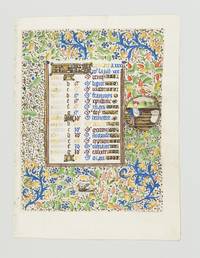
AN ILLUMINATED VELLUM CALENDAR LEAF FROM A BOOK OF HOURS, DEPICTING LABOR OF THE MONTH AND ZODIAC SIGN
TEXT FOR THE MONTH OF OCTOBER
Paris ca. 1460. 195 x 143 mm. 7 3/4 x 5 1/2". Single column 16 lines in a gothic book hand. <br/> Minor feast days in red and blue major feasts in gold numerous gold and painted line fillers the five "A" initials and the "KL" highly decorative and painted pink and blue against a gold background gold and pink bar surrounding the text on three sides BOTH SIDES OF THE LEAF WITH EXTRAVAGANTLY DECORATIVE BOTANICAL FULL BORDERS with two small birds hidden within and INCORPORATING TWO MEDALLION MINIATURES DEPICTING THE LABOR OF THE MONTH SOWING AND THE SIGN OF THE ZODIAC SCORPIO FOR OCTOBER. ◆IN VERY FINE FRESH CONDITION with gold and paint extraordinarily bright.<br/> <br/> The extraordinarily lavish and animated full borders coupled here with extensive use of brushed and burnished gold--for major feast days for decorative border elements and even for the hundreds of seeds being sown!--suggests that this calendar folio comes from a Book of Hours that was commissioned for a person or persons of high rank since it would have been very costly. The leaf comes from a manuscript that included numerous roundels depicting the lives of St. Catherine and the more obscure St. Alexius and it is possible that the Book of Hours belonged to a husband and wife for whom these saints served as patrons. The style of the delicately painted figures especially in the roundels indicates an artist who was familiar with the early output of the Coëtivy Master who according to Avril and Renaud can be identified with Colin d'Amiens who made a great name for himself in Paris not as was previously thought with Henri de Vulcop who made a great name for himself in the Loire region. The master takes his name from the Book of Hours now in the Austrian national library that he painted for Olivier de Coëtivy and his wife Marie de Valois one of some 30 works that have been identified as his. Although there is considerable Flemish influence that can be seen in his work he has links for example with Simon Marmion Colin d'Amiens was active in Paris during the third quarter of the 15th century and with Barthélmy van Eyck and Jean Fouquet was among the three great artists of this period patronized by the French court--Avril and Renaud says flatly that our master was "the most important artist practising in Paris in the third quarter of the century from about 1450 to 1485." For more on the Coëtivy Master see Avril and Reynaud pp. 58-69. unknown
Bookseller reference : ST12835
|
|
|
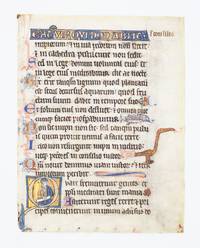
AN ILLUMINATED VELLUM MANUSCRIPT LEAF WITH AN HISTORIATED INITIAL OF A PROPHET, FROM A LAVISH PSALTER-HOURS MADE FOR A NUN
TEXT FROM THE BEGINNING OF THE PSALMS
Flanders Southern Netherlands or Rhineland ca. 1250-75. 176 x 135 mm. 7 x 5 1/4". Single column 20 lines in a bold gothic book hand. <br/> First line of recto with lettering in gilt on blue and pink ground with white highlights versal initials in blue with red penwork or burnished gold with blue penwork ten line fillers in geometric designs of red blue and burnished gold recto WITH TWO PENWORK LINE FILLERS IN THE SHAPE OF CREATURES one being a fish and the other the head of a beast the latter biting the tail of a large gilt bird whose neck and beak extend into the right margin AND WITH A THREE-LINE INITIAL DEPICTING A PROPHET HOLDING A SCROLL the initial with a long tail extending into the lower margin. See: Kidd "The McCarthy Collection" vol. II no. 20. â—†Bottom marginal decoration including the anthropomorphic tail of the initial trimmed away despite ample margin above the decoration gold a bit worn but a specimen of great interest nonetheless and the decoration still very appealing.<br/> <br/> From a lavish manuscript with considerable scholarly interest this leaf from a very early Psalter-Hours contains a lovely illuminated initial as well as absolutely delightful whimsical inhabitation. The latter are in the form of extraordinarily charming penwork line fillers comprising a scaled fish that appears to be sticking out his tongue and the head of a dog-like creature nipping at the tail feathers of a long-necked bird. According to a recent Christie's description "The parent manuscript from which this leaf comes was of almost unparalleled luxury: it contained the Psalms Hours of the Virgin and Office of the Dead and apparently had a historiated initial for every psalm hymn prayer canticle etc.--more than 200 in total--and there is evidence that it may also have had between thirty and forty full-page prefatory miniatures." The present leaf is of particular interest because it contains the opening line of the Psalms "Beatus vir qui non abiit" in gilt on the top line of the recto. Given the extravagance of the parent manuscript this page would in all likelihood have sat opposite an elaborate "B" initial though its whereabouts today are unknown. Thanks to previous academic research particularly the contributions of Peter Kidd we know that the parent manuscript was likely made for a wealthy and perhaps even royal Benedictine nun based on the presence of at least two collects mentioning "our abbess" as well as another rare collect asking for the intercession of St. Benedict. There is still some disagreement over the place of origin of this manuscript and while scholarly consensus now seems to lean towards Flanders Southern Netherlands or the Rhineland region arguments have also been made in favor of Eastern France Lower Lorraine and England. A number of leaves from this manuscript came to market in the second half of the 20th century and a list of most known leaves can be found in Sotheby's catalogue entry for their lot 13 a leaf with five initials at their sale on 7 July 2015 and in Kidd's catalogue for the McCarthy Collection vol. II no. 20. Whatever the origin of this leaf it is difficult to overstate how engaging it is. unknown
Bookseller reference : ST19555
|
|
|
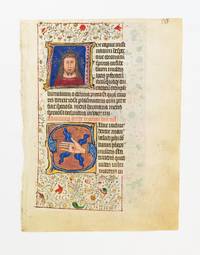
AN ILLUMINATED VELLUM MANUSCRIPT LEAF FROM A BOOK OF HOURS IN LATIN, WITH UNUSUAL HISTORIATED INITIALS FEATURING THE WOUNDS OF C
TEXT FROM HYMNS TO THE PASSION OF CHRIST
Bruges ca. 1465. 193 x 145 mm. 7 5/8 x 5 3/4". Single column 21 lines in a gothic book hand. <br/> Rubrics in red WITH THREE LARGE HISTORIATED INITIALS: ONE WITH A PORTRAIT OF CHRIST WEARING THE CROWN OF THORNS AND TWO WITH DISEMBODIED HANDS SHOWING THE STIGMATA each initial in pink or blue with white tracery filled with dark pink or blue with thin gilt lines and dots hands with wavy blue rays radiating from behind the appendage all within a thin gilt frame both sides with a three-quarter border consisting of hairline vines gold bezants and a few colorful flowers. â—†Margins with a little light soiling BUT IN FINE CONDITION THE PAINT OF THE INITIALS ESPECIALLY RICH AND WELL PRESERVED.<br/> <br/> From a manuscript probably produced in Bruges for the English market this leaf contains arresting initials that direct the viewer's attention to the wounds endured by Christ during the Passion. According to Roger Wieck Passion Cycle images enjoyed a particular vogue in 15th century Dutch Flemish and English Books of Hours including those that were exported to England. In the present example the strikingly unusual imagery includes a portrait of Christ wearing the Crown of Thorns his gaze fixed directly at the viewer and in separate initials his left and right hands appear disembodied and displaying the stigmata. A sister leaf to the present item features three additional initials showing the wounds of the left and right foot as well as the spear injury to Christ's side depicted as an oval piece of flesh with a laceration across the center. The parent manuscript containing the present leaf sold at Christie's on 15 November 2006 lot 16 the description for which gives us additional information about the book's contents and provenance: it was made for the Use of Sarum included a calendar with the English saint Thomas Becket and Popes Gregory and Silvester with their names crossed out indicating that it was in England through at least the time of the Reformation and contained an early ownership inscription of a woman named Bridget Lowe with a Middle English inscription on the pastedown. Christie's also attributed the parent manuscript to the workshop of William Vrelant with miniatures possibly by his chief assistant the Master of the "Vraie Cronique Descoce." They note that this work is "of higher quality than many of the works that satisfied the English demand for Netherlandish illumination" and that it "demonstrates why Vrelant appealed to the great bibliophiles of the Burgundian Netherlands." Vrelant was the leading purveyor of books of private devotion in Bruges during the third quarter of the 15th century and his prominent position among Flemish illuminators of the time is indicated by the considerable number of manuscripts illustrated in his manner by other miniaturists both in Bruges and in nearby cities in Flanders. Similar examples to the present leaf can be found in intact Books of Hours at the Philadelphia Free Library MS Widener 3 and the Huntington HM 1086--both of which were produced in Flanders or the Netherlands around the same time as the present work--but the present leaf surpasses both of these examples in terms of excellence of the artistic hand and level of detail depicted. unknown
Bookseller reference : ST17243a
|
|
|
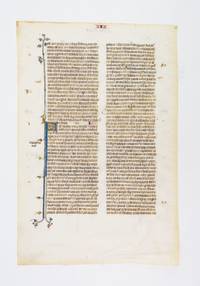
AN ILLUMINATED VELLUM MANUSCRIPT LEAF FROM A LARGE BIBLE IN LATIN
TEXT FROM THE THIRD BOOK OF KINGS i.e. 1 KINGS 8:31-9:25
France 14th century. 402 x 268 mm. 15 7/8 x 10 1/2". Double column 50 lines in an attractive gothic hand. <br/> Running titles and chapter numbers in red and blue one three-line initial in blue with white tracery filled with curling pink vines on burnished gold ground the initial with a long descender and extensions running the entire length of the column painted pink and blue with gold bezants and gold ivy leaves sprouting into the margins both ends terminating in sprays of painted and gold ivy and bezants. Remnants of mounting tape on recto fore edge. Vellum with a little wrinkling around the edges top edge with a couple of very small stains but AN EXTREMELY FINE LEAF clean and bright with wide margins and finely preserved decoration.<br/> <br/> Given the impressive size and beauty of this leaf we can confidently assume that the Bible from which it came was commissioned by a person or ecclesiastical institution of considerable wealth and importance. And everything about the script decoration and design confirms that it was executed by appropriately gifted hands. The "III Regnum" observed in the running titles on this leaf is today known as 1 Kings and the text here deals with Solomon's prayers to God following the dedication of his temple followed by the Lord's second appearance to Solomon in Gabaon. The four inner and outer margins here all have neatly penned contemporaneous letters from "a" through "h" to be used as markers that would facilitate the study of the text; likewise we find the three letters "p" "s" and "t" presumably for "primus" "secundus" and "tertius" employed in the same way. According to Clemens and Graham "what is most striking about both marking systems is that they conflict with the Bible's chapter divisions . . . as the letter sequences run across chapter breaks. Both systems must have been intended to assist a reader to locate passages of text and presumably they relate to a reference work that was known to users . . . but that reference work has not yet been identified." p. 190 It is also possible that the "p" "s" and "t" stand for the canonical hours prime sext and terce indicating instead that this item had been marked up for liturgical readings. unknown
Bookseller reference : ST18250g
|
|
|
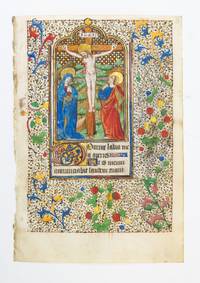
AN ILLUMINATED VELLUM MANUSCRIPT LEAF FROM AN EXTRAORDINARILY LARGE BOOK OF HOURS, WITH A MINIATURE OF THE CRUCIFIXION
TEXT FROM THE HOURS OF THE CROSS
France probably Besançon 3rd quarter of 15th century. 239 x 165 mm. 9 3/8 x 6 1/2". Single column 15 lines in an elegant gothic book hand. <br/> Rubrics in dark pink line-enders in dark pink and blue highlighted with a gilt bezant several one-line initials and one two-line initial in burnished gold on dark pink and blue ground with white tracery one three-line initial in pink with white tracery filled with trefoils painted red or blue all on a gold ground verso with panel border of delicate hairline vines terminating in gilt bezants and ivy and with acanthus and flowers recto with A HALF-PAGE MINIATURE OF THE CRUCIFIXION in an arch-topped gilt frame Christ in the center of the composition with the mocking inscription "I N R I" "Iesus Nazarenus Rex Iudaeorum" on a banner above him the Virgin standing on the left and St. John on the right the landscape behind them filled with hills and trees under a tessellated sky SURROUNDED BY A FULL BORDER consisting of hairline vines terminating in gold bezants and ivy colorful acanthus strawberries and flowers the text and image further framed by a "U"-shaped bar of gold pink and blue extending the full height of the miniature. ◆Virgin's robe a little mottled and chipped minor chipping elsewhere borders with slight smudging to some of the hairline vines small marginal stain but in all in excellent condition with wide margins with the colors very bright and the miniature well preserved.<br/> <br/> Opening the Hours of the Cross a shorter text that is sometimes found in addition to the Hours of the Virgin this touching miniature of the Crucifixion is richly painted and features a particularly emotional depiction of Christ his head slightly bowed with an expression of pain. Blood flows freely from his wounds partly merging with the orange in the sky and partly forming rivulets at the base of the cross. This exsanguination stands in contrast to the more typically restrained indications in other Crucifixion scenes and serves to emphasize the cruel suffering of the execution. His mother stands to the left in a blue cloak hands knitted together and with a look of weary resignation on her face; to the right stands St. John whose lips are slightly parted as he looks directly at the crucified Christ as if searching his face for signs of life. Our artist has made an unusual choice for the background with the lower two thirds devoted to a naturalistic landscape with many hills and trees and the sky entirely tessellated with squares of red blue and gold. While the Virgin and St. John are both firmly situated within the earthy realm the body of Christ occupies both spaces perhaps emphasizing his dual nature as both human and divine. Stylistically this leaf can be localized to the Franche-Comté region in eastern France and is closely related if not directly attributable to an atelier specializing in Books of Hours made for the Use of Besançon and most likely situated in that city see Avril and Reynaud p. 197. The similarities are especially apparent in the figures' faces which are slightly puffy in appearance and have distinct slit-like eyes. As noted by Avril and Reynaud the unnamed master of this atelier was deeply indebted to the Master of Morgan 293 a talented Burgundian illuminator active in the second quarter of the 15th century whose name derives from a particularly lovely Book of Hours made for the Use of Besançon. In fact there are certain consonant details between this miniature and the Crucifixion in the Morgan manuscript: Christ's position and physicality are nearly identical as is the pattern of blood as it moves down the cross and both artists create a division in the landscape with the Morgan artist using gold rather than tessellation for his sky. Whoever the artist responsible for the present miniature the work here is clearly accomplished both quietly powerful and an excellent representation of a distinct regional style. unknown
Bookseller reference : ST17060Z
|
|
|
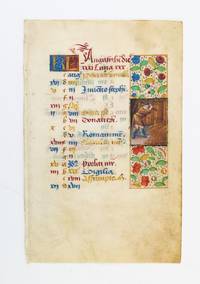
AN ILLUMINATED VELLUM MANUSCRIPT CALENDAR FROM A BOOK OF HOURS IN LATIN, WITH SMALL MINIATURES OF THE LABOR OF THE MONTH AND ZOD
TEXT FROM THE MONTH OF AUGUST
Northern France probably Rouen ca. 1470. 180 x 117 mm. 7 x 4 5/8". Single column 18 lines text in a bâtarde hand. <br/> Text in red blue and gold two-line "KL" in shell gold on blue and red ground both sides with panel border composed of flowers and ink dots WITH TWO SMALL MINIATURES each centered in the middle of the panel borders featuring the labor of the month Threshing and the zodiac sign a young woman for Virgo. Vellum a bit soiled and slight wrinkling in margins small area of rubbing at bottom of the Virgo miniature but in excellent condition overall the fine details in the miniatures well preserved.<br/> <br/> Situated among the flowers of the panel borders here are two small but charming miniatures depicting the labor of the month "Threshing" and the zodiac sign for August. According to Roger Wieck far fewer than half the Books of Hours of the period contain illustrated calendars "even in manuscripts with otherwise lavish cycles of miniatures"; when they do appear they are invariably charming as is the case here. In the threshing scene a young layman brings down his grain flail two hinged pieces of wood the longer one called a helve and the other a beater joined by a thong in an effort to separate the grain while neatly gathered bushels of straw appear just behind him. On the verso we see a representation of Virgo as a young woman holding appropriately two long stalks of grain in her hands. The rich palette used in these miniatures allows the delicate gold highlighting on the harvested crop and garments to shine through adding a fine sense of detail to each image. unknown
Bookseller reference : ST17245-09
|
|
|
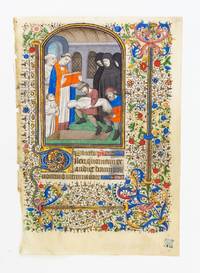
AN ILLUMINATED VELLUM MANUSCRIPT LEAF FROM A BOOK OF HOURS IN LATIN, WITH A MINIATURE OF A BURIAL SCENE
TEXT FROM THE OFFICE OF THE DEAD
France probably Paris ca. 1440. 181 x 125 mm. 7 1/8 x 5". Single column verso with 16 lines in a gothic book hand. <br/> Rubrics in red line enders in blue and pink with white tracery and central gilt bezant seven one-line initials in gold on pink and blue ground with white tracery one three-line initial in blue with white tracery filled with red and blue ivy leaves and on gold ground WITH A HALF-PAGE MINIATURE DEPICTING A BURIAL SCENE in a thin arch-topped gold frame WITH A FULL BORDER of hairline vines gilt bezants and ivy leaves colorful acanthus and flowers densely arranged around gold and painted bars. Lower fore-edge corner of recto with a small blue ink stamp of the library of Count Nicholai Alexanderovich Kushelev-Bezborodko. ◆Inner margin a little small near bottom but without loss slight smudge at the foot of the burial shroud but IN VERY FINE CONDITION the color and detail beautifully preserved.<br/> <br/> Apart from those relatively few copies with illustrated calendars the miniatures found in Books of Hours are almost entirely devoted to retrospective Bible scenes that are obviously outside the experience of the illuminator; it is only in the present kind of scene at the beginning of the Office of the Dead that we can see a contemporaneous image that would have come directly from the Medieval experience. The present scene represents the final stage of the funerary event in which the body is actually laid to rest in the ground this being preceded by the funeral procession Requiem Mass prayers Absolution and the procession into the graveyard. Though the corpse would have been encased in a coffin during the aforementioned rites and processions it was customary to bury the dead in only a shroud in the present example the artist has even thought to show the stitching along the length of the shroud. Three groups of people each serving a different function appear in this miniature: in the foreground are two laborers lowering the body into an earthen grave a small group of mourners in black cloaks stand behind them at the right and a duo of clergy members stand to the left with a young boy holding a processional cross at their side. One of the clergymen presumably the priest wears a blue cope donned prior to administering Absolution to the deceased and holds a manuscript codex containing the Rites for Burial. Though the faces have all been painted without much modelling the artist manages to express a surprising amount of emotion on each visage: the mourners and clergy appear sorrowful with downcast eyes the laymen are solemn yet pragmatic as they attend to their task and the small boy the only one looking upward observes the scene with quiet curiosity. It is interesting to note that the somber character of the miniature is at odds with the riot of colorful and beautifully rendered decoration in the borders reminding us that the manuscript from which this painting came was a luxury object. Apparently the parent manuscript was owned in the 18th century by "Mr Jourdan Secrétaire de Mgnr l'ancien Evêque de Limoges Precepteur des Enfans de Françe"; by the 19th century it was part of the library of Count Nicholai Alexandrovich Kushelev-Bezborodko 1834-62 a Russian senator and art collector who built a world-class collection of art and sculpture. After his untimely death much of his collection went to the Imperial Academy of Art's newly formed Kushelevskaya Gallery and later became part of the Hermitage and Pushkin museums. It appears that the manuscript was sold at Christie's on 7 December 1988 lot 22 imperfect with only three miniatures and again at Sotheby's on 5 December 2000 lot 61 and was broken up sometime thereafter. unknown
Bookseller reference : ST17240
|
|
|
AN ILLUMINATED VELLUM MANUSCRIPT LEAF FROM A BOOK OF HOURS IN LATIN, WITH UNUSUAL HISTORIATED INITIALS FEATURING THE WOUNDS OF C
TEXT FROM HYMNS TO THE PASSION OF CHRIST
Bruges ca. 1465. 193 x 145 mm. 7 5/8 x 5 3/4". Single column 21 lines in a gothic book hand. <br/> Rubrics in red one two-line initial in gold filled with blue on pink ground WITH THREE LARGE HISTORIATED INITIALS: ONE FEATURING AN OVAL-SHAPED PIECE OF FLESH WITH A GASH IN THE CENTER AND TWO WITH CHRIST'S DISEMBODIED FOOT SHOWING THE PUNCTURE WOUND FROM THE CRUCIFIXION each initial in pink or blue with white tracery filled with dark pink and thin gilt lines and dots four wavy blue rays radiating from behind each appendage all within a thin gilt frame both sides with a three-quarter border consisting of hairline vines gold bezants and a few colorful flowers. â—†Vellum a shade less than bright faint marginal rumpling trivial paint transfer on one initial BUT IN FINE CONDITION the initials richly painted and extremely well preserved.<br/> <br/> From a manuscript probably produced in Bruges for the English market this leaf contains arresting initials that direct the viewer's attention to the wounds endured by Christ during the Passion. According to Roger Wieck Passion Cycle images enjoyed a particular vogue in 15th century Dutch Flemish and English Books of Hours including those that were exported to England. In the present example the strikingly unusual imagery includes the wounds of the left and right foot as well as the spear injury to Christ's side depicted as an oval piece of flesh with a laceration across the center. A sister leaf to the present item features three additional initials showing a portrait of Christ wearing the Crown of Thorns his gaze fixed directly at the viewer and in separate initials his left and right hands appear disembodied and displaying the stigmata. The parent manuscript containing the present leaf sold at Christie's on 15 November 2006 lot 16 the description for which gives us additional information about the book's contents and provenance: it was made for the Use of Sarum included a calendar with the English saint Thomas Becket and Popes Gregory and Silvester with their names crossed out indicating that it was in England through at least the time of the Reformation and contained an early ownership inscription of a woman named Bridget Lowe with a Middle English inscription on the pastedown. Christie's also attributed the parent manuscript to the workshop of William Vrelant with miniatures possibly by his chief assistant the Master of the "Vraie Cronique Descoce." They note that this work is "of higher quality than many of the works that satisfied the English demand for Netherlandish illumination" and that it "demonstrates why Vrelant appealed to the great bibliophiles of the Burgundian Netherlands." Vrelant was the leading purveyor of books of private devotion in Bruges during the third quarter of the 15th century and his prominent position among Flemish illuminators of the time is indicated by the considerable number of manuscripts illustrated in his manner by other miniaturists both in Bruges and in nearby cities in Flanders. Similar examples to the present leaf can be found in intact Books of Hours at the Philadelphia Free Library MS Widener 3 and the Huntington HM 1086--both of which were produced in Flanders or the Netherlands around the same time as the present work. The present leaf surpasses both of these examples in terms of excellence of the artistic hand and attention to detail. unknown
Bookseller reference : ST17243b
|
|
|
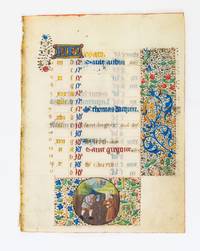
AN ILLUMINATED VELLUM MANUSCRIPT CALENDAR LEAF FROM A BOOK OF HOURS, WITH A SMALL ROUNDEL MINIATURE DEPICTING THE LABOR OF THE M
TEXT FROM THE MONTH OF MARCH
France possibly Rouen mid-15th century. 173 x 130 mm. 6 3/4 x 5 1/8". Single column 16 ruled lines text in a gothic book hand. <br/> Text in gold blue and dark pink "KL" in blue with white tracery on a gold ground decorated with dark pink baubles and leaves and with a floral spray extension both sides with panel border composed of densely packed acanthus flowers and hairline vines with gold bezants WITH A SMALL ROUNDEL MINIATURE at the bottom depicting the labor of the month Pruning set on a panel of flowers hairline vines and gold bezants. With numbering to the left of the golden numbers and a few calendar entries in a later hand. â—†Light soiling to vellum a few small smudges in the borders a little paint transfer affecting a couple lines of text and margins of the verso but these issues all very minor and on the whole in fine condition with a particularly well-preserved miniature with rich uneroded paint.<br/> <br/> With lovely panel borders and a particularly charming roundel miniature showing the labor of the month this leaf likely comes from a high-quality manuscript made for a person of means. Though miniatures depicting the labors of the month are often illustrated with just a single person performing the task here we are treated to two laypeople--a man and a woman--working together to prune and break ground in their field. The man appears to be carrying an axe for trimming branches while the woman carries a long stick to loosen dirt for spring plantings. The names of several saints have been added to the calendar by a later hand though it would appear that they were erroneously placed in March: St. Hugh belongs on 9 April Pope Leo on 11 April and St. Tiburtius on 14 April. While almost all of these feast days are commonly found in Books of Hours of this period Hugh Bishop of Rouen is slightly unusual suggesting that the manuscript may have been made in or at least ended up in Rouen. unknown
Bookseller reference : ST17245-04
|
|
|
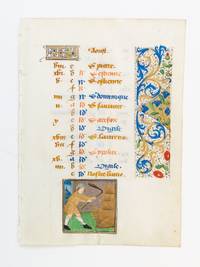
AN ILLUMINATED VELLUM MANUSCRIPT LEAF FROM THE CALENDAR OF A BOOK OF HOURS, WITH SMALL MINIATURES OF THE LABOR OF THE MONTH AND
TEXT FROM THE MONTH OF AUGUST
France probably Rouen second half of 15th century. 162 x 117 mm. 6 3/8 x 4 5/8". Single column 17 ruled lines text in a bâtarde hand. <br/> Text in gold blue and red "KL" in scrolling white letters on a gold ground with small blue and red blossoms both sides with panel border of acanthus flowers small ink dots and gold bezants WITH TWO SMALL MINIATURES showing the labor of the month Threshing on recto and the zodiac sign Virgo on verso. ◆Small wrinkle in lower margin just touching the lower edge of the miniatures trivial smudging but IN VERY FINE CONDITION the vellum especially clean and bright the paint quite rich and the miniatures extremely well preserved.<br/> <br/> With clean white vellum small but appealing miniatures and attractive lettering and decoration this is a desirable example of a calendar leaf from a high-quality Book of Hours likely made in Rouen. According to Roger Wieck far fewer than half the Books of Hours of the period contain illustrated calendars "even in manuscripts with otherwise lavish cycles of miniatures"; when they do appear they are invariably charming as is the case here. In the lower margin of the recto is a small miniature depicting the typical labor for August "Threshing" in which a young layman brings down his grain flail two hinged pieces of wood the longer one called a helve and the other a beater joined by a thong in an effort to separate the grain while neatly stacked unprocessed clumps of straw appear just behind it. On the verso we see a representation of Virgo as a young woman holding appropriately a long sheaf of grain in her hand. While most of the feast days that appear in the calendar are typical for the period the inclusion of St. Sauveur i.e. Transfiguratio Domini on 6 August is characteristic of a calendar for the use of Rouen suggesting that the parent manuscript may have been produced in that place or the region around it. unknown
Bookseller reference : ST17245-02
|
|
|
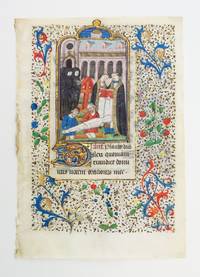
AN ILLUMINATED VELLUM MANUSCRIPT LEAF FROM AN EXTRAORDINARILY LARGE BOOK OF HOURS, WITH A MINIATURE OF A BURIAL
TEXT FROM THE OFFICE OF THE DEAD
France probably Besançon 3rd quarter of 15th century. 239 x 165 mm. 9 3/8 x 6 1/2". Single column 15 lines in an elegant gothic book hand. <br/> Rubrics in dark pink line-enders in dark pink and blue with a gilt bezant several one-line initials in burnished gold on dark pink and blue ground with white tracery one three-line initial in blue with white tracery filled with flowers painted pink or blue all on a gold ground verso with panel border of delicate hairline vines terminating in gilt bezants and ivy and with a spray of blue flowers and a red bud recto with A FULLY-REALIZED HALF-PAGE MINIATURE OF A BURIAL in an arch-topped gilt frame with two laymen lowering a shrouded corpse into the ground a small group of hooded monks to the left and two ecclesiastical figures reading from a book to the right all in front of a gothic church painted pink with a blue roof SURROUNDED BY A FULL BORDER consisting of hairline vines terminating in gold bezants and ivy colorful acanthus strawberries and blue flowers the text below the miniature further framed with a thin "U"-shaped line extending the full height of the miniature. A very few trivial imperfections quite minor wear to paint on clothing a little insignificant smudging one small light stain in the blank margin of verso but these defects not the least distracting and overall the miniature in fine condition with rich well-preserved color.<br/> <br/> This is a splendid miniature from a particularly large Book of Hours showing a detailed rendering of a scene from contemporary Medieval life--that of a burial in a churchyard involving clergy mourners and laymen. Apart from those relatively few copies with illustrated calendars the miniatures found in Books of Hours are almost entirely devoted to retrospective Bible scenes that are obviously outside the experience of the illuminator; it is only in the present kind of scene at the beginning of the Office of the Dead that we can see a contemporaneous image that would have come directly from the Medieval experience. While our painting is fairly typical in subject matter and design it offers a number of interesting details about the Medieval rites and rituals surrounding death. The present scene represents the final stage preceded by the funeral procession Requiem Mass prayers Absolution and the procession into the graveyard in which the body is actually laid to rest in the ground. Though the corpse would have been encased in a coffin during the aforementioned rites and processions it was customary to bury the dead in only a shroud in the present example the artist has even thought to show the stitching along the length of the shroud. Three groups of people each serving a different function appear in this miniature: in the foreground are two laborers lowering the body into an earthen grave a small group of mourners in black cloaks stand off to the left and a duo of clergy members stand to the right. The latter have tonsured heads and each wears a black cope donned prior to administering Absolution to the deceased; together they hold a manuscript containing the Rites for Burial. The background is composed of a grand church or cathedral containing a number of fine architectural details including several windows including a clerestory level an arched entrance a dome and decorative touches. Stylistically this leaf can be localized to the Franche-Comté region in eastern France and is closely related if not directly attributable to an atelier specializing in Books of Hours made for the Use of Besançon and most likely situated in that city see Avril and Reynaud p. 197. The similarities are especially apparent in the figures' faces which are slightly puffy in appearance and have distinct slit-like eyes. As noted by Avril and Reynaud the unnamed master of this atelier was deeply indebted to the Master of Morgan 293 a talented Burgundian illuminator active in the second quarter of the 15th century whose name derives from a particularly lovely Book of Hours made for the Use of Besançon. Whoever the artist responsible for the present miniature this work is an excellent representation of a distinct regional style extremely attractive and replete with interesting details that connect us to the Medieval experience. unknown
Bookseller reference : ST17060V
|
|
|
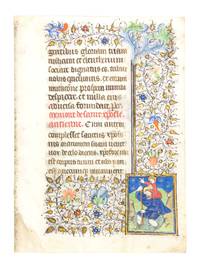
AN ILLUMINATED VELLUM MANUSCRIPT LEAF FROM A BOOK OF HOURS IN LATIN AND FRENCH, WITH A SMALL MINIATURE OF ST. CHRISTOPHER
TEXT FROM SUFFRAGES
France mid-15th century. 155 x 113 mm. 6 1/8 x 4 1/2". Single column 14 lines in a gothic book hand. <br/> Rubrics in red one two-line initial in pink with white tracery filled with painted ivy vines and on a gold ground BOTH SIDES WITH THREE-QUARTER BORDER composed of hairline vines gold ivy and bezants and painted flowers fruit and acanthus outer margin near text column with a thin blue and gold bar terminating in colorful acanthus recto with A SMALL 40 x 35 mm. MINIATURE OF ST. CHRISTOPHER CROSSING THE RIVER WITH THE CHRIST CHILD ON HIS BACK. Verso with remnants of mounting tape on four corners. â—†General faint soiling and a few negligible marginal spots small area of dampstaining on lower corner and margins but a very attractive leaf with no serious issues and the miniature in excellent condition very bright and fresh.<br/> <br/> This charming miniature depicts the most well-known episode from the life of St. Christopher in which he carries the "weight of the world" across a perilous river part of the charm here is that the river as depicted in the small space available to the miniaturist presents no more peril than a puddle. According to Catholic tradition St. Christopher was a man of extraordinary size who after converting to Christianity served God by acting as a ferryman of sorts using his bulk to help people cross a particularly dangerous stretch of water. During one such crossing the weight of one of his smallest passengers became almost too much to bear; after he arrived safely on the other side of the river it was revealed that his passenger was the Christ Child and that Christopher had been carrying both the weight of the world and its savior. The artist of the present miniature emphasizes the burden felt by the saint depicting him with a bent back and knees relying heavily on his walking stick as he makes his way through the water. Christ sits confidently astride the saint's shoulders holding a golden orb in one hand and making the sign of benediction--his two fingers pointing toward the opposite shore--with the other. Though the miniature is small the story is immediately grasped and the artist makes excellent use of the space with harmonious shapes and bright colors. The unusual format of this leaf is also interesting with the borders being quite thick and the miniature situated outside the text rather than within it. The overall design is pleasing and dozens of gilt bezants and leaves on both recto and verso add an extra touch of luxury. unknown
Bookseller reference : ST17076b
|
|
|
AN ILLUMINATED VELLUM MANUSCRIPT LEAF WITH SMALL MINIATURES OF SAINTS FROM A BOOK OF HOURS IN LATIN
TEXT FROM THE SUFFRAGES
Northeastern France probably Arras late 15th century. 146 x 95 mm. 5 3/4 x 3 3/4". Single column 15 lines in a pleasing bâtarde hand. <br/> Rubrics in red one- and two-line initials in brushed gold on a red or blue ground EACH SIDE OF LEAF WITH A BRUSHED GOLD PANEL BORDER WITH VERY PRETTY ILLUSIONISTIC FLOWERS AND FRUITS and intricate strapwork design in colors; WITH TWO SMALL MINIATURES measuring approximately 40 x 25 mm. depicting John the Baptist and John the Evangelist shown with their attributes. Headlines written in French in a later 18th century calligraphic hand. ◆Light soiling a touch of paint loss to frames and background not very noticeable and not affecting the figures otherwise an excellent specimen generally clean and smooth with ample margins winning decoration and shining gold.<br/> <br/> From a charmingly decorated 15th century prayer book this leaf offers the opportunity to acquire two particularly nice miniatures each depicting an important saint. The recto shows St. John the Baptist with a lamb at his side and a book balanced on his knee; and the verso depicts St. John the Evangelist as a young man holding a chalice with what ought to be snakes emerging from it in reference to the poisoned cup he was invited to drink as a test of faith but which instead look more like tendrils of smoke. For other leaves from this same manuscript please check our website. unknown
Bookseller reference : ST12668bH

|
|
|
AN ILLUMINATED VELLUM MANUSCRIPT LEAF WITH A MINIATURE OF THE HOLY TRINITY, FROM A BOOK OF HOURS IN FRENCH AND LATIN
TEXT FROM A PRAYER TO THE TRINITY IN FRENCH
Paris ca. 1460. 153 x 110 mm. 6 x 4 3/8". Single column 14 lines of text in a fine gothic book hand. <br/> One-line initial in burnished gold on a pink and blue ground with white tracery a two-line initial and a three-line initial in pink with white tracery on a ground of burnished gold the center filled with twining blue vines bearing pink and scarlet flowers verso with a rinceau panel border featuring twining hairline stems bearing burnished gold ivy leaves and fruit blue and gold acanthus leaves and flowers recto WITH AN ARCH-TOPPED MINIATURE OF THE HOLY TRINITY SURROUNDED BY THE HEAVENLY HOST this and the accompanying text enclosed by a pink blue and burnished gold bar border on one side and a brushed gold bar border with pink lotus flowers on two sides the whole surrounded by A FULL RINCEAU BORDER DENSE WITH ACANTHUS LEAVES FOLIAGE FRUIT FLOWERS AND TINY GOLD BERRIES on hairline stems. â—†A little paint flaked from the book held by the Trinity a couple of small spots in the margin otherwise in fine condition--clean and smooth with comfortable margins and bright gold.<br/> <br/> The Trinity is shown here seated on a canopied throne with God the Son his hand raised in blessing to the left of the Father. The latter in a towering crown holds a gold orb and the Father and Son together support a large book opened between them. The dove of the Holy Spirit hovers above the book radiating golden beams. The Trinity is flanked on both sides by cherubim and seraphim in rich red and soft yellow. It is the rendering of this angelic ambiance that elevates the level of aesthetic achievement here: both red and yellow celestial beings are given a ghostly appearance as if appearing out of a filmy yellow or a densely red fog. The artistic qualities as a whole suggest that this leaf comes from a manuscript commissioned by a person of significant means. unknown
Bookseller reference : ST12839

|
|
|
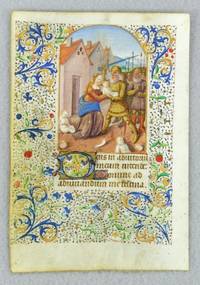
AN ILLUMINATED VELLUM MANUSCRIPT LEAF WITH A GRUESOME MINIATURE OF THE MASSACRE OF THE INNOCENTS, FROM A FINE BOOK OF HOURS IN L
TEXT FROM THE OPENING OF VESPERS
Paris ca. 1450. 159 x 108 mm. 6 1/4 x 4 1/4". Single column four lines of text on the verso 15 on the recto in a very pleasing gothic book hand. <br/> Attractively matted. Recto with a line filler in colors and gold verso with a one-line initial in burnished gold on a maroon and blue background with white tracery and a three-line "D" in blue and white enclosing a spray of violets in the same colors the capital on a burnished gold ground the same side WITH A FULL SWIRLING BORDER of acanthus leaves flowers and berries and many burnished gold ivy leaves ENCLOSING A BLOODY ILLUMINATED MINIATURE OF THE MASSACRE OF THE INNOCENTS measuring approximately 78 x 54 mm. Fore and lower margins on the side with the miniature a bit rubbed and with a faint patina reflecting frequent use also minor fading and loss of paint and gold in the same place otherwise in fine condition THE MINIATURE itself REMARKABLY WELL PRESERVED WITHOUT ANY EROSION OF PIGMENT.<br/> <br/> This leaf comes from a Book of Hours decorated by extremely skilled members of what must have been a first-class workshop. The Massacre of the Innocents cannot help but be a moving subject and the composition here as well as the painter's considerable ability add to the emotional impact in the present miniature. The center of the scene is dominated by the gold-armored gray-bearded soldier whose sword is raised over the head of a woman clinging to her son. The blood-spattered foreground is littered with the dismembered bodies of infants looking like so many broken dolls. On the left we see a row of modest cottages providing considerable depth as they recede toward distant hills. On the right stands a crowd of grim-faced soldiers all as elderly as their commander and seemingly following orders that are unwelcomed; it is perhaps the acute sadness in their faces that makes this scene especially memorable. The clear sky green fields and serene blue mountains in the distance contrast markedly with the horrific events unfolding. unknown
Bookseller reference : ST11774-85
|
|
|
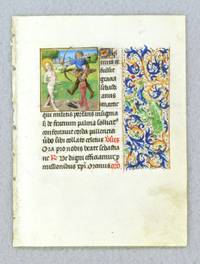
AN ILLUMINATED VELLUM MANUSCRIPT LEAF WITH A SMALL MINIATURE OF SAINT SEBASTIAN, FROM AN ENGAGING LITTLE BOOK OF HOURS IN LATIN
TEXT FROM THE SUFFRAGES OF THE SAINTS
Northern France probably Paris 1460s. 130 x 98 mm. 5 1/8 x 3 7/8". Single column 14 lines in a fine gothic book hand. <br/> Attractively matted. The text similarly decorated as in the previous entry but with panel borders on both sides inhabited by a friendly peacock one with a bright green tail the other with a brushed gold tail the recto also WITH A BLOODY MINIATURE measuring 35 x 33 mm. OF SAINT SEBASTIAN'S MARTYRDOM the half-naked saint tied to a tree bleeding from numerous arrow wounds his two tormentors a study in contrasts: one a large uncouth fellow with a plain bow the other a dandy in pink tights and a blue and gold doublet shooting a crossbow the scene set in a meadow with rolling green hills leading to a turreted town in the distance. â—†One tiny hole to the background landscape minor flaking of paint peacock on the recto a little rubbed otherwise a fine fresh leaf.<br/> <br/> Although the martyred Saint Sebastian is invariably pictured as shot full of arrows he did not die from these punctures but rather was actually nursed back to health by Saint Irene then returned to serve the emperor who had him clubbed to death. As Wieck says in "Time Sanctified" the story of these double miseries of our third century captain in Diocletian's army had already made Sebastian one of the two or three most popular of Christian martyrs. But in addition to the wide regard that had accrued from his martyrdom "the opportunity that Sebastian provided for portraying a beautiful nude youth ensured his popularity among artists and many of their clients . . . from the late Middle Ages through the Renaissance to the 19th century." One of the archers in the Sebastian miniature is usually depicted wearing an elaborately decorated doublet and in that tradition the artist here has done an impressive job of showing carefully defined gold embroidery on the garment of the figure in the foreground. unknown
Bookseller reference : ST12021-244
|
|
|
AN ILLUMINATED VELLUM MANUSCRIPT LEAF WITH TWO CHARMING MINIATURES OF FEMALE SAINTS, FROM A FINE BOOK OF HOURS IN LATIN
TEXT FROM THE SUFFRAGES
Bruges ca. 1465. 181 x 127 mm. 7 1/8 x 5". Single column 19 lines in a careful pleasing gothic book hand. <br/> In a very attractive new gilt wooden frame. Rubrics in pink or faded red one two-line initial in blue magenta and burnished gold two lines with undulating line fillers in blue and gold both sides of the leaf with a three-quarter panel border incorporating foliage blossoms and ivy leaves on hairline stems the vertical part of this frame with a bar border composed of colors and burnished gold terminating at top and bottom in colorful acanthus leaves and WITH TWO SMALL BUT VERY PLEASING MINIATURE PAINTINGS SAINT ELIZABETH ON THE RECTO AND SAINT GERTRUDE ON THE VERSO. â—†Tiny wormhole in fore edge where it has done negligible damage small portions of the blue paint in the Elizabeth miniature eroded gray paint slightly smeared as well but apparently at the time of painting otherwise in fine clean fresh condition.<br/> <br/> This leaf is characteristic work from the circle of Willem Vrelant the leading purveyor of books of private devotion in Bruges during the third quarter of the 15th century. His leading position among Flemish illuminators of the time is indicated by the considerable number of manuscripts illustrated in his manner by other miniaturists both in Bruges and in nearby cities in Flanders. The illuminator of our Book of Hours shows a number of distinctive stylistic traits. Among these are a preference for boldly patterned cloth backdrops tessellated flooring landscapes filled with stylized bushes and trees and persisting prominent architectural constructions that frame the subject frequently in a corner in these leaves it is a waist-high outdoor wall or an indoor feature resembling wainscoting. The inclination for strong geometrical patterning is manifested in the artist's angular treatment of human figures and their garments. Dressed in pink and blue Elizabeth is depicted with a sweet round face. She is saluted here as the woman worthy to be the mother of John the Baptist the forerunner of the Redeemer. Gertrude is dressed in monastic black although a pink undergarment is visible and her inky habit is trimmed in gold. This shimmering feature is a reminder that Gertrude 626-59 was the daughter of Pepin I of Landen Mayor of the Palace for the Frankish realm of Austrasia and the forebear of Charlemagne. Gertrude is a natural choice for illustration by an artist of Bruges since she was the patron of nearby Nivelles. The saint was routinely invoked for aid in coping with mice and is here shown surrounded by four animated rodents as black as her habit. No legend survives to explain why she had such power over the creatures who seem here to be more her pets one climbs her staff of office than her victims. unknown
Bookseller reference : ST11151b
|
|
|
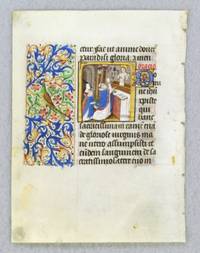
AN ILLUMINATED VELLUM MANUSCRIPT LEAF WITH A SMALL BUT POWERFUL MINIATURE OF SAINT GREGORY, FROM AN ENGAGING LITTLE BOOK OF HOUR
TEXT FROM THE SUFFRAGES OF THE SAINTS
Northern France probably Paris ca. 1460s. 130 x 98 mm. 5 1/8 x 3 7/8". Single column 14 lines in a fine gothic book hand. <br/> Attractively matted. The text similarly decorated as in the previous entry but with the panel border on the verso inhabited by a long-tailed pheasant the same side WITH A DRAMATIC MINIATURE measuring 35 x 33 mm. OF SAINT GREGORY CELEBRATING MASS the saint holding aloft the communion wafer WHILE THE FIGURE OF CHRIST RISES FROM THE ALTAR BLOOD FROM THE WOUND TO HIS HAND CASCADING INTO THE CHALICE on the altar surface the wall behind displaying the "Arma Christi" Gregory's doubting deacon kneeling behind him and beside the deacon a noblewoman recognizable as the owner of the Book of Hours. â—†A little faint soiling near edges otherwise in fresh bright and altogether pleasing condition.<br/> <br/> Representing the most heightened of religious moments in general as well as a key point in the life of Saint Gregory specifically this leaf features compelling actions being witnessed by the woman for whom this Book of Hours was made. According to the doctrine of Transubstantiation the Communion wafer becomes the body of Christ once the priest blesses it with the words "this is my body" and this dramatic transformation is revealed publicly at the moment when the wafer is raised; similarly when the wine is blessed by the priest it becomes the Christ's blood a transmutation that is obviously being symbolized by the spouting blood in the present scene. For Gregory ca. 540-604 this miniature represents the occasion for gratitude toward God. Faced with doubts expressed by his deacon about the validity of Transubstantiation Gregory had prayed for a sign that the doctrine was true whereupon the bread was transformed in the deacon's presence into Christ in the visible guise of the Man of Sorrows rising from the altar clad only in a loincloth and displaying the wounds left by the Crucifixion here the wound on just the right hand suffices. The miniature is full of absorbing details including the "Arms of Christ" symbols from the Passion displayed on the wall the gold hatching and black embroidery on the altar cloth the line of text and closure tabs on the Missal lying on the altar and the architectural elements of the chapel including a rooster standing on a pedestal one more item in the "Arma Christi". unknown
Bookseller reference : ST12021-233
|
|
|
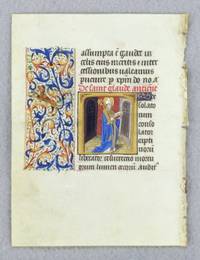
AN ILLUMINATED VELLUM MANUSCRIPT LEAF WITH A SMALL MINIATURE OF SAINT CLAUDE OF BESANCON, FROM AN ENGAGING LITTLE BOOK OF HOURS
TEXT FROM THE SUFFRAGES OF THE SAINTS
Northern France probably Paris ca. 1460s. 130 x 98 mm. 5 1/8 x 3 7/8". Single column 14 lines in a fine gothic book hand. <br/> Attractively matted. The text similarly decorated as in the previous entry but with the panel border on the verso inhabited by a leaping dog the same side WITH A GOLD-FRAMED MINIATURE measuring 35 x 33 mm. OF SAINT CLAUDE OF BESANÇON attired in his bishop's regalia standing in a hallway between two arch-topped doors reading a book. ◆A fine fresh leaf with only the vaguest sense of soiling.<br/> <br/> Born in 603 and living well into his 90s Saint Claude or Claudius became Archbishop of Besançon in 685 and after his death was so popular that his shrine became one of the major destinations for pilgrims in France the town where he was buried actually changing its name from Condate to Saint Claude. Lore surrounding this saint strains credulity and the historian Henry Wace has said that "on this saint the inventors of legends have compiled a vast farrago of improbabilities." Perhaps chief among the myths is the belief that his body remained in an incorruptible state at least until it was destroyed during the French Revolution. However well preserved his corpse remained his feet were exposed three times each day to be kissed by the many pilgrims who flocked to his shrine. In the Hours of Henry VIII in the Morgan Library there is a miniature showing Claude resuscitating a dead man. unknown
Bookseller reference : ST12021-239
|
|
|
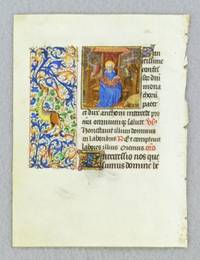
AN ILLUMINATED VELLUM MANUSCRIPT LEAF WITH A SMALL MINIATURE OF SAINT ANTHONY THE GREAT, FROM AN ENGAGING LITTLE BOOK OF HOURS I
TEXT FROM THE SUFFRAGES OF THE SAINTS
Northern France probably Paris ca. 1460s. 130 x 98 mm. 5 1/8 x 3 7/8". Single column 14 lines in a fine gothic book hand. <br/> Attractively matted. The text similarly decorated as in the previous entry but with the panel border on the verso inhabited by a long-necked hybrid beast the same side WITH A FINE SMALL MINIATURE measuring 35 x 33 mm. OF SAINT ANTHONY THE GREAT the Desert Father seated on a broad wooden bench beneath a red and gold canopy one hand upraised in blessing the other holding an open book the saint flanked on either side by a fierce demon one raising a stick with which to beat him and in the foreground a pig sniffing around the saint's feet. â—†Minor loss of paint in a small spot on the miniature affecting the head of one demon one initial faintly blurred otherwise fresh clean and altogether pleasing.<br/> <br/> This is a memorably animated miniature showing the father of Christian monasticism serenely ignoring the demons sent to taunt and tempt him. The patron saint of swineherds thus the pig as his attribute Saint Anthony withstood many years of demonic torments and offered advice and encouragement to others in their own trials. While the artist was restricted by an expected reverence toward the saint he felt no such constraint in depicting the devils and the one on the left--with a chest resembling the red scales of an alligator--is a particularly successful expression of artistic license exercised in the name of droll malevolence. unknown
Bookseller reference : ST12021-241
|
|
|
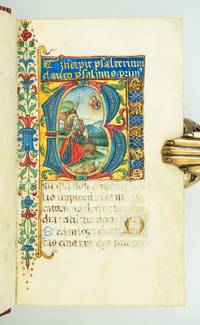
AN ILLUMINATED VELLUM PSALTER WITH TWO LARGE HISTORIATED INITIALS
TEXT IN LATIN
Italy Florence completed in 1536. 155 x 96 mm. 6 1/8 x 3 3/4". Single column 17 lines in a rounded gothic hand. 225 leaves first leaf and last three leaves blank. One signature bound upside-down the calendar bound at end but COMPLETE. With modern foliation in pencil i 225 leaves f. 222 omitted in numbering. <br/> Attractive 19th century red straight-grain morocco covers with lacy gilt border raised bands compartments with floral a scrolling tools with small stars and bezants green morocco label with gilt lettering gilt floral turn-ins all edges gilt and gauffered. In a fine modern pebble-grained red morocco folding box by A. Lobstein gilt lettering on spine lined with velvet. Rubrics in red numerous one-line initials and paragraph marks in red or blue many two-line gilt initials on ground of two colors red blue green or purple with small gold embellishments three-line "KL" initials for each calendar month in gilt TWO LARGE HISTORIATED INITIALS the first measuring approximately 11 lines 65 mm. and featuring King David in prayer the initial painted blue and embellished with green and pink acanthus on gold ground surrounded on two sides by bars of gilt lettering on blue and pink ground inner margin decorated with colorful floral motifs decorated with gilt bezants the second initial measuring six lines 35 mm. and featuring the Holy Trinity the initial painted pink with colorful acanthus on gilt ground and with a similar floral border in the outer margin and extending over the initial along the top. See: Alexander "The Painted Page" nos. 1 3 & 4; and Salmi "Italian Miniatures" frontispiece and pp. 52-53. Text rather faded in places though sense always recoverable isolated insignificant rubbing or chipping to the gilt a handful of trivial stains and instances of soiling or foxing but a nevertheless lovely manuscript--very clean and fresh with wide margins and the historiated initials especially well preserved. Just the slightest signs of use to the lustrous binding.<br/> <br/> This is a fine example of Florentine manuscript production from the early 16th century with a beautiful rounded gothic script sparkling initials and historiation that suggests a link to some of the most important miniaturists of the period. The decoration is composed of rich jewel tones and includes a half-page initial opening "Beatus vir" depicting King David in prayer and a smaller "D" opening Psalm 109 "Dixit Dominus Domino meo: a sede adextris meis" depicting the Holy Trinity. Each initial is embellished by a lovely partial border of floral motifs and many gilt bezants in a typical Florentine style. The large "Beatus vir" initial is particularly well done with excellent molding and shading and careful attention to even the smallest hair on David's beard. Into a relatively small space the artist manages to fit an entire outdoor scene complete with foreground middle ground and background including rolling hills a river and a distinctive rock formation that adds dimension scale and a sense of realism to the painting. Although whoever had the box made for this work attributed the manuscript to Giovanni Boccardi known as Boccardino il Vecchio 1460-1529 the figures and border decoration are stylistically closer to the work of two other contemporary workshops: that of Attavante degli Attavanti 1452-1525 and brothers Gherardo 1445-97 and Monte 1448-1532 di Giovanni del Fora. Of Attavante Salmi notes that he was "At one time the most celebrated miniaturist of the Renaissance" and Alexander says that he "was one of the most successful entrepreneurs in the Florentine book trade in obtaining commissions from patrons outside Florence." He counted European royalty among his patrons and executed celebrated manuscripts for Mattias Corvinus King of Hungary and Manuel I King of Portugal as well as high ranking members of the church including Pope Leo X. Among the many hands employed by Attavante were those of Gherardo and Monte di Giovanni del Fora which explains the closely related styles of the two workshops. Salmi notes that "As expert miniaturists Gherardo and Monte composed magnificent interiors evoking historical events and landscapes of great depth and drama abounding in descriptive details and precious minutiae worthy of the Books of Hours of Flemish and French Masters." In addition to stylistic similarities we have been able to find two other examples of miniatures with compositions that are very close to the "Beatus vir" initial in the present work both of which are attributed to Gherardo and Monte Giovanni del Fora or their workshop. These are: an "S" initial in a Choirbook at the Museo dell'Opera di S. Maria del Fiore we found a black & white reproduction only; and a full-page miniature in the Biblioteca Medicea Laurenziana MS Plut. 15.17. Like our opening initial these miniatures both depict King David kneeling in prayer dressed in similarly draped and shaped garments in the miniature with color reproductions available the garments are identically colored red and blue with an unusual lobed harp on the ground and a rocky outcropping in the background. Most notably in the latter miniature as well as our initial this rock formation includes a natural archway that has formed over a river. If we are to believe the final rubricated lines indicating that the manuscript was completed on 25 October 1536 then the historiated initials were probably painted by an artist who was at the very least quite familiar with the work of the aforementioned miniaturists if not directly employed by one of their workshops. The most likely workshop would be that of Monte Giovanni del Fora who died in 1532--four years before this work was supposedly completed. It is perhaps even conceivable that the production of the Psalter took long enough that the initials might have been executed during Monte's lifetime. It is unfortunate that three lines in the colophon have been erased as they may have provided additional information about the making of this manuscript. Whatever the case may be this is a lovely object with tasteful decoration that clearly echoes the work of some of Florence's finest workshops. Italian prayer books such as this are increasingly difficult to come by and the present item being complete and in excellent condition would be a fine addition to any private or institutional collection. unknown
Bookseller reference : ST20557
|
|
|
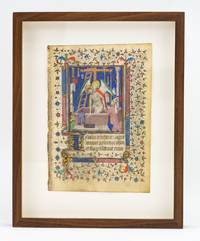
AN ILLUMINATED VELLUM MANUSCRIPT LEAF FROM A BOOK OF HOURS IN LATIN, WITH A MINIATURE OF THE MASS OF ST. GREGORY, DONE BY THE MA
TEXT OPENING THE PASSION ACCORDING TO ST. JOHN
Paris ca. 1415-20. Leaf: 160 x 110 mm. 6 1/4 x 3/8"; Frame: 232 x 185 mm. 9 1/8 x 7 1/4". Recto with three lines single column in a gothic book hand verso not inspected due to frame. <br/> Mounted in a wooden frame. Recto with a three-line initial in blue on gold ground embellished with ivy leaves A HALF-PAGE MINIATURE DEPICTING THE MASS OF ST. GREGORY the recently crucified Christ depicted emerging from a tomb supported by an angel and surrounded by the Arma Christi St. Gregory kneeling at the corner of the image the text and miniature framed by thick bar borders of pink blue and gold on three sides all SURROUNDED BY A FULL BORDER of hairline vines gilt ivy leaves and bezants and a few colorful flowers and acanthus. â—†A little faint smudging in top and bottom borders very small scarcely noticeable area of blue background retouched not affecting the figures but A BEAUTIFUL LEAF the colors bright and the detail in the miniature very well preserved.<br/> <br/> Featuring carefully realized detail intriguing iconography and artistry that shows a very high degree of skill this is an important and early example of the work of the Master of the Harvard Hannibal. The subject of the present work is a well-known story about the sixth century Pope Gregory ca. 540-604 commonly known as St. Gregory the Great. According to legend Gregory was saying Mass when one of his deacons expressed a doubt in the doctrine of Transubstantiation whereby the communion bread actually becomes the body of Christ. Gregory prayed to God for a verifying sign whereupon Christ appeared in the guise of the Man of Sorrows clad in a loincloth and displaying the bloody wounds he incurred during the Crucifixion. Most Medieval miniatures depict Gregory kneeling before an altar as he says Mass accompanied by one or more deacons or assistants who bear witness to the miraculous event. In a notable departure from this norm the present miniature depicts the saint alone at the edge of the picture plane; in place of the chalice host and altar that would normally occupy the center of the scene is a considerable open tomb from which a larger-than-life-size Christ emerges. With blood still rushing from his wounds he places one hand on the edge of the tomb to steady himself while an angel supports him from behind. Christ's expression conveys both physical and mental pain as he struggles to support his own bodyweight; the angel who assists him spreads his wings protectively around the body of Christ while looking down at Gregory with a sorrowful expression knitted into his brow. The fine detail work seen in the figures' faces the angel's wings and the careful delineation of each slender finger is also carried over into more than a dozen objects crammed into the spaces in and around the tomb the rope is especially remarkable in the representation of its detail. Known as the "Arma Christi" or "Instruments of the Passion" these objects are meant to symbolize Christ's suffering. Seen here are: the cross nails and hammer that were used to crucify Christ the ladder used in the Deposition the disembodied hand symbolizing the one which slapped Christ's face the dice used by soldiers to see who would claim his seamless robe a lantern used by the soldiers who arrested Christ the 30 pieces of silver from Judas' betrayal a purple robe used in the mockery of Christ and other items that appear as part of the Passion narrative. It is also interesting to note that although a St. Gregory miniature usually appears at the beginning of the Hours of the Cross the Penitential Psalms or before the Seven Prayers of St. Gregory here rather unusually it opens a reading from John chapter 19 beginning "In illo tempore adprehendit Pilatus Iesum et flagellavit" describing the events of the Passion. This miniature can be attributed to an artist known as the Master of the Harvard Hannibal so-named for a splendid miniature painting of the "Coronation of Hannibal" prefacing a Livy in the Harvard College Library. Active from about 1415-30 in Paris and later possibly Rouen it is believed that our illuminator was a pupil of the Boucicaut Master with whom he is thought to have collaborated on several manuscripts both secular and religious. The present miniature would probably have been executed early in his career and while it certainly shows the influence of his teacher it also reveals certain stylistic tendencies that would become staples of the Master of the Harvard Hannibal's more mature work such as his preference for rich colors heavy molding of the faces and interest in decorative details. With its clever composition meticulous detail work and emotive figures that engage the viewer the present miniature is not only a beautiful work of art it also documents the precocious talent of an emerging master early in his professional career. unknown
Bookseller reference : ST17763
|
|
|
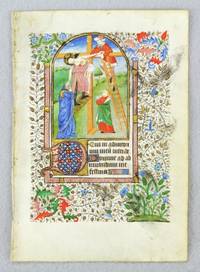
AN ILLUMINATED MANUSCRIPT LEAF ON VELLUM WITH AN EXTREMELY EMOTIONAL MINIATURE OF THE DEPOSITION, FROM A BOOK OF HOURS IN LATIN
USE OF SAINTES. TEXT FROM THE HOURS OF THE CROSS
France probably Paris ca. 1420. 210 x 146 mm. 8 1/4 x 5 3/4". Single column recto with five lines of text verso with 16 lines all in a very pleasing very regular gothic book hand. <br/> Attractively matted. Rubrics in red verso with a one-line and two two-line initials as well as a line filler in colors and burnished gold recto with a one-line initial and a line filler in the same style and with a quite large five-line "D" in pink and white with enclosed floral diapering all on a burnished gold ground the same side WITH A LOVELY FULL BORDER of swirling hairline stems bearing numerous leaves and berries of burnished gold and with sprays of acanthus leaves and flowers in multiple colors spilling from the corners this ENCLOSING A POIGNANT ARCH-TOPPED MINIATURE OF THE REMOVAL OF CHRIST FROM THE CROSS measuring approximately 85 x 60 mm. the miniature within a thin gold frame and enclosed in turn on three sides by bars in colors and gold the scene showing two men on ladders unfastening Christ's lifeless body from the cross while Joseph of Arimathea waits below clutching cloth to be used for a burial shroud as the Madonna at the lower left of the picture reaches up to clasp her son's bloody arm. With a small cross stitched in white thread in each upper corner. â—†A little soiling right along hinge edge a few smudges in the border a couple of tiny flakes of paint missing from the cross and the sky otherwise fine the vellum clean and fresh the colors rich and the gold lustrous.<br/> <br/> This is an especially sorrowful scene depicted with power grace and sensitivity by an artist demonstrating very considerable skill in composition and execution. The scene is well designed with the cross providing a device for focus at the center of the miniature. Nicodemus identified by his expensive attire is atop a ladder behind the cross lowering Christ's limp body onto the shoulder of another man probably a servant whose ladder is set against the front. Despite the fact that the corpse is more bones than flesh the artist has made it seem a heavy burden draped over the shoulder of the man as he walks backward down his ladder. Fully stretched out Christ's left arm is held for balance by Nicodemus at the top right while the other arm hangs down toward the Virgin. While we can only see her back her image evokes great pathos as she reaches up with both hands to grasp the mangled arm of her son his blood running from his hand onto hers. Joseph of Arimathea whose position anchors the right side of the picture looks on with concern tightly holding linen to shroud the body. St. John and Mary Magdalen conventional participants in the Deposition are not present in this miniature. While it is possible and even likely that the same artist produced this scene and the miniature of Christ Carrying the Cross this one is better as the faces are more deftly painted and the folds in the various garments are more clearly defined. unknown
Bookseller reference : ST12005f
|
|
|
AN ILLUMINATED VELLUM MANUSCRIPT LEAF FROM A DUTCH BOOK OF HOURS, WITH A VERY FINE MINIATURE OF THE NATIVITY BY THE MASTERS OF T
WITHOUT TEXT BUT PROBABLY OPENING PRIME
Delft ca. 1470. Leaf: 172 x 115 mm. 6 3/4 x 4 1/2". Frame: 242 x 190 mm. 9 1/2 x 7 1/2". <br/> In an attractive wooden frame. A FINELY PAINTED MINIATURE OF THE NATIVITY within an arch-topped compartment the parents of the Christ Child kneeling before him as he lies on the ground outside the stable Joseph uncharacteristically supporting himself with a cane in his left hand and holding a long burning candle in his right two diminutive angels in attendance the head of an ass sticking out of the stable window in the background to the left AND IN THE RIGHT BACKGROUND A CHARMING DEPICTION OF THE ANNUNCIATION TO THE SHEPHERDS ALL OF THIS BENEATH A VERY DETAILED ARCHITECTURAL CANOPY suspended in the sky AND THE WHOLE WITHIN A FULL BORDER of acanthus leaves and other foliage and flowers in reds blues greens yellows and brushed gold along with very many small burnished gold ivy leaves and buds on hairline stems a small stag in the bottom border and a large delicately shaded angel who mirrors the Virgin's pose in the left border verso blank. â—†A hint of soiling to edges of vellum but IN VERY FINE CONDITION without any paint erosion with the colors rich and true and with the burnished gold still shimmering.<br/> <br/> Notable for its attractive color scheme fine craftsmanship and unusual composition this vibrant leaf was produced by a talented artist belonging to the stylistic group known as the Masters of the Delft Half-Length Figures. The lack of text and blank back of this leaf clearly suggest that it was produced as a singleton intended for insertion in a Book of Hours and its subject matter indicates that it would have faced the opening for the third hour of the day Prime. The present depiction of the Nativity is out of the ordinary in that it is combined with another scene the Annunciation to the Shepherds a subject that usually begins Terce in the Hours of the Virgin. It is a testament to the artist's ingenuity and compositional skills that he has managed to incorporate these two scenes so seamlessly; in fact rather than pulling focus from the main subject celebrating the birth of Christ this secondary scene adds additional interest to the picture and amplifies the storyline. Though the Annunciation to the Shepherds takes place at a distance from the Nativity we immediately grasp their connection and can see how arrival of humanity's savior was felt far beyond the manger. It is also interesting to note how much the artist has emphasized the figure of Joseph. Not only does he take up as much space as the Virgin but the candle and cane he holds frame the Christ child and communicate a strong suggestion of a protective parent the Virgin is doing her part by praying hard but she is more passive. In addition to its engaging subject matter there is a high level of artistic achievement here including delicately molded figures impressively detailed architectural elements and a lovely color palette. The elegant hand seen in this miniature manifests a quiet sophistication that distinguishes this artist as a particularly talented member of his circle. Active from about 1450-80 the Masters of the Delft Half-Length Figures were named by James Marrow after the angels and other figures whose upper bodies are typically found emerging from a cloud within the borders. Although the present leaf uncharacteristically contains a full-length angel in the border it shares other stylistic similarities such as the elaborate architectural canopy hovering over the main composition; and it particularly resembles the work of the artist of Keble College MS 77 an illuminator described in "The Golden Age of Dutch Manuscript Illumination" as "one of the more articulate of the group" whose "figures are more fully modelled and his palette . . . deeper and brighter" than that of his contemporaries. Because of the complexity of the subject matter and the high level of artistic accomplishment seen here this leaf was probably part of an elaborate Book of Hours produced in response to an important commission. unknown
Bookseller reference : ST17765
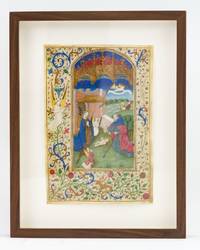
|
|
|
ANACREON
Poésies de Sappho suivies des odes d'Anacréon et des anacréontiques
Paris Emile Chamontin Librairie flammarion 1941 In-8 Broché, couverture illustrée rempliée
Bookseller reference : 008926
|
|
|
André Thérive
Blason de la Pologne - exemplaire numéroté sur vélin lafuma
Émile-Paul Frères 2026 93 pages in8. 2026. Broché couverture rempliée. 93 pages. Blason de la Pologne est un ouvrage d'André Thérive publié en 1929 par Émile-Paul Frères dans la collection Ceinture du Monde. Le livre illustré par Kisling traite de la Pologne
Bookseller reference : 13105
|
|
|
André CHARVET
De LYON à SATOLAS, le PAYS du VELIN, des ORIGINES à nos JOURS
Un ouvrage de 160 pages, format 145 x 210 mm, illustré, broché, publié en 1984, AREM Communication, bon état, rare
Bookseller reference : LFA-126743814
|
|
|
André BRETON - Lise DEHARME - Julien GRACQ - Jean TARDIEU
Farouche à quatre feuilles
Paris Grasset 1954 In-8 Broché, couverture rempliée Ed. originale
Bookseller reference : 001208
|
|
|
André BRETON, Lise DEHARME, Julien GRACQ, Jean TARDIEU
Farouche à quatre feuilles
Paris Grasset 1954 In-8 Broché Ed. originale
Bookseller reference : 004698
|
|
|
ANDRO Jean-Claude
La maison profonde (roman).
Paris, Flammarion, 1976 15 x 21, 232 pp., broché, non coupé, très bon état
Bookseller reference : 8936
|
|
|
ANDRO Jean-Claude
Toutes les salles de la fôret (roman).
Paris, Flammarion, 1979 15 x 21, 214 pp., broché, non coupé, très bon état
Bookseller reference : 8935
|
|
|
ANOUILH Jean
Cécile ou l'école des pères
Paris La Table Ronde 1954 In-12 Broché
Bookseller reference : 012934
|
|
|
Anonyme, dessinateur
Elle est belle, dit-il, mais le moindre grain de mil ferait bien mieux mon affaire - Lithographie originale en couleur sur Velin blanc.
Lithographie - Planche HT parue dans La Caricature politique, morale, littéraire et scénique, volume 4, 25 octobre 1832 (Planche n°212)Dimensions Hauteur: 35.6cm x Largeur: 27cm - Image = Hauteur: 16cm x Largeur: 17.5cm - Titre en bas au centre : « Elle est belle, dit-il, // Mais le moindre grain de mil // Ferait bien mieux mon affaire. » ; indications, en ht au centre : « La Caricature (Journal) // N°103 », en ht à dte : « Pl. 212. » Inscription - Dans la lettre : « [Lith.] de Becquet, r. Childebert, 9. » [imprimeur], « On s’abonne chez Aubert, passage Véro-Dodat. » [éditeur] ; attribution : ?la table des matières du 4e vol. de La Caricature attribue cette pl. à « Fran…. ». Un coq multicolore prononce les paroles contenues dans le titre en voyant une croix de la légion d’honneur posée sur un petit talus. Usant d’un détournement de la fable de La Fontaine Le coq et la perle (1668), la pl. dénonce la forte tendance qu’a le gouvernement à distribuer les décorations tandis que c’est d’autre chose que la France a besoin en réalité.
Bookseller reference : 25277
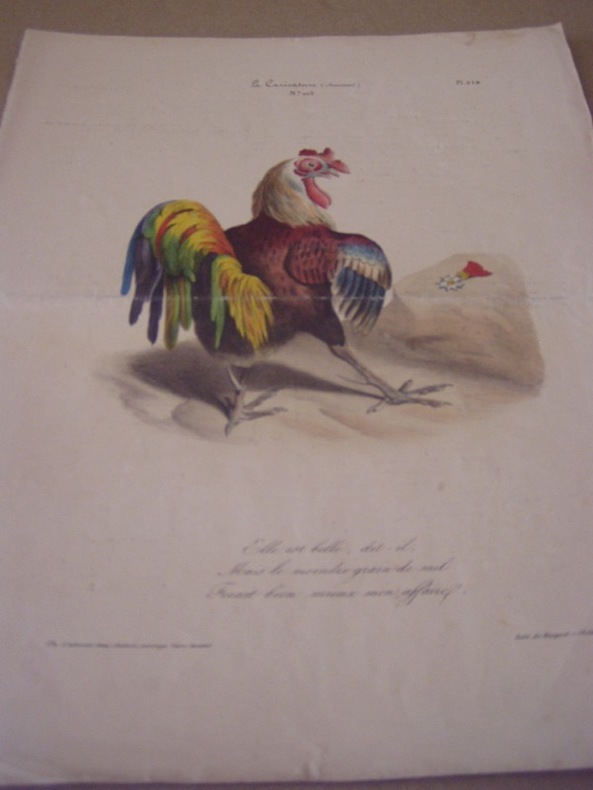
|
|
|
Anonyme, dessinateur
Je n’ai pu atraper que ça pour ma compagnie…… ma foi tant pis ! - Lithographie originale en couleur sur Velin blanc.
Lithographie : Planche HT parue dans La Caricature morale, religieuse, littéraire et scénique, volume 4, 6 septembre 1832 (Planche n°196) - Œuvre : Hauteur: 35.6cmx Largeur: 27cm - Image : Hauteur: 17.9cmx Largeur: 16.5cm - Titre en bas au centre : « Je n’ai pu atraper [attraper] que ça pour ma compagnie…… // ma foi tant pis ! » ; indications, en ht au centre : « La Caricature (Journal) // N°96. », en ht à dte : « Pl. 196 » - Dans la lettre : « Lith. de Becquet rue Childebert N°9. » [imprimeur], « On s’abonne chez Aubert Galerie Vero Dodat » [éditeur] ; attribution : ?la table des matières du 4e vol. de La Caricature précise le titre : « Le tambour apportant la provision de croix » et attribue la pl. à « V. ». Un tambour de grenadier se tient debout, de face au premier plan. Il a les bras chargés de croix de la légion d’honneur. A l’arrière-plan, deux autres militaires plient sous le poids d’énormes sacs contenant des décorations. La pl. dénonce, par le biais de l’ironie, les largesses du gouvernement dans la distribution de décorations, en vue de flatter la vanité des hommes dans le but de les rallier à sa cause.
Bookseller reference : 25276
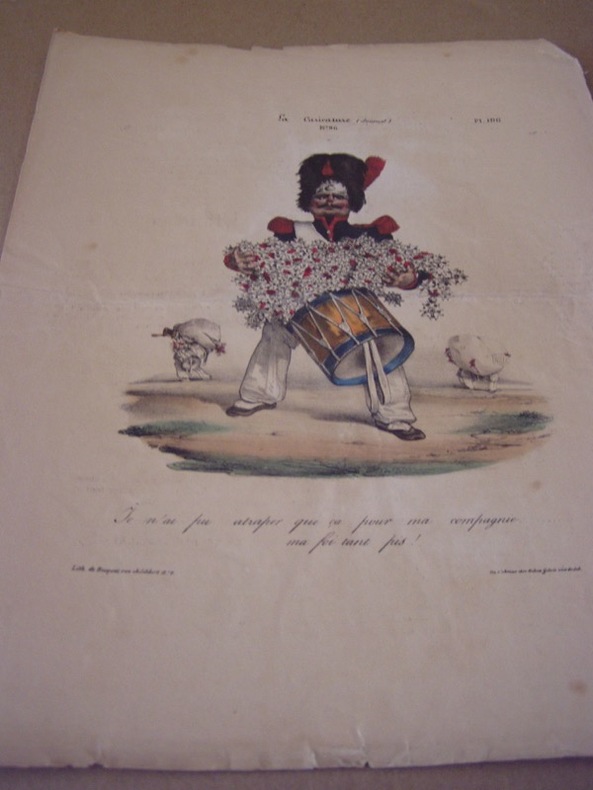
|
|
|
Anonyme
Melle Monarchie (Félicité Désirée) tient les hommes en sevrage, les tond, les coupe, fait leur éducation et leur bonheur, le tout à bon marché - Lithographie originale en couleur sur Velin blanc.
Planche HT parue dans La Caricature morale, religieuse, littéraire et scénique, volume 4, 26 juillet 1832 (Planche n°182) - Dimensions - Œuvre: Hauteur: 27cmx Largeur: 35.6cm - Image : Hauteur: 17.5cmx Largeur: 19.9cm- Titre en bas au centre : « MELLE MONARCHIE (Félicité Désirée) // Tient les hommes en sevrage, les tond, les coupe, fait leur éducation et leur bonheur, le tout à bon marché. » ; indications, en ht au centre : « La Caricature (Journal) // N°90. », en ht à dte : « Pl. 182. »- Dans la lettre : « Lith. de Becquet, rue Childebert N°9. » [imprimeur], « On s’abonne chez Aubert, galerie véro dodat. » [éditeur]
Bookseller reference : 25243
|
|
|
ANSEEUW Alin & MERILLON Georges
Deux, quatre: l'autre trace je lis le délire écrit
Beuvry Bethune Collection Ecbolade n°10, Alin Anseeuw 1976 In-4 En feuilles, couverture
Bookseller reference : 009448
|
|
|
Antiphonal Music Leaf on Vellum
A Manuscript Antiphonal Leaf Spain 16th Century.
A single leaf on vellum black square notation with custodes five staves of five red lines on both sides. Size is 19cm x 26.5cm. Text is in Latin from Mark:14. It begins on the recto: "manum in parapside: hic me tradet filius quidem hominis vadit" and ends on the verso: "Respondens autem iudas qui". One small red initial on the verso. Two small tape marks from matting in the upper margin on the recto; clean and in excellent condition. Part of the Institutional Narrative of the Roman Catholic Mass. A handsome antiphonal leaf. <br/><br/> hardcover
Bookseller reference : 56242
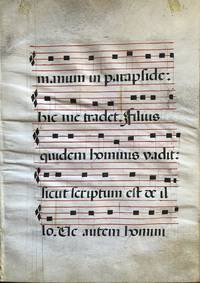
|
|
|
APOLLINAIRE, Guillaume (Guillaume Albert Vladimir Alexandre Apollinaire de Kostrowitzky) - RAMONDOT, Jacques.
L'Hérésiarque et Cie. Eaux-Fortes originales de Jacques Ramondot.
Les Franc-Bibliophiles, 1959, 1 volume in-folio de 320x255 mm environ, 2ff.blancs, 200 pages, en feuillets sous chemise illustrée et emboîtage de l'éditeur, feuillets non rognés. Exemplaire N° 151, un des 160 exemplaires sur Vélin à la cuve de Rives avec une suite complète en noir avec remarques sur Japon vergé des 46 eaux-fortes originales de Jacques Ramondot (y compris la couverture illustrée), accompagnée d'un menu illustré, et de 4 planches non annoncées (2 épreuves de chacune des deux illustrations qui ornent les plats de l'emboîtage). Frottements sur les coins et l'ouverture de l'étui, dos de la chemise-étui légèrement insolé avec début de fente sur les mors, intérieur bon état.
Bookseller reference : 109822

|
|
|
APOLLINAIRE, Guillaume
Les exploits d'un jeune Don Juan
Londres 1949 In12 Broché
Bookseller reference : 002089
|
|
|
APOLLINAIRE Guillaume
L’Esprit nouveau et les poètes.
in 12 broché,faux-titre,titre,Imprimerie J. Haumont 1946.édition numérotée sur vélin de Rives.Très bon état
Bookseller reference : 1112
|
|
|
Appianus d'Alexandrie :
Appiani Alexandrini Hispanica et Annabalica. Latinem nunc primum edita, ex Francisci Beraldi [François Bérauld, traducteur] linguae Graecae professoris doctissimi interpretatione.
[Genève], Henri Estienne, Huldrich Fugger (Huldrici Fuggeri), 1560 ; in-8 ; plein vélin ivoire ; 100 pp. (A-F 8, G 2).
Bookseller reference : 14605

|
|
|
ARAGON Louis
L'Enseigne de Gersaint
Paris - Neuchâtel Ides et Calendes 1946 In-8 Broché, couverture illustrée
Bookseller reference : 009337
|
|
|
ARAGON (Louis)
Le Paysan de Paris
Paris Gallimard NRF 1926 In-12 Broché
Bookseller reference : 012476
|
|
|
ARAGON Louis
Les Beaux quartiers **
Paris Bruxelles Denoël Les Éditions de l'Avenue 1945 Broché
Bookseller reference : 011057
|
|
|
Aretino (Pietro) :
1- La prima [secunda] parte de Ragionamenti di M. Pietro Aretino, cognominato il flagello de prencipi, il veritiero, el divino, divisa in tre giornate, la contenenza de le quali si porra ne la facciata seguente. 2- Idem. Doppo le quali habbiamo aggiunto il piacevol ragionamenti del Zoppino, composto da questo medisimo autore per suo piacere. "Veritas odium parit" suivi de "Commento di ser agresto da ficarvolo sopra la prima ficata del padre Siceo. Con la diseria de Nasi".
Bengodi (fictive), s.n., 1584 (21 octobre) ; 3 tomes en un petit volume in-8 (157 x 100 mm) ; plein vélin ivoire à recouvrements de l'époque ; (12), 228 pp. (A-P 8) ; (8), le premier feuillet blanc, 401 pp., (1 bl.), (2) ff. blancs (A-Z 8, Aa-Cc 8) ; 142 pp. (Dd-Mm 8), (1) f. blanc et figure de la figue à fourrure p.107 de la 3e partie.
Bookseller reference : 14460
|
|
|
Aristoteles :
Artis Rhetoricae libri III. Rhetorices ad Alexandrum lib. I. De arte Poetica liber I. Addita in fine Varia locorum lectio, partim e probatioribus editionibus ; partim e Petri Victorii commentariis et aliorum doctorum vivorum observationibus...
Francfort, Héritiers de André Wechel, 1584 ; in-4 ; plein vélin ivoire de l'époque, titre manuscrit au dos ; 341 pp., (1) p. corrigenda, (1) f. blanc. Texte grec jusqu'à la page 258 puis Annotations en latin sur deux colonnes et Index.
Bookseller reference : 14506
|
|

 Receive by email
 Download as PDF document
 RSS feed
 Permanent link


