|
|
|
GIBBAL Jean-Marie
Guérisseurs et magiciens du Sahel
- A.M. Métaillé, Paris 1984, 12x21,5cm, broché. - Edition originale pour laquelle il n'a pas été tiré de grands papiers. Envoi autographe signé de Jean-Marie Gibbal à ses amis Françoise et Pierre Dumayet. Agréable exemplaire. [ENGLISH DESCRIPTION ON DEMAND]

|
|
|
Gibran Khalil
La Voix De L'eternelle Sagesse
Dangles / Horizons spirituels 1978 104 pages in-8. 1978. broché. 104 pages.
Referenz des Buchhändlers : 3448

|
|
|
Gilbert-Joseph-François CHABROL - Edme-François JOMARD - Claude-Alexandre MOISY
DESCRIPTION DE L'EGYPTE. Thèbes. Karnak. Détails d'architecture en coupe du sanctuaire et bas-reliefs du petit temple du Sud. (ANTIQUITES, volume III, planche 62)
Imprimerie Impériale | Paris 1809-1829 | 71 x 54 cm | une feuille
Referenz des Buchhändlers : 23393
|
|
|
Gilbert-Joseph-François CHABROL - Edme-François JOMARD - Nicolas-Auguste LEISNIER (sculpsit)
DESCRIPTION DE L'EGYPTE. Thèbes. Karnak. Élévation de la porte extérieure et bas-reliefs du petit temple sud. (ANTIQUITES, volume III, planche 60)
Imprimerie Impériale | Paris 1809-1829 | 71 x 54 cm | une feuille
Referenz des Buchhändlers : 23366
|
|
|
Gilbert-Joseph-Gaspard CHABROL - Edme-François JOMARD - Claude-Alexandre MOISY
DESCRIPTION DE L'EGYPTE. Antinoë. Plan, élévation coupes et détails de l'arc de triomphe. (ANTIQUITES, volume IV, planche 58)
Imprimerie Impériale | Paris 1809-1829 | 70 x 51.50 cm | une feuille
Referenz des Buchhändlers : 23460
|
|
|
Gilbert-Joseph-Gaspard CHABROL - Edme-François JOMARD - Claude-Alexandre MOISY
DESCRIPTION DE L'EGYPTE. Antinoë. Plan, élévation, coupes et détails du portique du théâtre. (ANTIQUITES, volume IV, planche 56)
Imprimerie Impériale | Paris 1809-1829 | 70 x 51.50 cm | une feuille
Referenz des Buchhändlers : 23466
|
|
|
Gilbert-Joseph-Gaspard CHABROL - Edme-François JOMARD - Louis SELLIER FILS (sculpsit)
DESCRIPTION DE L'EGYPTE. Thèbes. Karnak. Plans, élévation, coupes et détails du petit Temple du sud. (ANTIQUITES, volume III, planche 58)
Imprimerie Impériale | Paris 1809-1829 | 71 x 54 cm | une feuille
Referenz des Buchhändlers : 23377
|
|
|
Gilbert-Joseph-Gaspard CHABROL - Edme-François JOMARD - Jean Joseph François TASSAERT
DESCRIPTION DE L'EGYPTE. Thèbes. Karnak. Vases dessinés dans plusieurs monuments. (ANTIQUITES, volume III, planche 66)
Imprimerie Impériale | Paris 1809-1829 | 71 x 54 cm | une feuille
Referenz des Buchhändlers : 23412
|
|
|
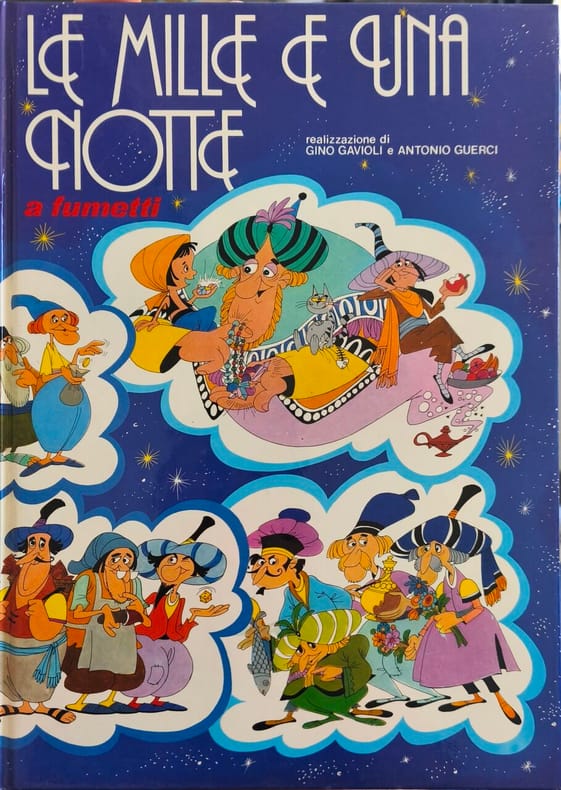
Gino Gavioli e Antonio Guerci
Le mille e una notte a fumetti
Libreria della famiglia 1979 95 pages IN4. 1979. Reliure editeur cartonnée. 95 pages. Le livre "Le mille e una notte" est une adaptation en bande dessinée des célèbres contes arabes réalisée par les auteurs italiens Gino Gavioli et Antonio Guerci. Publié en 1979 par Libreria della famiglia il s'agit d'un volume illustré de 95 pages présentant ces histoires classiques sous forme de comics
Referenz des Buchhändlers : 11655
|
|
|
GIRARD & BERTHAULT (sculpsit) & BOUTELOU (sculpsit)
DESCRIPTION DE L'EGYPTE. Ile d'Eléphantine. Plan, élévation, coupe et détails d'un nilomètre. (ANTIQUITES, volume I, planche 33)
- Imprimerie Impériale, Paris 1809-1829, 71x54cm, une feuille. - Original, unshaved, full-page etching from the "Imperial edition" of the Description de l'Égypte, or 'Recueil des observations et recherches faites en Égypte pendant l'expédition française, publié par les ordres de Sa Majesté l'Empereur Napoléon le Grand [A Collection of the observations and research carried out in Egypt during the French expedition, published on the orders of his Majesty the Emperor Napoleon the Great]'. Produced between February 1802 and 1830 on the orders of Naopleon Bonaparte and published between 1809 and 1828, 1,000 copies were printed and distributed to institutions, on vergé paper with an 'Égypte ancienne et moderne' watermark, visible when held up to the light. Light marginal spotting not touching image, otherwise in very fresh, fine condition. An engraving from the Description de l'Egypte, one of the masterpieces of French printing and the birth of a new field: Egyptology. A gigantic survey of Egypt at the time of Bonaparte's conquests in 1798 and 1799, the work is divided into 13 volumes of engravings making up 892 plates, of which 72 colored, as well as presenting the splendors of the Egypt of the Pharaohs in 9 volumes. The other volumes discuss natural history and present a fascinating portrait of Coptic and Islamic Egypt as it was seen by Bonaparte's Eastern Armies. The 'Egyptian campaign', militarily a disaster, demonstrates, through the engravings of the Description d'Egypte, the scientific success it nonetheless became thanks to the 167 expert members of the Commission of the Sciences and Arts of the Institut d'Egypte [Egyptian Institute] who followed Napoleon's army. The Institut gathered together in Egypt the mathematician Monge, the chemist Berthollet, the naturalist Geoffroy Saint-Hilaire as well as numerous artists, engineers, architects and doctors. They were tasked with re-discovering modern and ancient Egypt and displaying its natural treasures as well as the know-how of its inhabitants. This edition, the so-called "Imperial" edition of the plates for the Description de l'Egypte was printed in four large formats, two of which were specially created for it and christened "Moyen-Egypte" and "Grand-Egypte". A special press was built to print it, the process extending over 20 years, from 1809 to 1829. The "Imperial" edition proved so popular that a second edition, this time in black and white and without the "Egypte ancienne et moderne" watermark - known as the "Royal Edition" - was published during the Restoration by the printing house of C.-L.-F. Panckoucke (Paris). The engravings of the Description d'Egypte owe a great deal to Baron Dominique-Vivant Denon, illustrator, diplomat, collector and later Director of the Musée Napoléon (the Louvre). His exploration of the South of Egypt gave Bonaparte the idea of sending the experts of the Institut there, thus creating a faithful and complete portrait of the area. This was the research gathered together from 1802 in the mammoth Description de L'Egypte. Denon embarked on this story of archeological exploration at the age of 51, reaching first Alexandria and then Cairo before exploring Upper Egypt. Along with the members of the Institut d'Egypte, the Natural History Museum's painter H.J. Redouté (brother of Pierre-Joseph Redouté, author of Roses), the mineralogist Dolomiue, and the draughtsman Joly, Denon then explored the Nile Delta and Lower Egypt. When, however, he joined the 21st Light Infantry Regiment as it marched across Upper Egypt in pursuit of the retreating Mameluks in November 1798, he found himself the only civilian. In the very midst of the battle itself, he reeled off sketches of the works of art that peppered his path right up to the threshold of the Sudan. He said that he had crossed "a country that is, apart from its name, entirely unknown to Europeans, and therefore everything was worth describing" (Voyages dans la Basse et la Haute Egypte pendant le

|
|
|
GIRARD & FEVRE (delineavit) & LE PERE Gratien & DE ROXIERE (delineavit) & SEMEN (sculpsit)
DESCRIPTION DE L'EGYPTE. Isthme de Soueys. Bubaste. Tanis. Thmuis. Fragments persépolitains, Mouqfâr, Groupe d'Aboukeycheyd, Antiquités de Bubaste, Antiquités de Tanis, Monolithe de Thmuis. (ANTIQUITES, volume V, planche 29)
- Imprimerie Impériale, Paris 1809-1829, 53,5x71cm, une feuille. - Original, unshaved, full-page etching from the "Imperial edition" of the Description de l'Égypte, or 'Recueil des observations et recherches faites en Égypte pendant l'expédition française, publié par les ordres de Sa Majesté l'Empereur Napoléon le Grand [A Collection of the observations and research carried out in Egypt during the French expedition, published on the orders of his Majesty the Emperor Napoleon the Great]'. Produced between February 1802 and 1830 on the orders of Naopleon Bonaparte and published between 1809 and 1828, 1,000 copies were printed and distributed to institutions, on vergé paper with an 'Égypte ancienne et moderne' watermark, visible when held up to the light. Light marginal spotting not touching image, otherwise in very fresh, fine condition. An engraving from the Description de l'Egypte, one of the masterpieces of French printing and the birth of a new field: Egyptology. A gigantic survey of Egypt at the time of Bonaparte's conquests in 1798 and 1799, the work is divided into 13 volumes of engravings making up 892 plates, of which 72 colored, as well as presenting the splendors of the Egypt of the Pharaohs in 9 volumes. The other volumes discuss natural history and present a fascinating portrait of Coptic and Islamic Egypt as it was seen by Bonaparte's Eastern Armies. The 'Egyptian campaign', militarily a disaster, demonstrates, through the engravings of the Description d'Egypte, the scientific success it nonetheless became thanks to the 167 expert members of the Commission of the Sciences and Arts of the Institut d'Egypte [Egyptian Institute] who followed Napoleon's army. The Institut gathered together in Egypt the mathematician Monge, the chemist Berthollet, the naturalist Geoffroy Saint-Hilaire as well as numerous artists, engineers, architects and doctors. They were tasked with re-discovering modern and ancient Egypt and displaying its natural treasures as well as the know-how of its inhabitants. This edition, the so-called "Imperial" edition of the plates for the Description de l'Egypte was printed in four large formats, two of which were specially created for it and christened "Moyen-Egypte" and "Grand-Egypte". A special press was built to print it, the process extending over 20 years, from 1809 to 1829. The "Imperial" edition proved so popular that a second edition, this time in black and white and without the "Egypte ancienne et moderne" watermark - known as the "Royal Edition" - was published during the Restoration by the printing house of C.-L.-F. Panckoucke (Paris). The engravings of the Description d'Egypte owe a great deal to Baron Dominique-Vivant Denon, illustrator, diplomat, collector and later Director of the Musée Napoléon (the Louvre). His exploration of the South of Egypt gave Bonaparte the idea of sending the experts of the Institut there, thus creating a faithful and complete portrait of the area. This was the research gathered together from 1802 in the mammoth Description de L'Egypte. Denon embarked on this story of archeological exploration at the age of 51, reaching first Alexandria and then Cairo before exploring Upper Egypt. Along with the members of the Institut d'Egypte, the Natural History Museum's painter H.J. Redouté (brother of Pierre-Joseph Redouté, author of Roses), the mineralogist Dolomiue, and the draughtsman Joly, Denon then explored the Nile Delta and Lower Egypt. When, however, he joined the 21st Light Infantry Regiment as it marched across Upper Egypt in pursuit of the retreating Mameluks in November 1798, he found himself the only civilian. In the very midst of the battle itself, he reeled off sketches of the works of art that peppered his path right up to the threshold of the Sudan. He said that he had crossed "a country that is, apart from its name, entirely unknown to Europeans, and therefore everything was worth describing" (Voyages dans la Basse et la Haute Egypte pendant

|
|
|
GIRARD - BERTHAULT (sculpsit) - BOUTELOU (sculpsit)
DESCRIPTION DE L'EGYPTE. Ile d'Eléphantine. Plan, élévation, coupe et détails d'un nilomètre. (ANTIQUITES, volume I, planche 33)
Imprimerie Impériale | Paris 1809-1829 | 71 x 54 cm | une feuille
Referenz des Buchhändlers : 25934
|
|
|
GIRARD - FEVRE (delineavit) - Gratien LE PÈRE
DESCRIPTION DE L'EGYPTE. Isthme de Soueys. Bubaste. Tanis. Thmuis. Fragments persépolitains, Mouqfâr, Groupe d'Aboukeycheyd, Antiquités de Bubaste, Antiquités de Tanis, Monolithe de Thmuis. (ANTIQUITES, volume V, planche 29)
Imprimerie Impériale | Paris 1809-1829 | 53.50 x 71 cm | une feuille
Referenz des Buchhändlers : 26205
|
|
|
GIRARD Claude
"Les cavaliers du soleil; l'épopée des Spahis."
Ottignie-Louvain-La-Neuve, Editions Quorum, 1995. 16 x 24, 281 pp., quelques illustrations, broché, très bon état.
Referenz des Buchhändlers : 96079
|
|
|
Gl. PERTEV DEMIRHAN, (1871-1964).
The true way of international unity and brotherhood and Islâm. Translated from Turkish into English by Nevin Pertev Demirhan.
Very Good English Paperback. Cr. 8vo. (20 x 14 cm). Edition in English. 48 p. The true way of international unity and brotherhood and Islâm. Translated from Turkish by Nevin Pertev Demirhan. First and Only English Edition. Pertev Demirhan was an Ottoman / Turkish soldier and intellectual. First published in Turkish, 1945. Daughter of author, Nevin Pertev Demirhan, five years later of this publication, who was translator it into English. Pertev Demirhan dedicated his work to Franklin Roosevelt in his foreword as: "These humble lines, which I could not help putting down under the influence of a great desire that has overcome me since many days, are dedicated to the soul of Franklin Delano Roosevelt, President of the United States of America, who died recently". And Nevin Demirhan said her foreword that she presents that to the whole civilized world and especially to the Anglo-American world.
|
|
|
GLAIRE Jean-Baptiste.
Principes de grammaire arabe, suivis d'un Traité de langue arabe considérée selon le système des grammairiens arabes, avec des exercices d'analyse grammaticale, par J.-B. Glaire.
1861 Paris, Benjamin Duprat, 1861; grand in-8°, pleine basane fauve de l'époque, triple filet doré encadrant les plats, dos lisse orné de filet à froid et dorés et de petits fers dorés, titre doré; x, 256pp.
Referenz des Buchhändlers : 9678
|
|
|
GLUBB PACHA (Sir John Bagot Glubb)
Soldat avec les Arabes. Traduit de l'anglais par Jean R. Weiland...
Paris, Plon 1958 In-8 23 x 13,5 cm. Reliure demi-basane fauve, dos nerfs, couvertures et dos conservés, V-464 pp., 17 cartes dans le texte, table des cartes, table des matières. Bon exemplaire.
Referenz des Buchhändlers : 142968
|
|
|
GOBINEAU Joseph Arthur Comte de
Trois ans en Asie
- Librairie de L. Hachette et Cie., Paris 1859, In-8 (13x21,1cm), 526pp., relié. - Edition originale. Reliure en demi chagrin rouge d'époque. Dos à nerfs orné de 4 fleurons dans des caissons à froid. Auteur, titre et date dorés. Tête dorée. Papier bien frais (quelques rares pâles rousseurs). Bel exemplaire. En décembre 1854, Joseph-Arthur de Gobineau (1816-1882), alors premier secrétaire à la légation de Francfort, est nommé secrétaire d'une mission extraordinaire en Perse, conduite par le ministre Prosper Bourée et ordonnée par l'empereur Napoléon III. Sur le chemin de la Perse, Gobineau parcourt Malte, l'Egypte et les pays de la péninsule arabique. La deuxième partie de Trois ans en Asie est certainement la partie la plus riche de cet ouvrage, une mine d'informations sur la société persane de cette époque. Animé par le même enthousiasme pour la Perse, Gobineau publiera, en 1864, Religions et philosophies dans l'Asie centrale, puis, en 1869, une Histoire des Perses et enfin, entre 1872 et 1874, son recueil des six Nouvelles Asiatiques. [ENGLISH DESCRIPTION ON DEMAND]

|
|
|
GODEFROY Eugène
Les communes de plein exercice de l'Algérie sous l'empire de la loi municipale
- A. Jourdan, Alger 1888, 16,5x25,5cm, broché. - Edition originale. Tampon de bibliothèque, piqûres sur les plats et sur les gardes, petites déchirures en pied du dos, agréable état intérieur. Envoi autographe de Eugène Godefroy sur le premier plat. [ENGLISH DESCRIPTION ON DEMAND]
|
|
|
GOGUYER (A.).
Manuel pour l'étude des Grammairiens Arabes. La’ Alfiyyah D'Ibnu-Malik suivie de la Lâmiyyah du même auteur avec traduction et notes en français et un lexique des termes techniques.
Beyrouth, Imprimerie des Belles-Lettres, 1888, in-8° (245x165mm), xx-353pp., demi chagrin et coin (moderne), couverture conservée, défaut à la couverture, 5 premiers feuillets renforcés en marge
Referenz des Buchhändlers : PHO-2060

|
|
|
GOLIUS JACOBUS
Lexicon Arabico-Latinus, contextum ex probatioribus orientis lexicographis. Accedit index latinus copiosissimus.
Lugdini Batavorum, Bonaventurae & Abraham Elseviriorum, 1653. In-folio, plein veau époque, dos à nerfs. 16pp-1f-2922 colonnes, texte sur 2 colonnes, première édition. Notes manuscrites sur le titre et dans quelques marges, rousseurs, mouillures sur 20pp à l’index, maque de pp à l’index, petits trous de vers en marge. Jacobus Golius, mathématicien et orientaliste, étudia l’Arabe avec Erpenius, qui lui succéda en tant que professeur d’Arabe à l’université de Leide en 1625. Puis il prit la chaire des mathématiques dans la même université. Son dictionnaire Arabe-Latin restera la grande référence jusqu’au XIX siècle.
Referenz des Buchhändlers : P2-6E-2
|
|
|
GOMEZ MARTINEZ, Bonifacio. YEBBUR ODDI, Abderrahim. ARAGON CAÑIZARES, José.
ARABE DIALECTAL MARROQUI. SEGUNDO CURSO.
22x16. 139p. Manchas en cubierta.

|
|
|
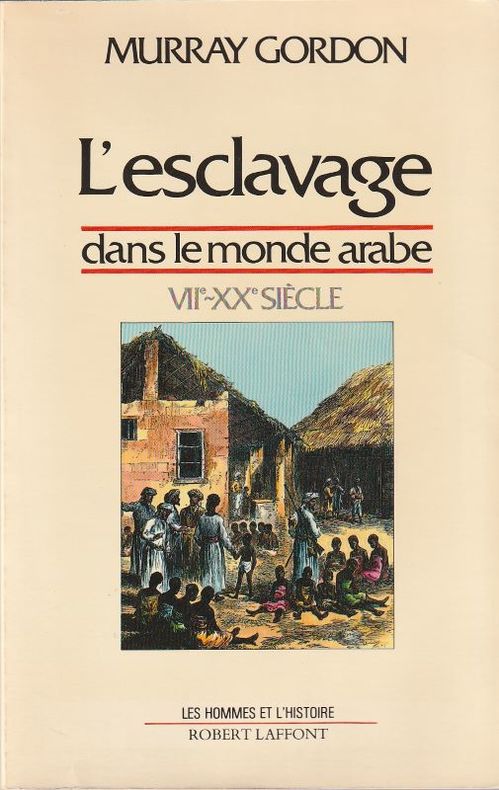
Gordon Murray
L'Esclavage dans le Monde Arabe - VII-XXe Siècle
Les Hommes et L'Histoire / Robert Laffont Broché 14x24cm , 265 pages , 2 cartes , bon et bel exemplaire .
Referenz des Buchhändlers : 6834
|
|
|
GORREE Georges
Au service du Maroc, Charles de Foucauld
- Grasset, Paris 1939, 12x19cm, broché. - Nouvelle édition. Petites taches sans gravité sur les plats. Envoi autographe daté et signé de Georges Gorrée au mademoiselle Schuller. [ENGLISH DESCRIPTION ON DEMAND]

|
|
|
GOULET
DESCRIPTION DE L'EGYPTE. Botanique. Euphorbia calendulaefolia, Euphorbia alexandrina, Euphorbia punctata, Euphorbia parvula. (Histoire Naturelle, planche 30)
Imprimerie Impériale | Paris 1809-1829 | 71 x 54 cm | une feuille
Referenz des Buchhändlers : 26449
|
|
|
GOULET
DESCRIPTION DE L'EGYPTE. Botanique. Salsola alopecuroides, Salsola echinus, Salsola tetrandra, Caucalis tenella. (Histoire Naturelle, planche 21)
Imprimerie Impériale | Paris 1809-1829 | 71 x 54 cm | une feuille
Referenz des Buchhändlers : 26487
|
|
|
GOULET
DESCRIPTION DE L'EGYPTE. Botanique. Euphorbia calendulaefolia, Euphorbia alexandrina, Euphorbia punctata, Euphorbia parvula. (Histoire Naturelle, planche 30)
- Imprimerie Impériale, Paris 1809-1829, 71x54cm, une feuille. - Original, unshaved, full-page etching from the "Imperial edition" of the Description de l'Égypte, or 'Recueil des observations et recherches faites en Égypte pendant l'expédition française, publié par les ordres de Sa Majesté l'Empereur Napoléon le Grand [A Collection of the observations and research carried out in Egypt during the French expedition, published on the orders of his Majesty the Emperor Napoleon the Great]'. Produced between February 1802 and 1830 on the orders of Naopleon Bonaparte and published between 1809 and 1828, 1,000 copies were printed and distributed to institutions, on vergé paper with an 'Égypte ancienne et moderne' watermark, visible when held up to the light. Light marginal spotting not touching image, otherwise in very fresh, fine condition. An engraving from the Description de l'Egypte, one of the masterpieces of French printing and the birth of a new field: Egyptology. A gigantic survey of Egypt at the time of Bonaparte's conquests in 1798 and 1799, the work is divided into 13 volumes of engravings making up 892 plates, of which 72 colored, as well as presenting the splendors of the Egypt of the Pharaohs in 9 volumes. The other volumes discuss natural history and present a fascinating portrait of Coptic and Islamic Egypt as it was seen by Bonaparte's Eastern Armies. The 'Egyptian campaign', militarily a disaster, demonstrates, through the engravings of the Description d'Egypte, the scientific success it nonetheless became thanks to the 167 expert members of the Commission of the Sciences and Arts of the Institut d'Egypte [Egyptian Institute] who followed Napoleon's army. The Institut gathered together in Egypt the mathematician Monge, the chemist Berthollet, the naturalist Geoffroy Saint-Hilaire as well as numerous artists, engineers, architects and doctors. They were tasked with re-discovering modern and ancient Egypt and displaying its natural treasures as well as the know-how of its inhabitants. This edition, the so-called "Imperial" edition of the plates for the Description de l'Egypte was printed in four large formats, two of which were specially created for it and christened "Moyen-Egypte" and "Grand-Egypte". A special press was built to print it, the process extending over 20 years, from 1809 to 1829. The "Imperial" edition proved so popular that a second edition, this time in black and white and without the "Egypte ancienne et moderne" watermark - known as the "Royal Edition" - was published during the Restoration by the printing house of C.-L.-F. Panckoucke (Paris). The engravings of the Description d'Egypte owe a great deal to Baron Dominique-Vivant Denon, illustrator, diplomat, collector and later Director of the Musée Napoléon (the Louvre). His exploration of the South of Egypt gave Bonaparte the idea of sending the experts of the Institut there, thus creating a faithful and complete portrait of the area. This was the research gathered together from 1802 in the mammoth Description de L'Egypte. Denon embarked on this story of archeological exploration at the age of 51, reaching first Alexandria and then Cairo before exploring Upper Egypt. Along with the members of the Institut d'Egypte, the Natural History Museum's painter H.J. Redouté (brother of Pierre-Joseph Redouté, author of Roses), the mineralogist Dolomiue, and the draughtsman Joly, Denon then explored the Nile Delta and Lower Egypt. When, however, he joined the 21st Light Infantry Regiment as it marched across Upper Egypt in pursuit of the retreating Mameluks in November 1798, he found himself the only civilian. In the very midst of the battle itself, he reeled off sketches of the works of art that peppered his path right up to the threshold of the Sudan. He said that he had crossed "a country that is, apart from its name, entirely unknown to Europeans, and therefore everything was worth describing" (Voyages dans la Basse et la Haute Egypte pendant le

|
|
|
GOULET
DESCRIPTION DE L'EGYPTE. Botanique. Salsola alopecuroides, Salsola echinus, Salsola tetrandra, Caucalis tenella. (Histoire Naturelle, planche 21)
- Imprimerie Impériale, Paris 1809-1829, 71x54cm, une feuille. - Original, unshaved, full-page etching from the "Imperial edition" of the Description de l'Égypte, or 'Recueil des observations et recherches faites en Égypte pendant l'expédition française, publié par les ordres de Sa Majesté l'Empereur Napoléon le Grand [A Collection of the observations and research carried out in Egypt during the French expedition, published on the orders of his Majesty the Emperor Napoleon the Great]'. Produced between February 1802 and 1830 on the orders of Naopleon Bonaparte and published between 1809 and 1828, 1,000 copies were printed and distributed to institutions, on vergé paper with an 'Égypte ancienne et moderne' watermark, visible when held up to the light. Light marginal spotting not touching image, otherwise in very fresh, fine condition. An engraving from the Description de l'Egypte, one of the masterpieces of French printing and the birth of a new field: Egyptology. A gigantic survey of Egypt at the time of Bonaparte's conquests in 1798 and 1799, the work is divided into 13 volumes of engravings making up 892 plates, of which 72 colored, as well as presenting the splendors of the Egypt of the Pharaohs in 9 volumes. The other volumes discuss natural history and present a fascinating portrait of Coptic and Islamic Egypt as it was seen by Bonaparte's Eastern Armies. The 'Egyptian campaign', militarily a disaster, demonstrates, through the engravings of the Description d'Egypte, the scientific success it nonetheless became thanks to the 167 expert members of the Commission of the Sciences and Arts of the Institut d'Egypte [Egyptian Institute] who followed Napoleon's army. The Institut gathered together in Egypt the mathematician Monge, the chemist Berthollet, the naturalist Geoffroy Saint-Hilaire as well as numerous artists, engineers, architects and doctors. They were tasked with re-discovering modern and ancient Egypt and displaying its natural treasures as well as the know-how of its inhabitants. This edition, the so-called "Imperial" edition of the plates for the Description de l'Egypte was printed in four large formats, two of which were specially created for it and christened "Moyen-Egypte" and "Grand-Egypte". A special press was built to print it, the process extending over 20 years, from 1809 to 1829. The "Imperial" edition proved so popular that a second edition, this time in black and white and without the "Egypte ancienne et moderne" watermark - known as the "Royal Edition" - was published during the Restoration by the printing house of C.-L.-F. Panckoucke (Paris). The engravings of the Description d'Egypte owe a great deal to Baron Dominique-Vivant Denon, illustrator, diplomat, collector and later Director of the Musée Napoléon (the Louvre). His exploration of the South of Egypt gave Bonaparte the idea of sending the experts of the Institut there, thus creating a faithful and complete portrait of the area. This was the research gathered together from 1802 in the mammoth Description de L'Egypte. Denon embarked on this story of archeological exploration at the age of 51, reaching first Alexandria and then Cairo before exploring Upper Egypt. Along with the members of the Institut d'Egypte, the Natural History Museum's painter H.J. Redouté (brother of Pierre-Joseph Redouté, author of Roses), the mineralogist Dolomiue, and the draughtsman Joly, Denon then explored the Nile Delta and Lower Egypt. When, however, he joined the 21st Light Infantry Regiment as it marched across Upper Egypt in pursuit of the retreating Mameluks in November 1798, he found himself the only civilian. In the very midst of the battle itself, he reeled off sketches of the works of art that peppered his path right up to the threshold of the Sudan. He said that he had crossed "a country that is, apart from its name, entirely unknown to Europeans, and therefore everything was worth describing" (Voyages dans la Basse et la Haute Egypte pendant le

|
|
|
Gouvernement général de l'Algérie
Algérie et tourisme.
Alger, Baconnier frères, s.d. (ca 1930.). 18 x 26, 174 pp., très nombreuses illustrations en N/B et en couleurs, 1 illustration de la mosaîque de la Basilique d'Orléansville, broché, bon état.
Referenz des Buchhändlers : 26815
|
|
|
Gozlan Martine
Pour comprendre l'intégrisme islamiste
Albin Michel 2002 199 pages 10x18x1cm. 2002. Poche. 199 pages. Cet essai de Martine Gozlan grand reporter spécialiste du monde arabe propose un panorama historique et politique de l'intégrisme islamiste. Il retrace ses origines dans l'Égypte des années 1930 analyse son développement en un phénomène mondial et examine son impact sur les sociétés occidentales notamment à travers le terrorisme et la propagande. L'ouvrage s'interroge également sur les ressentiments envers l'Occident et la guerre menée contre les femmes
Referenz des Buchhändlers : 500329397

|
|
|
GRANDE Bencion Meerovic
Vvedenie v sravnitel'noe izucenie semitskich jazykov
442pp., 27cm., 1ste ed., edition limited to 2500 copies, cloth, G, [introduction to the comparative study of Semitic languages, with a grammatical sketch of the Akkadian, Hebrew, Syriac, Arabic and Ethiopic language; text in Russian in Cyrillic script], OCLC 640257348, X72607
|
|
|
GRANDE Bencion Meerovic
Vvedenie v sravnitel'noe izucenie semitskich jazykov
Moskva [Moscow], Akad. Nauk SSSR Inst. vostokovedenija 1972 442pp., 27cm., 1ste ed., edition limited to 2500 copies, cloth, G, [introduction to the comparative study of Semitic languages, with a grammatical sketch of the Akkadian, Hebrew, Syriac, Arabic and Ethiopic language; text in Russian in Cyrillic script], OCLC 640257348, X72607
Referenz des Buchhändlers : X72607
|
|
|
GRANDVAL Gilbert
Ma mission au Maroc.
Paris, Plon et Nourrit, 1956. 14 x 20, 273 pp., broché, bon état (papier jauni).
Referenz des Buchhändlers : 17963
|
|
|
GRANT CYRIL FLETCHER AND GRANT L.
' TWIXT SAND AND SEA. SKETCHES AND STUDIES IN NORTH AFRICA.
LONDON. SAMPSON LOW, MARSTON AND CO. 1911. FORT IN-8 DE XII + 504 PAGES, RELIURE DE L'EDITEUR PLEINE PERCALINE BLEUE, TITRE DORE SUR DOS LISSE ET SUR LE PLAT SUPERIEUR. ILLUSTRE D'UNE CARTE REPLIEE ET DE 52 PLANCHES HORS-TEXTE, DONT 51 DE PHOTOGRAPHIES EN NOIR. (CARTHAGE. TIMGAD. BLIDAH. CHERCHEL. TEBESSA. TUNIS. ALGER. CONSTANTINE. BISKRA....). PETITS DEFAUTS EXTERIEURS SANS GRAVITE, SINON BON EXEMPLAIRE.
Referenz des Buchhändlers : 239
|
|
|
Gratien LE PERE - BALTARD (sculpsit)
DESCRIPTION DE L'EGYPTE. Thèbes. Karnak. Vue et détails de l'un des Sphinx placés à l'entrée principale du palais. Détail de l'un des Sphinx de l'allée du Sud. Petit torse en granit trouvé près de la porte du Sud. (ANTIQUITES, volume III, planche 29)
Imprimerie Impériale | Paris 1809-1829 | 71 x 54 cm | une feuille
Referenz des Buchhändlers : 35546
|
|
|
Gratien LE PERE - COLLIN (sculpsit)
DESCRIPTION DE L'EGYPTE. Isthme de Soueys (canal des deux mers). Tableau synoptique des différents points de nivellement de l'isthme, rapportés au meqyas de l'île de Roudah. (ETAT MODERNE, volume I, planche 14)
Imprimerie Impériale | Paris 1809-1829 | 53.50 x 70 cm | une feuille
Referenz des Buchhändlers : 25447
|
|
|
GRAY (Brasil).
La peinture persane.
Genève Editions d'Art Albert Skira, coll. "Les trésors de l'Asie" 1995 1 vol. broché in-4, broché, 190 pp., nombreuses illustrations en couleurs in-texte, index, bibliographie. Très bon état.
Referenz des Buchhändlers : 100054
|
|
|
GRAY (Brasil).
La peinture persane.
Genève Editions d'Art Albert Skira, coll. "Les trésors de l'Asie" 1995 1 vol. broché in-4, broché, 190 pp., nombreuses illustrations en couleurs in-texte, index, bibliographie. Très bon état.
Referenz des Buchhändlers : 100054
|
|
|
GRESH Alain, RAMADAN Tariq
"L'Islam en question; débat animé et présenté par Françoise Germain-Robin."
Arles, Actes Sud/Paris, Sindbad, 2000. 14 x 22, 253 pp., broché, très bon état.
Referenz des Buchhändlers : 104.917 ISBN : 274272916
|
|
|
GROFFIER Jean
Orage sur Tunis.
Bruxelles, Paris, Genval, L. de Lannoy, s.d. 13 x 18, 177 pp., broché, bon état.
Referenz des Buchhändlers : 102.491
|
|
|
GROHMANN Adolf (ed.)
Arabic papyri from Hirbet El-Mird
xlvi + 126pp.with 10 figures in text + 33 plates out of text, in the series "Bibliothèque du Muséon" volume 52, editor's hardcover in grey cloth, dustwrapper, 28cm., very good condition, X56290
|
|
|
GROHMANN Adolf (ed.)
Arabic papyri from Hirbet El-Mird
Louvain, Institut Orientaliste 1963 xlvi + 126pp.with 10 figures in text + 33 plates out of text, in the series "Bibliothèque du Muséon" volume 52, publisher's hardcover in grey cloth, dustwrapper, 28cm., very good condition, X56290
Referenz des Buchhändlers : X56290
|
|
|
GROS Simone
La politique de Carthage. Collection : Tribune Libre, N°34.
Paris, Plon, 1958. 14 x 20, 111 pp., broché, bon état (couverture légèrement défraîchie).
Referenz des Buchhändlers : 45375
|
|
|
GRUNEBAUM (Gustave E. von)
L'islam médiéval. Histoire et civilisation. Traduit de l'anglais par Odile Mayot.
In-8, broché, couverture illustrée, 381 p., soulign. au crayon.
|
|
|
GRUNEBAUM (Gustave E. von)
L'islam médiéval. Histoire et civilisation. Traduit de l'anglais par Odile Mayot.
In-8, broché, couverture illustrée, 381 p., soulign. au crayon. Paris, Payot, 1962.
Referenz des Buchhändlers : 18132
|
|
|
Grégoire SARKISSIAN
Le Soudan égyptien, étude de droit international public
Emile Larose | Paris 1913 | 16.50 x 25.50 cm | broché
Referenz des Buchhändlers : 29465
|
|
|
GUASCH, P. Antonio S. I.
EL IDIOMA GUARANI. gramtica y antolgia de prosa y versos
Asuncion Ediciones Loyola 1983 in 12 (19x14) 1 fort volume broché, couverture illustrée à rabats, 430 pages [1]. Sexta edicion refundida y acrecentada. Bel exemplaire ( Photographies sur demande / We can send pictures of this book on simple request )
Referenz des Buchhändlers : 33018
|
|
|
GUBB DR A.S.
La flore saharienne
- A. Jourdan, Alger 1913, 14,5x20cm, reliure de l'éditeur. - Edition originale. Reliure de l'éditeur en pleine percaline olive, dos lisse. Ouvrage illustré de reproductions photographiques. Piqûres sur les gardes, agréable exemplaire. [ENGLISH DESCRIPTION ON DEMAND]
|
|
|
GUEMRICHE Salah
Dictionnaire des mots français d'origine arabe
Seuil 2007, fort In-8 cartonnage souple éditeur, 878 pages. Préface d'Assia Djebar. Très bon état
|
|
|
Gui Casimir de LÉVIS-MIREPOIX
Mes souvenirs d'orient - Egypte - Syrie - Palestine
Henri Lecesne | Châteaudun 1882 | 16.50 x 25.50 cm | relié
Referenz des Buchhändlers : 52260
|
|
|

 Per e-mail erhalten
 Als pdf-Dokument herunterladen
 RSS feed
 Permanenter link


