|
SEFER TORAT ELOHIM: KOLEL HAMISHAH HUMSHE TORAH
.
Prag, S. Freund's Witw & Comp., 1865. Cloth, 16mo (pocket size), aprox. 200 pages. "Zweite auflage. Neue Taschen-Ausgabe." Nice pocket-sized collection of Bible commentaries. We were unable to locate a copy anywhere. Subject: Bible. O.T. Pentateuch - Commentaries. Heavy wear as one would expect, but complete, binding easily shored up. (RAB-54-7)

|
|
|
Sommario dei documenti relativi alla cessata commissione creata dal consiglio governativo la università israelitica di Firenze
In -4°, 70, (1), b. Manca in Iccu
|
|
|
Terms of Molecular Biology and Microbiology: English-Hebrew.
23x15 cm. 57 + 50 pages. Softcover. Cover slightly rubbed. Else in good condition.
|
|
|
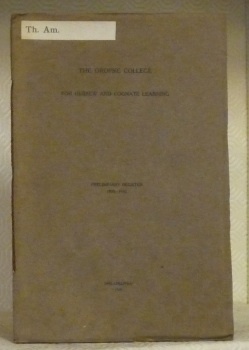
The Dropsie College. For hebrew and cognate learning. Preliminary register. 1909 - 1910.
Philadelphia, Cahan Printing Company 1909, 235x155mm, 28pages, paperback. Tab of quotation on the upper coverage. Tear of 2cm on lower coverage, otherwise book in good condition.
Referenz des Buchhändlers : 39457
|
|
|
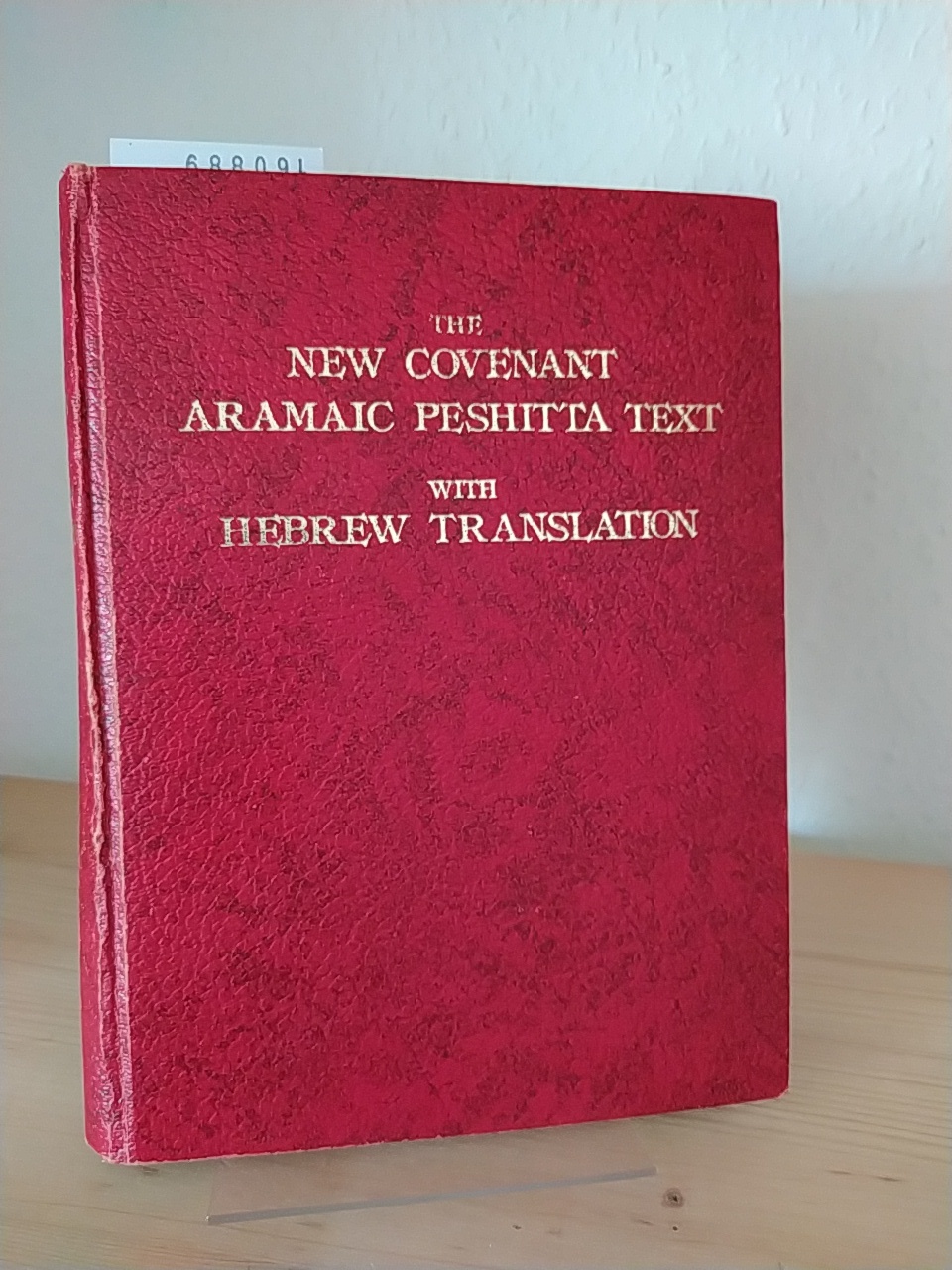
The New Covenant commonly called the New Testament. Peshitta Aramaic text, with a Hebrew translation. [Edited by The Aramaic Scriptures Research Society in Israel].
Jerusalem: The Bible Society 1986. V, 383 Seiten. Dünndruck. 8° (17,5-22,5 cm). Orig.-Kunstlederband mit goldgeprägtem Titel auf Deckel und Rücken. [Hardcover / fest gebunden].
Referenz des Buchhändlers : 160889
|
|
|
The New Hebrew Testament.
Jerusalem: United Bible Societies 1976. 645 Seiten. Dünndruckpapier. 8° (17,5-22,5 cm). Flexibler Kunstlederband mit Goldprägung und Lesebändchen. [Hardcover / fest gebunden].
Referenz des Buchhändlers : 161037
|
|
|
The New Hebrew Testament.
Jerusalem: United Bible Societies 1976. 645 Seiten. Dünndruckpapier. 8° (17,5-22,5 cm). Flexibler Kunstlederband mit Goldprägung. [Hardcover / fest gebunden].
Referenz des Buchhändlers : 3128490

|
|
|
The Unified Arabic Dictionary for Computer Terminology: ENGLISH-FRENCH-ARABIC
RARE comprehensive ENGLISH-FRENCH-ARABIC dictionary of computer terms. 250x175mm. 968 pages [+8]. Green leather Hardcover with gilt lettering on both covers and spine. Cover corners, upper and bottom edges bumped and slightly peeling. Spine edges bumped. Several tiny peeling-marks on spine front hinge and corners. Peeling-mark on front whitepage. Else in good condition. PLEASE NOTE: This item is overweight. We may ask for extra shipping costs.
|
|
|
World Congress of Jewish Studies: Summer 1947 - Volume I [THIS VOLUME ONLY][IN HEBREW]
THIS VOLUME ONLY. IN HEBREW. Contains B&W plates. 240x175 mm. 486 pages. Soft cover. Cover slightly yellowing. Cover corners and edges tattered. Spine yellowing and slightly water stained. Spine tattered. Spine edges tattered and rubbed. Pages slightly yellowing. Else in good condition.
|
|
|
YERUSHALAYIM SHENATON LE-DIVRE SIFRUT VE-OMANUT.
8vo. 451 pages. Illustrated. In Hebrew. SUBJECT (S) : Hebrew literature. OCLC lists 2 copies worldwide (Yale, Florida Atlantic Univ) . Has dust jacket with small tears and reinforced with masking tape. Hinges starting, good condition. (HebLit-6-8)
|
|
|
YWHA SILVER MEDAL, 1916-1917 ALL ROUND GYM CHAMPS.
Silver medallion with blue and white inlay, double-sided approximately 1 inch across. Medal awarded to Rae Neiman, with YWHA insignia and laurel leaves on front, engraved on rear: All Round Gym Champs 1916-1917 Rae Neiman. No stamps, but appears to be sterling. Light age patina, Very Good Condition. (women-4-14)

|
|
|
( Hebrew )
MACHATZIT HA-SHEKEL
Wien. 1808 . Large hardcover book entirely in Hebrew. 14-1/2 x 9-1/2 x 1 inch thick. Full leather. Remnants of paper spine labels. Leather is chipped and worn especially along one board edge. Delicate blue geometrically stamped end papers. Front inner hinge cracked ; rear inner hinge not cracked. Rouged page ends. Text clean; binding secure. Fairly Good. Owner stam pof Israelitschen Corporation Fraustdt and others. Pictures available on request. . hardcover
Referenz des Buchhändlers : a104075
|
|
|
( Hebrew )
TUR YOREH DEAH VOLUME III vol 3 only
Berlin 1764 Isaac Jacob Speirer. large hardcover book 14-3/4 x 9-1/2 x 2 inches thick. Wood boards with full leather cover on boards. Some metal nails. Had clasps at one point in time which are now gone. Backstrip is nearly all chipped away. Binding is secure; light even toning of text. Owner stamps of Rabbi Dr. A Cohn of Basel. Several other ink signatures and notations. Fully in Hebrew. Fair. Vol 3 of a 4 volume set. Pictures available on request. . hardcover
Referenz des Buchhändlers : a104073
|
|
|
( Hebrew )
TUR YOREH DEAH VOLUME III vol 3 only
1793. large hardcover book 14-3/4 x 9-1/3 x 1-1/2 inches thick. Papercovered boards. Black cloth spine. Ink mss title on slip of paper mounted on spine. Binding is secure hinges not cracked in or out; rouged page ends; two small tears/chips in black spine cloth; light even toning of text. Owner stamps of Rabbi Dr. A Cohn of Basel. Several other ink signatures and notations. In Hebrew. One end paper is fully covered with signatures and ink notes. Good. Vol 3 of a 4 volume set. Pictures available on request. . hardcover
Referenz des Buchhändlers : a104074
|
|
|
()
PERL TSITRON VILIAMSBURGER ARBETER-RING SHUL 3. 25TER YUBILAI ZSHURNAL.
Original Decorated Wrappers, 4to, 36 leaves. Includes 3 pages of photo plates. Includes English cover: 1933-OUR SCHOOL-1958. 25th ANNUAL SCHOOL JOURNAL. Text in Yiddish with on page (The P. T. A) in English. Ads mostly in English. No Copies on OCLC. Rare. (YID-20-2)

|
|
|
(Baron, Salo Wittmayer) Lieberman, Saul, editor
SALO WITTMAYER BARON : JUBILEE VOLUME ON THE OCCASION OF HIS EIGHTIETH BIRTHDAY. THREE VOLUMES (COMPLETE)
8vo; 1095 + 500 pages; Original Publisher's Cloth. Large 8vo. 1095, 500 pages. Volumes I & II are in English, Volume III is in Hebrew. Includes a bibliography of baron's works. Contents include: From Zudecha to Yahudi Mahallesi: The Jewish Quarter of Candia in the Seventeenth Century (by Zvi Ankori) ; Premiers Temoignages Epigraphiques Sur les Juifs en France (by Bernard Blumenkranz) ; The Hasmonean Revolution Politically Considered (by Martin A. Cohen) ; Christian Translators of Mamonaides' Mishne Torah into Latin (by Jacob Dienstag) ; H. M. Baratz and his View of Khazar Influence on the Earliest Russian Literature, Juridical and Historical (by Douglas Dunlop) ; Garcia de Orta--A Militant Marrano in Portuguese-India in the 16th Century (by Walter J. Fischel) ; Jewish Influence upon Arthurian Legends (by Kurt Leviant) ; Taamrat Emanuel's Note of Falasha Monks and Holy Places (by Wolf Leslau) ; The Attitudes of the Early Karaites towards Christianity (by Leon Nemoy) ; Hermann Cohen and Heinrich Graetz (by Erwin I. J. Rosenthal) ; A Frankish Document from Prague (by Gershom Scholem) ; East European Workers in Germany during World War I (by Zosa Szakowski) ; Young German Intellectuals on Romanticism and Judaism--Spiritual Turbulence in the Early19th Century (by Uriel Tal) ; Professing Jews in Post-Expulsion Spain and Portugal (by Yosef Hayim Yerushalmi) ; Unpublished Materials on the Relations of Austrian and German Jews to the Central Governments (by Arthur Zuckerman); etc. Nice, clean copies in Very good condition. (FEST1-119)
|
|
|
(Bible in Hebrew and Greek)
Biblia Hebraica . Novum Testamentum Graecum . Old Testament in Hebrew with interlinear notes in Latin bound with the New Testament in Greek with interlinear notes in Latin
Geneva: Pierre de la Rouière 1609. In two columns. 28 184 283 1 84 203 1; 8 186 2 134 2pp. Folio 15 x 9-1/2 inches. Contemporary pigskin covers blocked in gilt and blind remnants of paper label on the spine gauffered edges lacks bosses and hinges and clasps worn at extremities and bottom of spine. Provenance: Johann Georg Feuchter of Jura-Weickersroda inscription on pastedown that the bible was purchased at an August 6 1728 auction for 4 florins and 30 groschen; General Theological Seminary blindstamp. In two columns. 28 184 283 1 84 203 1; 8 186 2 134 2pp. Folio 15 x 9-1/2 inches. Edited with introduction by Benito Arias Montanus 1527-1598 Spanish orientalist and editor of the Antwerp Polyglot a reprint of Plantin's similar edition. Darlow & Moole 5113 OT and 4662 NT Pierre de la Rouière unknown
Referenz des Buchhändlers : 371891
|
|
|
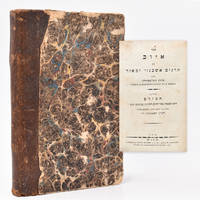
(Bible in Hebrew)
Sefer Iov im targum ashkenazi uveur me'et Aaron Wolfsohn. . . Book of Job
Vienna: Anton Schmidt 1817. Portrait frontispiece engraved additional title. 8vo. Contemporary quarter calf and marbled boards the calf tooled in blind worn rear hinge cracked lacks rear pastedown frontispiece detached. Portrait frontispiece engraved additional title. 8vo. Includes commentary by Rashi and Beur. Anton Schmidt unknown
Referenz des Buchhändlers : 353306
|
|
|
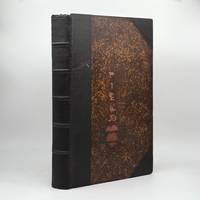
(Bible in Hebrew and Spanish)
Torah Neviʾim u-Khetuvim bi-shene ʻamudim in Hebrew type . Biblia. En dos colunas Hebrayco y Español
Amsterdam: Joseph Jacob and Abraham the sons of Solomon Proops 5522. Titled printed in red and black. 2 178 2 179-332 10 Introduction etc. 2 160 2 161-350pp. Publisher's introduction and other preliminaries misbound preceding the later Prophets. Folio 15-7/8x10 inches. Nineteenth or early 20th century half morocco and marbled paper boards rear joint splitting worn at joints and head and tail of spine. Foxing principally to the title tear to the final text leaf. Provenance: General Theological Seminary bookplate. Titled printed in red and black. 2 178 2 179-332 10 Introduction etc. 2 160 2 161-350pp. Publisher's introduction and other preliminaries misbound preceding the later Prophets. Folio 15-7/8x10 inches. Besides being the first bi-lingual edition in Hebrew and Spanish this edition is the first Hebrew book whose publication was financed by an American - Abraham Mendes de Castro 1689-1762 of Curaçao - intended for use in the West Indies with the sale proceeds to benefit the Jewish communities of Jerusalem and Hebron. Cowley 102; Darlow & Moule 5156; Zedner 102; not in Steinschneider or Roest Joseph, Jacob and Abraham, the sons of Solomon Proops unknown
Referenz des Buchhändlers : 371476
|
|
|
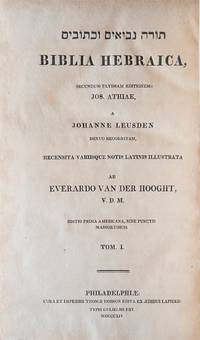
(Bible in Hebrew)
Torah Nevi'in U-Khetuvim in Hebrew . Biblia Hebraica Secundum Ultimam Editionem Jos. Athiae a Johanne Leusden denuo Recognitam Recensita Variisque Notis Latinis Illustrata ab Everardo Van der Hooght
Philadelphia: Cura et Impensis Thomae Dobson edita ex aedibus Lapideis. Typis Gulielmi Fry 1814. First American edition. Text in Hebrew with notes in Latin. 6 296; 2 312 leaves. Half titles present in each volume. Uncut. 2 vols. 8vo. Original blue paper boards rebacked with plain paper. Provenance: Hugh Blair Grigsby booklabels. In a blue cloth folding box. First American edition. Text in Hebrew with notes in Latin. 6 296; 2 312 leaves. Half titles present in each volume. Uncut. 2 vols. 8vo. The first complete Hebrew Bible printed in America. Hebrew type was first used in the North American colonies in the Bay Psalm Book printed in 1640 in Cambridge. Over the next ninety-five years Hebrew type appeared in a handful of American imprints usually in brief examples of single words or short sentences. Paucity of appropriate type would continue to be a problem over the years that followed. The first Jewish Psalter was finally published in 1809 followed by this complete Bible five years later. "In 1812 Mr. Horwitz had proposed the publication of this edition of the Hebrew Bible the first proposal of the kind in the United States; early in 1813 be transferred his right and list of subscribers to Mr. Thos. Dobson who published soon afterwards the 1st volume" O'Callaghan. The title page indicates that this work is a reprinting of the second edition of the Joseph Athias Bible edited by Leusden with Latin notes by Everardo Van der Hought and that the Hebrew is printed without vowels. An important piece of American printing and of Jewish Americana. Darlow and Moule 5168a; Goldman 4; Rosenbach 171; Shaw and Shoemaker 30857; Singerman 236; M. Vaxer "The First Hebrew Bible Printed in America" Journal of Jewish Bib. 1940 vol. 2 pp. 20-26 Cura et Impensis Thomae Dobson edita ex aedibus Lapideis. Typis Gulielmi Fry unknown
Referenz des Buchhändlers : 372931
|
|
|
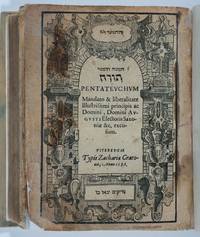
(Bible Old Testament Hebrew)
Hamishah Humshei Torah: Pentateuchum; Nevi'im Rishonim; Nevi'im Aharonim; Sefer Ketuvim The Pentateuch; Former Prophets; Later Prophets; Hagiographa
Wittenberg: Zacharias Crato Krafft 1586. First edition. Hardcover. Very Good. Four parts quarto published between 1586 and 1587. Register continuous through parts 1 and 2; separate registers for parts 3 and 4. Collation in 4s: 1-65 blank 33.4; 1-30 lacks blank 30.4; 1-32 lacks 32.4 colophon. 506 leaves. Title within elaborate woodcut borders. Single-column text in vocalized Hebrew with cantillation; printed side-glosses. Separate Hebrew half-titles within woodcut borders for the latter three parts Former Prophets; Later Prophets; Hagiographa; names of the biblical books set in large font within woodcut cartouches. Later vellum. Title and following three leaves with marginal reinforcement slight text loss. Occasional mild embrowning else very good with bright half-titles. <br /> <br /> First Wittenberg edition of the complete Hebrew Scriptures with a concluding list of Haftaroth readings noting the Ashkenazi and Sefardi variations. Our copy is the variant with Hebrew and Latin title. A majority of the few surviving copies are bound with a Hebrew title and the publisher's information is taken from the colophon which provides a Jewish calendar date of 5347 = 1587. Vinograd notes that individual books and sections of the Hebrew Bible had been printed at Wittenberg since a quarto edition of the prophet Obadiah appeared in 1521. The title-page designs were re-used in the Hebrew bible published at Frankfurt am Oder in 1595. Each book closes with the Masora Finales printed in square type.<br /> <br /> Andreas Masch notes in his revised edition of Le Long's Bibliotheca Sacra 1778: "This edition of the Hebrew Bible is so rare and infrequent that it was omitted in the earlier edition of Le Long's work at Paris but it is known to Wolffius Bibliotheca Hebraea not in its entirety but only in respect of certain parts." One can speculate as to why the edition is rare but it may be worth noting that "when Hans and Friedrich Hartmann decided to start producing Hebraica in an effort to become the official printer for the univeristy of Frankfurt/Oder they were able to do so relatively quickly by hiring away five experienced workmen from Zacharias Croto's Wittenberg firm which was having financial difficulties" Burnett.<br /> <br /> Masch continues: "At the colophon is noted the year and the name of those at whose expense this Hebrew Bible was published: colophon info in Heb. and Latin The above example is therefore attributed to the liberality of the prince and to the expense of the two citizens of Wittenberg But the Rühilii brothers were not correctors of the work but citizens and senators of Witteberg whose name is quite famous in the history of the Germanic Bibles. The work came from the workshop of Zacharias Craton otherwise known as Kraft to whom we owe several editions of German Bibles. The title in both copies represents a gate in which above and below Ps. 118 com. 20. is printed. In accordance with the first Plantin edition the text was printed so as to match nearly page-for-page. It is composed of four parts with the five festival books added to the Pentateuch; but each part is decorated with a special title." Full title: חמשה חומשי תורה Pentateuchum mandato & liberalitate illustrissimi principis ac Domini Domini Augusti Electoris Saxoniae. Vitebergae: Typis Zacharia Cratonis Anno 1586. alternate Hebrew title: חמשה חומשי תורה × ×“×¤×¡ ×¢× ×¨×‘ העיון על ידי זכריה כר×טו.<br /> <br /> References: Benzing Buchdrucker 16/17 p. 471; Le Long/Masch I 1778 pp. 33-34; Steinschneider 277; VD16 ZV 29818 quarto; Vinograd 21. Not in: Adams; Darlow & Moule; Delaveau & Hillard. Cf. Burnett Christian Hebraism in the Reformation Era p. 204. Zacharias Crato [Krafft] hardcover
Referenz des Buchhändlers : 53478
|
|
|
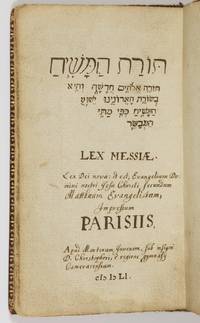
(Bible: New Testament; Gospels; Matthew; Hebrew). Cinqarbres (Quinquarboreus), Jean (ed)
Torat ha-Mashiah. Lex Messiae. Lex Dei nova: id est Evangelium Domini nostri Iesu Christi secundum Matthaeum Evangelistam The Law of the Messiah. The New Law of God: That Is The Gospel of Our Lord Jesus Christ According the Matthew the Evangelist
1700. Very good-. Small octavo 14.1 by 8.5 cm. Manuscript in black and brown ink; 18-20 lines per page; text in vocalized Hebrew. 6 title and editor's preface 146 12 blank 10 notes. Lacks the first leaf which has been supplied in manuscript by a later owner. 19th-century limp morocco rubbed at extremities gilt dentelles marbled endleaves. Faint dampstain along bottom margin occasional smudges and mild stains else very good with crisp text.<br /> <br /> Early modern transcription of the Hebrew version of the Gospel of Matthew published in 1551 at Paris by Martin le Jeune with notes at the rear likely the work of a student. This edition was prepared by Jean Cinqarbres Quinquarboreus; 1514-1587 who jointly held the chair of King's Professor of Hebrew Literature at the University of Paris with Jean Mercier d. 1570. Lapide describes this as a "literal" edition and notes that the learned French bibliographer and father of the Oratory Jacques Le Long regarded it as the "true and authentic Gospel of Matthew." Like many of the surviving copies it lacks the Appendix which comprised the Seven Penetential Psalms Psalm CXIX Daniel's Prayer and the Ten Commandments. Apart from minor formatting changes e.g. breaks between chapters the text appears to be a faithful copy including vowel points and some of the additional cantillation marks the printed marginalia new Hebrew page numbers and Cinqarbres's dated preface. As the original version contains only 17 lines of text per page the transcription is not a page-for-page copy. Here the copiest appears quite fastidious in providing appropritate new catchwords! The Latin portion of the title however differs notably from the original which reads: Sanctum Domini nostri Iesu Christi Hebraicum Evangelium secundum Matthaeum.<br /> <br /> "In 1537 Sebastian Münster published his Hebrew version of the Gospel of Matthew at Basel the first printed edition of the New Testament in the so-called 'mother tongue of the evangelist' as he states in his preface" Lapide. Like the Paris edition of Hebrew Matthew upon which the present copy is based Münster entitled his version Torat ha-Mashiah The Teaching of the Messiah. While Münster's version of Matthew was long believed to be based on the 14th-century Hebrew translation by the Jewish polemicist Shem Tov ben Isaac ibn Shaprut more recent scholarship has called this attribution into question. "There are medieval Hebrew forms of Matthew that most scholars think of as retroversions from the Greek of canonical Matthew often made to serve in arguments between Christians and Jews. However some claim that these texts are a guide to the original Hebrew of Matthew French scholars like J. Carmignac and M. Dubarle have contributed to this thesis. Still other scholars think they can reconstruct the original Hebrew or Aramaic underlying the whole or parts of the Greek text of canonical Matthew on the assumption that the original was in Semitic. The vast majority of scholars however contend that the Gospel we know as Matthew was composed originally in Greek and is not a translation of a Semitic original" Brown.<br /> <br /> Provenance and annotations: The copiest has added notes following the main text comprising a Seder shel Miqra / Ordo Bibliorum in which the tripartite division of the Scriptures according to Jewish tradition is described. Then follows several pages of Hebrew terminology with biblical references and definitions in Latin. Along with one or two references to rabbinic literature an erudite reference to the Passover Haggadah notes Rabbi Judah's grouping of the ten plagues into three acronyms.<br /> <br /> At the head of the leaf inserted after Cinqarbres' preface is the note "When I bought this Mss. the first chapter from verse one unto verse 14 and part of verse 15. I filled in the missing verses. May. 18th. 1901. Llewellyn Saunderson 10 De Vesse Terrace Kingstown Co. Dublin" References: R. Brown Introduction to the New Testament 1997 p. 210; P. Lapide Hebrew in the Church Grand Rapids 1984 see Chap. IV "Modern Christian Hebraica" esp. pp. 53-58. Cf. Adams B1890 wanting the appendix; Darlow & Moule 5095: An independent edition of Shem Tob's version see no. 5088 which notes: The editor S. Münster obtained an imperfect MS. copy of St. Matthew's Gospel in Hebrew which had been made as early as 1385 for polemical purposes by Shem Tob b. Shaprut a Jew of Tudela in Castile. He revised and completed this for the press Basel: H. Petri 1537 adding a Latin translation of the Hebrew.; Delaveaux & Hillard 4644 noting Ibn Shaprut as the ulitmate source; Le Long/Masch 2 1781 p. 10. Schwarzfuchs Paris 212. Steinschneider 6591.26 under Münsterus.<br /> <br /> Full title noting original imprint: תורת המשיח תורת ××œ×”×™× ×—×“×©×” ×•×”×™× ×‘×©×™×¨×ª ×”××“×•× ×™× ×• ישוע המשיח כפי מתי המבשר <br /> Lex Messiae. Lex Dei nova: id est Evangelium Domini nostri Iesu Christi secundum Matthaeum Evangelistam Impressum Parisiis: apud Martinum Iuvenem sub insigni D. Christophori è regione gymnasii Cameracensium M.D.LI. 1551. unknown
Referenz des Buchhändlers : 55766
|
|
|
(Bible: Old Testament; Hebrew). Doderlein, Johann Christoph (ed); Johann Heinrich Meisner (ed)
Biblia Hebraica
Leipzig: I. G. I. Breitkopf and Associates 1793. First edition. Hardcover. Good. Two volumes octavo 18.1 by 10.6 cm. xii 6 360 302; 352 404 pp. Title-pages and first-volume preface in Latin; half-titles for the Pentateuch Former Prophets Latter Prophets and Hagiographa. Main text in Hebrew. Contemporary green paper boards with title-labels edges stained red. Illustrated head pieces such as the heavens before Genesis and King David at prayer before Psalms. First volume covers slightly warped. Spines sunned. Library stamp on title and back pages. Minor worm tracing at first the 32 leaves vol. 2 resulting in the loss of a word or two along the line else a good or better ex-library copy.<br /> <br /> Complete Old Testament in Hebrew with traditional cantillation marks and scholarly footnotes indicating varying textual readings. Latin chapter headings summarize content. Preface in Latin by Johann Heinrich Meisner offers a history of the project. In the back is an appendix showing variant readings from the De Rossi Codex. There is also a chart giving the weekly readings from the Pentateuch and prophets. This Bible exemplifies early modern Protestant interest in being able to read the Old Testament in the original Hebrew. This was a product of their belief in sola scriptura that only the basis for religious authority was the Bible. <br /> <br /> Provenance: Stamps of the Franciscan monastery at Eggenfelden in Bavaria. References: Darlow & Moule 5163; Orme Bibl. Biblica pp. 238-9.<br /> <br /> Full title and imprint: Biblia Hebraica olim a B. Christiano Reineccio edita et ad optimorum codicum et editionum fidem recensita et expressa nunc denuo ad fidem recensionis Masoreticae cum variis lectionibus ex ingenti codicum copia a B. Kennicotto et I. B. de Rossi collatorum ediderunt D. Io. Christoph. Doederlein. et Joannes Henricus Meisner. Lipsiae: impensis I. G. I. Breitkopfii et Soc. MDCCXCIII. I. G. I. Breitkopf and Associates hardcover
Referenz des Buchhändlers : 18880
|
|
|
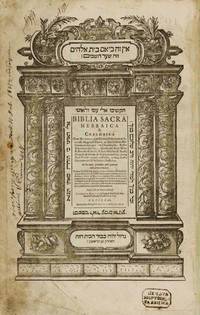
(Bible: Old Testament; Hebrew; Aramaic; Commentary). Buxtorf, Johann, the Elder (ed)
Biblia Sacra Hebraica & Chaldaica cum Masora The Holy Bible in Hebrew and Aramaic with the Masorah BOUND WITH: Tiberias COPIES of the ACCLAIMED OLD TESTAMENT SCHOLAR BREVARD CHILDS previously held at THE GREAT SYNAGOGUE OF MINSK
Basel: Ludwig König 1619. First editions. Hardcover. Good. Seven parts in two volumes folio biblical texts and commentary in four parts continuously foliated; two supplemental sections each with separate foliation; Tiberias 1620 with separate pagination here bound after the second part - Vol. 1: 6 title and prelims 1-228 1 sect. title 234-441 1 blankff.; 6 sect. title and prelims 2 blank 114 2 blankpp. Vol. 2: 442-946; 8 Targum Yerushalmi; last leaf unfoliated; 67 Masora 1 blankff. Largely arranged in two columns of biblical texts in square font surrounded by commentaries in rabbinic Rashi font; text reads from right to left. This copy with collective Latin title surrounded by biblical quotations in Hebrew set within elaborate woodcut architectural borders. Hebrew sectional titles set within the same woodcut borders for the second and fourth parts with a plain letterpress half-title for the Five Megillot. The third sectional title for the Latter Prophets is lacking as are the Ashkenazi Haftarot readings not found in all copies. Apart from these lacks the Rabbinic Bible collates complete despite numerous errors in foliation throughout as per the detailed notes in Prijs Die Basler hebräischen Drucke. Opening word of each biblical book set in large one-third to one-half page cartouche vignettes with elaborate woodcut borders and surrounding letterpress Hebrew text. Main Latin title dated 1619 with the editor's Latin preface to the reader appearing at the verso. Jewish date chronogram for the second section Former Prophets dated 5378 1618/1619. Early twentieth-century black cloth boards worn at extremities gilt-lettered spine. Title moderately soiled re-inforced at gutter; neat old repairs to corners and fore-edge of title and next three leaves; old Russian stamp at bottom margin title manuscript entry in Russian along fore-edge dated 1837; intermittent mild to moderate marginal dampstains largely confined to corners and embrowning throughout both volumes somewhat more heavily in the first especially throughout Tiberias; top right corner of the opening leaf in vol. 2 repaired with loss of about 12 words surrounding title cartouche recto and some text in 9 lines of the commentary at the verso. Overall a good set with a notable chain of provenance. <br /> <br /> Sixth Rabbinic Bible in Hebrew: Mikra'ot Gedolot edited by Johann Buxtorf I 1565-1629 professor of Hebrew at the University of Basel and the foremost Christian Hebraist of his era with the assistance of the Jewish scholars Abraham Braunschweig who served as the principal corrector and Mordechai Gumplin of Posen. This was "a truly audacious undertaking for his time" Burnett From Christian Hebraism to Jewish Studies as no Christian scholar had yet attempted to edit the entire biblical corpus including the Aramaic versions Targumim and masoretic notes. Based mainly on the third Rabbinic Bible published by Daniel Bomberg at Venice in 1546-1548 the editor has carefully incorporated elements from two other Venetian editions. At the verso of the Latin title Buxtorf provides a detailed bibliographical excursus on the earlier Venetian editions and offers a tribute to Bomberg's industry by reprinting the colophon of the second Venetian Rabbinic Bible 1524-1525 at the conclusion of the masoretic appendix with text by the Hebrew grammarian and lexicographer Elijah Levita 1468 or 1469-1549 and a new introduction by Abraham Braunschweig. The design of the sectional titles and separate book title vignettes closely model those of the Venetian editions. "Buxtorf did not plan simply to reprint one of the existing Venice editions but rather to assemble the best features of them all into one work" and "to provide theologians with what he considered the most important tools for interpreting the Old Testament" Burnett. Buxtorf served in an official capacity as Basel's Hebrew censor charged with the oversight of all Jewish printing in the city and insuring that "no 'blasphemies' or slurs against Christians or Christianity appear in any book printed in Basel" Burnett. He carefully edited the Jewish commentaries in the Rabbinic Bible in accordance with this mandate "and removed many words and phrases which had escaped the attention of earlier censors" Burnett. <br /> <br /> The Rabbinic Bible contains the vocalized Masoretic text of the Hebrew Scriptures with accents and a vocalized Targum an Aramaic paraphrase of the biblical text: Onkelos for the Pentateuch; Jonathan b. Uzziel for the Prophets; and Targum Hagiographa for the Writings. The Hebrew and Aramaic versions are printed in square characters and presented in facing columns at the center of each page. The Jerusalem Targum of the Pentateuch appears as an appendix. In addition to the Aramaic paraphrases the Rabbinic Bible includes a massive scholarly apparatus of biblical commentaries by Rashi Ibn Ezra Baal ha-Turim Jacob b. Asher R. David Kimchi Radak R. Levi b. Gershon Ralbag Saadia Gaon and R. Isaiah along with the Masora a corpus of critical notes on the external form of the Biblical text compiled by Jewish scholars from late antiquity through the medieval era. As frequently occurs a copy of Buxtorf's work on the textual history of the Hebrew Bible Tiberias the 1620 first edition is bound-in. This work was made possible by the publication in 1538 of Elijah Levita's Masoret ha-Masoret a commentary on the Masora which Buxtorf translated into Latin for his own private use in 1593. "Buxtorf was concerned with the integrity of the consonantal text and the origin and integrity of the vowel points and accents of the Hebrew Bible from the very beginning of his scholarly career" and while he had earlier published a long excursus on the age of the vowel points and accents in his 1609 Thesaurus Grammaticus "Tiberias is Buxtorf's fullest and most impressive work on the history of the biblical text" Burnett. Intended as a reference work for Christian students and scholars interested in studying the Masora Buxtorf was also keen to refute the view advanced by Levita that the Hebrew vowel points were early medieval innovations. Our folio version of Tiberias was intended to accompany the Rabbinic Bible and has the same architectural borders at the title. König also published a quarto edition in the same year but only the folio version includes a critical commentary on the Masora in which Buxtorf proposes various corrections to the Masoretic notes. <br /> <br /> As noted at the title Buxtorf's faithful study and tireless labor studio fido et labore indefesso yielded notably long-lasting results: "The Basel rabbinical Bible became a standard tool for research among Christian scholars and would remain so. until the end of the nineteenth century" Burnett. A vast array of early modern scholars including Protestants like Johannes Drusius and John Selden as well as Roman Catholics like Robert Bellarmine and Andreas Masius owned a copy or two of the Rabbinic Bible. "Johannes Buxtorf's thoroughly censored "Christian" version of the Rabbinic Bible Basel 1618-19 only made it easier for Hebraists to own copies of their own" Burnett Christian Hebraism in the Reformation Era p.163.<br /> <br /> A note on the date of publication: "The actual printing began between the mid-August and mid-September of 1618. According to the colophon production ended on the 24 of Ab 5379 = August 4 1619 but since this date also appeared on the colophon of the Bomberg Biblia rabbinica edition of 1524-25 reprinted unchanged in the 1546-48 and 1568 editions it is suspect. Prijs suggested that the probable completion date was sometime during Ab of 5379 between July 12 and August 10 of 1619" Burnett. <br /> <br /> Provenance: from the library of acclaimed theologian and biblical scholar Brevard Childs with his entry at the free endpaper in the second volume. The earlier bookplate of judge Samuel Heller with his motto in Hebrew: Mi-kol melamdai hiskalti from all my teachers I have learned appears at the front paste-down. An old blue ink-stamp in Hebrew characters makes occasional appearances the text: Bet ha-Midrash ha-Gadol Minsk The Great Synagogue of Minsk. A Russian entry dated 1837 appears at the fore-margin of the main title along with an old ink stamp in Russian at the bottom margin the last word of which reads "Rabbina" References: Biblia Sacra: Burnett 7. Cowley 87. Darlow & Moule 5120 bound with the 1665 second edition of Tiberias cf. 5093. Davidson Otsar ha-shirah vol.1 p.406 no.8954. Prijs 219. Steinschneider 423 423b. VD17 23:675325G. S. Burnett Christian Hebraism in the Reformation Era Leiden: Brill 2012 p.163. Tiberias: Burnett 111. Prijs 222a. For detailed analyses of both works see: S. Burnett From Christian Hebraism to Jewish Studies Leiden: Brill 1996 pp.169-239 chaps. 6 & 7.<br /> <br /> Full Latin title: Biblia Sacra Hebraica & Chaldaica cum Masora quae critica Hebraeorum sacra est Magna & Parva ac selectissimis Hebraeorum interpretum commentariis Rabbi Salomonis Jarchi R. Abrahami Aben Esrae R. Davidis Kimchi R. Levi Gerson R. Saadie Gaon R. Jeschajae & Notis ex authore quem Baal Turim vocant collectis quibus textus grammaticè & historicè illustratur. In his nunc primum post quatuor editiones Venetas textus Chaldaicus qui Targum dicitur à deformitate punctationis & pravitate vocum innumeratum vindicatus; loca in Masora transposita deficientia pugnantia numeris depravata subsidio diversorum exemplarium & Concordantiarum Hebraicarum quantum fieri potuit reposita restituta & conciliata sunt ut in praefatione amplius declarabitur. Studio fido & labore indefesso Johannis BuxtofI linguae sanctae in Academia Basileensi Professoris Ord. Basileae: Sumptibus & typis Ludovici König 1619.<br /> <br /> Collation vol. 1 Rabbinic Bible: ital.a6 a-z8 A-E8 F4 G-Z8 Aa-Hh8 Ii9 Ii10 blank; 1 blank :3 1 blank A-N4 O5.<br /> <br /> Collation vol. 2 Rabbinic Bible: Kk-Rr8 Kk1 lacks Ss6 Tt10 Vv-Zz8 AA-PP8 QQ-TT6 VV9 VV10 blank XX-ZZ8 Aaa-Nnn8 Ooo3 Ooo4 blank PppTtt8 Vuu3 Vuu4 blank Xxx-Zzz8 AAaa-EEee8 8 A-G8 H6 I5 I6 blank. Ludwig König hardcover
Referenz des Buchhändlers : 48847
|
|
|
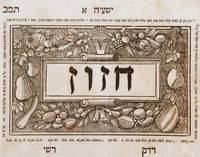
(Bible: Old Testament; Hebrew; Aramaic; Commentary). Buxtorf, Johann, the Elder (ed)
Ha-'Esrim ve-'Arba'ah The Twenty-Four Holy Books i.e. The Hebrew Bible BOUND WITH: Tiberias sive Commentarius Masorethicus triplex historicus didacticus criticus ad illustrationem Operis Biblici A Three-fold Historical Didactic and Critical Commentary on the Masora for the Illustration of the Hebrew Bible
Basel: Ludwig König 1619. First edition in part. Hardcover. Good. Eight parts in three volumes folio biblical texts and commentary in four parts continuously foliated; three supplemental sections each with separate foliation; Tiberias 1655 with separate pagination here bound after the Haftarot - Vol. 1: 6 title and prelims 1-228 1 sect. title 234-441 1 blank ff. Vol. 2: 1 sect. title 442-705 3 blank 707 sect. title-837 1 blank ff. Vol. 3: 839 half-title-881 1 blank 883-946; 8 Targum Yerushalmi; last leaf unfoliated; 67 Masorah 1 blank; 1 title 2-36 Haftarot ff.; 8 title and prelims 108pp. Despite the gap in foliation between the first and second parts and numerous errors in foliation throughout the Rabbinic Bible collates complete with all blanks noted in Prijs Die Basler hebräischen Drucke and the Haftarot bound at the end. Largely arranged in two columns of biblical texts in square font surrounded by commentaries in rabbinic Rashi font; biblical texts read from right to left. This copy with collective Hebrew title surrounded by biblical quotations in Hebrew set within elaborate woodcut architectural borders; brief preface in Hebrew by Abraham Braunschweig at the verso. Hebrew sectional titles set within the same woodcut borders for the three other biblical sections and the Haftarot with a plain letterpress half-title for the Five Megillot. Opening word of each biblical book set in large one-third to one-half page cartouche vignettes with elaborate woodcut borders and surrounding letterpress Hebrew text. Main title Jewish date chronogram = 5378 1618-1619. Near-contemporary half calf over speckled boards worn and rubbed; spines with raised bands gilt morocco lettering pieces and old paper labels heavily faded. About two-thirds of the text embrowned ranging from minimal to moderately heavy; worm tracing in a 1- by 2-inch section at leaves 541-553 affecting text. A good complete set notably containing the Ashkenazi Haftarot readings not found in all copies.<br /> <br /> Sixth Rabbinic Bible in Hebrew: Mikra'ot Gedolot edited by Johann Buxtorf I 1565-1629 professor of Hebrew at the University of Basel and the foremost Christian Hebraist of his era with the assistance of the Jewish scholars Abraham Braunschweig who served as the principal corrector and Mordechai Gumplin of Posen. This was "a truly audacious undertaking for his time" Burnett as no Christian scholar had yet attempted to edit the entire biblical corpus including the Aramaic versions Targumim and masoretic notes. Based mainly on the third Rabbinic Bible published by Daniel Bomberg at Venice in 1546-1548 the editor has carefully incorporated elements from two other Venetian editions. At the verso of the Latin title Buxtorf provides a detailed bibliographical excursus on the earlier Venetian editions and offers a tribute to Bomberg's industry by reprinting the colophon of the second Venetian Rabbinic Bible 1524-1525 at the conclusion of the masoretic appendix with text by the Hebrew grammarian and lexicographer Elijah Levita 1468 or 1469-1549 and a new introduction by Abraham Braunschweig. The design of the sectional titles and separate book title vignettes closely model those of the Venetian editions. "Buxtorf did not plan simply to reprint one of the existing Venice editions but rather to assemble the best features of them all into one work" and "to provide theologians with what he considered the most important tools for interpreting the Old Testament" Burnett. Buxtorf served in an official capacity as Basel's Hebrew censor charged with the oversight of all Jewish printing in the city and insuring that "no 'blasphemies' or slurs against Christians or Christianity appear in any book printed in Basel" Burnett. He carefully edited the Jewish commentaries in the Rabbinic Bible in accordance with this mandate "and removed many words and phrases which had escaped the attention of earlier censors" Burnett. <br /> <br /> The Rabbinic Bible contains the vocalized Masoretic text of the Hebrew Scriptures with accents and a vocalized Targum an Aramaic paraphrase of the biblical text: Onkelos for the Pentateuch; Jonathan b. Uzziel for the Prophets; and Targum Hagiographa for the Writings. The Hebrew and Aramaic versions are printed in square characters and presented in facing columns at the center of each page. The Jerusalem Targum of the Pentateuch appears as an appendix. In addition to the Aramaic paraphrases the Rabbinic Bible includes a massive scholarly apparatus of biblical commentaries by Rashi Ibn Ezra Baal ha-Turim Jacob b. Asher R. David Kimchi Radak R. Levi b. Gershon Ralbag Saadia Gaon and R. Isaiah along with the Masora a corpus of critical notes on the external form of the Biblical text compiled by Jewish scholars from late antiquity through the medieval era. As frequently occurs a copy of Buxtorf's work on the textual history of the Hebrew Bible Tiberias the 1655 revised edition is bound-in. This work was made possible by the publication in 1538 of Elijah Levita's Masoret ha-Masoret a commentary on the Masora which Buxtorf translated into Latin for his own private use in 1593. While "Buxtorf was concerned with the integrity of the consonantal text and the origin and integrity of the vowel points and accents of the Hebrew Bible from the very beginning of his scholarly career." While he had earlier published a long excursus on the age of the vowel points and accents in his 1609 Thesaurus Grammaticus "Tiberias is Buxtorf's fullest and most impressive work on the history of the biblical text" Burnett. Intended as a reference work for Christian students and scholars interested in studying the Masora Buxtorf was also keen to refute the view advanced by Levita that the Hebrew vowel points were early medieval innovations. Our folio version of Tiberias was intended to accompany the Rabbinic Bible and has the same architectural borders at the title. König also published a quarto edition in the same year but only the folio version includes a critical commentary on the Masora in which Buxtorf proposes various corrections to the Masoretic notes. <br /> <br /> As noted at the title Buxtorf's faithful study and tireless labor studio fido et labore indefesso yielded notably long-lasting results: "The Basel rabbinical Bible became a standard tool for research among Christian scholars and would remain so. until the end of the nineteenth century" Burnett. A vast array of early modern scholars including Protestants like Johannes Drusius and John Selden as well as Roman Catholics like Robert Bellarmine and Andreas Masius owned a copy or two of the Rabbinic Bible. "Johannes Buxtorf's thoroughly censored "Christian" version of the Rabbinic Bible Basel 1618-19 only made it easier for Hebraists to own copies of their own" Burnett Christian Hebraism in the Reformation Era p.163.<br /> <br /> A note on the date of publication: "The actual printing began between the mid-August and mid-September of 1618. According to the colophon production ended on the 24 of Ab 379 = August 4 1619 but since this date also appeared on the colophon of the Bomberg Biblia rabbinica edition of 1524-25 reprinted unchanged in the 1546-48 and 1568 editions it is suspect. Prijs suggested that the probable completion date was sometime during Ab of 379 between July 12 and August 10 of 1619" Burnett. References: Biblia Sacra: Burnett 7. Cowley 87. Darlow & Moule 5120 like our copy bound with the 1665 second edition of Tiberias cf. 5093. Davidson Otsar ha-shirah vol.1 p.406 no.8954. Prijs 219. Steinschneider 423 423b. VD17 23:675325G. S. Burnett Christian Hebraism in the Reformation Era Leiden: Brill 2012 p.163. Tiberias: Burnett 114. Prijs 272a. For detailed analyses of both works see: S. Burnett From Christian Hebraism to Jewish Studies Leiden: Brill 1996 pp.169-239 chaps. 6 & 7. Ludwig König hardcover
Referenz des Buchhändlers : 52679
|
|
|
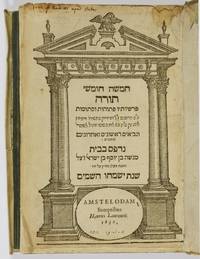
(Bible: Old Testament; Hebrew); Menasseh (or, Manasseh) ben Israel (ed)
Hamishah Humshei Torah. u-Nevi'im Rishonim va-Aharonim u-Khetuvim The Five Books of Moses the Former and Latter Prophets and the Writings
Amsterdam: printed by Menasseh ben Israel for Henricus Laurentius 1631. First edition. Hardcover. Very good-. Octavo 16.8 by 11.4 cm. Collation: aleph-lamed-zayin8 = 296 leaves. 612 i.e. 592 pp: p. 464 erroneously numbered 484 465 as 485 and so on throughout. Two column text in unvocalized Hebrew; every fifth verse numbered in the margin. Title within architectural border; half titles with letterpress ornamentation for the Former and Latter Prophets. Contemporary vellumwith exposed thongs edges stained blue; yapp fore-edges; front joint cracked but holding strong. Intermittent light toning to text outmost leaves a bit more darkened; very occasional small stains. Title-page slighltly trimmed 4 mm at bottom edge; expert marginal repairs at bottom corners of 2 leaves; 1 leaf re-margined at fore-edge with no loss of text else a very good copy with crisp clean text.<br /> <br /> First Hebrew Bible published in Amsterdam printed by the rabbi diplomat publisher and religious thinker Menasseh ben Israel 1604-1657 one of the most distinguished members of the Portuguese Jewish community of Amsterdam and the first Jewish printer in the Northern Netherlands. The Amsterdam printer and publisher Hendrick Laurensz Lauretius provided the financing for this edition along with two other Bible editions and two editions of the Hebrew Psalms printed by Menasseh between 1631 and 1646. "These publications were not only made for the local market but mainly for international trade. Thanks to this financial help Menasseh was able to organize his printing office in a more professional way" Fuks hiring a Jewish compositor Judah Leb ben Mordecai Gimple from Posen and a gentile compositor Bartholomeus Laurensz. <br /> <br /> The printing activity of Menasseh was especially important in the steadily growing productions of the Hebrew press in the Northern Netherlands. Fulfilling the needs of the Sephardic community for Jewish ritual texts eliminated the need for expensive imports from Venice and Poland. Menasseh undersood that the relatively cheap paper and tools available in Amsterdam made it possible to compete in quality and prices with the Hebrew presses of Poland Italy and Basel. "Gentile publishers and booksellers in Amsterdam such as Jansonius and Laurentius were quick to see the opportunity of the opening Eastern European market and financed several of Menasseh's publications" Fuks. Menasseh was the first to introduce in the Netherlands waybertaytsch types for Yiddish publications along with illustrated Hebrew books. He was also the first Jewish printer to adopt the Dutch pocket-book format made famous by the Elzeviers.<br /> <br /> Notes on publication date and issue: The title is dated 1630 in Arabic numerals; the colophon notes the date of completion in Hebrew characters as 5 Adar 5391 = 7 February 1631 along with the printer's apology for being unable to provide the index of pericopes promised on the title-page due to lack of printing material. Darlow and Moule describe this issue as Variant A with a Latin imprint appearing in the cartouche beneath the Hebrew title.<br /> <br /> Provenance and annotations: early entry in brown ink at front paste-down with short Greek inscription Theos. dated 1700; old Latin inscription in black ink at top margin title in reference to Hebrew roots; date of 1812 beside Yiddish entry penned in black ink within imprint cartouche at title; old entry in German penned in black ink at verso title beneath which is an oval cartouche in imitation of the one at the title in which an owner has penned in black ink the Hebrew imprint information regarding Hendrick Laurensz as it would appear in the Varient B issue; old library shelf marks at rear paste-down; recent owner entry in blue ink in Hebrew at front paste-down. References: Darlow and Moule 5123a; Fuks/Fuks-Mansfeld no. 152; pp. 105; 111f.; Steinschneider no. 453; Vinograd Amsterdam 22.<br /> <br /> Full title and imprint: חמשה חומשי תורה פרשיותיו פתוחות וסתומות ×¢"פ ×”×¨×ž×‘× ×–"ל ומדוייק בחסירו' ויתרות להעתק ס"ת ×¢× ×œ×•×— בסופו מועיל לסופרי' ×•× ×‘×™××™× ×¨××©×•× ×™× ×•××—×¨×•× ×™× ×•×›×ª×•×‘×™×: × ×“×¤×¡ בבית ×ž× ×©×” בן ישר×ל ז׳׳צל והוגה בעיון × ×ž×¨×¥ על ידו ×©× ×ª ישמחו השמי×<br /> Amstelodami sumptibus Henrici Laurentii 1630. printed by Menasseh ben Israel for Henricus Laurentius hardcover
Referenz des Buchhändlers : 55459
|
|
|
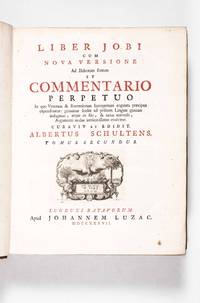
(Bible: Old Testament Job Hebrew Latin Commentary). Schultens, Albert (ed)
Liber Jobi cum nova versione ad Hebraeum fontem et commentario perpetuo. Tomus Primus -Tomus Secundus The Book of Job Newly Translated from the Hebrew with a Running Commentary
Leiden: Jean Luzac 1737. First edition. Two volumes large quarto. 52 544; 2 545-1232 63 indices 1 corrigendapp. Text in two columns with Hebrew text and facing Latin translation interspersed with commentary. Titles in red and black with engraved vignettes. Contemporary speckled calf; gilt-tooled spine with raised bands and morocco lettering pieces; gilt dentelles; edges daubed in red and green. Light scuffing to boards and fading to spines. A very good set with crisp clean text throughout.<br /> <br /> First edition of this comprehensive commentary to the biblical Book of Job by the Dutch scholar of Semitic languages Albert Schultens 1686-1750 who maintained "that the true nature of the Hebrew language and the meaning of many of its words and idioms are to be found chiefly in the Arabic" Orme. Fifty-five pages of the indices constitute a brief lexicon and provide Latin as well as Arabic equivalents for more than 1000 Hebrew words. Schultens studied theology and eastern languages at Groningen where he received his degree in theology in 1709. After a brief career as a preacher in Wassenaar he was nominated professor of Hebrew and Jewish antiquities at Franeker in 1713. In 1729 he decamped for Leiden were he was first appointed reader in eastern languages and finally full professor in 1732.<br /> <br /> At this time a chief concern of Calvinist theologians was to liberate Old Testament exegesis from the Jewish Rabbinic as well as Catholic traditions. Schultens' influential and controversial solution was revealed as early as 1706 in his first public thesis Disputatio theologico philologica de utilitate linguae Arabicae in interpretanda S. Scriptura A Theologico-Philosophical Dissertation on the Utility of the Arabic Language for the Interpretation of the Holy Scriptures "a forceful attack" Brugman & Schröder on the Protestant sola scriptura methodology of Biblical exegesis. "With the help of Jacobus Golius' Arabic dictionary he perused with zeal and fervour the Old Testament and wrote prolifically. The lexical superiority of Arabic had led him to a reconsideration of the position of Hebrew: at first he had called Arabic 'the most splendid daughter of mother Hebrew' but in his oration of 1729 he proclaimed Hebrew and Arabic cognate twin sisters. This shocked conservative theologians as an outright profanation of God's Word" Brugman & Schröder. "In 1737 he applied his theories in his bilingual edition of the book of the prophet Job whom he regarded as an Arab. The Hebrew text and the Latin translation are all but totally submerged by the extensive commentary in which Schultens draws abundantly on Arabic texts such as the Hamasa an anthology of early Arabic poetry by the ninth-century poet Abu Tammam" Vrolijk & van Leeuwen. Schultens was not without his critics and by 1824 William Orme notes a turning of the tide: "Different opinions are entertained of the correctness of his views and also of his success in applying them; but it is now generally admitted that he carries his notions of the advantage of Arabic learning to the interpretation of the Scriptures too far." <br /> <br /> Jean Luzac 1728-1777 was a member of a well-known Huguenot family of printers; he published many works for the University of Leiden including three Hebrew books of Albert Schultens. Isaac van der Mijn is noted as the printer at the colophon of the second volume.<br /> <br /> Provenance: printed label of the Bibliotheca Seminarii Warmondani at the front endleaf of the first volume. Full title: Liber Jobi cum nova versione ad Hebraeum fontem et commentario perpetuo in quo Veterum et Recentiorum Interpretum cogitata præcipua expenduntur: genuinus sensus ad priscum Linguae genium indagatur atque ex filo et nexu universo Argumenti nodus intricatissimus evolvitur. Curavit et editit. Albertus Schultens. Tomus Primus. -Tomus Secundus<br /> <br /> References: J. Brugman & F. Schröder Arabic Studies in the Netherlands Leiden: E.J. Brill 1979 p.26f. Fuks/Fuks-Mansfeld 78. Orme Bibl. Biblica p. 390. A. Vrolijk & R. van Leeuwen Arabic Studies in the Netherlands a Short History in Portraits 1580-1950 Leiden: E.J. Brill 2014 pp. 73-79. Jean Luzac unknown
Referenz des Buchhändlers : 49261
|
|
|
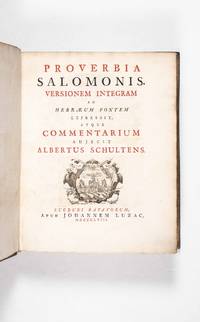
(Bible: Old Testament Proverbs Hebrew Latin Commentary). Schultens, Albert (ed)
Proverbia Salomonis. Versionem integram ad Ebraeum fontem expressit atque Commentarium adjectit The Proverbs of Salomon Translated from the Hebrew with a Commentary
Leiden: Jean Luzac 1748. First edition. Hardcover. Very Good. Quarto. 8 cviii 522 60 indices & corrigendapp. Text in two columns with Hebrew text and facing Latin translation interspersed with commentary. Title in red and black with engraved vignette; woodcut ornaments. Contemporary Dutch paneled vellum with blind-stamped vignettes and ruled borders; manuscript title at spine. Covers lightly soiled. Occasional touches of soiling and some leaves with mild embrowning. A very good copy generally crisp and clean.<br /> <br /> First edition of this comprehensive commentary to the biblical Book of Proverbs by the Dutch semitic language scholar Albert Schultens 1686-1750 who maintained "that the true nature of the Hebrew language and the meaning of many of its words and idioms are to be found chiefly in the Arabic" Orme. Forty-one pages of the indices constitute a brief lexicon and provide Latin as well as Arabic equivalents for more than 1000 Hebrew words. Schultens studied theology and eastern languages at Groningen where he received his degree in theology in 1709. After a brief career as a preacher in Wassenaar he was nominated professor of Hebrew and Jewish antiquities at Franeker in 1713. In 1729 he decamped for Leiden were he was first appointed reader in eastern languages and finally full professor in 1732.<br /> <br /> At this time a chief concern of Calvinist theologians was to liberate Old Testament exegesis from Jewish Rabbinic as well as Catholic traditions. Schultens' influential and controversial solution was revealed as early as 1706 in his first public thesis Disputatio theologico philologica de utilitate linguae Arabicae in interpretanda S. Scriptura A Theologico-Philosophical Dissertation on the Utility of the Arabic Language for the Interpretation of the Holy Scriptures "a forceful attack" Brugman & Schröder on the Protestant sola scriptura methodology of Biblical exegesis. "With the help of Jacobus Golius' Arabic dictionary he perused with zeal and fervour the Old Testament and wrote prolifically. The lexical superiority of Arabic had led him to a reconsideration of the position of Hebrew: at first he had called Arabic 'the most splendid daughter of mother Hebrew' but in his oration of 1729 he proclaimed Hebrew and Arabic cognate twin sisters. This shocked conservative theologians as an outright profanation of God's Word" Brugman & Schröder. <br /> <br /> Like his earlier commentary on the Biblical Book of Job one here finds that the "Hebrew text and the Latin translation are all but totally submerged by the extensive commentary in which Schultens draws abundantly on Arabic texts such as the Hamasa an anthology of early Arabic poetry by the ninth-century poet Abu Tammam" Vrolijk & van Leeuwen. Schultens was not without his critics and by 1824 William Orme notes a turning of the tide: "Different opinions are entertained of the correctness of his views and also of his success in applying them; but it is now generally admitted that he carries his notions of the advantage of Arabic learning to the interpretation of the Scriptures too far." <br /> <br /> Jean Luzac 1728-1777 was a member of a well-known Huguenot family of printers; he published many works for the University of Leiden including three Hebrew books of Albert Schultens. Isaac van der Mijn is noted as the printer at the colophon of the second volume.<br /> <br /> Provenance: bookplate of the Crozer Theological Seminary - Bucknell Library; bookseller's ticket of Librairie Ancienne et Moderne de Frederik Muller Amsterdam at the front paste-down. References: J. Brugman & F. Schröder Arabic Studies in the Netherlands Leiden: E.J. Brill 1979 p.26f. Fuks/Fuks-Mansfeld 78. Orme Bibl. Biblica p. 390. A. Vrolijk & R. van Leeuwen Arabic Studies in the Netherlands a Short History in Portraits 1580-1950 Leiden: E.J. Brill 2014 pp. 73-79. Jean Luzac hardcover
Referenz des Buchhändlers : 49255
|
|
|
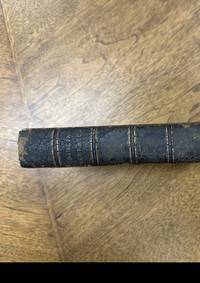
(Bible: Old & New Testament; Hebrew)
Sefer ha-Kodesh ve-hu Torah Ne-vi'im Ketuvim gam Kitve Berit ha-Hadashah The Holy Scriptures that is Torah Prophets and Writings Along with the New Testament FIRST HEBREW VERSION OF THE NEW TESTAMENT PUBLISHED IN THE UNITED STATES
Philadelphia: Bagster & Marshall 1839. First American edition. Hardcover. Good . Octavo. 6 10 778pp. Pointed Hebrew text in two columns the New Testament with only vocal marks. Continuous pagination in Arabic numerals; but separate Hebrew pagination for the Old and New Testaments. Contemporary three-quarter calf over pebbled cloth boards; spine with raised bands ruled and lettered in gilt. Decorative endleaves. Covers rubbed with wear at spine caps and corners. Library pressure stamp at title bookplate and pocket at paste-downs. A good ex-library copy with very clean fresh text throughout.<br /> <br /> First American edition of this Hebrew Bible earlier published by Samuel Bagster at London in 1835; it contains the first printing of the New Testament in Hebrew translation to appear in the United States. That translation was prepared by the philologist William Greenfield 1799-1831 the editorial superintendent of the British and Foreign Bible Society and first published by Samuel Bagster at London in 1831 D&M no. 5186. In preparing his revised Hebrew version Greenfield was allowed to utilise the London Jews' Society Hebrew New Testament published at London between 1813 and 1817 D&M no. 5170. Among the earliest publications of the society founded in 1809 this version was itself based upon Elias Hutter's Hebrew translation of the New Testament published at Nuremberg in 1599 D&M no. 5111. Prepared by a group of scholars under the supervision of Thomas Fry and William Bengo Collyer this London Jews’ Society edition employed only biblical words and translated Old Testament quotations from the Greek not citing them directly from the Hebrew Scriptures.<br /> <br /> The editor of the New Testament version in the present work appears to have had a notable gift for languages. William Greenfield began his Hebrew studies as a young man while apprenticed to a bookbinder taking lessons from one of his co-workers a Jew with some learning who had been described as "a reader of the law in the synagogue" ODNB. Greenfield subsequently left the business in 1824 in order to devote himself to languages and biblical criticism. His defence of the Serampore Mahratta version of the New Testament in response to an 1829 article in the Asiatic Journal brought him to the attention of the British and Foreign Bible Society who then hired him to superintend their editiorial department. "During his nineteen months in the society's service Greenfield wrote on twelve European five Asiatic one African and three American languages and acquired considerable knowledge of Peruvian African-English Chippeway and Berber" ODNB. His revision of the Hebrew New Testament earlier published by the London Jews' Society was among the last works he undertook for the British and Foreign Bible Society along with the revision of the Modern Greek Psalter as it went through the press.<br /> <br /> Provenance: Bookplate and other markings including withdrawal stamp of the Library of the Garrett Theological Seminary Evanston Illinois. Full title in Hebrew: ספר הקדש ×•×”×•× ×ª×•×¨×” × ×‘×™××™× ×•×›×ª×•×‘×™× ×’× ×›×ª×‘×™ ברית החדשה × ×¢×ª×§ מלשון ×™×•× ×™×ª ×ל לשון עברית <br /> Philadelphiae: Sumptibus Bagster et Marshall in via vulgo dicta Chestnut Street ad Repositorium Bibliorum Sacrorum etc. quae in linguis antiquis et hodiernis edita sunt. Anno erae Judaicae I rev. C; rev. C DXCIX.<br /> <br /> References: Goldman Hebrew Printing in America no. 6: "This was the first New Testament published in Hebrew in America." ODNB: "Greenfield William" Gordon Goodwin revised by H. C. G. Matthew. J. R. Marcus "Jewish Americana a Supplement to A. S. W. Rosenbach An American Jewish Bibliography" in: Monographs of the American Jewish Archives 1954 no. 1 no. 164. Cf. Darlow & Moule nos. 5111; 5170; 5186. Bagster & Marshall hardcover
Referenz des Buchhändlers : 52150
|
|
|
(Bible: Old Testament; Hebrew; Critical Edition). Kennicott, Benjamin (ed)
Vetus Testamentum Hebraicum cum variis lectionibus. Tomus primus -secundus. Dissertatio generalis in Vetus Testamentum Hebraicum The Old Testament with Various Readings. A General Dissertation on the Old Testament
Oxford: The Clarendon Press 1776. First edition. Hardcover. Near fine. Two volumes folio published in 1776 and 1780. xxiii title and subscribers' list 1 blank VIII preface 684 1 catalogue of manuscripts 1 blank; 4 title and subscribers' list 732 129 1 blank 6 indicespp. Expertly rebound in modern quarter vellum over marbled boards spines titled in gilt. Titles darkened and dusty; very occasional light foxing or oxidation spots; dampstain at bottom quarter of the first twenty and final four leaves in the first volume else a nearly fine wide-margined set crisp and uncut.<br /> <br /> First edition and the "earliest attempt to provide a critical edition of the Hebrew Scriptures on a large scale†D&M and a notable early example of a large-scale scholarly project which attracted international financial and scholarly support. The biblical scholar Benjamin Kennicott 1718-1783 was educated at Oxford and "instructed in Hebrew by Professor Thomas Hunt and the greater part of his life was spent in the collation of Hebrew manuscripts with the object of producing a definitive original text of the Old Testament. Robert Lowth always his major patron first inspired him with a desire to test the accuracy of the Hebrew text of the Old Testament. With his formidable knowledge of Syriac early Latin the Septuagint and the Samaritan Pentateuch it was recognized that he was very well qualified for the task. His critical examination of manuscripts initially in the British Museum and the libraries of Oxford and Cambridge began in 1751 and when Thomas Secker then bishop of Oxford and also a member of Exeter College urged him in March 1758 to undertake their collation he agreed to the request. In return Secker when archbishop of Canterbury gave Kennicott his unstinting support and friendship when for a time he nurtured a project for producing a revised Authorized Version of the Bible. Meanwhile in 1753 Kennicott issued The State of the Printed Hebrew Text of the Old Testament Considered: a Dissertation and in 1759 he brought out a second dissertation on the same subject. He identified his object thus: to compare Scripture with itself to explain a difficult phrase or passage by a clear one that bears some relation to it to consider the natural force of the Original Words the tendency of the Context and the Design of the Writer; to compare the most ancient editions of the Original with one another and with the best copies of the most celebrated versions vol.1 p.12. These volumes were translated into Latin by W. A. Teller and published at Leipzig the first in 1756 the second with additions in 1765.<br /> <br /> Kennicott's scholarly endeavours attracted support in Britain and beyond. In England subscriptions amounted to £9119 7s. 6d.; in France the duc de Nivernois a former French ambassador to the court of St James patronized him and helped him to gain access to Parisian manuscript collections in 1767; the king of Denmark offered him the use of six ancient manuscripts; four quarto volumes of variant readings were sent to him on the king of Sardinia's orders; and the stadholder of the Netherlands made an annual donation of 30 guineas. His first report On the Collation of the Hebrew Manuscripts of the Old Testament was forwarded to the subscribers in December 1760 and a similar statement appeared each year until 1769. This annual summary afforded him an opportunity to defend the accuracy of his own collations the Hebraic scholarship of the staff assisting him and to print lists of subscribers. A copy of the entire work was personally presented by Kennicott to George III. Lowth called the 1776 variorum Old Testament 'a work the greatest and most important that has been undertaken and accomplished since the Revolution of Letters' B. Hepworth Robert Lowth p. 145" Nigel Aston ODNB. An early judgement on this seminal edition is provided by William Orme in his 1824 Bibliotheca Biblica: “This is beyond all comparison the most splendid edition of the Hebrew Scriptures ever published. It was patronized by most of the crowned heads of Europe. It occupied its learned editor in preparation or actual labour more than thirty years. More than six hundred MSS. and editions were collated for it in all parts of Europe. The text is that of Vander Hooght without the points. The Samaritan Pentateuch where it differs from the Hebrew text is printed in parallel columns in the Hebrew character. The various readings are almost innumerable and occupy in general the largest half of every page. The Dissertatio Generalis annexed to the second volume is invaluable for the information which it contains respecting the state of the original text and the sound principles of criticism which it exhibits." The final leaf lists 312 manuscripts and some printed editions which provided the various readings noted throughout the apparatus. The concluding Dissertatio Generalis was republished separately at Braunschweig in 1783 by professor Paul Jakob Bruns who assisted Kennicott in his collations.<br /> <br /> Provenance: Engraved bookplate of the Parochial Library of St Phillips Birmingham in the County of Warwick at front endleaf in both volumes. References: N. Aston "Benjamin Kennicott" in: ODNB. Darlow & Moule 5160. ESTC T147508. Orme Bibl. Biblica 238. For a notable recent discussion see J. Turner Philology: The Forgotten Origins of the Modern Humanities Princeton Univ. Press 2014 77f. An earlier assessment of the critical endeavors of Kennicott and De Rossi appears in N. P. Wiseman's 1836 Twelve Lectures on the Connexion between Science and Revealed Religion pp.368-371 ed. Dublin 1866. The Clarendon Press hardcover
Referenz des Buchhändlers : 53321
|
|
|
(Hebrew Bible - van der Hooght - Athiae)
Torah nevi'im u-khetuvim BIBLIA HEBRAICA secundum ultimam editionem Jos. Athiae a Johanne Leusden denuo recognitam recensita atque ad Masoram et correctiorea Bobbergi Stephani Plantini aliorumque editiones exquisite adornata variisque notis illustrata ab Everardo van der Hooght V.D.M. Editio longe accuratissima.
Amsterdam & Utrecht: H. Boom Joh. II van Waesberge Goethals Ger. Borstius Joh. Wolters Fr. Halma W. van de Water & W. Broedelet 1705. Third Edition . Hardcover - as published. Engraved title page in red & black plus four additional engraved title pages for each of the four parts into which the text is divided: 1 Genesis - Deuter.; 2 the Prophetae antiores; 3 the Prophetae posteriores; and 4 Hagiographa. Text is in Hebrew with the preliminaries and preface by van der Hooght & others as well as the printed marginalia in Latin. This is actually the third editon edited & revised by van der Hooght of the famous Hebrew Bible originally published by Joseph Athias in 1661. Thick octavo; a.e.g. Some light worming to end leaves pastedown & rear board; lacking rear front fly leaf & front rear fly leaf. Also first engraving detached. Spine is dry and rubbed along raised bands 5 panels with some light wear to edges & joints; head of spine is torn but without loss; rubbed label in 2nd panel present & readable; some worming at head of spine; small gouge on back board. A very nice internally clean tight copy of a scarce title. H. Boom, Joh. II van Waesberge, Goethals, Ger. Borstius, Joh. Wolters, Fr. Halma, W. van de Water, & W. Broedelet hardcover
Referenz des Buchhändlers : 36556
|
|
|
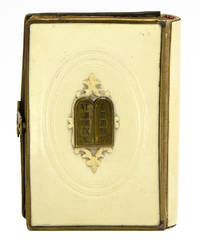
(Hebrew Prayer Book)
The Form of Daily Prayer according to the custom of the German and Polish Jews with a new translation by Joseph Güns
Vienna: Jos. Schlesinger Library 1857. Text in Hebrew and English. 875 3pp. Thick 12mo. Near contemporary binding of celluloid over cloth with bone and metal decorations and metal clasp. Light surface rubbing to covers text toned. Text in Hebrew and English. 875 3pp. Thick 12mo. Jos. Schlesinger Library unknown
Referenz des Buchhändlers : 311893
|
|
|
(jt) (Marx, Alexander) Frankel, David, editor
SEPHER HA-YOVEL: A TRIBUTE TO PROFESSOR ALEXANDER MARX BY COLLEAGUES, DISCIPLES AND FRIENDS ON COMPLETING FORTY YEARS OF DISTINGUISHED SERVICE AS LIBRARIAN OF THE JEWISH THEOLOGICAL SEMINARY OF AMERICA.
Large 8vo; 154 + 10 pages; 1 essay (10 pages) by Moses Marx in English: The Last Hebrew Books Printed in the Fifteenth Century: The Second Edition of the Mashal Ha-Kadmoni and the Quarto Tur Orah Hayyim (on Gershom Soncino and includes 6 photo plates of the book) ; remainder of essays are in Hebrew. Bottom of spine bumped, Good Condition (FEST-6-6b) xx

|
|
|
(Jt) Aescoly, Aaron Zeev.
YISRAEL : PIRKE ETNOLOGYAH, YEDI`AT HA-`AM.
(FT) Large 8vo. 7, 252 pages. Illustrated with charts and fold-outs. In Hebrew. SUBJECT(S) : Jews - history. OCLC lists 15 copies worldwide. Aescoly (1910-1948) was a "Hebrew writer, historian, and ethnologist. Aescoly studied in Berlin, Liège, and Paris, where for a short time he taught at the Ecole Nationale des Langues Orientales Vivantes. In 1925 he immigrated to Palestine, although he did scholarly research in Paris from 1925 to 1930 and from 1937 to 1939. From 1939 he directed the I. Epstein Training College for kindergarten teachers which he had founded. During World War II he served in the British Army and, as chaplain, in the Jewish Brigade. Aescoly's contributions to Jewish scholarship cover a wide field. His ethnological writings include Geza ha-Adam, Yisrael, and a number of studies on the Beta Israel. " (EJ, 2007) Hinges repaired, dent in spine, rubbed spots on front cover, good condition. (HebLit-4-17)
|
|
|
(Jt) Amir-Pinkerfeld, Anda.
GADISH : SHIRIM.
(FT) 12mo. 450 pages. In Hebrew. SUBJECT(S) : Poetry. OCLC lists no copies for this edition worldwide. Amir-Pinkerfeld (1902-1981) "was born in Galicia, into an assimilated family. Her father worked as an architect for the Austro-Hungarian government. She completed secondary school in Lvov, and published a book of verse in Polish at the age of 18, her first poem being the prayer of a Polish child for the liberation of his country. After studying at the universities of Leipzig and Lvov, she immigrated to Palestine in 1923. In 1921 she published another volume of verse in Polish, Piesni zycia. Thereafter, under the influence of Uri Zevi Greenberg, she began writing in Hebrew. The themes of her verse are love of nature, romantic love, and the joys of motherhood. Her long poem "Ahat" describes a young Jewish girl who immigrates to Israel after surviving the Holocaust and dies fighting for Israeli independence. [She] was the first poet to write poetry in Hebrew specifically for children and distinguished herself in this field. In 1978 she received the Israel Prize for children's literature. " (EJ, 2007) Shalom Spiegel's copy with his bookplate. Has dust jacket. Tanned, gift inscription on free endpaper, good+ condition. (HebLit-5-29)
|
|
|
(Jt) Avinery, Isaac.
KIBUSHE HA-`IVRIT BE-DORENU.
(FT) 16mo. 195 pages. In Hebrew. English title: The achievements of modern Hebrew. SUBJECT(S) : Hebrew language. OCLC lists 26 copies worldwide. SERIES: Le-khol. Ex library with minimal markings and library binding. Light moisture marks on first and last couple pages, good+ condition. (HebLit-4-5)
|
|
|
(Jt) Avnery, Shraga.
SHIN SHALOM : HEDIM, TEGUVOT U-MAAMARIM `AL SHIRATO.
(FT) 8vo. 333 pages. In Hebrew. English title: Shin Shalom : a selection of critical essays on his poetry. SUBJECT(S) : Shalon, Shin, b. 1904; Poetry, Hebrew. Shalom Spiegel's copy with his bookplate. Has rubbed dust jacket. Good+ condition. (HebLit-5-16)
|
|
|
(Jt) Bacher, Wilhelm; Alexander Siskind Barinovitz.
AGADAT AMORAE ERETS-YISRAEL. VOLUME 2.
(FT) 8vo. 269 pages. In Hebrew. Volume two, in two parts. SUBJECT(S) : Amoraim; Aggada. Ex library. Light wear, good condition. (HebLit-5-11)
|
|
|
(Jt) Bar-Yossef, Yehoshua.
HA-`OMDIM `AL HA-SAF : ROMAN.
(FT) 12mo. 310 pages. In Hebrew. SUBJECT(S) : Fiction. OCLC lists 18 copies worldwide. Ex library. Pages tanned, Water stains in corners, good condition. (HebLit-4-1)
|
|
|
(Jt) Bavli, Hillel
ADERET HA-SHANIM: SHIRIM.
(FT) 8vo. 221 pages. In Hebrew. Bavli, (18931961) , was a Hebrew poet and educator. Bavli, who was born in Pilvishki, Lithuania, attended yeshivot in Kovno and Vilna. In 1912 he immigrated to the United States and studied at Canisius College and Columbia University. From 1918 he taught modern Hebrew literature at the Jewish Theological Seminary of America, after 1937 with the rank of professor. Bavli's first poems appeared in a children's periodical, Ha-Perahim, in 1908. His first book of poetry, Neginot Arez ("Melodies of the Land") , was published in 1929. (EJ, Silberschlag) In very good condition in a very good jacket. (Heblit1-7)
|
|
|
(Jt) Ben-Or, Aharon
TOLDOT HA-SIFRUT HA-`IVRIT HA-HADASHAH, ME-RAMHAL `AD YAMENU ELEH. BI-SHELOSHAH KEREKHIM.
(FT) 8vo. 346 pages. In Hebrew. SUBJECT(S) : Hebrew literature, Modern -- History and criticism. In good condition. (heblit1-12)
|
|
|
(Jt) Ben-Yehuda, Eliezer
AD EMATAI DIBRU `IVRIT?
(FT) 12mo. 132 pages. In Hebrew. SUBJECT(S) : Hebrew language. In very good condition. (HEBLIT1-1)
|
|
|
(Jt) Berdichevsky, Micah Joseph (Ben-Gorion)
SIPURIM.
(FT) 8vo. Xxx, 201 pages. In Hebrew. SUBJECT(S) : Fiction. SERIES: Sifre mofet le-vate midrash. Berdichevsky (1865-1921) , also know as Ben-Gorion, was born in Podalia, to a long line of rabbis. In his teens, he read the Haskalah writers, and this conflict between modernism and tradition informed his entire literary career. It also caused deep disagreements with teachers and family members. He began to be published in 1888, writing both fiction and non-fiction. In 1890, he moved to Russia, and was acquainted with David Frischmann; in 1892 he moved to Germany. In Berlin, he solidified a philosophy of personal and intellectual freedom in the face of "stultifying" tradition. His writing attacked any already-established position, including the Haskalah and Zionism, and demanded an expansion of the Jewish literary canon. Though a later trip back to Russia, and witnessing the realities of Jewish life there, slightly moderated his polemics, Berdichevsky wrote much of the same, though he also branched out to collections of legends and Jewish history. It is of no surprise that his readers were divided along generational lines; the younger readers flocked to his work, while older critics rejected his ideas. (Almagor, EJ) Ex library. Occasional pencil underlining, water stains throughout, good- condition. (HebLit-5-22)
|
|
|
(Jt) Berdichevsky, Micah Joseph.
ME-OTSAR HA-AGADAH. VOLUME 1 (ONLY) , MI-NE KEDEM.
(FT) 8vo. Xv, 234 pages. In Hebrew. Volume one (of two) only. First edition. SUBJECT(S) : Legends, Jewish. SERIES: Kol kitve Mikhah Yosef Berditsevski ; ; kerekh 1-2. Berdichevsky (1865-1921) , also know as Ben-Gorion, was born in Podalia, to a long line of rabbis. In his teens, he read the Haskalah writers, and this conflict between modernism and tradition informed his entire literary career. It also caused deep disagreements with teachers and family members. He began to be published in 1888, writing both fiction and non-fiction. In 1890, he moved to Russia, and was acquainted with David Frischmann, and in 1892 he moved to Germany. In Berlin, he solidified a philosophy of personal and intellectual freedom in the face of stultifying tradition. His writing attacked any already-established position, including the Haskalah and Zionism, and demanded an expansion of the Jewish literary canon. Though a later trip back to Russia, and witnessing the realities of Jewish life there, slightly moderated his polemics, Berdichevsky wrote much of the same, though he also branched out to collections of legends and Jewish history. It is of no surprise that his readers were divided along generational lines; the younger readers flocked to his work, while older critics rejected his ideas. (Almagor, EJ) Gilt title. Backstrip missing, edgeworn, title page missing, hinges starting, good- condition. (GER-27-27)
|
|
|
(Jt) Berdichevsky, Micah Joseph. [ Ben-Gorion]
ME-OTSAR HA-AGADAH. COMPLETE IN TWO VOLUMES.
(FT) 8vo. Xv, 234 pages. In Hebrew. Complete in two volumes. First edition. SUBJECT(S) : Legends, Jewish. SERIES: Kol kitve Mikhah Yosef Berditsevski ; ; kerekh 1-2. Berdichevsky (1865-1921) , also know as Ben-Gorion, was born in Podalia, to a long line of rabbis. In his teens, he read the Haskalah writers, and this conflict between modernism and tradition informed his entire literary career. It also caused deep disagreements with teachers and family members. He began to be published in 1888, writing both fiction and non-fiction. In 1890, he moved to Russia, and was acquainted with David Frischmann, and in 1892 he moved to Germany. In Berlin, he solidified a philosophy of personal and intellectual freedom in the face of stultifying tradition. His writing attacked any already-established position, including the Haskalah and Zionism, and demanded an expansion of the Jewish literary canon. Though a later trip back to Russia, and witnessing the realities of Jewish life there, slightly moderated his polemics, Berdichevsky wrote much of the same, though he also branched out to collections of legends and Jewish history. It is of no surprise that his readers were divided along generational lines; the younger readers flocked to his work, while older critics rejected his ideas. (Almagor, EJ) Gilt titles. Inch-long section of backstrip missing at bottom on vol 2, corners worn, spines faded, tear along spine on vol 1, good condition. (GER-27-26)
|
|
|
(Jt) Bergman, Samuel Hugo
HOGE HA-DOR
8vo. 243 pages. In Hebrew. SUBJECT (S) : Philosophy, Modern -- 20th century. Bergman, (1883 1975) , was a philosopher. Bergman studied philosophy in Prague and Berlin. During his student days at Prague, he was a member of the Zionist student circle, Bar Kochba, and in 1903 began to publish articles on Zionist themes. During this period he came into contact with Martin Buber who had a lasting influence on him. From 1907 to 1919 Bergman was librarian at the University Library at Prague, except during World War I when he served in the Austrian army. In 1920 he emigrated to Palestine where he was the first director of the National and University Library, a position he held until 1935. He helped found the Histadrut ha-Ovedim and was elected a member of its executive council. (EJ, Rotenstriech) In good condition (heblit1-13)
|
|
|
(Jt) Bernfeld, Simon.
DOR HAKHAM : MONOGRAFYAH `A.D. HOKHME `AMENU HA-METSUYANIM BA-MEAH HA-19 U-TEKUFATAM.
(FT) 12mo. 90 pages. In Hebrew. SUBJECT(S) : Jews - biography; Jewish ethics. OCLC lists 11 copies worldwide. BOUND WITH: (jt) Bernfeld, Simon. DOR TAHAPUKHOT : MONOGRAFYOT MI-YEME RESHIT HASKALAT HA-YEHUDIM BE-GERMANYAH BI-SHENOT HA-MEAH HA-SHEMONEH-`ESREH. ? ? ? ? ? ? ? ? ? ? : ? ? ? ? ? ? ? ? ? ? ? ? ? ? ? ? ? ? ? ? ? ? ? ? ? ? ? ? ? ? ? ? ? ? ? ? ? ? ? ? ? ? ? ? ? ? ? ? ? ? Warsaw : Tushiyah, 1897-1898. 128, 87 pages. In Hebrew. Complete, two volumes bound in one. SUBJECT(S) : Jews -history - 1789-1945; Jew - Germany - history. OCLC lists 18 copies worldwide. "Bernfeld was born in Stanislav, Galicia, and was educated in Koenigsberg and Berlin. In 1886 he was appointed chief rabbi of the Sephardi community of Belgrade, Serbia; he remained there until 1894, when he returned to Berlin and devoted himself to scholarly pursuits. He continued his literary work until his death, despite blindness in his later years. Bernfeld wrote several monographs in Hebrew on Jewish history and philosophy, the earliest published when he was only 19." (Klausner, EJ) Tanned, good condition. (HebLit-5-25x)
|
|
|
(Jt) Bernfeld, Simon.
DOR TAHAPUKHOT : MONOGRAFYOT MI-YEME RESHIT HASKALAT HA-YEHUDIM BE-GERMANYAH BI-SHENOT HA-MEAH HA-SHEMONEH-`ESREH. COMPLETE, TWO VOLUMES BOUND IN ONE.
(FT) 12mo. 128, 87 pages. In Hebrew. Complete, two volumes bound in one. SUBJECT(S) : Jews -history - 1789-1945; Jew - Germany - history. OCLC lists 18 copies worldwide. BOUND WITH: (jt) Bernfeld, Simon. DOR HAKHAM : MONOGRAFYAH `A. D. HOKHME `AMENU HA-METSUYANIM BA-MEAH HA-19 U-TEKUFATAM. ? ? ? ? ? ? : ? ? ? ? ? ? ? ? ? ? ? ? ? ? ? ? ? ? ? ? ? ? ? ? ? ? ? ? ? ? ? ? ? ? ? ? ? ? ? ? ? ? ? Warsaw : Toshiyah, 1896. 90 pages. In Hebrew. SUBJECT(S) : Jews - biography; Jewish ethics. OCLC lists 11 copies worldwide. "Bernfeld was born in Stanislav, Galicia, and was educated in Koenigsberg and Berlin. In 1886 he was appointed chief rabbi of the Sephardi community of Belgrade, Serbia; he remained there until 1894, when he returned to Berlin and devoted himself to scholarly pursuits. He continued his literary work until his death, despite blindness in his later years. Bernfeld wrote several monographs in Hebrew on Jewish history and philosophy, the earliest published when he was only 19." (Klausner, EJ) Has postage style Max Nordau stamp on title page. Tanned, bookplate, good condition. (HebLit-5-25x)
|
|
|
(Jt) Bialik, Hayyim Nahman.
DEVARIM SHEBE-`AL PEH. VOLUME 1 (OF 2)
(FT) 8vo. In Hebrew. Tissue-papered frontispiece. Volume one (of two) only. SUBJECT(S) : Hebrew literature - history and criticism. Bialik (1873-1934) was "the greatest Hebrew poet of modern times. " His childhood and youth influenced his poetry - the fields and forests of Volhynia, the solitariness of his grandfather's house where he lived after his father died, and the yeshiva he went to in Volozhin. Other influences include Ahad Ha-Am, and Russian literature - which he began to read as he became disillusioned with the religiosity at the yeshiva, and further immersed himself in after leaving the yeshiva and going to Odessa. His first published work was the poem "El ha-Zippor, " which was published in 1892, in the first volume of Ha-Pardes. Later in life he lived also in Berlin, and settled in Palestine in 1924. (EJ, Spicehandler) Bookplate. Covers faded, wear at corners, good+ condition. (HebLit-5-28)
|
|
|
(Jt) Bialik, Hayyim Nahman.
SEFER HA-AGADAH : MIVHAR HA-AGADOT SHEBA-TALMUD UVA-MIDRASHIM SEDUROT LE-FIY HA-`INYANIM U-MEFORASHOT. VOLUME 1 (OF 3)
(FT) 8vo. In Hebrew. Volume one (of three) only. SUBJECT(S) : Aggada; Midrash. OCLC lists 20 copies worldwide. Bialik (1873-1934) was "the greatest Hebrew poet of modern times. " His childhood and youth influenced his poetry - the fields and forests of Volhynia, the solitariness of his grandfather's house where he lived after his father died, and the yeshiva he went to in Volozhin. Other influences include Ahad Ha-Am, and Russian literature - which he began to read as he became disillusioned with the religiosity at the yeshiva, and further immersed himself in after leaving the yeshiva and going to Odessa. His first published work was the poem "El ha-Zippor, " which was published in 1892, in the first volume of Ha-Pardes. Later in life he lived also in Berlin, and settled in Palestine in 1924. (EJ, Spicehandler) Marginalia throughout, otherwise good condition. (HebLit-5-7)
|
|

 Per e-mail erhalten
 Als pdf-Dokument herunterladen
 RSS feed
 Permanenter link


