|
PASCHALES M. KITROMELIDES.
Exêntapente chronia epistêmonikês prosphoras: Apotimêsê kai prooptikê, [1930-1973].
Fine Greek, Modern (post 1453) Paperback. Demy 8vo. (21 x 14 cm). In Greek (Modern). 138 p., 16 b/w plates.Exêntapente chronia epistêmonikês prosphoras: Apotimêsê kai prooptikê, [1930-1973]. Sixty-five years of scientific offerings: Evaluation and perspective.
|
|
|
Paschalis, Michael & Stavros Frangoulidis (Eds. )
SPACE IN THE ANCIENT NOVEL (Ancient Narrative Supplementum 1)
Some scuffing to front board. Very minor shelfwear. Gift inscription from Maaike Zimmerman (editorial board) to R. E. Fantham on ffep. ; Contents: DAVID KONSTAN: Narrative Spaces CATHERINE CONNORS: Chariton's Syracuse and its histories of empire MARTIN M. WINKLER: Chronotope and locus amoenus in Daphnis and Chloe and Pleasantville STEPHEN J. HARRISON: Literary Topography in Apuleius' Metamorphoses LUCA GRAVERINI: Corinth, Rome, and Africa: a Cultural Background for the Tale of the Ass MAAIKE ZIMMERMAN: On the Road in Apuleius' Metamorphoses STELIOS PANAYOTAKIS: The Temple and the Brothel: Mothers and Daughters in Apollonius of Tyre JUDITH PERKINS: Social Geography in the Apocryphal Acts of the Apostles MICHAEL PASCHALIS: Reading Space: A Re-examination of Apuleian ekphrasis RICHARD P. MARTIN: A Good Place to Talk: Discourse and Topos in Achilles Tatius and Philostratus NIALL W. SLATER: Space and Displacement in Apuleius STAVROS FRANGOULIDIS: The Laughter Festival as a Community Integration Rite in Apuleius' Metamorphoses; Ancient Narrative Supplementum 1; 192 pages
|
|
|
Paschoud, François
CINQ ÉTUDES SUR ZOSIME
Pages are tanned. Rubbing to wraps. Scholar's name to ffep (E. Badian). Correction in ink to 1 page (wrong page number in index). ; Contents: I. La digression antimonarchique du préambule de l'Histoire nouvelle; II. Zosime 2,29 et la version paienne de la conversion de Constantin; III. La fin du règne de Gratien dans l'Histoire Nouvelle de Zosime; IV. La fin du règne de Théodose dans l'Histoire nouvelle de Zosime et la source Paienne d'Eunape; Zosime et Polybe. Appendix A: Eunape, Zosime et Photios; Appendice B: Zosime et les histoires ecclésiastiques. ; Collection D'Études Anciennes; 232 pages
|
|
|
Paspaliares. Panagiotes
Ioannis Kapadistrias
[Megaloi Ellenes : dekatomo istoriko ergo. Tomos A] The first volume of a series of popular biographies produced by Skai, on the life of Kapodistrias and his contributions to establishment of the modern Greek state.160p. plates chronology, bibliography Book
|
|
|
PASSOW FRANCOIS, LONGUEVILLE E. P. M., CONGNET H.
PROSODIE GRECQUE D'APRES LES TABLEAUX PROSODIQUES DE FRANCOIS PASSOW
Jacques Lecoffre et Cie, Paris. 1848. In-8 Carré. Relié. Etat d'usage. Couv. légèrement passée. Dos satisfaisant. Rousseurs. 80 pages. Etiquette de code sur la couverture. Quelques tampons et annotations de bibliothèque. Pages de garde et de titre manquantes. Fortes rousseurs. Publié par MM. Longueville et Congnet. Le complément naturel de toutes les Grammaires, de tous les Dictionnaires grecs, etc.

|
|
|
Pastorino, Agostino
TROPAEUM LIBERI Saggio Sul Lucurgus Di Nevio E Sui Motivi Dionisiaci Nella Tragedia Latina Arcaica [Arcaida]
Former classics scholar's name stamped to ffep (A. Dalzell). Pages are tanned. Wraps have edgewear with chipping and small tears. Browning to wraps. ; Università Di Genova - Facoltà Di Lettere; 133 pages
|
|
|
PATIN M.
"Etudes sur les tragiques grecs (4 volumes); tome 1 : Eschyle, tome 2 : Sophocle; tomes 3 et 4 : Euripide."
Paris, Librairie Hachette, 1858. "12 x 18, 4 volumes, 387 + 389 + 429 + 425 pages, reliure dos/coins toilés, bon état (rousseurs; coins émoussés)."
Référence libraire : 89393
|
|
|
PATIN M.
Eschyle (Etudes sur les tragédies grecques).
Couverture rigide. Relié demi-basane. 386 pages.
Référence libraire : 88091

|
|
|
PATIN M. ( Henri Joseph Guillaume )
ETUDES SUR LA POÉSIE LATINE. Tomes 1-2
Paris Librairie Hachette et Cie 1875 in 12 (18x12) 2 volumes reliures demi veau havane de l'époque, dos à nerfs soulignés de filets à froid, pièces de titre de maroquin rouge, VII et 378 pages [1], 483 pages, quelques rares rousseurs éparses sur les premiers et derniers feuillets. Bon exemplaire ( Photographies sur demande / We can send pictures of this book on simple request )
Référence libraire : 054586
|
|
|
PATERA,M.
Figures grecques de l'épouvante de l'antiquité au présent.
Leiden, Boston, Brill, 2015.
Référence libraire : 152899
|
|
|
PATRICK (Samuel)
Geographia antiqua cum indice. quo vetera locorum nomina novus praeponuntur scholarum usui accomodata
Berlin, Oehmigke, 1800 in-12, [2]-206 pp., index, cartonnage de papier marbré, modeste étiquette de titre en papier vert au dos (reliure de l'époque). Rousseurs.
Référence libraire : 176114
|
|
|
PATTERSON HARRY
NTIAAIRKEP.
FOX BEST SELLER. 1986. In-12. Broché. Bon état, Couv. convenable, Dos satisfaisant, Intérieur frais. 214 pages - ouvrage en grec - 2 photos disponibles - petite annotation sur la page de titre au stylo noir et au stylo bleu sur la page de garde.. . . . Classification Dewey : 480-Langues helléniques. Grec
Référence libraire : R240090636
|
|
|
PATIN M. ( Henri Joseph Guillaume )
ÉTUDES SUR LES TRAGIQUES GRECS. SOPHOCLE
Paris Librairie Hachette et Cie 1870 in 12 (18x12) 1 volume reliure demi chagrin rouge de l'éditeur, dos à nerfs orné de caissons de filets dorés, plats de percaline rouge orné d'un encadrement estampé à froid, plat supérieur orné d'un fer doré du Lycée de Montpellier, 389 pages [1]. Bel exemplaire, reliure très fraîche ( Photographies sur demande / We can send pictures of this book on simple request )
Référence libraire : 053323
|
|
|
PATIN M. ( Henri Joseph Guillaume )
ÉTUDES SUR LES TRAGIQUES GRECS. EURIPIDE. Tomes 1-2
Paris Librairie Hachette et Cie 1873 in 12 (18x12) 2 volumes reliures demi chagrin rouge de l'éditeur, dos à nerfs ornés de caissons de filets dorés, plats de percaline rouge ornés d'un encadrement estampé à froid, plats supérieurs ornés d'un fer doré du Lycée de Montpellier, 427 pages, 451 pages [2]. Bel exemplaire, reliures très fraîches ( Photographies sur demande / We can send pictures of this book on simple request )
Référence libraire : 053324
|
|
|
Patera, Ioanna
OFFRIR EN GRÈCE ANCIENNE Gestes Et Contextes
Still wrapped in plastic. ; Moyen fréquemment utilisé pour établir une communication avec les dieux, les offrandes ne correspondent pas exactement, telles qu'on les conçoit aujourd'hui, à ce que les Grecs désignaient ainsi. Le vocabulaire qui leur est associé et les contextes dans lesquels elles sont trouvées sont examinés à partir des sources littéraires, épigraphiques et archéologiques. La question est de savoir comment ces objets étaient apportés aux sanctuaires, comment ils étaient dédiés, et quelles valeurs leur étaient attribuées. Les noms grecs de l'offrande différencient en effet les objets selon leurs qualités propres ou selon les occasions de l'acte d'offrir, dont les diverses modalités sont ici détaillées à travers l'examen des dispositifs rituels. Le parcours des objets est donc suivi depuis les lieux et les structures de consécration ou d'exposition jusqu'à la mise au rebut. La diversité des pratiques liées aux offrandes permet de cerner les gestes rituels et de remettre en question leurs interprétations modernes. ; Potsdamer Altertumswissenschaftliche Beiträge 41; 292 pages
|
|
|
Paton, W. R.
ANTHOLOGIAE GRAECAE EROTICA The Love Epigrams or Book V. of the Palatine Anthology, Edited, and Partly Rendered Into English Verse.
Book slight askew. Very light chipping to spine ends. Rubbing to extremities. Former owner's inscription on inner cover. ; 8vo 8" - 9" tall; 201 pages
|
|
|
Paton, W. R.
THE GREEK ANTHOLOGY Volume III: (Books IX)
Very Minor foxing to top of textblock else book is fine. Dustjacket is protected in mylar. ; Loeb Classical Library No. 84; Vol. 3; 464 pages
|
|
|
Paton, W. R.
THE GREEK ANTHOLOGY Volume IV: (Books X-XII)
Non-circulating ex-library copy with call numbers to spine and institution plate to inner cover (Dept. Of Classics, Univ. Of Toronto). Clean text. Light browning to endpapers. Some wear and bumping to corners. Fraying to top of spine with a couple of chips and small tears. Light Bubbling to cloth on boards (moisture exposure? ). ; Loeb Classical Library No. 85; Vol. 4; 432 pages
|
|
|
Paton, W. R.
THE GREEK ANTHOLOGY Volume IV: (Books X-XII)
Former owner's name to ffep (R. C. Greig). Light browning to endpapers. ; Loeb Classical Library No. 85; Vol. 4; 432 pages
|
|
|
Patterson, Annabel (Ed. )
ROMAN IMAGES Selected Papers from the English Institute, 1982. Edited with an Introduction
Minor wear to extremities. Slight spine slant. ; Vergil's Bees: The Ancient Roman's View of Rome ; "The Afflatus of Ruin": Meditations on Rome by Du Bellays, Spenser, and Stevens; "Cymbeline": Shakespeare's Valediction to Rome; Edward Gibbon and the "Ruins of the Capitol"; Rome and Its Romantic Significance; The Colosseum: American Uses of an Imperial; The Rome of Henry James; Vergil's "Eclogues": Images of Change. ; 208 pages
|
|
|
Patterson, Cynthia B.
THE FAMILY IN GREEK HISTORY
Very minor shelfwear to book. DJ has minor edgewear and light water-staining. ; The family, Cynthia Patterson demonstrates, played a key role in the political changes that mark the history of ancient Greece. From the archaic society portrayed in Homer and Hesiod to the Hellenistic age, the private world of the family and household was integral with and essential to the civic realm. Early Greek society was rooted not in clans but in individual households, and a man's or woman's place in the larger community was determined by relationships within those households. The development of the city-state did not result in loss of the family's power and authority, Patterson argues; rather, the protection of household relationships was an important element of early public law. The interaction of civic and family concerns in classical Athens is neatly articulated by the examples of marriage and adultery laws. In law courts and in theater performances, violation of marital relationships was presented as a public danger, the adulterer as a sexual thief. This is an understanding that fits the Athenian concept of the city as the highest form of family. The suppression of the cities with the ascendancy of Alexander's empire led to a new resolution of the relationship between public and private authority: the concept of a community of households, which is clearly exemplified in Menander's plays. Undercutting common interpretations of Greek experience as evolving from clan to patriarchal state, Patterson's insightful analysis sheds new light on the role of men and women in Greek culture. ; 286 pages
|
|
|
Patterson, Cynthia B.
THE FAMILY IN GREEK HISTORY
Very minor shelfwear to book. 1 corner lightly bumped. Former owner's name on ffep. DJ has minor edgewear and light creasing. ; The family, Cynthia Patterson demonstrates, played a key role in the political changes that mark the history of ancient Greece. From the archaic society portrayed in Homer and Hesiod to the Hellenistic age, the private world of the family and household was integral with and essential to the civic realm. Early Greek society was rooted not in clans but in individual households, and a man's or woman's place in the larger community was determined by relationships within those households. The development of the city-state did not result in loss of the family's power and authority, Patterson argues; rather, the protection of household relationships was an important element of early public law. The interaction of civic and family concerns in classical Athens is neatly articulated by the examples of marriage and adultery laws. In law courts and in theater performances, violation of marital relationships was presented as a public danger, the adulterer as a sexual thief. This is an understanding that fits the Athenian concept of the city as the highest form of family. The suppression of the cities with the ascendancy of Alexander's empire led to a new resolution of the relationship between public and private authority: the concept of a community of households, which is clearly exemplified in Menander's plays. Undercutting common interpretations of Greek experience as evolving from clan to patriarchal state, Patterson's insightful analysis sheds new light on the role of men and women in Greek culture. ; 286 pages
|
|
|
Patterson, Cynthia B.
THE FAMILY IN GREEK HISTORY
Light pencilling to last 2 pages. Else very minor shelfwear. ; 286 pages; The family, Cynthia Patterson demonstrates, played a key role in the political changes that mark the history of ancient Greece. From the archaic society portrayed in Homer and Hesiod to the Hellenistic age, the private world of the family and household was integral with and essential to the civic realm. Early Greek society was rooted not in clans but in individual households, and a man's or woman's place in the larger community was determined by relationships within those households. The development of the city-state did not result in loss of the family's power and authority, Patterson argues; rather, the protection of household relationships was an important element of early public law. The interaction of civic and family concerns in classical Athens is neatly articulated by the examples of marriage and adultery laws. In law courts and in theater performances, violation of marital relationships was presented as a public danger, the adulterer as a sexual thief. This is an understanding that fits the Athenian concept of the city as the highest form of family. The suppression of the cities with the ascendancy of Alexander's empire led to a new resolution of the relationship between public and private authority: the concept of a community of households, which is clearly exemplified in Menander's plays. Undercutting common interpretations of Greek experience as evolving from clan to patriarchal state, Patterson's insightful analysis sheds new light on the role of men and women in Greek culture.
|
|
|
Patterson, Cynthia B.
THE FAMILY IN GREEK HISTORY
Very minor shelfwear to book and DJ. ; The family, Cynthia Patterson demonstrates, played a key role in the political changes that mark the history of ancient Greece. From the archaic society portrayed in Homer and Hesiod to the Hellenistic age, the private world of the family and household was integral with and essential to the civic realm. Early Greek society was rooted not in clans but in individual households, and a man's or woman's place in the larger community was determined by relationships within those households. The development of the city-state did not result in loss of the family's power and authority, Patterson argues; rather, the protection of household relationships was an important element of early public law. The interaction of civic and family concerns in classical Athens is neatly articulated by the examples of marriage and adultery laws. In law courts and in theater performances, violation of marital relationships was presented as a public danger, the adulterer as a sexual thief. This is an understanding that fits the Athenian concept of the city as the highest form of family. The suppression of the cities with the ascendancy of Alexander's empire led to a new resolution of the relationship between public and private authority: the concept of a community of households, which is clearly exemplified in Menander's plays. Undercutting common interpretations of Greek experience as evolving from clan to patriarchal state, Patterson's insightful analysis sheds new light on the role of men and women in Greek culture. ; 286 pages
|
|
|
Patterson, James & Paetro, Maxine
0 Ektos Stochos = The Sixth Target
"A horrifying burst of gunfire on a crowded ferry leaves several people dead - and one woman fighting for her life. That victim is a member of the Women's Murder Club, four friends who join forces on their toughest cases when traditional methods get them nowhere. Inspector Lindsay Boxer pursues one tantalizing lead after another in her attempt to bring in the man who tried to kill her friend. But nothing makes sense in the most twisted, frightening case the Women's Murder Club has ever faced..Translated into Greek by Nikos Spyridakis. 394p. [4 copies found in WorldCat] Book
|
|
|
Patterson, James & Paetro, Maxine
Evdomos Ouranos = Seventh Heaven
Lindsey and her partner Rich Conklin are trying to solve a series of deadly arson fires occurring around San Francisco.Someone is targeting beautiful mansions in the bay area. Translated into Greek by Nikos Spyridakis. 304p. [8 copies found in WorldCat] Book
|
|
|
Patterson, James & Paetro, Maxine
He Octo Omologia = The Eighth Confession
Translated into Greek by Nikos Spyridakis. 350p. [2 copies found in WorldCat] Book
|
|
|
Patterson, James & Paetro, Maxine
O Pemptos Hippeas = The Fifth Horseman
"Healthy patients are dying of unknown causes in a San Francisco hospital and the Women's Murder Club decides to investigate the hospital's personnel. They discover a hospital administrator determined to shield the hospitals reputation."-.Translated into Greek by Nikos Spyridakis. 394p. [4 copies found in WorldCat] Book
|
|
|
Patterson, James & Paetro, Maxine
Tesseris Iouliou = 4th of July.
A yound man is found dead in a seedy hotel room, electrocuted in his bath with a toaster. This is the second electrocution murder Lindsay Boxer has come across and the message left in graffiti on the wall at the scene of the crime is the same: NOBODY CARES ANYMORE. What does it refer to? The one clue Lindsay and her partner Jacobi have is that a black Mercedes was spotted at the scene of both murders. But when they follow a car they think is connected, they get more than they bargained for.Translated intoGreek by Christina Spyridaki. 394p. [3 copies found in WorldCat] Book
|
|
|
Patzer, Harald
Die Anfänge der griechischen Tragödie,
Wiesbaden, Franz Steiner (= Schriften der wissenschaftlichen Gesellschaft an der Johann Wolfgang Goethe-Universität Frankfurt/ Main - Geisteswissenschaftliche Reihe Nr. 3), 1962. 8°, X, 178 S. mit s/w-Abbildungen, original Leineneinband (Hardcover), Erstausgabe Lehrerbüchereiexemplar mit den üblichen bibliothekarischen Stempeln und Vermerken, Einband etwas fleckspurig, Einbandecken leicht bestoßen, sonst ein gutes, textsauberes Exemplar
Référence libraire : 21827CB

|
|
|
PAUL OROSE
Adversus Paganos historiarum libri septem. ut et Apologeticus contra Pelagium de arbitrii libertate. Ad fidem Mss. et praesertim Cod. Longob. antiquiss. Bibliothecae Florentinae Mediceae S. Laurentii, adjectis integris notis Franc. Fabricii Marcodurani et Lud. Lautii, recensuit suisque animadversionibus nummisque antiquis plurimis illustravit Sigebertus Havercampus
Leyde, Gerhard Potuliet, 1738 in-4, [19] ff. n. ch. (titre, dédicaces et préfaces, table orthographique), 634 pp., [15] ff. n. ch. d'index, avec des reproductions de monnaies dans le texte, demi-veau havane, dos lisse orné de filets dorés, pièce de titre prune, tranches mouchetées (rel. du XIXe siècle). Dos très frotté, épidermures.
Référence libraire : 182967

|
|
|
PAUL,E.
Antike Welt in Ton. Griechische und römische Terrakotten des archäologischen Institutes in Leipzig.
Lpz., Seemann, (n.d.) (1959?).
Référence libraire : 108512
|
|
|
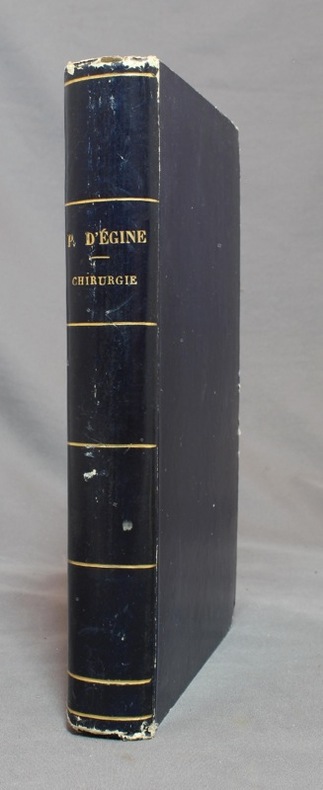
PAUL D'EGINE:
Chirurgie de Paul d'Égine, texte grec restitué et collationné sur tout les manuscrits de la bibliothèque impériale, accompagné des variantes de ces mauscrits et de celle des deux éditions de Venise et de Bâle, ainsi que de notes philologiques et médicales; avec traduction française en regard, précédé d'une introduction par René Briau.
Paris, Victor Masson, 1855. Grand in-8 de [6]-308 pages, cartonnage bleu marine du temps, coiffes et coins frottés, rousseurs. Ancienne étiquette (XIXe siècle) de la librairie Salomon à Strasbourg.
Référence libraire : 15499
|
|
|
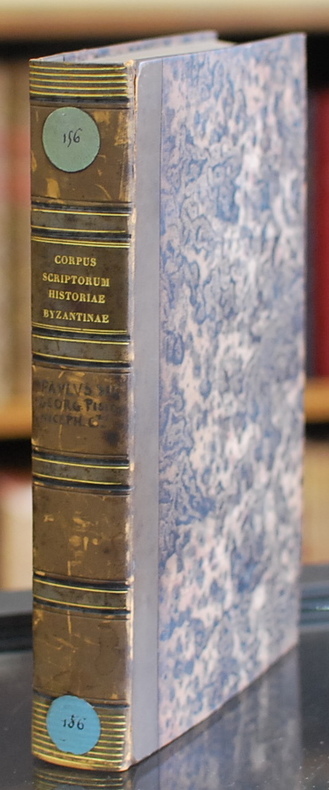
PAUL LE SILENTIAIRE
Corpus scriptorum historiae Byzantinae. Editio emendatior et copiosior, consilio B. G. Niebuhrii instituta. Descriptio S. Sophiae et ambonis. ex recensione Immanuelis Bekkeri
Bonn, Ed. Weber, 1836-1837 in-8, VIII-180 pp., avec 4 planches, sous serpentes, demi-veau havane, dos lisse orné de filets dorés et à froid, pièce de titre, tranches mouchetées (reliure de l'époque). Rousseurs abondantes.
Référence libraire : 184731
|
|
|
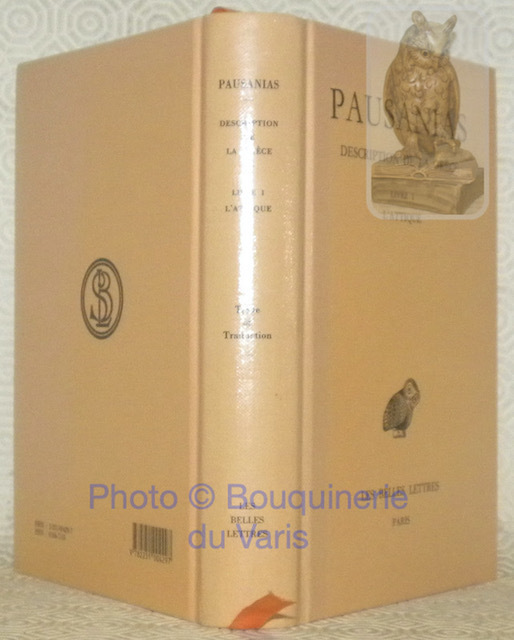
PAUSANIAS.
Description de la Grèce. Tome I. Introduction générale. Livre I. L’attique. Texte établi par Michel Casevitz, traduit par Jean Pouilloux. Commenté par François Chamoux. Collection des Universités de France, publiée sous le patronnage de l’Association Guillaume Budé.
Paris, Société d’Edition Les Belles Lettres 1992, 200x130mm, XLVI - 321pages, reliure d'éditeur. Cachet de possesseur sur le haut de la page de garde supérieure et dos légèrement insolé, autrement bel exemplaire.
Référence libraire : 95559
|
|
|
PAUSANIAS.
Graeciae descriptio. Recognovit Fridericus Spiro.
Leipzig, B.G. Teubner, 1903.
Référence libraire : 158933
|
|
|
PAUSANIAS.
Graeciae descriptio. Recognovit F. SPIRO. Vol. I: libri V-IV.
Lpz., Tbn., 1903.
Référence libraire : 61852
|
|
|
PAULINUS NOLANUS.- BOUMA,J.A.
Het epithalamium van Paulinus van Nola. Carmen XXV met inleiding, vertaling en commentaar.
Assen, Van Gorcum, (1968).
Référence libraire : 79830
|
|
|
Paul GERVAIS - ARISTOPHANE - GUITARD (traduit du grec ancien par émile-Henri)
L'Assemblée des femmes. Comédie Lyrique (393 avant J.-C.)
éditions Occitania - E.-H. Guitard, éditeur 1929 Illustrations de Paul Gervais. Tirage restraint. In-4. Broché sous couverture rempliée, premier plat imprimé, 127 pp., 7 hors-texte en couleurs, nombreux dessins en noir, & document volant 4 ff. Exemplaire en bon état.
Référence libraire : 53255
|
|
|
PAUSANIAS.- TRENDELENBURG,A.
Pausanias in Olympia. Mit einem Plane von Olympia.
Berlin, Weidmann, 1914.
Référence libraire : 158545
|
|
|
Paul Faure
Alessandro Magno
tela edit. con titoli al dorso e sovrac. ill. - prima edizione it. - trad. di Francesco Morabito - illustrazioni in b.n. fuori testo

|
|
|
PAUL MORAUX.
Bibliotheque de la Societe Turque d' Histoire, catalogue des manuscrits Grecs (Fond du Syllogos).
New English Paperback. Pbo. Roy. 8vo. (24 x 17 cm). In French. [xxiv], 265, [1] p. Contents: INTRODUCTION; DESCRIPTION DES MANUSCRITS; CORRECTIONS ET ADDITIONS.; INDEX.; BIBLIOGRAPHIE. Bibliotheque de la Societe Turque d' Histoire, catalogue des manuscrits Grecs (Fond du Syllogos).
|
|
|
Paul Veyne
La vita privata nell'Impero romano
bross. edit. ill. - trad. di Maria Garin

|
|
|
Paul, George MacKay & Michael Ierardi (eds.)
ROMAN COINS AND PUBLIC LIFE UNDER THE EMPIRE E. Togo Salmon Papers II
Dustjacket is protected in mylar. ; 0.72 x 9.48 x 6.2 Inches; 216 pages; Roman coins often shed light on Roman public life and society through the legends, portraits, and images they bear. The papers collected in this volume were originally presented at the Second E. Togo Salmon Conference on Roman Studies. The eight contributors are specialists in Roman coins or Roman history and in the relations between them. Coins are a unique source of information about the Roman world. In the case of the Roman Empire they were issued by or with the approval of the ruling power. The representations and legends they show therefore present an official view of contemporary affairs. The coins themselves, minted for official purposes such as paying the army, when studied carefully can help reconstruct official policies. They can also occasionally reveal what monuments now lost may have looked like. It is not infrequent to come across pleas that the ancient historian should make more frequent use of numismatic evidence. These essays make clear that efforts are being made both by numismatists and by historians to bring the two disciplines together. At the same time the papers reveal that the task is by no means a straightforward one. The survival of Roman coins is variable, and so attempts to reconstruct the size and distribution of issues calls for skilled and experienced analysis. This collection of papers provides evidence for the kind of deductions that the historian may make from Roman coins as well as the illustrations of the pitfalls that await the unwary. Those interested in Roman history, amateur coin collectors, and professional numismatists will all find much here to widen their knowledge of the public context of Roman coins. Contributors: William E. Metcalf, P. Bruun, Barbara Levick, R. P. Duncan-Jones, Anthony Barrett, Duncan Fishwick, C. E. King, Andrew Burnett.
|
|
|
Paul, George MacKay & Michael Ierardi (eds.)
ROMAN COINS AND PUBLIC LIFE UNDER THE EMPIRE E. Togo Salmon Papers II
0.72 x 9.48 x 6.2 Inches; 216 pages; Roman coins often shed light on Roman public life and society through the legends, portraits, and images they bear. The papers collected in this volume were originally presented at the Second E. Togo Salmon Conference on Roman Studies. The eight contributors are specialists in Roman coins or Roman history and in the relations between them. Coins are a unique source of information about the Roman world. In the case of the Roman Empire they were issued by or with the approval of the ruling power. The representations and legends they show therefore present an official view of contemporary affairs. The coins themselves, minted for official purposes such as paying the army, when studied carefully can help reconstruct official policies. They can also occasionally reveal what monuments now lost may have looked like. It is not infrequent to come across pleas that the ancient historian should make more frequent use of numismatic evidence. These essays make clear that efforts are being made both by numismatists and by historians to bring the two disciplines together. At the same time the papers reveal that the task is by no means a straightforward one. The survival of Roman coins is variable, and so attempts to reconstruct the size and distribution of issues calls for skilled and experienced analysis. This collection of papers provides evidence for the kind of deductions that the historian may make from Roman coins as well as the illustrations of the pitfalls that await the unwary. Those interested in Roman history, amateur coin collectors, and professional numismatists will all find much here to widen their knowledge of the public context of Roman coins. Contributors: William E. Metcalf, P. Bruun, Barbara Levick, R. P. Duncan-Jones, Anthony Barrett, Duncan Fishwick, C. E. King, Andrew Burnett.
|
|
|
Paul, Louis; Child, Charles B.; Duncan, Val; Mayse, Arthur; Dent, Lester; Frank, Pat; Pollack, Jack Harrison; reynolds, Quentin; Sherwood, Robert E.; Ketcham, Hank; Santoro, Al; Crichton, Kyle
Collier's Magazine, August 21, 1948 - The Secret Papers of Harry L. Hopkins - Stalin Meets Roosevelt
78 pages. Articles: Traffic Traps for Tourists - unjust arrests in many parts of the U.S.; Red Clouds over Olympus - Life in Greek village of Magoula is miserable under the Communists; The Secret Papers of Harry L. Hopkins (part 13) - from Cairo to Teheran - the first meeting with Stalin;.Sunday Dinner - lady in the kitchen; Pot Shots by One Shot Ross - Boxing Manager Wirt Ross; "There Goes Rusty" - one of the world's fastest greyhounds. Fiction: Plenty of Time for Love; The Inspector had a Wife; The Fugitive; The Logger and the Lady; River Crossing; An Affair of State (part 3 of 4). Ads include: Studebaker cars; Vitalis (with Bob Feller); Philco radio-phonographs; Firestone "Super-Balloon" tires; Gillette Blue Blades (2-pages in color); Kaiser-Frazer cars (centerfold); Pllymouth; "Good Sam" movie with Gary Cooper; Schlitz beer; GM Electro-motive division; Coke - shows Coke machine at gas station; Texaco - shows young lady water skiing; Rice-Stix; U.S. Army; Lucky Strike cigarettes (back cover). Unmarked with moderate wear and minor bits of moisture exposure to top and bottom edges. A sound vintage copy. Book

|
|
|
Paulson, Johannes
INDEX HESIODEUS
Very light creasing along bottom edge of wraps else Fine. ; Unchanged Reprint of 1890 edition. ; 94 pages
|
|
|
Paulson, Johannes
INDEX HESIODEUS
Former owner's blindstamp to ffep. Else fine. ; Unchanged Reprint of 1890 edition. ; 94 pages
|
|
|
Pausanias; J. G. Frazer (Trans. )
PAUSANIAS'S DESCRIPTION OF GREECE [6 VOLUME SET] Translated with a Commentary. Vol. I: Translation; Vol. II: Commentary on Book I; Vol. III: Commentary on Books II-V; Vol. IV: Commentary on Books VI-VIII; Vol V: Commentary on Books IX. , X. Addenda; Vol. VI: Indices. Maps.
First few pages of vol 3 has miscut corners (rounded). Slight bump to head of vol 4. Very light shelfwear. ; 616 pp, 582 pp, 652 pp, 447 pp, 638 pp, 194 pp ; 6 Volume Set (Complete). ; Vol. 1/6/2022
|
|
|
Pausanias; J. G. Frazer (Trans. )
PAUSANIAS'S DESCRIPTION OF GREECE [6 VOLUME SET] Translated with a Commentary. Vol. I: Translation; Vol. II: Commentary on Book I; Vol. III: Commentary on Books II-V; Vol. IV: Commentary on Books VI-VIII; Vol V: Commentary on Books IX. , X. Addenda; Vol. VI: Indices. Maps.
Very light shelfwear to all volumes. Crisp, clean, and unmarked except for the bookplates of George Rapp, Jr. To ffeps of all volumes. ; 616 pp, 582 pp, 652 pp, 447 pp, 638 pp, 194 pp ; 6 Volume Set (Complete). ; Vol. 1/6/2022
|
|

 Recevoir par e-mail
 Télécharger en PDF
 Flux RSS
 Lien permanent


