|
CARLEGLE
Le rire N°386 de la nouvelle série, A la campagne.
Tonnelle. 25 juin 1910. In-4. Broché. Bon état, Couv. convenable, Dos satisfaisant, Intérieur frais. 16 pages, gravures noir et blanc in et hors texte, deux pages en couleurs, 1ère et dernière pages couleurs par Carlègle et Kainer.. . . . Classification Dewey : 70.441-Journaux satiriques anciens
Referenz des Buchhändlers : ROD0054119
|
|
|
CARLEGLE
Le rire N°257 de la nouvelle série - La joie des enfants.
Tonnelle. 4 janvier 1908. In-4. Broché. Etat d'usage, Couv. défraîchie, Dos satisfaisant, Intérieur frais. 16 pages, gravures noir et blanc in et hors texte, 1ère et dernière page couleurs par Carlègle et Cardona.. . . . Classification Dewey : 70.441-Journaux satiriques anciens
Referenz des Buchhändlers : ROD0053990
|
|
|
CARLEGLE
Le rire N°260 de la nouvelle série - Le respect s'en va.
Tonnelle. 25 janvier 1908. In-4. Broché. Bon état, Couv. convenable, Dos satisfaisant, Intérieur frais. 16 pages, gravures noir et blanc in et hors texte, 1ère et dernière page couleurs par Carlègle et Guillaume.. . . . Classification Dewey : 70.441-Journaux satiriques anciens
Referenz des Buchhändlers : ROD0053993
|
|
|
CARLEGLE
Le rire N°279 de la nouvelle série - Les affaires.
Tonnelle. 6 juin 1908. In-4. Broché. Bon état, Couv. convenable, Dos satisfaisant, Intérieur frais. 16 pages, gravures noir et blanc in et hors texte, 1ère et dernière page couleurs par Carlègle et Roubille.. . . . Classification Dewey : 70.441-Journaux satiriques anciens
Referenz des Buchhändlers : ROD0054012
|
|
|
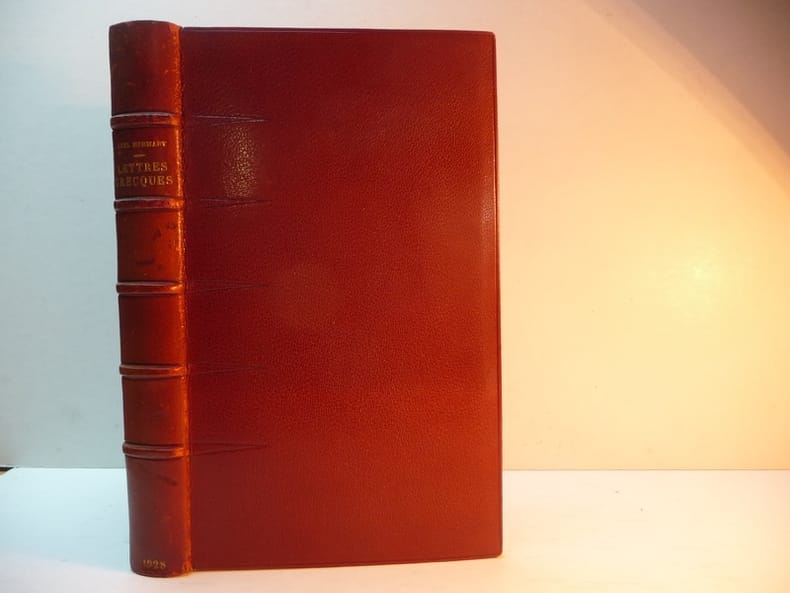
CARLEGLE HERMANT (Abel)
Le nouvel Anacharsis. Promenade au jardin des Lettres grecques.
P., Le Livre, 1928. Grand in-8 reliure post. plein chagrin havane poli, dos à 5 nerfs bordés d'un filet à froid prolongé en pointe sur les plats, auteur et titre doré, filet à froid bordant les plats, roulette et filet dorés aux coupes, contreplats bordés d'une roulette, d'une double ligne de pointillés et de deux filets, le tout doré, doubles gardes de papier marbré, tête dorée, couv. et dos conservés, grands témoins conservés, 250 pp., [3] ff., frontispice, vignettes (Coll. didactique inédite, 5). Un des 30 exemplaires sur Hollande Van Gelder zonen, 3e papier après 10 vieux Japon et 10 Japon impérial.
Referenz des Buchhändlers : 550456
|
|
|
CARLEGLE FRANCE (Anatole)
Le Génie latin.
P., Emile Chamontin, 1926. Grand in-8, broché, couv. rempliée, 310 pp., bois originaux de Carlègle dans le texte. Un des 375 exemplaires numérotés sur vélin à la forme des papeteries d’Arches, n°69.
Referenz des Buchhändlers : 553979
|
|
|
Carlègle
Les travaux de'Hercule - 10 bois gravés inédits de Carlègle - Le lion de némée - la biche aux pieds d'airain - l'hydre de lerne - les amazones - le taureau de l'ile de crete - les oiseaux du lac stymphale - le sanglier d'érymanthe - les cavales de diomède
O.V.P. Editions. non daté. In-4. En feuillets. Bon état, Couv. convenable, Dos satisfaisant, Intérieur frais. 10 bois gravés inédits de Carlègle (collationnées) - 3 photos disponibles.. . . . Classification Dewey : 741-Dessin
Referenz des Buchhändlers : R320116750
|
|
|
CARLEGLE. [REVUE]. MORIN (Louis), FORAIN (Jean-Louis), WILLETTE (Adolphe), DAUMIER (Honoré), CARLEGLE, HEMARD (Joseph), etc.
Les Humoristes. Bulletin semestriel de la Société des Dessinateurs-Humoristes.
Paris Société des Dessinateurs Humoristes 1924 1 Paris, Société des Dessinateurs Humoristes, 1924 à 1929, 11 Numéros in-12, brochés, sous couverture illustrée.
Referenz des Buchhändlers : 4927
|
|
|
Carlègle - Régnier, Henri de:
Les rencontres de M. de Bréot. Aquarelles de Carlègle.
Paris, André Plicque & Cie. Editeurs. 1928. 4°. 273 p. Avec 3 dessins originaux, 30 illustrations au pochoir, un dessin colorié supplémentaire dans le livre et la suite des illustrations en noir. Broché, couverture rempliée. La suite enveloppée, sous chemise.
Referenz des Buchhändlers : 51393BB
|
|
|
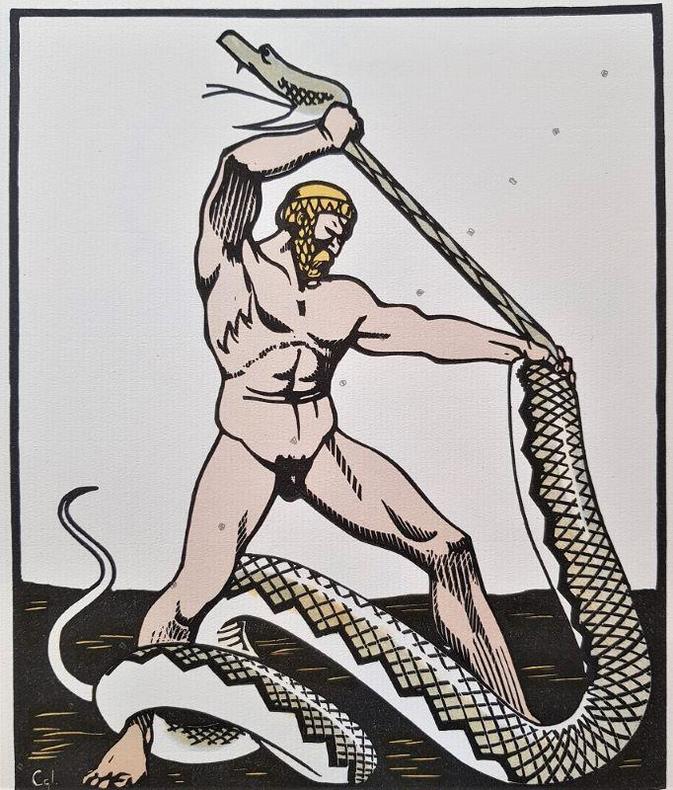
CARLEGLE.
Les Travaux d'Hercule. 10 bois gravés inédits de Carlègle.
P., O.V.P. Editions, vers 1930, In-4, en feuilles sous chemise.
Referenz des Buchhändlers : 12815
|
|
|
CARLEGLE-SOULAGES Gabriel
LES PLUS JOLIES ROSES DE L'ANTHOLOGIE GRECQUE, RECEUILLIES PAR GABRIEL SOULAGES ET AGREMENTEES DE VIGNETTE GRAVEES PAR CARLEGLE.
A Paris chez l'imprimeur Léon Pichon, 1921. In-4 broché, couverture rempliée, 204 pages. Tirage limité à 560 exemplaires numérotés, celui-ci sur papier vélin à la cuve (n° 255). Couverture brunie, quelques piqûres, sinon état correct.
Referenz des Buchhändlers : 9194
|
|
|
CARLEGLE LOUYS (Pierre)
Psyché.
P., Mornay, 1935. In-8 broché, couv. rempliées, 229 pp., [1] ff., compositions de Carlègle en couleurs dans le texte. (Les Beaux livres, 11). Exemplaire numéroté sur Rives à la forme.
Referenz des Buchhändlers : 551073
|
|
|
Carlègle. - Cuénoud, Edmond.
Une histoire qui finit mal. Texte d’Edmond Cuénoud. Dessins de Carlègle. Album Carlègle.
Paris, Office Central de la Librairie Librairie Molière 1905, 193x285mm, 31pages, cartonnage illustré de l’éditeur, dos toilé rouge, plat supérieur taché, usures sur certains bords des plats, intérieur en parfait état, dédicace de l’auteur de l’illustrateur sur la page de garde.
Referenz des Buchhändlers : 95420
|
|
|
CARLEGLE
La chasse � l'�l�phant ou "les vertus m�nag�res".
1934. reli�. D'OccasionBon�tat. Editions Bourrelier Chinm�nes Paris 1934. In-8 � l'italienne 25 x 16 cm cartgonnage illustr� dos toil� rouge illustrations en bleu 57 feuillets pagin�s. Traces l�g�res en couverture sinon bon �tat. Charles �mile Egli dit Carl�gle illustrateur et peintre suisse naturalis� fran�ais : 1877 - 1937. Il a illustr� des journaux satiriques tel que L�Assiette au beurre Le Rire ou La Vie Parisienne mais aussi L'Illustration et de nombreux livres et textes classiques ou contemporains comme La Fontaine Ronsard Verlaine Henri de R�gnier etc. unknown
Referenz des Buchhändlers : 21757

|
|
|
Carlegle
LES HUMORISTES: Bulletin Trimestriel de la Societe des Dessinateurs Humoristes. Annee 1926. Numero 6
Paris: Eugene Rey Libraire-Editeur 1926. 1926. Good. - Small quarto 6-5/8 inches high by 5 inches wide soft covers bound in pictorial cream wraps with a reproduction of a drawing by Carlegle in black on the front wrap. The wraps are darkened around the edges with the corners lightly creased & with a tiny stain to the top edge of the front wrap. 32 & 4 pages. Illustrated in black & white with a title vignette textual illustrations & 2 plates including a frontispiece. The versos of the plates are foxed The last 2 leaves which are printed on a cheaper stock are darkened & the remaining page edges are slightly darkened. Good. <p>Among the contents of this issue are an article on Carlegle pp. 5-13 by Marcel Belvianes and an address on the "Dessinateur et Peintre Humoriste" pp. 15-23 by Joseph Hemard. The text is in French.<p>Scarce. Paris: Eugene Rey, Libraire-Editeur, 1926. paperback
Referenz des Buchhändlers : 7943
|
|
|
CARLEGLE
Oeuvres Complètes de Anatole France. Tome XXII - La Révolte des Anges. Suite uniquement des épreuves sur chine - Compositions de Carlègle.
1930. Paris Calmann-Lévy Editeurs. en feuillets sous couverture rempliée. Couverture insolée rares et très faibles rousseurs en bas de quelques feuillets sinon très bon état des gravures. pt in-4. avec 66 compositions sur chine ; couverture avec titre en rouge et noir. unknown
Referenz des Buchhändlers : G5 - HAY17568
|
|
|
Carlegle Charles Emile . . Illustrateur
C'est un oiseau qui vient de France / texte et dessins de Carlègle Volume 1 1916 Leather Bound
2019. Leather Bound. New. Leather Binding on Spine and Corners with Golden Leaf Printing on round Spine. Reprinted in 2019 with the help of original edition published long back 1916. This book is printed in black & white sewing binding for longer life Printed on high quality Paper re-sized as per Current standards professionally processed without changing its contents. As these are old books we processed each page manually and make them readable but in some cases some pages which are blur or missing or black spots. We expect that you will understand our compulsion in these books. We found this book important for the readers who want to know more about our old treasure so we brought it back to the shelves. Hope you will like it and give your comments and suggestions. Lang: - Francais Vol: - Volume 1 Pages 72. EXTRA 10 DAYS APART FROM THE NORMAL SHIPPING PERIOD WILL BE REQUIRED FOR LEATHER BOUND BOOKS. FOLIO EDITION IS ALSO AVAILABLE. Volume 1 hardcover
Referenz des Buchhändlers : LB1111008531549
|
|
|
Carlegle Charles Emile . . Illustrateur
C'est un oiseau qui vient de France / texte et dessins de Carl�gle Volume 1 1916 Hardcover
2020. Hardcover. New. Lang: - Francais Vol: - Volume 1 Pages 72. Reprinted in 2020 with the help of original edition published long back 1916. This book is printed in black & white Hardcover sewing binding for longer life with Matt laminated multi-Colour Dust Cover Printed on high quality Paper re-sized as per Current standards professionally processed without changing its contents. As these are old books we processed each page manually and make them readable but in some cases some pages which are blur or missing or black spots. We expect that you will understand our compulsion in these books. We found this book important for the readers who want to know more about our old treasure so we brought it back to the shelves. Any type of Customisation is possible with extra charges. Hope you will like it and give your comments and suggestions. Volume 1 hardcover
Referenz des Buchhändlers : 1111008531549
|
|
|
Carlegle Charles Emile . . Illustrateur
C'est un oiseau qui vient de France / texte et dessins de Carl�gle Volume 1 1916
2020. Paperback. New. Lang: - Francais Vol: - Volume 1 Pages 72. Reprinted in 2020 with the help of original edition published long back 1916. This book is Printed in black & white sewing binding for longer life with Matt laminated multi-Colour Soft Cover HARDCOVER EDITION IS ALSO AVAILABLE Printed on high quality Paper re-sized as per Current standards professionally processed without changing its contents. As these are old books we processed each page manually and make them readable but in some cases some pages which are blur or missing or black spots. We expect that you will understand our compulsion in these books. We found this book important for the readers who want to know more about our old treasure so we brought it back to the shelves. Any type of Customisation is possible with extra charges. Hope you will like it and give your comments and suggestions. Volume 1 paperback
Referenz des Buchhändlers : PB1111008531549
|
|
|
CARLEGLE Charles Emile
La plus belle fille du monde Croquis de la vie parisienne EDITION ORIGINALE Tirage de tête
Paris: L'édition 1922. Fine. L'édition Paris 1922 335x255cm broché. - 43019 - FRENCH VERSION FOLLOWS Edition originale imprimée sur vélin d'Arches et illustrée de 26 planches originales à l'encre de Chine de Carlègle. Préface de Léo Larguier. Deux manques et deux déchirures en tête et en pied du dos rousseurs et pâles mouillures angulaires sur les plats et les gardes. Agréable état intérieur sans rousseur. L'édition unknown
Referenz des Buchhändlers : 61117

|
|
|
Carlegle.
C'est un Aiseau qui Vient de France.
Paris:: Societe Litteraire de France. Decorative Cloth. Good. 11 x 7 1/4". 56 pp. Cover suffed and somewhat soiled. 1/2 inch tear in 1st page. French picture book. Societe Litteraire de France. hardcover
Referenz des Buchhändlers : 19793
|
|
|
CATTIER Dr.
Des bébés, s'il vous plaît! Essai sur le problème de la dénatalité.
Paris, Plon-Nourrit, 1923. In-8° broché. Dessins au trait dans le texte. Tiré à 112 exemplaires sur vélin à la cuve.
Referenz des Buchhändlers : EXE00525
|
|
|
Charles-Emile EGLI, dit. CARLEGLE .
C'est un oiseau qui vient de France
Cartonnage d'éditeur rouge-bordeaux illustré en couleurs. Petites salissures sur les plats. Rousseurs sur l'illustration du premier plat. Ex-libris sous forme d'étiquette et étiquette d'éditeur sur le contre-plat. Papier bruni. Bel état du contenu orné des planches illustrées en noir et blanc par CARLEGLE.
Referenz des Buchhändlers : 62764
|
|
|
Charles MAURRAS
L'allée des philosophes
Couverture souple rempliée. Ornée d'un frontispice gravé sur bois par CARLÈGLE et publiée par la Société littéraire de France. Non coupé et non rogné.
Referenz des Buchhändlers : 52379
|
|
|
Charles-Emile CARLEGLE
La Rivière. Costume de fantaisie (pl.3, La Gazette du Bon ton, 1912-1913 n°4)
Lucien Vogel éditeur | Paris Février 1913 | 19 x 24.50 cm | une feuille
Referenz des Buchhändlers : 54503
|
|
|
Charles Émile CARLÈGLE
Le Bon oncle. Costumes d'enfants. (La Gazette du Bon ton, n°1 - Année 1914, Planche II )
Lucien Vogel éditeur | Paris 1914 | 19.50 x 25 cm | une feuille
Referenz des Buchhändlers : 43225
|
|
|
Charles-Emile CARLEGLE
Le Cachemire vert - Robe du soir de Redfern (pl.9, La Gazette du Bon ton, 1912-1913 n°1)
Lucien Vogel éditeur | Paris 1912-1913 | 19 x 24.50 cm | une feuille
Referenz des Buchhändlers : 54480
|
|
|
Charles-Emile CARLEGLE
Le Bon Oncle. Costumes d'enfants (pl.2, La Gazette du Bon ton, 1914 n°1)
Lucien Vogel éditeur | Paris Janvier 1914 | 19 x 24.50 cm | une feuille
Referenz des Buchhändlers : 54616
|
|
|
Charles-Emile CARLEGLE - Georges COURTELINE
Le train de 8h47
Société littéraire de France | Paris 1925 | 14.50 x 22.50 cm | broché
Referenz des Buchhändlers : 65210
|
|
|
Charles-Emile CARLEGLE
Le Bon Oncle. Costumes d'enfants (pl.2, La Gazette du Bon ton, 1914 n°1)
Lucien Vogel éditeur | Paris Janvier 1914 | 19 x 24.50 cm | une feuille
Referenz des Buchhändlers : 84681
|
|
|
Charles MÜLLER - Paul REBOUX - Charles Émile CARLÈGLE
Rikette aux enfers
Ernest Flammarion | Paris 1914 | 15 x 22 cm | broché
Referenz des Buchhändlers : 60831
|
|
|
Charles Maurras; illustrations by Carlegle
Corps Glorieux from the Christmas1926 issue of L'Illustration
Paris France: L'Illustration 1926. First Edition. Disbound. Very good. French text. This is an original 6 page story disbound from the Christmas1926 issue of L'Illustration. Folio pages 16" tall 12 inches wide intertextual black and white woodcut illustration with red letters. Text and illustrations in very good clean condition overall but margins lightly foxed and top fore-corner slightly bumped gutter margin with small holes from the original wire stitch and lightly discolored paper lightly yellowed over all. L'Illustration unknown
Referenz des Buchhändlers : 46594
|
|
|
Charles Morice Elisabeth. Carlegle Charles Emile . Illustrateur
Aurore et Ph�bus ou La f�e de la musique / Elisabeth Charles-Morice ; illustrations de Carl�gle Volume 1 Hardcover
2018. Hardcover. New. Lang: - Francais Vol: - Volume 1 Pages 152. Reprinted in 2018 with the help of original edition published long back. This book is printed in black & white Hardcover sewing binding for longer life with Matt laminated multi-Colour Dust Cover Printed on high quality Paper re-sized as per Current standards professionally processed without changing its contents. As these are old books we processed each page manually and make them readable but in some cases some pages which are blur or missing or black spots. We expect that you will understand our compulsion in these books. We found this book important for the readers who want to know more about our old treasure so we brought it back to the shelves. Any type of Customisation is possible. Hope you will like it and give your comments and suggestions. Volume 1 hardcover
Referenz des Buchhändlers : 1111008532259
|
|
|
Charles Morice Elisabeth. Carlegle Charles Emile . Illustrateur
Aurore et Ph�bus ou La f�e de la musique / Elisabeth Charles-Morice ; illustrations de Carl�gle Volume 1
2018. Softcover. New. Lang: - Francais Vol: - Volume 1 Pages 152. Reprinted in 2018 with the help of original edition published long back. This book is Printed in black & white sewing binding for longer life with Matt laminated multi-Colour Soft Cover HARDCOVER EDITION IS ALSO AVAILABLE Printed on high quality Paper re-sized as per Current standards professionally processed without changing its contents. As these are old books we processed each page manually and make them readable but in some cases some pages which are blur or missing or black spots. We expect that you will understand our compulsion in these books. We found this book important for the readers who want to know more about our old treasure so we brought it back to the shelves. Any type of Customisation is possible. Hope you will like it and give your comments and suggestions. Volume 1 paperback
Referenz des Buchhändlers : PB1111008532259
|
|
|
Collectif
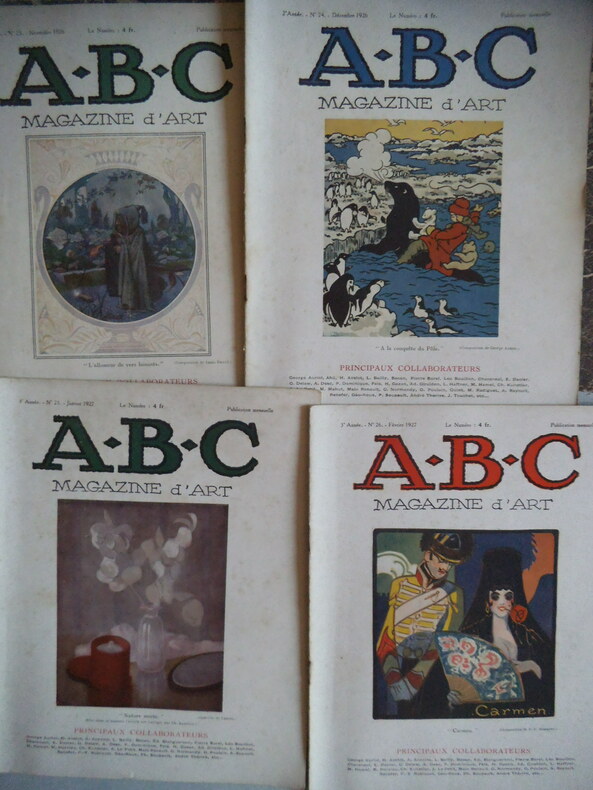
A.B.C
A.B.C magazine d’art. Publication mensuelle. 36 pages, texte sur 2 colonnes, publicités en début et fin de volume. Couverture illustrée en couleurs. Année 1926 : n° 23-24 année 1927 n° 25 de janvier ; 26 de février- 27 de Mars- 28 d’avril- 29 de mai. Couvertures de Louis BAILLY- George AURIOL- CARLEGLE- P.V ROBIQUET- A. ARNOLD- H. GAZAN- RAY-LAMBERT. L’ensemble
Referenz des Buchhändlers : 13102
|
|
|
Collectif
Comoedia illustré 4e année - N. 15 - 1 Mai 1912
Paris Comoedia 1912 In4 - broché - pagination continue ( environ 50 pages - Sommaire voir photographie )- A noter l'article sur le Salon des Humoristes - Illustrations de Hémard , Hellé , Sem , Carlègle , Dulac . très belle Couverture Art déco illustrée par Léon Bakst . Bon état .
Referenz des Buchhändlers : Tir225

|
|
|
Collectif
Comoedia illustré 4e année - N. 15 - 1 Mai 1912
Paris Comoedia 1912 In4 - broché - pagination continue ( environ 50 pages - Sommaire voir photographie )- A noter l'article sur le Salon des Humoristes - Illustrations de Hémard , Hellé , Sem , Carlègle , Dulac . très belle Couverture Art déco illustrée par Léon Bakst . Bon état .
Referenz des Buchhändlers : Tir225
|
|
|
collectif Dignimont, Vox, CARLEGLE, ROUBILLE (A.)
Demain revue littéraire sous la direction de R.Escholier n:2
1924 Paris,J.Ferenczi, 1924, In huit ,222 pp, broché, bon état,
Referenz des Buchhändlers : 66332
|
|
|
Collectif ; VOGEL, Lucien ; LEPAPE, Georges ; BRISSAUD, Pierre ; MARTY, André ; BOULET DE MONVEL, Bernard ; MERAS, Paul ; CARLEGLE ; GOSE, Javier ; DRESA
Gazette du Bon Ton. Art - Modes & Frivolités. Novembre 1912 - Numéro 1
1 vol. in-8 en feuillets sous chemise, Librairie Centrale des Beaux-Arts, Paris, 1912, 2 ff. (titre général pour l'année 1912-1913), 4 ff. (paginées I-VI puis 2 ff. non paginés, pour la table des matières de l'année et la table des planches), IV pp. (publicités), 2 ff. (prospectus pour la Gazette du Bon Ton), 28 pp. [manque les pages 29-32 ], avec 9 planches hors texte en couleurs (sur 10)
Referenz des Buchhändlers : 61528

|
|
|
COLLECTIF GALANIS
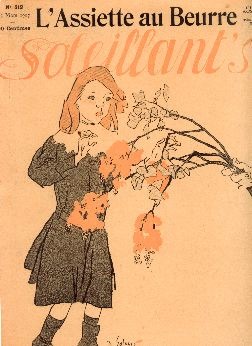
L'Assiette au Beurre N°312. Soleillant's,23 mars 1907,
Schwarz.Imprimerie spéciale de l'assiette au beurre] 18 pages de gravures en noir et en couleurs par Galanis, Poulbot, Valéry-muller, Camara, Carlègle. In-4 Broché, Intérieur frais
Referenz des Buchhändlers : 20524
|
|
|
COLLECTIF
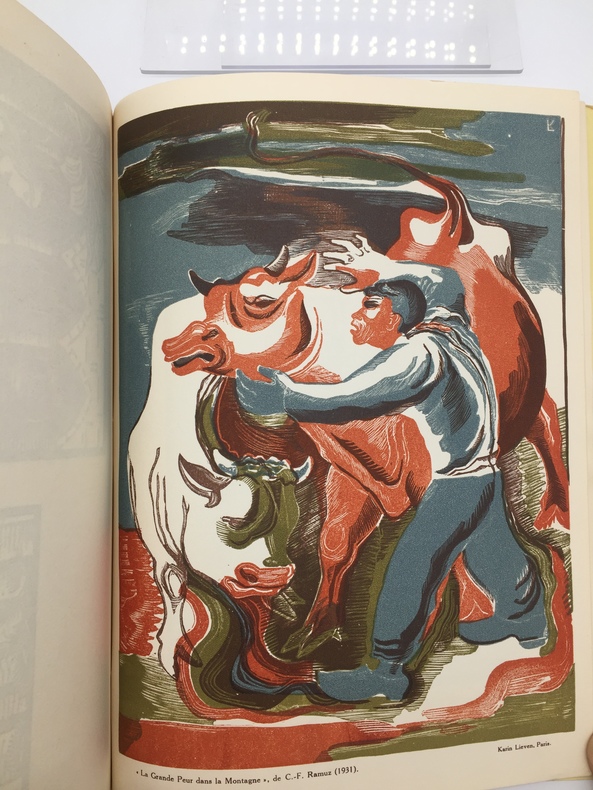
La gravure sur bois dans l'art suisse
Couverture souple Editions de l'Art en Suisse 1932 Genève 27x20,5 cm
Referenz des Buchhändlers : 3204
|
|
|
COLLECTIF
La Grande Guerre par les Artistes
Paris Berger Levrault / Crès 1915 La Grande Guerre par les artistes - Paris, Berger-Levrault / Georges Crés & Co., 1914/1915 - Fort in4 cartonnage éditeur toilé illustré aux plats (en voie de débrochage) - 4ff de préface par Gustave Geffroy puis 155 planches reliées à la suite - Il s'agit de la réunion des planches des 2 premières années de la revue éponyme qui paraissaient 2 fois par mois à partir de novembre 1914. Chaque numéro comptait 8 à 9 planches d'artistes qui étaient nombreux à avoir travaillé à cette parution, certains pour un fascicule entier, d'autres pour une ou deux planches. On trouve ainsi des ensembles de 8 ou 9 planches de Hermann-Paul, Victor Prouvé, Masereel, Huard, Vallotton, Raemaekers, Fouqueray et de 4 planches de Huygens et Steinlen. D'autres artistes ont travaillé régulièrement tout au long de la parution ou plus occasionnellement : Rabier, Job, Hansi, Ibels, Slom, Jou, Bouroux, Morin, Léandre, Depaquit, Willette, Galanis, Carlègle, Laforge et bien d'autres .... illustrations couleurs de Bénito, Nam, Hansi. Si la reliure est en voie de débrochage, les planches sont en très bon état. 350 ?
Referenz des Buchhändlers : RES39L156
|
|
|
COLLECTIF
La Grande Guerre par les Artistes
Paris Berger Levrault / Crès 1915 La Grande Guerre par les artistes - Paris, Berger-Levrault / Georges Crés & Co., 1914/1915 - Fort in4 cartonnage éditeur toilé illustré aux plats (en voie de débrochage) - 4ff de préface par Gustave Geffroy puis 155 planches reliées à la suite - Il s'agit de la réunion des planches des 2 premières années de la revue éponyme qui paraissaient 2 fois par mois à partir de novembre 1914. Chaque numéro comptait 8 à 9 planches d'artistes qui étaient nombreux à avoir travaillé à cette parution, certains pour un fascicule entier, d'autres pour une ou deux planches. On trouve ainsi des ensembles de 8 ou 9 planches de Hermann-Paul, Victor Prouvé, Masereel, Huard, Vallotton, Raemaekers, Fouqueray et de 4 planches de Huygens et Steinlen. D'autres artistes ont travaillé régulièrement tout au long de la parution ou plus occasionnellement : Rabier, Job, Hansi, Ibels, Slom, Jou, Bouroux, Morin, Léandre, Depaquit, Willette, Galanis, Carlègle, Laforge et bien d'autres .... illustrations couleurs de Bénito, Nam, Hansi. Si la reliure est en voie de débrochage, les planches sont en très bon état. 350 ?
Referenz des Buchhändlers : RES39L156
|
|
|
Collectif
LE RIRE
nouvelle série,année 1909 du n° 309 du 2 janvier au n° 360 du 25 décembre,en un volume demi-cuir rouge,titre et filets dorés dessins de Carlègle,Préjelan, Goussé, A Guillaume … en noir et en couleurs, texte sur une ou deux colonnes, légères traces de pliure transversale,petits défauts, réparés, à la reliure, bon état d’ensemble
Referenz des Buchhändlers : 6094
|
|
|
COLETTE (Sidonie Gabrielle). CARLEGLE (Charles-Émile Egli, dit).
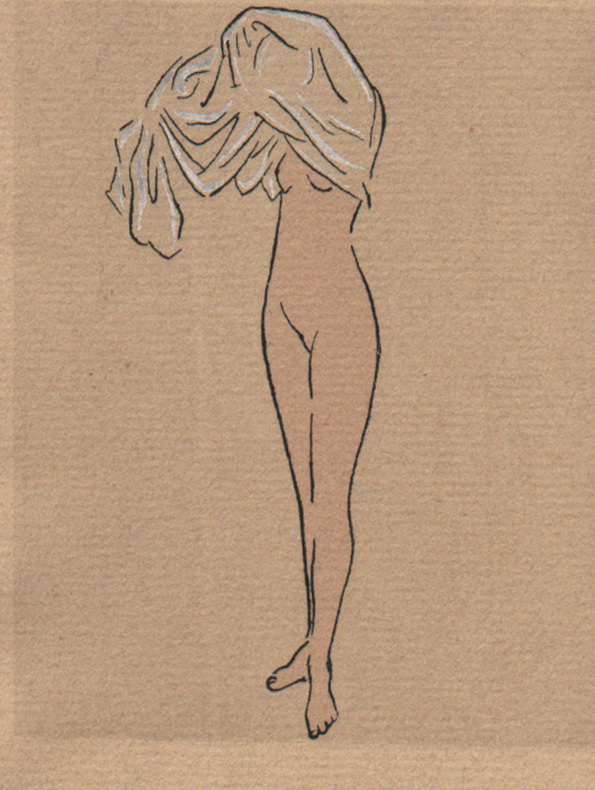
Nudité.
1943 Illustrations de Carlègle. Bruxelles, Éditions de la Mappemonde, 1943, in-4, broché, couverture rempliée illustrée en couleurs
Referenz des Buchhändlers : 23109
|
|
|
Colette
NUDITE
La Mappemonde.1943.In-4 br.Couv.ill.20 dessins de Carlègle.Ex.322/450.TBE.intérieur.Couv.usagée.
Referenz des Buchhändlers : 50394
|
|
|
COLETTE
Nudité
Sous couverture rempliée illustrée. Ouvrage orné d'illustrations dans le texte et hors-texte d'après les dessins de CARLEGLE dont une en frontispice.
Referenz des Buchhändlers : 35641
|
|
|
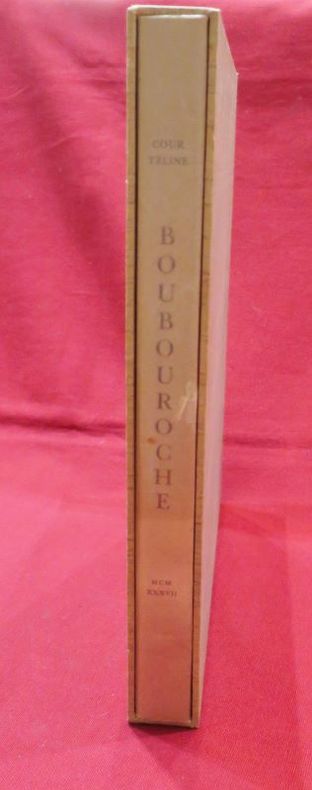
COURTELINE, Georges (Georges Moinaux ou Moineau, dit Georges Courteline) - CARLEGLE.
Boubouroche. Pièce en deux Actes créée au Théâtre libre d'Antoine. Ornée de bois originaux de CARLEGLE.
Cercle Parisien du Livre, 1937, 1 volume in-4 de 265x200x25 mm environ, 81 pages, 1f. (justificatif de tirage), 1 f.blanc, en feuillets libres sous couverture rempliée illustrée et étui, feuillets non rognés. Exemplaire nominatif N° 33, enrichi du menu illustré, d'un extrait du discours prononcé au dîner de distribution de l'ouvrage, et d'un dessin original au crayon signé par l'artiste. Tirage à 110 exemplaires sur Rives numérotés. Orné de bois originaux in-texte en deux tons. Couverture insolée, sinon bon état.
Referenz des Buchhändlers : 107931
|
|
|
COURTELINE Georges
Le train de 8h.47.
Paris, Société Littéraire de France, 1917. In-8° broché. Tiré à 1200 exemplaires, celui-ci sur vélin, orné de bois gravés par Carlègle.
Referenz des Buchhändlers : EXE00528
|
|
|
COURTELINE, GeorgesIllustrations de Lucien BOUCHER, Maurice Van MOPPES, Pierre FALKE, Ch. A. EDELMANN, CARLEGLE, Zig BRUNNER, WANNER.
Le train de 8 h 47 - La conversation d'alceste - Les Gaietés de l'Escadron - Boubouroche, Suivi de la philosophie de Courteline - Un client sérieux - Les Linottes - Les Femmes d'Amis - Ah! Jeunesse et autres Contes
PARIS, Editions Littéraires de France circa - Sans date - 8 livres en 4 Volumes In-8 - 1/2 Reliure à coins marron, signée - Dos à nerfs à filets dorés - Couverture conservée - Signet - Frontispice en couleurs - Illustrations Nb en texte & Couleurs PP HT - 241, 269, 283, 316, 246, 242, 248 & 231 pages - Bon ensembleReliure signée Georges Querruel, Maître relieur, Premier Artisan de France 1949
Referenz des Buchhändlers : 24064
|
|

 Per e-mail erhalten
 Als pdf-Dokument herunterladen
 RSS feed
 Permanenter link
