|
|
|
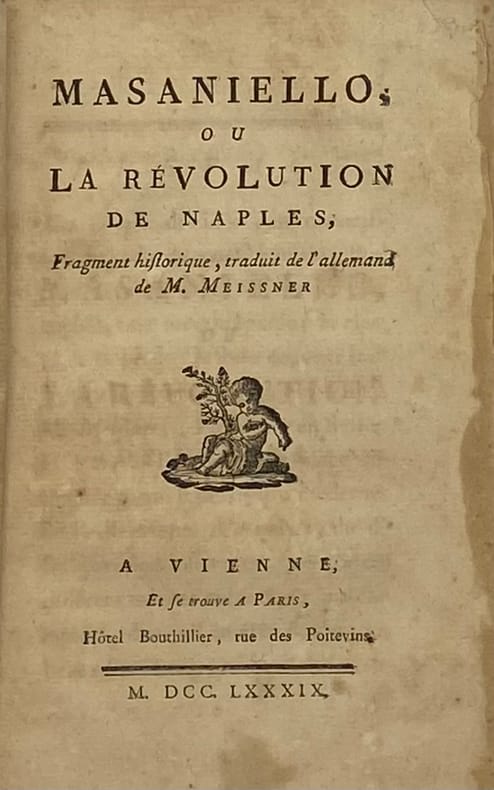
MEISSNER (Auguste-Théodore)
Masaniello, ou la révolution de Naples. Fragment historique, traduit de l'allemand
A Vienne et se trouve à Paris, 1789 in-8, IV-168 pp., broché sous couv. factice. Qqs taches et rousseurs.
Referenz des Buchhändlers : 142575
|
|
|
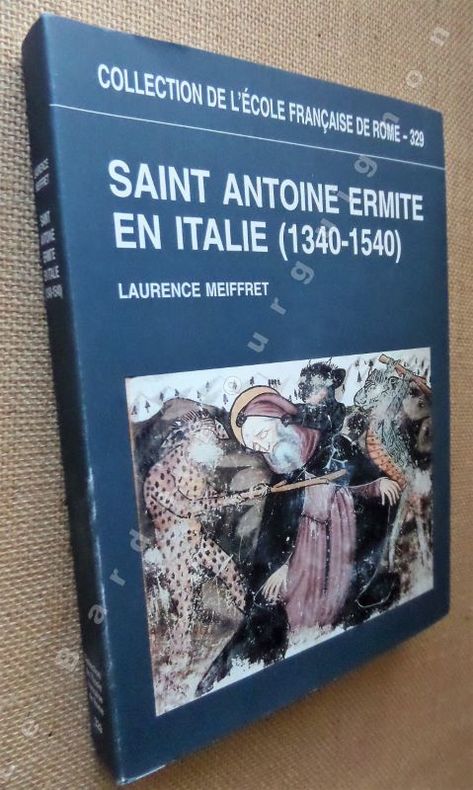
MEIFFRET Laurence
Saint Antoine ermite en Italie (1340-1540)
Ecole française de Rome/collection de l'école française de Rome n°329, 2004, broché, couverture à rabats, 17x24 cm. 358 pages. 99 illustrations en noir et blanc hors texte.
Referenz des Buchhändlers : 7865
|
|
|
MEIS, John Dore.
Toscane gourmande.
Paris, Flammarion, 1993, Première Edition en français, in-4 carré, cartonnage couv. photo coul. éd., 160 pp., papier glacé, très nb. photos coul., 1 carte en coul., Sommaire, Index, On ne présente plus la Toscane historique, ni d'ailleurs grastronomique, les plus beaux fleurons des produits italiens proviennent de cette région ! Des recettes au fil des saisons présentées par chefs qui savent mettre en valeur les produits qu'ils ont sous la main. Un régal de saveur ! Très bon état
Referenz des Buchhändlers : 64511
|
|
|
Meiggs, Russell
ROMAN OSTIA
Oxford University Press. 1977. Second Edition. Hardcover. Very Good in Very Good dust jacket. Pages a bit browned. Minor bumping to a couple of corners. DJ has minor edgewear and a bit of chipping.; Ostia an ancient town on the coast facing the Tyrrhenian Sea in Latium Italy was the harbour of ancient Rome and perhaps its first colonia. Located at the mouth of the River Tiber Ostia was said to have been founded by Ancus Marcius one of the kings of Rome in the 7th century BC. However the most ancient archaeological remains so far discovered are no earlier than the 4th century BC and the most ancient buildings currently visible are from the 3rd century BC notably the Castrum military camp and of a slightly later date the Capitolium temple of Jupiter Juno and Minerva. The opus quadratum walls of the original castrum at Ostia provide important evidence for the building techniques that were employed in Roman urbanism during the period of the Middle Republic. Although Ostia was probably founded for the sole purpose of military defence — since through the Tiber's mouths armies could eventually reach Rome by water — in time the port became a commercial harbour and a very important one too. Many of the goods that Rome received from its colonies and provinces passed through Ostia. In this role Ostia soon replaced Pozzuoli.; 4to 11" - 13" tall; 722 pages . 0198148100 . Oxford University Press hardcover
Referenz des Buchhändlers : 43574 ISBN : 0198148100 9780198148104
|
|
|
MEIJER B.W.
Niccolo Frangipane collectanea
111pp., with 89 bl/w illustrations, + 2pp. with theses, 27cm., text in English, Doctoral Dissertation (Rijksuniversiteit te Utrecht, the Netherlands), softcover with small vague trace of removed label, stamp at verso of title page, text is clean and bright, S111762
|
|
|
MEILLE, Giovanni E.
L'Immagine de Gesù nella Storia e nell'Arte. Prefazione de Serafina Ricci.
Milano, Anonima Libraria Italiana, s.a. (hacia 1923). 4to. mayor; X pp., 2 hs., 178 pp., con doscientas ilustraciones fotográficas en negro. Diseño general de Paolo Paschetto. Encuadernación original en cartoné con dibujo y diseño de Paolo Paschetto.

|
|
|
MEISNER Daniel (Attivo nella prima metà del XVII sec.)
Aethiopem Lavas. Tarviso in Italia
Veduta tratta dall'edizione del 1678 della celebre Sciagraphia Cosmica nota anche con il titolo Das ist Newes Emblematisches Buechlei, dainen in acht Centurijs die vornembste Stat, Vestung, Schlosser der ganzen Welt... stampata a Norinberga. La Sciagraphia Cosmica, venne ampliata sotto la supervisione di Kieser dopo la morte di Meisner nel 1625, arrivando quindi ad una composizione di 800 magnifiche incisioni. Ogni opera è caratterizzata da un motto sopra l'immagine, e da versi emblematici (in latino o tedesco). L'opera è la combinazione di due generi allora popolari, il libro degli stemmi e il "Teatro delle città". Tra i maestri incisori e miniatori che contribuirono a questa serie ci sono Matthäus Merian, Sebastian Furck, Christian Stimmer e forse anche Meisner stesso, che concepì l'opera e contribuì a buona parte della prosa. Incisione in rame, con margini, in perfetto stato di conservazione. View taken from the 1678 edition of the famous Sciagraphia Cosmica also known with the full title Sciagraphia Cosmica: Das ist Newes Emblematisches Buechlei, dainen in acht Centurijs die vornembste Stat, Vestung, Schlosser der ganzen Welt... printed in Nuremberg. The Sciagraphia Cosmica, was expanded under the supervision of Kieser after the death of Meisner in 1625, thus arriving at a composition of 800 magnificent engravings. Each engraving is characterized by a motto above the image, and by emblematic verses (in Latin or German). The work is a combination of two then-popular genres, the book of coats of arms and the "Town Book". Among the master engravers and illuminators who contributed to this series are Matthäus Merian, Sebastian Furck, Christian Stimmer, and perhaps Meisner himself, who conceived the work and contributed much of the prose. Copperplate engraving, with margins, in perfect condition. Cremonini pagg. 57/58, 45a.

|
|
|
MEISNER Daniel (Attivo nella prima metà del XVII sec.)
Auritus Midas - Florentia
Veduta tratta dall'edizione del 1678 della celebre Sciagraphia Cosmica nota anche con il titolo Das ist Newes Emblematisches Buechlei, dainen in acht Centurijs die vornembste Stat, Vestung, Schlosser der ganzen Welt... stampata a Norinberga. La Sciagraphia Cosmica, venne ampliata sotto la supervisione di Kieser dopo la morte di Meisner nel 1625, arrivando quindi ad una composizione di 800 magnifiche incisioni. Ogni opera è caratterizzata da un motto sopra l'immagine, e da versi emblematici (in latino o tedesco). L'opera è la combinazione di due generi allora popolari, il libro degli stemmi e il "Teatro delle città". Tra i maestri incisori e miniatori che contribuirono a questa serie ci sono Matthäus Merian, Sebastian Furck, Christian Stimmer e forse anche Meisner stesso, che concepì l'opera e contribuì a buona parte della prosa. Incisione in rame, con margini, in perfetto stato di conservazione. View taken from the 1678 edition of the famous Sciagraphia Cosmica also known with the full title Sciagraphia Cosmica: Das ist Newes Emblematisches Buechlei, dainen in acht Centurijs die vornembste Stat, Vestung, Schlosser der ganzen Welt... printed in Nuremberg. The Sciagraphia Cosmica, was expanded under the supervision of Kieser after the death of Meisner in 1625, thus arriving at a composition of 800 magnificent engravings. Each engraving is characterized by a motto above the image, and by emblematic verses (in Latin or German). The work is a combination of two then-popular genres, the book of coats of arms and the "Town Book". Among the master engravers and illuminators who contributed to this series are Matthäus Merian, Sebastian Furck, Christian Stimmer, and perhaps Meisner himself, who conceived the work and contributed much of the prose. Copperplate engraving, with margins, in perfect condition. Cremonini pagg. 57/58, 45a.

|
|
|
MEISNER Daniel (Attivo nella prima metà del XVII sec.)
Baiae Italiae
Veduta tratta dall'edizione del 1678 della celebre Sciagraphia Cosmica nota anche con il titolo Das ist Newes Emblematisches Buechlei, dainen in acht Centurijs die vornembste Stat, Vestung, Schlosser der ganzen Welt... stampata a Norinberga. La Sciagraphia Cosmica, venne ampliata sotto la supervisione di Kieser dopo la morte di Meisner nel 1625, arrivando quindi ad una composizione di 800 magnifiche incisioni. Ogni opera è caratterizzata da un motto sopra l'immagine, e da versi emblematici (in latino o tedesco). L'opera è la combinazione di due generi allora popolari, il libro degli stemmi e il "Teatro delle città". Tra i maestri incisori e miniatori che contribuirono a questa serie ci sono Matthäus Merian, Sebastian Furck, Christian Stimmer e forse anche Meisner stesso, che concepì l'opera e contribuì a buona parte della prosa. Incisione in rame, con margini, in perfetto stato di conservazione. View taken from the 1678 edition of the famous Sciagraphia Cosmica also known with the full title Sciagraphia Cosmica: Das ist Newes Emblematisches Buechlei, dainen in acht Centurijs die vornembste Stat, Vestung, Schlosser der ganzen Welt... printed in Nuremberg. The Sciagraphia Cosmica, was expanded under the supervision of Kieser after the death of Meisner in 1625, thus arriving at a composition of 800 magnificent engravings. Each engraving is characterized by a motto above the image, and by emblematic verses (in Latin or German). The work is a combination of two then-popular genres, the book of coats of arms and the "Town Book". Among the master engravers and illuminators who contributed to this series are Matthäus Merian, Sebastian Furck, Christian Stimmer, and perhaps Meisner himself, who conceived the work and contributed much of the prose. Copperplate engraving, with margins, in perfect condition. Cremonini pagg. 57/58, 45a.

|
|
|
MEISNER Daniel (Attivo nella prima metà del XVII sec.)
Blitri in Italia
Veduta tratta dall'edizione del 1678 della celebre Sciagraphia Cosmica nota anche con il titolo Das ist Newes Emblematisches Buechlei, dainen in acht Centurijs die vornembste Stat, Vestung, Schlosser der ganzen Welt... stampata a Norinberga. La Sciagraphia Cosmica, venne ampliata sotto la supervisione di Kieser dopo la morte di Meisner nel 1625, arrivando quindi ad una composizione di 800 magnifiche incisioni. Ogni opera è caratterizzata da un motto sopra l'immagine, e da versi emblematici (in latino o tedesco). L'opera è la combinazione di due generi allora popolari, il libro degli stemmi e il "Teatro delle città". Tra i maestri incisori e miniatori che contribuirono a questa serie ci sono Matthäus Merian, Sebastian Furck, Christian Stimmer e forse anche Meisner stesso, che concepì l'opera e contribuì a buona parte della prosa. Incisione in rame, con margini, in perfetto stato di conservazione. View taken from the 1678 edition of the famous Sciagraphia Cosmica also known with the full title Sciagraphia Cosmica: Das ist Newes Emblematisches Buechlei, dainen in acht Centurijs die vornembste Stat, Vestung, Schlosser der ganzen Welt... printed in Nuremberg. The Sciagraphia Cosmica, was expanded under the supervision of Kieser after the death of Meisner in 1625, thus arriving at a composition of 800 magnificent engravings. Each engraving is characterized by a motto above the image, and by emblematic verses (in Latin or German). The work is a combination of two then-popular genres, the book of coats of arms and the "Town Book". Among the master engravers and illuminators who contributed to this series are Matthäus Merian, Sebastian Furck, Christian Stimmer, and perhaps Meisner himself, who conceived the work and contributed much of the prose. Copperplate engraving, with margins, in perfect condition. Cremonini pagg. 57/58, 45a.

|
|
|
MEISNER Daniel (Attivo nella prima metà del XVII sec.)
Dexeritate Pollens, Facile Victum Quaerit. Caprarola in Italia
Veduta tratta dall'edizione del 1678 della celebre Sciagraphia Cosmica nota anche con il titolo Das ist Newes Emblematisches Buechlei, dainen in acht Centurijs die vornembste Stat, Vestung, Schlosser der ganzen Welt... stampata a Norinberga. La Sciagraphia Cosmica, venne ampliata sotto la supervisione di Kieser dopo la morte di Meisner nel 1625, arrivando quindi ad una composizione di 800 magnifiche incisioni. Ogni opera è caratterizzata da un motto sopra l'immagine, e da versi emblematici (in latino o tedesco). L'opera è la combinazione di due generi allora popolari, il libro degli stemmi e il "Teatro delle città". Tra i maestri incisori e miniatori che contribuirono a questa serie ci sono Matthäus Merian, Sebastian Furck, Christian Stimmer e forse anche Meisner stesso, che concepì l'opera e contribuì a buona parte della prosa. Incisione in rame, con margini, in perfetto stato di conservazione. View taken from the 1678 edition of the famous Sciagraphia Cosmica also known with the full title Sciagraphia Cosmica: Das ist Newes Emblematisches Buechlei, dainen in acht Centurijs die vornembste Stat, Vestung, Schlosser der ganzen Welt... printed in Nuremberg. The Sciagraphia Cosmica, was expanded under the supervision of Kieser after the death of Meisner in 1625, thus arriving at a composition of 800 magnificent engravings. Each engraving is characterized by a motto above the image, and by emblematic verses (in Latin or German). The work is a combination of two then-popular genres, the book of coats of arms and the "Town Book". Among the master engravers and illuminators who contributed to this series are Matthäus Merian, Sebastian Furck, Christian Stimmer, and perhaps Meisner himself, who conceived the work and contributed much of the prose. Copperplate engraving, with margins, in perfect condition. Cremonini pagg. 57/58, 45a.

|
|
|
MEISNER Daniel (Attivo nella prima metà del XVII sec.)
Ex Oratore Arator Terracina
Veduta tratta dall'edizione del 1678 della celebre Sciagraphia Cosmica nota anche con il titolo Das ist Newes Emblematisches Buechlei, dainen in acht Centurijs die vornembste Stat, Vestung, Schlosser der ganzen Welt... stampata a Norinberga. La Sciagraphia Cosmica, venne ampliata sotto la supervisione di Kieser dopo la morte di Meisner nel 1625, arrivando quindi ad una composizione di 800 magnifiche incisioni. Ogni opera è caratterizzata da un motto sopra l'immagine, e da versi emblematici (in latino o tedesco). L'opera è la combinazione di due generi allora popolari, il libro degli stemmi e il "Teatro delle città". Tra i maestri incisori e miniatori che contribuirono a questa serie ci sono Matthäus Merian, Sebastian Furck, Christian Stimmer e forse anche Meisner stesso, che concepì l'opera e contribuì a buona parte della prosa. Incisione in rame, con margini, in perfetto stato di conservazione. View taken from the 1678 edition of the famous Sciagraphia Cosmica also known with the full title Sciagraphia Cosmica: Das ist Newes Emblematisches Buechlei, dainen in acht Centurijs die vornembste Stat, Vestung, Schlosser der ganzen Welt... printed in Nuremberg. The Sciagraphia Cosmica, was expanded under the supervision of Kieser after the death of Meisner in 1625, thus arriving at a composition of 800 magnificent engravings. Each engraving is characterized by a motto above the image, and by emblematic verses (in Latin or German). The work is a combination of two then-popular genres, the book of coats of arms and the "Town Book". Among the master engravers and illuminators who contributed to this series are Matthäus Merian, Sebastian Furck, Christian Stimmer, and perhaps Meisner himself, who conceived the work and contributed much of the prose. Copperplate engraving, with margins, in perfect condition. Cremonini pagg. 57/58, 45a.

|
|
|
MEISNER Daniel (Attivo nella prima metà del XVII sec.)
Finis Coronat Opus Zaiazia in Italia
Veduta tratta dall'edizione del 1678 della celebre Sciagraphia Cosmica nota anche con il titolo Das ist Newes Emblematisches Buechlei, dainen in acht Centurijs die vornembste Stat, Vestung, Schlosser der ganzen Welt... stampata a Norinberga. La Sciagraphia Cosmica, venne ampliata sotto la supervisione di Kieser dopo la morte di Meisner nel 1625, arrivando quindi ad una composizione di 800 magnifiche incisioni. Ogni opera è caratterizzata da un motto sopra l'immagine, e da versi emblematici (in latino o tedesco). L'opera è la combinazione di due generi allora popolari, il libro degli stemmi e il "Teatro delle città". Tra i maestri incisori e miniatori che contribuirono a questa serie ci sono Matthäus Merian, Sebastian Furck, Christian Stimmer e forse anche Meisner stesso, che concepì l'opera e contribuì a buona parte della prosa. Incisione in rame, con margini, in perfetto stato di conservazione. View taken from the 1678 edition of the famous Sciagraphia Cosmica also known with the full title Sciagraphia Cosmica: Das ist Newes Emblematisches Buechlei, dainen in acht Centurijs die vornembste Stat, Vestung, Schlosser der ganzen Welt... printed in Nuremberg. The Sciagraphia Cosmica, was expanded under the supervision of Kieser after the death of Meisner in 1625, thus arriving at a composition of 800 magnificent engravings. Each engraving is characterized by a motto above the image, and by emblematic verses (in Latin or German). The work is a combination of two then-popular genres, the book of coats of arms and the "Town Book". Among the master engravers and illuminators who contributed to this series are Matthäus Merian, Sebastian Furck, Christian Stimmer, and perhaps Meisner himself, who conceived the work and contributed much of the prose. Copperplate engraving, with margins, in perfect condition. Cremonini pagg. 57/58, 45a.

|
|
|
MEISNER Daniel (Attivo nella prima metà del XVII sec.)
Florens in Italia
Veduta tratta dall'edizione del 1678 della celebre Sciagraphia Cosmica nota anche con il titolo Das ist Newes Emblematisches Buechlei, dainen in acht Centurijs die vornembste Stat, Vestung, Schlosser der ganzen Welt... stampata a Norinberga. La Sciagraphia Cosmica, venne ampliata sotto la supervisione di Kieser dopo la morte di Meisner nel 1625, arrivando quindi ad una composizione di 800 magnifiche incisioni. Ogni opera è caratterizzata da un motto sopra l'immagine, e da versi emblematici (in latino o tedesco). L'opera è la combinazione di due generi allora popolari, il libro degli stemmi e il "Teatro delle città". Tra i maestri incisori e miniatori che contribuirono a questa serie ci sono Matthäus Merian, Sebastian Furck, Christian Stimmer e forse anche Meisner stesso, che concepì l'opera e contribuì a buona parte della prosa. Incisione in rame, con margini, in perfetto stato di conservazione. View taken from the 1678 edition of the famous Sciagraphia Cosmica also known with the full title Sciagraphia Cosmica: Das ist Newes Emblematisches Buechlei, dainen in acht Centurijs die vornembste Stat, Vestung, Schlosser der ganzen Welt... printed in Nuremberg. The Sciagraphia Cosmica, was expanded under the supervision of Kieser after the death of Meisner in 1625, thus arriving at a composition of 800 magnificent engravings. Each engraving is characterized by a motto above the image, and by emblematic verses (in Latin or German). The work is a combination of two then-popular genres, the book of coats of arms and the "Town Book". Among the master engravers and illuminators who contributed to this series are Matthäus Merian, Sebastian Furck, Christian Stimmer, and perhaps Meisner himself, who conceived the work and contributed much of the prose. Copperplate engraving, with margins, in perfect condition. Cremonini pagg. 57/58, 45a.

|
|
|
MEISNER Daniel (Attivo nella prima metà del XVII sec.)
Fortunae Credere Noli. Venedig. Univers:
Veduta tratta dall'edizione del 1678 della celebre Sciagraphia Cosmica nota anche con il titolo Das ist Newes Emblematisches Buechlei, dainen in acht Centurijs die vornembste Stat, Vestung, Schlosser der ganzen Welt... stampata a Norinberga. La Sciagraphia Cosmica, venne ampliata sotto la supervisione di Kieser dopo la morte di Meisner nel 1625, arrivando quindi ad una composizione di 800 magnifiche incisioni. Ogni opera è caratterizzata da un motto sopra l'immagine, e da versi emblematici (in latino o tedesco). L'opera è la combinazione di due generi allora popolari, il libro degli stemmi e il "Teatro delle città". Tra i maestri incisori e miniatori che contribuirono a questa serie ci sono Matthäus Merian, Sebastian Furck, Christian Stimmer e forse anche Meisner stesso, che concepì l'opera e contribuì a buona parte della prosa. Incisione in rame, con margini, in perfetto stato di conservazione. View taken from the 1678 edition of the famous Sciagraphia Cosmica also known with the full title Sciagraphia Cosmica: Das ist Newes Emblematisches Buechlei, dainen in acht Centurijs die vornembste Stat, Vestung, Schlosser der ganzen Welt... printed in Nuremberg. The Sciagraphia Cosmica, was expanded under the supervision of Kieser after the death of Meisner in 1625, thus arriving at a composition of 800 magnificent engravings. Each engraving is characterized by a motto above the image, and by emblematic verses (in Latin or German). The work is a combination of two then-popular genres, the book of coats of arms and the "Town Book". Among the master engravers and illuminators who contributed to this series are Matthäus Merian, Sebastian Furck, Christian Stimmer, and perhaps Meisner himself, who conceived the work and contributed much of the prose. Copperplate engraving, with margins, in perfect condition. Cremonini pagg. 57/58, 45a.

|
|
|
MEISNER Daniel (Attivo nella prima metà del XVII sec.)
Fundi in Champanien .
Veduta tratta dall'edizione del 1678 della celebre Sciagraphia Cosmica nota anche con il titolo Das ist Newes Emblematisches Buechlei, dainen in acht Centurijs die vornembste Stat, Vestung, Schlosser der ganzen Welt... stampata a Norinberga. La Sciagraphia Cosmica, venne ampliata sotto la supervisione di Kieser dopo la morte di Meisner nel 1625, arrivando quindi ad una composizione di 800 magnifiche incisioni. Ogni opera è caratterizzata da un motto sopra l'immagine, e da versi emblematici (in latino o tedesco). L'opera è la combinazione di due generi allora popolari, il libro degli stemmi e il "Teatro delle città". Tra i maestri incisori e miniatori che contribuirono a questa serie ci sono Matthäus Merian, Sebastian Furck, Christian Stimmer e forse anche Meisner stesso, che concepì l'opera e contribuì a buona parte della prosa. Incisione in rame, con margini, in perfetto stato di conservazione. View taken from the 1678 edition of the famous Sciagraphia Cosmica also known with the full title Sciagraphia Cosmica: Das ist Newes Emblematisches Buechlei, dainen in acht Centurijs die vornembste Stat, Vestung, Schlosser der ganzen Welt... printed in Nuremberg. The Sciagraphia Cosmica, was expanded under the supervision of Kieser after the death of Meisner in 1625, thus arriving at a composition of 800 magnificent engravings. Each engraving is characterized by a motto above the image, and by emblematic verses (in Latin or German). The work is a combination of two then-popular genres, the book of coats of arms and the "Town Book". Among the master engravers and illuminators who contributed to this series are Matthäus Merian, Sebastian Furck, Christian Stimmer, and perhaps Meisner himself, who conceived the work and contributed much of the prose. Copperplate engraving, with margins, in perfect condition.

|
|
|
MEISNER Daniel (Attivo nella prima metà del XVII sec.)
Gallipoli in Fran.
Veduta tratta dall'edizione del 1678 della celebre Sciagraphia Cosmica nota anche con il titolo Das ist Newes Emblematisches Buechlei, dainen in acht Centurijs die vornembste Stat, Vestung, Schlosser der ganzen Welt... stampata a Norinberga. La Sciagraphia Cosmica, venne ampliata sotto la supervisione di Kieser dopo la morte di Meisner nel 1625, arrivando quindi ad una composizione di 800 magnifiche incisioni. Ogni opera è caratterizzata da un motto sopra l'immagine, e da versi emblematici (in latino o tedesco). L'opera è la combinazione di due generi allora popolari, il libro degli stemmi e il "Teatro delle città". Tra i maestri incisori e miniatori che contribuirono a questa serie ci sono Matthäus Merian, Sebastian Furck, Christian Stimmer e forse anche Meisner stesso, che concepì l'opera e contribuì a buona parte della prosa. Incisione in rame, con margini, in perfetto stato di conservazione. View taken from the 1678 edition of the famous Sciagraphia Cosmica also known with the full title Sciagraphia Cosmica: Das ist Newes Emblematisches Buechlei, dainen in acht Centurijs die vornembste Stat, Vestung, Schlosser der ganzen Welt... printed in Nuremberg. The Sciagraphia Cosmica, was expanded under the supervision of Kieser after the death of Meisner in 1625, thus arriving at a composition of 800 magnificent engravings. Each engraving is characterized by a motto above the image, and by emblematic verses (in Latin or German). The work is a combination of two then-popular genres, the book of coats of arms and the "Town Book". Among the master engravers and illuminators who contributed to this series are Matthäus Merian, Sebastian Furck, Christian Stimmer, and perhaps Meisner himself, who conceived the work and contributed much of the prose. Copperplate engraving, with margins, in perfect condition.

|
|
|
MEISNER Daniel (Attivo nella prima metà del XVII sec.)
In me Mihi Omnia. Ancona in Italia
Veduta tratta dall'edizione del 1678 della celebre Sciagraphia Cosmica nota anche con il titolo Das ist Newes Emblematisches Buechlei, dainen in acht Centurijs die vornembste Stat, Vestung, Schlosser der ganzen Welt... stampata a Norinberga. La Sciagraphia Cosmica, venne ampliata sotto la supervisione di Kieser dopo la morte di Meisner nel 1625, arrivando quindi ad una composizione di 800 magnifiche incisioni. Ogni opera è caratterizzata da un motto sopra l'immagine, e da versi emblematici (in latino o tedesco). L'opera è la combinazione di due generi allora popolari, il libro degli stemmi e il "Teatro delle città". Tra i maestri incisori e miniatori che contribuirono a questa serie ci sono Matthäus Merian, Sebastian Furck, Christian Stimmer e forse anche Meisner stesso, che concepì l'opera e contribuì a buona parte della prosa. Incisione in rame, con margini, in perfetto stato di conservazione. View taken from the 1678 edition of the famous Sciagraphia Cosmica also known with the full title Sciagraphia Cosmica: Das ist Newes Emblematisches Buechlei, dainen in acht Centurijs die vornembste Stat, Vestung, Schlosser der ganzen Welt... printed in Nuremberg. The Sciagraphia Cosmica, was expanded under the supervision of Kieser after the death of Meisner in 1625, thus arriving at a composition of 800 magnificent engravings. Each engraving is characterized by a motto above the image, and by emblematic verses (in Latin or German). The work is a combination of two then-popular genres, the book of coats of arms and the "Town Book". Among the master engravers and illuminators who contributed to this series are Matthäus Merian, Sebastian Furck, Christian Stimmer, and perhaps Meisner himself, who conceived the work and contributed much of the prose. Copperplate engraving, with margins, in perfect condition. Cremonini pagg. 57/58, 45a.

|
|
|
MEISNER Daniel (Attivo nella prima metà del XVII sec.)
Invidia Tormentorum maximum, Castelnuovo in Italia
Veduta tratta dall'edizione del 1678 della celebre Sciagraphia Cosmica nota anche con il titolo Das ist Newes Emblematisches Buechlei, dainen in acht Centurijs die vornembste Stat, Vestung, Schlosser der ganzen Welt... stampata a Norinberga. La Sciagraphia Cosmica, venne ampliata sotto la supervisione di Kieser dopo la morte di Meisner nel 1625, arrivando quindi ad una composizione di 800 magnifiche incisioni. Ogni opera è caratterizzata da un motto sopra l'immagine, e da versi emblematici (in latino o tedesco). L'opera è la combinazione di due generi allora popolari, il libro degli stemmi e il "Teatro delle città". Tra i maestri incisori e miniatori che contribuirono a questa serie ci sono Matthäus Merian, Sebastian Furck, Christian Stimmer e forse anche Meisner stesso, che concepì l'opera e contribuì a buona parte della prosa. Incisione in rame, con margini, in perfetto stato di conservazione. View taken from the 1678 edition of the famous Sciagraphia Cosmica also known with the full title Sciagraphia Cosmica: Das ist Newes Emblematisches Buechlei, dainen in acht Centurijs die vornembste Stat, Vestung, Schlosser der ganzen Welt... printed in Nuremberg. The Sciagraphia Cosmica, was expanded under the supervision of Kieser after the death of Meisner in 1625, thus arriving at a composition of 800 magnificent engravings. Each engraving is characterized by a motto above the image, and by emblematic verses (in Latin or German). The work is a combination of two then-popular genres, the book of coats of arms and the "Town Book". Among the master engravers and illuminators who contributed to this series are Matthäus Merian, Sebastian Furck, Christian Stimmer, and perhaps Meisner himself, who conceived the work and contributed much of the prose. Copperplate engraving, with margins, in perfect condition. Cremonini pagg. 57/58, 45a.

|
|
|
MEISNER Daniel (Attivo nella prima metà del XVII sec.)
Laureto in Italia
Veduta tratta dall'edizione del 1678 della celebre Sciagraphia Cosmica nota anche con il titolo Das ist Newes Emblematisches Buechlei, dainen in acht Centurijs die vornembste Stat, Vestung, Schlosser der ganzen Welt... stampata a Norinberga. La Sciagraphia Cosmica, venne ampliata sotto la supervisione di Kieser dopo la morte di Meisner nel 1625, arrivando quindi ad una composizione di 800 magnifiche incisioni. Ogni opera è caratterizzata da un motto sopra l'immagine, e da versi emblematici (in latino o tedesco). L'opera è la combinazione di due generi allora popolari, il libro degli stemmi e il "Teatro delle città". Tra i maestri incisori e miniatori che contribuirono a questa serie ci sono Matthäus Merian, Sebastian Furck, Christian Stimmer e forse anche Meisner stesso, che concepì l'opera e contribuì a buona parte della prosa. Incisione in rame, con margini, in perfetto stato di conservazione. View taken from the 1678 edition of the famous Sciagraphia Cosmica also known with the full title Sciagraphia Cosmica: Das ist Newes Emblematisches Buechlei, dainen in acht Centurijs die vornembste Stat, Vestung, Schlosser der ganzen Welt... printed in Nuremberg. The Sciagraphia Cosmica, was expanded under the supervision of Kieser after the death of Meisner in 1625, thus arriving at a composition of 800 magnificent engravings. Each engraving is characterized by a motto above the image, and by emblematic verses (in Latin or German). The work is a combination of two then-popular genres, the book of coats of arms and the "Town Book". Among the master engravers and illuminators who contributed to this series are Matthäus Merian, Sebastian Furck, Christian Stimmer, and perhaps Meisner himself, who conceived the work and contributed much of the prose. Copperplate engraving, with margins, in perfect condition. Cremonini pagg. 57/58, 45a.

|
|
|
MEISNER Daniel (Attivo nella prima metà del XVII sec.)
Liberà Curis Est in Prculo Padoa in Italia
Veduta tratta dall'edizione del 1678 della celebre Sciagraphia Cosmica nota anche con il titolo Das ist Newes Emblematisches Buechlei, dainen in acht Centurijs die vornembste Stat, Vestung, Schlosser der ganzen Welt... stampata a Norinberga. La Sciagraphia Cosmica, venne ampliata sotto la supervisione di Kieser dopo la morte di Meisner nel 1625, arrivando quindi ad una composizione di 800 magnifiche incisioni. Ogni opera è caratterizzata da un motto sopra l'immagine, e da versi emblematici (in latino o tedesco). L'opera è la combinazione di due generi allora popolari, il libro degli stemmi e il "Teatro delle città". Tra i maestri incisori e miniatori che contribuirono a questa serie ci sono Matthäus Merian, Sebastian Furck, Christian Stimmer e forse anche Meisner stesso, che concepì l'opera e contribuì a buona parte della prosa. Incisione in rame, con margini, in perfetto stato di conservazione. View taken from the 1678 edition of the famous Sciagraphia Cosmica also known with the full title Sciagraphia Cosmica: Das ist Newes Emblematisches Buechlei, dainen in acht Centurijs die vornembste Stat, Vestung, Schlosser der ganzen Welt... printed in Nuremberg. The Sciagraphia Cosmica, was expanded under the supervision of Kieser after the death of Meisner in 1625, thus arriving at a composition of 800 magnificent engravings. Each engraving is characterized by a motto above the image, and by emblematic verses (in Latin or German). The work is a combination of two then-popular genres, the book of coats of arms and the "Town Book". Among the master engravers and illuminators who contributed to this series are Matthäus Merian, Sebastian Furck, Christian Stimmer, and perhaps Meisner himself, who conceived the work and contributed much of the prose. Copperplate engraving, with margins, in perfect condition. Cremonini pagg. 57/58, 45a.

|
|
|
MEISNER Daniel (Attivo nella prima metà del XVII sec.)
magna sunt naturae Miracula. Luca in Italia
Veduta tratta dall'edizione del 1678 della celebre Sciagraphia Cosmica nota anche con il titolo Das ist Newes Emblematisches Buechlei, dainen in acht Centurijs die vornembste Stat, Vestung, Schlosser der ganzen Welt... stampata a Norinberga. La Sciagraphia Cosmica, venne ampliata sotto la supervisione di Kieser dopo la morte di Meisner nel 1625, arrivando quindi ad una composizione di 800 magnifiche incisioni. Ogni opera è caratterizzata da un motto sopra l'immagine, e da versi emblematici (in latino o tedesco). L'opera è la combinazione di due generi allora popolari, il libro degli stemmi e il "Teatro delle città". Tra i maestri incisori e miniatori che contribuirono a questa serie ci sono Matthäus Merian, Sebastian Furck, Christian Stimmer e forse anche Meisner stesso, che concepì l'opera e contribuì a buona parte della prosa. Incisione in rame, con margini, in perfetto stato di conservazione. View taken from the 1678 edition of the famous Sciagraphia Cosmica also known with the full title Sciagraphia Cosmica: Das ist Newes Emblematisches Buechlei, dainen in acht Centurijs die vornembste Stat, Vestung, Schlosser der ganzen Welt... printed in Nuremberg. The Sciagraphia Cosmica, was expanded under the supervision of Kieser after the death of Meisner in 1625, thus arriving at a composition of 800 magnificent engravings. Each engraving is characterized by a motto above the image, and by emblematic verses (in Latin or German). The work is a combination of two then-popular genres, the book of coats of arms and the "Town Book". Among the master engravers and illuminators who contributed to this series are Matthäus Merian, Sebastian Furck, Christian Stimmer, and perhaps Meisner himself, who conceived the work and contributed much of the prose. Copperplate engraving, with margins, in perfect condition. Cremonini pagg. 57/58, 45a.

|
|
|
MEISNER Daniel (Attivo nella prima metà del XVII sec.)
Maius Tormentum Avaritiae, Quam Pauperatatis. Rimini im Romifchen gebriet
Veduta tratta dall'edizione del 1678 della celebre Sciagraphia Cosmica nota anche con il titolo Das ist Newes Emblematisches Buechlei, dainen in acht Centurijs die vornembste Stat, Vestung, Schlosser der ganzen Welt... stampata a Norinberga. La Sciagraphia Cosmica, venne ampliata sotto la supervisione di Kieser dopo la morte di Meisner nel 1625, arrivando quindi ad una composizione di 800 magnifiche incisioni. Ogni opera è caratterizzata da un motto sopra l'immagine, e da versi emblematici (in latino o tedesco). L'opera è la combinazione di due generi allora popolari, il libro degli stemmi e il "Teatro delle città". Tra i maestri incisori e miniatori che contribuirono a questa serie ci sono Matthäus Merian, Sebastian Furck, Christian Stimmer e forse anche Meisner stesso, che concepì l'opera e contribuì a buona parte della prosa. Incisione in rame, con margini, in perfetto stato di conservazione. View taken from the 1678 edition of the famous Sciagraphia Cosmica also known with the full title Sciagraphia Cosmica: Das ist Newes Emblematisches Buechlei, dainen in acht Centurijs die vornembste Stat, Vestung, Schlosser der ganzen Welt... printed in Nuremberg. The Sciagraphia Cosmica, was expanded under the supervision of Kieser after the death of Meisner in 1625, thus arriving at a composition of 800 magnificent engravings. Each engraving is characterized by a motto above the image, and by emblematic verses (in Latin or German). The work is a combination of two then-popular genres, the book of coats of arms and the "Town Book". Among the master engravers and illuminators who contributed to this series are Matthäus Merian, Sebastian Furck, Christian Stimmer, and perhaps Meisner himself, who conceived the work and contributed much of the prose. Copperplate engraving, with margins, in perfect condition. Cremonini pagg. 57/58, 45a.

|
|
|
MEISNER Daniel (Attivo nella prima metà del XVII sec.)
Malum Depellitur Malo. Menlandt
Veduta tratta dall'edizione del 1678 della celebre Sciagraphia Cosmica nota anche con il titolo Das ist Newes Emblematisches Buechlei, dainen in acht Centurijs die vornembste Stat, Vestung, Schlosser der ganzen Welt... stampata a Norinberga. La Sciagraphia Cosmica, venne ampliata sotto la supervisione di Kieser dopo la morte di Meisner nel 1625, arrivando quindi ad una composizione di 800 magnifiche incisioni. Ogni opera è caratterizzata da un motto sopra l'immagine, e da versi emblematici (in latino o tedesco). L'opera è la combinazione di due generi allora popolari, il libro degli stemmi e il "Teatro delle città". Tra i maestri incisori e miniatori che contribuirono a questa serie ci sono Matthäus Merian, Sebastian Furck, Christian Stimmer e forse anche Meisner stesso, che concepì l'opera e contribuì a buona parte della prosa. Incisione in rame, con margini, in perfetto stato di conservazione. View taken from the 1678 edition of the famous Sciagraphia Cosmica also known with the full title Sciagraphia Cosmica: Das ist Newes Emblematisches Buechlei, dainen in acht Centurijs die vornembste Stat, Vestung, Schlosser der ganzen Welt... printed in Nuremberg. The Sciagraphia Cosmica, was expanded under the supervision of Kieser after the death of Meisner in 1625, thus arriving at a composition of 800 magnificent engravings. Each engraving is characterized by a motto above the image, and by emblematic verses (in Latin or German). The work is a combination of two then-popular genres, the book of coats of arms and the "Town Book". Among the master engravers and illuminators who contributed to this series are Matthäus Merian, Sebastian Furck, Christian Stimmer, and perhaps Meisner himself, who conceived the work and contributed much of the prose. Copperplate engraving, with margins, in perfect condition. Cremonini pagg. 57/58, 45a.

|
|
|
MEISNER Daniel (Attivo nella prima metà del XVII sec.)
Nocerra in Umbria
Veduta tratta dall'edizione del 1678 della celebre Sciagraphia Cosmica nota anche con il titolo Das ist Newes Emblematisches Buechlei, dainen in acht Centurijs die vornembste Stat, Vestung, Schlosser der ganzen Welt... stampata a Norinberga. La Sciagraphia Cosmica, venne ampliata sotto la supervisione di Kieser dopo la morte di Meisner nel 1625, arrivando quindi ad una composizione di 800 magnifiche incisioni. Ogni opera è caratterizzata da un motto sopra l'immagine, e da versi emblematici (in latino o tedesco). L'opera è la combinazione di due generi allora popolari, il libro degli stemmi e il "Teatro delle città". Tra i maestri incisori e miniatori che contribuirono a questa serie ci sono Matthäus Merian, Sebastian Furck, Christian Stimmer e forse anche Meisner stesso, che concepì l'opera e contribuì a buona parte della prosa. Incisione in rame, con margini, in perfetto stato di conservazione. View taken from the 1678 edition of the famous Sciagraphia Cosmica also known with the full title Sciagraphia Cosmica: Das ist Newes Emblematisches Buechlei, dainen in acht Centurijs die vornembste Stat, Vestung, Schlosser der ganzen Welt... printed in Nuremberg. The Sciagraphia Cosmica, was expanded under the supervision of Kieser after the death of Meisner in 1625, thus arriving at a composition of 800 magnificent engravings. Each engraving is characterized by a motto above the image, and by emblematic verses (in Latin or German). The work is a combination of two then-popular genres, the book of coats of arms and the "Town Book". Among the master engravers and illuminators who contributed to this series are Matthäus Merian, Sebastian Furck, Christian Stimmer, and perhaps Meisner himself, who conceived the work and contributed much of the prose. Copperplate engraving, with margins, in perfect condition. Cremonini pagg. 57/58, 45a.

|
|
|
MEISNER Daniel (Attivo nella prima metà del XVII sec.)
Non Secus A Tactu Milliebri Corda Virorum. Ferraria in Italia
Veduta tratta dall'edizione del 1678 della celebre Sciagraphia Cosmica nota anche con il titolo Das ist Newes Emblematisches Buechlei, dainen in acht Centurijs die vornembste Stat, Vestung, Schlosser der ganzen Welt... stampata a Norinberga. La Sciagraphia Cosmica, venne ampliata sotto la supervisione di Kieser dopo la morte di Meisner nel 1625, arrivando quindi ad una composizione di 800 magnifiche incisioni. Ogni opera è caratterizzata da un motto sopra l'immagine, e da versi emblematici (in latino o tedesco). L'opera è la combinazione di due generi allora popolari, il libro degli stemmi e il "Teatro delle città". Tra i maestri incisori e miniatori che contribuirono a questa serie ci sono Matthäus Merian, Sebastian Furck, Christian Stimmer e forse anche Meisner stesso, che concepì l'opera e contribuì a buona parte della prosa. Incisione in rame, con margini, in perfetto stato di conservazione. View taken from the 1678 edition of the famous Sciagraphia Cosmica also known with the full title Sciagraphia Cosmica: Das ist Newes Emblematisches Buechlei, dainen in acht Centurijs die vornembste Stat, Vestung, Schlosser der ganzen Welt... printed in Nuremberg. The Sciagraphia Cosmica, was expanded under the supervision of Kieser after the death of Meisner in 1625, thus arriving at a composition of 800 magnificent engravings. Each engraving is characterized by a motto above the image, and by emblematic verses (in Latin or German). The work is a combination of two then-popular genres, the book of coats of arms and the "Town Book". Among the master engravers and illuminators who contributed to this series are Matthäus Merian, Sebastian Furck, Christian Stimmer, and perhaps Meisner himself, who conceived the work and contributed much of the prose. Copperplate engraving, with margins, in perfect condition. Cremonini pagg. 57/58, 45a - A. Alberghini (a cura di) "Ferrara..." p. 171

|
|
|
MEISNER Daniel (Attivo nella prima metà del XVII sec.)
Non Venerationis, sed Lucri Causa. Mola in Latio
Veduta tratta dall'edizione del 1678 della celebre Sciagraphia Cosmica nota anche con il titolo Das ist Newes Emblematisches Buechlei, dainen in acht Centurijs die vornembste Stat, Vestung, Schlosser der ganzen Welt... stampata a Norinberga. La Sciagraphia Cosmica, venne ampliata sotto la supervisione di Kieser dopo la morte di Meisner nel 1625, arrivando quindi ad una composizione di 800 magnifiche incisioni. Ogni opera è caratterizzata da un motto sopra l'immagine, e da versi emblematici (in latino o tedesco). L'opera è la combinazione di due generi allora popolari, il libro degli stemmi e il "Teatro delle città". Tra i maestri incisori e miniatori che contribuirono a questa serie ci sono Matthäus Merian, Sebastian Furck, Christian Stimmer e forse anche Meisner stesso, che concepì l'opera e contribuì a buona parte della prosa. Incisione in rame, con margini, in perfetto stato di conservazione. View taken from the 1678 edition of the famous Sciagraphia Cosmica also known with the full title Sciagraphia Cosmica: Das ist Newes Emblematisches Buechlei, dainen in acht Centurijs die vornembste Stat, Vestung, Schlosser der ganzen Welt... printed in Nuremberg. The Sciagraphia Cosmica, was expanded under the supervision of Kieser after the death of Meisner in 1625, thus arriving at a composition of 800 magnificent engravings. Each engraving is characterized by a motto above the image, and by emblematic verses (in Latin or German). The work is a combination of two then-popular genres, the book of coats of arms and the "Town Book". Among the master engravers and illuminators who contributed to this series are Matthäus Merian, Sebastian Furck, Christian Stimmer, and perhaps Meisner himself, who conceived the work and contributed much of the prose. Copperplate engraving, with margins, in perfect condition. Cremonini pagg. 57/58, 45a.

|
|
|
MEISNER Daniel (Attivo nella prima metà del XVII sec.)
Optime Domi. Bononia in Italia
Veduta tratta dall'edizione del 1678 della celebre Sciagraphia Cosmica nota anche con il titolo Das ist Newes Emblematisches Buechlei, dainen in acht Centurijs die vornembste Stat, Vestung, Schlosser der ganzen Welt... stampata a Norinberga. La Sciagraphia Cosmica, venne ampliata sotto la supervisione di Kieser dopo la morte di Meisner nel 1625, arrivando quindi ad una composizione di 800 magnifiche incisioni. Ogni opera è caratterizzata da un motto sopra l'immagine, e da versi emblematici (in latino o tedesco). L'opera è la combinazione di due generi allora popolari, il libro degli stemmi e il "Teatro delle città". Tra i maestri incisori e miniatori che contribuirono a questa serie ci sono Matthäus Merian, Sebastian Furck, Christian Stimmer e forse anche Meisner stesso, che concepì l'opera e contribuì a buona parte della prosa. Incisione in rame, con margini, in perfetto stato di conservazione. View taken from the 1678 edition of the famous Sciagraphia Cosmica also known with the full title Sciagraphia Cosmica: Das ist Newes Emblematisches Buechlei, dainen in acht Centurijs die vornembste Stat, Vestung, Schlosser der ganzen Welt... printed in Nuremberg. The Sciagraphia Cosmica, was expanded under the supervision of Kieser after the death of Meisner in 1625, thus arriving at a composition of 800 magnificent engravings. Each engraving is characterized by a motto above the image, and by emblematic verses (in Latin or German). The work is a combination of two then-popular genres, the book of coats of arms and the "Town Book". Among the master engravers and illuminators who contributed to this series are Matthäus Merian, Sebastian Furck, Christian Stimmer, and perhaps Meisner himself, who conceived the work and contributed much of the prose. Copperplate engraving, with margins, in perfect condition. Cremonini pagg. 57/58, 45a.

|
|
|
MEISNER Daniel (Attivo nella prima metà del XVII sec.)
Ornamenta Mulieris: Silentium, Modestia et Domi Maner
Veduta tratta dall'edizione del 1678 della celebre Sciagraphia Cosmica nota anche con il titolo Das ist Newes Emblematisches Buechlei, dainen in acht Centurijs die vornembste Stat, Vestung, Schlosser der ganzen Welt... stampata a Norinberga. La Sciagraphia Cosmica, venne ampliata sotto la supervisione di Kieser dopo la morte di Meisner nel 1625, arrivando quindi ad una composizione di 800 magnifiche incisioni. Ogni opera è caratterizzata da un motto sopra l'immagine, e da versi emblematici (in latino o tedesco). L'opera è la combinazione di due generi allora popolari, il libro degli stemmi e il "Teatro delle città". Tra i maestri incisori e miniatori che contribuirono a questa serie ci sono Matthäus Merian, Sebastian Furck, Christian Stimmer e forse anche Meisner stesso, che concepì l'opera e contribuì a buona parte della prosa. Incisione in rame, con margini, in perfetto stato di conservazione. View taken from the 1678 edition of the famous Sciagraphia Cosmica also known with the full title Sciagraphia Cosmica: Das ist Newes Emblematisches Buechlei, dainen in acht Centurijs die vornembste Stat, Vestung, Schlosser der ganzen Welt... printed in Nuremberg. The Sciagraphia Cosmica, was expanded under the supervision of Kieser after the death of Meisner in 1625, thus arriving at a composition of 800 magnificent engravings. Each engraving is characterized by a motto above the image, and by emblematic verses (in Latin or German). The work is a combination of two then-popular genres, the book of coats of arms and the "Town Book". Among the master engravers and illuminators who contributed to this series are Matthäus Merian, Sebastian Furck, Christian Stimmer, and perhaps Meisner himself, who conceived the work and contributed much of the prose. Copperplate engraving, with margins, in perfect condition. Cremonini pagg. 57/58, 45a; G. Pane - V. Valerio, "La città di Napoli tra vedutismo e cartografia", p. 99, 28; E. Bellucci - V. Valerio, "Piante e vedute di Napoli dal 1600 al 1699", p. 48, 23

|
|
|
MEISNER Daniel (Attivo nella prima metà del XVII sec.)
Orvieto
Veduta tratta dall'edizione del 1678 della celebre Sciagraphia Cosmica nota anche con il titolo Das ist Newes Emblematisches Buechlei, dainen in acht Centurijs die vornembste Stat, Vestung, Schlosser der ganzen Welt... stampata a Norinberga. La Sciagraphia Cosmica, venne ampliata sotto la supervisione di Kieser dopo la morte di Meisner nel 1625, arrivando quindi ad una composizione di 800 magnifiche incisioni. Ogni opera è caratterizzata da un motto sopra l'immagine, e da versi emblematici (in latino o tedesco). L'opera è la combinazione di due generi allora popolari, il libro degli stemmi e il "Teatro delle città". Tra i maestri incisori e miniatori che contribuirono a questa serie ci sono Matthäus Merian, Sebastian Furck, Christian Stimmer e forse anche Meisner stesso, che concepì l'opera e contribuì a buona parte della prosa. Incisione in rame, con margini, in perfetto stato di conservazione. View taken from the 1678 edition of the famous Sciagraphia Cosmica also known with the full title Sciagraphia Cosmica: Das ist Newes Emblematisches Buechlei, dainen in acht Centurijs die vornembste Stat, Vestung, Schlosser der ganzen Welt... printed in Nuremberg. The Sciagraphia Cosmica, was expanded under the supervision of Kieser after the death of Meisner in 1625, thus arriving at a composition of 800 magnificent engravings. Each engraving is characterized by a motto above the image, and by emblematic verses (in Latin or German). The work is a combination of two then-popular genres, the book of coats of arms and the "Town Book". Among the master engravers and illuminators who contributed to this series are Matthäus Merian, Sebastian Furck, Christian Stimmer, and perhaps Meisner himself, who conceived the work and contributed much of the prose. Copperplate engraving, with margins, in perfect condition.

|
|
|
MEISNER Daniel (Attivo nella prima metà del XVII sec.)
Periculosa Temeritas. Palma in Italia
Veduta tratta dall'edizione del 1678 della celebre Sciagraphia Cosmica nota anche con il titolo Das ist Newes Emblematisches Buechlei, dainen in acht Centurijs die vornembste Stat, Vestung, Schlosser der ganzen Welt... stampata a Norinberga. La Sciagraphia Cosmica, venne ampliata sotto la supervisione di Kieser dopo la morte di Meisner nel 1625, arrivando quindi ad una composizione di 800 magnifiche incisioni. Ogni opera è caratterizzata da un motto sopra l'immagine, e da versi emblematici (in latino o tedesco). L'opera è la combinazione di due generi allora popolari, il libro degli stemmi e il "Teatro delle città". Tra i maestri incisori e miniatori che contribuirono a questa serie ci sono Matthäus Merian, Sebastian Furck, Christian Stimmer e forse anche Meisner stesso, che concepì l'opera e contribuì a buona parte della prosa. Incisione in rame, con margini, in perfetto stato di conservazione. View taken from the 1678 edition of the famous Sciagraphia Cosmica also known with the full title Sciagraphia Cosmica: Das ist Newes Emblematisches Buechlei, dainen in acht Centurijs die vornembste Stat, Vestung, Schlosser der ganzen Welt... printed in Nuremberg. The Sciagraphia Cosmica, was expanded under the supervision of Kieser after the death of Meisner in 1625, thus arriving at a composition of 800 magnificent engravings. Each engraving is characterized by a motto above the image, and by emblematic verses (in Latin or German). The work is a combination of two then-popular genres, the book of coats of arms and the "Town Book". Among the master engravers and illuminators who contributed to this series are Matthäus Merian, Sebastian Furck, Christian Stimmer, and perhaps Meisner himself, who conceived the work and contributed much of the prose. Copperplate engraving, with margins, in perfect condition. Cremonini pagg. 57/58, 45a.

|
|
|
MEISNER Daniel (Attivo nella prima metà del XVII sec.)
Pezaro…. Piceno
Veduta tratta dall'edizione del 1678 della celebre Sciagraphia Cosmica nota anche con il titolo Das ist Newes Emblematisches Buechlei, dainen in acht Centurijs die vornembste Stat, Vestung, Schlosser der ganzen Welt... stampata a Norinberga. La Sciagraphia Cosmica, venne ampliata sotto la supervisione di Kieser dopo la morte di Meisner nel 1625, arrivando quindi ad una composizione di 800 magnifiche incisioni. Ogni opera è caratterizzata da un motto sopra l'immagine, e da versi emblematici (in latino o tedesco). L'opera è la combinazione di due generi allora popolari, il libro degli stemmi e il "Teatro delle città". Tra i maestri incisori e miniatori che contribuirono a questa serie ci sono Matthäus Merian, Sebastian Furck, Christian Stimmer e forse anche Meisner stesso, che concepì l'opera e contribuì a buona parte della prosa. Incisione in rame, con margini, in perfetto stato di conservazione. View taken from the 1678 edition of the famous Sciagraphia Cosmica also known with the full title Sciagraphia Cosmica: Das ist Newes Emblematisches Buechlei, dainen in acht Centurijs die vornembste Stat, Vestung, Schlosser der ganzen Welt... printed in Nuremberg. The Sciagraphia Cosmica, was expanded under the supervision of Kieser after the death of Meisner in 1625, thus arriving at a composition of 800 magnificent engravings. Each engraving is characterized by a motto above the image, and by emblematic verses (in Latin or German). The work is a combination of two then-popular genres, the book of coats of arms and the "Town Book". Among the master engravers and illuminators who contributed to this series are Matthäus Merian, Sebastian Furck, Christian Stimmer, and perhaps Meisner himself, who conceived the work and contributed much of the prose. Copperplate engraving, with margins, in perfect condition. Cremonini pagg. 57/58, 45a.

|
|
|
MEISNER Daniel (Attivo nella prima metà del XVII sec.)
Piger Existens Tu Dives, Pauper Eris. Tybur in Latio
Veduta tratta dall'edizione del 1678 della celebre Sciagraphia Cosmica nota anche con il titolo Das ist Newes Emblematisches Buechlei, dainen in acht Centurijs die vornembste Stat, Vestung, Schlosser der ganzen Welt... stampata a Norinberga. La Sciagraphia Cosmica, venne ampliata sotto la supervisione di Kieser dopo la morte di Meisner nel 1625, arrivando quindi ad una composizione di 800 magnifiche incisioni. Ogni opera è caratterizzata da un motto sopra l'immagine, e da versi emblematici (in latino o tedesco). L'opera è la combinazione di due generi allora popolari, il libro degli stemmi e il "Teatro delle città". Tra i maestri incisori e miniatori che contribuirono a questa serie ci sono Matthäus Merian, Sebastian Furck, Christian Stimmer e forse anche Meisner stesso, che concepì l'opera e contribuì a buona parte della prosa. Incisione in rame, con margini, in perfetto stato di conservazione. View taken from the 1678 edition of the famous Sciagraphia Cosmica also known with the full title Sciagraphia Cosmica: Das ist Newes Emblematisches Buechlei, dainen in acht Centurijs die vornembste Stat, Vestung, Schlosser der ganzen Welt... printed in Nuremberg. The Sciagraphia Cosmica, was expanded under the supervision of Kieser after the death of Meisner in 1625, thus arriving at a composition of 800 magnificent engravings. Each engraving is characterized by a motto above the image, and by emblematic verses (in Latin or German). The work is a combination of two then-popular genres, the book of coats of arms and the "Town Book". Among the master engravers and illuminators who contributed to this series are Matthäus Merian, Sebastian Furck, Christian Stimmer, and perhaps Meisner himself, who conceived the work and contributed much of the prose. Copperplate engraving, with margins, in perfect condition. Cremonini pagg. 57/58, 45a.

|
|
|
MEISNER Daniel (Attivo nella prima metà del XVII sec.)
Pulchritudinis Vanitas. Pisae in Italia
Veduta tratta dall'edizione del 1678 della celebre Sciagraphia Cosmica nota anche con il titolo Das ist Newes Emblematisches Buechlei, dainen in acht Centurijs die vornembste Stat, Vestung, Schlosser der ganzen Welt... stampata a Norinberga. La Sciagraphia Cosmica, venne ampliata sotto la supervisione di Kieser dopo la morte di Meisner nel 1625, arrivando quindi ad una composizione di 800 magnifiche incisioni. Ogni opera è caratterizzata da un motto sopra l'immagine, e da versi emblematici (in latino o tedesco). L'opera è la combinazione di due generi allora popolari, il libro degli stemmi e il "Teatro delle città". Tra i maestri incisori e miniatori che contribuirono a questa serie ci sono Matthäus Merian, Sebastian Furck, Christian Stimmer e forse anche Meisner stesso, che concepì l'opera e contribuì a buona parte della prosa. Incisione in rame, con margini, in perfetto stato di conservazione. View taken from the 1678 edition of the famous Sciagraphia Cosmica also known with the full title Sciagraphia Cosmica: Das ist Newes Emblematisches Buechlei, dainen in acht Centurijs die vornembste Stat, Vestung, Schlosser der ganzen Welt... printed in Nuremberg. The Sciagraphia Cosmica, was expanded under the supervision of Kieser after the death of Meisner in 1625, thus arriving at a composition of 800 magnificent engravings. Each engraving is characterized by a motto above the image, and by emblematic verses (in Latin or German). The work is a combination of two then-popular genres, the book of coats of arms and the "Town Book". Among the master engravers and illuminators who contributed to this series are Matthäus Merian, Sebastian Furck, Christian Stimmer, and perhaps Meisner himself, who conceived the work and contributed much of the prose. Copperplate engraving, with margins, in perfect condition. Cremonini pagg. 57/58, 45a.

|
|
|
MEISNER Daniel (Attivo nella prima metà del XVII sec.)
Puteoli in Italia
Veduta tratta dall'edizione del 1678 della celebre Sciagraphia Cosmica nota anche con il titolo Das ist Newes Emblematisches Buechlei, dainen in acht Centurijs die vornembste Stat, Vestung, Schlosser der ganzen Welt... stampata a Norinberga. La Sciagraphia Cosmica, venne ampliata sotto la supervisione di Kieser dopo la morte di Meisner nel 1625, arrivando quindi ad una composizione di 800 magnifiche incisioni. Ogni opera è caratterizzata da un motto sopra l'immagine, e da versi emblematici (in latino o tedesco). L'opera è la combinazione di due generi allora popolari, il libro degli stemmi e il "Teatro delle città". Tra i maestri incisori e miniatori che contribuirono a questa serie ci sono Matthäus Merian, Sebastian Furck, Christian Stimmer e forse anche Meisner stesso, che concepì l'opera e contribuì a buona parte della prosa. Incisione in rame, con margini, in perfetto stato di conservazione. View taken from the 1678 edition of the famous Sciagraphia Cosmica also known with the full title Sciagraphia Cosmica: Das ist Newes Emblematisches Buechlei, dainen in acht Centurijs die vornembste Stat, Vestung, Schlosser der ganzen Welt... printed in Nuremberg. The Sciagraphia Cosmica, was expanded under the supervision of Kieser after the death of Meisner in 1625, thus arriving at a composition of 800 magnificent engravings. Each engraving is characterized by a motto above the image, and by emblematic verses (in Latin or German). The work is a combination of two then-popular genres, the book of coats of arms and the "Town Book". Among the master engravers and illuminators who contributed to this series are Matthäus Merian, Sebastian Furck, Christian Stimmer, and perhaps Meisner himself, who conceived the work and contributed much of the prose. Copperplate engraving, with margins, in perfect condition. Cremonini pagg. 57/58, 45a.

|
|
|
MEISNER Daniel (Attivo nella prima metà del XVII sec.)
Rerum Omnium Sua Sunt Tempora. Piacenza in Italia
Veduta tratta dall'edizione del 1678 della celebre Sciagraphia Cosmica nota anche con il titolo Das ist Newes Emblematisches Buechlei, dainen in acht Centurijs die vornembste Stat, Vestung, Schlosser der ganzen Welt... stampata a Norinberga. La Sciagraphia Cosmica, venne ampliata sotto la supervisione di Kieser dopo la morte di Meisner nel 1625, arrivando quindi ad una composizione di 800 magnifiche incisioni. Ogni opera è caratterizzata da un motto sopra l'immagine, e da versi emblematici (in latino o tedesco). L'opera è la combinazione di due generi allora popolari, il libro degli stemmi e il "Teatro delle città". Tra i maestri incisori e miniatori che contribuirono a questa serie ci sono Matthäus Merian, Sebastian Furck, Christian Stimmer e forse anche Meisner stesso, che concepì l'opera e contribuì a buona parte della prosa. Incisione in rame, con margini, in perfetto stato di conservazione. View taken from the 1678 edition of the famous Sciagraphia Cosmica also known with the full title Sciagraphia Cosmica: Das ist Newes Emblematisches Buechlei, dainen in acht Centurijs die vornembste Stat, Vestung, Schlosser der ganzen Welt... printed in Nuremberg. The Sciagraphia Cosmica, was expanded under the supervision of Kieser after the death of Meisner in 1625, thus arriving at a composition of 800 magnificent engravings. Each engraving is characterized by a motto above the image, and by emblematic verses (in Latin or German). The work is a combination of two then-popular genres, the book of coats of arms and the "Town Book". Among the master engravers and illuminators who contributed to this series are Matthäus Merian, Sebastian Furck, Christian Stimmer, and perhaps Meisner himself, who conceived the work and contributed much of the prose. Copperplate engraving, with margins, in perfect condition. Cremonini pagg. 57/58, 45a; M. Derata - L. Fanelli - A. Marchesi, "Piacenza incisa", 17

|
|
|
MEISNER Daniel (Attivo nella prima metà del XVII sec.)
Sedulus Arte Placet. Genua in Italia
Veduta tratta dall'edizione del 1678 della celebre Sciagraphia Cosmica nota anche con il titolo Das ist Newes Emblematisches Buechlei, dainen in acht Centurijs die vornembste Stat, Vestung, Schlosser der ganzen Welt... stampata a Norinberga. La Sciagraphia Cosmica, venne ampliata sotto la supervisione di Kieser dopo la morte di Meisner nel 1625, arrivando quindi ad una composizione di 800 magnifiche incisioni. Ogni opera è caratterizzata da un motto sopra l'immagine, e da versi emblematici (in latino o tedesco). L'opera è la combinazione di due generi allora popolari, il libro degli stemmi e il "Teatro delle città". Tra i maestri incisori e miniatori che contribuirono a questa serie ci sono Matthäus Merian, Sebastian Furck, Christian Stimmer e forse anche Meisner stesso, che concepì l'opera e contribuì a buona parte della prosa. Incisione in rame, con margini, in perfetto stato di conservazione. View taken from the 1678 edition of the famous Sciagraphia Cosmica also known with the full title Sciagraphia Cosmica: Das ist Newes Emblematisches Buechlei, dainen in acht Centurijs die vornembste Stat, Vestung, Schlosser der ganzen Welt... printed in Nuremberg. The Sciagraphia Cosmica, was expanded under the supervision of Kieser after the death of Meisner in 1625, thus arriving at a composition of 800 magnificent engravings. Each engraving is characterized by a motto above the image, and by emblematic verses (in Latin or German). The work is a combination of two then-popular genres, the book of coats of arms and the "Town Book". Among the master engravers and illuminators who contributed to this series are Matthäus Merian, Sebastian Furck, Christian Stimmer, and perhaps Meisner himself, who conceived the work and contributed much of the prose. Copperplate engraving, with margins, in perfect condition. Cremonini pagg. 57/58, 45a.

|
|
|
MEISNER Daniel (Attivo nella prima metà del XVII sec.)
Si Vis Vincere Disce Pati. Interamna in Italia
Veduta tratta dall'edizione del 1678 della celebre Sciagraphia Cosmica nota anche con il titolo Das ist Newes Emblematisches Buechlei, dainen in acht Centurijs die vornembste Stat, Vestung, Schlosser der ganzen Welt... stampata a Norinberga. La Sciagraphia Cosmica, venne ampliata sotto la supervisione di Kieser dopo la morte di Meisner nel 1625, arrivando quindi ad una composizione di 800 magnifiche incisioni. Ogni opera è caratterizzata da un motto sopra l'immagine, e da versi emblematici (in latino o tedesco). L'opera è la combinazione di due generi allora popolari, il libro degli stemmi e il "Teatro delle città". Tra i maestri incisori e miniatori che contribuirono a questa serie ci sono Matthäus Merian, Sebastian Furck, Christian Stimmer e forse anche Meisner stesso, che concepì l'opera e contribuì a buona parte della prosa. Incisione in rame, con margini, in perfetto stato di conservazione. View taken from the 1678 edition of the famous Sciagraphia Cosmica also known with the full title Sciagraphia Cosmica: Das ist Newes Emblematisches Buechlei, dainen in acht Centurijs die vornembste Stat, Vestung, Schlosser der ganzen Welt... printed in Nuremberg. The Sciagraphia Cosmica, was expanded under the supervision of Kieser after the death of Meisner in 1625, thus arriving at a composition of 800 magnificent engravings. Each engraving is characterized by a motto above the image, and by emblematic verses (in Latin or German). The work is a combination of two then-popular genres, the book of coats of arms and the "Town Book". Among the master engravers and illuminators who contributed to this series are Matthäus Merian, Sebastian Furck, Christian Stimmer, and perhaps Meisner himself, who conceived the work and contributed much of the prose. Copperplate engraving, with margins, in perfect condition. Cremonini pagg. 57/58, 45a.

|
|
|
MEISNER Daniel (Attivo nella prima metà del XVII sec.)
Sivis Nubere: Nube Pari. Sulmona
Veduta tratta dall'edizione del 1678 della celebre Sciagraphia Cosmica nota anche con il titolo Das ist Newes Emblematisches Buechlei, dainen in acht Centurijs die vornembste Stat, Vestung, Schlosser der ganzen Welt... stampata a Norinberga. La Sciagraphia Cosmica, venne ampliata sotto la supervisione di Kieser dopo la morte di Meisner nel 1625, arrivando quindi ad una composizione di 800 magnifiche incisioni. Ogni opera è caratterizzata da un motto sopra l'immagine, e da versi emblematici (in latino o tedesco). L'opera è la combinazione di due generi allora popolari, il libro degli stemmi e il "Teatro delle città". Tra i maestri incisori e miniatori che contribuirono a questa serie ci sono Matthäus Merian, Sebastian Furck, Christian Stimmer e forse anche Meisner stesso, che concepì l'opera e contribuì a buona parte della prosa. Incisione in rame, con margini, in perfetto stato di conservazione. View taken from the 1678 edition of the famous Sciagraphia Cosmica also known with the full title Sciagraphia Cosmica: Das ist Newes Emblematisches Buechlei, dainen in acht Centurijs die vornembste Stat, Vestung, Schlosser der ganzen Welt... printed in Nuremberg. The Sciagraphia Cosmica, was expanded under the supervision of Kieser after the death of Meisner in 1625, thus arriving at a composition of 800 magnificent engravings. Each engraving is characterized by a motto above the image, and by emblematic verses (in Latin or German). The work is a combination of two then-popular genres, the book of coats of arms and the "Town Book". Among the master engravers and illuminators who contributed to this series are Matthäus Merian, Sebastian Furck, Christian Stimmer, and perhaps Meisner himself, who conceived the work and contributed much of the prose. Copperplate engraving, with margins, in perfect condition. Cremonini pagg. 57/58, 45a.

|
|
|
MEISNER Daniel (Attivo nella prima metà del XVII sec.)
Super Solum et Super salum Orandum. Rezo
Veduta tratta dall'edizione del 1678 della celebre Sciagraphia Cosmica nota anche con il titolo Das ist Newes Emblematisches Buechlei, dainen in acht Centurijs die vornembste Stat, Vestung, Schlosser der ganzen Welt... stampata a Norinberga. La Sciagraphia Cosmica, venne ampliata sotto la supervisione di Kieser dopo la morte di Meisner nel 1625, arrivando quindi ad una composizione di 800 magnifiche incisioni. Ogni opera è caratterizzata da un motto sopra l'immagine, e da versi emblematici (in latino o tedesco). L'opera è la combinazione di due generi allora popolari, il libro degli stemmi e il "Teatro delle città". Tra i maestri incisori e miniatori che contribuirono a questa serie ci sono Matthäus Merian, Sebastian Furck, Christian Stimmer e forse anche Meisner stesso, che concepì l'opera e contribuì a buona parte della prosa. Incisione in rame, con margini, in perfetto stato di conservazione. View taken from the 1678 edition of the famous Sciagraphia Cosmica also known with the full title Sciagraphia Cosmica: Das ist Newes Emblematisches Buechlei, dainen in acht Centurijs die vornembste Stat, Vestung, Schlosser der ganzen Welt... printed in Nuremberg. The Sciagraphia Cosmica, was expanded under the supervision of Kieser after the death of Meisner in 1625, thus arriving at a composition of 800 magnificent engravings. Each engraving is characterized by a motto above the image, and by emblematic verses (in Latin or German). The work is a combination of two then-popular genres, the book of coats of arms and the "Town Book". Among the master engravers and illuminators who contributed to this series are Matthäus Merian, Sebastian Furck, Christian Stimmer, and perhaps Meisner himself, who conceived the work and contributed much of the prose. Copperplate engraving, with margins, in perfect condition. Cremonini pagg. 57/58, 45a.

|
|
|
MEISNER Daniel (Attivo nella prima metà del XVII sec.)
Ultimus Ardor. Triburia Villa Imperialis
Veduta tratta dall'edizione del 1678 della celebre Sciagraphia Cosmica nota anche con il titolo Das ist Newes Emblematisches Buechlei, dainen in acht Centurijs die vornembste Stat, Vestung, Schlosser der ganzen Welt... stampata a Norinberga. La Sciagraphia Cosmica, venne ampliata sotto la supervisione di Kieser dopo la morte di Meisner nel 1625, arrivando quindi ad una composizione di 800 magnifiche incisioni. Ogni opera è caratterizzata da un motto sopra l'immagine, e da versi emblematici (in latino o tedesco). L'opera è la combinazione di due generi allora popolari, il libro degli stemmi e il "Teatro delle città". Tra i maestri incisori e miniatori che contribuirono a questa serie ci sono Matthäus Merian, Sebastian Furck, Christian Stimmer e forse anche Meisner stesso, che concepì l'opera e contribuì a buona parte della prosa. Incisione in rame, con margini, in perfetto stato di conservazione. View taken from the 1678 edition of the famous Sciagraphia Cosmica also known with the full title Sciagraphia Cosmica: Das ist Newes Emblematisches Buechlei, dainen in acht Centurijs die vornembste Stat, Vestung, Schlosser der ganzen Welt... printed in Nuremberg. The Sciagraphia Cosmica, was expanded under the supervision of Kieser after the death of Meisner in 1625, thus arriving at a composition of 800 magnificent engravings. Each engraving is characterized by a motto above the image, and by emblematic verses (in Latin or German). The work is a combination of two then-popular genres, the book of coats of arms and the "Town Book". Among the master engravers and illuminators who contributed to this series are Matthäus Merian, Sebastian Furck, Christian Stimmer, and perhaps Meisner himself, who conceived the work and contributed much of the prose. Copperplate engraving, with margins, in perfect condition. Cremonini pagg. 57/58, 45a.

|
|
|
MEISNER Daniel (Attivo nella prima metà del XVII sec.)
Urbino
Veduta tratta dall'edizione del 1678 della celebre Sciagraphia Cosmica nota anche con il titolo Das ist Newes Emblematisches Buechlei, dainen in acht Centurijs die vornembste Stat, Vestung, Schlosser der ganzen Welt... stampata a Norinberga. La Sciagraphia Cosmica, venne ampliata sotto la supervisione di Kieser dopo la morte di Meisner nel 1625, arrivando quindi ad una composizione di 800 magnifiche incisioni. Ogni opera è caratterizzata da un motto sopra l'immagine, e da versi emblematici (in latino o tedesco). L'opera è la combinazione di due generi allora popolari, il libro degli stemmi e il "Teatro delle città". Tra i maestri incisori e miniatori che contribuirono a questa serie ci sono Matthäus Merian, Sebastian Furck, Christian Stimmer e forse anche Meisner stesso, che concepì l'opera e contribuì a buona parte della prosa. Incisione in rame, con margini, in perfetto stato di conservazione. View taken from the 1678 edition of the famous Sciagraphia Cosmica also known with the full title Sciagraphia Cosmica: Das ist Newes Emblematisches Buechlei, dainen in acht Centurijs die vornembste Stat, Vestung, Schlosser der ganzen Welt... printed in Nuremberg. The Sciagraphia Cosmica, was expanded under the supervision of Kieser after the death of Meisner in 1625, thus arriving at a composition of 800 magnificent engravings. Each engraving is characterized by a motto above the image, and by emblematic verses (in Latin or German). The work is a combination of two then-popular genres, the book of coats of arms and the "Town Book". Among the master engravers and illuminators who contributed to this series are Matthäus Merian, Sebastian Furck, Christian Stimmer, and perhaps Meisner himself, who conceived the work and contributed much of the prose. Copperplate engraving, with margins, in perfect condition.

|
|
|
Meister, Jan Bernhard
DER KÖRPER DES PRINCEPS; Zur Problematik Eines Monarchischen Körpers Ohne Monarchie
Franz Steiner Verlag. 2012. Hardcover. Fine in No Dust Jacket dust jacket. English summary: Bodies are not historical constants and their perception and their symbolic value can vary considerably. This is especially true for the early Roman Principate when a monarchical body appeared with the emperor that moved in a supposedly republican society. While during the late Republican period the external appearance of Roman aristocrats above all their clothing and public performance were socially relevant this traditional perception of the body was no longer pertinent to the body of the princeps. Because he did not appear overtly monarchical his physical body in the Republican period a widely held indicator of individuality was meaningful in an entirely new way. Therefore the social and political changes led to new perceptions about what a body really is. German description: aKorper sind keine historischen Konstanten sondern ihre Wahrnehmung und ihr Symbolgehalt konnen beachtlich variieren. Dies gilt besonders fur das fruhe romische Principat als mit dem Princeps ein monarchischer Korper auftrat der sich in einer angeblich republikanischen Gesellschaft bewegte. Wahrend in spatrepublikanischer Zeit an der ausseren Erscheinung romischer Aristokraten vor allem Kleidung und Performanz gesellschaftlich relevant waren traf diese traditionelle Wahrnehmung auf den Korper des Princeps nicht mehr zu. Gerade weil er dezidiert nicht monarchisch auftrat wurde sein physischer Korper - in republikanischer Zeit ein weitgehend normfreier Indikator von Individualitat - in ganz neuer Art bedeutsam. Damit fuhrten gesellschaftliche und politische Veranderungen zu neuen Vorstellungen davon was ein aKorper eigentlich sei.; Historia - Einzelschriften 223; 327 pages . 3515100806 . Franz Steiner Verlag hardcover
Referenz des Buchhändlers : 12013 ISBN : 3515100806 9783515100809

|
|
|
MELLANO ANDREA
DIMENSION 4000 - VALLEE D'AOSTE
BRUNNER & CIE. 1978. In-4. Relié. Bon état, Couv. convenable, Dos satisfaisant, Intérieur frais. 59 Pages. Nombreuses photos en couleur dans et hors texte.. . . . Classification Dewey : 945-Italie
Referenz des Buchhändlers : RO80179420
|
|
|
MELANDRI A.
Histoire du Peuple Italien
PICARD Alcide et Fils. 3ème édition. Non daté. In-8. Cartonnage d'éditeurs. Bon état, Couv. convenable, Dos satisfaisant, Intérieur acceptable. 270 pages. Frontispice en noir et blanc. Nombreuses photos et illustrations en noir et blanc, dans le texte et hors-texte. Tranches dorées. Coiffes usées.. . . . Classification Dewey : 945-Italie
Referenz des Buchhändlers : RO80056612

|
|
|
MELANDRI A.
HISTOIRE DU PEUPLE ITALIEN
Librairie d'Education Nationale. Non daté. In-4. Cartonnage d'éditeurs. Etat d'usage, Coins frottés, Dos abîmé, Intérieur acceptable. 270 pages. Photo-gravure en noir et blanc en frontispice. Illustré de nombreuses gravures et photos-gravures en noir et blanc dans et hors texte. Tranche dorée. Fichette manuscrite de prix (1er prix d'excellence, 1907) au dos du 1er plat.. . . . Classification Dewey : 945-Italie
Referenz des Buchhändlers : RO40158701
|
|
|
MELANDRI A.
HISTOIRE DU PEUPLE ITALIEN.
EDUCATION NATIONALE. .. Non daté. In-8. Broché. Etat d'usage, Couv. convenable, Mors fendus, Quelques rousseurs. 270 pages. Frontispice en noir et blanc. Nombreuses illustrations en noir et blanc dans le texte et hors texte.. . . . Classification Dewey : 945-Italie
Referenz des Buchhändlers : R150156244

|
|
|
MELANDRI A.
HISTOIRE DU PEUPLE ITALIEN / COLLECTION PICARD
LIBRAIRIE D'EDUCATION NATIONALE. XIXe SIECLE. In-4. Relié. Etat d'usage, Couv. convenable, Dos satisfaisant, Intérieur acceptable. XII + 270 pages - Augmenté de nombreuses illustrations en noir et blanc in et hors texte -ET d'un frontispice - Tranches dorées - Cartonnage monochrome. . . . Classification Dewey : 945-Italie
Referenz des Buchhändlers : R320061979
|
|
|
MELPIGNANO Andrea S.J.
L'anticurialismo napoletano sotto Carlo III
Roma, Herder 1965 264pp., 25cm., softcover, text in Italian, Academic dissertation (Dissertatio ad lauream in Facultate Historiae Ecclesiasticae Pontificiae Universitatis Gregorianae), good condition, R104002
Referenz des Buchhändlers : R104002
|
|
|
MELONI (Piero)
L'Amministrazione della Sardegna da Augusto all'invasione vandalica.
Roma, "L'Erma" di Bretschneider, 1966. In-8 br., 311 pp., bibliogr., index,
Referenz des Buchhändlers : 592496
|
|
|

 Per e-mail erhalten
 Als pdf-Dokument herunterladen
 RSS feed
 Permanenter link


