|
|
|
PITRA Jean-Baptiste, STEVENSON Henricus & DE ROSSI I.B.
Codices Palatini Latini Bibliothecae Vaticanae, descrpti praesidi I.BB. Cardinali Pitra, recensuit et digessit Henricus Stevenson, recognovit I.B. De Rossi, Tomus I
Roma, Ex typographeo Vaticano 1886 Volume 1 (all published), CXXXII + 327 + [3] pp., text in Latin, 30cm., bound in solid hardcover in black cloth, original softcover preserved and bound in, few foxing at edges, text and interior are clean and bright, in the series "Bibliotheca Apostolica Vaticana Codices Manuscripti recensiti" vol.2, good condition, weight: 2kg., [Contains the description of 921 codices], R107217
Référence libraire : R107217
|
|
|
Pitzipios (Jacques G.)
L'Eglise orientale
Rome, Imprimerie de la propagande 1855 In-8, reliure demi basane, brune, dos lisse orné de fers dorés, roulettes ornées encadrant des fleurons. 3 parties réunies en un seul volume 144+150 pages. page de titre tachée. sinon frais.
Référence libraire : 87492
|
|
|
PITRA Jean-Baptiste, STEVENSON Henricus & DE ROSSI I.B.
Codices Palatini Latini Bibliothecae Vaticanae, descrpti praesidi I.BB. Cardinali Pitra, recensuit et digessit Henricus Stevenson, recognovit I.B. De Rossi, Tomus I
Volume 1 (all published), CXXXII + 327 + [3] pp., text in Latin, 30cm., bound in solid hardcover in black cloth, original softcover preserved and bound in, few foxing at edges, text and interior are clean and bright, in the series "Bibliotheca Apostolica Vaticana Codices Manuscripti recensiti" vol.2, good condition, weight: 2kg., [Contains the description of 921 codices], R107217
|
|
|
PITTI C. - RADMILLI A. M. -
La stazione del Paleolitico inferiore a Castel di Guido presso Roma.
Firenze, 1984, 8vo stralcio con copertina posticcia muta, pp. 119/130 con 3 tavole. - !! ATTENZIONE !!: Con il termine estratto (o stralcio) intendiamo riferirci ad un fascicolo contenente un articolo, completo in se, sia che esso sia stato stampato a parte utilizzando la stessa composizione sia che provenga direttamente da una rivista. Le pagine sono indicate come "da/a", ad esempio: 229/231 significa che il testo è composto da tre pagine. Quando la rivista di provenienza non viene indicata é perché ci è sconosciuta. - !! ATTENTION !!: : NOT A BOOK : “extract” or “excerpt” means simply a few pages, original nonetheless, printed in a magazine. Pages are indicated as in "from” “to", for example: 229/231 means the text comprises three pages (229, 230 and 231). If the magazine that contained the pages is not mentioned, it is because it is unknown to us.

|
|
|
PITTONI detto "Battista Vicentino" Giovanni Battista (Vicenza 1520 - 1583)
(Rovine Romane)
Acquaforte e bulino, 1561, firmata in lastra in basso al centro. La veduta appartiene alla serie "Praecipua aliquot romanae antiquitatis ruinarum monumenta par baptistam Pittonem vicentinum mense september MDLXI", ispirata alle opere di Hieronimus Cock del "Praecipua aliquot romanae antiquitatis ruinarum monumenta".Le lastre del Pittoni furono successivamente ristampate, nel 1582, nell’opera di Vincenzo Scamozzi "Discorsi sopra l'Antichità di Roma". Queste prove, più stanche, recano al verso il testo descrittivo. Una terza stesura della lastra, dalla quale proviene questo esemplare, è di nuovo stampata priva del testo descrittivo, nella metà del XVII secolo.Buona prova, impressa su carta vergata, con ampli margini, in eccellente stato di conservazione. Tutte le rovine sono sinonimo di persistenza e decadenza. Eppure la specificità delle rovine romane, per l'editore di Anversa Hieronymus Cock (c. 1510-1570), risiede meno in una sublimità carica che in un persistente potere di modellare, di fornire modelli nel suo qui-e-ora olandese. La sorprendente serie di incisioni di Cock, i Praecipua Aliquot Romanae Monimenta fu pubblicata nel 1551. Uno dei primi prodotti della rivoluzionaria ditta Aux Quatre Vents di Cock, la Praecipua si è a lungo dimostrata problematica per gli storici dell'arte, poiché non sembra tanto documentare l'antica Roma quanto presentare la città come un paesaggio, una distesa di strutture disastrate. Scrivendo nel 1907, l'archeologo Hülsen si lamentava che le vedute di Cock "non ci insegnano quasi nulla" dell'antichità, e "descrivono solo quanto grave sia diventato lo sttao id conservazione dei monumenti". Eppure il fascino cinquecentesco delle stampe di Cock risiedeva proprio in questa rappresentazione della decadenza. Per il suo pubblico Cock frammentava le vedute del Colosseo, confondeva le distanze tra edifici come il Settizonio e le Terme di Diocleziano e corredava le rovine con piccoli animali e figure umane. In definitiva, le incisioni non erano importanti come documenti antiquari, ma come stampe di modelli, che vennero riutilizzati ed estrapolati da intarsisti tedeschi, fabbri olandesi e pittori italiani. Era il mezzo di stampa che permetteva a tali copie di ricostruire una Roma che non c'era più, non tanto mostrandola quanto rimettendola in scena attraverso una sorta di virtualità antiquaria. (cfr. Christopher P. Heuer, Hieronymus Cock's Aesthetic of Collapse, pp. 387, 389-408, Oxford 2009). Etching and engraving, 1561. Example of the third issue, printed without text on verso in the middle of the 17th Century. First published in the rare Praecipua aliquot romanae antiquitatis ruinarum monumenta par baptistam Pittonem vicentinum mense september MDLXI, inspired by the same work by Hieronimus Cock, printed in Antwerp in 1551 (frontispiece and 24 plates). “All ruins bespeak both persistence and decay. Yet the specificity of Roman ruins, for the Antwerp publisher Hieronymus Cock (c. 1510—1570), lay less in a charged sublimnity than in a lingering power to model, to furnish templates in his Netherlandish here-and-now. Cock's astonishing series of etchings, the Praecipua Aliquot Romanae Monimenta was published in 1551. One of the earliest products of Cock's revolutionary Aux Quatre Vents firm, the Praecipua has long proven problematic to art historians, since it seems less to document ancient Rome than to present the city as landscape, a sprawl of disabled structures. Writing in 1907, for example, the archaeologist Hülsen complained that Cock's views 'teach us nearly nothing' of antiquity, and 'depict only how grave the monuments' "en-rubblement" (Verschüttung) has become'. Yet the sixteenth-century appeal of Cock's prints lay precisely with this enactment of decay. For his audiences Cock fragmented views of the Colosseum, blurred distances between buildings like the Septizodium and the Baths of Diocletian and dotted the ruins with tiny animals and human figures. Ultimately, the etchings mattered not as antiquarian documents but as pattern prints, templates re-used and excerpted by German intarsists, Dutch metalsmiths, and Italian painters. It was the print medium that enabled such copia to reconstruct a Rome that was no longer there, less by showing it than re-staging via a kind of antiquarian virtuality, its aesthetic of bricolage” (cf. Christopher P. Heuer, Hieronymus Cock's Aesthetic of Collapse, pp. 387, 389-408, Oxford 2009). The plates by Pittoni were later reprinted in 1582 and included in the Vincenzo Scamozzi Discorsi sopra l'Antichità di Roma, where the views are weaker and with a descriptive text, on verso.

|
|
|
PITTONI detto "Battista Vicentino" Giovanni Battista (Vicenza 1520 - 1583)
(Rovine romane)
nella metà del XVII secolo. Opera appartenente alla rarissima serie Praecipua aliquot romanae antiquitatis ruinarum monumenta par baptistam Pittonem vicentinum mense september MDLXI. Si tratta di una serie di incisioni basate sull’omonima opera di Hieronimus Cock, stampata ad Anversa nel 1551 (frontespizio e 24 tavole). Tutte le rovine sono sinonimo di persistenza e decadenza. Eppure la specificità delle rovine romane, per l'editore di Anversa Hieronymus Cock (c. 1510-1570), risiede meno in una sublimità carica che in un persistente potere di modellare, di fornire modelli nel suo qui-e-ora olandese. La sorprendente serie di incisioni di Cock, i Praecipua Aliquot Romanae Monimenta fu pubblicata nel 1551. Uno dei primi prodotti della rivoluzionaria ditta Aux Quatre Vents di Cock, la Praecipua si è a lungo dimostrata problematica per gli storici dell'arte, poiché non sembra tanto documentare l'antica Roma quanto presentare la città come un paesaggio, una distesa di strutture disastrate. Scrivendo nel 1907, l'archeologo Hülsen si lamentava che le vedute di Cock "non ci insegnano quasi nulla" dell'antichità, e "descrivono solo quanto grave sia diventato lo sttao id conservazione dei monumenti". Eppure il fascino cinquecentesco delle stampe di Cock risiedeva proprio in questa rappresentazione della decadenza. Per il suo pubblico Cock frammentava le vedute del Colosseo, confondeva le distanze tra edifici come il Settizonio e le Terme di Diocleziano e corredava le rovine con piccoli animali e figure umane. In definitiva, le incisioni non erano importanti come documenti antiquari, ma come stampe di modelli, che vennero riutilizzati ed estrapolati da intarsisti tedeschi, fabbri olandesi e pittori italiani. Era il mezzo di stampa che permetteva a tali copie di ricostruire una Roma che non c'era più, non tanto mostrandola quanto rimettendola in scena attraverso una sorta di virtualità antiquaria. (cfr. Christopher P. Heuer, Hieronymus Cock's Aesthetic of Collapse, pp. 387, 389-408, Oxford 2009). Le lastre del Pittoni furono successivamente ristampate, nel 1582, nell’opera di Vincenzo Scamozzi Discorsi sopra l'Antichità di Roma. Queste prove recano al verso il testo descrittivo. Buona prova, impressa su carta vergata coeva, con margini, minimi restauri alla piega centrale, per il resto in buono stato di conservazione. Etching and engraving, 1561. Example of the third issue, printed without text on verso in the middle of the 17th Century. First published in the rare Praecipua aliquot romanae antiquitatis ruinarum monumenta par baptistam Pittonem vicentinum mense september MDLXI, inspired by the same work by Hieronimus Cock, printed in Antwerp in 1551 (frontispiece and 24 plates). “All ruins bespeak both persistence and decay. Yet the specificity of Roman ruins, for the Antwerp publisher Hieronymus Cock (c. 1510—1570), lay less in a charged sublimnity than in a lingering power to model, to furnish templates in his Netherlandish here-and-now. Cock's astonishing series of etchings, the Praecipua Aliquot Romanae Monimenta was published in 1551. One of the earliest products of Cock's revolutionary Aux Quatre Vents firm, the Praecipua has long proven problematic to art historians, since it seems less to document ancient Rome than to present the city as landscape, a sprawl of disabled structures. Writing in 1907, for example, the archaeologist Hülsen complained that Cock's views 'teach us nearly nothing' of antiquity, and 'depict only how grave the monuments' "en-rubblement" (Verschüttung) has become'. Yet the sixteenth-century appeal of Cock's prints lay precisely with this enactment of decay. For his audiences Cock fragmented views of the Colosseum, blurred distances between buildings like the Septizodium and the Baths of Diocletian and dotted the ruins with tiny animals and human figures. Ultimately, the etchings mattered not as antiquarian documents but as pattern prints, templates re-used and excerpted by German intarsists, Dutch metalsmiths, and Italian painters. It was the print medium that enabled such copia to reconstruct a Rome that was no longer there, less by showing it than re-staging via a kind of antiquarian virtuality, its aesthetic of bricolage” (cf. Christopher P. Heuer, Hieronymus Cock's Aesthetic of Collapse, pp. 387, 389-408, Oxford 2009). The plates by Pittoni were later reprinted in 1582 and included in the Vincenzo Scamozzi Discorsi sopra l'Antichità di Roma, where the views are weaker and with a descriptive text, on verso.

|
|
|
PITTONI detto "Battista Vicentino" Giovanni Battista (Vicenza 1520 - 1583)
(Rovine Romane)
nella metà del XVII secolo. Opera appartenente alla rarissima serie Praecipua aliquot romanae antiquitatis ruinarum monumenta par baptistam Pittonem vicentinum mense september MDLXI. Si tratta di una serie di incisioni basate sull’omonima opera di Hieronimus Cock, stampata ad Anversa nel 1551 (frontespizio e 24 tavole). Tutte le rovine sono sinonimo di persistenza e decadenza. Eppure la specificità delle rovine romane, per l'editore di Anversa Hieronymus Cock (c. 1510-1570), risiede meno in una sublimità carica che in un persistente potere di modellare, di fornire modelli nel suo qui-e-ora olandese. La sorprendente serie di incisioni di Cock, i Praecipua Aliquot Romanae Monimenta fu pubblicata nel 1551. Uno dei primi prodotti della rivoluzionaria ditta Aux Quatre Vents di Cock, la Praecipua si è a lungo dimostrata problematica per gli storici dell'arte, poiché non sembra tanto documentare l'antica Roma quanto presentare la città come un paesaggio, una distesa di strutture disastrate. Scrivendo nel 1907, l'archeologo Hülsen si lamentava che le vedute di Cock "non ci insegnano quasi nulla" dell'antichità, e "descrivono solo quanto grave sia diventato lo sttao id conservazione dei monumenti". Eppure il fascino cinquecentesco delle stampe di Cock risiedeva proprio in questa rappresentazione della decadenza. Per il suo pubblico Cock frammentava le vedute del Colosseo, confondeva le distanze tra edifici come il Settizonio e le Terme di Diocleziano e corredava le rovine con piccoli animali e figure umane. In definitiva, le incisioni non erano importanti come documenti antiquari, ma come stampe di modelli, che vennero riutilizzati ed estrapolati da intarsisti tedeschi, fabbri olandesi e pittori italiani. Era il mezzo di stampa che permetteva a tali copie di ricostruire una Roma che non c'era più, non tanto mostrandola quanto rimettendola in scena attraverso una sorta di virtualità antiquaria. (cfr. Christopher P. Heuer, Hieronymus Cock's Aesthetic of Collapse, pp. 387, 389-408, Oxford 2009). Le lastre del Pittoni furono successivamente ristampate, nel 1582, nell’opera di Vincenzo Scamozzi Discorsi sopra l'Antichità di Roma. Queste prove recano al verso il testo descrittivo. Buona prova, impressa su carta vergata coeva, con margini, minimi restauri alla piega centrale, per il resto in buono stato di conservazione. Etching and engraving, 1561. Example of the third issue, printed without text on verso in the middle of the 17th Century. First published in the rare Praecipua aliquot romanae antiquitatis ruinarum monumenta par baptistam Pittonem vicentinum mense september MDLXI, inspired by the same work by Hieronimus Cock, printed in Antwerp in 1551 (frontispiece and 24 plates). “All ruins bespeak both persistence and decay. Yet the specificity of Roman ruins, for the Antwerp publisher Hieronymus Cock (c. 1510—1570), lay less in a charged sublimnity than in a lingering power to model, to furnish templates in his Netherlandish here-and-now. Cock's astonishing series of etchings, the Praecipua Aliquot Romanae Monimenta was published in 1551. One of the earliest products of Cock's revolutionary Aux Quatre Vents firm, the Praecipua has long proven problematic to art historians, since it seems less to document ancient Rome than to present the city as landscape, a sprawl of disabled structures. Writing in 1907, for example, the archaeologist Hülsen complained that Cock's views 'teach us nearly nothing' of antiquity, and 'depict only how grave the monuments' "en-rubblement" (Verschüttung) has become'. Yet the sixteenth-century appeal of Cock's prints lay precisely with this enactment of decay. For his audiences Cock fragmented views of the Colosseum, blurred distances between buildings like the Septizodium and the Baths of Diocletian and dotted the ruins with tiny animals and human figures. Ultimately, the etchings mattered not as antiquarian documents but as pattern prints, templates re-used and excerpted by German intarsists, Dutch metalsmiths, and Italian painters. It was the print medium that enabled such copia to reconstruct a Rome that was no longer there, less by showing it than re-staging via a kind of antiquarian virtuality, its aesthetic of bricolage” (cf. Christopher P. Heuer, Hieronymus Cock's Aesthetic of Collapse, pp. 387, 389-408, Oxford 2009). The plates by Pittoni were later reprinted in 1582 and included in the Vincenzo Scamozzi Discorsi sopra l'Antichità di Roma, where the views are weaker and with a descriptive text, on verso.

|
|
|
PITTONI detto "Battista Vicentino" Giovanni Battista (Vicenza 1520 - 1583)
Il Foro e Tempio di Nerva, e suoi ornamenti
Acquaforte e bulino, 1561, datata e firmata in lastra in basso al centro. Terza stesura della lastra, stampata nella metà del XVII secolo. Opera appartenente alla rarissima serie Praecipua aliquot romanae antiquitatis ruinarum monumenta par baptistam Pittonem vicentinum mense september MDLXI. Si tratta di una serie di incisioni basate sull’omonima opera di Hieronimus Cock, stampata ad Anversa nel 1551 (frontespizio e 24 tavole). Tutte le rovine sono sinonimo di persistenza e decadenza. Eppure la specificità delle rovine romane, per l'editore di Anversa Hieronymus Cock (c. 1510-1570), risiede meno in una sublimità carica che in un persistente potere di modellare, di fornire modelli nel suo qui-e-ora olandese. La sorprendente serie di incisioni di Cock, i Praecipua Aliquot Romanae Monimenta fu pubblicata nel 1551. Uno dei primi prodotti della rivoluzionaria ditta Aux Quatre Vents di Cock, la Praecipua si è a lungo dimostrata problematica per gli storici dell'arte, poiché non sembra tanto documentare l'antica Roma quanto presentare la città come un paesaggio, una distesa di strutture disastrate. Scrivendo nel 1907, l'archeologo Hülsen si lamentava che le vedute di Cock "non ci insegnano quasi nulla" dell'antichità, e "descrivono solo quanto grave sia diventato lo sttao id conservazione dei monumenti". Eppure il fascino cinquecentesco delle stampe di Cock risiedeva proprio in questa rappresentazione della decadenza. Per il suo pubblico Cock frammentava le vedute del Colosseo, confondeva le distanze tra edifici come il Settizonio e le Terme di Diocleziano e corredava le rovine con piccoli animali e figure umane. In definitiva, le incisioni non erano importanti come documenti antiquari, ma come stampe di modelli, che vennero riutilizzati ed estrapolati da intarsisti tedeschi, fabbri olandesi e pittori italiani. Era il mezzo di stampa che permetteva a tali copie di ricostruire una Roma che non c'era più, non tanto mostrandola quanto rimettendola in scena attraverso una sorta di virtualità antiquaria. (cfr. Christopher P. Heuer, Hieronymus Cock's Aesthetic of Collapse, pp. 387, 389-408, Oxford 2009). Le lastre del Pittoni furono successivamente ristampate, nel 1582, nell’opera di Vincenzo Scamozzi Discorsi sopra l'Antichità di Roma. Queste prove recano al verso il testo descrittivo. Buona prova, impressa su carta vergata coeva, con margini, minimi restauri alla piega centrale, per il resto in buono stato di conservazione. Etching and engraving, 1561. Example of the third issue, printed without text on verso in the middle of the 17th Century. First published in the rare Praecipua aliquot romanae antiquitatis ruinarum monumenta par baptistam Pittonem vicentinum mense september MDLXI, inspired by the same work by Hieronimus Cock, printed in Antwerp in 1551 (frontispiece and 24 plates). “All ruins bespeak both persistence and decay. Yet the specificity of Roman ruins, for the Antwerp publisher Hieronymus Cock (c. 1510—1570), lay less in a charged sublimnity than in a lingering power to model, to furnish templates in his Netherlandish here-and-now. Cock's astonishing series of etchings, the Praecipua Aliquot Romanae Monimenta was published in 1551. One of the earliest products of Cock's revolutionary Aux Quatre Vents firm, the Praecipua has long proven problematic to art historians, since it seems less to document ancient Rome than to present the city as landscape, a sprawl of disabled structures. Writing in 1907, for example, the archaeologist Hülsen complained that Cock's views 'teach us nearly nothing' of antiquity, and 'depict only how grave the monuments' "en-rubblement" (Verschüttung) has become'. Yet the sixteenth-century appeal of Cock's prints lay precisely with this enactment of decay. For his audiences Cock fragmented views of the Colosseum, blurred distances between buildings like the Septizodium and the Baths of Diocletian and dotted the ruins with tiny animals and human figures. Ultimately, the etchings mattered not as antiquarian documents but as pattern prints, templates re-used and excerpted by German intarsists, Dutch metalsmiths, and Italian painters. It was the print medium that enabled such copia to reconstruct a Rome that was no longer there, less by showing it than re-staging via a kind of antiquarian virtuality, its aesthetic of bricolage” (cf. Christopher P. Heuer, Hieronymus Cock's Aesthetic of Collapse, pp. 387, 389-408, Oxford 2009). The plates by Pittoni were later reprinted in 1582 and included in the Vincenzo Scamozzi Discorsi sopra l'Antichità di Roma, where the views are weaker and with a descriptive text, on verso.

|
|
|
PITTONI detto "Battista Vicentino" Giovanni Battista (Vicenza 1520 - 1583)
Parte dellla Cella et del Portico del Tempio nel Foro di Nerva
Acquaforte e bulino, 1561, datata e firmata in lastra in basso al centro. Terza stesura della lastra, stampata nella metà del XVII secolo. Opera appartenente alla rarissima serie Praecipua aliquot romanae antiquitatis ruinarum monumenta par baptistam Pittonem vicentinum mense september MDLXI. Si tratta di una serie di incisioni basate sull’omonima opera di Hieronimus Cock, stampata ad Anversa nel 1551 (frontespizio e 24 tavole). Tutte le rovine sono sinonimo di persistenza e decadenza. Eppure la specificità delle rovine romane, per l'editore di Anversa Hieronymus Cock (c. 1510-1570), risiede meno in una sublimità carica che in un persistente potere di modellare, di fornire modelli nel suo qui-e-ora olandese. La sorprendente serie di incisioni di Cock, i Praecipua Aliquot Romanae Monimenta fu pubblicata nel 1551. Uno dei primi prodotti della rivoluzionaria ditta Aux Quatre Vents di Cock, la Praecipua si è a lungo dimostrata problematica per gli storici dell'arte, poiché non sembra tanto documentare l'antica Roma quanto presentare la città come un paesaggio, una distesa di strutture disastrate. Scrivendo nel 1907, l'archeologo Hülsen si lamentava che le vedute di Cock "non ci insegnano quasi nulla" dell'antichità, e "descrivono solo quanto grave sia diventato lo sttao id conservazione dei monumenti". Eppure il fascino cinquecentesco delle stampe di Cock risiedeva proprio in questa rappresentazione della decadenza. Per il suo pubblico Cock frammentava le vedute del Colosseo, confondeva le distanze tra edifici come il Settizonio e le Terme di Diocleziano e corredava le rovine con piccoli animali e figure umane. In definitiva, le incisioni non erano importanti come documenti antiquari, ma come stampe di modelli, che vennero riutilizzati ed estrapolati da intarsisti tedeschi, fabbri olandesi e pittori italiani. Era il mezzo di stampa che permetteva a tali copie di ricostruire una Roma che non c'era più, non tanto mostrandola quanto rimettendola in scena attraverso una sorta di virtualità antiquaria. (cfr. Christopher P. Heuer, Hieronymus Cock's Aesthetic of Collapse, pp. 387, 389-408, Oxford 2009). Le lastre del Pittoni furono successivamente ristampate, nel 1582, nell’opera di Vincenzo Scamozzi Discorsi sopra l'Antichità di Roma. Queste prove recano al verso il testo descrittivo. Buona prova, impressa su carta vergata coeva, con margini, minimi restauri alla piega centrale, per il resto in buono stato di conservazione. Etching and engraving, 1561. Example of the third issue, printed without text on verso in the middle of the 17th Century. First published in the rare Praecipua aliquot romanae antiquitatis ruinarum monumenta par baptistam Pittonem vicentinum mense september MDLXI, inspired by the same work by Hieronimus Cock, printed in Antwerp in 1551 (frontispiece and 24 plates). “All ruins bespeak both persistence and decay. Yet the specificity of Roman ruins, for the Antwerp publisher Hieronymus Cock (c. 1510—1570), lay less in a charged sublimnity than in a lingering power to model, to furnish templates in his Netherlandish here-and-now. Cock's astonishing series of etchings, the Praecipua Aliquot Romanae Monimenta was published in 1551. One of the earliest products of Cock's revolutionary Aux Quatre Vents firm, the Praecipua has long proven problematic to art historians, since it seems less to document ancient Rome than to present the city as landscape, a sprawl of disabled structures. Writing in 1907, for example, the archaeologist Hülsen complained that Cock's views 'teach us nearly nothing' of antiquity, and 'depict only how grave the monuments' "en-rubblement" (Verschüttung) has become'. Yet the sixteenth-century appeal of Cock's prints lay precisely with this enactment of decay. For his audiences Cock fragmented views of the Colosseum, blurred distances between buildings like the Septizodium and the Baths of Diocletian and dotted the ruins with tiny animals and human figures. Ultimately, the etchings mattered not as antiquarian documents but as pattern prints, templates re-used and excerpted by German intarsists, Dutch metalsmiths, and Italian painters. It was the print medium that enabled such copia to reconstruct a Rome that was no longer there, less by showing it than re-staging via a kind of antiquarian virtuality, its aesthetic of bricolage” (cf. Christopher P. Heuer, Hieronymus Cock's Aesthetic of Collapse, pp. 387, 389-408, Oxford 2009). The plates by Pittoni were later reprinted in 1582 and included in the Vincenzo Scamozzi Discorsi sopra l'Antichità di Roma, where the views are weaker and with a descriptive text, on verso.

|
|
|
Pittoni Giovanni Battista
Antichità romane. Praecipua aliquot romanae antiquitatis ruinarum monimenta 1561.
pp. 100, cm 35x25, rilegatura editoriale cartonata, contiene 40 riproduzioni delle incisioni del Pittoni riprodotte dall'edizione del 1582 e quelle del 1617 in formato originale e in formato ridotto. Possediamo anche 1 copia con la copertina rovesciata a Euro 21,00.
|
|
|
PITTORE INGLESE
4 begli acquarelli datati 1901 su ff.23x14. Famose vestigia romane artisticamente riprodotte con l'iscrizione e la data.
1 Vol. pag. 1. Palatino, septizonimus of Severus 2. S.Pietro visto da Villa Doria-Pamphili 3. Basilica, House Augustus on Palatino PROG 11463 CATT_ATT 20
|
|
|
PITTORRU Fabio
Agrippina imperatrice sorella di Caligola, moglie di Claudio, madre di Nerone
'Storia & Storie'. 8vo (cm 22,5 x 14); brossura illustrata a colori, p. (4) 286 (6). Ottima copia.
|
|
|
PITTORRU, Fabio
Agrippina imperatrice sorella di Caligola, moglie di Claudio, madre di Nerone
1 Vol. In-8 pag. 285. Copt. ill PROG 18765 CATT_ATT 29
|
|
|
PITZIPIOS JACQUES G
L'EGLISE ORIENTALE. Exposé historique de sa séparation et de sa réunion avec celle de Rome. Accord perpétuel de ces deux églises dans les dogmes de la foi. La continuation de leur union...Quatre parties en 1 volume.
Rome, imprimerie de la propagande, 1855. In-8 relié , dos à nerfs, XIV-144, 150 (deuxième et troisième partie) et 88 pages. Coiffe supérieure arasée, frottements et petits manques de papier à la reliure. Bon état intérieur.
|
|
|
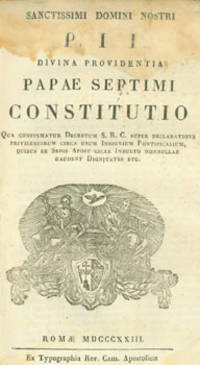
Pius IV (Pope, Roman Catholic Church, 1559 - 1565); Cam Apostolicae (Rome).
Pius Episcopus Servus Servorum Dei Ad Perpetuam Rei Memoriam.
Rome: Cam. Apostolicae 1823. 8vo. String-bound Pamphlet Letterpress on Rag 22 pp. Good with minor loss marginal tear minor staining. Illustrated title page. Text in Latin. Scarce. Rome: Cam. Apostolicae, 1823. unknown
Référence libraire : 63-7978
|
|
|
Pius VI Pio 6
Ragguaglio della solenne funzione, e ceremonie usate dal regnante sommo pontefice papa Pio 6. nell'apertura della porta santa di S. Pietro in Vaticano ..
In-8°. pp. VIII montate su fogli in-4°, senza legatura, stemma papale al frontespizio, una testatina, un capolettera e un finalino incisi su legno. Pio VI cerimonie apertura porta santa roma San Pietro vaticano riti
|
|
|
Pius VI Pio 6
Relazione di tutte le cerimonie fatte per la consercrazione in vescovo e solenne coronazione di papa PIO VI il 22 febraro 1775 ricorrendo in tal giorno la memoria della Catedra di S. Pietro di Antiochia
In-8°. pp. VIII montate su fogli in-4°, senza legatura. incoronazione Pio VI papa pope cerimonia basilica vaticana roma rome coronation apparati effimeri ephemeral fiano feste feast
|
|
|
Pius VI Pio papa 6
Sanctissimi in christo patris .. Pii divina providentia papae VI schedula motus proprii qua nonnullae gratiae superviventiae in officiis vacabilibus romanae curiae abrogantur
In-4°. pp. VI, 1 c.b. , senza legatura, stemma papale al frontespizio, testatina e un capolettera incisi su legno. roma rome curia pius VI Pio 6
|
|
|
PIZZI CANNELLA - Sargentini Fabio (Roma 1939)
Perle coltivate
Brescia: Edizioni l'Obliquo Passaggi 2011. Brossura wrappers. Ottimo Fine. Con una nota di <strong>Andrea Cortellessa</strong>. Uno dei 75 esemplari con una <strong>litografia originale </strong>di <strong>Piero Pizzi Cannella</strong> numerata e firmata a matita Le Perle cm 54x70. 16mo. pp. 108. Ottimo Fine. Prima edizione di 425 55 XX es. numerati. <em>Sargentini alterna l'attività"; di gallerista di avanguardia alla pratica teatrale e letteraria. Dal 1979 ad oggi è autore di diversi spettacoli tra cui spiccano Peter Pan 1979 Beat 72 e Ballerina 1979 Beat 72 primi lavori in Italia di teatro lirico concettuale. Tra le messinscena più" recenti Happy journey 2005 Senza titolo Doppio Shakespeare. Otto personaggi per sedici interpreti 2007 LAttico Obliquo Pirandello 2010 LAttico coregia di Elsa Agalbato. Sul versante letterario negli ultimi anni ha pubblicato Pescatore di Perle Edizioni della Cometa 2002 Diarietto teatrale Edizioni della Cometa 2005 Il mio doppio fuma loppio Edizioni lObliquo 2008. Sue poesie sono apparse su ''Nuovi Argomenti''.</em> Edizioni l'Obliquo, Passaggi unknown
Référence libraire : 99028 ISBN : 8888845917 9788888845913

|
|
|
Pizzirani Gigi
Una giostra di tori al colosseo Biblioteca popolare romana diretta da Gigi Pizzirani
In 8°, pp. 27. Brossura originale.

|
|
|
PIZZUTO, Antonio (Palermo 1893 - Roma 1976),
Signorina Rosina
Milano: Lerici Narratori 1959. Rilegato mezza tela half-cloth binding. Ottimo Fine. Seconda edizione con varianti ripretto alla Prima edizione edita da Macchia Roma nel 1954. 8vo. pp. 148. Ottimo Fine. Seconda edizione con varianti. Dizionario della letteratura italiana del Novecento Asor Rosa 1992 Asor Rosa Alberto Dizionario della letteratura italiana del Novecento. Torino Einaudi 1992. Lerici, Narratori hardcover
Référence libraire : 69663

|
|
|
Pizzuto, Antonio
Paginette
Mm 150x210 "Collana Narratori - Nuova Seie" Prima edizione. Volume in copertina rigida con sovracoperta, 183 pagine. Copia in buone-ottime condizion con solo lievi fioriture esterne che non riguardano il testo; spedizione in 24 ore dalla conferma dell'ordine.
|
|
|
PLAUTE (ERNOUT Alfred)
"Plaute; Comédies, tome 3 : Cistellaria, Curculio, Epidicus, texte et traduction. Collection des Universités de France, Guillaume Budé."
Paris, Les Belles Lettres, 1935. 13 x 20, 166 + 173 pages, broché, bon état (dos insolé).
Référence libraire : 87409
|
|
|
PLAUTE (CLOUARD Henri)
"Plaute : Théâtre; tome 3 (texte latin et traduction française). Collection : Classiques Garnier."
Paris, Librairie Garnier Frères, 1935. 12 x 19, 607 pp., broché, bon état.
Référence libraire : 87627
|
|
|
PLAUTE (ERNOUT Alfred)
"Plaute : Comédies (7 volumes); tome 1 : Amphitruo, Asinaria, Aulularia; tome 2 : Bacchides, Captivi, Casina; tome 3 : Cistellaria, Curculio, Epidicus; tome 4 : Menaechmi, Mercator, Miles Gloriosus; tome 5 : Mostellaria, Persa, Poenulus; Tome 6 : Pseudolus, Rudens, Stichus; tome 7 : Trinummus, Truculentus, Vidularia, fragmenta; textes et traductions (éditions de 1989, 1989, 1972, 1970, 1970, 1972, 1961). Collection des Universités de France, Association Guillaume Budé."
Paris, Les Belles Lettres, 1961-1989 13 x 20, 7 volumes, 1 : xlix-203 + 198 pages, 2 : 255 + 211 pages, 3 : 173 + 166 pages, 4 : 279 + 275 pages, 5: 270 + 257 pages, 6 : 273 + 260 pages, 7 : 205 + 165 pages, tomes 1 et 2 reliure d'édition saumon, carton imprimé, tomes 3 à 7 brochés, non coupés, très bon état.
Référence libraire : 88231
|
|
|
PLAUDE (ERNOUT Alfred)
"Plaute : Comédies; tome V : Mostellaria, Persa, Poenvlus. Collection des universités de France."
"Paris, Société d'Edition ""Les Belles Lettres"", 1938." 13 x 20, 253 pp., broché, bon état (couverture légèrement défraîchie).
Référence libraire : 101.825
|
|
|
PLAUDE (ERNOUT Alfred)
"Plaute : Comédies; tome V : Mostellaria, Persa, Poenvlus. Collection des universités de France."
"Paris, Société d'Edition ""Les Belles Lettres"", 1938." 13 x 20, 253 pp., broché, bon état (couverture légèrement défraîchie).
Référence libraire : 101.826
|
|
|
PLAUTE
COMÉDIES Tome VI (6) : Pseudolus - Rudens - Stichus
Les Belles Lettres, Guillaume Budé 1957 Paris, Société d'édition Les Belles Lettres, Guillaume Budé, 1957. Édition bilingue latin et français. Texte établi et traduit par Alfred Ernout. In-8 broché sous couverture saumon de l'éditeur. Très bon état, non coupé. Sans annotations ni soulignements. Texte et traduction.
Référence libraire : 17638

|
|
|
PLAUTE.
Comédies. Tome II : Bacchides, Captivi, Casina.
Les Belles Lettres, 1943, in-8°, 424 pp, texte établi et traduit par Alfred Ernout, broché, papier jauni, bon état (Coll. Budé). Texte latin avec traduction en regard
Référence libraire : 19943
|
|
|
PLAUTE.
Comédies. Tome I : Amphitryon, Asinaria, Aulularia.
Les Belles Lettres, 1932, in-8°, xli-331 pp, texte établi et traduit par Alfred Ernout, broché, dos lég. abîmé, bon état (Coll. Budé). Texte latin avec traduction en regard
Référence libraire : 19944
|
|
|
PLAUTE.
Comédies. Tome IV : Menaechmi, Mercator, Miles Gloriosus.
Les Belles Lettres, 1936, in-8°, 527 pp, texte établi et traduit par Alfred Ernout, broché, bon état (Coll. Budé). Texte latin avec traduction en regard
Référence libraire : 19945
|
|
|
PLAUTE,
Comédies. Tome IV : Menaechmi - Mercator - Miles Gloriosus
Texte établi et traduit par Alfred Ernout, Les Belles Lettres, Association Guillaume Budé, 1970, sixième tirage, 280 pp. (double pagination), texte bilingue latin/français, broché, couverture un peu défraîchie, plis de lecture sur le dos, état correct.
Référence libraire : 40203

|
|
|
Plana Georgette - Bachicha - Rodor Jean,Roma Oscar
Partition de la chanson : Ranchera (La) Besame
Garzon 1938 approx.
Référence libraire : 77081

|
|
|
PLAUTE (CLOUARD Henri)
Plaute, théâtre, tome 4eme. Classiques Garnier.
Paris, Librairie Garnier Frères, 1936. 12 x 19, 573 pp., broché, non coupé, bon état.
Référence libraire : 29011
|
|
|
PLAUTE (CLOUARD Henri)
Théâtre, tome 4eme. Classiques Garnier.
Paris, Librairie Garnier Frères, 1936. 12 x 19, 573 pp., broché, non coupé, bon état.
Référence libraire : 20114
|
|
|
Placidi, Giovanni
Polvere di Musa. Le Poesie Comiche, Quelle Del Sentimento, Quelle dell'Amore, Quelle Filosofiche, in Dialetto Romanesco
Mm 150x215 Brossura originale, 142 pagine. Copia eccellente, spedizione in 24 ore dalla conferma dell'ordine.
|
|
|
Plass, Paul
WIT AND THE WRITING OF HISTORY The Rhetoric of Historiography in Imperial Rome
Minor curling of wraps along foreedges. Light shelfwear. ; Wit has many uses in political discourse—to entertain, to underscore or unmask, to hinder or enhance insight. Wit and the Writing of History focuses on how this potential is realized in the historiography of the earlier Principate. Preeminently in Tacitus, to a lesser degree in Suetonius and Dio Cassius, wit is a vehicle for political understanding and judgment of the historical account. As part of Roman political life, hostile anecdotal or epigrammatic wit was deeply embedded in the sources used by historians and is reflected in the rhetoric of their narratives. Some anecdotes may, in fact, have been mere jests later taken as fact, hence the frequent problem of credulity. But what is historically false can be politically true. Not only were political jokes a weapon for making some fair points against the Principate; ancient rhetorical theory recognized that wit in general arises from a violation of normal, expected ways of thinking. What is “funny” is thus disturbing in a serious way as well as amusing, and in the hands of Tacitus wit becomes scalpel as well as sword. ; Wisconsin Studies in Classics; 182 pages
|
|
|
Platina Battista
Delle Vite de' Sommi Pontefici, dal Salvator Nostro sino a Paolo II. Ampliato con le historie de' Papi Moderni da Sisto IV fino a Paolo V. Scritte dal P. F. Onofrio Panuinio veronese, da Antonio Cicare lli da Foligno e da D. Gio. Stringa venetiano. Con l'annotazioni del Panuinio e con la Cronologia Ecclesiastica dello stesso, ampliata da Bartolomeo Dionigi, da Lauro Testa. Oltre i nomi, cognomi e patrie di tutti gli Cardinali, raccolti per il sudetto Dionigi dall'opere del Pa
In 4° (22,4x16 cm); 2 parti in un volume: (24), 9-912 pp. e (14 ), 222 pp. La seconda parte, con frontespizio proprio contiene “La cronologia ecclesiastica del R. P. F. Honofrio Panvinio Veronese, Frate Eremitano di Sant’Agostino. Dall’Imperio di C. Giulio Cesare Dittatore, fin’ all’Imperator Cesare Massimiliano II. d’Austria, Pio, Felice, Perpetuo, Augusto. Tadotto nuovamente dalla lingua Latina nell’Italiana, supplita, & ampliata daò MDLXVI. Sin l’Anno MDCVI. Dal R. M. Bartolomeo Dionigi da Fano et dall’Anno MDCVI. Fin’ all’Anno MDCXII. da D. Lauro Testa, & altri”. Bella legatura coeva in piena pergamena con titolo chiosato da abile mano coeva al dorso. Leggere tracce di polvere alla legatura. Antica firma di appartenenza privata al frontespizio “Ad usum de Rossi”. Nel primo frontespizio, stampato in rosso e nero, armi papali, nel secondo frontespizio la bella marca tipografica di Barezzo Barezzi. L’opera presenta oltre 200 xilografie con i ritratti dei Papi e gli stemmi delle famiglie di provenienza, testatine, capolettera e finalini incisi. Una piccola mancanza di carta all’angolo inferiore basso di carta a5 della seconda opera, dovuta ad un difetto della carta antecedente la stampa che interessa solo la parte bianca e non il testo, del tutto ininfluente. Esemplare in buone-ottime condizioni di conservazione. Bell’edizione veneziana notevolmente aumentata ed aggiornata al 1623 di questa celeberrima fonte storica opera del famoso umanista e gastronomo, Bartolomeo Sacchi, detto il Plàtina (Piadena in provincia di Cremona, 1421 – Roma, 21 settembre 1481). Dopo aver prestato servizio militare presso Francesco Sforza e Niccolò Piccinino come mercenario si trasferì poi a Mantova per avviarsi agli s tudi umanistici sotto la guida di Ognibene da Lonigo. Nel 1453 il Platina entrò al servizio diretto dei Gonzaga divenendo precettore di Ludovico III Gonzaga. Nel 1457 si stabilì a Firenze per seguire le lezioni di Giovanni Argiropulo, celebre umanista di orientamento platonico. Qui strinse amicizia con celebri umanisti quali Marsilio Ficino, Poggio Bracciolini, Francesco Filelfo, Cristoforo Landino, Leon Battista Alberti, Giovanni Pico della Mirandola e molti altri. Sempre a Firenze divenne precettore presso la famiglia Medici e legandosi anche, alla famiglia Capponi, di parte repubblicana. Amante dei classici latini e greci fu anche abile storico. Nel 1461, seguendo il Cardinale Francesco Gonzaga si stabilì a Roma dove, entrato in contatto con la corte pontificia, venne da questa precettato in qualità di “abbreviatore”. Servì sotto i papi Pio II, Paolo II e Sisto IV. In particolare sotto il secondo è da ricordare che fu da questi, insieme ad altri “abbreviatori” rinchiuso nelle carceri pontificie e torturato con l’accusa di aver cospirato contro il papa. Scagionato da ogni accusa fu ben accolto da papa Sisto IV che lo nominò direttore della Biblioteca Vaticana. Qui potendo attingere liberamente alle enormi riserve di notizie conservate presso l’istituto, compose alcune delle sue opere più celebri quali il Liber de vita Christi ac omnium pontificum, il De Principe, il De Vera Nobiltate, il De falso et vero e bono ed appunto Delle vite de’ Sommi Pontefici. E’ di questi anni anche il suo celebre trattato gastronomico, il De honesta voluptate et valetudine. L’opera del Platina è qui notevolmente integrata grazie al contributo di diversi studiosi come Ciccarelli Antonio, Stringa Giovanni, Dionigi Bartolomeo, Tomasucci Francesco. Onofrio Panvinio e Testa Lauro. Importante fonte storica ed iconografica per la storia del papato romano. Esemplare in buone-ottime condizioni di conservazione. Rif. Bibl.: ICCU IT\ICCU\UM1E\001384.

|
|
|
PLATONE, , Mario Vegetti (a cura di)
La Repubblica Testo a Fronte
(vo, br. ed. 1183pp. "La Repubblica" è, probabilmente, il più importante tra i dialoghi di Platone; senza dubbio è il più controverso e frainteso. Scritta nell'arco di molti anni, "La Repubblica" è uno specchio fedele della vastità e della complessità della speculazione platonica, di cui si può considerare a buon diritto la summa e la sintesi. Partendo dal concetto di giustizia, infatti, il campo dell'indagine si allarga sempre di più fino a prendere in esame la migliore costituzione di un'ipotetica città, affrontando via via etica, politica, psicologia, ontologia ed epistemologia, e aprendo problematiche che a tutt'oggi sono lontane dall'essere risolte.
|
|
|
Plaute [Plautus] / Ernout, Alfred [Tr.]
Plaute - Comedies - Tome I: Amphitryon - Asinaria [Plautus][THIS VOLUME ONLY]. [SERIES]: Collection des Universites de France.
THIS VOLUME ONLY. 20x13 cm. 203+41 pages. Softcover. Pages uncut - as published. Spine wrinkled. Pages slightly age stained. Else in good condition.
|
|
|
Plauti, T. Macci / Lindsay, Wallace Martin [Ed.]
Comoediae [SET IN TWO VOLUMES] [SERIES]: Oxford Classical Texts
SET IN TWO VOLUMES. XX+508+XI+unnumbered pages. Gilt hardcover in dust jacket. Pen writing on inner front cover pages. Else in good condition. PLEASE NOTE: This item is overweight. We may ask for extra shipping costs.
|
|
|
Plauto, T. Maccio
Commedie Volume 2, Bacchides - Captivi
Mm 125x195 Volume cartonato di pp. 368, testo e versione poetica di Guido Vitali, sovraccoperta mancate. All'interno Bacchides - Captivi. Opera in buonissime condizioni. SPEDIZIONE IN 24 ORE DALLA CONFERMA DELL'ORDINE
|
|
|
Plauto, T. Maccio
Commedie Volume 3
Mm 125x195 Collana "Poeti di Roma". Terzo volume con testo a fronte dell'opera. Testo e versione poetica di Guido Vitali. Volume cartonato, legatura editoriale in tela, sovraccoperta mancante, 451 pagine con qualche raro segno di matita ed un piccolo strappo alla pagina 47, peraltro copia in biono stato. All'interno Amphitruo, Menaechmi. SPEDIZIONE IN 24 ORE DALLA CONFERMA DELL'ORDINE.
|
|
|
PLAUTO, T. Maccio; a cura di Guido Vitali.
Commedie. 3 Volumi.
Cm. 19,5 x 12,5; pp. XXIII - 420 - 368 - 452; cucito; legatura editoriale in tutta tela editoriale con fregi e titoli in oro e sovraccoperta; carta finissima; capitelli; taglio superiore rosso.<BR>Traduzioni poetiche con testo a fronte.<BR>Collana Poeti di Roma.<BR>Vol. I.: Aulularia; Miles gloriosus. Vol. II.: Bacchides; Captivi. Vol. III.: Amphitruo; Menaechmi.<BR>Qualche piccolo strappetto alle sovraccoperte, per il resto in ottimo stato.
|
|
|
Plautus / Dencke, Arthur
Zur Würdigung des Plautus, Jahresbericht des Gymnasium zum Heiligen Kreuz 1910-1911,
o.O. [Dresden], ohne Verlagsangabe [Lehmann] (= Programm No. 757 - dies handschriftlich auf Vorderdeckel vermerkt), 1911. gr.8°, 23 S., Text zweispaltig, original Kartonage, schöner alter Stempel der Lehrerbibliothek eines alteingesessenen Frankfurter Gymnasiums auf Vorderdeckel, sonst gutes, kaum altersspuriges Exemplar (ro ord12)
Référence libraire : 6234BB

|
|
|
Plautus / Terenz
Antike Komödien in zwei Bänden, herausgegeben und mit einem Nachwort und Anmerkungen versehen von Walther Ludwig,
Wiesbaden, Drei Lilien Verlag, ohne Jahr. 8°, zus. 1449 S., illustr. original Pappband (Hardcover), am Buchrücken und Einbandkanten minimal beschabt, sonst zwei schöne, saubere Exemplare.
Référence libraire : 21833CB

|
|
|
PLAUTUS [TITUS MACCIUS], (254-184 BC).
Kartacali. [= Poenulus]. Translated by Nurullah Ataç. (Lâtin Klasikleri: 25).
Very Good Turkish Paperback. Foolscap 8vo. (18 x 12 cm). In Turkish. 104 p. Kartacali. [= Poenulus]. Translated by Nurullah Ataç. (Lâtin Klasikleri: 25). First Edition.
|
|
|
PLAUTUS, TERENTIUS & SENECA (& NISARD M., dir.)
Theatre complet des latins comprenant Plaute, Terence et Seneque le tragique, avec la traduction en français
Hardback fort volume petit in-4, XX + 545 + 166 + 211 pages, reliure demi-veau a coins d"epoque, dos a nerfs, caissons richement decore, filets dores aux plats, tranches jaspees. Tres bon etat (bords frottes) [PIL-5] Bilingue: latin-français
|
|
|
Plaza Maria
The Function of Humour in Roman Verse Satire: Laughing and Lying
8vo, br,ed. 384pp. Maria Plaza sets out to analyse the function of humour in the Roman satirists Horace, Persius, and Juvenal. Her starting point is that satire is driven by two motives, which are to a certain extent opposed: to display humour, and to promote a serious moral message. She argues that, while the Roman satirist needs humour for his work's aesthetic merit, his proposed message suffers from the ambivalence that humour brings with it. Her analysis shows that this paradox is not only socio-ideological but also aesthetic, forming the ground for the curious, hybrid nature of Roman satire.
|
|
|
PLEHWE Friedrich-Karl von
The End of an Alliance. Rome's Defection from the Axis in 1943. With a Foreword by F.W.D. Deakin. Translated from the German by Eric Mosbacher. [First English Edition]. FIRST ENGLISH EDITION IN UNCLIPPED DUSTWRAPPER
8vo., First Edition thus; green cloth, gilt back, a near fine copy in unclipped dustwrapper. SCARCE IN THIS CONDITION. Enser, p.52.

|
|
|

 Recevoir par e-mail
 Télécharger en PDF
 Flux RSS
 Lien permanent


