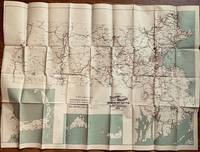
Boston: State of Massachusetts 1902. 36 x 26 inches. Very good condition. Beautifully presented map showing the electric railways of the state. Everything about the map is laid out with a legend having only four points of issue; Street Railways Junction Points proposed line Steam railways. There are inset maps of Cape Cod and Nantucket with Martha’s Vineyard. Very nice composition. State of Massachusetts unknown
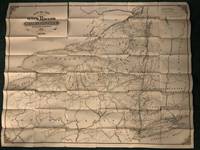
New York: Railroad Commissioners of New York 1890. 1890. MAP NEW YORK RAILROADS. First Edition. Large Folding Map. 44"x35". A detailed map showing all of the major and short-line railroads in the state of New York in 1890. Map also shows surrounding areas of Canada Vermont Connecticut New Jersey and Pennsylvania. Scale is 10 miles to 1 inch. Several places with splitting along folds as map is printed on relatively thin paper. Railroad Commissioners of New York, 1890. unknown
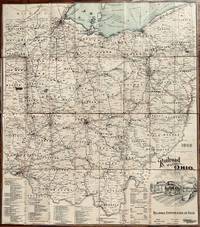
Columbus OH: Columbus Lithograph Company 1909. 32 1/2 x 28 1/2 inches. Very good condition. This is a beautifully composed map of Ohio showing the railroadscape of the state. Bounded by the Ohio River and Lake Erie the layout across the state is vividly presented. The prominent cities of the state are well connected. Toledo and Cleveland in the north are central railroad towns as is Columbus in the center of the state. In the south is Cincinnati and Northeast is centered on Youngstown. There were 45 steam railroads operating in Ohio in 1909. Additionally there were 58 electric railways in operation. Needless to say it was not difficult to get from here to there in the State of Ohio in1909. It is of significant note that the state of Ohio was connected to both the Great Lakes trading system and the Mississippi River trading system. Farmers had the option of moving produce north into the Great Lakes system or south into the Mississippi River system via the Ohio River. In 1850 when there were significant shortages of grains and produce in the South the Ohio State trading mechanism shipped to the south before the new crops were harvested. Flexibility followed price. Columbus Lithograph Company unknown
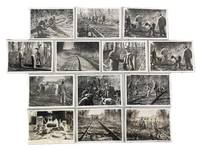
1960. Railroad labor photo archive documenting manual track rehabilitation work on a rural rail line likely Minnesota circa 1960s during the period when thousands of miles of lightly used American branch line track were being abandoned salvaged or transferred into preservation and excursion use. The scenes illustrate the broader contraction of regional rail service that accelerated after World War II as trucking highway construction and changing freight patterns undermined small-line profitability. Crews work directly on deteriorated rails and ties using pry bars hammers jacks buckets and lining tools recording the physical labor required to maintain secondary rail infrastructure before mechanized maintenance became dominant on many smaller lines. Several scenes suggest volunteer or preservation-oriented work rather than standard commercial railroad maintenance including the mixed-age crew casual work clothing and informal group arrangements. Notations identify John L. Blamey on two images possibly referring to a Minnesota photographer of the same name.<br /> <br /> Photo archive of 12 black and white Kodak prints each 5 x 7 inches likely silver gelatin photographs Minnesota circa 1960s. Workers stand along heavily worn track in wooded rural terrain while replacing ties aligning rails clearing ballast and fastening hardware by hand. A rail maintenance vehicle and small rail equipment appear in the distance in several scenes while other views isolate long stretches of neglected track curving through leaf-covered corridors. Younger participants in denim overalls work alongside older men in railroad caps and heavy work jackets suggesting a collaborative rehabilitation effort rather than a fully standardized railroad gang. Buckets oil cans pry bars spikes and timber ties are positioned directly along the right-of-way emphasizing the improvised and labor-intensive character of the work. One scene captures two men driving spikes while kneeling beside exposed ties; another shows a larger crew spread across the rails with tools arranged in parallel lines along the track bed. Several prints bear manuscript identification to "John L. Blamey." One still life of dining utensils and tableware appears within the group perhaps a meal shared by the group or an image retained from the same processing batch.<br /> <br /> By the 1960s many Midwestern branch lines faced abandonment as railroads consolidated operations and shifted investment toward higher-volume freight corridors. Across states such as Minnesota Wisconsin and Iowa local historical societies preservation groups and volunteer railroad organizations increasingly intervened to salvage depots rolling stock and short rail segments before removal. These scenes preserve the transition period when maintaining even a short stretch of track still depended upon coordinated hand labor and inherited railroad knowledge. No loss or wear noted; prints clean and sharply detailed. Overall in very good to near fine condition. unknown
Washingtion D.C.: Association of American Railroads 1947. Paper Back. Near Fine/No Jacket. 4to - over 9¾" - 12" tall. 44pp.; SC staple-bound blk.&white; slight rub w/cleantight pgs. "This report. focuses attention on those branches of the railroad organization which have to do with maintenance of the fixed facilities and rolling stock and the actual operation of the service. <br/> <br/> Association of American Railroads unknown
Paperback. New. New Book; Fast Shipping from UK; Not signed; Not First Edition; The Official Northern Pacific Railroad Guide - For the Use of Tourists and Travelers over the Lines of the Northern Pacific Railroad and its Branches is an unchanged high-quality reprint of the original edition of 1894. Hansebooks is e paperback
Referenz des Buchhändlers : ria9783744727907_inp ISBN : 3744727904 9783744727907

 Per e-mail erhalten
 Als pdf-Dokument herunterladen
 RSS feed
 Permanenter link