|
|
|
GOLDSCHMIDT (E.P.)
Hieronymus Muenzer and Other Fifteenth Century Bibliophiles. Reprinted from Bulletin of the New York Academy of Medicine.
491-508pp., printed wrappers.
|
|
|
GOSSART (Maurice)
Catalogue des incunables d'origine néerlandaise conservés à la bibliothèque communale de Lille.
Grand in-8, demi-chagrin noir, dos lisse orné de petits filets et fers dorés, titre doré en long, couverture conservée, 83 p. Lille, Imprimerie L. Danel, 1907.
Referenz des Buchhändlers : 31814

|
|
|
GRATIEN.
Decretum Gratiani iam recens innumeris pene mendis : ijusquem fedissimis : quibenque passim et in glossis et in textu scatebat : non sine labore grantissimo repurgatum.
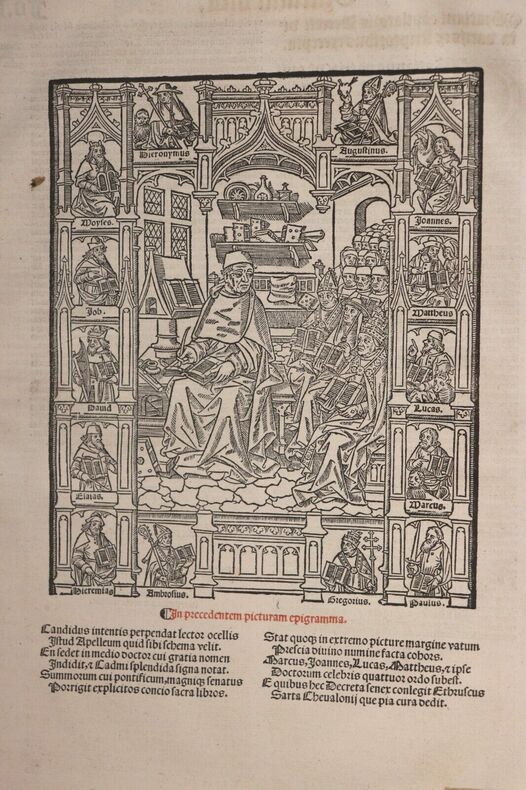
Parisiis, ex officina Claudii Chevallonii sub sole aureo in dia ad divum Jacobum. 1528 mense Aprili. [Paris, Claude Chevallon, avril 1528] 1 fort volume in-folio (39 x 28 cm) de 28 feuillets non chiffrés, CCCCLIX fol. chiffrés (le folio CCLXXIX manque), XLVI fol. chiffrés et 1 fol. non chiffré. Titre imprimé en rouge et noir dans un encadrement gravé sur bois, marque de B. Rembolt sur le titre. Grande gravure sur bois au verso du folio I (L'auteur présentant son ouvrage). Grande gravure sur bois au verso du folio CCCCXVIII (Arbor consanguinitatis) et autre grande gravure au recto du feuillet suivant (qui n'est pas chiffré). Le dernier feuillet contient le registre. Texte imprimé en rouge et noir pour la plupart des feuillets, le plus souvent sur 4 colonnes avec différentes tailles de caractères, le tout en caractères gothiques. Reliure ancienne (probablement du début du XVIIe siècle) en veau brun. Reliure usagée encore solide. Manque de cuir au dos, mors fendus. A restaurer. Intérieur assez frais. Quelques mouillures sans gravité à quelques feuillets. Mouillure avec petit manque de papier dans la marge inférieure des derniers feuillets, sans atteinte au texte. Comme indiqué plus haut le folio 279 manque (trace d'arrachage dans la marge intérieure), sinon tous les autres feuillets sont présents. Superbe mise en page avec de très nombreuses grandes lettrines historiées.
Referenz des Buchhändlers : AMO-4518
|
|
|
HAEBLER (Konrad)
Spanische und Portugiesische B?cherzeichen des XV. und XVI. Jahrhunderts.
Folio, [iv],xlpp., with the H.P. Kraus bookplate, 46 plates, cont. quarter roan, spine rubbed, marbled sides. The marks of 93 different Spanish and Portuguese printers are included in this study. An alphabetical list of printers' and publishers' names refers the reader to biographical sketch in which each name appears. Information presented includes the dates during which a printer was active, cities in which he worked, and associates with whom he worked. Clear prints of marks are provided, as are the title, author, date and city of publication, and size of book(s) in which each mark appears, as well as citations to other scholarly resources. The index of printers' and publishers' names is comprehensive, guiding users of this work to both the main entry on a printer or publisher as well as to entries in which the name is mentioned, which makes this a useful book for researching the interactions between various printers.
|
|
|
HAEBLER (Konrad)
The Early Printers of Spain and Portugal.
[iv],165pp., frontis., 33 facsimiles, orig. cloth.
|
|
|
Haebler, Konrad
Bibliografia iberica del siglo XV
Two volumes in one. The standard bibliography of Spanish and Portuguese books printed up to the year 1500. 720 items meticulously described, many in great detail. 4to, fine and bright in publisher's cloth.
|
|
|
Haebler, Konrad
The Early Printers of Spain and Portugal
A standard monograph on Iberian incunabula and post-incunabula. Dozens of facsimile plates. Large, squarish 8vo. Publisher's cloth. As new.
|
|
|
HAIN (Ludwig) COPINGER (W. A.) & REICHLING (Dietericus)
Repertorium Bibliographicum, in que Libri Omnes ab Arte Typographical Inventa Usque ad Annum MD, Typis Expressis Ordine Alphabetico vel Simpliciter Enumerantur vel Adcuratius Recensentur... [Appendices ad Hainii-Copingeri Repertorivm Bibliographicum...]
Main work 7 vols., orig. cloth, Reichling 7 parts, orig. printed wrappers, 14 volumes in total. This work is the basic bibliography to which anyone working on fifteenth-century books refers or is referred to, this set includes the important appendix by Reichling.
|
|
|
Harman, Marian and Christopher D. Cook
Incunabula in the University of Illinois Library at Urbana-Champaign. A Bibliography [with] Supplement
Two volumes, complete. The bibliography of an excellent collection: well over 1100 items, precisely described. [11], 251; x, 37 pp. With a few facsimile plates. 4to. Main volume in publisher's cloth; supplement in wraps. Fine and bright. Scarce.
|
|
|
HASSLER (Konrad Dieterich)
Die Buchdrucker-Geschichte Ulm's...
4to, [vii]pp., 158 columns, with the H.P. Kraus bookplate, orig. printed wrappers. Dealing with the printers Ludwig Hohenwang and Johannes Zainer. The bibliographical part list 166 books printed at Ulm during the 15th and early 16th century.
|
|
|
HAUTE MARNE LANGRES SOCIETE HISTORIQUE ET ARCHEOLOGIQUE DE LANGRES
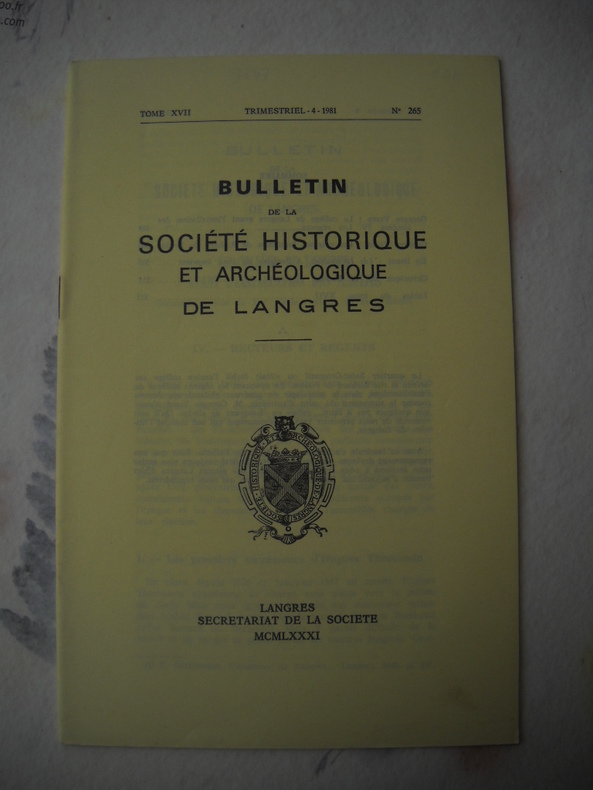
Bulletin de la société historique et archéologique de LANGRES:Le collège de LANGRES avant l'intallation des Jésuites . IV. Les régents par G. VIARD.Les origines de Richard DE FOULON par G. VIARD.En lisant : les incunables. A l'origine du livre imprimé.Chronique de la société.Table du tome XVII.
broché - 15.5x24 - pages 489 à 520 - tome XVII - 4 éme trimestre 1981 - n° 265
Referenz des Buchhändlers : 9047
|
|
|
HEBER (Richard)
Bibliotheca Heberiana. Catalogue of the Library of the Late Richard Heber, Esq... Removed from his House in York-Street, Westminster, Which Will be Sold by Auction, by Messrs. Sotheby and Son [Evans; Wheatley]...
13 Volumes bound in five, large 8vo printed on good wove paper, [iv], 388; xii, 363, [1]; [iv], 295, [1]; vii, [iii], 355, [1]; [iv], 257; [iv], 314; [iv], 306; [iv], 170; [iv], 195, [1]; [iv], 117, [1]; [iv], 189, [1]; [iv], 83, [1]; [iv], 82, [2]pp., parts 1-3 in orig. boards, spines chipped, covers loose, orig. printed label on upper covers, uncut, parts 4-7 cont. half calf, rubbed, spine stained and spotted, parts-8-13 cont. quarter morocco, rubbed, foot of spine torn, faint stamp of 'Mercantile Library, Philada.', front hinge shaken, title page to part 8 loose, prices and buyers' names supplied in a cont. hand, a made-up set of the complete English sale catalogues of the library of Richard Heber (the 13th volume is notoriously rare). Heber was a book collector on a monumental scale, De Ricci estimated his library between two and three hundred thousand volumes. The sales took place at a time when the market was absolutely glutted and there were practically no buyers. The total realised was ?65,774, for books which had cost their late owner a good deal over ?100,000. "The Dibdinian age may be aptly said to terminate with the dispersal of the gigantic library accumulated by Richard Heber, a bibliomaniac if there ever was one... From 1800 to 1830, he purchased at every London sale... He thought nothing of securing whole libraries... When he died, his books filled two houses in London, one at Hodnet, one at Oxford, one at Ghent and one at Paris, not to speak of smaller stores at... other Continental cities. The total number of volumes in his library must have been between two and three hundred thousand, and it is doubtful whether any private individual has ever owned so large a library... The London sales produced ?56,744, for books which had cost their late owner over ?100,000. The market was absolutely glutted and there were practically no new buyers... The Heber catalogues, although... arranged in the most inconvenient manner, are daily consulted by every bibliographer... His series of Continental books, early Italian and Spanish works, later Latin poetry, humanistic treatises... were unrivalled... The real strength... was, however, in the field of early English literature... For thirty years he... purchased nearly every item which came on the market".?De Ricci, p.102. Organised according to the residences where Heber kept his libraries, the present catalogues number 1 - 13 and were held in 1834, 1835, 1836 & 1837. Sotheby's managed the sale for parts 1- 3 and 9 - 10; R. H. Evans, for parts 4 and 6 - 8 and 11; B. Wheatley, parts 5 and 12-13.
|
|
|
HECKETHORN (Charles William)
The Printers of Basle in the XV. & XVI. Centuries. Their Biographies, Printed Books and Devises.
First Edition, 4to, xiv, [ii], 208pp., a very good ex-library, frontis., 3 plates, 61 facsimiles of woodcuts, devices etc., orig. buckram, gilt, head and tail of spine slightly frayed, corners rubbed, uncut.
|
|
|
HELLINGA (Lotte)
Printing in England in the Fifteenth Century. E. Gordon Duff's Bibliography with supplementary descriptions, chronologies and census of copies.
4to, xvii, 278pp., facsimiles, orig. cloth.
|
|
|
HIERONYMUS (Saint-Jérôme) / DOMINUS PINCIUS
Epistolae
Feuille d'incunable vénitien du quinzième siècle provenant de « Epistolae ». Venetiis, Dominus Pincius, sans date (vers 1500). Un feuillet in-folio (29.9 x 21.4 cm). Texte latin en caractères romains de 2 pages sur 2 colonnes de 62 lignes (folio 154 avec signature u ii et réclame). Très bel état. Goff H-177. OCLC 80971150.
Referenz des Buchhändlers : 3372
|
|
|
HODGKIN (John Eliot)
Rariora: Being Notes of Some of the Printed Books, Manuscripts, Historical Documents, Medals, Engravings, Pottery. Etc., Collected (1858-1900) by John Eliot Hodgkin.
First Edition, 3 vols., 4to, xix, [i], 124; [viii], iv, 297, [1]; xiv, 161, [1], viii, 92, 11, [1]pp., a very good ex-library set, printed on thick Van Gelder paper, plates and illustrs., throughout (some coloured), orig. buckram, soiled, uncut, t.e.g. Describes many items acquired by Hodgkin from the Phillipps sales of manuscripts, also, the fine collection of incunabula. Volume three has an annotated bibliography of firework books. De Ricci, p. 187.
|
|
|
HODGKIN (John Eliot)
Rariora: Being Notes of Some of the Printed Books, Manuscripts, Historical Documents, Medals, Engravings, Pottery. Etc., Collected (1858-1900) by John Eliot Hodgkin.
First Edition, 3 vols., 4to, xix, [i], 124; [viii], iv, 297, [1]; xiv, 161, [1], viii, 92, 11, [1]pp., printed on thick Van Gelder paper, plates and illustrs., throughout (some coloured), orig. buckram, uncut, t.e.g. a very nice set. Describes many items acquired by Hodgkin from the Phillipps sales of manuscripts, also, the fine collection of incunabula. Volume three has an annotated bibliography of firework books. De Ricci, p. 187.
|
|
|
HODNETT (Edward)
English Woodcuts 1480-1535.
Reprinted with Additions and Corrections, 4to, 251 facsimiles, orig. cloth. The core of the work is a catalogue of cuts, covering all the books containing cuts printed by Caxton, Wynkyn de Worde, Richard Pynson and minor printers, preceded by an introduction, and followed by a bibliography of illustrated books and an index of cuts by sizes.
|
|
|
HUBERT, Mgr Jean François
Mandement du 28 octobre, M.DCC.XCIII.
(Québec, John Neilson ? 1794 ?) In-4 (24.9 cm) (1)f. [titre], 13p. [texte]. En feuilles. Fines rousseurs. Manque la page de titre et la p. 13 qui contient une Liste des Solennités, qui sont remplacées par des fac-similé. Vlach & Buono 520. Lande S 1096. Tremaine 875. [ Mandement de Monseigneur l'Évêque de Québec, qui révoque certaines dispositions de deux Mandements précédents et pourvoit à quelques autres objets. Sur la suppression de certains jours de fêtes. Incunable canadien qui d'après Tremaine a été tiré à 400 exemplaires.]
Referenz des Buchhändlers : 494
|
|
|
HUTH (Henry)
The Huth Library. A Catalogue of the Printed Books, Manuscripts, Autograph Letters, and Engravings, Collected by Henry Huth, with Collations and Bibliographical Descriptions.
5 Vols., 4to (268 x 180 mm), limited to 130, frontis., portrait, a very good ex-library set, later red quarter calf, cloth boards. Huth's collection, which ranked among the finest in England, was rich in incunabula, voyages, Shakespearean and early English literature, and Bibles. He began compiling this catalogue late in life, but finding it too time-consuming, he employed W.C. Hazlitt and F. S. Ellis to do most of the work. "With the assistance of Ellis and Hazlitt, Huth had started printing a magnificent catalogue of his library, with full titles of every item and exact collations, both entirely novel features in a library catalogue. The work was completed in five volumes two years after his death and has remained... a corner-stone of British bibliography." De Ricci, p. 151.
|
|
|
HUTH LIBRARY.
Catalogue of the Famous Library of Printed Books, Illuminated Manuscripts, Autograph Letters and Engravings Collected by Henry Huth, and Since Maintained and Augmented by his Son Alfred H. Huth, Fosbury Manor, Wiltshire... First [-Ninth and Final] Portion. [With:] The Autograph Letters; Engravings & Woodcuts; Unsold & Imperfect Books.
12 Parts., 4to, numerous plates throughout (some coloured, some folding), all parts illustrated in orig. printed wrappers unless otherwise described. A complete record of the sale of printed books, manuscripts and autographs which De Ricci described as "one of the most striking events in the history of the English sale-rooms". Huth's collection, which ranked among the finest in England, was rich in incunabula, voyages, Shakespearean and early English literature, and Bibles. Together these 12 sales consisted of 8,788 lots and totalled over ?350,000. [i] 12 June 1911. Autograph letters (246 lots). [ii] 4 July 1911. Engravings and woodcuts (341 lots). This catalogue was under printed and is especially difficult to obtain. [iii] 15 November 1911. Library, part I (lots 1-1228). Limited edition, spine broken. [iv] 5 June 1912. Library, part II (lots 1229-2596). Quarter calf. [v] 2 June 1913. Library, part III (lots 2597-3931). Lightly waterstained, spine broken. [vi] 7 July 1914. Library, part IV (lots 3932-4602). Limited edition. [vii] 4 July 1916. Library, part V (lots 4603-5205). New wrappers. [viii] 11 July 1917. Library, part VI (lots 5206-6060). Limited edition. [ix] 1 July 1918. Library, part VII (lots 6061-7182). [x] 8 July 1919. Library, part VIII (7183-7842). Un-illustrated, new wrappers. [xi] 22 June 1920. Library, part IX and final portion (lots 7843-7969). [xii] 27 February 1922. Unsold or imperfect books (232 lots). De Ricci, pp. 151-154.
|
|
|
HUTH LIBRARY.
Catalogue of the Famous Library of Printed Books, Illuminated Manuscripts, Autograph Letters and Engravings Collected by Henry Huth, and Since Maintained and Augmented by his Son Alfred H. Huth, Fosbury Manor, Wiltshire... First [-Ninth and Final] Portion.
9 Parts., 4to, numerous plates throughout, including some chromolithographed (some which a couple of the folding examples are adhered), list of prices and buyers' names bound in of the back of each part, uniform brown buckram, spines lettered in gilt. A complete record of the sale of printed books and manuscripts which De Ricci described as "one of the most striking events in the history of the English sale-rooms". Huth's collection, which ranked among the finest in England, was rich in incunabula, voyages, Shakespearean and early English literature, and Bibles. De Ricci, pp. 151-154.
|
|
|
IBRAHIM HILMI [ÇIGIRAÇAN], (1876-1963).; DOKTOR MORITMA (?).
[OTTOMAN MAP of BYZANTINE CONSTANTINOPLE] Kurun-u vustâ inhâsinda Kostantiniyye. Doktor Moritma'nin tetkikâtina göre kable'l-feth-i sehrin plâni. Feth-i Kostantiniyye asârina aiddir. Published by Ibrahim Hilmi.
Very Good Turkish, Ottoman (1500-1928) Original b/w city map of Byzantine Constantinople printed in ??? by Tüccarzâde Ibrahim Hilmi Çigiraçan, (1876-1963). Oblong: 37x50 cm. In Ottoman script. Folded. Scale is not described. Toponyms are Turkish besides some of old Byzantine. [OTTOMAN MAP of BYZANTINE CONSTANTINOPLE] Kurun-u vustâ inhâsinda Kostantiniyye. Doktor Moritma'nin tetkikâtina göre kable'l-feth-i sehrin plâni. Feth-i Kostantiniyye asârina aiddir. Published by Ibrahim Hilmi. Ibrahim Hilmi Çigiraçan was a Turkish publisher and author. He is one of the first Turkish publishers of the Ottoman Empire. He published more than 1000 books on history, literature, politics, religion and social issues and maps in the printing house he founded in 1896.
|
|
|
IBRAHIM MUTEFERRIKA, (The founder of the first printing house in the Islamic world), (1674-1745).
["DECLARATION OF THE OTTOMAN EUROPEANIZATION": THE 9TH ISLAMIC INCUNABULA] Usûlü'l-hikem fî nizâmi'l-ümem. [i.e. The origins of thought and the order of the nations].
Very Good Turkish, Ottoman (1500-1928) Contemporary quarter dark burgundy leather bdg. Grey cloth boards. Four compartments at spine. Cr. 8vo. (20 x 14 cm). In Ottoman script (Old Turkish with Arabic letters). 96 p. [48 leaves]. 19 lines on each page. Printed on paper with European watermarks. A small tear up to the last page with no loss of text. Overall a fine copy. The 9th incunable of the Islamic world, written by Ibrahim Müteferrika and printed in his legendary Basmahane. Known as the most significant work by Müteferrika, this incunable is a political and state-theoretical treatise composed in order to improve the Ottoman government. In his book, Ibrahim Müteferrika used the sources written in Latin in the Europe of his period, and he presented it to Sultan Mahmud I right after the Patrona Halil Revolt (1730). Müteferrika divided the state forms of government in Europe into three groups with the titles "monarkiya" [i.e. monarchy], "aristokrasiya" [i.e. aristocracy], and "demokrasiya] [i.e. democracy]. In the work, the importance of the sciences (physics, astronomy, and geography) in the state administration was emphasized, and it was stated that a solid-state order could not be established in a country where these sciences were not developed. In addition to this, he used the term "Nizâm-i Cedîd" [i.e. The New Order] for the first time and stated that the Ottoman Empire should definitely adopt and implement the new military orders of the 18th century Europe. In addition, this work is one of the earliest in which the "democracy" term is used in the Islamic world. The book was published in French in Vienna and Paris in 1769 (Traite de la tactique ou méthode artificielle pour l'ordonnance des troupes, Vienne, 1769. Translated by Karl Emerich Alexander von Reviczky von Revisnye [Baron Reviczki]), and was translated from French into Russian in 1777. One of only 500 copies. The volume appeared in 1732, about one and a half years after the uprising of Patrona Halil Revolt which had overthrown the system of Sultan Ahmed III and Grand Vizier Damad Ibrahim. The writing, recalling the characteristics of Ottoman siyâsetnâme [i.e. the book of politics], calls the attention of the Ottoman leaders to the results of the state and military development and to the reasons for the strategic superiority of the rival European powers, while strongly condemning the several centuries long disinterest of the Ottomans to the external world. An important feature of the work is to break with the hitherto prevailing nostalgic attitude to bygone golden ages. Although observes the stylistic conventions in as much he speaks contemptuously about the Christian nations, in the content, already turns away from the indifference referring to the superiority of Islam. It announces in a list organized by items the reasons for the state's weakness and the conditions of rising. In harmony with the main aspects of contemporary Ottoman reforms, the work mainly focuses on the necessity of the reorganization of the army. It also offers a broader historical background by describing after the Greek philosophers the various types of states (6v-7v), or by treating the origins and reasons for the success of the foundations of European culture, the Roman Empire (19v-20v). The concept "Nizâm-I Cedîd" (i.e. the New Order), which would be used for the newly organized military formations of Sultan Selîm III (1789-1807), appears here for the first time referring to the modernized European army (17v-18r). "The utopistic optimism of Risâle-i Islâmîye may have had some rational basis, if one takes into account the Karlovci Treaty (1699) which was a rather positive correction in contrast to the previous series of Turkish failures in the Balkans, the European 'internal wars' of the first decade of the 18th century, and the experiences of the reform and peace years of the Tulip Period. However, the Usûl ül-hikem. was already inspired by the atmosphere after the Pozarevac Treaty (1718) which was a further stro
|
|
|
INCUNABLES.
Bibliotheca Corviniana. Die Bibliothek des Königs Matthias Corvinus von Ungarn.
Budapest, Magyar Helikon, 1978. Grand in-4° reliure pleine toile, jaquette illustrée. Avec 126 planches hors-texte en couleurs reproduisant les codex et les incunables de cette importante bibliothèque humaniste.
Referenz des Buchhändlers : 703
|
|
|
Incunable leaf - Gruninger - Terenz (Publius Terentius Afer)
Comoediae.
1496. Straßburg Grüninger I.XI. 1496 305 : 21 cm. One leaf with one woodcut. Leaf LXX 'Secundus actus' from the "Heautontimorumenos". The woodcut shows the two protagonists of the play. - With some old annotations. - Hain/Copinger 15431; Goff T-94; GW M45481. unknown
Referenz des Buchhändlers : 17350AB
|
|
|
Incunable leaf - Terenz (Publius Terentius Afer)
Comoediae.
1493. Lyon 1493. 225 : 155 cm. One leaf with one woodcut. Leaf 223 shows the Terenz editor Calliopius in front of a polygonal building. The woodcut was also attributed to the master of the Lübeck bible.' - Hain/Copinger 15424; Goff T-91; GW M45397. unknown
Referenz des Buchhändlers : 17352AB
|
|
|
INCUNABLE GUIDE TO THE TEN COMMANDMENTS
Praeceptorium perutile in quo decem sermonibus materia . pro unoquoque preceptorum decalogi . perstringitur. BOUND WITH: SCHMIDT CARL. Das Buch von den Neun Felsen von dem Strassburger Bürger Rulman Merswin 1352.
Hardcover. Fair. Leipzig: Martin Landsberg c.1492-1494 AND Leipzig: Verlag von S. Hirzel 1859. 2 works bound in one volume 8vo 193 x 123 mm. 41 of 42 leaves lacking blank final leaf. Bound in 19th century cloth over marbled boards sunned hand-written paper label on spine. First work with dampstaining at head and repairs with losses to text in final 8 leaves. Second work with light browning throughout. HC 13316. SOLD AS IS. <br/><br/> hardcover books
Referenz des Buchhändlers : D17853
|
|
|
Incunable Leaf
Printed Leaf from Nicolaus de Lyra's Postilla super Biblia Strassburg 1472
Strassburg: Johann Mentelin 1472. Single leaf printed recto and verso. Text in two columns 62 lines initials supplied in red 5 on recto one on verso. 1 vols. Folio. Fine. Mounted in card folder. Single leaf printed recto and verso. Text in two columns 62 lines initials supplied in red 5 on recto one on verso. 1 vols. Folio. From the Press of Johann Mentelin 1472. Hain 10366; BMC I 56; ISTC No. in00133000 Johann Mentelin unknown books
Referenz des Buchhändlers : 256254

|
|
|
INCUNABLE LEAVES SIXTUS IV Pont. Max. formerly Franciscus Cardinalis de Rovere
REGULAE ORDINATIONES; et Constitutiones Cancellariae Apostolicae
Rome: Adam Rot 1471. after 2 Oct. 1471. 8vo 12 leaves printed in black with red heading some marginal chipping in two columns good. Probably HC 14820; Pr 3433; BMC IV 42; BSB-Ink 447; GW M42586. Rules and constitution of the Apostolic Chancery. Notes on Benedict XII 1334-1342; Boniface VIII 1294-1303; Paul II 1464-1471; Calixtus III 1455-1458; Boniface VIII 1294-1303; Alexander IV 1254-1261; Gregory X 1271-1276; Clement VI 1342-1352. Adam Rot unknown books
Referenz des Buchhändlers : 59416

|
|
|
INCUNABULA.
A Selection of Incunabula from over 150 Presses... Part I [-Part V with Index]... for Sale by Lathrop C. Harper, New York.
5 Parts bound in one, frontispieces, cont. cloth, 1,000 items.
|
|
|
INCUNABULA.
Catalogue of the Library at Corbyns, Torquay Formed by Clifford C. Rattey. Block Printing and Incunabula.
4to, 56pp., orig. printed wrappers. A catalogue of Rattey's incunabula, collected over 20 years. This collection was later dispersed by Maggs.
|
|
|
INCUNABULA.
English Incunabula in the John Rylands Library. A Catalogue of Books Printed in England and of English Books Printed Abroad Between the Years 1475 and 1500.
First Edition, 4to, xi,[v],102pp., 16 facsimiles, orig. cloth, a fine copy. The collection dealt with in the present catalogue is not large, but is of considerable importance by reason of the extreme rarity of a number of the works which find a place in it. It describes 154 items. Of these 132 formed part of the famous Althrop Library.
|
|
|
INCUNABULA.
Incunabula Typographica. Catalogue d'une Collection d'Incunables... a l'Occasion du Cinqui?me Centenaire de Guttenberg. [Catalogues 24].
232pp., numerous illustrs., orig. printed wrappers, torn and a little defective, uncut. Contains 1500 incunables, published on the occasion of the 500th anniversary of Gutenberg's birth.
|
|
|
INCUNABULA.
Incunabula. Katalogue 24.
4to, numerous coloured plates throughout, price list loosely inserted, orig. cloth, 97 items.
|
|
|
INCUNABULA.
Inkunabeln. Das erste Jahhundert des Deutschen Buch- und Bilddrucks.
70pp., frontis., 16 plates, illustrs., in the text, orig. printed wrappers. 486 Items listed.
|
|
|
INCUNABULA.
Katalog Fr?hester Erzeugnisse der Druckerkunst der T. O. Weigel'schen Sammlung. Zeugdrucke, Metallschnitte, Holzschnitte, Xylographische Werke, Spielkarten, Schrotbl?tter, Teigdrucke, Kupferstiche, Typographische Werke (Horae etc). Auszug aus dem Werke: Die Anf?nge der Druckerkunst von T. O. Weigel und A. Zestermann. Die Versteigerung dieser Sammlung beginnt am 27. Mai 1872 im Weigel'schen Auctionslocale.
8vo (230 x 155 mm), viii, 274pp., 12 plates (mostly folding), cont. quarter morocco, marbled boards, lightly rubbed but a nice copy. 533 items described.
|
|
|
ITALIAN BOOKS.
Fine Italian Books 15th and 16th Century. Bulletin X.
Frontis., 25 plates, orig. printed wrappers, 225 items.
|
|
|
JACQUES DE VORAGINE.
[Légende dorée]. Incipit prologus super legendas sanctorum quas compilavit frater Jacobus ianuensis natione de ordine fratrum predicatorum.
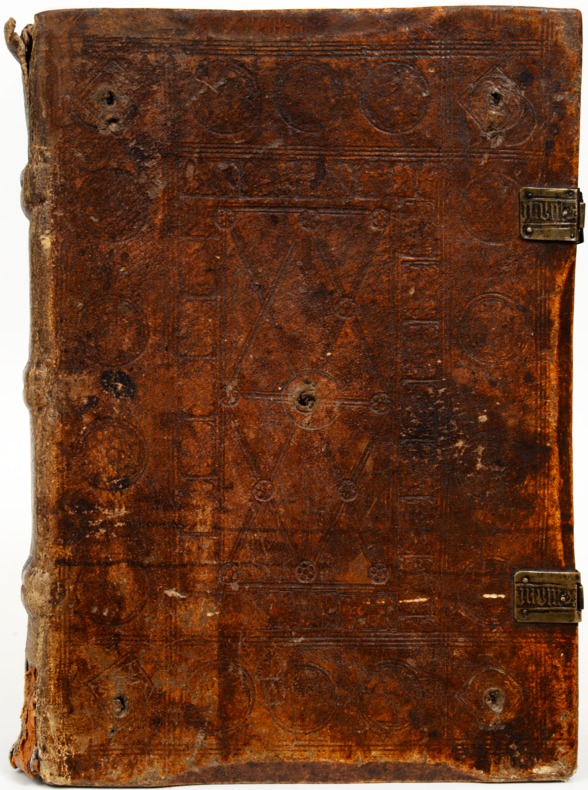
Ulm, Johann Zainer, [1478 ca]. Petit in-folio gothique (20 x 29 cm) de (418) ff. à 40 lignes par page, sans foliotation, réclames ni signatures dont 2 feuillets blancs (1er et 371e), peau de truie sur ais de bois biseautés, dos à trois nerfs, décor géométrique estampé à froid dans un encadrement de médaillons, titre manuscrit en noir sur le dos, fermoirs, traces de cabochons (reliure de l'époque).
Referenz des Buchhändlers : 16006
|
|
|
JACOBUS MATHEY dit Jacquet Maci
Grande majuscule « F » ornée
Première moitié du XIVe siècle 1851 Lettre ornée sur vélin (18,5x16,5 cm) extraite d’une page d’antiphonaire ou graduel, musique notée sur une portée à 4 lignes. Grande initiale F (17,3x10,5 cm) décorée aux gouaches et à l’encre à motifs abstraits bleus et vermillons pour la hampe et à l’encre vermillon verte et bleue pour les motifs ornementaux couvrant l’espace intérieur et les prolongation marginales.
Referenz des Buchhändlers : 3126

|
|
|
JAULME (André).
Le XVéme siècle.
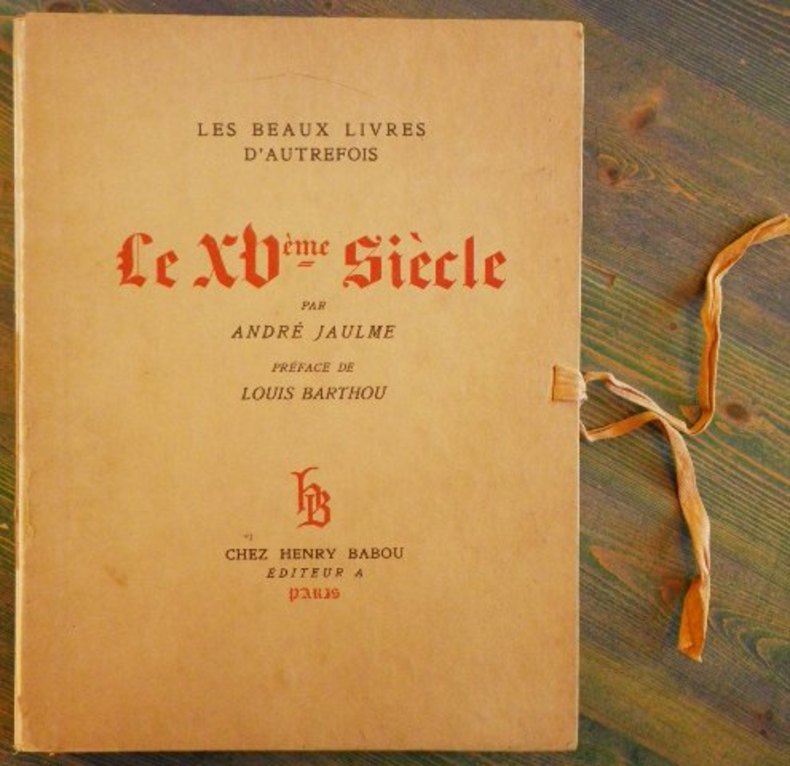
P., Chez Henry Babou, 1929, 1 petit in-4 en feuilles, sous chemise cartonnée (mors légèrement défraichis), de 36 pp + 40 planches H.T. tirées en héliotypie.
Referenz des Buchhändlers : 795
|
|
|
JAULME André 40 planches.
Les beaux livres d'autrefois. Le XV e siècle.
Couverture rigide. En cahiers. Sous chemise cartonnée de l'éditeur avec liens. Légères rousseurs.
Referenz des Buchhändlers : 39439
|
|
|
JAULME (André)
Les Beaux livres d'autrefois - Le XVè siècle.
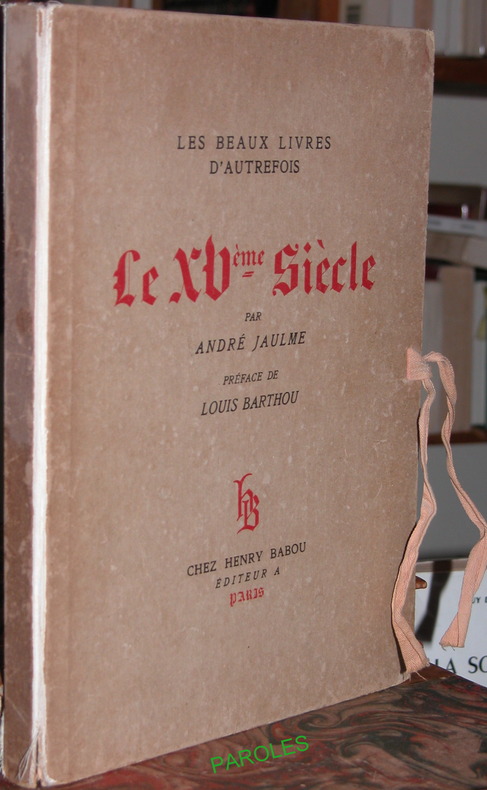
Paris, Henry Babou, "Les Beaux livres d'autrefois", Henry Babou, "Les Beaux livres d'autrefois", 1929 1 volume 20,2 x 26,2cm En feuilles en portefeuille à lacet. 1feuillet, 1titre imprimé en rouge et noir et orné d'une vignette, 36p., 40 planches dont 1 en couleurs, 2 feuillets. Feuilles en bon état (quelques petites rousseurs surtout aux gardes); petites fentes aux charnières du portefeuille, et papier de couvrure déchiré le long de ces charnières.
Referenz des Buchhändlers : 9815
|
|
|
JAULME (André)
Les Beaux livres d'autrefois - Le XVè siècle.
Texte d'André JAULME (1897-1940), bibliothécaire à la Bibliothèque Nationale, sur la typographie et les incunables européens, suivi de 40 planches tirées en héliotypie par Marotte d'après les originaux de la Bibliothèque Nationale; lettre-préface de Louis BARTHOU. 1er volume de la collection "Les Beaux livres d'autrefois" dirigée par Marcel Valotaire. Tirage à 1150 exemplaires; 1 des 1010 sur vélin Johannot, justifié n°426 (après 140 sur japon). Français

|
|
|
JENKINSON (Francis)
List of the Incunabula Collected by George Dunn Arranged to Illustrate the History of Printing.
First Edition, 83pp., disbound.
|
|
|
JENKINSON (Francis)
List of the Incunabula Collected by George Dunn Arranged to Illustrate the History of Printing.
First Edition, 83pp., orig. printed wrappers, unopened, uncut.
|
|
|
JOHANNES DE KETHAM
FASCICULO DE MEDICINA. Vulgarizzato per Sebastiano Manilio Romano e stampito (sic) per Zuane & Gregorio di Gregorii in Venexia.
In-4 gr., lussuosa legatura editoriale in piena pelle (abrasioni alle cerniere), dorso a cordoni, astuccio con cuffia in pelle, 54 cc.nn., con il bellissimo frontespizio figurato e 8 grandi tavole anatomiche di cui 1 a colori. Riproduzione in facsimile della seconda edizione (1493) del primo testo di anatomia con figure originali. E' l'anatomia di Mondino de' Luzzi (1270-1326), il primo insigne anatomista degno di questo nome, pubblicata per la prima volta a Venezia nel 1491 dal medico Giovanni de Ketham, alemanno, nel suo cosiddetto "Fascicolo di medicina". Cfr. Castiglioni "Storia della Medicina", pp. 340, 420. Bella edizione su carta a mano, in tiratura di 350 esemplari numerato. Ben conservato.
|
|
|
JONES (George W.)
Some Books from the Library of George W. Jones Formerly at Monkbarns, Northwood.
Folio, [x],111,[3]pp., printed in Linotype Estienne with Civilite headings, Cockerell marbled paper boards, title label to spine, uncut. "This [library] was designed to be a guide and inspiration to a working printer and to illustrate the history of printing and all its adjuncts: types, pages, margins, woodcut and other decoration. The great names of Gutenberg, Fust and Schoeffer, Zel, Sweynheym and Pannartz, Wendolin of Speier, Jenson, Crantz, Gering and Friburger, and Caxton appear, and there are a number of examples of the fine borders and initials produced by the Zainers at Augsburg and Ulm and by Ratdolt at Venice."?Preface. Rogerson, 26.
|
|
|
KATIP ÇELEBI [HACI KHALFA], (1609-1657).
[ACCOUNT OF THE OTTOMAN-VENETIAN NAVAL WAR] Tuhfetu'l-kibâr fî esfâri'l-bihâr. [i.e. The gift to the great ones on naval campaigns].
Very Good Turkish, Ottoman (1500-1928) Full leather new bdg. Original illustrated cover saved inside. Roy. 8vo. (24 x 17 cm). In Ottoman script (Old Turkish with Arabic letters). [12], 166, [2] p., b/w and color plates of Ottoman warships and scenes from naval wars, seven maps of the earliest examples of Ottoman cartography. Very rare second edition of this book on the history of Ottoman naval wars against Venetians began with the Crete campaign (War of Candia) in 1645 and lasted for years until 1656. The book was published first in 1729 in Müteferrika Printing House which was the first printing house in the Islamic world as the third printed book. This is the second edition including five maps of almost the same size (two paged) titled world map, The Mediterranean, The Archipelago (Aegean), The Adriatic Sea, and the compass-like in its first edition as well as two maps and twenty-six plates (some of them are color) and small illustrations of Ottoman ships as head of some carriage returns. Additional maps depict the city of Venice (from Kitab-i Bahriye [i.e. Book of Navigation) and the travels of Ottoman Admiral Sidi Ali Reis through the Sea of Oman. The Cretan War or the Fifth Ottoman-Venetian War, was a conflict between the Republic of Venice and her allies (chief among them the Knights of Malta, the Papal States, and France) against the Ottoman Empire and the Barbary States because it was largely fought over the island of Crete, Venice's largest and richest overseas possession. This account of Ottoman maritime warfare in Turkish, written in Safer 1067/November 1656. This date places the book in a moment of utmost danger for the Ottoman capital following the defeat of the Ottoman navy at the hands of the Venetians at the Dardanelles (4 Ramadan 1066/26 June 1656) and the subsequent loss of the islands of Lemnos and Tenedos. It is also written shortly after the appointment of Köprülü Mehmed Pasha as grand vizier (25 Dhulqada 1066/14 September 1656). Thus it is suggested to read it as a program of reform of the navy intended for a person whom Hadji Khalfa might have seen as the "man of the sword" who might revert the fate of the Empire. Of the four ulemâ [i.e. scholars] who wrote endorsements for the book, two are closely related to the Köprülü family. The first part is a history of Ottoman maritime campaigns from the beginning to 1067/1656, while the second is a systematic description of naval affairs, from administration and offices to shipbuilding, culminating in a list of 40 suggestions for the organization and strategy of the Ottoman navy, including the use of recent scientific and technological innovations. Thus the juxtaposition with history provides an argument for reform. Suggestions are largely centered around the traditional qanun-i qadim; there is no reference to high-board ships. The final pages include an important discussion of historical causality, explaining how divine omnipotence creates the consequence of historical causes, in reward for the righteous rule, or punishment of injustice. (Source: Ottomanhistorians). Özege 21273.
|
|
|
KELCHNER (Dr. Ernst)
Die Marienthaler Drucke der Stadt-Bibliothek zu Frankfurt am Main.
4to, [iv],10pp., 5 photographic plates, orig. printed wrappers bound-in, cloth-backed marbled boards. Illustrations of some examples of type used in incunabula attributed to the Press at Marienthal. Tipped-in at the back: HENNEN (Dr.) Unbekannte und Unzul?nglich Gew?rdigte Marienthaler... Otto Harrassowitz, Leipzig. 1887. 12pp., orig. upper wrapper.
|
|
|

 Per e-mail erhalten
 Als pdf-Dokument herunterladen
 RSS feed
 Permanenter link
