Portal independiente de libreros profesionales

‎Matemáticas‎

Main

Número de resultados : 31.747 (635 Página(s))

Primera página Página anterior 1 ... 33 34 35 [36] 37 38 39 ... 124 209 294 379 464 549 634 ... 635 Página siguiente Ultima página

‎"SYLVESTER, J.J. (JAMES JOSEPH). - THE PROOF OF NEWTON'S RULE.‎

‎Algebraic Researches, containing a disquisition on Newton's Rule for the Discovery of Imaginary Roots, and an allied Rule applicable to a particular class of Equations, together with a complete invariantive determination of the character of the Roots ...‎

‎(London, Taylor and Francis, 1865). 4to. No wrappers as extracted from ""Philosophical Transactions"", Vol. 154 - Part III, pp. 579-666 and 2 lithographed plates. Some faint brownspots to theplates. Otherwise clean and fine.‎

‎"SYLVESTER, J.J. (JAMES JOSEPH). - THE PROOF OF NEWTON'S RULE.‎

‎Algebraic Researches, containing a disquisition on Newton's Rule for the Discovery of Imaginary Roots, and an allied Rule applicable to a particular class of Equations, together with a complete invariantive determination of the character of the Roots ...‎

‎(London, Taylor and Francis, 1865). 4to. No wrappers as extracted from ""Philosophical Transactions"", Vol. 154 - Part III, pp. 579-666 and 2 lithographed plates. Some faint brownspots to theplates. Otherwise clean and fine.‎

‎First printing of a main paper of the founder (together with Cayley) of the theory of algebraic invariants, in which Sylvester investigates the roots of quintic equations and the proof of Newton's rule.""Another problem of great importence investigated in two long memoirs of 1853 and 1864 (the paper offered) concerns the nature of the roots of quintic equation. Sylvester took the functions of the coefficients that serve to decide the reality of the roots, and treated them as coordinates of a point in n-dimensional space. A point is or is not ""facultative"" according to whether there correspons, or fail to correspond, an equation with real coefficients. The character of the roots depends on the bounding surface or surfaces of the facultative regions, and on a single surface depending on the ""discriminant.""(DSB XIII, p. 219).‎

Referencia librero : 42883

Livre Rare Book

Herman H. J. Lynge & Son
Copenhagen Denmark Dinamarca Dinamarca Danemark
[Libros de Herman H. J. Lynge & Son]

€ 335,75 Comprar

‎"TARSKI, ALFRED (+) ALONZO CHURCH [Editor].‎

‎On The Calculus Of Relations (In: ""The Journal Of Symbolic Logic"").‎

‎(No place), The Association for Symbolic Logic, 1941. Large 8vo. Bound in blue half cloth with silver lettering to spine. In ""Journal of Symbolic Logic"", Volume 5. Small paper label to lower part of spine and upper inner margin of front board. Stamp to title-page and last leaf, otherwise internally fine. Pp. 73-89. (Entire copy: (4), 188 pp.).‎

‎First appearance of Tarski's groundbreaking work in mathematical logic. Published in 1941, it revolutionized the study of relations by introducing a formal calculus that provided a rigorous foundation for understanding and reasoning about relations.By introducing a formal calculus, Tarski provided mathematicians with a rigorous framework for reasoning about relations, leading to advancements in diverse fields of mathematics and beyond. His contributions laid the groundwork for the exploration of abstract algebra, order theory, and model theory, and found practical applications in computer science.‎

Referencia librero : 60430

Livre Rare Book

Herman H. J. Lynge & Son
Copenhagen Denmark Dinamarca Dinamarca Danemark
[Libros de Herman H. J. Lynge & Son]

€ 470,05 Comprar

‎"TARSKI, ALFRED.‎

‎Pojecie Prawdy w Jezykach Nauk Dedukcyjnych (Polish). [The Concept of Truth in Formalized Languages]. - [FOUNDING MODERN LOGICAL SEMANTICS]‎

‎Warszawa, 1933. Small 4to. Orig. printed wrappers, sunned at the edges, but otherwise near mint condition, also internally. An excellent copy. VII, (1), 116, (1, - errata) pp.‎

‎"TARSKI, ALFRED.‎

‎Pojecie Prawdy w Jezykach Nauk Dedukcyjnych (Polish). [The Concept of Truth in Formalized Languages]. - [FOUNDING MODERN LOGICAL SEMANTICS]‎

‎Warszawa, 1933. Small 4to. Orig. printed wrappers, sunned at the edges, but otherwise near mint condition, also internally. An excellent copy. VII, (1), 116, (1, - errata) pp.‎

‎The exceedingly scarce first printing of Tarski's most important and influential work, ""The Concept of Truth in Formalized Languages"", which founded modern logical semantics.The work appeared in an extremely small number, in Polish, and many copies of the article have later been destroyed, thus, the work is of the utmost scarcity. In this seminal article the Polish-American logician and mathematician Alfred Tarski devotes himself to ""the definition of truth"". ""Its task is to construct -with reference to a given language- a materially adequate and formally correct definition of the term ""true sentence""."" (Introduction, English translation, 1956). With this work the face of logic was changed forever. The ""Concept of Truth"" constitutes a landmark event in 20th century analytic philosophy, and it ranks as one of the most important contributions to symbolic logic, semantics and philosophy of language. In this work Tarski develops the semantic theory of truth for formal languages and determines the fact that no language can contain its own truth predicate. Tarski thus concluded that the semantic theory could not be applied to any natural language. -This was later used by e.g. Davidson to construct his truth-conditional semantics, and the problems solved by Tarski are some of the same that Russell and Whitehead struggled to solve in their ""Principia Mathematica"".Tarski (1901-1983) has contributed seminally to the fields of mathematics and logic in a number of ways, and together with Frege, Russell and Gödel, he now ranks as one of the most important contributors to the field of modern logic. At the time of Franz Brentano (1838-1917), one of the philosophers of the greatest significance for contemporary philosophy and in many ways a forerunner of present-day empiricism, it was very unusual for a metaphysician to acknowledge that philosophical investigation must go hand in hand with an analysis of language. Linguistic analysis has thus been almost totally limited to the pure empiricists of philosophy, who reject all forms of metaphysics. Meanwhile, ontologists and metaphysicians have been satisfied with the ordinary language and asked no questions about its possible limitations, merely dismissing the logical faults and adding the odd neologisms. Today, however, especially within the English speaking tradition, linguistic analysis has reached a degree unheard of at the time of Brentano, and it is now generally accepted that certain logical and epistemological problems can be solved only by forsaking ordinary language and substituting it for artificially constructed language systems that follow certain principles. Thus, difficulties that appeared within earlier philosophical doctrines are meant to disappear if the theory can be formulated more precisely, and one of the most important examples is the ""adequacy theory of truth"". Tarski shows that the concept of truth of the adequacy theory can be introduced in a perfectly exact way within the formalized language systems that are equipped with precise rules of interpretation, and thus he rids us of the usual misgivings against the concept of truth. And thus he has developed one of the most important theories of modern logic.""Tarski's investigations are of singular philosophical significance for another reason as well. Within the framework of semantics, which he founded and which Carnap later developed further, it becomes possible for the first time to introduce the notion of an analytic judgment (or an analytic statement) in a form that is both sufficiently general and of the utmost precision. This notion also plays an exceptionally important role in Brentano's philosophy, especially in his studies in formal logic."" (Stegmüller, Main Currents... p. 56). When constructing a semantical system, a vocabulary of the desired object language must be determined as the first. Then formulation rules must be specified, before the rules of interpretation are laid down, and finally the rules of application are supplied. The most important rules here are the rules of truth, and the concept of truth is one of the most important semantical concepts at all, for without them no understanding of the sentences within the system would be ensured. And, of course, the truth definitions must satisfy a condition of adequacy. ""...This form of an adequacy condition that must be satisfied by every semantical truth concept goes back to the Polish logician, Stanislaw Lesniewski. But it was the logician Alfred Tarski who above all made use of this notion, and who first studied in detail the possibilities of introducing a formally exact and materially adequate concept of truth into the precise languages of science. Carnap's accounts of semantical systems rest largely on the prior works of Tarski."" (Stegmüller, p. 311). Tarski also pointed out that it is necessary for all semantical concepts, and especially for the concept of truth, to strictly separate object language and metalanguage. Otherwise we would put ourselves in the unlucky position of being able to prove both a statement and its negation at the same time. In the English translation from 1956 of Tarski's works, ""Logic, Semantics, Metamathematics"", the bibliographical information about this article is erroneous.‎

Referencia librero : 35832

Livre Rare Book

Herman H. J. Lynge & Son
Copenhagen Denmark Dinamarca Dinamarca Danemark
[Libros de Herman H. J. Lynge & Son]

€ 5.103,40 Comprar

‎"TCHEBYCHEFF, P. [CHEBYSHEV] [TCHEBYCHEV].‎

‎Sur deux théorèmes relatifs aux probabilités. - [THE FOUNDATION FOR THE APPLICATION OF PROBABILITY THEORY TO STATISTICS]‎

‎Berlin, Stockholm, Paris, Almqvist & Wiksell, 1890. 4to. As extracted from ""Acta Mathematica"", Vol, 14, 1890. No backstrip. A fine and clean copy. Pp. 305-15.‎

‎"TCHEBYCHEFF, P. [CHEBYSHEV] [TCHEBYCHEV].‎

‎Sur deux théorèmes relatifs aux probabilités. - [THE FOUNDATION FOR THE APPLICATION OF PROBABILITY THEORY TO STATISTICS]‎

‎Berlin, Stockholm, Paris, Almqvist & Wiksell, 1890. 4to. As extracted from ""Acta Mathematica"", Vol, 14, 1890. No backstrip. A fine and clean copy. Pp. 305-15.‎

‎First translation of Chebyshev's landmark paper (first published in Journal of the The St. Petersburg Academy in 1887) in which he laid the foundation for the application of probability theory to statistics, generalizing the theorems of Moivre and Laplace. It also generalized the theory of integral beta function. This led him to find an algorithm for finding an optimal solution in a system of linear equations with an approximate solution is known.""In the 1860's Chebyshev returned to the theory of probability. One of the reasons for this new interest was, perhaps, his course of lectures on the subject started in 1860. He devoted only two articles to the theory of probability, but they are of great value and designate the beginning of a new period in the development of this field. In the article of 1866 Chebyshev suggested a very wide generalization of the law of large numbers. In 1887 he published (without extensive démonstration) a corresponding generalization of the central limit theorem of Moivre and Laplace."" (DSB).""Chebyshev and many of his students were often cold and skepticall towrads various important achievements in Western European mathematics. In the two-hundred-year development period in probability theory its main achievements were the limiting theorems: the law of large number and the de Moivre-Laplace theorem. But the confines of applicability of these theorems and their further refinements and generalizations were not satisfactory. The second basic problem that occupied Chebyshev's attention was the central limit theorem. However, only in 1887 in the Proceedings of the Academy of Sciences was Chebyshev's paper devoted to this subject published."" (Maistrov, Probability and Mathematical Statistics, P. 202).‎

Referencia librero : 49619

Livre Rare Book

Herman H. J. Lynge & Son
Copenhagen Denmark Dinamarca Dinamarca Danemark
[Libros de Herman H. J. Lynge & Son]

€ 376,04 Comprar

‎"TCHEBYCHEFF, P. [PAFNUTY LVOVICH CHEBYSHEV]‎

‎Sur la représentation des valeurs limites des intégrales par des résidus intégraux.‎

‎Berlin, Stockholm, Paris, Beijer, 1886. 4to. With the original wrappers in ""Acta Mathematica, 9:1. Band]. No backstrip. Fine and clean. Pp. 35-56. [Entire issue: 104 pp. ].‎

‎"TCHEBYCHEFF, P. [PAFNUTY LVOVICH CHEBYSHEV]‎

‎Sur la représentation des valeurs limites des intégrales par des résidus intégraux.‎

‎Berlin, Stockholm, Paris, Beijer, 1886. 4to. With the original wrappers in ""Acta Mathematica, 9:1. Band]. No backstrip. Fine and clean. Pp. 35-56. [Entire issue: 104 pp. ].‎

‎First translation of Tchebycheff's paper on Moments - a quantitative measure of the shape of a set of points. Tchebycheff is known for his work in the field of probability, statistics and number theory.‎

Referencia librero : 46202

Livre Rare Book

Herman H. J. Lynge & Son
Copenhagen Denmark Dinamarca Dinamarca Danemark
[Libros de Herman H. J. Lynge & Son]

€ 161,16 Comprar

‎"TETENS, JOHANN NICOLAI.‎

‎Formula Polynomiorum. En almindelig Formel for Coefficienterne udi Polynomier.‎

‎(Kiøbenhavn, Johan Rudolph Thiele, 1799). 4to. Without wrappers. In: ""Nye Samling af det Kongelige Danske Videnskabernes Selskabs Skrifter."" Vol. V. Pp. 253-286.‎

‎"TETENS, JOHANN NICOLAI.‎

‎Formula Polynomiorum. En almindelig Formel for Coefficienterne udi Polynomier.‎

‎(Kiøbenhavn, Johan Rudolph Thiele, 1799). 4to. Without wrappers. In: ""Nye Samling af det Kongelige Danske Videnskabernes Selskabs Skrifter."" Vol. V. Pp. 253-286.‎

‎An importent mathematical memoir by the author of ""Einleitung zur Berechnung der Leibrenten und Anwartschaften"", a landmark work in actuarial science.‎

Referencia librero : 45698

Livre Rare Book

Herman H. J. Lynge & Son
Copenhagen Denmark Dinamarca Dinamarca Danemark
[Libros de Herman H. J. Lynge & Son]

€ 60,43 Comprar

‎"TETENS, JOHANN NICOLAI. - PROBABILITY IN VOTING.‎

‎Om Fleerheden af collective Stemmer, og Probabiliteten af samme.‎

‎(Kiøbenhavn, Johan Rudolph Thiele, 1799). 4to. Without wrappers. In: ""Nye Samling af det Kongelige Danske Videnskabernes Selskabs Skrifter."" Vol. V. Pp. 116-143.‎

‎"TETENS, JOHANN NICOLAI. - PROBABILITY IN VOTING.‎

‎Om Fleerheden af collective Stemmer, og Probabiliteten af samme.‎

‎(Kiøbenhavn, Johan Rudolph Thiele, 1799). 4to. Without wrappers. In: ""Nye Samling af det Kongelige Danske Videnskabernes Selskabs Skrifter."" Vol. V. Pp. 116-143.‎

‎First printing of a remarkable paper, probably being the first to give a mathematical treatment of the probability distribution of votes in the cases where voting - yes or no - selects itself into undergroups also voting yes or no and thus relating the result to the primary voting.The author, called ""The German Hume"" is well known for his work ""Einleitung zur Berechnung der Leibrenten und Anwartschaften"", which is a landmark work in actuarial science.‎

Referencia librero : 49633

Livre Rare Book

Herman H. J. Lynge & Son
Copenhagen Denmark Dinamarca Dinamarca Danemark
[Libros de Herman H. J. Lynge & Son]

€ 248,45 Comprar

‎"THE MAGNETRON ISSUE - FISK, J. B. (+) H. D. HAGSTRUM (+) P. L. HARTMAN.‎

‎The Magnetron as a Generator of Centimeter Waves. Developments at the Bell Telephone Laboratories, 1940-1945.‎

‎New York, American Telephone and Telegraph Company, 1946. 8vo. In the original printed blue wrappers. In ""The Bell System Technical Journal"", Volume XXV, Number 2, April 1946. Light miscolouring to spine and previous owner's name to front wrapper. Other wise a fine and clean copy. Pp. (4), 167-349.‎

‎"THE MAGNETRON ISSUE - FISK, J. B. (+) H. D. HAGSTRUM (+) P. L. HARTMAN.‎

‎The Magnetron as a Generator of Centimeter Waves. Developments at the Bell Telephone Laboratories, 1940-1945.‎

‎New York, American Telephone and Telegraph Company, 1946. 8vo. In the original printed blue wrappers. In ""The Bell System Technical Journal"", Volume XXV, Number 2, April 1946. Light miscolouring to spine and previous owner's name to front wrapper. Other wise a fine and clean copy. Pp. (4), 167-349.‎

‎First printing of Bell Labs Magnetron issue. The Magnetron is a high-powered vacuum tube that through a stream of electrons in a magnetic field generates microwaves. This reduced the size of radar sets which made it possible to install them in anti-submarine aircrafts and escort ships. This had a profound influence on the warfare during WWII. Today magnetrons are commonly used in microwave ovens and in various radar applications.""The studies of Fisk, H. D. Hagstrum, and P. L. Hartman [the present paper] increased the understanding of the role that the various possible modes of oscillation played in magnetron operation and the effect of the wire straps - which later evolved into two pair of concentric copper rings."" (Millman, S. A History of Engineering & Science in the Bell System, 1984, p. 173).‎

Referencia librero : 57762

Livre Rare Book

Herman H. J. Lynge & Son
Copenhagen Denmark Dinamarca Dinamarca Danemark
[Libros de Herman H. J. Lynge & Son]

€ 268,60 Comprar

‎"THOMÉ, L. W.‎

‎Zur Theorie der algebraischen Funktionen mit Bezugnahme auf die Theorie der linearen Differentialgleichungen (+) Über eine Anwendung der Theorie der linearen Differentialgleichungen in der Variationsrechnung (+) Über simultane lineare Differentialglei... - [COLLECTION OF OFFPRINTS SIGNED BY THE AUTHOR]‎

‎Berlin, Georg Reimer, 1888 - 1901. Small folio. Collection of 13 offprint all in the original printed wrappers from ""Journal für reine und angewandte Mathematik"", A. L. Crelle. All with the printed presentation statement on top of frontwrappers ""Überreicht vom Verfasser"" [i.e. ""Given by the author""] and the author's signature: ""Thomé"". All have been bended vertically, otherwise fine and clean.‎

‎"THOMÉ, L. W.‎

‎Zur Theorie der algebraischen Funktionen mit Bezugnahme auf die Theorie der linearen Differentialgleichungen (+) Über eine Anwendung der Theorie der linearen Differentialgleichungen in der Variationsrechnung (+) Über simultane lineare Differentialglei... - [COLLECTION OF OFFPRINTS SIGNED BY THE AUTHOR]‎

‎Berlin, Georg Reimer, 1888 - 1901. Small folio. Collection of 13 offprint all in the original printed wrappers from ""Journal für reine und angewandte Mathematik"", A. L. Crelle. All with the printed presentation statement on top of frontwrappers ""Überreicht vom Verfasser"" [i.e. ""Given by the author""] and the author's signature: ""Thomé"". All have been bended vertically, otherwise fine and clean.‎

‎A collection of offprints by the influential German mathematician L. W. Thomé, all signed by the author. L.W. Thomé worked closely with Bernhard Riemann on continued fractions.‎

Referencia librero : 48884

Livre Rare Book

Herman H. J. Lynge & Son
Copenhagen Denmark Dinamarca Dinamarca Danemark
[Libros de Herman H. J. Lynge & Son]

€ 241,74 Comprar

‎"THOMÉ, LUDVIG G.‎

‎13 papers on ""Linearen Differentialgleichungen"" und ""Differentialgleichungen mitt algebraischen Koeffizienten"" etc.‎

‎Berlin, G. Reimer, 1887-1901. 4to. All 13 offprints from ""Journal für die reine und angewandte Mathematik. Hrsg. von A.L. Crelle"", Bde. 100-123. Some of the offprints with traces after having been folded.‎

‎"THOMÉ, LUDVIG G.‎

‎13 papers on ""Linearen Differentialgleichungen"" und ""Differentialgleichungen mitt algebraischen Koeffizienten"" etc.‎

‎Berlin, G. Reimer, 1887-1901. 4to. All 13 offprints from ""Journal für die reine und angewandte Mathematik. Hrsg. von A.L. Crelle"", Bde. 100-123. Some of the offprints with traces after having been folded.‎

‎All first printing.‎

Referencia librero : 41691

Livre Rare Book

Herman H. J. Lynge & Son
Copenhagen Denmark Dinamarca Dinamarca Danemark
[Libros de Herman H. J. Lynge & Son]

€ 268,60 Comprar

‎"TINSEAU (D'AMONDANS, CHARLES de).‎

‎Sur quelques Propriètés des Solides renfermés par des Surfaces composées de Lignes droites.‎

‎(Paris, Moutard, Panckoucke, 1780). 4to. Extract from ""Mémoires fe Mathematique et de Physique, Présentés à l'Academie des Sciences par divers Savans"", Tome IX. Pp. 625-642 and 2 folded engraved plates.‎

‎"TINSEAU (D'AMONDANS, CHARLES de).‎

‎Sur quelques Propriètés des Solides renfermés par des Surfaces composées de Lignes droites.‎

‎(Paris, Moutard, Panckoucke, 1780). 4to. Extract from ""Mémoires fe Mathematique et de Physique, Présentés à l'Academie des Sciences par divers Savans"", Tome IX. Pp. 625-642 and 2 folded engraved plates.‎

‎First appearance of an importent papwer in the history of analytic geometry.""Two of the three memoirs that constitute Tinseau’s oeuvre deal with topics in the theory of surfaces and curves of double curvature: planes tangent to a surface, contact curves of circumscribed cones or cylinders, various surfaces attached to a space curve, the determination of the osculatory plane at a point of a space curve, problems of quadrature and cubature involving ruled surfaces, the study of the properties of certain special ruled surfaces (particularly conoids), and various results in the analytic geometry of space. In these two papers the equation of the tangent plane at a point of a surface was first worked out in detail (the equation had been known since Parent), methods of descriptive geometry were used in determining the perpendicular common to two straight lines in space, and the Pythagorean theorem was generalized to space (the square of a plane area is equal to the sum of the squares of the projections of this area on mutually perpendicular planes). (DSB). Although Tinseau published very little, his papers are of great interest as additions to Monge’s earliest works. Indeed, Tinseau appears to have been Monge’s first disciple.‎

Referencia librero : 44932

Livre Rare Book

Herman H. J. Lynge & Son
Copenhagen Denmark Dinamarca Dinamarca Danemark
[Libros de Herman H. J. Lynge & Son]

€ 134,30 Comprar

‎"TINSEAU (D'AMONDANS, CHARLES de). - GENERALIZATION OF THE PYTHAGOREAN THEOREM.‎

‎Solution de quelques Problêmes relatifs à la Théorie des Surfaces courbes, & des Courbes à double courbure. (Présenté en 1774).‎

‎(Paris, Moutard, Panckoucke, 1780). 4to. Extract from ""Mémoires fe Mathematique et de Physique, Présentés à l'Academie des Sciences par divers Savans"", Tome IX. Pp. 593-624 and 2 folded engraved plates. Clean and fine.‎

‎"TORRES, M.L. (LEONARDO TORRES Y QUEVEDO).‎

‎Sur la constuction des machines algébriques. Extrait de la Revue de Mécanique, nos de septembre-octobre 1901. - [THE BIRTH OF COMPUTING - TORRES QUEVEDO'S CALCULATING MACHINES]‎

‎Paris, 1901. Small folio. Original printed wrappers. The fragile wrappers have been expertly restored along the edges. A stain to back wrapper, a closed horizontal tear, and spine re-enforced. A bit of soiling and discolouration. With a library-label to top of front wrapper, from the Bibliothèque des professeurs St-Stanislas, Mons, of which there is a book-plate to half-title and a stamp to title-page. Wrappers loose. Internally some brownspotting and finely restored marginal chipping, far from affecting text. 32 pp. Richly illustrated.‎

‎"TORRES, M.L. (LEONARDO TORRES Y QUEVEDO).‎

‎Sur la constuction des machines algébriques. Extrait de la Revue de Mécanique, nos de septembre-octobre 1901. - [THE BIRTH OF COMPUTING - TORRES QUEVEDO'S CALCULATING MACHINES]‎

‎Paris, 1901. Small folio. Original printed wrappers. The fragile wrappers have been expertly restored along the edges. A stain to back wrapper, a closed horizontal tear, and spine re-enforced. A bit of soiling and discolouration. With a library-label to top of front wrapper, from the Bibliothèque des professeurs St-Stanislas, Mons, of which there is a book-plate to half-title and a stamp to title-page. Wrappers loose. Internally some brownspotting and finely restored marginal chipping, far from affecting text. 32 pp. Richly illustrated.‎

‎Exceedingly scarce original offprint of Torres y Quevedo's publication of his seminal algebraic machines, constituting a milestone in computing history. In this thoroughly illustrated publication, Torres y Quevedo explains the construction and operation of the first accurate calculating machines, following his explanation of them before the French Academy of Sciences earlier the same year. ""At the end of the nineteenth century, several analog machines had been proposed for solving algebraic equations. These machines -based not only on kinematics principles but also on dynamic or hydrostatic balances, electric or electromagnetic devices, etc.- had one important drawback: lack of accuracy. Leonardo Torres was the first to beat the challenge of designing and implementing a machine able to compute the roots of algebraic equations that, in the case of polynomials of degree eight, attained a precision down to 1/1000. The key element of Torres' machine was the endless spindle, an analog mechanical device designed to compute log(a +b) from log(a) and log(b). This short account gives a detailed description of this mechanism."" (Federico Thomas: A Short Account on Leonardo Torres' Endless Spindle). Leonardo Torres y Quevedo (1852 -1936), civil engineer and mathematician, was a one of the most important Spanish inventors of all time. Although little known outside of Spain and France in his life-time, he was an inventor of the utmost importance and would later be recognized as one of the most significant inventors of the beginning of the twentieth century. Apart from pioneering accurate automated calculation machines, he was also a pioneer in the development of the radio control, the inventor of a chess automaton (the first decision-making automaton), an innovative designer of the three-lobed non-rigid Astra-Torres airship as well as the Whirlpool Aero Car located in Niagara Falls, and with his Telekine, he created wireless remote-control operation principles.""Leonardo Torres was probably the most eminent Spanish engineer in the first half of the 20th century. He had a great influence, truncated by the Spanish Civil War, in the development of automatic control in Spain. As Randell points out in, we can only speculate on what might happened if Torres' writings had become better known to the English-speaking world. For instance, he qualifies Torres' paper Essays on Automatics as ""a fascinating work which well repays reading even today."" The paper contains what Randell believes to be the first proposal of the idea of floating-point arithmetic. It seems clear that Torres' contributions deserve much wider appreciation outside Spain"". (Federico Thomas: A Short Account on Leonardo Torres' Endless Spindle). ""Because of Torres Quevedo's work on analog machines, the Paris Academy of Sciences welcomed his ""Calculating Machines"" report in 1900. As a result, he was elected to the Academy of Sciences in Madrid in 1901, where he delivered a lecture on algebraic machines.The endless spindle was a critical component of the 8-term equation-solving computing machine. It created sums to answer the algorithm's central equation. The mechanism was the first of its sort, and it was the most intriguing and unique of Torres Quevedo's inventions.Torres Quevedo's calculating machine was both theoretically and practically groundbreaking. The endless spindle is a mechanical device that evaluates an expression's logarithm as the sum of numerous logarithms, overcoming the difficulty of reaching enough precision with an automatic set of parts."" (The History of the Computer) The algebraic machine of Torres was an analog computing device, featuring a mechanism based on cone-shaped pulley with a helical groove around it. The machine was used for the resolution of equations like: + Ax = B or + Ax = B. His publications marked the beginning of a new era in mathematical theory, and his contributions resulted in the creation of cutting-edge new machinery. ""Torres Quevedo's writings ushered in a new era in mathematical theory based on new concepts. His contributions led to the development of innovative new machines.He built a series of analog calculating machines to complement his theoretical work, all of which were mechanical."" (Torres Quevedo Museum - where another copy of the present offprint is displayed) ""Leonardo Torres (1852-1936), usually known as Leonardo Torres y Quevedo in Spanish-speaking countries, was a Spanish engineer and mathematician. He was president of the Academy of Sciences of Madrid, a member of the French Academy of Sciences, and famous-mainly in Spain and France- as a prolific and successful inventor... Some of the earliest Torres' inventions took the form of mechanical analog devices, considered of great originality, aiming at implementing what he called the Algebraic Machine. This machine had the ability of computing the values of arbitrary polynomial functions in one variable. Since it was an analogue machine, the variable could attain any value, not only a preestablished set of discrete values, contrarily to what happened, for example, with the celebrated Babbage's Difference Engine, an engine that used the method of finite differences to generate successive values of polynomial functions. In Torres' Algebraic Machine, all quantities were represented by means of angular displacements in logarithmic scale. Then, adding a counter to keep track of the number of turns, it was possible to compactly represent very large variations for all quantities. When the wheel representing the variable spun round, the final result was obtained as the angular displacement of another wheel that accumulated the addition of all involved monomials. When this result was zero, a root of the function was found. Using proper modifications, it was even possible to obtain the complex roots. The use of logarithms had two main advantages. Firstly, assuming that all absolute errors for the angular displacements were constant, all relative errors for the represented quantities were also kept constant. Secondly, the computation of monomials was greatly simplified. Actually, the logarithm of a monomial of the form aixi is an expression, ai+ilogx, that can be easily calculated using a differential transmission. Nevertheless, the use of logarithms had a number of disadvantages. It was necessary to introduce some transformations to ensure that all quantities were positive and, what was much more challenging, it was necessary to design a sophisticated mechanical device able to compute log(a +b) from log(a) and log(b) that would permit to accumulate the sum of all involved monomials. This device was the endless spindle. In 1893, Leonardo Torres presented, before the Academy of Exact, Physical and Natural Sciences, a memoir on his Algebraic Machine. In his time, this was considered an extraordinary success for Spanish scientific production. In 1895 the machine was presented at a congress in Bordeaux. Later on, in 1900, he would present his calculating machine before the Paris Academy of Sciences."" The present offprint, which richly illustrates, demonstrates, and presents his seminal calculating machines, was published after his presentation at the Academy of Sciences in Paris, and as he says in the preface to the present offprint ""the theoretical principles of these machines have very recently been exposed in a mémoire entitled ""Machines à calculer"" [See Tomash & Williams: T 47, printed 1902], presented by me at the l'Académie des Sciences, which should appear also in the ""Recueil des Savants étrangers."" (own translation from p. (5) ). This publication is of the utmost scarcity, and we can locate merely two copies of this offprint: at the Torres y Quevedo-museum in Spain, and at the Hungarian Academy of Sciences.‎

Referencia librero : 60101

Livre Rare Book

Herman H. J. Lynge & Son
Copenhagen Denmark Dinamarca Dinamarca Danemark
[Libros de Herman H. J. Lynge & Son]

€ 15.444,50 Comprar

‎"TORTOLINI, BARNABA.‎

‎Sur les transformations et les valeur de plusieurs intégrales définies qui se rapportent aux surfaces et aux solidités des volumes.‎

‎Berlin, G. Reimer, 1843. 4to. In ""Journal für die reine und angewandte Mathematik, 26. Band, 4 Heft, 1843"". In the original printed wrappers, without backstrip. Fine and clean. [Tortolini:] Pp. 277-310. [Entire issue: Pp. 277-368, (2) + 1 plate.].‎

‎"TORTOLINI, BARNABA.‎

‎Sur les transformations et les valeur de plusieurs intégrales définies qui se rapportent aux surfaces et aux solidités des volumes.‎

‎Berlin, G. Reimer, 1843. 4to. In ""Journal für die reine und angewandte Mathematik, 26. Band, 4 Heft, 1843"". In the original printed wrappers, without backstrip. Fine and clean. [Tortolini:] Pp. 277-310. [Entire issue: Pp. 277-368, (2) + 1 plate.].‎

‎First printing of Italian Mathematician's paper on definit integrals relating to surfaces. Barnaba Tortolini was a 19th-century Italian priest and mathematician who played an early active role in advancing the scientific unification of the Italian states. He founded the first Italian scientific journal with an international presence, Annali di scienze matematiche e fisiche, and functioned a professor of mathematics at the University of Rome for 30 years.‎

Referencia librero : 46280

Livre Rare Book

Herman H. J. Lynge & Son
Copenhagen Denmark Dinamarca Dinamarca Danemark
[Libros de Herman H. J. Lynge & Son]

€ 107,44 Comprar

‎"TSCHIRNHAUS, EHRENFRIED W. V. [FIRST PUBLICATION OF THE ""TSCHIRNHAUS TRANSFORMATION"".]‎

‎Methodus datae figurae, rectis lineis & curva Geometrica terminate, aut Quadraturam, aut impossibilitatem ejusdem Quadraturae determinandi. (+) Nova Methodus determinandi Maxima & Minima (+) Aufrendi omnes terminos intermedios ex data aequatione. - [FORCED LEIBNIZ TO PUBLISH THE CALCULUS]‎

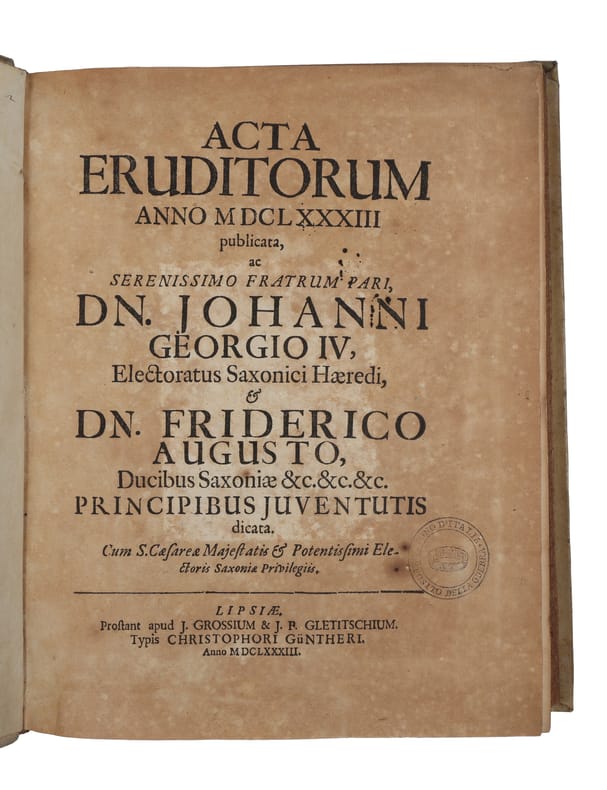
‎Leipzig, Grosse & Gleditsch, 1683. 4to. Contemporary full vellum. Handwritten title on spine. Library label to pasted down front free end-paper and a small stamps on titlepage. In: ""Acta Eruditorum Anno MDCLXXXIII"". As usual with various browning to leaves and plates. Tschirnhaus' paper: pp. 122-124" Pp. 204-207" Pp. 433-437. [Entire volume: (8), 561, (7) pp + 13 plates].‎

‎First appearance of Tschirnhaus's three exceedingly important papers which were to to initiate one of the most famous mathematical discoveries. In the papers he used infinitisimal methods which were very close to Leibniz's method and where he tried to lay down criteria for rational quadratures in the case of conic, cubic and quadratic curves, papers that led Leibniz to publish his first paper on the differential calculus, the ""Nova Methoda"" in the Acta for 1684 in order to secure his priority over Tschirnhaus concerning the calculus. Leibniz discovered, when he read Tschirnhaus' papers, that Tschirnhaus had here published results showing similarity with Leibniz's invention of the calculus as he had confided to Tschirnhaus earlier, during their Parisian stay, and this without references to Leibniz.The present volume of Acta also contain the first edition of Tschirnhaus' ""Tschirnhaus Tranformation"". Tschirnhaus work intensively on finding a general method for solving equations of higher of higher degree. ""His transformations constituted the most promising contribution to the solution of equations during the seventeenth century" but his elimination of the second and third coefficients by means of such transformation was far from adequate for the solution of the quintic.(Boyer. A History of Mathematics, 1968, 472 p.).Tschirnhaus (1651-1708) , a Saxon nobleman, had as wide interest as acquaintances: He studied in Leyden, served in the Dutch army, visited England and Paris several times. He set up a glassworks in Italy and is said to have introduced Porcelain to Europe. He wrote about philosophy and mathematics and was a close friend of Leibniz.‎

Referencia librero : 46399

Livre Rare Book

Herman H. J. Lynge & Son
Copenhagen Denmark Dinamarca Dinamarca Danemark
[Libros de Herman H. J. Lynge & Son]

€ 1.007,25 Comprar

‎"TSCHIRNHAUS, EHRENFRIED W. V. [FIRST PUBLICATION OF THE ""TSCHIRNHAUS TRANSFORMATION"".]‎

‎Methodus datae figurae, rectis lineis & curva Geometrica terminate, aut Quadraturam, aut impossibilitatem ejusdem Quadraturae determinandi. (+) Nova Methodus determinandi Maxima & Minima (+) Aufrendi omnes terminos intermedios ex data aequatione. - [FORCED LEIBNIZ TO PUBLISH THE CALCULUS]‎

‎Leipzig, Grosse & Gleditsch, 1683. 4to. Contemporary full vellum. Handwritten title on spine. Library label to pasted down front free end-paper and a small stamps on titlepage. In: ""Acta Eruditorum Anno MDCLXXXIII"". As usual with various browning to leaves and plates. Tschirnhaus' paper: pp. 122-124" Pp. 204-207 " Pp. 433-437. [Entire volume: (8), 561, (7) pp + 13 plates].‎

‎"TUKEY, JOHN W.‎

‎Some Notes on the Separation of Convex Sets.‎

‎Lisboa, R. Almirante Pessinha, 1942. 8vo. In the original grey printed wrappers. Offprint from: ""Portugaliae Mathematica"", Vol 3, 1942. Very fine and clean. Pp. 95-102‎

‎"TUKEY, JOHN W.‎

‎Some Notes on the Separation of Convex Sets.‎

‎Lisboa, R. Almirante Pessinha, 1942. 8vo. In the original grey printed wrappers. Offprint from: ""Portugaliae Mathematica"", Vol 3, 1942. Very fine and clean. Pp. 95-102‎

‎Offprint of Tukey's paper on the pathology of convex sets.‎

Referencia librero : 48851

Livre Rare Book

Herman H. J. Lynge & Son
Copenhagen Denmark Dinamarca Dinamarca Danemark
[Libros de Herman H. J. Lynge & Son]

€ 67,15 Comprar

‎"TUKEY, JOHN. (+) ET AL‎

‎Compactness in General Spaces (+)Generalized ""Sandwich"" Theorems (+) Named and Faceless Values: An Initial Exploration in Memory of Prasanta C. Mahalanobis (+) Some Sèlected Quick and Easy Methods of Statistical Analysis (+) Correlation of Ranges of c... - [LARGE COLLECTION OF OFFPRINTS]‎

‎[Various places and printer] ,1945 - 1974. Collection of 24 offprint from various academic journals. All with wrappers (or as issued) and in fine condition. Contained in a black kassett.‎

‎"TUKEY, JOHN. (+) ET AL‎

‎Compactness in General Spaces (+)Generalized ""Sandwich"" Theorems (+) Named and Faceless Values: An Initial Exploration in Memory of Prasanta C. Mahalanobis (+) Some Sèlected Quick and Easy Methods of Statistical Analysis (+) Correlation of Ranges of c... - [LARGE COLLECTION OF OFFPRINTS]‎

‎[Various places and printer] ,1945 - 1974. Collection of 24 offprint from various academic journals. All with wrappers (or as issued) and in fine condition. Contained in a black kassett.‎

‎A large collection of offprint by American physicist John Tukey known for development of the FFT algorithm and box plot. Tukey's range test, the Tukey lambda distribution, Tukey's test of additivity and Tukey's lemma all bear his name.""John Tukey's whole life was one of public service, and as the preceding quotes make clear, he had profound influence. He was a member of the President's Scientific Advisory Committee for each of Presidents Eisenhower, Kennedy, and Johnson. He was special in many ways. He merged the scientific, governmental, technological, and industrial worlds more seamlessly than, perhaps, anyone else in the 1900s. His scientific knowledge, creativity, experience, calculating skills, and energy were prodigious. He was renowned for creating statistical concepts and words. JWT's graduate work was in mathematics, but driven by World War II, he left that field to go on to revolutionize the world of the analysis of data. At the end of the war he began a joint industrial-academic career at Bell Telephone Laboratories and at Princeton University. Science and the analysis of data were ubiquitous. This split career continued until he retired in 1985. Even after retirement his technical and scientific work continued at a very high level.He is said to have introduced the terms: ""bit"", ""linear programming"", ""ANOVA"", ""Colonel Blotto"", and was first into print with ""software"". Of these efforts L. Hogben and M. Cartwright wrote, ""The introduction by Tukey of bits for binary digits has nothing but irresponsible vulgarity to commend it."" Tukey's word ""polykay"" was described as ""linguistic miscegenation"" by Kendall and Stuart because of its combining a Greek prefix with a Latin suffix. JWT did it again later with ""polyspectrum"". (Brillinger, John Wilder Tukey).‎

Referencia librero : 48852

Livre Rare Book

Herman H. J. Lynge & Son
Copenhagen Denmark Dinamarca Dinamarca Danemark
[Libros de Herman H. J. Lynge & Son]

€ 470,05 Comprar

‎"TURING, A(LAN) M(ATHISON).‎

‎On Computable Numbers with an Application to the Entscheidungsproblem. A Correction. - [TURING'S CORRECTION TO HIS ""ON COMPUTABLE NUMBERS""]‎

‎London, Hodgson & Son, 1937. Royal8vo. In a nice recent half cloth binding with gilt lettering to spine. In ""Proceedings of the London Mathematical Society. Second Series"", Volume 43. Two small stamps to title page. A very nice copy" " Binding tight and in excellent condition, Internally very clean and fresh. Pp. 544-46.‎

‎"TURING, A. M.‎

‎Computability and Lambda-Definability. (Extracted from The Journal of Sybolic Logic, Volume 2, 1937, pp.153-64.).‎

‎1937. 8vo. Bound in recent marbled boards. Title-page for volume 2 of Journal of Symbolic Logic withbound.‎

‎"TURING, A. M.‎

‎Computability and Lambda-Definability. (Extracted from The Journal of Sybolic Logic, Volume 2, 1937, pp.153-64.).‎

‎1937. 8vo. Bound in recent marbled boards. Title-page for volume 2 of Journal of Symbolic Logic withbound.‎

‎First edition of Turing's important paper, in which he links Kleene's recursive functions, Church's lambda-definable functions and his own computable functions and proves them to be identical. In the appendix of his milestone-paper ""On Computable Numbers"" from 1936, Turing gave a short outline of a method for proving that his notion of computability is equivalent with Alonzo Church's notion of lambda-definabilty. It was not until the present article, however, that it was proved that Steven Kleene's general recursive functions, Church's lambda-definable functions and Turing's computable functions were all identical. Kleene had already proved that every general recursive function is lambda-definable, so by showing that computability follows from lambda-definability and that general recursiveness follows from computability, Turing had ended the circle, which was a primary reason for its acceptance as a notion of ""effective calculable"" demanded by Hilbert's Entscheidungsproblem.""The purpose of the present paper is to show that the computable functions introduced by the author (in ""On computable numbers"") are identical with the lambda-definable functions of Church and the general recursive functions due to Herbrand and Gödel and developed by Kleene."" Turing wrote this paper while at Princeton studying with Church.""(Hook and Norman No. 395)‎

Referencia librero : 25248

Livre Rare Book

Herman H. J. Lynge & Son
Copenhagen Denmark Dinamarca Dinamarca Danemark
[Libros de Herman H. J. Lynge & Son]

€ 1.074,40 Comprar

‎"TURING, A. M.‎

‎Rounding-off Errors in Matrix Processes. - [TURING'S LU FACTORIZATION]‎

‎Oxford, Clarendon Press, 1948. 8vo. Bound in contemporary full calf with gilt lettering to spine. In ""The Quarterly Journal of Mechanics and Applied Mathematics"", Vol. 1, 1948. Previous owner's name written to front free-endpaper. Ver fine and clean. Pp. 287-380. [Entire volume: (4), 474 pp.].‎

‎"TURING, A. M.‎

‎Rounding-off Errors in Matrix Processes. - [TURING'S LU FACTORIZATION]‎

‎Oxford, Clarendon Press, 1948. 8vo. Bound in contemporary full calf with gilt lettering to spine. In ""The Quarterly Journal of Mechanics and Applied Mathematics"", Vol. 1, 1948. Previous owner's name written to front free-endpaper. Ver fine and clean. Pp. 287-380. [Entire volume: (4), 474 pp.].‎

‎First printing of this important paper in which Turing for the very first time introduced the concept of LU factorization or LU decomposition. ""Turing's paper was one of the earliest attempts to examine the error analysis of the various methods of solving linear equations and inverting matrices. His analysis was basically sound. The main importance of the paper was that it was published at the dawn of the modern computing era, and it gave indications of which methods were 'safe' when solving such problems on a computer"". (Burgoyne, Collected Works of A M Turing).""In 1945, [Turing] declined an offer of a Fellowship at King's [College, Cambridge] in favour of joining the newly formed Mathematical Division at the National Physical Laboratory (NPL). His early work on computability, combined with his wartime experience in electronics, had fired him with an enthusiasm for working on the design of an electronic computer. ethe machine he designed, which was called the Automatic Computing Engine (ACE) in recognition of Babbage's pioneering work, was characteristically original…""While in the Mathematics Division of NPL, Turing became keenly interested in numerical analysis. His paper, ""Rounding-off Errors in Matrix Processes"", showed that the acute anxiety about the effect of rounding errors in Gaussian elimination was largely unjustified. This paper has been overshadowed to some extent by the von Neumann and Goldstine paper on matrix inversion, but it is a brilliant piece of work and would have repaid closer study at the time"". (""Turing, Alan M."" by James H. Wilkinson, p. 1803, in Encyclopedia of Computer Science, A. Ralston et al (eds.), 4th edition, Nature Publishing Group, 2000).In linear algebra, LU decomposition factorizes a matrix as the product of a lower triangular matrix and an upper triangular matrix. LU decomposition is a key step in several fundamental numerical algorithms in linear algebra such as solving a system of linear equations, inverting a matrix, or computing the determinant of a matrix. Not in Origins of Cyberspace nor The Erwin Tomash Library.‎

Referencia librero : 47095

Livre Rare Book

Herman H. J. Lynge & Son
Copenhagen Denmark Dinamarca Dinamarca Danemark
[Libros de Herman H. J. Lynge & Son]

€ 671,50 Comprar

‎"TURING, A.M.‎

‎A Method for the Calculation of the Zeta-Function. [Received 7 March, 1939. - Read 16 March, 1939]. [In: Proceedings of the London Mathematical Society. Second Series. Volume 48]. - [TURING'S FIRST WORK ON THE ZETA-FUNCTION]‎

‎London, Hodgson & Son, 1945. Royal8vo. In a recent nice green full cloth binding with gilt lettering to spine. Entire volumes 48 of ""Proceedings of the London Mathematical Society. Second Series"". A very nice and clean copy without any institutional stamps. Pp. 180-197. [Entire volume: (4),477 pp.]‎

‎"TURING, A.M.‎

‎A Method for the Calculation of the Zeta-Function. [Received 7 March, 1939. - Read 16 March, 1939]. [In: Proceedings of the London Mathematical Society. Second Series. Volume 48]. - [TURING'S FIRST WORK ON THE ZETA-FUNCTION]‎

‎London, Hodgson & Son, 1945. Royal8vo. In a recent nice green full cloth binding with gilt lettering to spine. Entire volumes 48 of ""Proceedings of the London Mathematical Society. Second Series"". A very nice and clean copy without any institutional stamps. Pp. 180-197. [Entire volume: (4),477 pp.]‎

‎First printing of Turing's first published paper devoted to the Riemann-zeta function, the basis for his famous ""Zeta-function Machine"", a foundation for the digital computer.While working on his Ph.D.-thesis, Turing was concerned with a few other subjects as well, one of them seemingly having nothing to do with logic, namely that of analytic number theory. The problem that Turing here took up was that of the famous Riemann Hypothesis, more precisely the aspect of it that concerns the distribution of prime numbers. This is the problem that Hilbert in 1900 listed as one of the most important unsolved problems of mathematics. Turing began investigating the zeros of the Rieman zeta-function and certain of its consequences. The initial work on this was never published, though, but nevertheless he continued his work. ""Turing had ideas for the design of an ""analogue"" machine for calculating the zeros of the Riemann zeta-function, similar to the one used in Liverpool for calculating the tides."" (Herken, The Universal Turing Machine: A Half-Century Survey, p. 110). Having worked on the zeta-function since his Ph.D.-thesis but never having published anything directly on the topic, Turing began working as chief cryptanalyst during the Second World War and thus postponed this important work till after the war. Thus, it was not until 1945 that he was actually able to publish his first work on this most important subject, namely the work that he had presented already in 1939, the groundbreaking ""A Method for the Calculation of the Zeta-Function"", which constitutes his first printed contribution to the subject.""After the publication of his paper ""On computable Numbers,"" Turing had begun investigating the Riemann zeta-function calculation, an aspect of the Riemann hypothesis concerning the distribution of prime numbers... Turing's work on this problem was interrupted by World War II, but in 1950 he resumed his investigations with the aid of the Manchester University Mark I [one of the earliest general purpose digital computers]..."" (Origins of Cyberspace p. 468).Not in Origins of Cyberspace (on this subject only having his 1953-paper - No. 938).‎

Referencia librero : 54013

Livre Rare Book

Herman H. J. Lynge & Son
Copenhagen Denmark Dinamarca Dinamarca Danemark
[Libros de Herman H. J. Lynge & Son]

€ 2.350,25 Comprar

‎"TURING, A.M.‎

‎Systems of Logic based on Ordinals. [Received 31 May, 1938. - Read 16 June, 1938.]. [In: Proceedings of the London Mathematical Society. Second Series. Volume 45]. - [TURING'S PH.D.-THESIS]‎

‎London, Hodgson & Son, 1939. Royal8vo. In a recent nice red full cloth binding with gilt lettering to spine. Entire volume 45 of ""Proceedings of the London Mathematical Society. Second Series"". Small white square paper label pasted on to lower part of spine, covering year of publication stating: ""A Gift / From /Anna Wheeler"". A very nice and clean copy without any institutional stamps. Pp. 161-240. [Entire volume: (4), 475 pp.].‎

‎"TURING, A.M.‎

‎Systems of Logic based on Ordinals. [Received 31 May, 1938. - Read 16 June, 1938.]. [In: Proceedings of the London Mathematical Society. Second Series. Volume 45]. - [TURING'S PH.D.-THESIS]‎

‎London, Hodgson & Son, 1939. Royal8vo. In a recent nice red full cloth binding with gilt lettering to spine. Entire volume 45 of ""Proceedings of the London Mathematical Society. Second Series"". Small white square paper label pasted on to lower part of spine, covering year of publication stating: ""A Gift / From /Anna Wheeler"". A very nice and clean copy without any institutional stamps. Pp. 161-240. [Entire volume: (4), 475 pp.].‎

‎The rare first printing of Turing's Ph.D.-thesis, which ""opened new fields of investigation in mathematical logic"". This seminal work constitutes the first systematic attempt to deal with the Gödelian incompleteness theorem as well as the introduction to the notion of relative computing. After having studied at King's College at Cambridge from 1931 to 1934 and having been elected a fellow here in 1935, Turing, in 1936 wrote a work that was to change the future of mathematics, namely his seminal ""On Computable Numbers"", in which he answered the famous ""Entscheidungsproblem"", came up with his ""Universal Machine"" and inaugurated mechanical and electronic methods in computing. This most famous theoretical paper in the history of computing caught the attention of Church, who was teaching at Princeton, and in fact he gave to the famous ""Turing Machine"" its name. It was during Church's work with Turing's paper that the ""Church-Turing Thesis"" was born. After this breakthrough work, Newman, under whom Turing had studied at Cambridge, urged him to spend a year studying with Church, and in September 1936 he went to Princeton. It is here at Princeton, under the guidance of Church, that Turing in 1938 finishes his thesis [the present paper] and later the same year is granted the Ph.D. on the basis of it. The thesis was published in ""Proceedings of the London Mathematical Society"" in 1939, and after the publication of it, Turing did no more on the topic, leaving the actual breakthroughs to other generations. In his extraordinary Ph.D.-thesis Turing provides an ingenious method of proof, in which a union of systems prove their own consistency, disproving, albeit shifting the problem to even more complicated matters, Gödel's incompleteness theorem. It would be many years before the ingenious arguments and striking partial completeness result that Turing obtained in the present paper would be thoroughly investigated and his line of research continued. The present thesis also presents other highly important proofs and hypotheses that came to influence several branches of mathematics. Most noteworthy of these is the idea that was later to change the face of the general theory of computation, namely the attempt to produce an arithmetical problem that is not number-theoretical (in his sense). Turing's result is his seminal ""o-machines"""" he here introduces the notion of relative computing and augments the ""Turing Machines"" with so-called oracles (""o""), which allowed for the study of problems that could not be solved by the Turing machine. Turing, however, made no further use of his seminal o-machine, but it is that which Emil Post used as the basis for his theory of ""Degrees of Unsolvability"", crediting Turing with the result that for any set of natural numbers there is another of higher degree of unsolvability. This transformed the notion of computability from an absolute notion into a relative one, which led to entirely new developments and in turn to vastly generalized forms of recursion theory. ""In 1939 Turing published ""Systems of Logic Based on Ordinals,""... This paper had a far-reaching influence"" in 1942 E.L. Post drew upon it for one of his theories for classifying unsolvable problems, while in 1958 G. Kreisel suggested the use of ordinal logics in characterizing informal methods of proof. In the latter year S. Feferman also adapted Turing's ideas to use ordinal logics in predicative mathematics."" (D.S.B. XIII:498). A part from these groundbreaking points, which Turing never returned to himself, he here also considers intuition versus technical ingenuity in mathematical reasoning, does so in an interesting and provocative manner and comes to present himself as one of the most important thinkers of modern mathematical as well as philosophical logic.""Turing turned to the exploration of the uncomputable for his Princeton Ph.D. thesis (1938), which then appeared as ""Systems of Logic based on Ordinals"" (Turing 1939). It is generally the view, as expressed by Feferman (1988), that this work was a diversion from the main thrust of his work. But from another angle, as expressed in (Hodges 1997), one can see Turing's development as turning naturally from considering the mind when following a rule, to the action of the mind when not following a rule. In particular this 1938 work considered the mind when seeing the truth of one of Gödel's true but formally unprovable propositions, and hence going beyond rules based on the axioms of the system. As Turing expressed it (Turing 1939, p. 198), there are 'formulae, seen intuitively to be correct, but which the Gödel theorem shows are unprovable in the original system.' Turing's theory of 'ordinal logics' was an attempt to 'avoid as far as possible the effects of Gödel's theorem' by studying the effect of adding Gödel sentences as new axioms to create stronger and stronger logics. It did not reach a definitive conclusion.In his investigation, Turing introduced the idea of an 'oracle' capable of performing, as if by magic, an uncomputable operation. Turing's oracle cannot be considered as some 'black box' component of a new class of machines, to be put on a par with the primitive operations of reading single symbols, as has been suggested by (Copeland 1998). An oracle is infinitely more powerful than anything a modern computer can do, and nothing like an elementary component of a computer. Turing defined 'oracle-machines' as Turing machines with an additional configuration in which they 'call the oracle' so as to take an uncomputable step. But these oracle-machines are not purely mechanical. They are only partially mechanical, like Turing's choice-machines. Indeed the whole point of the oracle-machine is to explore the realm of what cannot be done by purely mechanical processes...Turing's oracle can be seen simply as a mathematical tool, useful for exploring the mathematics of the uncomputable. The idea of an oracle allows the formulation of questions of relative rather than absolute computability. Thus Turing opened new fields of investigation in mathematical logic. However, there is also a possible interpretation in terms of human cognitive capacity."" (SEP).Following an oral examination in May, in which his performance was noted as ""Excellent,"" Turing was granted his PhD in June 1938.‎

Referencia librero : 54748

Livre Rare Book

Herman H. J. Lynge & Son
Copenhagen Denmark Dinamarca Dinamarca Danemark
[Libros de Herman H. J. Lynge & Son]

€ 6.043,50 Comprar

‎"TURING, M. (+) H. A. NEWMAN.‎

‎A Formal Theorem in Church's Theory of Types (+) Practical forms of type theory‎

‎(No place), The Association for Symbolic Logic, 1942, 1943 &1948. Lev8vo. Bound in two uniform red half cloth with gilt lettering to spine. In ""Journal of Symbolic Logic"", Volume 7, 8 [Bound together] & 13.. Barcode label pasted on to back board. Small library stamp to lower part of 6 pages. Minor scratches to extremities of volume 13. A fine set. Pp. 28-33" Pp. 80-94. [Entire volumes: IV, 164 pp. " IV, 236 pp.).‎

‎"TURING, M. (+) H. A. NEWMAN.‎

‎A Formal Theorem in Church's Theory of Types (+) Practical forms of type theory‎

‎(No place), The Association for Symbolic Logic, 1942, 1943 &1948. Lev8vo. Bound in two uniform red half cloth with gilt lettering to spine. In ""Journal of Symbolic Logic"", Volume 7, 8 [Bound together] & 13.. Barcode label pasted on to back board. Small library stamp to lower part of 6 pages. Minor scratches to extremities of volume 13. A fine set. Pp. 28-33" Pp. 80-94. [Entire volumes: IV, 164 pp." IV, 236 pp.).‎

‎First printing of the two important - but often overlooked - papers by Turing which provide ""information about Turing's thoughts on the logical foundations of mathematics which is not to be found elsewhere in his writings"". (Copeland, The Essential Turing, P. 206).‎

Referencia librero : 48381

Livre Rare Book

Herman H. J. Lynge & Son
Copenhagen Denmark Dinamarca Dinamarca Danemark
[Libros de Herman H. J. Lynge & Son]

€ 376,04 Comprar

‎"URSIN, GEORG FREDERIK.‎

‎Logarithmer med 6 Decimaler for Tallene fra 1 til 100000 for Sinus og Tangens for hver 10"" tilligemed forskjellige constante Logarithmer og Tal, der ere af vigtighed i Mathematiken.‎

‎Kjøbenhavn, Schultz, 1827. Samtidigt hldrbd. Rygforgyldning. papirsetiket påsat øverst på ryg. Stempler på titelbladet. XXIV pp. + ca. 500 upaginerede sider. Indvendig ren og frisk, trykt på svært skrivepapir.‎

‎"URSIN, GEORG FREDERIK.‎

‎Logarithmer med 6 Decimaler for Tallene fra 1 til 100000 for Sinus og Tangens for hver 10"" tilligemed forskjellige constante Logarithmer og Tal, der ere af vigtighed i Mathematiken.‎

‎Kjøbenhavn, Schultz, 1827. Samtidigt hldrbd. Rygforgyldning. papirsetiket påsat øverst på ryg. Stempler på titelbladet. XXIV pp. + ca. 500 upaginerede sider. Indvendig ren og frisk, trykt på svært skrivepapir.‎

‎Bibl. Dan. II,14.‎

Referencia librero : 53031

Livre Rare Book

Herman H. J. Lynge & Son
Copenhagen Denmark Dinamarca Dinamarca Danemark
[Libros de Herman H. J. Lynge & Son]

€ 60,43 Comprar

‎"URSIN, GEORG FREDERIK.‎

‎Øvelses=Exempler af Decimal=regning, Kjædebrøk, Bogstavregning, Ligninger, Logarithme=regning samt Opgaver af Plangeometrien.‎

‎Kjöbenhavn, Schultz, 1835. Lille 8vo. Samtidigt beskedent hldrbd. stempel på titelblad. 60 pp., tekstfigurer. Med dedikation på fribladet, underskrevet ""Forfatteren""‎

‎"URSIN, GEORG FREDERIK.‎

‎Øvelses=Exempler af Decimal=regning, Kjædebrøk, Bogstavregning, Ligninger, Logarithme=regning samt Opgaver af Plangeometrien.‎

‎Kjöbenhavn, Schultz, 1835. Lille 8vo. Samtidigt beskedent hldrbd. stempel på titelblad. 60 pp., tekstfigurer. Med dedikation på fribladet, underskrevet ""Forfatteren""‎

Referencia librero : 54851

Livre Rare Book

Herman H. J. Lynge & Son
Copenhagen Denmark Dinamarca Dinamarca Danemark
[Libros de Herman H. J. Lynge & Son]

€ 60,43 Comprar

‎"URSIN, GEORG FREDRIK.‎

‎Logarithmer med 6 Decimaler for Tallene fra 1 til 100000 for Sinus og Tangens for hver 10"" tilligemed forskjellige Constante Logarithmer og Tal der ere af Vigtighed i Mathematiken. Kbhvn., 1827.‎

‎Orig. hollanderet papbd med shirtryg. Revne i false og rep. med tape. Stempel p. titel. Indvendig frisk, trykt på svært papir. XXIV,ca. 1000 pp.‎

‎"URSIN, GEORG FREDRIK.‎

‎Logarithmer med 6 Decimaler for Tallene fra 1 til 100000 for Sinus og Tangens for hver 10"" tilligemed forskjellige Constante Logarithmer og Tal der ere af Vigtighed i Mathematiken. Kbhvn., 1827.‎

‎Orig. hollanderet papbd med shirtryg. Revne i false og rep. med tape. Stempel p. titel. Indvendig frisk, trykt på svært papir. XXIV,ca. 1000 pp.‎

Referencia librero : 18311

Livre Rare Book

Herman H. J. Lynge & Son
Copenhagen Denmark Dinamarca Dinamarca Danemark
[Libros de Herman H. J. Lynge & Son]

€ 114,15 Comprar

‎"VOLTERRA, VITO.‎

‎Drei Vorlesungen über neuere Fortschritte der mathematischen Physik. Gehalten im September 1909 an der Clark-University.‎

‎Leibzig & Berlin, B.G. Tebner, 1914. Royal8vo. Original printed wrappers. Spine strip with wear, otherwise fine. Offprint from ""Archiv der Mathematik und Physik"" pp. (5),98-181 pp. and 1 photographic plate.‎

Número de resultados : 31.747 (635 Página(s))

Primera página Página anterior 1 ... 33 34 35 [36] 37 38 39 ... 124 209 294 379 464 549 634 ... 635 Página siguiente Ultima página