|
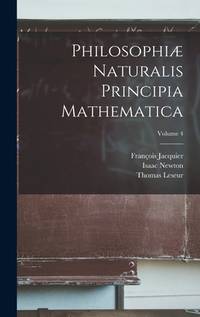
Newton, Isaac,
Philosophiae Naturalis Principia Mathematica
like new. unknown
Referenz des Buchhändlers : 45152920 ISBN : 1016271972 9781016271974
|
|
|
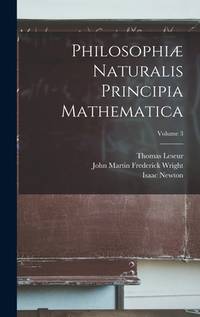
Newton, Isaac,
Philosophiae Naturalis Principia Mathematica
like new. unknown
Referenz des Buchhändlers : 45466883 ISBN : 1016215703 9781016215701
|
|
|
NEWTON, Isaac
Philosophiae naturalis principia mathematica . . . perpetuis commentariis illustrata communi studio PP. Thomae Le Seur et Francisci Jacquier
Glasgow: Andreae et Joannis M. Duncan 1822. FIRST GLASGOW EDITION. Numerous text diagrams and illustrations. Contemporary calf all covers with blind-stamped floral border within gilt floral borders within gilt-lined borders spines in compartments with gilt decoration spine labels; first few leaves of each volume spotted otherwise an excellent set. First Glasgow reprint of the first Jesuit edition printed in Geneva from 1739-1742. This edition of Newton’s Principia was edited by John Martin Frederick Wright of Trinity College who contributed additional commentary. Babson notes that Glasgow’s printing of this edition of the complete text was a great credit to the university whereas Cambridge was “satisfied with reprints of the first three sections of the first book.â€<br /> <br /> Babson 32; Gray 17; Wallis 17. Andreae et Joannis M. Duncan unknown
Referenz des Buchhändlers : 19114
|
|
|
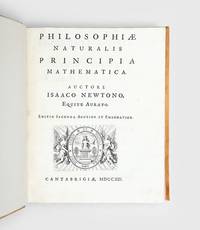
NEWTON, Isaac
Philosophiae naturalis principia mathematica. Editio Secunda Auctior et Emendatior.
Cambridge: Printed by Cornelius Crownfield at the University Press 1713. I feign no hypotheses Second edition extensively revised by Newton himself and including the first appearance of the General Scholium: among his last discussions of scientific enquiry and the source of his famed principle "Hypotheses non fingo" "I feign no hypotheses" - p. 484. "The Principia that has shaped Western scientific tracition is substantially the second edition" ODNB. Together with Roger Cotes 1682-1716 Cambridge's Plumian Professor of Astronomy Newton extensively overhauled the Principia over a period of four years: almost 400 of the first edition's 494 pages have been revised here. Alongside the Scholium the pair made particularly extensive annotations to the sections on lunar theory comets and fluid dynamics. Cotes was a gifted mathematician in his own right: after his early death Newton commented that "if he had lived we might have learned something". Cotes's lengthy preface together with Newton's Scholium and the revisions to the text itself helped to fashion the second edition of the Principia into a key text in the lengthy debate between Newton and continental philosophy most particularly that of Leibniz. The "Hypotheses non fingo" principle is directly framed to emphasize Newton's focus on descriptive analysis in contrast to continental speculation over causes. This is one of 750 copies printed at the Cambridge university press under the supervision of Richard Bentley the famed and feared master of Trinity College. Quarto 233 x 191 mm pp. xxviii 484 8. Leaf 3Q2 cancelled. Folding engraved plate facing p. 465 engraved Cambridge University Press printer's device on title page extensive wood-engraved diagrams in text. Recent vellum spine with red morocco label covers with yapp edges edges sprinkled red. With 20th-century engraved bookplate of the noted science collectors Peter and Margarethe Braune. Light finger soiling infrequent minor browning and foxing running wormhole throughout with discreet infill to most leaves and marginal repair to title and leaf b1 contents otherwise crisp and clean: a very good copy indeed. Babson 12; Dibner 11 note; ESTC T93210; Gray 8; Wallis 8. hardcover
Referenz des Buchhändlers : 181514
|
|
|
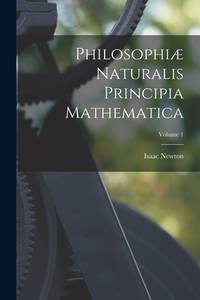
Newton, Isaac,
Philosophiae Naturalis Principia Mathematica
like new. unknown
Referenz des Buchhändlers : 45064351 ISBN : 1015592635 9781015592636
|
|
|
Newton, Isaac, Sir,Innys, William (d),Innys, John,Vanderbank, John,Vertue, George
Philosophiae naturalis principia mathematica 1726 Full Leather Bound
2022. Full Leather Bound. NEW. Size: 19.68 x 24.13 cms A Unique Premium Leather-Bound book for elite readers/collectors of old rare books. An Original Leather is being used for binding this book with Golden Leaf Printing and designing on Spine front and Back of the book with edge gilding. WE HAVE MULTIPLE OPTIONS IN COLOR OF LEATHER RED GREEN BLUE MAGENTA TAN PURPLE DEEP BROWN BLACK AND WITH DIFFERENT COLOR LABELS. YOU MAY CHOOSE ANY COLOR OF YOUR CHOICE AND MAIL US. This service is chargeable. Original edition was published in 1726 and this unique edition is Reprinted in 2022 with the help of original edition. Black & white printing on high quality natural shade paper with sewing binding for longer life professionally processed without changing its contents. As these are old books we processed each page manually on computer and make them readable. We give our best to give you the best book but in some cases we have to adjust few pages which are blur or missing or black spots. If it is multi volume set then it is only single volume. We hope that you understand these issues in these old treasure. This is an important book for the readers who want to know more about our old treasure. Our dedicated team is trying to bring these rare books back to the shelves. We are also giving service of printing the hard-to-find books which are not listed in our store. Hope you will like it and give your comments and suggestions. Lang: - Latin Pages 548. Product Disclaimer: Please be aware that because leather is a natural material slight discoloration or change in texture may be visible. FOLIO EDITION Size 12x19 Inches IS ALSO AVAILABLE ON REQUEST. hardcover
Referenz des Buchhändlers : BIBSD008470631
|
|
|
NEWTON, Isaac
Philosophiae Naturalis Principia Mathematica. Editio tertia aucta & emendata.
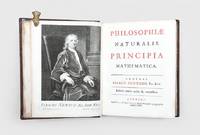
London: William & John Innys printers to the Royal Society 1726. The final lifetime edition Third edition revised by Newton himself; the final and most lavish edition to appear in his lifetime. The revisions include a new preface by Newton and one of his final statements on the nature of philosophy. By 1726 the 83-year-old Newton was making a sustained effort to tidy up his scientific legacy. For the Principia that meant adapting his arguments in light of his many disputes with continental philosophers following the first edition of 1687. The third edition is perhaps most notable for the new Rule IV of Book III in which Newton codifies his contention that hypotheses and particularly Leibnizian aether hypotheses have no place in true philosophy. Newton also adds extensive revisions to the sections on fluxions and lunar motion. Henry Pemberton 1694-1771 a 30-year-old physician and correspondent of the Oxford Newtonian John Keill was selected as the co-editor although Newton remained the primary force shaping the edition. A contemporary reader has made four ink annotations throughout this copy on pages 388 414 416 and 465 along with a handful of underlinings. The reader is particularly interested in Newton's treatment of lunar theory: the annotation on page 414 observes that "faciliùs multò polest hic calculus perfici ope motûs lunaris" "this calculation could be completed much more easily with the help of the lunar movement". Quarto 240 x 188 mm pp. xxxiv 530 8. Engraved portrait frontispiece after George Vertue engraved illustration by John Senex at p. 506 woodcut tables diagrams headpiece and initial within the text. Title page lettered in red and black. Contemporary mottled calf spine rebacked to style and with later red morocco label covers with double-fillet panel in gilt. With December 1922 signature of one Herbert Brittain possibly the Treasury official and mathematics graduate 1894-1961 to front pastedown. Light rubbing extremities restored infrequent foxing to contents: a very good copy. Babson 13; ESTC T98375; Gray 9; Wallis II.9. unknown
Referenz des Buchhändlers : 188378
|
|
|
Newton, Isaac,
Philosophiae Naturalis Principia Mathematica
like new. unknown
Referenz des Buchhändlers : 45224410 ISBN : 1016974760 9781016974769
|
|
|
Newton, Isaac,
Philosophiae Naturalis Principia Mathematica
like new. unknown
Referenz des Buchhändlers : 45514406 ISBN : 1018335846 9781018335841
|
|
|
NEWTON, Issac
Philosophiae naturalis principia mathematica. Editio secunda auctior et emendatior
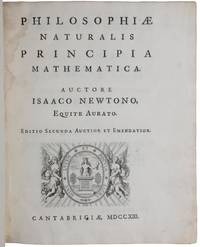
Cantabrigiae Cambridge: Cornelius Crownfield at the University Press 1713. Second edition. <p>Second edition and the first to contain the General Scholium - the four pages in which Hypotheses non fingo appears in print for the first time and in which Newton having spent the entire book establishing gravity as a mathematical law without a known cause gestures in his closing paragraph toward a spiritus subtilissimus diffused through all bodies and responsible at once for cohesion light sensation and electricity. Twenty-six years separate this from the 1687 first edition. What Roger Cotes extracted from Newton in three and a half years of editorial labour is not a corrected reprint but a substantively different book: of the original 494 pages 397 were altered; Book II was essentially rewritten; the lunar and cometary theories were enlarged; and Cotes's own preface was added - the first sustained public defence of Newtonian induction against Cartesian vortex physics. Printed in 750 copies and distributed by Newton's own hand to the academies and courts of Europe the 1713 is the edition through which Newtonianism conquered the Continent - the Principia Voltaire used and Émilie du Châtelet's base text for the only French translation Newton has ever had.</p>. The First Appearance of the General Scholium and of Hypotheses non fingo. <p>Second edition and the first to contain the General Scholium - Newton's most famous and most quoted single passage in which the phrase Hypotheses non fingo appears in print for the first time. Twenty-six years separate this edition from the 1687 first and Newton spent most of those years claiming to have lost interest in natural philosophy while in fact reworking the Principia in private. What the Cambridge mathematician Roger Cotes and the formidable Master of Trinity Richard Bentley between them extracted from him in the years 1709 to 1713 is not a corrected reprint of the 1687 Principia but a substantively different book - the version of the Principia through which the eighteenth century actually came to know Newtonian physics. The first edition had been a hurried mathematical performance for a tiny audience printed in perhaps 250 copies and effectively unobtainable on the Continent within a few years. The second edition printed in 750 copies at the recently revived Cambridge University Press and distributed by Newton's own hand to a list of European academies princes and savants - including a personal presentation to Queen Anne on 27 July 1713 and copies sent to Cassini de la Hire Varignon the Bernoullis Leibniz and Yale - is the Principia through which Newtonianism established itself as the dominant scientific worldview of the European Enlightenment.</p> <br /> <br /> <p>The story of how the edition came into being is essentially the story of Cotes's labour. Bentley who had recently revived Cambridge University Press and was looking for a flagship publication to establish its prestige persuaded Newton in 1709 to allow a new edition and proposed Cotes - at twenty-seven the recently appointed first Plumian Professor of Astronomy and Experimental Philosophy at Trinity - as supervisor of the work. Newton at first treated the revision casually but Cotes took it seriously and in the course of three and a half years of close collaboration coaxed Newton into a similar enthusiasm. The surviving Newton-Cotes correspondence edited by Edleston in 1850 and one of the most revealing documents we have of Newton at work shows Cotes querying every page proposing alterations and gradually pulling Newton back into active engagement with mathematical and astronomical problems he had not seriously thought about in fifteen years. By the time the printing was finished in the spring of 1713 the 494 pages of the 1687 had become a book of which as Rouse Ball calculated 397 are more or less modified in the second edition. The major reworked sections were the propositions on the resistance of fluids in Book II - sections 6 and 7 propositions 34 to 40 where Newton had been embarrassed by errors since the 1690s and which are now essentially rewritten; the lunar theory in Book III much enlarged using observational data Newton had wrenched from Flamsteed in a quarrel that broke their friendship; the precession of the equinoxes Book III prop. 39; and the cometary theory Book III props. 41 and 42 of which the visible monument in the volume is the folding engraved plate at p. 465 showing the parabolic orbit of the great comet of 1680. None of this revised material had been seen in print before. Cotes died of a fever on 5 June 1716 three years after publication aged thirty-three. When Newton heard he is recorded as saying that if Cotes had lived we might have known something - the only generous tribute Newton ever paid to anyone and a measure of how seriously the Principia of 1713 should be understood as a Newton-Cotes joint production rather than as a Newton solo.</p> <br /> <br /> <p>Cotes's Editoris Praefatio which opens the book after Newton's two prefaces is the first explicit sustained public defence of Newtonian natural philosophy as a method - induction from phenomena rather than hypothesis from first principles - and as a metaphysical position distinct from both Cartesianism and from Leibniz's emerging dynamical cosmology. Cotes attacks the Cartesian vortex theory of planetary motion directly and dismisses the charge that Newtonian gravitation is a causa occulta an occult quality smuggled in by an author who has no proper mechanical explanation for the action of bodies at a distance. He insists that gravity is to be regarded as a primary property of matter on a level with extension mobility and impenetrability. Newton who had explicitly told Bentley not to attribute that view to him declined to read the preface before publication and afterwards declined to disown it; his silence is itself eloquent and he was content for Cotes's harder line to stand as the official Newtonian position. I. B. Cohen in his Introduction to Newton's Principia 1971 called Cotes's preface the first clear public statement of the inductive method in any language. It is more than any text Newton himself ever wrote the founding manifesto of what the eighteenth century would call Newtonianism - and the Principia of 1713 as a result is the first edition in which Newtonianism has the shape of a party with a platform.</p> <br /> <br /> <p>By far the most important single addition to the second edition however is Newton's own - the Scholium Generale sent by him to Cotes on 2 March 1713 very late in the printing process and now the most quoted single passage in all of Newton's published work. It runs from page 481 to page 484 occupies the last leaves before the index and was clearly conceived by Newton as the philosophical and theological capstone of the entire Principia. The Scholium begins with a sustained attack on the Cartesian hypothesis of vortices - the same target Cotes has already softened in his preface - and then expands into the most extended discussion of the nature of God ever printed under Newton's name. The phrasing is famously austere: God is to be understood not through the familiar attributes of perfection which we may admire but through dominion in virtue of which we revere and adore him; he exercises this dominion in modo minime humano in modo nobis prorsus incognito and is utterly void of all body and bodily figure and can therefore neither be seen nor heard nor touched. There is no room in this theology for anything resembling the personal God of orthodox Christianity. Newton scholarship is now broadly agreed that the surface text is constructed in concentric layers with the uncontroversial argument from design occupying the outer skin and a heterodox attack on the doctrine of the Trinity concealed in the inner layers accessible only to readers prepared to follow Newton's deeply private theology. Denial of the Trinity remained a criminal offence in Britain until 1813 a full century after the Scholium first appeared in print; Samuel Clarke Newton's closest theological ally had published a controversial critique of the Trinity the year before. The most revolutionary book in the history of science championed throughout the eighteenth century as the model of orthodox natural theology ends on a quietly subversive note that Newton was content for only the cognoscenti to recognise.</p> <br /> <br /> <p>From God Newton turns abruptly to gravity and to the most quoted sentence in his entire published work. He acknowledges that he has not been able to discover from phenomena the cause of gravity and that he will not feign hypotheses about it: Hypotheses non fingo. The phrase has no published precedent. It does not occur in the 1687 Principia nor in the Opticks nor in any of Newton's earlier papers. Its first appearance in print is in this edition on a leaf added in the spring of 1713 almost as an afterthought and it has been the watchword of the Newtonian style of physics ever since - invoked by every subsequent generation of physicists who have wished to claim the authority of phenomena over speculation from the eighteenth-century anti-Cartesians through Mach and Duhem to the operationalists of the twentieth century. Whether Newton himself meant it as the categorical rejection of all hypothesising that it became is doubtful; the surrounding paragraphs make clear that he is rejecting a particular kind of speculative mechanical hypothesis about the cause of gravity rather than abjuring theoretical reasoning in general. But the slogan once printed took on a life entirely independent of its author's intentions and the 1713 Principia is the only edition in which one can encounter that life beginning.</p> <br /> <br /> <p>The Scholium ends with a paragraph that has attracted if anything less notice than it deserves. Having declared that he frames no hypotheses about the cause of gravity Newton allows himself in the last paragraph of the entire Principia to speak of spiritus quidam subtilissimus - a most subtle spirit which pervades and lies hid in all gross bodies by means of which he proposes particles of bodies attract one another light is emitted reflected refracted and bent bodies are heated sensations are excited the limbs of animals move at the command of the will and electric bodies repel and attract. It is an extraordinary list and an extraordinary moment: Newton having spent the entire book establishing that gravity is a mathematical law without a known cause ends his most public work by gesturing toward a unified mediating substance that would account at once for gravity light heat sensation the action of will and the phenomena of electricity. He concludes by remarking only that these are things which cannot be explained in few words - and the Principia ends. The spiritus subtilissimus paragraph is the closest Newton ever came in print to a unified theory of the imponderables and it is the seed from which both the eighteenth-century aether physics of Hauksbee Desaguliers and Boscovich and through a longer historical filiation that runs through Faraday the nineteenth-century field-theoretic conception of physics would germinate. It survives only because Newton appended it to the General Scholium in March 1713 and Cotes set it in type before the press could be stopped - a textual moment in other words made possible only by this edition.</p> <br /> <br /> <p>The remaining innovations of the second edition are smaller but worth recording. The dedication leaf is rewritten from 1687 - the Illustrissimae Societati Regali dedication that the present copy carries names King Charles II as the founder of the Royal Society and Queen Anne as the monarch under whose auspices it now flourishes in place of the original 1687 dedication that had named James II. The change is small and politically inevitable the Glorious Revolution had intervened James was an exile Newton himself had been knighted by Anne in 1705 but it is a reminder that this is the Principia of an established and triumphant national science rather than of a private mathematician operating at the edge of an institutional culture. Halley's celebrated Latin ode In viri praestantissimi D. Isaaci Newtoni opus hocce mathematico-physicum - the only verse tribute one major scientist has ever paid to the published work of another in seventeenth-century English science - is reprinted with its closing line Nec fas est propius mortali attingere Divos still in place. Newton's two prefaces the 1686 original and a brief new one dated Dabam Londini Mart. 28. 1713 in which he summarises the changes sit together for the first time. And - a small but real piece of editorial archaeology - the 1713 is the first edition of the Principia to carry an actual table of contents the Index Capitum totius Operis listing the section headings of Books I and II with their page references together with a sketchy alphabetical index at the rear. The 1687 had had nothing of the sort. The book is for the first time navigable. This too is a sign of Cotes's editorial mind.</p> <br /> <br /> <p>The 1713 lunar theory deserves a closer look as the most contentious revision of the entire edition. Newton's reworking of Book III propositions 25 to 35 on the motion of the moon depended throughout on the unpublished observational data of John Flamsteed the first Astronomer Royal at Greenwich. Newton had had the use of Flamsteed's observations during the 1690s but the relationship had broken down spectacularly when Flamsteed declined to release further data without prior credit and Newton with Halley's complicity contrived to have Flamsteed's Historia Coelestis printed against his will in 1712 from a working draft. Flamsteed eventually recovered three hundred copies of the pirated edition and burned them publicly at the Royal Observatory; the corrected authorised Historia would not appear until 1725 six years after Flamsteed's death. The 1713 Principia is therefore not only an intellectual document but a forensic exhibit in one of the most acrid scientific quarrels of the period. Newton's lunar theory as recast under Cotes's editorial pressure is built on the very observations whose owner was at the same moment attempting to recall them from circulation; the elegant new propositions on lunar motion in Book III are materially the spoils of the Flamsteed quarrel. Cotes seems to have understood the awkwardness perfectly well and never raised it in correspondence. The result in any case is that the 1713 contains a lunar theory accurate to within a few minutes of arc - a substantial improvement on 1687 and the empirical basis on which Maupertuis and Clairaut would later test the predictions of Newtonian gravitation against the observed motion of the apsides of the lunar orbit the test that finally settled the eighteenth-century debate over whether universal gravitation was sufficient to account for the moon.</p> <br /> <br /> <p>The print run of the second edition is famous: 750 copies against perhaps 250 of the first. Bentley's accounts have survived and show that the total cost of printing came to £117 4s 1½d; he sold 375 copies to booksellers and individuals at an average of 13s each with Crownfield the printer taking a further 200 at 11s yielding Bentley a profit of about £200 while still leaving substantial stock. Cotes who did the actual intellectual work received twelve presentation copies and no money. Some seventy or so further copies are recorded in a distribution list among Newton's papers as having been sent to named recipients across Europe - Cassini de la Hire Varignon Johann and Daniel Bernoulli Leibniz Machin - together with the major academies royal libraries and university collections from Paris to St Petersburg. The personal presentation to Queen Anne on 27 July 1713 is documented separately as is a copy Newton sent to Yale. Voltaire who had learned Newtonian physics from Maupertuis after his return from England in 1729 wrote the Eléments de la philosophie de Newton 1738 using the second edition; his personal copy survives at the Bibliothèque nationale de France. Émilie du Châtelet working with Clairaut on her French translation through the 1740s and published posthumously in 1759 as Principes mathématiques de la philosophie naturelle - still the only French translation Newton has ever had - used the 1713 as her primary base collated against the 1726 third edition. The 1713 is therefore not merely the second edition: it is the edition through which Newtonian became a synonym for modern in eighteenth-century European thought and copies in unrestored or near-unrestored contemporary bindings with the original endpapers preserved are markedly less common on the market than the standard sale catalogues suggest.</p> <br /> <br /> <p>References: Babson 12 - Wallis 8 - Gray 8 - Babson Suppl. p. 8 - Norman 1587 - Gjertsen Newton Handbook pp. 463-4 and 475-6 - Cohen Introduction to Newton's Principia 1971 chapters VII-IX - ESTC T93210 - PMM 161 for the first edition.</p> <br /> <br/> <br/> <br /> <p>4to 235 × 190 mm pp. xxviii 484 8. Engraved Cambridge University arms vignette on the title by Samuel Gribelin signed S.G. at lower edge one folding engraved plate of the cometary orbit at p. 465 woodcut diagrams throughout the text woodcut head- and tail-pieces and initials. Paper a fine European laid stock chain lines horizontal at 25 mm spacing watermark a star with curling ornament visible in several gatherings consistent with imported Dutch paper of the period. Contemporary English calf blind-tooled rectangular panel on the boards raised bands on the spine with double gilt fillets at the bands single red morocco lettering-piece gilt NEWTON'S / PRINCIPIA / MATHEMATICA edges sprinkled red; spine and corners sympathetically renewed using the original spine leather where possible original pastedowns and free endleaves preserved. Old waterstaining at the upper outer corner of the title and at the fore-edges of the first and last gatherings not affecting text; old ink mark and minor surface marks to the upper cover; the body of the text crisp and clean throughout the engraved plate fresh the corrigenda leaf at the rear present.</p> . Cornelius Crownfield at the University Press] unknown
Referenz des Buchhändlers : 6668
|
|
|
Newton, Isaac
Philosophiæ Naturalis Principia Mathematica Revision IV: The Laws of Orbital Motion
paperback. Good. Access codes and supplements are not guaranteed with used items. May be an ex-library book. paperback
Referenz des Buchhändlers : 172518348X.G ISBN : 172518348X 9781725183483
|
|
|
Newton, Isaac
Philosophiae Naturalis Principia Mathematica: Full and Annotated Latin Edition
hardcover. Good. Access codes and supplements are not guaranteed with used items. May be an ex-library book. hardcover
Referenz des Buchhändlers : 6257959799.G ISBN : 6257959799 9786257959797
|
|
|
Newton, Isaac
Philosophiæ Naturalis Principia Mathematica Revision IV: Laws of Orbital Motion
paperback. Good. Access codes and supplements are not guaranteed with used items. May be an ex-library book. paperback
Referenz des Buchhändlers : 1072156059.G ISBN : 1072156059 9781072156055
|
|
|
Newton, Isaac
Philosophiæ naturalis principia mathematica. Auctore Isaaco Newtono . Editio secunda auctior et emendatior. Latin Edition
hardcover. Good. Access codes and supplements are not guaranteed with used items. May be an ex-library book. hardcover
Referenz des Buchhändlers : 1379295521.G ISBN : 1379295521 9781379295525
|
|
|
Newton, Isaac
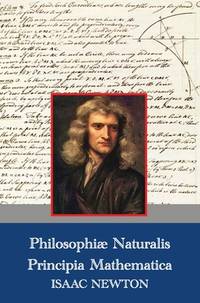
Philosophiae Naturalis Principia Mathematica Latin1687 Latin Edition
Benediction Classics 2015-05-08. hardcover. Used: Good. 6.69x0.75x9.61. Buy with confidence. Excellent Customer Service & Return policy. Benediction Classics hardcover
Referenz des Buchhändlers : SONG1789431328 ISBN : 1789431328 9781789431322
|
|
|
Newton, Isaac
Philosophiæ Naturalis Principia Mathematica Revision IV - Volume II: Laws of Orbital Motion the laws and formulas
paperback. Good. Access codes and supplements are not guaranteed with used items. May be an ex-library book. paperback
Referenz des Buchhändlers : 1072197251.G ISBN : 1072197251 9781072197256
|
|
|
Newton, Isaac
Philosophiæ Naturalis Principia Mathematica Revision IV - Volume III: Laws of Orbital Motion physical constants and support
paperback. Good. Access codes and supplements are not guaranteed with used items. May be an ex-library book. paperback
Referenz des Buchhändlers : 1072198630.G ISBN : 1072198630 9781072198635
|
|
|
Newton, Isaac
Philosophiæ Naturalis Principia Mathematica Revision IV - Volume I: Laws of Orbital Motion the narrative
paperback. Good. Access codes and supplements are not guaranteed with used items. May be an ex-library book. paperback
Referenz des Buchhändlers : 1072195267.G ISBN : 1072195267 9781072195269
|
|
|
Newton, Isaac
Philosophiae Naturalis Principia Mathematica Latin1687 Latin Edition
hardcover. Good. Access codes and supplements are not guaranteed with used items. May be an ex-library book. hardcover
Referenz des Buchhändlers : 1789431328.G ISBN : 1789431328 9781789431322
|
|
|
Newton, Isaac
Philosophilæ Naturalis Principia Mathematica Latin Edition
hardcover. Good. Access codes and supplements are not guaranteed with used items. May be an ex-library book. hardcover
Referenz des Buchhändlers : 111597078X.G ISBN : 111597078X 9781115970785
|
|
|
Newton, Isaac
Philosophiæ Naturalis Principia Mathematica; Volume 1 Italian Edition
hardcover. Good. Access codes and supplements are not guaranteed with used items. May be an ex-library book. hardcover
Referenz des Buchhändlers : 1015587607.G ISBN : 1015587607 9781015587601
|
|
|
Newton, Isaac
Philosophilæ Naturalis Principia Mathematica Latin Edition
hardcover. Good. Access codes and supplements are not guaranteed with used items. May be an ex-library book. hardcover
Referenz des Buchhändlers : 1015407137.G ISBN : 1015407137 9781015407138
|
|
|
Newton, Isaac
Philosophiæ Naturalis Principia Mathematica; Volume 1 Italian Edition
paperback. Good. Access codes and supplements are not guaranteed with used items. May be an ex-library book. paperback
Referenz des Buchhändlers : 1015592635.G ISBN : 1015592635 9781015592636
|
|
|
Newton, Isaac
Philosophiæ Naturalis Principia Mathematica; Volume 3 Latin Edition
hardcover. Good. Access codes and supplements are not guaranteed with used items. May be an ex-library book. hardcover
Referenz des Buchhändlers : 1016215703.G ISBN : 1016215703 9781016215701
|
|
|
Newton, Isaac
Philosophiæ naturalis principia mathematica; Volume 4 Latin Edition
hardcover. Good. Access codes and supplements are not guaranteed with used items. May be an ex-library book. hardcover
Referenz des Buchhändlers : 1016271972.G ISBN : 1016271972 9781016271974
|
|
|
Newton, Isaac
Philosophiæ Naturalis Principia Mathematica; Volume 1 Latin Edition
hardcover. Good. Access codes and supplements are not guaranteed with used items. May be an ex-library book. hardcover
Referenz des Buchhändlers : 1016974760.G ISBN : 1016974760 9781016974769
|
|
|
Newton, Isaac
Philosophiæ Naturalis Principia Mathematica; Volume 1 Latin Edition
paperback. Good. Access codes and supplements are not guaranteed with used items. May be an ex-library book. paperback
Referenz des Buchhändlers : 1016979584.G ISBN : 1016979584 9781016979580
|
|
|
Newton, Isaac
Philosophiæ Naturalis Principia Mathematica; Volume 2 Latin Edition
hardcover. Good. Access codes and supplements are not guaranteed with used items. May be an ex-library book. hardcover
Referenz des Buchhändlers : 1017391882.G ISBN : 1017391882 9781017391886
|
|
|
Newton, Isaac
Philosophiae Naturalis Principia Mathematica Éd.1687 Sciences French Edition
paperback. Good. Access codes and supplements are not guaranteed with used items. May be an ex-library book. paperback
Referenz des Buchhändlers : 2012599281.G ISBN : 2012599281 9782012599284
|
|
|
Newton, Isaac
Philosophiae Naturalis Principia Mathematica; Volume 2 Latin Edition
hardcover. Good. Access codes and supplements are not guaranteed with used items. May be an ex-library book. hardcover
Referenz des Buchhändlers : 1018335846.G ISBN : 1018335846 9781018335841
|
|
|
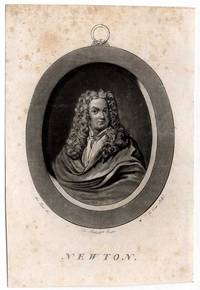
Newton, Isaac =
Portrait Brustbild von vorn im ovalen Rahmen.
1787. Galerie universelle des hommes qui se sont illustres dalls l'emoire des lettres . Imbert. S. Comte de la Platiere. Paris 1787 des Rais del le Couer Sculp. Ex Biblioth.ca Regia Schabkunstblatt 16 x 122 cm auf 20 x 148 cm. Seltenes Portrait von Issac Newton. unknown
Referenz des Buchhändlers : 34300
|
|
|
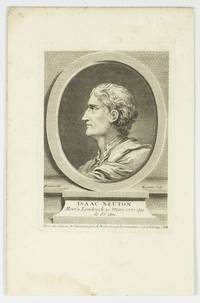
Newton, Isaac
Portrait by S. F. Ravenet and J. or N. Roettiers.
Paris Odieuvres et Déslampes ca. 1727-1728. Single leaf 8vo-size 23.4 x 15.3 cm. Printed on one side. Printed surface 14.5 x 10.2 cm. = A rare portrait of Isaac Newton 1642-1727 by the French artist Simon François Ravenet 1706-1764 engraved by the British engraver John Roettiers 1631-1703 - or one of his sons James 1663-1698 or Norbert 1665-1727 - and here reissued with a new caption. The caption reads: "Isaac Neuton SIC Mort à Londres le 20 mars 1727. Agé de 85 ans". With very wide margins. Dampstain at the lower edge far from the printed part otherwise very good clean with a strong impression. unknown
Referenz des Buchhändlers : 69828
|
|
|
Newton, Isaac
Portrait by É. J. Desrochers
Paris Desrochers ca. 1727-1728. Single leaf 8vo-size 15.3 x 11.5 cm. Printed on one side. Printed surface 14.2 x 9.7 cm. = A very rare portrait of Isaac Newton 1642-1727 at an advanced age by the French engraver Étienne Jehandier Desrochers 1668-1741. Desrochers was".best known for his miniature portraits of his contemporaries" Wikipedia. In 1726 he published his "Recueil de portraits des personnes qui se sont distinguées tant dans les Armes que dans les Belles Lettres et les Arts comme aussi la famille Royale de France et Autres Cours Étrangères 1726". This portrait perhaps is supplemental to this work. The caption reads: "fameux mathematicien né en Angleterre et il y est mort. De ce physicien le sublime genie De la nature entiere a pénétre les loix a ses profunds calculs elle semble asservie Et ne s'expliquer plus que par sa seule voix. R.". Only a few copies in libraries. Some light soiling otherwise very good with a strong impression. unknown
Referenz des Buchhändlers : 69827

|
|
|
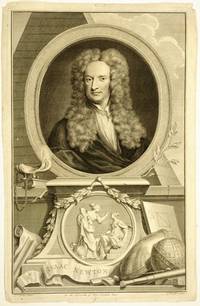
Newton, Isaac =
Portrait three quarter lenth to left. Oval frame on pedestal with emblems and working objects.Brustbild.
1747. Birch's Heads 1747/1752. - Line J.Houbraken sculpsit G. Kneller pinx 1743 363 x 232 auf 402 x 260 mm. Sir Isaac Newton 1642-1727 P.R.S. Lucasian profewssor of nathgematics; physicist and philosopher. Portr. Wellcome Inst. Hist. Med. R.Burgess No.2140.5 unknown
Referenz des Buchhändlers : 43865
|
|
|
Newton, Isaac
Principes Mathématiques de la Philosophie Naturelle Vol. 2 Classic Reprint French Edition
hardcover. Good. Access codes and supplements are not guaranteed with used items. May be an ex-library book. hardcover
Referenz des Buchhändlers : 0364580011.G ISBN : 0364580011 9780364580011
|
|
|
Newton, Isaac
Principes Mathématiques de la Philosophie Naturelle Traduit Du Latin Tome 1 French Edition
paperback. Good. Access codes and supplements are not guaranteed with used items. May be an ex-library book. paperback
Referenz des Buchhändlers : 2011257484.G ISBN : 2011257484 9782011257482
|
|
|
Newton, Isaac
Principes Mathématiques de la Philosophie Naturelle Traduit Du Latin Tome 2 French Edition
paperback. Good. Access codes and supplements are not guaranteed with used items. May be an ex-library book. paperback
Referenz des Buchhändlers : 2011257476.G ISBN : 2011257476 9782011257475
|
|
|
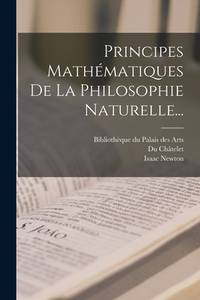
Newton, Isaac
Principes Mathématiques De La Philosophie Naturelle. French Edition
hardcover. Good. Access codes and supplements are not guaranteed with used items. May be an ex-library book. hardcover
Referenz des Buchhändlers : 1015647901.G ISBN : 1015647901 9781015647909
|
|
|
Newton, Isaac
Principes Mathématiques De La Philosophie Naturelle. French Edition
paperback. Good. Access codes and supplements are not guaranteed with used items. May be an ex-library book. paperback
Referenz des Buchhändlers : 1015652727.G ISBN : 1015652727 9781015652729
|
|
|
Newton, Isaac
Principia Mathematical principles of natural philosophy and his system of the world.
Norwalk: Easton Perss 1992. Book. Near Fine. Hardcover. First Thus. 680pp. Red Leather six raised bands on the spine Gilt decorations. Gold Silk Moire Endpapers ribbon marker All Edges gilt. Except for a minor spot on the verso of the fron endpaper this copy is fine. Laid in is the Easton Press Bookplate which is blank. "The book focuses on topics like the classical mechanics branch of physics with Newton's three laws of motion. In the Principia Isaac Newton also describes important concepts like gravity with the law of universal gravitation which is a core concept for modern physics and astronomy." Size: Octavo. Easton Perss Hardcover
Referenz des Buchhändlers : 034091
|
|
|
Newton, Isaac,
Principia Vol II
new. unknown
Referenz des Buchhändlers : 41422264-n ISBN : 0520362209 9780520362208

|
|
|
Newton, Isaac,
Principia Vol II
like new. unknown
Referenz des Buchhändlers : 41422264 ISBN : 0520362209 9780520362208
|
|
|
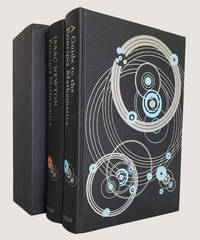
Newton, Isaac
Principia Mathematica with A Guide to the Principia Mathematica. Two volume set Mathematical Principles of Natural Philosophy.
London; Folio Society 2008. 2008. Hard Cover. Second printing. Large octavo pp. xxx 494; xxvii 1 385. Illustrated with eight double-sided colour plates to main volume with line diagrams throughout both volumes. Publisher's black cloth with silver orange and blue motifs to spines and upper boards; silver titles to spines black endpapers. Housed in a black slipcase. A neat bright set; near fine books in a very good slipcase. A few barely visible marks to page block edge of main volume and a light bump to one corner of accompanying volume. Slipcase is lightly bumped to rear corner with light water marks to lower faces. First published in Latin in 1687 this translation is based on the third edition of 1726 and was first published by University of California in 1999. Translated by I. Bernard Cohen and Anne Whitman assisted by Julia Buzenz. Heavyweight set so a contribution towards increased postage costs will be requested for overseas delivery. London; Folio Society, 2008. hardcover
Referenz des Buchhändlers : 10967
|
|
|
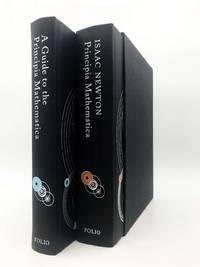
Newton, Isaac
PRINCIPIA MATHEMATICA
The Folio Society 2008T. hardcover. Like New. 8.9932 cent in x 26.1801 cent in x 18.3860 cent in. The Folio Society hardcover
Referenz des Buchhändlers : mon0000078738
|
|
|
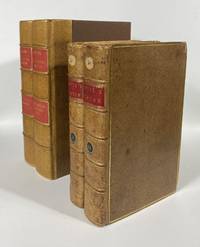
Newton, Isaac
PRINCIPIA MATHEMATICA - FIRST EDITION IN ENGLISH. The Mathematical Principles of Natural Philosophy. Translated into English by Andrew Motte. To which are added The Laws of the Moon's Motion according to Gravity. BY John Machin
London: For Benjamin Mott 1729. first Edition in English. Two vols. 8vo. 19 x 11 cm. Paginated: 36 320; 2 393 13; viii 3 4-71 1 pp. Collation = Ad 1: pi1 A2 2A8 a8 B-X8. Ad 2: pi1 B-Z8 Aa-Cc8 Dd3 lacking blank leaf Dd4 as commonly; a4 A-D8 E4 with cancel C1 headling = "Gentium"; stain on fols. b7-8 and c1-2. Lacking engraved allegorical frontispiece to each volume not unusually. With 47 engraved folding plates numbered 1-25 and 1-19 with 3 unnumbered plates at rear of volume 2 2 folding letterpress tables 3 engraved headpieces. Bound in contemporary English sprinkled calf very minor wear wear along binding extremities spines with red morocco lettering pieces gilt black oval volume numbers gilt old shelf labels in MS on paper circles "30". BEAUTIFUL COPY OF THE FIRST ENGLISH-LANGUAGE EDITION OF THE GREATEST WORK IN THE HISTORY OF SCIENCE "PERHAPS THE GREATEST INTELLECTUAL STRIDE THAT IT HAS EVER BEEN GRANTED TO ANY MAN TO MAKE" EINSTEIN. <br /> <br /> "The Principia is generally described as the greatest work in the history of science. These provided the great synthesis of the cosmos proving finally its physical unity. Newton showed that the important and dramatic aspects of nature that were subject to the universal law of gravitation could be explained in mathematical terms within a single physical theory. With him the separation of natural and supernatural of sublunar and superlunar worlds disappeared" Bernard Cohen Introduction in The Mathematical Principles of Natural Philosophy 1968.<br /> <br /> PMM: "Copernicus Galileo and Kepler had certainly shown the way; but where they described the phenomena they observed Newton explained the underlying laws." Originally published in Latin in 1687 the Principia "marked the culmination of the scientific revolution . ushered in modern science and through its legacy the work may have done more to shape the modern world than any other ever published" ODNB. Newton here laid the foundation for classical mechanics establishing the three laws of motion and universal gravitation. It is universally considered a masterpiece that unified physical laws of the heavens and earth. <br /> <br /> This finely printed translation into English by Mott made the work available to a wider lay audience. This edition also contains John Machin's attempt to rectify Newton's lunar theory "The Laws of the Moon's Motion according to Gravity." Most copies have an engraved frontispiece in each volume although some have only one Ransom Center etc. while a surprising number have neither of them as here including the Gonville and Caius copy at Cambridge University M.26.7-8. Because the book has been of enduring interest for almost 300 years with commensurately heavy use copies as fresh as this in contemporary bindings are of genuine rarity.<br /> <br /> Babson 20. Wallis 23. PMM 161. For Benjamin Mott unknown
Referenz des Buchhändlers : 4526
|
|
|
Newton, Isaac
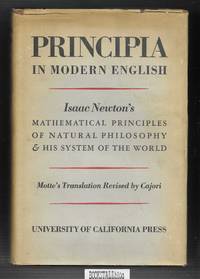
Principia in Modern English :
<p>A good hardcover cloth-bound with good- DJ chippings tears & other signs of wear on DJ as in image clipped DJ text/block tight clean with note & underlining on 10 pages only image_2. 680p. 26x18cm. 1700gr.</p><p><u><strong>Notice:</strong></u><em> Has increased shipping cost due to size & weight 170kg. Look up "Shipping terms".</em></p> University of California Press hardcover
Referenz des Buchhändlers : PC7383
|
|
|
Newton, Isaac; Cajori, Florian [Editor]; Motte, Andrew [Translator];
Principia : Vol. 1 The Motion of Bodies
University of California Press 1966-01-01. Paperback. New. In shrink wrap. Looks like an interesting title! University of California Press paperback
Referenz des Buchhändlers : Q-0520009282 ISBN : 0520009282 9780520009288
|
|
|
Newton, Isaac
Principia Sir Isaac Newton's Mathematical Principlesof Natural Philosophy and His System of the World
Norwalk CT: Easton Press 1992. Leather Hardcover. Near Fine. Three small light scuffs in gilt on top page edges; 1/4" scuff in gilt on bottom page edges. ; Translated into English by Andrew Motte in 1729. The translation revised and supplied with an historical and explanatory appendix by Florian Cajori. Introduction by Richard S. Westfall. Part of the Collector's Editions. Bound in bonded red leather with ornate decorative gilt on covers and spine raised bands on spine and gilt on all page edges. ; 6 x 9 1/4"; 680 pages. Easton Press hardcover
Referenz des Buchhändlers : 110904
|
|
|
Newton, Isaac
Principia Vol. II: The System of the World
hardcover. Good. Access codes and supplements are not guaranteed with used items. May be an ex-library book. hardcover
Referenz des Buchhändlers : 0520362209.G ISBN : 0520362209 9780520362208
|
|
|
Newton, Isaac
Principia: Vol. II: The System of the World
New. Brand new and still unused unknown
Referenz des Buchhändlers : 0520009290 ISBN : 0520009290 9780520009295
|
|

 Per e-mail erhalten
 Als pdf-Dokument herunterladen
 RSS feed
 Permanenter link


