Die unabhängige Plattform professioneller Buchhändler und Antiquare

‎Biologie‎

Main

Eltern des Themas

‎Sciences naturelles‎
Anzahl der Treffer : 20.859 (418 seiten)

Erste Seite Vorherige Seite 1 ... 19 20 21 [22] 23 24 25 ... 81 137 193 249 305 361 417 ... 418 Nächste Seite Letzte Seite

‎"DARWIN, CHARLES.‎

‎Obrazovanie rastitel'nago sloa deatel'nost'u dozdevyh cervej i nabludenia nad obrazom zizni poslednih. [i.e. ""Vegetable Mould and Worms""]. [Translated by:] Mihail Aleksandrovic Menzbir.‎

‎Moscow, S. P. Arkhipov. 1882. 8vo. In contemporary half calf. Wear to extremities and small stamp to upper right corner of title-page, internally fine and clean. IV, 186 pp.‎

‎"DARWIN, CHARLES.‎

‎Observations on the Structure and Propagation of the genus Sagitta. - [""ONE OF THE MOST ANOMALOUS ANIMALS IN THE WORLD""]‎

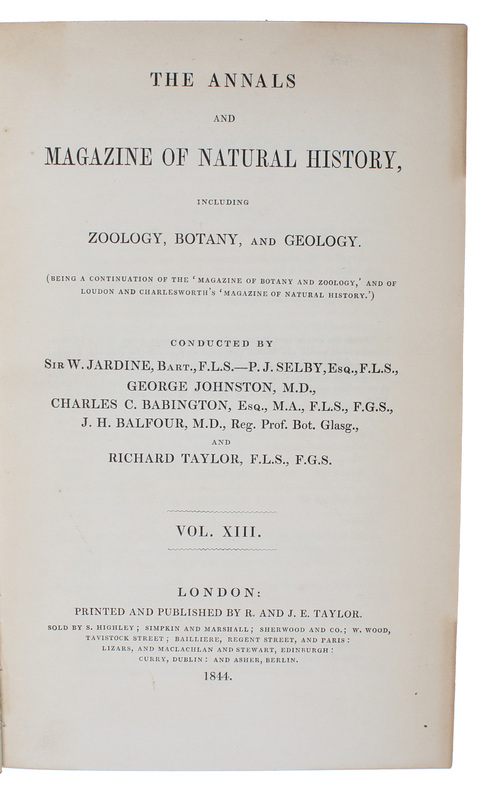
‎London, Taylor and Francis, 1844. 8vo. In a nice later half morocco binding with five raised bands and gilt lettering to spine. Blind stamped to upper outer corner of first leaf of table of contents. In ""The Annals and Magazine of Natural History"", volume 13. A very fine and clean copy. [Darwin's paper] pp. (1)-6 + 1 plate. [Entire volume:] viii, [1] - 528 + 14 plates (4 hand-coloured).‎

‎"DARWIN, CHARLES.‎

‎Observations on the Structure and Propagation of the genus Sagitta. - [""ONE OF THE MOST ANOMALOUS ANIMALS IN THE WORLD""]‎

‎London, Taylor and Francis, 1844. 8vo. In a nice later half morocco binding with five raised bands and gilt lettering to spine. Blind stamped to upper outer corner of first leaf of table of contents. In ""The Annals and Magazine of Natural History"", volume 13. A very fine and clean copy. [Darwin's paper] pp. (1)-6 + 1 plate. [Entire volume:] viii, [1] - 528 + 14 plates (4 hand-coloured).‎

‎First edition of Darwin's paper on marine arrow worms collected by him on his voyage on the Beagle. It is one of Darwin's early papers on invertebrates, which was originally intended for publication in The Zoology of the Voyage of HMS Beagle. Described by Darwin as ""one of the most anomalous animals in the world,"" the origin of these strange carnivorous animals, which Darwin found highly interesting, is still unresolved. These early works are rarely seen on the market. The plate, drawn by Darwin, is based on his drawings made during the Beagle Voyage.Darwin arrived back in England from his voyage around the world on the Beagle in October 1836. He immediately set about writing up the results of the expedition-first, his general account, the Journal of the Beagle, and then, publishing the scientific observations and collections he had made while on the Beagle. The majority of these were published in the Zoology-including parts on mammals, fish, birds, and reptiles but Darwin ran out of funds beforehe could bring out the volume on invertebrates:""Darwin undertook to provide a comprehensive programme for the publication of the zoological results of the Beagle voyage - he obtained a Treasury grant to pay for the necessary engravings, and, having enlisted the leading taxonomical specialists in the several fields, he superintended the publication of the Zoology of the voyage of H.M.S. Beagle from February 1838 to October 1843 - The work comprises five parts: Fossil Mammalia, by Richard Owen" Mammalia, by G. R. Waterhouse Birds, by John Gould Fish, by Leonard Jenyns" and Reptiles, by Thomas Bell-a total of nineteen quarto issues. Darwin contributed a substantial portion of the text, drawing uponhis field notes for geological and geographical data and for the descriptions of the habits and habitats of the species - Darwin had originally planned to include descriptions of invertebrates in the Zoology but the exhaustion ofthe government grant forced him to abandon the idea. Instead he decided to publish his own observations and descriptions of the specimens that he considered to be important new discoveries, and did so in articles on Sagitta finished during the autumn of 1843, and Planariae, described in 1844"" (Burkhardt 1986 p. xv.).PROVENANCE: From the collection William Pickett Harris, Jr. (1897 - 1972) (pencil note on p. iii). American investment banker and biologist. Following a career in banking, Harris was appointed Associate Curator of the Museum of Zoology at the University of Michigan in 1928. ""[Harris] played a highly important role in developing mammalogy and systematic collections of mammals at the University of Michigan"" (Hooper p. 923).Freeman 1664.‎

Referenz des Buchhändlers : 56990

Livre Rare Book

Herman H. J. Lynge & Son
Copenhagen Denmark Dinamarca Dinamarca Danemark
[Bücher von Herman H. J. Lynge & Son]

€ 6.446,40 Kaufen

‎"DARWIN, CHARLES.‎

‎Om Arternes Oprindelse ved Kvalitetsvalg (Danish) + Arternes Oprindelse gjennem naturligt Udvalg (Norwegian) + Om Arternas Uppkomst genom naturligt Urval (Swedish). - [INTRODUCTION OF THE ""ORIGIN"" IN SCANDINAVIA]‎

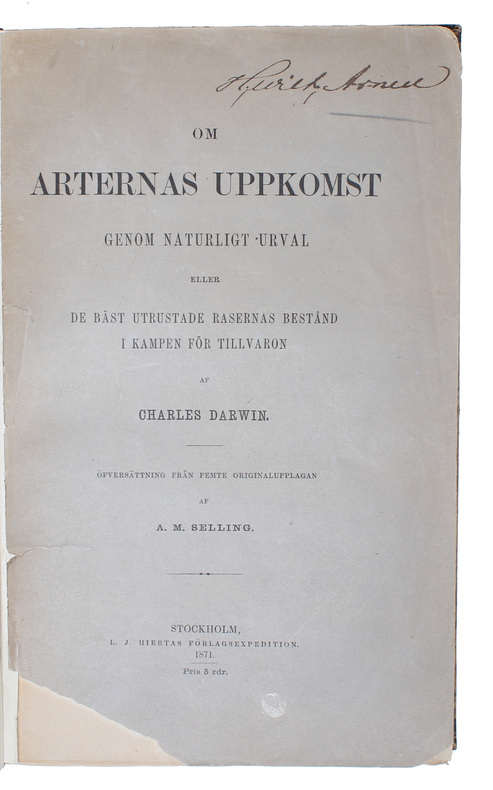
‎Kjøbenhavn [Copenhagen], 1872 - (Kristiania [Oslo], 1890) - Stockholm, 1871. A very nice and harmonious set, in four excellent half calf bindings.1) The Danish translation: 1 volume 8vo. A nice contemporary half calf with gilding to spine and gilt title-label. Only light wear. Internally some light brownspotting. (19), XIII, 605, (1) pp.2) The Norwegian translation: 2 volumes small 8vo. Bound in two excellent, uniform, recent red morocco bindings in pastiche-style, with gilt lines to spines. The work is printed in quite bad paper, which is always yellowed and quite brittle. Thus, the first title-page has two small restorations from verso, far from arrecting printing. The second title-page had an old owener's signature and a previous owner's stamp. 379, (5)" " 383 pp.3) The Swedish translation: 1 volume large 8vo. Bound uncut and with the extremely scarce original front wrapper in a lovely later brown half morrocco binding in contemporary style, with five raised bands and gilt author and year to spine. Front wrapper bound on a strip at inner hinge and with a missing outer coner (far from affecting printing). Old owner's name to front wrapper. An excellent copy. XI, (1), 420 pp.‎

‎"DARWIN, CHARLES.‎

‎Om Arternes Oprindelse ved Kvalitetsvalg (Danish) + Arternes Oprindelse gjennem naturligt Udvalg (Norwegian) + Om Arternas Uppkomst genom naturligt Urval (Swedish). - [INTRODUCTION OF THE ""ORIGIN"" IN SCANDINAVIA]‎

‎Kjøbenhavn [Copenhagen], 1872 - (Kristiania [Oslo], 1890) - Stockholm, 1871. A very nice and harmonious set, in four excellent half calf bindings.1) The Danish translation: 1 volume 8vo. A nice contemporary half calf with gilding to spine and gilt title-label. Only light wear. Internally some light brownspotting. (19), XIII, 605, (1) pp.2) The Norwegian translation: 2 volumes small 8vo. Bound in two excellent, uniform, recent red morocco bindings in pastiche-style, with gilt lines to spines. The work is printed in quite bad paper, which is always yellowed and quite brittle. Thus, the first title-page has two small restorations from verso, far from arrecting printing. The second title-page had an old owener's signature and a previous owner's stamp. 379, (5)"" 383 pp.3) The Swedish translation: 1 volume large 8vo. Bound uncut and with the extremely scarce original front wrapper in a lovely later brown half morrocco binding in contemporary style, with five raised bands and gilt author and year to spine. Front wrapper bound on a strip at inner hinge and with a missing outer coner (far from affecting printing). Old owner's name to front wrapper. An excellent copy. XI, (1), 420 pp.‎

‎A magnificent collection of first editions of the first Danish, Norwegian and Swedish translations of Darwin's masterpiece ""The Origin of Species"", together constituting the introduction to ""The Darwinian Revolution in Scandinavia"".The first Scandinavian translation to appear was the Swedish, which is also the rarest of the three. Darwinism was strongly opposed in Sweden, where the primary reaction to the work came from religious institutions that were outraged and fiercely fought against spreading the ideas presented in ""origin"" in their country. The second Scandinavian translation to appear was the Danish, which was translated in 1872 by the then young botanist J. P. Jacobsen, who was soon to become one f Scandinavia's most celebrated and influential authors. He received world-wide fame as the author of ""Marie Grubbe"" and ""Niels Lyhne"", which founded literary naturalism in Europe. ""In the early 1870's, however, he was still dedicated to science. In 1873 he received the University of Copenhagen's Gold Medal for his work on desmids, single-celled green freshwater algae. The Descent of Man was also translated by Jacobsen and appeared in 1874-75.""Darwin's ideas found great resonance in scientific circles in Denmark, and his ideas were immediately recognized. ""In the early 1870s [With the Danish translation] the literary critic Georg Brandes started promoting Darwin's ideas as part of his liberal ideology and soon Darwinism became the mark of a new generation of intellectuals. Both the Steenstrup circle and the Brandes circle held Darwin in high esteem, but made completely different attributions to his theory. Consequently they both decided to raise money separately for the same Darwin. Darwin had borrowed the collection of barnacles from the Zoology Museum in Copenhagen with the help of Steenstrup. As a compliment Darwin sent him a signed copy of the Origin. Steenstrup acknowledged Darwin as an important fellow naturalist, but like many of his colleagues at the University of Copenhagen he never accepted evolutionary theory. The initial scientific reaction to Darwin's work on evolution by means of natural selection was respectful, but made few converts. memorial in 1882. Independently, Darwinism transformed as it became part of popular culture. "" (Kjærsgaard, Darwinism comes to Denmark).The Norwegian translation was the last of the three to appear, but it is quite scarce and very difficult to come by. It was published by businessman and publisher Johan Sørensen (1830-1918) as a part of 'Bibliothek for de tusen hjem' (Library for Every Home).""The first volume came out at the end of 1889, in five parts and a total of 379 pages. Each part cost 30 øre, making a total price of 1 kroner 50 øre. The following year, 1890, the second volume appeared and this consisted of four parts totaling 383 pages and cost 1 kroner 20 øre. The books were translated from the English sixth and final edition by the Master of the Arendal Public Secondary College, Ingebret Suleng (1852-1928)"" (Glick, The Reception of Charles Darwin in Europe).1. The Danish translation: Om Arternes Oprindelse ved Kvalitetsvalg eller ved de heldigst stillede Formers Sejr i Kampen for Tilværelsen. Efter Originalens femte Udgave oversat af J.P. Jacobsen. Kjøbenhavn, Gyldendalske Boghandel (F. Hegel), 1872. 8vo. (10),XIII,605,(1) pp. - Freeman No 643 (Freeman with wrong collation, as he omits half-title and content-leaves).2. The Norwegian translation: Arternes Oprindelse gjennem naturligt Udvalg eller de bedst skikkede Formers bevarelse i Striden for Livet. Oversat efter Originalens VI. Udgave af Ingebret Suleng. (I-) II. (Kristiania), Bibliothek for de tusen hjem. Fagerstrand pr. Høvik, (1890). Small 8vo. (1-3)4-379,(4)"(1-3)4-383 pp. - Not in Freeman.3. The Swedish translation: Om Arternas Uppkomst genom naturligt Urval eller de bäst utrustade Rasernas Bestånd i Kampen för Tillvaron. Öfversättning från femte Originalupplagan af A.M. Selling. Stockholm, L.J. Hiertas Förlagsexpedition, 1871. (I-IV)V-XI,420 pp., 1 plate. - Freeman No 793 (Freeman having the wrong year of publication and not mentioning the plate).‎

Referenz des Buchhändlers : 56501

Livre Rare Book

Herman H. J. Lynge & Son
Copenhagen Denmark Dinamarca Dinamarca Danemark
[Bücher von Herman H. J. Lynge & Son]

€ 7.386,50 Kaufen

‎"DARWIN, CHARLES.‎

‎Om Arternes Oprindelse ved Kvalitetsvalg eller ved de heldigst stillede Formers Sejr i Kampen for Tilværelsen. Efter Originalens femte Udgave oversat af J.P. Jacobsen. - [FIRST DANISH EDITION OF ""THE ORIGIN OF SPECIES"".]‎

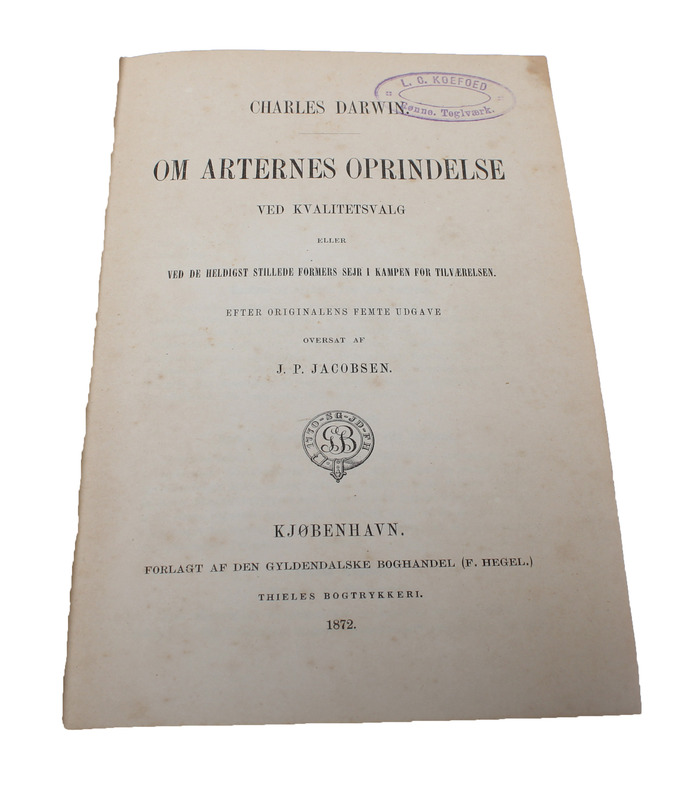
‎Kjøbenhavn, Gyldendalske Boghandel (F. Hegel), 1872. 8vo. Bound in contemporary half calf with gilt lettering to spine. Spine rubbed. A few light brownspots throughout. Otherwise a fine and clean copy. (10), XIII, 605, (1) + 1 plate.‎

‎"DARWIN, CHARLES.‎

‎Om Arternes Oprindelse ved Kvalitetsvalg eller ved de heldigst stillede Formers Sejr i Kampen for Tilværelsen. Efter Originalens femte Udgave oversat af J.P. Jacobsen. - [FIRST DANISH EDITION OF ""THE ORIGIN OF SPECIES"".]‎

‎Kjøbenhavn, Gyldendalske Boghandel (F. Hegel), 1872. 8vo. Bound in contemporary half calf with 4 raised bands and gilt lettering to spine. Spine rubbed. A few light brownspots throughout. Otherwise a fine and clean copy. (10), XIII, 605, (1) + 1 plate.‎

‎"DARWIN, CHARLES.‎

‎Om Arternes Oprindelse ved Kvalitetsvalg eller ved de heldigst stillede Formers Sejr i Kampen for Tilværelsen. Efter Originalens femte Udgave oversat af J.P. Jacobsen. - [FIRST DANISH EDITION OF ""THE ORIGIN OF SPECIES"".]‎

‎Kjøbenhavn, Gyldendalske Boghandel (F. Hegel), 1872. 8vo. Bound in contemporary half calf with 4 raised bands and gilt lettering to spine. Spine rubbed. A few light brownspots throughout. Otherwise a fine and clean copy. (10), XIII, 605, (1) + 1 plate.‎

‎The Scarce first Danish edition (translated from the 5. edition) of Darwin's monumental ""On the Origin of Species"". ""In 1872 the book was translated into Danish by the young botanist J. P. Jacobsen. He was soon to become a celebrated novelist famous for Marie Grubbe - A Lady of the Seventeenth Century (1876) and Niels Lyhne (1880). In the early 1870's, however, he was still dedicated to science. In 1873 he received the University of Copenhagen's Gold Medal for his work on desmids, single-celled green freshwater algae. The Descent of Man was also translated by Jacobsen and appeared in 1874-75. ""In the early 1870s [With the Danish translation] the literary critic Georg Brandes started promoting Darwin's ideas as part of his liberal ideology and soon Darwinism became the mark of a new generation of intellectuals. Both the Steenstrup circle and the Brandes circle held Darwin in high esteem, but made completely different attributions to his theory. Consequently they both decided to raise money separately for the same Darwin. Darwin had borrowed the collection of barnacles from the Zoology Museum in Copenhagen with the help of Steenstrup. As a compliment Darwin sent him a signed copy of the Origin. Steenstrup acknowledged Darwin as an important fellow naturalist, but like many of his colleagues at the University of Copenhagen he never accepted evolutionary theory. The initial scientific reaction to Darwin's work on evolution by means of natural selection was respectful, but made few converts. memorial in 1882. Independently, Darwinism transformed as it became part of popular culture. ""(Kjærsgaard, Darwinism comes to Denmark)Freeman: 643. (PMM 344 - first edition)‎

Referenz des Buchhändlers : 52105

Livre Rare Book

Herman H. J. Lynge & Son
Copenhagen Denmark Dinamarca Dinamarca Danemark
[Bücher von Herman H. J. Lynge & Son]

€ 872,95 Kaufen

‎"DARWIN, CHARLES.‎

‎Origem das Espécies. [i.e. Portuguese: ""Origin of Species""]. - [FIRST PORTUGUESE TRANSLATION OF 'ORIGIN OF SPECIES'.]‎

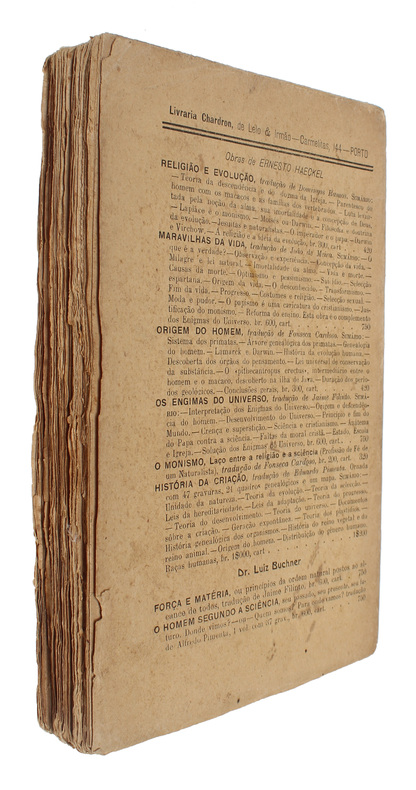
‎Oporto, Livraria Chardron, de Lello y Irmao, (1913). 8vo. Partly uncut in the original printed wrappers. Spine cracked and front hindge with repair. Wrappers with a few nicks. Half-title with previous owners names. Internally fine and clean. XVI, 477 pp.‎

‎"DARWIN, CHARLES.‎

‎Origem das Espécies. [i.e. Portuguese: ""Origin of Species""]. - [FIRST PORTUGUESE TRANSLATION OF 'ORIGIN OF SPECIES'.]‎

‎Oporto, Livraria Chardron, de Lello y Irmao, (1913). 8vo. Partly uncut in the original printed wrappers. Spine cracked and front hindge with repair. Wrappers with a few nicks. Half-title with previous owners names. Internally fine and clean. XVI, 477 pp.‎

‎The first edition, in the rarely seen wrappers, of the first Portuguese translation of Darwin's ""Origin of Species"". The comparatively late translation is partly due to the Portuguese 'Frenchism' at the time. The first French translation appeared in 1862 and was also widely circulated in Portugal. It also appears that the translator, a doctor and professor (who was also a Mason, a self-proclaimed poet, and the founder of the Spiritist Society of Portugal) named Joaquim [Marques] Dá Mesquita [Montenegro] Paúl (1875-1946), used the French translation rather than the English original. This apparently led to a number of errors and mis-translations that rendered the work unfaithful, to say the least. Unfortunately, this translation continued to be reprinted for the rest of the century in the Portuguese speaking world, oftentimes by simply changing the name of the translator for a spurious name. The first Brazilian edition, in 1973, turned out to be nothing but an exact reproduction of the text of the Portuguese translation. It appears that even in the 21st century many of the purported new translations were still reprints of the first Portuguese edition. A proper translation from the English was made in 1982, but it was apparently condensed from the 6th ed. (1872). In 1985 a complete translation was published, but it was based on the first ed. (1859). In 2011 and 2014, finally, two different translations were published in Brazil that appear to be more legitimate, which, as a commentator avers (see links below) doesn't necessarily guarantee that they are faithful. Thus, the Portuguese OSS bibliography remains murky and convoluted to this day, and it appears to be a continuing saga. Therefore this late, defective first translation, seems to have been crucial to the understanding-or misunderstanding- of Darwin's OSS for Portuguese readers for the remainder of the century, and then some.The uncertainty regarding the publication year is quite puzzling for a modern book. Freeman (online) gives three different numbers (F743, F743a, and F743b, the latter being 1961 and 1990, both of which are by the same translator as the first), and he gives the date ""[?192-]"" and 1920 to the first. The entry in the Biblioteca Nacional de España states ""1924"", and two Brazilian libraries give ""1900's"" and the rather wide ranging ""1910-1992,"" a Portuguese university library states ""1900-80,"" and the Biblioteca Nacional de Portugal says ""1900."" The year 1925 is given to the only two copies in US libraries, the American Philosophical Society and The Huntington. In the links below, the commentators assign it to the year 1913, and even though they don't justify that date, they seem to be quite familiar with Portuguese OSS editions in general. The date 1913 is also given by Ana Leonor Pereira in ""The Reception of Darwin in Portugal (1865-1914)"" Revista Portuguesa de Filosofia T. 66, Fasc. 3, Evolução, Ética e Cultura / Evolution, Ethics and Culture (2010), pp. 643-660, which perhaps makes it more plausible As a final note, the 1961 translation at the Huntington purportedly by Eduardo Fonseca, is one of those spurious reprints with a made up name mentioned earlier. (http://catalog.huntington.org/record=b1703473 )(For a few commentaries on the different editions and on various Portuguese OOS translations and purported translators, see:http://observatoriodaimprensa.com.br/armazem-literario/_ed802_lendo_darwin_em_portugues/ andhttp://naogostodeplagio.blogspot.com/2009/10/miseria-pouca-e-bobagem.html )Freeman 743‎

Referenz des Buchhändlers : 55761

Livre Rare Book

Herman H. J. Lynge & Son
Copenhagen Denmark Dinamarca Dinamarca Danemark
[Bücher von Herman H. J. Lynge & Son]

€ 3.357,50 Kaufen

‎"DARWIN, CHARLES.‎

‎Orígen de las especies por medio de la seleccion natural, ó, Conservacion de las razas en su lucha por la existencia‎

‎Madrid, José de Rojas, (1877 or 1880). 8vo. In (the original?) half calf binding with 4 raised bands and gilt lettering to spine. Title and author embossed in gilt lettering to front board. Stamp to title-page and 1 quire detached (pp. 115-126, otherwise fine and clean. (2), X, (2), 559 pp. + folded plate. [Freeman wrongly collate X, 589 pp.].‎

‎"DARWIN, CHARLES.‎

‎Priruchennyie zhivotnyie i vozdelannyie rasteniya [i.e. Russian ""The Variation of Animals and Plants under Domestication"". Translated from English with the consent and assistance of the author by V. Kovalevsky. Edited by I. M. Sechenov, botanical sect... - [THE VERY FIRST PUBLICATION OF DARWIN'S 'VARIATION UNDER DOMESTICATION' IN ANY LANGUAGE. ]‎

‎St. Petersburg, 1868 [but in fact 1867-1869]. 8vo. In contemporary half calf with renewed spine. Inner hindges with repairs and boards with soiling and a few marks and holes to volume 1. Light foxing throughout, primarily affecting margins and plates. Overall a good copy. IV, 443, (1): ill" " V.2: 462, (I)-VI pp.‎

‎"DARWIN, CHARLES.‎

‎Priruchennyie zhivotnyie i vozdelannyie rasteniya [i.e. Russian ""The Variation of Animals and Plants under Domestication"". Translated from English with the consent and assistance of the author by V. Kovalevsky. Edited by I. M. Sechenov, botanical sect... - [THE VERY FIRST PUBLICATION OF DARWIN'S 'VARIATION UNDER DOMESTICATION' IN ANY LANGUAGE. ]‎

‎St. Petersburg, 1868 [but in fact 1867-1869]. 8vo. In contemporary half calf with renewed spine. Inner hindges with repairs and boards with soiling and a few marks and holes to volume 1. Light foxing throughout, primarily affecting margins and plates. Overall a good copy. IV, 443, (1): ill"" V.2: 462, (I)-VI pp.‎

‎The very first publication of Darwin's 'Variation under Domestication' in any language. The title-page states 1868 but they two volumes were in fact published, respectively in November 1867 and 1869.""In August, 1867, Darwin wrote to Lyell that he was visited by a young Russian ""who is translating my new book into Russian."". The book was the 'Variation of Animals and Plants under Domestication', and the youngRussian was Vladimir Kovalevsky, who subsequently became a well-known evolutionary palaeontologist. At that time the 'Variation' was not yet published, and it seems most probably that the translation was made from a set of proofs given to Kovalevsky by Darwin. Thanks to Kovalevsky's rapid work, the first section of the Russian translation of the Variation was published several months prior to the publication of the English original."" (Glick, The Comparative Reception of Darwinism, p. 235)""The first Russian edition, which is dated 1868 on the volume title page, is of particular interest. It is the only work, in his lifetime, of which any part appeared in foreign translation before it appeared in English. Correspondence at Cambridge shows that the translator was sent copies of corrected proofs as they were ready. It was published in seven parts of which four, perhaps to the end of Chapter XV, appeared in 1867"" the next two appeared in 1868, and the last not until 1869, because he had been away in Russian Asia. The title is given in full, in English translation, under No. 925 and has been discussed above"" (Freeman).Vladimir Kovalevsky (1842-1883), the translator of this book, was a Russian biologist and the founder of evolutionary palaeontology. His own scientific works were printed between 1873 and 1877, and according to Henry Osborn (Osborn, H. The rise of Mammalia in North America // Proc. Amer. Assoc. Sci. 1894. vol. 42, pp. 189-227) they ''dare away'' all traditional and dry European paleontology. That was mainly because Kovalevsky was a devoted Darwinist and adapted Darwin's ideas to palaeontology. Luis Dollo, the Belgian palaeontologist, a contemporary of Kovalevsky's, described him thus: ''No palaeontologist embodies so perfectly our epoch, as the brilliant and miserable Vladimir Kovalevsky, friend and guest of the immortal Charles Darwin''. Indeed, Kovalevsky was a friend of Darwin's and they corresponded extensively. When visiting Darwin in 1877, the Russian botanist, Timiryazev, asked Darwin about his views on Russian science and Darwin surprised him with an answer that Vladimir Kovalevsky (little known at the time) was the bright hope of palaeontology.Kovalevsky was very eager to translate Darwin into Russian as soon as possible so he asked Darwin to send him the proofs of his book chapter by chapter as soon as Darwin finished them. Kovalevsky translated with great speed (the complete book contains 900 pages) and he began to print the chapters from July 1867 (the first English edition appeared on 30th January 1868). The chapters were printed one after another as the translation went on. It is unclear whether any part of it appeared before the English edition.Vladimir Kovalevsky translated another of Darwin's books, The Expression of the Emotions in Man and Animals [O vyrazhenii emotsyi u cheloveka I zhyvotnikh] that appeared the same year as the English edition (1872).Kovalevsky committed suicide at the age of forty after the breakdown of his marriage to the celebrated mathematician, Sophia Kovalevskaya who became the first female professor of mathematics in the world.OCLC finds only three complete copies worldwide (Cornell, American Philosophical Society (US) and Thomas Fisher Library, (Canada)). Freeman 925‎

Referenz des Buchhändlers : 59981

Livre Rare Book

Herman H. J. Lynge & Son
Copenhagen Denmark Dinamarca Dinamarca Danemark
[Bücher von Herman H. J. Lynge & Son]

€ 5.640,60 Kaufen

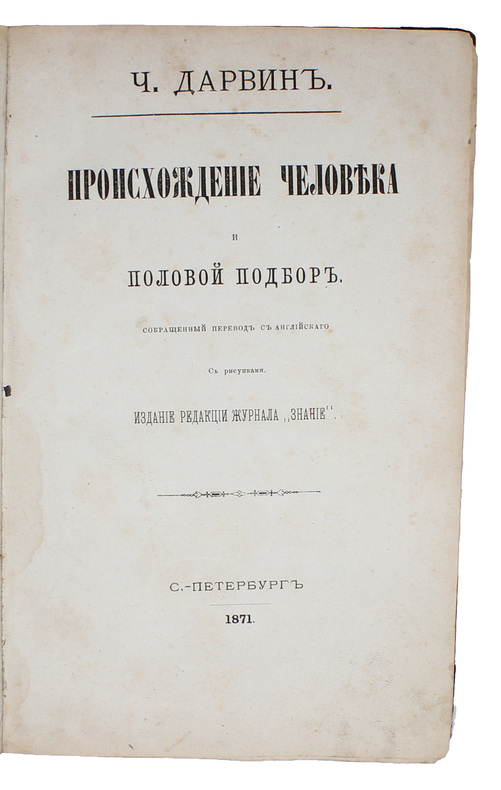
‎"DARWIN, CHARLES.‎

‎Proiskhozhdenie chelovieska i polovoi podbor [i.e. English ""Descent of Man""]. - [FIRST TRANSLATION OF DARWIN'S 'DESCENT OF MAN' INTO ANY LANGUAGE]‎

‎S.-Peterburg, Izdanie redaktsii zhurnala ""Znanie, 1871. 8vo. In contemporary black half calf with four rasied bands and gilt lettering to spine. Corners of binding with repairs and a three cm long tear to lower front hindge. Light miscolouring throughout, especially to first 10 leaves. (2), VII, (6), 439 pp.‎

‎"DARWIN, CHARLES.‎

‎Proiskhozhdenie chelovieska i polovoi podbor [i.e. English ""Descent of Man""]. - [FIRST TRANSLATION OF DARWIN'S 'DESCENT OF MAN' INTO ANY LANGUAGE]‎

‎S.-Peterburg, Izdanie redaktsii zhurnala ""Znanie, 1871. 8vo. In contemporary black half calf with four rasied bands and gilt lettering to spine. Corners of binding with repairs and a three cm long tear to lower front hindge. Light miscolouring throughout, especially to first 10 leaves. (2), VII, (6), 439 pp.‎

‎The exceedingly rare first Russian translation of Darwin's 'Descent of Man' published only four month after the original English. The Russian publisher was eager to have a translation published, hence this early abridged edition - two other Russian translations followed later the same year - The present translation being the very first into any language. ""The Descent of Man showed that the process of organic evolution, propelled by the struggle for existence and natural selection, applied to man no less than to the rest of the animal kingdom. It gave explicit recognition to the idea of the anthropoid origin of man. This claim surprised no one, for it was clearly hinted at in the great work of 1859 and was elaborated in Thomas Huxley's Man's Place in Nature and Vogt's Lectures on Man. Nor was it much of a surprise when three Russian translations of The Descent appeared within one year after the publication of the English original. Two general ideas represented the essence of The Descent: natural selection is not only behind the physical survival of man but also behind the evolution of cultural values"" and the differences between animal and human behavior are differences of degree rather than of kind."" (Darwin in Russian Thought) ""The Expression helped lay the foundations for a scientific study of the psychological aspect of the evolution of species. The book appeared in a Russian translation only a few months after the publication of the English original. The paleontologist Vladimir Kovalevskii was the translator, and the embryologist Aleksandr Kovalevskii was in charge of editorial tasks. In 1874 Vladimir wrote to Darwin that nearly two thousand copies of the Russian translation were sold."" "" The Expression deals much more extensively with selected aspects of human and animal behavior than with general problems of evolutionary biology. The Russian reviewers were generally impressed with Darwin's descriptions and categorizations of animal behavior. The Journal of the Ministry of Public Education was unusually profuse in praising the book's content and writing style. The reviewer commended Darwin's impartiality and avoidance of ""materialistic trappings."" Even the adherents of spiritualism could read the book, he wrote, without the least discomfort. The reviewer thought that psychologists would benefit from the information the book presented on the ""physiological"" basis of behavior. Indeed, he recommended the book to all readers interested in the scientific foundations of human behavior. The liberal journal Knowledgewas equally laudatory. It noted that the book was eminently successful on two counts: it offered a ""rational explanation"" of many expressions of human emotions, and it integrated the study of animal and human behavior into the universal process of organic evolution. In fact, no educated person could afford to ignore it.N. P. Vagner, professor of zoology and comparative anatomy at St. Petersburg University, called The Expression a book with ""great strengths and minor flaws."" The volume reminded him of Darwin's previous works, which marked ""turning points in the history of science."" The strength of the book lay much more in its suggestion of new topics for comparative-psychological research than in a presentation of a theoretically and logically integrated system of scientific thought. Insufficient exploration of the physiological underpinnings of mental activities represented the book's major shortcoming"" (Darwin in Russian Thought) In Russia Darwinism had a profound influence not only upon the different sciences, but also on philosophy, economic and political thought, and the great literature of the period. For instance, both Tolstoy and Dostoevsky referenced Darwin in their most important works, as did numerous other thinkers of the period.Like Strakhov, however, Dostoevsky, acknowledging the significance of the ""Origin of Species"", saw the dangers of the theory. In the same year as the publication of Rachinsky's translation, he lets the narrator in ""Notes from Underground"" (1864) launch his attack on Darwinism , beginning: ""As soon as they prove you, for instance, that you are descended from a monkey, then it's no use scowling, you just have to accept it.""In ""Crime and Punishment"" (two years later, 1866) the Darwinian overtones inherent in Raskolnikov's theory of the extraordinary man are unmistakable. He describes the mechanism of ""natural selection,"" where, according to the laws of nature, by the crossing of races and types, a ""genius"" would eventually emerge. In general, Darwinian themes and Darwin's name occur in many contexts in a large number of Dostoevsky's works.'Descent of Man' was transted into Danish, Dutch, French, German, Italian, Polish, Russian and Swedish in Darwin's lifetime. Freeman 1107.‎

Referenz des Buchhändlers : 53279

Livre Rare Book

Herman H. J. Lynge & Son
Copenhagen Denmark Dinamarca Dinamarca Danemark
[Bücher von Herman H. J. Lynge & Son]

€ 4.297,60 Kaufen

‎"DARWIN, CHARLES.‎

‎Put Jednoga Prirodoslovca Oko Zemlje. Part 1 (All that was published).‎

‎Zagreb, Tisak Kr. zemaljske tiskare, 1922. 8vo. Partly uncut in the original printed wrappers. Wrappers with light wear a few nicks. Internally fine and clean. (4), (1)-165‎

‎"DARWIN, CHARLES.‎

‎Putovanje jednog prirodoslovca oko svijeta. - [ONLY TRANSLATION OF DARWIN INTO SERBO-CROATIAN]‎

‎Zagreb & Beograd, Novo Pokoljenje, 1949. Small4to. In publisher's original half cloth with printed lettering and ornamentation to spine. A ship decorating front board. Hindges very weak and first quire partly detached. 577, (6) + frontiespiece.‎

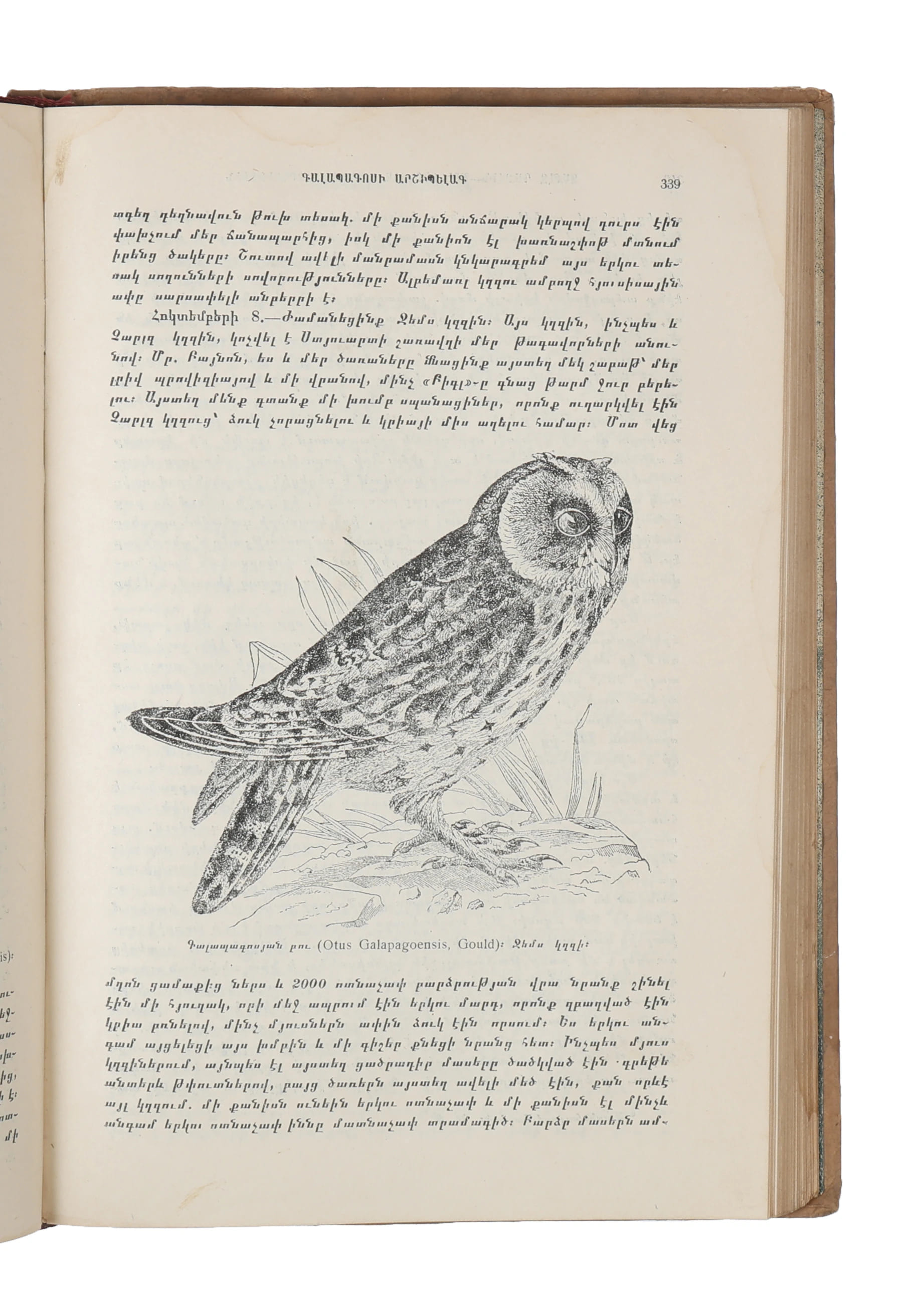
‎"DARWIN, CHARLES.‎

‎Shurjerkrya chanaparhordutyun BIGL navov [i.e. ""Voyage of the Beagle""]. - [EXCEEDINGLY RARE FIRST ARMENIAN TRANSLATION OF DARWIN'S ""JOURNAL OF RESEARCHES""]‎

‎Erevan, Academy of Sciences Armenian S.S.R., 1949. Large8vo. In publisher's original printed cardboard binding. Title printed to spine and front board. A pictures of The Beagle on lower part of front board. Binding with wear to spine, especially to upper part. Back board with a few stains. Internally fine and clean with many text-illustrations throughout. (4), 460 pp. + frontiespiece of Darwin.‎

‎"DARWIN, CHARLES.‎

‎Shurjerkrya chanaparhordutyun BIGL navov [i.e. ""Voyage of the Beagle""]. - [EXCEEDINGLY RARE FIRST ARMENIAN TRANSLATION OF DARWIN'S ""JOURNAL OF RESEARCHES""]‎

‎Erevan, Academy of Sciences Armenian S.S.R., 1949. Large8vo. In publisher's original printed cardboard binding. Title printed to spine and front board. A pictures of The Beagle on lower part of front board. Binding with wear and some stains. Internally with dampstain to upper part of leaves, primarily affecting first half. (4), 460 pp. + frontiespiece of Darwin.‎

‎The exceedingly rare first Armenian translation of Darwin's ""Journal of Researches"". ""His first published book is undoubtedly the most often read and stands second only to ‘On the origin of Species’ as the most often printed. It is an important travel book in its own right and its relation to the background of his evolutionary ideas has often been stressed.""(Freeman p. 31).Freeman 169‎

Referenz des Buchhändlers : 63399

Livre Rare Book

Herman H. J. Lynge & Son
Copenhagen Denmark Dinamarca Dinamarca Danemark
[Bücher von Herman H. J. Lynge & Son]

€ 2.014,50 Kaufen

‎"DARWIN, CHARLES.‎

‎Sposobnost rastenij dvischenijo. [i.e. The Power of Movements in Plants]. [translated by:] G. Miloradovich (+) A. Kobelyatskii, - [FIRST RUSSIAN TRANSLATION]‎

‎Kief, F. A. Johanson, 1882. 8vo. In contemporary half cloth with gilt lettering to spine. Extremities with wear and spine lacking 1 cm of upper part of spine. Title-page with 8 numbers written in contemporary hand. Pasted down back end-paper with two small stamps, otherwise internally fine. VII, 433 pp.‎

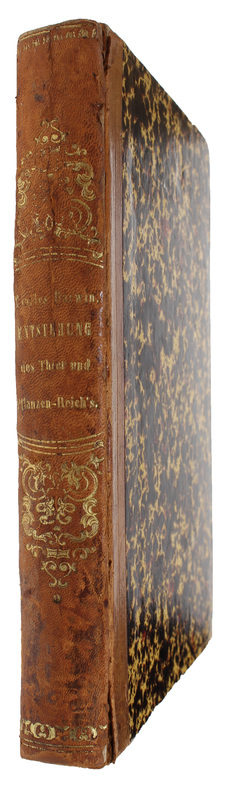
‎"DARWIN, CHARLES.‎

‎Über die Entstehung der Arten im Thier-und Pflanzen-Reich durch natürliche Züchtung, oder Erhaltung der vervollkommneten Rassen im Kampfe um's Daseyn. Nach der zweiten Auflage mit einer geschichtlichen Vorrede und andern Zusätzen des Verfassers für d... - [FIRST GERMAN TRANSLATION OF ""ORIGIN OF SPECIES"".]‎

‎Stuttgart, E. Schweizerbart'sche Verlagshandlung und Druckerei, 1860. 8vo. Bound in contemporary half calf with gilt lettering and ornamentation to spine. Small stamp and previous owner signature to title page. Leather on lower part of spine with a tear and part detached. Hinges weak but book-block firmly attached. VIII (including half, 520, (6) pp + 1 plate.‎

‎"DARWIN, CHARLES.‎

‎Über die Entstehung der Arten im Thier-und Pflanzen-Reich durch natürliche Züchtung, oder Erhaltung der vervollkommneten Rassen im Kampfe um's Daseyn. Nach der zweiten Auflage mit einer geschichtlichen Vorrede und andern Zusätzen des Verfassers für d... - [FIRST GERMAN TRANSLATION OF ""ORIGIN OF SPECIES"".]‎

‎Stuttgart, E. Schweizerbart'sche Verlagshandlung und Druckerei, 1860. 8vo. Bound in contemporary half calf with gilt lettering and ornamentation to spine. Small stamp and previous owner signature to title page. Leather on lower part of spine with a tear and part detached. Hinges weak but book-block firmly attached. VIII (including half, 520, (6) pp + 1 plate.‎

‎The very scarce first edition of the highly important first German translation, which appeared just months after the original.This translation came to play a tremendous role in the spreading of Darwinism in Germany and Northern Europe in general. It was through this translation that Darwinian thought reached most of the German scientists and thinkers of the period, and it was this translation that challenged German scholars to think in new ways about morphology, systematics, paleontology, and other biological disciplines. It was from this translation that Ernst Haeckel, Darwin's most famous nineteenth-century proponent and popularizer in Germany, got his Darwinism and was able to further spread the new ideas in his own country. The German translation of Darwin's ""The Origin of Species"" appeared in 1860, just months after the original, thanks to Heinrich Georg Bronn, a distinguished German paleontologist whose work in some ways paralleled Darwin's. Bronn's version of the book (with his own notes and commentary appended) did much to determine how Darwin's theory was understood and applied by German biologists, for the translation process involved more than the mere substitution of German words for English.""Its [Origin of Species] greatest impact on German biological practice lay in the introduction of historical modes of explanation for the observable phenomena of living nature. The historical approach to nature was rejected, not only by the opponents of evolution, but also by the idealist evolutionist. Whether they favored a teleological or a reductionist biology, the idealists could not see the point of a theory that emphasized the irregularities and exceptions in the organic world. In the timeless real of idealist thinking, unchanging laws worked out an inevitable destiny. But Darwin taught his followers to look at living beings one by one. Thus prompted, they recognized, as if for the first time, the surprising fact of anomaly and the wisdom of an open-ended theory."" (Glick, The Comparative Reception of Darwinism). ""Darwin was not happy about the first German translation. It was done from the second English edition by H.G. Bronn, who had, at Darwin's suggestion, added an appendix of the difficulties which occurred to him"" but he had also excised bits of which he did not approve. This edition also contains the historical sketch in its shorter and earlier form."" (Freeman).Freeman No 672 - Freeman does not mention the lithographed plate.‎

Referenz des Buchhändlers : 50927

Livre Rare Book

Herman H. J. Lynge & Son
Copenhagen Denmark Dinamarca Dinamarca Danemark
[Bücher von Herman H. J. Lynge & Son]

€ 4.297,60 Kaufen

‎"DARWIN, FRANCIS. - PLANT GROWTH CONTROLLED BY HORMONES.‎

‎Observations on Stomata. Received May 31, - Read June 16, 1898.‎

‎(London, Harrison and Sons, 1898). 4to. No wrappers as extracted from ""Philosophical Transactions"" Year 1897, Volume 190 - Series B. - Pp. 531-621.‎

‎"DARWIN, FRANCIS. - PLANT GROWTH CONTROLLED BY HORMONES.‎

‎Observations on Stomata. Received May 31, - Read June 16, 1898.‎

‎(London, Harrison and Sons, 1898). 4to. No wrappers as extracted from ""Philosophical Transactions"" Year 1897, Volume 190 - Series B. - Pp. 531-621.‎

‎First printing of a classic paper on plant physilogy and plants growth, reporting his discovery of the stomatal responses to light. The fundamental concept that the growth of plants, and the interrelation between their parts, is controlled by hormones, stems from the classic work of Charls Darwin and his son Francis Darwin.‎

Referenz des Buchhändlers : 45943

Livre Rare Book

Herman H. J. Lynge & Son
Copenhagen Denmark Dinamarca Dinamarca Danemark
[Bücher von Herman H. J. Lynge & Son]

€ 134,30 Kaufen

‎"DARWIN, KAROL [CHARLES DARWIN].‎

‎Podróz Naturalisty. [i.e. ""Journal of Researches""]. - [FIRST POLISH TRANSLATION OF DARWIN’S JOURNAL OF RESEARCHES]‎

‎Warszawa, 1887. 4to. In contemporary half calf with gilt lettering to spine and four raised bands. Spine with wear and top right corner (3 x 5 cm) of title-page lacking, not affecting text. Internally fine and clean. (4), II, 412, XVIII pp.‎

‎"DARWIN, KAROL [CHARLES DARWIN].‎

‎Podróz Naturalisty. [i.e. ""Journal of Researches""]. - [FIRST POLISH TRANSLATION OF DARWIN’S JOURNAL OF RESEARCHES]‎

‎Warszawa, 1887. 4to. In contemporary half calf with gilt lettering to spine and four raised bands. Spine with wear and top right corner (3 x 5 cm) of title-page lacking, not affecting text. Internally fine and clean. (4), II, 412, XVIII pp.‎

‎Extremely rare first Polish translation of Darwin’s Journal of Researches: ""His first published book is undoubtedly the most often read and stands second only to ‘On the origin of Species’ as the most often printed. It is an important travel book in its own right and its relation to the background of his evolutionary ideas has often been stressed.""(Freeman p. 31).Freeman 223‎

Referenz des Buchhändlers : 53495

Livre Rare Book

Herman H. J. Lynge & Son
Copenhagen Denmark Dinamarca Dinamarca Danemark
[Bücher von Herman H. J. Lynge & Son]

€ 2.014,50 Kaufen

‎"DARWIN, KAROL [CHARLES].‎

‎Dobór plciowy. Przetlomaczyl z angielskiego za upowaznieniem autura Ludwik Maslowski. [i.e. Polish: ""Descent of Man"", Translated by Ludwik Maslowski]. 2 vols. - [POLISH TRANSLATION OF DARWIN'S 'THE DESCENT OF MAN']‎

‎Lwów, Ksiegarnia Polska, 1875-1876. 8vo. In contemporary half cloth with gilt lettering to spine. Previous owner's stamp and another owner's sginature to title-page. Light wear to extremities, otherwise a fine and clean set. 262, (2)" " 313, (3) pp.‎

‎"DARWIN, KAROL [CHARLES].‎

‎Dobór plciowy. Przetlomaczyl z angielskiego za upowaznieniem autura Ludwik Maslowski. [i.e. Polish: ""Descent of Man"", Translated by Ludwik Maslowski]. 2 vols. - [POLISH TRANSLATION OF DARWIN'S 'THE DESCENT OF MAN']‎

‎Lwów, Ksiegarnia Polska, 1875-1876. 8vo. In contemporary half cloth with gilt lettering to spine. Previous owner's stamp and another owner's sginature to title-page. Light wear to extremities, otherwise a fine and clean set. 262, (2)"" 313, (3) pp.‎

‎Rare first Polish edition of the second and third parts of the Descent of Man, but published separate from the first part, as one work, hence the title 'Sexual Selection', a translation authorised by Darwin in response to Malowski's request to make the translation (Letter 8910, 14 May 1873). Whereas ""Origin of Species"" established Darwinism as a turning point in nineteenth-century biology ""The Descent of Man"" helped built a bridge between biology, the social sciences, and the humanities and made Darwinism a broad system of research designs, theoretical principles, and philosophical outlook.The numeration of parts is from Chapter I to Chapter VI (vol. I) and from Chapter VII to Chapter XIV (vol. II). It is generally based on the first English edition (1871) but at the end of vol. II the Polish publisher has added the short note on the brains of man and apes of T. H. Huxley, which was originally published in the second English edition (1874). ""It was translated into Danish, Dutch, French, German, Italian, Polish, Russian and Swedish in Darwin's lifetime and into ten further languages since."" Freeman.Maslowski (1847-1928) studied medicine and natural sciences in Paris before returning to Poland, where he took part in the January Uprising: he remained active in politics, primarily as a journalist. At first an ardent Darwinian, he later became a fierce opponent.Not in FreemanDarwin Online: F1101b.1, F1101b.2.OCLC locates four copies worldwide (Cornell Univ., Huntington Libr., Yale Univ. Libr., National Library of Poland,)‎

Referenz des Buchhändlers : 55758

Livre Rare Book

Herman H. J. Lynge & Son
Copenhagen Denmark Dinamarca Dinamarca Danemark
[Bücher von Herman H. J. Lynge & Son]

€ 2.686,00 Kaufen

‎"DARWIN, KAROL [CHARLES].‎

‎O Powstawaniu Gatunków. [i. e. Polish: ""Origin of Species""]. [Translated by Szymon Dickstein]. - [FIRST FULL POLISH TRANSLATION OF DARWIN'S ""ORIGIN OF SPECIES""]‎

‎Warszawa, Przegladu Tygodniowego, 1884. Large8vo. In contemporary half calf. Spine with wear, lacking the upper 1 cm. Small stamp to title-page. Hindges weak and back board detached from bookblock. Verso of title-page and first leaf on content. 437, (1), XVI [Including the plate] pp.‎

‎"DARWIN, KAROL [CHARLES].‎

‎O Powstawaniu Gatunków. [i. e. Polish: ""Origin of Species""]. [Translated by Szymon Dickstein]. - [FIRST FULL POLISH TRANSLATION OF DARWIN'S ""ORIGIN OF SPECIES""]‎

‎Warszawa, Przegladu Tygodniowego, 1884. Large8vo. In contemporary half calf. Spine with wear, lacking the upper 1 cm. Small stamp to title-page. Hindges weak and back board detached from bookblock. Verso of title-page and first leaf on content. 437, (1), XVI [Including the plate] pp.‎

‎First edition of the first full Polish translation of Darwin's ""Origin of Species"". An attempt to publish a Polish translation was made as early as 1873. This was, however, never completed and only half of the work was published (Freeman 739), thus making the present copy the very first full Polish translation. As seen in several other countries (especially in Japan) the majority of Polish intellectuals adopted a Social Darwinism perspective at a very early stage, rather than appreciating the English naturalist's caution in applying his ideas to human society.""Before the first translations of Darwin's appeared [...], many Polish intellectuals, such as positivist writer Eliza Orzeszkowa (1841-1910) complained about the increasing confusion over the essence of the English naturalist's ideas, which had all too often been mixed up with all sorts of ideological debates. However, when Darwin's books were actually available in Polish translations, the novelty of his concepts gradually wore off, making room for more serious attempts to come to terms with evolutionary theory."" (Glick, The Reception of Charles Darwin in Europe). ""It appears that the struggle for or against Darwinism in partitioned Poland prefigured a pattern that is relevant for Polish thinking up to the present day: the conflict of striving for progress with the help of powerful allies abroad and of virulently rejecting all foreign advice for fear of losing one's cultural identity."" (Ibid.).Translation was begun by Szymon Dickstein who in the processe of the translation committed suicide. It was completed by Józef Nusbaum who also translated 'The Variation of Animals and Plants under Domestication' in 1888.Freeman 740‎

Referenz des Buchhändlers : 56005

Livre Rare Book

Herman H. J. Lynge & Son
Copenhagen Denmark Dinamarca Dinamarca Danemark
[Bücher von Herman H. J. Lynge & Son]

€ 4.297,60 Kaufen

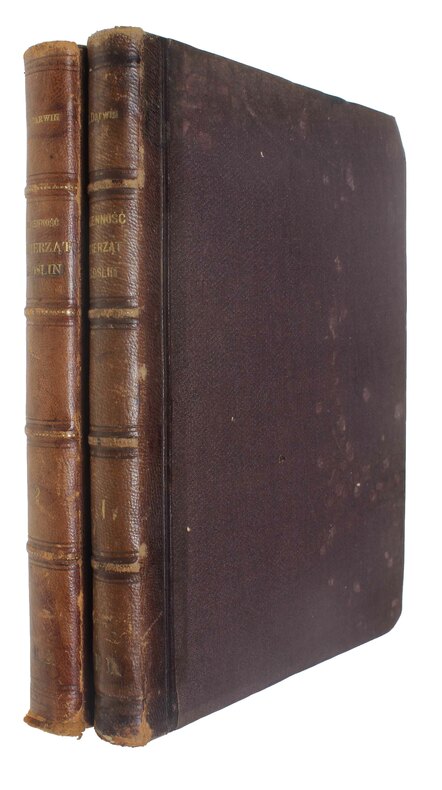
‎"DARWIN, KAROL [CHARLES].‎

‎Zmiennosc zwierzat i roslin w stanie kultury [i.e. ""The Variation of Animals and Plants under Domestication"", translated by Jozef Nusbaum]. 2 vols. - [RARE FIRST POLISH TRANSLATION OF DARWIN'S 'THE VARIATION OF ANIMALS AND PLANTS UNDER DOMESTICATION']‎

‎Warszawa, Wydawnictwo Przegladu Tygodnio, 1888-1889. Large8vo. In two uniform contemporary half calf bindings with four raised bands and gilt lettering to spine. Top right corner (app. 3 x 5 cm) of both title pages cut off" volume 1 not affecting text, volume 2 missing the n in 'Darwin'. Light wear to extremities, otherwise a fine set. (2), X, 11-357, III " (2), 379, IV, VIII, V pp.‎

‎"DARWIN, KAROL [CHARLES].‎

‎Zmiennosc zwierzat i roslin w stanie kultury [i.e. ""The Variation of Animals and Plants under Domestication"", translated by Jozef Nusbaum]. 2 vols. - [RARE FIRST POLISH TRANSLATION OF DARWIN'S 'THE VARIATION OF ANIMALS AND PLANTS UNDER DOMESTICATION']‎

‎Warszawa, Wydawnictwo Przegladu Tygodnio, 1888-1889. Large8vo. In two uniform contemporary half calf bindings with four raised bands and gilt lettering to spine. Top right corner (app. 3 x 5 cm) of both title pages cut off" volume 1 not affecting text, volume 2 missing the n in 'Darwin'. Light wear to extremities, otherwise a fine set. (2), X, 11-357, III" (2), 379, IV, VIII, V pp.‎

‎Rare first Polish translation of Darwin's extensive work 'The Variation of Animals and Plants under Domestication'. It is the longest work and, being so detailed, was never a very successful one, selling only about five thousand copies in his life time and eight before the end of the century"" (R.B. Freeman). Freeman 922.‎

Referenz des Buchhändlers : 53153

Livre Rare Book

Herman H. J. Lynge & Son
Copenhagen Denmark Dinamarca Dinamarca Danemark
[Bücher von Herman H. J. Lynge & Son]

€ 1.611,60 Kaufen

‎"DE VRIES, HUGO. - THE REDISCOVERY OF MENDEL'S LAWS - THE BIRTH OF MODERN GENETICS.‎

‎Sur la loi de disjonction des hybrides. (The Law of Segregation of Hybrides - Das Spaltungsgesetzt der Bastarde).‎

‎Paris, Gauthier-Villars, 1900. 4to. No wrappers. In: ""Comptes Rendus Hebdomadaires des Séances de L'Academie des Sciences"", Tome 130, No 13. Titlepage to tome 130 a. pp. (809-) 864. (Entire issue offered). De Vries paper: pp. 845-847. Rather poor paperquality, fragile. Small nicks to margins of titlepage.‎

‎"DE VRIES, HUGO. - THE REDISCOVERY OF MENDEL'S LAWS - THE BIRTH OF MODERN GENETICS.‎

‎Sur la loi de disjonction des hybrides. (The Law of Segregation of Hybrides - Das Spaltungsgesetzt der Bastarde).‎

‎Paris, Gauthier-Villars, 1900. 4to. No wrappers. In: ""Comptes Rendus Hebdomadaires des Séances de L'Academie des Sciences"", Tome 130, No 13. Titlepage and half-title to tome 130 included. Pp. (809-) 864. (Entire issue offered). De Vries paper: pp. 845-847. Clean and fine.‎

‎"DUHAMEL DU MONCEAU, H.L.‎

‎Des Semis et Plantations des Arbres et de leur Culture ou méthodes pour multiplier et elever les Arbres, les Planter en Massifs et en Avenues former les Forets & les Bois‎

‎Paris, Veuve Desaint, 1780. 4to. In fine contemporary motted full calf with five raised bands and gilt lettering and ornamentation to spine. A bit of wear to extremities, mainly to lower part of hindges, otherwise a very fine and clean copy. LXXXII, 420, (2) pp. + 16 folded plates.‎

‎"DUHAMEL DU MONCEAU, H.L.‎

‎Des Semis et Plantations des Arbres et de leur Culture ou méthodes pour multiplier et elever les Arbres, les Planter en Massifs et en Avenues former les Forets & les Bois‎

‎Paris, Veuve Desaint, 1780. 4to. In fine contemporary motted full calf with five raised bands and gilt lettering and ornamentation to spine. A bit of wear to extremities, mainly to lower part of hindges, otherwise a very fine and clean copy. LXXXII, 420, (2) pp. + 16 folded plates.‎

‎Second edition of Duhamel's important work on tree cultivation. ""Duhamel's tree-planting on both his own estate and his brother's provided the practical experience behind his books as he explained in the preface to 'Semis et Plantations' . The sections of the book discuss the soil, the climate, and the choice of the trees" their propagation nursery gardens planting" forests, and maintenance and re-afforestation, with all instuments based firmly on the author's long experience of forestry"" (S. Raphael. An Oak Spring Sylva p. 10)‎

Referenz des Buchhändlers : 60161

Livre Rare Book

Herman H. J. Lynge & Son
Copenhagen Denmark Dinamarca Dinamarca Danemark
[Bücher von Herman H. J. Lynge & Son]

€ 537,20 Kaufen

‎"EHRENBERG, C.G. - A GROUNDBREAKING PAPER ON THE MICROSCOPICAL STRUCTURE OF THE BRAIN.‎

‎Notwendigkeit einer feineren mechanischen Zerlegung des Gehirns und der Nerven vor der chemischen, dargestellt aus Beobachtungen.‎

‎Leipzig, Johann Ambrosius Barth, 1833. Without wrappers. In: ""Annalen der Physik und Chemie. Hrsg.von Poggendorff"", Bd. 28, Siebentes Stück. Pp. 449-528. Entire issue offered with titlepage to vol. 28. Ehrenberg's paper: pp. 449-473 and 1 engraved plate with many figs. (nervecells and tubes, nerve fibres, ganglia).‎

‎"GALTON, FRANCIS.‎

‎""The Patterns in Thumb and Finger Marks" " on their Arrangement into naturally distinct Classees, the Permanence of the Papillary Ridges that make them, and the Resemblance of their Classes to ordinary Genera."" ( (And same author:) ""Methods of indexing ... - [FINGER-PRINTS AND CRIMINOLOGY]‎

‎Lindon, Harrison and Sons, 1890-91. Bound together in recent marbled boards. With both titlepages to vols 48 and 49 (both 1891) in ""Proceedings of the Royal Society of London"" pp. 455-459 (in vol. 48) and pp. 540-548.‎

‎"GALTON, FRANCIS.‎

‎""The Patterns in Thumb and Finger Marks"" on their Arrangement into naturally distinct Classees, the Permanence of the Papillary Ridges that make them, and the Resemblance of their Classes to ordinary Genera."" ( (And same author:) ""Methods of indexing ... - [FINGER-PRINTS AND CRIMINOLOGY]‎

‎Lindon, Harrison and Sons, 1890-91. Bound together in recent marbled boards. With both titlepages to vols 48 and 49 (both 1891) in ""Proceedings of the Royal Society of London"" pp. 455-459 (in vol. 48) and pp. 540-548.‎

‎""The Patterns in Thumb and Finger Marks"" is an early 'abstract' read to the Royal Society. The full paper paper appeared later the same year. ""Methods of indexing Finger Mark"" being the first appearance. These two paper constitute the very first appearance of the anthropometric classification of fingerprint.""Galtons establisment of fingerprinting as an easy and almost infallible means of human identification transformed a difficult subject, and his taxonomy of prints is basically that used today"".(DSB).‎

Referenz des Buchhändlers : 39153

Livre Rare Book

Herman H. J. Lynge & Son
Copenhagen Denmark Dinamarca Dinamarca Danemark
[Bücher von Herman H. J. Lynge & Son]

€ 402,90 Kaufen

‎"GALTON, FRANCIS. - FIRST BOOK OF THE STATISTICAL STUDY OF BIOLOGICAL VARIATION.‎

‎Natural Inheritance.‎

‎London and New York, Macmillan and Co., 1889. Orig. full cloth, uncut. Light wear along edges. Part of hinges neathly repaired. Small tears to spine ends. IX,(4),259,(3) pp. Internally clean and fine.‎

‎"GALTON, FRANCIS. - FIRST BOOK OF THE STATISTICAL STUDY OF BIOLOGICAL VARIATION.‎

‎Natural Inheritance.‎

‎London and New York, Macmillan and Co., 1889. Orig. full cloth, uncut. Light wear along edges. Part of hinges neathly repaired. Small tears to spine ends. IX,(4),259,(3) pp. Internally clean and fine.‎

‎First edition. - ""By the employment of statistical Methods Galton propounded a ""law of filial regression"". This book represents the first statistical study of biological variation and inheritance.""(Garrison & Morton No. 233). ""The Natural Inheritance was his outcome of his work over the past 15 years on statistical techniques related to genetics. This includes develpment of the concept of correlation coefficients and the formula for the standard error of estimate.""(Parkinson, Breakthroughs).‎

Referenz des Buchhändlers : 38789

Livre Rare Book

Herman H. J. Lynge & Son
Copenhagen Denmark Dinamarca Dinamarca Danemark
[Bücher von Herman H. J. Lynge & Son]

€ 604,35 Kaufen

‎"GALTON, FRANCIS.- THE LAW OF ANCESTRAL HEREDITY.‎

‎The average Contribution of each several Ancestor to the total heritage of the Offspring. Received and Read June 3, 1897.‎

‎London, Harrison and Sons, 1897. No wrappers. Extracted from ""Proceedings of the Royal Society"", Vol. 61. Pp. 401-413.‎

‎"GAMOW, G.‎

‎Possible Relation Between Deoxyribonucleic Acid and Protein Structures. - [GAMOW'S DISCOVERY OF NUCLEOTIDES]‎

‎London, Macmillian and Co, 1954. Royal8vo. Bound in contemporary full cloth with title to spine. In ""Nature"", Vol. 173, 1968. Library stamp to upper right corner of title page, otherwise a fine and clean copy. Pp. 709-13. [Entier volume: LXVVI, 1246 pp.].‎

‎"GAMOW, G.‎

‎Possible Relation Between Deoxyribonucleic Acid and Protein Structures. - [GAMOW'S DISCOVERY OF NUCLEOTIDES]‎

‎London, Macmillian and Co, 1954. Royal8vo. Bound in contemporary full cloth with title to spine. In ""Nature"", Vol. 173, 1968. Library stamp to upper right corner of title page, otherwise a fine and clean copy. Pp. 709-13. [Entier volume: LXVVI, 1246 pp.].‎

‎First printing of Gamow's exceedingly influential discovery of four different kinds of acino-acids, nucleotides, which were to influence Watson and Crick in their further work. To Gamow, most famous for his work within physics and cosmology, this was a highly unfamiliar field. His work was described as: ""perhaps the last example of amateurism in scientific work on a grand scale"".""In early 1954, less than a year after J. D. Watson and Francis Crick discovered the double helical structure of DNA, Gamow recognized that the information contained in the four different kinds of nucleotides (adenine, thymine, guanine, cytosine) constituting the DNA chains could be translated into the sequence of twenty amino acids which form protein molecules by counting all possible triplets one can form from four different quantities. This remarkable way in which Gamow could rapidly enter a more or less unfamiliar field at the forefront of its activity and make a highly creative contribution to it, often far more by intuition than by calculation, led Ulam to characterize his work as ""perhaps the last example of amateurism in scientific work on a grand scale."" It earned him membership in a number of professional societies-American Physical Society, Washington Philosophical Society, International Astronomical Union, American Astronomical Society, U.S. National Academy of Sciences, Royal Danish Academy of Sciences and Letters-as well as an overseas fellowship in Churchill College, Cambridge."" (DSB)""Even as he was starting research in relativistic cosmogony, Gamow came to think that the time was nearly ripe for phys-ics to help biology move beyond its descriptive stage. This perception probably derived from Erwin Schrödinger's What Is Life? The Physical Aspect of the Living Cell (1945) and his longtime friend Max Delbrück's successful migration from theoretical physics to experimental genetics. In any case, Gamow got so caught up with the idea that rejecting his initial plans to revive the Washington conferences with one focused on cosmogony, he instead devoted the first postwar gathering to ""the physics of living matter."" His preparations for the conference held in the fall of 1946, and his subse-quent endeavours to promote the infusion of more physics into biology, led Gamow to believe by the early 1950s that the central ""riddle of life"" is how each species' genes shape its distinctive proteins. But lacking any notion about the molecular structure of genes, he could not imagine how to formulate this enigma in a tangible way.In June 1953 Gamow got an idea for doing so from reading James Watson and Francis Crick's soon-to-be-famous Nature paper on DNA's structure. Confident that they were on the right track, he impulsively introduced himself to them by letter, praising them for their success in moving biology into the ""exact' sciences"" and expressing his hope that he could meet with them in England at the end of the summer to talk about the possibility of using combinatorics to tackle genetic problems. As both were planning to be away then, Watson discussed Gamow's letter briefly with Crick, then filed it away. In late October, undeterred by their failure to respond, Gamow sent a short note off to Nature on a ""Possible Relation between Deoxyribonucleic Acid and Protein Structures"" (1954). He opened by crediting Watson and Crick with having established that the basic hereditary materials are DNA molecules. Then he daringly outlined what soon evolved into the protein-coding research program. He proposed that each organism's DNA ""could be characterized by a long number written in a four-digital system"" that ""completely determined"" the composition of its unique complement of proteins, which in turn ""are long peptide chains formed by about 20 different amino-acids [that] can be considered as 'long' words based on a 20-letter alphabet."" The problem to be solved was how these ""four-digital 26 numbers [are] translated into such 'words.'"" Gamow closed by suggesting how this might be done and promising that a fuller account would be published elsewhere.During the next few months, Gamow plunged into work on the protein-coding problem. He wrote up an expanded version of his note in Nature for the National Academy of Sciences' Proceedings and, when it was not accepted there-possibly because Gamow jokingly listed his fictional character Tompkins as co-author-submitted it successfully (without Tompkins as co-author) to the Royal Danish Society of Sciences' biological series. He also spurred first Crick, then Watson, and then many other researchers-especially those associated with Caltech's Delbrück and Berkeley's Gunther Stent-to join the enterprise of identifying how DNAcoded proteins. As this growing research circle reviewed prior and ongoing experimental work of relevance, a consensus soon emerged that DNA did not serve as a simple template in protein synthesis. It appeared instead that the coding might be a two-step process in which DNA first coded RNA and then RNA coded proteins. Although initially resisting this view, Gamow ended up as the ""synthesizer"" in the ""RNATie Club,"" founded in mid-1954 to foster the circle's informal communications and camaraderie.Gamow's involvement in the expanding circle of coding researchers remained intense for another year and a half. He found it stimulating to be once again on the wave crest of an exciting new specialty. Just as important if not more so, he enjoyed being at the center of the ambitious circle's partying and joking. But starting in late 1955, years before a consensus emerged about the coding of proteins, Gamow's engagement with the problem wilted. One reason was that his marriage of 23years had just fallen apart. Asecond, and more compelling reason was that, as he had experienced toward the end of his active participation in nuclear, stellar, and cosmogonical researches, he was getting bored with coding research because the opportunities for someone with his freewheeling style were ever more limited in this increasingly competitive and empirically constrained field"" (George Gamow: A Biographical Memoir, National Academy of Sciences).‎

Referenz des Buchhändlers : 46966

Livre Rare Book

Herman H. J. Lynge & Son
Copenhagen Denmark Dinamarca Dinamarca Danemark
[Bücher von Herman H. J. Lynge & Son]

€ 1.007,25 Kaufen

‎"GASKELL, WALTER HOLBROOK - A CLASSIC PAPER IN NEUROSCIENCE.‎

‎The Croonian Lecture. - On the Rhytm of the Heart and the Frog, and the Nature of the Action of the Vagus Nerve. Read December 22, 1881.‎

‎(London, Harrison and Sons, 1883). 4to. No wrappers as extracted from ""Philosophical Transactions"" Year 1882, Volume 173 - 1883. - Pp. 993-1033 and 5 plates (1 heliogravure (instrument), 4 folded recordings).‎

‎"GASKELL, WALTER HOLBROOK - A CLASSIC PAPER IN NEUROSCIENCE.‎

‎The Croonian Lecture. - On the Rhytm of the Heart and the Frog, and the Nature of the Action of the Vagus Nerve. Read December 22, 1881.‎

‎(London, Harrison and Sons, 1883). 4to. No wrappers as extracted from ""Philosophical Transactions"" Year 1882, Volume 173 - 1883. - Pp. 993-1033 and 5 plates (1 heliogravure (instrument), 4 folded recordings).‎

‎First edition of Gaskell's classic in neuroscience on the musculature and innervation of the heart.""In the Croonian lecture for 1881, dealing with the frog heart, Gaskell presented an important new method for studying heart action (later named the ""suspension method"") and insisted that cardiac inhibition depended less on nerve or ganglionic mechanisms than on the inherent properties of the cardiac musculature. The role of the vagus nerve in inhibition was reduced to that of being the “trophic” (anabolic) nerve of the cardiac muscle. Yet in the same lecture Gaskell produced impressive evidence against Foster’s myogenic theory of rhythmicity and advocated instead the neurogenic view that discontinuous ganglionic discharges are responsible for the rhythmicity of the normal heartbeat. The background to this defection was exceedingly complex, but it derived from an initial assumption (which Foster himself accepted) that ganglionic impulses - whatever their role in rhythmicity - are somehow involved in coordinating the normal sequence of the vertebrate heartbeat.""(DSB).Garrison & Morton, 829.‎

Referenz des Buchhändlers : 51495

Livre Rare Book

Herman H. J. Lynge & Son
Copenhagen Denmark Dinamarca Dinamarca Danemark
[Bücher von Herman H. J. Lynge & Son]

€ 604,35 Kaufen

‎"GEOFFROY, CLAUDE-JOSEPH. - FIRST DELINEATION OF POLLEN GRAINS.‎

‎Observations sur la structure & l'usage des principales parties des Fleurs.‎

‎(Paris, L'Imprimerie Royale, 1714). 4to. Without wrappers. Extracted from ""Mémoires de l'Academie des Sciences. Année 1711"". Pp. 210-234 and 1 engraved plate. Clean and fine.‎

‎"GEOFFROY, CLAUDE-JOSEPH. - FIRST DELINEATION OF POLLEN GRAINS.‎

‎Observations sur la structure & l'usage des principales parties des Fleurs.‎

‎(Paris, L'Imprimerie Royale, 1714). 4to. Without wrappers. Extracted from ""Mémoires de l'Academie des Sciences. Année 1711"". Pp. 210-234 and 1 engraved plate. Clean and fine.‎

‎First edition. In this paper Geoffroy supported the views of Grew and others as to the sexes of plants and he here produced the first illustrations of pollen grains in the literature (the engraved plate). He states that the germ is never to be seen in the seed till the apices (anthers) shed their dust" and that if the stamina be cut out before the apices open, the seed will either not ripen, or be barren if it ripens. He mentions two experiments made by him to prove this one by cut ting off the staminal flowers in Maize, and the other by rearing the female plant of Mercurialis apart from the male. In these instances most of the flowers were abortive, but a few were fertile, which he attributes to the dust of the apices having been wafted by the wind from other plants.‎

Referenz des Buchhändlers : 53260

Livre Rare Book

Herman H. J. Lynge & Son
Copenhagen Denmark Dinamarca Dinamarca Danemark
[Bücher von Herman H. J. Lynge & Son]

€ 335,75 Kaufen

‎"GRAHAM, THOMAS. - THE FOUNDATION OF COLLOID CHEMISTRY.‎

‎Liquid Diffusion applied to Analysis.‎

‎(London, Richard Taylor and William Francis, 1854). 4to. No wrappers as extracted from ""Philosophical Transactions"" 1861, Vol. 151 - Part I. Pp. 183-224, textillustrations.‎

‎"GRAHAM, THOMAS. - THE FOUNDATION OF COLLOID CHEMISTRY.‎

‎Liquid Diffusion applied to Analysis.‎

‎(London, Richard Taylor and William Francis, 1854). 4to. No wrappers as extracted from ""Philosophical Transactions"" 1861, Vol. 151 - Part I. Pp. 183-224, textillustrations.‎

‎First printing of a groundbreaking paper in biochemistry and physiology, as Graham here introduced the distinction between colloidal and crystalloid substances by his method of separating animal and other fluids.""Although some isolated investigations on colloids had been carried out before Graham, his publications in this field laid the foundations of colloid chemistry. In ""On the Diffusion of Liquids,"" Graham applied to liquids the exact method of inquiry he had applied to gases twenty years before, and he succeeded in placing the subject of liquid diffusion on about the same footing as that to which he had raised the subject of gaseous diffusion prior to the discovery of his numerical law. He showed that the rate of diffusion was approximately proportional to the concentration of the original solution, increased with rise in temperature, and was almost constant for groups of chemically similar salts at equal absolute (not molecular) concentrations and different with different groups.""(DSB).Garrison & Morton: 688.‎

Referenz des Buchhändlers : 49415

Livre Rare Book

Herman H. J. Lynge & Son
Copenhagen Denmark Dinamarca Dinamarca Danemark
[Bücher von Herman H. J. Lynge & Son]

€ 402,90 Kaufen

Anzahl der Treffer : 20.859 (418 seiten)

Erste Seite Vorherige Seite 1 ... 19 20 21 [22] 23 24 25 ... 81 137 193 249 305 361 417 ... 418 Nächste Seite Letzte Seite