|
|
|
Conrad von Hötzendorf, Franz Frh., Heerführer (1852-1925).
Ms. Brief mit eigenh. Zusatz mit U. "Feldpost 11", 24. IV. (o. J.) und 28. VIII. 1916.
½ S. auf Doppelblatt. 4to. An einen namentlich nicht genannten Adressaten: "Ich danke Euer Hochwohlgeboren herzlich für Ihr freundl. Schreiben und wünsche dem von Ihnen zur Ausgabe gelangenden Kriegsalmanache dessen Reinerträgnis den Hinterbliebenen nach im Luftkriege Gefallenen gewidmet ist, den besten Erfolg [...]", der eh. Zusatz, "Der Luftkrieg ist nicht nur ein Triumpf menschlicher Technik, sondern auch menschlicher Kühnheit [...]". - Zweimal signiert. Mit Briefkopf des "K. u k. Chef[s] des Generalstabes".
|
|
|
Conrad von Hötzendorf, Franz Frh., Militär (1852-1925).
Visitenkarte mit eigenh. Dankeszeile. O. O. u. D.
1 S. Visitkartenformat.

|
|
|
Conrad von Hötzendorf, Gina Gräfin, Gattin des Feldmarschalls (1879-1961).
Eigenh. Postkarte mit U. Wien, 5. IX. 1942.
1 S. Qu.-8vo. An Otto Hoschek in Wien "zur freundlichen Erinnerung". - Gina Gräfin Conrad von Hötzendorf, zweite Gattin und später Witwe des Generalfeldmarschalls, veröffentlichte 1935 ihre Erinnerungen an "Mein Leben mit Conrad von Hötzendorf".

|
|
|
Conrad, Michael Georg, Schriftsteller (1846-1927)
2 eigenh. Briefe mit U.
o.J. München, 22. und 24. III. 1921, Verschied. Formate. Zus. 4 Seiten.
Referenz des Buchhändlers : 44101
|
|
|
Conrad, Michael Georg, Schriftsteller (1846-1927)
Eigenh. Albumblatt mit U.
o.J. München, Januar 1905, Gr.-8°. 1 Seite.
Referenz des Buchhändlers : 47369
|
|
|
Conrad, Michael Georg, Schriftsteller (1846-1927)
Eigenh. Brief mit U.
o.J. München, 20. X. 1907, Kl.-8°. 2 Seiten. Kartenbrief mit Adresse.
Referenz des Buchhändlers : 42847
|
|
|
Conrad, Michael Georg, Schriftsteller (1846-1927)
Eigenh. Brief mit U.
o.J. München, 17. II. 1897, 8°. 1 Seite.
Referenz des Buchhändlers : 39361
|
|
|
Conrad, Michael Georg, Schriftsteller (1846-1927)
Eigenh. Brief mit U. "C.".
o.J. München, 2. IV. 1912, Kl.-8°. 2 Seiten. Kartenbrief mit Adresse.
Referenz des Buchhändlers : 42848
|
|
|
Conrad, Michael Georg, Schriftsteller (1846-1927)
Eigenh. Brief mit U. sowie 2 eigenh. Postkarten mit U.
o.J. München und Bad Tölz, 22. III. 1895 bis 19. VIII. 1919, Verschied. Formate. Zus. ca. 4 Seiten.
Referenz des Buchhändlers : 47368
|
|
|
Conrad, Michael Georg, Schriftsteller (1846-1927)
Eigenh. Briefkarte mit U.
o.J. München, ohne Jahr [1912], Qu.-Kl.-8°. 2 Seiten. Briefkopf.
Referenz des Buchhändlers : 43493
|
|
|
Conrad, Michael Georg, Schriftsteller (1846-1927)
Eigenh. Postkarte mit U.
o.J. München, 29. IV. 1888, 1 Seite. Mit Adresse.
Referenz des Buchhändlers : 39362
|
|
|
Conrad, Michael Georg, Schriftsteller (1846-1927).
Eigenh. Albumblatt mit U. München, Mai 1893.
1 S. 8vo. “Suchst zur Natur die rechte Spur? | Sei selbst Natur! | Ohn Natur und ihre Wunder | Ist alles Plunder”. - Der als Sohn eines Landwirts geborene Schriftsteller besuchte das Lehrerseminar und unterrichtete in Bayern und in Genf, wo er auch zu studieren begann. Seit 1871 überdies in Rom und Neapel Philologie und Philosophie studierend, promovierte er und kam über Lissabon 1878 nach Paris, wo er sich als Korrespondent mehrerer deutscher Zeitungen einen guten Ruf erwarb und in dem Kreis um Zola Aufnahme fand. Seit 1882 wieder in München, gründete er 1885 die Zeitschrift "Die Gesellschaft", "die zum vielleicht wichtigsten Organ des frühen Naturalismus in Deutschland wurde" (DBE) und sich u. a. für Autoren wie Gerhart Hauptmann und Bertha von Suttner einsetzte. Von 1893-98 vertrat er die Demokratische Volkspartei im Reichstag. "Als Romanschriftsteller den Spuren Zolas folgend, war Conrad als geschmackvoller Feuilletonist und hervorragender Theaterkritiker auch Mitarbeiter bedeutender Tageszeitungen wie der 'Täglichen Rundschau'" (Kosch I, 292).
|
|
|
Conrad, Michael Georg, Schriftsteller (1846-1927).
Eigenh. Brief mit U. München, 14. VIII. 1894.
1 S. auf Doppelblatt. 8vo. An einen namentlich nicht genannten Adressaten: "Auf Ihre werte Anfrage antworte ich folgendes: Ich bin mit der Musik innigst verwachsen. Meine ganze Familie ist musikalisch. Leben ohne Musik ist mir unfaßbar. Einige Takte Wagner, Beethoven, Bach oder Händel gewähren mir tiefste Erschütterung, höchstes Entzücken. Ein einfaches Volkslied kann mich zu Thränen rühren. Ein Ton, ein Akkord, ein Trommelwirbel sogar genügt, mich in eine bestimmte Stimmung zu versetzen und mir im Nu die seltsamsten Visionen vorzuzaubern [...]". - Der als Sohn eines Landwirts geborene Schriftsteller besuchte das Lehrerseminar und unterrichtete in Bayern und in Genf, wo er auch zu studieren begann. Seit 1871 überdies in Rom und Neapel Philologie und Philosophie studierend, promovierte er und kam über Lissabon 1878 nach Paris, wo er sich als Korrespondent mehrerer deutscher Zeitungen einen guten Ruf erwarb und in dem Kreis um Zola Aufnahme fand. Seit 1882 wieder in München, gründete er 1885 die Zeitschrift "Die Gesellschaft", "die zum vielleicht wichtigsten Organ des frühen Naturalismus in Deutschland wurde" (DBE) und sich u. a. für Autoren wie Gerhart Hauptmann und Bertha von Suttner einsetzte. Von 1893-98 vertrat er die Demokratische Volkspartei im Reichstag. "Als Romanschriftsteller den Spuren Zolas folgend, war Conrad als geschmackvoller Feuilletonist und hervorragender Theaterkritiker auch Mitarbeiter bedeutender Tageszeitungen wie der 'Täglichen Rundschau'" (Kosch I, 292).

|
|
|
Conrad, Michael Georg, Schriftsteller (1846-1927).
Eigenh. Brief mit U. München, 4. I. 1900.
1 S. auf Doppelblatt. 8vo. An einen namentlich nicht genannten Adressaten: “Im Juli ersuchten Sie mich um MS und Photographie für ein [...] Flugblatt; im September versicherten Sie: nächstens erscheint das Blatt. Bis heute ist meines Wissens nicht erschienen. Ich ersuche Sie um gefällige Aufklärung [...]”. - Der als Sohn eines Landwirts geborene Schriftsteller besuchte das Lehrerseminar und unterrichtete in Bayern und in Genf, wo er auch zu studieren begann. Seit 1871 überdies in Rom und Neapel Philologie und Philosophie studierend, promovierte er und kam über Lissabon 1878 nach Paris, wo er sich als Korrespondent mehrerer deutscher Zeitungen einen guten Ruf erwarb und in dem Kreis um Zola Aufnahme fand. Seit 1882 wieder in München, gründete er 1885 die Zeitschrift "Die Gesellschaft", "die zum vielleicht wichtigsten Organ des frühen Naturalismus in Deutschland wurde" (DBE) und sich u. a. für Autoren wie Gerhart Hauptmann und Bertha von Suttner einsetzte. Von 1893-98 vertrat er die Demokratische Volkspartei im Reichstag. "Als Romanschriftsteller den Spuren Zolas folgend, war Conrad als geschmackvoller Feuilletonist und hervorragender Theaterkritiker auch Mitarbeiter bedeutender Tageszeitungen wie der 'Täglichen Rundschau'" (Kosch I, 292).
|
|
|
Conrad, Michael Georg, Schriftsteller (1846-1927).
Eigenh. Postkarte mit U. München
1 S. auf Doppelblatt. 8vo. An den Schriftsteller Richard Battka: “[...] längerer Aufenthalt im Gebirge läßt mich erst heute dazu kommen, Ihnen zu antworten. Ich begrüße Ihr Unternehmen und wünsche Ihnen Glück dazu. Selbstverständlich bin ich gern bereit, Ihnen einen geeigneten Beitrag zu liefern, bis wann müssen Sie das MS haben? [...]” - Der als Sohn eines Landwirts geborene Schriftsteller besuchte das Lehrerseminar und unterrichtete in Bayern und in Genf, wo er auch zu studieren begann. Seit 1871 überdies in Rom und Neapel Philologie und Philosophie studierend, promovierte er und kam über Lissabon 1878 nach Paris, wo er sich als Korrespondent mehrerer deutscher Zeitungen einen guten Ruf erwarb und in dem Kreis um Zola Aufnahme fand. Seit 1882 wieder in München, gründete er 1885 die Zeitschrift "Die Gesellschaft", "die zum vielleicht wichtigsten Organ des frühen Naturalismus in Deutschland wurde" (DBE) und sich u. a. für Autoren wie Gerhart Hauptmann und Bertha von Suttner einsetzte. Von 1893-98 vertrat er die Demokratische Volkspartei im Reichstag. "Als Romanschriftsteller den Spuren Zolas folgend, war Conrad als geschmackvoller Feuilletonist und hervorragender Theaterkritiker auch Mitarbeiter bedeutender Tageszeitungen wie der 'Täglichen Rundschau'" (Kosch I, 292). - Das von Conrad angesprochene Unternehmen ist wohl die im kommenden Jahr erstmals erschienene ‘Neue musikalische Rundschau’, die Battka zusammen mit Hermann Teibler bis 1898 herausgeben sollte. Nach deren Einstellung war der Schriftsteller und Kritiker unermüdlich für andere Journale tätig, gründete den Prager Dürerbund, veranstaltete klassische und moderne Musikkonzerte und leitete 1906 die Prager Musikausstellung. 1908 nach WIen übersiedelnd, war er bis 1919 Musikritiker beim ‘Wiener Fremdenblatt’, dann bei der ‘Wiener Allgemeinen Zeitung’ und gab 1909-13 mit Richard Specht die Theaterzeitung ‘Der Merker’ heraus. Seit 1909 lehrte er Musikgeschichte an der Wiener Akademie der Tonkunst.
|
|
|
Conradi, Georg Johann, Theologe (1679-1747)
Eigenh. Brief mit U.
o.J. Hamburg, 22. VIII. 1709, 4°. 2 Seiten.
Referenz des Buchhändlers : 52954
|
|
|
Conradi, Hermann, Dichter (1862-1890).
4 eigenh. Briefe mit U. Magdeburg und Leipzig, 1883-1886.
Zusammen 15½ SS. auf Doppelblättern. 8vo. An einen namentlich nicht genannten Redakteur, möglicherweise Theophil Zolling, Herausgeber der "Gegenwart. Zeitschrift für Literatur, Wirtschaftsleben und Kunst": "Nun muß ich noch einmal von vorn anfangen! Der erste Versuch, der mit der bekannten Phrase 'Verzeihen Sie, daß, wenn ...' etc. anfing, schien mir doch etwas zu alltäglich und nur auf einen steifen Gesellen zugeschnitten, dem man nur mit Glacéhandschuhen schreiben darf - aber einem so ausgereift-originellen Schriftsteller, der über den lebendigsten, geistreichsten, blühendsten Stil verfügt, einen mit den erbärmlichsten Redensarten zusammengeflickten Brief, wie man ihn an Hof- und Gartenräthe zu schreiben pflegt, über den Hals zu senden - - das schien mir gleichbedeutend mit einer laesa majestas zu sein und das Erreichen meines Zweckes nichts als in Frage zu stellen [...]" (Br. v. 12. V. 1883). - "Ihre liebenswürdige Antwort hat mich beschämt. Als mein Brief abgeflogen war, hatte ich schon etwas gebangt - man kann ja nie wissen, wie man fährt, wie man aufgenommen, verstanden wird! Nehmen Sie meinen besten Dank, daß Sie mich richtig verstanden und mir so ermutigend und zuvorkommend entgegengetreten sind! Ehe ich noch einige Notizen zu dem beifolgenden Manuscript ('Zur Dichterphysiognomie Herwegh's') gebe, erlauben Sie mir gütigst im Anschluß an Ihre witzige Antwort noch Mehreres zu bemerken [...]" (Br. v. 26. V. 1883; ohne das erwähnte Manuskript). - 1883 mit Freunden gemeinsam den "Bund der Lebendigen" gründend - dem auch Johannes Schlaf angehört und zu dessen Treffen in Berlin 1885 Arno Holz stößt -, kam der aus Jeßnitz stammende Sohn eines verarmten Unternehmers im Jahr darauf in einen weiteren Literatenzirkel, dem der Gebrüder Heinrich und Julius Hart. Einer größeren Öffentlichkeit wurde er erstmals durch eine pathetisch-pamphletische Vorrede zu der von Wilhelm Arent herausgegebenen Lyrik-Anthologie "Moderne Dichter-Charaktere" bekannt. In den folgenden Jahren häufig den Wohnort wechselnd und mit nicht zu verkennendem Druck an Romanen und Essays arbeitend, stirbt Conradi 28jährig an den Folgen einer Lungenentzündung. Sein schmales, sich in nur wenigen Jahren abgerungenes Werk wird dem frühen Naturalismus zugerechnet.
|
|
|
Conradi, Wolfgang
Puskin und die Bibel. Dargestellt an der Gavriiliada und dem Prorok.
(Hamburg), Dr. Kovac, (2003). 233 S. (= Studien zur Slavistik, 8). (21 x 14,5 cm). OKart.
Referenz des Buchhändlers : 78242

|
|
|
Conradi-Bleibtreu, Ellen, Schriftstellerin (geb. 1929)
Eigenh. Gedichtmanuskript (15 Zeilen) mit U.
o.J. , Ohne Ort und Jahr, Fol. 1 Seite.
Referenz des Buchhändlers : 41817
|
|
|
Conrads, Heinz (Wien 1913-1986), Schauspieler, Conferencier und Wienerlied-Interpret
Orig.-Fotografie (Brustbild, Rollenporträt) mit eigenh. Signatur.
(Wien um 1964). Ca. 23,5 x 29,5 cm.
Referenz des Buchhändlers : 46780

|
|
|
Conrads, Heinz, Schauspieler, Conférencier und Wienerlied-Interpret (1913-1986).
Portraitpostkarte mit eigenh. U. O. O. u. D.
1 S. 8vo. Farbportrait im ¾-Profil. - Beiliegend eine Eintrittskarte zu Conrads' Sonntagvormittagsrevue "Was gibt es Neues?"

|
|
|
Consalvi, Ercole, Kardinal und Diplomat des Kirchenstaates (1757-1824).
Eigenh. Brief mit U. Rom, 26. I. 1822.
1 S. auf Doppelblatt. 4to. Dankesschreiben für Neujahrswünsche an Papst Pius VII. an einen nicht namentlich genannten Freund. Sobald es die Gesundheit des Papstes zulasse, werde dieser persönlich antworten. - Tadellos erhalten.
|
|
|
Consalvi, Ercole, Kardinal und Diplomat des Kirchenstaates (1757-1824).
Eigenh. Brief mit U. Rom, 5. V. 1822.
3 SS. auf Doppelblatt. 4to. Dankesschreiben im eigenen wie im Namen von Papst Pius VII. an einen Kapitän Carlone anlässlich von dessen "Rückkehr nach Genua", wohl zur Pensionierung. - Die Tinte stärker durchschlagend, daher stellenweise geringer Tintenfraß, sonst tadellos erhalten.
|
|
|
Conseil d'Administration de la Compagnie des Chemin de Fer de l'Ouest ; BLOUNT, Edward-Charles
Chemins de fer de l'Ouest. Procès-Verbaux de la Commission du Budget. [ 1880 - 1881 - 1882 - 1883 ]
1 registre in-folio reliure demi-basane marron, 400 pp. dont 18 seulement manuscrites, 1880-1883 : Détail du Contenu : Séance du 17 Novembre 1880. Commission du Budget de 1881 / Séance du 19 Novembre 1880. Commission du Budget de 1881 / Séance du 8 Février 1881. Commission du Budget de 1881 / Séance du 11 Février 1881. Commission du Budget de 1881 / Séance du 20 décembre 1881. Commission du Budget de 1882 / 3 extraits des délibérations / Séance du 1er Mai 1883. Commission du Budget de 1883. Les PV sont tous certifiés, signés par le Président Ed. Blount Financier et diplomate britannique, Sir Edward-Charles Blount fut président de la Compagnie des Chemins de Fer de l'Ouest de 1880 à 1894. Mauvais état (reliure très abîmée avec très fortes mouill. colorées, un des feuillets manuscrits débrochés). Prix en l'état pour cet intéressant témoignage historique. Français

|
|
|
Conseil Municipal de la Commune de Tonneins La Montagne
Lettre de 8 pp. adressée " A Messieurs du Directoire du District de Toneins" [ Tonneins ] daté du 13 janvier 1791 ; [ On joint : ] Extrait de la délibération prise par le Conseil Municipal de la Commune de Tonneins La Montagne dans la séance du 9me Pluviose, 3me Année de la République.
"Messieurs, le soussigné à l'honeur de vous représenter qu'ayant été nomé jugé de paix du canton de Montpézat, à la pluralité de trois cent trente-trois voix - sur cinq cent trente six, il a la douleur de voir que, par des opositions déguisées, il est dans l'impossibilité de remplir ses fonctions & de s'acquiter envers le public des devoirs que sa charge lui impose. Quelques habitants de Montpézat dont les motifs ne sont peut-être pas tout à fait désintéressés, ont formé la prétention de m'obliger à aller prêter serment devant le Conseil Général de la Comune du chef lieu du Canton, & de m'assujetier à doner trois jours de la semaine des Audiences réglées dans leur ci-devant Parquet ; et pour réussir dans leur projet, ils ont engagé Me Martine de Bonefon, Président de l'Assemblée à empêcher le Secrétaire de prendre l'extrait du procès verbal qui doit m'être remis pour l'envoyer au greffe du Tribunal du District." etc etc. , soit une lettre manuscrite de 8 pp. au format in-4, On joint : Extrait de la délibération prise par le Conseil Municipal de la Commune de Tonneins La Montagne dans la séance du 9me Pluviose, 3me Année de la République, concernant une pétition présentée par "Blavignac Père à l'adresse du district, et renvoyée à la municipalité pour avoir son avis, la dite pétition tendante à se plaindre de ce que sur la réquisition des fourrages faite en vert du 9 Nivose, le dit Blavignac est porté pour 40 quintaux"... Deux documents manuscrits de la période révolutionnaire concernant le district de Tonneins. Français

|
|
|
Constant, Benjamin, Swiss-French political theorist, author, and statesman (1767-1830).
Autograph letter signed. Paris, 8. XII. 1826.
8vo. ½ p. on bifolium. With autograph address. To Augustine Émilie Victorine Destutt de Tracy, Madame de Laubespin, the youngest daughter of Antoine Destutt de Tracy and sister-in-law of Georges Washington de La Fayette, asking her about the specifics of the "sad ceremony that I desire to attend" and whether he will there meet La Fayette or where he might otherwise find him: "Oserais-je vous prier, Madame, de me faire savoir si la triste cérémonie à laquelle je désire assister aura lieu demain & à quelle heures, & si je trouverai Monsieur Georges La Fayette, où dans quel lieu je pourrais le rencontrer". - A classical liberal of the early 19th century, Constant defined the concept of liberty as a condition of existence that allowed the individual to turn away interference from the state or society. His ideas influenced the Trienio Liberal movement in Spain, the Liberal Revolution of 1820 in Portugal, the Greek War of Independence, the November uprising in Poland, the Belgian Revolution, and liberalism in Brazil and Mexico. - Traces of folds. Some browning. With a tear to the address leaf.
|
|
|
Constant, Benjamin, Swiss-French political theorist, author, and statesman (1767-1830).
Autograph letter signed. Paris, Maison de Salm, "30 Thermidor An 7" (17 July 1799).
Small 4to. 1½ pp. on bifolium. With autograph address and traces of seal. To a lawyer named Malandain, urging him to take action in an affair concerning a widow named Jullien, as it impedes Constant's payment by a C. Arnault, whom he accuses of "misrepresenting his fortune" in order to "frustrate his creditors". Constant sees his interests at risk: "Je comptais avec certitude sur une réponse à ma dernière lettre. Vous me mandiez dans votre précédente que vous déviez revoir la veuve Jullien le 14, & nous sommes au 30. Je vous prie instamment de presser l'issue de cette affaire. Je vous répète ce que je vous ai mandé précédemment. Cette affaire seule m'empêche d'être payé de C. Arnault, que j’ai raison de croire occupé à dénaturer sa fortune, pour frustrer ses créanciers. Vous voiez combien de plus longs retards seroient préjudiciables à mes intérêts". - The second part of the letter concerns another ongoing affair concerning compensation payments by a Mr. Coquereaumont. Constant suspects that his adversary has moved without indicating his new address: "J'ai écrit de nouveau à mon ci-devant homme d'affaires mais son silence me fait croire qu'il a changé domicile. Je vous ai expliqué, Citoyen, ce qu'il m'avait mandé relativement aux réparations de Coquereaumont. Il se trouvait qu'il m'ait transmis des détails erronés, et qu'il eut consenti des réparations, ce qui doit pouvoir le constater par un acte signé de lui, [...]". - The great thinker and politician Constant was notoriously short of cash throughout his life. In 1816 he fell out with his long-term partner Madame de Staël, not least due to his gambling debts; towards the end of his life King Louis Philip I provided him with a large sum to settle his debts. - With recipient's note in ink and tears from breaking the seal. Some foxing and browning.
|
|
|
Constantin BRANCUSI
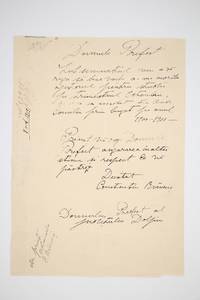
Deux lettres autographes signées adressées au Préfet du département de Dolj Two handwritten signed letters addressed to the Dolj County Prefect
Craïova Roumanie Craiova 1900. Fine. Craïova Roumanie Craiova 9 octobre 1900 14.70 x 22 cm deux feuillets rédigées au recto Two handwritten signed letters addressed to the Dolj County Prefect Craïova Romania 9 October 1900 14.7 x 22 cm & 27 x 19.5 cm two leaves written on the recto Two handwritten letters signed by Constantin Brâncui addressed to the Dolj County Prefect and written in brown and black ink one on a piece of lined paper 14.7 x 22cm and the other on larger size white paper 27 x 195 cm. The first letter is written in ink on a leaf and bears the registration number 12981 followed by the acronym pPG and is signed with the artist's full name: Constantin Brâncu. At the bottom left of the page there is a handwritten note by Brâncui: ""I received the prescription"" followed by his signature ""C. Brâncu"" and not ""Brâncusi"" or ""Brâncusi"" as he signed after his arrival in Paris. The second letter is written in ink on half a sheet of notebook paper and contains the same message the same signature and a similar inventory number. A 10 bani centimes stamp is glued to the top left. The left side below the stamp is cut out as Brâncui used to do: he removed the stamps or erased information that he did not want to keep. These two important letters document a significant chapter of the artist's biography concerning his studies financed in part by the Craiova Department.On 28 September 1898 Brâncui successfully completed his five-year schooling at the Craiova Trade School the capital of his native region and enrolled at the Bucharest School of Fine Arts. He obtained scholarships from the Madonna Dudu church in Craiova which helped him to continue his studies. He was quickly noticed by his teachers in Bucharest who awarded him prizes for making busts such as Laocoon and the antique sculpture Study based on Mars Borghese. In October 1900 Brâncui sent a request for a scholarship to the Prefect of the Dolj County the capital of which is Craiova who helped him to follow ""his studies during the October term"" and specified that this scholarship was granted to him by the County Council 1900-1901 budget. unknown
Referenz des Buchhändlers : 76380
|
|
|
Constantin BRANCUSI
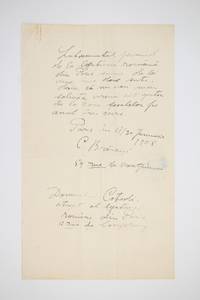
Déclaration autographe signée auprès de Mr. Costadi attaché à la légation roumaine à Paris Handwritten signed declaration to Mr Costadi attached to the Romanian legation in Paris
Paris 1908. Fine. Paris 17/30 janvier 1908 21 x 35 cm une page sur un feuillet Handwritten signed declaration to Mr Costadi attached to the Romanian legation in Paris Paris 17/30 January 1908 21 x 35 cm one page on a leaf Handwritten declaration dated and signed by Constantin Brâncui to Mr Costadi attached to the Romanian legation in Paris written in black ink on a leaf of white paper. Embossed stamp and a trace of a stamp. Some transverse folds. The declaration is signed with his full name that he will retain from then on: C. Brâncui and dated 17/30 January 1908 the two dates reflect the coexistence of the Gregorian and the Julian calendar in Romanian principalities in the early 20th century. In this declaration written on 30 January 1908 Brâncui addresses the Romanian legation in Paris represented by Mr Costadi. He hereby confirms receipt of the sum 1200 lei and specifies that he will no longer request assistance from the Maison des écoles section of the future Ministry of Education and Culture for the current year. This grant is the last he will be awarded by a Romanian establishment. unknown
Referenz des Buchhändlers : 76381
|
|
|
Constantin BRANCUSI
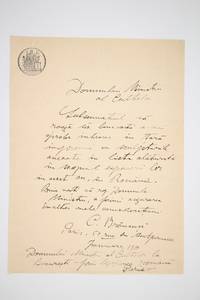
Lettre autographe signée adressée au Ministère roumain des cultes Handwritten signed letter addressed to the Romanian Ministry of Worship
Paris 1914. Fine. Paris janvier 1914 21 x 28.50 cm une page sur un feuillet Handwritten signed letter addressed to the Romanian Ministry of Worship Paris January 1914 21 x 28.5 cm one page on a leaf Very important handwritten letter signed by Constantin Brâncui addressed to the Romanian Ministry of Worship written in black ink on a leaf of white paper. Embossed stamp and a trace of a stamp. Transverse folds from having been sent. In this letter dated January 1914 and addressed to the Ministry of Worship the sculptor requests authorisation to bring some of his sculptures to Romania for the exhibition of the ""Tinerimea Artistica"" company Artistic Youth. Brâncui was then in Paris as evidenced by his address: « 54 rue du Montparnasse ». A list of works was visibly attached to the letter but sadly has disappeared. This letter testifies to the close links maintained between Brâncui and the Romanian artists of the ""Tinerimea Artistica"" who since 1908 organized exhibitions bringing together paintings and sculptures. In March 1914 Brâncui presents six works including La Prière 1907 Le Baiser 1907-08 Mademoiselle Pogany 1913 at the fourteenth exhibition of this important artistic company. He was already a renowned sculptor at that time: the presence of five of his works at the Armory Show in New York 17 February 15 March 1913 where his sculpture Mademoiselle Pogany caused a scandal due it its modernity at the side of Marcel Duchamp's Nu descendant un escalier and allowed him to become one of the major artists of the second decade of the 20th century. unknown
Referenz des Buchhändlers : 76382
|
|
|
Conta, Friedrich Christian Anton, Staatsmann (1778-1850)
Mont. eigenh. Brieffragment mit U.
o.J. Weimar, 6. II. 1801, Qu.-8°. 1 Seite.
Referenz des Buchhändlers : 54125
|
|
|
Conta, Richard von, Militär (1856-1941).
Eigenhändige Sentenz mit eh. ausgefülltem Formularteil und eh. Namenszug. Frankfurt/Oder, o. D.
1 S. Folio (223:282 mm). Albumblatt mit gedruckter Bordüre, gedr. Fußzeile "Beitrag zum Selbstschriftenalbum 'Deutschlands Zukunft'" und gedr. Formular für biograph. Daten, aufgezogen auf einen Bogen Pergamentpapier (ca. 330:344 mm). Mit einem Aufruf zur Rückkehr zur monarchischen Staatsführung: "Wer die Entwicklung der inneren und äußeren Zustände in Deutschland seit dem 9. Nov. 1918 mit offenen Augen und wahrhaft deutschfühlendem Herzen verfolgt hat, den kann nur die größte Besorgnis für die Zukunft des deutschen Volkes und Vaterlandes erfüllen [...]". Geschrieben als Beitrag für die von Friedrich Koslowsky im Berliner Eigenbrödler-Verlag herausgegebene Faksimile-Anthologie "Deutschlands Köpfe der Gegenwart über Deutschlands Zukunft" (1928). Die Sentenz bei Veröffentlichung in Druckschrift wiedergegeben. - Mit feinen Einschnitten im Formularteil. Koslowsky 68.
|
|
|
CONTE, Teresa - CANDEL, Francisco
TERESA CONTE (Dedicado) - Barcelona 1989
Barcelona, Caja Madrid, 1989. Catálogo. Ilustraciones en color de Teresa Conte. Texto de Francisco Candel. s/p. 8º mayor. Rústica editorial ilustrada. Dedicatoria autógrafa del artista. Muy buen ejemplar.
|
|
|
Contrucci, Pietro, Italian cleric and politician (1788-1859).
Autograph letter signed. [Pistoia], 7 [Jan.] 1853.
Large 8vo. 3 pp. on bifolium. With autograph address. Beautiful letter to an intimate friend named Matteo Trenta in Lucca, thanking him for a previous letter and expressing his hope that Trenta's health had improved. Contrucci informs Trenta of the publication of his short "Commemorazione di Niccolò Puccini" from 1852 that he attached to the letter and quotes: "The unhappiness of conception and 'childbirth' was joined by the sophistries, scruples, and fears of the attending physicians, the wet nurse, and even the last servants. Some said: he's too red, some too black, some too pale; some feared that the church door would be closed on his snout and his baptism refused, some wanted him shorter, some longer, some fatter, some thinner; [...]" (transl.). The final part of the letter is dedicated to the recipient's worrying state of health: "Among life's continual sorrows, I feel most bitterly what reaches me concerning your poor health, so good of heart, egregious of mind, so able and willing to teach, so young and eager for good in times so depleted of virtue and poor in knowledge [...], is a painful thought to my soul, although I know you greater than the evil that torments you. I want and gain hope that youth, care and God will come to the rescue of perfect recovery; that you may resume your offices for the benefit of society and country. In my many and long illnesses, I have found the principal remedy in myself. Fortitude of mind and imperturbability even in extremes. This I say to your comfort not to boast of my nature [...]." - A note at the foot of the third page informs us that "the poor Trenta died on March 19, 1856". - With a small tear to fol. 2 from opening the letter (no text loss). Minimal foxing. - From the collection of Eduard Fischer von Röslerstamm (1848-1915).

|
|
|
CONVERSE, Frederick S (1871-1949)
Autograph Note Signed
This American composer favored the classical style but with an American twist; his four operas include "The Pipe of Desire" remembered as the first American composition performed at the Metropolitan Opera House in New York but his best known work is his "Leaves of Grass" inspired symphonic poem "The Mystic Trumpeter" 1904. ANS 1p 7¼" X 10½" Westwood MA 10 November 1938. Addressed to Arnold F. Gates 1914-93 noted Lincoln and Civil War scholar. Near fine. Two faint horizontal folds. On his imprinted personal letterhead Converse pens in his large handsome script a grateful appreciation to an admirer: "Your appreciation of my music gives me great satisfaction and encouragement. Many thanks for your kindness. unknown
Referenz des Buchhändlers : 41003

|
|
|
Conz, Walter, German painter and etcher (1872-1947).
Autograph signature. Karlsruhe, [postmark: 21 Dec. 1911].
Oblong 8vo (postcard). ½ page. Inscribed to the German dermatologist Alwin Scharlau. - Conz taught the etching class at the Karlsruhe Academy of Arts from 1902 onwards. He enjoyed particular success with his landscapess and cooperated with the majolica ceramics factory based in Karlsruhe. - Traces of a postmark; faint brownstain near right margin. Self-addressed by the collector on the reverse. The Mecklenburg physician Scharlau (b. 1888) assembled a collection of artists' autographs by personal application.
|
|
|
Conze, Alexander, deutscher Archäologe (1831-1914).
Eigenh. Postkarte mit U. Charlottenburg bei Berlin, 24. II. 1880.
1 S. 8vo. Mit eh. Adresse. An Friedrich Pichler (1834-1911), Professor der Numismatik und Heraldik in Graz: "Mit Herrn Dr. Floigl, der mir von Ihnen empfohlen ist, habe ich das Unglück mehrfachen Verfehlens gehabt und bin dabei nicht einmal in Besitz seiner hiesigen Adresse gekommen, verehrter Herr Professor. Erweisen Sie mir und ihm die Freundlichkeit mir diese Adresse, die Sie gewiß haben, umgehend zu schreiben. Etwas umständlich, aber nicht anders zu machen! [...]". - Bei besagtem Dr. Floigl handelt es sich vermutlich um Victor Floigl, einen außerakademischen Bibelforscher und Assyriologen.
|
|
|
COOLUS, Romain (1868-1952), nouvelliste et dramaturge
carte pneumatique, 16 mai 1914, à Charles Dettelbach.
1 f. (145 x 113), recto verso avec timbre télégraphe oblitéré, bords dentelés, pliure au centre du document.
Referenz des Buchhändlers : 1647

|
|
|
COOPMANS, J.P.A.
DE RECHTSTOESTAND VAN DE GODSHUIZEN TE 'S-HERTOGENBOSCH VOOR 1629.
's Hertogenbosch, Zuid-Nederlandsche Drukkerij, 1964 Gebrocheerd, originele uitgeversomslag, 15.8x24 cm., 213 pp.
Referenz des Buchhändlers : 26494
|
|
|
COOLUS (Romain).
L'Enfant malade. Pièce en quatre actes.
Paris Editions de la "Revue blanche" 1897 1 vol. relié in-8, bradel cartonnage de papier marbré, pièce de titre de basane bordeaux au dos, couvertures conservées, 95 pp. Edition originale en service de presse avec un envoi de l'auteur à Octave Mirbeau. Petit manque au coin supérieur de la page de titre et dos un peu frotté.
Referenz des Buchhändlers : 54686
|
|
|
COOLUS (Romain).
L'Enfant malade. Pièce en quatre actes.
Paris Editions de la "Revue blanche" 1897 1 vol. relié in-8, bradel cartonnage de papier marbré, pièce de titre de basane bordeaux au dos, couvertures conservées, 95 pp. Edition originale en service de presse avec un envoi de l'auteur à Octave Mirbeau. Petit manque au coin supérieur de la page de titre et dos un peu frotté.
Referenz des Buchhändlers : 54686
|
|
|
COOK, Joseph (1838-1901)
Autograph Quotation Signed
Popular lecturer who gave a famous series of Monday lectures at Tremont Temple in Boston on the relation of science to religion. AQS 1p 5¼" X 3" Boston MA 1878 January 10. Very good. Minor age toning; mounting traces on verso. "Duty done is the soul's fireside" boldly signed and dated. unknown
Referenz des Buchhändlers : 19916

|
|
|
COOK, Peter
Manuscript Journal - Nautical Log with Compass Drawing
Constantinople, Odessa, Canary Islands, Spain, Italy, 1816-1818. Manuscript journal chronicling two voyages with a British merchant brig called "Exchange," featuring a sixteen-month voyage for trade at the Turkish city of Constantinople and Russian ruled Odessa only five years after the conclusion of the Anglo-Russian War, and two years prior to Odessa becoming a Free Port, being a detailed nautical log made by Peter Cook, a ship's mate twenty-six years of age. Folio. 88 pages, with authorship signature. A purpose-made document produced by J. Robins & Sons of Southwark, for recording nautical data during a sea voyage, completed in manuscript by the marine. Double leafs measuring approximately 21 x 32 cm, watermarked "O & P 1812" and with the Britannia, string-tied with paper wrappers titled in manuscript to front. Together with a single leaf in the same hand, with a hand coloured manuscript drawing of a mariner's compass to recto, and manuscript notes on Traverse Sailing to verso, made by the same hand circa 1805-1810, measuring approximately 21 x 25 cm. Together with the mariner's pensioner ticket, a legal document made on vellum, completed in manuscript, dated and signed on 22 April 1872 by an administrator of the Board of Trade, measuring approximately 19,5 x 25 cm. Some age-toning, a few leafs chipped at margin, otherwise in very good and original condition. Little is known of the vessel or the writer, other than what is revealed in the present documents. Robert Ashton was the commander of the brig, "SS Exchange" whose home port at the time was Plymouth. Peter Cook, born 1790, was a man of short stature, evidently employed by the mercantile marine. He was placed on the Pension List by the Board of Trade at the Port of Milford, Surrey, effective 1 April 1871, and resided in Tenby in Wales. Manuscript
|
|
|
COOKE, Jay (1821-1905)
Autograph Note Signed
The banker who founded Jay Cooke & Co. proved remarkably successful as a fiscal agent for the U.S. Treasury selling far more government bonds than was thought possible; later he financed western railroad construction such as the Northern Pacific and mines in Utah. ANS 1p 5 3/4" X 7 3/4" Philadelphia PA 1902 January 27. Very good. On his "Fourth & Library Streets" letterhead Cooke complies with an autograph request in his large bold flamboyant script. A very handsome piece. unknown
Referenz des Buchhändlers : 15314

|
|
|
Cooke, Josiah Parsons, American scientific chemist (1827-1894).
Autograph letter signed. Cambridge (Massachusetts), "Friday" [1853].
8vo. 1½ pp. To the Harvard law graduate Thomas Henderson Chandler (1824-95), who was applying for the post of usher, or assistant teacher, at the Boston Latin School, which both Henderson and Cooke themselves had attended: "I received your letter yesterday and immediately asked Prof. Lane [the Harvard classicist George Martin Lane, 1823-97] if he would allow you to use his name as a reference. He gave his consent unhesitatingly and I certainly shall have no objections to see my name in such good company. I am very glad to hear that you have obtained so good an opening. A private school in Boston is a sure fortune if successful; indeed it is the only form of teaching which is decently paid in this country. You will always have my best wishes for your success which also I will not fail to enforce with warm recommendations whenever the opportunity offers [...]". - In 1858 the versatile Henderson would take up studying the then-young science of dentistry and in 1860 returned to Harvard, joining the newly formed Dental School as adjunct professor. Cooke's own work at Harvard was instrumental in the measurement of atomic weights, inspiring Theodore Richards, America's first Nobel laureate in chemistry, to pursue similar research. Cooke's 1854 paper on atomic weights has been said to foreshadow the periodic law developed later by Mendeleev. - With 2 small strips of old mounting tape on verso.
|
|
|
Cooke, Rose Terry, American author and poet (1827-1892).
2 autograph letters signed. Winsted (Connecticut) and 15 East Street (Pittsfield, Massachusetts), 14 Nov. 1882 and 23 Nov. 1887.
8vo. Together 3 pp. on 2 bifolia. One with autograph address. To the editor of the Boston Traveller: "I send you the promised Christmas story to-day. I had to make it a little longer than I intended; these things get the better of me sometimes, but I suppose you will not object to this sort of fault. If you need it condensed however, be so kind as to let me do it. I don't like to have anyone else tinker my work: do you? [...]" (14 Nov. 1882). - To a Pittsfield lady, sending her a shad, or Alosa herring: "This is to introduce Mr. S. Shad: a Finnish gentleman whom I hear you have never met. He is a person of old family, though rather scaly; but he has always been in the swim; he has explored unknown depths, and has a great deal of Attic salt in his constitution, and much good taste. He needs to be accomodated with a cold bath all night, and martyred like St. Anthony in the morning. If you should alleviate his woes then with the crême de la crême, or even the milk of human unkindness, poured upon his cremated body, you will find him grateful (to the palate) [...] I trust you will be able to recommend him to Pittsfield society, as he has long been an important constituent of the Connecticut legislature [...]". - Each with 2 small strips of old mounting tape on verso. The letter of 1882 a little brownstained.
|
|
|
Coolidge, Louis Arthur
Abraham Lincoln : Address by Louis A. Coolidge - February 12, 1925, at the Lincoln Cabin built for Mary Bowditch Forbes in Milton, Massachusetts
1 p. typescript Unbound Good condition, top edge chipped
|
|
|
COOPER, Jackie (1922-2011)
Photograph Signed
This child star of the 1930s -- the first child actor to be nominated for an Oscar for the 1931 film "Skippy" -- appeared in such favorites as "The Champ" 1931 and "Treasure Island" 1934 and continued to appear in films and on television through the 1980s becoming a television producer and director of note. PS 8" X 10" n.p. 1985. Fine. Modern print of a vintage publicity portrait a half-length shot of a young Cooper in black leather jacket fists on hips staring angrily at the viewer -- possibly a still for the 1937 film "Boy of the Streets." In a light area at upper right Cooper signs boldly in black fineline adding "7/85. unknown
Referenz des Buchhändlers : 34611

|
|
|
Cooper, James Fenimore, American writer (1789-1851).
Autograph letter signed ("J. Fenimore Cooper"). Paris, 22 March 1827.
8vo (192:134 mm). 1 p. on a single bifolium. Address panel to verso. In remarkably good French, to the engineer Pierre-Alexandre Adolphe Jullien, thanking him for his concern about his health, and gives an estimate for the publication date of the forthcoming French edition of The Prairie ("sans doute, pendant le mois d'avril", depending on the industry of the translator and publisher) and he makes some social arrangements in Paris. Cooper had brought his family to Paris the previous year, becoming the centre of a small but influential circle of American expatriots. - Traces of seal, slight loss to upper forecorner from opening (expert old repair, no loss). Early annotation in French to head describing Cooper as "le Walter-Scott de l’amérique du nord". Provenance: Charavay, Paris.
|
|
|
Cooper, James Fenimore, American writer (1789-1851).
Cheque with autogr. insertion and signature. Cooperstown, 29. V. 1834.
Narrow oblong 8vo. (57:149 mm). Issued by the Otsego County Bank in the amount of US $ 25,42. - In mint condition.

|
|
|

 Per e-mail erhalten
 Als pdf-Dokument herunterladen
 RSS feed
 Permanenter link


