|
|
|
Anonyme
Recueil de Pièces Fugitives Tant en Vers qu'en Prose. Beau recueil manuscrit de 400 pp., environ, entièrement calligraphié.
Un fort volume de format in 4° de 500 pp., environ dont 400 contiennent des pièces diverses et une vingtaine de pp., en fin, les tables et index. Reliure en plein maroquin vert empire; dos lisse uniformément passé; riche décor au dos ; triple encadrement de filets dorés sur les plats; pièce de titre en maroquin rouge, titre doré. Entièrement doré sur tranches. La charnière du premier plat est fendue discrètement sur 1/3 du plat; au même endroit une discrète trace de mouillure qui n'affecte pas le corps de l'ouvrage qui est très frais. Imposant recueil calligraphié, parfois discrètement décoré , constitué d'épitres; de parodies; d'épitaphes d'oraisons de chansons... On y retrouve les noms de Voltaire, du Cardinal de Fleury; de Mme de La Tournelle; Le Maréchal de Saxe... et de multiples informations sur les évènements marquants, la vie quotidienne aussi, du milieu du XVIIIe siècle. Voir les photos.
|
|
|
Anonyme
Recueil de Pièces Fugitives Tant en Vers qu'en Prose. Beau recueil manuscrit de 400 pp., environ, entièrement calligraphié.
sans lieu manuscrit milieu 18ème ? 1 Un fort volume de format in 4° de 500 pp., environ dont 400 contiennent des pièces diverses et une vingtaine de pp., en fin, les tables et index. Reliure en plein maroquin vert empire; dos lisse uniformément passé; riche décor au dos ; triple encadrement de filets dorés sur les plats; pièce de titre en maroquin rouge, titre doré. Entièrement doré sur tranches.
Référence libraire : 13719

|
|
|
Anonyme
Recueil de Poésie pendant mes deux années chez Mr. Pépin à Cherbourg l'an 7 et 8 de la République [ Manuscrit de Poésie - à Cherbourg 1799 - 1800 ]
1 vol. grand in-8 reliure de remploi de l'époque plein vélin, Cherbourg, 1799-1800, 186 pp. Beau manuscrit rédigé par un rédacteur anonyme, lors de ses deux années à la pension de M. Pépin, à Cherbourg. D'une belle écriture très lisible, on peut y découvre tous les genres rhétoriques, avec une multitude d'acrostiches, des bouts-rimés, des cantiques, des charades ("plat-eau", "corne-muse", "thé-atre", "mit-an", etc...), de contes ("Le Chapelier et les Singes", Gils Blas en voyage", etc...), des distiques latins traduits en vers, des Discours ("Discours d'un précepteur à la rentrée des classes"), un drame ("Le Bon Coeur"), un éloge, des Epigrammes et des Epitaphes, des Fables sur sujet imposé, ou imitées de Phèdre, de nombreux Logogriphes, des odes et poèmes, des sentences et des traductions... Bon état (mouill. aux ff. en tête n'affectant pas le texte Français

|
|
|
ANONYME
RECUEIL DE RECETTES intéressant la Pharmacie, la Médecine, l'économie domestique.TEXTE DU XVIIIe SIECLE ENTIEREMENT MANUSCRIT.
1 cahier (28cm sur 19cm) couverture muette de l'époque 21 pages avec 1 supplément central de 2 feuillets (24cm sur 19cm) et 1 feuillet indépendant (10cm sur 19,5cm) recto verso daté 14 9bre 1777 et 22 juin 1778. Encre légèrement pâlie en tête de quelques pages, manque de papier en bordure de la première page avec petite perte de texte, manque au bas de la dernière page sans perte de texte.
Référence libraire : GITf652

|
|
|
anonyme
Recueil d’anecdotes, de réparties ingénieuses, de faits historiques & autres, en partie inédits
Une centaine de page, en grande partie manuscrites. Plus de 200 anecdotes, de 1840 à 1870. (anecdote 163 : depuis qu’il est à Londres, le citoyen CAUSSIDIERE, est redevenu un capitaliste, un négociant, un bourgeois…En un volume in 8 broché.
Référence libraire : 12709

|
|
|
Anonyme
recueil factice de 21 lettres manuscrites d’un fils, canonnier à sa mère habitante de Bourbonne–les-bains
21 lettres manuscrites d’un fils,canonnier,à sa mère habitante de Bourbonne–les–Bains Haute-Marne.Première lettre en date de Strasbourg décembre 1813,canonnier onzième compagnie Strasbourg.Dernière lettre,Chalons 22 juin 1826.D’autres envoyées de Metz,Auxonne,Troyes. L’ensemble monté sur onglets en un volume in 8 carré pleine toile bleue chagrinée,filets à froid en encadrement sur les plats.Titre et filets dorés,filets à froid au dos.Le titre exact est: 1813-1821 lettres de Hubert GAUME à sa mère témoignage émouvant de l'amour filial.Très bon état
Référence libraire : 5224

|
|
|
Anonyme
Recueil manuscrit de diverses études littéraires et comptes rendus de réunions de société littéraire
Relié 1849 In-4 (24 x 36 cm), reliure demi-peau, sans date (circa 1848-1849), recueil manuscrit de diverses études littéraires (travail scolaire) d'auteurs sans doute multiples (deux noms reviennent régulièrement : Jules Moulin et Blivet) et comptes rendus de réunions de société littéraire ; coiffeset coupes usées, frottements aux plats, coin inférieur du quatrième plat corné, cartonnage déchiré, assez bon état général. Livraison a domicile (La Poste) ou en Mondial Relay sur simple demande.
Référence libraire : wa1307
|
|
|
Anonyme
TAPUSCRIT : LE MONO - TRACTEUR (ancetre du velosolex)
TAPUSCRIT original ,etude industrielle, de 32 P;avec illustrations,sd (vers/ avant ? 1920),non signé,devis et proposition d'affaire basée sur des brevets déposés,en 1913 et 1914 dans divers pays d'Europe
Référence libraire : 23012

|
|
|
Anonyme
Troisième dimanche après Pâques après avoir lu l’évangile.
Manuscrit in 16 broché, 110x170mm, 24pages. Daté 1821. Belle écriture.
Référence libraire : 13488

|
|
|
Anonyme
Un évènement d'amour
Sans éditeur. Sans date. In-12. Broché. Bon état, Couv. légèrement passée, Dos abîmé, Intérieur frais. Manuscrit dactylographié. . . . Classification Dewey : 91-Manuscrits
Référence libraire : ROD0043476
|
|
|
Anonyme marine Forçats galeres evasion manuscrit
Ordonnances Commission de Mr.l’Intendant des Galéres pour juger les coupables et complices des evasions de forçats turcs...manuscrit
1726 1726 Marseille ?Toulon 1726,IN folio ,4 p.,historique et reglement
Référence libraire : 20453

|
|
|
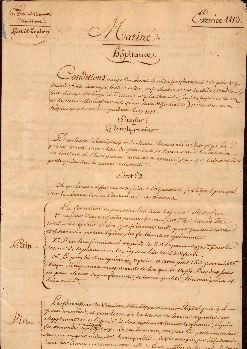
Anonyme marine hopitaux Empire manuscrit
Marine Hopitaux Empire manuscrit Port de Toulon 6e Arrdt. Exercice 1813
MANUSCRIT 1812 In folio Procés verbal d’adjudication, liste fournitures pour hopitaux de marine,14 p.,prix epoque,signé par ?
Référence libraire : 20452
|
|
|
Anonyme ( préface de Stéphane Gaborieau, hommage de Paul Bocause )
Cuisinière lyonnaise - cuisine - gastronomie - Reprint moderne d'un très ancien manuscrit de cuisine d'une cuisinière lyonnaise
2001 1 vol in-4 broché - 2001 - 147 pages - Editions Stéphane Bachès -
Référence libraire : 54326
|
|
|
Anonyme (Manuscrit présenté par Jacques Petitjean Roget)
L'histoire de l'Îsle de Grenade en Amérique 1649-1659
Presses de l'Université de Montréal In-8 Couverture souple Montréal 1975
Référence libraire : 6086
|
|
|
Anonyme (Médecin )
MANUSCRIT MEDICAL : RECETTES DE MEDICAMENTS, POTIONS, PILULLES, POUDRES, POMMADES, EMPLATRES, SYROPS, CATAPLASMES, BOLS, ONGUENTS, RATAFIATS, ELIXIRS, LIQUEURS, COLYRRES, MIXTURES, VINS, BOUILLONS, FUMIGATIONS, TEINTURES, EAUX, REMEDES ET TRAITEMENTS D'UN MEDECIN NOTEES DE 1804 (11 Ventose An XIII) A 1811
1804 un volume, reliure vélin ivoire d'époque (binding full white vellum) petit in-quarto (19 x 24,5 cm), dos long muet (spine without raised band and without title), manque de vélin sur le 1er plat (lake of a vellum on de first cover), fermeture à cordonnets, tête lisse (top edge smooth), tranches lisses (smooth edges), Carnet manuscrit de 350 pages à l'encre brune contenant des recettes de médicaments, potions, pilulles, poudres, pommades, emplatres, syrops, cataplasmes, bols, onguents, ratafiats, elixirs, liqueurs, colyrres, mixtures, vins, bouillons, fumigations, teintures, eaux , remèdes et traitements, Pagination jusqu'à la page 292, sorte d'index aprés pour retrouver les recettes ecrites entre 1804 et 1814, livre d'une écriture trés lisible...une mine d'or...
Référence libraire : 17096
|
|
|
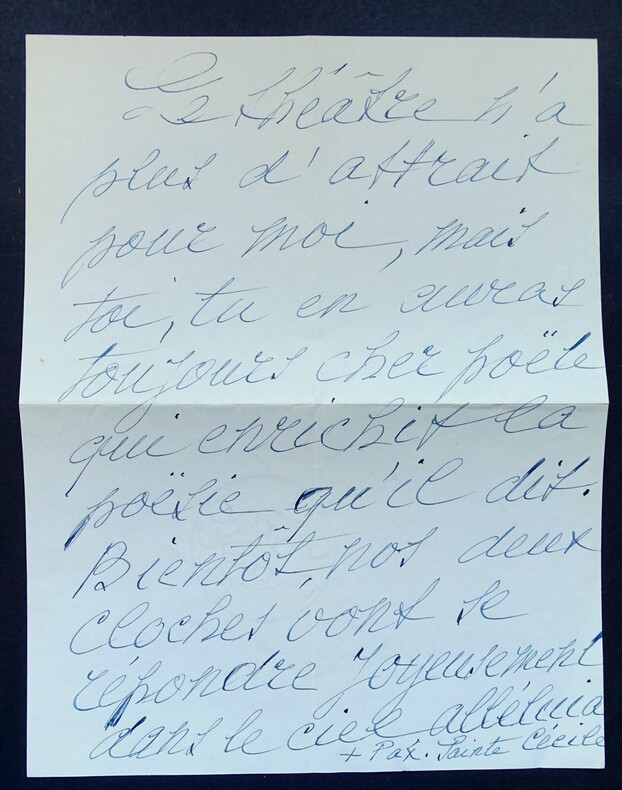
Anonyme (Saint Cécile)
INTRIGUANTE LETTRE AUTOGRAPHE SIGNÉE PAR ANONYME DESTINÉE A Maurice ESCANDE
Lettre autographe signée par une "anonyme", sans date. Dimensions : 21 x 27 cm. 2 pages. État : Bon état de conservation.
Référence libraire : boz_002839
|
|
|
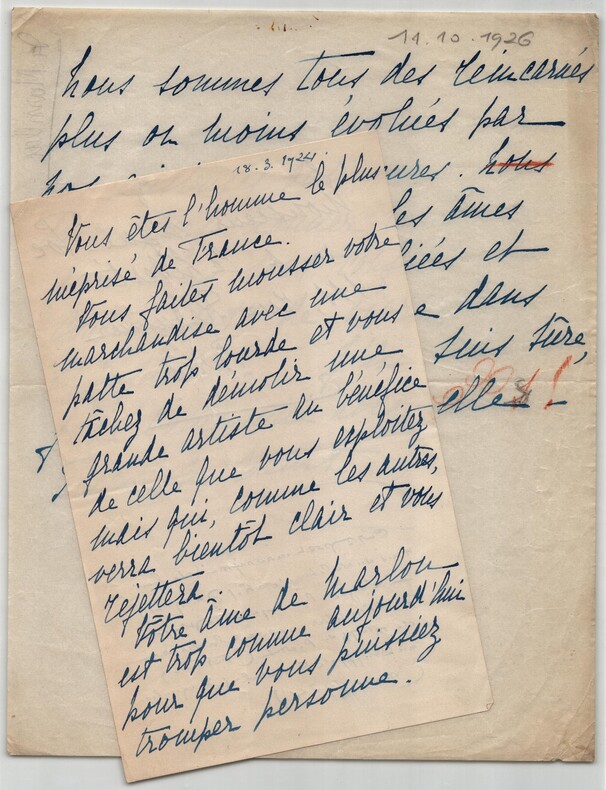
Anonyme (valet de chambre Jacques)
Lettre anonyme virulente contre Lugné Poe + note manuscrite mystique - 1924/26
Lettre anonyme contre Lugné-Poe note manuscrite mystique - 1924/26 1/ Lettre autographe anonyme virulente contre Aurélien Lugné-Poe, datée du 18 mars 1924. Rédigée à l'encre bleue sur un feuillet de papier vélin. Dimensions : 13,4 x 21,2 cm Nombre de pages : 2 pages 2/ Note Manuscrite Mystique, datée du 11 octobre 1926 au crayon. Rédigée à l'encre bleue sur un feuillet de papier vélin fin. Dimensions : 21 x 26,7 cm Nombre de pages : 1 page Lugné-Poe Aurélien-Marie Lugné, dit Lugné-Poe, est un acteur, metteur en scène et directeur de théâtre français, né à Paris le 27 décembre 1869, et mort à Villeneuve-lès-Avignon le 19 juin 1940. Fondateur du théâtre de l'Œuvre, il est, avec André Antoine, l'artisan d'un renouveau du théâtre parisien à la fin du XIXᵉ siècle.
Référence libraire : boz_002618
|
|
|
ANONYME - COLLECTIF - Antoine BEAURENAUD
Technologie du dessin appliqué au tissage - Etude sur les principaux "styles"
in8 agrafé, non paginé, couverture muette. Il s'agit d'un cahier de cours. Le texte est sur le papier ligné et les dessins, à la plume et à la gouache, sont remarquablement réalisés en 1920 par Antoine BEAURENAUD
Référence libraire : 12cb16
|
|
|
ANONYME - Edouard COUTURIER
[AFFAIRE DREYFUS] Carte postale appartenant à la série intitulée "Histoire d'un crime" (n°16)
Edouard Couturier | s. l. [Paris] s. d. [1899] | 13.90 x 9 cm | une carte postale
Référence libraire : 80783
|
|
|
ANONYME - Edouard COUTURIER
[AFFAIRE DREYFUS] Carte postale dreyfusarde appartenant à la série intitulée "Histoire d'un crime" (n°15)
Edouard Couturier | s. l. [Paris] s. d. [1899] | 13.90 x 9 cm | une carte postale
Référence libraire : 80782
|
|
|
ANONYME - Edouard COUTURIER
[AFFAIRE DREYFUS] Carte postale dreyfusarde appartenant à la série intitulée "Histoire d'un crime" (n°18)
Edouard Couturier | s. l. [Paris] s. d. [1899] | 13.90 x 9 cm | une carte postale
Référence libraire : 80784
|
|
|
ANONYME - Issu du manuscrit indien d'un ancien Bramine
Oeconomie de la Vie Humaine
1752 A Edimbourg - M.DCC.LII (1752) - In-duodecimo, reliure d'époque plein veau blond, dos à cinq nerfs - xxxii +160 pages - Frontispice en N&B
Référence libraire : 121973

|
|
|
Anonyme - manuscrit
Les Ordonnances et reglements relatifs au service des INVALIDES ( marine ),manuscrit
manuscrit autographe de 8 pages,sans date vers 1841,IN FOLIO broché,non relié,juste cordon bleu,en feuilles non numerotées,a l’encre,numeroté en colonnes,historique du droit des marins invalides ,jusqu’au 21 Juin 1841.
Référence libraire : 20449
|
|
|
Anonyme ; [ CHARIER ]
[ Recueil de 2 manuscrits sur Plombières-les-Bains ] Extraits de quelques ouvrages sur Plombières [ Suivi de : ] Notes explicatives sur les extraits de Mr. C******
1 vol. in-8 reliure milieu XIXe (vers 1840-1860) demi-basane fauve, dos lisse orné, s.d. [circa 1800-1830 ? ] 39 ff. dont 17 ff. et 3 ff. manuscrits
Référence libraire : 67822

|
|
|
Anonyme ; [ CHARLAS, Antoine ]
[ Manuscrit ] Remarques sur la Théologie Morale de M. Bonal
Manuscrit en 1 vol. in-12 (16,7 x 13,5 cm) reliure de l'époque plein vélin, s.d. [ circa 1690-1698 ], 266 pp. et 7 ff. n. ch.
Référence libraire : 66392

|
|
|
Anonyme ; [ Curé de Mialet ]
Discours pour la Bénédiction du Christ placé dans l'Eglise de Mialler [Mialet ; Miallet ] par suite des dons de MM. Profes et Barbey Cluzeau, l'un et l'autre propriétaires et membres de la Fabrique de la paroisse.
1 manuscrit en 9 ff. in-4, circa 1845 Etat très satisfaisant Français

|
|
|
Anonyme ; [ Curé de Mialet ]
Discours pour la Bénédiction du Christ placé dans l'Eglise de Mialler [Mialet ; Miallet ] par suite des dons de MM. Profes et Barbey Cluzeau, l'un et l'autre propriétaires et membres de la Fabrique de la paroisse.
1 manuscrit en 9 ff. in-4, circa 1845
Référence libraire : 38402

|
|
|
Anonyme ; [ Curé de Saint Chamassy ]
Discours prononcé à l'occasion du Mariage de M. Armand Cantaloup et Mme Léontine Gibiat, célébré dans l'Eglise paroissiale de Saint Chamassy le 14 juin 1853
1 manuscrit de 3 ff. in-folio, 1853 Etat très satisfaisant Français

|
|
|
Anonyme ; [ Curé de Saint Chamassy ]
Discours prononcé à l'occasion du Mariage de M. Armand Cantaloup et Mme Léontine Gibiat, célébré dans l'Eglise paroissiale de Saint Chamassy le 14 juin 1853
1 manuscrit de 3 ff. in-folio, 1853
Référence libraire : 38401

|
|
|
Anonyme ; [ DE SOLAGES, Madame ]
[ Manuscrit : ] Recueil de Chansons, Romances, etc. - A Madame De Solages à Vannes
Manuscrit en 1 vol. in-8 reliure de l'époque pleine basane racinée, super libris "F. D. S.", s.d. [ circa 1805-1814 ], 67 ff. (dont 22 rédigés) au grand filigrane au portrait lauré de Napoléon (mention "Napoléon Empereur des Français Roi d'Italie") et à l'Aigle Impériale (format du papier : 23,5 x 17,5 cm) Les 18 premiers feuillets rédigés en début de manuscrit (les dernières pages étant la copie d'une lettre de l'impératrice Elisabeth de Russie en novembre 1826) le sont d'une écriture plus fines que les 3 derniers feuillets manuscrits, en fin de recueil. Parmi les chansons on trouvera le "Départ de la Garde d'Honneur du Morbihan" sur "l'Air de La Sentinelle". Le manuscrit est très intéressant, mais l'on remarquera surtout le papier vélin au remarquable filigrane, qui représente (en alternance plus ou moins irrégulière, en général tous les 2 ou 3 feuillets) un grand portrait couronné de l'Empereur cerclé de la mention "Napoléon Empereur des Français Roi d'Italie" ou l'Aigle Impériale couronnée. On sait que de tels filigranes ornaient le papier du cabinet de l'Empereur. Bon état (reliure un peu frottée avec petits mq.) Français

|
|
|
Anonyme ; [ DE SOLAGES, Madame ]
[ Manuscrit : ] Recueil de Chansons, Romances, etc. - A Madame De Solages à Vannes
Manuscrit en 1 vol. in-8 reliure de l'époque pleine basane racinée, super libris "F. D. S.", s.d. [ circa 1805-1814 ], 67 ff. (dont 22 rédigés) au grand filigrane au portrait lauré de Napoléon (mention "Napoléon Empereur des Français Roi d'Italie") et à l'Aigle Impériale (format du papier : 23,5 x 17,5 cm)
Référence libraire : 59751

|
|
|
ANONYME ; [ GERUZEZ ANDLAUER, Jeanne ]
Manuscrit fin XIXe relatif à plusieurs communes (dont nombreuses communes de l'Essonne) : Livre de raison du P. Marchetti extrait de La maison d'un Bourgeois au XVIIIe siècle - Premiers Seigneurs de Pithiviers, par J. Devaux - Extrait d'une histoire inédite de Pithiviers au XVIIIe siècle par M. de la Brière - Mémoires sur l'élection de Pithiviers en 1698 ed. Herluison Orléans - Les châteaux de Ribeauvillé : Rappolstein- Girs erg. St Ulrich - Extrait des Archives de Ribeauvillé - N.D. de Dusenbach - Relation d'une Noce célébrée au château de Ribeauvillé XVIe siècle - Château d'Andlau - Rouffach - Schlestadt - Les trois Châteaux - Comte d'Andlau - Les Antiquités de la Ville, Comté et Chatelenie de Corbeil, de la recherche de Me Jean de la Barre cy-devant Prévost de Corbeil ed. 1647 - Pancarte du Chastelet représentant l'étendu et le ressort de la Chastellenie de Corbeil - Les Comtes de Corbeil : Hémon, Bouchard, Maugis, Guillaume, Regnault, Bouchart II, Oddes, Hugues du Puisset, etc... - Fontenay-le-Vicomte [ extrait de l'Histoire du Diocèse de Paris par l'abbé Lebeuf ] - Mennecy - Villabé - Ormoy - La Norville - Leudeville - Ver-le-Grand - Ver-le-Petit - La Saussaie - Escharcon - Avrinville - La Honville
1 cahier plein cuir souple bordeaux, s.d. [ circa 1890-1900 ], environ 96 feuillets. Manuscrit fin XIXe relatif à plusieurs communes (dont nombreuses communes de l'Essonne) : Livre de raison du P. Marchetti extrait de La maison d'un Bourgeois au XVIIIe siècle - Premiers Seigneurs de Pithiviers, par J. Devaux - Extrait d'une histoire inédite de Pithiviers au XVIIIe siècle par M. de la Brière - Mémoires sur l'élection de Pithiviers en 1698 ed. Herluison Orléans - Les châteaux de Ribeauvillé : Rappolstein- Girs erg. St Ulrich - Extrait des Archives de Ribeauvillé - N.D. de Dusenbach - Relation d'une Noce célébrée au château de Ribeauvillé XVIe siècle - Château d'Andlau - Rouffach - Schlestadt - Les trois Châteaux - Comte d'Andlau - Les Antiquités de la Ville, Comté et Chatelenie de Corbeil, de la recherche de Me Jean de la Barre cy-devant Prévost de Corbeil ed. 1647 - Pancarte du Chastelet représentant l'étendu et le ressort de la Chastellenie de Corbeil - Les Comtes de Corbeil : Hémon, Bouchard, Maugis, Guillaume, Regnault, Bouchart II, Oddes, Hugues du Puisset, etc... - Fontenay-le-Vicomte [ extrait de l'Histoire du Diocèse de Paris par l'abbé Lebeuf ] - Mennecy - Villabé - Ormoy - La Norville - Leudeville - Ver-le-Grand - Ver-le-Petit - La Saussaie - Escharcon - Avrinville - La Honville Manuscrit recueillant des informations de provenance diverses (généralement extraites d'ouvrages anciens) à propos de plusieurs communes de France (essentiellement sur les départements de l'Essonne, du Loiret et d'Alsace). Des similitudes avec d'autres manuscrits font penser que le rédacteur était un membre ou un proche de la famille Géruzez et de l'illustrateur Crafty ; des similitudes avec d'autres manuscrits font penser que le rédacteur était un membre ou un proche de la famille Géruzez et de l'illustrateur Crafty ; il s'agit selon toute vraisemblance de sa fille Jeanne Geruzez, épouse du futur général Joseph Andlauer, né en 1869 à Fontenay-le-Vicomte (d'où l'intérêt pour Andlau, et pour Fontenay-le-Vicomte). Bon état. Français

|
|
|
ANONYME ; [ GERUZEZ ANDLAUER, Jeanne ]
Manuscrit fin XIXe relatif à plusieurs communes (dont nombreuses communes de l'Essonne) : Livre de raison du P. Marchetti extrait de La maison d'un Bourgeois au XVIIIe siècle - Premiers Seigneurs de Pithiviers, par J. Devaux - Extrait d'une histoire inédite de Pithiviers au XVIIIe siècle par M. de la Brière - Mémoires sur l'élection de Pithiviers en 1698 ed. Herluison Orléans - Les châteaux de Ribeauvillé : Rappolstein- Girs erg. St Ulrich - Extrait des Archives de Ribeauvillé - N.D. de Dusenbach - Relation d'une Noce célébrée au château de Ribeauvillé XVIe siècle - Château d'Andlau - Rouffach - Schlestadt - Les trois Châteaux - Comte d'Andlau - Les Antiquités de la Ville, Comté et Chatelenie de Corbeil, de la recherche de Me Jean de la Barre cy-devant Prévost de Corbeil ed. 1647 - Pancarte du Chastelet représentant l'étendu et le ressort de la Chastellenie de Corbeil - Les Comtes de Corbeil : Hémon, Bouchard, Maugis, Guillaume, Regnault, Bouchart II, Oddes, Hugues du Puisset, etc... - Fontenay-le-Vicomte [ extrait de l'Histoire du Diocèse de Paris par l'abbé Lebeuf ] - Mennecy - Villabé - Ormoy - La Norville - Leudeville - Ver-le-Grand - Ver-le-Petit - La Saussaie - Escharcon - Avrinville - La Honville
1 cahier plein cuir souple bordeaux, s.d. [ circa 1890-1900 ], environ 96 feuillets. Manuscrit fin XIXe relatif à plusieurs communes (dont nombreuses communes de l'Essonne) : Livre de raison du P. Marchetti extrait de La maison d'un Bourgeois au XVIIIe siècle - Premiers Seigneurs de Pithiviers, par J. Devaux - Extrait d'une histoire inédite de Pithiviers au XVIIIe siècle par M. de la Brière - Mémoires sur l'élection de Pithiviers en 1698 ed. Herluison Orléans - Les châteaux de Ribeauvillé : Rappolstein- Girs erg. St Ulrich - Extrait des Archives de Ribeauvillé - N.D. de Dusenbach - Relation d'une Noce célébrée au château de Ribeauvillé XVIe siècle - Château d'Andlau - Rouffach - Schlestadt - Les trois Châteaux - Comte d'Andlau - Les Antiquités de la Ville, Comté et Chatelenie de Corbeil, de la recherche de Me Jean de la Barre cy-devant Prévost de Corbeil ed. 1647 - Pancarte du Chastelet représentant l'étendu et le ressort de la Chastellenie de Corbeil - Les Comtes de Corbeil : Hémon, Bouchard, Maugis, Guillaume, Regnault, Bouchart II, Oddes, Hugues du Puisset, etc... - Fontenay-le-Vicomte [ extrait de l'Histoire du Diocèse de Paris par l'abbé Lebeuf ] - Mennecy - Villabé - Ormoy - La Norville - Leudeville - Ver-le-Grand - Ver-le-Petit - La Saussaie - Escharcon - Avrinville - La Honville
Référence libraire : 59301

|
|
|
ANONYME ; [ GERUZEZ ANDLAUER, Jeanne ]
Manuscrit fin XIXe relatif à plusieurs communes de l'Essonne : Saint Vrain anciennement Escorchy - Chevilly - Lay ou Lahy - Fresnes-les-Rungy - Rungy - Arcueil - Villejuy - Longjumeau - Orengy - Ris - Evry anciennement Aivry - Soisy-sur-Seine - Lices - Courcouronne - Juvisy - Vigneu - Draveil - Montgeron - Villeneuve St Georges - Crone - Valenton - Bonneuil sur Marne - Vitry sur Seine - Choisy le Roi - Thiais - Orly - Athis - Villeneuve le Roi - Paray - Arpajon - Chanteloup - Saint Sulpice de Favières - Longpont - Montlhéry - Plessis-d'Argonge - Brétigny - Torfou - Lardy - Chamarante - Gentilly - Villeroy [ entre Fontenay et Corbeil ] (avec relevés au crayon sur 2 calques du plan terrier de Villeroy de 1751) - Le Vicomte - Nicoles de Neufville Seigneur de Villeroy - Créteil - Chetainville - Viry - Ste Geneviève des Bois - Vitry - Bonneuil - Maisons - Epinay - Ballenvilliers - Chailly - St Sulpice de Favières (suite) - Itteville - Cours de M. C. Jullian - Souvenirs inédits de Fontenay le Vicomte
1 cahier cartonnage demi-percaline à coins bleu, s.d. [ circa 1890-1900 ] environ 96 ff. dont environ 80 rédigés à l'encre : Saint Vrain anciennement Escorchy (9 pp.) - Chevilly (6 pp.) - Lay ou Lahy (2 pp.) - Fresnes-les-Rungy (1 page et demie) - Rungy (4 pp.) - Arcueil - Villejuy - Longjumeau (6 pages et demie) - Orengy - Ris (3 pp.) - Evry anciennement Aivry (10 pp.) - Soisy-sur-Seine (2 pages et demie) - Lices (6 pages et demie) - Courcouronne (1 pages et demie) - Juvisy (2 pages et demie) - Vigneu (4 pages) - Draveil (3 pp.) - Montgeron - Villeneuve St Georges (6 pp.) - Crone - Valenton - Bonneuil sur Marne - Vitry sur Seine - Choisy le Roi (2 pp.) - Thiais - Orly - Athis - Villeneuve le Roi (3 pp.) - Paray - Arpajon (9 pp.) - Chanteloup (4 pages et demie) - Saint Sulpice de Favières - Longpont (12 pp.) - Montlhéry (9 pp.) - Plessis-d'Argonge - Brétigny (5 pp.) - Torfou (8 pp.) - Lardy (4 pp.) - Chamarante (2 pp.) - Gentilly (2 pp.) - Villeroy [ entre Fontenay et Corbeil ] (20 pp. avec Relevés au crayon sur 2 calques du plan terrier de Villeroy de 1751) - Le Vicomte - Nicoles de Neufville Seigneur de Villeroy (6 pp.) - Créteil - Chetainville - Viry - Ste Geneviève des Bois - Vitry - Bonneuil - Maisons - Epinay - Ballenvilliers - Chailly - St Sulpice de Favières (suite) - Itteville (9 pp.) - Cours de M. C. Jullian - Souvenirs inédits de Fontenay le Vicomte (6 pp.) Intéressant manuscrit recueillant des informations de provenance diverses sur plusieurs communes de l'Essonne. Le rédacteur s'intéresse longuement au petit village de Villeroy (près de Fontenay-le-Vicomte) et joint un relevés au crayon, sur 2 calques, du plan terrier de Villeroy de 1751. Le manuscrit se termine sur d'intéressantes anecdotes inédites relatives à Fontenay-le-Vicomte. Des similitudes avec d'autres manuscrits font penser que le rédacteur était un membre ou un proche de la famille Géruzez et de l'illustrateur Crafty ; il s'agit selon toute vraisemblance de sa fille Jeanne Geruzez, épouse du futur général Joseph Andlauer, né en 1869 à Fontenay-le-Vicomte (d'où l'intérêt pour Andlau dans un autre manuscrit, et pour Fontenay-le-Vicomte). Bon état. Bon état Français

|
|
|
Anonyme ; [ LELONG-FERRAND Jacqueline ]
Notes de cours manuscrites : Cours de Mécanique rationnelle. Mécanique du point. Cinématique (2 cahiers manuscrits)
2 cahiers d'écolier format in-8 manuscrit, circa 1946-1947 Intéressant ensemble des notes de cours, manuscrites, prises vers 1946-1947 par un étudiant girondin de la mathématicienne Jacqueline Lelong-Ferrand (1918-2014). Normalienne (Ulm), reçue première (avec Roger Apéry) à l'agrégation de mathématique en 1939, Jacqueline Lelong-Ferrand sera notamment chargée de cours à l'université de Bordeaux à partir de 1943. On joint trois coupures de presse (articles de Mme Lelong-Ferrand) Français

|
|
|
Anonyme ; [ LELONG-FERRAND Jacqueline ]
Notes de cours manuscrites : Cours de Mécanique rationnelle. Mécanique du point. Cinématique (2 cahiers manuscrits)
2 cahiers d'écolier format in-8 manuscrit, circa 1946-1947
Référence libraire : 55292

|
|
|
Anonyme ; [ LEMAIGRE-DUBREUIL, Léon ]
Cours manuscrit de Philosophie et notes de cours diverses dont Ode d'Anacréon et Art poétique d'Horace [ Notes de cours manuscrites d'un étudiant de Limoges et Guéret, Léon Lemaigre-Dubreuil, 1820-1821 ]
6 cahiers in-8, s.d. [ circa 1820-1821 ], 10 ff. de notes de philosophie ("L"idée") datées de "Limoges, le 6 Août 1821" ; 20 ff. (dont 6 ms.) sur la "Métaphysique" ; 6 ff. (dont 4 ms.) "Etymologie - Définition de la Philosophie" ; 20 ff. (dont 10 ms.) "Ode d'Anacréon" ; 10 ff. (dont 5 ms.) "Art Poétique d'Horace" datés du 1er au 18 mai 1820 à Guéret ; 10 ff. (dont 7 ms.), notes de politique et théologie
Référence libraire : 64746

|
|
|
Anonyme ; [ LEMAISTRE DE SACY ; LE MAISTRE DE SACY ]
Cantique des Cantiques traduit en françois avec une Explication tirée des Saints Pères & des Auteurs Ecclésiastiques.
1 vol. in-8 rel. d'époque pleine basane marron, dos à 5 nerfs orné, tranches rouges, mention "Bibliothèque Asiatique" au dos en tête, Chez Guillaume Desprez,, Paris, 1709, 20 ff., 558 pp. et 5 ff.
Référence libraire : 69416

|
|
|
Anonyme ; [ LEMAISTRE DE SACY ; LE MAISTRE DE SACY ]
Daniel traduit en françois avec l'Explication tirée des Saints Pères & des Auteurs Ecclésiastiques
1 vol. in-8 rel. d'époque pleine basane marron, dos à 5 nerfs orné, tranches rouges, mention "Bibliothèque Asiatique" au dos en tête, Chez la Veuve de Guillaume Desprez, Paris, 1700, 12 ff., 616 pp. et 6 ff. n. ch.
Référence libraire : 69420

|
|
|
Anonyme ; [ LEMAISTRE DE SACY ; LE MAISTRE DE SACY ]
Ezechiel traduits en françois avec l'Explication du sens littéral & du sens spirituel, tirée des Saints Pères & des Auteurs Ecclésiastiques
1 vol. in-8 rel. d'époque pleine basane marron, dos à 5 nerfs orné, tranches rouges, mention "Bibliothèque Asiatique" au dos en tête, Chez la Veuve de Guillaume Desprez, Paris, 1711, 12 ff., 807 pp.
Référence libraire : 69419

|
|
|
Anonyme ; [ LEMAISTRE DE SACY ; LE MAISTRE DE SACY ]
Job, traduit en françois avec une Explication tirée des Saints Pères & des Auteurs Ecclésiastiques.
1 vol. in-8 rel. d'époque pleine basane marron, dos à 5 nerfs orné, tranches rouges, mention "Bibliothèque Asiatique" au dos en tête, Chez Guillaume Desprez,, Paris, 1712, 23 ff., 658 pp., 7 ff. n. ch.
Référence libraire : 69413

|
|
|
Anonyme ; [ LEMAISTRE DE SACY ; LE MAISTRE DE SACY ]
Josué, les Juges et Ruth, traduits en françois avec une Explication tirée des Saints Pères & des Auteurs Ecclésiastiques.
1 vol. in-8 rel. d'époque pleine basane marron, dos à 5 nerfs orné, tranches rouges, mention "Bibliothèque Asiatique" au dos en tête, Chez Guillaume Desprez,, Paris, 1709, 6 ff., 368 pp., 4 ff., 412 pp.
Référence libraire : 69410

|
|
|
Anonyme ; [ LEMAISTRE DE SACY ; LE MAISTRE DE SACY ]
Jérémie traduit en françois avec une Explication tirée des Saints Pères & des Auteurs Ecclésiastiques [ Suivi de :] Baruch
1 vol. in-8 rel. d'époque pleine basane marron, dos à 5 nerfs orné, tranches rouges, mention "Bibliothèque Asiatique" au dos en tête, Chez Guillaume Desprez, Paris, 1700, 18 ff., 837 pp., et 3 ff., 90 pp. et 2 ff.
Référence libraire : 69418

|
|
|
Anonyme ; [ LEMAISTRE DE SACY ; LE MAISTRE DE SACY ]
L'Ecclesiastique traduit en françois avec une Explication tirée des Saints Pères & des Auteurs Ecclésiastiques.
Nouvelle Edition, 1 vol. in-8 rel. d'époque pleine basane marron, dos à 5 nerfs orné, tranches rouges, mention "Bibliothèque Asiatique" au dos en tête, Chez Guillaume Desprez et Jean-Baptiste Dessesars,, Paris, 1711, 6 ff., 771 pp.
Référence libraire : 69417

|
|
|
Anonyme ; [ LEMAISTRE DE SACY ; LE MAISTRE DE SACY ]
L'Exode et le Lévitique, traduits en françois avec une Explication tirée des Saints Pères & des Auteurs Ecclésiastiques.
1 vol. in-8 rel. d'époque pleine basane marron, dos à 5 nerfs orné, tranches rouges, mention "Bibliothèque Asiatique" au dos en tête, Chez Guillaume Desprez,, Paris, 1699, LXVIJ-833 pp.
Référence libraire : 69408

|
|
|
Anonyme ; [ LEMAISTRE DE SACY ; LE MAISTRE DE SACY ]
La Genèse traduite en françois avec l'Explication du sens littéral & du sens spirituel, tirée des Saints Pères & des Auteurs Ecclésiastiques.
Nouvelle édition, 1 vol. in-8 rel. d'époque pleine basane marron, dos à 5 nerfs orné, tranches rouges, mention "Bibliothèque Asiatique" au dos en tête, Chez Guillaume Desprez et Jean-Baptiste Desessars, Paris, 1711, 36 ff., 448 pp., 1 f., pp. 448-960.
Référence libraire : 69407

|
|
|
Anonyme ; [ LEMAISTRE DE SACY ; LE MAISTRE DE SACY ]
Les Deux Premiers Livres des Rois, traduits en françois avec une Explication tirée des Saints Pères & des Auteurs Ecclésiastiques. [suivi de : ] Les Deux Derniers Livres des Rois, traduits en françois avec une Explication tirée des Saints Pères & des Auteurs Ecclésiastiques.
Troisième et Seconde édition, 2 vol. in-8 rel. d'époque pleine basane marron, dos à 5 nerfs orné, tranches rouges, mention "Bibliothèque Asiatique" au dos en tête, Chez Guillaume Desprez,, Paris, 1700 et 1690, 8 ff., 656 pp. et 4 ff. ; VII-844 pp. et 7 ff. n. ch.
Référence libraire : 69411

|
|
|
Anonyme ; [ LEMAISTRE DE SACY ; LE MAISTRE DE SACY ]
Les Douze Petits Prophètes, traduits en françois avec l'Explication du sens littéral & du sens spirituel, tirée des Saints Pères & des Auteurs Ecclésiastiques.
Troisième édition, 1 vol. in-8 rel. d'époque pleine basane marron, dos à 5 nerfs orné, tranches rouges, mention "Bibliothèque Asiatique" au dos en tête, Chez la Veuve de Guillaume Desprez, Paris, 1710, 12 ff., 752 pp.
Référence libraire : 69421

|
|
|
Anonyme ; [ LEMAISTRE DE SACY ; LE MAISTRE DE SACY ]
Les Nombres, traduits en françois avec l'Explication du sens littéral & du sens spirituel, tirée des Saints Pères & des Auteurs Ecclésiastiques [suivi de : ] Le Deutéronome, traduit en françois avec l'Explication du sens littéral & du sens spirituel, tirée des Saints Pères & des Auteurs Ecclésiastiques.
1 vol. in-8 rel. d'époque pleine basane marron, dos à 5 nerfs orné, tranches rouges, mention "Bibliothèque Asiatique" au dos en tête, Chez Guillaume Desprez,, Paris, 1701, 9 ff., 478 pp., 4 ff., 526 pp. et 1 f. n. ch.
Référence libraire : 69409

|
|
|
Anonyme ; [ LEMAISTRE DE SACY ; LE MAISTRE DE SACY ]
Les Paralipomènes, traduits en françois avec une Explication tirée des Saints Pères & des Auteurs Ecclésiastiques [ Suivi de : ] Esdras et Néhémias, traduits en françois avec une Explication tirée des Saints Pères & des Auteurs Ecclésiastiques.
1 vol. in-8 rel. d'époque pleine basane marron, dos à 5 nerfs orné, tranches rouges, mention "Bibliothèque Asiatique" au dos en tête, Chez Guillaume Desprez et Jean-Baptiste Desessartz, Paris, 1711, 13 ff., 612 pp., 5 ff., 9 ff., 286 pp. et 3 ff. n. ch.
Référence libraire : 69412

|
|
|

 Recevoir par e-mail
 Télécharger en PDF
 Flux RSS
 Lien permanent


