|
[WHEATLEY Major J. M.)]
History of the Dorsetshire Regiment, 1914-1919 [Part I: The Regular Battalions Part II: The Territorial Battalions Part III: The Service Battalions.]
First edition, small 4to, 3 parts in one, 306; 152; 64pp., 3 large folding maps to rear (one with a closed tear), plans within the text, orig. green publishers cloth, a little worn and stained.
|
|
|
[WISSEMBOURG, GUERRE 1870]
Le monument français de Wissembourg.
Strasbourg, Imprimerie alsacienne-Lorraine , 1910 ; in-8, 165 pp., br. Aux soldats français morts pour la patrie. Préface du général Bonnal. Broché en bon état - 1er plat COIN DU HAUT UN PEU SALIS , sinon bel état.
Référence libraire : 202001614
|
|
|
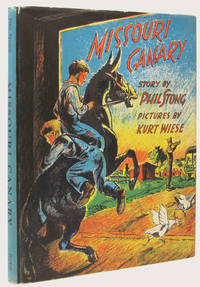
[Wiese, Illus, World War II] Stong Phil
MISSOURI CANARY
New York: Dodd Mead & Company 1943. First edition. Illustrated throughout in both colour and black and white by Kurt Weise. Tall 8vo in the original pictorially decorated paper-covered boards backed in black cloth illustrated endpapers in the original dustjacket. 78pp. A fine copy with just a little rubbing along the bottom board edge unobtrusive former owner's stamp on the front free-fly the jacket is bright and clean and fully intact with only trivial mellowing at the edges and folds. SCARCE IN DUSTJACKET AN ENTERTAINING WORLD WAR TWO CHILDREN'S BOOK WITH ILLUSTRATIONS BY CALDECOTT HONOR WINNER KURT WIESE.<br> In this fast-moving and funny adventure two boys and their mule the titular Missouri Canary get involved with a troop of Army soldiers in town for combat training. This is one of several books by the combined talents of Phil Stong and Kurt Weise published during and about the Second World War. Children's books such as these played an important role in maintaining good morale on the home front. Dodd, Mead & Company hardcover
Référence libraire : 33741
|
|
|
[Wilfred Owen (1893-1918), war poet; Rev Norman Print, Vicar of Dunsden; Catherine Winkworth; John Stallworthy; D J Enright; Rob
Wilfred Owen war poet. Printed ‘Order of Service for the dedication of a memorial to Wilfred Owen 1893-1918’. with readers including Ted Hughes Geoffrey Hill D. J. Enright Jon Stallworthy Jill Balcon
‘All Saints Church Dunsden at 2.30 p.m. on 12 November 1978 Remembrance Sunday’. A nice association with a man widely regarded as the greatest English poet of the First World War and a scarce item of which not many copies can have been printed and no other copy has been traced. 4pp 8vo. Bifolium on laid paper. In fair condition lightly aged with slight creasing at head. Explanatory note on final page begins: ‘The memorial to Wilfred Owen is cut on Portland stone by Michael Harvey from lettering drawn by Reynolds Stone CBE RDI. / The graves of Tom and Susan Owen the poet’s father and mother and of his sister Mary are in the south-east corner of the churchyard. / Tea will be served by the ladies of the parish after the service at the old vicarage now called The Glebe House where Wilfred Owen lived from 20 October 1911 to 7 February 1913 while acting as lay assistant to the Rev. Herbert Wigan. A small display of books by and about Owen may be seen there.’ The two central pages give the order of service beginning with the text of Catherine Winkworth’s translation of Rinkart’s ‘Now thank we all our God’. A list of the readings follows with Owen’s biographer Jon Stallworthy speaking about ‘Wilfred Owen at Dunsden’ and Ian Parsons about ‘Wilfred Owen as Poet’. Letters by Owen to his mother ‘The Sentry’ and ‘The Send-Off’ are read by Stallworthy the actress Jill Balcon D. J. Enright and Peter Owen. The poets Ted Hughes Geoffrey Hill and Robert Gittings read poems by Owen and extracts from letters. The memorial is dedicated by the Bishop of Oxford and there is a ‘Bidding Prayer’ by Rev. Norman Print Vicar of Dunsden. ‘All Saints Church Dunsden at 2.30 p.m. on 12 November 1978 Remembrance Sunday’. unknown
Référence libraire : 24693
|
|
|
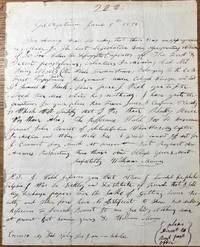
[William Mann] [Mexican War] [Pennsylvania]
1851 Letter from William Mann Mexican War Veteran requesting pension attorney Col. William S. Amweg for his help in obtaining funds for his military service
Georgetown: n/a 1851. Letter. Good. Letter. Approx. 8" x 10". 1 page of writing. Paper previously removed from a glass frame. Tissue repairs on the edges. Paper has multiple folds. According to a note found on the back of the glass frame William Mann addressed this letter to Col. William S. Amweg a pension attorney near Lancaster Pennsylvania area in the years 1849-1851. The number 200 is written top of the paper. Unfortunately the note affixed to the back of the frame is now missing. Col. Amweg's name is not found in this document.<br /> <br /> The letter transcribed as best as possible reads: "Georgetown June 8 1851 Sir Having heard not reading that there was an appropriation being made for the last legislative body appropriating a sum of $30000 dollars for defraying the expenses of the First & Second Pennsylvania volunteers in Mexico and not being to the whole circumstance belonging to the Co. of First Pennsylvania Ridgement under Colonel Wincape and Lt. Col. Samuel Black therefore I wish you to intercede for me and lose nothing. I have great acquaintances in your place Rea Frarer Jones B. Canfuier Dr. Casally &c. which will certify that I was there. Reece was there also. The reference would be to Brigadier General John Bennet of Philadelphia who was my captain in Mexico and who would be a friend in need. Just ask for I cannot say much at present but request an answer respecting these things and oblige yours most respectively William Mann. P.S. I would inform you that when I landed in Philadelphia I was sickly and destitute of friends that I sold my discharge papers for the sake of getting home decently and therefore have no certificate to show but making reference to General Bennet Jr. can be had nothing more at present but remain yours &c William Mann. Excuse my bad spelling for I am no scholar. Please direct to post office. n/a unknown
Référence libraire : 35415
|
|
|
[Williamson, Henry]
The Gold Falcon or The Haggard Of Love
New York: Harrison Smith and Robert Haas 1933. First American Edition. HB. Blue cloth blindstamped falcon on front cover and gilt lettering with falcon on spine 8vo 425 pp. No marks in book binding tight. Page 415 has an 1 1/2" tear at bottom not affecting any text. Covers faded around edges and spine. In an unclipped $2.50 tan dust jacket with red lettering and a gilt falcon on front panel publisher's ads on rear panel. Dust jacket shows some sunning to spine minor chipping to top and bottom of spine. Book condition VG in VG DJ. Post World War I novel by this prolific English author. Harrison Smith and Robert Haas hardcover
Référence libraire : EZ6152
|
|
|
[WOBBLIES -- WORLD WAR I, WASHINGTON STATE].
In the service: the Great World War honor roll Southwest Washington.
Centralia WA: Published by F.H. Cole Printing Co. 1920. Tall 8vo. 216 pp. plus 18 pp. illustrated sponsor’s advertisements. Illustrated title with American eagle holding red white & blue flag in one claw with numerous photographic collage plates plates 1 large folding plate of Lewis County Company M. Illustrated dark khaki-coloured softcovers yapp edges gilt lettering on front cover illust. of American eagle holding flag minor edgewear rubbing still a NF copy w/ 5 photos of Sergeant Roy Strom 1897-1981 longtime salesman for Tidwater Oil Company in Tumwater WA and his buddies in France laid-in 1 of them a Real Photo Postcard w/ annotations on back identifying all of the soldiers. First edition of this exceedingly scarce history of the Southwest Washington doughboys in World War I with emphasis on Company M from the 161st Infantry. Of particular interest is the dramatic account of the fierce episode which amounted to a war of extermination of the IWW--the Centralia case. By slaying some members of Centralia Washington Legionnaires on parade on Armistice Day 1919 the Wobbly loggers managed to ignite a firestorm which destroyed the IWW as a Union. The community backlash resulted in the lynching of Wesley Everest a Wobbly organizer as well as a drive by the American Legion to raise funds by for the killed soldiers and for the Legion by publishing this Unit History and furthermore hiring Lampman -- a Portland Oregonian reporter -- to write the famed anti-IWW polemic Centralia tragedy and trial. In addition this World War I local Unit history includes an extensive section on the American Red Cross and the nurses from Centralia & Chehalis who served in France with the American Expeditionary Force. See: Copeland The Centralia Tragedy of 1919: Elmer Smith and the Wobblies pp. 88-99. Published by F.H. Cole Printing Co., paperback
Référence libraire : 52138
|
|
|
[WOMEN -- WORLD WAR II]. ELLIS, Jean M & DINGMAN, Isabel
Face powder and gunpowder. Illustrated by Jack Hambleton.
Toronto: S.J. Reginald Saunders & Co. Ltd. 1947. 8vo. 229 1 pp. Illust. title page numerous illustrations. Red cloth gilt lettering front cover & spine minor shelfwear w/ d.j. cover art by Hambleton minor rubbing edgewear still NF/VG copy inscribed by the author to her husband Kenneth Osborne Wright 1911-2002 noted Canadian astrophysicist. First Canadian edition stated & inscribed of this memoir of serving with the Canadian Red Cross Corps during World War II. The writes about “dodging bombs in London or shells in Normandy; writing letters for wounded men or learning to bathe in a basin†all while caring for wounded soldiers in hospital wards and maintaining morale. S.J. Reginald Saunders & Co., Ltd., hardcover
Référence libraire : 57876
|
|
|
[WOMEN -- WORLD WAR I]. McKENNA, Marthe [Mathilde Cnockaert].
I was a spy!
New York: Robert M. McBride & Co. 1933. 8vo. 288 pp. Photo frontisp. numerous photo plates illustrations. Quarter-black cloth over photo-pictorial boards cover art images of WWI rubbing & wear to lower fore-edge very minor bumping to couple corners w/ d.j. photo cover art of images from World War I minor edgewear creasing VG-/VG copy. Second printing of this remarkable memoir recounting the World War I espionage adventures of this Belgian nurse working at a German military hospital in Roulers and passing on information to British Intelligence during the war. She was eventually captured after a sabotage bombing of an ammunition depot and served two years as a prisoner-of-war rather than being executed due to having received prior the Iron Cross from the German Army. Robert M. McBride & Co., hardcover
Référence libraire : 53800
|
|
|
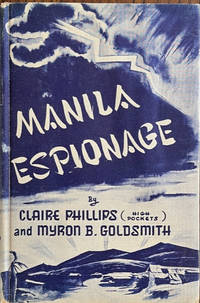
[WOMEN -- WORLD WAR II]. PHILLIPS, Claire & GOLDSMITH, Myron B
Manila espionage. . . by. . . High-Pockets.
Portland OR: Binfords & Mort 1947. 8vo. 8 226 pp. Pictorial light blue publisher’s cloth w/ artwork reproducing the cover art of the dustjacket blue & white minor rubbing shelfwear slight bumping to couple corners w/ d.j. minor chipping head & foot of spine couple minor closed tears some age toning still VG/G- copy inscribed by Claire Phillips on the ffep. First edition signed of this rare and exciting story of Claire Phillips --an Oregon Native -- who married an American officer before the fall of Bataan opened a nightclub became a spy fought for the Philippine Underground and was eventually captured and tortured at the notorious Bilibid Prison near the Cabanatuan Prison Camp. In January 1945 she was liberated by American Forces and received the Presidential Medal of Freedom in 1951. This was made into the movie I was an American spy starring Ann Dvorak Gene Evans Richard Loo and directed by Lesley Selander. Binfords & Mort, hardcover
Référence libraire : 55077
|
|
|
[WOMEN -- WORLD WAR I]. McKENNA, Marthe [Mathilde Cnockaert].
Spies I knew.
New York: Robert M. McBride & Co. 1934. 8vo. xx 21-266 pp. Photo frontisp. numerous photo plates illustrations. Orange cloth silver lettering w/ d.j. photo cover art of images from World War I minor chipping head & foot of spine dustsoiling still NF/VG- copy. Second edition of this rousing sequel to “I was a spy†recounting the World War I espionage adventures of the six spies the author mostly closely interacted with while working as a nurse for the Germans and passing on information to British Intelligence during the war. Robert M. McBride & Co., hardcover
Référence libraire : 53799
|
|
|
[WOMEN -- WORLD WAR II AVIATION]. RICKMAN, Sarah Byrn; SCOTT, Dorothy
WASP of the Ferry Command: women pilots uncommon deeds. Foreword by Deborah G. Douglas; Finding Dorothy Scott: letters of a WASP pilot.
Denton & Lubbock TX: Univ. of North Texas; Texas Tech University Press 2016. Two vols. 8vo. xvii 5 440; xxiii 1 245 1 pp. Frontisp. in 2nd vol. with photo illustrations throughout. 1st vol. w/ blue boards black lettering & 2nd w/ half-beige cloth over Army green metallic green lettering both with d.j.’s NF/NF set. First edition 1st printing of both volumes detailing the careers personal lives and extensive training of the over 1100 women aviators flying as WASP ferry pilots during World War II. They delivered over 72 different aircraft logged 115000 flight hours and were crucial in the delivery of P-51 P-47 and P-39 fighter aircraft to the European theatre. Dorothy Scott was one of the pioneering women aviators initially known as WAFS Women’s Auxiliary Ferry Squadron and died in a mid-air crash at the age of 23 in Dec. 1943 over California delivering a P-39 fighter aircraft. Univ. of North Texas; Texas Tech University Press, hardcover
Référence libraire : 61378
|
|
|
[WOMEN -- WORLD WAR I]. THERESE, Josephine (pseud).
With Old Glory in Berlin: the story of a young American girl who went to Germany as a music student in the fall of nineteen sixteen lived in Berlin for thirteen months and made her escape eight months after America had entered the conflict.
Boston: The Page Co. 1918. Tall 8vo. xii 4 319 1 pp. Photo frontisp. 16 photo plates. Blue pictorial publisher’s cloth cover art of young girl peeking out through window at passing German soldiers lettering in red & gilt very minor shelfwear w/ d.j. cover art of woman in red white & blue holding shield & sword w/ running German soldier chipping & tears to upper fore-edge some lettering perished minor chipping to spine dustsoiling still NF/G- copy. First edition of this pseudonymous memoir recounting a young woman’s experiences studying with the Berlin Opera from 1916 to early 1918 when she manages to return back home to Boston MA. She recounts recurring and arbitrary restrictions curfews expired documents Americans summarily executed in police stations struggles while studying music fending off suitors until finally securing an admirer’s assistance to obtain a precious Norwegian passport and visas to return to the U.S. Very scarce with original dustjacket. The Page Co., hardcover
Référence libraire : 60116
|
|
|
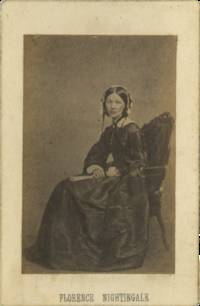
[Women's History – Medicine – Crimean War – Early Photography] Kilburn, William Edward [Nightingale, Florence]
Carte-de-Visite Portrait of Florence Nightingale
N.p. 1870. Carte After the original photograph by William Edward Kilburn 1818–1891 taken circa 1854 with later CDV issue probably circa 1870s. Albumen print mounted on card; sitter identified in print beneath image. Standard carte-de-visite format approximately 2½ x 4 inches. Excellent contrast with light surface wear. Seated three-quarter portrait of Nightingale in dark silk dress with white collar hands folded over a paper posed beside an upholstered Victorian chair. The image derives from a sitting arranged in London with William Edward Kilburn one of Britain’s early professional photographers and a former daguerreotypist who gained fame by exhibiting at the Great Exhibition of 1851. By the early 1850s Kilburn had established a reputation for photographing members of the aristocracy and prominent public figures.<br /> <br /> The Nightingale sitting happened shortly before her departure for the Crimea in October 1854 at a moment when her name was just entering the public press. The portrait predates her full transformation into the national icon later known as the “Lady with the Lamp.†Unlike later more romanticized images Kilburn’s photograph presents a composed unsentimental likeness more consistent with standard portraiture practices than her later photographs. Following Nightingale’s wartime service at Scutari 1854–1856 and the subsequent surge of public acclaim Kilburn’s image became the primary photographic source from which engravings lithographs and later carte-de-visite reproductions were made.1<br /> <br /> 1 Denis Pellerin “Florence Nightingale: The Mystery Behind Her Iconic Photographs†The Classic November 15 2020 https://theclassicphotomag.com/florence-nightingale-the-mysteries-behind-her-iconic-photographs/ accessed February 27 2026. unknown
Référence libraire : List36105
|
|
|
[Women's History - World War II – Women's Army Corps – VE Day – Pacific Theater] Bremer, Mary J; Miller, June; Melotte, John
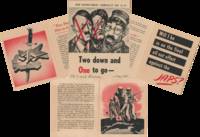
Collection of a Women’s Army Corps Technician Concerning VE Day Reassignment to the Pacific Theater and Processions for Roosevelt and Eisenhower with Lyrical Descriptions of Paris on V-E Day
Paris France; and Washington D.C. 1945. Six 8 x 10 inch and smaller typed pages; one 4 x 5 inch card with two tickets; one twenty-six page 4 x 5.5 inch pamphlet; one six page 6 x 8.5 inch pamphlet; six 2.5 x 3.5 photographs and two 3 x 4.5 inch photographs. Of the printed matter most is affixed to paper some small tears and folds; overall excellent; photographs near fine. Mary J. Bremer 1917–2019 was a Technician fourth grade from Grant Township Nebraska. Her correspondents here include June Miller 1920–deceased an aviation cadet from Michigan and John Melotte 1919–deceased an artilleryman from Philadelphia. Bremer and Miller were members of the Women’s Army Corps WAC. Established in May of 1942 as the Women’s Army Auxiliary Corps the WAC converted to active duty in July of 1943. The women of WAC known as Wacs served in noncombatant roles across the various theaters of World War II.<br /> <br /> Offered here is a small archive of Bremer’s documents and photographs relating to WAC: a few letters including a description of Paris the day after the Nazi surrender; two pamphlets including the War Department pamphlet Two down and One to go –; and a collection of photographs of Eisenhower’s victory parade and Roosevelt’s funeral procession.<br /> <br /> On April 12 1945 President Roosevelt died of a stroke in Warm Springs Georgia. His body was returned to Washington two days later and a military procession escorted it from the train station to the White House. Two photographs of the funeral procession are included in the archive. One showing a woman at the start of a section of the parade is identified verso as “WACs led by Capt. Machenâ€.<br /> <br /> The following month the Nazis surrendered. Bremer’s friend June Miller was stationed in Paris at the time. She wrote to Bremer the next day describing the celebration:<br /> “It began the night before when we stood on the roof and watched the flares go off all over the city--just like the 4th of July; the Sacred Couer was blazing with lights and it looked like a miniature fairy-land. Last night all the famous old buildings including the Arc d’Triumph was all lit up the fountains in the parks at Concord in front of the Trocadero--they were all going and the kids were wading and splashing around having the time of their life. It was really something to see--something the French had been waiting a long time for. “Fini le guerre†they kept saying--the end of the war!â€<br /> <br /> Miller also claims to have witnessed a bomber flying a celebratory loop through the Eiffel Tower:<br /> <br /> “When we came out of the Trocadéro the fountains were on and what a sight that is. Looking down over the water that looks like a miniature waterfall to the Eiffel Tower at the bottom of a small hill. And if I hadn’t seen it with my own eyes I would never have believed that I saw a small bomber come through the bottom but that’s just what it did--and just did clear it too. The planes seemed to be going as wild as the people on the ground--they were so thick up there that pretty soon we thought surely something would happen.â€<br /> In June Dwight Eisenhower returned from Europe and a homecoming parade was held for him in Washington D.C. Six photographs of this parade are included in the archive including a shot of his plane arriving at the airport and one where he is visible standing in the back of a Jeep.<br /> <br /> Miller notes in her letter from Paris that “you wondered what was coming next; where we would go from here ‘cause in a sense there is still a war very definitely going onâ€. In fact John Melotte who seems to be Miller’s partner writes to Bremer that he “May be slated for that place they call the CBI but don’t tell June please. She does not want me to even mention the place in my letters so I let well enough alone†July 15 1945. Hostilities would continue in the CBI—the China-Burma-India theater—until September of that year.<br /> The process by which soldiers were selected to be sent to the Asia-Pacific theater is laid out in the War Department pamphlet Two down and One to go –. The pamphlet reminds them that there are still “a couple of big jobs ahead†the primary one being to “crush†or “smash†the “Japs†and the second one being to occupy and police “conquered lands . until the peril of future aggression is gone.†It is a visually striking piece with illustrations in a bold black and red color palette; its cover is a reproduction of a caricature of Hitler Mussolini and Hirohito by Polish-Jewish artist Arthur Szyk.<br /> <br /> Also included in the archive are a card from a friend with tickets to an American League baseball game; a humorous poem congratulating Wacs Ruth O.B. and Lenore I. Nier on new work assignments; and a Christmas 1945 WAC pamphlet with a dinner menu and list of WAC officers. The pamphlet assures the Wacs with a note from Colonel Kenton Cooley “Before another Christmas you all will have returned to civilian life and each of you will take with you my appreciation and my sincere admiration for a great job well done.â€<br /> Of interest to scholars of women’s history especially in the military; and of the events leading up to the end of the Second World War. unknown
Référence libraire : List2747
|
|
|
[WOMEN'S HISTORY & LITERATURE] [WORLD WAR II]
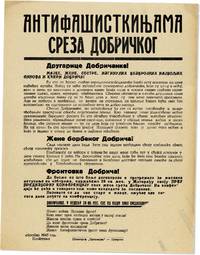
To The Anti-Fascist Women of The DobriÄko Region
Prokuplje: Prekomurac Printing House October 1945. 40cm x 30cm. Single sheet of newsprint style paper printed recto only with a printer's error to the bottom right corner where the paper has been folded over as it entered the press so a fragment of the text is printed in error to the verso. Some trifling toning to the edges otherwise a very good example indeed and an almost miraculous survival.<br /> <br /> Simultaneously a call to action a plea for political support and a memorial to the great deeds of the women of the DobriÄ Province during WW2 distributed by the People's Front Party and the Anti-Fascist Women's Front of what would become the Socialist Federal Republic of Yugoslavia;<br /> <br /> "Mothers Wives Sisters and the Many Great Sons and Daughters of the Good Men who are Missed!" would be an approximate translation of the sub-heading. <br /> <br /> The main body of text printed in cyrillic goes on to list the wartime exploits of these women and less specifically their men; "We will never forget the sacrifice of the women from Dobrich who went day and night summer and winter throught the mountains and valleys of our region and brought our famous partisans clothes food ammuniotion and information. The ferocious occupier and his informants our home-grown traitors knew of these deeds and that is why they persecuted you women in particular. But neither prisons nor beatings nor camps nor shootings nor the burning of your houses truly swayed you from the right path for the good of The People." <br /> <br /> The text goes on to detail the immmediate post war collective efforts of these women; caring for the wounded adopting orphaned children and helping with the provincial administration both for the living and the dead. These actions it is maintained strengthened the People's Front to the point where it has become the only clear choice for the future of the region; the women of "Fighting DobriÄ" therefore must ensure their vote in the upcoming elections is cast for the People's Front so as to "elect worthy sons of the people as our representatives in the Constituent Assembly."<br /> The dense and rather understandably enthused broadsheet concludes with the patriotic cheer:<br /> <br /> "Long Live The People's Front!<br /> Long Live the First Free Elections in Our Country!<br /> Long Live Women's Rights and Freedoms!<br /> Long Live the Frontline Soldiers of the DobriÄki Section!<br /> Long Live Our Candidates!<br /> Long Live The Anti-Fascist Women's Front of Yugoslavia!"<br /> <br /> A courageous and uncompromising piece of antifascist ephemera from a region that was subject to a brutal Wehrmacht campaign assisted by local Chetnik collaborators and the UstaÅ¡e forces that was rightfully regarded as genocidal ethnic cleansing in post-war analyses. The Yugoslav Partisans however refused to capitulate and supported by an increasingly decimated local population fought relentlessly until the collapse of the Reich before victoriously proclaiming the foundation of the Socialist Federal Republic of Yugoslavia. No examples of this piece appear in OCLC and no trace can be found of its distribution in the public record. Prekomurac Printing House unknown
Référence libraire : 84546
|
|
|
[WOMEN] [WORLD WAR II]
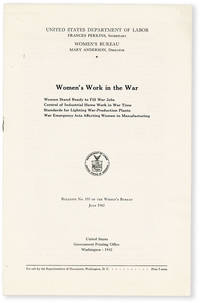
Women's Work in the War. Women Stand Ready to Fill War Jobs; Control of Industrial Home Work in War Time; Standards for Lighting War-Production Plants; War Emergency Acts Affecting Women in Manufacturing
Washington DC: United States Government Printing Office 1942. First Edition. Slim octavo 23cm; original printed wrappers stapled; 10pp. Mild wear and handling else Near Fine. Pamphlet issued as "Bulletin No.193" of the Women's Bureau U.S. Department of Labor highlighting the contributions of nearly 1.5 million newly-registered women in unemployment offices around the country. United States Government Printing Office unknown
Référence libraire : 50712
|
|
|
[Women]: [Civil War]: Barton, Clara
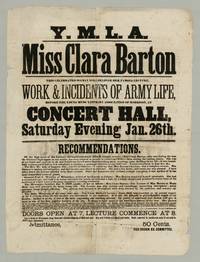
Y.M.L.A. Miss Clara Barton. This Celebrated Woman Will Deliver Her Famous Lecture Work and Incidents of Army Life Before the Young Mens' Literary Association at Morrison. caption title
Morrison WI 1867. Broadside 26.75 x 20.25 inches printed on thin paper. Old folds some creasing edges occasionally a bit frayed with a few small nicks or tears a couple of minor losses along folds. Overall very good condition. A striking and seemingly unique surviving broadside advertising a January 26 1867 lecture by Clara Barton entitled "War & Incidents of Army Life" part of a popular post-Civil War lecture series she delivered across the United States. Barton spent two years touring and recounting her battlefield experiences which helped popularize her and fund her subsequent efforts to locate missing soldiers. The present lecture was delivered to the Young Men's Literary Association of Morrison Wisconsin at the local Concert Hall. In addition to the bold title containing the relevant information on the lecture and the information on obtaining tickets at the bottom much of the lower portion of the broadside prints several laudatory "Recommendations" from various entities in Indiana and other locations in Wisconsin including a January 7 1867 review from The Milwaukee Sentinel. Noted temperance lecturer John B. Gough also praises Barton's lecture stating that "I never heard anything more touching more thrilling in my life."<br /> <br /> Typographically the broadside is interesting for employing several sizes of fonts likely wooden type especially near the bottom of the Recommendations section where the printers needed to reduce the size of the font to fit in the entirety of a quote from The Daily Wisconsin as well as a line in the smallest font from the Concert Hall promoter noting that the foregoing group of recommendations is "enough" and praising Barton for her "noble character which she has won by her efforts to ameliorate the sufferings of our sick and disabled soldiers."<br /> <br /> Clara Barton 1821-1912 was a noted educator and humanitarian who helped distribute needed supplies to the Union Army during the Civil War and later founded the American Red Cross. Barton garnered nationwide recognition for her efforts during the war and quickly became known as the "Angel of the Battlefield." After the war Barton's lecture tour brought her in contact with other notables of the day including Susan B. Anthony and Elizabeth Cady Stanton and also Frederick Douglass who involved her in the suffrage and civil rights movements respectively. In the Fall of 1866 Barton began to lecture on her Civil War experiences in lyceum halls churches town halls and schools. Though she never felt comfortable in front of an audience wherever she spoke Barton was well received. Her contemporary biographer Percy Epler wrote that "a tear-stained multitude thronged everywhere to hear her" as she had made it her mission to show not "the glories of conquering armies but the mischief and misery they strew in their tracks; and how while they march on.some one must follow closely in their steps crouching to the earth faces bathed in tears and hands in blood. This is the side which history never shows."<br /> <br /> From 1866 through 1868 Barton delivered over 200 lectures throughout the northeast and midwest regarding her Civil War experiences. She shared platforms with other prominent figures including the aforementioned Douglass as well as Ralph Waldo Emerson William Lloyd Garrison and Mark Twain. She often earned $75 to $100 per lecture. Original broadsides advertising her lectures especially of this size are exceedingly rare to say the least. We could locate just a single result in auction records of a much smaller example and OCLC reports just one institutional holding of any Barton lecture broadside again much smaller for an 1867 event in New Haven located at the Library of Congress. unknown
Référence libraire : 13090
|
|
|
[World Jewish Congress]
JEWISH COMMENT. VOL. II. NO. 23. OCTOBER 21, 1944. RESTORATION OF JEWISH RIGHTS: A STATEMENT OF THE WORLD JEWISH CONGRESS
Paper Wraps. 8vo. 4 pages. A statement from the World Jewish Congress, in light of the Nazis rise to power in Germany and the ensuing assault on Jewish rights, urged governments to undertake a four part rehabilitation of Jewish rights. OCLC lists no copies worldwide. Two small tears to edge and loose crease down middle, but all text is clear. Very good condition. (HOLO2-47-3) .
|
|
|
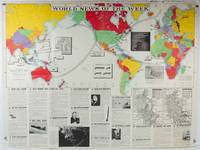
[WORLD MAP - WORLD WAR II]
World News of the Week. Monday Apr. 13 1942. Covering period Apr. 3 to Apr. 9. Military Edition.
Army Orientation Course. / News Map of the Week Inc. Volume 4 No. 32. 13 April1942. Folding colour pictorial map on sheet 88 x 119 cms blank on verso inset maps two photographic diagrams and black and white photographic illustrations descriptive text top edge chipped a few short edge tears and lower corner torn no loss pinholes at the corners inoffensive tidemark at a lower corner in good condition. Colour world map showing political boundaries and military events of World War II from April 3 to 9 1942. with descriptive text beneath including: the loss of two British Cruisers off Ceylon; the occupation of Bataan by the Japanese and their landing on Manus; Japanese war tactics revealed by Malay prisoners and the increasing importance of Central Africa to the Allied war effort. The. Map is indexed according to these notes. Two inset maps of Europe chart Hitler's gains in 1941 and activity on the Russian Front. Additional diagrams on the main world map show war spending and the civilian and war output of US industries. . Army Orientation Course. / News Map of the Week, Inc. unknown
Référence libraire : 202620
|
|
|
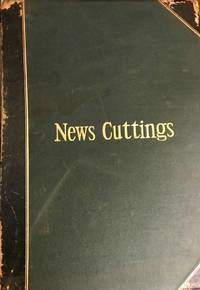
[World War I] [England] [London Times]
1914 World War I English Newspaper Scrapbook filled with articles clipped from the London Times
London 1914. Scrapbook. Fair. Folio. Scrapbook. Approx. 15" x 10.5". 22 alphabetized thumb index pages with written contents 119 pages with 63 pages used for pasted down news clippings. Pages 64-119 are blank. Green cloth covered boards with leather corners and edges. No spine. Gilt stamp title "News Cuttings" stamped on the front cover. Outer hinges are cracked. Boards are edge worn. Brittle newspaper clippings have toning edge wear tears splits and are flaking. Scattered glue stains to several pages. <br /> <br /> The news articles are chronologically pasted down or tipped in. All appear to be from the London Times newspaper. The first articles are dated August 1 1914 and the last article is dated October 1 1914. Some pencil dates and page numbers written in the upper corners. Provenance unknown. A partial cut piece of cardboard with an inscription written on one side not legible and the name of "A Martin-Leake" written on the other side was found inside the Scrapbook. Many of the articles are folded over and several have map illustrations. World War I officially started July 28 1914. These articles provide a first hand daily report of the early stages of World War I in Europe. A potential association with the scrapbook to "A Martin-Leake" whose name was found inside. From wikipedia: Lieutenant-Colonel Arthur Martin-Leake VC & Bar VD 4 April 1874 – 22 June 1953 was a British physician officer in the Royal Army Medical Corps and a double recipient of the Victoria Cross VC the highest award for gallantry in the face of the enemy that can be awarded to British and Commonwealth forces. Martin-Leake was the first of only three men to be awarded the VC twice the others being Noel Godfrey Chavasse and Charles Upham. unknown
Référence libraire : 33747
|
|
|
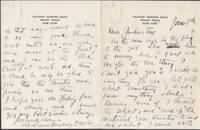
[World War I] [Richard Harding Davis]
1915 World War I era two page hand written letter to "Johnstone" with reference to the Red Cross and being at the "Front" WITH Photograph portrait of Richard Harding Davis
Mount Kisco New York: n.p. 1915. n/a. Letter. Very good. Letter. Two pages. Paper measures approx. 7" x 5". Written on the writers letterhead. Removed staple upper left corner. Included with the two page letter is a silver gelatin photograph portrait approx. 5" x 3.5" of a well groomed Davis. Paper and photograph in very good condition. <br /> <br /> Richard Harding Davis was a writer journalist and World War I correspondent. He was friends with Theodore Roosevelt. This letter was written less than 1 year before his death from heart attack at his home in Mount Kisco New York at the age of 51. Transcribed letter reads:<br /> <br /> Dear Johnstone<br /> <br /> As the man says in the play to the girl who wants to marry her "Don't ask me for one thing I can't give you." I would do anything for you but write about something I don't know anything about. Besides even if I studied the subject and "read up" the material you threaten to send me what I would write in that way would do none of us any good. Please wait until we are all once more at "the front" and I can see the Red Cross people at work and then I shall only be too glad to give them the thanks and praise we owe them.<br /> <br /> I hope you are feeling fine and daisy and I send you my best wishes always.<br /> <br /> Sincerely yours <br /> <br /> Richard Harding Davis. From wikipedia:<br /> <br /> Richard Harding Davis April 18 1864 – April 11 1916 was an American journalist and writer of fiction and drama known foremost as the first American war correspondent to cover the Spanish–American War the Second Boer War and the First World War.1 His writing greatly assisted the political career of Theodore Roosevelt. He also played a major role in the evolution of the American magazine. His influence extended to the world of fashion and he is credited with making the clean-shaven look popular among men at the turn of the 20th century.2. n.p. unknown
Référence libraire : 35587
|
|
|
[WORLD WAR II -- HOLOCAUST & DACHAU]. [DALY, Lt Hugh C, et al]; MacKECHNIE, Theodore (Artist); DOUGLASS [WHITE], [Ruby] Jane & B
42nd “Rainbow†Infantry Division: a combat history of World War II; This cartograph shows the “Trail of the Rainbow†from the time of its landing in France through its battles and victories over the Germans to its final occupation in Austria; Rainbow fighting song; Rainbow Valley dedicated to mothers wives and sweethearts of “Rainbow†men.
Baton Rouge LA; Germany: 42nd “Rainbow†Infantry Division Army & Navy Publishing Co. 666th Engr. Topographic Company 7th Army 1946. Four pieces. 1st -- 4to. 9.25 x 12.25 in. 188 pp. Colour maps and photo illustrations throughout some full page. Embossed blue publisher’s calf Divisional insignia and lettering in red & gold & green minor bumping to corners slightly shaken still VG copy; 2nd -- Oblong atlas folio. 1 colour pictorial map sized 25 x 19.5 in. printed in 4 colours depicting the route of the 42nd across Europe minor creasing thumbing edgewear couple minor holes still a G copy now shrink--wrapped on archival foam core; 3rd - Oblong folio. 19 x 12.75 in. Double-page broadside sheet music score shrink-wrapped on foam core minor creasing edgewear; 4th - 9 x 11 in. 1 broadside sheet music score shrink-wrapped on foam core minor creasing still a VG set. First editions of four uncommon souvenir pieces for the famed 42nd Infantry Division during World War II who is best remembered as one of the three liberating divisions for the Dachau Concentration Camp on April 29 1945. Reactivated in July 1943 the original nickname “Rainbow Division†was coined by Douglas MacArthur as it was drawn from National Guards of 26 States and the District of Columbia in 1917 and in December 1944 they landed in the French port of Marseille. By mid-December the 42nd had advanced North into Alsace and fought the German Army ear Strasbourg. In march 1945 they crossed the Siegfried Line in the Hardt Mountains where there was hard fighting at Hatten. During the fighting against the last major German offensive a 242nd Infantry Congressional Medal of Honor winner repulsed several attacks. This Divisional History includes a number of graphic photos of their entry into Dachau and together with the 45th Infantry and the 20th Armored Division they helped liberate over 30000 prisoners from the Camp as well as those trapped on trains after being sent from Buchenwald and other concentration camps. The map created by MacKechnie 1923-2012 was produced only for his fellow soldiers not for publication and fought with the 42nd Infantry during the Rainbow Division campaigns including a number of humorous figures for his “Cartograph†although SS Skull & Crossbones for Dachau. Jane Douglass was a WAC officer during World War II music educator and songwriter who wrote many songs during World War II to promote the WAC’s and other Army Divisions. Captain Douglass commanded the first all-woman Special Service company. Worldcat locates 3 copies of the pictorial map NYPL TX A&M WI Vet. Mus. Res. Ctr; No copies located of either of the Jane Douglass songs. 42nd “Rainbow†Infantry Division, [Army & Navy Publishing Co.], 666th Engr. Topographic Company, 7th Army, unknown
Référence libraire : 63630
|
|
|
[WORLD WAR II -- ATOMIC ENERGY]. SMYTH, H[enry] D[eWolf].
A general account of the development of methods of using atomic energy for military purposes under the auspices of the United States Government 1940-1945. . . .
Washington DC: Adjutant General’s Office in the Pentagon August 12 1945. 4to. 194 pp sections all separately paginated I-XIII A1-A5. w/ first 4 leaves litho-printed on recto only. Cream-coloured litho-printed softcovers w/ “Released for Publication _________†on lower front cover dittoed notice at lower right corner of “Distributed by Technical Information Section of the Bureau of Aeronautics†stapled at gutter margin as issued minor soiling & spotting to front cover minor rust to staples minor bumping to corners light scuff to fore-edge of textblock printed in multiple grades of paper as issued w/ some sections more toned than others still a VG- copy numbered in ink at lower right corner. First lithoprint edition 3rd printing of 6000 total copies prepared by secretly lithoprinting in the Pentagon NOT 1000 copies as previously posited by Coleman & others in sections from modified dittoed versions which had been distributed under General Groves’s orders to correct the master copies with eventually whole paragraphs deleted or added in some chapters. This copy is entirely complete with none of the often missing pages especially p. VI-12 duplicates or misbound signatures which often appear due to the speed and paper requirements and also bears the colophon 25-56388-2M on page A5-1 at the rear indicating this was one of those printed on the high-sulphide paper often bearing signatures of varying toning. As per Arnold Kramish 1923-2010 nuclear physicist who worked Oak Ridge TN on the Manhattan Project and at the behest of Harry Smyth researched the printing history before 1985 of the original report and determined that there were 2000 copies released initially past the dittoed and mimeograph versions to the press and senior lab people. Due to early complaints of lack of access another 2000 were released followed by the much demanded 3rd release all before Princeton University Press released their published print run less than 1 month later in 1945. The famed Smyth report released to the public just after the United States had obliterated the cities of Hiroshima and Nagasaki using the first two atomic bombs at the end of World War II -- is “a remarkably full and candid account of the development work carried out. . . by the American-directed by internationally recruited team of physicists under the code name of Manhattan District. . . .†The introduction opens with statement that “The purpose of this report is to describe the scientific and technical developments in this country since 1940 directed toward the military use of energy from Atomic nuclei.†As an aside it should be noted that Michael Zinman has the original Arnold Kramish TLS identifying the printing history and an article is being prepared by Brett Tomlinson noted historian of science. See: Printing and Mind of Man 422e; Coleman The Smyth Report: A Descriptive Checklist Princeton University Library Chronicle Vol. 37 No. 3 Spring 1976 No. 3 pp. 206-207; For fuller explication of Linus Pauling’s dittoed version at OSU 1 of 2 known survivor copies see blog by Ann Bahde Serifs and Secrecy: The Smyth Report in SCARC Nov. 2 2021. [Adjutant General’s Office in the Pentagon], paperback
Référence libraire : 60559
|
|
|
[World War I]; [Navy]; [Prayer Books]; [Hymnals]; [Military]
A Prayer Book for the Public and Private Use of our Soldiers and Sailors; With Bible Readings and Hymns
Philadelphia: Bishop White Prayer Book Society 1917. Hardcover. Near Very Good. 16mo. 29 cm x 21 cm. 2 3-192 pp. Blue publisher's cloth with a red border on each board red lettering on the front board flexible boards. There is a pocket on the rear board but nothing is in the pocket. Immediately after the title page the book states the motives and objects of the First World war: "We are glad to fight for the ultimate peace of the world and for the liberation of its peoples the German peoples included; for the rights of nations great and small and the privilege of men everywhere to choose their way of life and obedience . ". It is an excerpt from President Wilson's statement on the United States entering the First World War. An inscription on the free front endpaper reads: "Willis Winfried/Winfreed 506 S. Neil The next line is illegible Illinois 1917 - U.S.A. Great Lakes Illinois". The owner of this prayer book was either trembling while writing his inscription or his ink was exposed to moisture though the paper itself has no dampstain. This book clearly traveled with the naval recruit to Great Lakes the naval training station just north of Chicago. Although we cannot identify exactly who the owner was the item is significant as it is a record of what kind of item was important enough to a Navyman to transport to a war zone based on the book's significant wear and use we believe it traveled to the European theatre after the recruit completed his training at Great Lakes. Significant rubbing to the cloth rear gutter is cracked but the binding is holding. Bishop White Prayer Book Society hardcover
Référence libraire : 000012500
|
|
|
[World War I; Souvenir kerchief]
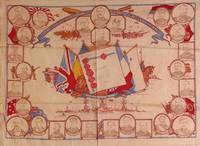
A Souvenir of the Great War" - Patriotic kerchief of the First World War
United Kingdom 1914. Very good condition. Souvenir kerchief printed on linen with the head and shoulders portraits of Allied leaders including from upper left corner clockwise: King George V; Viceroy of India; Mikado; at the center: Lord Kitchener; General French; Gr Duke Nicholas; General Joffre; at the right: King of Servia; Czar of Russia; General Botha; below this additional generals' portraits adorn the right bottom and left borders. A cavalry charge and an artillery attack are also illustrated. <br /> <br /> At the center is an illustration of a piece of note paper with red seals on it with facsimile signatures of the Generals and the motto "Our Word Our Bond" on a banner beneath. The Australian War Memorial holds a copy listed in their collection. Besides the 3 tiny ink spots it is in very good condition. Color lithographic kerchief 14" x 12 1/2" unknown
Référence libraire : 20000
|
|
|
[WORLD WAR I -- PANORAMIC PHOTO]. CLEMENTS, [Rell Sam & Albert Bennie (Photographers).]
A.E.F. arriving Newport News VA June 4 1919. #1366. One large panoramic photograph depicting the 88th Infantry Division thronging the decks of the USS Koningin Der Nederlanden ID-2708 entering port and being assisted by the tug Britannia before disembarking following World War I.
Washington D.C. & Newport News VA: United States Army American Expeditionary Force Clements 619 - F Street NW 1919. Oblong atlas folio. One large sepia-tinted panoramic photograph sized 35 x 8 in. w/ photographer’s imprint & caption w/in the negative at lower fore-edge slightly over-exposed minor tidemark to upper right blank corner preserved in the original silvered decorative wooden frame w/ archival foam core backing still a VG- image with bright contrast. One large original and striking panoramic photograph capturing the 88th Infantry Division or the “Cloverleaf Division†upon their return to the United States following World War I on board seized troopship the USS Koningin Der Nederlanden ID 2708. The 88th Infantry Division commanded by Major General Edward H. Plummer was formed at Camp Dodge in Sept. 1917 in Iowa and fought in the trenches during the Alsace Campaign aiding the French Army regain Alsace and Lorraine both of which had been lost 43 years earlier in the Franco-Prussian War suffering 590 casualties during the War. The photo documents them arriving June 4 1919 and by June 10 1919 they were demobilized at Camp Dodge IA and would remain inactive until called up during World War II in 1942. The USS Koningin Der Nederlanden had been built and launched as a Dutch Passenger steamship for the Netherland Line in 1911 running between Amsterdam and Indonesia but was seized by the United States under orders by President Wilson in San Francisco CA in 1918. She traversed the Panama Canal and embarked more than 2200 troops of the AEF to France and on her 3rd trip she reached Brest two days before the Armistice. She would later repatriate more than 10000 troops and after delivering the 88th was decommissioned and returned to the Dutch Shipping line. Clements commercial photographic firm was operated by brothers Rells 1883-1963 and Albert 1899-1968 who operated their studio on F Street in Washington D.C. and specialized in panoramic photos. During the 1920’s they became especially well known for their U.S. Naval airship photographs at Lakehurst. [United States Army], American Expeditionary Force, Clements, 619 - F Street NW, unknown
Référence libraire : 63115
|
|
|
[WORLD WAR II -- JAPANESE AVIATION]. [Kazuo Baba, Masao Horiba, Tadashi Itagaki, & Shoji Suzuki (Eds)].
Aireview’s General view of Japanese military aircraft in the Pacific War. 日本è»ç”¨æ©Ÿã®å…¨è²Œ/Nihon gun’yoki no zembo; General view of Japanese military aircraft in the Pacific War. English Text.
Tokyo Japan: Published for Aireview Kanto-sha Co. Ltd. 1956. Two vols. 324; 127 1 pp. 1st vol. with silhouettes of Japanese planes text photos diagrams photo plates 3 large folding plates maps on endpapers illustrated ads 2 large folding tables. Uniformly bound in red cloth gilt lettering front & back covers spines NF set. First edition in English of first vol. fourth edition of Japanese volume of this set compiling all the data and production information on Japanese aircraft activated for combat or test flown during World War II. The text & illustrations delineate Japanese Imperial Army aircraft Naval aircraft experimental aircraft supplementary notes and even those which remained unfinished at the end of the War. Published for Aireview, Kanto-sha Co., Ltd., hardcover
Référence libraire : 59022
|
|
|
[WORLD WAR II]. CALDWELL, Erskine
All-out on the road to Smolensk.
New York: Duell Sloan and Pearce 1942. 8vo. 4 230 pp. Beige cloth purple lettering on spine light offsetting to binder’s glue at gutter margins minor shelfwear w/ d.j. minor edgewear sunning to fore-edges still VG/VG copy signed by author on ffep. First edition signed of this first-hand account of the Nazi armoured divisions invading Russia to the gates of Moscow in World War II and the pivotal Battle of Yelnya which resulted in 45000 to 47000 German casualties. Duell, Sloan and Pearce, hardcover
Référence libraire : 56542
|
|
|
[World War I: Correspondence]
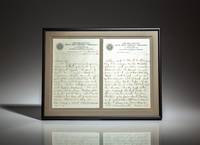
ALS from Corporal at Fort Benjamin Harrison Indiana - June 30 1917
Ft. Benjamin Harrison Indiana: ALS 1917. ALS. Paper Letter. Fine. Letter from an acting Corporal in Ambulance Company #16 stationed at Fort Benjamin Harrison Indiana before deployment to Europe in June 1917. Two-page letter written on "Army and Navy Young Men's Christian Association" letterhead. Framed with gray matte archival glass. This letter is written to "George" in New York. The Corporal spends most of the letter detailing camp life at Ft. Benjamin Harrison noting that a "about 20000 soldiers are here at present and over a thousand a day come in." He describes the offices as: "nearly all civilian doctors who have had training and got in the officer's reserve corps. They are very decent but occasionally make "bulls." An insightful look at camp life shortly before deployment to the European Theater. Ambulance Company #16 was part of the 6th Division Medical Regiment which deployed to France in early 1918. They were initially stationed along a "quiet" part of the line French-German line between Verdun and St. Mihiel the Toulon-Troyon sectors to train with French medical personnel. Ambulance Company #16 arrived in Brest France on February 5 1918 then quickly dispatched to Blois France where they assisted with soldier fatigue and general medical duties. On March 24 1918 they deployed to Revigny where they assisted in French hospitals and with evacuations of injured soldiers. ALS unknown
Référence libraire : 14234
|
|
|
[World War I: Medical Officer Training Corp]
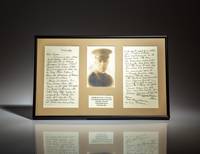
ALS from Medical Officer at Fort Benjamin Harrison Indiana - 1917
Ft. Benjamin Harrison Indiana: ALS 1917. ALS. Paper Letter. Fine. Letter from Harold J. Everett of Portland Maine a member of the Medical Officer's Training Corps at Fort Benjamin Harrison Indiana. Framed with matte finish monochrome photograph at center. Original letter in archival sleeve on verso. Letter reads in part: ".about 50 doctors have been drawn from this camp in the past two weeks for duty in France. The other day they made a request for twenty-five more to volunteer for immediate service. I did not placed my name down preferring to wait for a while yet.The men who leave are ordered to Washington but from what port they leave I cannot say. I shall all probably be eventually sent to a Foreign country - I am studying French now. The work is very hard.Affectionataly Yours Harry." Fort Benjamin Harrison was established as a training center for the Indiana National Guard in 1904 located 10-miles north of downtown Indianapolis. During World War I it became one of the largest Army training and mobilization sites in the United States due to central location and proximity to major transportation lines. ALS unknown
Référence libraire : 14235
|
|
|
[WORLD WAR II MAP - EUROPEAN COLONIALISM] BARRASS, CLIVE (MAPMAKER).
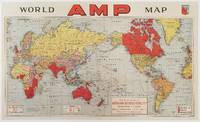
AMP World Map.
Sydney Australia.: Australian Motorists Petrol Company Ltd. A.M.P. pre1942. Large brightly coloured folding world map 51 x 97.4 cms map; 61 x 101 cms sheet archivally mounted on linen breaks at several folds and a minute bit of paper loss in the Celebes now Sulawesi and northern Afghanistan professionally repaired; in very good clean condition. World War II era advertising wall map printed in Australia for Australian Motorists Petrol Company Ltd. AMP now Ampol: "With the Compliments of Australian Motorists Petrol Co. Ltd. Authorized Capital £1000000" map text and pleads "In Wartime buy Australian" and "Australia Merits Preference". AMP was the first publicly listed Australian oil company. <br> <br>A colour-coded key identifies European colonial powers the continent of Africa being the recipient of multiple colonial claimants. British Imperial might was still dominant however claiming Australia New Zealand Canada Southern and Eastern Africa India and British Guyana. Notably Micronesia is identified as "Japanese Mandate" but the map was published before the Japanese occupation of New Guinea. Tannu Tuva now the Tuva Republic within the Russian Federation is noted separately as is Sinkiang now Xinjiang Uyghur Autonomous Region XUAR. <br> <br>A scarce map and when available usually in poor condition this copy in very good attractive condition archivally mounted and ready for framing. . Australian Motorists Petrol Company Ltd. (A.M.P.) unknown
Référence libraire : 210773
|
|
|
[World War II]. [Oklahoma]. Black, Kenneth
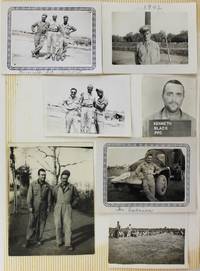
Annotated Vernacular Photograph Album and Scrapbook Documenting the World War II Experiences of Kenneth Black a United States Army Corporal from Oklahoma Serving in the 527th Fighter Squadron in Europe
Various locations in Europe mainly Italy but also France and Germany 1945. Very good. Forty-seven album leaves and plastic sleeves illustrated with approximately 350 photographs many with manuscript annotations a handful of personnel documents and numerous ephemeral items. Later black three-ring binder used to re-house original album leaves and sleeves. Moderate soiling to album. Contents largely in nice shape. A unique view of the European region of World War II through the eyes of Kenneth Black a U.S. Army private then later corporal hailing from Lamont Oklahoma where he worked as a farmer. This densely-packed collection of photographs and ephemera documents Black's service as a truck driver for the 527th Fighter Squadron in France Italy and Germany during the conflict. While there Black participated in several battles in Italy southern France and Central Europe earning six commendations including a Good Conduct Medal. Black enlisted in the Army on April 14 1942 and served throughout the war mustering out on October 24 1945.<br /> <br /> The photographs include dozens of portraits of Black posing by himself or with fellow named soldiers and capturing them posed with their vehicles on airfields and in camp walking the streets in various European cities along the Italian coastline at Mount Vesuvius visiting bombed out fields south of Rome and various ruins posed at the Pisa Airfield traveling along the Rhine River and the autobahn in Germany and more. There are also dozens of images of fighter planes a handful showing their nose art taken from the airfield and sometimes from inside the airplanes themselves. A handful of images record crashed aircraft on various airfields or bombed out cities. Identified locations include the French island of Corsica; the Italian cities of Caserta Pisa where he had a particular fascination with the Leaning Tower snapping about ten pictures Salerno Naples Rome where he is obviously enamored of the architecture of the city Grossetto and Pomig; and the German towns of Darmstadt "before the bombs went to work on it" and Mannheim. He also includes images of the 86th Fighter Group Orchestra playing at a hospital in Rome and floods near Pisa and Grossetto.<br /> <br /> The ephemeral items include two different versions of Black's honorable discharge his "Separate Qualification Record" a letter he wrote home while in Europe a mimeographed illustrated roster of the 527th Fighter Squadron various mimeographed newsletters menus and similar publications collected during the war newspaper clippings and later extracts from magazines showing locations Black visited during his service. A large collection of images featuring a humble Oklahoma farmer lumbering through three different European countries during the Second World War. unknown
Référence libraire : 3142
|
|
|
[World War II]. Gamon, John A
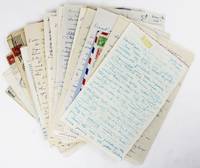
Archive of Manuscript Letters by U.S. Navy Commander Capt. John A. Gamon Jr. Writing Home to His Wife During the Interwar Period World War II and the Korean War
Various locations 1952. Very good. Approximately 230 manuscript or typed letters signed totaling about 550 pages almost all with original transmittal envelopes. Minor overall wear. A voluminous collection of original correspondence sent home by United States Navy Commander John Arthur Gamon Jr. 1910-2001 covering almost twenty years of his military service encompassing the interwar period World War II and the Korean War. John A. Gamon was raised in Berkeley California then trained and served as a pilot in the Navy. The overwhelming percentage of the present collection includes letters written from him to Helen Mae Hall who shortly became Helen Mae Gamon. His first few letters here are written to "Miss" Helen Hall while his June 9 1937 letter addressed to "Mrs. John A. Gamon Jr." The couple had at least two children who are mentioned in the letters named Goodie and Jona. Gamon served in the Navy until 1960. He passed away in San Diego on September 2 2001.<br /> <br /> Gamon's letters are chock full of information about his activities both professional and personal his leisure activities in various port cities and at naval bases throughout the country and more over a seventeen year period. The collection includes around 200 letters by Gamon to his wife twenty-five letters from Helen back to him and a handful of family letters. The great majority of Gamon's letters around 150 total were written during World War II or the Korean War. His prewar letters were sent from the U.S.S. Oklahoma at home in Berkeley at port in Tacoma Honolulu Panama San Diego Pensacola Norfolk various inland locations and others. Gamon frequently reports on his flying adventures his activities and the specifics of life aboard ship as well as those of fellow sailors mentions the books he's reading movies he's seen describes his various social activities and more. He also asks Helen to report on home front activities and regularly requests various family news.<br /> <br /> The great majority of the letters were sent home by Gamon while serving with the U.S. Navy during World War II in 1943 and 1944. When the war began Gamon was a lieutenant commander stationed in Virginia then he moved around to Florida New York Rhode Island Virginia and California. Because he served largely on the home front during the war Gamon's letters do not include much content on the war itself; the letters are in a sense the record of a marriage lived out at a distance and in letters. As with his earlier letters Gamon reports on his professional and personal life in the Navy then touches on issues at home and continually expresses a profound sense of love for Helen and his family across the miles. Gamon's later letters dated between 1948 and 1952 are largely of the same nature while he was stationed in Washington D.C. and then again in San Francisco. However much of Gamon's 1952 letters which emanate from the last half of the year are written from various locations in Japan where Gamon was apparently providing naval support during the Korean War. As in the earlier letters Gamon mentions his piloting activities but without a great deal of detail. As with most letters written during the Second World War and in Korea military letters were subject to censors; several of the letters here exhibit approval stamps from the censors. Helen's twenty-five letters to Gamon report much from the home front including family news and the activities of their children; in one early letter Helen has drawn herself as a pregnant stick figure. The collection contains much to mine for researchers looking into marital relationships in the mid-20th century. unknown
Référence libraire : 2530
|
|
|
[World War I]. [American Expeditionary Force, Siberia]. Soden, Lester W
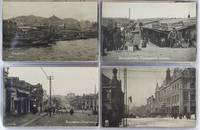
Archive of Annotated Real Photo Postcards Picture Postcards and Photographs Amounting to a Narrative of an American Serviceman's Experiences in Russia During the American Expeditionary Force in Siberia As Well As Several Other Locations Around the World
Vladivostok Russia; China; Japan; Philippines; Cuba; Panama; and Egypt 1922. Very good plus. Ninety-six real photo postcards postcards and photographs each about 3.5 x 5.5 inches or slightly smaller. A very well-preserved group arranged in clear plastic sleeves in a brad-bound folder. An informative and ultimately unique collection of mostly annotated images documenting the military exploits of Lester W. Soden of Portland Oregon a Navy Midshipman serving in important locations in Asia and elsewhere in the years immediately following World War I. Soden sent the postcards and photographs home to various family members and friends in Portland Oregon. On the verso of the great majority of the postcards and photographs Soden has added vital typed or handwritten captions describing the subject location or other important information for each image as well as occasionally adding a personal note about them. Most of the images do not exhibit postmarks so were likely sent along by Soden with letters.<br /> <br /> Most important among Soden's experiences here and encompassing almost half of the images forty-seven in fact was his time in Vladivostok Russia in 1918-1920 as part of the American Expeditionary Force Siberia. All but four of the postcards and photographs from Russia have typed captions on the verso providing critical background information on Soden's experiences. Soden's captions run from one line "Street scene in Vladdie" to a couple of lines "View of Vladivostok Siberia showing section of the city along the tracks of the Siberian railroad and one of the fine Russian churches in the back ground. This was taken but a week ago" to detailed much longer efforts for example: "Since coming to Siberia I have not seen a single saw mill where modern machinery such as power driven saws and etc was used. Here is a picture I took the other day in Vladivostok showing the Asiatic method of making lumber. The Chinamen do the work two men to a saw one on top of the framework that serves for a work bench the other stands on the ground and away they saw on logs turning out lumber of various thicknesses. When first I witnessed such ancient methods it seemed as tho I had stepped into a land of long ago but time has accustomed me to such sights in Siberia."<br /> <br /> Soden's other images provide a deep picture of the Vladivostok area at a crucial time in its history picturing street scenes the funeral of "a deceased shipmate who died at Vladivostok" the Bay of the Golden Horn Japanese headquarters and a Japanese market in the city troops and ships from other Allied countries a YMCA train car serving coffee to soldiers a Bolshevik armored car stuck in the mud a portrait of Czech leader General Radola Gajda here spelled Gaida two images of Gajda's armored train car which he used in a failed attempt to occupy Vladivostok in 1918 and much more. Part of the Allied mission in Vladivostok involved protecting and providing passage for Czech troops who had fought for their own freedom against Lenin and the Russian revolutionaries. One of Soden's captions concern these freedom fighters: "Czech troops along the trans-Siberian R.R. coming into Vladivostok. They have some sort of decorations on the cars. You will notice the odd style of cars used with single axeled wheels that are not solid steel like the car wheels we have in the States where only double tracks are used. The cars here are very short tho once in a while one notices standard sized cars with double tracks identical to the ones used in the States in fact they were built there."<br /> <br /> In addition to his time in Siberia Soden also served in China Japan Manchuria the Philippines Egypt Panama and Cuba. Seventeen postcards document his experiences in China as well as sixteen in Japan and Manchuria eight in the Philippines and the remainder from Egypt Panama and Cuba. Most of these images are also captioned on the verso picturing street scenes a Peking sawmill the city of Shanghai Tartar Wall Hankow a Dragon Festival in Hong Kong the Nanking Road and more in China. Most of the Japanese images show the celebrations in Tokyo for the return of Hirohito from a tour of Europe but also temples in Nikko the American fleet in Yokohama and two street views of Dairen City Manchuria. Other images depict a child's funeral "The other day I was lucky enough to see a native funeral one of the strangest sights I've ever seen. You would think it's a parade" and a Manila river scene in the Philippines; Guantanamo Bay in Cuba; the United Fruit Company's offices in Panama; and more. The only non-visual item included with the postcards and photographs is a black ribbon reading "U.S.S. Scorpion" presumably Soden's ship. unknown
Référence libraire : 3734
|
|
|
[WORLD WAR I] MALONE, Paul B
Barbed Wire Entanglements
Harrisburg PA: Stackpole Sons 1940. First Edition. First Printing. Octavo 22cm; red cloth titled in black on spine and front cover; dustjacket; 89-3973pp. Spine ends gently nudged else a clean very Near Fine copy. Dustjacket is unclipped priced $2.50 showing modest shelfwear some shallow losses to spine and corner tips with a closed tears and attendant creases; Very Good. <br /> <br /> World War I novel by retired U.S. Army Major General Paul Bernard Malone 1872-1960 "a thrilling story of young American men and women caught up by our participation in the first World War and thrown together during the breathless days of frenzied preparation in America and of fierce heroic struggle in France.at once a warning and an inspiring patriotic message to the people of America" from front flap. 87084. Stackpole Sons unknown
Référence libraire : 87084
|
|
|
[WORLD WAR II -- AVIATION]. [PROPER, Colonel Louis W (Commanding Officer) & FAUSSET, Jr, Private GF (Editor)]. G F
Bee Tee 44-E. Army Air Forces Pilot School Basic. Gardner Field. . . .
Gardner Field CA: Army Air Forces March 1944. 4to. 44 pp unpaginated. title in blue & black photo illustrations throughout double-page colour photo centerfold. Colour-illustrated softcovers cover art of Army Air Force trainers on the field minor edgewear creasing still VG copy. First edition of this scarce souvenir book for the 44-E training squadrons at Gardner Field in March 1944. The field located 9 miles East of Taft CA trained cadets in Link Trainers and single engine Vultee BT-13A aircraft operated for 46 months and managed to graduate 8916 pilots during World War II. Worldcat locates 2 copies Brown Mid-Continent Pub. Lib. [Army Air Forces], paperback
Référence libraire : 56700
|
|
|
[WORLD WAR I -- PHOTOGRAPH].
Belgian armored train in action! The armored train used by the Belgians is seen in action near Antwerp. . . advertising press photo for image used by the Christian Advocate and the New York Times October 23 1914.
New York: Photograph by Underwood & Underwood Elliott Service Co. 110-112 West 40th St. Oct. 22 1914. One large silver gelatin photo 11 x 14 in. w/ printed text attached below sized 5.5 x 14 in. minor creasing edgewear 1 very small chip at left white margin of photo still a VG exemplar. Original press photo news advertisement for promoting stories detailing the use of armored trains by Belgium in 1914 as they fought against the Germans. The image shows the armored train shrouded in smoke from the artillery firing with a spotter at the top of a telegraph tower directing the fire of the armored train. Smaller images were later used in Real Photo Postcards and souvenir photos of the War which were severely cropped cutting off most of the right hand perspective as seen in this larger image. See: The Christian Advocate Vol. 89 Oct. 29 1914 p. 1509; New York Times Current History: The European War February 1915. Photograph by Underwood & Underwood, Elliott Service Co., 110-112 West 40th St., unknown
Référence libraire : 51542
|
|
|
[WORLD WAR II] Benchley, Robert
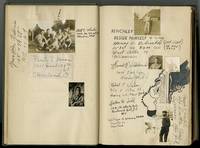
BENCHLEY BESIDE HIMSELF
New York and London: Harper & Brothers 1943. Fifth edition. 8vo. vii 304 pp. b&w drawings with added gelatin silver photographs pasted-in. Publisher's cloth with paper spine label. Worn with drink ring on the front cover. Gift inscription Christmas 1943 on the front fly leaf. Corporal Robert G. Rohner Headquarters and Service Company of the 84th Engineer Battalion U. S. Army was gifted this Robert Benchley book for Christmas during his service in World War II. He proceeded to use the book as an album to collect names home addresses and photographs of members of his Army unit. He used the accompanying unit roster a single mimeograph sheet 8 x 13 inches dated May 1944 to record by check marks and page numbers those members whose signature address and sometimes photograph appear on the blank spaces pages between chapters and endpapers; the roster is brittle and partially cracked at the center. Of the 104 names on the roster 73 have been checked. The 53 pasted-in photographs vary in size from postage stamp size to 3 1/4 x 5 inches. The 84th Engineer Battalion participated in the European Campaign in Italy Southern France Alsace and Central Europe. Harper & Brothers unknown
Référence libraire : 54655
|
|
|
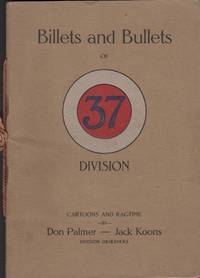
[World War I] Palmer, Don; Koons, Jack (Division Observers)
Billets and Bullets of 37 Division Cartoons and Ragtime
Self published 1919. First Edition. Wraps. Good. String bound wraps. 7.5" x 5.25". 1 80 pages. Illustrated with drawings and cartoons. Brown paper wraps with title a Division insignia on the front cover. This copy has been vertically folded with light vertical creases to the contents. Self published unknown
Référence libraire : 34196
|
|
|
[WORLD WAR II]. GILCHRIST, Derek C
Blue hell. Illustrations by H.L. Gate.
London: Heath Cranton Ltd. 1943. 8vo. 126 pp. Photo frontisp. plates. Blue cloth gilt lettering on spine w/ d.j. cover art by Gate minor chipping head of spine small tear upper right corner still NF/VG copy. First edition stated of this memoir recounting the sinking of the City of Shanghai during World War II by the German U-boat No. 103 and the subsequent survival in a lifeboat for 30 days before being picked up by the Dutch Merchant Stad Arnhem and landed at Freetown. Heath Cranton, Ltd., hardcover
Référence libraire : 56690
|
|
|
[WORLD WAR II] [BELGIUM] [PRISONERS OF WAR] AMICALE DES POSTIERS PRISONNIERS POLITIQUES RESCAPES
Broadside Diploma Front Unique de Belgique / 1914-18 1940-45 / Diplôme d'Honneur / Section: Prisonniers Politiques.
Breendonk: Amicale des Postiers Prisonniers Politiques Rescapés 1945. Original broadside pictorial diploma 24.5x32cm. printed lithograph on cream stock in red gilt and black accomplished in manuscript and rubberstamp. Minor foxing else a fresh Fine example. Exceedingly uncommon diploma awarded to a survivor of the Nazi prison camp at Fort Breendonk outside Antwerp. The camp generally held political prisoners members of the Resistance and Jews who were almost all subsequently dispersed to the larger concentration camp across Eastern Europe. More than 3000 prisoners passed through Breendonk of whom approximately ten percent died or were executed within its walls while half perished following deportation to other camps. The present certificate awarded to a member of the French resistance a mechanic outside Saumur in the Maine-et-Loire department of Western France his arrest part of a massive purge following the assassination of a Dr. Ritter representative of Gauleiter Sauckel in France see Colonel Remy "La Résistance en Anjou Touraine et Orléanais" 1975 Vol. 1 p. 103. The entire town of Saumur was later awarded the Croix de Guerre for its role in the resistance. <br /> <br /> Certificate margins adorned with poignant vignettes of camp life men in striped uniforms awaiting execution working in the mines or caught in barbed wire fence. In the case of Huberdeau his first name here spelled "Villiam" he was awarded this diploma for "sa déportation dans le bagnes nazis" "his deportation to the nazi camps". Though no mention is explicitly made to Breendonk it appears that the award was given to survivors of that camp specifically. We find no other examples in the trade auction records of separately catalogued in OCLC as of February 2020. Amicale des Postiers Prisonniers Politiques Rescapés] unknown
Référence libraire : 47585

|
|
|
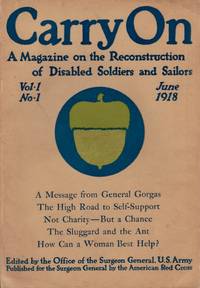
[World War I] [Carry On] Office of the Surgeon General, USA Army (edited by); Wood, Casey Lt-Col (editor-in-chief) U S A
Carry On A Magazine on the Reconstruction of Disabled Soldiers and Sailors. 5 misc. issues
Washington DC: Published for the the Surgeon General by the American red Cross 1919. Periodical. Very good. Periodicals. Volume 1 Numbers 1-10 all published. These are 5 misc. issues. <br /> <br /> 1. Volume 1 Number 1 June 1918: 32 pages. Illustrated with photographs and a cartoon by Briggs. Includes articles by General Gorgas The High Road to Support Not Charity but a Chance and more. Very good condition. <br /> <br /> 2. Volume 1 Number 2 August 1918: 32 pages. Illustrated with photographs and drawings. Contributors include Theodore Roosevelt Woodrow Wilson and others. Very good condition. <br /> <br /> 3. Volume 1 Number 4 October-November 1918: 32 pages. Illustrated with photographs and drawings. Contributors include Edna Ferber Gertrude Atherton and others. Very good condition. <br /> <br /> 4. Volume 1 Number 8 May 1919: 32 pages. Illustrated with photographs. Several contributors. Very good condition. <br /> <br /> 5. Volume 1 Number 9 June 1919: 32 pages. Illustrated with photographs and a very small racist cartoon towards the back. Very good condition. All issues are in very good condition with little wear and some light toning. Illustrated with a color acorn illustrations on the covers. Published for the the Surgeon General by the American red Cross unknown
Référence libraire : 34661
|
|
|
[WORLD WAR II HOME FRONT -- PORTLAND, OREGON/WOMEN].
Charming photo album and scrapbook documenting the Kindergarten and Preschool activities of St. Mary’s Academy in Portland Oregon including photographs of children playing parties field trips as well as a reply letter from President Roosevelt signed by his private secretary Grace Tully.
Portland OR: St. Mary’s Academy Preschool and Kindergarten 1608 SW Fifth Ave. 1945. Folio. 11.5 x 14.5 in. 16 pp unpaginated. thick light-gray coloured leaves each w/ tissue guards w/ 9 silver gelatin photos sized from 4 x 6 in. up to 8 x 10 in. all w/ pen & ink annotations above or below the image 3 printed photos 1 TLS on White House letterhead 2 typed sheets of enrolled students’ names and 1 tipped-in newspaper clipping glue residue on rear pastedown from removed item. Contemporary embossed black cloth post-binder raised gilt lettering on front cover decoration in blind sewn at gutter margin w/ black silk braid very minor shelfwear slight scuffing VG exemplar. An engaging photo album depicting the Home Front activities of the young students enrolled in the St. Mary’s Academy Preschool and Kindergarten during the depths of World War II. Printed photos show the ivy-covered building in downtown Portland followed by photos of children in the Baby Buggy brigade Preschool class on the playground a field trip to the fire station birthday party playing with blocks tea party and prayers. Of special interest is the TLS on White House letterhead dated Dec. 4 1944 soon after President Roosevelt had won the election for a fourth term from his private secretary Grace G. Tully 1900-1984 thanking the children for their prayers and nice letter with best wishes from the President. Tully had originally assisted Eleanor Roosevelt and then become private secretary to President Roosevelt after Missy LeHand’s stroke in 1941. She later published her memoir as FDR: My Boss in 1949. St. Mary’s Academy is Oregon’s oldest continually operating secondary school founded in 1858 and while it maintained a co-educational preschool and kindergarten program during World War II it was strictly a single-gender school for 1st grade through high school. St. Mary’s Academy, Preschool and Kindergarten, 1608 SW Fifth Ave., hardcover
Référence libraire : 53593
|
|
|
[WORLD WAR II MAPS]
China Burma India War Sector etc. Chronology of Important War Events since December 7 1941.
Chicago.: Geographical Publishing Company. 1943. 10 printed colour maps on a large single sheet 91 x 71 cms small inset map of the European theatre chronology of events original folds a few short fold splits archivally sealed; in very good condition. A suite of numbered U.S. war maps with Allied action overstamped in red by the publisher that for Germany and France with pictorial stamps for strategic targets including "Chemical Factories" and "Airplane Factories". The maps numbered 1 to 10: English Channel; Italy; Southern Greece; Western Mediterranean Sea; Germany and France; Baltic Sea and Scandinavia; China Burma India; Japan; Tokyo; and Greater Pacific Battle Zone: a large half sheet map noting the placement of US and Japanese bases. The "Chronology of Important War Events" lists action from the bombing of Pearl Harbour: "Japan's day of Infamy: Japanese air attack cripples American Fleet at Pearl Harbour" to March 21 1944 "Germans take over key political posts in Bulgaria and Romania". <br> <br>Issued by the Geographical Publishing Company of Chicago this educational sheet includes an advertisement for WLS Chicago "The prairie farmer station" with a list of their war broadcasts and a world clock. . Geographical Publishing Company. unknown
Référence libraire : 206908
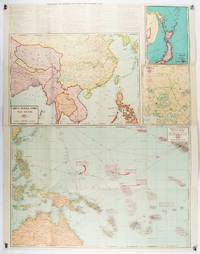
|
|
|
[World War II] [Aberdeen Proving Ground, Maryland]
Class 44 Ordnance Officer Candidate School
Baton Rouge: Army and Navy Publishing Co. Inc 1942. Hardcover. Good. Small folio. 60 pages. Dark embossed cloth covers with color insignia on the front cover. Illustrated with numerous black and white photographs. Includes 28 pages of loose punch holed material on training including an essay on leadership laid inside the back cover. The loose paper has different page sections. The paper is fragile browned etc. Army and Navy Publishing Co., Inc hardcover
Référence libraire : 35849
|
|
|
[World War II]. Joyce, Fred N
Collection of Photographs and a Few Documents Relating to the Military Service of Fred N. Joyce During World War II
Camp Lee Va. and various locations in and around Fukuoka Japan 1947. Very good. Sixty-four vernacular photographs and five professional photographic postcards between 2.25 x 2 inches and 8.75 x 11 inches plus two documents and a canceled check. Minor occasional wear to images. A small but informative archive of photographs and documents pertaining to Private Fred N. Joyce's service in Occupied Japan at the conclusion of the Second World War. Joyce served in the Third Platoon of the 93rd Quartermaster Training Company stationed at Camp Hakata in Kyushu Japan. The two documents present here include a "Letter of Merit" given to Joyce while in training at Camp Lee Virginia in August 1946 and his "Honorable Discharge" granted in November 1947. Between those dates Joyce spent his short career in Japan documented with over sixty candid shots some of which are captioned in manuscript on the verso. The vernacular shots show a variety of subjects and settings including American serviceman on base at work and play in both Virginia and Japan portraits of Joyce's fellow soldiers numerous street scenes in Japan one manuscript caption reads "One of the modern Jap theatres on Main Street in Fukuoka" elevated views of the city of Fukuoka one taken from the Red Cross Building a shot of three Japanese "Janitors that work here in Battalion Headquarters" and other locals an image of Joyce with several Japanese children captioned on the verso "'Me' and some other little 'Japs'" and more. Three of the largest images present here are aerial photographs of Camp Hakata one with numerous buildings captioned in manuscript in the image area and keyed to a printed list on the verso. The other larger photograph is a professional group photograph of Joyce's Third Platoon with all members identified. Six commercial photographic postcards round out the collection which depict scenes in Japan with English printed captions beneath the images. unknown
Référence libraire : 2580
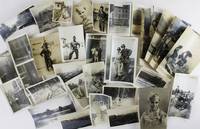
|
|
|
[World War II] [France]
COMMENDATION FOR A WOMAN WHO ASSISTED THE FRENCH RESISTANCE
An undated letter from a leader in the French Resistance commending a French woman for her role assisting the opposition group during World War II. The typed text is in French and the translation reads: “I the undersigned Pierre Stibbe certify that Miss Charlotte Evrard has rendered the greatest services to the Resistance with complete devotion and incurred the greatest dangers.â€<br /> <br /> The next typed line reads: “Pierre Stibbe delegate to the Consultive Assembly Member of the Steering Committee of ‘Those of the Resistance’ Director of ‘Volontes’ of the Resistance.â€<br /> <br /> Evrard 1917-2011 does not appear in any obvious list of members of the French Resistance a network of groups that fought the Nazi occupation of France during the Second World War. According to newspaper reports she was a professional singer in France and moved to the Pasadena California in 1949. She worked as an attaché for the French Consulate in Los Angeles then for United Airlines travel services and later as North American representative for the Tahiti Tourist Development Board. Evrard’s last name changed in 1956 to Hyde following her marriage to J. Stuart Hyde 1890-1985 a British officer who emigrated to the United States in the 1940s.<br /> <br /> The French Resistance was critical to the liberation of France. The members provided first-hand intelligence information and escape networks that helped Allied soldiers and airmen. It’s estimated that the proportion of French people who participated in organized resistance was one to three percent of the total population.<br /> <br /> The letter is typed on stationary for the Assemblee Consultative Provisoire Republique Francaise. It measures approximately 5†x 6†and has been professionally matted and framed. Tears along the edges have been mended with non-archival tape that has browned. Not inspected outside the frame. unknown
Référence libraire : 78638
|
|
|
[WORLD WAR II -- HASKELL-CLASS ATTACK TRANSPORTS].
Compartment plan for troop transports. Production Planning & Scheduling Dept. . . .
Los Angeles CA: California Shipbuilding Corporation 1944. Oblong folio. 22 x 5.75 in. 14 pp unpaginated. deckplans throughout for compartments. Self-printed softcovers title on front cover center fold for easy storage slight shelfwear still VG bright copy stapled at gutter margin as issued. First edition of this exceedingly scarce shipyard deck plans books for the Haskell-Class Victory ships built by California Shipbuilding Corp. from 1944-1945 with 117 launched. The VC2-S-AP5 ships were designed to transport and assault landing craft of over 1500 troops and their heavy combat with the Haskell’s carrying 25 landing craft right to the beach. Nearly all of the Haskell-class ships were mothballed in 1946 following the War and most scrapped from 1973-75. At its height during World War II CalShip was operating 53 shipyards employing 1000’s of workers but at the end of the War the Maritime Commission shipyards closed down production. No copies in Worldcat. California Shipbuilding Corporation, paperback
Référence libraire : 62171
|
|
|
[WORLD WAR I -- MACHINE GUNS].
Confidential handbook of the Browning Automatic Rifle Model 1918 Air Cooled. . . War Department Document No. 845.
Washington D.C.: War Plans Division Office of the Adjutant General August 1918. 12mo. 40 pp. With 9 plates couple photographic 1 large folding. Light tan printed softcovers minor edgewear still NF copy from the library of former Sergeant Errol George Sinclair 1895-1971 enlisted in 1917 trained with the Machine Gun Company at Fort Logan CO and Fort Douglas UT and then transferred in 1918 to the 10th Division at Camp Funston Fort Riley KS. First edition of this very scarce United States Army manual on the famed Browning Automatic Rifle BAR and the M1918 version was chambered for the .30-06 Springfield rifle cartridge and designed by John Browning in 1917 for the AEF. Although designed to be used firing from the hip with a sling over the shoulder in practice this light machine gun was often fired from a bipod and eventually became standard issue in the US Army in 1938 used extensively through World War II and the Korean War. Worldcat locates 6 copies Connecticut State Library Hagley US Army Combined Arms War College Western Reserve Wisconsin Vet Museum. War Plans Division, Office of the Adjutant General, paperback
Référence libraire : 53954
|
|

 Recevoir par e-mail
 Télécharger en PDF
 Flux RSS
 Lien permanent


