|
[World War II]
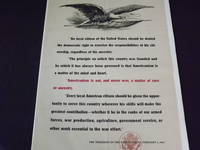
“America is not and never was a matter of race or ancestry.â€
<p>Wartime poster 27 ¾ x19 ¾ large eagle engraving at the top of the poster printed in red and black. Creases where folded. This rare U.S. Government wartime poster attempts to promote equality by reminding Americans that race and ancestry shouldn’t matter in our country. It reminds us that every American "should be given the opportunity to serve the country" and help the war effort. While this was certainly a noble goal this poster was printed at a time when our armed forces were still largely segregated.</p> U.S. Government Printing Office:
Referenz des Buchhändlers : 100607
|
|
|
[Civil War]
Collection of Fifty-Two Manuscript Newark City Council Resolutions on the Civil War
52 folded and docketed uniform manuscript resolutions mostly 4to typically written on one side and docketed on the back includes a contemporary cover sheet that originally held resolutions together two small pictures of Lincoln and Grant included housed in modern photo album. A few with folds at the top and minor chips normal aging and browning; overall in very good condition. These resolutions were passed by the Public Aid Committee which was created by the Newark City Council at the beginning of the Civil War to advance money to soldiers' families. These resolutions would then be given to a clerk for filing. This clerk seems to have had strong anti war or Copperhead sympathies and gradually began editorializing as he wrote out the docketing on the back of each folded document. He titled the 31 March 1862 resolution "For aid to families. in the war to abolish slavery." On 2 September it was "the war for the ruin of the country." On 26 November it became "the Negro War" and 2 December it says "the Army of Abm. Lincoln to subjugate the Southern States." This obscure city clerk took things a step further after the Emancipation Proclamation. On 4 February 1863 he titled a resolution "In aid of families of volunteers. in the Nigger War!" He must have been spoken to after this remark because he drifts into sarcasm rather than outright racism. In a later resolution he states "for the benefit of our coloured fellow citizens of African decent." However by 14 September 1863 he was back to his old tricks again referring to "Lincoln's nigger war." He continued his editorializing through June 1864. These docketed resolutons were found in the included wrapper on which a a Union soldier later wrote: "The name if it can be found out of the miserable traitor who booked the within resolutions should go down in posterity as one who should receive the contempt of loyal men." The name of that Union soldier appears to be Major W. W. Morris.
Referenz des Buchhändlers : 100657
|
|
|
[English Civil War]
An Act for Several Lands and Estates Forfeited to the Commonwealth for Treason Appointed to be Sold for the Use of the Navy
2 volumes 4to however one volume is slightly larger than the other modern calf and boards printed in black leter and Roman types 2 1369-1417 & 2 1677-1689 pp. Last leaf in both volumes moderately worn and some repairs to one of those leafs pages in both volumes creased in the middle library plate on both front pastedowns early owners inscrpition on back of last leaf in one volume normal aging and browning; otherwise very good. This is a scarce item that was probably removed from a larger work however the sjubect is the same. Basically these acts focus on the seizure of lands during the English Civil War following the execution of Charles I in 1649 and just before the installation of Oliver Cromwell as Lord Protector in 1653. The text is primarily lists of nobility who remained loyal to the crown and whose lands were forfeited to the commonwealth for "treasons against the parliament and the people of England." John Field, hardcover
Referenz des Buchhändlers : 100670
|
|
|
Civil War
What Jeff Davis Thinks of the War
Small broadside 11 1/2x 9 printed on one side. A little darkened with a few spots and some light dampstaining; else very good. This broadside is a response to the Democratic Party platform which suggests the war is all but lost and advises meeting with the Confederate government to talk peace terms. The National Union Ticket supporting Abraham Lincoln quotes at length from speeches of Jefferson Davis revealing the difficult circumstances facing the Confederacy concluding ".Vote For Lincoln! This is the most effecfive way of EndingThe War And Restoring The Union." National Union Executive Committee unknown
Referenz des Buchhändlers : 100734
|
|
|
Civil War
Proclamation… I hereby notify all citizens that they must connect themselves with some company of
<p> Small broadside about 6 x 8 1/2 printed on one side about ten partial lines of text including title Proclamation!. Minor toning slight creasing a little uneven small margin on the left side a couple of minor nicks; overall very good. While Kentucky may have been neutral at the start of the war after the Confederates invaded the state they turned toward the Union. This small broadside reminds people they needed to register with the "home guard." It also reminds people that failure to register will result in being disarmed. This order was passed under the threat of an impending invasion of Kentucky by General Braxton Bragg's Army of Tennessee. The broadside is signed in print by Major P. G. Bracht. </p> Observer and Reporter Power Press Print
Referenz des Buchhändlers : 100733

|
|
|
Department, War
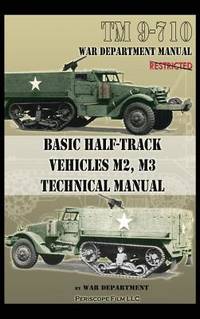
Basic Half-Track Vehicles M2 M3 Technical Manual
hardcover. Good. Access codes and supplements are not guaranteed with used items. May be an ex-library book. hardcover
Referenz des Buchhändlers : 1940453534.G ISBN : 1940453534 9781940453538
|
|
|
United States War Department
Technical Manual: Cleaning Preserving Lubricating and Welding Materials and Similar Items Issues by the Ordnance Department; TM 9-850 August 21 1941
Washington DC: War Department 1941. Presumed First Edition First printing thus. Wraps. Good. 116 4 pages. plus covers. Tabular information. Index pages 95-116. Front cover has wear and soiling and is stamped Ordnance School Small Arms. The was printed by the Publications Department at Raritan Arsenal. A second edition was apparently issued on April 13 1942. Other editions were apparently issued in 1944 and 1951 Korean War era. Consequently relatively few of this initial edition are believed to have survived. Ordnance is another word for military supplies like guns rockets or armor. The word ordinance for “command†lost an i in the 1500’s and became ordnance meaning “military materials.†Ordnance helps soldiers fight and protect them. This manual has the following Sections: General; Cleaners and abrasives; Preservatives; Paints and related materials; Lubricants; Fluids for recoil mechanisms and hydraulic Jacks; Welding brazing soldering and cutting materials and Miscellaneous. The purpose of this manual was to present information to the using arms and services concerning the characteristics application and handling of cleaning preserving lubrications welding brazing cutters and other materials issued by the Ordnance Department and listed in SNL's K-1 and K-2. Information and direction herein superseded those given in TR 1395-A or in the various Ordnance Field Service circulars published prior to the publication of this manual and dealing with materials within its scope/ These regulations cover materials listed in par. 1. b. that are issued by the Ordnance Department for use on or with ordnance material. The use of materials other than those authorized for the specific purposes mentioned was strictly forbidden. The Raritan Arsenal originally known as the Raritan River Ordnance Base was established in 1917 in preparation for the United States' entry into World War I. The Arsenal initially a 2150 acre complex with 275 buildings 52 miles of railroad six miles of concrete roads and water access to the Raritan River played a key role in the transport of war materials to both Allied and American armed forces in Europe during World War I. The installation served as a major East Coast storage and transshipment center for munitions an assembly/repair facility for motorized ordnance equipment and an ordnance training camp for 20000 American soldiers. As the United States entered World War II the Arsenal retained and expanded these vital functions and reactivated the ordnance training unit. War Department paperback
Referenz des Buchhändlers : 86448
|
|
|
United States War Department
Infantry and Aircraft Armament U.S. Rifle Caliber .22 M1922 M1922M1 and M2; Technical Regulations No. 1300-22A
Washington DC: United States War Department 1936. Presumed First Edition First printing thus supersedes TR 1300-22A November 1 1927 including C 1 January 2 1930 and C 2 April 30 1932. Wraps. Fair. 42 pages. Illustrations Photographs and drawings. General Notes. Tabular Data. Tear in front repaired from behind with tape. Front page worn torn soiled and chipped. Staple bound and also stapled near spine left side. Additional staple holes present may have been stapled to other military documents. The Springfield Model 1922 is a .22 caliber bolt-action rifle. It features a 24-inch barrel and a 5-round magazine. It was built as a cadet rifle designed to mimic the M1903 Springfield rifle for training purposes. It was produced in several different versions until World War II when shortages of materials made production of a training rifle impractical. The M1922M1 variant was introduced in 1925. This version had a new bolt head an improved firing mechanism modifications to the chambering and a new rear sight. The stock was also modified to incorporate a flat based pistol grip. The M1922M1 NRA variant was introduced in 1927. This rifle basically consisted of the improved M1 version's action in the original 1922 version stock. This version was made for civilian use only and was not purchased by the U.S. Military. The M2 variant was introduced in 1933. This version featured a simplified bolt and a shallower pistol grip on the stock. "M1922" was not included in the M2's designation. All versions of the M1922 used what would be the safety lug on the 1903 bolt as the locking lug. Initial problems with this lug cracking drove further development of the M1922 resulting in the final M2 version. The main change in the M2 variant was the incorporation of an adjustable headspace mechanism in the locking lug. These regulations were published for the information and guidance of the using arms Reserve Officers' Training Corps Reserve Officers and all personnel charged with the maintenance of this materiel. They give a detailed description of the different groups assemblies components and accessories of the rifles with sufficient illustrations to readily identify each component. They explain the mechanical operation and give all necessary information regarding the care and preservation of the rivles. U.S. Army Technical Manuals commonly known as 'Army manuals' are part of a series of official U.S. military manual publications intended to be instructive and informative for all branches of the military. Of interest to military historians curators military enthusiasts re-enactors and collectors army manuals can be used to trace the evolution of the Army's doctrine organizational structure equipment uniforms and weapons. They are also helpful in terms of the care maintenance and preservation of military artifacts. Army manuals include publications on historic U. S. military vehicles including military motorcycles jeeps military trucks scout cars tanks amphibians and aircraft. Subjects of the manuals also include radio cooking language dictionaries and phrase books. Army manuals also included a number of so-called "enemy" manuals. These are manuals which are official U.S. Army publications concerning enemy equipment or forces. The letter E in the manual number indicates that a particular manual is an enemy manual. For example Technical Manual TM E9-803 on the German Volkswagen appears just after Technical Manual TM 9-803 on the Jeep. A number of enemy manuals about foreign forces are included like TM E30-420 Handbook of the Italian Military Forces. The publication of enemy manuals was authorized by Section II. Processing of Captured Material for Intelligence Purposes of War Department Training Circular 81 6 November 1942. The War Department which became the Department of the Army in 1947 issued three major classes of publications -- administrative doctrinal training and organizational and technical and equipment publications. Administrative publications include publications such as Army Regulations Special Regulations Bulletins Circulars General and Special Orders and Pamphlets; doctrinal training and organizational publications contain Field Manuals Army Training and Evaluation Programs Training Circulars Tables of Organization and Equipment and Tables of Allowances; and technical and equipment publications include publications such as Technical Manuals Technical Bulletins Supply Manuals etc. United States War Department paperback
Referenz des Buchhändlers : 86490
|
|
|
United States War Department
Ordnance Maintenance--Infantry and Aircraft Armament Browning Automatic and Machine Rifles; Technical Regulations No. 1400-30E
Washington DC: United States War Department 1928. Presumed First Edition First printing. Wraps. Fair. 17 1 pages. Illustration photographs. Tabular data. Staple bound and also stapled near spine left side. The Browning Automatic Rifle BAR is a family of American automatic rifles and machine guns used by the United States and numerous other countries during the 20th century. The primary variant of the BAR series was the M1918 chambered for the .30-06 Springfield rifle cartridge and designed by John Browning in 1917 for the American Expeditionary Forces in Europe as a replacement for the French-made Chauchat and M1909 Benét–Mercié machine guns that US forces had previously been issued. The BAR was designed to be carried by infantrymen during an assault advance while supported by the sling over the shoulder or to be fired from the hip. This is a concept called "walking fire"—thought to be necessary for the individual soldier during trench warfare. The US Army in practice used the BAR as a light machine gun often fired from a bipod introduced on models after 1938. A variant of the original M1918 BAR the Colt Monitor Machine Rifle remains the lightest production automatic firearm chambered for the .30-06 Springfield cartridge though the limited capacity of its standard 20-round magazine tended to hamper its utility in that role. Although the weapon did see some action in World War I the BAR did not become standard issue in the US Army until 1938 when it was issued to squads as a portable light machine gun. The BAR saw extensive service in both World War II and the Korean War and saw limited service in the Vietnam War. The purpose of these regulations is to furnish suitable instructions for the shop repair inspection and maintenance of the Browning automatic rifle caliber .30 M1918 and the Browning machine rifle caliber .30 M1922 and their accessories. These regulations were intended for the use of ordnance maintenance personnel only and were not intended for use by line organizations. U.S. Army Technical Manuals commonly known as 'Army manuals' are part of a series of official U.S. military manual publications intended to be instructive and informative for all branches of the military. Of interest to military historians curators military enthusiasts re-enactors and collectors army manuals can be used to trace the evolution of the Army's doctrine organizational structure equipment uniforms and weapons. They are also helpful in terms of the care maintenance and preservation of military artifacts. Army manuals include publications on historic U. S. military vehicles including military motorcycles jeeps military trucks scout cars tanks amphibians and aircraft. Subjects of the manuals also include radio cooking language dictionaries and phrase books. Army manuals also included a number of so-called "enemy" manuals. These are manuals which are official U.S. Army publications concerning enemy equipment or forces. The letter E in the manual number indicates that a particular manual is an enemy manual. For example Technical Manual TM E9-803 on the German Volkswagen appears just after Technical Manual TM 9-803 on the Jeep. A number of enemy manuals about foreign forces are included like TM E30-420 Handbook of the Italian Military Forces. The publication of enemy manuals was authorized by Section II. Processing of Captured Material for Intelligence Purposes of War Department Training Circular 81 6 November 1942. The War Department which became the Department of the Army in 1947 issued three major classes of publications -- administrative doctrinal training and organizational and technical and equipment publications. Administrative publications include publications such as Army Regulations Special Regulations Bulletins Circulars General and Special Orders and Pamphlets; doctrinal training and organizational publications contain Field Manuals Army Training and Evaluation Programs Training Circulars Tables of Organization and Equipment and Tables of Allowances; and technical and equipment publications include publications such as Technical Manuals Technical Bulletins Supply Manuals etc. United States War Department paperback
Referenz des Buchhändlers : 86496
|
|
|
United States War Department
Ordnance Maintenance--Infantry and Aircraft Armament Browning Machine Gun Caliber .30 Ground Tank and Antiaircraft Types; Technical Regulations No. 1400-30 C.
Washington DC: United States War Department 1927. Presumed First Edition First printing. Wraps. Fair. 21 3 pages. Illustration photographs and diagram. Front page worn and soiled. Edge soiling. Staple bound and also stapled near spine left side. With Changes No. 1 January 2 1929 3 pages. Stamp of Ordnance School Small Arms. The M1917 Browning machine gun is a heavy machine gun used by the United States armed forces in World War I World War II the Korean War and the Vietnam War; it has also been used by other nations. It was a crew-served belt-fed water-cooled machine gun that served alongside the much lighter air-cooled Browning M1919. It was used at the battalion level and often mounted on vehicles such as a jeep. There were two main iterations: the M1917 which was used in World War I and the M1917A1 which was used thereafter. The M1917 which was used on some aircraft as well as in a ground role had a cyclic rate of 450 rounds per minute. The M1917A1 had a cyclic rate of 450 to 600 rounds per minute. The M1919 Browning is a .30 caliber medium machine gun that was widely used during the 20th century especially during World War II the Korean War and the Vietnam War. The M1919 saw service as a light infantry coaxial mounted aircraft and anti-aircraft machine gun by the U.S. and many other countries. The M1919 was an air-cooled development of the standard US machine gun of World War I the John M. Browning-designed water-cooled M1917. The emergence of general-purpose machine guns in the 1950s pushed the M1919 into secondary roles in many cases especially after the arrival of the M60 in US Army service. The purpose of these regulations is to furnish suitable instructions for the shop repair inspection and maintenance of the Browning machine gun caliber .30 M1917 and the Browning tank machine Gun caliber .30 M1919 and their accessories. These regulations were intended for the use of ordnance maintenance personnel only and were not intended for use by organizations armed with these weapons. U.S. Army Technical Manuals commonly known as 'Army manuals' are part of a series of official U.S. military manual publications intended to be instructive and informative for all branches of the military. Of interest to military historians curators military enthusiasts re-enactors and collectors army manuals can be used to trace the evolution of the Army's doctrine organizational structure equipment uniforms and weapons. They are also helpful in terms of the care maintenance and preservation of military artifacts. Army manuals include publications on historic U. S. military vehicles including military motorcycles jeeps military trucks scout cars tanks amphibians and aircraft. Subjects of the manuals also include radio cooking language dictionaries and phrase books. Army manuals also included a number of so-called "enemy" manuals. These are manuals which are official U.S. Army publications concerning enemy equipment or forces. The letter E in the manual number indicates that a particular manual is an enemy manual. For example Technical Manual TM E9-803 on the German Volkswagen appears just after Technical Manual TM 9-803 on the Jeep. A number of enemy manuals about foreign forces are included like TM E30-420 Handbook of the Italian Military Forces. The publication of enemy manuals was authorized by Section II. Processing of Captured Material for Intelligence Purposes of War Department Training Circular 81 6 November 1942. The War Department which became the Department of the Army in 1947 issued three major classes of publications -- administrative doctrinal training and organizational and technical and equipment publications. Administrative publications include publications such as Army Regulations Special Regulations Bulletins Circulars General and Special Orders and Pamphlets; doctrinal training and organizational publications contain Field Manuals Army Training and Evaluation Programs Training Circulars Tables of Organization and Equipment and Tables of Allowances; and technical and equipment publications include publications such as Technical Manuals Technical Bulletins Supply Manuals etc. United States War Department paperback
Referenz des Buchhändlers : 86495
|
|
|
United States War Department
Infantry and Aircraft Armament Browning Machine Gun Caliber .30 M2 Aircraft Fixed and Flexible Types; Technical Regulations No. 1300-30J
Washington DC: United States War Department 1939. Presumed First Edition First printing thus supersedes TR 1300-30J 1934. Wraps. Fair. 70 pages. Illustrations Photographs and drawings. General Notes. Tabular Data. Front page worn torn soiled and chipped. Edge soiling. Staple bound and also stapled near spine left side. Additional staple holes present may have been stapled to other military documents. The M2 machine gun or Browning .50 caliber machine gun informally "Ma Deuce" is a heavy machine gun that was designed near the end of World War I by John Browning. While similar to Browning's earlier M1919 Browning machine gun which was chambered for the .30-06 cartridge the M2 uses Browning's larger and more powerful .50 BMG cartridge. The design has had many designations; the official U.S. military designation for the current infantry type is Browning Machine Gun Cal. .50 M2 HB Flexible. It is effective against infantry unarmored or lightly armored vehicles and boats light fortifications and low-flying aircraft. The gun has been used extensively as a vehicle weapon and for aircraft armament by the United States since the 1930s. It was heavily used during World War II the Korean War the Vietnam War the Falklands War the Soviet–Afghan War the Gulf War the Iraq War and the War in Afghanistan. At the outbreak of the Second World War the United States had versions of the M2 in service as fixed aircraft guns anti-aircraft defensive guns on aircraft ships or boats infantry tripod-mounted guns and as dual purpose anti-aircraft and anti-vehicular weapons on vehicles. These regulations were intended for the Air Corps and all personnel charged with the maintenance of this materiel. They contain descriptions and figures and instruction in the proper methods of adjustment disassembling assembling and care and preservation of the material/ Nomenclature list of spare parts and equipment and basic spare parts for the Browning machine gun caliber .30 Me aircraft are contained in Standard Nomenclature List No. A-28. U.S. Army Technical Manuals commonly known as 'Army manuals' are part of a series of official U.S. military manual publications intended to be instructive and informative for all branches of the military. Of interest to military historians curators military enthusiasts re-enactors and collectors army manuals can be used to trace the evolution of the Army's doctrine organizational structure equipment uniforms and weapons. They are also helpful in terms of the care maintenance and preservation of military artifacts. Army manuals include publications on historic U. S. military vehicles including military motorcycles jeeps military trucks scout cars tanks amphibians and aircraft. Subjects of the manuals also include radio cooking language dictionaries and phrase books. Army manuals also included a number of so-called "enemy" manuals. These are manuals which are official U.S. Army publications concerning enemy equipment or forces. The letter E in the manual number indicates that a particular manual is an enemy manual. For example Technical Manual TM E9-803 on the German Volkswagen appears just after Technical Manual TM 9-803 on the Jeep. A number of enemy manuals about foreign forces are included like TM E30-420 Handbook of the Italian Military Forces. The publication of enemy manuals was authorized by Section II. Processing of Captured Material for Intelligence Purposes of War Department Training Circular 81 6 November 1942. The War Department which became the Department of the Army in 1947 issued three major classes of publications -- administrative doctrinal training and organizational and technical and equipment publications. Administrative publications include publications such as Army Regulations Special Regulations Bulletins Circulars General and Special Orders and Pamphlets; doctrinal training and organizational publications contain Field Manuals Army Training and Evaluation Programs Training Circulars Tables of Organization and Equipment and Tables of Allowances; and technical and equipment publications include publications such as Technical Manuals Technical Bulletins Supply Manuals etc. United States War Department paperback
Referenz des Buchhändlers : 86491
|
|
|
United States War Department
Infantry and Aircraft Armament U.S. Rifle Caliber .30 M1903 and M1903A1; Technical Regulations No. 1300-30A
Washington DC: United States War Department 1939. Presumed First Edition First printing thus supersedes TR 320-10 March 12 1924 including C 1 January 2 1926 and C 2 January 2 1937. Wraps. Fair. 36 pages. Illustrations Photographs and drawings. Staple bound. Worn and soiled. The M1903 Springfield officially the United States Rifle Caliber .30-06 Model 1903 is an American five-round magazine-fed bolt-action service repeating rifle used primarily during the first half of the 20th century. The M1903 was first used in combat during the Philippine–American War and it was officially adopted by the United States as the standard infantry rifle on June 19 1903 where it saw service in World War I and was replaced by the faster-firing semi-automatic eight-round M1 Garand starting in 1936. However the M1903 remained in service as a standard issue infantry rifle during World War II since the U.S. entered the war without sufficient M1 rifles to arm all troops. It also remained in service as a sniper rifle during World War II the Korean War and the Vietnam War. It remains popular as a civilian firearm historical collector's piece a competitive shooting rifle and as a military drill rifle. Toward the end of the war Springfield turned out the Model 1903 Mark I. The Mark I has a cut on the left hand side of the receiver meant to act as an ejection port for the Pedersen device a modified sear and cutoff to operate the Pedersen device; a specialized insert that replaced the bolt and allowed the user to fire .30 caliber pistol cartridges semi-automatically from a 40-round detachable magazine. The stock was also slightly cut down on the left side to clear the ejection port. Temperature control during forging was improved prior to Mark I production. The receiver alloy was toughened by addition of nickel after Mark I production. These regulations were published for the information and guidance of the using arms and all personnel charged with the maintenance of this materiel. They contain description and illustrations and instruction in the proper methods of disassembling assembling care and preservation of the U.S. rifle caliber .30 M1903 and M1903A1. U.S. Army Technical Manuals commonly known as 'Army manuals' are part of a series of official U.S. military manual publications intended to be instructive and informative for all branches of the military. Of interest to military historians curators military enthusiasts re-enactors and collectors army manuals can be used to trace the evolution of the Army's doctrine organizational structure equipment uniforms and weapons. They are also helpful in terms of the care maintenance and preservation of military artifacts. Army manuals include publications on historic U. S. military vehicles including military motorcycles jeeps military trucks scout cars tanks amphibians and aircraft. Subjects of the manuals also include radio cooking language dictionaries and phrase books. Army manuals also included a number of so-called "enemy" manuals. These are manuals which are official U.S. Army publications concerning enemy equipment or forces. The letter E in the manual number indicates that a particular manual is an enemy manual. For example Technical Manual TM E9-803 on the German Volkswagen appears just after Technical Manual TM 9-803 on the Jeep. A number of enemy manuals about foreign forces are included like TM E30-420 Handbook of the Italian Military Forces. The publication of enemy manuals was authorized by Section II. Processing of Captured Material for Intelligence Purposes of War Department Training Circular 81 6 November 1942. The War Department which became the Department of the Army in 1947 issued three major classes of publications -- administrative doctrinal training and organizational and technical and equipment publications. Administrative publications include publications such as Army Regulations Special Regulations Bulletins Circulars General and Special Orders and Pamphlets; doctrinal training and organizational publications contain Field Manuals Army Training and Evaluation Programs Training Circulars Tables of Organization and Equipment and Tables of Allowances; and technical and equipment publications include publications such as Technical Manuals Technical Bulletins Supply Manuals etc. United States War Department paperback
Referenz des Buchhändlers : 86493
|
|
|
United States War Department
Ordnance Maintenance--Infantry and Aircraft Armament Aircraft Machine Gun Cal. .30; Technical Regulations No. 1400-30G
Washington DC: United States War Department 1928. Presumed First Edition First printing With Changes No. 1 1929. Wraps. Fair. 11 1 pages. Changes No. 1 1 page stapled in front. Illustration photographs and diagram. Tabular data. Staple bound and also stapled near spine left side. The M1917 Browning machine gun is a heavy machine gun used by the United States armed forces in World War I World War II the Korean War and the Vietnam War; it has also been used by other nations. It was a crew-served belt-fed water-cooled machine gun that served alongside the much lighter air-cooled Browning M1919. It was used at the battalion level and often mounted on vehicles such as a jeep. There were two main iterations: the M1917 which was used in World War I and the M1917A1 which was used thereafter. The M1917 which was used on some aircraft as well as in a ground role had a cyclic rate of 450 rounds per minute. The M1917A1 had a cyclic rate of 450 to 600 rounds per minute. The purpose of these regulations is to furnish suitable instructions for the proper adjustment shop repair maintenance and inspection of the Browning aircraft machine gun caliber .30 M1918M1; Browning aircraft machine gun caliber .30 M1919; Lewis aircraft machine gun cal. 30 M1918; and the Marlin aircraft machine gun cal. .30 M1917. These regulations were intended for the use of ordnance maintenance personnel and the armament personnel of the Air Corps. U.S. Army Technical Manuals commonly known as 'Army manuals' are part of a series of official U.S. military manual publications intended to be instructive and informative for all branches of the military. Of interest to military historians curators military enthusiasts re-enactors and collectors army manuals can be used to trace the evolution of the Army's doctrine organizational structure equipment uniforms and weapons. They are also helpful in terms of the care maintenance and preservation of military artifacts. Army manuals include publications on historic U. S. military vehicles including military motorcycles jeeps military trucks scout cars tanks amphibians and aircraft. Subjects of the manuals also include radio cooking language dictionaries and phrase books. Army manuals also included a number of so-called "enemy" manuals. These are manuals which are official U.S. Army publications concerning enemy equipment or forces. The letter E in the manual number indicates that a particular manual is an enemy manual. For example Technical Manual TM E9-803 on the German Volkswagen appears just after Technical Manual TM 9-803 on the Jeep. A number of enemy manuals about foreign forces are included like TM E30-420 Handbook of the Italian Military Forces. The publication of enemy manuals was authorized by Section II. Processing of Captured Material for Intelligence Purposes of War Department Training Circular 81 6 November 1942. The War Department which became the Department of the Army in 1947 issued three major classes of publications -- administrative doctrinal training and organizational and technical and equipment publications. Administrative publications include publications such as Army Regulations Special Regulations Bulletins Circulars General and Special Orders and Pamphlets; doctrinal training and organizational publications contain Field Manuals Army Training and Evaluation Programs Training Circulars Tables of Organization and Equipment and Tables of Allowances; and technical and equipment publications include publications such as Technical Manuals Technical Bulletins Supply Manuals etc. United States War Department paperback
Referenz des Buchhändlers : 86497
|
|
|
United States War Department
Technical Regulation No. 1395-A Ordnance Department Instructions Covering the Characteristics Purpose Handling Etc. of Cleaning and Preserving Materials Tools and Materials for use therewith and oils greases and cutting compounds Issued by the Ordnance Department
Washington DC: War Department printed by the U. S. Government Printing Office 1929. Presumed First Edition First printing thus. Wraps. Fair. 51 1 pages. Tabular information. Index pages 95-116. Ink comments on pages 1 3 38 with pasted in addendum 42 with pasted in addendum and 48 with pasted in addendum. One change dated in 1935. Item as wear tears soiling and chips. First page has tear at bottom of spine. Rear page missing some material at the bottom no loss of text. Some page discoloration. Two holes at spine to permit this to be included into an Army issued document binder/holder. This preceded the issuance in 1941 of Technical Manual 9-850 on the same subject. Relatively few of this initial regulation are believed to have survived. Ordnance is another word for military supplies like guns rockets or armor. The word ordinance for “command†lost an i in the 1500’s and became ordnance meaning “military materials.†Ordnance helps soldiers fight and protect them. This manual has the following Sections: General; Cleaners and abrasives; Preservatives; Paints and related materials; Lubricants; Special oils liquids gas and grease for recoil mechanism hydraulic jacks and variable speed gears; Welding and cutting materials gases and fluxes and Miscellaneous materials and tools. This regulation was issued approximately 10 years after the end of the First World War and approximately 10 years prior to the start of the Second World War and as such it represents both a compilation of lessons learned from the earlier conflict and the state of practice at the time of the later conflict enhanced by updates driven by improvements in technology weaponry maintenance and logistics. The purpose of this regulation was to present information to the using arms and services concerning the characteristics application and handling of various materials issued by the Ordnance Department and classed as cleaners preservatives lubricants paints and related materials cutting and welding liquids gases and compounds recoil oils liquids and gases liquids for hydraulic jacks oils for Waterbury variable speed gears and the application of these materials. War Department, printed by the U. S. Government Printing Office paperback
Referenz des Buchhändlers : 86450
|
|
|
United States War Department
Infantry and Aircraft Armament Browning Machine Gun Caliber .50 M1921 Water-cooled; Technical Regulations No. 1300-50A
Washington DC: United States War Department 1932. Presumed First Edition First printing thus. Wraps. Fair. 54 2 pages. Illustrations Photographs and drawings. Fold-out. Tabular Data. Front page worn torn soiled and chipped. Staple bound and also stapled near spine left side. Additional staple holes present may have been stapled to other military documents. The M1921 Browning machine gun was a water-cooled .50-caliber machine gun designed by John Moses Browning which entered production in 1929. From 1917 to 1918 he developed the prototype Browning Winchester Cal.50 caliber heavy machine gun. It was developed from a water-cooled .30 caliber M1917 Browning machine gun. Machine guns were heavily used in World War I and weapons of larger than rifle caliber began appearing on both sides of the conflict. The larger rounds were needed to defeat the armor that was being introduced to the battlefield both on the ground and in the air. During World War I the Germans introduced a heavily armored airplane the Junkers J.I. Consequently the American Expeditionary Force's commander General John J. Pershing asked for a larger caliber machine gun. Pershing asked the Army Ordnance Department to develop a machine gun with a caliber of at least 0.50 inches and a muzzle velocity of at least 2700 feet per second. Around July 1917 John M. Browning started redesigning his .30-06 M1917 machine gun for a larger and more powerful round. In order to adapt his machine gun to .50 cal Browning had to introduce a proper hydraulic recoil buffer as well as breech block cushioning. Both the US Army and the US Navy adopted the M1921 after World War I. These regulations were published for the information and guidance of the using arms. They contain descriptions and figures; also necessary instructions in the proper methods of adjustment disassembling assembling and care of the material. Nomenclature list of spare parts and equipment and basic spare parts for the Browning machine gun caliber .50 M1921 water-cooled are given in Standard Nomenclature List No. A-28. U.S. Army Technical Manuals commonly known as 'Army manuals' are part of a series of official U.S. military manual publications intended to be instructive and informative for all branches of the military. Of interest to military historians curators military enthusiasts re-enactors and collectors army manuals can be used to trace the evolution of the Army's doctrine organizational structure equipment uniforms and weapons. They are also helpful in terms of the care maintenance and preservation of military artifacts. Army manuals include publications on historic U. S. military vehicles including military motorcycles jeeps military trucks scout cars tanks amphibians and aircraft. Subjects of the manuals also include radio cooking language dictionaries and phrase books. Army manuals also included a number of so-called "enemy" manuals. These are manuals which are official U.S. Army publications concerning enemy equipment or forces. The letter E in the manual number indicates that a particular manual is an enemy manual. For example Technical Manual TM E9-803 on the German Volkswagen appears just after Technical Manual TM 9-803 on the Jeep. A number of enemy manuals about foreign forces are included like TM E30-420 Handbook of the Italian Military Forces. The publication of enemy manuals was authorized by Section II. Processing of Captured Material for Intelligence Purposes of War Department Training Circular 81 6 November 1942. The War Department which became the Department of the Army in 1947 issued three major classes of publications -- administrative doctrinal training and organizational and technical and equipment publications. Administrative publications include publications such as Army Regulations Special Regulations Bulletins Circulars General and Special Orders and Pamphlets; doctrinal training and organizational publications contain Field Manuals Army Training and Evaluation Programs Training Circulars Tables of Organization and Equipment and Tables of Allowances; and technical and equipment publications include publications such as Technical Manuals Technical Bulletins Supply Manuals etc. United States War Department paperback
Referenz des Buchhändlers : 86492
|
|
|
War Department, Ordnance Office
Supervised Articles of Ordnance; Ordnance Field Service Bulletin No. 1-5 OFSB 1-5
Washington DC: War Department Ordnance Office 1941. Presumed First printing thus supersedes OFSB 1-5 March 1 1940. Single sheet printed on both sides. Good. The format is approximately 6 inches by 9 inches. This Bulletin has two sections: I. Designation and II. Disposition. Supervised articles of ordnance were defined as including supplies and equipment stored and issued by the Ordnance Department in which disposition of the articles when placed in inventory and inspection reports was governed by policies announced by the Chief of Ordnance and approved by the Secretary of War. These supervised articles include all ordnance supplies and equipment listed in Standard Nomenclature Lies Nos. A-1 B-1 C-1 D-1 D02 E-1 F-1 F-2 F-3 and G-1. Also included were similar supplies and equipment listed as obsolete but had been retained for possible future use in an emergency or for sale. all ammunition issued to troops. Inert ammunition instruction materials were exempted. Under disposition supervised articles of general supply except for repairable motor vehicles were to be shipped to the ordnance depot from which like supplies were issued. The Chief of Ordnance would give specific instructions in each case for the disposition of ammunition considered safe for handling. When cannon or other firearms were condemned and in a suitable condition for use as trophies they may be so used as any military post with the corps area or department. Machinery mechanical equipment and tools no longer need by the Army could be donated to schools for vocational training and instruction according to regulations and circulars. This provides significant insight into ordnance materiel management practices at the time of the U.S. entry into the World War II. Materiel refers to supplies equipment and weapons in military supply-chain management and typically supplies and equipment in a commercial supply chain context. In a military context the term materiel refers either to the specific needs excluding manpower of a force to complete a specific mission or the general sense of the needs excluding manpower of a functioning army. An important category of materiel is commonly referred to as ordnance especially concerning mounted guns artillery and the shells they consume. Along with fuel and munitions in general the steady supply of ordnance is an ongoing logistical challenge in active combat zones. Materiel management consists of continuing actions relating to planning organizing directing coordinating controlling and evaluating the application of resources to ensure the effective and economical support of military forces. It includes provisioning cataloging requirements determination acquisition distribution maintenance and disposal. The terms "materiel management" "materiel control" "inventory control" "inventory management" and "supply management" are synonymous. Military materiel is often shipped to and used in severe climates without controlled warehouses or fixed material handling equipment. Packaging and labeling often need to meet stringent technical specifications to help ensure proper delivery and final use. War Department, Ordnance Office unknown
Referenz des Buchhändlers : 86452
|
|
|
Cyvette Guerra
The joy robbers
paperback. Good. Access codes and supplements are not guaranteed with used items. May be an ex-library book. paperback
Referenz des Buchhändlers : 0914850393.G ISBN : 0914850393 9780914850397

|
|
|
Guerra Vio Jose
South Korea's Role in Building the East Asian Community
Paperback / softback. New. paperback
Referenz des Buchhändlers : B9783659500725 ISBN : 3659500720 9783659500725
|
|
|
Imperial War Museum (Great Britain)
The Special Operations Executive Oral history recordings
Trustees of the Imperial War Museum. Used - Good. Ships from UK in 48 hours or less usually same day. Your purchase helps support Sri Lankan Children's Charity 'The Rainbow Centre'. Shows some signs of wear but in good overall condition. 100% money back guarantee. We are a world class secondhand bookstore based in Hertfordshire United Kingdom and specialize in high quality textbooks across an enormous variety of subjects. We aim to provide a vast range of textbooks rare and collectible books at a great price. Our donations to The Rainbow Centre have helped provide an education and a safe haven to hundreds of children who live in appalling conditions. We provide a 100% money back guarantee and are dedicated to providing our customers with the highest standards of service in the bookselling industry. Trustees of the Imperial War Museum unknown
Referenz des Buchhändlers : Z1-Q-030-02402 ISBN : 1901623041 9781901623048
|
|
|
United States War Dept
Revised United States Army Regulations of 1861: With an Appendix Containing the Changes and Laws Affecting Army Regulations and Articles of War to June 25 1863
Hardback. New. hardcover
Referenz des Buchhändlers : B9781016492096 ISBN : 101649209x 9781016492096

|
|
|
Great Britain War Office
Manual of Military Law: War Office 1907
Hardback. New. hardcover
Referenz des Buchhändlers : B9781016001748 ISBN : 1016001746 9781016001748
|
|
|
United States War Dept Puerto Rico
Report On The Census Of Porto Rico 1899
Hardback. New. hardcover
Referenz des Buchhändlers : B9781015854475 ISBN : 1015854478 9781015854475

|
|
|
CATTON, Bruce
A Stillness at Appomattox
Norwalk CT: Easton Press 1998. Bound in full navy blue decorated leather stamped in gold sans DW as published; moire end sheets; a.e.g.; silk book ribbon; Part of the publisher's "Collector's Edition - Bound in Genuine Leather" series. 438 pp. Part of the author's The Army of the Potomac Trilogy. - An as new unread copy. . Limited. Hard Cover. Fine/No Jacket as published. Easton Press Hardcover
Referenz des Buchhändlers : 5005586
|
|
|
CATTON, Bruce
Glory Road
Norwalk CT: Easton Press 1998. Bound in full navy blue decorated leather stamped in gold sans DW as published; moire end sheets; a.e.g.; silk book ribbon; Part of the publisher's "Collector's Edition - Bound in Genuine Leather" series. 389 pp. Part of the author's "The Army of the Potomac" Trilogy. - An as new unread copy. . Limited. Hard Cover. Fine/No Jacket as published. Easton Press Hardcover
Referenz des Buchhändlers : 5005587
|
|
|
CATTON, Bruce
Mr. Lincoln's Army
Norwalk CT: Easton Press 1998. Bound in full navy blue decorated leather stamped in gold sans DW as published; moire end sheets; a.e.g.; silk book ribbon; Part of the publisher's "Collector's Edition - Bound in Genuine Leather" series. 363 pp. Part of the author's "The Army of the Potomac" Trilogy. - An as new unread copy. . Limited. Hard Cover. Fine/No Jacket as published. Easton Press Hardcover
Referenz des Buchhändlers : 5005585
|
|
|
Office, War
Memorandum - Treatment of Injuries in War War Office Facsimiles
paperback. Good. Access codes and supplements are not guaranteed with used items. May be an ex-library book. paperback
Referenz des Buchhändlers : 1908487917.G ISBN : 1908487917 9781908487919
|
|
|
United States War Department
The Firing Battery: Ballistics Effects of Projectiles Dispersion
Washington DC: United States War Department 1941. Presumed First Edition First printing thus. Wraps. Good. 4 53 1 pages. Illustrations. Tabular Data. Organizational stamp on the front page. This was prepared under the direction of the Chief of Field Artillery. Pending inclusion in a revision of FM 6-40 the following instructions are published for the information and guidance of all concerned. In military organizations an artillery battery is a unit or multiple systems of artillery mortar systems rocket artillery multiple rocket launchers surface-to-surface missiles ballistic missiles cruise missiles grouped to facilitate better battlefield communication and command and control as well as to provide dispersion for its constituent gunnery crews and their systems. Historically the term "battery" referred to a cluster of cannons in action as a group either in a temporary field position during a battle or at the siege of a fortress or a city. Such batteries could be a mixture of cannon howitzer or mortar types. A siege could involve many batteries at different sites around the besieged place. The term also came to be used for a group of cannons in a fixed fortification for coastal or frontier defense. During the 18th century "battery" began to be used as an organizational term for a permanent unit of artillery in peace and war although horse artillery sometimes used "troop" and fixed position artillery "company". They were usually organized with between 6 and 12 ordnance pieces often including cannon and howitzers. In the 20th century the term was generally used for the company level sub-unit of an artillery branch including field air-defence anti-tank and position coastal and frontier defenses. This is an important snapshot into the state-of-the-art state of knowledge and the state of practice of Artillery Battery firing during the early period of the Second World War prior to the entry of the United States into that global conflict. Gunner is the practical handling of artillery fire. It consists generally of two phases; The preparation of initial data and the conduct of fire. Gunnery is based on practical experience. When selecting gunnery methods the officer must use initiative and judgment. The contents of this memorandum should be supplemented by the FM 6-series on service of the piece; Field Manuals on camouflage fortification and defense against chemical attack and by Technical manuals pertaining to materiel and ammunition. The procedure described herein refers primarily to a firing battery of four pieces commanded by an executive. When pieces are emplaced singly or in pairs the modification to be made are obvious. The officer conducting fire is referred to as such regardless of the number of assistants he may utilize. United States War Department paperback
Referenz des Buchhändlers : 90560
|
|
|
United States War Department
Dictionary of United States Army Terms; War Department Technical Manual TM 20-205 RESTRICTED
Washington DC: U. S. Government Printing Office 1944. Presumed First Edition First printing. Wraps. Good. vi 312 2 pages. This publication has a RESTRICTED dissemination notice on the front cover. Some page discoloration noted. The format of the dictionary is primarily in two-columns. Notes on the Use of the Dictionary. The dictionary of U.S. Army terms is a working dictionary for a working Army. It is intended to assist in reaching a more nearly common understanding of the meaning of military terms. It is designed especially for the men who are writing or revising training literature who are using training literature in the instruction of troops and as far as it is available to them for the men who are being trained. The dictionary contains approximately 7000 terms selected from a preliminary list three times as large. The final selects falls within well-marked boundaries. 1. Each term was chosen for its military significance. Only terms dealing with objects or practices of general military interest have been fully defined. The dictionary does not attempt to replace an entire Technical Manual with a single definition. The majority of the 7000 terms defined have been drawn directly from then current official military literature. This dictionary was the first to be prepared directly and exclusively from such sources. Military terminology refers to the terms and language of military organizations personnel and military doctrine. Much like other forms of corporate jargon military terminology is distinguishable from colloquial language by its use of new or repurposed words and phrases typically only understandable by current and former members of the military or associated companies and agencies. The operational pressure for uniform understanding has developed since the early 20th century with the importance of joint operations between different services army navy air force of the same country. International alliances and operations including peacekeeping have added additional complexity. For example the NATO alliance now maintains a large dictionary of common terms for use by member countries. Development work is also taking place between NATO and Russia on common terminology for extended air defense in English French and Russian. Some claim military terms serve to depoliticize dehumanize or otherwise abstract discussion about its operations from an actual description thereof. Similar to "legal terminology" and related to "political terminology" military terms are known for an oblique tendency to incorporate technical language. In many cases it reflects a need to be precise. It can also reflect a perceived need for operational security giving away no more information than needed. It can also serve to disguise or distort meaning as with doublespeak. "Kinetic activity" as a buzzword for combat in use since the inception of the War on Terror has been criticized as a don't-ask-don't-tell policy for murder. U. S. Government Printing Office paperback
Referenz des Buchhändlers : 90558
|
|
|
Drew Pullen
Portrait Of the Past: The Civil War on Hatteras Island North Carolina A Pictorial Tour
Mount Holly NJ: Aerial Perspective 2001. First US Edition First Printing. . Hardcover. Fine/Fine. Photography By Robert V. Drapala. F/F A very clean tight unmarked copy of pictorial Tour of Hatteras Island's role in the Civil War. Drew Pullen's words are accompanied by many full color and black and white photos and illustrations. Also includes selections from the journal of Edwin Graves Champney Union soldier. Dust Jacket is covered with a mylar jacket. Interesting Confederate history and illustrations. Size: Large Oblong <br/> <br/> Aerial Perspective hardcover
Referenz des Buchhändlers : 0021222 ISBN : 0966058658 9780966058659
|
|
|
Archivo General de la Guerra Civil Espanola
Vivir bajo las bombas
paperback. Good. Access codes and supplements are not guaranteed with used items. May be an ex-library book. paperback
Referenz des Buchhändlers : 8481813222.G ISBN : 8481813222 9788481813227
|
|
|
Maryland War Records Commission
Maryland in the World War 1917-1919; Military and Naval Service Records 2 Volumes
Maryland War Records Commission 1933. Hardcover. Very Good. 0x0x0. 2 volume set. Bound in publisher's cloth. Hardcover. Good binding and cover. Clean unmarked pages. Note: Lacks portfolio volume includes the two text volumes. This is an oversized or heavy book which requires additional postage for international delivery outside the US. Maryland War Records Commission hardcover
Referenz des Buchhändlers : 2510190020
|
|
|
Cornwell, Dean
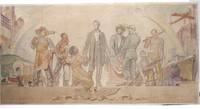
ABRAHAM LINCOLN FREED THE SLAVES AND PRESERVED THE UNION: Original Watercolor and Color Pencil Study for Murals in the Lincoln Memorial Shrine in Redlands California
<p>Redlands California: Unpublished 1932. Original watercolor and color pencil drawing on artist board. SIGNED. Near Fine. 9 inches by 18 Inches.</p><p>Dean Cornwell 1892-1960 studied under Howard Pyle's student Harvey Dunn and the influence of the Brandywine School in much of Cornwell's work. Nicknamed "The Dean of Illustrators" by his peers Cornwell completed more than 1000 paintings as illustrations for stories and advertisements in books and magazines such as <em>Cosmopolitan Life Redbook</em> and many others.</p><p>Although he was very successful as an illustrator Cornwell decided to become a muralist; so in the late 1920s he spent 3 years in England studying mural painting with Frank Brangwyn. His first commission was to create his now famous murals for the Los Angeles Public Library. In 1932 he completed murals for the Lincoln Memorial Shrine in Redlands California. Although the study offered here was not selected for inclusion it may well have been the inspiration for the 2 allegorical murals he completed for the project because it includes both of the elements that were the focus of each of the selected murals: "He Freed the Slaves" and "He Preserved the Union." Included with the watercolor are 2 vintage postcards picturing the murals. Also the scene in this study is placed atop a plinth that is quite similar to those in the murals. The study also includes the muralist technique of surrounding figures with strong outlines which Cornwell adopted both in his own murals and in his later illustration work.</p><p>Paintings by Cornwell have been exhibited in the Whitney Museum of American Art The Art Institute of Chicago the National Academy of Design and the Pennsylvania Academy of Fine Arts. In 1959 he was inducted into the Society of Illustrators' Hall of Fame.</p> Unpublished
Referenz des Buchhändlers : W2805
|
|
|
WAR MEMOIR, SPAIN – MONTVAILLANT, H de
Manuscript memoir of a French officer's experiences during the Napoleonic Wars in Spain 1808-1809. Title: Recollections / By / H de Montvaillant
Hunthill House Scotland 1814. Written in English in a small and narrow but legible italic hand with occasional corrections or additions in a different hand on wove paper watermarked Budgen & Wilmott / 1812. Four unnumbered pages of French text at front and four at back the latter dated 27 May 1814 in a different hand apparently the author’s on different paper with no visible watermark. Very good; some occasional spotting. Contemporary red straight-grained morocco gilt edges scuffed and scraped joints strained head of spine chipped.<br /> <br /> An unpublished first-hand memoir filled with searing descriptions of the horrors of war by a French army officer veteran of the terrible Peninsular War. The narrator was one of few survivors of the surrender of French forces after the Battle of Bailén in July 1808. The background to this event was Napoleon's attempt to complete the isolation of England from the continent by sending a French army into the Iberian Peninsula to occupy Portugal and Spain thereby preventing British trade with the Continent.  Napoleon later referred to the Peninsular War characterized by appalling cruelty on both sides as the ‘Spanish ulcer’; it was to be one of the primary factors in his downfall. <br /> <br /> General Pierre Dupont de l'Étang was charged with securing French control of the major cities in Spain. Dupont's 20000 men had initial success but as they penetrated deeper into Spain they faced increasing resistance. This memoir by H. de Montvaillant an 18-year-old Protestant officer from Montpellier who was serving in the second Corps d’Observation of the Gironde recounts the route and experiences of Dupont's army to its furthest point of penetration into Spain: Córdoba. There after a particularly bloody and cruel occupation the army was forced to withdraw and was soon overwhelmed. Dupont surrendered his army at Bailén. Originally promised safe passage most of the French were slaughtered immediately after their surrender. <br /> <br /> Montvaillant’s account commences with the French arrival in Bayonne in November 1807. By December 22 the French troops had arrived in the town of Vittoria 50 miles west of Pamplona and by January 9 1808 they had advanced to south of Burgos. Detailed descriptions of the monuments churches libraries art and inhabitants of various localities passed through in their zigzagging progress south through French-occupied Spain enliven this first part of Montvaillant’s narrative: he describes with evident pleasure Burgos Valladolid Guadarrama and the Escorial Madrid and Toledo where the troops spent most of May. He makes the acquaintance of many Spaniards. In Toledo a young woman explains to him the contradictions of Spanish women rendered emotionally susceptible by their extreme religious devotion but whose sometimes shocking to the French frankness contrasts with a strict sexual morality. Later he deplores the time wasted in Toledo while the Spanish insurgents were building up their strength. <br /> <br /> As the French troops proceed southward the local populations exhibit increasing hostility often hidden under excessive politeness. They encounter a Frenchwoman who has fled Bailén saying that she was not safe there because of her nationality but the soldiers assume that she exaggerates. By the end of May the French pass the Sierra Morena and enter Andalusia and the truth becomes evident. It is at this point that the narrative takes on an ominous tone. Montvaillant notes that the population had abandoned the villages taking all foodstuffs. He records that the senior officers had assumed that the army would only be harassed by small bands of “brigands†a far cry from the massive resistance that it encountered: “We learned that the insurgents each day gathered strength and that the Junta of Seville was determined to stop us in our March. The following day we got to the little town Baylen in whose plains two months afterwards our destiny was decided†p. 86. <br /> <br /> The first battle was engaged at Alcoléa just upstream from Córdoba an event Montvaillant describes in a poem in French transcribed. The next day the French arrived at Córdoba where the Spanish enemy had taken refuge. A musketry attack upon their arrival so enraged General Dupont that “he gave up the town to pillage" p. 88. Allowed to run wild the French soldiers sacked the city committing hideous crimes: “Neither tears promises or humble supplications could arrest the thirst for pillage.†p. 89. Discipline was nonexistent drunkenness and looting continued for eight days. The soldiers raped the women and ransacked homes. Montvaillant presents himself as a savior of women and the elderly on several occasions but notes that some of the Spanish whom he and fellow officers placed under protection in Córdoba were later “the first to persecute the unprotected French prisoners and even those who had been their Benefactors†p. 92. While he does not detail the contents of the soldiers’ plunder it is known that the rich churches of Córdoba were heavily looted. Notwithstanding the circumstances he manages to visit and describes in amazement the great mosque-cathedral scarcely changed in a thousand years. <br /> <br /> Nine days after the French entrance into Córdoba Montvaillant and his troops were ordered back to Alcolea to guard a bridge crossing. En route there from Cordóba he discovered and graphically describes the many mutilated corpses of the French sick and wounded who had been left along the line of march while the main body of General Dupont's troops had taken Córdoba. “It is almost incredible how people calling themselves Christians could push inhumanity to such an excess†p. 96.<br /> <br /> The army moved back to Andújar near Bailén and encamped. Montvaillant records that the general staff had by now realized that the French were outnumbered and that the opposition had organized itself. Dupont's army was isolated without hope of reinforcement or re-supply defending a garrison situated on a flat plain in the scorching sun. The narrative becomes one of revenge heat troop dispositions losses tactical mistakes errors of the general staff and increasing difficulties. Dupont's surrender came on July 20 1808 and thus begins the second part of the memoir devoted to the narrator’s experiences as a prisoner of war. <br /> <br /> The officers were segregated from the defeated army before being escorted supposedly to return to France. Most of the army was slaughtered within days. Montvaillant records details of the survivors’ months-long “death march†southwards to the coast. Having finally arrived at Jerez de la Frontera near Cádiz to await embarkation to France they waited in vain. Their captors kept them in Jerez having discovered that the ruling Junta of Seville had abrogated the surrender treaty and that the inhabitants were planning to massacre them on their approach to Cádiz. Montvaillant’s account is henceforth devoted to anecdotes of captivity and of the prisoner’s horrendous treatment at the hands of their escorts and guards. He is unclear as to exact dates but it seems that the French captives were held at Jerez until mid-December and then hastily driven aboard ships to sail for the Balearic Islands. A severe storm intervened and they were blown off course to Africa finally coming to port at Gibraltar; several days later they were blown back to Andalusia at Málaga. After more storms and much sailing having been at sea 25 days for a voyage which normally took a week they finally made the Balearics. <br /> <br /> And here the worst surprise of many bad surprises awaited them: the desert island of Cabrera. Montvaillant counts some 4000 soldiers and 400 officers who were forced to survive as best they could on this scorching hot nearly waterless uninhabited island p. 148. Details of his account square with Denis Smith’s monograph on the subject. During the next four years close to 9400 French prisoners of war were exiled to this island; possibly 40% died of disease or malnutrition. The officers as usual fared much better than their soldiers. Montvaillant was one of 216 officers who were collected from this exile after a month and taken to the capital Palma p. 150; another group was sent to Mahon in Minorca. There imprisoned in better circumstances the group waited although the news from outside was threatening as the Spanish "mobs" were calling for their "sacrifice." The officers between attempting escapes were able to conjure up some distractions. The narrator passed the time translating Spanish poems and plays and spending up to eight hours at a stretch playing chess. They also freely imbibed the good Mallorcan wine danced and partied; making do without women Bacchus presided as he delicately puts it. <br /> <br /> But nearly half these officers were massacred during a riot and assault on the prison by the inhabitants of Palma described by Montvaillant in gory detail pp. 158-162. The survivors were returned to Cabrera in March 1810 as were the officers from Mahon. They found there a diminished population of half-naked walking skeletons. During the next five months spent on Cabrera Montvaillant was nonetheless able to observe a thriving “political economy†on the island where enough food was still provided that the prisoners had the energy for theater productions and dances. Describing the gender-bending that took place as the men playing female roles in the performances instinctively took on conventionally feminine attitudes even to the point of inspiring crushes bickering and jealousy among the audience members Montvaillant comments that the theatrical chronicle of Cabrera would make quite a book â€un bel in folioâ€- p. 170.<br /> <p>In early August Montvaillant and the officers were removed from the island on an English ship — all unhesitatingly leaving their men to rot on the island where they remained for four more years. A diplomatic impasse kept the officers off the coast at Gibraltar for several weeks until they were finally put on ships for Portsmouth and Plymouth. Montvaillaint went on to Salisbury for a short time and then embarked again for Leith en route to his final destination in Scotland where he remained in comfortable exile until the accession of Louis XVIII in 1814. <br /> <br /> The text is written in an occasionally stilted English a translation from the author’s own French account by a family whom he had befriended at Hunthill House near Jedburgh Scotland where he stationed. Eight pages of notes in French by the author are inserted four pages at the beginning the bifolium is inserted using wax seals and four pages at the end. The French preface contains a romanticized account of the author’s Scottish sojourn including a temptress fairy and concludes with the author’s promise to never forget his friends in Scotland. The English text is preceded by the title-leaf and a one-page dedicatory poem introduced by a statement that these “`Recollections’ in an English Garb are presented by the sincerest of Friends to the Author†and dated Hunt Hill 1 January 1814. <br /> <br /> Following the narrative in a letter to his family dated from Jedburgh 27 May 1814 Montvaillant explains the history of the manuscript the remaining pages contain literary notes including translations into French of poems by Robert Burns and Sir Walter Scott. During his years of exile in Jedburgh Montvaillant had become deeply attached to the owners of Hunthill House and to their three daughters. Without them he claims he would not have survived the loneliness of his exile. In homage and gratitude he dedicated his memoir to them. His friends retained the original French version as a keepsake of their friend and an engrossing biographical narrative and presented him with this translation which he brought back to France planning to render it anew into French to share with his family and close friends. He emphasizes that he plans to keep the manuscript unpublished; perhaps the memories were too painful. <br /> <br /> Cf. Denis Smith The Prisoners of Cabrera: Napoleon's Forgotten Soldiers 1809-1814 New York 2001.</p> unknown
Referenz des Buchhändlers : 2677

|
|
|
Office, United States Naval War Records
Official Records of the Union and Confederate Navies in the War of the Rebellion Vol. 23 Classic Reprint: Naval Forces on Western Waters From April 12 to December 31 1862
paperback. Good. Access codes and supplements are not guaranteed with used items. May be an ex-library book. paperback
Referenz des Buchhändlers : 1528503953.G ISBN : 1528503953 9781528503952
|
|
|
Department, United States War
Annual Reports of the War Department for the Fiscal Year Ended June 30 1903 Vol. 11 Classic Reprint: Report of the Chief of Engineers; Part 3
paperback. Good. Access codes and supplements are not guaranteed with used items. May be an ex-library book. paperback
Referenz des Buchhändlers : 1528003128.G ISBN : 1528003128 9781528003124

|
|
|
[Japan; Russia; War]
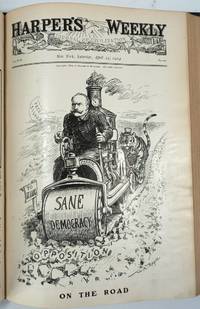
Harper's Weekly Vol. XLVIII Half year volume Russo-Japanese War
New York: Harper's 1904. First printing. Hardcover. Otherwise very good condition. Lg 4to 994pp of bound weekly issues. This half year bound volume of Harper's Weekly January 2 1904 to June 25 1904 features the Russo-Japanese War double page War map p464; war images pp967-975; X Ray invention p49; Steamer "General Slocum" on p99; San Juan Hill p955; Walter Travers golf p931; St. Louis World Fair p677; Southern California The Story of Its Development. pp504-519. With woodblock illustrations on the covers of the weekly issues. Complete with the supplements.<br /> <br /> Weekly issues bound up into a large single volume with 3/4 leather and marbled boards. Leather spine chipped cracked along the hinges but the binding is holding. Internally bright & very clean. Harper's hardcover
Referenz des Buchhändlers : 28398
|
|
|
Kearney, Robert and Cleary, Sharon
Valour and Violets South Australia in the Great War Limited Edition
Mile End SA: Wakefield Press. 2018. Quarto Size approx 24cm x 30.5cm. Mint copy in a Mint Dustjacket. A New Copy. Dustjacket protected in our purpose-made clear archival plastic sleeve. Illustrated with Colour and Black & White Photographs and Plates. Only 200 copies printed. 400 pages. Close to 35000 South Australians enlisted for service overseas during the Great War. Around 5500 never came back. Countless more returned with physical and psychological injuries that would affect them for the rest of their lives. This book brings together for the first time the stories of the campaigns and battles in which South Australians served set against the backdrop of the South Australian home front. Robust professional packaging and tracking provided for all parcels. . New. Limited Edition. Hardback. Wakefield Press hardcover
Referenz des Buchhändlers : BIB299056 ISBN : 1743055315 9781743055311
|
|
|
[1870-1871 WAR]
Dieu et Patrie ! Souvenirs d’un volontaire de l’Ouest.
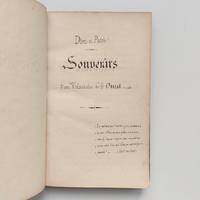
<p><strong>Probably the only surviving copy of this rich account of the enlistment and service of a young volunteer soldier from the West.</strong><br />Entirely autographed and illustrated with a few compositions the author recounts in 24 chapters the war in which he took part his enlistment in the 4th company of the 3rd battalion at Le Mans his Chassepot bayonet rifle his comrades and superiors the Papal Zouaves the descendants of Charette and Stofflet his travels in the West and of course the Prussians.</p><p><em>"My aim is not to invent a novel of pure fantasy; there is no such thing as the simple statement of a fact stripped of all fabulous exaggeration. My intention is therefore to relate very imperfectly no doubt memory is so unfaithful the vicissitudes in the midst of which I lived during four months of a campaign at the height of winter and the impressions I was able to bring back. I wish to preserve in this account an entire truth a character of frankness and authenticity that removes the slightest doubt."</em></p>
Referenz des Buchhändlers : 19726
|
|
|
(WORLD WAR II ARCHIVE)
The Archive Of Meyer J. Frechie The Jewish American Army Officer Who Organized Covert Allied Transportation To Normandy For D-Day
MEYER J. FRECHIE 1907-1988. An American Army Lieutenant Colonel in World War Two Frechie was Chief of the Operational Branch of the Transportation Office and was responsible for coordinating the transportation logistics of the Normandy Invasion D-Day. Archive. More than 1600 pieces. 1942-1953. The archive of Lieutenant Colonel later Colonel Meyer J. Frechie. The archive primarily dates from 1942 to 1945. It includes letters to and from his family in Philadelphia including his wife young son parents and sister and military papers including some interesting material directly related to his work in Allied transportation.Frechie a graduate of the Wharton School of Business at the University of Pennsylvania worked as a traffic manager for the railroad and steamship industries before the war. After the United Statess entry into World War Two the military actively courted Frechie for his skill in transportation logistics. He joined the war effort as a civilian traffic manager for the Army in 1941 before officially joining the Army at the rank of Captain in February 1942 and being sent to London. There he was put in charge of coordinating the covert transport of Allied servicemen and supplies from England to Normandy for D-Day. According to the lengthy text accompanying his citation for the Legion of Merit Frechies war-time activities were in part as follows:The Operational Branch Movements Division Office of the Chief of Transportation was activated in August 1943. Lt. Col. Frechie being the only officer available with amphibious operational experience was designated Chief of said Branch. He developed his staff by sending his officers and men thru a series of strenuous exercises with the British and American Forces at various places in the United Kingdom in preparation for D-DayLt. Col. Frechie as Chief of the Operational Branch was responsible for the movement of all troops vehicles equipment and supplies for movement OVERLORD. From D-Day to 7 September 1944 a total of 1302954 personnel 260433 vehicles and 1272532 deadweight tons of supplies have been shipped from the United Kingdom ports to the Continent. The entire OVERLORD movement program was executed by the movement instructions issued by the Operational BranchLt. Col. Frechie arranged for the building of scale models of various landing craft and scale wood blocks of various general purpose and special purpose vehicles to be used in movement OVERLORDParticipating in actual exercises where one or more of the plans were tested by actual execution Lt. Col. Frechie analysed the results and proceeded t make final plans for movement to implement Army requirements. Lectures were made to the Air Force and Ground Services outlining movement plans; ports and depots were visited and careful studies made of their capacity to handle the vast quantity of supplies vehicles and personnel necessary to sustain the operation. Many obstacles were confronted and surmounted by Lt. Col. Frechie in perfection of operation OVERLORDThis required the greatest flexibility in operation which the Operational Branch under Lt. Col. Frechie was able to exert with dispatchAt all times Lt. Col. Frechies superior judgment keen foresight expert planning and unselfish devotion to duty maintained an exceedingly high state of morale among the officers and men associated with him and his efforts can be directly attributed to the prolonged success of this vitally important mission of the Transportation Corps.Frechie was discharged from active duty in November 1945 and served in the Army Reserves until 1953. He was promoted to Colonel in 1946.The archive contains two large boxes and three small boxes of letters and documents. All are in at least good condition with the exception of a few torn letters. Highlights are as follows:One large box of military paperwork. The highlight is a book entitled Berth Allocation Ports UK and marked Most Secret on the cover; it examines many British ports and their capacity in preparation for the D-Day Landings. It includes a booklet of secret maps and information about ports in the United Kingdom. There is also a thick file of diverse paperwork relating to Frechies military career a mix of originals and copies some of it quite mundane such as records of his travel within the UK booklets written by Frechie including Preliminary Analysis and Recommendations Cargo Documentation Procedure and Historical Critique of the United Kingdom Overlord Movements three copies certificates of appointment as Lieutenant Colonel and Colonel copies of his Honorable Discharge citations for the Bronze Star and Legion of Merit and a thick file of documents relating directly to his work on the Normandy landings. Much of the most interesting and unique material can be found in this box. The two thick files are hundreds of pages each.One large box of hand-written letters and copies of V-Mail to and from Frechies wife Rita and son Allen. There are 659 letters from Frechie to Rita and Allen including many duplicates. They are dated 1942-1945 and 1947 and there are also numerous letters dated only with the month and day. The greatest number are dated late 1942 and 1943 when he wrote multi-page letters to her every day often more than once per day. There are also 230 letters to Frechie from his wife and son the majority dating to 1942. This is the bulk of the archive both in number of unique items and in quantity of pages.One small box of hand-written letters and copies of V-Mail to 144 and from 246 Frechies parents Bessye and Jack. There are numerous copies of V-Mail from Frechies mother including some duplicates.One small box of hand-written letters and copies of V-Mail to 43 and from 206 Frechies sister Fleurette Lang brother-in-law Stanley and niece Jackie. The majority is copies of V-Mail letters from Fleurette.One small box of miscellaneous cards newspaper clippings assorted Army-related pamphlets etc.This is the substantial archive of a man who made a unique and valuable contribution to the Allied victory in World War Two. unknown
Referenz des Buchhändlers : 5396
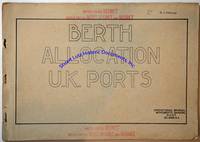
|
|
|
Taber, Isaac Walton
THE GROUND IN FRONT OF BATTERY ROBINETTE original drawing
New York: The Century Co. 1884. The image is 4 5/8 inches by 7 1/4 inches on artist board measuring 14 1/2 inches by 12 1/4 inches. Original ink drawing by Walton Taber 1857-1933 after a post-battle photograph. The scene shows dead Confederate soldiers in front of Battery Robinette on October 5 1862 the morning after the battle at Corinth Mississippi. Civil War historians J. Matthew Gallman and Gary W. Gallagher attributed the photograph to Ohio born and Corinth based photographer George Washington Armistead . However the Library of Congress has a virtually identical photographic negative that is attributed to Nicholas D. Brown. Although the photographer's identity remains uncertain it is clear that the drawing is by Walton Taber and is signed by him in the lower left corner of the image. Taber did the drawing for the Century Company who published it on page 751 of volume 2 of Battles and Leaders of the Civil War. This drawing along with others by Taber that were included in the Century Collection of Civil War Art was auctioned by Christie's in New York in 1988. Born in New Bedford Massachusetts Taber was one of the most important American illustrators during the late nineteenth and early twentieth centuries. His pen and ink drawings provided the Century Company almost 250 illustrations for Battles and Leaders. The drawing offered here is in near fine condition: clean and bright on artist board that is lightly and uniformly toned on the recto; there is some minor soiling on the verso along with notations made by Century editors and a later framer. The drawing is now archivally matted and ready for a 16" by 16" frame. SIGNED. Original. Single Sheet. Near Fine. Illus. by Isaac Walton Taber. 4 5/8" by 7 1/4". Fine Art Print. The Century Co.
Referenz des Buchhändlers : W2434
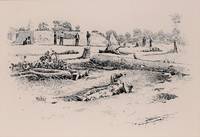
|
|
|
Ministere de la Guerre
Mouvements Et Transports. Organisation Générale Aux Armées: Volume Arrêté À La Date Du 8 Décembre 1913 French Edition
paperback. Good. Access codes and supplements are not guaranteed with used items. May be an ex-library book. paperback
Referenz des Buchhändlers : 2019961768.G ISBN : 2019961768 9782019961763
|
|
|
Fischer, Joachim (War Correspondent); Otto Cleve (Ill)
Die Goldene Spange: Wie sich der Feldwebel Bergmann die Goldene Nahkampfspange erwarb WITH 15 ORIGINAL LITHOGRAPHS HAND-SIGNED BY OTTO CLEVÉ A SOLDIER IN THE WEHRMACHT DURING THE CAMPAIGN ON THE EASTERN FRONT
Russland: Frontdruckerei "Panzerfaust 1943. First edition. Loose leaf. g to near fine. 58/100 hand-numbered on title page and signed Joachim Fischer at end of text. All lithographs signed Clevé 43. Elephant Folio 18 x 14". 32 leaves incl. 15 full-page lithographs 17 3/4 x 13 3/4". Original cream portfolio with black lettering on cover protected by modern mylar. Title page with small ochre image of the golden clasp below title and black publisher's device. Additional unsigned lithograph on last printed page below Fischer signature.<br /> <br /> This is an extravagant limited edition produced during the Russia campaign for an elite circle of officers. Laid in a typed letter to Major Zeck site commander at Vitebsk dated November 1 1943 and signed Fischer first lieutenant and company commander "Enclosed a portfolio in the hope you might like it. With obedient recommendations your devoted "Fischer". <br /> <br /> The printed text describes the heroic combat of Staff Sergeant Bergmann from the Tank Division 697. The fighting takes place in the trenches in hand-to-hand combat as well as other combat situations during Bolshevik attacks in 1942 through June of 1943 including an injury of the Staff Sergeant's arm incurred during one of the attacks. At times the enemy seriously outnumbers the German force and the report is highlighting Bergmann's bravery that led to the bestowal of three decorations and eventually the Golden Close Combat Clasp on July 2 1943. The impressive lithographs depict various combat situations.<br /> <br /> Text in German. Portfolio with light wear along edges small chip at bottom of front cover and portfolio flap folds expertly repaired. Lightly sunned along edges. Portfolio in overall good interior in near fine condition. Frontdruckerei "Panzerfaust unknown
Referenz des Buchhändlers : 44673
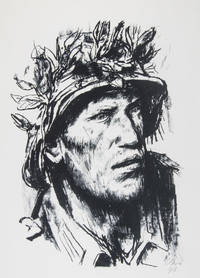
|
|
|
War Office, Geographical Section, General Staff
Map of Nanking
War Office Geographical Section General Staff 1927. 745 by 995mm. 29.25 by 39.25 inches. Coloured lithograph map dissected into 32 4 by 8 sections mounted on linen. Scale 1:250000 Nanking in 1927 was a treaty port located on the southern shores of the Yangtze River. Because the foreign interests in China were largely American and European squadrons of foreign naval vessels were stationed along the Yangtze to protect their citizens doing business at the treaty ports. The British Royal Navy operated the China Station under Rear Admiral Sir Reginald Tyrwhitt and the United States Navy the Yangtze Patrol; both lasted for around 80 years until World War II. War Office, Geographical Section, General Staff unknown
Referenz des Buchhändlers : 15017
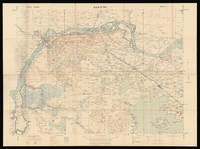
|
|
|
CIVIL WAR
First Federal Occupation of Winchester Broadside
<p>Broadside describing the first occupation of Winchester Virginia during the Civil War.</p> <b>CIVIL WAR.</b>Broadside signed in type by Colonel William D. Lewis Winchester Virginia April 17 1862 1 p. 12½ x 11 in.<p><b>Partial Transcript</b></p><p><i>"HEAD QUARTERS </i></p><p><i>Commander of the Post </i></p><p><i>Winchester Va. April 17 1862. </i></p><p><i>CITIZENS OF WINCHESTER: </i></p><p><i>Upon me has devolved the duty of commanding this Post. My wish and my duty is to afford you all the </i>liberty<i> and </i>protection<i> due to </i>fellow citizens<i>. The </i>Government<i> I represent is </i>the same our forefathers established <i>to form a more perfect </i>Union<i>. . . promote the </i>general welfare<i> and secure to </i>us and our posterity<i> the blessing of </i>Liberty<i>. We mean truly to represent its impartial </i>Justice.</p><p><i>But no one can expect the privileges of a </i>citizen<i> and behave as an </i>enemy<i>. No one can expect kindness . . . who does not extend it to others. </i></p><p><i>Citizens are reminded that the troops now stationed here are those of </i>their own Government<i> and are </i>lawfully<i> here on their </i>country's soil<i>. . . they are here for the </i>protection<i>of their fellow citizens and for the prosecution of their Country's Enemies the 'Rebels.' Those persons Male or Female engaged in circulating flying rumors and creating false excitements are particularly warned. </i></p><p><i>Our soldiers are to support the </i>Rights of all<i> and were I to permit flying reports and insulting remarks to be made the means of mischief annoyance and insult to the service or its servants they would provoke retaliations and lead to much useless suffering. </i></p><p><i>I trust Fellow Citizens you will understand and appreciate the justice of these principles and by your conduct obviate the necessity for harsh measures"</i></p><p><b>Historical Background</b></p><p>Colonel William D. Lewis issues a warning to the citizens of Winchester Virginia imploring them to submit to his occupation or face <i>"harsh measures."</i> This was the first official occupation of a town that would change hands nearly seventy times during the war. Union General Nathaniel Banks entered the Shenandoah Valley in March 1862 occupied Winchester on March 12 and defeated the Confederates at the battle of Kernstown on March 23. On May 25 Union forces were defeated by Stonewall Jackson at the first battle of Winchester and forced to withdraw from the town towards Harper's Ferry thus ending the first Federal occupation of Winchester.</p><p><b>Condition</b></p><p>Very good</p>
Referenz des Buchhändlers : 22128
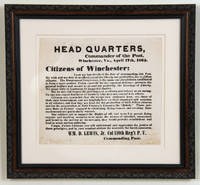
|
|
|
[CIVIL WAR]
Hand-Made Union Patriotic and Religious Song Book
1864. No binding. Condition: Fine. Manuscript Pen and Ink Folk Art Song Book ca. 1864. 24 pp. 6 5/8 x 8 in. This hand-sewn booklet contains eight songs popular during the Civil War era with music and lyrics in calligraphy. Songs include "On a Green Grassy Noll" by J. D. Canning with music by Ira Odell; "The Old Mountain Tree" by James G. Clark; "Harmonian Waltz"; "Year of Jubilee or Kingdom has Come!"; "Squire Jones's Daughter"; "The Sweet Birds Are Singing"; "Lament of the Irish Emigrant"; and "Soon and For Ever" by J. B. Monsell. The last page of the booklet is dated February 21 1864. Partial Transcript: Year of Jubilee or Kingdom has Come! I come up Norf on a little bender Left Missus at home wid no one to tend her Ole Massa's gone I dun-no what to; Sambo pretty sure he don't much care to. Chorus: Den sound de horn beat de drum Sound de horn and beat de drum De year ob jubilee am come Sound de horn and beat de drum De year ob jubilee am come. Met genral Bloaregard on my way here He told me dat I had better stay dere He said up Norf dey would skin and eat me Dat was a yarn dat a little heat me. He said he had just whipp'd Gen-ral Bu-el Grant and Wallace All three in a duel. I axed him den why he was running away Sam-bo says he dat question aint fair play. Oh times down Soth am getting quite rotten He's so berry scarce they have to burn cotton I left dat land ob oppression and gas And roam de free Norf without nary pass. Molasses Junction was a big scarecrow Nigh its wooden guns nobody didn't dare go; But when McClellan got a good ready De Southern Gentry seemed quite unsteady. Abraham Lincoln and Emancipation De two tallest tings in dis tall nation; Hurrah den boys let us still be merry Kingdom has come boys we've good times berry. Historical Background: Music played a prominent role in the American Civil War. On the battlefield and in the camps it boosted morale and released tensions. On the homefront it helped individuals and families express political sentiments grief and longing. Music entertained and often carried political religious and social messages. "The Year of Jubilee or Kingdom has Come!" was written by "Sambo" and first published in 1862 by H. M. Higgins in Chicago. "Squire Jones's Daughter" tells of the virtues of "The prettiest girl in the State of Maine" and was copyrighted by New York publisher Henry De Marsan in 1860. "The Sweet Birds Are Singing" is a cheerful pastoral duet about springtime that dates to at least 1836. "On a Green Grassy Noll" by J. D. Canning was first published in Boston in 1852 and is an elegy for a nameless old farmer who has "ploughed his last furrow." "The Old Mountain Tree" is a ballad in the form of a quartet by James G. Clark first published in 1854. It expresses longing for an old homestead. Clark 1829-1897 enlisted in the 35th New York as a 1st lieutenant and was detailed to remain in the recruiting service. He used music in his efforts to enlist soldiers in the cause and was dubbed "The People's Poet." "Lament of the Irish Emigrant" is a ballad by Helen Blackwood 1807-1867 with music by William R. Dempster 1808-1871 first published in Boston around 1840. It tells the story of an Irish emigrant who has buried his wife Mary and their child. Blackwood Baronness Dufferin and Claneboye was a British songwriter composer poet and author. Dempster a Scottish singer was very popular in the United States. "Soon and For Ever" is a sentimental hymn by J. B. Monsell about the Christian's union with Christ in Heaven. Rev. James Samuel Bewley Monsell 1811-1875 was an Irish Anglican clergyman and poet. He wrote the poem in 1853 or earlier.Condition: Very minor soiling else near fine.<br />
Referenz des Buchhändlers : 24826
|
|
|
[CIVIL WAR] - READ, Joseph Corson
Southern Mississippi and Alabama Showing the Approaches to Mobile
Washington: Coastal Survey Office 1863. Folding map 24 x 25 1/2 inches mounted in twenty-four sections on linen. Original card covers with printed paper label. Contemporary ownership inscription on label. Light wear. Minor foxing. Rare field operations map of Mississippi.<br/> <br/> This rare Civil War map was created by the Coast Survey office the main cartographic arm of the Union Army for use in the Union campaigns into the South. This copy was owned and used by Colonel Joseph Corson Read the Chief Commissary of the Army of the Cumberland. In November 1863 the Union armies captured Chattanooga the "Gateway to the South" enabling them to stage a prolonged offensive into the Southern heartland. Grant moved very quickly to overwhelm the South and immediately ordered Sherman to move against Atlanta and its vital railroad supply lines at the same time as he sent Nathaniel Banks to attack Mobile Alabama. Joseph Corson Read 1831-1889 was one of the first wave of men to take up Abraham Lincoln's call for volunteers to put down the rebellion in April 1861. He remained continuously in the army serving first on General Jesse Reno's staff and rising to the rank of Chief Commissary for the Army of the Cumberland commanded by George H. Thomas. Thomas was impressed with Read and on May 1 1864 with the spring campaign against Atlanta imminent Thomas named Read Chief Commissary of the Army of the Cumberland in the Field. This meant that although Colonel A.P. Porter was the Army's overall chief Read would serve alongside Thomas in the field and had the responsibility to supply the entire army as it moved South. During the long and arduous Atlanta campaign he was the man on the ground making the supply side work. Read developed a close relationship with Thomas one with both personal and professional aspects. This map scaled at ten miles to the inch shows Mississippi and Alabama from Jackson to Montgomery starting about fifty miles north of those two points and continuing south to New Orleans and the Gulf of Mexico. Rivers roads and rail lines and all the towns they connect are detailed with waterways printed in blue. Two of the railroads the Mobile & Pensacola and the Mobile & Great Northern construction and removal dates during the war. An important map that would have been used by the Union Army in the field specifically by the Chief Commissary of the Army of the Cumberland.<br/> <br/> Library of Congress Civil War Maps 260.1; Library of Congress Railroad Maps 140. Coastal Survey Office unknown
Referenz des Buchhändlers : 27010

|
|
|
Nicola Guerra
The Italian Far Right from 1945 to the Russia-Ukraine Conflict
like new. unknown
Referenz des Buchhändlers : 46514839 ISBN : 1032566256 9781032566252

|
|
|
United States War Policies Commission
War Policies Commission: Hearings before the Commission Appointed Under the Authority of Public Resolution No. 98 Seventy-first Congress Second Session H. J. Res. 251 Part 1 March 5-18 1931; Part 2 May 13 14 1931; Part 3 May 14-22 1931.
Washington DC: United States Government Printing Office 1931. Presumed first editions first printings. Hardcover. Good. 898 71 6 p. Includes index. Three parts bound together in one volume. Folding charts. No dust jacket. Ex-library. Signed by previous owner. Cover has some wear and soiling. Usual library markings. Some marks to text/margins noted. The Message from the President of the United States was transmitting a communication from the Secretary of War Chairman of the War Policies Commission Submitting additonal documents in connection with the study may by the Commission as required by provisions of the Public Resolution creating the Commission March 12 1931 72d Congress First Session House Document No. 271. Also includes is 72d Congress FIrst Session House of Representatives Document No. 264 transmitting in accordance with the provisions of Public Resolution No. 98.the final recommencation of the Commission. The Chairman outlined the purpose of the Commission as follows: "To carry out the task assigned by law there must first be assembled and analyzed such data as well set forth clearly the essential needs of the country in a major emergency. Next there must be determined the reasons why in the GOvernment efforts to supply its needs in all past wars opportunity has been presented to some individuals to reap extraordinary financial profit while others have been called upon to bear more than a proprotionate share of the burdens. Based upon these analyses the commission must develop basic methods and policies whereby the economic burdens of war may be made to fall with equal weight on every element of our citizenship. This is a most difficult and intricate problem and a correct solution of it is of tremendous importance. " The Commission recommended constitutional amendments Presidential power to stabilize prices control natural resources commandeer property to procure without competitive bidding between government agencies for industry products and no use of cost plus percentage contracts. United States Government Printing Office hardcover
Referenz des Buchhändlers : 64664
|
|
|
Naval War College Press
Non-International Armed Conflict in the Twenty-First Century International Law Studies Volume 88
hardcover. Good. Access codes and supplements are not guaranteed with used items. May be an ex-library book. hardcover
Referenz des Buchhändlers : 1782662405.G ISBN : 1782662405 9781782662402
|
|
|
Norma S Guerra
From Problem-Solving to Responsible Decision-Making
Paperback / softback. New. <p>This book offers a comprehensive and culturally responsive problem-solving approach that addresses the complexities of culture identity and the impact of decisions on individuals families and communities. It is a guide for problem-solvers seeking to make better-informed decisions in professional and personal situations.</p> paperback
Referenz des Buchhändlers : B9781837085071 ISBN : 1837085072 9781837085071
|
|

 Per e-mail erhalten
 Als pdf-Dokument herunterladen
 RSS feed
 Permanenter link


