G/NONE. 1945. Softbound. Paperbound stapled booklet with 29 pages and large foldout map at rear. Cover in red white blue depicts tank on front panel and quote by General Patton on rear. Contents tight in cover with first free endpaper creased at upper corner. Colorful map at rear is in nice condition no tears and depicts the route of the Ghost Corps through Normandy Northern France Rhineland Central Europe. ; . paperback
U. S. Army. very nice copy; larger-format; inscribed by General Barry R. McCaffrey commanding general of the 24th Infantry Division . Fine. Hardcover. 1st Edition. 1991. U. S. Army hardcover
Washington D. C.: Departments of the Army and the Air Force 1958. Paper Back. Near Fine/No Jacket. 8vo - over 7¾" - 9¾" tall. 82pp.; SC staple-bound tan w/blk.no title on spine; slight rub w/cleantight pgs. ". limited to a consideration of those toxic chemicals and weapon systems which are available to the field commander at the time of publication ." TM 3-200 / TO 42C-1-7. original 1958 manual. <br/> <br/> Departments of the Army and the Air Force unknown
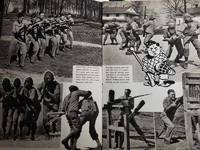
Good with No dust jacket as issued. 1940s. Stapled wraps. Partially detached from cover. There are minor imperfections not affecting text or photos such as corner off of back cover one page has an edgetear the book shows wear. ; full of photos; 6 x 9; 26 pages . paperback
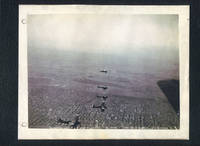
Mitchel Field Long Island NY: U.S. Army Air Service 1923-1925. 1923-1925. Archive of 57 original aerial photographs from the 8th & 14th Photographic Sections Air Service during the Aerial Mapping Survey of New York City and vicinity and the Northeast. 57 original photos mounted on thick card stock 10" x 8". 53 have identifications of place and Air Service Photo section at lower fore-edge of the images and all are printed on glossy photographic stock with some sepia-toned. The images encompass planes in formation over New York views of Manhattan the Statue of Liberty a factory fire in Jersey City Fort Ticonderoga the Zeppelin hanger at Lakehurst New Jersey Albany Philadelphia Hartford Exeter NH numerous Air Fields a scarce series of photos for the Jan. 24th 1925 Eclipse of the Sun and more. The Air Service was created by executive orders of President Wilson in May 1918 during World War I and would eventually expand to nearly 200000 personnel and 2000 aircraft by the end of the war producing planes as well as carrying out operations by aerial reconnaissance photo sections dirigibles balloons and fixed wing aircraft. By 1923 the peacetime cutbacks had slashed the Air Service down to just under 10000 men and 1450 aircraft including 15 photographic sections encompassing the above mentioned 8th and the 14th commanded from 1920 to 1925 by Brig. General Billy Mitchell. Mitchell campaigned tirelessly and bitterly until his court-martial at the end of 1925 to establish the Air Service as a separate military wing independent from the Army and Navy. To aid this mission he authorized a number of publicity stunts to emphasize the modernity and ability of the Air Service including aerial mapping projects speed and altitude records in cross country flying scientific projects and most famously the first flight around the world. The Air Service set up support facilities around the world for the fliers and in April 1924 sent four aircraft named Seattle Chicago Boston and New Orleans west beginning from Seattle Washington and led by Major General Mason Patrick Chief of Air Service. Two of the images in this collection show the two surviving Douglas World Cruisers which on Sept. 8 1924 stopped over in New York One of the photos shows a formation including the New Orleans flown by Lieutenants Eric Nelson and John Harding. They would complete the circumnavigation on Sept. 28 1924 in Seattle nearly 3 weeks later after these photos. The earliest of the dated photos shows 5 DH-4Bs flying in formation on November 20 1923 over Manhattan. The DH-4Bs set records of flying aloft through aerial refueling. The images dated July through November 1924 by the 8th Photo Section during their Aerial Survey mapping projects include Hartford Bridgeport and New Haven CT; Air Port in Boston MA; Fairgrounds at Brockton MA; Exeter NH; Providence and Connecticut Island RI; as well as 2 photos of a Nov. 1924 fire in the industrial section near the docks in Jersey City NJ showing tugboats nearby as well as smoke billowing above the factories damaged by the fire. Images by the 14th Photo Section include the airfield and hangar Lakehurst Naval Air Station NJ which was the home of the ZR-3 Los Angeles dirigible and would later be the site of the Hindenburg disaster; 3 photos of Mitchell Field Long Island NY; landing fields in Van Cortland Park Bronx NY; Governors Island; 2 photos of Roosevelt Field and downtown Albany at Albany NY; aerial views of the Statue of Liberty lower Manhattan including nice images of the Manhattan and Brooklyn Bridges; Fort Ticonderoga; Niagara Falls; Philadelphia; and photographs mapping the area around Mt. Mansfield Vermont. Of particular interest are the series of 11 photographs showing the sequence of the total solar eclipse on Jan. 24th 1925 over Connecticut. The skies were cloudy but 12 planes the ZR-3 Los Angeles dirigible and many scientists and men with special cameras and instruments recorded the event. Ten of the photographs here are marked in stages for the eclipse and an additional separate initial view that is marked Eclipse of the Sun 14th Photo Section Air Service U.S.A. This collection offers an excellent historical record of the early years of U.S. aviation as well as views of the Northeast during the 1920's. All of the images are quite crisp with almost no fading and have two small holes at the left gutter margin where they were apparently stored originally in a two- ring binder. Minor bumping and chipping to some corners of the boards. A few images have lifted at the corners and a couple have very minor loss one with creasing to center of image though not affecting the quality of the image. A remarkable collection of a scarce series of aerial photographs taken by the 8th and 14th Photographic Sections of the U.S. Army Air Service. U.S. Army Air Service, 1923-1925. hardcover
London: HMSO 1944. British Edition. Wraps. Good. Quarto viii 119 pages plus illustrated cover. Wraps. Illustrations. Maps Glossary. Endpaper map and Illustration. Some pages darkened and some foxing spine edges worn covers soiled and worn. Eighth Air Force was established as VIII Bomber Command on 19 January 1942 and activated at Langley Field Virginia on 1 February. It was reassigned to Savannah Army Air Base Georgia on 10 February 1942. An advanced detachment of VIII Bomber Command was established at RAF Daws Hill near RAF Bomber Command Headquarters at RAF High Wycombe on 23 February in preparation for its units to arrive in the United Kingdom from the United States. The first combat group of VIII Bomber Command to arrive in the United Kingdom was the ground echelon of the 97th Bombardment Group which arrived at RAF Polebrook and RAF Grafton Underwood on 9 June 1942. VIII Bomber Command of the United States Army Air Forces was established early in 1942. The first combat units arrived in the United Kingdom in June and combat operations began in July with first heavy bomber operations in August. Its bomber units were deployed in the UK chiefly around East Anglia. From June 1943 it was the daylight bombing part of the Combined Bomber Offensive against Germany. VIII Bomber Command was redesignated as Eighth Air Force on 22 February 1944. The Eighth Army Air Force 8 AAF was a United States Army Air Forces combat air force in the European theater of World War II 1939/41–1945 engaging in operations primarily in the Northern Europe area of responsibility; carrying out strategic bombing of enemy targets in France the Low Countries and Germany; and engaging in air-to-air fighter combat against enemy aircraft until the German capitulation in May 1945. It was the largest of the deployed combat Army Air Forces in numbers of personnel aircraft and equipment. Regular combat operations by the VIII Bomber Command began on 17 August 1942 when the 97th Bombardment Group flew twelve Boeing B-17E Flying Fortresses on the first VIII Bomber Command heavy bomber mission of the war from RAF Grafton Underwood attacking the Rouen-Sotteville marshaling yards in France. During World War II the offensive air forces of the United States Army Air Forces USAAF came to be classified as strategic or tactical. A strategic air force was that with a mission to attack an enemy's war effort beyond his front-line forces predominantly production and supply facilities whereas a tactical air force supported ground campaigns usually with objectives selected through co-operation with the armies. In Europe Eighth Air Force was the first USAAF strategic air force with a mission to support an invasion of continental Europe from the British Isles. Eighth Air Force carried out strategic daytime bombing operations in Western Europe from airfields in eastern England as part of the Combined Bomber Offensive. HMSO paperback
Los Angeles: AAF Publications Company. Near Fine. 1947. First Edition. Paperback. Softcover in pictorial wraps. First edition. 1947. Book is crisp clean and unmarked with very light rubbing to edges. Includes a brief history of the Twelfth Air Force. Illustrated with black-and-white photos throughout. 4to. Unpaginated . AAF Publications Company paperback
U. S. Army Base Printing Plant 29th Engineers 1918. Map. Very Good. Soft cover. 28 x 21 inch U. S. 1918 WW1 Army Map. Scarce U. S. Army French WW1 map in nice condition. Size: Double Elephant - over 25 - 50" tall. U. S. Army Base Printing Plant 29th Engineers Paperback
University Press of the Pacific 2004-11-06. paperback. Used: Good. 8.25x0.44x11.00. Buy with confidence. Excellent Customer Service & Return policy. University Press of the Pacific paperback
Referenz des Buchhändlers : SONG1410218376 ISBN : 1410218376 9781410218377

 Per e-mail erhalten
 Als pdf-Dokument herunterladen
 RSS feed
 Permanenter link