Washington DC: United States Department of the Army Headquarters 1976. Presumed first edition/first printing no 'supercedes' notice. Ringbound. Very good. Includes: illustrations diagrams maps. Three-hole punched in binder with Change No. 1 of 20 May 1977 present. Various paginations about 200 p Glossary. Fold-out. s This manual presents the state of the art state of knowledge and the state of practice at the end of the Vietnam War era. From Wikipedia: "An army aviation unit is an aviation-related unit of a nation's army often described as an air corps. These units are generally separate from a nation's dedicated air force and usually comprise helicopters and light support fixed-wing aircraft. The tasks of each army's aviation units are defined slightly different depending on nationality. Some general characteristics however apply to all army aviation units regardless of provenience: Logistic and battlefield support Tactical transport both internally and externally of personnel and material Assault duties and anti-tank warfare Search and rescue Medical evacuation Reconnaissance and fire support in a combined arms team Surveillance Liaison Flying training Disaster relief In order to fulfill their manifold tasks army aviation mostly uses helicopters. These helicopters can be classified into the following types: Attack helicopters for close air support of ground troops and anti-tank role Transport helicopters Observation helicopters Utility helicopters CSAR Casualty Evacuation CASEVAC/MEDEVAC helicopters Training helicopters" United States Department of the Army Headquarters unknown
Washington DC: U.S. Government Printing Office 1966. Wraps. Good. No dust jacket as issued. Cover has some wear and soiling. Stamp on front blacked over. 116 1 p. Includes: illustrations diagrams index. Three-hole punched staple bound. Fold-out chart. Glossary. This manual supersedes FM 3-1 20 February 1962; TM 3-200/TO 42C-1-7 13 October 1958 Including C! 18 April 1060; and the following portions of FM 3-5 13 September 1961: Chapters 2 3 and 6; secton 1 of Chapter 4 and section III of chapter 5. This represents the state of knowledge and the state of practice during the first part of the Vietnam War. This manual provides doctrinal guidance for the employment of antipersonnel chemical and biological agents. It provides data and guidance for the planling and employmnent of chemical and biological munitions with available weapons systems. U.S. Government Printing Office paperback
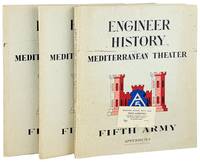
N.p.: United States Fifth Army 1945. Very Good. N.p.: United States Fifth Army 1945. First Edition. Three small quarto volumes. Photographs and illustrations throughout including many maps. Illustrated wraps with a "Declassified" sticker dated 1948 to front of each. Light edgewear toning and scuffing to wraps. First 25 pages of volume II nearly fully detached but present; bindings otherwise sound. Mild curling to corners but interiors unmarked; still a Very Good set of this detailed history of the fifth army from an engineering perspective. Covers Anzio Beachhead and the Arno and Po campaigns. United States Fifth Army unknown
Washington DC: U.S. Government Printing Office 1969. Reprint. 1986 printing. Wraps. Good. No dust jacket as issued. Stamped balcked out on front. Cover has wear soiling and sticker residue. 237 p. Includes: illustrations diagrams index. Three-hole punched staple bound. References. This manual supersedes FM 5-13 31 July 1964. This reflects the lessons learned over the major period of the Vietnam War and served as the standard text for approximately the next two decades. U.S. Government Printing Office paperback
2022. Leather Bound. New. Size: 19.68 x 24.13 cms Presenting an Exquisite Leather-Bound Edition expertly crafted by the prestigious organization “Rare Biblio” with Original Natural Leather that gracefully adorns the spine and corners. The allure continues with Golden Leaf Printing that adds a touch of elegance while Hand Embossing on the rounded spine lends an artistic flair. This masterpiece has been meticulously reprinted in 2022 utilizing the invaluable guidance of the original edition published many years ago in 1961. The contents of this book are presented in classic black and white. Its durability is ensured through a meticulous sewing binding technique enhancing its longevity. Imprinted on top-tier quality paper. A team of professionals has expertly processed each page delicately preserving its content without alteration. Due to the vintage nature of these books every page has been manually restored for legibility. However in certain instances occasional blurriness missing segments or faint black spots might persist. We sincerely hope for your understanding of the challenges we faced with these books. Recognizing their significance for readers seeking insight into our historical treasure we've diligently restored and reissued them. Our intention is to offer this valuable resource once again. We eagerly await your feedback hoping that you'll find it appealing and will generously share your thoughts and recommendations. Lang: - English Pages:- 38. If it is a multi-volume set then it is only a single volume. Product Disclaimer: Kindly be informed that owing to the inherent nature of leather as a natural material minor discolorations or textural variations may be perceptible. Explore the FOLIO EDITION 12x19 Inches: Available Upon Request. hardcover
Washington DC: United States Department of the Army 1988. Contemporary Xerox style copy. Xerox style copy. Good. Various paginations approximately 160 pages. Illustrations Tables and Figures. Maps. List of Acronyms References Appendices. Three-hole punched held in place by a binder clip. Cover has some wear and soiling. The elimination of the Army's solid-fueled Pershing Missiles using the Treaty's prescribed methods of explosive demolition or burning has been analyzed for potential environmental effect at each of four candidate locations: Pueblo Army Depot Tooele Army Depot Hercules Aerospace Inc. and Longhorn Army Ammunition Plant. The analysis is documented in this Environmental Assessment. The Intermediate-Range Nuclear Forces Treaty INF Treaty formally Treaty Between the United States of America and the Union of Soviet Socialist Republics on the Elimination of Their Intermediate-Range and Shorter-Range Missiles was an arms control treaty between the United States and the Soviet Union and its successor state the Russian Federation. US President Ronald Reagan and Soviet General Secretary Mikhail Gorbachev signed the treaty on 8 December 1987. The US Senate approved the treaty on 27 May 1988 and Reagan and Gorbachev ratified it on 1 June 1988. The INF Treaty banned all of the two nations' land-based ballistic missiles cruise missiles and missile launchers with ranges of 500-1000 kilometers 310-620 mi short medium-range and 1000-5500 km 620-3420 mi intermediate-range. The treaty did not apply to air- or sea-launched missiles. By May 1991 the nations had eliminated 2692 missiles followed by 10 years of on-site verification inspections. Amidst continuing growth of China's missile forces US President Donald Trump announced on 20 October 2018 that he was withdrawing the US from the treaty due to supposed Russian non-compliance. The United States claimed another reason for the withdrawal was to counter a Chinese arms buildup in the Pacific including within the South China Sea as China was not a signatory to the treaty. The US formally suspended the treaty on 1 February 2019 and Russia did so on the following day in response.citation needed The US formally withdrew from the treaty on 2 August 2019. United States, Department of the Army unknown

 Per e-mail erhalten
 Als pdf-Dokument herunterladen
 RSS feed
 Permanenter link