|
-
Praga. Il film a colori dell'invasione russa.
Milano, 1968, numero speciale della "Domenica del Corriere", pp. 74 con ill. (anche una tav. di Jacovitti)

|
|
|
-
Produzione e vita di fabbrica nell'URSS. Atti del Convegno di informazione sulla produzione e la vita di fabbrica nell'URSS (Torino 1-2 marzo 1952).
Roma, 1952, 8vo brossura, pp. 220.

|
|
|
-
Raccolta di "Lotta Comunista" 1965-1982
Milano, Edizioni Lotta Comunista, 1987. In 4to, tutta tela editoriale con sovraccoperta, pp. non num. raccolta della rivista dal n. 1 del dicembre 1965 al n. 148 del dicembre 1982.-Stato di nuovo.

|
|
|
-
Raccolta di documenti. IX Congresso Nazionale del Partito Comunista Cinese. Statuto del Partito Comunista Cinese.
Pechino, 1969, 16mo cop. in plastica rossa editoriale, pp. 178 con tavole fotografiche nel testo.

|
|
|
-
Rapporto Krusciov.
Torino, 1958, 16mo brossura, pp. 110

|
|
|
-
RIVISTA ANARCHICA N. 4 - 1977
In 8, pp. 34, br., molte imm. fotograf. n.t. Minimi difetti (6497/ TERRORISMO - ANARCHIA - COMUNISMO - POLONIA - SPAGNA)
|
|
|
-
Scepilov sostituito da Gromyko alla direzione della politica estera russa.
Bologna, 1957, febbraio 16, titolo in prima pagina de "il Resto del Carlino" col giornale completo.

|
|
|
-
Soldati sovietici saccheggiano la cattedrale di Simonow, poi demolita con la dinamite.
1930, 24 febbraio, tavola a colori de 'Il Mattino Illustrato'.

|
|
|
-
Stalin il terribile.
Milano, Mondadori, 1966, 8vo brossura con copertina illustrata, pp. 146 completamente illustrato da fotografie e tavole fotografiche in nero e a colori (Numero di “Storia illustrata”) .

|
|
|
-
Stalin.
Milano, Mondadori, 1971, 8vo cartonato editoriale con copertina illustrata, pp. 159 con illustrazioni n.t. (Pro e contro, 1).

|
|
|
-
Storia del comunismo. Fatti, uomini, idee che hanno segnato il XX secolo.
Milano, Rizzoli, anni '90, quattro volumi in-4to legatura mezza tela con copertina illustrate a colori, pp. 625 + 240, completamente illustrati a colori.

|
|
|
-
Storia del partito comunista (bolscevico) dell' URSS.
Mosca, 1945, 8vo tutta tela editoriale, pp. 314

|
|
|
-
Storia del partito comunista (bolscevico) dell' URSS.
Mosca, 1949, 8vo tutta tela editoriale, pp. 400

|
|
|
-
Sul libro nero del comunismo. Una discussione nella sinistra.
Roma, Manifestolibri, 1998, 16mo brossura editoriale con copertina illustrata, pp. 139.

|
|
|
-
Sul marxismo e le scienze. Critica marxista. Quaderno n. 6.
Roma, Editori Riuniti, 1972, 8vo brossura con sovraccopertina illustrata a colori, pp. 286

|
|
|
-
Tesi manifesti e risoluzioni del I Congresso dell’Internazionale Comunista.
Edizioni Samonà e Savelli, La Nuova Sinistra, 1970, 16mo brossura con copertina illustrata a colori, pp. 113 (Cultura Politica, 57)

|
|
|
-
Togliatti editorialista 1962-1964.
Roma, Editori Riuniti, 1971, 8vo tutta tela con sovraccopertina, ill. pp. XXXII-310

|
|
|
-
Togliatti editorialista 1962-1964.
Roma, Editori Riuniti, 1971, 8vo cartonato con sovraccopertina illustrata, pp. XXXII-310. Piccoli strappi e mancanze al dorso e al piatto.

|
|
|
-
Togliatti editorialista 1962-1964.
Roma, Editori Riuniti, 1971, 8vo tutta tela , pp. XXXII-310

|
|
|
-
Togliatti editorialista 1962-1964.
Roma, Editori Riuniti, 1971, 8vo tutta tela con sovraccopertina, ill. pp. XXXII-310

|
|
|
-
Ufficio stampa dell'Ambasciata dell'URSS. Bollettino Numero 13. 21 aprile 1971.
Roma, ITER, 1971, 16mo punto metallico, pp. 47. (Cenni biografici sui dirigenti del PCUS - Il discorso del Ministro degli Esteri dell'URSS Gromyko al XXIV Congresso del PCUS - Il decennale del volo umano nello spazio)

|
|
|
-
Usa - Urss.
Cremona, Marshall Cavendish, 1985, 4to cartonato editoriale con copertina illustratata a colori, pp. 66 con nuomerosissime illustrazioni a colori nel testo. ( Documenti di guerra).

|
|
|
-
Vita o fine della Perestrojka.
Roma, L'Unità, 1990, 16mo brossura editoriale con copertina illustrata a colori, pp. 174.

|
|
|
-
Vladimir Ilic Lenin. Saggio biografico.
Roma, Novosti, s.d. (anni '70) 16mo punto metallico con copertina illustrata, pp. 48.

|
|
|
-
XIX Congresso del Partito Comunista dell' URSS. Documenti e tesi. In appendice il rapporto di Stalin al XIX congresso.
Roma, Ed. Cultura Sociale, 1952, 16mo br. sovr. pp. VIII-223

|
|
|
.trotsky Léon
Vie de Lènine.
(Comunismo).trotsky Léon. Vie de Lènine. Parigi, 1936. In-8°, pp. 304.
|
|
|
?i?ek Slavoj
Dal punto di vista comunista. Trentacinque interventi inattuali
br. L'ultimo libro di Slavoj ?i?ek raccoglie i suoi più recenti interventi su riviste e giornali, e costituisce una spietata, umorale e umoristica dissezione dei tempi attuali, del clima sociale che ci imprigiona. Pur nella grande varietà dei temi (dalla critica a un certo tipo di politicamente corretto al maoismo, dall'analisi di film come Roma e Joker a casi universitari di scandali a sfondo sessuale, da certi locali newyorkesi presidiati da «consensocorni» ai sexbot - i famigerati robot sessuali -, da Greta Thunberg a Donald Trump), la prospettiva adottata dal filosofo sloveno è quella del comunismo, un comunismo che, allargato a tutto il pianeta, sia in grado di affrontare i molteplici disastri causati dal capitalismo globale. Sì, perché più il capitalismo sembra trionfare, più i suoi antagonismi interni esplodono: basti pensare al controllo digitale sulle nostre vite (quello sì una moderna forma di totalitarismo), al riscaldamento globale, all'esplosione dell'emergenza rifugiati in tutto il mondo e alla pandremia di Covid-19. Di fronte alla crisi mondiale della sinistra, lo sguardo lucido e ampio di ?i?ek, tanto realistico quanto utopistico, è oggi più che mai necessario: bisogna auspicarsi che la sinistra radicale ricomincia sporcarsi le mani con il lavoro politico reale, e osi (finalmente, di nuovo) pronunciare il suo nome.

|
|
|
?i?ek Slavoj
Problemi in paradiso. Il comunismo dopo la fine della storia
br. La caduta del Muro di Berlino venne descritta come la fine della Storia, la porta aperta verso un paradiso lastricato dal capitalismo. Ma che fine ha fatto questo paradiso? Lo vedete da qualche parte? La crisi globale produce da noi gli eterni precari, la tragica disoccupazione giovanile la demolizione del welfare, la gigantesca evasione fiscale, la crescita di povertà e disuguaglianza; altrove, decine di guerre, centinaia di milioni di schiavi (letteralmente schiavi, più che in qualsiasi altro periodo dell'umanità) e miliardi di sfruttati. Slavoj Zizek, secondo molti il più influente filosofo al mondo, non ha dubbi: è arrivate il momento di svelare le menzogne del capitalismo e di lavorare per superarlo. Ma come? Esaminando le caratteristiche della globalità capitalista, le costrizioni ideologiche entro cui ci dibattiamo ogni giorno, le ben magre prospettive che la persistenza del sistema lascerebbe all'umanità; esplorando le potenzialità e le trappole delle nuove lotte d'emancipazioni sparse per il mondo; sostenendo con forza che una fuoriuscita dal capitalismo si potrà avere solo attingendo all'ispirazione, storica e ideale, delle lotte comuniste, socialiste, comunitarie. È quanto fa in questo libro, immergendo nel fuoco dell'argomentazione materie così diverse come il Cangnam Style e Marx, la Thatcher e i film di Hollywood. "Problemi in paradiso" è dunque un'acuta (e godibile) analisi del mondo in cui viviamo e una felice prefigurazione di quello che, speriamo, verrà.

|
|
|
?i?ek Slavoj; Manganelli M. (cur.)
Lenin oggi. Ricordare, ripetere, rielaborare
br. A un secolo dalla rivoluzione d'ottobre, Slavoj Zizek ci parla di Lenin e soprattutto lo fa parlare attraverso i suoi scritti. Colui che è stato definito il filosofo più pericoloso dei nostri giorni si confronta con il più celebre rivoluzionario dello scorso secolo, proponendoci di rileggerlo: 11 ricordo, la ripetizione e la rielaborazione del pensiero di Lenin forniscono ancora oggi importanti suggerimenti per la critica e la lotta al capitalismo. Per questo Zizek ha selezionato alcuni testi scritti dal leader bolscevico non alla presa del potere, avvenuta nel 1917, ma negli ultimi anni di vita: Lenin doveva far coesistere gli obiettivi rivoluzionari con il governo di un paese la cui popolazione era stremata dalla guerra e dalla fame, nonché distribuita su un territorio enorme, e confrontarsi con i limiti pratici delle teorie comuniste, traendo però dal rischio del fallimento sempre nuove spinte a immaginare percorsi di rivoluzione. Oggi, dunque - sostiene Zizek - l'importanza fondamentale di Lenin risiede proprio nella sua volontà di confrontarsi lucidamente con la realtà, anche quando si rivela scomoda per i nostri ideali, senza ricette prefissate, unendo spirito pragmatico e immaginazione. È proprio di fronte a uno stallo come quello in cui la sinistra internazionale e la politica globale si trovano oggi -questa è la grande lezione di Lenin - che i rivoluzionari cercano nuove vie.

|
|
|
[ADLER (Friedrich)]
Der Attentatsprozess gegen Dr. Friedrich Adler. [Le procès pour attentat de Friedrich Adler].
Zürich. Imprimerie Coopérative, 1917. In-8 br. Portrait photo de F. Adler en frontispice. Adler, physicien, un des quatre secrétaires du Parti Social-Démocrate d'Autriche. Il assassine en octobre 1916 le ministre-président Stüngkh, responsable selon lui de la poursuite de la guerre. Condamné à mort, mais gracié par l'Empereur, il fut amnistié en 1918. Il continua sa carrière politique, puis émigra aux États-Unis en 1940. En allemand. E.O.
Referenz des Buchhändlers : 12239

|
|
|
[African Americana]: [Communism]
Texas Tom" Clark. Deport This. Keep Ferdinand C. Smith Here cover title
New York: Council of Negro Trade Unionists 1948. Near fine. 4pp. on a single folded sheet. Minimal wear. A rare leaflet issued by the Provisional Harlem Committee to Free Ferdinand C. Smith and the Council of Negro Trade Unionists. Ferdinand C. Smith secretary of the National Maritime Union was instrumental in promoting Black membership in the Negro Trade Unionists. Attorney General Tom C. Clark originally from Texas sought to deport Smith back to Jamaica because of his Communist affiliations and work for civil rights. OCLC reports just a single copy of this work at the University of Kansas. Council of Negro Trade Unionists unknown
Referenz des Buchhändlers : 2875

|
|
|
[Anonymous]
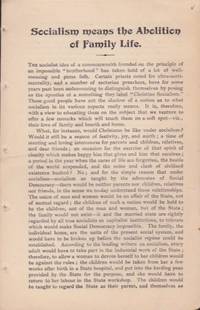
Socialism Means the Abolition of Family Life
<p>London: Liberty and Property Defence League ca. 1901-05. First Edition. <br /><br />A wonderfully lurid warning against socialism by an organization devoted to laissez-faire economics.</p><p>The anonymous author suggests that socialism would lead to the breakup of families: "There would be no such place as home under socialism. Everyone would live in the State barracks. There would be no breakfasts dinners or teas with one's family at one's own table as in the first place meals in private would not be permitted as it would be against the socialist idea of equality.In other words everybody when hungry would be reduced to the necessity of repairing to the common swine-trough and eating the hogwash the State had placed therein. No roast beef turkey and plum pudding no smiling faces of children and friends around the table on Christmas Day. Indeed there would not be any Christmas Day under socialism."</p><p>This pamphlet carries no publication date but it appears to have been issued sometime between 1901 and 1905. It refers to "the late Mr. Oscar Wilde" who died in late 1900. In 1906 the Liberty and Property Defence League issued a book Socialism: Its Fallacies and Dangers which included the text of this pamphlet.</p><p>OCLC lists 8 institutional holdings under two different accession numbers: Syracuse Stanford Amherst Harvard Texas Wisconsin Historical Society Michigan and the London School of Economics. No other copies in commerce.</p><p>PHYSICAL DETAILS: Single sheet measuring 8 x 5 1/4 inches 205 x 132 mm when folded creating a 4-page unbound pamphlet.</p><p>CONDITION: Paper lightly toned old stab holes along the gutter tiny check mark to front wrapper a couple small closed tears small ink stamp at the end of the text general handling wear. A Very Good copy of an uncommon publication.</p> Liberty and Property Defence League paperback
Referenz des Buchhändlers : 1202
|
|
|
[Bredel, Willi (Vorlage)]
Ernst Thälmann - Führer seiner Klasse. [Ein Farbfilm der DEFA im Progress Film-Vertrieb].
Berlin, Presse- u. Werbedienst des Progress Film-Vertrieb, ( 1955). 8 Bll., mit Farbfotos (1 doppelseit.). 21 cm. Farb. illustr. OBroschur.
Referenz des Buchhändlers : 95788

|
|
|
[CHINE] - MACCIOCCHI (Maria-Antonietta).-
De la Chine. Traduit de l'italien.
P., Le Seuil, 1971, fort in 8° broché, 542 pages ; couverture illustrée.
Referenz des Buchhändlers : 51727
|
|
|
[COLLECTIF]
Diogène n°125 - mars 1984.
Paris, Gallimard, 1984 1 volume 16,5 x 25cm Broché. 1 feuillet, 139p., 5 feuillets. Très bon état.
Referenz des Buchhändlers : 11481
|
|
|
[COLLECTIF]
Diogène n°125 - mars 1984.
N°125, de mars 1984, de la trimestrielle Revue Internationale des Sciences Humaines fondée par Roger Caillois et dirigée par Jean d'Ormesson; en 2 parties: "Etapes mexicaines" (textes d'Ignacio BERNAL sur l'archéologie, de George Alexander KUBLER sur les pélerinages précolombiens, de Christian DUVERGER sur les Aztèques, de Carlos MONSIVAIS sur les relations de voyages XIXè-XXè siècles, de Luis GONZALEZ sur l'historiographie mexicaine contemporaine et de Tzvetan TODOROV sur la rencontre de "l'autre"); et "Résumé sur Marx" (textes d'Eric J. HOBSBAWM sur la pensée marxiste et l'histoire, et de Michel HENRY sur la pensée de Marx et le "marxisme"). Avec la bande annonce de l'éditeur. Français
|
|
|
[COLLECTIF] / JONAS (Serge), PRONTEAU (Jean), sous la direction de.
L'Homme et la société n°7 - Janvier-février-mars 1968 - Numéro spécial 150° anniversaire de Karl Marx (1818-1968).
N°7, de janvier-février-mars 1968, de "L'Homme et la société, revue internationale de recherches et de synthèses sociologiques", dirigée par Serge JONAS et Jean PRONTEAU: au sommaire,dossier à l'occasion du 150° anniversaire de Karl Marx: articles d'Adam SCHAFF, "L'humanisme marxiste", de Cesare LUPORINI, "Introduction à [...] l'Idéologie allemande", de Lucien GOLDMANN, "L'Idéologie allemande et les thèses sur Feuerbach", de Jorge SEMPRUN, "Economie politique et philosophie dans les "Grundrisse" de Marx", de Henri LEFEBVRE, "Forme, fonction, structure dans "Le Capital"", d'Isaac DEUTSCHER, "De l'homme socialiste", de Robert KALIVODA, "Marx et Freud", d'Anouar ABD-EL-MALEK, "Vers une sociologie comparative des idéologies", de Maxime RODINSON, "Le marxisme et la nation", de Jean SANVOISIN, "Rapport entre mode de production et concept de nation dans la théorie marxiste", de Sylvain PERIGNON, "Marxisme et positivisme"; suivi de "recherches": "Jean Price-Mars et le mythe de l'Orphée noir ou les aventures de la négritude" par René DEPESTRE et "Essai sur la pensée militaire vietnamienne" par Georges BOUDAREL; d' "études critiques": "De la théorie des groupes à la Pensée sauvage" par André REGNIER et "Ethnologie et structuralisme - des jaguars et des hommes" par Raoul et Laura MAKARIUS; d' "inédits et documents": une interview de Karl MARX au Chicago Tribune présentée par Bert ANDREAS, "La scission de la Ligue des communistes", extrait de "La Vie de Karl Marx" de Franz MEHRING, "Communication sur l'héritage littéraire de Marx et Engels", faite en 1923 par David RIAZANOV, et "Esquisse pour un portrait de Marx" par Victor FAY; comptes rendus d'ouvrages et divers in fine. Français
|
|
|
[COLLECTIF] / SARTRE (Jean-Paul), sous la direction de
Les Temps modernes - n°355 - février 1976 - Crise urbaine aux USA.
N°355, de févrierr 1976 (janvier corrigé en février), de la revue mensuelle dirigée par Jean-Paul Sartre. Au sommaire: "La crise urbaine aux Etats-Unis: vers la barbarie?" par Manuel CASTELLS, "L'union du capital et de la science" par Marc RAKOVSKI, "Pour une critique des forces productives - Réponse à Marc Rakovski" par André GORZ, "Transition au socialisme ou transition socialiste ?" par Paul SWEEZY, "Usines et universités d'usines - dans la Chine d'après la Révolution culturelle" par Benjamin CORIAT, "Le cas Dora - Un cas de "petite hystérie" - Essai d'analyse d'une psychanalyse freudienne" par Judith BELLADONA, etc. Avec la bande-annonce éditeur: "Crise urbaine aux USA - Universités en Chine - RAKOWSKI-GORZ pour une critique des forces productives". Français
|
|
|
[COLLECTIF].
Arguments N°25-26 - 1er et 2è trimestres 1962 - La question politique (I).
Paris, Editions de Minuit, 1962 1 volume 15,9 x 24,3cm Agrafé. 96p.; quelques vignettes in texte. Bon état (agrafes rouillées).
Referenz des Buchhändlers : 20517
|
|
|
[COMMUNISM -- LABOR HISTORY/WOMEN]. PORTER, Anna
A Moscow diary.
Chicago: Charles H. Kerr & Co. 1926. 8vo. 152 2 pp. Blue cloth red lettering & ruling on covers red lettering on spine minor shelfwear w/ d.j. black lettering and hammer & sickle on red field minor chipping head & foot of spine VG/VG- copy. First edition of this travel memoir recounting this labor writer’s visit to the Soviet Union as she investigated music instruction in the new Russian schools. She describes labor conditions status of women child organization militarism a Volga journey along with theaters and the new sports movement. Charles H. Kerr & Co., hardcover
Referenz des Buchhändlers : 58580
|
|
|
[COMMUNISM] MARX, Karl [KERR, Charles Hope; UNTERMANN, Ernest]
Capital. Vol. I: Capitalistic Production; Vol. II: Capitalistic Circulation; Vol. III: Capitalist Production as a Whole
Chicago Ill: Charles H. Kerr & Co. London: Swan Sonnenschein & Co. 1906 1907 1909. First Editions First Printings. Three Volumes. Octavo. 22.5cm. Publisher's deep maroon ribbed cloth titled in gilt to spines and ruled in blind to boards. 869pp.; 618pp.; 1048pp. Generally strong and tight; mild scuffing and to spine ends and corners and a few minor exterior stains. Spine gilt is significantly oxidized to Vol II as is usually seen on the first printing; internally clean and fresh some very light spotting in places mainly confined to the page edges. A very good handsome set of first printings. <br /> <br /> A full set of first printings of this bibliographically complex edition issued over the course of three years. Marx published the first volume of his epic analysis of capitalism in German in 1867. The first translation into English was of Volume 1 only and was accomplished by Edward Aveling and Samuel Moore in 1887 based on the revised 4th German edition as edited by Engels. The 1906 first American printing under the Charles Kerr impint as here largely follows this translation with the subsequent translation work for Volumes II and III being performed by Ernest Untermann. Thus the earliest printings of the Kerr edition comprise the first complete edition of Capital in the English language. The printing was done in Chicago by James Higgins Kerr's printer of choice making this also the first complete edition of Capital to be printed entirely by a union-run print shop. Untermann did most of his translation work from remote Florida beginning the effort in 1905 discovering in the process a number of indices footnotes and at least ten pages of text that Aveling and Moore had not included in their London edition - making the Kerr edition the most complete up to its time. <br /> <br /> Kerr burned through the first two-thousand copy print run of Volume I almost immediately and rushed to get Volume II out by July 1907. It's very possible that financial constraints were already making themselves known by Volume II as Kerr was selling the books at a loss to encourage sales; the almost ubiquitous oxidation of the gilt on Vol II is likely a result of experimental economy that swiftly failed. Vol III returns to the higher standards of the first volume. The bindings on the first printings also feature a triple blind rule to the ribbed cloth boards with subsequent printings having double rules. Kerr's reprint system seems to have incorporated dates on the title pages for some length of time with the dates on the copyright pages remaining unchanged; after a certain point around the early 1920's reprints were issued without dates to the title pages and any volume without a date can safely be deemed a post-1920s reprint. Issues of Kerr's International Socialist Review from the period of printing recount in detail some of his problems and concerns publishing and selling the work with detailed data on dates numbers of copies and the firm's hopes for the completed book. <br /> <br /> Genuine first printing sets of this important edition are tremendously scarce in commerce. The lack of any real bibliographical authority for the American edition combined with Kerr's generally lax approach to differentiating printings has over the years led to frequent errors and misjudgments on the part of cataloguers including in full disclosure ourselves. After a good deal of research most in the advertising pages of the International Socialist Review we're confident we've finally got it right. Charles H. Kerr & Co. [London: Swan Sonnenschein & Co.] unknown
Referenz des Buchhändlers : 88451

|
|
|
[Communism]. [Periodicals]
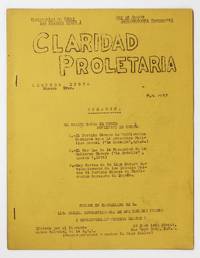
Claridad Proletaria. Secunda Epoca Numero Dos -Tres
New York: Revolutionary Workers League 1937. About very good. Two issues each 13pp. Folio. Mimeographed front wrapper stapled. One cover loosening. Moderate toning and dust soiling. Two issues of the scarce New York Spanish-language periodical Claridad Proletaria "El Organo en Castellano de la Liga Obrera Revolucionaria de los Estados Unidos." The Revolutionary Workers League was formed by American Trotskyist and Communist Party leader Hugo Oehler in 1935. The first issue present here dated September 1936 contains articles describing the revolutions in Spain and Latin America as well as pieces on the various internecine fights between the Trotskyist Stalinsist and other Communist factions during the 1930s. The second dated February 1937 is dedicated entirely to events in Spain and the role of Partido Obrero de Marxista Unificacion Workers' Party of Marxist Unification. OCLC locates a small smattering of individual issues. Revolutionary Workers League unknown
Referenz des Buchhändlers : 6146
|
|
|
[Communism; Peekskill, NY] Fast, Howard
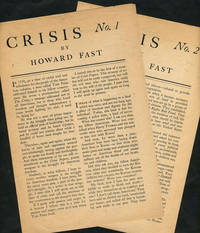
Crisis No. 1 and Crisis No. 2. Folded Broadsheets
New York: Civil Rights Congress 1951. Very good condition. Two pamphlets part of a series of articles by the American author and noted Communist. Fast modeled his pamphlets on Thomas Paine's "Crisis Papers" noting "I intend this to be the first of a number of Crisis Papers. This tyranny of today will not be easily conquered nor will the evil men who rule America easily bow to the will of the people. I state that I will speak up again and again so long as the need be present". <br /> <br /> Crisis No. 1 protests the American war in Korea the activities of the House Committee on Un-American Activities and attacks and threats on American Communists. Fast decries the threats against the leader of the Civil Rights Congress William L. Patterson to turn over all of his organization's records or be jailed. The Congress's goal was to fight racism & racial injustice in the US.<br /> <br /> Crisis No. 2 concerns the government's attacks on the Civil Rights Congress Bail Fund. 8vo 4pp each. Paper evenly toned. These are the first and second of three pamphlets titled Crisis. Fast wrote extensively on the Paul Robeson riots in Peekskill NY. OCLC: 30448136 Crisis No. 1 and OCLC: 71682230. Civil Rights Congress unknown
Referenz des Buchhändlers : 23521
|
|
|
[COMMUNISM] [CHILE] STAUBER, John
El Peligro Comunista y Su Influencia en Chile
Santiago de Chile: Union Social de Chile 1932. First Edition. 12mo 17.5cm.; publisher's blue-grey printed staplebound wrappers; 8pp. Textblock slightly toned else a Fine copy. Issued as "Folleto No. 21. [Union Social de Chile] unknown
Referenz des Buchhändlers : 43659

|
|
|
[COMMUNISM] PACKER, Herbert L
Ex-Communist Witnesses; Four Studies in Fact Finding. A challenging examination of the testimony of Whittaker Chambers Elizabeth Bentley Louis Budenz and John Lautner
Stanford: Stanford University Press 1962. First Edition. Octavo. 22.5cm. Publisher's pale slate grey cloth covered boards titled in black to spine. Dustjacket. viii; 279pp. Light scuffing and edgewear minor bumping to spine ends in a bright strong example of the dustjacket with some minor rubbing and chipping to extremities. some sunning and fraying to the spine panel and ends a very good handsome copy with some light wear. Internally clean. Bookplate of Phillip G. Fox to front pastedown clearly a home made design and almost certainly that of Professor Phillip G. Fox of the University of Wisconsin who was a professor of business administration with an almost obsessive interest in slot machines and the mathematics of gambling payouts. The bookplate has been composed as a piece of typewriter art centered on a complex mathematical equation; bookdealers aren't necessarily terribly mathematically adept so the solution will have to be found by the next owner of the book.<br /> <br /> Packer's preoccupation here is centred around which of the regularly used official methods for interrogating communists and building information on their activities is the most efficient and successful; court trials admisnitrative hearins or Congressional investigations. There is an interesting corollary in that he is compelled to analyze whether or not Communism is in fact subversive but the answer to that shouldn't probably shouldn't get in the way of a good system for governments to control their citizens. Stanford University Press unknown
Referenz des Buchhändlers : 82699

|
|
|
[COMMUNISM] [ANTI-COMMUNISM] CARLTON, Richard K (Editor)
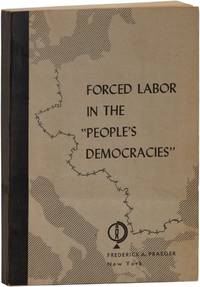
Forced Labor in the "People's Democracies
New York: Frederick A. Praeger; For the Mid-European Studies Center of the Free Europe Committee 1955. Revised Edition. Octavo. 20cm. Original black cloth spine over illustrated card wraps. 247pp. Some light wear to the extremities and minor toning to the card wraps; internally clean. A very good strong copy.<br /> <br /> An analysis of the nature extent and appalling realities of Soviet forced labor camps in Hungary Czechoslovakia Romania Bulgaria and Poland. This revised edition was expanded in order to include data regarding forced labor camps in Communist China. Frederick A. Praeger; For the Mid-European Studies Center of the Free Europe Committee unknown
Referenz des Buchhändlers : 84362
|
|
|
[COMMUNISM - MICHIGAN]
Hand-Painted Banner: "Elect Communists! Kristalsky for Mayor
Hamtramck MI 1934. Hand-painted banner 8.5cm x 65cm ca 3-1/4" x 26". In red and black on a white background. Old stains and tape adhesions; complete and Good. Scarce relic from the 1934 Hamtramck Michigan mayoral campaign in which George Kristalsky and a slate of seven communist candidates for City Council were defeated. Hamtramck a working-class suburb of Detroit was a center of radical labor activity during the Great Depression. unknown
Referenz des Buchhändlers : 16160

|
|
|
[COMMUNISM] [CPUSA] MANUILSKY, DZ [Dmitry Zhakarovych] D Z
How to Prepare a Report on the International Situation
San Francisco: Educational Committee San Francisco Communist Party N.d. ca 1937. First Edition. Corner-stapled mimeographed typescript 36cm x 22cm; 6pp printed recto-only. Toning corner creases and general wear; still a complete Good or better example. Dated from text. Rather remarkable Popular Front document prepared by Manuilsky as Deputy General Secretary of the Comintern and clearly oriented toward American Party members as the majority of the text deals with the resurgent economic crisis in the U.S. Though the title of the paper might suggest a style sheet or compositional outline the document in fact is a list of rather explicit instructions to American Party members on how to interpret contemporary world events in the light of current Soviet doctrine the general upshot being that the American economic crisis the rise of European fascism revolution in China and the increasing militancy of the Japanese are all symptoms of the collapse of capitalism and the ". growing resistance of the working class and the toiling masses against the onslaught of the fascist powers!" Evidence of Moscow's direct influence on the CPUSA during this period is hardly necessary to prove a point but this document provides a neat example of precisely how that influence was directed and executed. Unrecorded in this format though a similar document was published in Los Angeles in 1946 per OCLC; this printing clearly much earlier based on text. Educational Committee, San Francisco Communist Party unknown
Referenz des Buchhändlers : 40520

|
|
|
[COMMUNISM - FRANCE] GRANDJOUAN, Jules
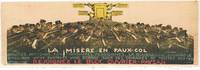
La Misere en Faux-Col "White Collar Misery": Employes Artisans Fonctionnaires Pensionnes La Bourgeoisie Incapable D'Assurer Votre Existence Vous Ecrase Sous Des Charges de Toutes Sortes - Rejoignez Le Bloc Ouvrier-Paysan
Impression illegible: Bloc Ouvrier-Paysan 1929. Original lithographed poster 40cm x 120cm ca 16" x 47". Minuscule losses at margins not approaching image; closed tears; impression slightly weak; Very Good professionally backed on linen B/B.<br /> <br /> An ephemeral work produced for the short-lived Bloc Ouvrier-Paysan Workers & Peasants Party a Communist splinter group which existed in France only from 1929-30. The poster invites white-collar workers including artisans civil servants and pensioners to join the Bloc to save themselves from being crushed under the weight of bourgeois capitalism. The image depicts the bourgeoisie personified in the form of high rents food goods taxes and transportation costs being pulled forward by a horde of civil servants under harness. Copies located at Hoover Institution and the archives of the Department of Correze France; none others in institutional collections or commerce. Bloc Ouvrier-Paysan unknown
Referenz des Buchhändlers : 82982
|
|
|
[COMMUNISM] MARX, Karl; J Roy, trans
Le Capital
Paris: Maurice Lachatre et Cie 1872-1875. First French Edition. Large octavo 28.5cm.; original parts bound in early 20th century blue cloth gilt-lettered spine; 351pp.; pictorial half title and title pages full-paged steel-engraved portrait and facsimile additional vignettes throughout; text printed in double column. Boards a bit rubbed and corners bumped foxing and toning to preliminaries as well as minor dampstaining to last few leaves of text light foxing to rear cover; overall Very Good and sound. First appearance in French of Marx's "Das Kapital" the translation the only such to have been executed with the collaboration of the author whose letter to Lachatre appears in facsimile on p. 7: "J'applaudis à votre idée de publier la traduction de 'Das Kapital' en livraisons périodiques. Sous cette forme l'ouvrage sera plus accessible à la classe ouvrière et pour moi cette considération l'emporte sur toute autre" "I congratulate you on your idea to publish the translation of 'Das Kapital' as a periodical. In this format the work should be more accessible to the working class and to me this is more important than all else" our translation. Maurice Lachatre 1814-1900 was a Parisian radical bookseller publisher and collaborator of Félix Pyat's with whom Marx butted heads over the growth of the International Working Men's Association in France. Lachatre's projected publication of the anarchist newspaper "La Commune" nearly cost him his life after the fall of the Paris Commune when his bookshop was attacked with murderous intent by the Versaillaise army see "The Publisher's Weekly" Vol. 19 1881 pp. 50-1. It was while exiled first in Belgium and then Switzerland that Lachatre began work on publishing the present edition though he was not free to return to Paris until 1879. Maurice Lachatre et Cie unknown
Referenz des Buchhändlers : 47305

|
|

 Per e-mail erhalten
 Als pdf-Dokument herunterladen
 RSS feed
 Permanenter link


