|
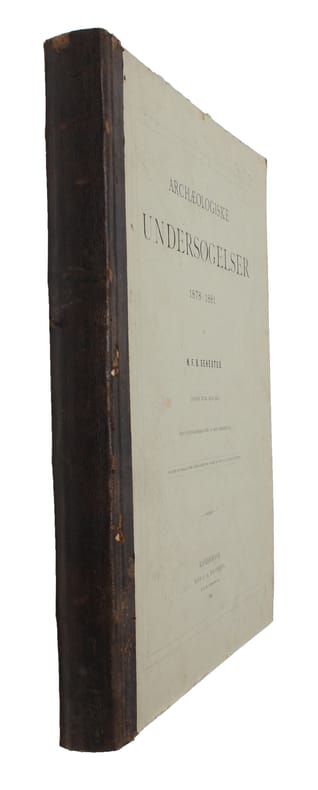
SEHESTED, N.F.B.
Archæologiske Undersøgelser 1878-1881. Udgivne efter hans Død.
Kjøbenhavn, Reitzel, 1884. Stor 4to. Originalt bogtrykt papbind med læderryg. Udvendig med noget slitage, indvendig sporadisk brunplettet. . X,180 pp., 5 litograferede kort samt 36 kobberstukne plancher med talrige figurer.
Referenz des Buchhändlers : 60793
|
|
|
"WORM, OLE.
De aureo Cornu. Dissertatio. - [THE FIRST AND MOST IMPORTANT TREATISE ON THE GOLDEN HORN]
Hafniae (Copenhagen), Melchior Matzan, Joachim Moltke, 1641. Small folio. Bound in an newer absolutely exquisite full mottled calf pastiche-binding with five raised bands and gilt title-label to richly gilt spine. Gilt ornamental borders with gilt corner-pieces to boards, all edges of boards gilt, and inner gilt dentelles. Title-page restored at inner hinge, far from affecting print. Some leaves slighly dusty and some mostly light brownspotting. Overall very nice indeed. The folded plate neatly re-enforced at the foldings, from verso, and on stub. ""Dupl"" written in hand to upper right corner of title-page and with two stamps to verso: ""Museum Britannicum"" and ""British Museum Sale Duplicate 1787"". (8), 72 pp. + large folded engraved plate of the horn.
Referenz des Buchhändlers : 60808

|
|
|
HERZOG, RUDOLF.
Koische Forschungen und Funde. Mit sieben Tafeln.
Leipzig, Dieterisch'sche, 1899. Lex8vo. Contemp. hcalf. Spine somewhat worn along edges. A stamp to foot of titlepage. XII,(4),244 pp., 1 table and 7 plates. Internally clean and fine.
Referenz des Buchhändlers : 47660
|
|
|
ARNE, T.J.
Das Bootgräberfeld von Tuna in Alsike Uppland.
Stockholm, Verlag der Akademie, 1934. Folio. Solid hbuckram. Slightly rubbed. Stamps on halftitle. 75,(5) pp. and 33 plates. From the library of H.C. Broholm.
Referenz des Buchhändlers : 51703
|
|
|
AARBØGER FOR NORDISK OLDKYNDIGHED OG HISTORIE, udg. af Det Kgl. Nordiske Oldskrift-Selskab. 1.-10. Aarg.
K., 1866-75. Plancher og tekstillustr Heri mange afhandlinger vedr.norrønt sprog og kultur.
Referenz des Buchhändlers : 4584
|
|
|
MESSERSCHMIDT, FRANZ..
Bronzezeit und frühe Eisenzeit in Italien. Pfahlbau, Terramare, Villanova.
Berlin, Leipzig, Walter de Gruyter, 1935. 4to. Solid full cloth. Stamps on titlepage. (4),77 pp. and 16 plates with many figs. Internally clean and fine.
Referenz des Buchhändlers : 46238
|
|
|
CHRISTENSEN, ARISTÉA PAPANICOLAOU et CHARLOTTE FRIIS JOHANSEN.
Les Poteries hellénestiques et les Terres sigillées orientales. (Hama Fouilles et Recherches 1931-1938. III:2).
Copenhagen, 1971. Large 4to. Orig. printed wrappers. XII,208 pp. Richly illustrated.
Referenz des Buchhändlers : 46686
|
|
|
MODESTI, GIANNI B.
Cairano nell'eta Arcaica. L'Abitato e la Necropoli.
Napoli, 1980. Folio. In the original red printed wrappers. Small stamp to lower part of title page and small white label pasted on to top left corner of front wrappers, otherwise fine. 221 pp + 116 plates.
Referenz des Buchhändlers : 51600
|
|
|
EBERS, GEORG.
Ægypten. Oversat ved M. Galschiøt.
Kbhvn., 1882. Lex8vo. Orig. hldrbd. med permer af komponeret shirt. Ryg slidt. 694 pp. Rigt illustr. i træsnit, 1 kort. - Første danske udgave.
Referenz des Buchhändlers : 9708
|
|
|
BAGGE, AXEL und LILI KAELAS.
Die Funde aus Dolmen und Ganggräbern in Schonen, Schweden. I-II.
Stockh., 1950-52. Folio. 1o6,161 pp., textillustr. and 126 plates.
Referenz des Buchhändlers : 9813
|
|
|
BULLETIN DE LA SOCIETÉ PRÉHISTORIQUE FRANCAISE.
Tome 47-88.
Paris, 1950-92. Vols. 1950-61 in boards, rest in parts.
Referenz des Buchhändlers : 9819
|
|
|
[BOURBONNAIS] - [GLOZEL] - BENJAMIN (René).-
Glozel, vallon des morts et des savants.
1928 P., Fayard, 1928, in 12 broché, 251 pages ; couverture légèrement fanée.
Referenz des Buchhändlers : 75
|
|
|
BROMBERGER (M. et S.).-
Les secrets de l'expédition d'Egypte.
1957 P., Edition des quatre fils Aymon, 1957, in 12 broché, 269 pages
Referenz des Buchhändlers : 98
|
|
|
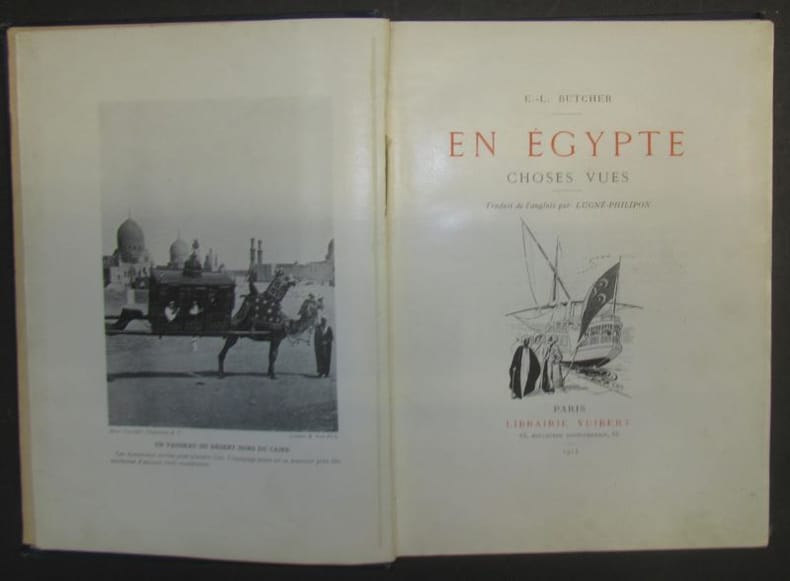
BUTCHER (E.-L.).-
En Egypte. Choses vues. Traduit de l'anglais par Lugné-Philipon.
P., Vuibert, 1913, grand in 8° relié pleine percaline bleue de l'éditeur, tranche dorée, 253 pages ; Très nombreuses illustrations ; salissures à quelques pages
Referenz des Buchhändlers : 1046
|
|
|
EYDOUX (Henri-Paul).-
Cités mortes et lieux maudits de France.
1959 P., Plon, 1959, in 8, cartonnage éditeur, 241 pages ; trente illustrations in-texte et quinze hors-texte.
Referenz des Buchhändlers : 1130
|
|
|
EYDOUX (Henri-Paul).-
Cités mortes et lieux maudits de France. Seconde édition augmentée.
1959 P., Plon, 1959, in 8°, reliure souple de l'éditeur, jaquette illustrée, cent dix illustrations in et hors-texte, 334 pages.
Referenz des Buchhändlers : 1131
|
|
|
HUS (Alain).-
Les étrusques, peuple secret.
1957 Paris, Fayard, 1957, in 8 broché, 281 pages ; carte hors-texte.
Referenz des Buchhändlers : 1640
|
|
|
JOLEAUD (L.).-
Cours de paléontologie. FASCICULE I : Paléontologie générale. paléontologie végétale. - FASCICULE II : Paléontologie animale. Foramifères, Radiolaires, Spongiaires, Célentérés. - FASCICULE III : Paléontologie animale. Echinodermes, Bryozoaires, Brachyopodes, Vers.
1935 PARIS, Centre de Documentation Universitaire, CDU (Les Cours de Sorbonne), 1935, 3 fascicules en un volume in 4) broché, 81, 54 et 119 pages dactylographiées et 114 planches hors-texte ; couverture fanée.
Referenz des Buchhändlers : 1810
|
|
|
LOUKOMSKI (G.-K.).-
Art Etrusque. Etude illustrée sur la peinture murale de Corneto-Tarquinia, suivie, à titre comparatif, d'un choix d'oeuvres caractéristiques des principaux musées d'Europe.
1930 Paris, Duchartre, 1930, in 4° broché, couverture illustrée en couleurs, 60 pages de texte et 80 planches hors-texte.
Referenz des Buchhändlers : 2149
|
|
|
HANOTAUX (Gabriel).-
Regards sur l'Egypte et la Palestine.
1929 Paris, Plon, 1929, in 8, broché, 282 pages.
Referenz des Buchhändlers : 2755
|
|
|
MOREUX (Abbé Th.).-
La science Mystérieuse des Pharaons. Nouvelle édition.
Paris, Doin, (1947), in 12 broché, 251 pages ; couverture illustrée en couleurs.
Referenz des Buchhändlers : 2777
|
|
|
ALLARD (Paul).-
Etudes d'histoire et d'archéologie.
Paris, Lecoffre, 1899, in 12, broché, VIII-437 pages ; dos fendu.
Referenz des Buchhändlers : 2783
|
|
|
[ARCHEOLOGIE] - [EGYPTOLOGIE].-
RECHERCHES DE PAPYROLOGIE.
1961 Paris, PUF, 1961-1962, 2 volumes in 4° brochés, 120 et 121 pages ; 15 planches hors-texte au total.
Referenz des Buchhändlers : 2944
|
|
|
PARROT (André).-
Découverte des mondes ensevelis.
1952 Paris, Delachaux et Niestlé, 1952, in 8 broché, 149 pages, gravures hors-texte.
Referenz des Buchhändlers : 3036
|
|
|
PARROT (André).-
L'activité archéologique dans le Proche-Orient.
1934 Paris, Editions d'Art et d'Histoire, 1934, fascicule in 4°, (extrait de la Revue des Arts Asiatiques pp. 257 à 271), 1 carte dépliante.
Referenz des Buchhändlers : 3037
|
|
|
PARROT (André).-
De Babylone à Jéricho. L'archéologie contemporaine confirme-t-elle la Bible?
Sans lieu ni date [P., Imprimerie Nouvelle, vers 1933], plaquette in 8 brochée, 32 pages ; couverture illustrée ; 3 planches hors-texte.
Referenz des Buchhändlers : 3039
|
|
|
NOSEK (Stefan).-
Zarys acheologii malopolski.
1956 Krakow (Cracovie), 1956, in 8 broché, 78 pages suivies de 36 planches hors-texte.
Referenz des Buchhändlers : 3233
|
|
|
CONSTANS (L.-A.).-
Arles.
1928 Paris, Les Belles Lettres (Collection "Le Monde Romain"), 1928, in 8 broché, 100 pages ; 13 planches hors-texte dont un plan dépliant.
Referenz des Buchhändlers : 3384
|
|
|
[PROVENCE].-
Les fouilles en Provence. Archéologie terrestre et sous-marine.
Marseille, Bulletin de "Arts et Livres de Provence", n° 33, 1957, grand in 8° broché, 133 pages ; importante iconographie ; publicités hors-texte.
Referenz des Buchhändlers : 3392
|
|
|
SAMIVEL.-
Trésors de l'Egypte.
1955 Grenoble, Arthaud, 1955, grand in 8, broché, jaquette illustrée en couleurs, photos en noir et en couleurs de Michel Audrain.
Referenz des Buchhändlers : 3670
|
|
|
SAUTEL (Chanoine J.).-
Le théâtre de Vaison et les Théâtres Romains de la Vallée du Rhône. Nouvelle édition revue et corrigée.
Avignon, Rullière, 1951, in 8 broché, 48 pages, illustrations in et hors-texte ("Etudes et documents sur Vaison-la-Romaine, XIe").
Referenz des Buchhändlers : 3682
|
|
|
TARSOT (Louis) et MOULINS (Amédée).-
L'Histoire de France dans ses monuments. Scènes et vestiges du Temps passé, de François Ier à la Révolution. Avant-propos de M. Pierre de Nolhac. Ouvrage illustré de 72 gravures.
1923 Paris, Laurens, sans date (1923), in 8° relié demi-percaline éditeur, III-200 pages.
Referenz des Buchhändlers : 3749
|
|
|
CHERBLANC (Emile).-
Mémoire sur l'invention du tissu.
1935 Paris, Editions d'Art et d'Histoire, 1935, in 4° broché, 75 pages ; couverture rempliée (petit manque en tête du dos) ; 6 planches hors-texte et 26 figures in-texte.
Referenz des Buchhändlers : 3850
|
|
|
VERNEAU (René).-
Les origines de l'humanité.
1925 Paris, Rieder, 1925, in 8° broché, 80 pages et 59 planches hors-texte en héliogravure.
Referenz des Buchhändlers : 4160
|
|
|
EYDOUX (Henri-Paul).-
Monuments et trésors de la Gaule. Les récentes découvertes archéologiques. Préface de Jérôme Carcopino. Avec 42 illustrations et cartes in texte et 30 illustrations hors texte.
1963 Paris, Plon (Collection D'un Monde à l'Autre), 1963, in 8°, reliure souple de l'éditeur, jaquette illustrée, IX-267 pages.
Referenz des Buchhändlers : 4393
|
|
|
LALOUX (V.).-
L'architecture grecque.
1890 P., Quantin (Bibliothèque de lenseignement des Beaux Arts), sans date (vers 1890), in 8° relié pleine toile noire (modeste), 304 pages
Referenz des Buchhändlers : 4394
|
|
|
PARROT (André).-
Archéologie mésopotamienne. Tome I : Les étapes.
1946 Paris, Albin Michel (Collection "Sciences d'Aujourd'hui") 1946, in 8 broché, 541 pages
Referenz des Buchhändlers : 4395
|
|
|
MALEGARIE (Charles).-
Vers les cimes (le mystère Inca).
1950 Paris, SFELT, 1950, in 8, broché, 173 pages ; non coupé, jaquette illustrée ; nombreuses photos in et hors texte.
Referenz des Buchhändlers : 4488
|
|
|
CHARROUX (Robert).-
Trésors du Monde. Trésors de France. Trésors de Paris. Enterrés, emmurés, engloutis.
1972 Paris, Fayard, 1972, in 8, reliure toile de l'éditeur, IV-333 pages ; illustrations, carte volante.
Referenz des Buchhändlers : 4633
|
|
|
GAUTHIER (A. et G.).-
Alésia métropole disparue.
1963 Le Puy, Mappus, 1963, in 8, broché, 206 pages ; illustrations.
Referenz des Buchhändlers : 4937
|
|
|
WEBER (Dr A.).-
Les catacombes romaines. Traduction de l'allemand par l'Abbé Bertrand.
1903 P., Amat, 1903, in 8, broché, 215 pages ; illustrations, dos renforcé.
Referenz des Buchhändlers : 5082
|
|
|
HATT (J.-J.).-
La tombe Gallo-Romaine. Recherches sur les inscriptions et les monuments funéraires gallo-romains des trois premiers siècles de notre ère suivi de : Les croyances funéraires des Gallo-Romains d'après la décoration des tombes. Thèse complémentaire.
1986 Paris, Picard, 1986, in 8, broché, XI-425pp. ; planches hors-texte, cartes, graphiques et figures ; couverture illustrée.
Referenz des Buchhändlers : 5689
|
|
|
BORDEAUX (Raymond).-
Traité de la réparation des Eglises. Principes d'archéologie pratique. 3e édition.
Paris, Baudry, 1888, in 8, broché, XXIV-358 pages ; dos cassé, le premier plat de couverture manque
Referenz des Buchhändlers : 6930
|
|
|
[HUBERT-ROBERT (Marius)] - GADALA (Marie-Thérèse).-
Egypte - Palestine. Du Sphinx à la Croix. Aquarelles de Marius HUBERT-ROBERT. Ouvrage orné de 175 héliogravures.
Grenoble, Arthaud, 1930, in 8° relié demi-basane marron, dos à nerfs très orné, tête dorée, couverture illustrée conservée, 238 pages ; indimes frottis.
Referenz des Buchhändlers : 6980
|
|
|
COUCHOUD (P.-L.).-
Sur des tombeaux grecs. Epigrammes de l'anthologie présentées et traduites par P.-L. Couchoud.
Paris, Plon, 1952, in 8, broché, 117 pages
Referenz des Buchhändlers : 7029
|
|
|
HERRMANN (Paul E.).-
L'homme à la découverte du monde. Traduit de lallemand par René Jouan et Max Roth. Avec 30 cartes, de nombreux clichés dans le texte et 31 illustrations hors texte.
Paris, Plon, 1954, fort in 8 broché, III-525 pages, couverture illustrée
Referenz des Buchhändlers : 7060
|
|
|
[JULLIAN (Camille)] - GRENIER (Albert).-
Camille Jullian. Un demi-siècle de science historique et de progrès français 1880-1930.
1944 Paris, Albin-Michel, 1944, in 8, broché, 317 pages, portrait
Referenz des Buchhändlers : 7207
|
|
|
EYDOUX (Henri-Paul).-
Lumières sur la Gaule. Les récentes découvertes archéologiques.
Paris, Plon (Collection "D'un Monde à l'Autre"), 1960, in 8, broché, IV-335 pages, nombreuses illustrations in et hors texte
Referenz des Buchhändlers : 7208
|
|
|
MARSTON (Sir Charles).-
La bible a dit vrai. Résultats des fouilles effectuées de 1924 à 1934 en terre biblique. Avec 4 cartes et 18 photographies hors texte.
Paris, Plon, 1935, in 12, broché, V-287pp, illustrations; annotations marginales au crayon
Referenz des Buchhändlers : 7290
|
|
|
DANIELOU (Jean).-
Les symboles chrétiens primitifs.
Paris, Le Seuil, 1961, in 8, broché, 159pp, illustrations
Referenz des Buchhändlers : 7308
|
|

 Per e-mail erhalten
 Als pdf-Dokument herunterladen
 RSS feed
 Permanenter link


