|
George BARBIER
Costumes parisiens. Blouse japonaise en soie sur une jupe plissée. Marin de toile blanche pl.105 Journal des Dames et des Modes 1913 n°47
Paris: S. n. 1913. Fine. S. n. Paris 1913 14 x 22.50 cm une feuille original print in color printed on laid paper signed on the top left of the board. One of the first French fashion magazines published a few days before the famous Gazette fashionable and bringing together the greatest French artists of the Art Deco movement. The Journal ladies and modes is a trimensuelle illustrated French fashion magazine created in 1797. Its publication was stopped in 1839 before being taken in June 1912 under the leadership of Tommaso Antongini secretary friend and biographer of Gabriele 'Annunzio. It will disappear in August 1914 on the eve of the First World War. The review was drawn in 1279 copies making it for the time a relatively confidential publication. The 186 plates with great finesse are engraved on strong paper and colored stencil. They represent the majority of the time women but also men and children. The models are not unlike those of the Gazette fashionable whose publication will be launched a few months later those renowned couturiers but are the fruit of the imagination of the illustrators themselves. The stencils are mostly executed by George Barbier but other artists collaborating on the magazine: Léon Bakst B. Berty Bernard Boutet de Monvel Roger Broders Jan van Brock Umberto Brunelleschi H. Robert Dammy Etienne Drian Abel Faivre Marie-Madeleine Franc-Nohain Xavier Gosé Paul Iribe Kriegck Victor Lhuer Pierre Legrain Charles Martin Fernand Simeon Ismael Smith Armand Vallee and Gerda Wegener. Many of these illustrators will also be involved in The Gazette fashionable. Their work emblematic of the Art Deco movement emphasize the influence of Orientalism and costumes of the Ballets Russes while registering in the daily activities of affluent French of the time. From the preface of the first issue of 1912 Anatole France said: ""After seventy-five years he is reborn. He is reborn through the efforts of a few ingenious minds and artists. He is reborn for the curious if there is that do not simply modes newspaper fired several thousand and illustrated by photography. And if publishers make us very exactly in its format with its paper printing its processes of etching and coloring the old classic patterns of the past is that they intend to continue the pleasantly and become charming classic fashion of today and tomorrow. "" S. n. unknown
Référence libraire : 57771

|
|
|
George BARBIER - (Charles-Frederick WORTH)
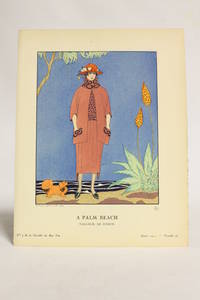
A Palm Beach. Tailleur de Worth pl.40 La Gazette du Bon ton 1921 n°5
Paris: Lucien Vogel éditeur 1921. Fine. Lucien Vogel éditeur Paris 1921 18 x 24 cm une feuille original print in color printed on laid paper signed lower left on the board. Original content produced for the illustration of The Gazette fashionable one of the finest and most influential twentieth century fashion magazines celebrating the talent of creators and artists French burgeoning art deco. Famous fashion magazine founded in 1912 by Lucien Vogel The Gazette fashionable appeared until 1925 with an interruption during the War of 1915 to 1920 due to mobilization of its editor. She is 69 Deliveries from just 2000 copies and is illustrated including 573 color plates and 148 sketches depicting models of fashion designers. Upon publication these luxury publications ""are for bibliophiles and worldly aesthetes"" Françoise Tétart-Vittu ""good Gazette of tone"" in the fashion dictionary 2016. Printed on fine laid paper they use a typeface created specifically for the magazine by Georges Peignot the Cochin character taken in 1946 by Christian Dior. The prints are made with the technique of metal stencil enhanced color and some outlined in gold or palladium. The adventure began in 1912 when Lucien Vogel man of the world and fashion - it has already participated in Femina magazine - decided to found with his wife Cosette de Brunhoff John's sister the father of Babar Gazette good tone in which the subtitle is then ""Art fashions and frivolities."" Georges Charensol quotes the editor: ""In 1910 he observed there was no truly artistic fashion magazine and representative of the spirit of his time. So I thought of making a glossy magazine with truly modern artists . I was certain of success because no country for fashion can compete with France. """" A great art editor. Lucien Vogel ""in Literary News No. 133 May 1925. The success of the magazine is immediate not only in France but also the US and South America. Originally Vogel therefore brings together a group of seven artists: André-Édouard Marty and Pierre Brissaud followed by Georges Lepape and Dammicourt; and finally his friends from the School of Fine Arts as are George Barbier Bernard Boutet de Monvel or Charles Martin. Other talents come quickly reach the equipped Guy Arnoux Léon Bakst Benito Boutet de Monvel Umberto Brunelleschi Chas Laborde Jean-Gabriel Domergue Raoul Dufy Edward Halouze Alexander Iacovleff Jean Emile Laboureur Charles Loupot Charles Martin Maggie Salcedo. These artists mostly unknown when Lucien Vogel appealed to them will eventually become iconic figures and artistic sought. These are the same illustrators who make the drawings advertisements Gazette. The boards highlight the dresses and sublime seven artists of the time: Lanvin Doeuillet Paquin Poiret Worth Vionnet and Doucet. The designers provide for each number of exclusive models. Nevertheless some of Illustrations contained no real model but only the idea that the illustrator is done in the fashion of the day. Gazette fashionable is a milestone in the history of fashion. Combining the aesthetic requirement and plastic unit it brings together for the first time the great talents of the world of arts literature and fashion and imposed by this alchemy a new image of women slender independent and bold also driven by the new generation of designers Coco Chanel Jean Patou Rochas Marcel . Recovery in 1920 by Condé Montrose Nast Gazette fashionable modeled for the new composition and the aesthetic choices of the ""little dying newspaper"" that Nast had bought a few years ago: the Vogue magazine. Lucien Vogel éditeur hardcover
Référence libraire : 57545
|
|
|
SKERTCHLY, Sydney Barber Josiah
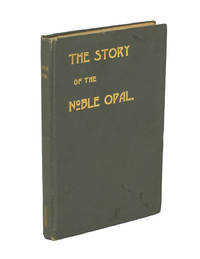
The Story of the Noble Opal
Brisbane: Flavelle Roberts and Sankey 1908. First Edition. Hardcover. Very Good. Brisbane Flavelle Roberts and Sankey 1908. Small octavo 114 2 recto blank with the device of the printers Outridge Printing Co. on the verso pages. Original olive-green cloth lettered in gilt on the spine 'Noble Opal' and the author's surname and front cover the full title; cloth slightly marked and lightly rubbed at the extremities; top edge endpapers and adjacent leaves a little foxed; an excellent copy. Flavelle's Gem Series Number 1. This copy is inscribed and signed to 'C.C. Brittlebank with kind regards from Sydney B.J. Skertchly. Corinda Qld. 6.3.08'. Sydney Skertchly 1850-1926 arrived in Brisbane in 1891 after a successful career as a geologist in places as varied as the Fenland and East Anglia Egypt California Burma and China. In 1895-97 he was assistant government geologist in the Geological Survey of Queensland; he was President of the Royal Society of Queensland in 1898 and a founder and first president of the Field Naturalists' Club in 1906 the 'Australian Dictionary of Biography' entry on Skertchly is most informative without mentioning this publication. The author's end-note to the reader states that the publishers 'asked me to write a series of little books on gemstones and gave me an entirely free hand. As this the first of them shows they will not be mere gatherings from other harvests but original works embodying the results of my own experience'. An early rare and important work on the subject and we know of no other volumes in the Flavelle's Gem Series. The inscription and signature date from what appears to be the month of publication reviews begin to appear in Queensland newspapers from 10 March 1908. Charles Clifton Brittlebank 1862-1945 the recipient of this copy was a notable mycologist and natural history illustrator. Among many original papers on geology and plant diseases Brittlebank's work includes the illustrations to French's 'Destructive Insects of Victoria' 1891-1911 Archibald Campbell's 'Nests and Eggs of Australian Birds' 1901 and many of the works of Daniel McAlpine whom he succeeded as Vegetable Pathologist to the Department of Agriculture in Victoria. This copy also carries the later pencilled ownership signature of Edward Edgar Pescott 1872-1954 horticulturalist naturalist author and bibliographer. We currently have for sale two unsigned copies of this item sourced from a significant collection on the subject. They prove the existence of distinctly variant issues: one contains an unnumbered advertising leaf for 'Queensland the Queen of the Colonies' verso blank tipped in at the rear the other is printed on textured and coarser paper resulting in a noticeably thicker volume 14 mm as distinct from 11 mm. This signed copy is yet a third variant: while it is printed on the better-quality paper it does not contain the additional advertising leaf and it was clearly never present. Flavelle, Roberts and Sankey hardcover
Référence libraire : 106072
|
|
|
Barber, Barrington
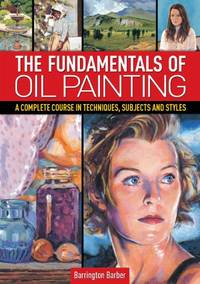
The Fundamentals of Oil Painting: A Complete Course in Techniques Subjects and Styles
Paperback. Very Good. paperback
Référence libraire : GOR007782081 ISBN : 1848584687 9781848584686
|
|
|
George BARBIER - (Charles-Frederick WORTH)
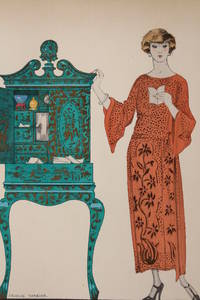
Le Tombeau des secrets. Robe d'intérieur de Worth pl.7 La Gazette du Bon ton 1922 n°1
Paris: Lucien Vogel éditeur 1922. Fine. Lucien Vogel éditeur Paris 1922 18 x 24 cm une feuille Original color print heightened with gold printed on vergé paper signed in the plate. An original print used to illustrate the Gazette du bon ton one of the most attractive and influential 20th century fashion magazines featuring the talents of French artists and other contributors from the burgeoning Art Deco movement. A celebrated fashion magazine established in 1912 by Lucien Vogel La Gazette du bon ton appeared until 1925 with a hiatus from 1915 to 1920 due to the war the editor-in-chief having been called up for service. It consisted of 69 issues printed in only 2000 copies each and notably illustrated with 573 color plates and 148 sketches of the models of the great designers. Right from the start this sumptuous publication “was aimed at bibliophiles and fashionable society” Françoise Tétart-Vittu “La Gazette du bon ton” in Dictionnaire de la mode 2016 and was printed on fine vergé paper using a type cut specially for the magazine by Georges Peignot known as Cochin later used in 1946 by Christian Dior. The prints were made using stencils heightened in colors some highlighted in gold or palladium. The story began in 1912 when Lucien Vogel a man of the world involved in fashion he had already been part of the fashion magazine Femina decided with his wife Cosette de Brunhoff – the sister of Jean creator of Babar – to set up the Gazette du bon ton subtitled at the time: “Art fashion frivolities.” Georges Charensol noted the reasoning of the editor-in-chief: “’In 1910’ he observed ‘there was no really artistic fashion magazine nothing representative of the spirit of the time. My dream was therefore to make a luxury magazine with truly modern artists…I was assured of success because when it comes to fashion no country on earth can compete with France.’” “Un grand éditeur d’art. Lucien Vogel” in Les Nouvelles littéraires no. 133 May 1925. The magazine was immediately successful not only in France but also in the United States and Latin America. At first Vogel put together a team of seven artists: André-Édouard Marty and Pierre Brissaud followed by Georges Lepape and Dammicourt as well as eventually his friends from school and the School of Fine Arts like George Barbier Bernard Boutet de Monvel and Charles Martin. Other talented people soon came flocking to join the team: Guy Arnoux Léon Bakst Benito Boutet de Monvel Umberto Brunelleschi Chas Laborde Jean-Gabriel Domergue Raoul Dufy Édouard Halouze Alexandre Iacovleff Jean Émile Laboureur Charles Loupot Chalres Martin Maggie Salcedo. These artist mostly unknown when Lucien Vogel sought them out later became emblematic and sought-after artistic figures. It was also they who worked on the advertising drawings for the Gazette. The plates put the spotlight on and celebrate dresses by seven designers of the age: Lanvin Doeuillet Paquin Poiret Worth Vionnet and Doucet. The designers provided exclusive models for each issue. Nonetheless some of the illustrations are not based on real models but simply on the illustrator’s conception of the fashion of the day. The Gazette du bon ton was an important step in the history of fashion. Combining aesthetic demands with the physical whole it brought together – for the first time – the great talents of the artistic literary and fashion worlds; and imposed through this alchemy a completely new image of women: slender independent and daring which was shared by the new generation of designers including Coco Chanel Jean Patou Marcel Rochas and so on… Taken over in 1920 by Condé Montrose Nast the Gazette du bon ton was an important influence on the new layout and aesthetics of that “little dying paper” that Nast had bought a few years earlier: Vogue. Lucien Vogel éditeur unknown
Référence libraire : 54957
|
|
|
George BARBIER - (Charles-Frederick WORTH)
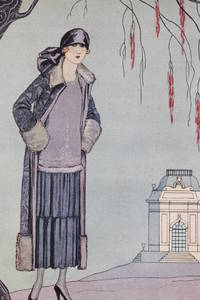
Le Belvédère. Robe-manteau de Worth pl.36 La Gazette du Bon ton 1924 n°7
Paris: Lucien Vogel éditeur 1924. Fine. Lucien Vogel éditeur Paris 1924 18 x 24 cm une feuille Original color print printed on vergé paper signed in the plate. An original print used to illustrate the Gazette du bon ton one of the most attractive and influential 20th century fashion magazines featuring the talents of French artists and other contributors from the burgeoning Art Deco movement. A celebrated fashion magazine established in 1912 by Lucien Vogel La Gazette du bon ton appeared until 1925 with a hiatus from 1915 to 1920 due to the war the editor-in-chief having been called up for service. It consisted of 69 issues printed in only 2000 copies each and notably illustrated with 573 color plates and 148 sketches of the models of the great designers. Right from the start this sumptuous publication “was aimed at bibliophiles and fashionable society” Françoise Tétart-Vittu “La Gazette du bon ton” in Dictionnaire de la mode 2016 and was printed on fine vergé paper using a type cut specially for the magazine by Georges Peignot known as Cochin later used in 1946 by Christian Dior. The prints were made using stencils heightened in colors some highlighted in gold or palladium. The story began in 1912 when Lucien Vogel a man of the world involved in fashion he had already been part of the fashion magazine Femina decided with his wife Cosette de Brunhoff – the sister of Jean creator of Babar – to set up the Gazette du bon ton subtitled at the time: “Art fashion frivolities.” Georges Charensol noted the reasoning of the editor-in-chief: “’In 1910’ he observed ‘there was no really artistic fashion magazine nothing representative of the spirit of the time. My dream was therefore to make a luxury magazine with truly modern artists…I was assured of success because when it comes to fashion no country on earth can compete with France.’” “Un grand éditeur d’art. Lucien Vogel” in Les Nouvelles littéraires no. 133 May 1925. The magazine was immediately successful not only in France but also in the United States and Latin America. At first Vogel put together a team of seven artists: André-Édouard Marty and Pierre Brissaud followed by Georges Lepape and Dammicourt as well as eventually his friends from school and the School of Fine Arts like George Barbier Bernard Boutet de Monvel and Charles Martin. Other talented people soon came flocking to join the team: Guy Arnoux Léon Bakst Benito Boutet de Monvel Umberto Brunelleschi Chas Laborde Jean-Gabriel Domergue Raoul Dufy Édouard Halouze Alexandre Iacovleff Jean Émile Laboureur Charles Loupot Chalres Martin Maggie Salcedo. These artist mostly unknown when Lucien Vogel sought them out later became emblematic and sought-after artistic figures. It was also they who worked on the advertising drawings for the Gazette. The plates put the spotlight on and celebrate dresses by seven designers of the age: Lanvin Doeuillet Paquin Poiret Worth Vionnet and Doucet. The designers provided exclusive models for each issue. Nonetheless some of the illustrations are not based on real models but simply on the illustrator’s conception of the fashion of the day. The Gazette du bon ton was an important step in the history of fashion. Combining aesthetic demands with the physical whole it brought together – for the first time – the great talents of the artistic literary and fashion worlds; and imposed through this alchemy a completely new image of women: slender independent and daring which was shared by the new generation of designers including Coco Chanel Jean Patou Marcel Rochas and so on… Taken over in 1920 by Condé Montrose Nast the Gazette du bon ton was an important influence on the new layout and aesthetics of that “little dying paper” that Nast had bought a few years earlier: Vogue. Lucien Vogel éditeur unknown
Référence libraire : 55080
|
|
|
George BARBIER - (Charles-Frederick WORTH)
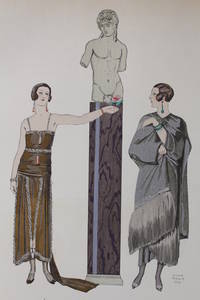
Eros. Robe et Manteau pour le soir de Worth pl.51 La Gazette du Bon ton 1924 n°9
Paris: Lucien Vogel éditeur 1924. Fine. Lucien Vogel éditeur Paris 1924 18 x 24 cm une feuille Original color print heightened with palladium printed on vergé paper signed in the plate. An original print used to illustrate the Gazette du bon ton one of the most attractive and influential 20th century fashion magazines featuring the talents of French artists and other contributors from the burgeoning Art Deco movement. A celebrated fashion magazine established in 1912 by Lucien Vogel La Gazette du bon ton appeared until 1925 with a hiatus from 1915 to 1920 due to the war the editor-in-chief having been called up for service. It consisted of 69 issues printed in only 2000 copies each and notably illustrated with 573 color plates and 148 sketches of the models of the great designers. Right from the start this sumptuous publication “was aimed at bibliophiles and fashionable society” Françoise Tétart-Vittu “La Gazette du bon ton” in Dictionnaire de la mode 2016 and was printed on fine vergé paper using a type cut specially for the magazine by Georges Peignot known as Cochin later used in 1946 by Christian Dior. The prints were made using stencils heightened in colors some highlighted in gold or palladium. The story began in 1912 when Lucien Vogel a man of the world involved in fashion he had already been part of the fashion magazine Femina decided with his wife Cosette de Brunhoff – the sister of Jean creator of Babar – to set up the Gazette du bon ton subtitled at the time: “Art fashion frivolities.” Georges Charensol noted the reasoning of the editor-in-chief: “’In 1910’ he observed ‘there was no really artistic fashion magazine nothing representative of the spirit of the time. My dream was therefore to make a luxury magazine with truly modern artists…I was assured of success because when it comes to fashion no country on earth can compete with France.’” “Un grand éditeur d’art. Lucien Vogel” in Les Nouvelles littéraires no. 133 May 1925. The magazine was immediately successful not only in France but also in the United States and Latin America. At first Vogel put together a team of seven artists: André-Édouard Marty and Pierre Brissaud followed by Georges Lepape and Dammicourt as well as eventually his friends from school and the School of Fine Arts like George Barbier Bernard Boutet de Monvel and Charles Martin. Other talented people soon came flocking to join the team: Guy Arnoux Léon Bakst Benito Boutet de Monvel Umberto Brunelleschi Chas Laborde Jean-Gabriel Domergue Raoul Dufy Édouard Halouze Alexandre Iacovleff Jean Émile Laboureur Charles Loupot Chalres Martin Maggie Salcedo. These artist mostly unknown when Lucien Vogel sought them out later became emblematic and sought-after artistic figures. It was also they who worked on the advertising drawings for the Gazette. The plates put the spotlight on and celebrate dresses by seven designers of the age: Lanvin Doeuillet Paquin Poiret Worth Vionnet and Doucet. The designers provided exclusive models for each issue. Nonetheless some of the illustrations are not based on real models but simply on the illustrator’s conception of the fashion of the day. The Gazette du bon ton was an important step in the history of fashion. Combining aesthetic demands with the physical whole it brought together – for the first time – the great talents of the artistic literary and fashion worlds; and imposed through this alchemy a completely new image of women: slender independent and daring which was shared by the new generation of designers including Coco Chanel Jean Patou Marcel Rochas and so on… Taken over in 1920 by Condé Montrose Nast the Gazette du bon ton was an important influence on the new layout and aesthetics of that “little dying paper” that Nast had bought a few years earlier: Vogue. Lucien Vogel éditeur unknown
Référence libraire : 55097
|
|
|
George BARBIER
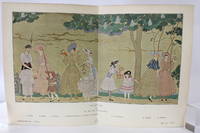
Vichy II ou Le Jeu des marionnettes pl.3 La Gazette du Bon ton Eté 1915 n°8-9
Paris: Lucien Vogel éditeur 1915. Fine. Lucien Vogel éditeur Paris Eté 1915 36.50 x 24 cm une feuille Double original color print heightened with gold printed on vergé paper signed in the plate. An original print used to illustrate the Gazette du bon ton one of the most attractive and influential 20th century fashion magazines featuring the talents of French artists and other contributors from the burgeoning Art Deco movement. A celebrated fashion magazine established in 1912 by Lucien Vogel La Gazette du bon ton appeared until 1925 with a hiatus from 1915 to 1920 due to the war the editor-in-chief having been called up for service. It consisted of 69 issues printed in only 2000 copies each and notably illustrated with 573 color plates and 148 sketches of the models of the great designers. Right from the start this sumptuous publication “was aimed at bibliophiles and fashionable society” Françoise Tétart-Vittu “La Gazette du bon ton” in Dictionnaire de la mode 2016 and was printed on fine vergé paper using a type cut specially for the magazine by Georges Peignot known as Cochin later used in 1946 by Christian Dior. The prints were made using stencils heightened in colors some highlighted in gold or palladium. The story began in 1912 when Lucien Vogel a man of the world involved in fashion he had already been part of the fashion magazine Femina decided with his wife Cosette de Brunhoff – the sister of Jean creator of Babar – to set up the Gazette du bon ton subtitled at the time: “Art fashion frivolities.” Georges Charensol noted the reasoning of the editor-in-chief: “’In 1910’ he observed ‘there was no really artistic fashion magazine nothing representative of the spirit of the time. My dream was therefore to make a luxury magazine with truly modern artists…I was assured of success because when it comes to fashion no country on earth can compete with France.’” “Un grand éditeur d’art. Lucien Vogel” in Les Nouvelles littéraires no. 133 May 1925. The magazine was immediately successful not only in France but also in the United States and Latin America. At first Vogel put together a team of seven artists: André-Édouard Marty and Pierre Brissaud followed by Georges Lepape and Dammicourt as well as eventually his friends from school and the School of Fine Arts like George Barbier Bernard Boutet de Monvel and Charles Martin. Other talented people soon came flocking to join the team: Guy Arnoux Léon Bakst Benito Boutet de Monvel Umberto Brunelleschi Chas Laborde Jean-Gabriel Domergue Raoul Dufy Édouard Halouze Alexandre Iacovleff Jean Émile Laboureur Charles Loupot Chalres Martin Maggie Salcedo. These artist mostly unknown when Lucien Vogel sought them out later became emblematic and sought-after artistic figures. It was also they who worked on the advertising drawings for the Gazette. The plates put the spotlight on and celebrate dresses by seven designers of the age: Lanvin Doeuillet Paquin Poiret Worth Vionnet and Doucet. The designers provided exclusive models for each issue. Nonetheless some of the illustrations are not based on real models but simply on the illustrator’s conception of the fashion of the day. The Gazette du bon ton was an important step in the history of fashion. Combining aesthetic demands with the physical whole it brought together – for the first time – the great talents of the artistic literary and fashion worlds; and imposed through this alchemy a completely new image of women: slender independent and daring which was shared by the new generation of designers including Coco Chanel Jean Patou Marcel Rochas and so on… Taken over in 1920 by Condé Montrose Nast the Gazette du bon ton was an important influence on the new layout and aesthetics of that “little dying paper” that Nast had bought a few years earlier: Vogue. Lucien Vogel éditeur unknown
Référence libraire : 54705
|
|
|
Kimiko Barber
YO! SUSHI - THE JAPANESE COOKBOOK
Paperback. Very Good. paperback
Référence libraire : GOR007704181 ISBN : 0007801203 9780007801206

|
|
|
George BARBIER - (Charles-Frederick WORTH)
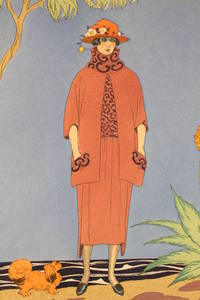
A Palm Beach. Tailleur de Worth pl.40 La Gazette du Bon ton 1921 n°5
Paris: Lucien Vogel éditeur 1921. Fine. Lucien Vogel éditeur Paris 1921 18 x 24 cm une feuille Original color print printed on vergé paper signed in the plate. An original print used to illustrate the Gazette du bon ton one of the most attractive and influential 20th century fashion magazines featuring the talents of French artists and other contributors from the burgeoning Art Deco movement. A celebrated fashion magazine established in 1912 by Lucien Vogel La Gazette du bon ton appeared until 1925 with a hiatus from 1915 to 1920 due to the war the editor-in-chief having been called up for service. It consisted of 69 issues printed in only 2000 copies each and notably illustrated with 573 color plates and 148 sketches of the models of the great designers. Right from the start this sumptuous publication “was aimed at bibliophiles and fashionable society” Françoise Tétart-Vittu “La Gazette du bon ton” in Dictionnaire de la mode 2016 and was printed on fine vergé paper using a type cut specially for the magazine by Georges Peignot known as Cochin later used in 1946 by Christian Dior. The prints were made using stencils heightened in colors some highlighted in gold or palladium. The story began in 1912 when Lucien Vogel a man of the world involved in fashion he had already been part of the fashion magazine Femina decided with his wife Cosette de Brunhoff – the sister of Jean creator of Babar – to set up the Gazette du bon ton subtitled at the time: “Art fashion frivolities.” Georges Charensol noted the reasoning of the editor-in-chief: “’In 1910’ he observed ‘there was no really artistic fashion magazine nothing representative of the spirit of the time. My dream was therefore to make a luxury magazine with truly modern artists…I was assured of success because when it comes to fashion no country on earth can compete with France.’” “Un grand éditeur d’art. Lucien Vogel” in Les Nouvelles littéraires no. 133 May 1925. The magazine was immediately successful not only in France but also in the United States and Latin America. At first Vogel put together a team of seven artists: André-Édouard Marty and Pierre Brissaud followed by Georges Lepape and Dammicourt as well as eventually his friends from school and the School of Fine Arts like George Barbier Bernard Boutet de Monvel and Charles Martin. Other talented people soon came flocking to join the team: Guy Arnoux Léon Bakst Benito Boutet de Monvel Umberto Brunelleschi Chas Laborde Jean-Gabriel Domergue Raoul Dufy Édouard Halouze Alexandre Iacovleff Jean Émile Laboureur Charles Loupot Chalres Martin Maggie Salcedo. These artist mostly unknown when Lucien Vogel sought them out later became emblematic and sought-after artistic figures. It was also they who worked on the advertising drawings for the Gazette. The plates put the spotlight on and celebrate dresses by seven designers of the age: Lanvin Doeuillet Paquin Poiret Worth Vionnet and Doucet. The designers provided exclusive models for each issue. Nonetheless some of the illustrations are not based on real models but simply on the illustrator’s conception of the fashion of the day. The Gazette du bon ton was an important step in the history of fashion. Combining aesthetic demands with the physical whole it brought together – for the first time – the great talents of the artistic literary and fashion worlds; and imposed through this alchemy a completely new image of women: slender independent and daring which was shared by the new generation of designers including Coco Chanel Jean Patou Marcel Rochas and so on… Taken over in 1920 by Condé Montrose Nast the Gazette du bon ton was an important influence on the new layout and aesthetics of that “little dying paper” that Nast had bought a few years earlier: Vogue. Lucien Vogel éditeur unknown
Référence libraire : 54878
|
|
|
David W. Barber
When the Fat Lady Sings: Opera History as it Ought to be Taught
Paperback. Very Good. paperback
Référence libraire : GOR002740852 ISBN : 0920151345 9780920151341

|
|
|
George BARBIER - (John REDFERN)
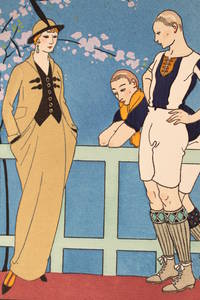
Rugby - Costume tailleur de Redfern pl.39 La Gazette du Bon ton 1914 n°4
Paris: Lucien Vogel éditeur 1914. Fine. Lucien Vogel éditeur Paris Avril 1914 19 x 24.50 cm une feuille Original color print printed on vergé paper signed in the plate. An original print used to illustrate the Gazette du bon ton one of the most attractive and influential 20th century fashion magazines featuring the talents of French artists and other contributors from the burgeoning Art Deco movement. A celebrated fashion magazine established in 1912 by Lucien Vogel La Gazette du bon ton appeared until 1925 with a hiatus from 1915 to 1920 due to the war the editor-in-chief having been called up for service. It consisted of 69 issues printed in only 2000 copies each and notably illustrated with 573 color plates and 148 sketches of the models of the great designers. Right from the start this sumptuous publication “was aimed at bibliophiles and fashionable society” Françoise Tétart-Vittu “La Gazette du bon ton” in Dictionnaire de la mode 2016 and was printed on fine vergé paper using a type cut specially for the magazine by Georges Peignot known as Cochin later used in 1946 by Christian Dior. The prints were made using stencils heightened in colors some highlighted in gold or palladium. The story began in 1912 when Lucien Vogel a man of the world involved in fashion he had already been part of the fashion magazine Femina decided with his wife Cosette de Brunhoff – the sister of Jean creator of Babar – to set up the Gazette du bon ton subtitled at the time: “Art fashion frivolities.” Georges Charensol noted the reasoning of the editor-in-chief: “'In 1910' he observed ‘there was no really artistic fashion magazine nothing representative of the spirit of the time. My dream was therefore to make a luxury magazine with truly modern artists…I was assured of success because when it comes to fashion no country on earth can compete with France.'” “Un grand éditeur d'art. Lucien Vogel” in Les Nouvelles littéraires no. 133 May 1925. The magazine was immediately successful not only in France but also in the United States and Latin America. At first Vogel put together a team of seven artists: André-Édouard Marty and Pierre Brissaud followed by Georges Lepape and Dammicourt as well as eventually his friends from school and the School of Fine Arts like George Barbier Bernard Boutet de Monvel and Charles Martin. Other talented people soon came flocking to join the team: Guy Arnoux Léon Bakst Benito Boutet de Monvel Umberto Brunelleschi Chas Laborde Jean-Gabriel Domergue Raoul Dufy Édouard Halouze Alexandre Iacovleff Jean Émile Laboureur Charles Loupot Chalres Martin Maggie Salcedo. These artist mostly unknown when Lucien Vogel sought them out later became emblematic and sought-after artistic figures. It was also they who worked on the advertising drawings for the Gazette. The plates put the spotlight on and celebrate dresses by seven designers of the age: Lanvin Doeuillet Paquin Poiret Worth Vionnet and Doucet. The designers provided exclusive models for each issue. Nonetheless some of the illustrations are not based on real models but simply on the illustrator's conception of the fashion of the day. The Gazette du bon ton was an important step in the history of fashion. Combining aesthetic demands with the physical whole it brought together – for the first time – the great talents of the artistic literary and fashion worlds; and imposed through this alchemy a completely new image of women: slender independent and daring which was shared by the new generation of designers including Coco Chanel Jean Patou Marcel Rochas and so on… Taken over in 1920 by Condé Montrose Nast the Gazette du bon ton was an important influence on the new layout and aesthetics of that “little dying paper” that Nast had bought a few years earlier: Vogue. Lucien Vogel éditeur unknown
Référence libraire : 54653
|
|
|
T. X. Barber; Leo V. DiCara; Joe Kamiya
Biofeedback and Self Control 1975/1976: An Aldine Annual on the regulation of bodily processes and consciousness
Aldine Publishing Company Chicago 1976-06-01. Hardcover. Very Good. 1976; brown cloth boards with gold titles; corners of boards lightly bumped; no jacket; interior is clean; 581 pages; 8vo - over 7 3/4" - 9 3/4" Tall Aldine Publishing Company, Chicago hardcover
Référence libraire : SKU1089083 ISBN : 0202251101 9780202251103
|
|
|
Barber, Captain Horatio
How to Fly a Plane: The First World War Pilot's Manual
Paperback. Very Good. paperback
Référence libraire : GOR007259627 ISBN : 1445635836 9781445635835

|
|
|
Auguste BARBIER
Iambes et poèmes
Paris: Paul Masgana 1841. Fine. Paul Masgana Paris 1841 11.50 x 19 cm relié Fourth edition. Bradel binding in full brown cloth smooth spine date and double gilt fillet at foot signed binding. Handsome copy. Paul Masgana hardcover
Référence libraire : 52484

|
|
|
Barber, James David
The Presidential Character: Predicting Performance in the White House 2nd edition
Prentice Hall. 1977. Paperback. UsedGood. ASIN: B010EX8Y8C Paperback; fading and edge wear to exterior; price stampe d on title page and that page is coming loose; otherwise in good condition with clean text. . Prentice Hall paperback
Référence libraire : 68059
|
|
|
George BARBIER
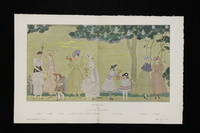
Vichy II ou Le Jeu des Marionnettes. La Gazette du Bon ton n°8-9. Été 1915 - Planche 3
Paris: Lucien Vogel éditeur 1915. Fine. Lucien Vogel éditeur Paris 1915 37.60 x 24.20 cm une feuille Original color print printed on vergé paper signed in the plate. An original print used to illustrate the Gazette du bon ton one of the most attractive and influential 20th century fashion magazines featuring the talents of French artists and other contributors from the burgeoning Art Deco movement. A celebrated fashion magazine established in 1912 by Lucien Vogel La Gazette du bon ton appeared until 1925 with a hiatus from 1915 to 1920 due to the war the editor-in-chief having been called up for service. It consisted of 69 issues printed in only 2000 copies each and notably illustrated with 573 color plates and 148 sketches of the models of the great designers. Right from the start this sumptuous publication “was aimed at bibliophiles and fashionable society” Françoise Tétart-Vittu “La Gazette du bon ton” in Dictionnaire de la mode 2016 and was printed on fine vergé paper using a type cut specially for the magazine by Georges Peignot known as Cochin later used in 1946 by Christian Dior. The prints were made using stencils heightened in colors some highlighted in gold or palladium. The story began in 1912 when Lucien Vogel a man of the world involved in fashion he had already been part of the fashion magazine Femina decided with his wife Cosette de Brunhoff – the sister of Jean creator of Babar – to set up the Gazette du bon ton subtitled at the time: “Art fashion frivolities.” Georges Charensol noted the reasoning of the editor-in-chief: “’In 1910’ he observed ‘there was no really artistic fashion magazine nothing representative of the spirit of the time. My dream was therefore to make a luxury magazine with truly modern artists…I was assured of success because when it comes to fashion no country on earth can compete with France.’” “Un grand éditeur d’art. Lucien Vogel” in Les Nouvelles littéraires no. 133 May 1925. The magazine was immediately successful not only in France but also in the United States and Latin America. At first Vogel put together a team of seven artists: André-Édouard Marty and Pierre Brissaud followed by Georges Lepape and Dammicourt as well as eventually his friends from school and the School of Fine Arts like George Barbier Bernard Boutet de Monvel and Charles Martin. Other talented people soon came flocking to join the team: Guy Arnoux Léon Bakst Benito Boutet de Monvel Umberto Brunelleschi Chas Laborde Jean-Gabriel Domergue Raoul Dufy Édouard Halouze Alexandre Iacovleff Jean Émile Laboureur Charles Loupot Chalres Martin Maggie Salcedo. These artist mostly unknown when Lucien Vogel sought them out later became emblematic and sought-after artistic figures. It was also they who worked on the advertising drawings for the Gazette. The plates put the spotlight on and celebrate dresses by seven designers of the age: Lanvin Doeuillet Paquin Poiret Worth Vionnet and Doucet. The designers provided exclusive models for each issue. Nonetheless some of the illustrations are not based on real models but simply on the illustrator’s conception of the fashion of the day. The Gazette du bon ton was an important step in the history of fashion. Combining aesthetic demands with the physical whole it brought together – for the first time – the great talents of the artistic literary and fashion worlds; and imposed through this alchemy a completely new image of women: slender independent and daring which was shared by the new generation of designers including Coco Chanel Jean Patou Marcel Rochas and so on… Taken over in 1920 by Condé Montrose Nast the Gazette du bon ton was an important influence on the new layout and aesthetics of that “little dying paper” that Nast had bought a few years earlier: Vogue. Lucien Vogel éditeur unknown
Référence libraire : 51292
|
|
|
Auguste BARBIER
Iambes
Paris: Urbain Canel et Ad. Guyot 1832. Fine. Urbain Canel et Ad. Guyot Paris 1832 12.50 x 19.50 cm relié First edition. Two poems not reprinted in subsequent editions. Contemporary full brown shagreen binding spine with five raised bands decorated with gilt compartments and fillets triple gilt fillet framing the covers gilt dentelle framing the marbled paper pastedowns all edges gilt. A handsome copy. Urbain Canel et Ad. Guyot hardcover
Référence libraire : 50000

|
|
|
BARBER Noel
Sinister Twilight. The Fall and Rise Again of Singapore. BRIGHT CLEAN COPY IN UNCLIPPED DUSTWRAPPER
Collins 1968. 8vo. First Edition with endpaper maps; grey tweed cloth gilt back grey top a very good bright clean copy in unclipped dustwrapper. Enser p.404. Collins, hardcover
Référence libraire : 28479

|
|
|
Barber, Antonia
The Mousehole Cat
Paperback. Very Good. paperback
Référence libraire : GOR006812534 ISBN : 1406360775 9781406360776

|
|
|
Auguste BARBIER
Nouvelles satires Pot-de-vin et Erostrate
Paris: Paul Masgana 1840. Fine. Paul Masgana Paris 1840 14.50 x 22.50 cm relié First edition of which there were no deluxe copies. Bound in half cherry red Russian morocco with corners spine with five fine raised bands set with double gilt fillets decorated with double gilt compartments enhanced with gilt romantic tools gilt date at foot one joint showing traces of rubbing gilt fillet frame on marbled paper boards marbled endpapers and pastedowns covers and spine preserved handsome binding in the Romantic taste signed by Canape. Rare autograph inscription signed by Auguste Barbier to Monsieur Oliveira. Some minor foxing affecting mainly the margins of certain leaves. Handsome copy perfectly bound in a handsome pastiche Romantic binding by Canape. Paul Masgana hardcover
Référence libraire : 48730

|
|
|
Barber, Laura
Penguin's Poems for Love
Paperback. Acceptable. paperback
Référence libraire : GOR006703623 ISBN : 0140424806 9780140424805

|
|
|
Barber, H.
The Aeroplane Speaks.
London: McBride Nast & Co. 1917. Fifth Edition. Octavo flexible cloth 156 pp. Plates illustrations ads. Very Good. McBride, Nast & Co., (1917). Fifth Edition. hardcover
Référence libraire : 3229qs
|
|
|
Barber, Paul
Essentials Of Pharmacology For Nurses
Paperback. Good. paperback
Référence libraire : GOR006607988 ISBN : 0335234046 9780335234042

|
|
|
Benjamin R. Barber
Superman and Common Men: Freedom Anarchy and the Revolution
Paperback. Acceptable. paperback
Référence libraire : GOR006609564 ISBN : 0140214305 9780140214307

|
|
|
E. K. Barber.
The Phoenix and the Shield Book One: The Case of the Hidden Truth
PublishAmerica/Baltimore. 1st Edition. Soft cover. Near Fine. Signed by Authors. 1st Printing 372 pp. Book/dust jacket condition: NF- slight dents/creases to front spine/na paperback. First Edition First Printing/1st Ed. 1st Printing. Inscribed by author on title page. All orders are processed and shipped from MI or WI USA. PublishAmerica/Baltimore paperback
Référence libraire : 679
|
|
|
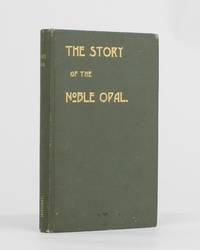
[Opals]. SKERTCHLY, Sydney Barber Josiah
The Story of the Noble Opal
Brisbane: Flavelle Roberts and Sankey 1908. First Edition. Hardcover. Very Good. Brisbane Flavelle Roberts and Sankey 1908. Small octavo 114 2 recto blank with the device of the printers Outridge Printing Co. on the verso pages. Original olive-green cloth lettered in gilt on the spine 'Noble Opal' and the author's surname and front cover the full title; cloth slightly marked lightly rubbed at the extremities and a little bumped at the top corners; first and last few leaves a little foxed; an excellent copy. Flavelle's Gem Series Number 1. Sydney Skertchly 1850-1926 arrived in Brisbane in 1891 after a successful career as a geologist in places as varied as the Fenland and East Anglia Egypt California Burma and China. In 1895-97 he was assistant government geologist in the Geological Survey of Queensland; he was President of the Royal Society of Queensland in 1898 and a founder and first president of the Field Naturalists' Club in 1906. The author's end-note to the reader states that the publishers 'asked me to write a series of little books on gemstones and gave me an entirely free hand. As this the first of them shows they will not be mere gatherings from other harvests but original works embodying the results of my own experience'. An early rare and important work on the subject and we know of no other volumes in the Flavelle's Gem Series. We currently have for sale two variant copies of this item sourced from a significant collection on the subject. This version does not have the advertisement for 'Queensland the Queen of the Colonies' verso blank tipped in at the rear and it is printed on textured and coarser paper resulting in a noticeably thicker volume 14 mm as distinct from 11 mm. Flavelle, Roberts and Sankey hardcover
Référence libraire : 99900
|
|
|
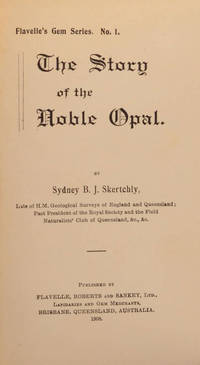
[Opals]. SKERTCHLY, Sydney Barber Josiah
The Story of the Noble Opal
Brisbane: Flavelle Roberts and Sankey 1908. First Edition. Hardcover. Very Good. Brisbane Flavelle Roberts and Sankey 1908. Small octavo 114 2 recto blank with the device of the printers Outridge Printing Co. on the verso 2 a tipped-in leaf being an advertisement for 'Queensland the Queen of the Colonies' verso blank pages. Original olive-green cloth lettered in gilt on the spine 'Noble Opal' and the author's surname and front cover the full title; cloth lightly rubbed at the extremities; endpapers a little foxed and offset with two small offset tape-marks to both flyleaves; an excellent copy. Flavelle's Gem Series Number 1. Sydney Skertchly 1850-1926 arrived in Brisbane in 1891 after a successful career as a geologist in places as varied as the Fenland and East Anglia Egypt California Burma and China. In 1895-97 he was assistant government geologist in the Geological Survey of Queensland; he was President of the Royal Society of Queensland in 1898 and a founder and first president of the Field Naturalists' Club in 1906. The author's end-note to the reader states that the publishers 'asked me to write a series of little books on gemstones and gave me an entirely free hand. As this the first of them shows they will not be mere gatherings from other harvests but original works embodying the results of my own experience'. An early rare and important work on the subject and we know of no other volumes in the Flavelle's Gem Series. We have identified three variant issues of this work; details available on request. Flavelle, Roberts and Sankey hardcover
Référence libraire : 99901
|
|
|
Barber, Chips
Brixham of Yesteryear
Paperback. Very Good. paperback
Référence libraire : GOR005971005 ISBN : 1899073140 9781899073146

|
|
|
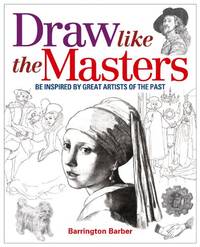
Barber, Barrington
Draw Like the Masters
Paperback. Very Good. paperback
Référence libraire : GOR006014573 ISBN : 1784040444 9781784040444
|
|
|
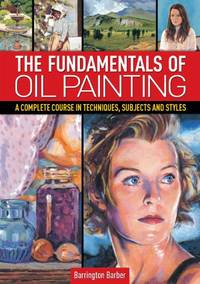
Barber, Barrington
The Fundamentals of Oil Painting: A Complete Course in Techniques Subjects and Styles
Paperback. Good. paperback
Référence libraire : GOR005885080 ISBN : 1848584687 9781848584686
|
|
|
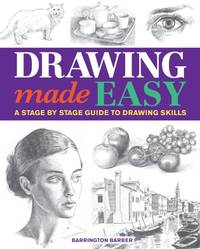
Barber, Barrington
Drawing Made Easy
Paperback. Very Good. paperback
Référence libraire : GOR005899260 ISBN : 1782122214 9781782122210
|
|
|
Barber, Malcolm
The Two Cities: Medieval Europe 1050-1320
Paperback. Acceptable. paperback
Référence libraire : GOR005609476 ISBN : 0415174155 9780415174152

|
|
|
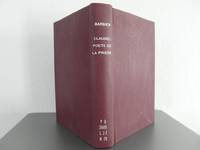
Barbier Joseph
Claudel poète de la prière
Mame 1962. Book. Good. Hardcover. 8vo - over 7¾" - 9¾" tall. In-8 relié Bon Etat cachet. Mame Hardcover
Référence libraire : 1176170
|
|
|
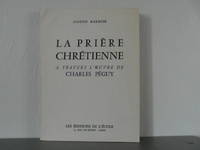
Barbier Joseph
La prière chrétienne à travers l'oeuvre de Charles Péguy
Les Editions de l'Ecole 1959. Book. Good. Soft cover. 8vo - over 7¾" - 9¾" tall. In-8 broché Bon Etat. Les Editions de l'Ecole Paperback
Référence libraire : 1177993
|
|
|
Barber, Mary Corpening; Corpening, Sara; Narlock, Lori Lyn
Smoothies: 50 Recipes for High-Energy Refreshment
San Francisco CA: Chronicle Books Llc 1997. Book. Like New. Trade Paperback. ISBN: 0-8118-1648-6 As new no wear. Quite clean. 'Frothy flavorful and thirst-quenching smoothies are the quintessential modern refreshment - and these blended fruit drinks are a cinch to make at home. This book is bursting with tempting suggestions for healthful and occasionally sinful mixtures of fruits sorbets ice creams yogurts soy milks and other deliciously fresh ingredients.' 108 pages. Chronicle Books Llc Paperback
Référence libraire : 037241 ISBN : 0811816486 9780811816489

|
|
|
Richard Barber Anne Riches
A Dictionary of Fabulous Beasts
Boydell & Brewer Group Limited pp. 170 . Papeback. New. Boydell & Brewer Group, Limited unknown
Référence libraire : 697312916 ISBN : 0851156851 9780851156859

|
|
|
Barber, Kimiko
Sushi: Taste and Technique
Paperback. Good. paperback
Référence libraire : GOR005514072 ISBN : 1405373385 9781405373388

|
|
|
Barber, Charles
Early modern English
London: Andre Deutsch 1976. Second 1981 printing 8vo pp. 360; original boards in blue-green dust jacket; spine a bit faded Blackwell's price ticket on front jacket flap; very good. Forms part of the Language Library edited by David Crystal. Andre Deutsch unknown
Référence libraire : 44257
|
|
|
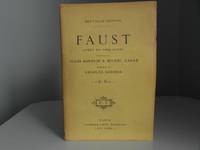
Barbier Jules, Carre Michel
Faust opéra en cinq actes
Calmann Levy 1919. Book. Good. Soft cover. 12mo - over 6¾ - 7¾" tall. In-12 broché Bon Etat quelques annotations. Calmann Levy Paperback
Référence libraire : 78847
|
|
|
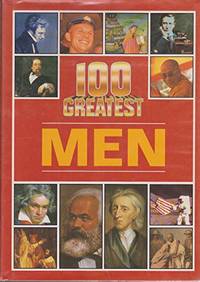
Kyla Barber [editor]
100 GREATEST MEN
Hardback. Very Good. hardcover
Référence libraire : GOR005372265 ISBN : 1850283060 9781850283065
|
|
|
Barber, Barrington
The Practical Guide to Drawing Anatomy Artist's Workbook
Paperback. Very Good. paperback
Référence libraire : GOR005266363 ISBN : 1848378297 9781848378292

|
|
|
BARBER (ed.) Richard
The Life and Campaigns of the Black Prince. From contemporary Letters Diaries and Chronicles including Chandos Herald's 'Life of the Black Prince'. Edited and translated by Richard Barber. NEAR FINE COPY IN PUBLISHER'S SLIP-CASE
Folio Society 1979. 8vo. First Edition thus with a coloured frontispiece and plates and endpaper maps; red pictorial cloth upper board and backstrip blocked and lettered in silver and black a near fine copy in publisher's board slip-case. Folio Society, hardcover
Référence libraire : 24509

|
|
|
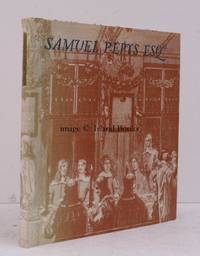
BARBER R.
Samuel Pepys Esquire. NEAR FINE COPY IN UNCLIPPED DUSTWRAPPER
National Portrait Gallery 1970. 4to. First Edition with a coloured portrait frontispiece and numerous coloured and monochrome photographs throughout; white cloth patterned in gilt gilt back green endpapers a near fine copy in unclipped dustwrapper the latter lightly sunned at backstrip. National Portrait Gallery, hardcover
Référence libraire : 24245
|
|
|
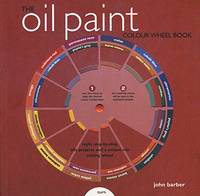
Barber, John
The Oil Paint Colour Wheel Book Colour Wheel Books
Paperback. Acceptable. paperback
Référence libraire : GOR005110846 ISBN : 1844484289 9781844484287
|
|
|
Barber, Kimiko
Sushi: Taste and Technique
Paperback. Very Good. paperback
Référence libraire : GOR005114748 ISBN : 1405373385 9781405373388

|
|
|
Barber, Chris
More Mysterious Wales Paladin Books
Paperback. Acceptable. paperback
Référence libraire : GOR004928278 ISBN : 0586085181 9780586085189

|
|
|
Malcolm Barber
The Cathars
Taylor & Francis Group pp. 256 2nd Edition . Papeback. New. Taylor & Francis Group unknown
Référence libraire : 654465369 ISBN : 1408252589 9781408252581

|
|
|
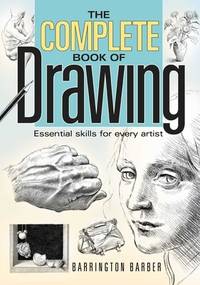
Barber, Barrington
Complete Book of Drawing: Essential Skills for Ev
Arcturus. New. Special order direct from the distributor Arcturus unknown
Référence libraire : ING9781848375369 ISBN : 1848375360 9781848375369
|
|
|
Keith Bate Malcolm Barber
Letters from the East
Ashgate Publishing Company pp. 206 Index. Papeback. New. Ashgate Publishing Company unknown
Référence libraire : 650434151 ISBN : 1472413938 9781472413932

|
|

 Recevoir par e-mail
 Télécharger en PDF
 Flux RSS
 Lien permanent


