Site indépendant de libraires professionnels

‎Thé‎

Main

Thèmes parents

‎Gastronomie‎
Nombre de résultats : 184.402 (3689 Page(s))

Première page Page précédente 1 ... 26 27 28 [29] 30 31 32 ... 554 1076 1598 2120 2642 3164 3686 ... 3689 Page suivante Dernière page

‎"LE CHATELIER, HENRI LOUIS. - INVENTION OF THE OPTICAL PYROMETER.‎

‎Sur la mesure optique des temperatures élevées.‎

‎(Paris, Gauthier-Villars), 1892. 4to. No wrappers. In: ""Comptes Rendus Hebdomadaires des Séances de L'Academie des Sciences"", Tome 114, No 5. Pp. (195-) 254. (Entire issue offered). Le Chatelier's paper: pp. 214-216.‎

‎First appearance of the paper in which Le Chevalier describes his invention of the Optical Pyrometer which was the first instrument to measure degrees Celsius over 3000.""Henri LeChatelier creates a practical optical pyrometer for measuring the temperature of hot bodies from the light intensity in a narrow wavelenght band by optical comparison of an image of the body in question and a glowing filament. He uses an oil lamp, an iris diaphragm, and a red glass filter for narrowing the wavelenght range.""(Parkinson).Parkinson ""Breakthroughs"", 1892 P.‎

Référence libraire : 48915

Livre Rare Book

Herman H. J. Lynge & Son
Copenhagen Denmark Dinamarca Dinamarca Danemark
[Livres de Herman H. J. Lynge & Son]

€ 201,45 Acheter

‎"LE CHATELIER, HENRI LOUIS. - INVENTION OF THE PLATINUM THERMOCOUPLE.‎

‎Sur la variation produite par une élèvation de température, dans la force électromotrice des couples thermo-électriques.‎

‎(Paris, Gauthier-Villars), 1886. 4to. No wrappers. In: ""Comptes Rendus Hebdomadaires des Séances de L'Academie des Sciences"", Tome 102, No 14. Pp. (783-) 834. (Entire issue offered). Le Chatelier's paper: pp. 819-822.‎

‎Firs printing of an importent paper in thermometry where he demonstrates that high temperatures could be precisely measured by way of a platinum wire in conjunction with a platinum-rhodium alloy wire.""It is to Henri Louis Le Chatelier th a t we owe the successful practical use of the platinum thermocouple which for many years was in fact known by his name. Among his many activities Le Chatelier was engaged in the study of silicates and cements and needed a reliable method of measuring high temperatures. In 1886 he reported to the Académie des Sciences an investigation on the use of thermocouples for this purpose in which he had tried to verify the parabolic relationships found by Professor T a i t between the electromotive force and the temperature of the hot junction, the cold junction being at 0°C. Using various metals and alloys against platinum, which he calibrated at the known melting points of lead, zinc, aluminium, silver, gold, copper and palladium, he obtainedresults that agreed with his calculations to within 20°C (11). He also came to the conclusion that of the various combinations he had used, platinum against 10 per cent rhodium-platinum gave the most consistent results."" (Donald McDonald and Leslie B. Hunt).Parkinson ""Breakthroughs"", 1885 P.‎

Référence libraire : 49879

Livre Rare Book

Herman H. J. Lynge & Son
Copenhagen Denmark Dinamarca Dinamarca Danemark
[Livres de Herman H. J. Lynge & Son]

€ 134,30 Acheter

‎"LE CLERC (LECLERC), SEB. (SEBASTIEN) - AN IMPORTANT WORK ON THE PHYSIOLOGY OF VISION DISCOVERING THE ""MASTER-EYE"".‎

‎Discours touchant le Point de Veue, dans lequel il est prouvé que les choses qu'on voit distinctement, ne sont veuës que d'un oeil.‎

‎Paris, Thomas Jolly, 1679. Small8vo. (15x9 cm.). Contemp. full sprinckled calf., raisedbands, richly gilt spine. Top of spine a bit worn. Edges of covers gilt. (12),86,(1) pp. Last page ""Extrait du Privilege du Roy"". 34 fine full-page engravings (25 copper-engraved a. 9 in woodcut). A paperflw at foot of titlepage neathly repaired, no loss of paper or letters. Internally clean and fine, printed on thick, good paper.‎

‎Extremely scarce first edition of Leclerc's important work on binocular vision in which he finds that one of the eyes has a dominant status, thus announcing the discovery of the ""Master-eye"" - a discovery of outmost importance in the theory of shooting and elsewhere. With use of diagrams he shows that ""things that can be seen clearly are seen with but one single eye."". He records and depicts a large series of experiments with binocular vision and shows geometrically the relation to the science of perspective, and points out the importance of understanding the physiology of binocular vision for perspective painting in general.Sebastien Leclerc was originally an engraver who studied physics and geometry in relation to perspective theory, a field of which he became famous. In 1672 he was appointed to ""l'Academie de Peinture"" as professor in perspective. He was also engraver to Louis XIV and was appointed professor at ""l'Ecole des Gobelins"".‎

Référence libraire : 44323

Livre Rare Book

Herman H. J. Lynge & Son
Copenhagen Denmark Dinamarca Dinamarca Danemark
[Livres de Herman H. J. Lynge & Son]

€ 3.357,50 Acheter

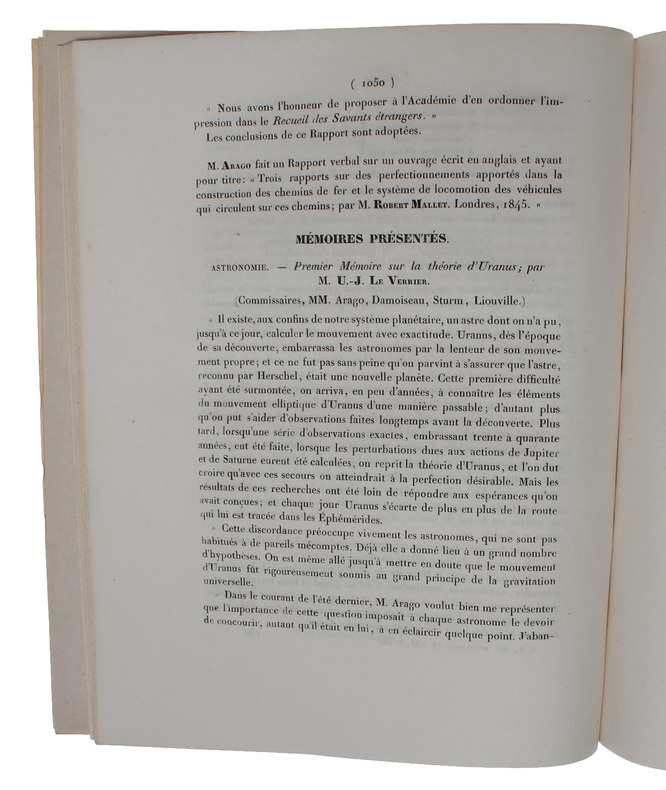
‎"LE VERRIER (LEVERRIER), URBAIN JEAN JOSEPH. - PREPARING FOR, PREDICTING AND CONFIRMING THE EXISTENCE OF NEPTUNE.‎

‎Premier Mémoire sur la théorie d'Uranus. (Séance 10 Novembre 1845). (+) Recherches sur les mouvements d'Uranus. (Séance du Lundi 1er Juin 1846). (+) Sur la planète qui produit les anomalies observées dans le mouvement d'Uranus. Détermination de ...‎

‎Paris, Bachelier, 1845 a. 1846. 4to. No wrappers. In: ""Comptes rendus hebdomadaires des séances de l’Académie des sciences"", Vol. 21, No 19, Vol. 22, No 22, Vol. 23, Nos 9, 14, 16 a. 17. (6 entire issues offered). Le verrier's papers: pp. 1050-1055 (No 19), pp. 907-919 (no 22), pp. 428-438 (No 9), pp. 657-659, 659-643, 676 (No 14), pp. 741, 741-754, 754 (No 16), pp. 798-799, 799-800 (No 17). With title-pages to vol. 21,22 a. 23. Titlepages with a small stamp in upper corner and a perforated stamp to lower margin. Light yellowing to title-pages, otherwise clean and fine on good paper.‎

‎First printing of Le Verrier's importent and famous papers, predicting and confirming the discovery of the Planet Neptune, including the ""preparatory"" paper, the first paper on the anomalities in the orbit of Uranus, the calculations on which eventually leading to his prediction and discovery of a new planet, Neptune the following year, 1846.""In 1846 John Cauch Adams... and Urban J. Leverrier... simultaneously and independently determined the location of a possible new planet... In 1845 he wrote of his findings of the mathematical location of a new planet to Sir George Bidell Airy,,, Because Adams was unknown, his letter was put aside. Meanwhile the same perturbations of Uranus had become of interest to Leverrier. On July 1(should be June !), 1846 he presented a paper ""Recherches sur les mouvements d'Uranus"" to the Academie des Sciences inParis. When Airy realized that Leverrier and Adams had reached the same conclusions, he hastened to suggest that a search be made for the newplanert. Shortly hereafter it was seen bur not recognized. About a week before it was found in England, it was discovered by Galle in Berlin on information supplied by Leverrier. Thus, the honour of the discovery, or even co-discovery of the new planet, Neptune, was lost to Adams and credited to Leverrier.... Adams paper was reade before the Royal Astronomical Society, November 13, 1846, and was published in 1847. (Milestones p. 40).Milestones of Science No 132. - Dibner No. 16.‎

Référence libraire : 49635

Livre Rare Book

Herman H. J. Lynge & Son
Copenhagen Denmark Dinamarca Dinamarca Danemark
[Livres de Herman H. J. Lynge & Son]

€ 2.215,95 Acheter

‎"LE VERRIER (LEVERRIER), URBAIN JEAN JOSEPH. - THE EXISTANCE OF NEPTUNE PREDICTED.‎

‎Recherches sur les mouvements d'Uranus. (Séance du Lundi 1er Juin 1846).‎

‎Paris, Bachelier, 1846. 4to. No wrappers. In: ""Comptes Rendu hebdomadaires des Séances de l’Académie des Sciences"", Vol. 22, No 22. Pp. (893-) 928. (Entire issue offered). Le Verrier's paper: pp. 907-018.‎

‎First appearance of Le Verrier's paper in which he postulated the existance of a new planet on mathematical premises from the gravitational disturbencies of Uranus.""In 1846 John Cauch Adams... and Urban J. Leverrier... simultaneously and independently determined the location of a possible new planet... In 1845 he wrote of his findings of the mathematical location of a new planet to Sir George Bidell Airy,,, Because Adams was unknown, his letter was put aside. Meanwhile the same perturbations of Uranus had become of interest to Leverrier. On July 1(should be June !), 1846 he presented a paper ""Recherches sur les mouvements d'Uranus"" (the paper offered) to the Academie des Sciences inParis. When Airy realized that Leverrier and Adams had reached the same conclusions, he hastened to suggest that a search be made for the newplanert. Shortly hereafter it was seen bur not recognized. About a week before it was found in England, it was discovered by Galle in Berlin on information supplied by Leverrier. Thus, the honour of the discovery, or even co-discovery of the new planet, Neptune, was lost to Adams and credited to Leverrier.... Adams paper was reade before the Royal Astronomical Society, November 13, 1846, and was published in 1847. (Milestones p. 40).Milestones of Science No 132. - Dibner No. 16.‎

Référence libraire : 47206

Livre Rare Book

Herman H. J. Lynge & Son
Copenhagen Denmark Dinamarca Dinamarca Danemark
[Livres de Herman H. J. Lynge & Son]

€ 1.141,55 Acheter

‎"LE VERRIER, URBAIN JEAN JOSEPH. - PREDICTING THE EXISTENCE OF THE PLANET NEPTUN.‎

‎Paris, Bachelier, 1846. 4to. No wrappers. In: ""Comptes rendus hebdomadaires des séances de l’Académie des sciences"", Vol. 23, No 9 (entire issue offered). With htitle and titlepage to vol. 23. Pp. 425-484. Le Verrier's paper: pp. 428-438.‎

‎First printing of this important paper in the history of astronomy in which Le Verrier predicted the existence of a new planet, determining its orbit and the mass as well as its actual position, so that, by informing Dr. Galle the following month, where he should look for it in the sky. The same evning when Galle had received the letter, he found close to the position given by Le Verrier a strange body showing a small planetary disc, which was soon recognized as a new planet, known now as Neptune. Adams in England, independently made the same prediction.""Until 1846 there was no theory of Uranus that permitted its movements to be represented satisfactorily. In 1821 Bouvard had constructed tables that, abandoning the older positions, adhered very closely to recent observations. Yet twenty years later a discrepancy of two minutes had already been observed, and several astronomers suggested that it might result from the attraction of an unknown planet. In 1845 Arago presented the problem to Le Verrier, who began by establishing a precise theory of Uranus. He then demonstrated that its observed perturbations could not be explained as the effect of the actions of Jupiter and Saturn, whatever modifications might eventually be made in the values assigned to the masses of those planets. He began to search for signs of an unknown disturbing planet. Finally, in a third memoir on the subject, appearing on 31 August 1846, Le Verrier fixed the exact position of the unknown planet and gave its apparent diameter.""(DSB)‎

Référence libraire : 46890

Livre Rare Book

Herman H. J. Lynge & Son
Copenhagen Denmark Dinamarca Dinamarca Danemark
[Livres de Herman H. J. Lynge & Son]

€ 604,35 Acheter

‎"LE VERRIER, URBAIN JEAN JOSEPH. - THE FIRST STEPS TOWARDS DISCOVERING NEPTUNE.‎

‎Premier Mémoire sur la théorie d'Uranus.‎

‎(Paris, Bachelier), 1845. 4to. No wrappers. In: ""Comptes rendus hebdomadaires des séances de l’Académie des sciences"", Vol. 21, No 19. Pp. (1009-) 1082 (entire issue offered). With titlepage to vol. 21. Le Verrier's paper: pp. 1050-1055. Stamp to top of titlepage.‎

‎First appearance of Le Verrier's first paper on the anomalities in the orbit of Uranus, the calculations on which eventually leading to his prediction and discovery of a new planet, Neptune the following year, 1846.‎

Référence libraire : 48802

Livre Rare Book

Herman H. J. Lynge & Son
Copenhagen Denmark Dinamarca Dinamarca Danemark
[Livres de Herman H. J. Lynge & Son]

€ 470,05 Acheter

‎"LEBESGUE, H. (HENRI LÉON) - REVOLUTIONIZING THE CALCULUS.‎

‎Sur une généralisation de l'intégrale dérfinie. Note de H. Lebesgue, présentée par M. Picard. (Séance du Lundi 29 Avril 1901).‎

‎(Paris, Gauthier-Villars), 1901). 4to. No wrappers. In: ""Comptes Rendus Hebdomadaires des Séances de L'Academie des Sciences"", Tome 132, No 17. pp. (1013-) 1080. (Entire issue offered). Lebesgue's paper: pp. 1025-1028. Clean and fine.‎

‎First printing of Lebesgue's seminal paper on the calculus, which generalized the Riemann integral.""Building on the work of others, including that of Emile Borel and Camille Jordan, Lebesgue formulated the theory of measure in 1901 and in his famous paper Sur une generalisation de l'integrale definie, which appeared in the Comptes Rendus on 29 April 1901 (the paper offered), he gave the definition of the Lebesgue integral that generalises the notion of the Riemann integral by extending the concept of the area below a curve to include many discontinuous functions. This generalisation of the Riemann integral revolutionised the integral calculus. Up to the end of the 19th century, mathematical analysis was limited to continuous functions, based largely on the Riemann method of integration. There is a problem here, namely that a function which is not Riemann integrable may be represented as a uniformly bounded series of Riemann integrable functions. What made the new definition important was that Lebesgue was able to recognise in it an analytic tool capable of dealing with - and to a large extent overcoming - the numerous theoretical difficulties that had arisen in connection with Riemann's theory of integration.""‎

Référence libraire : 49675

Livre Rare Book

Herman H. J. Lynge & Son
Copenhagen Denmark Dinamarca Dinamarca Danemark
[Livres de Herman H. J. Lynge & Son]

€ 470,05 Acheter

‎"LECOQ de BOISBAUDRAN, PAUL ÈMILE. - THE ELEMENT GALLIUM.‎

‎Sur un nouveau Métal, le Gallium.‎

‎Paris, G. Masson, 1877. 8vo. Contemp. hcalf, raised bands, gilt spine. Light wear along edges. Small stamps on verso of titlepage. In: ""Annales de Chimie et de Physique"", 5e Series - Tome 10. 576 pp. a. 2 folded engraved plates. (The entire volume offered). Lecoq de Boisbaudran's paper: pp. 100-141 a. 1 handcoloured engraved plate (showing the two spectral lines of gallium).‎

‎First appearance of a milestone paper in chemistry and physics in which the author describes how he found the new element Gallium by analyzing spectral lines which he observed on a Pyrenea blende sample, the emission lines corresponding to the eka-aluminum that was predicted by Mendeleev in 1871 and he subsequently isolated the element by electrolysis. This was the first element discovered by use of the spark spectrum. In his discovery of the new element Boisbaudran was not guided by the predictions of Mendeleev, but only by his own law of spectra.""Boisbaudran ranks with Bunsen, Kirchhoff, and Crookes as one of the founders of the science of spectroscopy.""(Weeks).""Lecoq de Boisbaudran announced his discovery (by spectroscopic analysis) of the new element gallium. Mendeleev had first predicted its existence and had named it eka-aluminium. The discovery was made in the author's private laboratory, in a specimen of zinc blende from the Pierrefitte mine in the Angelès Valley in the Hautes Pyrénées. He describes how on the evening of 27 August 1875 he detected the existence of this new element, which he named ""gallium"" in honor of France (Gallia). The plate shows the two spectral lines of gallium, which are distinct from those of other elements (indium and potassium) in the same region of the spectrum. A month later he ""performed in Wurtz's laboratory in Paris....a series of experiments to prove that gallium...is a true element""(Weeks). he discusses how he eventually isloated small amounts of pure metallic gallium and determined its physical and chemical properties. The paper (the paper offered) first describes gallium compounds (e.g., ammonium gallium alum,, chloride, oxide, and sulphate).""(Roy G. Neville II, p. 29).Partington IV,897. - Weeks p. 215 ff.The volume contains other nptable papers EDMUND BECQUEREL ""Sur l'Observation de la partie infra-rouge du spectre solaire, au moyen des effets de phosphorescence"", pp. 5-12, 8 papers by MARCELLIN BERTHELOT.‎

Référence libraire : 44235

Livre Rare Book

Herman H. J. Lynge & Son
Copenhagen Denmark Dinamarca Dinamarca Danemark
[Livres de Herman H. J. Lynge & Son]

€ 604,35 Acheter

‎"LECOQ de BOISBAUDRAN, PAUL ÈMILE. - ANNOUNCING THE DISCOVERY OF THE ELEMENT GALLIUM.‎

‎Caractéres chimique et spectroscopiques d'un nouveau métal, le Gallium, découvert dans une blende de la mine de Pierrefitte, vallée d'Argelès (Pyrénées). (Séance du Lundi 20 Septembre 1875). (+) Sur quelques propriétés dy gallium. (Séance du Lundi 6...‎

‎(Paris, Gauthier-Villars), 1875. 4to. No wrappers. In: ""Comptes Rendus Hebdomadaires des Séances de L'Academie des Sciences"", Tome 81, No 12 and No 23. Pp. (485-) 508 a. (1065-) 1148. (2 entire issues offered). Boisbaudran's papers: pp. 493-495 a. pp. 1100-1105.‎

‎First printing of the paper in which Boisbaudran announced his discovery of Gallium, together with the first printing of the paper in which he, by a series of experiments proved that Gallium, the metal that he had discovered amd named in honour of France, is a true element. A larger paper on the discovery was published in 1877 in ""Annales de Chimie et Physique"". In 1879 Bausbaudran was awarded the Davy Medal for his discovery of Gallium. ""In 1875 Boisbaudran spectroscopically discovered a new element, gallium, which he found in zinc blende from a mine in Hautes-Pyrénées. Continuing his work in Wurtz’s laboratory in Paris, he was a able to obtain the free metal by electrolysis of a solution of the hydroxide in potassium hydroxide. Gallium, Boisbaudran realized, was the ""eka-aluminum"" predicted by Mendeleev, and was the first of Mendeleev’s predicted elements to be isolated. Boisbaudran’s finding thus provided valuable evidence for the validity of Mendeleev’s periodic classification of the elements.""(DSB).""Lecoq de Boisbaudran announced his discovery (by spectroscopic analysis) of the new element gallium. Mendeleev had first predicted its existence and had named it eka-aluminium. The discovery was made in the author's private laboratory, in a specimen of zinc blende from the Pierrefitte mine in the Angelès Valley in the Hautes Pyrénées. He describes how on the evening of 27 August 1875 he detected the existence of this new element, which he named ""gallium"" in honor of France (Gallia)... A month later he ""performed in Wurtz's laboratory in Paris....a series of experiments to prove that gallium...is a true element""(Weeks). he discusses how he eventually isloated small amounts of pure metallic gallium and determined its physical and chemical properties. The paper (the paper offered) first describes gallium compounds (e.g., ammonium gallium alum,, chloride, oxide, and sulphate).""(Roy G. Neville II, p. 29).‎

Référence libraire : 47271

Livre Rare Book

Herman H. J. Lynge & Son
Copenhagen Denmark Dinamarca Dinamarca Danemark
[Livres de Herman H. J. Lynge & Son]

€ 604,35 Acheter

‎"LECOQ de BOISBAUDRAN, PAUL ÈMILE. - THE DISCOVERY OF SAMARIUM.‎

‎Nouvelles raies spectrales observées dans des substances extraites de la samarskite.‎

‎(Paris, Gauthier-Villars), 1879. 4to. No wrappers. In: ""Comptes Rendus Hebdomadaires des Séances de L'Academie des Sciences"", Tome 88, No 7. Pp. (313-) 352. (Entire issue offered). Boisbaudran's paper: pp. 322-324.‎

‎First apperance of the paper in which Boisbaudran revealed his discovery of a new earth that precipitated had a unique spectrum. De Boisbaudran named it samaria, after the mineral from which it was derived. The mineral samarskite is named for a Russian mining engineer and Chief of Staff - Corps of Mining Engineers, Colonel Vasili Evgrafovich Samarsky-Bykhovets.""Samarium was discovered by French chemist Paul Émile Lecoq de Boisbaudran in 1879. He noticed in his research that impure didymium (praseodymium and neodymium with other impurities), seemed to contain more than just didymium based on spectroscopic work on various rare-earth minerals. When Lecoq de Boisbaudran added ammonium hydroxide to a concentrate prepared from the mineral samarskite he observed a precipitate that formed before the didymium (Weeks and Leicester, 1968, p. 685). Partington ""Breakthroughs"" 1879 C.‎

Référence libraire : 47275

Livre Rare Book

Herman H. J. Lynge & Son
Copenhagen Denmark Dinamarca Dinamarca Danemark
[Livres de Herman H. J. Lynge & Son]

€ 241,74 Acheter

‎"LEGRAY, GUSTAVE. - THE INVENTION OF THE WAXED-PAPER PROCESS IN PHOTOGRAPHY.‎

‎Note sur un nouveau mode de préparation du papier photographique négatif. (Séance du Lundi 8 December 1851).‎

‎(Paris, Bachelier), 1851. 4to. Without wrappers. In ""Comptes rendus hebdomadaires des séances de l’Académie des sciences"", Vol. 33, No 23. Pp. (631-) 648. (Entire issue offered). Legray's paper: pp. 643-644. Clean and fine.‎

‎First printing of a landmark paper in photography, introducing his invention of the waxed-paper process.""Gustave Legray brought photograpy on paper to its culmination in the 1850s with the waxed-paper process. A struggling young artist..., Legray abandoned painting for photography around 1848, and with the financial backing of the Comte de Briges opened a portrai studio on the top floor of the same house as the Bisson brothers, in the Madelaine district. His reputation, however, was made not in the field of portraiture but as an architectural and landscape photographer. He also taught photography and ""nearly all renowned photographers of the day have been his pupils"". Legray devoted a good deal of time to experiments and wrote a number of manuals. His invention of the waxed-paper proces dates to before 25 Febr. 1851, but the manipulation was not published until the following December (the paper offered)..... The wxed-paper process was far more than a modification of the calotype, as can be seen from the substances used in oidizing paper - rice water, sugar of milk, iodide of potassium, cyanide of potassium, fluoride of potassium (to which was later added white honey and the white of some egg). Sensitizing was done with an acid solution of nitrate of silver and development took place with gallic acid.... The process took its name from the fact that the paper was waxed before iodizing, instead of merely after exposure, to facilitate printing."" (Helmut E. R. K. Gernsheim).‎

Référence libraire : 49595

Livre Rare Book

Herman H. J. Lynge & Son
Copenhagen Denmark Dinamarca Dinamarca Danemark
[Livres de Herman H. J. Lynge & Son]

€ 470,05 Acheter

‎"LEIBNITZ, GOTTFRIED WILHELM., JOHANN BERNOULLI, JACOB BERNOULLI & ISAAC NEWTON - SOLVING THE BRACHISTOCHRONE PROBLEM.‎

‎Communicatio suae pariter, duarumque alienarum ad edendum sibi a Dn. Jo. Bernoulli, deinde a Dn Marchione Hospitalio communicatarum solutionum problematici curvae..descensus a Dn. Jo. Bernpulli....propositi solutione... (Leibniz). + Curvatura Radii in...‎

‎Leipzig, Grosse & Gleditsch, 1697. 4to. No wrappers. In: ""Acta Eruditorum Anno MDCXCVII"", No V, May-issue. Pp. 193-240 (entire issue offered). With titlepage to the volume 1697. Leibniz: pp. 201-205. Johann Bernoulli: pp. 206-211. Jacob Bernoulli: pp. 211-214. Newton: pp. 223-224. As usual, some leaves with browning.‎

‎First appearance of the famous issue of Acta Eruditorum in which the 4 solutions by the 4 most eminent mathematicians at the time, were printed together. There were in all 5 solutions to the posed problem, and Newton's solution was first printed in the Philosophical Transactions (January 1697) and reprinted here. The solution proposed by L'Hopital, not printed here, was not published until 1988.The brachistochrone problem was posed by Johann Bernoulli in Acta Eruditorum in June 1696. He introduced the problem as follows: ""I, Johann Bernoulli, address the most brilliant mathematicians in the world. Nothing is more attractive to intelligent people than an honest, challenging problem, whose possible solution will bestow fame and remain as a lasting monument. Following the example set by Pascal, Fermat, etc., I hope to gain the gratitude of the whole scientific community by placing before the finest mathematicians of our time a problem which will test their methods and the strength of their intellect. If someone communicates to me the solution of the proposed problem, I shall publicly declare him worthy of praise."" Johann Bernoulli and Leibniz deliberately tempted Newton with this problem. It is not surprising, given the dispute over the calculus, that Johann Bernoulli had included these words in his challenge:- ....""there are fewer who are likely to solve our excellent problems, aye, fewer even among the very mathematicians who boast that [they]... have wonderfully extended its bounds by means of the golden theorems which (they thought) were known to no one, but which in fact had long previously been published by others.""According to Newton's biographer Conduitt, he solved the problem in an evening after returning home from the Royal Mint. Newton: ... ""in the midst of the hurry of the great recoinage, did not come home till four (in the afternoon) from the Tower very much tired, but did not sleep till he had solved it, which was by four in the morning.""Newton send his solution to his friend Charles Montague and Montague published anonymously in the Transactions. Newton's solution, presented here in the Acta, is also anonymous. The episode did not please Newton, as he later wrote: ""I do not love to be dunned [pestered] and teased by foreigners about mathematical things ..."" After the competition Johann Bernoulli said "".... my elder brother made up the fourth of these (after Leibniz, himself and Newton), that the three great nations, Germany, England and France, each one of their own to unite with myself in such a beautiful search, all finding the same truth.""Struik (Edt.) ""A Source Book in Mathematics, 1200-1800, pp. 391 ff.‎

Référence libraire : 45644

Livre Rare Book

Herman H. J. Lynge & Son
Copenhagen Denmark Dinamarca Dinamarca Danemark
[Livres de Herman H. J. Lynge & Son]

€ 1.275,85 Acheter

‎"LEIBNIZ (LEIBNITZ), G.F. - CHRISTIAAN HUYGENS - JOHANN BERNOULLI - JACOB BERNOULLI ET AL. - THE DISCOVERY OF THE ""CATENARY CURVE"" , THE ""LOGARITHMIC CURVE"" AND THE ""POLAR COORDINATES"".‎

‎1. De Linea in quam Flexile se pondere proprio curvat, ejeuque usu insignia adinveniendi quotcunque medias proportionales & Logarithmos. - 2. De Solutionibus Problematis Catenarii vel Funicularis in Actis A. 1691, aliisque a Dn. I.B. propositis. (1-2:...‎

‎Leipzig, Grosse & Gleditsch, 1691. 4to. Contemp. full vellum. Faint handwritten title on spine. a small stamp on titlepage. In: ""Acta Eruditorum Anno MDCLXXXXI"". (8),590,(6) pp. and 13 (of 15) folded engraved plates. The 2 first plates lacks, but they do not belong to the papers listed.Leibniz' papers: pp.277-281 a. 1 plate, pp. 435-439. Johann Bernoulli: pp. 274-276 a. 1 plate. Huygens: pp. 281-282. - Jacob Bernoulli: pp. 282-290 a. 1 plate.‎

‎All papers first apperance. All 5 of extreme importence in the development of the Calculus. Leibniz' 2 papers on the catenary curve (paper 1-2 offered here) was written at the instigation of Jacques Bernoulli. Following the example of Blaise Pascal, who had initiated, in 1658, a contest for the construction of the cycloid, Leibniz also provoked the geometers of his time, by challenging them to submit, at the fixed date of mid-1691, their geometric method for the construction of the catenary curve. Leibniz later provided the answer, followed by Johann Bernoulli and Huygens.'These two papers are a historical account of the origin of the study of this transcendental curve, and, at the same time, the first physical-geometric construction showing the species-relationship between the catenary and the logarithmic curves, as two companion curves" one arithmetic, the other geometric. All of the differentials of the catenary curve, are arithmetic means of corresponding differentials of the logarithmic curve" and, all of the differentials of the logarithmic curve, are geometric means of the catenary.'""The Catenary is the form of a hanging fully flexible rope or chain (the name comes from ""catena"", which means 'chain'), suspended on two points. The interest in this curve originated with Galileo, who thought that is was a parabola. Young Christiaan Huygens proved in 1646 that this cannot be the case. What the actual form was remained an open question till 1691, when Leibniz, Johann Bernoulli and the then much older Huygens sent solutions to the problem to the ""Acta"" (Jakob Bernoulli, 1690, Johann Bernoulli 1691, Huygens 1691 and Leibniz 1691), - these 4 1691-papers offered here - in which the previous year Jakob Bernoulli had challenged mathematicians to solve it. As published, the solutions did not reveal the methods, but through later publications of manuscripts these methods have been known. Huygens applied with great ( paper 4) virtuosity the by then classical methods of 17th century infinitesimal mathematics, and he needed all his ingenuity to reach a satisfactory solution. Leibniz ( the papers 1-2) and Bernoulli (paper 3), applying the new Calculus, found the solutions in a much direct way. In fact, the catenary was a test-case between the old and the new style in the study of curves, and only because the champion of the old style was a giant like Huygens, the test-case can formally be considered as ending in a draw."" (Grattan-Guiness in ""From the Calculus to Set Theory, 1630-1910."").The paper by JACOB BERNOULLI ( no. 5 offered here) is a milestone papers as it marks the invention of the ""SYSTEM OF POLAR COORDINATES"" with points located by reference to a fixed point and a line through that point. Although newton had earlier also devised such a coordinate system (in 1671), his work was not known, so that the credit for the discovery generally goes to Bernoulli. (Parkinson, Breakthroughs (1691).Further papers contained in this volume of Acta Eruditorum:DENYS PAPIN: Mecanicorum de Viribus Motricibus sententia, asserta a D. Papino adversius C.G.G. L. (Leibniz) objectiones. pp. 6-13. The plate lacks. - and Dion. Papini Observationes quaedam circa materias ad Hydraulicam spectantes. Pp. 208-213 a. 1 plate. This importent paper is part of the LEIBNIZ-PAPIN-CONTROVERSY.JACOB BERNOULLI: Specimen Calculi Differentialis in dimensione Parabolæ helicoidis, ubi de flexuris curvarum in genere, carundem evolutionibus. Pp. 13-22. The plate lacks. - and J.B. Demonstratio Centri Oscillationis ex Natura Vectis, reperta occassione eorum, quæ super hac materia in Historia Literaria Roterodamensi recensentur, articulo...Pp.317-321.LEIBNIZ: O.V.E. Additio ad Schediasma de Medii Resistentia publicatum in Actis mensis Febr. 1889. Pp. 177-178. and O.V.E. Quadratura Arithmetica Communis Sectionum Conicarum quæ centrum babent,...Pp. 178-182 a. 1 plate.TSCHIRNHAUS: Singularia Effecta Vitri Caustici bipedalis, quod omnia magno sumtu hactenus constructa specula ustoria virtute superat, per D.T. Pp. 517-520‎

Référence libraire : 41859

Livre Rare Book

Herman H. J. Lynge & Son
Copenhagen Denmark Dinamarca Dinamarca Danemark
[Livres de Herman H. J. Lynge & Son]

€ 3.357,50 Acheter

‎"LEIBNIZ (LEIBNITZ), G.F. - JOHANN BERNOULLI - JAKOB BERNOUILLI. - CHRISTIAAN HUYGENS ET AL. - INTRODUCING THE LEMNISCATE CURVE.‎

‎1. Nova Calculi Differentialis. Applicatio & usus, ad multiplicem linearum constructionem, ex data tangentium conditione. 2. Constructio Propria Problematiis de Curva Isochrona Paracentrica....& de constructione linearum transcendentium, una maxima ge...‎

‎Leipzig, Grosse & Gleditsch, 1694. 4to. Contemp. full vellum. Faint handwritten title on spine. a small stamp on titlepage. In: ""Acta Eruditorum Anno MDCXCIV"". (2),518 pp.. and 11 folded engraved plates. As usual with various browning to leaves and plates. The entire volume offered. Leibniz's papers: pp. 311-316, pp. 364-375. - Johann Bernoulli's papers: pp. 200-206, pp. 394-99, pp. 435-437, pp. 437-441. - Huygen's papers: pp. 338, pp. 339-41. - Jakob Bernoulli's papers: pp. 262-276, pp. 276-280, pp. 336-338, pp. 391-400. Some mispaginations.‎

‎All papers first appearance, dealing with, and clarifying the problems and the new applications of Leibniz' inventions of the differential- and integral calculus.In the papers Leibniz shows how to reduce linear first order ordinary differential equations to quadratures. I the other paper he gives a general method of finding the envelope of a family of curves, which helped to spread the theory of plane curves.In the groundbreaking paper offered here, Jakob Bernoulli introduces THE LEMNISCATE, a symmetric self-intersecting curve resembling a figure eight and defined by the condition that the product of the distance of anay point on the curve from two fixed points is (d/2)2, where d is the distance between the fixed points.""Jacob Bernoulli was fascinated by curves and the calculus, and one curve bears his name - the ""lemniscate of Bernoulli"", given by the polar equation r2=a cos 2""0"". The curve was described in the Acta Eruditorum of 1694 as resembling a figure eight or a knotted ribbon (lemniscus). However the curve that most caught his fancy was the logarithmic spiral....he swowed that it had several strioking properties not noted before...it is easy to appreciate the feeling that led Bernoulli to request that the ""spira mirabils"" be engraved on his tombstone together with the inscription ""Eadem mutata resurgo"" (Though changed, I arise again the same)."" (Boyer in his History of Mathematics).‎

Référence libraire : 41704

Livre Rare Book

Herman H. J. Lynge & Son
Copenhagen Denmark Dinamarca Dinamarca Danemark
[Livres de Herman H. J. Lynge & Son]

€ 1.275,85 Acheter

‎"LEIBNIZ (LEIBNITZ), G.F. - THE APPEARANCE OF THE THEORY OF NORDIC ISRAELISM OR NORSE ISRAELISM.‎

‎Accessiones Historicae quibus potissimum continentur Scriptores Rerum Garmanicarum, & aliorum, hactenus inediti sequentes. Tom. I-II. Tom. I: 1. Chronographus Saxo. 2. Joh. Vito Durani Chronicon. 3. Gesta Trevirorum. 4. Vetus Chronicon Holsatiæ. (Tom....‎

‎Hannover, Nicolai Förster, 1700 - Leipzig, Nicolai Förster, 1698. 4to. Contemp. full calf. Raised bands, richly gilt spine. (16),315,40,124,119 pp. Tome 2: (12),292,592 pp. First titlepage and Praefatio (16) leaves a bit browned, otherwise clean with only a few scattered brownspots. Some neath marginal notes in 2 contemporary hands.‎

‎Second edition of volume one, and first edition of volume two. In the 15 century chronicle ""Vetus Chronicon Holsatiae"", first printed here by Leibnitz, states, that the Danes were of the Tribe of Dan, while the Jutes the Jews. This is the first announcement of the theory later called Nordic Israelism or Norse Israelism. ""It is the belief that Scandinavian peoples, or the Nordic countries (Denmark, Faroe Islands, Finland, Iceland, Norway, Sweden) descend from the Ten Lost Tribes of Israel. Although there is evidence of such a belief from literature during the Early Modern Period, Nordic Israelism as a movement and ideology only emerged in the latter half of the 19th century among several early proponents of British Israelism.""(Wikipedia).Ravier: 49 (tome I), 44 (Tome II, but Ravier is not clear on this point)‎

Référence libraire : 46424

Livre Rare Book

Herman H. J. Lynge & Son
Copenhagen Denmark Dinamarca Dinamarca Danemark
[Livres de Herman H. J. Lynge & Son]

€ 1.007,25 Acheter

‎"LENARD, P. (PHILIPP). - THE LENARD WINDOW.‎

‎Ueber Kathodestrahlen in Gase von atmosphärischen Druck und im äussersten Vacuum. (On cathode rays in gases under atmospheric pressure and in extreme vacua).‎

‎Leipzig, Johann Ambrosius Barth, 1894. Without wrappers. In ""Annalen der Physik und Chemie. Hrsg. von G. Wiedemann."", Neue Folge Bd. 51, No. 2. (Entire issue offered). Pp. 225-416 a. 2 plates. Lenard's paper: pp. 225-267 a. 1 arge folded lithographed plate, showing the apparatus. Clean and fine.‎

‎First appearance of Lenard's importent paper on cathode rays for the work on which he was awarded the Nobel Prize in 1905.""After many experiments with aluminium foil of various thickness he was able to publish, in 1894 the paper offered), his great discovery that the plate of quartz that had, until then, been used to close the discharge tube, could be replace by a thin plate of aluminium foil just thick enough to maintain the vacuum inside the tube, but yet thin enough to allow the cathode rays to pass out. It thus became possible to study the cathode rays, and also the fluorescence they caused, outside the discharge tube and Lenard concluded from the experiments that he then did that the cathode rays were propagated through the air for distances of the order of a decimetre and that they travel in a vacuum for several metres without being weakened. Although Lenard at first followed Hertz in believing that the cathode rays were propagated in the ether, he later abandoned this view as the result of the work of Jean Perrin in 1895, Sir J.J. Thomson in 1897 and W. Wien in 1897, which proved the corpuscular nature of the cathode rays.""(Nobel Prize.org).Shiers ""Early Television"" no 239.‎

Référence libraire : 43650

Livre Rare Book

Herman H. J. Lynge & Son
Copenhagen Denmark Dinamarca Dinamarca Danemark
[Livres de Herman H. J. Lynge & Son]

€ 604,35 Acheter

‎"LENARD, P. (PHILIPP). - THE PHOTOELECTRIC EFFECT.‎

‎Ueber die lichtelektrische Wirkung.‎

‎(Berlin, J.A. Barth, 1902). No wrappers. In ""Annalen der Physik"", Vierte Folge. Band 8, No 5. Pp. 1-232 a. 1 folded plate. (Entire issue offered, No. 5). Lenard's paper: pp. 149-198. The block is punched in inner margins after cords. Punching does not affects the text. Fine and clean.‎

‎First printing of Lenard's famous paper in which he made the crucial discovery that the electron energy showed not the slightest dependence on the light intensity', a fact to be explained in 1905 by the existence of light-quanta by Einstein.""In 1902 Lenard succeeded in discovering importent properties of the photoelectric effect. He found that as the intensity of the light increases the number of electrons set free rises, but their velocity remains unaffected: the velocity depends solely on the wavelenght. The interpretation of this relationship was provided in 1905 by Albert Einstein's hypothesis of light quanta. In 1905 Lenard received the Nobel Prize in physics for his cathode ray experiments"" and in 1907 he succeede Quincke as professor and director of the physics and radiology laboratory at the University of Heidelberg...(The Laboratory was renamed the Philipp Lenard Laboratory in 1935).""(DSB VIII, p. 181). - Parkinson ""Breakthroughs"" 1902 P.‎

Référence libraire : 43645

Livre Rare Book

Herman H. J. Lynge & Son
Copenhagen Denmark Dinamarca Dinamarca Danemark
[Livres de Herman H. J. Lynge & Son]

€ 470,05 Acheter

‎"LENZ, E. (HEINRICH FRIEDRICH EMIL.). - THE LAW OF RESISTIVITY.‎

‎On the Laws of the Conducting Powers of Wires of different Lenghts and Diameters for Electricity.‎

‎(London, Richard Taylor, 1837). No wrappers. Extracted fron ""Scientific Memoirs, selected from The Transactions of Foreign Academies of Science and Learned Societies. Edited by Richard Taylor."", Vol. I, pp. 311-324. Disbound.‎

‎First appearance in English of this importent paper in which Lenz established the law of electrical resistivity in wires, stating that ""their conductibilities are in an inverse ratio to their lengths."" The paper is a translation of ""Ueber das Gesetz der Leitungsfähigket für Electricität bei Dräthen von verschiedenen Längen und Durchmessern."", published in St. Petersbourg in 1835.‎

Référence libraire : 49141

Livre Rare Book

Herman H. J. Lynge & Son
Copenhagen Denmark Dinamarca Dinamarca Danemark
[Livres de Herman H. J. Lynge & Son]

€ 134,30 Acheter

‎"Leonardo da Vinci as a Scientist" pp 1 2/3, "Charles Darwin, the Perfectionist of Evolution" pp 2, Tokuzo Nakajima, Chiyomatsu‎

‎Shinkokumin March 1935 Cover picture: Shunji Shimamura <Japanese Version>‎

‎Greater Japan Junior High School 1935. Soft Cover. Fine. Volume: 1 Greater Japan Junior High School paperback‎

Référence libraire : 2110502150403204

Biblio.com

Potato Head Bookshop
Singapore Singapur Cingapura Singapour
[Livres de Potato Head Bookshop]

€ 84,61 Acheter

‎"LESSEPS, FERDINAND. - ""PIERCING THE ISTHMUS OF SUEZ"" (PMM 339).‎

‎Percement de L'Isthme de Suez. (1.-) Cinquieme Série. 5 vols. (1. Exposé et Documents officiels. - 2. Exposé et Documents. - 3. Rapport et projet de la Commission internationale. - 4. Meetings Anglais en Faveur du Canal de Suez. - 5. Rapport de la Com...‎

‎Paris, Henri Plon, 1855-60. Bound in 5 uniform contemp. hcalf. Gilt spines with gilt lettering. A paperlabel pasted on upper part of spines. Stamp on title-pages. Wear to top of spine on volume four. (4),280,(2)"(6),332XI,376(8),320"(4),423,(8) pp., 1 table, 2 large folded lithographed maps (in vol. one), 4 coloured maps, 2 large folded chromolithographed profiles (Profil en long du Canal Maritime de Suez... 1859). Some faint scattered brownspots.‎

‎First edition. In the first volume - 'The Piercing of the Isthmus of Suez' - he set out the whole case for the canal and his proposed method of building it... Construction was begun in 1859 and completed 10 years later.""(PMM, 339).‎

Référence libraire : 52527

Livre Rare Book

Herman H. J. Lynge & Son
Copenhagen Denmark Dinamarca Dinamarca Danemark
[Livres de Herman H. J. Lynge & Son]

€ 671,50 Acheter

‎"LEWIS, C.I. (CLARENCE IRVING). - ""THE LOGIC OF STRICT IMPLICATIONS""‎

‎A Survey of Symbolic Logic.‎

‎Berkeley, University of California Press, 1918. Royal8vo. Orig. full cloth. Stamps on foot of titlepage. VI,406,(4) pp., textfigs. From the library of the Danish logician and philosopher Jørgen Jørgensen with his name on front free endpaper. Some pencil underlinings by Jørgensen.‎

‎First edition of a main textbook in modern symbolic logic and having an interesting provenance as the copy has belonged to the Danish logician Jørgen Jørgensen.""Modern interest in modal Logic begins with the work of C.I. Lewis, first published in book form in his 'Survey of Symbolic Logic' of 1918. This theory is commonly called the logic of strict implication, because it was originally put forward in opposition to an account of implication which Lewis thought mistaken.""(Kneale and Kneale ""The Development of Logic"" 1962, p. 548 ff.).‎

Référence libraire : 47987

Livre Rare Book

Herman H. J. Lynge & Son
Copenhagen Denmark Dinamarca Dinamarca Danemark
[Livres de Herman H. J. Lynge & Son]

€ 248,45 Acheter

‎"LEWIS, GILBERT N. - THE MASS-ENERGY EQUATION DERIVED WITHOUT RELATIVITY.‎

‎A Revision of the Fundamental Laws of Matter and Energy.‎

‎London, Taylor & Francis, 1908. Contemp. hcalf. Title-and tomelabels in leather on spine, gilt lettering, spine gilt. Wear to spine ends. A crack along hinges (covers not detached). Spine worn. A stamp to verso of titlepage. In: ""The London, Edinburgh, and Dublin Philosophical Magazine and Journal of Science"", Vol. XVI, Sixth Series. VIII,984 pp., textillustr. and 28 plates. (Entire volume offered). Lewis's paper: pp. 705-717. Internally clean and fine.‎

‎First apperance of Lewis' first paper on relativity in which he derived the mass-energy relationship in a different way from Albert Einstein's derivation.Lewis’ other theoretical interests also flourished at M.I.T. The publication of Einstein’s theory of relativity (1905) and his mass-energy equation renewed Lewis’ interest in his early speculations on radiation. He derived the mass-energy equation from his early idea of the pressure of light without using the principle of relativity (1908). This striking concurrence of his view with Einstein’s convinced Lewis of the value of his youthful ideas and made him one of the very few early supporters of Einstein and relativity in America. Lewis is best known for his discovery of the covalent bond in chemistry. and his naming of the ""photon"" in 1926.The volume contains further importent papers by Rutherford & Royds, Lord Kelvin, Barkla, Soddy, J.J. Thomson, W.H. Bragg.‎

Référence libraire : 47278

Livre Rare Book

Herman H. J. Lynge & Son
Copenhagen Denmark Dinamarca Dinamarca Danemark
[Livres de Herman H. J. Lynge & Son]

€ 470,05 Acheter

‎"LIEBIG, JUSTUS von - LOUIS PASTEUR. - THE CLASH OF GIANTS - THE LIEBIG-PASTEUR CONTROVERSY.‎

‎Sur la Fermentation et la Source de la Force Musculaire. Lu aux séances de l'Academie royale des Sciences de Munich, les 9 mai 1858 et 5 novembre 1869. (+) La Fermentation acétique. (+ Pasteur:) Note sur un Mémoire de M. Liebig, relatif aux Fermentati...‎

‎Paris, Victor Masson et Fils, 1871. (+) Paris, G. Masson, 1872. 8vo. 2 contemp. hcalf, raised bands, gilt spine. Light wear along edges. Small stamps on verso of titlepage. In: ""Annales de Chimie et de Physique"", 4e Series - Tome 23 a. 25. 480 pp. a. 1 folded engravedplate. + 576 pp. a. 1 folded engraved plate. (The entire volumes offered). Liebig's papers: pp. 1-49 a. pp. 194-212 (both in vol. 23). Pasteur's paper: pp. 145-151.‎

‎First appearance in French of Liebig's two papers on fermentation and first appearance of Pasteur's paper. Liebig's papers started a bitter controversy (after Liebig's death continued by Claude Bernard) as he claimed, that all ferments are chemical reactions and not vital processes. Pasteur, on the other hand, claimed that life is needed for fermentation.""From 1865 to 1870, while Pasteur was preoccupied with the silk-worm problem, his theory of fermentation enjoyed increasing favor, especially abroad. What criticism did appear during the period failed to distract him from his centraltask. In 1871, hovever, the ""Annales de chimie et de physique"" published a French translation of a wide-ranging critique by Liebig (the papers offered), who had broken a long silence on the issues of the two lectures (1868, 1869). In a reply (the paper offered) of almost arrogant brevity, Pateur discussed only two aspects of Liebig's critique, both of which involved direct challenges to experimental claims made a decade beforee by Pasteur: (1) that pure yeast and a simple alcoholic fermentation could be produced in a medium free of organic nitrogen and (2) that acetic fermentation required the intervention of ""Mycoderma aceti"". OPasteur responded by challenging Liebig to submit the dispute to a commission of the Academie des Sciences. before this commission, Pasteur boldly predicted, he would prepare, in a medium free of organic nitrogen, as much beer yeast as Liebig might reasonably demand and would demonstrate the existance of ""Mycoderma aceti"" on the surface of the beechwood shavings used in the German methpd of acetification....Liebig died in 1873 without accepting Pasteur's challenge.""(DSB X, ppp. 376 ff.). - Partington IV, pp. 307 ff.The volumes contains other notable papers: BERTHELOT ""Mémoire sur la force de poudre et des matieres explosives"", pp. 223-273., JANSSEN: ""Études sur les raies telluriques du spectre solaire"", pp. 274-298, KEKULÉ, BOUSSINGAULT, STAS, WURTZ et al.‎

Référence libraire : 44232

Livre Rare Book

Herman H. J. Lynge & Son
Copenhagen Denmark Dinamarca Dinamarca Danemark
[Livres de Herman H. J. Lynge & Son]

€ 644,64 Acheter

‎"LIEBIG, JUSTUS von. - THE ETHER THEORY OF LIEBIG.‎

‎Mémoire sur la Constitution de l'Ether et de ses Combinaisons.‎

‎Paris, Crochard, 1833. No wrappers. In: ""Annales de Chimie et de Physique, Par MM. Gay-Lussac et Arago."", 2 Séries, Tome 55, Cahier 2. pp. 113-224. Entire issue offered. Liebig's paper: pp. 113-156. Scattered brownspots.‎

‎First appearance in French - the paper was published at the same time in ""Annalen der Pharmacie"" and in""Annalen der Physik und Chemie. Hrsg.von Poggendorff""- of an importent paper on Radicals in which he regards alcohol as a hydrate of the ethyl radical and ether as the oxide of the ethyl radical. The paper is also relevant for the discovery and development of ether as an anaesthesia.‎

Référence libraire : 49628

Livre Rare Book

Herman H. J. Lynge & Son
Copenhagen Denmark Dinamarca Dinamarca Danemark
[Livres de Herman H. J. Lynge & Son]

€ 268,60 Acheter

‎"LIEBIG, JUSTUS von. - THE ETHER THEORY OF LIEBIG.‎

‎Ueber die Constitution des Aethers und seiner Verbindungen.‎

‎Leipzig, Johann Ambrosius Barth, 1834. Without wrappers as issued in ""Annalen der Physik und Chemie. Hrsg.von Poggendorff"", 1. Bd. (31. Bd. der Reihe), No. 21, 22 a. 23. Pp. 321-368. Liebig's paper: Titlepage to 1. Bd. pp. 321-360. Clean and fine.‎

‎First appearance - the paper was published at the same time in ""Annalen der Pharmacie"" - of an importent paper on Radicals in which he regards alcohol as a hydrate of the ethyl radical and ether as the oxide of the ethyl radical. The paper is also relevant for the discovery and development of ether as an anaesthesia.‎

Référence libraire : 43361

Livre Rare Book

Herman H. J. Lynge & Son
Copenhagen Denmark Dinamarca Dinamarca Danemark
[Livres de Herman H. J. Lynge & Son]

€ 335,75 Acheter

‎"LIEBIG, JUSTUS. - FOUNDING THE METHODS OF ORGANIC CHEMICAL ANALYSIS‎

‎Ueber einem neuen Apparat zur Analyse organischer Körper, und über die Zusammensetzung einiger organischen Substanzen.‎

‎Leipzig, Johann Ambrosius Barth, 1831. Contemp. hcalf, raised bands, gilt spine with gilt lettering. A few scratches to binding. In ""Annalen der Physik und Chemie. Hrsg.von Poggendorff"", Bd. 21. VIII,630,22 pp. and 6 engraved plates. (The entire volume offered). Small stamps to verso of titlepage and plates. Liebig's paper: pp. 1-42. Internally fine and clean.‎

‎First printing of Liebig's milestone work describing the methods for analyzing organic compounds by the ""combustion method for determining carbon and hydrogen in organic compounds, a method still in use. The paper was first published in ""Annalen"" in 1831 (the paper offered). His insistence that chemistry could be applied to agriculture marks the beginning of the practical applications of chemistry which dominated his life.""(Dibner ""Heralds of Science"" No 46). - He notably introduced a method for determining the amount of urea in a solution. This substance is found in blood and urine of mammalss, and was the first organic compound to be sunthetized, that is to be built up from inorganic substances.The work is more often referred to under the title ""Anleitung zur Analyse organischer Körper"", published 6 years later in 1837, this is the case for both Dibner and Horblit. Horblit in ""Milestones of Science"" No. 67, adds that it ""Appeared earlier in ""Annalen der Physik und Chemie, vol. 31..(the paper offered) He calls it ""Importent publication of the constitution of organic compounds, with descriptions in detail of the modern method of chemical analysis"".""Organic compounds generally had molecules of far more complicated structure than those of inorganic ones, and methods for analyzing the former quantiiavily lagged. Gay-Lussac and Thénard had worked out a way of burning organic compounds and measuring the quantity of carbon dioxide and water that was formed. By 1831 Liebig had taken this technique in hand and perfected it to a point where, from the figures on carbon dioxide and water formed, accurate measurements of the carbon and hydrogen in the original compound could be obtained.""(Asimov).Dibner No 46 - Horblitt No 67.The volume contains other importent papers Sefström ""Ueber das Vanadium..."" (discovery of Vanadium), August von Strombeck, H. Hess, Humboldt, Sérullas, 2 more by Liebig, Liebig & Wöhler ""vermischte Bemerkungen..."", Gay-Lussac (transl. into German), A. Fresnel ""Auszug aus einer Abhandlung über ...Doppelbrechung..."", August von Seebeck, Hansteen, Rose, Brewster etc.‎

Référence libraire : 43326

Livre Rare Book

Herman H. J. Lynge & Son
Copenhagen Denmark Dinamarca Dinamarca Danemark
[Livres de Herman H. J. Lynge & Son]

€ 1.275,85 Acheter

‎"LINDNER, DAVID JONATHAN. - ILLUSTRATING THE BIBLE IN 100 LARGE ENGRAVINGS.‎

‎The holy Scripture of the old and new testament in one hundred copper-plates represented accordingly to the order of the books in the bible. With historical explanations. Translated into English by J.A.E. Schmidt.‎

‎Leipzig, Edward Kummer, 1836. Small folio-oblong. (23x37 cm.). Contemp. modest hcloth. Boards rubbed. (4),27 pp. in double-columns with description of the plates. Before the plates an engraved titlepage with the text: ""Biblia Sacra Veteris et Novi Testamenti representata Centum Imaginibus Aeri incisis in Forma dimidii Plagulae transverssae, una cum Expositione dilucidativa. Augustae Vindelicorum. Prostat apud Antonium Klauber. MDCCCXXXV"". With 100 large engraved plates. (Plates sign. C.P.S.C.M. - Klauber Cath. Sc. et exc. A.V.). A bit of browning to edges of text and plates. Otherwise internally fine.‎

Référence libraire : 45942

Livre Rare Book

Herman H. J. Lynge & Son
Copenhagen Denmark Dinamarca Dinamarca Danemark
[Livres de Herman H. J. Lynge & Son]

€ 604,35 Acheter

‎"LIOUVILLE, JOSEPH. - THE EXISTANCE OF TRANSCENDENTAL NUMBERS PROVED.‎

‎Remarques... à des classes très-étendues de quantités dont la valeur n'est ni rationelle ni méme réductible à des irratonnelles algébriques... à un passage du livre des principes ou Newton... (Séance du Lundi 13 mai 1844). (+) Nouvelle démonstratio...‎

‎(Paris, Bachelier), 1844 4to. No wrappers. In: ""Comptes Rendus Hebdomadaires des Séances de L'Academie des Sciences"", Tome 18, No 20 a. 21. Pp. (883-) 898 a. pp. (899-) 960. (Entire issues offered). Liouville's papers: pp. 883-885 a. 910-911.‎

‎First printing of the papers in which Liouville proved the existence of transcendental numbers. ""J. Liouville..... invented a method (1844) for constructing any one of an extensive class of transcendental numbers. His numbers were the first to be proved transcendental" Hermite's proof of the transcendence of e ... followed in 1873" F. Lindemnn's for pi in 1882.""(Bell ""Development of Mathematics"", p. 275).Liouville showed that not only are these numbers irrational, they are always transcendental. Thus he was the first to prove the existence of transcendental numbers and also that there were an infinite number of them. Liouville suggested that e was transcendental, and provided the first example of a provably transcendental number, now known as Liouville’s constant.Parkinson ""Breakthroughs"", 1844 M.‎

Référence libraire : 49077

Livre Rare Book

Herman H. J. Lynge & Son
Copenhagen Denmark Dinamarca Dinamarca Danemark
[Livres de Herman H. J. Lynge & Son]

€ 470,05 Acheter

‎"LISSAJOUS, (JULES ANTOINE). - THE ""LISSAJOUS FIGURES"" AND THE ""PHONOPTOMÈTRE""‎

‎Mémoire sur l'Étude optique des Mouvements vibratoires. Mémoire présenté à l'Academie des Sciences dans la séance du 6 avril 1857.‎

‎Paris, Victor Msson, 1857. 8vo. Contemp. hcalf, raised bands, gilt spine. Light wear along edges. Small stamps on verso of titlepage. In: ""Annales de Chimie et de Physique"", 3e Series - Tome 51. 512 pp. a. 2 folded engraved plates. Small stamp to verso of plates. (The entire volume offered). Lissajous paper: pp. 147-231 a. 2 large folded engraved plates showing his experimental apparatus, his Phonoptomètre and the curves.‎

‎First appearance of Lissajous's most substantiel paper in which he describes his experimental technique by which he, together with Helmholtz, founded the modern sound theory. His invention of the Phonoptomètre, a vibratingmicroscope in which a tuning fork is attached to the objective lens, is also described and depicted on the plate.""Lissajous developed an optical method for studying vibration and was generally interested in the physics of wave motion. ""Lissajous igures"" are the curves in the xy plane generated by the functions y=a sin( (w1t + q1) and x=b sin (w2t + q2), where w1 and w2 are small integers. The curves are today easily produced on an oscilloscope screen"" but Lissajous obtained them in the context of acoustics, from the superposition of the vibrations of the tuning forks....The French physicists awarded the Lacaze Prize to Lissajous for his ""beautiful experiments"" and both Rayleigh and Tyndall discussed his work in their treatises on sound.""(DSB VIII, pp. 398-99.).‎

Référence libraire : 44169

Livre Rare Book

Herman H. J. Lynge & Son
Copenhagen Denmark Dinamarca Dinamarca Danemark
[Livres de Herman H. J. Lynge & Son]

€ 335,75 Acheter

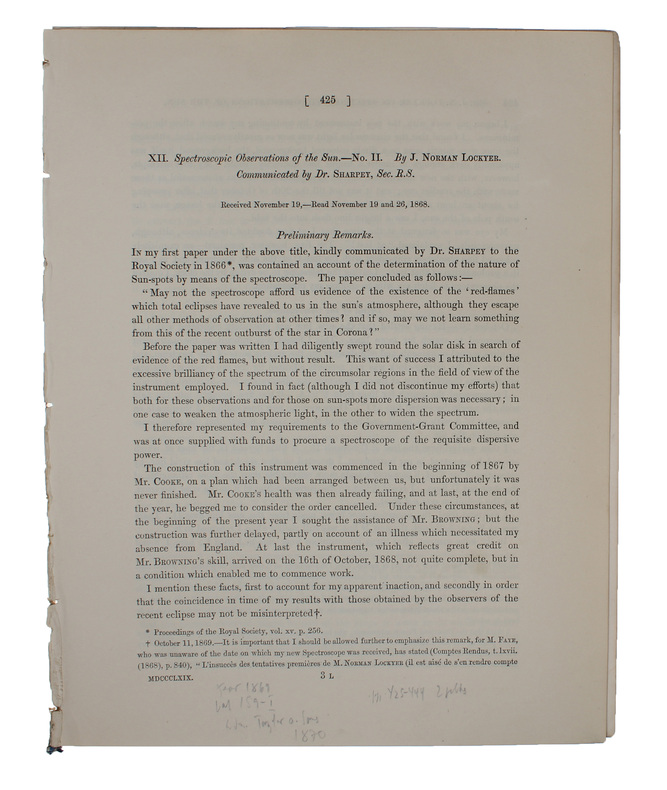
‎"LOCKYER, JOSEPH NORMAN - THE DISCOVERY OF HELIUM.‎

‎Spectroscopic Observations of the Sun.- No. II. Received November 19,- Read November 19 and 26, 1868. (With additional notes Nov. 26, April 9, 1869, Oct. 10, 1869).‎

‎(London, Taylor and Sons, 1870). 4to. No wrappers as extracted from ""Philosophical Transactions"" 1869, Vol. 159 - Part I. Pp. 425-444 and 2 lithographed plates (1 with the spectrum of helium, 1 with his spectroscope (not requiring eclipses to function)). Clean and fine.‎

‎First appearance of this milestone paper in chemistry, physics and astronomy, announcing the discovery of helium in the sun and naming it 'helium' for Helios, the Greek God of the Sun. In the same paper he demonstrates his invention of the spectroscope by which the prominences of the sun could be observed and studied without an eclipse by leading the light from the very edge of the sun through a prism. - Helium was not discovered on the earth before 1895 by William Ramsay, and it was Crookes who established its identity with the helium Lockyer observed in the spectrum of the sun.""This (the last discovery) was announced on the same day by the French astronomer Janssen, who was in India observing a total eclipse. As a result, the French government some ten years later struck a medallion showing the heads of both scientists.By that time, the two men had made a much more dramatic discovery at the same time, this time in cooperation. Janssen, studying the spectrum ofthe sun during the eclipse, had noted a fine line he did not recognize. he send a report on this to Lockyer, an acknowledges expert on solar spectra. Lockyer compared the reported position of the line with lines of known elements, concluding that it must belong to a yeat unknown element, possibly not even existing on the earth. He named the element, from the Greek word for the sun.""(Asimov).‎

Référence libraire : 42423

Livre Rare Book

Herman H. J. Lynge & Son
Copenhagen Denmark Dinamarca Dinamarca Danemark
[Livres de Herman H. J. Lynge & Son]

€ 1.275,85 Acheter

‎"LOEB, JACQUES. - ""TROPISM"" AS THE BASIS OF PSYCHOLOGY.‎

‎Einleitung in die vergleichende Gehirnphysiologie und vergleichende Psychologie. Mit besonderer Berücksichtigung der Wirbellosen Thiere. Mit 39 Abbildungen.‎

‎Leipzig, arth, 1899. Contemp. hcalf. Gilt spine with gilt lettering. (8),207,(2) pp. Stamp on foot of title-page and on last page. Inernally fine and clean.‎

‎First edition of a main work on the the physiology of the nerves in the lower animals. Loeb founded the theory of ""tropism"" as the basis of the psychology of the lower forms of life and he became the apostle of the mechanistic conceptions in biology.Loeb became one of the most famous scientists in America, widely covered in newspapers and magazines. He was the model for the character of Max Gottlieb in Sinclair Lewis's Pulitzer-winning novel Arrowsmith, the first great work of fiction to idealize and idolize pure science. Mark Twain also wrote an essay titled ""Dr. Loeb's Incredible Discovery"", which urges the reader not to support a rigid general consensus, but instead be open to new scientific advances.Loeb was nominated many times for the Nobel Prize but never won. - Garrison & Morton: 1428.‎

Référence libraire : 49746

Livre Rare Book

Herman H. J. Lynge & Son
Copenhagen Denmark Dinamarca Dinamarca Danemark
[Livres de Herman H. J. Lynge & Son]

€ 335,75 Acheter

‎"LOMONOSOW (LOMONOSOV), MICHAELE (MIKHAIL). - THE DISCOVERY OF THE TRANSITION OF A METAL INTO PASSIVE STATE.‎

‎Dissertatio de Actione Menstruorum Chymicorum in Genere. (Considerations of the Action of chemical Solvents).‎

‎(Petropoli (St. Petersbourg), 1750). 4to. Uncut, without wrappers. Extracted from ""Novi Commentarii Academiae Scientiarum Imperialis Petropolitanae"", Tom. I. ad Annum 1747 et 1748. Pp. 245-266 a. 1 engraved plate (ad. p. 251). Clean and fine.‎

‎First appearance of a groundbreaking paper in chemistry in which Lomonosov describes his discovery of the transition of a metal into passive state, and this is the first scientific description of this phenomena. He observed and described fast termination of the dissolution of iron in concentrated nitric acid, and attributed this to a change in the solvent properties.""Lomonosov employed corpuscular mechanics in chemical explanations more extensively than Boyle had done. Treating chemical compounds as particles in adhesion, he held that ""adhesion is eliminated and renewed by means of motion.....since no change in a body can take place withouy motion"". He attempted to apply these theories to chemical phenomena - although he was limited to speculation- in papers on the action of chemical solvents in general..""(DSB VIII, p. 469).""Lomonosov was founder of Russian science, and he would be universally recognized as a great pioneer of science had he been born a West European. He was famous also for his literary works, including poems and dramas. In 1755 he wrote a Russian Grammar that reformed the language and in the same year he helped found the University of Moscow. In 1760 he published the first history of Russia.""(Isaac Asimov).‎

Référence libraire : 42895

Livre Rare Book

Herman H. J. Lynge & Son
Copenhagen Denmark Dinamarca Dinamarca Danemark
[Livres de Herman H. J. Lynge & Son]

€ 1.343,00 Acheter

‎"LORENTZ, H.A. & L. (LUDWIG VALENTIN) LORENZ - THE ""LORENZ-LORENTZ EQUATION""‎

‎Ueber die Beziehung zwischen der Fortpflanzungsgeschwindigkeit des Lichtes und der Körperdichte" Von H.A. Lorentz. (+) Ueber die Refractionsconstante" von L. Lorenz. (2 Papers).‎

‎Leipzig, Johann Ambrosius Barth, 1880. Without wrappers as issued in ""Annalen der Physik und Chemie. Hrsg.von G. Wiedemann."", Neue Folge Band IX, Heft 4. Titlepage to Bd. 9. Pp. 513-680 a. 1 folded engraved plate. + Neue Folge Band XI, Heft 9. Titlepage to Bd. 11. Pp. 1-176 a. 2 folded plates. Lorentz's paper"" pp. 641-665 (of Heft 4). Lorenz's paper: pp. 70-103. (2 entire issues offered). A stamp on titlepapges and verso. Both clean and fine.‎

‎First printing of these two fundamental papers, revealing a lasting result in the history of physics, as both authors INDEPENDENTLY OF EACH OTHER, discovered the mathematical formula for the dependence of refraction of light upon specific gravity. It is very interesting that they found the formula - now called the Lorenz-Lorentz Equation or Formula - with altogether different ways and methods. They both discovered the formula before 1880, L.V. Lorenz first, but, also independently, published their final versions in the same periodical, and in the same year (the 2 papers offered). - Parkinson ""Breakthroughs"" 1880 P.‎

Référence libraire : 43412

Livre Rare Book

Herman H. J. Lynge & Son
Copenhagen Denmark Dinamarca Dinamarca Danemark
[Livres de Herman H. J. Lynge & Son]

€ 872,95 Acheter

‎"LORENTZ, H.A. - THE MOLECULAR THEORY OF DILUTE SOLUTIONS.‎

‎Sur la Théorie moléculaire des Dissolutions diluées.‎

‎Harlem, Les Heritieres Loosjes, 1891. Lex8vo. Orig. printed wrappers. In ""Archives Néerlandaises des Science Exactes et Naturelles. Redigée par J. Bosschar"", Tome XXV, 2me Livraison. Pp. (101-) 226 (entire issue offered). Lorentz's paper: pp. 107-130. A faint stamp to frontwrapper and to the first page.‎

‎First edition. In this paper Lorentz applies statistical methods to his molecular theory of dlute solutions, discussing the phenomena of osmosis (van't Hoff's law of pressure) in this context and Boltzmann's theorem.‎

Référence libraire : 48777

Livre Rare Book

Herman H. J. Lynge & Son
Copenhagen Denmark Dinamarca Dinamarca Danemark
[Livres de Herman H. J. Lynge & Son]

€ 201,45 Acheter

‎"LORENTZ, H.A. - THE STATIONARY ETHER.‎

‎De L'Influence du Mouvement de la Terre sur les Phénomènes Lumineux.‎

‎Harlem, Les Heritieres Loosjes, 1887. Lex8vo.Orig. printed wrappers. Wrappers a bit frayed at edges. Upper right corner of frontwrapper gone. A faint stamp on wrapper and on titlepage. In ""Archives Néerlandaises des Science Exactes et Naturelles. Redigée par J. Bosscha"", Tome XXI. VI,492 pp. a. 8 plates (2 in chromolithography, 2 with 8 mounted photographs (photottypie)). Uncut and unopened, clean and fine.(The entire volume offered). Lorentz's paper pp. 103-176.‎

‎First appearance of an importent paper on the aberration of light ""in which he concluded that Fresnel's view of the luminiferous ether was superior to Stokes's. Unlike Stokes, Fresnel in his theory of aberration assumed that the ether near yhe earth did not participate in its motion. Lorentz thought that the hypothesis of the complete transparancy of matter to the ether was implicit in Fresnel's whole theory.""(DSB VIII, p.493). Lorentz further shows that the results of the Michelson-Morley experiments did not vindicate the theory of Stokes as Michelson thought, and he demonstrates that the results can be explained by his own theory as a combination of Fresnel's and Stokes's theories.‎

Référence libraire : 43366

Livre Rare Book

Herman H. J. Lynge & Son
Copenhagen Denmark Dinamarca Dinamarca Danemark
[Livres de Herman H. J. Lynge & Son]

€ 604,35 Acheter

‎"LORENZ, L. - THE LORENZ-LORENTZ THEOREM.‎

‎Experimentale og teoretiske Undersøgelser over Legemernes Brydningsforhold. (Experimental and theoretical investigations on the refractions in matter).‎

‎Kjøbenhavn (Copenhagen), Bianco Luno,1869. 4to. Uncut and unopened in orig. printed wrappers. [Off-print from: Vidensk. Selsk. Skr., 5 Række, naturvidenskabelig og matematisk Afd., 8 Bd. V.]. Pp. (203-)248. A mint copy.‎

‎First printing, off-print in original printed wrappers of this groundbreaking paper.""A further remarkable result of Lorenz' optical researches on the basis of his fundamental wave equation was the well-known formula (Lorents-Lorenz formula) for the refraction constant R... His first paper on the refraction constant, in which he also gave an experimental verification of his formula in the case of water, dates from 1869. In 1870 H. A. Lorentz arrived at the same result, independently of Lorenz."" (D.S.B. VIII:501).‎

Référence libraire : 41671

Livre Rare Book

Herman H. J. Lynge & Son
Copenhagen Denmark Dinamarca Dinamarca Danemark
[Livres de Herman H. J. Lynge & Son]

€ 335,75 Acheter

‎"LUBBOCK, JOHN WILLIAM. - THE LUNAR THEORY.‎

‎On the Theory of the Moon. (I-II). Received November 30, Read December 12, 1833. (and Part II:) Received and Read March 13, 1834.‎

‎(London, Richard Taylor, 1834) 4to. No wrappers as extracted from ""Philosophical Transactions"" 1834 - Part I. Pp. 123-126 a. pp. 127-141.‎

‎First appearance of Lubbock's ""Lunar-Theory""""John Lubbock (1803-65), was an astronomer and mathematician. He made a special study of tides and of the lunar theory and developed a method for calculating the orbits of comets and planets. In mathematics he applied the theory of probability to life insurance problems.""‎

Référence libraire : 42833

Livre Rare Book

Herman H. J. Lynge & Son
Copenhagen Denmark Dinamarca Dinamarca Danemark
[Livres de Herman H. J. Lynge & Son]

€ 114,15 Acheter

‎"MACADAM (McADAM), JOHN LOUDON. - THE INVENTION OF MACADAMISING.‎

‎Bemerkungen über das gegenwärtige System des Chausseebau's nebst Vorschlägen und Verbesserungen. Mit einem Anhang, enthaltend Berichte von den Comités des Unterhauses, und Protokolle über Zeugen=Aussagen. Aus dem Englischen übersetzt nach der siebente...‎

‎Darmstadt, Heyer, 1825. Contemp. hcalf. Gilt spine, titlelabel with gilt lettering. A paperlabel pasted on upper part of spine. Stamps on title-page. XVIII,111 pp. and 1 folded lithographed plate. Clean and fine, printed on good paper.‎

‎First German edition of Mcadam's epoch-making ""Remarks on the present system of road making""....""‎

Référence libraire : 52418

Livre Rare Book

Herman H. J. Lynge & Son
Copenhagen Denmark Dinamarca Dinamarca Danemark
[Livres de Herman H. J. Lynge & Son]

€ 402,90 Acheter

‎"Mahmut" the Turkish Spy‎

‎The Eight Volumes of Letters Writ By a Turkish Spy Who Liv'd Five and Forty Years Undiscover'd at Paris: Giving an Impartial Account to the Divan at Constantinople of the Most Remarkable Transactions of Europe: .‎

‎London: Printed for G. Straban W. Mears S. Ballad F. Clay J. Stag D. Browne B. Motte R. Williamson J. Clarke A. Wilde J. Brotherton J. Hazard W. Meadows T. Cox W. Hinchcliffe W. Bickerton T. Astley S. Austen L. Gilliver and R. Willock 1734. Book. Rare. Full Leather. A beautiful set of 8 volumes bound in full brown leather. Five raised bands to spines. Decorative gilt motifs to edges in some instances faded and to spines. Title labels missing on 6 of the 8 volumes. Owner's name to front free end page and bookplate to front paste down in all volumes save for vol. 5. One instance of notes in margin in vol. 8. On most volumes joints cracked but solid. Some wear and chipping to spine extremities. Vol. 2 bears bookworm holes towards bottom of the page from start to finish. Vol. 3 where joint is cracked leather is peeling away from spine. Corners rubbed and some corners lightly bumped. Overall in remarkable condition. Our rating system: 1. Fine; 2. Near Fine; 3. Very Good; 4. Good; 5. Fair. Price is for the complete set of 8 volumes. Printed for G. Straban, W. Mears, S. Ballad, F. Clay, J. Stag, D. Browne, B. Motte, R. Williamson, J. Clarke, A. Wilde, J. Broth Hardcover‎

Référence libraire : 502633

Biblio.com

Montreal Books
Canada Canadá Canadá Canada
[Livres de Montreal Books]

€ 676,88 Acheter

‎"MALUS, ETIENNE LOUIS & LAPLACE, PIERRE-SIMONE & WOLLASTON, WILLIAM HYDE. - THE LAWS OF DOUBLE REFRACTION ESTABLISHED.‎

‎Ueber die Messung des Brechungsvermögens der undurchsichtigen Körper. (+) Ueber eine Eigenthümlichkeit des von durchsichtigen Körpern zurückgeworfenen Lichtes. Uebersetzt von Erman, mit einigen Erleuterungen von Tralles. (+ WOLLASTON:) eue Methode die...‎

‎Leipzig, Johann Ambrosius Barth, 1809. Without wrappers as issued in ""Annalen der Physik und der Physikalischen Chemie. Hrsg. Ludwig Wilhelm Gilbert"", Bd. 31, Drittes Stück. Titlepage to vol. 31. Pp. 225-336 a. 1 engraved plate. (Entire issue offered). Malus's papers: pp. 225-234 a. pp. 286-294. Wollaston's papers: pp. 235-251 a. pp. 252-262 a. Erläuterungen von Gilbert pp. 263-273. Laplace's paper: pp. 274-285.‎

‎First apperance in German of these importent papers on the refraction and double refraction of light. The papers by Malus is his first two papers on the refraction of light and Laplace's paper is the memoir in which he commented Malus' paper and Huygen's refraction law. ""In 1788 Haüy found experimentally that Huygen's law was true only in certain special cases, but in 1802 Wollaston found experimental evidence for the Huygenian construction (the second Wollaston paper offered). In ´""Mémoire sur la mesure du pouvoir réfringent"" (the first paper offered) Malus showed that Wollaston's experiments were incomplete, and so the French corpuscularian physicists did not trust Wollaston's results. They thought, moreover, that Wollaston was associated with Tmomas Young and therfore with the new wave hypothesis. In this situation the Institute on January 1808 proposed a prize which required an experimental and theoretical explanation of double refraction. The French ""Newtonian"" scientists hoped that Malus would find a precise and general law for double refraction within the framework of an emission theory of light. Malus was a skilled mathematician and during 1807 he had carried out experiments on double refraction. By december 1808 Malus had finished his experimental investigations, which verified the Huygenian law. What remained was a theoretical deduction of the law. In January 1809, Laplace published a memoir in which he deduced Huygen's law law within the framework of Newtonian mechanics, using the principle of least action, and Malus considered this an insolence which deprived him of the priority. In 1810 Malus von the prize for his ""Théorie sur la double réfraction"", published in 1811.""(DSB IX, p. 73).‎

Référence libraire : 44061

Livre Rare Book

Herman H. J. Lynge & Son
Copenhagen Denmark Dinamarca Dinamarca Danemark
[Livres de Herman H. J. Lynge & Son]

€ 470,05 Acheter

‎"MANTOUX, CH. (CHARLES) - THE INVENTION OF THE ""MANTOUX TEST"" FOR TUBERCULOSIS.‎

‎Intradermo-reaction de la tuberculine.‎

‎(Paris, Gauthier-Villars), 1908. 4to. No wrappers. In: ""Comptes Rendus Hebdomadaires des Séances de L'Academie des Sciences"", Tome 147, No 6. Pp. (323-) 366 (entire issue offered). Mantoux's paper: pp. 355-357.‎

‎First printing of the paper in which Mantoux published his invention of the famous test for tuberculosis.""The Mantoux test or Mendel-Mantoux test (also known as the Mantoux screening test, tuberculin sensitivity test, Pirquet test, or PPD test for purified protein derivative) is a screening tool for tuberculosis (TB). It is one of the major tuberculin skin tests used around the world, largely replacing multiple-puncture tests such as the Tine test."" (Wikipedia). - Garrison & Morton: 2341 (listing only the paper from 1910).‎

Référence libraire : 49892

Livre Rare Book

Herman H. J. Lynge & Son
Copenhagen Denmark Dinamarca Dinamarca Danemark
[Livres de Herman H. J. Lynge & Son]

€ 161,16 Acheter

‎"MARCONI, GUGLIELMO. - MARCONI'S ""MAGGIE"" - THE MAGNETIC DETECTOR - WIRELESS TELEGRAPHY‎

‎""Note on a Magnetic Detector of Electrical Waves, which can be employed as a receiver for Space Telegraphy."" (+) ""A Note on the Effect of Daylight upon the Propagation of Electromagnetic Impulses over Long Distances."" (2 papers).‎

‎(London, Taylor and Francis, 1902). No wrappers, as extracted from ""Proceedings of the Royal Society of London."", Vol. LXX. Pp. 341-344 a. pp. 344-347.‎

‎First printing of these two importent papers on wireless telegraphy, describing the inventions which made it possible to make the first wireless transmissions across the Atlantic in 1901. Maconi's apparatus was built on a magnetic detector invented by Rutherford, and was called Marconi's ""Maggie"". A powerfull transmitter was built at Poldu, Cornwall, England, and a large receiving antenna placed at Cape Cod, Massachusetts. Marconi succeeded to receive (on Dec. 12) three code dots, signifying the letter ""S"". ""Already well known, Marconi, et twenty-seven, became world famous overnight.""(DSB).Marconi and K.F. Brown were jointly awarded the Nobel Price in 1909 ""in recognition of their services in the development of wireless telegraphy.""‎

Référence libraire : 41880

Livre Rare Book

Herman H. J. Lynge & Son
Copenhagen Denmark Dinamarca Dinamarca Danemark
[Livres de Herman H. J. Lynge & Son]

€ 604,35 Acheter

‎"MAREY, (ETIENNE JULES). - MAREY'S ""LAW OF THE HEART""‎

‎Loi qui préside à la fréquence des battements du coeur.‎

‎(Paris, Gauthier-Villars), 1861. 4to. No wrappers. In: ""Comptes Rendus Hebdomadaires des Séances de L'Academie des Sciences"", Tome 53, No 3. Pp. (77-) 128. (Entire issue offered). Marey's paper: pp. 95-98. Faint marginal brownspots.‎

‎First printing of the paper in which Marey formulates the law, named after him and stating that heart rate is related inversely to arterial blood pressure.Marey contributed greatly to the development of experimental physiology. In 1860 he invented the modern sphygmograph, an instrument for recording the features of the pulse and variation in blood pressure on a graph. In 1861 he formulated Marey's law. He was the first to realize the relationship between blood pressure and heart rate.Garrison & Morton: 813.‎

Référence libraire : 49480

Livre Rare Book

Herman H. J. Lynge & Son
Copenhagen Denmark Dinamarca Dinamarca Danemark
[Livres de Herman H. J. Lynge & Son]

€ 201,45 Acheter

‎"MAREY, (ETIENNE JULES). - THE FIRST ELECTROCARDIOGRAM.‎

‎Des variations électriques des muscles et du coeur en particulier, étudiées au moyen de l'électromètre de M. Lippmann.‎

‎(Paris, Gauthier-Villars), 1876. 4to. No wrappers. In: ""Comptes Rendus Hebdomadaires des Séances de L'Academie des Sciences"", Tome 82, No 17. Pp. (927-) 1006. (Entire issue offered). Marey's paper: pp. 975-77‎

‎First printing of a founding paper in electrocardiography where Marey recorded the first electrocardiogram, using the mercury capillary electrometer, the electrical activity of an exposed frog's heart.‎

Référence libraire : 51113

Livre Rare Book

Herman H. J. Lynge & Son
Copenhagen Denmark Dinamarca Dinamarca Danemark
[Livres de Herman H. J. Lynge & Son]

€ 201,45 Acheter

‎"MAREY, (ETIENNE JULES). - THE INVENTION OF THE PHOTOGRAPHY OF MOTION, THE CINEMATOGRAPHE.‎

‎Analyse du méchanisme de la locomotion au moyen d'une série d'images photographiques recueillies sur une même plaque et représentant les phases successives du mouvement (Séance 3 Juillet 1882). (+) Emploi de la photographie pour déterminer la tr...‎

‎Paris, Gauthier-Villars, 1882, 1888, 1892. 4to. No wrappers. 7 entire issues. In: ""Comptes Rendus Hebdomadaires des Séances de L'Academie des Sciences"", Tome 95, No 1, 6 a. 14. Tome 107, No 16, 17 a. 18, Tome 114, No 18. (7 entire issues offered). With halftitles and titlepages to Vol. 95, 107 a. 114. The papers: pp. 14-16 (No1), 267-270 (no 6), 583-585, 2 textillustr. (no 14) - pp. 607-609 (No 16), 643-645, 1 textillustr. (No 17), 677-678 (No 18) - pp. 989-990 (No. 18). Stamps on verso of titlepages.‎

‎First printing of the main papers CONSTITUTING THE INVENTION OF MODERN CINEMATOGRAPHY -- from his invention of 1888 of the ""Chronophotograph"" followed the modern ""Cinematograph"" (first described here in the offered papers of 1888).It started with his invention of the chronographic apparatus with stationary plates and chronographic disk schutter... the paper of August 7, 1882, later in 1882 his description of the photographic gun, and in the 1892 paper ""Marey constructs, according to the reversible principle of the chronophotograph, an apparatus for the projection on a screen of series of pictures taken by the afore-mentioned apparatus and thus realizes the photographic synthesis of motion"" (Joseph Maria Eder ""History of Photography"", p.510).Marey (1830-1904) was a French physician, and his inventions sprang from his investigations in the physiology of the motion of men and animals.""In 1882, Marey, often claimed to be the 'inventor of cinema,' constructed a camera (or ""photographic gun"") that could take multiple (12) photographs per second of moving animals or humans - called chronophotography or serial photography, similar to Muybridge's work on taking multiple exposed images of running horses. [The term shooting a film was possibly derived from Marey's invention.] He was able to record multiple images of a subject's movement on the same camera plate, rather than the individual images Muybridge had produced. Marey's chronophotographs (multiple exposures on single glass plates and on strips of sensitized paper - celluloid film - that passed automatically through a camera of his own design) were revolutionary. He was soon able to achieve a frame rate of 30 images. Further experimentation was conducted by French-born Louis Aime Augustin Le Prince in 1888. Le Prince used long rolls of paper covered with photographic emulsion for a camera that he devised and patented. Two short fragments survive of his early motion picture film (one of which was titled Traffic Crossing Leeds Bridge).The work of Muybridge, Marey and Le Prince laid the groundwork for the development of motion picture cameras, projectors and transparent celluloid film - hence the development of cinema. American inventor George Eastman, who had first manufactured photographic dry plates in 1878, provided a more stable type of celluloid film with his concurrent developments in 1888 of sensitized paper roll photographic film (instead of glass plates) and a convenient ""Kodak"" small box camera (a still camera) that used the roll film. He improved upon the paper roll film with another invention in 1889 - perforated celluloid (synthetic plastic material coated with gelatin) roll-film with photographic emulsion."" (Tim Dirks ""The History of Film. The Pre-1920s"").‎

Référence libraire : 48088

Livre Rare Book

Herman H. J. Lynge & Son
Copenhagen Denmark Dinamarca Dinamarca Danemark
[Livres de Herman H. J. Lynge & Son]

€ 2.484,55 Acheter

‎"MARGGRAF, ANDREAS SIGISMUND. - EXAMINING THE ""PHILOSOPHER'S STONE""‎

‎Examen des Parties qui constituent cette Espece de Pierres, qui, après avoir été calcinées par les moyen ds Charbons, acquierent la Propritté de devenir lumineuses, quand on les expose à la Lumiere"" avec L'Exposé de la Composition artificielle des Pie...‎

‎(Berlin, Haude et Spener, 1752). 4to. No wrappers, as issued in ""Memoires de L'Academie Royale des Sciences et Belles Lettres"" tome VI (1750), pp.144-162.‎

‎First printing of Marggraf's importent investigation of the so-called ""Bologna-Stone"" in which he found that its base is different from lime, it is heavier and more soluble. In this memoir he anticipated Lavoisier’s conclusions by identifying the constituents of gypsum as water,lime, and vitriolic acid.Bologna stone, any of the dense, silvery white stones first found (1603) on Mount Paderno, near Bologna, by an Italian cobbler-alchemist, Vicenzo Cascariolo, who synthesized from them a luminescent material that glowed at night after being exposed by day to the Sun. Originally thought to be the philosopher’s stone that was believed capable of transmuting base metals into gold, Bologna stone ultimately was shown to be the mineral barite, barium sulfate.‎

Référence libraire : 44743

Livre Rare Book

Herman H. J. Lynge & Son
Copenhagen Denmark Dinamarca Dinamarca Danemark
[Livres de Herman H. J. Lynge & Son]

€ 114,15 Acheter

‎"MARIGNAC, C. (JEAN CHARLES). - THE DISCOVERY OF THE RARE EARTH YTTERBIUM.‎

‎Sur l'ytterbine, nouvelle terre contenue dans la gadolinite.‎

‎(Paris, Gauthier-Villars), 1878. 4to. No wrappers. In: ""Comptes Rendus Hebdomadaires des Séances de L'Academie des Sciences"", Tome 87, No 17. Pp. (570-) 616. (Entire issue offered). Marignac's paper: pp. 578-581.‎

‎First apperance of the paper relating Marignac's discovery of the rare earth Ytterbium (Ytterbia).""He began his study of the rare earths in 1840, when he was barely twenty-three years old. According to P.T. Cleve, ""Marignac's work on the rare earths is undoubtedly the most importent in this particular department of chemistry"". In 1878 marignac heated some erbium nitrate obtained from gadolinite until it decomposed. When he extracted the resulting mass with water, he obtained two oxides: a red one, for which he retained the name Erbia, and a colorless one, which he named Ytterbia."" (Weeks ""The Discovery of the Elements"").Parkinson ""Breakthroughs"", 1878 C‎

Référence libraire : 48210

Livre Rare Book

Herman H. J. Lynge & Son
Copenhagen Denmark Dinamarca Dinamarca Danemark
[Livres de Herman H. J. Lynge & Son]

€ 241,74 Acheter

‎"MATTEUCCI, CARLO. - THE DISCOVERY OF THE ""CURRENT OF INJURY"" AND THE ""CURRENT OF REST"".‎

‎Note sur les phénomenes électriques des animaux""‎

‎(Paris, Bachelier), 1841. 4to. No wrappers. In: ""Comptes Rendus Hebdomadaires des Séances de L'Academie des Sciences"", Tome XIII, No. 10. Pp. (487-) 558. (Entire issue offered). Matteucci's paper: pp. 540-41.‎

‎First appearance of a main paper in the history of electro-physiology.""The discovery by Volta of means for producing galvanic currents led to the construction of a galvanometer for measuring currents and later to its refinement.... In 1841 Matteucci presented... a paper which showed that a galvanometer indicates a curring flowing whenh it is connected from the surface of a muscle to a wound in the muscle, a current that was later called the ""current of injury"" and also the ""current of rest"", since it flowed without observable muscular contraction. Johannes Müller showed tis paper to his brilliant pupil, du Bois-reymond... Du Bois interest was caught at once. He published his first paper on ""thierische Electricität"" in 1843, and his two-volumes on the subject - soon to become the classic - in 1848-49.""(Boring ""History of Experimental Psychology"", p. 40).‎

Référence libraire : 47143

Livre Rare Book

Herman H. J. Lynge & Son
Copenhagen Denmark Dinamarca Dinamarca Danemark
[Livres de Herman H. J. Lynge & Son]

€ 201,45 Acheter

‎"MAUPAS, E. - THE SIGNIFICANCE OF SEXUALITY ESTABLISHED.‎

‎Théorie de la sexualité des Infusoires ciliés.‎

‎(Paris, Gauthier-Villars), 1887. 4to. No wrappers. In: ""Comptes Rendus Hebdomadaires des Séances de L'Academie des Sciences"", Tome 105, No 7. Pp. (325--) 563. (Entire issue offered). Maupas' paper: pp. 356-359.‎

‎First appearance of this classic paper in whic Maupas determined that fertilization in protozoa is essential to the indefinite continuation of a cell strain. His discovery proved an importent stimulus to subsequent investigation not only upon protozoa but also in the area of parthenogenesis.""He found in Paramecium that after generations of division, the stock becomes infeebled. Ultimately the individuals die, unless they meet partners for conjugation. When two such enfeebled individuals meet, their bodies are approximated and they interchange nuclear elements. Next, division takes place. The stock has regained its vigour. No differentiation of sexes is evident in the conjugatory process, though such differentiation can be traced in other prorozoa.""(Singer ""The Story of Living Tings"", p. 531 ff.).Thomas Hall ""A Source Book in Animal Biology"", pp. 458-60.‎

Référence libraire : 48946

Livre Rare Book

Herman H. J. Lynge & Son
Copenhagen Denmark Dinamarca Dinamarca Danemark
[Livres de Herman H. J. Lynge & Son]

€ 241,74 Acheter

Nombre de résultats : 184.402 (3689 Page(s))

Première page Page précédente 1 ... 26 27 28 [29] 30 31 32 ... 554 1076 1598 2120 2642 3164 3686 ... 3689 Page suivante Dernière page