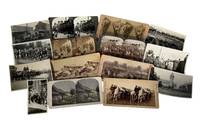
1899. China U.S. Military Turn of the century Boxer Rebellion photo archive. The United States military troops who were sent to suppress the Boxer Rebellion were known as the US China Relief Expedition. The main American forces included: 9th and 14th Infantry regiments 6th Cavalry regiment 5th Artillery regiment and a Marine battalion. The Boxer Rebellion was fought between the Chinese Society of Righteous and Harmonious Fists and the foreign Eight-Nation Alliance at the end of the Qing Dynasty. The China Relief Expedition expedition involved a combination of forces from the United States Britain Germany and other countries. Archive of 15 photographs of which include 7 silver gelatins and 8 stereoviews. Measurements range from 2.75" x 4" to 3" x 7". The Boxer Rebellion was an anti-imperialist movement of North Chinese citizens looking to drive out foreigners especially missionaries who were attempting to Christianize the country of 400 million people between the years 1899-1901. The term "Boxer" is an American nickname for the men in the Society of Righteous and Harmonious Fists since many of whom were martial arts practitioners. These photographs were taken by foreign powers to gather support for their cause and therefore they include many Anti-Chinese sentiments captioned on the margins of en verso. Some photos show the events leading up to the Battle of Tientsin with German and U.S. armies pitching tents and marching side by side in uniform. One photograph shows a line up of the Sixth U.S. Cavalry atop a band of horses ".now fighting in China to save the lives of American Citizens." Another photograph shows Russian soldiers tearing down rural Chinese mud houses to keep Boxers from having shelter. One photo shows two American soldiers standing next to a young Chinese boy and ceremonial paper figures. Some photos show Chinese civilians and "coolies" transporting goods with wheelbarrows and utilizing other traditional tools. Captions mock the "outdated" system and beckon for the construction of railways. One image shows a large group of Chinese men with wheelbarrows behind them is the American Quartermaster building with an American flag flying overhead where a letter from the State Department at Washington must be presented in order to receive a permit for transportation on a cargo boat. Another photograph of young Chinese children and one American girl are shown; the caption reads "Mission Children.Canton China-- thousands of such were massacred by "Boxers." ' The Battle of Tientsin was regarded as the bloodiest battle of the war with the Chinese defeating foreign powers. However after fighting two major battles against huge Chinese forces a larger relief force reached Peking which officially ended the rebellion in September 1901. An unequal treaty was created in which China was forced to concede after the failed expulsion of foreign entities with the signing of the Boxer Protocol. This allowed foreign troops to be stationed in Beijing. The agreement also forced China to pay a huge indemnity to the nations involved in the conflict eventually leading to the end of the 2000 year imperial dynasty. China suffered a devastating blow to her prestige and power which allowed foreign nations to consolidate their interests and previous territorial gains. These events and the opium wars of the 19th cent resulted in strong anti-Western attitudes in China for most of the 20th century. Archive is overall in very good condition. An important collection from a rarely documented event. unknown
Washington DC: U. S. Government Printing Office 2013. Presumed First Edition First printing. Wraps. Good. cii 1 453 3 pages. Footnotes. Endnotes. Maps. Boxes. Figures. Tables. Appendices including Commission Charter List of Research Material and Acronyms and Abbreviations. Cover has some wear and soiling. The United States-China Economic and Security Review Commission informally the US-China Commission is a congressional commission of the United States government. Created through a congressional mandate in October 2000 it is responsible for monitoring and investigating national security and trade issues between the United States and People's Republic of China. The Commission holds regular hearings and roundtables produces an annual report on its findings and provides recommendations to Congress on legislative actions related to China. The twelve commissioners are appointed to two-year terms by the majority and minority leaders of the U.S. Senate and by the minority leader and speaker of the U.S. House of Representatives. The U.S.-China Economic and Security Review Commission was created by the United States Congress in October 2000 to monitor investigate and submit to Congress an annual report on the national security implications of the bilateral trade and economic relationship between the United States and the People's Republic of China. The eleventh major Report presented to Congress by the Commission-pursuant to Public Law 106-398 October 30 2000 as amended by Public Law No. 109-108 November 22 2005. This report responds to the mandate for the Commission ''to monitor investigate and report to Congress on the national security implications of the bilateral trade and economic relationship between the United States and the People's Republic of China.'' In this Report the Commission reached a broad and bi- partisan consensus approving the Report by a vote of 11 ayes to 1 nay. The Report includes 41 recommendations for Congressional action. U. S. Government Printing Office paperback
Washington DC: U. S. Government Printing Office 2005. Presumed First Edition First printing. Wraps. Good/No DJ issued. x 179 1 i 5 pages. Tables. Illustrations. Front cover lower right corner curved. Among the participants in this hearing were: Fred Thompson Edward Markey Ashton Carter Gary Milhollin Curt Weldon and Henry Sokolski. In his opening statement Chairman D'Amato stated: "Our mandate calls on us to assess China's role in the proliferation of weapons of mass destruction to terrorist-sponsoring states. Ws we have stressed in our reports to the Congress proliferation stemming from China remains a serious concern. Have the Chinese taken decisive actions to reign in the various companies engaging in this behavior some of which have been repeatedly sanctions by the United States. We believe China must face this issue more frankly and effectively. Washington also must act to impose consequences on Beijing should it not cooperate on this vital matter. Currently the United States employes sanctions in hopes of curbing the proliferating habits of some of China's largest companies. That's the subject we're going to be exploring today. But U.S. sanctions laws have failed to stem this behavior and do not penalize the Chinese government for its lack of action to end it. Ultimately the Chinese government itself must be accountable for a WMD-related attack that involves either directly or indirectly materials or technologies originating in China. In addition to proliferation we will examine China's role in the North Korea nuclear crisis. The United States-China Economic and Security Review Commission informally the US-China Commission USCC is an independent agency of the United States government. It was established on October 30 2000 through the Floyd D. Spence National Defense Authorization Act. The USCC is responsible for providing recommendations based on their findings on bilateral trade with the Peoples Republic of China evaluating national security and trading risks in all industries and conducting research on Chinas actions. All these findings are discussed in their hearings and submitted as an annual report or specific research topics every year. In part due to its small size the USCC directly reports to Congress and the president - it is not a part of any other department or agency in the federal government. The USCC consists of 12 commissioners who staff it and facilities that were absorbed from the former US Trade Deficit Review Commission. The commissioners are appointed to two-year terms by the Majority and Minority Leaders of the U.S. Senate and by the Speaker and Minority Leader of the U.S. House of Representatives. The current head of the commission is Carolyn Bartholomew and the Vice Chairman is Robin Cleveland who are responsible for organizing meetings with other commissioners. Each commissioner is entitled to one vote. The USCC staff and facilities are from former US Trade Deficit Review Commission by the Floyd D. Spence National Defense Authorization Act of 2001. Since then the USCC is responsible for overseeing trade deficit matters with China. The USCC was created as the US government believes some of the current trades with China were in need of urgent attentions and corrections based on analyses considering Chinas military modernizations change of trade policy and media and information controls. Its first annual report in 2002 found that China is and will be a major competitor of the U.S. and also concluded that China as the third-largest trading partner had extremely unbalanced trade relationship. In the following years between 2004 and 2009 the USCC stated that Chinas undervalued currency counterfeiting and piracy export subsidies and lack of protection of US intellectual property right were continually contributed to a growing trade deficit. The main focus for the commission is constantly changing around the eight main areas. However the focused area in the last decade 2010-2020 is national security. The USCC argues the main direction of US-China relation will be "A combination of containment and engagement". The main part of the commission is to submit annual report every year. The USCC fulfills its mission by holding regular meetings with commission members to discuss recent related matters include write full analysis of eight focused parts which are Energy American Capital Market Economic transfers Regional Economics and Security impacts US-China Bilateral Programs Weapon proliferation World Trade Organization Compliance and Implications of restrictions on speech and information access in China. And provide conclusions and recommendations for legislative and administrative actions. Multiple hearings are held every year with commissioners and outside government parties to discuss relevant matters. The first hearing was "China Trade/Sectoral and WTO Issues" on June 14 2001. U. S. Government Printing Office paperback

 Per e-mail erhalten
 Als pdf-Dokument herunterladen
 RSS feed
 Permanenter link