|
|
|
Barksy, Vivianne [Ed., Trans.] / Perry-Lehmann, Meira [Curation]
The Printer's Imprint: Twenty Years of the Jerusalem Print Workshop [IN HEBREW AND ENGLISH]
IN HEBREW AND ENGLISH. 30X22.5 cm. 118+21 pages. Softcover. Cover slightly chafed. Cover edges slightly torn. Inner back cover slightly stained. Several pages slightly stained. Else in good condition.
|
|
|
Barnard, John (ed) [Simon Brett (engravings)]
John Keats: The Complete Poems
London: Folio Society 2001. 1st edition. As New. tall octavo. 1/4 leather xix 472pp. illusts. notes index Bound with an emerald green leather spine over decorated green boards. In nice slip-case as issued Folio Society hardcover
Referenz des Buchhändlers : 152920
|
|
|
Barnard, John (ed) [Simon Brett (engravings)]
John Keats: The Complete Poems
London: Folio Society 2001. 1st edition. As New. tall octavo. hardback in original cloth xix 472pp. engravings Leather spine over decorated boards. In sturdy card slip-case as issued Folio Society hardcover
Referenz des Buchhändlers : 154417
|
|
|
BARON SUPERVIELLE (Silvia)
Plaine blanche
Paris Carmen Martinez 1978 In-4 à l'italienne en feuilles, couverture à rabats, emboîtage toilé crème
Referenz des Buchhändlers : 011297
|
|
|
Barr, John
Britain Portrayed: A Regency Album, 1780-1830
Around the turn of the 19th century the towns, villages and countryside of Britain attained a level of picturesque beauty and charm that has been unsurpassed since. In watercolour drawing artists caught the changing light and weather to perfection, and in aquatint engravings their subtle tones could be reproduced in prints virtually indistinguishable from the originals. Here nearly 50 of the finest views and scenes in prints of the period are reproduced, their colours still as fresh and vivid today as when they were first published. Drawing upon contemporary accounts, John Barr provides a commentary of the artists, engravers and prints in this album which portrays the elegance and robust variety of Regency Britain for today's armchair tourist.A selection 50 illustrations reproduced from Topographical and Colour Plate Books of the Regency period [1790-1840] "providing today's armchair tourist with an album that faithfully portrays the elegance and robust variety of Regency Britain." 127p.illus. Illustrated endpapers Book
|
|
|
BARRAL Jacquie / SCHLOSSER René (frontispice)
Günter.
Jean-Pierre Huguet Carnets des Sept Collines Jean-Pierre Huguet, Carnets des Sept Collines (N°30), 2008, 70 p., broché, environ 23x12cm, exemplaire numéroté 39/100, avec une estampe-collage rehaussée et signée de Sauvageon, un envoi de J. Barral et un de R. Schlosser, bon état.
Referenz des Buchhändlers : 102234
|
|
|
BARRAL Jacquie / SCHLOSSER René (frontispice)
La trace.
Jean-Pierre Huguet Carnets des Sept Collines Jean-Pierre Huguet, Carnets des Sept Collines (N°29), 2008, 70 p., broché, environ 23x12cm, exemplaire numéroté 39/100, avec une estampe-collage rehaussée et signée de René Scholosser, dédicacé par Jacquie Barral et René Schlosser, bon état.
Referenz des Buchhändlers : 101744
|
|
|
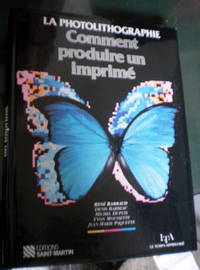
Barraud, Rene et al
La photolithographie. Comment produire un imprimé
Montréal: Saint-Martin Le Temps Apprivoisé 1987. Fine. <p> In-4 Cartonné jaquette illustrée 507p illcouleur n&b jaquette collée au plat inférieur</p> Saint-Martin, Le Temps Apprivoisé unknown
Referenz des Buchhändlers : biblio284 ISBN : 2890350851 9782890350854
|
|
|
Barth, Josef
Muskellehre nach den zwey Hauptverhältnissen, ihrer Lage und Verbindung untereinander, wie auch nach ihren allgemeinen und besonderen Verrichtungen. 2. Aufl. Mit 53 nach der Natur auf das genaueste entworfenen Kupfertafeln.
Wien, Michael Lechner, 1819. XX, [96] Text-S. u. [45] Taf. Mit insgesamt 61 Radierungen, davon 45 auf Taf. u. 16 im Text. Folio. 35,5 cm. Pp. d. Zt. m. RSch.
Referenz des Buchhändlers : 97430

|
|
|
Bartlett, Bo,
Heartland: Paintings By Bo Bartlett
Exhibition catalog for a show held at the publisher's gallery. Pamphlet ( 6" x 11") is in excellent condition, exterior shows no blemishes, text/interior is clean and free of marking of any kind. 8 pages with 4 full color prints from the artist.

|
|
|
Bartlett, Bo,
Heartland: Paintings By Bo Bartlett
Exhibition catalog for a show held at the publisher's gallery. Pamphlet ( 6" x 11") is in excellent condition, exterior shows no blemishes, text/interior is clean and free of marking of any kind. 8 pages with 4 full color prints from the artist.
|
|
|
Bartlett, Bo,
Heartland: Paintings By Bo Bartlett
Exhibition catalog for a show held at the publisher's gallery. Pamphlet ( 6" x 11") is in excellent condition, exterior shows no blemishes, text/interior is clean and free of marking of any kind. 8 pages with 4 full color prints from the artist.
|
|
|
Bartlett, W. H. / Vilnay, Zev [Intr.]
Jerusalem Revisited
Contains b&w plates. 240X170 mm. 202 pages. Softcover. Cover corners slightly wrinkled. Spine slightly worn. Pages yellowing. Else in good condition.
|
|
|
Bartlett, William Henry. Engraved by E. Smith.
[Syria, Holy Land, Asia Minor] Bazzar at Jaffa, the Ancient Joppa (caption title). [ORIGINAL STEEL ENGRAVED PRINT].
Original single-sheet steel engraving of a very fine quality. Overall size ca. 215 x 270 mm. Image size ca. 130 x 190 mm. A two-line caption engraved at bottom in elegant handtooled open-face and italic types. Engraved Artist's and Engraver's signatures underneath image. Engraved Publisher's line below. The print is in its original state, trimmed and gilded on three sides. It is printed with warmer ink, somewhat more dramatic in mood, with fine, crisp detail, subtlety and elegance. In overall fine condition. Preserved in pH-balanced, acid-free Renaissance archival paper. ~ A delicately executed steel engraving, representing a major illustrative work on 19th century Palestine, Syria, and Asia Minor. William Henry Bartlett (born London, 1809) was one of the foremost illustrators of topography of his generation. He travelled extensively throughout Britain, the Americas, and the Middle East, producing his work on location. In 1854 he made his last trip to the Holy Land; he died of fever on board a French ship on his return voyage to England. Bartlett's primary concern was to extract the picturesque aspects of a place and render "lively impressions of actual sights", as he wrote in the preface to "The Nile Boat" (London, 1849). His work became widely known through the numerous engravings after the original drawings and paintings he made. The interest in these engravings today is as much for the exquisite quality of the rendering and presentation of the architecture of the period, as it is for the representation of the landscape. Published in 1836 by Peter Jackson, Late Fisher, Son & Co. of London, it was originally accompanied by descriptions written by John Carne.
|
|
|
Bartlett, William Henry. Engraved by J. C. Bentley.
[Syria, Holy Land, Asia Minor] Approach to Antioch, the Ancient Anathoth, from Aleppo (caption title). [ORIGINAL STEEL ENGRAVED PRINT].
Original single-sheet steel engraving of a very fine quality. Overall size ca. 215 x 270 mm. Image size ca. 130 x 190 mm. A two-line caption engraved at bottom in elegant handtooled open-face and italic types. Engraved Artist's and Engraver's signatures underneath image. Engraved Publisher's line below. The print is in its original state, trimmed and gilded on three sides. It is printed with warmer ink, somewhat more dramatic in mood, with fine, crisp detail, subtlety and elegance. In overall fine condition. (Some marginal spotting.) Preserved in pH-balanced, acid-free Renaissance archival paper. ~ A delicately executed steel engraving, representing a major illustrative work on 19th century Palestine, Syria, and Asia Minor. William Henry Bartlett (born London, 1809) was one of the foremost illustrators of topography of his generation. He travelled extensively throughout Britain, the Americas, and the Middle East, producing his work on location. In 1854 he made his last trip to the Holy Land; he died of fever on board a French ship on his return voyage to England. Bartlett's primary concern was to extract the picturesque aspects of a place and render "lively impressions of actual sights", as he wrote in the preface to "The Nile Boat" (London, 1849). His work became widely known through the numerous engravings after the original drawings and paintings he made. The interest in these engravings today is as much for the exquisite quality of the rendering and presentation of the architecture of the period, as it is for the representation of the landscape. Published in 1836 by Peter Jackson, Late Fisher, Son & Co. of London, it was originally accompanied by descriptions written by John Carne.
|
|
|
Bartlett, William Henry. Engraved by J. H. Kernot.
[Syria, Holy Land, Asia Minor] Ruins of Soli, or Pompeiopolis - Asia Minor (caption title). [ORIGINAL STEEL ENGRAVED PRINT].
Original single-sheet steel engraving of a very fine quality. Overall size ca. 215 x 270 mm. Image size ca. 130 x 190 mm. A two-line caption engraved at bottom in elegant handtooled open-face and italic types. Engraved Artist's and Engraver's signatures underneath image. Engraved Publisher's line below. The print is in its original state, trimmed and gilded on three sides. It is printed with warmer ink, somewhat more dramatic in mood, with fine, crisp detail, subtlety and elegance. In overall fine condition. (Some spotting.) Preserved in pH-balanced, acid-free Renaissance archival paper. ~ A delicately executed steel engraving, representing a major illustrative work on 19th century Palestine, Syria, and Asia Minor. William Henry Bartlett (born London, 1809) was one of the foremost illustrators of topography of his generation. He travelled extensively throughout Britain, the Americas, and the Middle East, producing his work on location. In 1854 he made his last trip to the Holy Land; he died of fever on board a French ship on his return voyage to England. Bartlett's primary concern was to extract the picturesque aspects of a place and render "lively impressions of actual sights", as he wrote in the preface to "The Nile Boat" (London, 1849). His work became widely known through the numerous engravings after the original drawings and paintings he made. The interest in these engravings today is as much for the exquisite quality of the rendering and presentation of the architecture of the period, as it is for the representation of the landscape. Published in 1836 by Peter Jackson, Late Fisher, Son & Co. of London, it was originally accompanied by descriptions written by John Carne.
|
|
|
Bartlett, William Henry. Engraved by J. P. Heath.
[Syria, Holy Land, Asia Minor] Castle Near Pambouk (caption title). [ORIGINAL STEEL ENGRAVED PRINT].
Original single-sheet steel engraving of a very fine quality. Overall size ca. 215 x 270 mm. Image size ca. 130 x 190 mm. A two-line caption engraved at bottom in elegant handtooled open-face and italic types. Engraved Artist's and Engraver's signatures underneath image. Engraved Publisher's line below. The print is in its original state, trimmed and gilded on three sides. It is printed with warmer ink, somewhat more dramatic in mood, with fine, crisp detail, subtlety and elegance. In overall fine condition. (Few marginal spots, not affecting image.) Preserved in pH-balanced, acid-free Renaissance archival paper. ~ A delicately executed steel engraving, representing a major illustrative work on 19th century Palestine, Syria, and Asia Minor. William Henry Bartlett (born London, 1809) was one of the foremost illustrators of topography of his generation. He travelled extensively throughout Britain, the Americas, and the Middle East, producing his work on location. In 1854 he made his last trip to the Holy Land; he died of fever on board a French ship on his return voyage to England. Bartlett's primary concern was to extract the picturesque aspects of a place and render "lively impressions of actual sights", as he wrote in the preface to "The Nile Boat" (London, 1849). His work became widely known through the numerous engravings after the original drawings and paintings he made. The interest in these engravings today is as much for the exquisite quality of the rendering and presentation of the architecture of the period, as it is for the representation of the landscape. Published in 1836 by Peter Jackson, Late Fisher, Son & Co. of London, it was originally accompanied by descriptions written by John Carne.
|
|
|
Bartlett, William Henry. Engraved by J. Redaway.
[Syria, Holy Land, Asia Minor] Turkish Burying Ground at Sidon (caption title). [ORIGINAL STEEL ENGRAVED PRINT].
Original single-sheet steel engraving of a very fine quality. Overall size ca. 215 x 270 mm. Image size ca. 130 x 190 mm. A two-line caption engraved at bottom in elegant handtooled open-face and italic types. Engraved Artist's and Engraver's signatures underneath image. Engraved Publisher's line below. The print is in its original state, trimmed and gilded on three sides. It is printed with warmer ink, somewhat more dramatic in mood, with fine, crisp detail, subtlety and elegance. In overall fine condition. Preserved in pH-balanced, acid-free Renaissance archival paper. ~ A delicately executed steel engraving, representing a major illustrative work on 19th century Palestine, Syria, and Asia Minor. William Henry Bartlett (born London, 1809) was one of the foremost illustrators of topography of his generation. He travelled extensively throughout Britain, the Americas, and the Middle East, producing his work on location. In 1854 he made his last trip to the Holy Land; he died of fever on board a French ship on his return voyage to England. Bartlett's primary concern was to extract the picturesque aspects of a place and render "lively impressions of actual sights", as he wrote in the preface to "The Nile Boat" (London, 1849). His work became widely known through the numerous engravings after the original drawings and paintings he made. The interest in these engravings today is as much for the exquisite quality of the rendering and presentation of the architecture of the period, as it is for the representation of the landscape. Published in 1836 by Peter Jackson, Late Fisher, Son & Co. of London, it was originally accompanied by descriptions written by John Carne.
|
|
|
Bartlett, William Henry. Engraved by J. Redaway.
[Syria, Holy Land, Asia Minor] Village of Brumhanna, in Mount Lebanon (caption title). [ORIGINAL STEEL ENGRAVED PRINT].
Original single-sheet steel engraving of a very fine quality. Overall size ca. 215 x 270 mm. Image size ca. 130 x 190 mm. A two-line caption engraved at bottom in elegant handtooled open-face and italic types. Engraved Artist's and Engraver's signatures underneath image. Engraved Publisher's line below. The print is in its original state, trimmed and gilded on three sides. It is printed with warmer ink, somewhat more dramatic in mood, with fine, crisp detail, subtlety and elegance. In overall fine condition. (Light spot or two.) Preserved in pH-balanced, acid-free Renaissance archival paper. ~ A delicately executed steel engraving, representing a major illustrative work on 19th century Palestine, Syria, and Asia Minor. William Henry Bartlett (born London, 1809) was one of the foremost illustrators of topography of his generation. He travelled extensively throughout Britain, the Americas, and the Middle East, producing his work on location. In 1854 he made his last trip to the Holy Land; he died of fever on board a French ship on his return voyage to England. Bartlett's primary concern was to extract the picturesque aspects of a place and render "lively impressions of actual sights", as he wrote in the preface to "The Nile Boat" (London, 1849). His work became widely known through the numerous engravings after the original drawings and paintings he made. The interest in these engravings today is as much for the exquisite quality of the rendering and presentation of the architecture of the period, as it is for the representation of the landscape. Published in 1836 by Peter Jackson, Late Fisher, Son & Co. of London, it was originally accompanied by descriptions written by John Carne.
|
|
|
Bartlett, William Henry. Engraved by J. Tingle.
[Syria, Holy Land, Asia Minor] Zarephath or Zarapha, the Ancient Sarepta (caption title). [ORIGINAL STEEL ENGRAVED PRINT].
Original single-sheet steel engraving of a very fine quality. Overall size ca. 215 x 270 mm. Image size ca. 130 x 190 mm. A three-line caption engraved at bottom in elegant handtooled open-face and italic types. Engraved Artist's and Engraver's signatures underneath image. Engraved Publisher's line below. The print is in its original state, trimmed and gilded on three sides. It is printed with warmer ink, somewhat more dramatic in mood, with fine, crisp detail, subtlety and elegance. In overall fine condition. Preserved in pH-balanced, acid-free Renaissance archival paper. ~ A delicately executed steel engraving, representing a major illustrative work on 19th century Palestine, Syria, and Asia Minor. William Henry Bartlett (born London, 1809) was one of the foremost illustrators of topography of his generation. He travelled extensively throughout Britain, the Americas, and the Middle East, producing his work on location. In 1854 he made his last trip to the Holy Land; he died of fever on board a French ship on his return voyage to England. Bartlett's primary concern was to extract the picturesque aspects of a place and render "lively impressions of actual sights", as he wrote in the preface to "The Nile Boat" (London, 1849). His work became widely known through the numerous engravings after the original drawings and paintings he made. The interest in these engravings today is as much for the exquisite quality of the rendering and presentation of the architecture of the period, as it is for the representation of the landscape. Published in 1836 by Peter Jackson, Late Fisher, Son & Co. of London, it was originally accompanied by descriptions written by John Carne.
|
|
|
Bartlett, William Henry. Engraved by J. W. Lowry.
[Syria, Holy Land, Asia Minor] Ferry Over the Orontes (caption title). [ORIGINAL STEEL ENGRAVED PRINT].
Original single-sheet steel engraving of a very fine quality. Overall size ca. 215 x 270 mm. Image size ca. 130 x 190 mm. A three-line caption engraved at bottom in elegant handtooled open-face and italic types. Engraved Artist's and Engraver's signatures underneath image. Engraved Publisher's line below. The print is in its original state, trimmed and gilded on three sides. It is printed with warmer ink, somewhat more dramatic in mood, with fine, crisp detail, subtlety and elegance. In overall fine condition. Preserved in pH-balanced, acid-free Renaissance archival paper. ~ A delicately executed steel engraving, representing a major illustrative work on 19th century Palestine, Syria, and Asia Minor. William Henry Bartlett (born London, 1809) was one of the foremost illustrators of topography of his generation. He travelled extensively throughout Britain, the Americas, and the Middle East, producing his work on location. In 1854 he made his last trip to the Holy Land; he died of fever on board a French ship on his return voyage to England. Bartlett's primary concern was to extract the picturesque aspects of a place and render "lively impressions of actual sights", as he wrote in the preface to "The Nile Boat" (London, 1849). His work became widely known through the numerous engravings after the original drawings and paintings he made. The interest in these engravings today is as much for the exquisite quality of the rendering and presentation of the architecture of the period, as it is for the representation of the landscape. Published in 1836 by Peter Jackson, Late Fisher, Son & Co. of London, it was originally accompanied by descriptions written by John Carne.
|
|
|
Bartlett, William Henry. Engraved by R. Dawson.
[Syria, Holy Land, Asia Minor] Djebel Sheich and Mount Hermon (caption title). [ORIGINAL STEEL ENGRAVED PRINT].
Original single-sheet steel engraving of a very fine quality. Overall size ca. 215 x 270 mm. Image size ca. 130 x 190 mm. A three-line caption engraved at bottom in elegant handtooled open-face and italic types. Engraved Artist's and Engraver's signatures underneath image. Engraved Publisher's line below. The print is in its original state, trimmed and gilded on three sides. It is printed with warmer ink, somewhat more dramatic in mood, with fine, crisp detail, subtlety and elegance. In overall fine condition. (A spot.) Preserved in pH-balanced, acid-free Renaissance archival paper. ~ A delicately executed steel engraving, representing a major illustrative work on 19th century Palestine, Syria, and Asia Minor. William Henry Bartlett (born London, 1809) was one of the foremost illustrators of topography of his generation. He travelled extensively throughout Britain, the Americas, and the Middle East, producing his work on location. In 1854 he made his last trip to the Holy Land; he died of fever on board a French ship on his return voyage to England. Bartlett's primary concern was to extract the picturesque aspects of a place and render "lively impressions of actual sights", as he wrote in the preface to "The Nile Boat" (London, 1849). His work became widely known through the numerous engravings after the original drawings and paintings he made. The interest in these engravings today is as much for the exquisite quality of the rendering and presentation of the architecture of the period, as it is for the representation of the landscape. Published in 1836 by Peter Jackson, Late Fisher, Son & Co. of London, it was originally accompanied by descriptions written by John Carne.
|
|
|
Bartlett, William Henry. Engraved by S. Bradshaw.
[Syria, Holy Land, Asia Minor] Convent of Mount Carmel (caption title). [ORIGINAL STEEL ENGRAVED PRINT].
Original single-sheet steel engraving of a very fine quality. Overall size ca. 215 x 270 mm. Image size ca. 130 x 190 mm. A two-line caption engraved at bottom in elegant handtooled open-face and italic types. Engraved Artist's and Engraver's signatures underneath image. Engraved Publisher's line below. The print is in its original state, trimmed and gilded on three sides. It is printed with warmer ink, somewhat more dramatic in mood, with fine, crisp detail, subtlety and elegance. In overall fine condition. Preserved in pH-balanced, acid-free Renaissance archival paper. ~ A delicately executed steel engraving, representing a major illustrative work on 19th century Palestine, Syria, and Asia Minor. William Henry Bartlett (born London, 1809) was one of the foremost illustrators of topography of his generation. He travelled extensively throughout Britain, the Americas, and the Middle East, producing his work on location. In 1854 he made his last trip to the Holy Land; he died of fever on board a French ship on his return voyage to England. Bartlett's primary concern was to extract the picturesque aspects of a place and render "lively impressions of actual sights", as he wrote in the preface to "The Nile Boat" (London, 1849). His work became widely known through the numerous engravings after the original drawings and paintings he made. The interest in these engravings today is as much for the exquisite quality of the rendering and presentation of the architecture of the period, as it is for the representation of the landscape. Published in 1836 by Peter Jackson, Late Fisher, Son & Co. of London, it was originally accompanied by descriptions written by John Carne.
|
|
|
Bartlett, William Henry. Engraved by S. Bradshaw.
[Syria, Holy Land, Asia Minor] Encampment at Ras-El-Ain, Near Balbec (caption title). [ORIGINAL STEEL ENGRAVED PRINT].
Original single-sheet steel engraving of a very fine quality. Overall size ca. 215 x 270 mm. Image size ca. 130 x 190 mm. A two-line caption engraved at bottom in elegant handtooled open-face and italic types. Engraved Artist's and Engraver's signatures underneath image. Engraved Publisher's line below. The print is in its original state, trimmed and gilded on three sides. It is printed with warmer ink, somewhat more dramatic in mood, with fine, crisp detail, subtlety and elegance. In overall fine condition. (Few marginal spots.) Preserved in pH-balanced, acid-free Renaissance archival paper. ~ A delicately executed steel engraving, representing a major illustrative work on 19th century Palestine, Syria, and Asia Minor. William Henry Bartlett (born London, 1809) was one of the foremost illustrators of topography of his generation. He travelled extensively throughout Britain, the Americas, and the Middle East, producing his work on location. In 1854 he made his last trip to the Holy Land; he died of fever on board a French ship on his return voyage to England. Bartlett's primary concern was to extract the picturesque aspects of a place and render "lively impressions of actual sights", as he wrote in the preface to "The Nile Boat" (London, 1849). His work became widely known through the numerous engravings after the original drawings and paintings he made. The interest in these engravings today is as much for the exquisite quality of the rendering and presentation of the architecture of the period, as it is for the representation of the landscape. Published in 1836 by Peter Jackson, Late Fisher, Son & Co. of London, it was originally accompanied by descriptions written by John Carne.
|
|
|
Bartlett, William Henry. Engraved by T. Turnbull.
[Syria, Holy Land, Asia Minor] Seleucia (caption title). [ORIGINAL STEEL ENGRAVED PRINT].
Original single-sheet steel engraving of a very fine quality. Overall size ca. 215 x 270 mm. Image size ca. 130 x 190 mm. A two-line caption engraved at bottom in elegant handtooled open-face and italic types. Engraved Artist's and Engraver's signatures underneath image. Engraved Publisher's line below. The print is in its original state, trimmed and gilded on three sides. It is printed with warmer ink, somewhat more dramatic in mood, with fine, crisp detail, subtlety and elegance. In overall fine condition. Preserved in pH-balanced, acid-free Renaissance archival paper. ~ A delicately executed steel engraving, representing a major illustrative work on 19th century Palestine, Syria, and Asia Minor. William Henry Bartlett (born London, 1809) was one of the foremost illustrators of topography of his generation. He travelled extensively throughout Britain, the Americas, and the Middle East, producing his work on location. In 1854 he made his last trip to the Holy Land; he died of fever on board a French ship on his return voyage to England. Bartlett's primary concern was to extract the picturesque aspects of a place and render "lively impressions of actual sights", as he wrote in the preface to "The Nile Boat" (London, 1849). His work became widely known through the numerous engravings after the original drawings and paintings he made. The interest in these engravings today is as much for the exquisite quality of the rendering and presentation of the architecture of the period, as it is for the representation of the landscape. Published in 1836 by Peter Jackson, Late Fisher, Son & Co. of London, it was originally accompanied by descriptions written by John Carne.
|
|
|
Bartlett, William Henry. Engraved by W. F. Starling.
[Syria, Holy Land, Asia Minor] Castle Near Tripoli, On the River Kadesha (caption title). [ORIGINAL STEEL ENGRAVED PRINT].
Original single-sheet steel engraving of a very fine quality. Overall size ca. 215 x 270 mm. Image size ca. 130 x 190 mm. A two-line caption engraved at bottom in elegant handtooled open-face and italic types. Engraved Artist's and Engraver's signatures underneath image. Engraved Publisher's line below. The print is in its original state, trimmed and gilded on three sides. It is printed with warmer ink, somewhat more dramatic in mood, with fine, crisp detail, subtlety and elegance. In overall fine condition. Preserved in pH-balanced, acid-free Renaissance archival paper. ~ A delicately executed steel engraving, representing a major illustrative work on 19th century Palestine, Syria, and Asia Minor. William Henry Bartlett (born London, 1809) was one of the foremost illustrators of topography of his generation. He travelled extensively throughout Britain, the Americas, and the Middle East, producing his work on location. In 1854 he made his last trip to the Holy Land; he died of fever on board a French ship on his return voyage to England. Bartlett's primary concern was to extract the picturesque aspects of a place and render "lively impressions of actual sights", as he wrote in the preface to "The Nile Boat" (London, 1849). His work became widely known through the numerous engravings after the original drawings and paintings he made. The interest in these engravings today is as much for the exquisite quality of the rendering and presentation of the architecture of the period, as it is for the representation of the landscape. Published in 1836 by Peter Jackson, Late Fisher, Son & Co. of London, it was originally accompanied by descriptions written by John Carne.
|
|
|
Bartlett, William Henry. Engraved by W. Hill.
[Syria, Holy Land, Asia Minor] Halt of a Caravan in the Desert of Girgola, Near Mt. Amanus (caption title). [ORIGINAL STEEL ENGRAVED PRINT].
Original single-sheet steel engraving of a very fine quality. Overall size ca. 215 x 270 mm. Image size ca. 130 x 190 mm. A two-line caption engraved at bottom in elegant handtooled open-face and italic types. Engraved Artist's and Engraver's signatures underneath image. Engraved Publisher's line below. The print is in its original state, trimmed and gilded on three sides. It is printed with warmer ink, somewhat more dramatic in mood, with fine, crisp detail, subtlety and elegance. In overall fine condition. (A light spot.) Preserved in pH-balanced, acid-free Renaissance archival paper. ~ A delicately executed steel engraving, representing a major illustrative work on 19th century Palestine, Syria, and Asia Minor. William Henry Bartlett (born London, 1809) was one of the foremost illustrators of topography of his generation. He travelled extensively throughout Britain, the Americas, and the Middle East, producing his work on location. In 1854 he made his last trip to the Holy Land; he died of fever on board a French ship on his return voyage to England. Bartlett's primary concern was to extract the picturesque aspects of a place and render "lively impressions of actual sights", as he wrote in the preface to "The Nile Boat" (London, 1849). His work became widely known through the numerous engravings after the original drawings and paintings he made. The interest in these engravings today is as much for the exquisite quality of the rendering and presentation of the architecture of the period, as it is for the representation of the landscape. Published in 1836 by Peter Jackson, Late Fisher, Son & Co. of London, it was originally accompanied by descriptions written by John Carne.
|
|
|
Bartlett, William Henry. Engraved by W. J. Cooke.
[Syria, Holy Land, Asia Minor] The Ladder of Tyrus - A Pass "On the Sea Coast. Near Tyre" (caption title). [ORIGINAL STEEL ENGRAVED PRINT].
Original single-sheet steel engraving of a very fine quality. Overall size ca. 215 x 270 mm. Image size ca. 130 x 190 mm. A two-line caption engraved at bottom in elegant handtooled open-face and italic types. Engraved Artist's and Engraver's signatures underneath image. Engraved Publisher's line below. The print is in its original state, trimmed and gilded on three sides. It is printed with warmer ink, somewhat more dramatic in mood, with fine, crisp detail, subtlety and elegance. In overall fine condition. (Few marginal spots.) Preserved in pH-balanced, acid-free Renaissance archival paper. ~ A delicately executed steel engraving, representing a major illustrative work on 19th century Palestine, Syria, and Asia Minor. William Henry Bartlett (born London, 1809) was one of the foremost illustrators of topography of his generation. He travelled extensively throughout Britain, the Americas, and the Middle East, producing his work on location. In 1854 he made his last trip to the Holy Land; he died of fever on board a French ship on his return voyage to England. Bartlett's primary concern was to extract the picturesque aspects of a place and render "lively impressions of actual sights", as he wrote in the preface to "The Nile Boat" (London, 1849). His work became widely known through the numerous engravings after the original drawings and paintings he made. The interest in these engravings today is as much for the exquisite quality of the rendering and presentation of the architecture of the period, as it is for the representation of the landscape. Published in 1836 by Peter Jackson, Late Fisher, Son & Co. of London, it was originally accompanied by descriptions written by John Carne.
|
|
|
BARTOLINI (Luigi)
Gli esemplari unici o rari. Novantasei riproduzioni di acqueforti
Roma, Gherardo Casini Editore, 1952. 655 g In-8 à l'italienne, reliure éditeur, 222 pp., [1] ff., 96 reproductions des eaux-fortes.. Sans faux-titre, légers défauts. . (Catégories : Estampes, )
Referenz des Buchhändlers : 7745

|
|
|
BARTOLINI, Luigi (Cupramontana, 1892 - Roma, 1963)
6 litografie di Bartolini
Cartella contenente 6 litografie originali a colori, eseguite da Luigi Bartolini nel laboratorio delle Edizioni d'Arte il Bisonte a Firenze, tra il dicembre 1961 e il marzo 1962, ed un frontespizio litografico inciso dall'Autore. Titoli delle opere: "Villa in Sabina", "Strada di Villa Madama", "Il davanzale in fiore", "Anna nei boschi", "Fonte di campagna", "Le fioraie" (cm 65x46 - 46x65 c.ca). Le litografie sono numerate, titolate e firmate da Bartolini a matita. Con due poesie dell'Autore: "La passeggiata" e "Gli uccelli" Esemplare 6/30. Cm 66x48. pp. 4 + 7. . Molto buono (Very Good). . Prima edizione di 100+XXX es. numerati. .

|
|
|
BARTOLINI, Luigi (Cupramontana, 1892 - Roma, 1963),
Fonte Canapina
Acquaforte originale stampata per il volume ''La Nencia da Barberino'' di Lorenzo de Medici, Bucciarelli, Ancona 1965. La tiratura dell'acquaforte è del 1961 Firma e titolo a matita (Firma e data sulla lastra: Bartolini 1959). Esemplare p.d.a.. Cm 12,5x18,5 (Foglio 35x51). . . Ottimo (Fine). . 100 + alcune pda. .

|
|
|
BARTOLINI, Luigi (Cupramontana, 1892 - Roma, 1963)
Il cavallino di Monte Mario
Acquaforte originale di Luigi Bartolini (cm 4x4,6) non firmata. Opera allegata al periodico "L'Incisione" n. 16 che contiene altra acquaforte originale, numerata e firmata, di Walter Piacesi (Omaggio a Piero Della Francesca, cm 18,3x16,3). Testo inedito di Dino Garrone . 4to. pp. 20. . Perfetto (Mint). . . . Sarà questa una delle lastre incise da Luigi Bartolini rincorrendo il cavallini di Monte Mario? Consegnatami dal grande Artista, con piacere ora la dono agli amici di questa rivista che porta il titolo da lui stesso suggerito. L'autenticità dell'acquaforte è convalidata dal timbro a secco - il cui disegno è stato delineato da Bartolini nel 1962 - delle edizioni Bucciarelli (Nota dell'Editore Brenno Bucciarelli)

|
|
|
BARTOLINI, Luigi (Cupramontana, 1892 - Roma, 1963),
Senza titolo
Acquaforte originale. Una delle 4 acqueforti che illustrarono la raccolta di versi dell'A. ''Poesie 1960'', pubblicata da Bucciarelli Firma a matita (L.B.). Esemplare p.d.a.. Cm 6,8x3,6 (Foglio 17x25,5). . . . . Tiratura 100 + alcune p.d.a. .

|
|
|
BARTOLINI, Luigi (Cupramontana, 1892 - Roma, 1963),
Senza titolo
Acquaforte inclusa nella cartella ''Cinquanta incisioni di artisti italiani'', pubblicata da Prandi nel 1963 Firma e numerazione a matita (Firma e data sulla lastra). Esemplare 37/75. Cm 24,5x17 (Foglio 45x32). . . Ottimo (Fine). . . .

|
|
|
BARTOLINI, Luigi (Cupramontana, 1892 - Roma, 1963),
Senza titolo
Acquaforte. Opera appartenete alla cartella ''Testamento per Luciana'', contenente l'incisione ed un testo dell'Artista Disponibile senza la cartella. Esemplare p.d.a.. Cm 10,5x5 (Foglio 35x25). . . . . Tiratura 100 + alcune p.d.a.. .

|
|
|
Bartolini, Sigfrido
Mario Sironi. L'Opera Incisa
This is a very good hardcover copy in a very good dust jacket. Completely clean inside and very clean outside as well, just a small piece chipped out of the top edge of the front jacket panel. Text in Italian. Introduction by Alfonso Gatto. Illustrated in color and black & white. 12" high X 10" wide, 213 pages. A beautiful copy. This book will be securely wrapped and packed in a sturdy box and shipped with tracking.
|
|
|
Bartolomeo Pinelli
Nuova raccolta di Cinquanta costumi pittoreschi incisi all’acqua forte ... dedicati a sua eccellenza il cavaliere Hitroff
In-4° oblungo; frontespizio inciso e 50 tavole incise all’acquaforte da Pinelli (1781-1835), raffiguranti scene di costume ambientate nella campagna romana; i personaggi sono dediti a giochi, lavori, attività varie della vita quotidiana, anche a Roma e nel regno di Napoli; le ambientazioni sono in Ciociaria, Cerbara, Tivoli, Albano, Fracati, Pietra Terrazzana, Roma. L’indicazione di responsabilità presente su quasi tutti i rami è “Pinelli Fece 1815 Roma”. Buona copia.
|
|
|
Bartolomeo Pinelli - Giuseppe Berneri
Il Meo Patacca o vero Roma in feste nei trionfi di Vienna poema giocoso nel linguaggio romanesco Edizione seconda arricchita di num. 52 tavole
In4° grande oblungo, legatura solida in mezza pelle rossa con angoli, fregi dorati al dorso, tasselo con titolo in oro al piatto superiore. Seconda edizione la prima completa con tutte le tavole. PP. (6), 170, più 52 tavole. Buon esemplare. I dodici canti del poema eroicomico, in dialetto romanesco, che diede la notorietà a Giuseppe Berneri (1637-1701) pubblicato insieme alle famose incisioni all’acquaforte di Pinelli (1781-1835) che ritraggono vivide scene popolari, con personaggi e costumi contemporanei, iconografia della Roma ottocentesca.
|
|
|
Bartolomeo Vitturi - Bartolozzi
La serenata di Ciapino e il lamento della ghita. Stanze rusticali
In-4°; pp. (32), con 2 tavole f.t. incise da Francesco Bartolozzi (1727-1815), una vignetta incisa su rame al frontespizio, una testatina e 3 grandi finalini, di cui due da invenzioni di Piazzetta, incise da Fiorenza Marcello e Felicita Sartori. Sonetto introduttivo di Gasparo Gozzi, al termine una poesia di Giovanni MArsili. Legatura in cartonato colorato. Gamba p. 613.
|
|
|
Bartsch, Adam
Le peintre graveur
Würzburg : Verlagsdruckerei Würzburg 1920-22. <p>22 volumes in8 en 19 1920-22 Nouvelle édition  illustrations facsimiles de monogrames avec tables et index portrait ; 23 cm Rel demi-toile avec légers accrocs aux dos et plats généralement bel ex ex-libris MKG</p><p>v 1-5 Niederlaender --</p><p>v 6-11 Les vieux maiÌ‚tres allemands --</p><p>v 12 Les clair-obscurs des maiÌ‚tres italiens --</p><p>v 13 Les vieux maiÌ‚tres italiens --</p><p>v 14 Å’uvres de Marc-Antoine et de ses deux principaux eÌleÌ€ves Augustin de Venise et Marc de Ravenne --</p><p>v 15 Estampes de diffeÌrents graveurs anonymes qui semblent eÌ‚tre de l'eÌcole de Marc-Antoine Raimondi --</p><p>v 16-18 Peintres ou dessinateurs italiens: MaiÌ‚tres du seizieÌ€me sieÌ€cle --</p><p>v 19-21 Peintres ou dessinateurs italiens: MaiÌ‚tres du dix-septieÌ€me sieÌ€cle</p><p>v 22 zusatze zu Adam Bartsch's Le peintre graveur von Joseph Heller; Supplémentspar Rudolph Weigel</p><br /><br /><br /> Verlagsdruckerei Würzburg unknown
Referenz des Buchhändlers : biblio650

|
|
|
Bartsch, Friedrich Ritter von
Die Kupferstichsammlung der K. K. Hofbibliothek in Wien. In einer Auswahl ihrer merkwürdigsten Blätter.
Wien, Braumüller 1854. XIII, 312 S. HLdrBd. d. Zt. mit Rückengoldpräg.
Referenz des Buchhändlers : EEzz2582
|
|
|
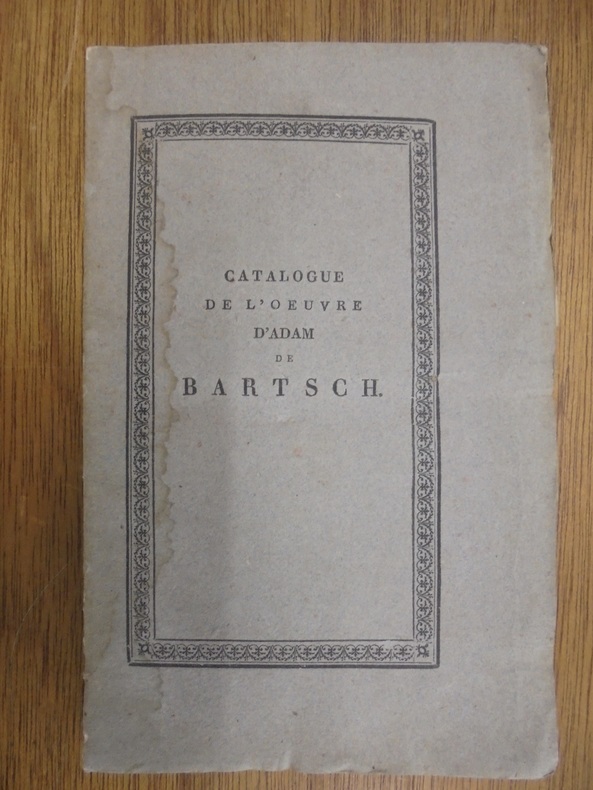
BARTSCH, Frédéric de.
Catalogue des estampes de J.Adam de Bartsch.
Vienne, Pichler, 1818. 8 °. Portrait gravé, VIII, 165 p. Brochure originale, (dos fissuré, couverture légèrement froissée). Liste complète et détaillée des 505 gravures d'Adam von Bartsch, publiées par son fils.
Referenz des Buchhändlers : ART5227M
|
|
|
Baruch, Adam [Ed.]
Peter Z. Malkin: Silkscreens Portfolio
15x21 cm. 31 pages. Paperback in dust jacket. In good condition.
|
|
|
Basan
Emmanuel Theodose de La Tour
Épreuve sur beau papier filigrané. en feuille Très bon Paris 16 x 12 cm
Referenz des Buchhändlers : 15178

|
|
|
based Noah Webster, illustrated with 670 engravings, blank endpapers former owner name, preface Charles Walter Brown
Donohues Websters Handy American Dictionary of English Language comprehensive Lexicon containing over 32000 words & phrases Correctly defined to which is added a list of foreign words phrases & quotations from ancient & modern languages Re
M. A. Donohue Chicago. HB NODJ No Date Early Vintage 1st edition Thus Purple with Black decorated cloth Cover minor rub & Wear & tiny Chips Extremities NF/VG NODJ back cover couple stains . First Thus. Hard Cover. M. A. Donohue Chicago hardcover
Referenz des Buchhändlers : 9248
|
|
|
Basel.- Schweizerischer Schriftstellerverein (Hrsg.):
E Majeli vo dr Liechtete im Rhyfälderhof fir d'Dailnämmer a dr Johresversammlig vom Schwyzerische Schriftstellerverain am 29. Mai 1921 z'Basel.
(Basel, o. Vlg.), 1921. Gross-8°. 20 S. Mit 3 signierten Lithographien von Burckhard Mangold, Otto Plattner u. ?, 1 mont. Linolschnitt nach Theodor Barth sowie 2 Lithographien nach Willi Wenk u. Dürrwang. Marmoriertes Heft d. Zt. mit mont. Deckelillustr. (mit mehreren kl. Randläsuren).
Referenz des Buchhändlers : 5925BB
|
|
|
BASELITZ (Georg).
GRÜNE PUNKTE, 1992. Gravure originale.
1992 Paris, Atelier Tanguy Garric, 1992. Un feuillet double (275 X 216 mm).
Referenz des Buchhändlers : 005640

|
|
|
Baselitz, Georg
Baselitz. Peintre-Gaveur. Werkverzeichnis der Druckgrafik. In Zusammenarbeit mit Johannes Gachnang. 2 Bände. 1. Band: Werkverzeichnis der Druckgrafik 1963-1974. 2. Band: Werkverzeichnis der Druckgrafik 1974-1982.
Bern, Berlin, Verlag Gachnang und Springer, 1983-1987. 4°. 34,5 x 25cm. 228 und 265 Seiten. Original-Leinenbände mit Original-Schutzumschlägen. Band 2 mit Pappschuber.
Referenz des Buchhändlers : 45344AB

|
|
|
Basil King
COSMOPOLITAN MAGAZINE JUNE 1920 FRANK F.X. LEYENDECKER 4-PAGE ILLUSTRATIONS GAY INTEREST The Everlasting Doors
Good. 1920. Magazine. Rare. Contains a story by Basil King with 4 pages of F. X. Leyendecker illustrations of semi-nude men and and a semi-nude woman. Magazine cover is soiled along right edge and pink damp staining. Pages are lightly toned with a rust stain on the inner margins from the staples otherwise clean and very good. Some of the pages are detached or loose and one page has been partially trimmed. No address label. . . unknown
Referenz des Buchhändlers : 17238
|
|
|
Baskin, Lisa Unger [CURATOR]
The Gehenna Press: The Work of Fifty Years 1942-1992
28x21.5 cm. 238 pages. Softcover. Spine slightly wrinkled. Else in good condition. PLEASE NOTE: This item is overweight. We may ask for extra shipping costs.
|
|
|

 Per e-mail erhalten
 Als pdf-Dokument herunterladen
 RSS feed
 Permanenter link


