|
|
|
Morisseau, Eugène, dessinateur-lithographe
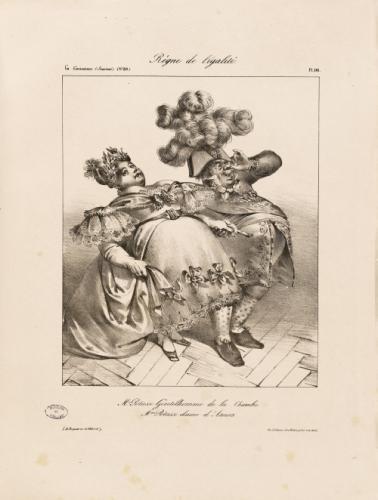
Règne de l’égalité. Mr Potasse Gentilhomme de la Chambre. Mme Potasse dame d’Atours. Lithographie sur blanc.
Planche HT parue dans La Caricature morale, religieuse, littéraire et scénique, volume 4, 19 juillet 1832 (Planche n°181)Marques, inscriptions, poinçons:Lithographie - Œuvre: Hauteur: 35.6cmx Largeur: 27cm - Image: Hauteur: 21.8cmx Largeur: 17.9cm - Titre en ht au centre : « Règne de l’égalité. » ; légende en bas au centre : « Mr Potasse Gentilhomme de la Chambre. // Mme Potasse dame d’Atours. » ; indications, en ht à gche : « La Caricature (Journal) (N°89.) », en ht à dte : « Pl. 181. »Inscription - Dans la lettre : « L. de Becquet, rue Childebert N°9. » [imprimeur], « On s’abonne chez Aubert, galerie véro dodat. » [éditeur] : la table des matières du 4e vol. de La Caricature attribue cette pl. à « Eug. Morrisseau ».Deux personnages ventripotents, un homme et une femme, se tiennent par la main. Sans doute le titre est-il ironique. La pl. se moque de la petite bourgeoisie. L’homme est habillé en garde national, tandis que la femme a fait beaucoup d’efforts vestimentaires et affiche un air hautain en dévisageant le spectateur. Ils semblent se rendre à un bal ou une réception.
Referenz des Buchhändlers : 25617
|
|
|
Moritzi, A
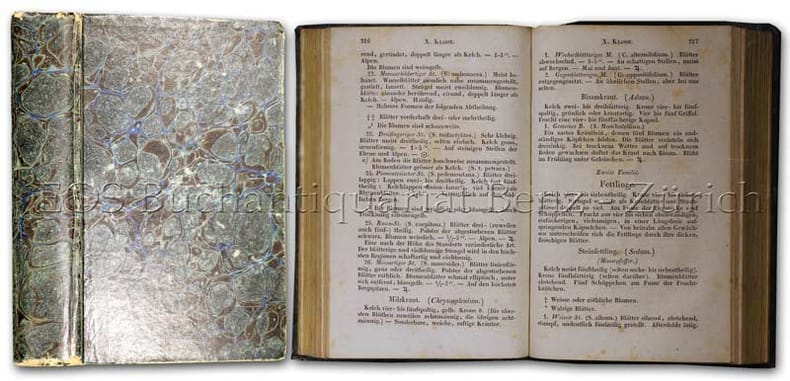
Die Flora der Schweiz, mit besonderer Berücksichtigung ihrer Verteilung nach allgemein physischen und geologischen Momenten.
Zürich, Winterthur, Verlag des Literarischen Compoirs, 1844. 8°. 1 l., XXII, 640 p. With 1 coloured map (folded). Contemporary orig. cloth (slightly rubbed). + Wichtig: Für unsere Kunden in der EU erfolgt der Versand alle 14 Tage verzollt ab Deutschland / Postbank-Konto in Deutschland vorhanden +
Referenz des Buchhändlers : 4172BB
|
|
|
Moritzi, A.:
Die Flora der Schweiz, mit besonderer Berücksichtigung ihrer Verteilung nach allgemein physischen und geologischen Momenten.
Zürich, Winterthur, Verlag des Literarischen Compoirs, 1844. 8°. 1 l., XXII, 640 p. With 1 coloured map (folded). Contemporary orig. cloth (slightly rubbed).
Referenz des Buchhändlers : 4172BB
|
|
|
Moritzi, Alexander
Die Pflanzen der Schweiz, ihrem wesentlichen Charakter nach beschrieben und mit Angaben über ihren Standort, Nutzen etc. versehen.
Chur, Simeon Benedict, 1832. 8°. (2), VIII, 460, (2) S. + Wichtig: Für unsere Kunden in der EU erfolgt der Versand alle 14 Tage verzollt ab Deutschland / Postbank-Konto in Deutschland vorhanden +, Einband und Innenansicht
Referenz des Buchhändlers : 2918DB

|
|
|
Moritzi, Alexander:
Die Pflanzen der Schweiz, ihrem wesentlichen Charakter nach beschrieben und mit Angaben über ihren Standort, Nutzen etc. versehen.
Chur, Simeon Benedict, 1832. 8°. (2), VIII, 460, (2) S.
Referenz des Buchhändlers : 2918DB
|
|
|
Morland, Valère Alphonse (en 1846), dessinateur-lithographe
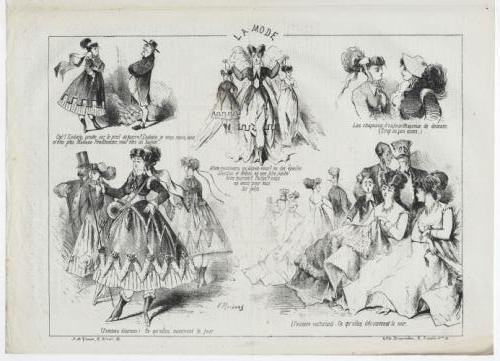
LA MODE - Lithographie
Le Charivari, trente-cinquième année, jeudi 6 décembre 1866- Lithographie : Hauteur: 43.4cmx Largeur: 30.7cm - Trait carré: Hauteur: 26.7cmx Largeur: 36.8cm - 1 feuillet (4 pages) ; illustration page 3 ; format paysage. - Au-dessus de l'image, au centre : "LA MODE" ; signé dans l'image en bas à gauche : "V. Morland", sous l'image à gauche : "A.de Vresse, R. Rivoli, 55." et à droite : "Lith Destouches, R. Paradis Pre 28".-- texte imprime au dos,bon etat.
Referenz des Buchhändlers : 25501
|
|
|
Morland, Valère Alphonse (en 1846), dessinateur-lithographe
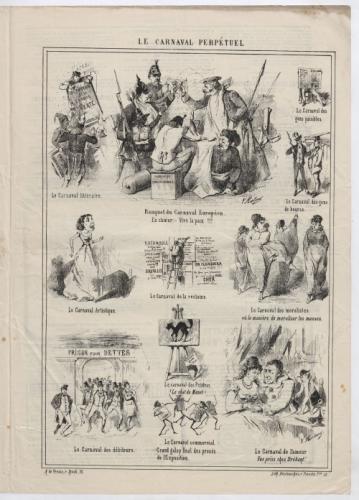
Le carnaval perpétuel- lithographie
Le Charivari, trente-septième année, samedi 29 février 1868- Lithographie - Hauteur: 44.2cmx Largeur: 30.9cm - Trait carré :Hauteur: 38cmx Largeur: illustration page 3.- Au-dessus de l'image, au centre : "LE CARNAVAL PERPÉTUEL" ; signé dans l'image en haut à droite : "V. Morland", sous l'image à gauche : "A.de Vresse, r. Rivoli, 55." et à droite : "Lith Destouches, r. Paradis Pre 28".texte imprime au dos,bon etat.
Referenz des Buchhändlers : 25447
|
|
|
Morland, Valère Alphonse (en 1846), dessinateur-lithographe
LES PARISIENS A LA MER - Lithographie
Le Charivari, trente-cinquième année, mercredi 12 septembre 1866- Lithographie= Hauteur: 43.5cmx Largeur: 30.7cm - Trait carré: Hauteur: 37cmx Largeur: 27.1cm- 1 feuillet (4 pages) ; illustration page 3.- Au-dessus de l'image, au centre : "LES PARISIENS A LA MER" ; signé dans l'image au centre à gauche : "V. Morland", sous l'image à gauche : "A.de Vresse, éditr Rue Rivoli, 55." et à droite : "LITH DESTUCHES Rue Paradis Poissonnière 28".-- texte imprime au dos,bon etat.
Referenz des Buchhändlers : 25499
|
|
|
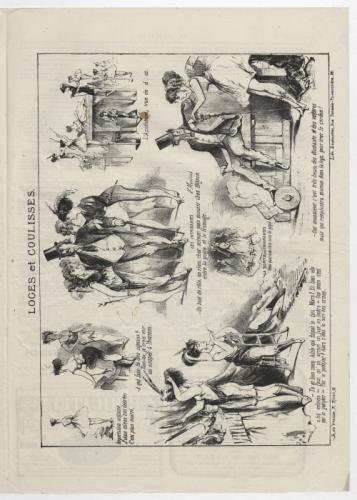
Morland, Valère Alphonse (en 1846), dessinateur-lithographe
Loges et coulisses - Lithographie
Le Charivari, trente-cinquième année, mardi 13 novembre 1866 - Lithographie : Hauteur: 43.7cmx Largeur: 30.7cm - Trait carré: Hauteur: 26cmx Largeur: 35.2cm- 1 feuillet (4 pages) ; illustration page 3 ; format paysage. - Au-dessus de l'image, au centre : "LOGES ET COULISSES." ; signé dans l'image au centre à droite : "V. Morland", sous l'image à gauche : "A.de Vresse, R. Rivoli, 55." et à droite : "Lith Destouches, Rue Paradis-Poissonnière, 28".-- texte imprime au dos,bon etat.
Referenz des Buchhändlers : 25504
|
|
|
Morland, Valère Alphonse (en 1846), dessinateur-lithographe
Modes de printemps.- Lithographie
1865 Le Charivari, Vers 1865 - Lithographie = Hauteur: 40.2cmx Largeur: 28.7cm - texte imprime au dos,bon etat.
Referenz des Buchhändlers : 25500
|
|
|
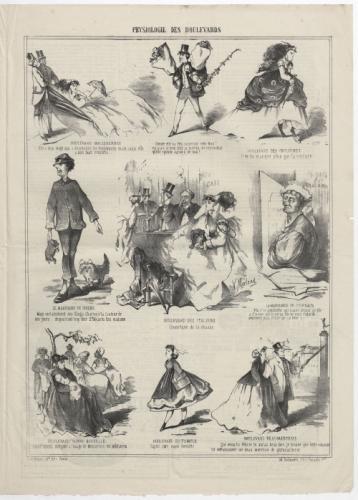
Morland, Valère Alphonse (en 1846), dessinateur-lithographe
Physiologie des Boulevards - Lithographie
Le Charivari, trente-cinquième année, jeudi 3 mai 1866- Lithographie : Hauteur: 43.5cmx Largeur: 30.8cm - Trait carré : Hauteur: 37.3cmx Largeur: 27.1cm- 1 feuillet (4 pages) ; illustration page 3. - Au-dessus de l'image, au centre : "PHYSIOLOGIE DES BOULEVARDS" ; signé dans l'image au centre à droite : "V. MORLAND", sous l'image à gauche : "A.de Vresse, Ed[iteu]r r. Rivoli, 55." et à droite : "Lith Destouches, 28, r. Paradis Pre".-- texte imprime au dos,bon etat.
Referenz des Buchhändlers : 25502
|
|
|
Morley, Henry
Memoirs Of Bartholomew Fair
London & New York: Frederick Warne And Co. 1859 . First edition thus. Hardcover. Very Good. 12mo; xvii 404 pages red half polished calf marbled boards <br/><br/>" This is not only the first history of BARTHOLOMEW FAIR but the first serious history of any Fair; even the general subject of fairs as far as I can learn has never been thought worthy of a book - Preface." With facsimiles and new drawings by H. Sydney Barton who "has exactly met my wish for minute faithfulness in teh copying of everything represented. . Accurate work is very hard to find. Most of the illustrations in this book are now for the first time drawn from the illuminations loose engravings or handbills in which they first appeared . - Preface." Frederick Warne And Co. hardcover
Referenz des Buchhändlers : 0009034
|
|
|
MORLOTTI, Ennio (Lecco, 1910 - Milano, 1992),
Rose
Litografia originale Tiratura 15o esemplari. Firma a matita dell'Artsta. Timbro a secco dello stampatore Il Torcoliere, Roma. Cm 34,5x43,5 (Foglio 50x70). . . Ottimo (Fine). . Tiratura: 150. .

|
|
|
MORLOTTI, Ennio (Lecco, 1910 - Milano, 1992),
Senza titolo
Litografia originale Firma, data e numerazione a matita. Esemplare: 84/100. cm 56x76. pp.. . Ottimo (Fine). . Tiratura: 150. .

|
|
|
MORLOTTI, Ennio (Lecco, 1910 - Milano, 1992),
Senza titolo
Litografia originale a colori Firma e numerazione a matita. Esemplare: 1/100. cm 45x60. pp.. . Ottimo (Fine). . Tiratura: 100. .

|
|
|
Morpurgo, Abraham Chai.
Trieste Haggadah [IN HEBREW] [FACSIMILE] [NUMBERED COPY #124]
RARE, NUMBERED COPY #124 OF 500. Enlarged facsimile edition of an illustrated Haggadah published in 1864 Trieste: the first Haggadah in the history of Hebrew printing to make use of lithographs. Each page of the Haggadah (save for the final two pages) feature a large b/w illustration and unique text decorations. The facsimile is printed on high-quality paper, patterned as parchment. 480x350mm, 42 pages. Red cloth hardcover with gilt lettering and illustration on front. [CONDITION:] Top cover edge worn in one particular spot. Bottom cover corner bumped. Section of the bottom front cover faded. Thin streak of paint along rear cover. Spine bottom worn. Other than this light external damage, this rare facsimile is in excellent condition.
|
|
|
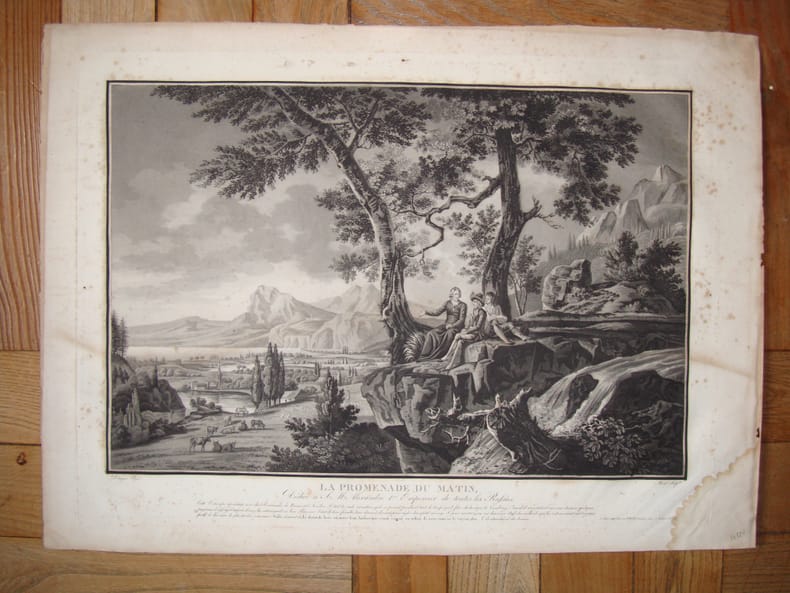
MORRET Jean-Baptiste
La Promenade du Matin
Dédiée à S. M. Alexandre 1er, Empereur de toutes les Russies. Le tableau représente François de Salignac de La Mothe Fénelon. en feuille Moyen Paris Basset 1806 33,5 x 22,5 cm
Referenz des Buchhändlers : 14327
|
|
|
MORSE (Robert)
A Catalogue of the Extensive and Choice Collection of Prints, Formed by the Late Robert Morse... Sold by Auction, by Mr. Thomas Dodd... On Wednesday, May 15, 1816, & Twenty-seven Following Days. [Smith & Davy, Printers]. 1816. vii,[i],191,[1]pp., title-page and text browned, margins worn, 3,602 lots. [Bound with:] A Catalogue of the Extensive and Valuable Library of Books, of Robert Morse... Sold by Auction, by Mr. Thomas Dodd... On Thursday, 20th of June, 1816, and Seven Following Days.
[ii],47,[1]pp., title-page and text browned, margins worn, nineteenth century half calf, rubbed, upper cover detached, 1,608 lots.
|
|
|
MORSE Peter
John Sloan's prints. A catalogue raisonné of Etchings, lithographs and poster.
London & New Haven Yale university press 1969 In-4 Catonnage ed. jaquette ill. Edition originale
Referenz des Buchhändlers : 004619
|
|
|
Morse, John D.
Prints in and of America to 1850: Winterthur Conference Report, 1970
Light wear and spots to cover; interior pages clean and unmarked; tight binding. 356 pages. Black and white illustrations. Sixteenth Annual Winterthur Conference, 1970.

|
|
|
MORÉ de PONGIBAUD, Cte de
Le Chartrier de Fontenay - Le Berseur de Fontenay - Le vicomte de blangy - De Moré de Pontgibaud - 1734 - 1892
CAEN, Imp; H.Delesques, 1913 - In-4 - Broché - Tiré à 100 ex sur papier vergé - Illustrations PP HT - XIX-585 pages - fortes mouillures - Saffroy II, 29691
Referenz des Buchhändlers : 24212
|
|
|
MORÉ de PONGIBAUD, Cte de
Le Chartrier de Fontenay - Le Berseur de Fontenay - Le vicomte de blangy - De Moré de Pontgibaud - 1734 - 1892
CAEN, Imp; H.Delesques, 1913 - In-4 - Broché - Tiré à 100 ex sur papier vergé - Illustrations PP HT - XIX-585 pages - fortes mouillures - Saffroy II, 29691
|
|
|
Mosai prints by
Japanese Propaganda Woodblock Print Book Kagoshima Senkyu 2 Volumes
March 1877 Meiji 10. Good. Depicting the Satsuma Rebellion. Each volume 17.5 by 11.5. Together 32 pp. 31 of which have woodblock prints. The Satsuma Rebellion was the last major uprising of Samurai against the newly formed Meiji government. The rebellion was the subject of the Tom Cruise movie "The Last Samurai". Covers with brightly colored woodblock prints. <br /><br /> books
Referenz des Buchhändlers : 005438

|
|
|
Mosai, prints by
Japanese Propaganda Woodblock Print Book Kagoshima Senkyu 2 Volumes
1877. Good. Depicting the Satsuma Rebellion. Each volume 17.5 by 11.5. Together 32 pp. 31 of which have woodblock prints. The Satsuma Rebellion was the last major uprising of Samurai against the newly formed Meiji government. The rebellion was the subject of the Tom Cruise movie "The Last Samurai". Covers with brightly colored woodblock prints. unknown
Referenz des Buchhändlers : 005438
|
|
|
Moser, Johann Jacob
Die gerettete völlige Souverainete der löblichen Schweitzerischen Eydgenossenschafft oder gründlicher Beweiss, dass in dem Westphälischen Frieden von dem H. Römischen Reich der löbl. Eydgenossenschafft ...
Tübingen, Johann Heinrich Philipp Schramm, 1731. Kl.-4°. 52 S.; 84 S. Pappband der Zeit mit goldgepr. Rückenschild u. einfacher Rückenvergoldung. + Wichtig: Für unsere Kunden in der EU erfolgt der Versand alle 14 Tage verzollt ab Deutschland / Postbank-Konto in Deutschland vorhanden +, 5837B
Referenz des Buchhändlers : 5837BB

|
|
|
Moser, R. u. Weber, R
Gutachten über die Vorlagen der Bodensee-Toggenburgbahn vom Juni 1906.; Vernehmlassung der Bodensee-Toggenburgbahn vom Juli 1906.
o.J.(um 1906). 4°. 26 S. Orig.-Heft + Wichtig: Für unsere Kunden in der EU erfolgt der Versand alle 14 Tage verzollt ab Deutschland / Postbank-Konto in Deutschland vorhanden + (mit kleineren Einrissen).
Referenz des Buchhändlers : 1398DB
|
|
|
Moser, R. u. Weber, R.:
Gutachten über die Vorlagen der Bodensee-Toggenburgbahn vom Juni 1906.; Vernehmlassung der Bodensee-Toggenburgbahn vom Juli 1906.
o.J.(um 1906). 4°. 26 S. Orig.-Heft (mit kleineren Einrissen).
Referenz des Buchhändlers : 1398DB
|
|
|
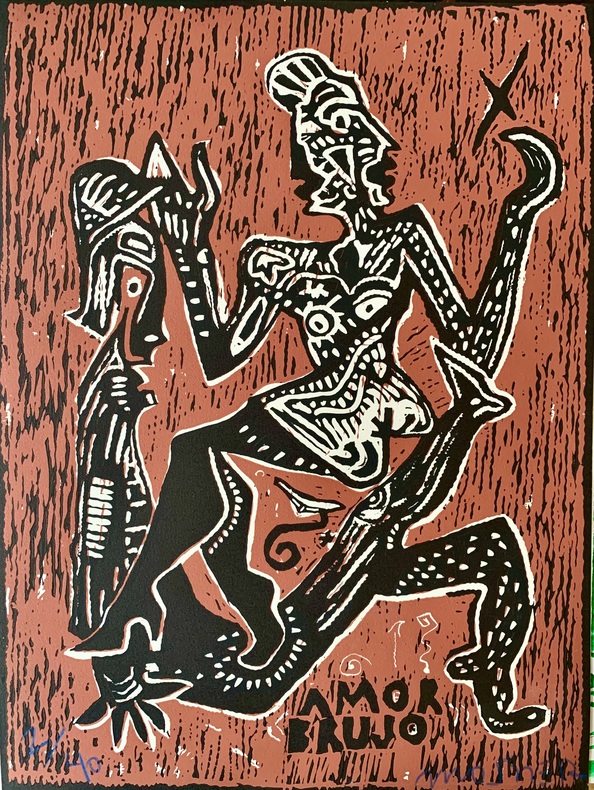
MOSNER (Ricardo).
Amor Brujo.
Gravure sur bois imprimée sur Arches signée en bleu en bas à droite et justifiée 2/40 ex. (42/56 cm). Bon état.
Referenz des Buchhändlers : awd-178
|
|
|
Mother Goose
Mother Goose and Nursery Rhymes
Full orange cloth boards have tape marks on them from dust jacket having been taped to cover. Edge wear, spots, and small tears on dust jacket. A bit of soiling to some pages. Previous owner's inscription inside. 7 7/8"w x 11"h. 58 pages. Color wood engravings by Philip Reed.

|
|
|
Mott, Frank Luther
The old printing office. With wood engravings by John DePol
This is a fine hardcover copy bound in gray quarter cloth and brown and white patterned paper, with no wear at all. Completely clean. With wood engravings in reddish brown by John DePol. This is a limited edition of 125 copies, this copy is number 11. Not signed. 9" high X 6" wide, unpaginated. An additional printed paper spine label is tipped in to the inside rear cover. This book will be securely wrapped and packed in a sturdy box and shipped with tracking.
|
|
|
MOTTE Charles
Rétablissement de la Religion
[s. l.] [s. n.] [c. 1820] Vue animée lithographiée par Charles Motte (1785-1836). 38,3 x 30 cm hors marges ; 50 x 35,7 cm toutes marges comprises.
Referenz des Buchhändlers : 4548
|
|
|
Mountfield, David / Short, Robert [Foreword]
Illustrated Marquis de Sade : Justine and Juliette - All the Prints.
285x225 mm. 110 pages. Gilt hardcover with dust jacket. Cover corners slightly bumped. Else in good condition.
|
|
|
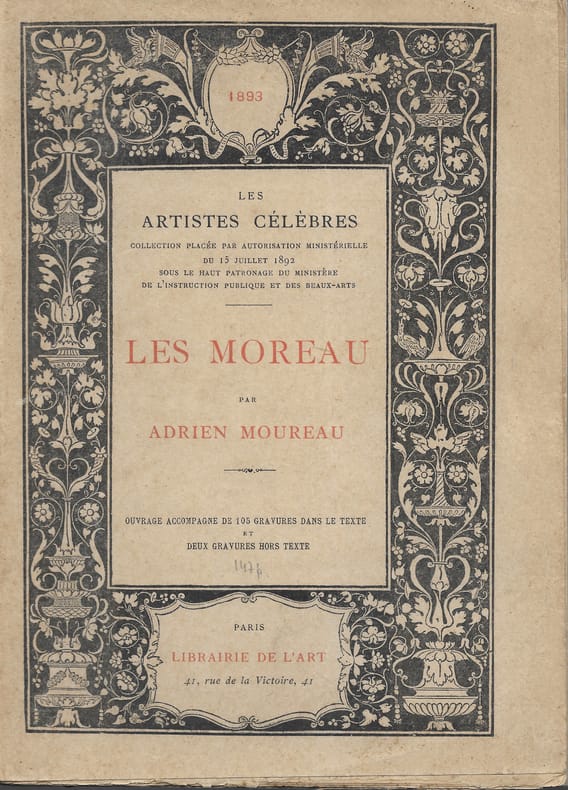
MOUREAU Adrien
Les Moreau
De la série “Les artistes célèbres”. Broché. très bon Paris Librairie de l’Art 1893 1 volume grand in-8°.
Referenz des Buchhändlers : 3146
|
|
|
MOURGUE Pierre
Chez Perugia ou Le Bottier à la mode (pl.34, La Gazette du Bon ton, 1924 n°7)
- Lucien Vogel éditeur, Paris 1924, 18x24cm, une feuille. - Original color print, printed on vergé paper, signed in the plate. An original print used to illustrate the Gazette du bon ton, one of the most attractive and influential 20th century fashion magazines, featuring the talents of French artists and other contributors from the burgeoning Art Deco movement. A celebrated fashion magazine established in 1912 by Lucien Vogel, La Gazette du bon ton appeared until 1925, with a hiatus from 1915 to 1920 due to the war (the editor-in-chief having been called up for service). It consisted of 69 issues printed in only 2,000 copies each and notably illustrated with 573 color plates and 148 sketches of the models of the great designers. Right from the start, this sumptuous publication "was aimed at bibliophiles and fashionable society," (Françoise Tétart-Vittu, "La Gazette du bon ton", in Dictionnaire de la mode, 2016) and was printed on fine vergé paper using a type cut specially for the magazine by Georges Peignot, known as Cochin, later used (in 1946) by Christian Dior. The prints were made using stencils, heightened in colors, some highlighted in gold or palladium. The story began in 1912, when Lucien Vogel, a man of the world involved in fashion (he had already been part of the fashion magazine Femina) decided, with his wife Cosette de Brunhoff - the sister of Jean, creator of Babar - to set up the Gazette du bon ton, subtitled at the time: "Art, fashion, frivolities." Georges Charensol noted the reasoning of the editor-in-chief: "'In 1910,' he observed, 'there was no really artistic fashion magazine, nothing representative of the spirit of the time. My dream was therefore to make a luxury magazine with truly modern artists...I was assured of success, because when it comes to fashion, no country on earth can compete with France.'" ("Un grand éditeur d'art. Lucien Vogel" in Les Nouvelles littéraires, no. 133, May 1925). The magazine was immediately successful, not only in France but also in the United States and Latin America. At first, Vogel put together a team of seven artists: André-Édouard Marty and Pierre Brissaud, followed by Georges Lepape and Dammicourt, as well as eventually his friends from school and the School of Fine Arts, like George Barbier, Bernard Boutet de Monvel and Charles Martin. Other talented people soon came flocking to join the team: Guy Arnoux, Léon Bakst, Benito, Boutet de Monvel, Umberto Brunelleschi, Chas Laborde, Jean-Gabriel Domergue, Raoul Dufy, Édouard Halouze, Alexandre Iacovleff, Jean Émile Laboureur, Charles Loupot, Chalres Martin, Maggie Salcedo. These artist, mostly unknown when Lucien Vogel sought them out, later became emblematic and sought-after artistic figures. It was also they who worked on the advertising drawings for the Gazette. The plates put the spotlight on, and celebrate, dresses by seven designers of the age: Lanvin, Doeuillet, Paquin, Poiret, Worth, Vionnet and Doucet. The designers provided exclusive models for each issue. Nonetheless, some of the illustrations are not based on real models, but simply on the illustrator's conception of the fashion of the day. The Gazette du bon ton was an important step in the history of fashion. Combining aesthetic demands with the physical whole, it brought together - for the first time - the great talents of the artistic, literary, and fashion worlds; and imposed, through this alchemy, a completely new image of women: slender, independent and daring, which was shared by the new generation of designers, including Coco Chanel, Jean Patou, Marcel Rochas, and so on... Taken over in 1920 by Condé Montrose Nast, the Gazette du bon ton was an important influence on the new layout and aesthetics of that "little dying paper" that Nast had bought a few years earlier: Vogue. [FRENCH VERSION FOLLOWS] Estampe originale en couleur, tirée sur papier vergé, signée en bas à droite de la planche. Gravure originale réalisée pour l'illustrat

|
|
|
MOURGUE Pierre
Eveil. Robe d'après-midi, garnie de ruban (pl.2, La Gazette du Bon ton, 1921 n°1)
- Lucien Vogel éditeur, Paris 1921, 18x24cm, une feuille. - Original color print, printed on vergé paper, signed in the plate. An original print used to illustrate the Gazette du bon ton, one of the most attractive and influential 20th century fashion magazines, featuring the talents of French artists and other contributors from the burgeoning Art Deco movement. A celebrated fashion magazine established in 1912 by Lucien Vogel, La Gazette du bon ton appeared until 1925, with a hiatus from 1915 to 1920 due to the war (the editor-in-chief having been called up for service). It consisted of 69 issues printed in only 2,000 copies each and notably illustrated with 573 color plates and 148 sketches of the models of the great designers. Right from the start, this sumptuous publication "was aimed at bibliophiles and fashionable society," (Françoise Tétart-Vittu, "La Gazette du bon ton", in Dictionnaire de la mode, 2016) and was printed on fine vergé paper using a type cut specially for the magazine by Georges Peignot, known as Cochin, later used (in 1946) by Christian Dior. The prints were made using stencils, heightened in colors, some highlighted in gold or palladium. The story began in 1912, when Lucien Vogel, a man of the world involved in fashion (he had already been part of the fashion magazine Femina) decided, with his wife Cosette de Brunhoff - the sister of Jean, creator of Babar - to set up the Gazette du bon ton, subtitled at the time: "Art, fashion, frivolities." Georges Charensol noted the reasoning of the editor-in-chief: "'In 1910,' he observed, 'there was no really artistic fashion magazine, nothing representative of the spirit of the time. My dream was therefore to make a luxury magazine with truly modern artists...I was assured of success, because when it comes to fashion, no country on earth can compete with France.'" ("Un grand éditeur d'art. Lucien Vogel" in Les Nouvelles littéraires, no. 133, May 1925). The magazine was immediately successful, not only in France but also in the United States and Latin America. At first, Vogel put together a team of seven artists: André-Édouard Marty and Pierre Brissaud, followed by Georges Lepape and Dammicourt, as well as eventually his friends from school and the School of Fine Arts, like George Barbier, Bernard Boutet de Monvel and Charles Martin. Other talented people soon came flocking to join the team: Guy Arnoux, Léon Bakst, Benito, Boutet de Monvel, Umberto Brunelleschi, Chas Laborde, Jean-Gabriel Domergue, Raoul Dufy, Édouard Halouze, Alexandre Iacovleff, Jean Émile Laboureur, Charles Loupot, Chalres Martin, Maggie Salcedo. These artist, mostly unknown when Lucien Vogel sought them out, later became emblematic and sought-after artistic figures. It was also they who worked on the advertising drawings for the Gazette. The plates put the spotlight on, and celebrate, dresses by seven designers of the age: Lanvin, Doeuillet, Paquin, Poiret, Worth, Vionnet and Doucet. The designers provided exclusive models for each issue. Nonetheless, some of the illustrations are not based on real models, but simply on the illustrator's conception of the fashion of the day. The Gazette du bon ton was an important step in the history of fashion. Combining aesthetic demands with the physical whole, it brought together - for the first time - the great talents of the artistic, literary, and fashion worlds; and imposed, through this alchemy, a completely new image of women: slender, independent and daring, which was shared by the new generation of designers, including Coco Chanel, Jean Patou, Marcel Rochas, and so on... Taken over in 1920 by Condé Montrose Nast, the Gazette du bon ton was an important influence on the new layout and aesthetics of that "little dying paper" that Nast had bought a few years earlier: Vogue. [FRENCH VERSION FOLLOWS] Estampe originale en couleur, tirée sur papier vergé, signée en bas à droite de la planche. Gravure originale réalisée pour l'illustrat

|
|
|
MOURGUE Pierre
La Promenade au Palais-Royal. Redingote "Directoire" (pl.18, La Gazette du Bon ton, 1921 n°3)
- Lucien Vogel éditeur, Paris 1921, 18x24cm, une feuille. - Original color print heightened with palladium, printed on vergé paper, signed in the plate. An original print used to illustrate the Gazette du bon ton, one of the most attractive and influential 20th century fashion magazines, featuring the talents of French artists and other contributors from the burgeoning Art Deco movement. A celebrated fashion magazine established in 1912 by Lucien Vogel, La Gazette du bon ton appeared until 1925, with a hiatus from 1915 to 1920 due to the war (the editor-in-chief having been called up for service). It consisted of 69 issues printed in only 2,000 copies each and notably illustrated with 573 color plates and 148 sketches of the models of the great designers. Right from the start, this sumptuous publication "was aimed at bibliophiles and fashionable society," (Françoise Tétart-Vittu, "La Gazette du bon ton", in Dictionnaire de la mode, 2016) and was printed on fine vergé paper using a type cut specially for the magazine by Georges Peignot, known as Cochin, later used (in 1946) by Christian Dior. The prints were made using stencils, heightened in colors, some highlighted in gold or palladium. The story began in 1912, when Lucien Vogel, a man of the world involved in fashion (he had already been part of the fashion magazine Femina) decided, with his wife Cosette de Brunhoff - the sister of Jean, creator of Babar - to set up the Gazette du bon ton, subtitled at the time: "Art, fashion, frivolities." Georges Charensol noted the reasoning of the editor-in-chief: "'In 1910,' he observed, 'there was no really artistic fashion magazine, nothing representative of the spirit of the time. My dream was therefore to make a luxury magazine with truly modern artists...I was assured of success, because when it comes to fashion, no country on earth can compete with France.'" ("Un grand éditeur d'art. Lucien Vogel" in Les Nouvelles littéraires, no. 133, May 1925). The magazine was immediately successful, not only in France but also in the United States and Latin America. At first, Vogel put together a team of seven artists: André-Édouard Marty and Pierre Brissaud, followed by Georges Lepape and Dammicourt, as well as eventually his friends from school and the School of Fine Arts, like George Barbier, Bernard Boutet de Monvel and Charles Martin. Other talented people soon came flocking to join the team: Guy Arnoux, Léon Bakst, Benito, Boutet de Monvel, Umberto Brunelleschi, Chas Laborde, Jean-Gabriel Domergue, Raoul Dufy, Édouard Halouze, Alexandre Iacovleff, Jean Émile Laboureur, Charles Loupot, Chalres Martin, Maggie Salcedo. These artist, mostly unknown when Lucien Vogel sought them out, later became emblematic and sought-after artistic figures. It was also they who worked on the advertising drawings for the Gazette. The plates put the spotlight on, and celebrate, dresses by seven designers of the age: Lanvin, Doeuillet, Paquin, Poiret, Worth, Vionnet and Doucet. The designers provided exclusive models for each issue. Nonetheless, some of the illustrations are not based on real models, but simply on the illustrator's conception of the fashion of the day. The Gazette du bon ton was an important step in the history of fashion. Combining aesthetic demands with the physical whole, it brought together - for the first time - the great talents of the artistic, literary, and fashion worlds; and imposed, through this alchemy, a completely new image of women: slender, independent and daring, which was shared by the new generation of designers, including Coco Chanel, Jean Patou, Marcel Rochas, and so on... Taken over in 1920 by Condé Montrose Nast, the Gazette du bon ton was an important influence on the new layout and aesthetics of that "little dying paper" that Nast had bought a few years earlier: Vogue. [FRENCH VERSION FOLLOWS] Estampe originale en couleur rehaussée au palladium, tirée sur papier vergé, signée en bas à droite de la pla

|
|
|
MOURGUE Pierre
La Promenade au Palais-Royal. Redingote "Directoire" (pl.18, La Gazette du Bon ton, 1921 n°3)
- Lucien Vogel éditeur, Paris 1921, 18x24cm, une feuille. - Estampe originale en couleur rehaussée au palladium, tirée sur papier vergé, signée en bas à droite de la planche. Gravure originale réalisée pour l'illustration de La Gazette du bon ton, l'une des plus belles et des plus influentes revues de mode du XXème siècle, célébrant le talent des créateurs et des artistes français en plein essor de l'art déco. Célèbre revue de mode fondée en 1912 par Lucien Vogel, La Gazette du bon ton a paru jusqu'en 1925 avec une interruption durant la Guerre de 1915 à 1920, pour cause de mobilisation de son rédacteur en chef. Elle se constitue de 69 livraisons tirées à seulement 2000 exemplaires et est illustrée notamment de 573 planches en couleurs et de 148 croquis représentant des modèles de grands couturiers. Dès leur parution, ces luxueuses publications « s'adressent aux bibliophiles et aux mondains esthètes » (Françoise Tétart-Vittu « La Gazette du bon ton » in Dictionnaire de la mode, 2016). Imprimées sur beau papier vergé, elles utilisent une police typographique spécialement créée pour la revue par Georges Peignot, le caractère Cochin, repris en 1946 par Christian Dior. Les estampes sont réalisées grâce à la technique du pochoir métallique, rehaussées en couleurs et pour certaines soulignées à l'or ou au palladium. L'aventure commence en 1912 lorsque Lucien Vogel, homme du monde et de la mode - il a déjà participé à la revue Femina - décide de fonder avec sa femme Cosette de Brunhoff (sur de Jean, le père de Babar) la Gazette du bon ton dont le sous-titre est alors « Art, modes et frivolités ». Georges Charensol rapporte les propos du rédacteur en chef : « En 1910, observe-t-il, il n'existait aucun journal de mode véritablement artistique et représentatif de l'esprit de son époque. Je songeais donc à faire un magazine de luxe avec des artistes véritablement modernes [...] J'étais certain du succès car pour la mode aucun pays ne peut rivaliser avec la France. » (« Un grand éditeur d'art. Lucien Vogel » in Les Nouvelles littéraires, n°133, mai 1925). Le succès de la revue est immédiat, non seulement en France, mais aussi aux Etats-Unis et en Amérique du Sud. À l'origine, Vogel réunit donc un groupe de sept artistes : André-Édouard Marty et Pierre Brissaud, suivis de Georges Lepape et Dammicourt ; et enfin ses amis de l'École des beaux-arts que sont George Barbier, Bernard Boutet de Monvel, ou Charles Martin. D'autres talents viennent rapidement rejoindre l'équipée : Guy Arnoux, Léon Bakst, Benito, Boutet de Monvel, Umberto Brunelleschi, Chas Laborde, Jean-Gabriel Domergue, Raoul Dufy, Édouard Halouze, Alexandre Iacovleff, Jean Émile Laboureur, Charles Loupot, Charles Martin, Maggie Salcedo. Ces artistes, inconnus pour la plupart lorsque Lucien Vogel fait appel à eux, deviendront par la suite des figures artistiques emblématiques et recherchées. Ce sont ces mêmes illustrateurs qui réalisent les dessins des publicités de la Gazette. Les planches mettent en lumière et subliment les robes de sept créateurs de l'époque : Lanvin, Doeuillet, Paquin, Poiret, Worth, Vionnet et Doucet. Les couturiers fournissent pour chaque numéro des modèles exclusifs. Néanmoins, certaines des illustrations ne figurent aucun modèle réel, mais seulement l'idée que l'illustrateur se fait de la mode du jour. La Gazette du bon ton est une étape décisive dans l'histoire de la mode. Alliant l'exigence esthétique et l'unité plastique, elle réunit pour la première fois les grands talents du monde des arts, des lettres et de la mode et impose, par cette alchimie, une toute nouvelle image de la femme, élancée, indépendante et audacieuse, également portée par la nouvelle génération de couturiers Coco Chanel, Jean Patou, Marcel Rochas... Reprise en 1920 par Condé Montrose Nast, la Gazette du bon ton inspirera largement la nouvelle composition et les choix esthétiques du « petit journal mourant » que Nast avait racheté quelques années auparavant : le magazine Vogue.

|
|
|
MOURGUE Pierre
La Visite à l'Ermitage. Cape en ruban (pl.49, La Gazette du Bon ton, 1921 n°7)
- Lucien Vogel éditeur, Paris 1921, 18x24cm, une feuille. - Original color print, printed on vergé paper, signed in the plate. An original print used to illustrate the Gazette du bon ton, one of the most attractive and influential 20th century fashion magazines, featuring the talents of French artists and other contributors from the burgeoning Art Deco movement. A celebrated fashion magazine established in 1912 by Lucien Vogel, La Gazette du bon ton appeared until 1925, with a hiatus from 1915 to 1920 due to the war (the editor-in-chief having been called up for service). It consisted of 69 issues printed in only 2,000 copies each and notably illustrated with 573 color plates and 148 sketches of the models of the great designers. Right from the start, this sumptuous publication "was aimed at bibliophiles and fashionable society," (Françoise Tétart-Vittu, "La Gazette du bon ton", in Dictionnaire de la mode, 2016) and was printed on fine vergé paper using a type cut specially for the magazine by Georges Peignot, known as Cochin, later used (in 1946) by Christian Dior. The prints were made using stencils, heightened in colors, some highlighted in gold or palladium. The story began in 1912, when Lucien Vogel, a man of the world involved in fashion (he had already been part of the fashion magazine Femina) decided, with his wife Cosette de Brunhoff - the sister of Jean, creator of Babar - to set up the Gazette du bon ton, subtitled at the time: "Art, fashion, frivolities." Georges Charensol noted the reasoning of the editor-in-chief: "'In 1910,' he observed, 'there was no really artistic fashion magazine, nothing representative of the spirit of the time. My dream was therefore to make a luxury magazine with truly modern artists...I was assured of success, because when it comes to fashion, no country on earth can compete with France.'" ("Un grand éditeur d'art. Lucien Vogel" in Les Nouvelles littéraires, no. 133, May 1925). The magazine was immediately successful, not only in France but also in the United States and Latin America. At first, Vogel put together a team of seven artists: André-Édouard Marty and Pierre Brissaud, followed by Georges Lepape and Dammicourt, as well as eventually his friends from school and the School of Fine Arts, like George Barbier, Bernard Boutet de Monvel and Charles Martin. Other talented people soon came flocking to join the team: Guy Arnoux, Léon Bakst, Benito, Boutet de Monvel, Umberto Brunelleschi, Chas Laborde, Jean-Gabriel Domergue, Raoul Dufy, Édouard Halouze, Alexandre Iacovleff, Jean Émile Laboureur, Charles Loupot, Chalres Martin, Maggie Salcedo. These artist, mostly unknown when Lucien Vogel sought them out, later became emblematic and sought-after artistic figures. It was also they who worked on the advertising drawings for the Gazette. The plates put the spotlight on, and celebrate, dresses by seven designers of the age: Lanvin, Doeuillet, Paquin, Poiret, Worth, Vionnet and Doucet. The designers provided exclusive models for each issue. Nonetheless, some of the illustrations are not based on real models, but simply on the illustrator's conception of the fashion of the day. The Gazette du bon ton was an important step in the history of fashion. Combining aesthetic demands with the physical whole, it brought together - for the first time - the great talents of the artistic, literary, and fashion worlds; and imposed, through this alchemy, a completely new image of women: slender, independent and daring, which was shared by the new generation of designers, including Coco Chanel, Jean Patou, Marcel Rochas, and so on... Taken over in 1920 by Condé Montrose Nast, the Gazette du bon ton was an important influence on the new layout and aesthetics of that "little dying paper" that Nast had bought a few years earlier: Vogue. [FRENCH VERSION FOLLOWS] Estampe originale en couleur, tirée sur papier vergé, signée en bas à droite de la planche. La Gazette du bon ton, l'une des plus belles et des pl

|
|
|
MOURGUE Pierre
La Visite à l'Ermitage. Cape en ruban (pl.49, La Gazette du Bon ton, 1921 n°7)
- Lucien Vogel éditeur, Paris 1921, 18x24cm, une feuille. - Estampe originale en couleur, tirée sur papier vergé, signée en bas à droite de la planche. La Gazette du bon ton, l'une des plus belles et des plus influentes revues de mode du XXème siècle, célébrant le talent des créateurs et des artistes français en plein essor de l'art déco. Célèbre revue de mode fondée en 1912 par Lucien Vogel, La Gazette du bon ton a paru jusqu'en 1925 avec une interruption durant la Guerre de 1915 à 1920, pour cause de mobilisation de son rédacteur en chef. Elle se constitue de 69 livraisons tirées à seulement 2000 exemplaires et est illustrée notamment de 573 planches en couleurs et de 148 croquis représentant des modèles de grands couturiers. Dès leur parution, ces luxueuses publications « s'adressent aux bibliophiles et aux mondains esthètes » (Françoise Tétart-Vittu « La Gazette du bon ton » in Dictionnaire de la mode, 2016). Imprimées sur beau papier vergé, elles utilisent une police typographique spécialement créée pour la revue par Georges Peignot, le caractère Cochin, repris en 1946 par Christian Dior. Les estampes sont réalisées grâce à la technique du pochoir métallique, rehaussées en couleurs et pour certaines soulignées à l'or ou au palladium. L'aventure commence en 1912 lorsque Lucien Vogel, homme du monde et de la mode - il a déjà participé à la revue Femina - décide de fonder avec sa femme Cosette de Brunhoff (sur de Jean, le père de Babar) la Gazette du bon ton dont le sous-titre est alors « Art, modes et frivolités ». Georges Charensol rapporte les propos du rédacteur en chef : « En 1910, observe-t-il, il n'existait aucun journal de mode véritablement artistique et représentatif de l'esprit de son époque. Je songeais donc à faire un magazine de luxe avec des artistes véritablement modernes [...] J'étais certain du succès car pour la mode aucun pays ne peut rivaliser avec la France. » (« Un grand éditeur d'art. Lucien Vogel » in Les Nouvelles littéraires, n°133, mai 1925). Le succès de la revue est immédiat, non seulement en France, mais aussi aux Etats-Unis et en Amérique du Sud. À l'origine, Vogel réunit donc un groupe de sept artistes : André-Édouard Marty et Pierre Brissaud, suivis de Georges Lepape et Dammicourt ; et enfin ses amis de l'École des beaux-arts que sont George Barbier, Bernard Boutet de Monvel, ou Charles Martin. D'autres talents viennent rapidement rejoindre l'équipée : Guy Arnoux, Léon Bakst, Benito, Boutet de Monvel, Umberto Brunelleschi, Chas Laborde, Jean-Gabriel Domergue, Raoul Dufy, Édouard Halouze, Alexandre Iacovleff, Jean Émile Laboureur, Charles Loupot, Charles Martin, Maggie Salcedo. Ces artistes, inconnus pour la plupart lorsque Lucien Vogel fait appel à eux, deviendront par la suite des figures artistiques emblématiques et recherchées. Ce sont ces mêmes illustrateurs qui réalisent les dessins des publicités de la Gazette. Les planches mettent en lumière et subliment les robes de sept créateurs de l'époque : Lanvin, Doeuillet, Paquin, Poiret, Worth, Vionnet et Doucet. Les couturiers fournissent pour chaque numéro des modèles exclusifs. Néanmoins, certaines des illustrations ne figurent aucun modèle réel, mais seulement l'idée que l'illustrateur se fait de la mode du jour. La Gazette du bon ton est une étape décisive dans l'histoire de la mode. Alliant l'exigence esthétique et l'unité plastique, elle réunit pour la première fois les grands talents du monde des arts, des lettres et de la mode et impose, par cette alchimie, une toute nouvelle image de la femme, élancée, indépendante et audacieuse, également portée par la nouvelle génération de couturiers Coco Chanel, Jean Patou, Marcel Rochas... Reprise en 1920 par Condé Montrose Nast, la Gazette du bon ton inspirera largement la nouvelle composition et les choix esthétiques du « petit journal mourant » que Nast avait racheté quelques années auparavant : le magazine Vogue. [ENGLISH DESCRIPTION ON DEMAND]

|
|
|
Moutafchieva, Irina, Staff
Hungarian Graphics from the Collection of the National Gallery for Foreign Art
12 loose leaf prints ( 12" wide x 16.5" high) on heavy paper in a paper cover illustrated with a print on the front and representations of the enclosed prints on the back from an exhibition at the gallery of the publisher. One sheet of text by Ms. Moutafchieva in three languages: Russian, Bulgarian and English. Prints are by the following artists: Istvan Szonyi, Gyula Hincz, Karoly Reich, Kalman Csohany, Csaba Rekassy, Gyula Feledy, Arnold Gross, Janos Kass, Margit Agotha, Imre Kovacs, Gabriella Molnar, Bela Tassy. Three are in color and the remainder in b&w, as produced. Publication date is not listed and estimated.

|
|
|
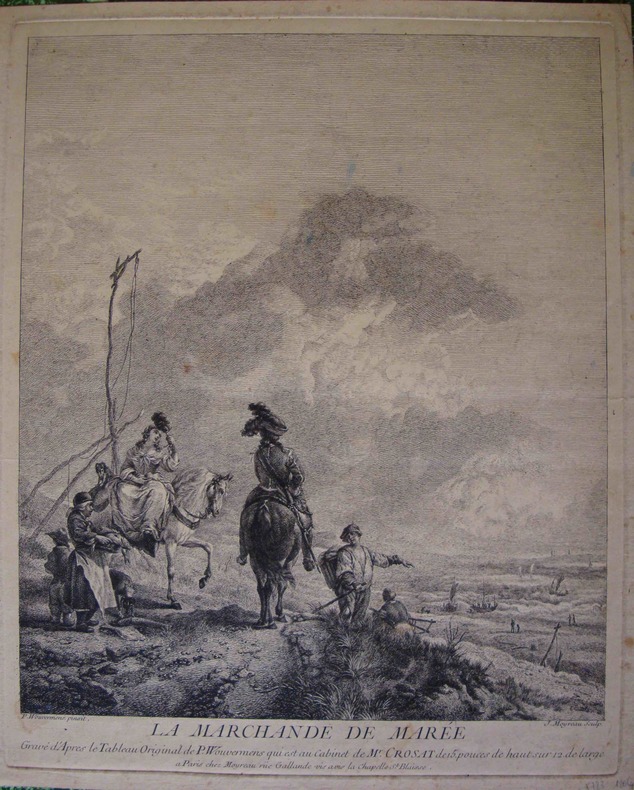
MOYREAU Jean
La marchande de marée
D’après P. Wouvermens. 36 x 29
Referenz des Buchhändlers : 5723
|
|
|
Mozart.-
Wolfgang Amadeus Mozart.
Zürich, Orell, Füssli und Comp. 1866. Gross-8°. 24 S. Mit 2 Portraits auf 1 lithogr. Tafel von H. Bodmer u. J. Lier. Orig.-Broschur (Deckel lose, stockfleckig). = "Neujahrsblatt der Allgemeinen Musikgesellschaft Zürich", Nr. 54.
Referenz des Buchhändlers : 27261AB
|
|
|
MUCHA Alphonse Mucha Alphonse
GISMONDA, Sarah Bernhardt, Théâtre de la Renaissance. Les Maitres de l'Affiche Pl. 27
Pars Imprimerie Chaix 1897 Planche N°27, format 29 x 40 cm (toutes marges). Chromolithographie d'époque avec le timbre à sec de l'Imprimerie Chaix (Lugt 1777c). Notre exemplaire est une des très rares épreuves imprimées sur papier Japon (Our plate is one of the few copies printed on Japanese paper). Original plate in good condition). LES MAITRES DE L'AFFICHE, prestigieuse publication d'art, éditée par l'atelier de lithographie Chaix, dont la parution s'étala de décembre 1895 à novembre 1900. Chaque livraison comportait 4 planches de reproduction en chromolithographie d'une remarquable qualité d'impression des plus belles affiches illustrées des grands artistes français et étrangers (auxquelles il faut ajouter 16 planches de lithographies originales données en prime aux abonnés). Lors de l'Exposition universelle de 1889, fut organisée la première exposition rétrospective dévolue à l'affiche, celle-ci devait valider la reconnaissance officielle d'appartenance de l'affiche au monde de l'art. Jules Chéret (1836-1932) y sera sacré '' Maître de l'affiche '', c'est aussi à cette date que Seurat commencera à collectionner les affiches de Chéret. Alfons Maria Mucha, 1860-1939. Bel exemplaire d'une des très rares épreuves imprimées sur papier Japon, du tirage de tête (Our plate is one of the few copies printed on Japanese paper) ( Photographies sur demande / We can send pictures of this book on simple request )
Referenz des Buchhändlers : 24137
|
|
|
MUCHA Alphonse Mucha Alphonse
XXème EXPOSITION DU SALON DES CENT. Les Maitres de l'Affiche Pl. 94
Pars Imprimerie Chaix 1897 Planche N°94, format 29 x 40 cm (toutes marges). Chromolithographie d'époque avec le timbre à sec de l'Imprimerie Chaix (Lugt 1777c). Notre exemplaire est une des très rares épreuves imprimées sur papier Japon (Our plate is one of the few copies printed on Japanese paper, original plate in good condition). LES MAITRES DE L'AFFICHE, prestigieuse publication d'art, éditée par l'atelier de lithographie Chaix, dont la parution s'étala de décembre 1895 à novembre 1900. Chaque livraison comportait 4 planches en lithographie, des plus belles affiches illustrées des grands artistes français et étrangers. Chaque livraison comportait 4 planches de reproduction en chromolithographie d'une remarquable qualité d'impression des plus belles affiches illustrées des grands artistes français et étrangers (auxquelles il faut ajouter 16 planches de lithographies originales données en prime aux abonnés). Lors de l'Exposition universelle de 1889, fut organisée la première exposition rétrospective dévolue à l'affiche, celle-ci devait valider la reconnaissance officielle d'appartenance de l'affiche au monde de l'art. Jules Chéret (1836-1932) y sera sacré '' Maître de l'affiche '', c'est aussi à cette date que Seurat commencera à collectionner les affiches de Chéret. Bel exemplaire d'une des très rares épreuves imprimées sur papier Japon, du tirage de tête (Our plate is one of the few copies printed on Japanese paper) ( Photographies sur demande / We can send pictures of this book on simple request )
Referenz des Buchhändlers : 24136
|
|
|
Mudie, Robert
The Feathered Tribes of the British Islands
London Eng: Whittaker & Co 1835. 2nd Edition. Hardcover. Good -. 2 volumes: xxiv 379 5 p.; 389 5 p.: hand-colored frontispiece and hand-colored title vignette in each volume 18 hand-colored plates several in-text drawings in each volume; 21 cm. Original dark green cloth with gilt-stamped spine titles and decoration; all boards have blind-stamped decoration. Yellow endpapers. In Good- Condition: front hinge of vol. 1 completely separated and front free endpaper and frontispiece of vol. 1 detached but present text block is otherwise solid and binding is in one piece; spines are sunned; cloth lacking at ends of spines; corners are bumped; covers are slightly soiled; title pages are foxed; otherwise only occasional light foxing; pages and plates are otherwise clean and tight. Whittaker & Co hardcover
Referenz des Buchhändlers : 000819
|
|
|
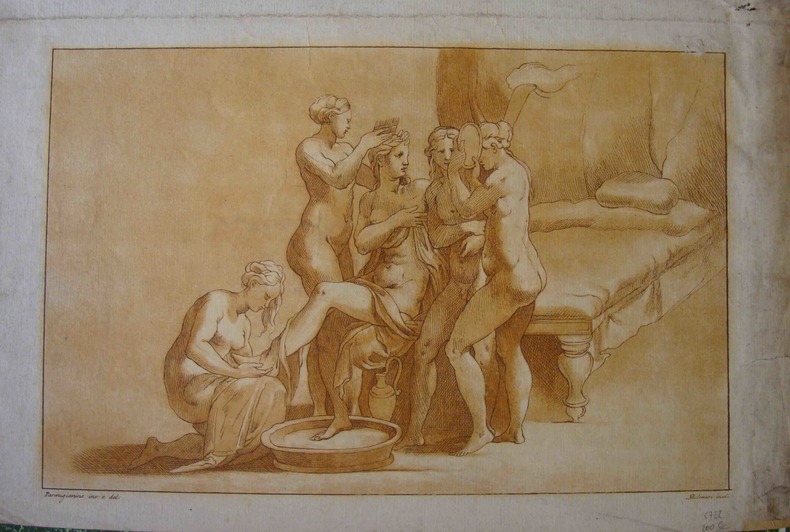
MULINARI Stéphano
(Le lever de Vénus)
D’après un beau dessin de Parmigianino 23 x 34
Referenz des Buchhändlers : 5722
|
|
|
MULLER Louis
Mezzetin.
Belle épreuve sur vergé. D'après Watteau. Sanchez et Seydoux 1889-3. en feuille Paris Gazette des Beaux-Arts 1889 18,5 x 13,7 cm au trait carré. Papier 44 x 30,6 cm.
Referenz des Buchhändlers : 8051

|
|
|
Muller, Josef Felix
Josef Felix Muller. Werkverzeichnis der Druckgraphik 1976-1992. Catalogue raisonne
The catalogue raisonne. Hundreds of items thoroughly described, all illustrated in color and black & white. 4to. Publisher's cloth. Dustjacket. FINE AND BRIGHT.
|
|
|
Multiple Contributors
Canadian Antiques Collector Magazine - November/December 1973
Features: Toile de Jouy - textile pattern; Symposium '73; Loyalist Settlement of Upper Canada; British Sporting Prints; Chine Export Trade Porcelain; Chinese Chippendale. Average wear. Address label upon front cover. Unmarked. Sound copy. Magazine

|
|
|
Multiple Contributors
Ikebana International, Issue No. 57
Features: Cover artist - Liao Shiou-ping; Saga School - Chiko School; Ikenobo School; Ichiyo School; Koryu Shohtoh-kai School; Floral Designs in Japanese Lacquer - many lovely colour photos with article; That day in Tehran when Ohara Houn Made an Old Man Cry; Ohara School; Soami School; Ryusei School; Japanese Contemporary Prints; Sogetsu School. Moderate wear. Unmarked. A sound copy. Book

|
|
|

 Per e-mail erhalten
 Als pdf-Dokument herunterladen
 RSS feed
 Permanenter link


