|
|
|
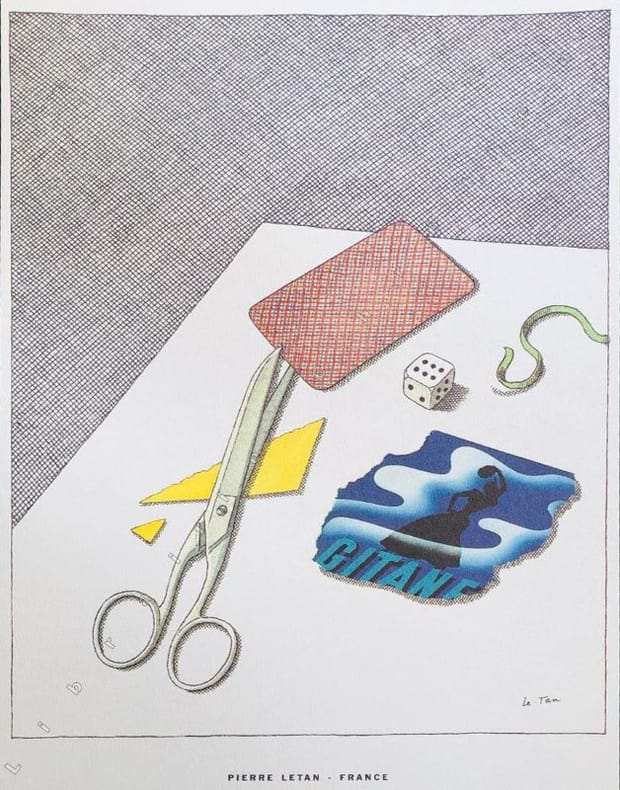
SEITA. LE TAN (Pierre), CIESLEWICZ (Roman), RAMBOW (Gunter), FRANCOIS (André), FLETCHER (Alan), DIMSON (Théo), DELHOMME (Jean-Philippe)...
Hommage à Max Ponty. La Gitane inspire 45 affichistes.
Paris, SEITA, 1991, portfolio cartonné, 41 illustrations en feuilles (21 x 29 cm).
Référence libraire : 24157
|
|
|
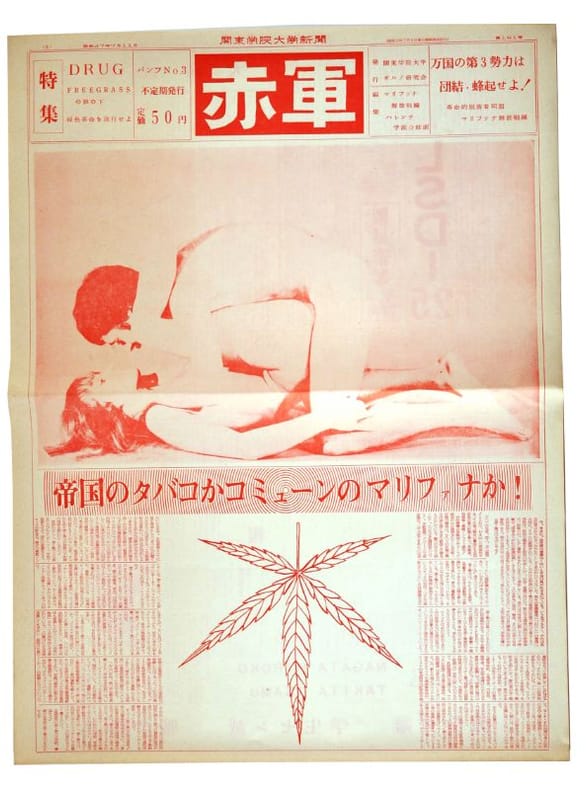
SEKIGUN
L’Armée Rouge pamphlet n°3 (seul paru)
1972 Journal-manifeste.Numéro spécial : Drogue, Herbe Libre, Révolution Verte.Tokyo, Bureau d’Etudes de la Pornographie de l’Université Kansaigakuin, 1972, 1 feuille 560x420mm imprimée recto-verso.Textes et illustrations imprimés en rouge sur papier "journal" crème avec deux noms d'auteurs en lettres latines: Nagata Hiroko et Takita Osamu. (104474)
Référence libraire : 104474
|
|
|
Selander Lesley
Les rebelles de l' Arizona
1968 60 x 80 LA LOI DU PLUS FORT : Affiche originale (1968) du film Les Rebelles de l'Arizona. Lesley Selander réunit Howard Keel et Yvonne De Carlo dans une aventure épique où l'honneur se gagne à la pointe du fusil. Une composition visuelle dynamique et colorée, véritable hommage à l'épopée de l'Ouest. Présentée dans un état exceptionnel, cette affiche est une pièce de choix pour tout amateur de western classique et de grand spectacle.
Référence libraire : LCI-6587

|
|
|
SEM
(PREMIERE GUERRE MONDIALE) Affiche Guerre 1914-1918: 4e Emprunt National. "Pour le triomphe Souscrivez à l'emprunt national, les souscriptions sont reçues à Paris et en Province / Banque Nationale de Crédit"
Paris Devambez Imp., sd, 1918, 80 x 114 cm, Marques du temps dans la marge supérieure gauche, sinon bon état. Affiche non entoilée, protégée sous rodhoïd. Avec cette affiche de la BNC, dédiée au 4e emprunt de la Défense nationale, Georges Goursat dit Sem, suggère l’imminence de la victoire des Alliés symbolisée par l’Arc de Triomphe en arrière-plan du document. Sous l’arche, les armées des guerres passées viennent rejoindre les Poilus tandis que la statue de la Marseillaise semble les encourager.
Référence libraire : 83789

|
|
|
SEM (GOURSAT, Georges, dit), dessinateur-lithographe
LITHOGRAPHIE ORIGINALE PUBLICITAIRE : "BEST IN THE WORLD ... CHESTERFIELD CIGARETTES" PAR SEM, tirée de l'Album : "white bottoms" by sem 1927
1927 Une lithographie Originale en couleurs , Format : 51 centimètres de haut par 33 centimètres de large, sur papier blanc, LITHOGRAPHIE ORIGINALE PUBLICITAIRE : "BEST IN THE WORLD ... CHESTERFIELD CIGARETTES" PAR SEM, tirée de l'Album : "white bottoms" by sem 1927
Référence libraire : 27812
|
|
|
SEM (GOURSAT, Georges, dit), dessinateur-lithographe
LITHOGRAPHIE ORIGINALE PUBLICITAIRE : "CHAMPAGNE DRY MONOPOLE" PAR SEM, tirée de l'Album : "white bottoms" by sem 1927
1927 Une lithographie Originale en couleurs , Format : 51 centimètres de haut par 33 centimètres de large, sur papier blanc, LITHOGRAPHIE ORIGINALE PUBLICITAIRE : "CHAMPAGNE DRY MONOPOLE" PAR SEM, tirée de l'Album : "white bottoms" by sem 1927
Référence libraire : 27848
|
|
|
SEM (GOURSAT, Georges, dit), dessinateur-lithographe
LITHOGRAPHIE ORIGINALE PUBLICITAIRE : "GRAND MARNIER" PAR SEM, tirée de l'Album : "white bottoms" by sem 1927
1927 Une lithographie Originale en couleurs , Format : 51 centimètres de haut par 33 centimètres de large, sur papier blanc, LITHOGRAPHIE ORIGINALE PUBLICITAIRE : "GRAND MARNIER" PAR SEM, tirée de l'Album : "white bottoms" by sem 1927
Référence libraire : 28062
|
|
|
SEM (GOURSAT, Georges, dit), dessinateur-lithographe
LITHOGRAPHIE ORIGINALE PUBLICITAIRE : "LE PRINCE CHARMANT RUE DE LA PAIX (LE PRINCE DE GALLES)... CARTIER" PAR SEM, tirée de l'Album : "white bottoms" by sem 1927
1927 Une lithographie Originale en couleurs , Format : 51 centimètres de haut par 33 centimètres de large, sur papier blanc, LITHOGRAPHIE ORIGINALE PUBLICITAIRE : "LE PRINCE CHARMANT RUE DE LA PAIX (LE PRINCE DE GALLES)... CARTIER" PAR SEM, tirée de l'Album : "white bottoms" by sem 1927
Référence libraire : 27843
|
|
|
SEMPE
Affiche du film de Murray Lerner, "De Mao ? Mozart".
Format 120x160 cm.
|
|
|
SEMPE JEAN JACQUES (1932-2022)
Neuf Heures du Matin New York
Paris The New Yorker 1982 800x400mm The New Yorker / Editions du désastre,1982, 800x400mm, impression lithographique en couleurs.Imprimé à Paris chez I.M.L. pour le New Yorker.Très bon état. (103695)
Référence libraire : 103695

|
|
|
SEMPÉ
L'AMERIQUE DE JEAN-PAUL MARTINEAU
Affiche originale. Artis. 1992. Impression en offset. Dim : 603 x 401 mm.
Référence libraire : 3777

|
|
|
SEMPÉ
L'AMERIQUE DE JEAN-PAUL MARTINEAU
Affiche originale. Artis. 1992. Impression en offset. Dim : 603 x 401 mm.
Référence libraire : 3777
|
|
|
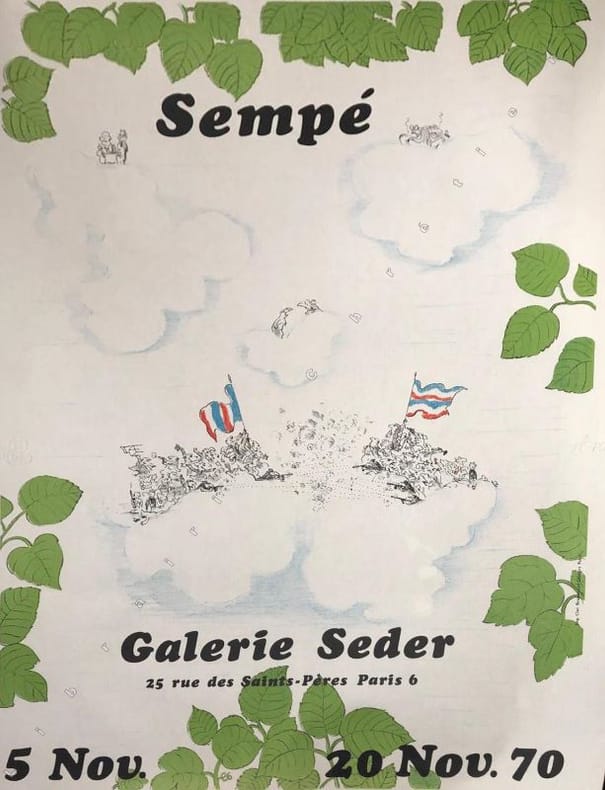
SEMPÉ (Jean-Jacques).
"Galerie Seder".
1970 Affiche lithographiée, Paris, Clot-Bramsen et Georges, 5 au 20 novembre 1970, 76 x 56 cm.
Référence libraire : 23737
|
|
|
Sengor Léopold Sedar (Préface de ) ; Adhemar Jean (Introduction de) ; Sorlier Charles (Notices de)
Les Affiches de Marc Chagall. マルク シャガールのポスター、1978 年
Tokyo, Publishers 2000 INC 1978 Livre en japonais. In-folio relié 36 cm sur 26. 227 pages. Couverture éditeur plastifiée. Bon état d’occasion.
Référence libraire : 125310

|
|
|
SERREAU Coline
Quisaitout & Grobêta. 26 et 27 mai 2006, Salle de l'Echiquier à Pouzaugues
L'OEUF AU RIZ. 2006. In-12. Broché. Bon état, Couv. convenable, Dos satisfaisant, Intérieur frais. Affiche de pièce de théâtre, en couleurs de 32 / 43 cm.. . . . Classification : 300-Affiches Divers
Référence libraire : RO80078852
|
|
|
SERVICE HISTORIQUE DE LA MARINE
la libération vue par les peintres de l'armée
31 planches dans pochette sous emboitage - 25.5x34.5 - ADDIM - 1994
Référence libraire : 15340
|
|
|
SESBOÜE Suzanne
Costumes parisiens. Manteau de fillette en velours bleu garni de Skungs. Guêtres de Suède blanc (pl.34, Journal des Dames et des Modes, 1912 n°19)
- s.n., Paris 1912, 14x22,5cm, une feuille. - Estampe originale en couleur, rehaussée au palladium, tirée sur papier vergé, signée en bas à droite de la planche. L'une des premières revues de mode françaises, parue quelques temps avant la fameuse Gazette du bon ton et réunissant les grands artistes français de la mouvance Art déco. Le Journal des dames et des modes est une revue trimensuelle de mode française illustrée créée en 1797. Sa publication est stoppée en 1839 avant d'être reprise en juin 1912 sous l'impulsion de Tommaso Antongini, le secrétaire, ami et biographe de Gabriele d'Annunzio. Elle disparaîtra en août 1914 à l'aube de la Première Guerre mondiale. La revue était tirée à 1279 exemplaires ce qui en fait, pour l'époque, une publication relativement confidentielle. Les 186 planches, d'une grande finesse, sont gravées sur papier fort puis coloriées au pochoir. Elles représentent, la majorité du temps, des femmes, mais aussi des hommes et des enfants. Les modèles ne sont pas, à la différence de ceux de la Gazette du bon ton dont la publication verra le jour quelques mois plus tard, ceux des couturiers de renom mais sont le fruit de l'imagination des illustrateurs eux-mêmes. Les pochoirs sont, la plupart du temps, exécutés par George Barbier, mais d'autres artistes collaborent à la revue : Léon Bakst, B. Berty, Bernard Boutet de Monvel, Roger Broders, Jan van Brock, Umberto Brunelleschi, H. Robert Dammy, Étienne Drian, Abel Faivre, Marie-Madeleine Franc-Nohain, Xavier Gosé, Paul Iribe, Kriegck, Victor Lhuer, Pierre Legrain, Charles Martin, Fernand Siméon, Ismael Smith, Armand Vallée et Gerda Wegener. Nombre de ces illustrateurs seront également associés à La Gazette du bon ton. Leurs travaux, emblématiques du mouvement Art déco, soulignent l'influence de l'orientalisme et des costumes des ballets russes tout en les inscrivant dans les activités quotidiennes des Français aisés de l'époque. Dès la préface du premier numéro de 1912, Anatole France déclare : « Au bout de soixante-quinze ans, il renaît. Il renaît par les soins de quelques esprits ingénieux et artistes. Il renaît pour les curieux (s'il en est encore) que ne contentent pas les journaux de modes tirés à plusieurs milliers et illustrés par la photographie. Et si les éditeurs nous rendent très exactement, dans son format, avec son papier, son impression, ses procédés de gravure et de coloris, le vieux classique des modes d'autrefois, c'est qu'ils entendent le continuer agréablement et devenir les classiques charmants de la mode d'aujourd'hui et de demain. » [ENGLISH DESCRIPTION ON DEMAND]

|
|
|
Seymour CHWAST
Affiche Seymour Chwast : A tribute to Arthur Freed. An American in Paris. Barkleys of Broadway, Showboat, Easter Parade, Brodway Melody of 1936. Gigi, Gabin in the Sky, Ziegfeld Follies. . June 20 -August 20, Gallery of Modern Art, 2 Columbus Circle, N.Y. Raymond Rohauer, Film Curator and Program Director.
New York, Personality Posters Inc, 1967, 75x101,50 cm, S. Chwast (New York, 1931 - ...), scénariste et dessinateur américain, fondateur avec Milton Glaser du "Push Pin studio" dans les années 1960. Déchirures marginales et petits trous dans le fond jaune. Pliures (particulièrement visibles sur les photos). Imprimé en jaune, rose, orange et bleu sur vélin gaufré. A encadrer.
Référence libraire : 81316
|
|
|
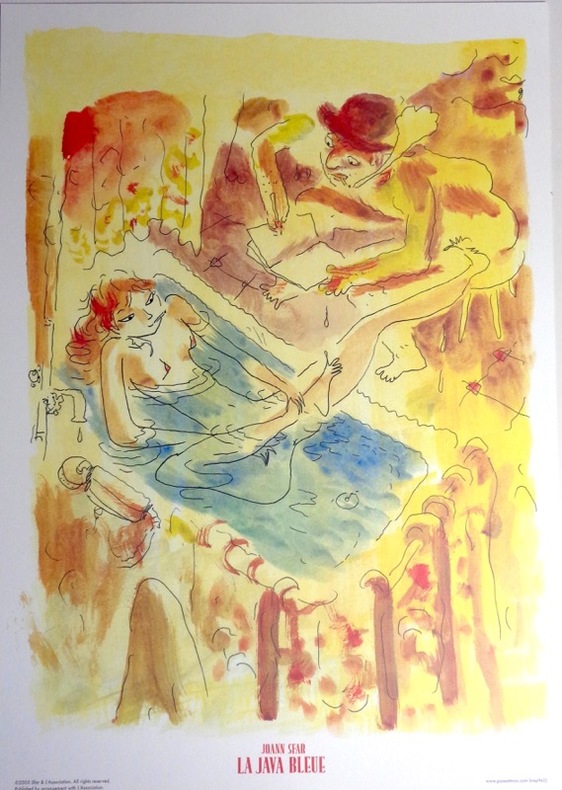
Sfar Joann:
La java bleue.
Affiche au format 50 x 70 cm. A l'état de neuf.
Référence libraire : 2843
|
|
|
Shahn, Ben; Kao, Deborah Martin; Katzman, Laura; Webster, Jenna
Ben Shahn's New York : The Photography of Modern Times
A clean, unmarked book with a tight binding. Light wear, small tears and spots to cover. 9"w x 10"h. 340 pages.

|
|
|
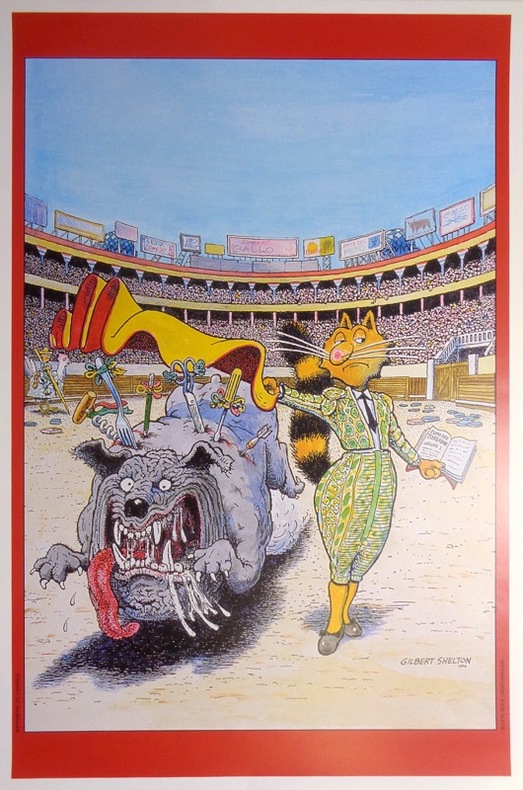
Shelton Gilbert:
[Corrida].
Affiche au format 40 x 60, à l'état de neuf.
Référence libraire : 3077
|
|
|
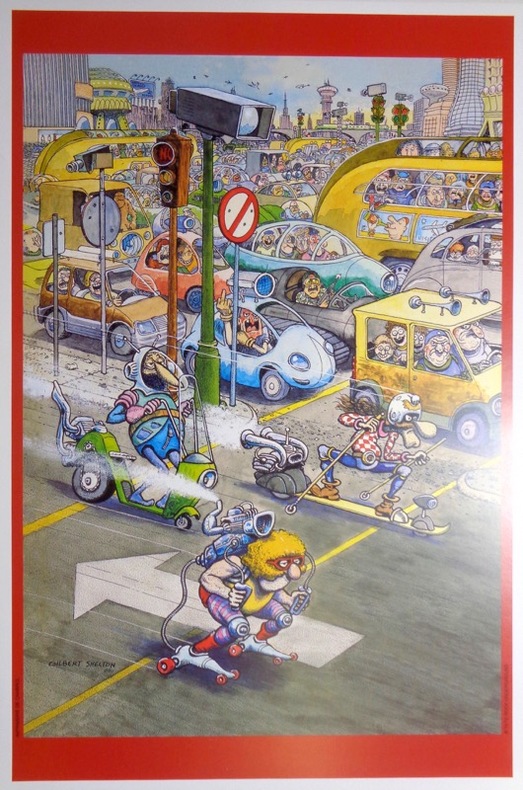
Shelton Gilbert:
[Embouteillage].
Affiche au format 40 x 60 cm., à l'état de neuf.
Référence libraire : 3080
|
|
|
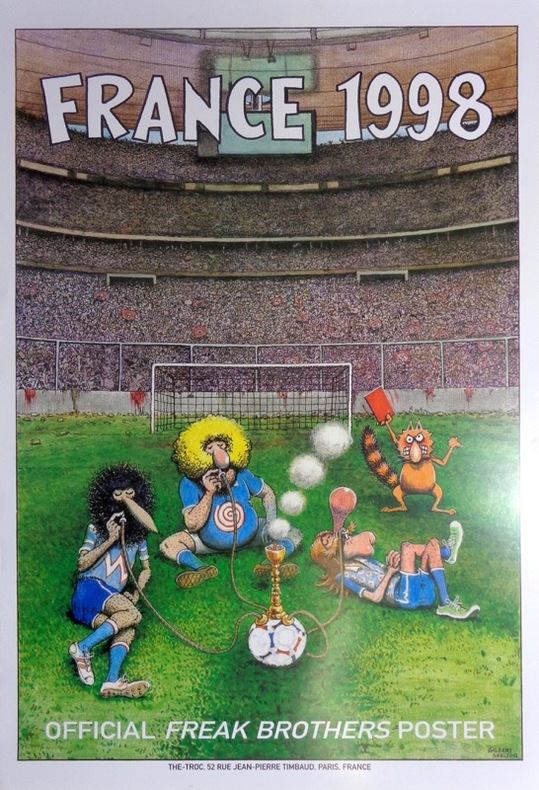
Shelton Gilbert:
France 1998. Official Freak Brothers poster.
Affiche au format 40 x 61 cm., à l'état de neuf.
Référence libraire : 3079
|
|
|
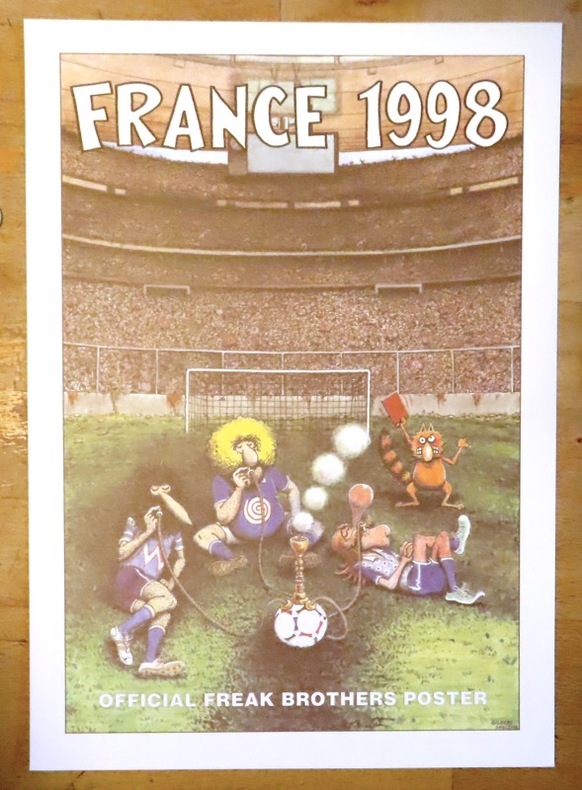
Shelton Gilbert:
France 1998. Official Freak Brothers poster.
Reproduction sur papier fort, au format 20 x 28 cm. et à l'état de neuf.
Référence libraire : 12530
|
|
|
Shelton Gilbert:
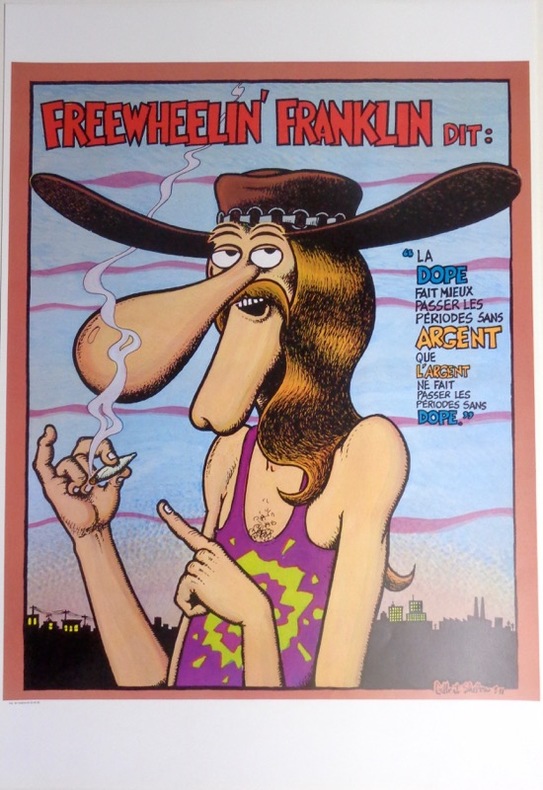
Freewheeling' Franklin dit : "La dope fait mieux passer les périodes sans argent que l'argent ne fait passer les périodes sans dope".
Affiche au format 41 60 cm., à l'état de neuf. 2 exemplaires pour 40 francs suisses (prendre contact si vous êtes intéressé. . . )
Référence libraire : 2881
|
|
|
Shelton Gilbert:
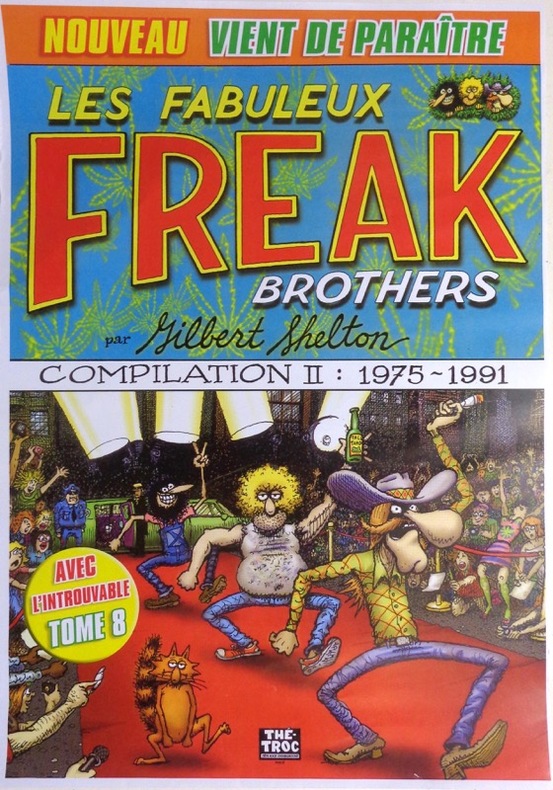
Les fabuleux Freak Brothers.
Galerie Thé-Troc. Affiche au format 30 x 42 cm., à l'état de neuf.
Référence libraire : 3081
|
|
|
Shelton Gilbert:
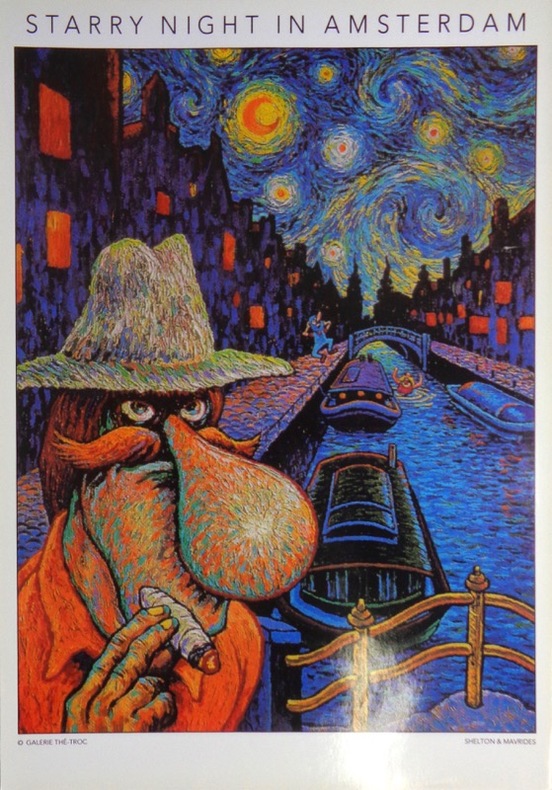
Starry night in Amsterdam.
Galerie Thé-Troc. Affiche au format 30 x 43 cm., à l'état de neuf.
Référence libraire : 3076
|
|
|
Shelton Gilbert:
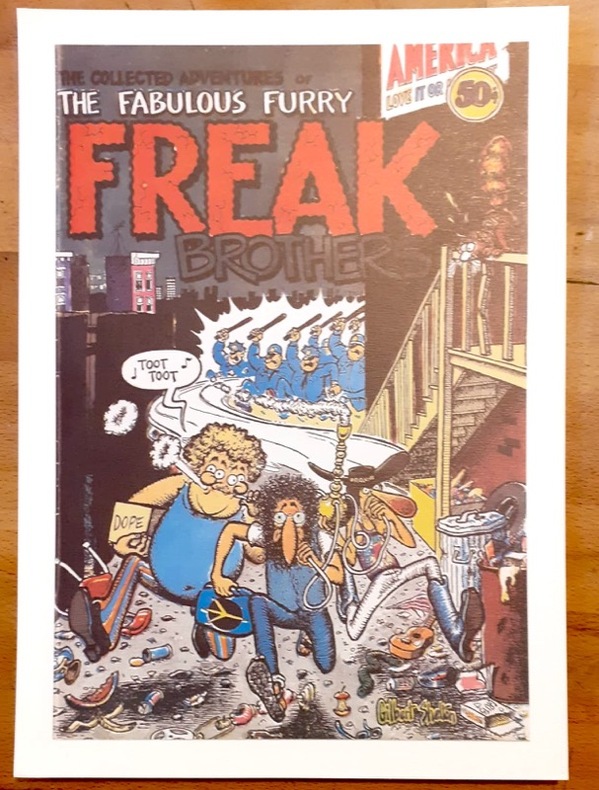
The fabulous furry Freak Brothers.
Reproduction sur papier fort, au format 20 x 28 cm. et à l'état de neuf.
Référence libraire : 12531
|
|
|
SHEMOUHEL KATZ
regards sur la danse contemporaine en Israël
Affiche originale. Éditions du centre G. Pompidou. Atelier Germinal, France. 1980. Impression en sérigraphie. Dim: 700 x 500 mm.
Référence libraire : 4194

|
|
|
SHEMOUHEL KATZ
regards sur la danse contemporaine en Israël
Affiche originale. Éditions du centre G. Pompidou. Atelier Germinal, France. 1980. Impression en sérigraphie. Dim: 700 x 500 mm.
Référence libraire : 4194
|
|
|
SHIRLEY McLAINE - BILL PAXTON - JULIETTE LEWIS
AFFICHE DE CINEMA - ETOILE DU SOIR THE EVENING STAR
ROBERT HARLING. Non daté. In-12. Broché. Bon état, Couv. convenable, Dos satisfaisant, Intérieur frais. Affiche de cinéma 120 cm x160 cm. Présenté par Paramount Pictures et Rysher Entertainment.. . . . Classification : 0-Affiches Cinéma
Référence libraire : R100000083

|
|
|
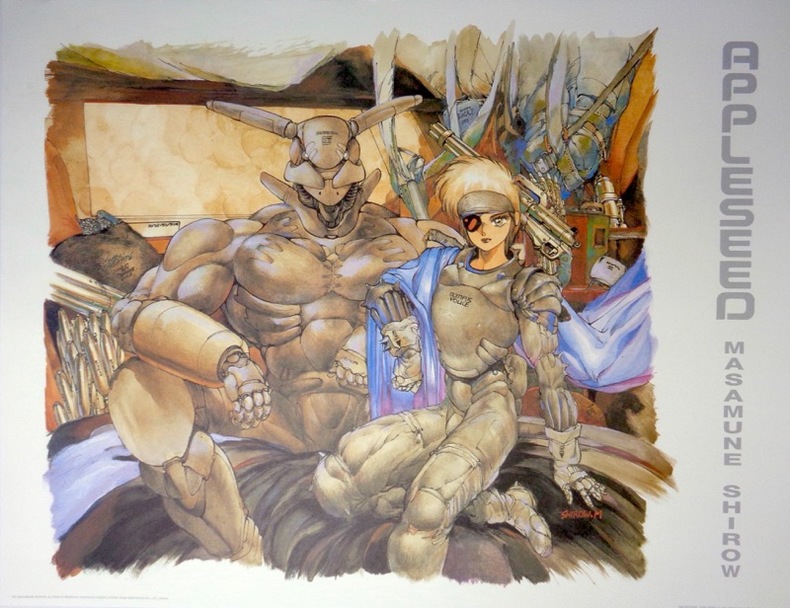
Shirow Masamune:
Appleseed.
Affiche au format 68 x 98cm., en très bel état.
Référence libraire : 3524
|
|
|
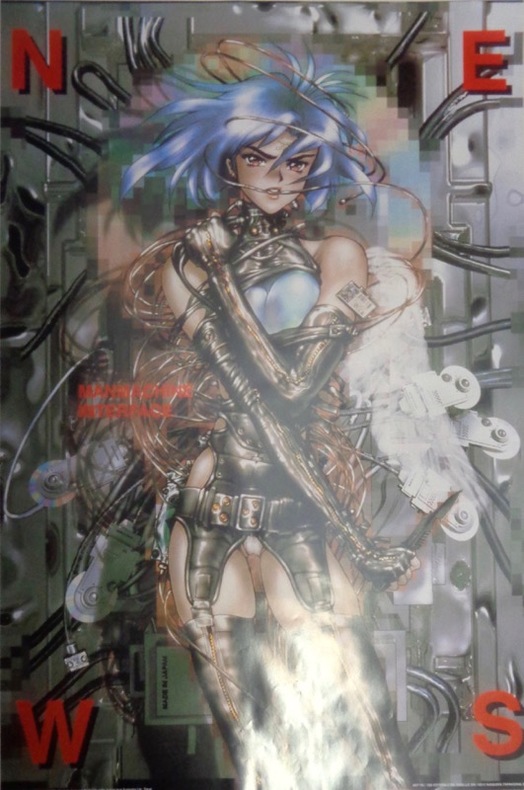
Shirow Masamune:
Compass.
Affiche au format 68 x 98cm., en très bel état.
Référence libraire : 3525
|
|
|
Sierra, Santiago
Haus im Schlamm. [Plakat] Kestner-Gesellschaft Hannover. 11. Februar - 10. April 2005.
Hannover., Kestner Gesellschaft., 2005. 84 x 59 cm., Umschlag Sehr gutes Exemplar.
Référence libraire : 33928AB

|
|
|
Signac.
Signac. Affiche éditée à l'occasion de l'exposition "Les Plaisirs de L'été" à la Galerie de Paris du 16 juin au 24 juillet 1965.
Une affiche de 50 x 70 cm; lithographie de Mourlot. Manqueà l'angle inférieur droit. Sinon bel état. Voir photo.
|
|
|
Signac.
Signac. Affiche éditée à l'occasion de l'exposition "Les Plaisirs de L'été" à la Galerie de Paris du 16 juin au 24 juillet 1965.
Une affiche de 50 x 70 cm; lithographie de Mourlot.
Référence libraire : 15785
|
|
|
SIGNORINA, 10.000.
Locandina pubblicitaria per la commedia ungherese diretta da Béla Gaàl.
Manifesto litografico originale cm 204x98 intelato, perfettamente conservato.. .

|
|
|
SIGNORINA, 10.000.
Locandina pubblicitaria per la commedia ungherese diretta da Béla Gaàl.
Manifesto litografico originale cm 204x98 intelato, perfettamente conservato.. .
|
|
|
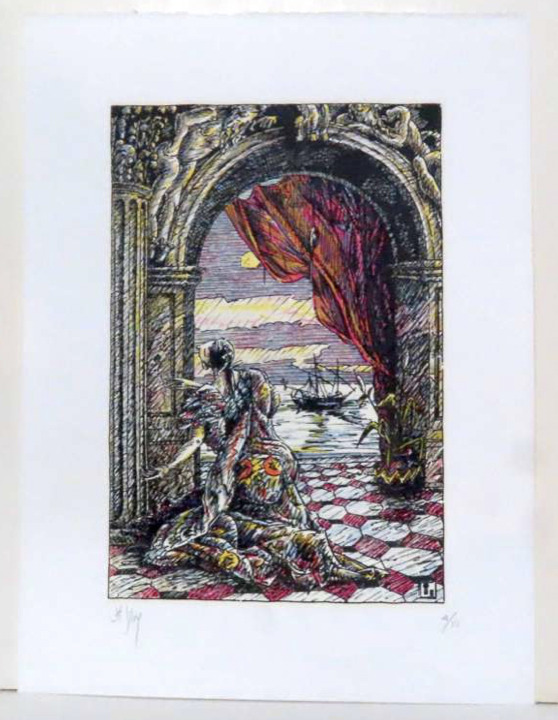
Silvy H.:
[Navire].
Sérigraphie au format 24,5 x 32.
Référence libraire : 15485
|
|
|
SIMEON
L'ondulation permanente Eugène (Publicité, La Gazette du Bon ton, 1920)
- Lucien Vogel éditeur, Paris 1920, 18x24cm, une feuille. - Estampe originale en couleur faisant la publicité de la boutique Verlaine, tirée sur papier vergé. Deux vignettes publicitaires au spine sur Valaze et les produits du Dr Dys. Gravure originale réalisée pour l'illustration de La Gazette du bon ton, l'une des plus belles et des plus influentes revues de mode du XXème siècle, célébrant le talent des créateurs et des artistes français en plein essor de l'art déco. Célèbre revue de mode fondée en 1912 par Lucien Vogel, La Gazette du bon ton a paru jusqu'en 1925 avec une interruption durant la Guerre de 1915 à 1920, pour cause de mobilisation de son rédacteur en chef. Elle se constitue de 69 livraisons tirées à seulement 2000 exemplaires et est illustrée notamment de 573 planches en couleurs et de 148 croquis représentant des modèles de grands couturiers. Dès leur parution, ces luxueuses publications « s'adressent aux bibliophiles et aux mondains esthètes » (Françoise Tétart-Vittu « La Gazette du bon ton » in Dictionnaire de la mode, 2016). Imprimées sur beau papier vergé, elles utilisent une police typographique spécialement créée pour la revue par Georges Peignot, le caractère Cochin, repris en 1946 par Christian Dior. Les estampes sont réalisées grâce à la technique du pochoir métallique, rehaussées en couleurs et pour certaines soulignées à l'or ou au palladium. L'aventure commence en 1912 lorsque Lucien Vogel, homme du monde et de la mode - il a déjà participé à la revue Femina - décide de fonder avec sa femme Cosette de Brunhoff (sur de Jean, le père de Babar) la Gazette du bon ton dont le sous-titre est alors « Art, modes et frivolités ». Georges Charensol rapporte les propos du rédacteur en chef : « En 1910, observe-t-il, il n'existait aucun journal de mode véritablement artistique et représentatif de l'esprit de son époque. Je songeais donc à faire un magazine de luxe avec des artistes véritablement modernes [...] J'étais certain du succès car pour la mode aucun pays ne peut rivaliser avec la France. » (« Un grand éditeur d'art. Lucien Vogel » in Les Nouvelles littéraires, n°133, mai 1925). Le succès de la revue est immédiat, non seulement en France, mais aussi aux Etats-Unis et en Amérique du Sud. À l'origine, Vogel réunit donc un groupe de sept artistes : André-Édouard Marty et Pierre Brissaud, suivis de Georges Lepape et Dammicourt ; et enfin ses amis de l'École des beaux-arts que sont George Barbier, Bernard Boutet de Monvel, ou Charles Martin. D'autres talents viennent rapidement rejoindre l'équipée : Guy Arnoux, Léon Bakst, Benito, Boutet de Monvel, Umberto Brunelleschi, Chas Laborde, Jean-Gabriel Domergue, Raoul Dufy, Édouard Halouze, Alexandre Iacovleff, Jean Émile Laboureur, Charles Loupot, Charles Martin, Maggie Salcedo. Ces artistes, inconnus pour la plupart lorsque Lucien Vogel fait appel à eux, deviendront par la suite des figures artistiques emblématiques et recherchées. Ce sont ces mêmes illustrateurs qui réalisent les dessins des publicités de la Gazette. Les planches mettent en lumière et subliment les robes de sept créateurs de l'époque : Lanvin, Doeuillet, Paquin, Poiret, Worth, Vionnet et Doucet. Les couturiers fournissent pour chaque numéro des modèles exclusifs. Néanmoins, certaines des illustrations ne figurent aucun modèle réel, mais seulement l'idée que l'illustrateur se fait de la mode du jour. La Gazette du bon ton est une étape décisive dans l'histoire de la mode. Alliant l'exigence esthétique et l'unité plastique, elle réunit pour la première fois les grands talents du monde des arts, des lettres et de la mode et impose, par cette alchimie, une toute nouvelle image de la femme, élancée, indépendante et audacieuse, également portée par la nouvelle génération de couturiers Coco Chanel, Jean Patou, Marcel Rochas... Reprise en 1920 par Condé Montrose Nast, la Gazette du bon ton inspirera largement la nouvelle composition et les choix esthétiques du « petit journal mourant » que Nast ava

|
|
|
SIMEON
Le Retour des autans. Tailleur et Robe d'après-midi, de Doeuillet. (La Gazette du Bon ton, n°7 - Planche 55 )
- Lucien Vogel éditeur, Paris [circa 1920], 19,5x25cm, une feuille. - Original color print, printed on vergé paper, non signed. An original print used to illustrate the Gazette du bon ton, one of the most attractive and influential 20th century fashion magazines, featuring the talents of French artists and other contributors from the burgeoning Art Deco movement. A celebrated fashion magazine established in 1912 by Lucien Vogel, La Gazette du bon ton appeared until 1925, with a hiatus from 1915 to 1920 due to the war (the editor-in-chief having been called up for service). It consisted of 69 issues printed in only 2,000 copies each and notably illustrated with 573 color plates and 148 sketches of the models of the great designers. Right from the start, this sumptuous publication "was aimed at bibliophiles and fashionable society," (Françoise Tétart-Vittu, "La Gazette du bon ton", in Dictionnaire de la mode, 2016) and was printed on fine vergé paper using a type cut specially for the magazine by Georges Peignot, known as Cochin, later used (in 1946) by Christian Dior. The prints were made using stencils, heightened in colors, some highlighted in gold or palladium. The story began in 1912, when Lucien Vogel, a man of the world involved in fashion (he had already been part of the fashion magazine Femina) decided, with his wife Cosette de Brunhoff - the sister of Jean, creator of Babar - to set up the Gazette du bon ton, subtitled at the time: "Art, fashion, frivolities." Georges Charensol noted the reasoning of the editor-in-chief: "'In 1910,' he observed, 'there was no really artistic fashion magazine, nothing representative of the spirit of the time. My dream was therefore to make a luxury magazine with truly modern artists...I was assured of success, because when it comes to fashion, no country on earth can compete with France.'" ("Un grand éditeur d'art. Lucien Vogel" in Les Nouvelles littéraires, no. 133, May 1925). The magazine was immediately successful, not only in France but also in the United States and Latin America. At first, Vogel put together a team of seven artists: André-Édouard Marty and Pierre Brissaud, followed by Georges Lepape and Dammicourt, as well as eventually his friends from school and the School of Fine Arts, like George Barbier, Bernard Boutet de Monvel and Charles Martin. Other talented people soon came flocking to join the team: Guy Arnoux, Léon Bakst, Benito, Boutet de Monvel, Umberto Brunelleschi, Chas Laborde, Jean-Gabriel Domergue, Raoul Dufy, Édouard Halouze, Alexandre Iacovleff, Jean Émile Laboureur, Charles Loupot, Chalres Martin, Maggie Salcedo. These artist, mostly unknown when Lucien Vogel sought them out, later became emblematic and sought-after artistic figures. It was also they who worked on the advertising drawings for the Gazette. The plates put the spotlight on, and celebrate, dresses by seven designers of the age: Lanvin, Doeuillet, Paquin, Poiret, Worth, Vionnet and Doucet. The designers provided exclusive models for each issue. Nonetheless, some of the illustrations are not based on real models, but simply on the illustrator's conception of the fashion of the day. The Gazette du bon ton was an important step in the history of fashion. Combining aesthetic demands with the physical whole, it brought together - for the first time - the great talents of the artistic, literary, and fashion worlds; and imposed, through this alchemy, a completely new image of women: slender, independent and daring, which was shared by the new generation of designers, including Coco Chanel, Jean Patou, Marcel Rochas, and so on... Taken over in 1920 by Condé Montrose Nast, the Gazette du bon ton was an important influence on the new layout and aesthetics of that "little dying paper" that Nast had bought a few years earlier: Vogue. [FRENCH VERSION FOLLOWS] Estampe originale en couleur tirée sur papier vergé, non-signée. Gravure originale réalisée pour l'illustration de La Gazette du bon ton, l'une

|
|
|
SIMEON
Un peu beaucoup. (La Gazette du Bon ton, n°5. Année 1920 - Planche 34 )
- Lucien Vogel éditeur, Paris 1920, 19,5x25cm, une feuille. - Original color print, printed on vergé paper, signed in the plate. An original print used to illustrate the Gazette du bon ton, one of the most attractive and influential 20th century fashion magazines, featuring the talents of French artists and other contributors from the burgeoning Art Deco movement. A celebrated fashion magazine established in 1912 by Lucien Vogel, La Gazette du bon ton appeared until 1925, with a hiatus from 1915 to 1920 due to the war (the editor-in-chief having been called up for service). It consisted of 69 issues printed in only 2,000 copies each and notably illustrated with 573 color plates and 148 sketches of the models of the great designers. Right from the start, this sumptuous publication "was aimed at bibliophiles and fashionable society," (Françoise Tétart-Vittu, "La Gazette du bon ton", in Dictionnaire de la mode, 2016) and was printed on fine vergé paper using a type cut specially for the magazine by Georges Peignot, known as Cochin, later used (in 1946) by Christian Dior. The prints were made using stencils, heightened in colors, some highlighted in gold or palladium. The story began in 1912, when Lucien Vogel, a man of the world involved in fashion (he had already been part of the fashion magazine Femina) decided, with his wife Cosette de Brunhoff - the sister of Jean, creator of Babar - to set up the Gazette du bon ton, subtitled at the time: "Art, fashion, frivolities." Georges Charensol noted the reasoning of the editor-in-chief: "'In 1910,' he observed, 'there was no really artistic fashion magazine, nothing representative of the spirit of the time. My dream was therefore to make a luxury magazine with truly modern artists...I was assured of success, because when it comes to fashion, no country on earth can compete with France.'" ("Un grand éditeur d'art. Lucien Vogel" in Les Nouvelles littéraires, no. 133, May 1925). The magazine was immediately successful, not only in France but also in the United States and Latin America. At first, Vogel put together a team of seven artists: André-Édouard Marty and Pierre Brissaud, followed by Georges Lepape and Dammicourt, as well as eventually his friends from school and the School of Fine Arts, like George Barbier, Bernard Boutet de Monvel and Charles Martin. Other talented people soon came flocking to join the team: Guy Arnoux, Léon Bakst, Benito, Boutet de Monvel, Umberto Brunelleschi, Chas Laborde, Jean-Gabriel Domergue, Raoul Dufy, Édouard Halouze, Alexandre Iacovleff, Jean Émile Laboureur, Charles Loupot, Chalres Martin, Maggie Salcedo. These artist, mostly unknown when Lucien Vogel sought them out, later became emblematic and sought-after artistic figures. It was also they who worked on the advertising drawings for the Gazette. The plates put the spotlight on, and celebrate, dresses by seven designers of the age: Lanvin, Doeuillet, Paquin, Poiret, Worth, Vionnet and Doucet. The designers provided exclusive models for each issue. Nonetheless, some of the illustrations are not based on real models, but simply on the illustrator's conception of the fashion of the day. The Gazette du bon ton was an important step in the history of fashion. Combining aesthetic demands with the physical whole, it brought together - for the first time - the great talents of the artistic, literary, and fashion worlds; and imposed, through this alchemy, a completely new image of women: slender, independent and daring, which was shared by the new generation of designers, including Coco Chanel, Jean Patou, Marcel Rochas, and so on... Taken over in 1920 by Condé Montrose Nast, the Gazette du bon ton was an important influence on the new layout and aesthetics of that "little dying paper" that Nast had bought a few years earlier: Vogue. [FRENCH VERSION FOLLOWS] Estampe originale en couleur tirée sur papier vergé, signée en bas au centre dans la planche. Gravure originale réalisée pour l'illu

|
|
|
SIMEON Fernand
Au bal noir et blanc. Manteau du soir (pl.25, La Gazette du Bon ton, 1921 n°4)
- Lucien Vogel éditeur, Paris 1921, 18x24cm, une feuille. - Original color print, printed on vergé paper, non signed. An original print used to illustrate the Gazette du bon ton, one of the most attractive and influential 20th century fashion magazines, featuring the talents of French artists and other contributors from the burgeoning Art Deco movement. A celebrated fashion magazine established in 1912 by Lucien Vogel, La Gazette du bon ton appeared until 1925, with a hiatus from 1915 to 1920 due to the war (the editor-in-chief having been called up for service). It consisted of 69 issues printed in only 2,000 copies each and notably illustrated with 573 color plates and 148 sketches of the models of the great designers. Right from the start, this sumptuous publication "was aimed at bibliophiles and fashionable society," (Françoise Tétart-Vittu, "La Gazette du bon ton", in Dictionnaire de la mode, 2016) and was printed on fine vergé paper using a type cut specially for the magazine by Georges Peignot, known as Cochin, later used (in 1946) by Christian Dior. The prints were made using stencils, heightened in colors, some highlighted in gold or palladium. The story began in 1912, when Lucien Vogel, a man of the world involved in fashion (he had already been part of the fashion magazine Femina) decided, with his wife Cosette de Brunhoff - the sister of Jean, creator of Babar - to set up the Gazette du bon ton, subtitled at the time: "Art, fashion, frivolities." Georges Charensol noted the reasoning of the editor-in-chief: "'In 1910,' he observed, 'there was no really artistic fashion magazine, nothing representative of the spirit of the time. My dream was therefore to make a luxury magazine with truly modern artists...I was assured of success, because when it comes to fashion, no country on earth can compete with France.'" ("Un grand éditeur d'art. Lucien Vogel" in Les Nouvelles littéraires, no. 133, May 1925). The magazine was immediately successful, not only in France but also in the United States and Latin America. At first, Vogel put together a team of seven artists: André-Édouard Marty and Pierre Brissaud, followed by Georges Lepape and Dammicourt, as well as eventually his friends from school and the School of Fine Arts, like George Barbier, Bernard Boutet de Monvel and Charles Martin. Other talented people soon came flocking to join the team: Guy Arnoux, Léon Bakst, Benito, Boutet de Monvel, Umberto Brunelleschi, Chas Laborde, Jean-Gabriel Domergue, Raoul Dufy, Édouard Halouze, Alexandre Iacovleff, Jean Émile Laboureur, Charles Loupot, Chalres Martin, Maggie Salcedo. These artist, mostly unknown when Lucien Vogel sought them out, later became emblematic and sought-after artistic figures. It was also they who worked on the advertising drawings for the Gazette. The plates put the spotlight on, and celebrate, dresses by seven designers of the age: Lanvin, Doeuillet, Paquin, Poiret, Worth, Vionnet and Doucet. The designers provided exclusive models for each issue. Nonetheless, some of the illustrations are not based on real models, but simply on the illustrator's conception of the fashion of the day. The Gazette du bon ton was an important step in the history of fashion. Combining aesthetic demands with the physical whole, it brought together - for the first time - the great talents of the artistic, literary, and fashion worlds; and imposed, through this alchemy, a completely new image of women: slender, independent and daring, which was shared by the new generation of designers, including Coco Chanel, Jean Patou, Marcel Rochas, and so on... Taken over in 1920 by Condé Montrose Nast, the Gazette du bon ton was an important influence on the new layout and aesthetics of that "little dying paper" that Nast had bought a few years earlier: Vogue. [FRENCH VERSION FOLLOWS] Estampe originale en couleur, tirée sur papier vergé, non-signée. Gravure originale réalisée pour l'illustration de La Gazette du bon ton, l'une des plus b

|
|
|
SIMEON Fernand
Costumes parisiens. Tailleur de velours blanc frappé garni de loutre et de passementerie (pl.28, Journal des Dames et des Modes, 1912 n°15)
- s.n., Paris 1912, 14x22,5cm, une feuille. - Estampe originale en couleur, tirée sur papier vergé, signée en bas à gauche de la planche. L'une des premières revues de mode françaises, parue quelques temps avant la fameuse Gazette du bon ton et réunissant les grands artistes français de la mouvance Art déco. Le Journal des dames et des modes est une revue trimensuelle de mode française illustrée créée en 1797. Sa publication est stoppée en 1839 avant d'être reprise en juin 1912 sous l'impulsion de Tommaso Antongini, le secrétaire, ami et biographe de Gabriele d'Annunzio. Elle disparaîtra en août 1914 à l'aube de la Première Guerre mondiale. La revue était tirée à 1279 exemplaires ce qui en fait, pour l'époque, une publication relativement confidentielle. Les 186 planches, d'une grande finesse, sont gravées sur papier fort puis coloriées au pochoir. Elles représentent, la majorité du temps, des femmes, mais aussi des hommes et des enfants. Les modèles ne sont pas, à la différence de ceux de la Gazette du bon ton dont la publication verra le jour quelques mois plus tard, ceux des couturiers de renom mais sont le fruit de l'imagination des illustrateurs eux-mêmes. Les pochoirs sont, la plupart du temps, exécutés par George Barbier, mais d'autres artistes collaborent à la revue : Léon Bakst, B. Berty, Bernard Boutet de Monvel, Roger Broders, Jan van Brock, Umberto Brunelleschi, H. Robert Dammy, Étienne Drian, Abel Faivre, Marie-Madeleine Franc-Nohain, Xavier Gosé, Paul Iribe, Kriegck, Victor Lhuer, Pierre Legrain, Charles Martin, Fernand Siméon, Ismael Smith, Armand Vallée et Gerda Wegener. Nombre de ces illustrateurs seront également associés à La Gazette du bon ton. Leurs travaux, emblématiques du mouvement Art déco, soulignent l'influence de l'orientalisme et des costumes des ballets russes tout en les inscrivant dans les activités quotidiennes des Français aisés de l'époque. Dès la préface du premier numéro de 1912, Anatole France déclare : « Au bout de soixante-quinze ans, il renaît. Il renaît par les soins de quelques esprits ingénieux et artistes. Il renaît pour les curieux (s'il en est encore) que ne contentent pas les journaux de modes tirés à plusieurs milliers et illustrés par la photographie. Et si les éditeurs nous rendent très exactement, dans son format, avec son papier, son impression, ses procédés de gravure et de coloris, le vieux classique des modes d'autrefois, c'est qu'ils entendent le continuer agréablement et devenir les classiques charmants de la mode d'aujourd'hui et de demain. » [ENGLISH DESCRIPTION ON DEMAND]

|
|
|
SIMEON Fernand
La Lettre surprise (pl.3, La Gazette du Bon ton, 1920 n°1)
- Lucien Vogel éditeur, Paris Février 1920, 18x24cm, une feuille. - Original color print heightened with gold, printed on vergé paper, signed in the plate. An original print used to illustrate the Gazette du bon ton, one of the most attractive and influential 20th century fashion magazines, featuring the talents of French artists and other contributors from the burgeoning Art Deco movement. A celebrated fashion magazine established in 1912 by Lucien Vogel, La Gazette du bon ton appeared until 1925, with a hiatus from 1915 to 1920 due to the war (the editor-in-chief having been called up for service). It consisted of 69 issues printed in only 2,000 copies each and notably illustrated with 573 color plates and 148 sketches of the models of the great designers. Right from the start, this sumptuous publication "was aimed at bibliophiles and fashionable society," (Françoise Tétart-Vittu, "La Gazette du bon ton", in Dictionnaire de la mode, 2016) and was printed on fine vergé paper using a type cut specially for the magazine by Georges Peignot, known as Cochin, later used (in 1946) by Christian Dior. The prints were made using stencils, heightened in colors, some highlighted in gold or palladium. The story began in 1912, when Lucien Vogel, a man of the world involved in fashion (he had already been part of the fashion magazine Femina) decided, with his wife Cosette de Brunhoff - the sister of Jean, creator of Babar - to set up the Gazette du bon ton, subtitled at the time: "Art, fashion, frivolities." Georges Charensol noted the reasoning of the editor-in-chief: "'In 1910,' he observed, 'there was no really artistic fashion magazine, nothing representative of the spirit of the time. My dream was therefore to make a luxury magazine with truly modern artists...I was assured of success, because when it comes to fashion, no country on earth can compete with France.'" ("Un grand éditeur d'art. Lucien Vogel" in Les Nouvelles littéraires, no. 133, May 1925). The magazine was immediately successful, not only in France but also in the United States and Latin America. At first, Vogel put together a team of seven artists: André-Édouard Marty and Pierre Brissaud, followed by Georges Lepape and Dammicourt, as well as eventually his friends from school and the School of Fine Arts, like George Barbier, Bernard Boutet de Monvel and Charles Martin. Other talented people soon came flocking to join the team: Guy Arnoux, Léon Bakst, Benito, Boutet de Monvel, Umberto Brunelleschi, Chas Laborde, Jean-Gabriel Domergue, Raoul Dufy, Édouard Halouze, Alexandre Iacovleff, Jean Émile Laboureur, Charles Loupot, Chalres Martin, Maggie Salcedo. These artist, mostly unknown when Lucien Vogel sought them out, later became emblematic and sought-after artistic figures. It was also they who worked on the advertising drawings for the Gazette. The plates put the spotlight on, and celebrate, dresses by seven designers of the age: Lanvin, Doeuillet, Paquin, Poiret, Worth, Vionnet and Doucet. The designers provided exclusive models for each issue. Nonetheless, some of the illustrations are not based on real models, but simply on the illustrator's conception of the fashion of the day. The Gazette du bon ton was an important step in the history of fashion. Combining aesthetic demands with the physical whole, it brought together - for the first time - the great talents of the artistic, literary, and fashion worlds; and imposed, through this alchemy, a completely new image of women: slender, independent and daring, which was shared by the new generation of designers, including Coco Chanel, Jean Patou, Marcel Rochas, and so on... Taken over in 1920 by Condé Montrose Nast, the Gazette du bon ton was an important influence on the new layout and aesthetics of that "little dying paper" that Nast had bought a few years earlier: Vogue. [FRENCH VERSION FOLLOWS] Estampe originale en couleur rehaussée à l'or, tirée sur papier vergé, signée en bas à gauche de la planch

|
|
|
SIMEON Fernand
Un peu beaucoup (pl.34, La Gazette du Bon ton, 1920 n°5)
- Lucien Vogel éditeur, Paris Juin 1920, 18x24cm, une feuille. - Original color print, printed on vergé paper, non signed. An original print used to illustrate the Gazette du bon ton, one of the most attractive and influential 20th century fashion magazines, featuring the talents of French artists and other contributors from the burgeoning Art Deco movement. A celebrated fashion magazine established in 1912 by Lucien Vogel, La Gazette du bon ton appeared until 1925, with a hiatus from 1915 to 1920 due to the war (the editor-in-chief having been called up for service). It consisted of 69 issues printed in only 2,000 copies each and notably illustrated with 573 color plates and 148 sketches of the models of the great designers. Right from the start, this sumptuous publication "was aimed at bibliophiles and fashionable society," (Françoise Tétart-Vittu, "La Gazette du bon ton", in Dictionnaire de la mode, 2016) and was printed on fine vergé paper using a type cut specially for the magazine by Georges Peignot, known as Cochin, later used (in 1946) by Christian Dior. The prints were made using stencils, heightened in colors, some highlighted in gold or palladium. The story began in 1912, when Lucien Vogel, a man of the world involved in fashion (he had already been part of the fashion magazine Femina) decided, with his wife Cosette de Brunhoff - the sister of Jean, creator of Babar - to set up the Gazette du bon ton, subtitled at the time: "Art, fashion, frivolities." Georges Charensol noted the reasoning of the editor-in-chief: "'In 1910,' he observed, 'there was no really artistic fashion magazine, nothing representative of the spirit of the time. My dream was therefore to make a luxury magazine with truly modern artists...I was assured of success, because when it comes to fashion, no country on earth can compete with France.'" ("Un grand éditeur d'art. Lucien Vogel" in Les Nouvelles littéraires, no. 133, May 1925). The magazine was immediately successful, not only in France but also in the United States and Latin America. At first, Vogel put together a team of seven artists: André-Édouard Marty and Pierre Brissaud, followed by Georges Lepape and Dammicourt, as well as eventually his friends from school and the School of Fine Arts, like George Barbier, Bernard Boutet de Monvel and Charles Martin. Other talented people soon came flocking to join the team: Guy Arnoux, Léon Bakst, Benito, Boutet de Monvel, Umberto Brunelleschi, Chas Laborde, Jean-Gabriel Domergue, Raoul Dufy, Édouard Halouze, Alexandre Iacovleff, Jean Émile Laboureur, Charles Loupot, Chalres Martin, Maggie Salcedo. These artist, mostly unknown when Lucien Vogel sought them out, later became emblematic and sought-after artistic figures. It was also they who worked on the advertising drawings for the Gazette. The plates put the spotlight on, and celebrate, dresses by seven designers of the age: Lanvin, Doeuillet, Paquin, Poiret, Worth, Vionnet and Doucet. The designers provided exclusive models for each issue. Nonetheless, some of the illustrations are not based on real models, but simply on the illustrator's conception of the fashion of the day. The Gazette du bon ton was an important step in the history of fashion. Combining aesthetic demands with the physical whole, it brought together - for the first time - the great talents of the artistic, literary, and fashion worlds; and imposed, through this alchemy, a completely new image of women: slender, independent and daring, which was shared by the new generation of designers, including Coco Chanel, Jean Patou, Marcel Rochas, and so on... Taken over in 1920 by Condé Montrose Nast, the Gazette du bon ton was an important influence on the new layout and aesthetics of that "little dying paper" that Nast had bought a few years earlier: Vogue. [FRENCH VERSION FOLLOWS] Estampe originale en couleur, tirée sur papier vergé, non-signée. Gravure originale réalisée pour l'illustration de La Gazette du bon ton

|
|
|
SIMEON Fernand
Vous avez vu ? Cette petite. Robe de promenade en Parquetine de Rodier. (La Gazette du Bon ton, n°4. Année 1920 - Planche 24 )
- Lucien Vogel éditeur, Paris 1920, 19,5x25cm, une feuille. - Original color print, printed on vergé paper, the signature does not let identify the artist. An original print used to illustrate the Gazette du bon ton, one of the most attractive and influential 20th century fashion magazines, featuring the talents of French artists and other contributors from the burgeoning Art Deco movement. A celebrated fashion magazine established in 1912 by Lucien Vogel, La Gazette du bon ton appeared until 1925, with a hiatus from 1915 to 1920 due to the war (the editor-in-chief having been called up for service). It consisted of 69 issues printed in only 2,000 copies each and notably illustrated with 573 color plates and 148 sketches of the models of the great designers. Right from the start, this sumptuous publication "was aimed at bibliophiles and fashionable society," (Françoise Tétart-Vittu, "La Gazette du bon ton", in Dictionnaire de la mode, 2016) and was printed on fine vergé paper using a type cut specially for the magazine by Georges Peignot, known as Cochin, later used (in 1946) by Christian Dior. The prints were made using stencils, heightened in colors, some highlighted in gold or palladium. The story began in 1912, when Lucien Vogel, a man of the world involved in fashion (he had already been part of the fashion magazine Femina) decided, with his wife Cosette de Brunhoff - the sister of Jean, creator of Babar - to set up the Gazette du bon ton, subtitled at the time: "Art, fashion, frivolities." Georges Charensol noted the reasoning of the editor-in-chief: "'In 1910,' he observed, 'there was no really artistic fashion magazine, nothing representative of the spirit of the time. My dream was therefore to make a luxury magazine with truly modern artists...I was assured of success, because when it comes to fashion, no country on earth can compete with France.'" ("Un grand éditeur d'art. Lucien Vogel" in Les Nouvelles littéraires, no. 133, May 1925). The magazine was immediately successful, not only in France but also in the United States and Latin America. At first, Vogel put together a team of seven artists: André-Édouard Marty and Pierre Brissaud, followed by Georges Lepape and Dammicourt, as well as eventually his friends from school and the School of Fine Arts, like George Barbier, Bernard Boutet de Monvel and Charles Martin. Other talented people soon came flocking to join the team: Guy Arnoux, Léon Bakst, Benito, Boutet de Monvel, Umberto Brunelleschi, Chas Laborde, Jean-Gabriel Domergue, Raoul Dufy, Édouard Halouze, Alexandre Iacovleff, Jean Émile Laboureur, Charles Loupot, Chalres Martin, Maggie Salcedo. These artist, mostly unknown when Lucien Vogel sought them out, later became emblematic and sought-after artistic figures. It was also they who worked on the advertising drawings for the Gazette. The plates put the spotlight on, and celebrate, dresses by seven designers of the age: Lanvin, Doeuillet, Paquin, Poiret, Worth, Vionnet and Doucet. The designers provided exclusive models for each issue. Nonetheless, some of the illustrations are not based on real models, but simply on the illustrator's conception of the fashion of the day. The Gazette du bon ton was an important step in the history of fashion. Combining aesthetic demands with the physical whole, it brought together - for the first time - the great talents of the artistic, literary, and fashion worlds; and imposed, through this alchemy, a completely new image of women: slender, independent and daring, which was shared by the new generation of designers, including Coco Chanel, Jean Patou, Marcel Rochas, and so on... Taken over in 1920 by Condé Montrose Nast, the Gazette du bon ton was an important influence on the new layout and aesthetics of that "little dying paper" that Nast had bought a few years earlier: Vogue. [FRENCH VERSION FOLLOWS] Estampe originale en couleur tirée sur papier vergé, la signature ne permet pas d'identifier l'artiste. Gravure orig

|
|
|
SIMEON Mario
La Partie de cache-cache. Robe en ruban. (La Gazette du Bon ton, n°1. Année 1921 - Planche 1 )
- Lucien Vogel éditeur, Paris 1921, 19,5x25cm, une feuille. - Original color print, printed on vergé paper, signed in the plate. An original print used to illustrate the Gazette du bon ton, one of the most attractive and influential 20th century fashion magazines, featuring the talents of French artists and other contributors from the burgeoning Art Deco movement. A celebrated fashion magazine established in 1912 by Lucien Vogel, La Gazette du bon ton appeared until 1925, with a hiatus from 1915 to 1920 due to the war (the editor-in-chief having been called up for service). It consisted of 69 issues printed in only 2,000 copies each and notably illustrated with 573 color plates and 148 sketches of the models of the great designers. Right from the start, this sumptuous publication "was aimed at bibliophiles and fashionable society," (Françoise Tétart-Vittu, "La Gazette du bon ton", in Dictionnaire de la mode, 2016) and was printed on fine vergé paper using a type cut specially for the magazine by Georges Peignot, known as Cochin, later used (in 1946) by Christian Dior. The prints were made using stencils, heightened in colors, some highlighted in gold or palladium. The story began in 1912, when Lucien Vogel, a man of the world involved in fashion (he had already been part of the fashion magazine Femina) decided, with his wife Cosette de Brunhoff - the sister of Jean, creator of Babar - to set up the Gazette du bon ton, subtitled at the time: "Art, fashion, frivolities." Georges Charensol noted the reasoning of the editor-in-chief: "'In 1910,' he observed, 'there was no really artistic fashion magazine, nothing representative of the spirit of the time. My dream was therefore to make a luxury magazine with truly modern artists...I was assured of success, because when it comes to fashion, no country on earth can compete with France.'" ("Un grand éditeur d'art. Lucien Vogel" in Les Nouvelles littéraires, no. 133, May 1925). The magazine was immediately successful, not only in France but also in the United States and Latin America. At first, Vogel put together a team of seven artists: André-Édouard Marty and Pierre Brissaud, followed by Georges Lepape and Dammicourt, as well as eventually his friends from school and the School of Fine Arts, like George Barbier, Bernard Boutet de Monvel and Charles Martin. Other talented people soon came flocking to join the team: Guy Arnoux, Léon Bakst, Benito, Boutet de Monvel, Umberto Brunelleschi, Chas Laborde, Jean-Gabriel Domergue, Raoul Dufy, Édouard Halouze, Alexandre Iacovleff, Jean Émile Laboureur, Charles Loupot, Chalres Martin, Maggie Salcedo. These artist, mostly unknown when Lucien Vogel sought them out, later became emblematic and sought-after artistic figures. It was also they who worked on the advertising drawings for the Gazette. The plates put the spotlight on, and celebrate, dresses by seven designers of the age: Lanvin, Doeuillet, Paquin, Poiret, Worth, Vionnet and Doucet. The designers provided exclusive models for each issue. Nonetheless, some of the illustrations are not based on real models, but simply on the illustrator's conception of the fashion of the day. The Gazette du bon ton was an important step in the history of fashion. Combining aesthetic demands with the physical whole, it brought together - for the first time - the great talents of the artistic, literary, and fashion worlds; and imposed, through this alchemy, a completely new image of women: slender, independent and daring, which was shared by the new generation of designers, including Coco Chanel, Jean Patou, Marcel Rochas, and so on... Taken over in 1920 by Condé Montrose Nast, the Gazette du bon ton was an important influence on the new layout and aesthetics of that "little dying paper" that Nast had bought a few years earlier: Vogue. [FRENCH VERSION FOLLOWS] Estampe originale en couleur tirée sur papier vergé et signée dans la planche par l'auteur en bas à gauche. Gravure originale réalis

|
|
|
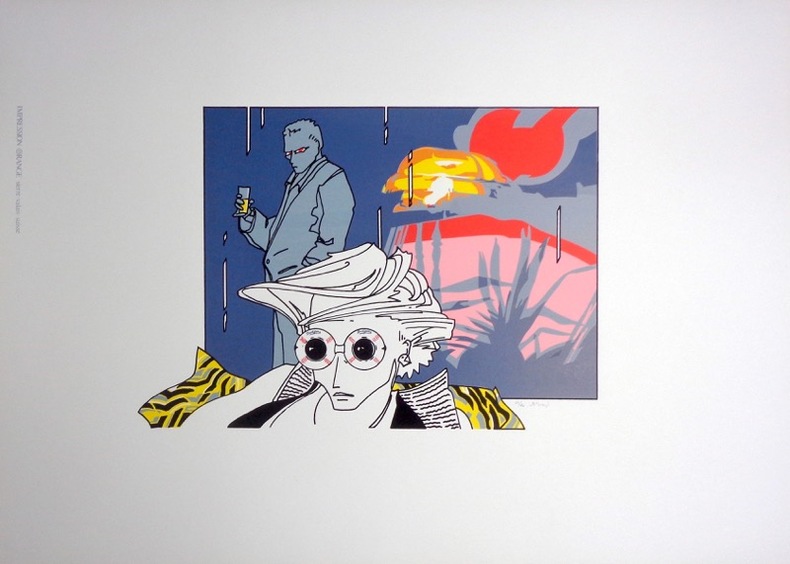
Simon (Tschopp):
[Dodgers].
Sierre, Impression Rangé. Sérigraphie au format 70 x 50 cm., à l'état de neuf.
Référence libraire : 3415
|
|
|
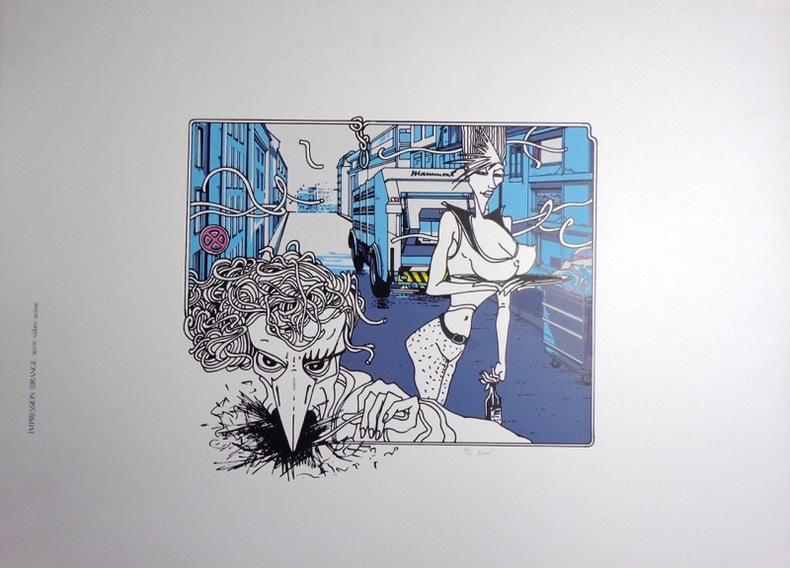
Simon (Tschopp):
[Sans titre].
Sierre, Impression Rangé. Sérigraphie au format 70 x 50 cm., légèrement salie, infime trace de pli.
Référence libraire : 3637
|
|
|

 Recevoir par e-mail
 Télécharger en PDF
 Flux RSS
 Lien permanent


