|
|
|
SACKVILLE-WEST Vita
Passaggio a Teheran
in 8°, pp. 247, 7 b., bross. edit. ill. con sguardie. Collana: Terre/Idee. Nel 1926 l'A. parte dall'Inghilterra per raggiungere Teheran dove il marito, Harold Nicolson, è consigliere del Foreign Office; l'emozione e la scoperta di un mondo incontaminato. Bordi un po' ingialliti dal tempo. 116-41

|
|
|
Sadiq Bey, Muhammad / Snouck Hurgronje, Christian / Al-Sayyid 'Abd al-Ghaffar.
[5 photographic lantern slides of Mecca and Medina (silver gelatin glass positives), taken in the years 1880 to 1889]. Stuttgart, Lichtbilderverlag Theodor Benzinger, [ca. 1910].
5 glass positive lantern slides (85 × 100 mm), each with a black paper mask, paper tape around the edges, a letterpress slip at the foot giving the publisher's name and city, and a slip at the head with the manuscript title. Stored in a contemporary purpose-made wooden box with brass fittings, with the word "Mekka" on the top of the hinged lid. Five of the earliest and best photographs of Mecca and Medina, beautifully preserved as silver gelatin glass plates, including the first photograph of the Ka'ba in Mecca's Masjid al-Haram (Great Mosque). Two of the photographs were taken by the first person to photograph Mecca and Medina, the Egyptian Colonel Muhammad Sadiq Bey (1832-1902), who made them in 1880 for the Ottoman Sultan Abdülhamid II. The others were taken by the first European to photograph Mecca, Christiaan Snouck Hurgronje, and Al-Sayyid 'Abd al-Ghaffâr, who worked closely with him. Snouck Hurgronje (1857-1936), one of the greatest pioneering Dutch Arabists, converted to Islam and lived in Mecca from January to about July 1885. The photographs by these three men are best known and most frequently reproduced from the published collotype facsimiles, while the rare surviving early albumen prints are usually faded or otherwise in bad condition. The present five plates, sold as lantern slides for magic lantern presentations, are therefore of the greatest importance as well-preserved high quality specimens of these famous photographs, providing the best early images of the mosques of Mecca and Medina. - All five slides are in very good condition, with only a bit of dust and the occasional smudge on the glass. They show: 1) The Masjid al-Haram in Mecca (the Great Mosque); 2) a closer view of the Ka'ba in Mecca; 3) the portrait of an unidentified Mu'ezzin in Mecca; 4) a portrait of an unidentified East Indian pilgrim; 5) the al-Masjid an-Nabawi in Medina (the Prophet's Mosque). Cf. D. v.d. Wal, Christiaan Snouck Hurgronje (2011); J. J. Witkam, new introduction to the 2007 reprint of the 1931 English translation of Hurgronje, Mekka.
|
|
|
Safadi (Yasim Hamid)
Calligraphie Islamique
Du Chêne 1978 petit In-4, 144 pp., broché, illustrations en noir. Une signature en page de titre
Referenz des Buchhändlers : 2434
|
|
|
SAH TAHMASB-I SAFEVÎ, (1514-1576).
Tezkire. Translated by Hicabi Kirlangiç.
New English Paperback. Pbo. Roy. 8vo. (24 x 16 cm). In Turkish. 86 p. Tezkire. Translated by Hicabi Kirlangiç. I. Tahmasb was an influential Shah of Iran, who enjoyed the longest reign of any member of the Safavid dynasty. He was the son and successor of Ismail I (Shah Ismail). PERSIAN LITERATURE Tazkira. 86 p.
|
|
|
SAHIN UÇAR.
Anadolu'da Islâm - Bizans mücadelesi.
Fine English Paperback. Pbo. Demy 8vo. (21 x 15 cm). In Turkish. 302 p. Anadolu'da Islâm - Bizans mücadelesi. Islam - Byzantine fights in Anatolia.
|
|
|
SAID NURSÎ.
Jihad of the word and positive action: Bediüzzaman Said Nursi's interpretation of Jihad in the modern age.
Very Good English Paperback. Cr. 8vo. (20 x 14 cm). In English. 17 p. Jihad of the word and positive action: Bediüzzaman Said Nursi's interpretation of Jihad in the modern age.
|
|
|
SAID NURSÎ.
Social change in Muslim societies. Studies of the Risale-i Nur: 2.
Very Good English Paperback. Pbo. 12mo. (16 x 11 cm). In English. 27, [2] p. Social change in Muslim societies. Studies of the Risale-i Nur: 2.
|
|
|
Said-Ruete, Rudolph.
Said bin Sultan (1791-1856), Ruler of Oman and Zanzibar. His Place in the History of Arabia and East Africa. London, Alexander-Ouseley, (1929).
Large 8vo. XVIII, 200 pp. With half-title, frontispiece portrait, 5 black-and-white plates, folding map and "Genealogical table of members of the Al Bu Said dynasty". Publisher's original blue cloth, title gilt on spine & upper cover, Said bin Sultan name gilt in Arabic on upper cover. Rare first edition. - Said-Ruete was the son of Princess Salma (1844-1924), daughter of Sayyid Sai’id ibn Sultan (1791-1856), ruler of Oman and Zanzibar. The Princess married Friedrich Ruete, a clerk at the German embassy, and lived for 52 years as a widow in Germany. Their son Rudolph produced this remarkable survey of his grandfather’s life and times, considered as important as Vincenzo Maurizi‘s "History of Seyd Said, Sultan of Muscat" (London 1819). Sayyid Said ibn Sultan became the ruler of Oman in 1806, when he was about 15 years of age. After defeating the opposition with British help he determined to reassert Oman's traditional claims in East Africa. He eventually succeeded, and in about 1840 shifted his capital to Zanzibar, where he introduced the cloves that became the foundation of the island's economy. He also controlled the Arab traders that brought back slaves and ivory from the African interior. In this monograph the author highlights the early history of Oman, the rise of Said ibn Sultan to power in Oman and Zanzibar, and his relations with foreign powers (France, England, and the United States). In his foreword to this work, Major General Sir Percy Cox identifies the establishment of an Arab dominion in Zanzibar as Sultan Said's most lasting achievement. - Covers a little soiled (lower cover more so); light wear to extremeties; insignificant spotting confined to flyleaves. A fine copy with ticket of The Times Book Club to lower pastedown. Provenance: from the library of Christopher Palmer Rigby (1820-85), who served as the East India Company's agent and British Consul in Zanzibar from 1858 to 1861. Macro 1986. OCLC 5705061.
|
|
|
Said-Ruete, Rudolph.
Said bin Sultan (1791-1856). Ruler of Oman and Zanzibar. His Place in the History of Arabia and East Africa. London, Alexander-Ouseley, (1929).
Large 8vo. XVIII, 200 pp. With half-title, frontispiece portrait, 5 black-and-white plates, folding map and "Genealogical table of members of the Al Bu Said dynasty". Publisher's original blue cloth, title gilt on spine & upper cover, Said bin Sultan name gilt in Arabic on upper cover. Rare first edition: presentation copy from Said-Ruete to Sir Saleh bin Ghalib Al-Qu'aiti, Sultan of Shihr and Makalla (ruled 1936-56), inscribed in green ink: "To / His Highness The Sultan / of Shiher and Makalla / Saleh bin Galib Alcaity / a token of sincere esteem / by the Author. / London, May 7th 1937". Below this is pasted a printed bookplate in Arabic. - The Qu'aiti Sultanate of Shihr and Mukalla, in the Hadhramaut region of the southern Arabian Peninsula (now Yemen), was the third largest kingdom in Arabia after the Kingdom of Saudi Arabia and the Sultanate of Oman. While the monarchy was toppled by communists in 1967 and Sultan Ghalib II was forced to abdicate, the Qu'aiti royal family still thrives in exile. - Said-Ruete was the son of Princess Salma (1844-1924), daughter of Sayyid Sai’id ibn Sultan (1791-1856), ruler of Oman and Zanzibar. The Princess married Friedrich Ruete, a clerk at the German embassy, and lived for 52 years as a widow in Germany. Their son Rudolph produced this remarkable survey of his grandfather’s life and times, considered as important as Vincenzo Maurizi‘s "History of Seyd Said, Sultan of Muscat" (London 1819). Sayyid Said ibn Sultan became the ruler of Oman in 1806, when he was about 15 years of age. After defeating the opposition with British help he determined to reassert Oman's traditional claims in East Africa. He eventually succeeded, and in about 1840 shifted his capital to Zanzibar, where he introduced the cloves that became the foundation of the island's economy. He also controlled the Arab traders that brought back slaves and ivory from the African interior. In this monograph the author highlights the early history of Oman, the rise of Said ibn Sultan to power in Oman and Zanzibar, and his relations with foreign powers (France, England, and the United States). In his foreword to this work, Major General Sir Percy Cox identifies the establishment of an Arab dominion in Zanzibar as Sultan Said's most lasting achievement. - Minimal wear to extremeties; insignificant spotting to first few leaves as common. Upper spine-end professionally repaired. A beautiful copy. Macro 1986. OCLC 5705061.
|
|
|
SAIM YILMAZ.
Anadolu'da Abbâsî - Bizans mücadelesi, (132-193 / 750-809).
New English Paperback. Pbo. Demy 8vo. (21 x 15 cm). In Turkish. 302 p. Anadolu'da Abbâsî - Bizans mücadelesi, (132-193 / 750-809). Abbasid - Byzantine wars in Anatolia, 750-809.
|
|
|
SAKHRI Mokhtar.
Gli arabi hanno tradito la Palestina?
Un libro scritto negli anni '80, tutt'ora di grande attualità. Uno studio del territorio ebraico; partendo dalle notizie fornite dai Testi Sacri per giungere alla situazione di giorni nostri. Dedica e firma di appartenenza alla prima bianca. Sei carte geografiche di Israele Brossura editoriale a stampa, pp. 170, in 8°
|
|
|
Salaberry
Storia dell'impero Ottomano dalla sua fondazione fino alla pace di Iassy nel 1792 – 9 vol.
Ottima copia
|
|
|
Saladin, Henri.
Le Yali des Keupruli a Anatoli-Hissar. Côte Asiatique du Bosphore. Paris, Société des amis de Stamboul, 1915.
Folio (375 x 485 mm). (2), 15, (3) pp. With 13 numbered lithographed plates, of which 9 are in original hand colour and 4 folded. Loosely inserted in original folder with printed decoration. One of 150 copies. Fine architectural study of Yali Körprülü, the oldest surviving seaside mansion (yali) on the Bosporus strait in Istanbul. Particularly remarkable for its detailed depictions of the rich ornaments and decor of the walls and ceilings in the residence. - The Körprülü seaside mansion is the oldest extant private residence in Istanbul. It was built in 1699 for Amcazade Hüseyin Pasa (1644-1702), a member of the Köprülü dynasty of grand-viziers in the second half of the 17th century, who was grand-vizier under Mustafa II from 1697 until his death. The residential complex he built on the Anatolian coast of the Bosporus at Anadoluhisari consisted of three mansions surrounded by gardens and orchards that extended landward. Only the assembly room (divanhane) of the men's quarters (selamlik) has survived, and today is in urgent need of repair after partial restorations performed in 1956 and 1977. - Text by the architects Henri Saladin and René Mesguich; the drawings were created under the direction of the architect M. Y. Terzian by two of his students and subsequently coloured by Saladin. With a foreword by the French naval officer and novelist Pierre Loti, who laments the decay of the Bosporus mansions and proclaims that the Körprülü yali should be "saved at all costs". - Boards slightly scratched. Paper lightly toned; occasional small marginal flaws. A good copy of this prominent work on a splendid, now largely lost example of Ottoman architecture. OCLC 10499257.
|
|
|
Salah, Nahda
Costumes and Customs From the Arab World
Dhahran Saudi Arabia: I.P.A. 1979. Classic comprehensive lavishly illustrated text presents a detailed survey of Arabic social customs and rituals; traditional costumes fashion perfumery coffeemaking marriage and divorce nomadic carpets jewellery and spirituality. Includes a short historical background of Arab culture and heritage. 124 pgs. Full color illustrations. Decorative endpapers. Small stamp and library presentation label pastedown on copyright pg. small label on lower spine; label removal mark on front cover. Considerable edgewear and rubbing to spine. Upper and lower text corners minor moisture damage- no stuck pages or text damage. Scarce. First Edition. Pictorial Hard Cover. Fair/ . Elephant Folio - over 15" - 23" tall. Ex-Library. I.P.A. Hardcover
Referenz des Buchhändlers : AR-84
|
|
|
Salahat, Muhannad
Wahidan fi al-intizar : qisas
Octavo in red and orange illus wraps; 235 p. ; 21 cm. In Arabic Short stories.
|
|
|
SALE GIOVANNI
STATI ISLAMICI E MINORANZE CRISTIANE
1^edizione - in8° - brossura editoriale - pp. 223 - collana Di fronte e atrraverso n. 858 - bibliografia - condizioni:eccellenti

|
|
|
Sale, Sir Robert H. (et al.).
The Defence of Jellalabad [...] drawn on stone by W. L. Walton. London, Joseph Hogarth, Henry Graves & Co., and sold by Hullmandel & Walton, [1845/1846].
Folio (full-sheet leaves, 54 x 36.5 cm). Lithographed frontispiece, title-page & dedication plus 5, [1 blank] pp. plus plates. With a lithographed frontispiece portrait of Sale by Thomas Fairland after a painting by Scarlet Davis, a lithographed illustrated title-page, a lithographed dedication to Queen Victoria (reproducing Sale's hand-written and signed dedication), a double-page "Plan of Jellalabad" (51.5 x 60 cm, lithographed by S. Leith in Edinburgh) and 34 tinted lithographic views of the city and its fortifications (in landscape format) on 22 leaves (10 full-page, 2 half-page and 11 pair of oblong half-page, numbered 1-11, showing the fortifications before and after repairs and improvements). All leaves are unwatermarked wove paper, the frontispiece on fine "India" paper mounted on thick paper, the plan on thin paper and all other lithographs on thick paper, that of the title-page grey. With a guard-leaf bound in facing each plate. All lithographs were probably printed by Hullmandel & Walton, though only the frontispiece and title-page name them. Gold-tooled red goatskin morocco, on 5 recessed supports (not aligned with the 6 false bands on the spine), each board with a frame of 3 gold double fillets alternating with 2 blind single fillets, with the title and author on the front board and the 2nd and 4th of 7 spine compartments, richly gold-tooled turn-ins, gold-tooled board edges, yellow endpapers, gilt edges, blue and white headbands. The first and only edition of a grand and spectacular visual presentation (there are only five pages of text) of the city of Jalalabad and its fortifications in eastern Afghanistan and related sites as far away as Kabul. The illustrated title-page (image size 45 x 35 cm) shows the tower known as Alexander's Column, with mountains and clouds in the background and several people at its foot (including two on horseback in the foreground: a British officer and turbaned man), the whole framed by palm trees, other plants and military attributes, with the title in grey sans-serif and slab-serif capitals with a white drop-shadow. The first 11 leaves of views (2 half-page and 10 full-page, the latter mostly with image size 26.5 x 37 cm) offer meticulously detailed views of sites in and related to Jalalabad, including four in and around Kabul. These show the architecture (including minarets, fortifications and the building where the British were held prisoner) as well as British and Afghan people engaged in military activities and trade. The 11 numbered plates that follow show two panoramas each (nos. 1 and 10 reproducing a hand-written caption) showing Jalalabad's fortifications before (below) and after (above) the repairs and improvements undertaken by Sale. A red line in the upper views indicates the parts that had been destroyed by an earthquake. - Although the title-page attributes the entire work to Robert Sale, the text begins with an account of the city and battle by Hamlet C. Wade, who served under him, followed by "Lady [Florentia] Sale's narrative of her prison & fellow prisoners" and eight short texts giving an account of the view on the title-page and those in the first 10 leaves of views (the 4th to 6th together and the 9th and 10th together), that for the third signed by Florentia Sale. - The grand presentation, the portrait of the author (Major General Robert Sale, who commanded the troops at Jalalabad during the 1842 battle) and the dedication to Queen Victoria suggest this volume commemorates a great success, but in fact it was only a minor and short-lived reprieve in Great Britain's foolish and disastrous First Anglo-Afghan War (1839-1842). In 1839 Great Britain hoped to put Afghanistan back under colonial control by invading it and taking Kabul, ignoring the Duke of Wellington's prescient warning that it was a foolish move, and that they would find it much more difficult to hold Kabul than to take it. The British grossly underestimated the strength of the opposition, the difficulty of the terrain and the country's anti-colonial sentiment. Forced to abandon the city after an uprising in 1841 they tried to retreat to Jalalabad but nearly all the British troops and their entourage were slaughtered in the treacherous mountain passes. Sale's troops, who futilely awaited them in Jalalabad, were surrounded and attacked by the Afghans but managed to defeat them and drive them back to Kabul. - Various sources speculatively date the present publication from ca. 1842 to ca. 1846, but at least in the present copy a footnote on the first page of the letterpress text says, "Since this has been put to press … Sir Robert Sale has gloriously fallen in the battle of Moodkee, fought 18 December, 1845 ... he was struck by a grape shot which ... proved mortal shortly after he received the wound". He died on 21 December, so the book must have been published in the last 10 days of 1845 or early in 1846. Although printed on unwatermarked wove paper, the letterpress leaves show point holes in the centres of the fore-edge and gutter margins, showing that each leaf was separately printed and each is almost certainly a whole sheet, probably of Demy format. - With an armorial bookplate showing the crest and motto ("sans changer") of the Earls of Derby, probably the 14th Earl, Edward George Geoffrey Smith-Stanley (1799-1869), Conservative Prime Minister three times in the years 1852-68. With minor foxing, slightly more in the frontispiece and much more in one full-page plate (Baba's garden, whose paper is not as thick as the others), but otherwise in very good condition. The frontispiece (together with the 2 preceding free endleaves) has separated from the bookblock, the hinges have been restored and the binding shows a few scuff marks, but the binding remains in good condition. Magnificent and detailed tinted lithographs of buildings, fortifications, terrain and life in and around Jalalabad (and Kabul) in Afghanistan ca. 1845. Thomson, The exotic and the beautiful (Bobins coll.) 268. WorldCat (3 copies?). Not in Abbey, Travel.
|
|
|
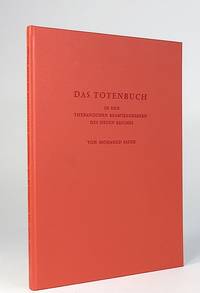
Saleh, Mohamed
Das Totenbuch in den thebanischen Beamtengräbern des Neuen Reiches. Texte und Vignetten. Archäologische Veröffentlichungen 46.
Mainz am Rhein Philipp von Zabern 1984. 1st Edition . Hardcover. . ~ ~ NOTE: THE PRICE OF THIS BOOK IS CURRENTLY REDUCED! ~ ~ . Small folio. Pp. 102. With 126 illustrations. HARDCOVER bound in the original publisher's full cloth. A BRAND NEW copy. ~ FIRST EDITION. Deutsches Archäologisches Institut Abteilung Kairo. Archäologische Veröffentlichungen 46. HATHOR-7 <br/> <br/> Mainz am Rhein, Philipp von Zabern hardcover
Referenz des Buchhändlers : 6005
|
|
|
SALEM (Jean)
Introduction à la pensée politique de Michel Chiha.
Beyrouth, Librairie Samir, 1970. Petit in-8 carré, 216 pp., notice biographique, notes, indications bibliographiques. Envoi autographe de l'auteur.
Referenz des Buchhändlers : 604740
|
|
|
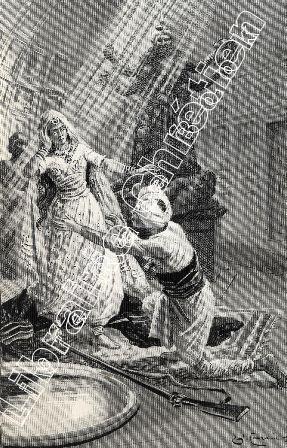
SALGARI (Emilio). CARRIER (Edmond).
Les Mystères de la Jungle noire.
Paris TALLANDIER 1926 8 Huit dessins réalisés sur des cartes à gratter signés en bas à droite, protégés par une serpente, (1925), 12.7 x 19.5 cm.
Referenz des Buchhändlers : 9035
|
|
|
SALIERNO Vito.
Iraq. Dai Sumeri a Saddam Husein. Casalvelino, Capone, 2007.
8°gr., ril. edit., soprac. ill., pp. 240 con illustrazioni n.t.
|
|
|
SALINGER PIERRE - LAURENT ERIC.
Guerra del Golfo. Il dossier segreto.
In 8°, br. edit. ill., pp. 217,(7); coll. "Fatti, testimonianze, reportages. 14"; copia molto buona. (L004/d)
|
|
|
SALLES (J.-F) [Dir.]
L'Arabie et ses mers bordières. I. Itinéraires et voisinages.
Lyon, Maison de l'Orient, 1988. In-4 broché, 199pp, cartes, qqs. ill. phot. (Séminaire de recherche 1985-1986).
Referenz des Buchhändlers : 605589
|
|
|
SALOMON, Michel
Mediterranée rouge. Un nouvel empire sovietique?
399 pag. con alcune ill.; 21,5 cm. Brossura editoriale. Discreto
|
|
|
SALVAN (General J.)
La Paix et la Guerre. Introduction générale aux problèmes de défense et de stratégie.
in-8°, 553 pp., relie carton souple illustre plastifie. Bel exemplaire (couv. leg. us.). [109B-13]
|
|
|
Salvin, Francis Henry / Brodrick, William.
Falconry in the British Isles. London, John van Voorst, 1855.
4to (29 x 19.5 cm). VII, (1 blank), 147, (1 blank) pp. With 24 hand-coloured lithographed plates by William Brodrick. Publisher's blind- and gold-blocked cloth, front board with title and large illustration of a falcon. First edition of a complete and important treatise on the art of falconry by F. H. Salvin (1817-1904), in which he describes the various species of birds used in England, both hawks and falcons. ''The best English book on falconry and a very attractive publication'' (Schwerdt). - The treatise is illustrated with lithographs by William Brodrick (1814-1888); they show 21 falcons and 5 hawks; plates 22-24 depict equipment used for falconry. The stones for the first edition were destroyed after publication so the plates for the second edition (London, 1873) had to be redrawn. - With bookplate of Leon Colin Somervell on front paste-down. Some pages and plates reinforced, two plates loose, some spotting, but still in good condition. Binding discoloured and slightly worn. Nissen, IVB 147. Souhart 419. Schwerdt II, p. 145. Wood p. 541. Not in Thiebaud.
|
|
|
Salvin, Francis Henry / Brodrick, William.
Falconry in the British Isles. London, John van Voorst, 1873.
4to. (10), 171, (1) pp. William Brodrick's copy with 3 original watercolours by him, heightened with gum arabic. 28 hand-coloured lithographed plates after William Brodrick, some heightened with gum arabic. Contemporary half green morocco, gilt. Second edition, revised and enlarged: the best edition of this handsome work. This copy, with an impeccable provenance, is enriched by the inclusion of three fine original watercolours by the eminent William Brodrick (1814-88), falconer, taxidermist, physician, and artist, whose works of avian portraiture set the standard of their times. - Provenance: "Wm. Brodrick, Little Hill, 1873" (ink inscription to front free endpaper, and a partially erased pencil inscription to title). - Occasional spotting, heavier to endpapers and half-title; spine faded to brown, corners worn, rubbed. Harting 67. Nissen IVB 147. Schwerdt II, 145.
|
|
|
Salzmann, Auguste.
Jérusalem. Etude et reproduction photographique des monuments de la ville sainte depuis l'époque judaïque jusqu'à nos jours. Planches. Paris, Gide & Baudry, 1856.
Folio (335 x 432 mm). 3 ff. of letterpress matter (half-title, title and list of plates). With 40 mounted calotypes. Contemporary marbled half morocco on five raised bands with giltstamped spine title; marbled endpapers. Second, "better known" (Parr/Badger) edition of this pioneering work, first published in 1854: only the plate volume with the 40 magnificent calotypes, wanting the separately published 90 pages of text. - Wishing to support L. F. J. Caignant de Saulcy in the controversy concerning the dating of the wall of Jerusalem that followed his journey to the Dead Sea, Auguste Salzmann set out for the Holy Land on 12 December 1853. With the help of his assistant Durheim, he prepared some two hundred waxed-paper negatives of the Jerusalem monuments during his four-month stay. While his findings were first published in a monumental volume in 1854 (the copy of the Duke de Luynes commanded 463,500 Euros at Sotheby's Paris in 2013), the present reduced edition, with prints by Blanquart-Evrard, is better known. "It was an expensive book, a livraison, or fasicle of three prints costing 24 gold francs. A single print was 10 francs [...] Salzmann was acutely attentive to both patina and pattern in attempting to define the architectural strata of a city in which building was built upon building, thus leaving a vertical record of the various cultures that had occupied the city and left their remains on the foundations built by earlier conquerors [...] Salzmann himself described his pictures as having 'a conclusive brutality', but to modern eyes their poetic aspect seems paramount. It would appear that Salzmann was at one and the same time both expert and layman, dispassionate observer and enthusiast. His pictures have this dual quality, flickering rapidly between documentary and poetry. This, one might suggest, is the ideal goal for any photographer". - Binding slightly rubbed and chafed in places. Marginal foxing throughout, affecting only a few photographs; insignificant waterstain to edge; old ownerships erased from title, leaving slight traces. Parr/Badger, The Photobook I, 25. Tobler 181f. Röhricht 440f. Baier, Geschichte der Fotografie 452f. Gernsheim, History of Photography 186. Witkin/London, Photograph Collector's Guide 86f.
|
|
|
Samad Khan Momtaz os-Saltaneh, Iranian diplomat (1869-1965).
Autograph Quotation signed ("Prince Smad"). In French. No place, July 1931.
Folio. 1 page. On uncut wove paper, bearing the Schoellers-Parole blind embossed seal, margins uncut. The original autograph contribution of Samad Khan to the Committee of the World League for Peace (Ligue Mondiale pour la Paix), a remarkable organization formed in 1925 with close ties to the League of Nations. The Committee itself was composed of such notaries as Queen Elizabeth of Belgium, King Carol II of Romania, John D Rockefeller, Marie Curie, and Albert Einstein, who personally gathered the present manuscripts over the course of seven years (1925-32). Among the public figures who contributed to the project were numerous dignitaries from the newly-created League of Nations' member states. "War, terrible in all times, has become vain and profitless today, and is equally disastrous for all involved, as even the counquering countries, as well as neutral countries, without exception, can no longer escape the suffering engendered by that calamity! The solidarity between nations has thus become fatally clear. Because of this, peace is no longer simply an ideal, it is becoming a necessity and an obligation. Even the most sceptical among us must finally give pause and reflect. Yet, how rarely are the means we choose to attain this much desired goal the most practical ones! Despite the fact that it is easy to understand that warfare and arms are merely effects, and that it is illogical to wish to avoid them while their causes persist! Can we extinguish an electric light without turning off the switch? Peace can only be seriously envisaged if it is also on a solid base, honest and practical, cemented by the work of the League of Nations, itself equipped with the effective means of intervention! Security for all, men of state and the people, should be the objective, the effect of which will be an inevitable disarmament and sincerity between nations. General fear must make way for a general trust and for faith in the respect of rights and in the future of humanity. Our civilisation owes this to itself, lest it be overcome. [Signed] Prince Smad, former Extraordinary Ambassador to London, former Persian Minister in Holland, and in France, former Premier Delegate of Persia to the Conference in The Hague and the Conference on the Revision of the Geneva Convention, and Permanent Court of Arbitration". Prince Samad was Ambassador to London, Holland, France. He personally owned the Embassy in Paris, which he made his home. Briefly Prime Minister of Persia in 1918. Pax Mundi. Livre d'or de la paix. Enquete universelle de la Ligue mondiale pour la paix sous le haut patronage de son comite d'honneur avec l'approbation de la Societe des nations, du Bureau international du travail et de la Cour permanente de justice internationale. Geneve, Societe paxunis, 1932.

|
|
|
SAMIR SALHA.
Türkiye, Suriye ve Lübnan iliskilerinde Âsi nehri sorunu.
Fine English Paperback. Pbo. Demy 8vo. (21 x 14 cm). In Turkish. [ii], 55 p. Türkiye, Suriye ve Lübnan iliskilerinde Âsi nehri sorunu. Orontes River in international relations between Turkey, Lebanon and Syria.
|
|
|
Samlali, Ahmed bin Abdullah bin Yaqub al-.
Astronomy and agriculture. [Northern Africa?, 19th century].
4to (154 x 194 mm). Arabic manuscript on paper. 120 pp. Black and red ink, 25 lines, per extensum, with several pen-and-ink diagrams in the text, some full-page. Bound in 19th century full leather with blindstamped borders and ornaments. Two works in a single manuscript by a single scribe: one a book on astronomy by Ahmad bin Abdullah bin Yaqoub al-Samlali (d. 1093 H), the other a commentary on Al-Senussi the younger. The astronomical work, extensively illustrated with detailed diagrams, also contains horoscopes and information on the best times of the year for cultivating the soil. - Binding rubbed; extremeties bumped, chipped and frayed; some traces of worming to upper cover; old repairs to spine. Paper browned and brittle; some brownstaining and occasional worming (mainly confined to margins), a few paper repairs in the margins.
|
|
|
Samuel, Herbert.
Zionism. Its Ideals and Practical Hopes. London, The Zionist Organisation, [1920].
8vo. 6, (2) pp. Contemporary blue printed wrappers. A speech given by the British politician Samuel, appointed High Commissioner of Palestine in 1920, at a meeting led by the English Zionist Federation, celebrating the second anniversary of the Balfour declaration, "which stated that the Government favoured the establishment of a Jewish National Home in Palestine". - Minor flaws to the edges, not touching text. OCLC 504623804.
|
|
|
Sani-zade Mehmed Ataullah.
[Hamse-i Sânizade]. Kostantiniye (Istanbul), Tabhane-yi Sahane / Dar üt-Tibaat ül-Amire (Imperial School of Medicine), [1820 CE] = 1235 H.
Folio (208 x 289 mm). 3 parts in 1 volume: 4 (instead of 8?) pp. of preliminaries (blank, alif, ba, gim); 131, (1 blank) pp. and 80 pp. (bound alternatingly), with 56 etched plates; 39, (1 blank) pp.; 283, (1 blank) pp. Contemporary half calf with gilt-stamped spine and marbled covers. The first edition of the first illustrated medical book ever printed in the Muslim world: the pioneering Ottoman physician Sanizade's (1771-1826) medical compendium, the first three books (on anatomy, physiology, and internal medicine) of what would later be known as "Sani-zade's Canon of Five", "Kitâb ül-evvel fi t-tesrihât" ("Mir'âtül-ebdân fî tesrih-i a'zâil-insân"), "Kitab üs-sânî fi 't-tabîyat", and "Kitâb üs-sâlis Miyâr ül-etibbâ". This was one of the earliest Turkish medical works to draw thoroughly on western, Paracelsian and Vesalian science: indeed, it is modelled on and partly translated from Italian and German sources, such as Anton Störck, Bartolomeo Eustachi, Gabriele Fallopio, and Costanzo Varolio, reproducing anatomical illustrations from a variety of sources including Vesalius. - "[B]y and large Ottoman medicine remained [...] attached to its Galenic roots. [...] Real paradigmatic change began to appear only with the upheavals of 19th-century reforms, when translations and adaptations of new European knowledge made their way to the core of the medical profession. One of the first books to spark this revolution was Ataullah Sanizade's compendium 'Hamse-i sanizade', a series of five books published in Ottoman Turkish from 1820 onward, incorporating new medical knowledge from Europe. Sanizade was a brilliant and innovative physician and theorist (as well as musician, astronomer, and historian) who did much to integrate new medical knowledge with the old. His views on medicine encountered much opposition, mainly because of his support for surgery-based study of anatomy. As a result his request to dedicate his chef d'oeuvre to Sultan Mahmud II was denied. In time, however, the compendium came to replace the earlier canonic texts, and was fondly named 'kanun-i sanizade' (Sanizade's canon), referring, of course, to the old master's 'Qanun'. Although the compendium formally adhered to the humoral system and other concepts of ancient medicine, it was here that blood circulation was mentioned for the first time as a scientific concept and as part of a different medical theory. Some of the terminology included in this book formed the basis for a new medical profession that was beginning to take shape" (D. Ze'evi, Producing Desire [2006], p. 20f.). A five-volume Arabic edition appeared at Bulaq in 1828 by direct order of Mehmet Ali. - Part 1 bound as follows (agreeing with the copy in the BSB Munich): 4 pp. of prelims (blank, alif, ba, gim); 3, (1) pp., (2 plates), 2 pp. [index], 5-34 pp., (17 plates), 3-22 pp. [index], 35-68 pp., (9 plates), 23-35 pp. [index; pp. 25-28 numbered 3-6 in error], 1 bl. p., 69-94 pp., (12 plates), 37-48 pp. [index], 95-100 pp., (6 plates), 49-55 pp. [index], 1 bl. p., 101-106 pp., (3 plates), 57-60 pp. [index], 107-120 pp., (5 plates), 61-70 pp. [index], 121-128 pp., (2 plates), 71-80 pp. [index], 129-131 pp., 1 bl. p. Some dampstaining throughout, more prominently so in several plates. In all, a good copy of this rare work, the only edition published during the author's lifetime. OCLC 608102180.
|
|
|
Sanson, Nicolas.
Estats de L'Empire du Grand Seigneur des Turqs ou Sultan des Ottomans en Asie, en Afrique, et en Europe. Paris, 1654.
Engraved map (42 x 56 cm), coloured in outline. Map of the Turkish Empire, showing Ottoman possessions in the Balkans, Eastern Mediterranean, Egypt and Arabia and marking topography and settlements. Al Ankary 59. Al-Qasimi 60. Tibbetts 99.
|
|
|
Santagata, Fernando
Industria e commercio in Egitto.
Br., cm16.5x21.5, pp (4) 54 (2), Coll. Quaderni de La Rivista d’Oriente #1.

|
|
|
Sanusi, Muhammad (ibn 'Uthman) as- / Shanufi, 'Ali (ed.).
[Ar-rihla al-hijaziyya]. Ar-rihla al-higaziyya. Relation de voyage au Higaz. Texte arabe établi et annoté avec introduction en français [...]. Tunis, Societé Tunisienne de Diffusion, 1976-1981 CE = 1396-1402 H.
3 vols. Large 8vo (178 x 245 mm). 344, (1), 15 pp. 557, (3) pp. (3)-400, (4) pp. All with a portrait frontispiece and numerous halftone illustrations throughout. Printed original wrappers (Arabic cover printed in green and black). - Includes: Chenoufi (Shanufi), Ali. Un savant Tunisien du XIXème siècle: Muhammad As-Sanusi. Sa vie et son oeuvre. Tunis, Imprimérie Officielle, 1977. 8vo. 244, (4) pp. With portrait frontispiece and several halftone illustrations. Printed original wrappers. First edition of this valuable account of a 19th century Hajj. - Muhammad as-Sanusi was an important law teacher at the University of Ez-Zitouna in Tunis, remembered as a scholar who was part of the late-19th century "Nahdha" Muslim reformist movement. Dismissed from civil service in 1881 for opposing the French Protectorate in Tunisia, he decided to undertake the pilgrimage to Mecca in 1882/83. His journey took him to Hejaz via Italy, Turkey, Syria, Lebanon, Egypt and finally back to Tunisia via Malta. He kept extensive notes on the customs of the countries visited, the persons he met, and the technological advances of Europe - particularly describing the railway, which in his opinion made it possible to "bring cities and believers closer together". His manuscript travel diary, a valuable perspective by a North African outsider on his Western and Middle Eastern contemporaries, was long neglected until it was rediscovered and published for the first time in 1976. - Bindings a little rubbed and bumped, but altogether a good, unmarked set. Includes the biography of As-Sanusi by the editor of his travelogue, the Tunisian scholar 'Ali Shanufi. Mahfoudh III, 251 A. Abdesselem, Historiens Tunisiens, 407 ff. OCLC 10523199, 6247132.
|
|
|
SARAFIAN (Ara)
Talaat Pasha's Report on the Armenian Genocide, 1917.
London, Gomidas Institute, 2011. In-8, broché, couv. ill., 70 pp., 2 cartes en couleurs sur un feuillet volant.
Referenz des Buchhändlers : 557027 ISBN : 1903656617
|
|
|
SARKISIAN (E.K.), SAHAKIAN (R.G.)
Vital issues in moderne armenian history. A documented exposé of misrepresentations in turkish history.
Watertown, Armenian Studies, 1965. In-8 broché, 82 pp., 2 cartes dans le texte.
Referenz des Buchhändlers : 556850
|
|
|
SARKISYANZ (Manuel)
A Modern History of Transcaucasian Armenia. Social, cultural and political.
Privately printed for the author by Udyama commercial Press, Nagpur, India, 1975. In-8, rel. demi-toile rouge sous jaquette ill., XVI-413 pp., texte anglais, notes et index.
Referenz des Buchhändlers : 556120
|
|
|
Sarre, Friedrich (ed.).
Islamische Bucheinbände (Buchkunst des Orients I). Berlin, Scarabaeus, (1923).
Folio (270 x 360 mm). 167 pp., final blank page. With 4 illustrations in the text, and 36 numbered plates with mounted full-color reproductions of Islamic book bindings, included in pagination. Text and plates with gilt borders. Contemporary cardboard with 6 gilt ornaments, 3 each to upper and lower cover. Edition "B" of this sumptuous work on Islamic bookbinding. Exhibits some of the finest and most valuable tomes from Berlin's Bode Museum as well as examples from a private collection. Bound in the original adorned binding, the giltstamped ornaments featuring floral motifs as well as a hunting scene of a lion attacking a bull. - A total of 36 bindings are here reproduced in excellent colour facsimiles, impressively demonstrating the high quality of Egyptian, Persian, and Turkish book production from the 14th to 19th centuries. Each specimen is accompanied by a page of descriptive text. - Edited by the German orientalist and art historian Sarre (1865-1945), who amassed a great collection of Islamic art during his lifetime. - Extremities somewhat rubbed. Interior in excellent condition. Mejer 554. OCLC 905430423.
|
|
|
Sarre, Friedrich / Trenkwald, Hermann.
Alt-Orientalische Teppiche. Herausgegeben vom österreichischen Museum für Kunst und Industrie. Vienna & Leipzig, Anton Schroll & Karl W. Hiersemann, 1926.
Imperial folio (600 x 450 mm). 2 vols. 21, 43 pp. With 120 plates (67 of which in full colour). Original half calf with marbled boards and gilt title to spine. First edition. "A milestone publication based on the earlier pioneer works published by the Museum [...] Documentation and technical notes on each carpet. Magnificent illustrations" (Arntzen/Rainwater). Includes a bibliography on oriental carpets and additional examples of oriental rugmaking previously unknown and not published in Martin's 1908 monograph. - A nicely bound copy, interior clean and spotless throughout. Arntzen/Rainwater P629. Enay/Azadi 517.

|
|
|
Sarre, Friedrich / Trenkwald, Hermann.
Alt-orientalische Teppiche. Vienna & Leipzig, Anton Schroll & Co. and Karl W. Hiersemann for the Österreichisches Museum für Kunst und Industrie, 1926-1928.
Imperial folio (440 x 605 mm). 2 vols. bound as four. 21, (3), (29) pp. (31) pp. 43, (28) pp. (32) pp. With 120 collotype plates (67 colour and 53 black & white, 7 of the latter double-page) by Max Jaffé, and 14 wood-engraved full-page illustrations on the integral leaves. Later half calf with cloth sides. First and only edition of "the most important recent publication with wonderful reproductions of the best known carpets" (Ettinghausen 1936), here in very good condition, rebound in four high-quality half calf volumes. The project was initiated by the Austrian Museum for Art and Industry, which had previously published two other works on carpets: "Orientalische Teppiche" (1892) and "Altorientalische Teppiche" (1908). The present work by Sarre & Trenkwald has far more and better illustrations than the earlier works, with 120 fine collotype plates. The authors were highly regarded authorities in the field of Islamic art, especially Friedrich Sarre (1865-1945), "without doubt one of the most influential figures regarding the scholarly formation of Islamic art" (Kadoi/Szanto). He was the director of the Museum für Islamische Kunst in Berlin and responsible for the formation of the "most comprehensive collection of Islamic art outside the Islamic world". - The work is characterized by an emphasis on the technique of production. The plates that depict carpets in colour and black & white are preceded by a descriptive page that is sometimes illustrated with a schematic explanation of the knotting technique used for making the carpet. The first part, by Hermann Trenkwald, with 60 plates, is entirely devoted to carpets in the world-renowned collection of the Austrian Museum. The second part, by Sarre, also comprising 60 plates, covers the greatest carpets in other collections throughout the world, including private collections such as that of Baron Maurice Rothschild. - Corners slightly bumped, but in very good condition. R. Ettinghausen, Kali (1936), p. 110. Kadoi & Szanto, The Shaping of Persian Art (2014), p. 227.
|
|
|
Sarrou, Auguste, French intelligence officer (1874-1968).
The archive of Auguste Sarrou. Mainly Near and Middle East, mainly 1917-1923, with earlier and much later supplementary material.
Various sizes (folio, 4to, 8vo). A total of 460 typescript and 177 manuscript pp. (9 of which comprise merely 2 lines) in 26 fascicles, assembled as 11 portfolios. With a few newspaper clippings as well as 1 photograph each of Hagia Sophia and the gate of Dolmabahce Palace, mounted on cardboard as postcards. A highly important and extensive archive from the secret personal papers of General Auguste Sarrou, France's chief spymaster in the Levant and Turkey during the critical period between 1917 and 1923, when the Near and Middle East were completely re-ordered following the demise of the Ottoman Empire. It features numerous "top secret" spy reports, correspondence and dossiers of political analysis, providing stellar insights into France's central role in shaping the destiny of Syria, Lebanon and Turkey, working to counteract the forces unleashed by Lawrence of Arabia during the Arab Revolt. - The present archive consists of dozens of classified intelligence reports, political masterplans and field notes. Most of the documents are typescripts or carbon copies of typescripts (many written by Sarrou), intended for distribution amongst only the most senior French military and political officials. The documents span Sarrou’s entire career, dating from 1908 to the 1960s, although the bulk of the documents concern the critical period from 1917 to 1923. It includes a typescript copy of Sarrou’s autobiography, written at the end of his 60-year-long career in espionage and diplomacy in Turkey, the Balkans and the Middle East; a series of papers relating to Sarrou’s time serving as a gendarme in Macedonia in the decade prior to World War I, when he notably befriended many leaders of "Young Turks"; and a further series of papers outline his secret "Mission d’Orient", a grand operation to support French ambitions in Syria, Lebanon and Anatolia. Furthermore, a series of highly important and secret analytical reports written by Sarrou provide a "game plan" for how France was to rule Syria and Lebanon (importantly, the Quay d’Orsay largely followed Sarrou’s advice as matters unfolded). Notable is Sarrou’s brutally unflattering assessment of Emir Faisal, Lawrence of Arabia’s old comrade. Additionally, there is an intriguing manuscript report of a meeting held between Arab intellectuals and Djemal Pasha, the Ottoman War Minister, the day before the fall of Damascus, as well as a series of fascinating reports concerning the 1921 attempt on the life of General Henri Gouraud, the French High Commissioner for Syria and Lebanon. Another series of 25 typescript "Secret" intelligence reports compiled by the Service des informations de la Marine dans le Levant (S.I.L.) in Port Said in 1918 and 1919 contain fascinating raw field intelligence on Anti-French elements throughout the Middle East, as well as the efforts of French assets to counteract these forces through counterespionage and propaganda. A diverse collection of typescript and manuscript research documents, as well as correspondence from key assets, assembled by Sarrou from 1919 to 1922, is supplemented by a series of highly insightful typescript reports, written by Sarrou to advise the French government on the situation in Turkey from 1921 to 1931, covering the rise of Atatürk’s new republic and French efforts to gain influence in Ankara. Finally, there is a collection of letters, documents and postcards from Sarrou’s mid to later career, from the late 1920s until his retirement in the mid-1960s. - Many of the elements of the present archive are likely unique survivors, while a couple examples of some of the typescripts may exist in various French official archives. A detailed list is available upon request.
|
|
|
Sarton, George.
[Al-Thaqafah al-gharbiyah fi riayat al-Sharq al-'Awsat]. The Incubation of the Western Culture in the Middle East. Beirut, Maktabat al-Ma'arif / Luzac, 1952.
8vo. 80 pp. Original printed wrappers with English title on the lower cover. An academic lecture delivered in 1950 by Havard history professor George Sarton (1884-1956), translated into Arabic by Dr. Omar A. Farrukh, a prolific academic translator and member of the Islamic Research Association, Bombay. George Sarton was considered the founder of the history of science as an independent discipline, and was a proponent of indisciplinary approaches, including not only the combination of scientists and historians, but historians of both Latin and Arabic scientific literature, two traditionally independent disciplines. The topic of the lecture, the so-called "incubation" of Western culture, refers to the Islamic Golden Age, during which Muslim scientists studied Ancient Greek mathematics and natural philosophy and made many of their own interpretations and additions. It was the resulting plethora of Arabic scientific texts which then went on, when translated into Latin, to spark the Italian Renaissance and the "re-birth" of Greek learning (though it was by that time as much Muslim as Greek) in the West. Sarton was among the first modern Westerners to make this connection and to highlight the importance of Arabic literature, making this particular lecture an important building block of the history of science as a discipline. - Light wear and toning, in good condition. OCLC 30183109.
|
|
|
Sasson, Jean P.
Tradita.
La testimonianza sconvolgente e terribile di una donna irachena che è stata torturata nelle prigioni di Saddam Hussein.
|
|
|
Satsvarupa dasa Goswami -
Nimai Dasa and the Mouse -
1999. Hardcover. Good. Hardcover/pub. 1999/Gd. condition/171 pages - A Fable. D13677z hardcover
Referenz des Buchhändlers : 3677z
|
|
|
Sattin, Anthony
The Young T. E. Lawrence
No marks or inscriptions. A very clean very tight copy with bright unmarked boards, wrinkling to one page fore-edge and no bumping to corners. Dust jacket not price clipped or marked or torn with crease to rear dust flap. 316pp. Detailed study of Lawrence around his twenties, his early life and what led up to the man becoming known as Lawrence of Arabia.

|
|
|
Saud bin Abdulaziz Al Saud, King of Saudi Arabia (1902-1969).
Portrait photograph. London, 1935.
Albumen print (vintage), hand-coloured and raised in gilt and opaque white. Matted (ca. 280 x 360 mm) and framed (ca. 530 x 640 mm). Signed "Lafayette" on the mat. His Royal Highness Saud of Saudi Arabia, second son of and immediate successor to Abdulaziz Ibn Saud, the founder of Saudi Arabia, as a young prince. A fine, splendidly hand-coloured portrait by Lafayette Studios, Photographers Royal and among the world's most prestigious studios of the early 20th century. - In immaculate condition.
|
|
|
Saudi Arabia - Mineral Investigations.
Mineral Investigations Maps. Jeddah, Ministry of Petroleum and Mineral Resources [Mudiriyah al-'Ammah lil-Tharwah al-Ma'diniyah], 1966-1967 and 1969.
Collection of 14 maps (nos. MI 1-13 and MI 18). Mostly in full colour; various sizes but mostly ca. 70 x 100 cm; scale mostly 1:100,000 (MI 3: 1:250,000; MI 6: 1:2,470 [b&w]; MI 7: ca. 1:1,600 [b&w with red overlays]; MI 8: 1:800 [b&w with red overlays]; MI 9: set of 2 maps [ca. 1:2,340 and 1:1,200] and 1 cross-section [all b&w, maps with red overlays]). All folded in original brown printed envelopes. 14 maps of the 25-map series published between 1966 and 1971, including the complete set of the first 13 maps. Many photomaps based on aerial reconaissance and photomosaics, showing geological or geochemical information. Some sheets include location diagrams, text, notes, cross sections, charts, index map, and insets. The mapped resources also concern ancient gold mines. Among the credited cartographers are some Arabian scientists, but mainly Americans: James Mytton, Robert F. Johnson, Virgil A. Trent, C. W. Smith, J. Kouther, M. Q. Asad, Gerrit Eijkelboom, Mohammed Gendi, Bernard Henry, Xavier Leca, Mohammed Shanti, Phillippe Delange, and Jean Pflaum. Abdullah O. Ankary contributed to the text of several maps, and much of the geology is based on work done in the 1950s and early 1960s by Glen F. Brown, one of the pioneers of the partnership between the U.S. Geological Survey and the Saudi government which began in the 1940s, spanned the next five decades and played such an important role in the development of the kingdom. The map and envelope design closely match that of the geological maps of Saudi Arabia issued by the USGS since the 1950s. - Perfectly preserved. OCLC 977893902.
|
|
|
Saudi Arabia.
Jabrin. GSGS 2555. Asia. North F-39. [London], War Office, 1950.
865 x 635 mm. Scale: 1:1,000,000. First edition, sales copy.
|
|
|

 Per e-mail erhalten
 Als pdf-Dokument herunterladen
 RSS feed
 Permanenter link


