|
|
|
YRWIN (Eyles )
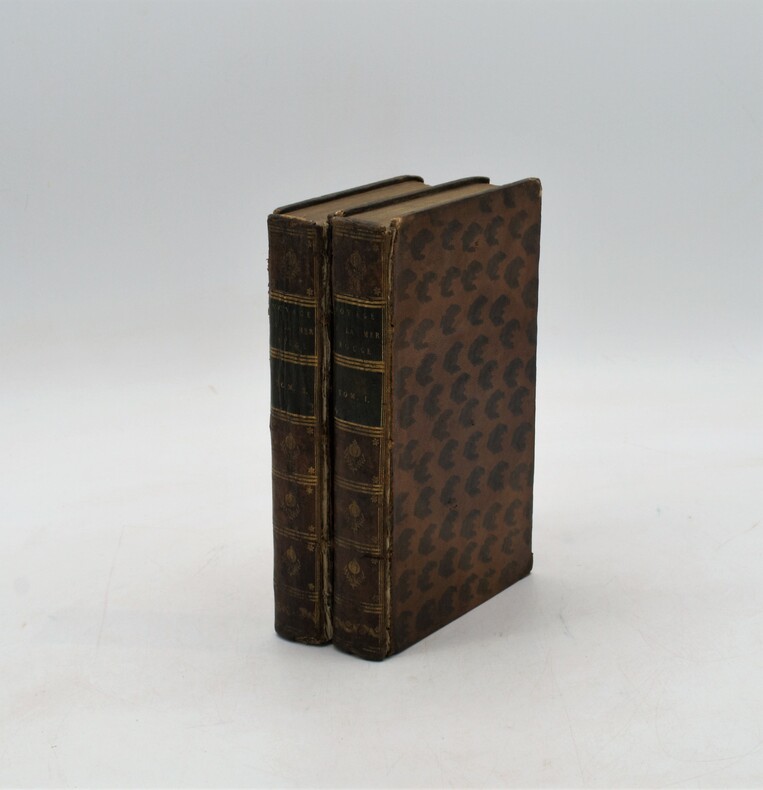
Voyage a la mer rouge, sur les cotes de l'Arabie, en Egypte, et dans les deserts de la Thébaide; suivi d'un autre, de Venise, Alep, les déserts, etc.
Chez Briand, à Paris 1792, 2 tomes en 2 Vol. in-8 (13,5x21,8cm), (2) vj, 440pp. et (2) 483pp., relié plein basane tacheté , dos lisse orné avec pièces de titre et tomaison vertes , ex-libris manuscrit , coiffes et coins usés , charnières fendues , vieilles mouillures avec quelques traces .
Referenz des Buchhändlers : PHO-1241
|
|
|
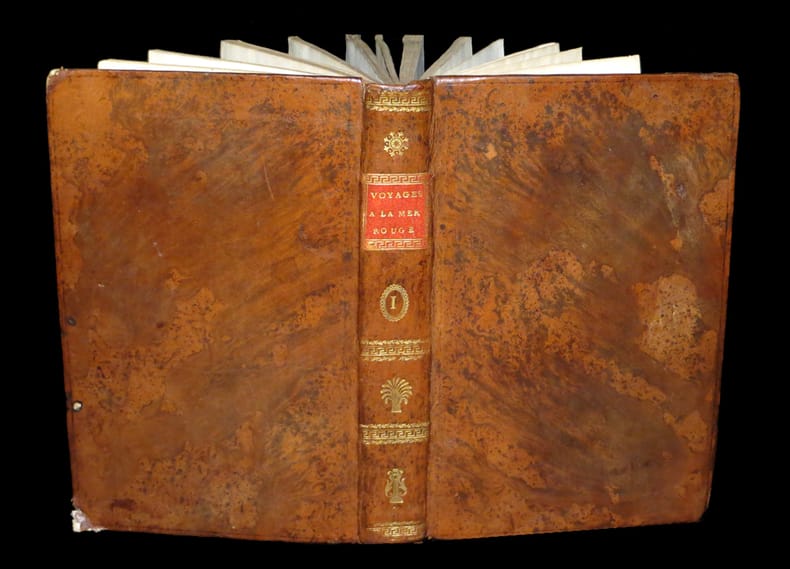
YRWIN ou IRWIN (Eyles).
Voyage à la Mer rouge, sur les côtes de l'Arabie, en Egypte et dans les déserts de la Thébaïde.
A Paris, chez Briand, 1792. Un fort vol. au format in-8 (201 x 132 mm) de 2 ff. n.fol., vi - 440 pp. Reliure de l'époque de pleine basane racinée brune, filet à froid encadrant les plats, dos lisse orné de filets dorés, roulettes dorés, larges fleurons stylisés dorés, pièce de titre de maroquin cerise, titre doré, tranches mouchetées.
Referenz des Buchhändlers : 21421
|
|
|
YUSUF NÂBÎ (URFALI), (1642-1712).
[A BRILLIANT TRAVEL ACCOUNT OF MECCA AND MEDINA AND VOYAGE TO HEJAZ] Tuhfetü'l-haramayn. [i.e. A gift to Haramayn; Mecca and Medina].
Very Good Turkish, Ottoman (1500-1928) In contemporary fine black 1/3 leather bdg. Decorated gilt to spine. Roy. 8vo. (23 x 16 cm). In Ottoman script (Old Turkish with Arabic letters). 112 p. Extremely rare first edition of this Nabi's first-hand account of Mecca, Medina and the Hejaz during his pilgrimage in the late 17th century. This is the most celebrated literary pilgrimage narrative written in Ottoman Turkish. Nabi (1642-1712) was one of the prominent Ottoman poets and is considered a foremost exponent of the didactic trend (hikem-i tarz) in Ottoman Turkish literature. Nabi, whose given name was Yusuf, was born in Urfa (then known as Ruha) in 1052/1642. In 1082/1671 he took part in the Ottoman military campaign in Poland, in the retinue of Müsahib Pasha, (1640-1686). Having spent thirteen years in Istanbul, Nabi desired to go on a pilgrimage to Mecca. He was personally ready to undertake a journey to the Hijaz and to set down an eloquent account of his journey, the experience of his lifetime. Accordingly, having achieved a position of good standing with his patrons, Müsahib Mustafa Pasha and Mehmed IV, Nabi revived his longstanding desire to perform the hajj. In 1089/1678, at around 37 years of age, he set out in a small private caravan from Istanbul, passing through Konya, Urfa, Damascus, Jerusalem and Cairo, where he joined the main Egyptian pilgrimage caravan. The work, which is one of the most successful examples of Ottoman insa (artistic prose), includes historical, sociological, geographical and autobiographical information. In his preliminary remarks, Nabi indicates that he had received governmental help for his journey. He relates that he first obtained leave for the hajj from his patron Musahib Mustafa Pasha, and then submitted a qasida to Mehmed IV, describing the sacred places. The sultan provided Nabi a letter of recommendation addressed to Abdurrahman Pasha (d. 1691), governor of Egypt, ordering him to enable Nabi to make a comfortable journey. Nabi traveled in a small private caravan, since the caravan extended its route to Nabi's homeland, Urfa, and spent about fifty days there. It appears that he generally followed the usual route of the pilgrimage caravan from Istanbul to Damascus, passing through Scutari, Kartal, Gebze, Hersek, Iznik, Eskisehir, Seyitgazi, Aksehir, Ilgin, Ladik, Konia, Eregli, Adana, Misis bridge, Payas, Antioche, Aleppo (with a long detour to Urfa (Edessa) and back to Aleppo via Aintab), Hama, Hims and the Kuteyfe strait. He was fascinated with the splendid architecture of the buildings, the bazaars and the mosques built side by side by Kurdish and Circassian rulers and the Nile when he arrived in Cairo. Nabi gives a general description of the city of Cairo, the Nile, the two reservoirs of the city, parklands, the Ahram hills and the immediate neighborhood of the city. In Mecca, Nabi visited the sacred sites enthusiastically and performed the hajj on 77 January 1679. He gives a moving account of his experience as a pious emotional pilgrim. It appears that Nabi stayed in Mecca for more than twenty days. Immediately after 1 Muharrem 1090/12 February 1679, he set out for Medina, presumably in the Damascus caravan. While in Medina, Nabi served at the tomb of the Prophet by lighting the candles since his name was on the honorary list of attendants who were determined by the central government to serve the sanctuaries in Mecca and Medina. Nabi regards these services as a testimony to the legitimacy of Ottoman rule. He summarizes his journey of return from Medina to Damascus and to Istanbul in a few general words. Özege 21267.; Not in OCLC.
|
|
|
ZAVIE Émile (Émile BOYER, Die 1884 - Paris 1949).-
D'Archangel au Golfe Persique. Aventures de cinquante Français en Perse.-
Le Roman Français d'Aujourd'hui.. Paris. Cité des Livres. 1927. In-8 (143 x 195mm) broché, couverture verte à rabats, 4ff., 358, (1) pages. Ouvrage tiré à 1095 exemplaires, celui-ci n°1016, un des 1000 sur vergé d'Arches. Pâles piqûres sur le 1er feuillet blanc et sur le fx-titre, sinon bel exemplaire.
Referenz des Buchhändlers : ORD-17376
|
|
|
ZEGHIDOUR, Slimane (Texte) :
La Mecque. Au coeur du pèlerinage. Photographies d'Ali Marok.
Paris, Larousse /Vuef/Prisma Presse/Geo, 2003, gr. in-4to, 190 p., rich. ill. de superbes prises photogr. en couleurs, cartonnage original ill. en couleur, jaquette couleur. Ex. Neuf.
Referenz des Buchhändlers : 67111aaf
|
|
|
ZEGHIDOUR, Slimane.
La vie quotidienne a la Mecque de Mahomet a nos jours.
Hardcover in-8, 446 pages, illustrations en noir, cartonnage sous jaquette illustrée. Très bon état. [BL-5]
|
|
|
Zur Nedden, Otto C. A
T. E. Lawrence (Lawrence von Arabien). Die Legende seines Lebens für die Bühne gestaltet.
Wuppertal-Barmen, Fr. Staats, (1958). 173 S. Mit einigen farb. Randillustr. 20 cm. OLn.
Referenz des Buchhändlers : 70022

|
|
|
ZWEMER (Samuel Marinus)
Arabia : th cradle of Islam. Studies in the geography, people and politics of the peninsula, with an account of Islam and mission-work. Introduction by Rev. James S. Dennis. Third edition, revised
Edimbourg-Londres, Oliphant, Anderson & Ferrier, s.d. (1910) in-8, [3] ff. n. ch., 436 pp., avec des figures dans le texte, 18 planches hors-texte, et deux cartes dépliantes, dont une aux contours rehaussés de couleurs "in fine", toile orange, dos et plats illustrés (reliure de l'éditeur). Dos insolé.
Referenz des Buchhändlers : 204775
|
|
|
ÖMER YALÇINKAYA (in cooperation with The National Bank of Kazakhstan).
The banknotes of Kazakhstan.
New English Original bdg. HC. 4to. (31 x 23 cm). In English. 152 p., color ills. "This book focuses on the banknotes of Kazakhstan with respect to their cultural, historical and technical content. It also tells the little known history of how Kazakhstan became one of the best producers of banknotes in the world in less than 20 years time." "Kazakhstan has been an eager adopter of innovative anti-counterfeiting technologies, including many firsts in world banknotes. Collectors everywhere will appreciate adding this book to their numismatic libraries as the first specialized reference to the nation's beautiful and groundbreaking new notes." (Owen W. Linzmayer, Publisher of the Banknote Book). Contents: Introduction.; Acknowledgements.; H. E. Nursultan Nazarbayev the First President of the Republic of KAzakhstan, his bright vision on the news technologies and innoivation.; Mr. Grigoriy Marchenko, the governor...; Historical characters depicted on the banknotes of Kazakhstan.; Technical definitions of the Security Features used on the banknotes of Kazakhstan.; Regular issues: 1993 - Tenge, 1993 Tiyn, 1994, 1996, 1998, 1999, 2000, 2001, 2003, 2006, 2011-2012 issue: Commemorative banknotes of Kazakhstan...".
|
|
|

 Per e-mail erhalten
 Als pdf-Dokument herunterladen
 RSS feed
 Permanenter link
