|
|
|
ATILLA ILHAN, FAZIL HÜSNÜ DAGLARCA, MELIH CEVDET ANDAY, BEHÇET NECATIGIL, CAHIT KÜLEBI, TAHSIN SARAÇ, NECDET EVLIYAGIL, YEKTA GÜNGÖR ÖZDEN, ÜMIT YASAR etc.
Atatürk et son oeuvre dans la poesie turque d'aujourd'hui. Compiled by Nimet Arzik.
Very Good English Paperback. Pbo. Cr. 8vo. (20 x 14 cm). In French. 194 p. A compilation of poems related to Ataturk. Atatürk et son oeuvre dans la poesie turque d'aujourd'hui. Compiled by Nimet Arzik.
|
|
|
ATILLA ORAL.
Charles Harington: Sömürge Valisi'nin himayesinde Vahdettin'in isgal Istanbul'u.
New English Paperback. Pbo. Roy. 8vo. (24 x 17 cm). In Turkish. [xiv], 498 p., color ills. Charles Harington: Sömürge Valisi'nin himayesinde Vahdettin'in isgal Istanbul'u. Study on Constantinople during the occupation by the Allied Forces in 1919. Part of the book (pp.2-84) is the translation of General Sir Charles Harington (1872-1940), Commander of the British Forces in Constantinople, memoirs. The translation includes the section on Turkey of his memoirs entitled Tim Harington Looks Back. OTTOMANIA Istanbul Constantinople International relations World War 1 Memoirs Biography.
|
|
|
ATINÇ EMNALAR.
Türk müziginde koro. Koro kavrami ve tarihçesi, Bati müziginde korolar, Türk halk ve Türk sanat müzigi korolarinin kurulus, hazirlik, yönetim, program, repertuvar ve teknikleri.
Fine English Paperback. Pbo. Roy. 8vo. (24 x 17 cm). In Turkish. [8], 190 p., b/w ills. First and Only Edition. Türk müziginde koro. Koro kavrami ve tarihçesi, Bati müziginde korolar, Türk halk ve Türk sanat müzigi korolarinin kurulus, hazirlik, yönetim, program, repertuvar ve teknikleri. Choir in Turkish classical and folk music. A history of chorus, choir in western music, choir in Turkish classical and folk music, their setting up, management, program, repertoir and techniques.
|
|
|
ATLAS TARIH.
Fotograf ve kartpostallarda II. Abdülhamid ve 31 Mart Olayi.
As New English Original bdg. Mint. Oblong Cr. 8vo. (14 x 20 cm). In Turkish. Color and b/w ills. Sultan II. Abdulhamid and 31 March Incident with postcards and photographs. Fotograf ve kartpostallarda II. Abdülhamid ve 31 Mart Olayi.
|
|
|
ATOM DAMALI.
150 devlet 1500 sultan. Islam sikkeleri.
New English Paperback. Pbo. Large 8vo. (20 x 20 cm). In Turkish. [6], iv, 422 p., b/w ills., 10 folding maps. A general view of Islamic coins: 150 States 1500 Sultans. 150 devlet 1500 sultan. Islam sikkeleri.
|
|
|
ATOM DAMALI.
A'dan Z'ye Osmanli nümismatik el kitabi.
Very Good English Original bdg. HC. Oblong large 8vo. (21,5 x 21,5 cm). In Turkish. 234 p., color ills. A comprehensive study on Ottoman numismatics. A'dan Z'ye Osmanli nümismatik el kitabi.
|
|
|
ATOM DAMALI.
History of Ottoman coins.= Osmanli sikkeleri tarihi. Vol. 1.
New New English Original bdg. Dust wrapper. 4to. (30 x 21,5 cm). In English and Turkish. 240 p. Color ills. First Volume covers the Ottoman coins from Osman I to Suleiman I. In the first volume of the series; The Ottoman mints and coin production techniques are described in detail Coding and classification of Ottoman coins are established Inscriptions on Ottoman coins are listed in Ottoman Turkish, Turkish and English Variations of weight of Ottoman coins are analyzed Important milestones in Ottoman coin production is researched In the series that is expected to be completed in 8 volumes;Chronological events are listed for each Sultan A short description of historical events summarized.
|
|
|
ATOM DAMALI.
History of Ottoman coins.= Osmanli sikkeleri tarihi. Vol. 2.
New New English Original bdg. Dust wrapper. 4to. (30 x 21,5 cm). In English and Turkish. [10], [iv], 440-767 pp. Color ills. The 2nd volume of "History of Ottoman Coins" focuses on and examines the coins of Sultan Suleyman the Magnificent. The basic difference between our 1st and 2nd volume is that the former reflects the economical life of the first 150 establishment years of the Ottoman Empire, while the latter reflects the economical life of later years; that is, after the State turns into an Empire. The variations in the monetary units, which had initiated with Sultan Selim the Grim but was not properly settled due to the Sultan's short reign, was satisfactorily applied during the reign of Sultan Suleyman. Consequently, the 2nd volume of our book, which is solely dedicated to the coins of Sultan Suleyman the Magnificent, explains all about the changes and innovations in the monetary system of his reign. This 2nd volume of the book intended to be completed in 8 volumes, provides detailed information on Sultan Suleyman the Magnificent's Chronological history Historical milestones and Coins of his 46-years reign The volume comprises photos related to the 700 golden and silver coins struck during Sultan Suleyman the Magnificent's reign, provides regional historical background of the 63 cities the coins were issued, and examines in detail the features of the coins minted in those cities.
|
|
|
ATOM DAMALI.
History of Ottoman coins.= Osmanli sikkeleri tarihi. Vol. 3.
New New English Original bdg. Dust wrapper. 4to. (30 x 21,5 cm). In English and Turkish. [10], [vii], 769-1111 pp. Color ills. The 3rd volume of the book "History of Ottoman Coins" studies in detail the coins of Sultan Selim II and Sultan Murad III. As of mid 16th century, the Ottoman Empire, which had successfully completed its establishment and had turned into an Empire encompassing three continents, had not been able to develop an internally consistent economical structure. In 1566 (H974), when Sultan Selim II acceded to the throne, the Empire was facing various difficulties disturbing the peace in both the Anatolian and Rumelia communities. On top of all these problems, the expenditures spent for the interminable western and eastern wars, laid during the second half of the 16th century, culminated in an irresolvable situation in the existing economic constriction. Devaluating akches was the only solution for the desperate government. The 3rd volume of our book studies the coins struck by the Empire under prevailing conditions. This volume of the book, expected to be completed in 9 volumes, gives useful information on Sultan Selim II and Sultan Murad III, conveying Chronological events of their 29 years reign Major historical milestones in their reign Coins of the Sultans explained in detail The volume includes the pictures of 200 silver and gold coins of Sultan Selim II and 350 coins of Sultan Murad III. Furthermore, this section comprises also the regional history related to the 60 cities striking this epoch's Ottoman coins, describing the characteristics of the coins struck in those cities. The last section of the book depicts a coin inventory related to the Sultans.
|
|
|
ATOM DAMALI.
History of Ottoman coins.= Osmanli sikkeleri tarihi. Vol. 4.
New New English Original bdg. Dust wrapper. 4to. (30 x 21,5 cm). In English and Turkish. 360 p. Color ills. The 4th volume of the book "History of Ottoman Coins" studies in detail the coins of Sultan Mehmed III and Sultan Ahmed I. Under the influence of the military, economic and social structure, the Ottoman money system naturally moved towards a new process by the end of the 16th century. This process lasted approximately one hundred years during the 1600s and struck a heavy blow to the Ottoman financial structure. The Ottoman mines, which were unable to compete with the cheap silver ore that Europe obtained from America, began to shut down one after another. This was followed by the shutdown of mints. Thus, the coins of Mehmed III and Ahmed I, the early sultans of this period, were struck under these difficult conditions. This volume of the book, expected to be completed in 9 volumes, gives useful information on Sultan Mehmed III and Sultan Ahmed I, conveying Chronological events of their 22 years reign Major historical milestones in their reign Coins of the Sultans explained in detail The volume includes the pictures of 270 silver and gold coins of Sultan Mehmed III and 200 coins of Sultan Ahmed I. Furthermore, this section comprises also the regional history related to the 40 cities striking this epoch's Ottoman coins, describing the characteristics of the coins struck in those cities. The last section of the book depicts a coin inventory related to the Sultans.
|
|
|
ATOM DAMALI.
History of Ottoman coins.= Osmanli sikkeleri tarihi. Vol. 5.
New New English Original bdg. Dust wrapper. 4to. (30 x 21,5 cm). In English and Turkish. 420 p. Color ills. Ottoman Sultans: Mustafa I-Osman II-Murad IV-Ibrahim-Mehmed IV. From the end of the sixteenth century onwards, various administrative, military, industrial, commercial, financial and social developments, which occurred within the boundaries of the Ottoman state and throughout the world, were instrumental in exacerbating the economic problems of the Ottoman Empire. These developments which greatly affected coin minting can be summarized briefly as follows:Newly discovered trade routes Changes in military structure and technology Population increase Rebellions in the Ottoman lands New silver mines in North America Capitulations granted to the European states The present volume of this work, which is expected to be completed in nine volumes, covers the reigns of sultans Mustafa I, Osman II, Murad IV, Ibrahim and Mehmed IV, and contains:Year-by-year chronological information regarding the 73 years of these sultanates; The most significant historical developments of this period; Detailed information on coins. This volume includes the pictures of 61 coins of Sultan Mustafa I, 98 coins of Sultan Osman II, 139 coins of Sultan Ibrahim and 118 coins of Sultan Mehmed IV; i.e. 465 gold and silver coins. Additionally, the book provides the local history of nearly 50 provinces which issued coins during these reigns and examines the characteristics of the coins minted in these provinces.An inventory of the coins belonging to the sultans is provided at the end of the book.
|
|
|
ATOM DAMALI.
History of Ottoman coins.= Osmanli sikkeleri tarihi. Vol. 6.
New New English Original bdg. Dust wrapper. 4to. (30 x 21,5 cm). In English and Turkish. 420 p. Color ills. Ottoman Sultans: Suleiman II - Ahmed II - Mustafa II - Ahmed III - Mahmud I. From the end of the sixteenth century onwards, various administrative, military, industrial, commercial, financial and social developments, which occurred within the boundaries of the Ottoman state and throughout the world, were instrumental in exacerbating the economic problems of the Ottoman Empire.These developments which greatly affected coin minting can be summarized briefly as follows:The silver crisis that emerged due to the closure of the silver mines in the 17th century in the Ottoman Empire was also a factor causing the collapse of the Ottoman monetary system. The standards of the coins produced at the mints outside of Istanbul started to degrade and the state was not able to inspect the fineness and measures of the coins due to the weakness of the central authority. The state which could not control the mints under these difficult circumstances ended the operations of many of them. While the number of mints producing coins had been above 50 at the beginning of the century, as of the mid-17th century the number of active mints came down to less than 10 as indicated in the list below.The present volume of this work, which is expected to be completed in nine volumes, covers the reigns of sultans Mustafa I, Osman II, Murad IV, Ibrahim and Mehmed IV, and contains:Year-by-year chronological information regarding the 67 years of these sultanates; the most significant historical developments of this period; detailed information on coins. This volume includes the details of 28 coins of Sultan Suleyman II, 18 coins of Sultan Ahmed II, 104 coins of Sultan Mustafa II, 346 coins of Sultan Ahmed III and 335 coins of Sultan Mahmud I; i.e. 831 gold and silver coins. Additionally, the book provides the local history of nearly 50 provinces which issued coins during these reigns and examines the characteristics of the coins minted in these provinces.An inventory of the coins belonging to the sultans is provided at the end of the book.
|
|
|
ATOM DAMALI.
History of Ottoman coins.= Osmanli sikkeleri tarihi. Vol. 7.
New New English Original bdg. Dust wrapper. 4to. (30 x 21,5 cm). In English and Turkish. 420 p. Color ills. Ottoman Sultans: Osman III - Mustafa III - Abdülhamid I - Selim III - Mustafa IV. The Ottoman Empire was endowed with the power of creating one of the most extensive numismatic histories of the world by having coins minted at more than 130 mints as of the 14th century. However, the fact that the Ottoman coins had presence in very few mints whose collective number did not exceed the number of fingers in one hand as of the mid-18th century is the most obvious indicator of the crucial changes in the Ottoman history and economy. These developments which greatly affected coin minting can be summarized briefly as follows: The provinces, where gold or silver coins were minted in addition to Istanbul, were limited with Baghdad, Algeria, Egypt, Tripoli and Tunisia from the enthronement of Sultan Osman III, the 25th Ottoman sultan, to the end of the Empire. Two common features catch the eye when we analyze the history of these provinces that were very critical for the Ottoman Empire. The present volume of this work, which is expected to be completed in nine volumes, covers the reigns of sultans Osman III, Mustafa III, Abdulhamid I, Selim III and Mustafa IV, and contains: Year-by-year chronological information regarding the 54 years of these sultanates; The most significant historical developments of this period; Detailed information on coins. This volume includes the details of 71 coins of Sultan Osman III, 460 coins of Sultan Mustafa III, 401 coins of Sultan Abdulhamid I, 409 coins of Sultan Selim III and 56 coins of Sultan Mustafa IV; i.e. 1478 gold and silver coins. Additionally, the book provides the local history of all provinces which issued coins during these reigns and examines the characteristics of the coins minted in these provinces. An inventory of the coins belonging to the sultans is provided at the end of the book.
|
|
|
ATOM DAMALI.
History of Ottoman coins.= Osmanli sikkeleri tarihi. Vol. 8.
New New English Original bdg. Dust wrapper. 4to. (30 x 21,5 cm). In English and Turkish. 420 p. Color ills. 1217 gold and silver coins minted in the period of Ottoman Sultan Mahmud II. The reign of Sultan Mahmud II went down in history as the period of major coin debasements of the Ottoman Empire. While the solution of the State's financial problems was sought by diminishing the fineness and the weight of the coins, extreme price increases emerged in the economy due to the loss of monetary value. The British sterling which used to be 19 kurush in the early years of the reign of Sultan Mahmud II rose to 106 kurush towards the end. The present volume of this work, which is expected to be completed in 9 volumes, covers the reign of Sultan Mahmud IIYear-by-year chronological information regarding the 54 years of these sultanates; The most significant historical developments of this period; Detailed information on coins. This volume includes the details of 1217 coins of Sultan Mahmud II Additionally, the book provides the local history of all provinces which issued coins during these reigns and examines the characteristics of the coins minted in these provinces. An inventory of the coins belonging to the sultans is provided at the end of the book.
|
|
|
ATOM DAMALI.
History of Ottoman coins.= Osmanli sikkeleri tarihi. Vol. 9.
New New English Original bdg. Dust wrapper. 4to. (30 x 21,5 cm). In English and Turkish. 440 p. Color ills. "This volume gives the details of almost a thousand gold and silver coins pertaining to six Sultans ranging from Sultan Abdulmecid to Sultan Vahdeddin. Besides, the regional history of the cities where coins were minted during this specific period is also narrated and the features of the coins minted in those cities are analyzed. The ninth volume provides the readers with the following: Chronological information of all the Ottoman Sultans; Major historical events in the era of each Sultan; Detailed information regarding the coins of every single Sultan. This final volume also marks the completion of the History of Ottoman Coins and the entire work is ready for the study of collectors and researchers. This all of the gold and silver coins of the six Sultans who ascended the throne during the final period of the Ottoman State are visually present in this last volume of the work. Periodical coin inventory is also provided at the end of the volume which is the last volume of the work that analyzes the history of the Ottoman coins.".
|
|
|
ATOM DAMALI.
History of Ottoman coins.= Osmanli sikkeleri tarihi. 9 volumes full set.
New New English Original bdg. Dust wrapper. 4to. (30 x 21,5 cm). In English and Turkish. 9 volumes complete set: (240 p.; [10], [iv], 440-767 pp.; [10], [vii], 769-1111 pp.; 360 p.; 420 p.; 420 p.; 420 p.; 420 p.; 440 p.). Color ills. History of Ottoman coins.= Osmanli sikkeleri tarihi. 9 volumes full set.
|
|
|
ATOM DAMALI.
Ottoman-Crete issue, Sultan's fete.= Sultan'in kermesi, Osmanli-Girit sorunu.
New English Original bdg. Oblong large 8vo. (21,5 x 21,5 cm). In English and Turkish. 244 p. Color ills. Ottoman-Crete issue, Sultan's fete.= Sultan'in kermesi, Osmanli-Girit sorunu. OTTOMANIA Turkish Greek international relations Crete Aegean Archipelago Collection Medal Order Stamp Postcard Coins Ottoman court Military History Sultan II. Abdülhamit.
|
|
|
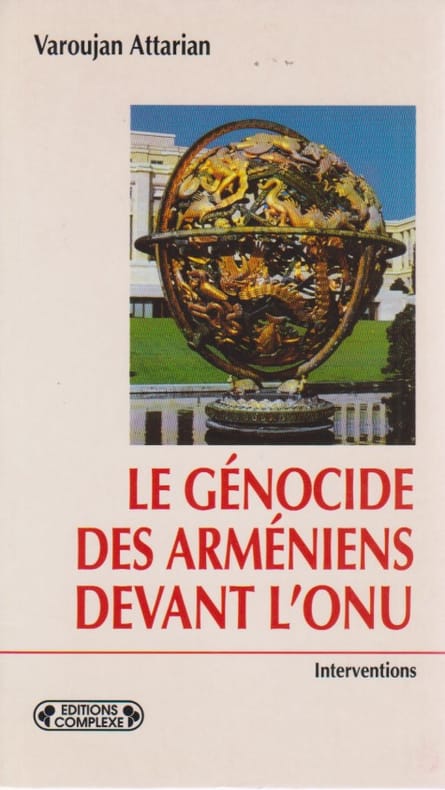
ATTARIAN Varoujan,
Le génocide arménien devant l'ONU,
Complexe, Interventions, 1997, 140 pp., broché, ex-dono, bon état.
Referenz des Buchhändlers : 68141
|
|
|
ATTILA ORBOK, (1887-1964).
The Armenian Revolutionary Movement. Based on original, official records of the Imperial Ottoman government about the Armenian campaign agaist the state. Translated by Boglarka Bakki.
New English Paperback. Cr. 8vo (20 x 14 cm). Edition in English. 88 p. The Armenian Revolutionary Movement. Based on original, official records of the Imperial Ottoman government about the Armenian campaign agaist the state. Hungarian journalist-author Attila Orbók is an important figure on foreign publications about World War I and Ottoman Armenians. The Armenian Revolutionary Movement that was published in 1916 in Hungarian language is well-researched and short but to the point. The arguments are supported with strong evidences. This research is a unique contribution to the discussions on Ottoman-Armenian relations during World War I.
|
|
|
ATTILA ORBOK, (1887-1964).
The Armenian Revolutionary Movement. Based on original, official records of the Imperial Ottoman government about the Armenian campaign against the state. Translated by Boglarka Bakki.
As New English Paperback. Mint. Cr. 8vo (20 x 14 cm). Edition in English. 88 p. The Armenian Revolutionary Movement. Based on original, official records of the Imperial Ottoman government about the Armenian campaign against the state. Hungarian journalist-author Attila Orbók is an important figure on foreign publications about World War I and Ottoman Armenians. The Armenian Revolutionary Movement that was published in 1916 in Hungarian language is well-researched and short but to the point. The arguments are supported with strong evidences. This research is a unique contribution to the discussions on Ottoman-Armenian relations during World War I.
|
|
|
ATVUR Orhan et ATVUR Ümit
"Side; guide de l'ancienne cité et du musée."
Istanbul, Aksoy Grafik DizgiMatbaacilik A.S., 1986. 22 x 24, 64 pp., nombreuses illustrations en couleurs et en N/B , plusieurs plans, broché, bon état.
Referenz des Buchhändlers : 46508
|
|
|
AUBOYNEAU (G.), FEVRET (A.)
Essai de bibliographie pour servir à l'histoire de L'Empire Ottoman. Livres turcs - Livres imprimés à Constantinople - Livres étrangers a la Turquie mais pouvant servir à son histoire. Fascicule I. Religion - Moeurs et Coutumes.
Paris Ernest Leroux 1911 un volume grand in-8°, (8) 84 (1) pp. (marque à la couverture, dos présentant une fente en sommet et plusieurs petites coupures). RARE.
Referenz des Buchhändlers : 025103
|
|
|
AUGUSTE DURAND, (French music publisher, organist, and composer), (1830-1909).
[SHEET MUSIC] Ire Valse pour piano, Op. 83 par.
Very Good French Paperback. Folio. (34 x 25 cm). In French. 15 p. 7 p. Stains on pages and cover. [SHEET MUSIC] Ire Valse pour piano Op. 83 par. Marie-Auguste Massacrié-Durand was a French music publisher, organist, and composer. Durand was born in Paris and studied at the Paris Conservatoire with François Benoist. He started as an organist in 1849 in Saint-Ambroise, then at St. Genevieve, St. Roch and St. Vincent de Paul (1862-74). Together with Louis Schoenewerk and other sponsors, Durand founded the company Durand-Schoenewerk & Cie. in December 1869 and acquired the important catalogue of the Paris music publisher Gustave Flaxland (1821-1895), which had grown from approximately 1,200 titles in 1847 to 1,400 titles in 1869. This included the French rights to the early Wagner operas. Following a dispute, the company dissolved on 18 March 1885 and was sold at auction in May 1896. Auguste Durand and Louis Schoenewerk bought the firm in its entirety, and they reconstituted the company with Durand's son Jacques (1865-1928). In November 1891, Jacques replaced Schoenewerk and the name changed to A. Durand & fils. Jacques assumed control of the company in 1909 when his father died, and brought in his cousin Gaston Choisnel (d. 1921) as a partner. Durand became an expert in the publication of works by French composers including Victorin de Joncières, Edouard Lalo, Jules Massenet, Claude Debussy, Camille Saint-Saëns, Maurice Ravel, Albert Roussel and Paul Dukas. The company also published the French editions of Tannhäuser, The Flying Dutchman and Lohengrin by Richard Wagner and many editions of old masters including, in particular, a complete critical edition of Rameau edited under the initial direction of Saint-Saëns. Between 1910 and 1913, Auguste and, after his death, his son Jacques organised concerts to raise awareness of new music. In 1914, Jacques published under the title Édition classique Durand & fils important nineteenth-century works for piano including the music of Chopin edited by Debussy, of Mendelssohn by Ravel and of Schumann by Gabriel Fauré. [.]. Sotiri Christides [sic. Christidis] who is an contemporary of Andria, started music publications in 1905's. Christides published on almost all the areas of music under the captions in Greek and Ottoman languages. He published some various Turkish marches and operets' scores besides Western music. He gave as the address 'Edition S. Christides: Grand Rue de Pera, 215, Constantinople). Hemay be stated that he published almost 1000 musical scores [.]. (Source: Musical publications from Ottoman Empire up today, 1876-1986.; BÜLENT ALANER).
|
|
|
Aulneau J.
Histoire de l'Europe centrale (depuis les orig.à nos jours)
8vo, br. ed. Bibliothèque historique. 646 p. storia dell'europa centrale, in francese
|
|
|
AURENCHE (Dr Henri).-
La mort de Stamboul. Préface de Paul de Chack.
P., Peyronnet, 1930, in 8° demi-basane grise, dos à faux nerfs orné, 357 pages.
Referenz des Buchhändlers : 22443
|
|
|
Aur lien Girard, Vassa Kontouma, Bernard Heyberger (eds)
Livres et confessions chr tiennes orientales. Une histoire connect e entre l?Empire ottoman, le monde slave et l?Occident (XVIe-XVIIIe si cles)
, Brepols, 2023 Paperback, 481 pages, Size:156 x 234 mm, Illustrations:17 col., 1 maps b/w, Language(s):French, English. ISBN 9782503604404.
Referenz des Buchhändlers : 64307
|
|
|
AUTOUR DU MONDE
Turquie. 2 Fascicules
Paris L. Boulanger Fascicule Grand In-8 à L'italienne circa 1900, non paginé, (.) Aquarelles, souvenirs, voyages. Fascicules VII : la Turquie, types et moeurs, IX : Turquie, types et moeurs. Photochromies n° XLIX à LVI et LXV à LXXI, d'après les clichés photographiques de MM. Sebah et Joaillier. Dos et une fine partie des plats passés, une fine coupure en queue. Exemplaires frais
Referenz des Buchhändlers : 8109
|
|
|
Auzépy Marie-France, Yerasimos Stéphane, Ducellier Alain
Istanbul
Citadelles & Mazenod L'art et les grandes civilisations, Les Grandes cités Cartonné avec jaquette sous emboîtage 2002 Grand in-4 (25,5 x 33 cm), cartonnage toilé de l'éditeur avec jaquette illustrée sous emboîtage illustré, 484 pages, iconographie en couleur ; choc au coin inférieur du premier plat et de l'emboîtage, quelques traces sur l'étui en tête, par ailleurs bon état général. Livraison a domicile (La Poste) ou en Mondial Relay sur simple demande.
Referenz des Buchhändlers : vp510
|
|
|
AV. H. SINASI DEVELI.
Dünden bugüne Mersin, 1836-1990.
Fine English Paperback. Pbo. Roy. 8vo. (24 x 17 cm). In Turkish. 246 p., b/w ills. Dünden bugüne Mersin, 1836-1990.
|
|
|
AVA GARDNER, (1922-1990); ZSA ZSA GABOR, (1917-2016); GLEN FORD, (1916-2006), ORHAN BORAN, (1928-2012)...
[Photograph of Hollywood and Turkish stars in Tarabya Hotel, Istanbul].
Very Good Turkish Original b/w photograph. (12 x 19 cm). Ava Gardner, Zsa Zsa Gabor, Glen Ford and others with Orhan Boran in Tarabya Hotel. Taken by one of the earliest paparazzi and photographer of high society, Foto Rüstü Özlen. Dated 06.23.1955. Orhan Boran was a Turkish radio and TV host and actor. He was also widely known for his laudable usage of the Turkish language.
|
|
|
AVANZADE [MEHMED] SÜLEYMAN, (1871-1922).
Musavver ve mükemmel kiyafetnâme.
Very Good English Paperback. Pbo. Cr. 8vo. (20 x 13 cm). In Ottoman script. 192 p., many color and b/w plates. Özege: 14494. An early Ottoman / Turkish study on world anthropology, ethnology. Musavver ve mükemmel kiyafetnâme.
|
|
|
AVELINE (Pierre).
Constantinople ville de Romanie et capitale de l'empire des Turcs.
[1692]. 206 x 317 mm.
Referenz des Buchhändlers : LBW-706

|
|
|
AVELOT (H.)
Croquis de Grèce et de Turquie. 1896-1897. Autour de l' Archipel.
1896 Mame. Tours. 1899. In-8, broché,sans couvertures ni dos ,à relier, 143pp. avec des dessins h. et in-t. par l' auteur,correct, rare.
Referenz des Buchhändlers : 23318
|
|
|
AVEDIS CEBECIYAN.
Bir Ermeni subayin Çanakkale ve Dogu Cephesi günlügü, (1914-1918).
New English Paperback. Pbo. Cr. 8vo. (20 x 14 cm). In Turkish. 176 p., ills. Daily of an Armenian officer in Gallipoli, East Front in World War I. Bir Ermeni subayin Çanakkale ve Dogu Cephesi günlügü, (1914-1918).
|
|
|
AVNER BEN-ZAKEN.
Hay bin Yakzan'i okumak. [= Reading Hayy Ibn Yaqzan. A cross-cultural history of autodidacticism]. Translated by Yavuz Alogan.
New Turkish Paperback. Demy 8vo. (21 x 14 cm). In Turkish. 264 p. Hay bin Yakzan'i okumak. [= Reading Hayy Ibn Yaqzan. A cross-cultural history of autodidacticism]. Translated by Yavuz Alogan. Commonly translated as "The Self-Taught Philosopher" or "The Improvement of Human Reason," Ibn-Tufayl's story Hayy Ibn-Yaqzan inspired debates about autodidacticism in a range of historical fields from classical Islamic philosophy through Renaissance humanism and the European Enlightenment. Avner Ben-Zaken's account of how the text traveled demonstrates the intricate ways in which autodidacticism was contested in and adapted to diverse cultural settings. In tracing the circulation of the Hayy Ibn-Yaqzan, Ben-Zaken highlights its key place in four far-removed historical moments. He explains how autodidacticism intertwined with struggles over mysticism in twelfth-century Marrakesh, controversies about pedagogy in fourteenth-century Barcelona, quarrels concerning astrology in Renaissance Florence, and debates pertaining to experimentalism in seventeenth-century Oxford. In each site and period, Ben-Zaken recaptures the cultural context that stirred scholars to relate to ?ayy Ibn-Yaq?an and demonstrates how the text moved among cultures, leaving in its wake translations, interpretations, and controversies as various as the societies themselves. Pleas for autodidacticism, Ben-Zaken shows, not only echoed within close philosophical discussions; they surfaced in struggles for control between individuals and establishments. Presented as self-contained histories, these four moments together form a historical collage of autodidacticism across cultures from the late Medieval era to early modern times. The first book-length intellectual history of autodidacticism, this novel, thought-provoking work will interest a wide range of historians, including scholars of the history of science, philosophy, literature, Europe, and the Middle East.
|
|
|
AVNI ERDEMIR.
Anadolu sahasi musikisinas divan sairleri.
Fine Turkish Paperback. Roy. 8vo. (24 x 17 cm). In Turkish. [xLix], 541 p. Anadolu sahasi musikisinas divan sairleri. TURKISH LITERATURE Traditional Ottoman literature Divan poetry Tasavvuf Sufism Biography.
|
|
|
AVNI LIFIJ, (1886-1927).
Avni Lifij: Photographs.= Fotograflar. Text by Necmi Sönmez. Edited by Erman Ata Uncu.
New English Original grey cloth bdg. Onlaid b/w photograph on board. Roy. 8vo. (24 x 16 cm). In English and Turkish. 128 p., color and b/w ills. Print run 300 copies, limited and numbered edition. This copy is: 274/300. In addition to the original photographs and negatives in the Ayten & I. Sazi Sirel Collection, this book includes a detailed review on the subject by art historian Dr. Necmi Sönmez.
|
|
|
AVRIL (Philippe).
Voyage en divers Etats d’Europe et d’Asie, entrepris pour découvrir un nouveau chemin à la Chine.
Paris, Claude Barbin, Jean Boudot, Georges & Louis Josse, 1692. In-4, plein veau époque, Édition originale, illustrée d'un portrait-frontispice, une carte dépliante de la Sibérie et Kitay, 6 vignettes et 2 planches hors texte gravées en taille-douce par Vallet figurant des traîneaux et des esquifs cosaques , un portrait du dédicataire le général polonais Stanisaw Jan Jablonowski (1634-1702) gravé par Étienne Picart, dit Le Romain (le père du célèbre graveur Bernard Picart). Reliure usagée( à refaire) , plusieurs pages détachées ,mouillures en début d’ouvrage, manque la table des matières et le titre.
Referenz des Buchhändlers : PHO-709

|
|
|
AVRIL (Philippe);
Voyage en divers Etats d'Europe et d'Asie, entrepris pour découvrir un nouveau chemin à la Chine.
Claude Barbin, Jean Boudot, Georges & Louis Josse Paris 1692 1 vol. In-4 de X 406 pp. 12 ff.n.ch. (table), plein veau brun de l'époque, dos à nerfs orné, roulette dorée sur les coupes.
Referenz des Buchhändlers : 15848
|
|
|
AVRAM BENAROYA [AVRAAM ELIEZER], (1887-1979).
[RARE OTTOMAN STENOGRAPHY BOOK BY THE FIRST TURKISH-JEWISH SOCIALIST AND A KEY FIGURE OF THE FOUNDATION OF THE COMMUNIST PARTY OF GREECE] Türkçe lisanina mahsûs stenografya usûlü. [i.e. Stenography in Turkish language].
Very Good Turkish, Ottoman (1500-1928) Paperback. Demy 8vo. (21 x 15 cm). In Ottoman script. 4, 77 p., 1 plate. Stain some pages, slight tear on the fifth page, text unaffected. Otherwise a good copy. Benaroya was a Jewish socialist, member of the Bulgarian Social Democratic Workers' Party (Narrow Socialists), later leader of the Socialist Workers' Federation in the Ottoman Empire. Benaroya played a key role in the foundation of the Communist Party of Greece in 1918. Idealistic and pragmatic at the same time, in Thessaloniki Benaroya played a leading role in the creation, in 1909, of the mainly Jewish Socialist Workers' Federation, or in Ladino, Federacion. The organization took this name because built on the federative model of the Social Democratic Party of Austria, it was conceived as a federation of separate sections, each representing the four main ethnic groups of the city: Jews, Bulgarians, Greeks, and Turks. It published its literature in the languages of these four groups (i.e., Ladino, Bulgarian, Greek, and Turkish, respectively) but in practice, the two latter sections were under-represented if not nonexistent. The democratic Federacion soon became, under Benaroya's leadership, the strongest socialist party in the Ottoman Empire. It created combative trade unions, attracted important intellectuals, and gained a solid base of support among Macedonian workers while cultivating strong links with the Second International. From 1910 to 1911 Benaroya edited its influential newspaper, the Solidaridad Ovradera, printed in Ladino. Unlike other parties that were organized on ethnic lines, as a cross-community group, the Federacion was allowed by the Ottoman authorities. A prominent Bulgarian member, Dimitar Vlahov, was a socialist MP in the new Ottoman parliament until 1912. Indeed, its leaders initially supported the Young Turks, and Benaroya participated in the "Army of Freedom" march on Istanbul to help put down the Countercoup of 1909. Alarmed by the growing power of socialist groups, the CUP subsequently launched a crackdown, under which Benaroya was jailed three times, in early November 1910, June 1911 (when he was deported to Serbia), and February 1912 (when he was deported to Greece). Benaroya was interested in the Jewish Question since the beginning of his career and made efforts to promote Jewish causes throughout it. His first book was The Jewish Question and Social Democracy (1908) while once in Thessaloniki he founded a group called the Sephardic Circle of Socialist Studies. He also played a leading role in the creation, in 1909, of the mainly Jewish Federation. Apprehensive of what the resurgent Greek self-confidence behind the Megali Idea might mean for Jews in Greece and Asia Minor, at the time he labeled the campaign imperialist. He envisaged a state free from any ethnic divisions where Jews could exist un-persecuted and free, retaining their religion. Some of his fears might have been argued to have been realized when after the city's fire, the Venizelos administration did not rebuild the original Jewish section, adopting instead a French town plan, but a considerable proportion of the Jewish population remained throughout the following decades, with the Greek government guaranteeing their rights in March 1926. Benaroya was always very interested in combating anti-Semitism, while over later years he shifted his emphasis to reflect the sizable Thessaloniki Jewish community that chose to remain within the Greek state. After a historic meeting with Venizelos, Benaroya's tactical abilities resulted in the birth of the Socialist Labour Party of Greece (later named Communist) and the General Confederation of Greek Workers, which helped unite Greek workers. This extremely rare book on stenographic style in the Turkish / Ottoman language. Özege 21579.; TBTK 5898.; Only two institutional copies in OCLC. 777181494 (KOÇ University Library; Universiteitsbibliotheek Leiden). First and Only Edition.
|
|
|
AVRAM GALANTI [ABRAHAM GALANTE].
Ankara tarihi. 2 volumes set. Vol. 1: Tarih öncesinden Ankara'nin Türkiye'nin eline geçtigi zamana kadar bahseder. Vol. 2: Ankaranin Türkiye eline geçtigi tarihten Mustafa Kemal Pasanin Ankaraya ayak bastigi ilk günlere kadar.
Fine English Paperback. Pbo. Roy. 8vo. (24 x 17 cm). In Turkish. 2 volumes set: (71, [1] p.; 150, [2] p.). Ankara tarihi. 2 volumes set. Vol. 1: Tarih öncesinden Ankara'nin Türkiye'nin eline geçtigi zamana kadar bahseder. Vol. 2: Ankaranin Türkiye eline geçtigi tarihten Mustafa Kemal Pasanin Ankaraya ayak bastigi ilk günlere kadar. History of Ankara. From ancient period to Turkish War of Independence. First Edition. Rare set.
|
|
|
AVRAM GALANTI [ABRAHAM GALANTE].
Ankara tarihi. Ankaranin Türkiye eline geçtigi tarihten Mustafa Kemal Pasanin Ankaraya ayak bastigi ilk günlere kadar
Fine English Paperback. Pbo. Roy. 8vo. (24 x 17 cm). In Turkish. 152 p., ills. Ankara tarihi. Ankaranin Türkiye eline geçtigi tarihten Mustafa Kemal Pasanin Ankaraya ayak bastigi ilk günlere kadar. Frist Edition. Vol. 1 of 2. Rare.
|
|
|
AXEL Brigitte.
H.
Flammarion. 1970. In-8° broché. Couverture illustrée dans le style hippie. 256 pages. E.O.
Referenz des Buchhändlers : 2303
|
|
|
Ayalon Yaron
Natural Disasters in the Ottoman Empire: Plague, Famine, and Other Misfortunes
8vo, br. ed. pp.264. This book explores the history of natural disasters in the Ottoman Empire and the responses to them on the state, communal, and individual levels. Yaron Ayalon argues that religious boundaries between Muslims and non-Muslims were far less significant in Ottoman society than commonly believed. Furthermore, the emphasis on Islamic principles and the presence of Islamic symbols in the public domain were measures the state took to enhance its reputation and political capital - occasional discrimination of non-Muslims was only a by-product of these measures. This study sheds new light on flight and behavioral patterns in response to impending disasters by combining historical evidence with studies in social psychology and sociology. Employing an approach that mixes environmental and social history with the psychology of disasters, this work asserts that the handling of such disasters was crucial to both the rise and the fall of the Ottoman Empire.
|
|
|
AYAN GÜLGÖNEN.
Konya Cappadocia carpets, from the 17th to 19th centuries. In the TIEM and Gülgönen collections. Color analysis and text by Harald Bohmer, Recep Karadag. Technical analysis: Niels Ruter. Translation: Robert Bragner.
New New English Original bdg. with original dust wrapper. DJ. Mint. 115, [1] p., 61 color ills. In English. Anatolian carpets may be divided into three broad categories -Western, Central and Eastern- on the basis of their distinguishing regional features. The examples presented in this catalog are members of a collection of pieces that share common elements of design, pattern, color, and texture and that were woven, most probably between 17th and 19th centuries, in the region bounded by Konia, Karaman and Nevsehir in Central Anatolia. Each one being a unique and original work of art, most of them having never been published before, all treated with modern concepts of conservation at textile museum and forming the most comprehensive group specific to this type and region, the collection appear as a unitary and coherent group. The main characteristics of these Konya - Cappadocia carpets which are closest to the kilims among Anatolian carpets in construction, purpose and shape, manifest itself in color and unique geometrical and traditional motives.
|
|
|
AYANDAN MUSTAFA NURI PASHA, (Ottoman governor of Mosul between 1902-1905).
THE SONS OF THE DEVIL: FIRST SEPARATE BOOK ON YEZIDIS Abede-i Iblis: Yezîdî taifesinin itikâdâti a'dâti evsâfi. i.e. The sons of Satan: Yezidi society's beliefs customs and characteristics.
Istanbul: Matbaa-i Ijtihad. AH 1328 1912. 1st Edition . Soft cover. Very Good. 8vo - over 7¾ - 9¾" tall. Paperback. 8vo. 18 x 12 cm. In Ottoman script Old Turkish with Arabic letters. 80 p. Probably taken from a volume. Minor wear on spine. Light fading on pages. Otherwise a very good copy. This interesting very rare and also pseudo-historical first book penned specifically on the Yezîdî people by an Ottoman statesman initially prepared as a report and then published in 1912 before WWI in Ottoman Cairo. One of only three written Eastern sources about this interesting community that has been subject to extremely controversial approaches throughout history. The first is the travel corpus of Evliya Çelebi the second is 'Abede-i Iblis' and the third is "Al-Yazidiyya Kadîmen wa Hadisen" which was published in Arabic in Beirut in 1934. Yezîdîs a member of a Kurdish religious minority found primarily in northern Iraq southeastern Turkey northern Syria the Caucasus region and parts of Iran. The Yezîdî religion includes elements of ancient Iranian religions as well as elements of Judaism Nestorian Christianity and Islam. Although scattered and probably numbering merely between 200000 and 1000000 the Yezîdîs have a well-organized society with a chief sheikh as the supreme religious head and an emir or prince as the secular head. The origins of the Yezîdî faith can be traced to areas of the Kurdish mountains of northern Iraq where pockets of devotion to the fallen Umayyad dynasty persisted long after the death of the last Umayyad caliph the half-Kurdish Marwan II in 750. Some descendants of the dynasty settled in the area further encouraging the development of mystical traditions in which the Umayyad lineage was prominently figured. In the early 12th century Sheikh 'Adî ibn Musâfir a Sufi and a descendant of the Umayyads settled in Lâlish north of Mosul and began a Sufi order known as the Adwiyyah. Although his own teachings were strictly orthodox the beliefs of his followers soon blended with local traditions. A distinct Yezîdî community living in the environs of Mosul appears in historical sources as early as the middle of the 12th century. This book includes descriptions of the Yezîdîs albeit all the prejudices within it on their geography origins mythology religions cosmogony etc. The book has a long chapter on Yezîdîs' chief divine Malak âûs or Tavus "Peacock Angel". Malak Taus has often been identified by outsiders with the Judeo-Christian figure of Satan causing the Yezîdîs to be inaccurately described as "Devil worshippers" as seen in this pseudo-historical book as well. Özege 24.; OCLC 83228795. <br/> <br/> Matbaa-i Ijtihad., [AH 1328] paperback
Referenz des Buchhändlers : 054651
|
|
|
AYANOGLU MUSTAFA HILMI PASHA.
Plevne Müdafii Müsir Gazi Osman Pasa Hazretleri. Ayanoglu Mustafa Hilmi Pasa'nin 93 Plevne Harbi hatiralari
Fine Turkish Paperback. 4to. (27 x 20 cm). In Turkish. 84 p. Plevne Müdafii Müsir Gazi Osman Pasa Hazretleri. Ayanoglu Mustafa Hilmi Pasa'nin 93 Plevne Harbi hatiralari.
|
|
|
AYDA AREL.
Bir sehr-i Rusenâbâd, kâr-i anka bir bender: Tanzimat öncesi Izmir sanatinda yeni yönelimler.
Very Good English Paperback. Pbo. Roy. 8vo. (23 x 16 cm). In Turkish. 91 p., b/w and color ills. Bir sehr-i Rusenâbâd, kâr-i anka bir bender: Tanzimat öncesi Izmir sanatinda yeni yönelimler.
|
|
|
AYDAN GÜNDÜZ.
Sarkin ve garbin hakimi Yavuz.
Fine English Paperback. Demy 8vo. (21 x 13 cm). In Turkish. 728 p. Roma Sultanlari III: Sarkin ve garbin hakimi Yavuz. TURKISH LITERATURE Historical novel Selim II Ottoman history.
|
|
|
AYDI.
Aydi divani. Edited by Ömer Asim Aksoy. Annotations: Sakir Sabri Yener, Ali Nadi Ünler.
Fine English Paperback. Demy 8vo. (22 x 15 cm). In Turkish. [Lviii), 168 p. Aydi divani. Edited by Ömer Asim Aksoy. Annotations: Sakir Sabri Yener, Ali Nadi Ünler. Rare. OTTOMAN LITERATURE Traditional Turkish / Ottoman literature Divan poetry Tasavvuf Sufizm Gaziantep.
|
|
|

 Per e-mail erhalten
 Als pdf-Dokument herunterladen
 RSS feed
 Permanenter link


