|
[BREMOND (Henri)] - MARTIN DU GARD (Maurice).-
De Sainte-Beuve à Fénelon : Henri Brémond. Edition Originale
P., Kra (Collection "Les Documentaires"), 1927, in 12 broché, 233 pages ; quelques rousseurs ; couverture orange (un peu fanée).
Référence libraire : 9421
|
|
|
[BRETON André].
André Breton (1896-1966) et le mouvement surréaliste.
Numéro spécial de la N.R.F. en hommage posthume à André Breton. N° 172. Avril 1967. Fort et grand in-8° broché. Paginé pp. 590-964. 16 pages de photos et documents.
Référence libraire : 1795
|
|
|
[BRIANCHON (Maurice)] HERON de VILLEFOSSE (René) :
A Travers nos Vignes.
P. Bernard Klein 1952. Grand in-4° en ff, sous chemise et étui.
Référence libraire : LIQ-746
|
|
|
[BRIANCHON (Maurice)] LARBAUD (Valéry) :
Le Vaisseau de Thésée.
Neuchatel et Paris, Ides et Calendes 1946. In-8° broché, sous couverture illustrée.
Référence libraire : LIQ-679

|
|
|
[BRIANCHON Maurice] HÉRON DE VILLEFOSSE René
A Travers nos vignes
Bernard Klein 1952 In-4 en ff. sous chemise illustrée, boîte de toile marron à dos de vélin, 49 pp. 9 compositions hors texte en couleurs. Quelques piqûres marginales.
Référence libraire : 43199
|
|
|
[BRIOLLET (Sylvain)] - BRILLANT (Maurice).-
Les années d'apprentissage de Sylvain Briollet.
Paris, Bloud et Gay, 1923, in 12, broché, VI-307 pages
Référence libraire : 7264
|
|
|
[British Empire – Mauritius – Slavery] Unknown Author
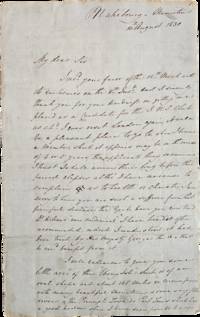
1830 Letter Written from Mauritius Describing Economic and Social Conditions on the “Ebony Isleâ€
Mahébourg Mauritius 1830. Single unsigned fourteen-page letter measuring 8 x 12 ¾ inches. Folded with some stains and pencil marks. Overall near fine. In 1830 Mauritius was a British colony captured from the French in 1810 during the Napoleonic Wars. It was originally a Dutch colony and the Dutch had introduced enslaved labor to the islands. Enslaved people were imported from Madagascar India and Southeast Asia to harvest the valuable ebony trees and later to farm sugarcane. It became a French colony in 1715 and among other provisions the French government awarded upper-class colonists large land grants each with twenty enslaved people to work them. Slavery was abolished in 1835 under British rule after which the planters still farming sugarcane turned to indentured servant labor from India and China alongside illegal slavery.1<br /> <br /> Offered here is a lengthy single letter written by an unknown author to an unknown recipient from Mahébourg in 1830 shortly before this radical change. The letter describes the lives and economic circumstances of the planters and merchants and of the non-white population particularly Malabar people and free and enslaved Black people.<br /> <br /> Noting that “every inch of ground that will produce sugar cane is planted with it†including “the former fine gardens to some of the Habitations†the author reports on the situation for sugar planters:<br /> <br /> “The price of sugar here is not more than 20/per Cwt. for the best quality which does not now remunerate the Planter as his expenses are becoming every day more heavy in consequence of their slaves diminishing . The want of Slaves induced many of the Planters to send for Chinese Labourers and several hundreds were imported at a great expense but unfortunately they did not answer and were obliged to be reshipped for their native Country again at the charge of those who sent for them.â€<br /> <br /> The author later notes that “nearly everyone of the Planters have heavy mortgages on their Estates and are obliged to pay this immense Interest which keeps them poor and will I fear ultimately ruin themâ€. In fact the planters in British Mauritius had extra duties on their sugar exports compared with their Caribbean counterparts. The shopkeepers on the other hand “calculate on retiring with a fortune in five years– therefore you will fancy what must be their prices also their profits.â€<br /> <br /> Though writing from Mahébourg the author describes the capital city of Port Louis at length especially its Malabar Indian and free Black residents—the lives of the latter particularly the free Black women seem especially grim. They write:<br /> <br /> “The Centre of Port Louis is inhabited by all the respectable people and many most excellent houses buildings– the Catholic Chapel the English Church amongst the number. The Suburbs to the West is the part occupied by about 3000 Malabars called ‘Malabar Town.’ – They are dressed mostly in white with Turbans ear rings c c and the females with ornaments in their noses and on their Toes as they generally go bare foot. – Once a year they have what is called a ‘Yamsee’ or a festival in honor of Mehomet which lasts for about a fortnight during which time they seem to get no sleep a continual beating of tom toms – jingling of bells – carrying pagodas which are made of various coloured paper and most richly ornamented followed by all the population of their Caste with their faces daubed with red white c and which has a most ludicrous appearance. The Suburbs to the South is called ‘black Camp’ – the Houses being very small and poor and inhabited by all the free blacks as well as many Mulattoes. – Also a certain class of females of the population of colour – who are visited immediately on the Arrival of a Ship the Crews soon enquiring the way to the ‘Camp.’â€<br /> <br /> As regards relations between the races the author recounts an incident that followed the 1828 abolition of the color bar which would ostensibly give the free non-white population the same rights as the whites:<br /> <br /> “The Theatre is a very good one but has been closed for several months past the Actors Actresses gone to Bourbon in consequence of the promulgation of the act ‘causing all free people of the population of Colour’ to have the same laws – the same privileges as the Whites’ fearing they ought come to the Theatre which they had hitherto been forbidden thereby cause disturbances as the French Whites detest them wd. not sit in the same box it was considered best to shut the Theatre which is a great loss to the Place it being the chief public amusement and indeed the only one we have here.â€<br /> <br /> Overall a detailed letter giving insight into life in a slave colony at a time when significant changes were on the horizon. Of interest to scholars of the colonial history of Mauritius and the second wave of British colonialism.<br /> <br /> 1 Truth and Justice Commission Report of the Truth and Justice Commission Vol. 1 Mauritius: Government Printing 2011. unknown
Référence libraire : List2931
|
|
|
[BROWNE, Maurice]
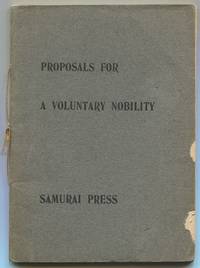
Proposals for a Voluntary Nobility
Ranwith Hall Norwich: The Samurai Press 1907. Softcover. Very Good. Second edition. Small octavo. 31 1pp. Stitched printed gray wrappers. Two modest chips on front wrap and one on the first leaf else very good. Early English-language source on the History of Bushido. OCLC notes a reasonable number of copies of the 1907 first edition but only four of this edition. The Samurai Press unknown
Référence libraire : 539003
|
|
|
[BUFFET (Bernard)] - DRUON (Maurice).-
Bernard Buffet. Images Luc Fournol. Texte Maurice Druon. Légendes Annabel Buffet. Mise en page Jean Widmer.
1964 Paris, Hachette, 1964, in 4° carré relié pleine toile blanche de l'éditeur, jaquette illustrée en couleurs ; illustrations en noir et en couleurs.
Référence libraire : 88662
|
|
|
[BULLETIN.] Claude Condé, Philippe Rufenacht, Erik Porge, Jean Allouch, Solange Faladé, Laurence Bataille, Marcel Ritter, Eric Laurent, Jean-Léon Schmitt, Jean Petitot, Philippe Julien, Guy Le Gaufey, Jacques Rozenberg, Bernard This, Stoian Stoianoff, Liliane Fainsilber, Herbert Haravon, Gérard Haddad, Gennie Lemoine, Jean Clavreul, Juan david Nasio, Jean-Pierre Bauer, Gérard Miller, Roland Chemama, Serge Zlatine, S. Knebelmann, M.F. Génin, Antonello Sciacchitano, Jacques Alain Miller, Marcel Czermak, Dominique Chardin, Maurice Alfandari, Christiane Rabant, Jean-Jacques Gorog, Stuart Schneiderman, Colette Soler, Jacques Lacan.
Les mathèmes de la psychanalyse.
Lettres de l’école freudienne, N°21, août 1977. Un volume in-4°, broché.
Référence libraire : 16651
|
|
|
[BURROUGHS (William)]. LEE (William). -- HELBRANT (Maurice)
JUNKIE. Contessions of an Unredeemed drug addict. -- NARCOTIC AGENT. Signed by Burroughs
New York Ace Books, Inc. - Collection « Ace double books » D-15 1953 In-12 broché, couverture illutrée Signé par l'auteur
Référence libraire : 013812
|
|
|
[BUSSANG, THÉATRE] - POTTECHER (Maurice) -
Jean de Calais - pièce légendaire en 12 tableaux.
Paris, Librairie théatrale, s.d. ; in-12, 96 pp., broché, couverture illustr.
Référence libraire : 200701841
|
|
|
[BUSSANG, VOSGES, THEATRE] - POTTECHER (Maurice), RICHRD-WILLM (Pierre) -
L'EMPEREUR DU SOLEIL COUCHANT.
Paris, Librairie théatrale, 1955 ; in-8, 98 pp., br. Exemplaire en superbe état broché - dédicacé de PiERRE RICHARD-WILLM et signé de MAURICE POTTECHER edition du soixantenaire - pièce légendaire en 3 actes et 12 tableaux.
Référence libraire : 201401035
|
|
|
[Béarn] - Maurice Estrabaut - Suzanne Albert-Cadier
Maurice Estrabaut 1891-1945. Evocations par Suzanne Albert-Cadier
Pau Les Amis de Maurice Estrabaut 1949 Un volume in+12 broché 108 pages Avec un portrait photographique en frontispice A22
Référence libraire : 1863

|
|
|
[Béjart Maurice] Colette Masson, Gérard Mannoni:
Maurice Béjart.
Editions Plume / Calmann Lévy, 1991. In-folio, pleine toile titrée en blanc, jaquette couleurs. En belle condition.
Référence libraire : 20016

|
|
|
[Béjart Maurice] France Ferran, Tony Catany (phot.):
Jorge Donn danse Béjart.
Fernand Nathan, 1977. In-4, pleine toile titrée or, jaquette couleurs. Infimes défauts à la jaquette, belle condition générale.
Référence libraire : 20020

|
|
|
[Béjart Maurice] Mannoni Gérard:
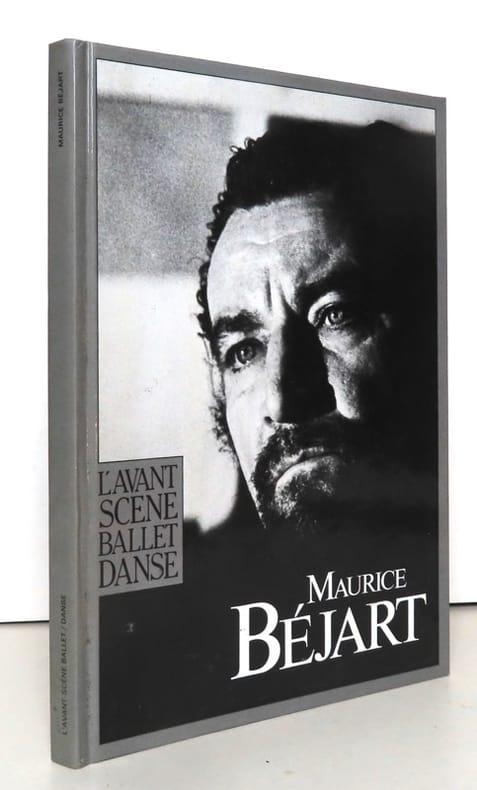
Maurice Béjart.
L'Avant-Scène Ballet / Danse, 1985. Grand in-8, cartonnage photographique. En belle condition. Abondamment illustré en noir.
Référence libraire : 20442
|
|
|
[Béjart Maurice] Silvio de Sario:
Images et mots qui dansent. La magie du théâtre de Béjart.
Fernand Nathan, 1977. Grand in-4, pleine toile noire, jaquette couleurs. En belle condition.
Référence libraire : 20021

|
|
|
[CAILLARD] - GENEVOIX (Maurice)
Christian Caillard.
Neuchâtel, Ides et Calendes, 1965. In-4°, 113p. en feuilles, sous couverture imprimée rempliée, chemise et étui.
Référence libraire : 39878

|
|
|
[CAILLARD] - GENEVOIX (Maurice)
Christian Caillard.
Neuchâtel, Ides et Calendes, 1965. In-4°, 113p. Reliure pleine toile d'éditeur, sous jaquette illustrée.
Référence libraire : 40663
|
|
|
[CAILLAVET (Madame Armand de)] - POUQUET (Jeanne Maurice).-
Le salon de Madame Arman de Caillavet. Ses amis: Anatole France, Commandant Rivière, Jules Lemaître, Pierre Loti, Marcel Proust etc, etc....
1926 Paris, Hachette, 1926, in 8°, broché, VII-271 pages, illustrations hors texte ; couverture légèrement fanée.
Référence libraire : 7948
|
|
|
[CALDER Alexander] BESSET Maurice; BALTHAZAR André:
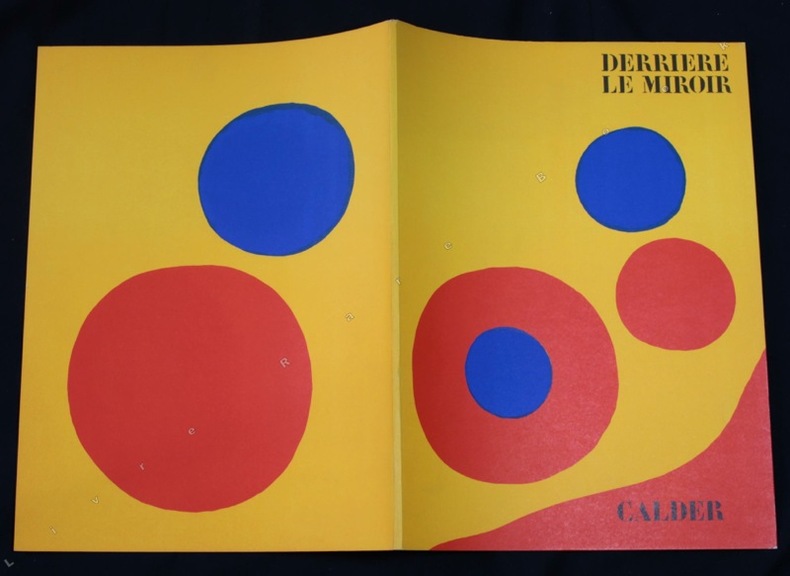
Derrière le miroir, n° 201. Calder.
Paris, Maeght, 1973. In-folio de 28 pages, en feuilles sous couverture lithographiée couleurs.
Référence libraire : 9649
|
|
|
[CANADA] MARQUIS (Maurice)
L'Ile d'Orléans.
Québec, Les Editions Marquis, 1935 Gr. in-4 oblong, en feuille, sous couv. rempliée.
Référence libraire : 579230
|
|
|
[CARNOT] - DREYFOUS (Maurice).-
Les trois Carnot. Histoire de cent ans (1789-1888). Ouvrage illustré dans le texte et hors-texte de nombreuses gravures, de fac-simile, de documents authentiques, de reproductions de dessins originaux et d'autographes.
P., Dreyfous, sans date, grand in 8° relié pleine percaline rouge décorée de l'éditeur, tranches dorées, II-295pp. ; des rousseurs ; cartonnage terni.
Référence libraire : 25050
|
|
|
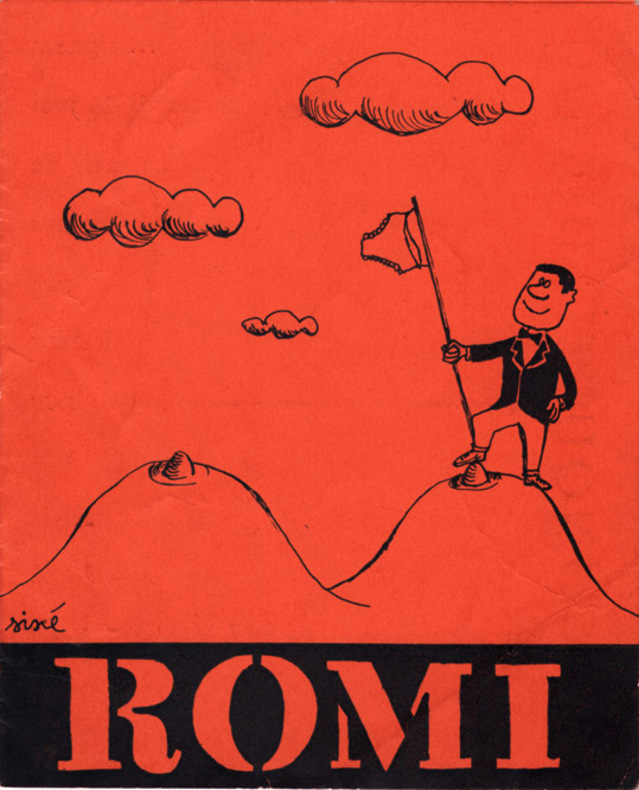
[Carton d'invitation] - Romi (Robert Miquel, dit) - Siné (Maurice Sinet, dit)
Carton d'invitation à la signature de "La Conquête du nu" par Romi à la galerie R.G. le 14 mai 1957 - illustré par Siné
1957 Paris, Galerie R.G., 7 rue Bonaparte, [1957]. Rare carton d'invitation plié en deux, 13,5 x 11 cm, premier plat illustré par Siné.
Référence libraire : 1634
|
|
|
[CARTONNAGE ILLUSTRE] LOIR (Maurice)
GLOIRES & SOUVENIRS MARITIMES.
Paris, Librairie Hachette, 1895. Grand In-8, cartonnage aux bords biseautés de l'éditeur, orné d'un décor de plaques or et noir sur le 1er plat, doré au dos et en noir sur le second plat, tranches dorés, VIII-331pp, 24 planches h.-t., tirées en couleurs, d'en-têtes et de culs-de-lampe gravés par MM. Rougeron et vigneron, et Ducourtpux et Huillard, d'après les aquarelles de M. Alfred Paris - La couverture et les quatre frontispices ont été exécutés par MM. Rougeron et Vignerot, d'après les aquarelles de M. A. Giraldon.
Référence libraire : 559024
|
|
|
[CARTONNAGES ILLUSTRES] - CHAMPAGNE (Maurice) -
Les sondeurs d'abimes.
Paris, Librairie Delagrave. 15, rue Soufflot, 1926 ; grand in-8, 240 pp., cartonnage de l'éditeur. Rousseurs - Illustrations de René Giffey, cartonnage. polychrome gris.
Référence libraire : 202103790
|
|
|
[CARTONNAGES ILLUSTRES] - CHAMPAGNE (Maurice) -
Les sondeurs d'abimes.
Paris, Librairie Delagrave. 15, rue Soufflot, 1926 ; in-4, 240 pp., cartonnage de l'éditeur. Illustrations de RENÉ GIFFEY - grand roman d'aventures-cartonn. polychrome gris, petites usures sur les coiffes, simon bon état général.
Référence libraire : 200616913
|
|
|
[CARÊME (Maurice)] - NICOULIN (Maurice)
Hommage à Maurice Carême.
Vevey, Editions Delta, 1978. In-8°, 55p. Broché, couverture illustrée.
Référence libraire : 21258
|
|
|
[CASANOVA] - ROSTAND (Maurice).-
La vie amoureuse de Casanova.
P., Flammarion (Collection "Leurs amours"), 1928, in 12 relié demi-basane racinée éditeur, dos orné, plat supérieur de couverture conservé, tête dorée, 185 pages. Bel exemplaire, avec dos de la reliure très décoratif.
Référence libraire : 20374
|
|
|
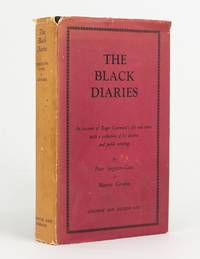
[CASEMENT, Roger] SINGLETON-GATES, Peter and Maurice GIRODIAS
The Black Diaries. An Account of Roger Casement's Life and Times with a Collection of his Diaries and Public Writings
London: Sidgwick & Jackson 1959. Hardcover. Very Good/Dust Jacket Included. London Sidgwick & Jackson 1959 'special edition'/ 1959. Tall octavo 536 pages with numerous illustrations from photographs and a map plus an errata slip mounted on the verso of the half-title and endpaper maps. Cloth slightly bumped at the top corners; edges a little discoloured with the top edge foxed; a very good copy with the good unclipped dustwrapper a little worn and moderately sunned on the spine. A small label mounted on the verso of the title page states this is number 711 of a maximum of 2000 copies of a 'special edition' issued by Sidgwick & Jackson. <p>The edition comprises copies of the first US edition Grove Press 1959 with a variant dustwrapper and a 'London Sidgwick & Jackson' label mounted over the original publisher's details at the foot of the title page. Sidgwick & Jackson hardcover
Référence libraire : 143208
|
|
|
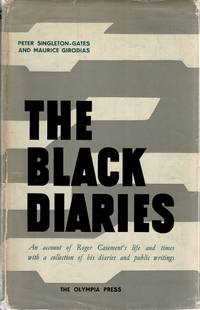
[Casement, Roger] Singleton-Gates, Peter and Girodias, Maurice
The Black Diaries - An Account of Roger Casement's Life and Times with a Collection of his Diaries and Public Writings With two very interesting newspaper-clippings loosely inserted.
1959. Paris The Olympia Press 1959. Large Octavo 17.2 cm wide x 25.5 cm. 626 pages with numerous photographs throughout. Original Hardcover with original dustjacket in protective collector's mylar. Very good condition with only minor signs of wear. The very rare Olympia Press Edition. Chapters in this monumental publication are: Irish Childhood / Africa / The Congo Report / The 1903 Diary / The Putumayo / The 1910 Diary / The Putumayo Report / The Awakening of Ireland / The Trial / The Aftermath / Appendix: The 1911 Diary Roger David Casement Irish: Ruairí Dáithí Mac Easmainn; 1 September 1864 3 August 1916 known as Sir Roger Casement CMG between 1911 and 1916 was a diplomat and Irish nationalist executed by the United Kingdom for treason during World War I. He worked for the British Foreign Office as a diplomat becoming known as a humanitarian activist and later as a poet and Easter Rising leader. Described as the "father of twentieth-century human rights investigations" he was honoured in 1905 for the Casement Report on the Congo Free State and knighted in 1911 for his important investigations of human rights abuses in the rubber industry in Peru. In Africa as a young man Casement first worked for commercial interests before joining the British Colonial Service. In 1891 he was appointed as a British consul a profession he followed for more than 20 years. Influenced by the Second Boer War and his investigation into colonial atrocities against indigenous peoples Casement grew to mistrust imperialism. After retiring from consular service in 1913 he became more involved with Irish republicanism and other separatist movements. During World War I he made efforts to gain German military aid for the 1916 Easter Rising that sought to gain Irish independence. He was arrested convicted and executed for high treason. He was stripped of his knighthood and other honours. Before during and after the trial British security agents and police showed typescripts prepared by the Metropolitan police to influential persons. These were said to be official copies of his private journals which detailed homosexual activities. Given prevailing views and existing laws on homosexuality this material undermined support for clemency. Disputes have continued about these diaries; a private handwriting comparison study in 2002 concluded that Casement had written the diaries but this was contested by several scholars. Casement worked in the Congo for Henry Morton Stanley and the African International Association from 1884; this association became known as a front for King Leopold II of Belgium in his takeover of what became the so-called Congo Free State. Casement worked on a survey to improve communication and recruited and supervised workmen in building a railroad to bypass the lower 220 miles 350 km of the Congo River which is made unnavigable by cataracts in order to improve transportation and trade to the Upper Congo. During his commercial work he learned African languages. In 1890 Casement met Joseph Conrad who had come to the Congo to pilot a merchant ship Le Roi des Belges 'King of the Belgians'. Both were inspired by the idea that "European colonisation would bring moral and social progress to the continent and free its inhabitants 'from slavery paganism and other barbarities.' Each would soon learn the gravity of his error." Conrad published his short novel Heart of Darkness in 1899 exploring the colonial ills. Casement later exposed the conditions he found in the Congo during an official investigation for the British government. In these formative years he also met Herbert Ward and they became longtime friends. Ward left Africa in 1889 and devoted his time to becoming an artist and his experience there strongly influenced his work. Casement joined the Colonial Service under the authority of the Colonial Office first serving overseas as a clerk in British West Africa. In August 1901 he transferred to the Foreign Office service as British consul in the eastern part of the French Congo. In 1903 the Balfour Government commissioned Casement then its consul at Boma in the Congo Free State to investigate the human rights situation in that colony of the Belgian king Leopold II. Setting up a private army known as the Force Publique Leopold had squeezed revenue out of the people of the territory through a reign of terror in the harvesting and export of rubber and other resources. In trade Belgium shipped guns and other materials to the Congo used chiefly to suppress the local people. 2014 Faroe Islands stamp depicting Casement and Daniel Jacob Danielsen his Faroese boat captain and assistant. Casement travelled for weeks in the upper Congo Basin to interview people throughout the region including workers overseers and mercenaries. He delivered a long detailed eyewitness report to the Crown that exposed abuses: "the enslavement mutilation and torture of natives on the rubber plantations".22 It became known as the Casement Report of 1904. King Leopold had held the Congo Free State since 1885 when the Berlin Conference of European powers and the United States effectively gave him free rein in the area. Leopold had exploited the territory's natural resources mostly rubber as a private entrepreneur not as king of the Belgians. Using violence and murder against men and their families Leopold's private Force Publique had decimated many native villages in the course of forcing the men to gather rubber and abusing them to increase productivity. Casement's report provoked controversy and some companies with a business interest in the Congo rejected its findings as did Casement's former boss Alfred Lewis Jones. When the report was made public opponents of Congolese conditions formed interest groups such as the Congo Reform Association founded by E. D. Morel with Casement's support and demanded action to relieve the situation of the Congolese. Other European nations followed suit as did the United States. The British Parliament demanded a meeting of the 14 signatory powers to review the 1885 Berlin Agreement defining interests in Africa. The Belgian Parliament pushed by Socialist leader Emile Vandervelde and other critics of the king's Congolese policy forced Léopold to set up an independent commission of inquiry. In 1905 despite Leopold's efforts it confirmed the essentials of Casement's report. On 15 November 1908 the parliament of Belgium took over the Congo Free State from Leopold and organised its administration as the Belgian Congo. Wikipedia hardcover
Référence libraire : 32182AB
|
|
|
[casenove, Quirin Maurice Arthur De] 186
Quatre siècles French Edition
paperback. Good. Access codes and supplements are not guaranteed with used items. May be an ex-library book. paperback
Référence libraire : 124520095X.G ISBN : 124520095X 9781245200950
|
|
|
[CASSIERS (Henri)] - GAUCHEZ (Maurice).-
Le Charme de la Hollande. Illustrations en couleurs de Henri CASSIERS.
1932 Paris, Piazza, 1932, in 8° relié demi-chagrin marron à coins, dos à nerfs orné de filets dorés, tête dorée, couverture conservée, 140 pages.
Référence libraire : 84283
|
|
|
[CASSIERS (Henri)] GAUCHEZ (Maurice)
LE CHARME DE LA HOLLANDE.
P., L'Edition d'Art H. Piazza, 1932. In-8 carré br., couv. rempliée ill. en couleurs, étui (salissures)136pp., [3]ff., illustrations en couleurs de Henri Cassiers. Tirage à 1000 ex. un des 200 ex. numérotés sur vélin chiffon (N° 214) avec un frontispice en couleurs et une suite en noir des illustrations.
Référence libraire : 581589
|
|
|
[CASSIERS (Henri)] GAUCHEZ (Maurice) :
Le Charme de La Hollande.
P. Piazza 1932. In-12° demi-chagrin noir à bandes, dos lisse,titre doré. couverture illustrée en couleurs. Reliure de Simone GOSSELIN.
Référence libraire : LIQ-6962

|
|
|
[CENTRE GENEALOGIQUE du MIDI PROVENCE]
PROVENCE GENEALOGIE
Numéro 115 - 1er trimestre 2000 : 64 pages, format 210 x 295 mm, broché, illustré, bon état
Référence libraire : LFA01017
|
|
|
[CERVANTES]. GEORGES René. GRIMAUD Maurice.-
Les étranges visions de don Quichotte de la Manche.-
Adaptation du roman de Miguel de Cervantès, d'après la traduction de Louis Viardot. Illustrations de Maurice GRIMAUD. Editions Joël Cuénot. 1970. In-f°(245 x 316mm) cartonnage blanc de l'éditeur imprimé en rouge et illustré en noir de la grande silhouette de Don Quichotte à cheval, 60 pages non chiffrées illustrées alternativement en gris ou en 2 teintes (orangé et bleu). Menus défauts mais bon exemplaire. Sans les lunettes.
Référence libraire : ORD-1964
|
|
|
[CESAR] Maurice Bruzeau, Pierre Nahon.
CESAR. Bronzes.
Paris, Galerie du messager / Musée de la poste, 1984. In-8 carré, broché.
Référence libraire : 6385
|
|
|
[Cezanne, Paul] Raynal, Maurice; Emmons, James (translator)
Cezanne
Skira 1954. Hardcover. Acceptable. Disclaimer:A readable copy. All pages are intact and the cover is intact. Pages can include considerable notes-in pen or highlighter-but the notes cannot obscure the text. At ThriftBooks our motto is: Read More Spend Less.Dust jacket quality is not guaranteed. Skira hardcover
Référence libraire : GB0000BMN64I5N00

|
|
|
[CEZANNE] - RAYNAL (Maurice).
Cézanne.
Genève, Skira (coll. "Le goût de notre temps"), 1954. In-8° carré, 138p. Reliure pleine toile d'éditeur, sous jaquette illustrée.
Référence libraire : 43726

|
|
|
[CHAMPAGNAT (Marcellin)] - BOUCHET (Maurice).-
Marcellin Champagnat, un homme pour notre temps, fondateur des Frères Maristes. 3e édition.
1989 Le Puy, Imprimerie Jeanne d'Arc, 1989, in 8° broché, 63 pages ; nombreuses illustratrions ; couverture illustrée.
Référence libraire : 81391
|
|
|
[CHAMPAGNE] - HOLLANDE (Maurice).-
Sur les routes de Champagne. Autour de Reims et d'Epernay.
Reims, Michaud, 1959, in 4° relié pleine toile éditeur, jaquette illustrée (petits défauts), 457pp. ; très importante iconographie.
Référence libraire : 12914
|
|
|
[CHANSON] - TEISSIER (Maurice) -
Chansons de geste.
Paris, Fernand lanore, 1963 ; in-8, 157 pp., broché, couverture illustr.
Référence libraire : 201000859
|
|
|
[CHANSONS] MAC-NAB (Maurice).
Chansons du Chat noir. Musique nouvelle ou harmonise par Camille Baron. Illustrations de H. Gerbault. 1 volume - Nouvelles chansons du Chat noir. Musique nouvelle de Roland Kohr. Illustrations de H. Gerbault. 1 volume.
Paris au Mnestrel 1890 2 volumes in-4 relis ensemble, bradel toile bleu fonc, dos portant une pice de titre en maroquin noir; doublures et gardes de papier marbr, non rogn. Une seule couverture illustre.Edition originale de ces deux recueils regroupant 24 chansons (12 par volume) dont chaque texte est abondamment illustr de dessins humoristiques de Henry Gerbault reproduits in texte et accompagn de sa musique. Chaque volume comporte un portrait de Mac-Nab, dessin par P. Merwart dans le premier volume, par Fernand Fau dans le second. Pote satirique et chansonnier franais, contestataire lhumour communicatif, Maurice Mac-Nab (1856-1889) fut une figure emblmatique du Chat noir dont il tait un des piliers. Surnomm le Croque-mort de la chanson, il avait la rputation davoir la voix la plus rauque, la plus fausse quil soit possible dimaginer; on croyait entendre un phoque enrhum (extrait dun article de lpoque).
Référence libraire : 53730
|
|
|
[CHANTEUR] - CHEVALIER (Maurice) -
Ma route et mes chansons ** LONDRES HOLLYWOOD PARIS.
Paris, Julliard sequana, 1947 ; in-12, 241 pp., broché (1er plat rousseurs).
Référence libraire : 200700967
|
|
|
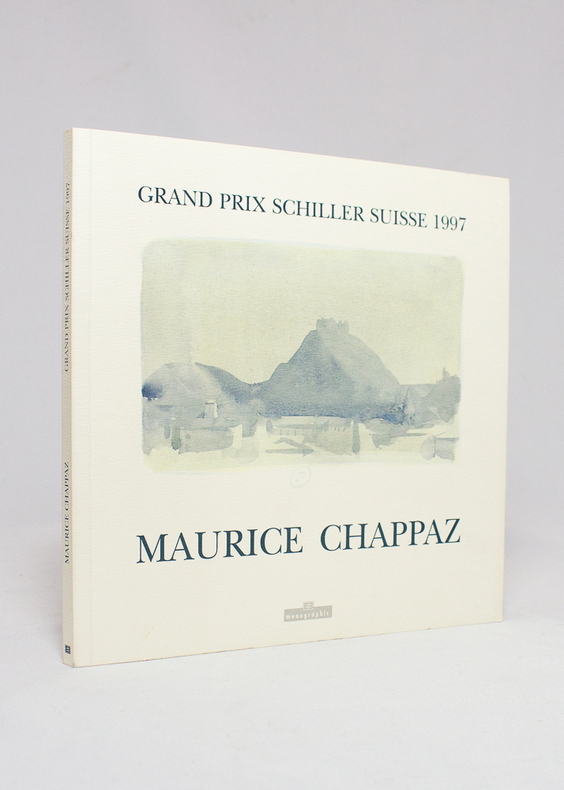
[CHAPPAZ Maurice] Collectif:
Maurice Chappaz - Grand Prix Schiller Suisse 1997.
Sierre, Monographic, 1997. In-8 broché de 75 pages, couverture illustrée par Palézieux.
Référence libraire : 11517
|
|
|
[Chappaz Maurice] Jacques Darbellay, Laurent Georges (phot.):
Maurice Chappaz, le marcheur au fil des mots.
Ayer, Editions Porte-Plume, 2006. In-8 broché à l'italienne, couverture à rabats. A l'état de neuf.
Référence libraire : 16558

|
|
|
[CHARLES VI] - HEIM (Maurice).-
La Passion d'un roi, Charles VI Le Fol (1398-1422). Sixième édition.
P., Gallimard NRF (Collection "Leurs figures"), 1955, in 12 broché, 331 pages ; rares rousseurs ; couverture (illustrée d'une reproduction de Gustave Doré) et dos fanés.
Référence libraire : 25486
|
|
|
[CHASSE] - [COMMERE (Jean)] - GENEVOIX (Maurice).-
Chasse. [Compositions originales de Jean COMMERE].
1964 P., de Tartas, 1964, in folio en feuilles, sous couverture de papier à feuilles végétales, rempliée et emboitage pleine toile marron de léditeur.
Référence libraire : 16839
|
|

 Recevoir par e-mail
 Télécharger en PDF
 Flux RSS
 Lien permanent


