|
Maurice Bloch
From Blessing to Violence: History and Ideology in the Circumcision Ritual of the Merina of Madagascar
Cambridge Univ Pr 1986. Paperback. New. 224 pages. 9.00x5.75x0.75 inches. Cambridge Univ Pr paperback
Référence libraire : x-0521314046 ISBN : 0521314046 9780521314046

|
|
|
Maurice Bloch
From Blessing to Violence
Cambridge University Press CUP pp. 228 . Papeback. New. Cambridge University Press CUP unknown
Référence libraire : 6418245 ISBN : 0521314046 9780521314046
|
|
|
Maurice Block
Handbuch der Statistik
new. unknown
Référence libraire : 44082487-n ISBN : 311259911x 9783112599112

|
|
|
Maurice Block
Handbuch der Statistik
like new. unknown
Référence libraire : 44082487 ISBN : 311259911x 9783112599112
|
|
|
Maurice Block
Handbuch der Statistik
Hardcover. New. New Book; Fast Shipping from UK; Not signed; Not First Edition; N/A hardcover
Référence libraire : ria9783112599112_inp ISBN : 311259911x 9783112599112

|
|
|
Maurice Bloomfield
Historical and Critical Remarks: Introductory to a Comparative Study of Greek Accent Classic Reprint
paperback. Good. Access codes and supplements are not guaranteed with used items. May be an ex-library book. paperback
Référence libraire : 1332327257.G ISBN : 1332327257 9781332327256
|
|
|
Maurice Bloomfield
Historical and Critical Remarks: Introductory to a Comparative Study of Greek Accent Classic Reprint
hardcover. Good. Access codes and supplements are not guaranteed with used items. May be an ex-library book. hardcover
Référence libraire : 0365042226.G ISBN : 0365042226 9780365042228
|
|
|
Maurice Bloomfield
Hymns of the Atharva-Veda
paperback. Good. Access codes and supplements are not guaranteed with used items. May be an ex-library book. paperback
Référence libraire : 024326741X.G ISBN : 024326741X 9780243267415

|
|
|
Maurice Bloomfield
Hymns of the Atharvaveda: Together with Extracts from the Ritual Books and the Commentaries
hardcover. Good. Access codes and supplements are not guaranteed with used items. May be an ex-library book. hardcover
Référence libraire : 0837118794.G ISBN : 0837118794 9780837118796
|
|
|
Maurice Bloomfield
Hymns of the Atharva-Veda: Together With Extracts From the Ritual Books and the Commentaries Classic Reprint
hardcover. Good. Access codes and supplements are not guaranteed with used items. May be an ex-library book. hardcover
Référence libraire : 0331825872.G ISBN : 0331825872 9780331825879
|
|
|
Maurice Bloomfield
Hymns of the Atharva-veda Together With Extracts From the Ritual Books and the Commentaries
Hardback. New. hardcover
Référence libraire : A9781018121611 ISBN : 1018121617 9781018121611

|
|
|
Maurice Bloomfield
Hymns of the Atharva-veda Together With Extracts From the Ritual Books and the Commentaries
Hardcover. New. New Book; Fast Shipping from UK; Not signed; Not First Edition; This work has been selected by scholars as being culturally important and is part of the knowledge base of civilization as we know it.This work is in the "public domain in the United States of America and possibly other nations. Withi hardcover
Référence libraire : ria9781018121611_inp ISBN : 1018121617 9781018121611

|
|
|
Maurice Bloomfield
Hymns of the Atharva-veda Together With Extracts From the Ritual Books and the Commentaries
Hardback. New. hardcover
Référence libraire : B9781018121611 ISBN : 1018121617 9781018121611
|
|
|
Maurice Bloch
In and Out of Each Other's Bodies: Theory of Mind Evolution Truth and the Nature of the Social
Paperback. New. New Book; Fast Shipping from UK; Not signed; Not First Edition; Fascinating and deep exploration into the nature of the social. How humans relate to each other psychologically symbolically and culturally. paperback
Référence libraire : ria9781612051024_inp ISBN : 1612051022 9781612051024
|
|
|
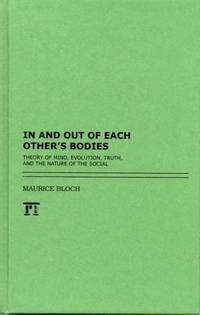
Maurice Bloch
In and Out of Each Others' Bodies : Theory of Mind Evolution Truth and the Nature of the Social
Hardcover. New. New Book; Fast Shipping from UK; Not signed; Not First Edition; What is human sociality How are universals such as truth and doubt variously demonstrated and negotiated in different cultures This book offers an accessible introduction to these and other fundamental human questions. Bloch shows tha hardcover
Référence libraire : ria9781612051017_inp ISBN : 1612051014 9781612051017
|
|
|
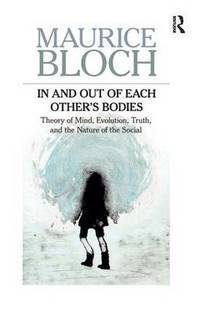
Maurice Bloch
In and Out of Each Other's Bodies: Theory of Mind Evolution Truth and the Nature of the Social
Paperback / softback. New. Fascinating and deep exploration into the nature of the social. How humans relate to each other psychologically symbolically and culturally. paperback
Référence libraire : A9781612051024 ISBN : 1612051022 9781612051024
|
|
|
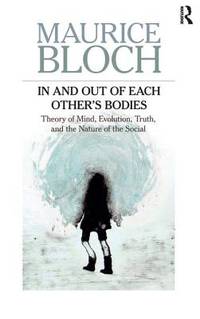
Maurice Bloch
In and Out of Each Other's Bodies
Paradigm Publishers pp. 172 . Hardback. New. Paradigm Publishers hardcover
Référence libraire : 63369455 ISBN : 1612051014 9781612051017
|
|
|
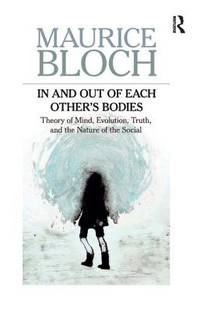
Maurice Bloch
In and Out of Each Other's Bodies
Paradigm Publishers pp. 172 . Papeback. New. Paradigm Publishers unknown
Référence libraire : 651371207 ISBN : 1612051022 9781612051024
|
|
|
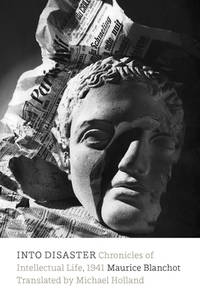
Maurice Blanchot , Michael Holland ,
Into Disaster: Chronicles of Intellectual Life 1941
FordhaUniversitPress 2013. 1st. Soft Cover. New/New. FordhaUniversitPress paperback
Référence libraire : AME_9780823250967 ISBN : 0823250962 9780823250967
|
|
|
Maurice BLANCHOT
Journal sans épisodes. Manuscrit autographe et tapuscrit complets
s. l. Paris: S. n. Journal des débats 1944. Fine. S. n. Journal des débats s. l. Paris s. d. 1944 13.50 x 21.50 cm 2 1/2 pages in-8 Autograph manuscript by the author of 2½ pages in-8 published in the February 10 1944 issue of Journal des Débats. Complete manuscript with very dense handwriting containing numerous deletions corrections and additions. Literary chronicle published on the occasion of the publication of Jean Dumay's ""Journal de guerre"". The complete typescript is included. Between April 1941 and August 1944 Maurice Blanchot published 173 articles on recently published books in the ""Chronique de la vie intellectuelle"" of Journal des Débats. In half a newspaper page approximately seven pages in-8 the young author of ""Thomas l'obscur"" takes his first steps in the field of literary criticism and thus inaugurates a theoretical work that he would later develop in his numerous essays from ""La Part du feu"" to ""L'Entretien infini"" and ""L'Écriture du désastre"". From the first articles Blanchot demonstrates an analytical acuity far exceeding the literary news that motivates their writing. Oscillating between classics and moderns first-rate writers and minor novelists he establishes in his chronicles the foundations of critical thought that would mark the second half of the 20th century. Transformed by writing and by war Blanchot breaks through a thought exercised ""in the name of the other"" with the violent Maurrassian certainties of his youth. Not without paradox he then transforms literary criticism into a philosophical act of intellectual resistance to barbarism at the very heart of an ""openly Maréchaliste"" newspaper: ""Brûler un livre en écrire sont les deux actes entre lesquels la culture inscrit ses oscillations contraires"" ""To burn a book to write one are the two acts between which culture inscribes its contrary oscillations"" Le Livre In Journal des Débats January 20 1943. In 2007 the Cahiers de la NRF brought together under the direction of Christophe Bident all the literary chronicles not yet published in volumes with this pertinent analysis of Blanchot's critical work: ""romans poèmes essais donnent lieu à une réflexion singulière toujours plus sûre de sa propre rhétorique livrée davantage à l'écho de l'impossible ou aux sirènes de la disparition. . Non sans contradictions ni pas de côté et dans la certitude fiévreuse d'une uvre qui commence . ces articles révèlent la généalogie d'un critique qui a transformé l'occasion de la chronique en nécessité de la pensée."" ""novels poems essays give rise to a singular reflection ever more sure of its own rhetoric delivered more to the echo of the impossible or to the sirens of disappearance. . Not without contradictions or sidesteps and in the feverish certainty of a work that begins . these articles reveal the genealogy of a critic who transformed the occasion of the chronicle into necessity of thought."" C. Bident. Autograph manuscripts by Maurice Blanchot are extremely rare. S. n.[ Journal des débats] unknown
Référence libraire : 44947

|
|
|
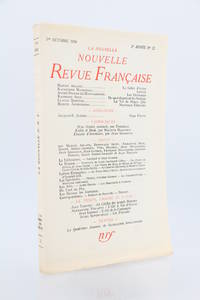
Maurice BLANCHOT - COLLECTIF
Kafka et Brod - In la Nrf du N°22 de la 2ème année
Paris: Gallimard 1954. Fine. Gallimard Paris 1er Octobre 1954 14 x 23 cm broché First edition one of 100 numbered copies on pure rag paper the only deluxe copies. First page shaded due to the presence of the NRF bulletin inserted at the beginning of the review. Handsome copy. Other contributions by Katherine Mansfield ""Lettres"" André Pieyre de Mandiargues ""Les Pierreuses"" Marcel Jouhandeau ""Nouveaux éléments"" René Etiemble ""D'un Orphée séminale"". Gallimard unknown
Référence libraire : 87683
|
|
|
Maurice BLANCHOT
L'attente l'oubli
Paris: Gallimard 1962. Fine. Gallimard Paris 1962 12 x 19 cm broché First edition one of 30 numbered copies on pur fil the only large paper copies. A very good copy. Gallimard unknown
Référence libraire : 45580

|
|
|
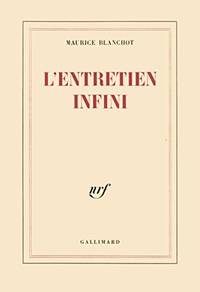
Maurice Blanchot
L'entretien infini
GALLIMARD 1969. Paperback. New. 640 pages. French language. 7.80x5.51x1.73 inches. GALLIMARD paperback
Référence libraire : 2-2070268268 ISBN : 2070268268 9782070268269
|
|
|
Maurice BLANCHOT
L'espace littéraire
Paris: Gallimard 1968. Fine. Gallimard Paris 1968 11 x 16.50 cm broché New pocket edition an advance copy. Moving and precious signed autograph inscription from Maurice Blanchot to his sister Marguerite: ""Pour ma très chère soeur Marguerite ce livre prémisses peut-être de ""la fin du livre"" avec les tendres excuses de MB."" ""For my very dear sister Marguerite this book perhaps the premises of ""the end of the book"" with tender apologies from MB."" Marguerite Blanchot a renowned organist at Chalon cathedral remained all her life in the family home with her mother and aunt. ""She would gradually become for the family like the memory of origins."" Very close to Maurice she corresponded regularly with the writer who showed her great gratitude for her devotion to their invalid mother. While Blanchot's intense affection for his mother and sister shows through in his dedications we know almost nothing of their relationship. In the only biographical essay on Blanchot Christophe Bident reveals however: ""Marguerite Blanchot revered her brother Maurice. Very proud of him . she attached great importance to his political ideas . She read extensively . They telephoned each other corresponded. At a distance they shared the same natural authority the same concern for discretion."" Blanchot indeed sent her numerous works from his library maintaining with her a continuous intellectual bond. A handsome copy. Gallimard unknown
Référence libraire : 43841

|
|
|
Maurice Block
L'Espagne en 1850: Tableau de Ses Progrès les Plus Récents Classic Reprint French Edition
hardcover. Good. Access codes and supplements are not guaranteed with used items. May be an ex-library book. hardcover
Référence libraire : 0428403816.G ISBN : 0428403816 9780428403812

|
|
|
Maurice Bladel
L'euvre de Georges Eekhoud Classic Reprint French Edition
hardcover. Good. Access codes and supplements are not guaranteed with used items. May be an ex-library book. hardcover
Référence libraire : 0666099022.G ISBN : 0666099022 9780666099020

|
|
|
Maurice BLANCHOT - (Marcel PROUST)
L'expérience de Proust. Manuscrit autographe complet The Proust Experience. Complete Autograph Manuscript
1943. Fine. 1943 21 x 13 cm en feuilles Autograph manuscript by the author four and a half pages in octavo published in the issue of Journal des Débats dated 12 May 1943. Complete recto-verso manuscript in a dense hand featuring numerous deletions corrections and additions. A literary column written on the occasion of the publication of Ramon Fernandezs book À la gloire de Proust. It was to Maurice Blanchot that his friend Emmanuel Levinas owed his discovery of the work of Marcel Proust which he deeply admired despite Charles Maurrass condemnationa judgment that at first failed to turn him away from it. What Blanchot valued most in Proust was his at times fluid rhythm and his remarkable sense of the scene. Placing him within his literary pantheon alongside the Marquis de Sade and Franz Kafka Blanchot was drawn in the early 1940s to the very nature of the experience Proust conveyed in his novels: « L'uvre de Proust est sortie d'états mystérieux qui semblent ne lui avoir été proposés que pour que cette uvre fût écrite. Ils ont servi de stimulant à une extraordinaire avidité de connaître et eux qui étaient d'abord une rupture de connaissance ont fourni un aliment inépuisable à la connaissance littéraire. Cependant ce n'est pas l'aspect le moins surprenant du Temps perdu que dans le flot d'images d'événements de théories de figures dont ils ont été par abus la source ces états aient gardé la valeur d'un secret en continuant selon le pouvoir qui leur était propre à paraître toujours plus mystérieux que l'uvre elle-même pourtant toute chargée de mystères. C'est en cela que Proust n'a pas trahi la révélation qu'il a rencontrée et dont il a offert l'image à la plus étendue et la plus admirable comme pour montrer qu'elle ne l'épuisait pas. » The text later revised would become part of the opening section of Faux Pas 1943 devoted to what Blanchot regarded as the fundamental question of inner experience. A very clean manuscript reflecting Blanchots clarity of thought on Proust. unknown
Référence libraire : 48328

|
|
|
Maurice BLANCHOT
L'instant de ma mort
Montpellier: Fata Morgana 1994. Fine. Fata Morgana Montpellier 1994 13.50 x 17.50 cm broché First edition one of 30 numbered copies on vellum pur-fil paper Johannot deluxe copies ""tirage de tête"". Rare and beautiful copy. Fata Morgana hardcover
Référence libraire : 67025

|
|
|
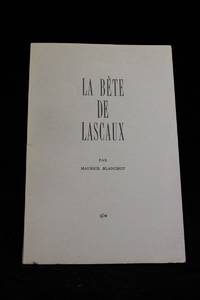
Maurice BLANCHOT
La bête de Lascaux The Beast of Lascaux
Paris: GLM 1958. Fine. GLM Paris 1958 12 x 18.50 cm broché First edition one of 48 numbered copies on Hollande tirage de tête. A tiny tear not serious to foot of upper cover. A rare and very good copy. GLM unknown
Référence libraire : 48048
|
|
|
Maurice BLANCHOT
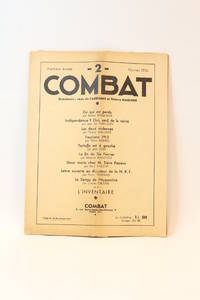
La fin du six février In Combat N°2 de la première année
Paris: Combat 1936. Fine. Combat Paris Février 1936 21.50 x 28.50 cm broché First and only publication of this pamphlet published in the review Combat directed by Thierry Maulnier. Vertical fold inherent to the distribution of this review small marginal tears. Other contributions by Robert Brasillach ""Ce qui est perdu"" Thierry Maulnier ""Les deux violences"" Pierre Andreu ""Fascisme 1913"" Jean de Fabrègues ""Indépendance Oui sauf de la vérité. Very rare document bearing witness to the anti-democratic period of the young Maurice Blanchot. Combat unknown
Référence libraire : 74347
|
|
|
Maurice BLANCHOT - Robert BRASILLACH
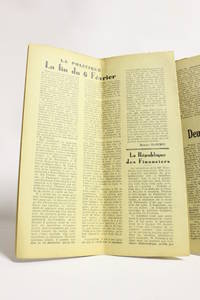
La fin du 6 février in Combat n°2 de la première année
Paris: in Combat 1936. Fine. in Combat Paris février 1936 21.50 x 28.50 cm agrafé First and only edition of this pamphlet published in the review Combat directed by Thierry Maulnier. Other contributions: Robert Brasillach Ce qui est perdu Thierry Maulnier Pierre Andreu. Very rare document bearing witness to the anti-democratic period of the young Maurice Blanchot. Vertical fold inherent to the distribution of this review. in Combat unknown
Référence libraire : 56072
|
|
|
Maurice BLANCHOT - Robert BRASILLACH
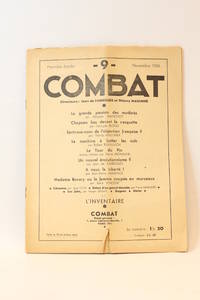
La grande passion des modérés in Combat n°9 de la première année
Paris: in Combat 1936. Fine. in Combat Paris Novembre 1936 21.50 x 28.50 cm agrafé First edition and sole publication of this pamphlet published in the magazine Combat directed by Thierry Maulnier. Vertical fold inherent to the distribution of this magazine and small marginal tears. Other contributions: Robert Brasillach ""La machine à botter les culs"" Thierry Maulnier ""Sortirons-nous de l'abjection française "" Georges Blond ""Chapeau bas devant la casquette"" Jean-Pierre Maxence ""A nous la liberté ! "". Very rare document testifying to the anti-democratic period of the young Maurice Blanchot. in Combat unknown
Référence libraire : 74349
|
|
|
Maurice BLANCHOT - Robert BRASILLACH
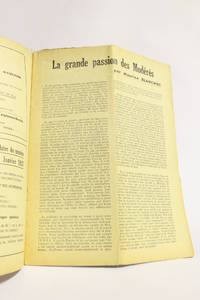
La grande passion des modérés in Combat n°9 de la première année
Paris: in Combat 1936. Fine. in Combat Paris novembre 1936 21.50 x 28.50 cm agrafé First and only edition of this pamphlet published in the review Combat directed by Thierry Maulnier. Other contributions: Robert Brasillach La machine à botter les culs Thierry Maulnier Georges Blond. Very rare document witnessing the anti-democratic period of young Maurice Blanchot. Vertical fold inherent to the distribution of this review with tear without loss at foot of same. in Combat unknown
Référence libraire : 56073
|
|
|
Maurice BLANCHOT
La part du feu The Share of the Fire
Paris: Gallimard 1949. Fine. Gallimard Paris 1949 14.50 x 21 cm broché First edition one of 13 numbered copies on pur fil paper the only large paper copies Spine very lightly sunned at head and foot not serious A very good and rare copy. Gallimard unknown
Référence libraire : 42834

|
|
|
Maurice BLOCK
La politique économique en Allemagne. Extrait de la Revue des Deux Mondes
s. l. Paris: Extrait de La Revue des deux mondes 1884. Fine. Extrait de La Revue des deux mondes s. l. Paris 1884 15.50 x 25 cm agrafé First edition. Plain paper cover. Rare. Extrait de La Revue des deux mondes unknown
Référence libraire : 15701

|
|
|
Maurice Bloomfield Abel Bergaigne
La Religion V Dique D'Apr's Les Hymnes Du Rig-V Da
New. unknown
Référence libraire : A9781113076106 ISBN : 1113076100 9781113076106

|
|
|
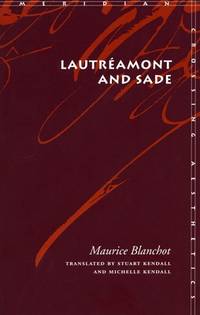
Maurice Blanchot; Michelle Kendall [Translator]; Stuart Kendall [Translator];
Lautréamont and Sade Meridian: Crossing Aesthetics
Stanford University Press 2004-07-09. Paperback. New. In shrink wrap. Looks like an interesting title! Stanford University Press paperback
Référence libraire : Q-0804750351 ISBN : 0804750351 9780804750356
|
|
|
Maurice BLANCHOT
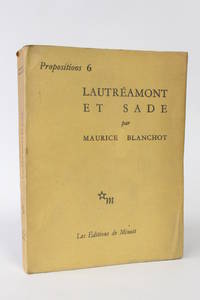
Lautréamont et Sade
Paris: Les Editions de Minuit 1949. Fine. Les Editions de Minuit Paris 1949 14 x 18.50 cm broché First edition on ordinary paper. Paper yellowed as usual. Les Editions de Minuit unknown
Référence libraire : 53073
|
|
|
Maurice BLANCHOT
Le baron d'Holbach. Manuscrit autographe et tapuscrit complets Baron d'Holbach. Complete autograph manuscript and typescript
s. l. Paris: S. n. Journal des débats 1943. Fine. S. n. Journal des débats s. l. Paris s. d. 1943 13.50 x 21.50 cm 4 1/2 pages in-8 Autograph manuscript by the author of 4½ pages in quarto published in the November 27-28 1943 issue of Journal des Débats. Complete manuscript with very dense handwriting containing numerous deletions corrections and additions. Literary chronicle published on the occasion of the publication of Paul Thiry d'Holbach et la philosophie scientifique au XVIIIe siècle by Pierre Naville. The complete typescript is included. Far more than a critique of Pierre Naville's work on Baron d'Holbach this long article by Blanchot is a veritable philosophical pamphlet against the materialist thought of the Encyclopedists whom he accuses of wanting to « know the world in order to seize it. This is a notable expression of the bourgeois spirit. . Man can only dominate the world if the world is a collection of objects. » But through this virulent critique of 18th-century thought Blanchot identifies a more modern evil: « To make man a thing that can be studied . is to ensure that he can be used as a thing and exploited as a thing. All the social contradictions of liberalism are already in this assertion. And its starting point is the Encyclopedia. » Between April 1941 and August 1944 Maurice Blanchot published 173 articles on recently published books in the ""Chronicle of Intellectual Life"" of Journal des Débats. In half a page of the newspaper approximately seven octavo pages the young author of ""Thomas l'obscur"" took his first steps in the field of literary criticism and thus inaugurated a theoretical work that he would later develop in his numerous essays from ""La Part du feu"" to ""L'Entretien infini"" and ""L'Écriture du désastre"". From the very first articles Blanchot demonstrated an analytical acuity that far exceeded the literary current events that motivated their writing. Oscillating between classics and moderns first-rate writers and minor novelists he laid in his chronicles the foundations of a critical thought that would mark the second half of the 20th century. Transformed by writing and by war Blanchot broke through a thought exercised ""in the name of the other"" with the violent Maurrassian certainties of his youth. Not without paradox he then transformed literary criticism into a philosophical act of intellectual resistance to barbarity at the very heart of an ""openly Maréchal-supporting"" newspaper: ""To burn a book to write one are the two acts between which culture inscribes its contrary oscillations"" Le Livre In Journal des Débats January 20 1943. In 2007 the Cahiers de la NRF brought together under the direction of Christophe Bident all the literary chronicles not yet published in volumes with this pertinent analysis of Blanchot's critical work: ""novels poems essays give rise to a singular reflection increasingly confident in its own rhetoric more given over to the echo of the impossible or to the sirens of disappearance. . Not without contradictions or sidesteps and in the feverish certainty of a work that begins . these articles reveal the genealogy of a critic who transformed the occasion of the chronicle into the necessity of thought."" C. Bident. Autograph manuscripts by Maurice Blanchot are extremely rare. S. n.[ Journal des débats] unknown
Référence libraire : 44967

|
|
|
Maurice BLANCHOT - COLLECTIF
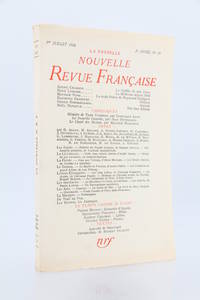
Le chant des sirènes - In la Nrf du N°19 de la 2ème année
Paris: Gallimard 1954. Fine. Gallimard Paris 1er Juillet 1954 14 x 23 cm broché First edition one of 100 numbered copies on pur fil paper the only deluxe copies. First page shaded due to the presence of the Nrf bulletin inserted at the beginning of the review. Handsome copy despite small red stains on the lower edge. Other contributions by Raymond Radiguet ""Poèmes"" Soeren Kierkegaard ""Journal"" Dominique Aury ""Histoire de trois vocations"" Noël Devaulx ""Bal chez Alféoni"". Gallimard unknown
Référence libraire : 87682
|
|
|
Maurice BLANCHOT
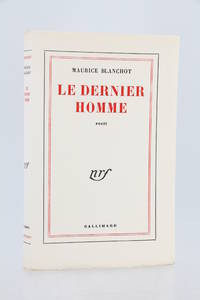
Le dernier homme
Paris: Gallimard 1957. Fine. Gallimard Paris 1957 12 x 19 cm broché First edition one of 30 numbered copies on pur fil paper the only deluxe copies. Very handsome copy. Gallimard unknown
Référence libraire : 84248
|
|
|
Maurice BLANCHOT
Le livre à venir
Paris: Gallimard 1959. Fine. Gallimard Paris 1959 13.50 x 19.50 cm broché First edition an advance service de presse copy. A very handsome and moving autograph inscription from Maurice Blanchot to his sister : ""Pour ma chère Marguerite qui porte maintenant mot illisible le poids de mon affection. Maurice For my dear Marguerite who now bears illegible word the weight of my affection. Maurice."" A good copy. Gallimard unknown
Référence libraire : 52434

|
|
|
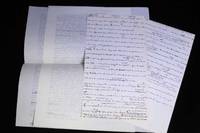
Maurice BLANCHOT - (Jean GIRAUDOUX)
Le mythe de Giraudoux. Manuscrit autographe et tapuscrit complets.
s. l. Paris: S. n. Paysage dimanche 1945. Fine. S. n. Paysage dimanche s. l. Paris s. d. 1945 11.50 x 22 cm 3 pages in-4 Autograph manuscript by the author 3 quarto pages published in issue 17 of October 7 1945 of the newspaper Le Paysage Dimanche. Complete manuscript in very dense handwriting with numerous deletions corrections and additions. Chronicle published on the occasion of the numerous studies on Giraudoux's work that appeared since his death in January 1944. The complete typescript is included. While the numerous references to his work in the articles of the Journal des Débats reveal Giraudoux's ascendancy over Blanchot the latter nevertheless manifests a clear desire to free himself from this paternity. Thus he removes from Faux-Pas numerous references to Giraudoux's work cf C. Bident M. B. De la chronique à la théorisation. This article published in 1945 is a unique testimony to the ambivalence of feelings toward an admired master who could no longer serve as a model for his disciple transformed by writing and war. ""Certes un auteur comme celui de Judith ne peut pas être un auteur de tout repos mais ce qu'il a créé est beau et ce beau n'est pas ""ce qui nous désespère"". Il est trop facile de voir que quoi qu'il veuille il ne va jamais jusqu'à compromettre en son art l'harmonie la compréhension la mesure. Comme une malédiction jetée sur la réalité inaccessible il formerait un monde entièrement faux Mais pas si faux: nous n'y perdons pas pied nous ne cessons de nous y reconnaitre et au contraire pour certains comme Sartre c'est celui de la banalité même des concepts de chaque jour."" ""Certainly an author like the one who wrote Judith cannot be a restful author but what he has created is beautiful and this beauty is not 'what drives us to despair'. It is too easy to see that whatever he may wish he never goes so far as to compromise in his art harmony understanding measure. Like a curse cast upon inaccessible reality would he form an entirely false world But not so false: we do not lose our footing there we never cease to recognize ourselves in it and on the contrary for some like Sartre it is that of the very banality of everyday concepts."" Between April 1941 and August 1944 Maurice Blanchot published 173 articles on recently published books in the ""Chronicle of intellectual life"" of the Journal des Débats. In half a newspaper page approximately seven octavo pages the young author of ""Thomas l'obscur"" took his first steps in the field of literary criticism and thus inaugurated a theoretical work that he would later develop in his numerous essays from ""La Part du feu"" to ""L'Entretien infini"" and ""L'Écriture du désastre"". From the first articles Blanchot demonstrated an analytical acuity far exceeding the literary current events that motivated their writing. Oscillating between classics and moderns first-rate writers and minor novelists he established in his chronicles the foundations of critical thinking that would mark the second half of the 20th century. Transformed by writing and by war Blanchot broke through a thought exercised ""in the name of the other"" with the violent Maurrassian certainties of his youth. Not without paradox he then transformed literary criticism into a philosophical act of intellectual resistance to barbarism at the very heart of an ""openly Maréchaliste"" newspaper: ""Burning a book writing one are the two acts between which culture inscribes its contrary oscillations"" Le Livre In Journal des Débats January 20 1943. In 2007 the Cahiers de la NRF brought together under the direction of Christophe Bident all the literary chronicles not yet published in volumes with this pertinent analysis of Blanchot's critical work: ""novels poems essays give rise to a singular reflection ever more confident in its own rhetoric delivered more to the echo of the impossible or to the sirens of disappearance. . Not without contradictions or sidesteps and in the feverish certainty of a S. n.[ Paysage dimanche] unknown
Référence libraire : 44924
|
|
|
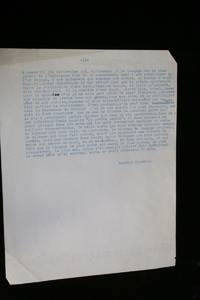
Maurice BLANCHOT
Le Paradoxe d'Aytré - Manuscrit original et tapuscrit complets
s. l.: S. n. 1949. Fine. S. n. s. l. 1949 13.50 x 21.50 cm Autograph manuscript by the author of 16 pages in-8 published in number 9 June 1946 of Les Temps modernes and reprinted slightly revised in La Part du Feu 1949. Complete recto-verso manuscript very densely written with numerous deletions corrections and additions. Accompanied by the complete typescript with autograph corrections in black ink. ""Le Paradoxe d'Aytré"" ""Aytré's Paradox"" is the first text by Maurice Blanchot that Jean-Paul Sartre published in the pages of Les Temps modernes the spearhead of committed literature. Three others would follow until 1952 ""Le roman uvre de mauvaise foi"" ""The Novel a Work of Bad Faith"" ""A la rencontre de Sade"" ""Meeting Sade"" and ""L'art la littérature et l'expérience originelle"" ""Art Literature and Original Experience"" all of great importance. Continuing his reflection begun several years earlier on the writer's struggle with language and his relationship to silence notably in his article ""Le Mythe d'Oreste"" ""The Myth of Orestes"" Blanchot bases his demonstration here on Aytré qui perd l'habitude ""Aytré Who Loses the Habit"" by Jean Paulhan - a major influence - who notably provides him with the title of his article: ""De ce petit récit il ne résulte pas que la littérature ne doive logiquement commencer qu'avec le crime ou à défaut avec le vol. Mais qu'elle suppose un écroulement une sorte de catastrophe initiale et le vide même que mesurent l'anxiété et le souci c'est ce qu'on peut être tenté de voir. Or remarquons-le cette catastrophe ne s'exerce pas seulement sur le monde les objets qu'on manie . ; elle s'étend aussi et en même temps au langage à la possibilité des mots. C'est là le paradoxe d'Aytré."" ""From this little story it does not follow that literature should logically begin only with crime or failing that with theft. But that it presupposes a collapse a sort of initial catastrophe and the very void that anxiety and worry measure this is what one might be tempted to see. Now let us note this catastrophe is not exercised only on the world the objects we handle .; it extends also and at the same time to language to the possibility of words. This is Aytré's paradox."" And he adds: ""L'écrivain ne débute pas toujours avec le sang d'un fait divers ou l'horreur d'un crime qui lui ferait sentir l'instabilité et le vide du monde mais il ne peut guère songer à commencer autrement que par une certaine incapacité de parler et d'écrire par une perte de mots par l'absence même des moyens dont il surabonde. Ainsi lui est-il indispensable de sentir d'abord qu'il n'a rien à dire."" ""The writer does not always begin with the blood of a news item or the horror of a crime that would make him feel the instability and emptiness of the world but he can hardly think of beginning otherwise than with a certain inability to speak and write with a loss of words with the very absence of the means of which he has abundance. Thus it is essential for him to feel first that he has nothing to say."" Jean Paulhan therefore but also Franz Kafka Herman Melville or Stéphane Mallarmé so many writers admired by Blanchot confronted Aytré's paradox silence the collapse of language. And the critic concludes: "". le silence du langage créateur ce silence qui nous fait parler n'est pas seulement une absence de parle mais une absence tout court cette distance que nous mettons entre les choses et nous et en nous-mêmes et dans les mots et qui fait que le langage le plus plein est aussi le plus poreux le plus transparent le plus nul car il laisse infiniment fuir le creux même qu'il enferme sorte de petit alcarazas du vide."" "". the silence of creative language this silence that makes us speak is not only an absence of speech but an absence pure and simple this distance that we put between things and ourselves and within ourselves and in words and which makes the fullest language also the most S. n. unknown
Référence libraire : 47141
|
|
|
Maurice BLANCHOT
Le pas au-delÃ
Paris: Gallimard 1973. Fine. Gallimard Paris 1973 14 x 20.50 cm broché First edition an advance service de presse copy. Very handsome and moving autograph inscription signed by Maurice Blanchot to his sister on a calling card pasted to head of one endpaper: ""A ma chère Marg. Ce livre d'amitié et pour l'amitié plus à feuilleter qu'à lire peut-être avec ma grande affection. Maurice To my dear sister Marg. This book of friendship or book for friendship maybe more to leaf through than to read with great affection. Maurice."" A good copy. Gallimard unknown
Référence libraire : 52429

|
|
|
Maurice BLANCHOT
Le pèlerinage aux sources - Manuscrit autographe et tapuscrit complets.
s. l. Paris: S. n. Journal des débats 1944. Fine. S. n. Journal des débats s. l. Paris s. d. 1944 13.50 x 21.50 cm 2 1/2 pages in-8 Autograph manuscript by the author 2½ pages octavo published in the January 13 1944 issue of the Journal des Débats. Complete recto-verso manuscript in very dense handwriting with numerous deletions corrections and additions. Accompanied by the complete typescript with one autograph correction in black ink. Chronicle published on the occasion of the publication of Le pèlerinage aux sources by Joseph Lanza del Vasto. This chronicle by Maurice Blanchot forms an astonishing echo to one of his very first published texts 1931 devoted to Gandhi's Memoirs which already contained the essence of his thought from the 1930s. Published in the pages of Cahiers mensuels a Catholic review close to the thinking of Jacques Maritain Blanchot defended the idea of a necessarily spiritual revolution but also of a struggle against the impurity of foreign influences. In ""Le pèlerinage aux sources"" Blanchot returns to Gandhi through a recently published work by Joseph Lanza del Vasto in which the Italian philosopher analyzes ""the hope of renewal that many Westerners seek often lightly in the profound secrets of Hinduism"". But for Blanchot Gandhi's action could hardly constitute a true example to follow: ""Naturally we all understand that Gandhi's politics tends not only toward a political victory but toward a spiritual victory: he wants to deliver the people from their ills from their ignorance to make them live the truth; all this is quite clear; what is also clear is that among these ills there is first the presence of the foreigner and that the regime recommended by the Mahatma and with a view to which he brings into play spiritual forces is a regime of political economic and social liberation. It is impossible not to see . in this rehabilitation of external action the distortion of the spiritual ideal. Man is no longer asked to strip himself of himself for nothing without any formidable end being able to justify him in this total annihilation but he receives the order to arrange the world to conquer himself with a view to making reality better. It is an inglorious return to the most vulgar morality of salvation."" An interesting critique of Mahatma Gandhi's political action. Between April 1941 and August 1944 Maurice Blanchot published 173 articles on recently published books in the ""Chronicle of Intellectual Life"" of the Journal des Débats. In half a page of newspaper approximately seven octavo pages the young author of ""Thomas l'obscur"" takes his first steps in the field of literary criticism and thus inaugurates a theoretical work that he would later develop in his numerous essays from ""La Part du feu"" to ""L'Entretien infini"" and ""L'Écriture du désastre."" From the first articles Blanchot demonstrates an analytical acuity far exceeding the literary current events that motivate their writing. Oscillating between classics and moderns first-rate writers and minor novelists he establishes in his chronicles the foundations of a critical thought that would mark the second half of the 20th century. Transformed by writing and by war Blanchot breaks through a thought exercised ""in the name of the other"" with the violent Maurrassian certainties of his youth. Not without paradox he then transforms literary criticism into a philosophical act of intellectual resistance to barbarism at the very heart of an ""openly Maréchaliste"" newspaper: ""To burn a book to write one are the two acts between which culture inscribes its contrary oscillations"" Le Livre In Journal des Débats January 20 1943. In 2007 the Cahiers de la NRF gathered under the direction of Christophe Bident all the literary chronicles not yet published in volumes with this pertinent analysis of Blanchot's critical work: ""novels poems essays give rise to a singular reflection always more sure of its own rhetoric delivered more to the echo S. n.[ Journal des débats] unknown
Référence libraire : 44955

|
|
|
Maurice BLANCHOT
Le ressassement éternel
Paris: Les Editions de Minuit 1951. Fine. Les Editions de Minuit Paris 1951 11.50 x 18.50 cm relié First edition one of 990 copies on Ghaldwill the only deluxe copies after 10 on pur fil. Half blue morocco binding smooth spine gilt date at foot covers with marbled paper blue paper endpapers and pastedowns original wrappers and spine preserved spine slightly sunned with small filled losses top edge gilt binding signed by Goy & Vilaine. Exceptional and moving signed autograph inscription from Maurice Blanchot to his mother and sister: ""Pour vous mes très chères ces pages hélas bien anciennes en toute affection. Maurice. / Mais avant le commencement il y a le recommencement qui fait de la lumière une fascination de toute chose une image et de nous le coeur vide du ressassement éternel"" ""For you my very dear ones these pages alas quite old with all my affection. Maurice. / But before the beginning there is the re-beginning which makes light a fascination everything an image and us the empty heart of eternal rehearsal"". Half-title page bearing the inscription very slightly and marginally shaded. Marguerite Blanchot renowned organist at Chalon cathedral remained all her life in the family home with her mother and aunt. ""She gradually became for the family like the memory of origins."" Very close to Maurice she corresponded regularly with the writer who showed her great gratitude for her devotion to their disabled mother. While Blanchot's intense affection for his mother and sister shows through in his dedications we know almost nothing of their relationships. In the only biographical essay on Blanchot Christophe Bident reveals however: ""Marguerite Blanchot venerated her brother Maurice. Very proud of him . she attached great importance to his political ideas . She read extensively . They telephoned each other corresponded. From a distance they shared the same natural authority the same concern for discretion."" Blanchot indeed sent her numerous works from his library maintaining with her a continuous intellectual bond. As for Blanchot's passion for his mother it is in the course of his work that we discover the most beautiful testimonies: ""Perhaps the power of the maternal figure borrows its brilliance from the very power of fascination and one could say that if the Mother exercises this fascinating attraction it is because appearing when the child lives entirely under the gaze of fascination she concentrates in herself all the powers of enchantment"". Cultivating absolute discretion Blanchot pushed the art of effacement even into his manuscript dedications generally succinct and written almost systematically on cards attached to the rare works he offered to his close friends. In contrast in these precious inscriptions to his mother and sister Blanchot offers himself in all his fragility and reveals a hitherto unknown intimacy. Fine copy perfectly established. Les Editions de Minuit unknown
Référence libraire : 44768

|
|
|
Maurice BLANCHOT
Le ressassement éternel
Paris: Les Editions de Minuit 1952. Fine. Les Editions de Minuit Paris 1952 12 x 19 cm relié First edition on ordinary paper. Half black morocco over marbled paper boards by P. Goy & C. Vilaine spine in six compartments date at foot marbled endpapers and pastedowns blue folded covers preserved top edge gilt. Exceptional autograph inscription from Maurice Blanchot to his brother and sister-in-law Inge: ""Pour vous mes chers ces pages hélàs très anciennes que seuls vous pouvez garder jeunes. Et en effet quoi de plus proche de la solennelle fatigue de la mort que le piétinement de la monotonie harcèlement gigantesque au sein du recommencement For you my darlings these pages sadly so old that only you can keep them young
And indeed what could be closer to the solemn fatigue of death than the footsteps of monotony the gigantic difficulty at the heart of any new beginning."" Half-title and final endpaper faded. A very good and handsome copy suitably bound. Les Editions de Minuit hardcover
Référence libraire : 46921

|
|
|
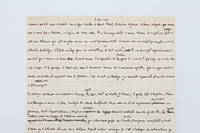
Maurice BLANCHOT - (Horace WALPOLE) - Paul ELUARD
Le roman noir - Manuscrit autographe et tapuscrit complets he Noir Novel Complete Autograph Manuscript and Typescript
s. l. Paris: S. n. Journal des débats 1944. Fine. S. n. Journal des débats s. l. Paris 1944 13.50 x 21 cm 2 pages 1/2 in-4 Autograph manuscript by the author 2½ pages in-8 published in the issue of 30 March 1944 of the Journal des Débats. Complete recto-verso manuscript in very dense handwriting containing numerous deletions corrections and additions. This is a review published on the occasion of the reissue of Horace Walpole's The Castle of Otranto with a preface by Paul Eluard. Accompanied by the complete typescript. The reissue by Éditions José Corti of Horace Walpole's The Castle of Otranto with a preface by Paul Eluard offered Maurice Blanchot the opportunity to set out his definition of the Gothic novel which thanks notably to the Surrealists was then enjoying a revival of interest: ""Le roman noir ne se confond pas simplement avec la littérature fantastique. S'il fait une large part au merveilleux ""de toute nature"" il a pour principal objet d'émouvoir la sensibilité par les ressources de la terreur. il veut secouer l'imagination. Il l'entraîne dans un mouvement frénétique qui ne lui laisse pas de repos. Il la provoque à tout croire hormis les dénouements heureux et les compromis agréables par des moyens dont le caractère conventionnel augmente encore la puissance. C'est un art méthodique qui connaît sa grossiéreté et en tire souvent des effets subtils et remarquables."" Blanchot then pursues an almost political analysis of the Gothic novelborn in the age of pre-revolutionary rationalism flourishing in the wake of 1789 before flagging under the Restoration. And he concludes: ""Horace Walpole est beaucoup plus qu'un précurseur. Avec ce volume fort mince il apparait vraiment comme l'auteur de milliers d'ouvrages qui sont nés de lui. Avec ce volume fort mince sic il est le plus fécond des écrivains."" Between April 1941 and August 1944 Maurice Blanchot published in the ""Chronique de la vie intellectuelle"" of the Journal des Débats 173 articles on recently published books. In a half-page of newspaper approximately seven in-8 pages the young author of Thomas l'obscur took his first steps in the field of literary criticism inaugurating a body of theoretical work that he would later develop in his numerous essays from La Part du feu to L'Entretien infini and L'Écriture du désastre. From the very first articles Blanchot demonstrated an acuity of analysis far surpassing the literary news that occasioned their writing. Oscillating between classics and moderns major writers and minor novelists he laid down in his columns the foundations of a critical thought that would shape the second half of the twentieth century. Transformed by writing and by the war Blanchot gradually broke in the exercise of a thought developed ""in the name of the other"" with the violent certainties of his youthful adherence to Maurras. Not without paradox he thus transformed literary criticism into a philosophical act of intellectual resistance to barbarism at the very heart of a newspaper that was ""openly maréchaliste"": ""Brûler un livre en écrire sont les deux actes entre lesquels la culture inscrit ses oscillations contraires"" ""Le livre"" in Journal des Débats 20 January 1943. In 2007 the Cahiers de la NRF under the direction of Christophe Bident brought together all the literary columns not yet published in volumes accompanied by a pertinent analysis of Blanchots critical work: ""romans poèmes essais donnent lieu à une réflexion singulière toujours plus sûre de sa propre rhétorique livrée davantage à l'écho de l'impossible ou aux sirènes de la disparition. . Non sans contradictions ni pas de côté et dans la certitude fiévreuse d'une uvre qui commence . ces articles révèlent la généalogie d'un critique qui a transformé l'occasion de la chronique en nécessité de la pensée."" C. Bident. Maurice Blanchots autograph manuscripts are of the utmost rarity. S. n.[ Journal des débats] unknown
Référence libraire : 83783
|
|
|
Maurice Block
Le Socialisme Moderne
paperback. Good. Access codes and supplements are not guaranteed with used items. May be an ex-library book. paperback
Référence libraire : 0243849516.G ISBN : 0243849516 9780243849512
|
|

 Recevoir par e-mail
 Télécharger en PDF
 Flux RSS
 Lien permanent


