|
Maurice Hendry.
Cadillac - Standard of the World: The Complete History Second Edition
Automobile Quarterly Publications. 2nd Edition. Hardcover. Very Good/Very Good. 447 pp. Second/2nd Edition. Book/dust jacket condition: VG/VG- several chips/closed tears up to 3/4"" front and back; moderate scratch through color to front; photos on request. All orders are processed and shipped from MI or WI USA. Automobile Quarterly Publications hardcover
Referenz des Buchhändlers : 1910
|
|
|
Frankel, Max G., F. William Happ, and Maurice P. Smith
Functional Teaching of the Mentally Retarded
Charles C. Thomas Publisher. 1967. Hardcover. UsedGood. Hardcover; second printing of a 1966 copyright; light wear to the cover; fo rmer owner's name on front end page; otherwise in good condition with clean text and tight binding. . Charles C. Thomas Publisher hardcover
Referenz des Buchhändlers : 72641
|
|
|
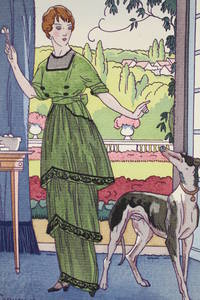
Maurice TAQUOY - (Charles-Frederick WORTH)
La Fidélité récompensée. Robe d'après-midi de Worth pl.8 La Gazette du Bon ton 1913 n°10
Paris: Lucien Vogel éditeur 1913. Fine. Lucien Vogel éditeur Paris Août 1913 19 x 24.50 cm une feuille Original color print printed on vergé paper signed in the plate. An original print used to illustrate the Gazette du bon ton one of the most attractive and influential 20th century fashion magazines featuring the talents of French artists and other contributors from the burgeoning Art Deco movement. A celebrated fashion magazine established in 1912 by Lucien Vogel La Gazette du bon ton appeared until 1925 with a hiatus from 1915 to 1920 due to the war the editor-in-chief having been called up for service. It consisted of 69 issues printed in only 2000 copies each and notably illustrated with 573 color plates and 148 sketches of the models of the great designers. Right from the start this sumptuous publication “was aimed at bibliophiles and fashionable society” Françoise Tétart-Vittu “La Gazette du bon ton” in Dictionnaire de la mode 2016 and was printed on fine vergé paper using a type cut specially for the magazine by Georges Peignot known as Cochin later used in 1946 by Christian Dior. The prints were made using stencils heightened in colors some highlighted in gold or palladium. The story began in 1912 when Lucien Vogel a man of the world involved in fashion he had already been part of the fashion magazine Femina decided with his wife Cosette de Brunhoff – the sister of Jean creator of Babar – to set up the Gazette du bon ton subtitled at the time: “Art fashion frivolities.” Georges Charensol noted the reasoning of the editor-in-chief: “’In 1910’ he observed ‘there was no really artistic fashion magazine nothing representative of the spirit of the time. My dream was therefore to make a luxury magazine with truly modern artists…I was assured of success because when it comes to fashion no country on earth can compete with France.’” “Un grand éditeur d’art. Lucien Vogel” in Les Nouvelles littéraires no. 133 May 1925. The magazine was immediately successful not only in France but also in the United States and Latin America. At first Vogel put together a team of seven artists: André-Édouard Marty and Pierre Brissaud followed by Georges Lepape and Dammicourt as well as eventually his friends from school and the School of Fine Arts like George Barbier Bernard Boutet de Monvel and Charles Martin. Other talented people soon came flocking to join the team: Guy Arnoux Léon Bakst Benito Boutet de Monvel Umberto Brunelleschi Chas Laborde Jean-Gabriel Domergue Raoul Dufy Édouard Halouze Alexandre Iacovleff Jean Émile Laboureur Charles Loupot Chalres Martin Maggie Salcedo. These artist mostly unknown when Lucien Vogel sought them out later became emblematic and sought-after artistic figures. It was also they who worked on the advertising drawings for the Gazette. The plates put the spotlight on and celebrate dresses by seven designers of the age: Lanvin Doeuillet Paquin Poiret Worth Vionnet and Doucet. The designers provided exclusive models for each issue. Nonetheless some of the illustrations are not based on real models but simply on the illustrator’s conception of the fashion of the day. The Gazette du bon ton was an important step in the history of fashion. Combining aesthetic demands with the physical whole it brought together – for the first time – the great talents of the artistic literary and fashion worlds; and imposed through this alchemy a completely new image of women: slender independent and daring which was shared by the new generation of designers including Coco Chanel Jean Patou Marcel Rochas and so on… Taken over in 1920 by Condé Montrose Nast the Gazette du bon ton was an important influence on the new layout and aesthetics of that “little dying paper” that Nast had bought a few years earlier: Vogue. Lucien Vogel éditeur unknown
Referenz des Buchhändlers : 54566
|
|
|
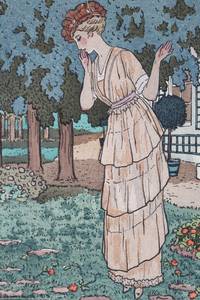
Maurice TAQUOY - (Charles-Frederick WORTH)
Mon pauvre gazon ! Robe de garden party de Chéruit pl.8 La Gazette du Bon ton 1913 n°11
Paris: Lucien Vogel éditeur 1913. Fine. Lucien Vogel éditeur Paris Septembre 1913 19 x 24.50 cm une feuille Original color print printed on vergé paper signed in the plate. An original print used to illustrate the Gazette du bon ton one of the most attractive and influential 20th century fashion magazines featuring the talents of French artists and other contributors from the burgeoning Art Deco movement. A celebrated fashion magazine established in 1912 by Lucien Vogel La Gazette du bon ton appeared until 1925 with a hiatus from 1915 to 1920 due to the war the editor-in-chief having been called up for service. It consisted of 69 issues printed in only 2000 copies each and notably illustrated with 573 color plates and 148 sketches of the models of the great designers. Right from the start this sumptuous publication “was aimed at bibliophiles and fashionable society” Françoise Tétart-Vittu “La Gazette du bon ton” in Dictionnaire de la mode 2016 and was printed on fine vergé paper using a type cut specially for the magazine by Georges Peignot known as Cochin later used in 1946 by Christian Dior. The prints were made using stencils heightened in colors some highlighted in gold or palladium. The story began in 1912 when Lucien Vogel a man of the world involved in fashion he had already been part of the fashion magazine Femina decided with his wife Cosette de Brunhoff – the sister of Jean creator of Babar – to set up the Gazette du bon ton subtitled at the time: “Art fashion frivolities.” Georges Charensol noted the reasoning of the editor-in-chief: “’In 1910’ he observed ‘there was no really artistic fashion magazine nothing representative of the spirit of the time. My dream was therefore to make a luxury magazine with truly modern artists…I was assured of success because when it comes to fashion no country on earth can compete with France.’” “Un grand éditeur d’art. Lucien Vogel” in Les Nouvelles littéraires no. 133 May 1925. The magazine was immediately successful not only in France but also in the United States and Latin America. At first Vogel put together a team of seven artists: André-Édouard Marty and Pierre Brissaud followed by Georges Lepape and Dammicourt as well as eventually his friends from school and the School of Fine Arts like George Barbier Bernard Boutet de Monvel and Charles Martin. Other talented people soon came flocking to join the team: Guy Arnoux Léon Bakst Benito Boutet de Monvel Umberto Brunelleschi Chas Laborde Jean-Gabriel Domergue Raoul Dufy Édouard Halouze Alexandre Iacovleff Jean Émile Laboureur Charles Loupot Chalres Martin Maggie Salcedo. These artist mostly unknown when Lucien Vogel sought them out later became emblematic and sought-after artistic figures. It was also they who worked on the advertising drawings for the Gazette. The plates put the spotlight on and celebrate dresses by seven designers of the age: Lanvin Doeuillet Paquin Poiret Worth Vionnet and Doucet. The designers provided exclusive models for each issue. Nonetheless some of the illustrations are not based on real models but simply on the illustrator’s conception of the fashion of the day. The Gazette du bon ton was an important step in the history of fashion. Combining aesthetic demands with the physical whole it brought together – for the first time – the great talents of the artistic literary and fashion worlds; and imposed through this alchemy a completely new image of women: slender independent and daring which was shared by the new generation of designers including Coco Chanel Jean Patou Marcel Rochas and so on… Taken over in 1920 by Condé Montrose Nast the Gazette du bon ton was an important influence on the new layout and aesthetics of that “little dying paper” that Nast had bought a few years earlier: Vogue. Lucien Vogel éditeur unknown
Referenz des Buchhändlers : 54590
|
|
|
Velluz, Leon, Maurice Legrand, and Marc Grosjean
Optical Circular Dichroism: Principles Measurements and Applications
Academic Press. 1965. Hardcover. UsedVeryGood. Hardcover; translated from the French by John MacCordick; light fading lig ht shelf wear to the cover; otherwise in very good condition with lean text and tight binding. . Academic Press hardcover
Referenz des Buchhändlers : 72810
|
|
|
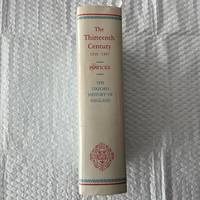
Sir Maurice Powicke
The Thirteenth Century 1216-1307. The Oxford History of Englan
Oxford: Oxford University at the Clarendon Press 1986. Second Edition Seventh Impression. . Cloth Bound Boards. Near Fine/Very Good. 1986 second edition seventh impression. Size large thick octavo 829 pages a heavy book. Navy cloth covered boards with gilt titles to the spine with the dust jacket. Book condition near fine a very clean copy. Dust jacket condition very good slight curl to edges spine a little faded head and tail of spine slightly creased not price clipped. Size: 8vo - over 7¾" - 9¾" tall <br/> <br/> Oxford University at the Clarendon Press hardcover
Referenz des Buchhändlers : 017257 ISBN : 0198217080 9780198217084
|
|
|
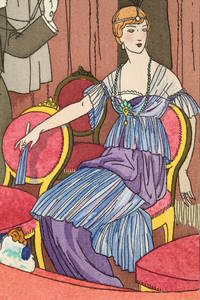
Maurice TAQUOY - (Charles-Frederick WORTH)
L'Entr'acte. Robe du soir de Worth pl.6 La Gazette du Bon ton 1913 n°12
Paris: Lucien Vogel éditeur 1913. Fine. Lucien Vogel éditeur Paris Octobre 1913 19 x 24.50 cm une feuille Original color print printed on vergé paper signed in the plate. An original print used to illustrate the Gazette du bon ton one of the most attractive and influential 20th century fashion magazines featuring the talents of French artists and other contributors from the burgeoning Art Deco movement. A celebrated fashion magazine established in 1912 by Lucien Vogel La Gazette du bon ton appeared until 1925 with a hiatus from 1915 to 1920 due to the war the editor-in-chief having been called up for service. It consisted of 69 issues printed in only 2000 copies each and notably illustrated with 573 color plates and 148 sketches of the models of the great designers. Right from the start this sumptuous publication “was aimed at bibliophiles and fashionable society” Françoise Tétart-Vittu “La Gazette du bon ton” in Dictionnaire de la mode 2016 and was printed on fine vergé paper using a type cut specially for the magazine by Georges Peignot known as Cochin later used in 1946 by Christian Dior. The prints were made using stencils heightened in colors some highlighted in gold or palladium. The story began in 1912 when Lucien Vogel a man of the world involved in fashion he had already been part of the fashion magazine Femina decided with his wife Cosette de Brunhoff – the sister of Jean creator of Babar – to set up the Gazette du bon ton subtitled at the time: “Art fashion frivolities.” Georges Charensol noted the reasoning of the editor-in-chief: “’In 1910’ he observed ‘there was no really artistic fashion magazine nothing representative of the spirit of the time. My dream was therefore to make a luxury magazine with truly modern artists…I was assured of success because when it comes to fashion no country on earth can compete with France.’” “Un grand éditeur d’art. Lucien Vogel” in Les Nouvelles littéraires no. 133 May 1925. The magazine was immediately successful not only in France but also in the United States and Latin America. At first Vogel put together a team of seven artists: André-Édouard Marty and Pierre Brissaud followed by Georges Lepape and Dammicourt as well as eventually his friends from school and the School of Fine Arts like George Barbier Bernard Boutet de Monvel and Charles Martin. Other talented people soon came flocking to join the team: Guy Arnoux Léon Bakst Benito Boutet de Monvel Umberto Brunelleschi Chas Laborde Jean-Gabriel Domergue Raoul Dufy Édouard Halouze Alexandre Iacovleff Jean Émile Laboureur Charles Loupot Chalres Martin Maggie Salcedo. These artist mostly unknown when Lucien Vogel sought them out later became emblematic and sought-after artistic figures. It was also they who worked on the advertising drawings for the Gazette. The plates put the spotlight on and celebrate dresses by seven designers of the age: Lanvin Doeuillet Paquin Poiret Worth Vionnet and Doucet. The designers provided exclusive models for each issue. Nonetheless some of the illustrations are not based on real models but simply on the illustrator’s conception of the fashion of the day. The Gazette du bon ton was an important step in the history of fashion. Combining aesthetic demands with the physical whole it brought together – for the first time – the great talents of the artistic literary and fashion worlds; and imposed through this alchemy a completely new image of women: slender independent and daring which was shared by the new generation of designers including Coco Chanel Jean Patou Marcel Rochas and so on… Taken over in 1920 by Condé Montrose Nast the Gazette du bon ton was an important influence on the new layout and aesthetics of that “little dying paper” that Nast had bought a few years earlier: Vogue. Lucien Vogel éditeur unknown
Referenz des Buchhändlers : 54608
|
|
|
Pinta, Maurice
Detection and Determination of Trace Elements: Absorption Spectrophotometry Emission Spectroscopy Polarography
Ann Arbor Science Publishers. 1973. Hardcover. UsedGood. Hardcover; 5th printing; translated from the French by Miriam Bivas; surplu s library copy with the usual stampings and reference number affixed to spi ne; fading and edge wear to exterior; bumps to the corners; otherwise in go od condition with clean text and tight binding. . Ann Arbor Science Publishers hardcover
Referenz des Buchhändlers : 70716 ISBN : 0250975114 9780250975112

|
|
|
Maurice MERLEAU-PONTY
Signes
Paris: Gallimard 1960. Fine. Gallimard Paris 1960 14 x 20.50 cm broché First edition an advance service de presse copy. Autograph inscription signed by Maurice Merleau-Ponty to Professor Georges Blin. A few small pale stains in the margins of the covers a discreet reading notein pen in the margin of a leaf a few other in pencil. Copy retaining its advertising slip. Gallimard unknown
Referenz des Buchhändlers : 53427

|
|
|
Roy, Maurice, editor
Dynamics of Satellites: Symposium Paris May 28-30 1962 / Dynamique des Sa tellites: Symposium Paris 28-30 Mai 1962
Springer-Verlag. 1963. Hardcover. UsedGood. Hardcover with text in English and French; International Union of Theoreti cal and Applied Mechanics; surplus library copy with the usual stampings an d reference number taped to the spine and front; fading and edge wear to ex terior; bumps to the corners; tape residue and bar code on the front; bindi ng reinforced; otherwise in good condition with clean text and tight bindin g. . Springer-Verlag hardcover
Referenz des Buchhändlers : 71049
|
|
|
Leonard, Maurice
Kathleen : The Life of Kathleen Ferrier 1912-1953
History Press Limited The. Used - Very Good. Ships from the UK. Former library book; may include library markings. Used book that is in excellent condition. May show signs of wear or have minor defects. History Press Limited, The unknown
Referenz des Buchhändlers : GRP89115582 ISBN : 1845886283 9781845886288

|
|
|
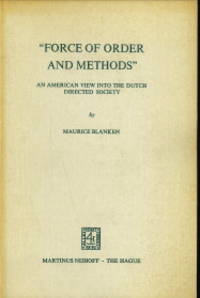
BLANKEN, MAURICE
"Force of order and methods". An American view into the Dutch directed society
The Hague: Martinus Nijhoff 1976. 174 pp. Series: Studies in social life no. XIX. Original copy no print on demand. Soft Cover. Book good. Martinus Nijhoff Paperback
Referenz des Buchhändlers : 17054
|
|
|
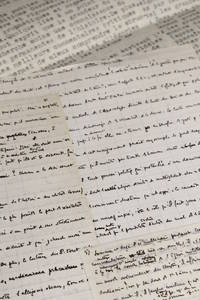
Maurice BLANCHOT
Le Paradoxe d'Aytré - Manuscrit original et tapuscrit complets
s. l.: S. n. 1949. Fine. S. n. s. l. 1949 13.50 x 21.50 cm Autograph manuscript by the author of 16 pages in-8 published in number 9 June 1946 of Les Temps modernes and reprinted slightly revised in La Part du Feu 1949. Complete recto-verso manuscript very densely written with numerous deletions corrections and additions. Accompanied by the complete typescript with autograph corrections in black ink. ""Le Paradoxe d'Aytré"" ""Aytré's Paradox"" is the first text by Maurice Blanchot that Jean-Paul Sartre published in the pages of Les Temps modernes the spearhead of committed literature. Three others would follow until 1952 ""Le roman œuvre de mauvaise foi"" ""The Novel a Work of Bad Faith"" ""A la rencontre de Sade"" ""Meeting Sade"" and ""L'art la littérature et l'expérience originelle"" ""Art Literature and Original Experience"" all of great importance. Continuing his reflection begun several years earlier on the writer's struggle with language and his relationship to silence notably in his article ""Le Mythe d'Oreste"" ""The Myth of Orestes"" Blanchot bases his demonstration here on Aytré qui perd l'habitude ""Aytré Who Loses the Habit"" by Jean Paulhan - a major influence - who notably provides him with the title of his article: ""De ce petit récit il ne résulte pas que la littérature ne doive logiquement commencer qu'avec le crime ou à défaut avec le vol. Mais qu'elle suppose un écroulement une sorte de catastrophe initiale et le vide même que mesurent l'anxiété et le souci c'est ce qu'on peut être tenté de voir. Or remarquons-le cette catastrophe ne s'exerce pas seulement sur le monde les objets qu'on manie . ; elle s'étend aussi et en même temps au langage à la possibilité des mots. C'est là le paradoxe d'Aytré."" ""From this little story it does not follow that literature should logically begin only with crime or failing that with theft. But that it presupposes a collapse a sort of initial catastrophe and the very void that anxiety and worry measure this is what one might be tempted to see. Now let us note this catastrophe is not exercised only on the world the objects we handle .; it extends also and at the same time to language to the possibility of words. This is Aytré's paradox."" And he adds: ""L'écrivain ne débute pas toujours avec le sang d'un fait divers ou l'horreur d'un crime qui lui ferait sentir l'instabilité et le vide du monde mais il ne peut guère songer à commencer autrement que par une certaine incapacité de parler et d'écrire par une perte de mots par l'absence même des moyens dont il surabonde. Ainsi lui est-il indispensable de sentir d'abord qu'il n'a rien à dire."" ""The writer does not always begin with the blood of a news item or the horror of a crime that would make him feel the instability and emptiness of the world but he can hardly think of beginning otherwise than with a certain inability to speak and write with a loss of words with the very absence of the means of which he has abundance. Thus it is essential for him to feel first that he has nothing to say."" Jean Paulhan therefore but also Franz Kafka Herman Melville or Stéphane Mallarmé so many writers admired by Blanchot confronted Aytré's paradox silence the collapse of language. And the critic concludes: "". le silence du langage créateur ce silence qui nous fait parler n'est pas seulement une absence de parle mais une absence tout court cette distance que nous mettons entre les choses et nous et en nous-mêmes et dans les mots et qui fait que le langage le plus plein est aussi le plus poreux le plus transparent le plus nul car il laisse infiniment fuir le creux même qu'il enferme sorte de petit alcarazas du vide."" "". the silence of creative language this silence that makes us speak is not only an absence of speech but an absence pure and simple this distance that we put between things and ourselves and within ourselves and in words and which makes the fullest language also the most S. n. unknown
Referenz des Buchhändlers : 47141
|
|
|
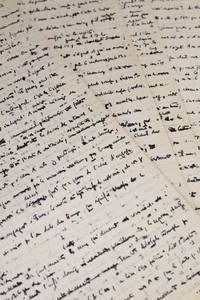
Maurice BLANCHOT
Une étude sur l'Apocalypse. Manuscrit autographe et tapuscrit complets
s. l. Paris: S. n. Journal des débats 1945. Fine. S. n. Journal des débats s. l. • Paris s. d. 1945 13.50 x 21 cm 4 1/2 pages in-8 Autograph manuscript by the author of 4 and a half pages in-8 published in the issue of November 3 1943 of Journal des Débats. Complete recto-verso manuscript in very dense handwriting with numerous deletions corrections and additions. The complete typescript is included. Chronicle published on the occasion of the publication of L'Apocalypse de St Jean vision chrétienne de l'histoire by Father H.M. Féret. From the outset Maurice Blanchot doing his job as a critic praises the seriousness of the study conducted by Father Féret. But what interests him more than this careful orthodoxy are the powerful echoes of L'Apocalypse in the terrible hours the world was then going through: « Dans les périodes troublées les esprits qui ne supportent pas l'incertitude de l'avenir ont besoin de prophètes. Mais ces prophètes ils les demandent au passé et plus l'oracle est ancien - et redoutable - plus ils y voient des correspondances avec l'histoire qu'ils voudraient connaître. L'Apocalypse de St Jean doit en partie à la sublimité du langage à l'autorité de l'écrivain à l'étendue de la révélation une curiosité que des siècles d'étude n'ont pas réussi à épuiser. Mais elle doit aussi son prestige auprès d'esprits qui ne sont pas toujours pieux à l'antiquité de la réponse et à son caractère terrifiant. Qui n'est pas prêt à croire que la fin des temps est proche et que le pire va être vécu Chacun a le désir secret d'associer sa propre fin qu'il entrevoie à celle du monde dont il est moins sûr. » ""In troubled periods minds that cannot bear the uncertainty of the future need prophets. But these prophets they seek them in the past and the more ancient - and fearsome - the oracle the more they see correspondences with the history they would like to know. The Apocalypse of St. John owes partly to the sublimity of language to the authority of the writer to the extent of the revelation a curiosity that centuries of study have not managed to exhaust. But it also owes its prestige among minds that are not always pious to the antiquity of the answer and to its terrifying character. Who is not ready to believe that the end of times is near and that the worst will be lived Each has the secret desire to associate his own end that he glimpses with that of the world of which he is less certain."" The biblical text thus awakens his interest for its literary and mythological qualities but also in an almost political approach for its sense of History. Furthermore if religion does not of course pose itself in terms of belief for Blanchot it nevertheless reveals his attention to the question of God particularly sensitive through Judaism notably and joins that decisive in his eyes of the writer's interior experience. Finally the analysis of L'Apocalypse that Blanchot delivers here constitutes a first in-depth reflection on the question of Evil: « . ce qui est propre au message inspiré c'est le rôle qu'il fait jouer au démon dans la vie collective et le mouvement de l'histoire. Saint Jean ne dévoile pas l'action du mal dans les âmes ; il se borne à montrer quelle maîtrise les puissances démoniaques peuvent exercer sur les réalités collectives par quelles voies elles agissent . et quelle défaite mettra un terme à leur empire. » "". what is proper to the inspired message is the role it makes the demon play in collective life and the movement of history. Saint John does not unveil the action of evil in souls; he confines himself to showing what mastery demonic powers can exercise over collective realities by what paths they act . and what defeat will put an end to their empire."" These links between the Apocalypse History and Evil would be questioned again by Blanchot in ""L'Apocalypse déçoit"" 1964 and ""Penser l'Apocalypse"" 1988. First foundational text by Blanchot on Evil and History. Between April 1941 and Augus S. n.[ Journal des débats] unknown
Referenz des Buchhändlers : 44925
|
|
|
Maurice BLANCHOT
Adolphe ou le malheur des sentiments - Manuscrit autographe.
1946. Fine. 1946 20.90 x 13.70 cm en feuilles Autograph manuscript by the author of sixteen and a half pages in-8vo published in issue 20 October 1946 of L'Arche and reprinted slightly revised in La Part du Feu 1949. Complete recto-verso manuscript in very dense handwriting with numerous deletions corrections and additions. Benjamin Constant's Adolphe who was one of the prestigious contributors to the Journal des débats during its golden age interests Maurice Blanchot at the very moment when he begins a passionate relationship with Denise Rollin former mistress of Georges Bataille. Moreover ""Adolphe ou le malheur des sentiments vrais"" is one of Blanchot's rare texts thus devoted to amorous desire: ""On trouve presque à chaque page dans Adolphe la description des sentiments dont la cause a beau se renverser tout les renvoie à eux-mêmes tout en confirme la fatalité. C'est que le point est atteint où la diversité des évènements et tout l'infini du monde répètent inlassablement le mouvement en cercle dans lequel s'est enfermé le cœur avide de vérité."" ""One finds on almost every page in Adolphe the description of feelings whose cause may well be reversed everything sends them back to themselves everything confirms their fatality. This is because the point is reached where the diversity of events and all the infinity of the world tirelessly repeat the circular movement in which the heart avid for truth has enclosed itself."" To support his analysis Blanchot chooses to compare Constant's approach to that of other writers particularly to that of Proust in the Recherche: "". Proust ne désire pas cette absence comme le mouvement de toute communication ainsi que le fait Constant : il ne la désire même pas mais c'est elle qui lui rend un être désirable en le faisant souffrir de ne pouvoir l'atteindre. . Proust aime parce qu'il souffre et il souffre de sentir tout ce qu'il y a d'absence dans une présence toujours fuyante ; mais c'est aussi à cause de cette absence que cette présence fonde des rapports véritables. Constant commence à aimer lorsqu'un être particulier éclaire aimante tout le vide qui le sépare des autres et que la possession est loin de restituer sous la forme de l'inconnu. Dès que par un engagement trop exigeant la possibilité de ses relations avec tous qu'il a voulu vivre avec une personne unique est épuisée il étouffe il succombe. Il a besoin d'être libre mais il est toujours lié."" ""Proust does not desire this absence as the movement of all communication as Constant does: he does not even desire it but it is this absence that makes a being desirable to him by making him suffer from not being able to reach it. . Proust loves because he suffers and he suffers from feeling all the absence there is in a presence that is always fleeting; but it is also because of this absence that this presence establishes true relationships. Constant begins to love when a particular being illuminates magnetizes all the void that separates him from others and which possession is far from restoring in the form of the unknown. As soon as through too demanding an engagement the possibility of his relationships with all that he wanted to live with a single person is exhausted he suffocates he succumbs. He needs to be free but he is always bound."" Blanchot's biographer will see in this conception of Adolphe the reflection of his own feelings toward Denise Rollin BIDENT Christophe Maurice Blanchot : partenaire invisible p. 275. Handsome study on passion and desire through the work of Benjamin Constant. unknown
Referenz des Buchhändlers : 48345
|
|
|
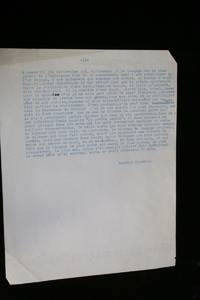
Maurice BLANCHOT
Lettre tapuscrite à Sartre
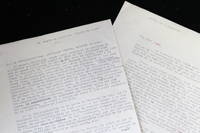
1960. Fine. 2 décembre 1960 26.70 x 20.90 cm 5 feuillets in-4 Draft typescript of letter to Jean-Paul Sartre with autograph corrections and with a second version of the first page and typescript with autograph corrections of ""Le monde en question Cours du monde"" project for La Revue internationale Set of five typescript leaves rectos only with the exception of one leaf recto-verso with corrections in red and black ballpoint pen in Maurice Blanchot's hand. This important collection bears witness to the exchanges between Maurice Blanchot and Jean-Paul Sartre around the famous ""Déclaration sur le droit à l'insoumission dans la guerre d'Algérie"" and the publication project that resulted from it La Revue internationale. Known as the ""Manifeste des 121"" this declaration signed by numerous intellectuals and artists and published on September 6 1960 had been drafted by Dionys Mascolo and Jean Schuster assisted by Maurice Blanchot in anticipation of the trial of the Jeanson network a group of French militants supporting the FLN and with the aim of informing public opinion about the protest movement against the Algerian War and its anti-democratic excesses. Among the signatories was of course Sartre. The manifesto had made many personalities aware of the influence they could exercise in public debate even in the course of History. It was in this context that in autumn 1960 Maurice Blanchot Dionys Mascolo and Elio Vittorini decided to create a review that would be not literary but critical whose purpose would be to continue this action. They sought the help of Jean-Paul Sartre whose extraordinary aura would benefit the publication favorably. In his letter to Sartre Blanchot attempts to convince the philosopher to join the project: ""Vous m'avez rappelé ce que j'ai dû dire quelquefois et que j'ai toujours intimement pensé : que la Déclaration ne trouverait son vrai sens que si elle était le commencement de quelque chose."" ""You reminded me of what I must have said sometimes and what I have always intimately thought: that the Declaration would only find its true meaning if it were the beginning of something."" "". Je voudrais dire mon sentiment propre : je crois que si nous voulons représenter comme il faut sans équivoque le changement dont nous avons les uns et les autres le pressentiment si nous voulons le rendre plus réel et l'approfondir dans sa présence mouvante c'est seulement à partir d'un organe nouveau que nous pourrons le faire. A partir de là si l'on voit Sartre et d'autres avec lui parmi les 121 décider de s'exprimer en cette forme choisie délibérément comme nouvelle chacun "" ""I would like to express my own feeling: I believe that if we want to represent as we should unequivocally the change that we all have a premonition of if we want to make it more real and deepen it in its moving presence it is only from a new organ that we will be able to do so. From there if we see Sartre and others with him among the 121 decide to express themselves in this form deliberately chosen as new everyone"" "". comprendra que vraiment nous entrons dans une nouvelle phase et que quelque chose de décisif a lieu qui cherche à s'affirmer."" ""will understand that we are truly entering a new phase and that something decisive is taking place that seeks to assert itself."" But Sartre would refuse to commit to the review. However during the first six months of 1961 Blanchot devoted himself body and soul to the project hoping it would come to fruition. The typescript included here ""Le monde en question Cours du monde"" reveals the table of contents he envisioned for the first issue: texts on destalinization the situation of the German press intellectual compartmentalization in France and Italy hunger strikes and the Berlin Wall and utopia. The review would never see the light of day to the great despair of Blanchot who was deeply enthusiastic about the idea of collective and international writi unknown
Referenz des Buchhändlers : 48321
|
|
|
Maurice BLANCHOT - (Friedrich NIETZSCHE)
Du côté de Nietzsche - Manuscrit autographe complet • On Nietzsche’s Side – Complete Autograph Manuscript
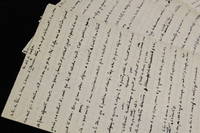
1946. Fine. 1946 21.70 x 11.50 cm 7 feuillets foliotés Autograph manuscript by the author 14 pages in octavo published in issue no. 12 December 1945–January 1946 of L'Arche. A complete recto-verso manuscript in a densely written hand with numerous deletions corrections and additions. Essay published on the occasion of the release of Father du Lubac’s Le Drame de l’humanisme athée. After the war the place of Friedrich Nietzsche—alongside the Marquis de Sade and Søren Kierkegaard—in Maurice Blanchot’s thought reflects the decisive influence of Georges Bataille and the philosophers he held in highest regard. From this point on Blanchot devoted many texts to these figures and “Du côté de Nietzsche” stands as a key testimony of that engagement. The very title of his forthcoming collection La Part du feu to be published in 1949 including this article in a slightly revised form is itself a Bataillean reference. For Blanchot Nietzsche’s power through his use of language and style lies less in his most explicit and oft-commented theses than in the crucible of a more fluid and sometimes self-contradictory discourse: « L'influence de Nietzsche ne se réduit pas aux formes extérieures qu'elle a prises ; c'est probablement au contraire ce qui de Nietzsche a échappé à toute transmission manifeste cette part de lui étrangère aux influences directes qui a exercé l'influence la plus profonde. » This idea would remain central to Blanchot’s reading of the German philosopher. Nietzsche’s inconsistency and ambiguity are embodied in the theme of the death of God central to his work: « En aucune façon le thème de la Mort de Dieu ne peut être l'expression d'un savoir définitif ou l'esquisse d'une proposition stable » Blanchot observes. And he famously adds: « Se contredire est le mouvement essentiel d'une telle pensée. » In L’Entretien infini 1969 Blanchot would once again revisit the Nietzschean question of the death of God where it meets that of the unity of man. A remarkable text by Maurice Blanchot on Friedrich Nietzsche illustrating the profound influence of Georges Bataille on his thought. unknown
Referenz des Buchhändlers : 48342
|
|
|
Maurice BLANCHOT - (Andre BRETON)
Reflexions sur le surréalisme - Manuscrit autographe complet
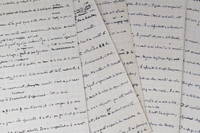
1945. Fine. 1945 22 x 11.50 cm 8 feuillets foliotés Autograph manuscript by the author of 16 octavo pages published in number 8 August 1945 of L'Arche under the title: Some Reflections on Surrealism. Complete recto-verso manuscript with very dense writing containing numerous deletions corrections and additions. Some Reflections on Surrealism forms the first important text that Maurice Blanchot devoted to André Breton's movement. He rehabilitates surrealism which placed at the center of its activity the question of language and experience - aspects that could not leave Blanchot indifferent - without forgetting to make the following observations: it carries within it a part of failure and its ""situation . remains ambiguous"". Now increasingly asserting his aesthetic positions Blanchot fully recognizes the poetic and experimental value of automatic writing for its very radicalism: ""Automatic writing is . a war machine against reflection and language. It is destined to humiliate human pride particularly in the form that traditional culture has given it. But in reality it is itself a proud aspiration to a mode of knowledge and it has opened to words a new unlimited credit."" Blanchot continues his reflection and insists on the questionings of surrealist writers and poets regarding discourse: ""Surrealism was haunted by this idea: that there was that there had to be a moment . when language was not discourse but reality itself without however ceasing to be the proper reality of language . The surrealists drew brilliant literary consequences from this 'discovery' but for language the effects are more ambiguous and more varied. In this domain they still seem above all to be destroyers. They are unleashed against discourse; they withdraw from it the right to signify something; as a means of social of precise designation they break it ferociously. Language appears somewhat alone annihilated or sacrificed but humiliated. In reality it is a matter of something quite different and even the contrary: language disappears as instrument but that is because it has become subject. Through automatic writing it has benefited from the highest promotion ."" The text would be reprinted in The Work of Fire 1949 not without Blanchot having taken care to attenuate the reservations he expressed in the initial article. First important monographic study devoted by Maurice Blanchot to the question of surrealist language. unknown
Referenz des Buchhändlers : 48352
|
|
|
Maurice, Thomas
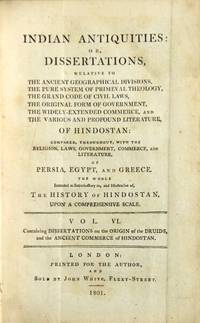
Indian antiquities: or disserations . of Hindostan: compared throughout with the religion laws government commerce and literature of Persia Egypt and Greece. Volume VI
London: printed for the author and sold by John White 1801. 8vo 1 volume only of a 7 volume set but the only volume concerning Stonehenge; pp. 5 viii-xiv 370 2; engraved folding frontispiece 3 engraved folding plates; burgundy cloth black leather label; boards faded and rubbed closed tear to one plate. Includes "A dissertation on the Indian origin of the Druids; and on the striking affinity which the religious rites and ceremonies anciently practised in the British Islands bore to those of the Brahmins." And "Dissertation on the commerce carried on the very remote ages by the Phoenicians Carthaginians and Greeks with the British Islands for their ancient staple of tin; and on their extensive barter of that commodity for those of the Indian continent. printed for the author and sold by John White unknown
Referenz des Buchhändlers : 48648
|
|
|
Maurice BLANCHOT - (Ernest HEMINGWAY)
Manuscrit autographe sur Hemingway intitulé traduit de . • Autograph manuscript on Hemingway
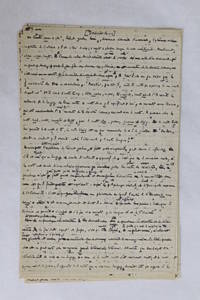
1946. Fine. 1946 13.50 x 21 cm en feuilles HEMINGWAY BLANCHOT Maurice. Autograph manuscript on Hemingway 1946 16 pages 1/2 in-8 135 x 21 cm loose leaves Author's autograph manuscript 16 and a half 8vo pages published in number 17 of L'Arche July 1946 and reprinted with slight modifications in La Part du Feu 1949. Complete manuscript written recto-verso very densely spaced with numerous deletions corrections and additions. In order to examine the problems related to the translation of a literary text into another language Maurice Blanchot looks at the contemporary American novel and its perception in Europe. “Many good critics complain about American literature: they find it less than original and of middling interest for a culture that moved over fifty years ago beyond naturalism. They make fun of young writers who think they're being modern by imitating Faulkner Dos Passos or Steinbeck while for Americans themselves these writers are more of yesterday than tomorrow.” Thus the critic for whom the oddities of language particular to any literary work survive translation takes the example of a novel by Ernest Hemingway. “In For Whom the Bell Tolls Robert Jordan discovering the importance of the moment he is living repeats the word ‘now' in several languages. Maintenant ahora now heute. But he is somewhat disappointed by the mediocrity of this vocabulary and looks for other words. …. He tries to find in language links between these words and what they mean for him his meeting with Maria who is also his meeting with his final hour his meeting with death. … The word Todt seems to him the most dead of all the word Krieg the one that resembles war most closely.” Or is it just that he knew German less well than the other languages This reflection fascinates Blanchot: “This impression of Robert Jordan's can give us food for thought. If it's true that a language seems more expressive and more real to us when we know it less if words need a certain ignorance to keep their virtue from being revealed this paradox should hardly surprise us since translators come across it all the time and it represents both one of the principal challenges and one of the foremost riches of all translation.” An inspired look at the work of Ernest Hemingway and the problem of translation. unknown
Referenz des Buchhändlers : 48346
|
|
|
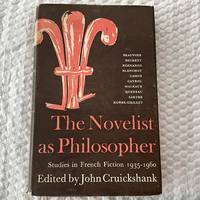
Edited by John Cruikshank. Ernest Beaumont, Cecil Jenkins, Martin Esslin, John Weightman, Geoffrey Hartman, Maurice Cranston, Ca
The Novelist as Philosopher. Studies in French Fiction 1935-1960
London: Oxford University Press 1962. First Edition First Impression. . Cloth Bound Boards. Very Good/Very Good. 1962 first edition first impression. Size octavo 257 pages. Green cloth covered boards with gilt titles on black panel to the spine with the dust jacket. Book condition very good plus slight edge wear contents very clean. Dust jacket condition very good corners edges and spine ends slightly rubbed spine slightly sunned not price clipped. Size: 8vo - over 7¾" - 9¾" tall <br/> <br/> Oxford University Press hardcover
Referenz des Buchhändlers : 016317
|
|
|
Lecat, Maurice
Lecons sur la Theorie des Determinants: A n Dimensions avec Applications a L'Algebre a la Geometrie Etc.
Gand Maison D'Editions et D'. 1910. Hardcover. UsedGood. Hardcover with text in French; surplus library copy with the usual stampin gs; reference number blackened out on spine; fading and edge wear to exteri or; marbled cover cloth; fading to pages; otherwise in good condition with clean text firm binding. . Gand Maison D'Editions et D' hardcover
Referenz des Buchhändlers : 69715
|
|
|
Maurice BLANCHOT
Fragment de manuscrit autographe sur Gaston Doumergue
1934. Fine. 1934 1 page in-8 en feuilles Autograph manuscript by the author of 1 page in-8vo presumably unpublished. Incomplete recto-only manuscript in dense handwriting with some corrections and additions on the verso of a printed record of subscriptions to the Journal des Débats period from May 1934 to May 1935. This text by Maurice Blanchot was probably written shortly after the resignation of the President of the Council and former President of the Republic Gaston Doumergue which occurred on November 8 1934. The young man was then editor-in-chief at the Journal des Débats and this manuscript appears to be a draft article devoted to Doumergue's career which presumably remained unpublished after his departure from the government where he had been called in the aftermath of the February 1934 demonstrations. It is among the rare manuscripts from this period still preserved: Blanchot indeed destroyed most of his writings from the 1930s renouncing his active and political participation in the extreme right-wing press. In this text Blanchot praises Doumergue's talents as a politician: ""Toute la carrière de Doumergue est marquée par une progression constante. Elle va par un perfectionnement remarquable vers le moment de sa vie où il tentera non seulement de gouverner mais d'améliorer les moyens du gouvernement. C'est cette sorte de dialectique qui le met à part comme homme et comme homme d'Etat."" ""Doumergue's entire career is marked by constant progression. It moves through remarkable improvement toward the moment in his life when he will attempt not only to govern but to improve the means of government. It is this sort of dialectic that sets him apart as a man and as a statesman."" Rare manuscript from the 1930s. unknown
Referenz des Buchhändlers : 48338

|
|
|
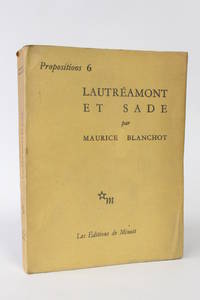
Maurice BLANCHOT
Lautréamont et Sade
Paris: Les Editions de Minuit 1949. Fine. Les Editions de Minuit Paris 1949 14 x 18.50 cm broché First edition on ordinary paper. Paper yellowed as usual. Les Editions de Minuit unknown
Referenz des Buchhändlers : 53073
|
|
|
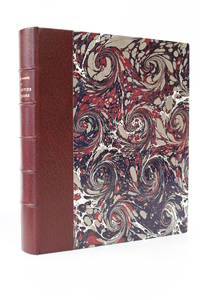
Maurice BARRES
Les amitiés françaises
Paris: Félix Juven 1903. Fine. Félix Juven Paris 1903 16 x 19 cm relié First edition one of 20 numbered copies on Japan paper the tirage de tête. Half maroon morocco over marbled paper boards by P. Goy & C. Vilaine spine in six compartments maroon paper pastedowns and endpapers covers preserved top edge gilt. A fine well-margined copy in a lovely binding. Félix Juven hardcover
Referenz des Buchhändlers : 53153
|
|
|
(Maurice BLANCHOT)
Photographie originale de Maurice Blanchot âgé d'environ 1 an assis sur un piédestal entouré de ses frères et soeurs • Original photograph of Maurice Blanchot at about one year old seated on a pedestal surrounded by his brothers and sisters.
Elbeuf: A. MARTIN 1900. Fine. A. MARTIN Elbeuf S.d Circa 1900 10.50 x 16.50 cm une feuille Original photograph of Maurice Blanchot at about one year old seated on a pedestal surrounded by his brothers and sisters. Original photograph of Maurice Blanchot at about one year old seated on a pedestal surrounded by his brothers and sisters. Contemporary silver print. “Blanchot eluded the photographers and caricaturists of the literary press for a long time. Attempts at producing an image were both rare and minimalist throughout the years. In 1962 in Express a hand holds up a book at the bottom of the page; in 1979 in Libération a blank square in the middle of the page captioned only with Blanchot’s name and a quotation from l’Entretien infini ""a vacuum of a universe: nothing that is visible nothing that is invisible”” C. Bident Maurice Blanchot. In 1986 at an exhibition of writers’ portraits he asked that his photo be replaced with a text noting his desire to “appear as little as possible not for the exaltation of his books but to avoid the presence of an author who pretends to a separate existence.” A photo taken without his knowledge in the parking lot of a supermarket was the only portrait of the writer until his friend Emmanuel Lévinas made public a few rare photos from their youth. That Blanchot did not oppose this act and the fact that it was done by his closest friend can be explained by what Bident calls “l'espacement de l'inquiétude the distancing of worry” the outdated nature of the portraits made public carry an echo of the delayed publication of L'Idylle Le Dernier Mot L'Arrêt de mort. Only a few photographs gathered in the centre pages of the issue of les Cahiers de l'Herne dedicated Maurice Blanchot complement these unique shots of the most secretive writer of the 20 th century. In his chapter on “L'indisposition du secret The indisposition of the secret” Christophe Bident devotes several pages to the almost complete absence of images of this invisible partner wondering about the intellectual and psychological motivations of the writer who was nonetheless aware of the inevitable revelation to come. “Everything must become public. The secret must be broken. The obscure must enter into the day and make itself clear. That which cannot be said must nonetheless make itself heard. Quidquid latet apparebit everything that is hidden must appear…” Maurice Blanchot L'Espace littéraire. A. MARTIN unknown
Referenz des Buchhändlers : 52955

|
|
|
(Maurice BLANCHOT)
Photographie originale de Maurice Blanchot assis à sa table de travail devant la bibliothèque • Original photograph of Maurice Blanchot seated at his desk before his library
Elbeuf 1900. Fine. Elbeuf S.d Circa 1900 10.50 x 16.50 cm une feuille Original photograph of Maurice Blanchot seated at his desk before his library Original photograph of Maurice Blanchot smiling at his desk before his library. Contemporary silver print. “Blanchot eluded the photographers and caricaturists of the literary press for a long time. Attempts at producing an image were both rare and minimalist throughout the years. In 1962 in Express a hand holds up a book at the bottom of the page; in 1979 in Libération a blank square in the middle of the page captioned only with Blanchot’s name and a quotation from l’Entretien infini ""a vacuum of a universe: nothing that is visible nothing that is invisible”” C. Bident Maurice Blanchot. In 1986 at an exhibition of writers’ portraits he asked that his photo be replaced with a text noting his desire to “appear as little as possible not for the exaltation of his books but to avoid the presence of an author who pretends to a separate existence.” A photo taken without his knowledge in the parking lot of a supermarket was the only portrait of the writer until his friend Emmanuel Lévinas made public a few rare photos from their youth. That Blanchot did not oppose this act and the fact that it was done by his closest friend can be explained by what Bident calls “l'espacement de l'inquiétude the distancing of worry” the outdated nature of the portraits made public carry an echo of the delayed publication of L'Idylle Le Dernier Mot L'Arrêt de mort. Only a few photographs gathered in the centre pages of the issue of les Cahiers de l'Herne dedicated Maurice Blanchot complement these unique shots of the most secretive writer of the 20 th century. In his chapter on “L'indisposition du secret The indisposition of the secret” Christophe Bident devotes several pages to the almost complete absence of images of this invisible partner wondering about the intellectual and psychological motivations of the writer who was nonetheless aware of the inevitable revelation to come. “Everything must become public. The secret must be broken. The obscure must enter into the day and make itself clear. That which cannot be said must nonetheless make itself heard. Quidquid latet apparebit everything that is hidden must appear…” Maurice Blanchot L'Espace littéraire. unknown
Referenz des Buchhändlers : 52956

|
|
|
Peat, Neville; Conly, Maurice
Tokelau - Atoll associate of New Zealand
Wellington: Compatriot Press 1986. Book. Good. Soft cover. Revised Edition. Oblong. 48 pages many colour and b/w illustrations maps. Staples rusty faint damp marking at top corner far away from text and illustrations. Compatriot Press Paperback
Referenz des Buchhändlers : 008295 ISBN : 0473002302 9780473002305

|
|
|
Holt, Maurice
Numerical Methods in Fluid Dynamics Springer Series in Computational Physi cs
Springer-Verlag. 1977. Hardcover. UsedGood. Hardcover; surplus library copy with the usual stampings and reference numb er affixed to the spine; fading and shelf wear to exterior; bumps to the co rners; otherwise in good condition with clean text and tight binding. . Springer-Verlag hardcover
Referenz des Buchhändlers : 70020 ISBN : 3540079076 9783540079071

|
|
|
Van Engen, Henry, Maurice L. Hartung, and James E. Stochl
Foundations of Elementary School Arithmetic
Scott Foresman and Company. 1965. Hardcover. UsedGood. ASIN: B002IA5CXK Hardcover; fading light soiling and shelf wear to exter ior; otherwise in good condition with clean text and tight binding. . Scott, Foresman and Company hardcover
Referenz des Buchhändlers : 70033
|
|
|
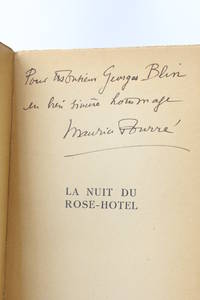
Maurice FOURRE
La nuit du rose-hôtel
Paris: Gallimard 1950. Fine. Gallimard Paris 1950 12 x 19 cm broché First edition on ordinary paper. Autograph inscription from Maurice Fourré to the Professeur Georges Blin. Spine slightly faded as usual. Gallimard unknown
Referenz des Buchhändlers : 53241
|
|
|
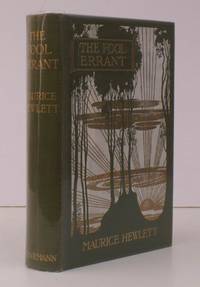
HEWLETT Maurice
The Fool Errant. Being the Memoirs of Francis-Antony Strelley Esq. Citizen of Lucca. Edited by Maurice Hewlett. REMARKABLY BRIGHT COPY IN PICTORIAL CLOTH
Heinemann 1905. 8vo. First Edition preliminaries and fore-edge lightly spotted; original green pictorial cloth upper board blocked and lettered in gilt and white gilt back a remarkably bright clear copy. SCARCE IN THIS CONDITION. Muir 16. Heinemann, hardcover
Referenz des Buchhändlers : 29073
|
|
|
Maurice MARTIN DU GARD
Jules Tellier
Paris: Les Amis d'Edouard 1925. Fine. Les Amis d'Edouard Paris 1925 13 x 16.50 cm broché First edition printed to 200 copies this one of the nominative copies and numbered sur Arches. A very good copy. Les Amis d'Edouard unknown
Referenz des Buchhändlers : 51689

|
|
|
Mandelbaum, Maurice
The Problem of Historical Knowledge: An Answer to Relativism
Harper & Row. 1967. Paperback. UsedAcceptable. ASIN: B000UFQQHQ Softcover; fading scuffing and edge wear to exterior; n umber written on front cover; former owner's notes written inside covers; u nderlining and margin notes; otherwise in acceptable condition with firm bi nding. . Harper & Row paperback
Referenz des Buchhändlers : 68365
|
|
|
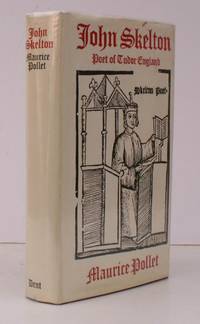
POLLET Maurice
John Skelton. Poet of Tudor England. Translated by John Warrington. BRIGHT CLEAN COPY IN UNCLIPPED DUSTWRAPPER
Dent 1971. 8vo. First Edition thus with portrait frontispiece and plates neat signature on front paste-down; red cloth gilt back a very good bright clean copy in unclipped dustwrapper. Dent hardcover
Referenz des Buchhändlers : 29292
|
|
|
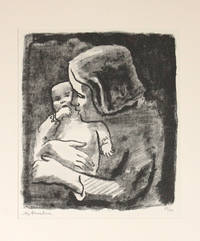
Savin, Maurice - Mac Orlan, Pierre (pref.)
Les Maîtres de l'estampe française contemporaine : Maurice Savin dix estampes originales présentées par Pierre Mac Orlan
Paris: Rombaldi 1949. Livre. Illus. by Maurice Savin. Très bon. En Feuilles. Signé par l'illustrateur. Ed. originale. In-folio. Paris Rombaldi 1949. Coll. "Les Maîtres de l'estampe française contemporaine" n° 8. 385 x 285 cm in-folio 2 ff. bl. - 7 ff. n. ch. portant 2 eaux-fortes dans le texte - 10 estampes 2 lithographies au crayon 3 lithographies au lavis 2 lithographie en couleurs 3 eaux-fortes toutes numérotées et signées par l'artiste à la mine de plomb et montées sous passe-partout - 3 ff. n. ch. - 3 ff. blancs en feuilles sous couverture blanche rempliée et imprimée et portefeuille de l'éditeur. Tirage limité à 100 exemplaires sur vélin pur fil de Lana. Celui-ci n° 93. On JOINT la carte de voeux de la Société des Peintres-Graveurs pour 1973 ornée au premier plat d'une lithographie en couleurs de Maurice Savin. Bel exemplaire. MONOD 10190 25 kg. Rombaldi Paperback
Referenz des Buchhändlers : 4348
|
|
|
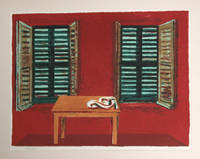
Asselin, Maurice - Diehl, Gaston (pref.)
Les Maîtres de l'estampe française contemporaine : Maurice Asselin dix estampes originales présentées par Gaston Diehl
Paris: Rombaldi 1946. Livre. Illus. by Maurice Asselin. Très bon. En Feuilles. Signé par l'illustrateur. Ed. originale. In-folio. Paris Rombaldi 1946. Coll. "Les Maîtres de l'estampe française contemporaine" n° 4. 385 x 285 cm in-folio 2 ff. bl. - 7 ff. n. ch. portant 2 eaux-fortes dans le texte - 10 estampes 4 lithographies en noir 1 lithographie en couleurs 4 eaux-fortes 1 pointe-sèche toutes numérotées et signées par l'artiste à la mine de plomb et montées sous passe-partout - 3 ff. n. ch. - 3 ff. blancs en feuilles sous couverture blanche rempliée et imprimée et portefeuille de l'éditeur. Tirage limité à 100 exemplaires sur vélin pur fil de Lana. Celui-ci n° 83. On JOINT une autre gravure de Maurice Asselin format in-8 signée dans la planche. Bel exemplaire. MONOD 584 25 kg. Rombaldi Paperback
Referenz des Buchhändlers : 4347
|
|
|
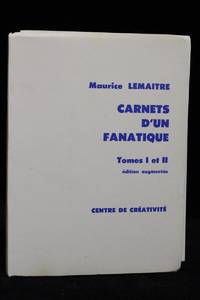
Maurice LEMAITRE
Carnets d'un fanatique tome I et II
Centre de créativité 1962. Fine. Centre de créativité 1962 14.50 x 20.50 cm 2 volumes brochés sous chemise Edition with some parts in first edition of which there were no deluxe copies. Set of two works slipped under a reuniting dust jacket. Handsome copy retaining its publisher's wraparound band Centre de créativité unknown
Referenz des Buchhändlers : 52380
|
|
|
Maurice Suwa.
I AM the Origin of Species!: Jesus Letters to Darwin America Pastors Africa and the Occult The Lamb's Epistle 1
Self-published. Soft cover. New. Signed by Authors. 190 pp. Book/dust jacket condition: New/na paperback. 1st Ed. 1st Printing/First Edition First Printing likely NAP. Inscribed by author on title page. All orders are processed and shipped from MI or WI USA. Self-published paperback
Referenz des Buchhändlers : 1659
|
|
|
Maurice BLANCHOT
Aminadab
Paris: Gallimard 1942. Fine. Gallimard Paris 1942 14 x 20.50 cm broché First edition an advance service de presse copy. Very precious and moving autograph inscription signed and dated by Maurice Blanchot to his mother and sister: ""Personne ne reçoit tant de Dieu que celui qui est entièrement mort. Saint Grégoire. Pour sa chère maman et sa vieille Marg en toute affection. Maurice No one receives God so fully as someone who is entirely dead. Saint Gregory. For his darling mother and old Marg with all love. Maurice."" Three small wormholes and a clear dampstain to margin of upper cover one joint cracked at foot. Retaining its prière d'insérer. Gallimard unknown
Referenz des Buchhändlers : 52427

|
|
|
Maurice BLANCHOT
Le livre à venir
Paris: Gallimard 1959. Fine. Gallimard Paris 1959 13.50 x 19.50 cm broché First edition an advance service de presse copy. A very handsome and moving autograph inscription from Maurice Blanchot to his sister : ""Pour ma chère Marguerite qui porte maintenant mot illisible le poids de mon affection. Maurice For my dear Marguerite who now bears illegible word the weight of my affection. Maurice."" A good copy. Gallimard unknown
Referenz des Buchhändlers : 52434

|
|
|
Maurice BLANCHOT
Le pas au-delÃ
Paris: Gallimard 1973. Fine. Gallimard Paris 1973 14 x 20.50 cm broché First edition an advance service de presse copy. Very handsome and moving autograph inscription signed by Maurice Blanchot to his sister on a calling card pasted to head of one endpaper: ""A ma chère Marg. Ce livre d'amitié et pour l'amitié plus à feuilleter qu'à lire peut-être avec ma grande affection. Maurice To my dear sister Marg. This book of friendship or book for friendship maybe more to leaf through than to read with great affection. Maurice."" A good copy. Gallimard unknown
Referenz des Buchhändlers : 52429

|
|
|
Compiled by Maurice Golesworthy. Foreword By Sir Leonard Hutton
The Encyclopaedia of Cricket
London: Robert Hale Limited 1962. First Edition First Impression. . Cloth Bound Boards. Very Good/Good. 1962 First edition first impression. Size octavo 224 pages. Black hard cover with white titles to the spine with the dust jacket. Book condition very good very slight edgewear pages slightly toned else clean throughout. Dust jacket condition fair-good corners and edges rubbed 1cm nick in outer fold of front panel of dust jacket large tear all along upper edge of front panel with no loss tear goes right round to the inner flap it is held together by the inner flap spine slightly sunned not price clipped price 15'- net. Size: 8vo - over 7¾" - 9¾" tall <br/> <br/> Robert Hale Limited hardcover
Referenz des Buchhändlers : 016277

|
|
|
Maurice ENGLISH
Midnight in the century
s. l.: The prairie school press 1964. Fine. The prairie school press s. l. 1964 14 x 21.50 cm reliure de l'éditeur First edition. Publisher's binding in full blue cloth smooth spine complete with dust jacket which has a tear and lack at foot of spine. Autograph inscription signed in English from Maurice English to Georges Charaire. Handsome copy. The prairie school press hardcover
Referenz des Buchhändlers : 52479

|
|
|
Maurice BLANCHOT
Les romans de Sartre. Manuscrit autographe
1945. Fine. 1945 - 19 pages 1/2 in-8 Autograph manuscript of the author of 19 pages and a half in-8 published in the October issue No. 10 of L'Arche Complete two-sided manuscript very dense writing with many erasures corrections and additions. Since the 1930s Maurice Blanchot regularly devotes articles to Jean-Paul Sartre and especially to his novels. The publication of the first two volumes of the trilogy The paths of freedom was to give rise to the almost simultaneous publication of a rather short chronicle in Dimanche paysage No. 19 October 21 1945 and this large study entitled ""The Novels of Sartre "". This one which goes beyond the circumscribed frame of the literary news intends to analyze what makes the specificity of these works namely the use of the ""thesis"": ""One can wonder why the thesis novel has bad reputation"" . Grievances seem as numerous on the side of the thesis as on the side of the novel; the theoretical affirmation complains of the adventure to which it is committed and from which it derives an additional truth. . In a novel of this kind we reproach the characters for being lifeless but it is ""the idea"" that is lifeless: it only looks like itself it has only its own sense . . "" Therefore Blanchot salutes Sartre's meeting of exceptional philosophical as well as literary capacities while underlining that it is also the fruit of his time: ""It is true that fiction works are more and more besieged by theoretical aims and that theoretical works are more and more a call to problems that require a complete expression. Existentialists or not novelists and philosophers pursue similar experiments and research . . "" Moreover he praises Sartre's ability to make his novels both an experience in itself and ""the story of an experience"" an essential concept for Blanchot and which had emerged as one of the central themes of his first critical collection False Pas 1943. And it is this same quality that he lends by the way to Simone de Beauvoir's Guest a ""remarkable work"" . Thus at the end of a reflection which reveals the admiration of Blanchot for the Sartrean novel and particularly for Nausea composed at the same time as his Thomas the Obscure he concludes: ""In short could not it be possible not that the novel was much less the enemy of the thesis than it is said ""The manuscript and multiple deletions and additions then reflects the hesitation of Blanchot in formulating the end of his demonstration yet clear in the finished text"" This only: to respect the status of bad faith that is its morality it to recognize a power of transformation of crystallization by the transparency of discovery through exposure which is its reality and finally having formed of its substance existing only by its duration to triumph by disappearing according to the movement proper to art to recover in affirmation and to fulfill itself in failure - which is its truth. "" The text will be repeated with some corrections in La Part du Feu 1949. unknown
Referenz des Buchhändlers : 48343

|
|
|
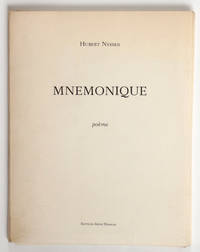
Nyssen, Hubert - Frydman, Maurice (ill.)
Mnémonique poème
Bruxelles: Editions Irène Dossche 1969. Livre. Très bon. En Feuilles. Dédicacé par l'auteur. Grand In-8. Bruxelles Editions Irène Dossche 1969. 24 x 185 cm grand in-8 11 doubles feuillets 22 pp. souvent imprimés sur une page seule gouache de Maurice Frydman reproduite en couleurs en frontispice en feuilles sous couverture rempliée et imprimée. Exemplaire numéroté n° 252 et enrichi d'un ENVOI autographe signé de l'auteur à Elisabeth Auclaire. La couverture tient lieu de titre. Bel exemplaire. Editions Irène Dossche Paperback
Referenz des Buchhändlers : 4426
|
|
|
Maurice BLANCHOT - (Alfred JARRY)
Un roman de Jarry. - Manuscrit autographe et tapuscrit signé complets • A Novel by Jarry – Complete Autograph Manuscript and Signed Typescript
s. l. Paris: S. n. Journal des débats 1944. Fine. S. n. Journal des débats s. l. • Paris s. d. 1944 13.50 x 21.50 cm 2 1/2 pages in-8 Autograph manuscript by the author two and a half pages in octavo published in the issue of April 13 1944 of the Journal des Débats. Complete recto-verso manuscript in a very dense hand with numerous deletions corrections and additions. Accompanied by the complete signed typescript. A review published on the occasion of the posthumous release of Jarry’s novel La Dragonne. In this review devoted to Alfred Jarry and Père Ubu Maurice Blanchot examines the confusion between the two and its consequences: « . on peut penser que Jarry en s'entêtant à être le Père Ubu a pendant sa vie gaspillé une partie de ses ressources d'écrivain et après sa mort égaré le jugement littéraire sur sa véritable valeur. » Yet this confusion testifies to the coherence of the author: « Chez Jarry le choix d'un masque aussi peu flatteur a un sens fort clair. Il y a d'abord une volonté de mettre à mal tout sérieux et particulièrement cette volonté même ; il n'est pas question de tracer des frontières au ridicule ; on rit d'abord de soi on en rit parce que ce rire n'est qu'un écho du vide. Et puis ce double grotesque que l'auteur revendique comme une représentation dont il est fier affirme sa complicité pleine de défi avec les travers qu'il caricature. » La Dragonne Jarry’s final work then issued by Gallimard would therefore strike Blanchot for « le sérieux avec lequel Jarry a accepté son métier de romancier » while he also praised « les soudains mouvements d'imagination poétique qui dérangent le plan ». The only monographic text Blanchot devoted to Jarry. Between April 1941 and August 1944 Maurice Blanchot published in the ""Chronique de la vie intellectuelle"" of the Journal des Débats 173 articles on newly released books. In a half page of newspaper around seven octavo pages the young author of Thomas l'obscur made his first steps in literary criticism thereby inaugurating the theoretical work he would later develop in numerous essays from La Part du feu to L'Entretien infini and L'Écriture du désastre. From the very first articles Blanchot displayed an acuity of analysis far surpassing the literary news that occasioned his writing. Oscillating between classics and moderns major writers and minor novelists his reviews laid the foundations of a critical thought that would shape the second half of the 20th century. Transformed by writing and by the war Blanchot gradually broke through a thinking exercised ""in the name of the other"" with the violent Maurrassian certainties of his youth. Not without paradox he turned literary criticism into a philosophical act of intellectual resistance to barbarism at the very heart of a newspaper ""ouvertement maréchaliste"": ""Brûler un livre en écrire sont les deux actes entre lesquels la culture inscrit ses oscillations contraires"" Le Livre in Journal des Débats January 20 1943. In 2007 the Cahiers de la NRF gathered under the direction of Christophe Bident all the literary reviews not yet collected in volume form along with this perceptive analysis of Blanchot’s critical work: ""romans poèmes essais donnent lieu à une réflexion singulière toujours plus sûre de sa propre rhétorique livrée davantage à l'écho de l'impossible ou aux sirènes de la disparition. . Non sans contradictions ni pas de côté et dans la certitude fiévreuse d'une œuvre qui commence . ces articles révèlent la généalogie d'un critique qui a transformé l'occasion de la chronique en nécessité de la pensée."" C. Bident. Autograph manuscripts by Maurice Blanchot are of the utmost rarity. S. n.[ Journal des débats] unknown
Referenz des Buchhändlers : 44930
|
|
|
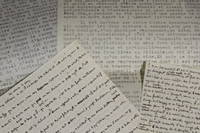
Maurice BLANCHOT - (Marcel PROUST)
L'expérience de Proust. Manuscrit autographe complet • The Proust Experience. Complete Autograph Manuscript
1943. Fine. 1943 21 x 13 cm en feuilles Autograph manuscript by the author four and a half pages in octavo published in the issue of Journal des Débats dated 12 May 1943. Complete recto-verso manuscript in a dense hand featuring numerous deletions corrections and additions. A literary column written on the occasion of the publication of Ramon Fernandez’s book À la gloire de Proust. It was to Maurice Blanchot that his friend Emmanuel Levinas owed his discovery of the work of Marcel Proust which he deeply admired despite Charles Maurras’s condemnation—a judgment that at first failed to turn him away from it. What Blanchot valued most in Proust was his at times fluid rhythm and his remarkable sense of the scene. Placing him within his literary pantheon alongside the Marquis de Sade and Franz Kafka Blanchot was drawn in the early 1940s to the very nature of the experience Proust conveyed in his novels: « L'œuvre de Proust est sortie d'états mystérieux qui semblent ne lui avoir été proposés que pour que cette œuvre fût écrite. Ils ont servi de stimulant à une extraordinaire avidité de connaître et eux qui étaient d'abord une rupture de connaissance ont fourni un aliment inépuisable à la connaissance littéraire. Cependant ce n'est pas l'aspect le moins surprenant du Temps perdu que dans le flot d'images d'événements de théories de figures dont ils ont été par abus la source ces états aient gardé la valeur d'un secret en continuant selon le pouvoir qui leur était propre à paraître toujours plus mystérieux que l'œuvre elle-même pourtant toute chargée de mystères. C'est en cela que Proust n'a pas trahi la révélation qu'il a rencontrée et dont il a offert l'image à la plus étendue et la plus admirable comme pour montrer qu'elle ne l'épuisait pas. » The text later revised would become part of the opening section of Faux Pas 1943 devoted to what Blanchot regarded as the fundamental question of inner experience. A very clean manuscript reflecting Blanchot’s clarity of thought on Proust. unknown
Referenz des Buchhändlers : 48328

|
|
|
Craig, Maurice
The Elephant and the Polish Question
Hardback. Acceptable. hardcover
Referenz des Buchhändlers : GOR007043242 ISBN : 0946640599 9780946640591

|
|
|
Maurice BLANCHOT
Sade ou le Royaume de l'Unique Quelques remarques sur Sade - Manuscrit autographe complet
s. l.: S. n. 1946. Fine. S. n. s. l. S.d 1946 - en feuilles Complete autograph manuscript of 12 pages on 6 octavo leaves with a title difficult to decipher perhaps: ""Sade or the Kingdoms of the Unique"" and which would appear under the title ""Some Remarks on Sade"" in Critique no. 3-4 of August-September 1946. Manuscript with very dense writing containing numerous deletions corrections and additions. ""It is Sade's thought that pushes Blanchot's to its fulfillment and it is also Blanchot's that fulfills that of Sade."" Georges Bataille Bataille's writing and friendship are undoubtedly not unrelated to the importance that Blanchot would attach throughout his life to this tutelary figure of his philosophical reflection. These Some Remarks on Sade are nonetheless the first study that Blanchot devoted to this writer whom he had until then almost never mentioned. In this first impartial and sometimes severe analysis Blanchot emphasizes the weaknesses of Sade's literary posture and his relative immorality within a post-revolutionary society shaped by ideological contradictions. However beneath the artifice of extreme expression Blanchot reveals a philosophy far more disconcerting and subversive than these ""great extravagances"". With singular acuity he draws the portrait of a unique mind embracing all the great ideals of his time but inflicting upon them the filter of his nihilistic singularity: ""Freedom in his eyes is nothing but the prohibition made to any person from being anything other than what he wants that is to say nothing."" Under Blanchot's pen Sadism is then no longer the enjoyment of violence inflicted on others but the expression of ""the infinite solitude of the individual"" in a world ""where the relationships between beings the general forms of life and even language everything is already consumed in universal destruction""; ""and henceforth all particular cruelties are no longer destined . except to bring to the Unique the pleasant proofs of his existence in the midst of nothing."" If as Bataille emphasizes more than a fresh perspective Blanchot's reading of Sade reveals a community of thought it is undoubtedly through the conclusion of this first major study that Blanchot the solitary most clearly testifies to his attachment to Sade the Unique: ""And then one comes to think: if circumstances made Sade a man forever reduced to the misery of an eternal prison he himself knew how to make his prison the image of the solitude of the universe over which reigns his sole glory forever all-powerful. This prison does not hinder him it is his work it is commensurate with the world over which he has more rights than God himself for not only does he reign there as master but he has banished and excluded all creatures from it. Such is the advantage of the Destroyer over the Creator. This atheist is more God than God. Thus he is called divine."" S. n. unknown
Referenz des Buchhändlers : 48355

|
|

 Per e-mail erhalten
 Als pdf-Dokument herunterladen
 RSS feed
 Permanenter link


