BOCCACCIO, GiovanniBiblio.com
2 653 résultats
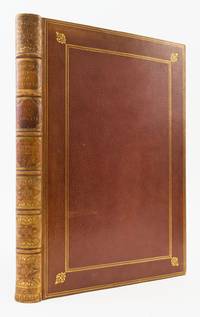
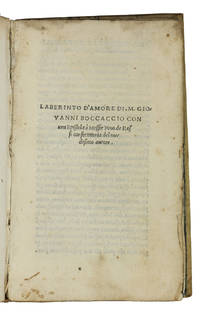
1525réf. L7UBM2B5YKM6Florence 1525. 8vo. heirs of Filippo Giunta the elder Contemporary sheepskin parchment with remains of a gold-tooled spine label dark blue edges. 72 ll. Second Giunta edition of the "Corbaccio" which first appeared in 1487 and was first and similarly anonymously printed by Filippo Giunta in 1516: "una materiale ristampa di questa edizione fatta pagina a pagina e riga a riga" Gamba; "ces deux editions sont assez rares" Brunet. This bawdy satire supposedly based on a Florentine widow who turned down Boccaccio was as popular as it remains controversial for its scurrilous and misogynistic elements. The text is prefixed by a letter from Filippo Giuntas son Bernardo "agli amatori della lingua Toscana"; leaves 57ff. contain Boccaccios letter to Pino di Rossi.With the engraved bookplate of Lord Robert Spencer 1747-1831 British Whig politician on the front paste-down. The youngest son of Charles Spencer 3rd Duke of Marlborough the hero of the Seven Years War Lord Robert was the nephew of the politician John Spencer 5th paternal great grandfather of Diana Princess of Wales and brother of George Spencer the great-great-great grandfather of Sir Winston Churchill. Occasional light brown stains and slight traces of worming to the foot margins of the first two leaves but altogether in very good condition. A charming example of a rare and desirable edition.l Adams B2182; Bandini Juntarum typographiae annales II 199; Brunet I 1016; Edit 16 CNCE 6267; Gamba 203 note; Panzer VII 40f 219; Renouard Supplément p. XLIX no. 79; WorldCat 612050557; cf. Hayn/Gotendorf I 398 citing later Italian eds.; not in BMC STC Italian. EARLY PRINTING & MANUSCRIPTS EUROPE LITERATURE & LINGUISTICS Early Printing - 16th century Italy Literature ZZ Literature & Linguistics unknown
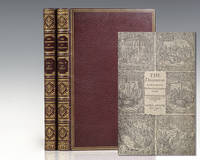
1757réf. 114589Londres Paris: Prault 1757-61. One of the masterpieces of the illustrated book A fine edition illustrated in large part by Gravelot: "one of the most accomplished illustrated books of the 18th century" Cohen-de Ricci 158-61; "one of the masterpieces of the illustrated book" Ray 15. The imprint is false; the book was published in Paris by Prault. The French translation is by Antoine Jean Le Maçon. Prault published an Italian version the same year with the same illustrations which is dated 1757 throughout and is usually regarded as taking precedence. 5 vols octavo 197 x 125 mm. Engraved portrait frontispiece title pages 110 plates engraved en-têtes engraved cartouches and 97 culs-de-lampe by Lemire Legrand and others after Gravelot Boucher Eisen and Cochin. Text in French. Contemporary French mottled calf smooth spines gilt in compartments green morocco double labels sides with triple gilt rule boards turn-ins decoratively gilt comb-marbled endpapers gilt edges. Contemporary ownership inscriptions to binder's blanks; wood-engraved bookplates of Bibl. Hammer Stockholm. A little wear to headcaps corners worn internally clean and fresh a very good set. hardcover
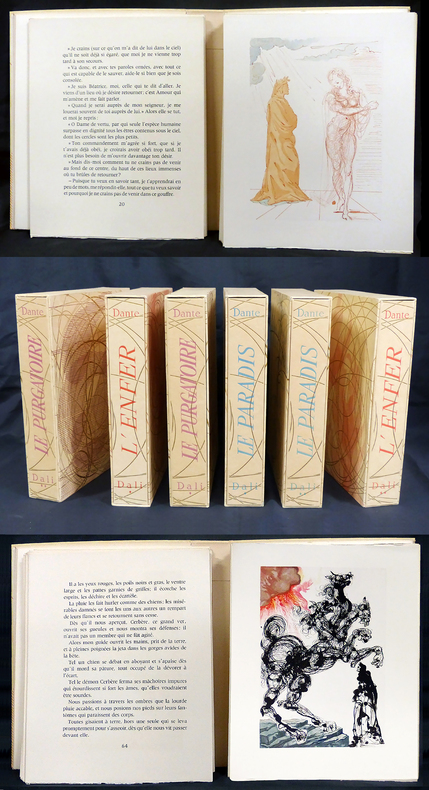
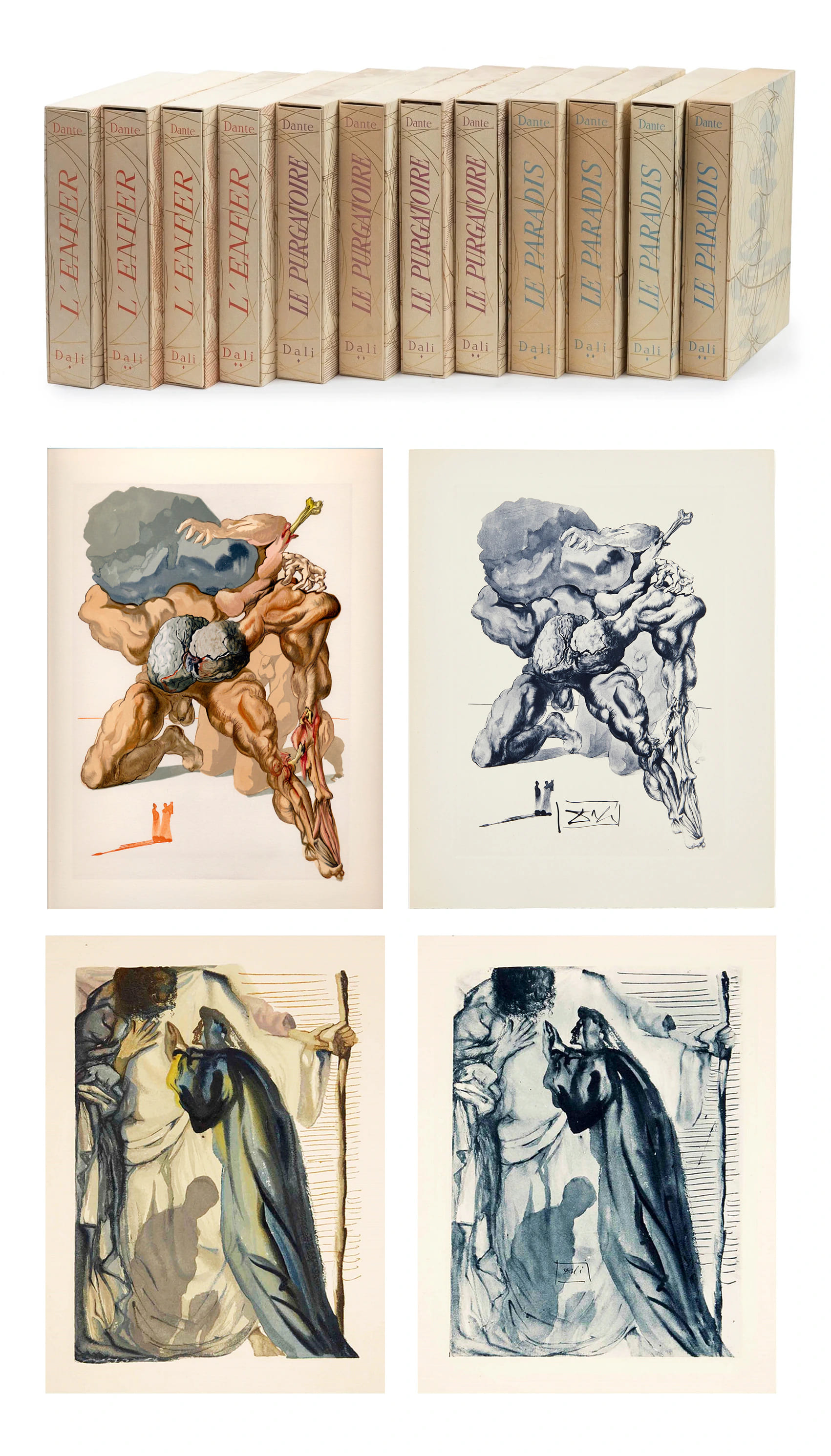
1963réf. 1371Les Heures Claires, Paris 1959-1963. 6 volumes in-folio (34 x 26 cm) en feuilles sous couvertures imprimées rempliées, chemises et étuis décorés de l'éditeur. 100 AQUARELLES ORIGINALES HORS-TEXTE DE SALVADOR DALI GRAVÉES SUR BOIS EN COULEURS par Raymond Jacquet. - Exemplaire : 1 des 3900 ex. numérotés sur pur chiffon de Rives filigrané. Les 6 ouvrages sont en excellent état et bien complets des 100 gravures et des 3 doubles-feuillets de justification numérotés. Les planches belles aux couleurs lumineuses. Les emboîtages sont en excellent état de conservation.
1539réf. 65731Bern, Matthias Apiarius, 1539. Fol. Mit 2 versch. Holzschn.-Druckermarken (am Titel u. dem letzten Blatt, eine von Hans Holbein) u. 15 (dav. 2 wiederh.) fast halbseitigen Textholzschnitten (davon 9 monogrammiert J[akob] K[allenberg]). 6 nn., LXXXI num., 1 nn. Bll., Blauer Kleisterpapier-Bd. d. 18. Jhds. m. Farbschnitt in mod. blauer Maroquin-Kassette m. goldgepr. Rückentitel.
1538réf. 16624Paris, [Pierre Sergent], 1538. In-8 gothique (15 x 9 cm) de (8)-196 ff. (sign. Ø8, A-X8, AA-CC8, DD4), veau tabac, dos orné à nerfs, triple filet doré d’encadrement sur les plats, tranches dorées (Koehler).
1614réf. 78341614 In Venetia : Alessandro Vecchi, 1614. In-8 : 15 x 21 cm, 12 ff. n. chiff. de pièces lim. y c, titre, 603 pp. de texte. Très belle édition vénitienne du Décaméron de Boccace illustrée dun portrait de lauteur et de 109 figures gravées sur bois dans le texte, certaines rehaussées dépoque en couleurs.Les bois sont ceux utilisés pour lédition de Giolito en 1546. Le texte, quant à lui, est celui établi par Leonardo Salviati parut 1582. Reliure en vélin doré de lépoque. Titre et date (erronée) manuscrits postérieurement au dos. Dos habilement restauré. Rares rousseurs.
réf. 6497Londres [Paris], 1757. 5 volumes in-12 (114 x 181 mm). Maroquin rouge, triple filet doré encadrant les plats, dos à nerfs orné, filet doré sur les coupes, roulette dorée sur les chasses, tranches dorées, quelques cahiers roussis, trait à l'encre très fin touchant la planche en regard de la page 203 du tome 2 (reliure de de l'époque).
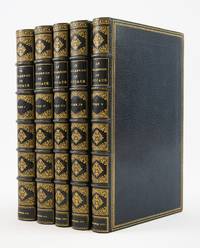
1757réf. ST20210Londres i.e. Paris: Prault 1757-61. 205 x 132 mm. 8 x 5 1/4". Five volumes. Translated by Antoine Jean Le Maçon. LOVELY INDIGO CRUSHED MOROCCO GILT BY DAVID stamp-signed on front turn-in covers with French fillet border raised bands spine compartments with intricate central fleuron and scrolling cornerpieces gilt lettering turn-ins with multiple decorative rolls marbled endpapers all edges gilt. Housed in a maroon buckram chemise in a matching morocco-backed slipcase. Engraved illustrated title page in each volume 110 engraved chapter headings and 205 ENGRAVED ILLUSTRATIONS BY GRAVELOT AND OTHERS 110 of these plates and 95 tailpiece vignettes. A Large Paper Copy. Cohen-de Ricci 160-61; Ray 15; Furstenberg 26. A couple of boards with trivial chafing isolated faint foxing occasional minor marginal smudges touching text on a couple of pages but A VERY FINE SET clean and fresh internally with spacious margins and in sparkling bindings with virtually no signs of wear. This is an elegantly bound and unusually well-preserved copy of one of the most famous and charming illustrated books of the 18th century a work frequently regarded as the supreme example of refined libertine illustration of the period. Owen Holloway calls it one of the four masterpieces of book illustration at the end of the Rococo period. Ray too is expansive in his praise calling the work simply "one of the masterpieces of the illustrated book." The publisher first released this work in Italian in 1757 with the present edition following later the same year. Although he had as collaborators on this work some of the outstanding French artists of the 18th century Gravelot born Hubert-François-Bourguignon 1699-1773 was chiefly responsible for its production designing 89 of its 111 plates and all 97 of its immensely delightful tailpieces. In this the most ambitious undertaking of his career Gravelot gave Boccaccio's narrative the settings and costumes of 18th century France and this transposition Ray tells us "made it possible for him to exercise his special talent for depicting the social world around him. For the most part his figures are young the women graceful and pretty the men lithe and handsome." But "all levels of life are presented from the peasant in his hovel to the king in his palace. Every variety of interior is there from boudoirs and bedrooms to dining rooms and salons. Animated street scenes alternate with glimpses of gardens and farms forests and river banks. The human condition has rarely been so attractively displayed." Our copy is particularly pleasing: it is in fine condition with wide generous margins and was bound in rich indigo morocco by David. Parisian binder Bernard David 1824-95 worked under Pfister Dompierre Lortic and Gruel before striking out on his own to establish a very high reputation in the trade. His bindery was taken over by his son Salvador in 1890. Prault] unknown
1757réf. ST20210Londres i.e. Paris: Prault 1757-61. 205 x 132 mm. 8 x 5 1/4". Five volumes. Translated by Antoine Jean Le Maçon. LOVELY INDIGO CRUSHED MOROCCO GILT BY DAVID stamp-signed on front turn-in covers with French fillet border raised bands spine compartments with intricate central fleuron and scrolling cornerpieces gilt lettering turn-ins with multiple decorative rolls marbled endpapers all edges gilt. Housed in a maroon buckram chemise in a matching morocco-backed slipcase. Engraved illustrated title page in each volume 110 engraved chapter headings and 205 ENGRAVED ILLUSTRATIONS BY GRAVELOT AND OTHERS 110 of these plates and 95 tailpiece vignettes. A Large Paper Copy. Cohen-de Ricci 160-61; Ray 15; Furstenberg 26. A couple of boards with trivial chafing isolated faint foxing occasional minor marginal smudges touching text on a couple of pages but A VERY FINE SET clean and fresh internally with spacious margins and in sparkling bindings with virtually no signs of wear. This is an elegantly bound and unusually well-preserved copy of one of the most famous and charming illustrated books of the 18th century a work frequently regarded as the supreme example of refined libertine illustration of the period. Owen Holloway calls it one of the four masterpieces of book illustration at the end of the Rococo period. Ray too is expansive in his praise calling the work simply "one of the masterpieces of the illustrated book." The publisher first released this work in Italian in 1757 with the present edition following later the same year. Although he had as collaborators on this work some of the outstanding French artists of the 18th century Gravelot born Hubert-François-Bourguignon 1699-1773 was chiefly responsible for its production designing 89 of its 111 plates and all 97 of its immensely delightful tailpieces. In this the most ambitious undertaking of his career Gravelot gave Boccaccio's narrative the settings and costumes of 18th century France and this transposition Ray tells us "made it possible for him to exercise his special talent for depicting the social world around him. For the most part his figures are young the women graceful and pretty the men lithe and handsome." But "all levels of life are presented from the peasant in his hovel to the king in his palace. Every variety of interior is there from boudoirs and bedrooms to dining rooms and salons. Animated street scenes alternate with glimpses of gardens and farms forests and river banks. The human condition has rarely been so attractively displayed." Our copy is particularly pleasing: it is in fine condition with wide generous margins and was bound in rich indigo morocco by David. Parisian binder Bernard David 1824-95 worked under Pfister Dompierre Lortic and Gruel before striking out on his own to establish a very high reputation in the trade. His bindery was taken over by his son Salvador in 1890. Prault] unknown books
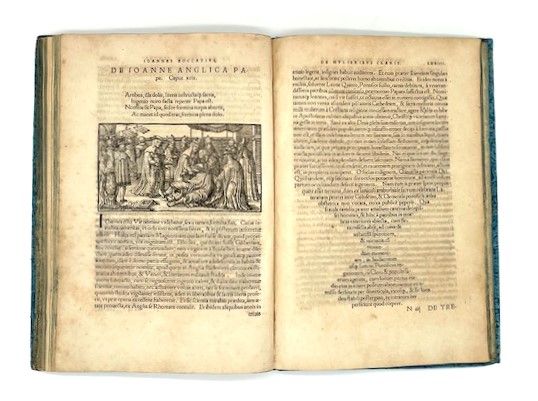
1539réf. 33106-1153Bern Mathias Apiarius 1539. With 15 near half-page woodcuts including 2 repeats of which 9 are signed Jakob Kallenberg 2 different printer's woodcut device on title and last leaf honey-licking bears one by H. Holbein. 6 LXXXI 1 ff. Small folio. 18th-century calf worn. From the library of G. Wüthrich with his engr. supralibros. Bern Mathias Apiarius 1539. Bound with: MAZZOCCHI Giacomo ed. Epigrammata antiquae urbis. With 21 woodcut illustrations of classical architecture and inscriptions including large depiction of the Pantheon on B2v more than 100 woodcut borders in text. Roman type. 10 CLXXXI leaves further 8 ff. with index and errate lacking at the end. Folio. Rome Jacobus Mazzocchi April 1521. Ad I: First edition of the earliest books from the press of the first printer of Bern and a beautifully illustrated edition of Boccaccio's encomium of famous women. It is notable as the first collection devoted exclusively to biographies of women in Western literature. The artist has been identified as Jakob Kallenberg a Bavarian painter and craftsman from Bern who worked there from 1535 until about 1565 and became a member of the city council. His style is reminiscent of Holbein whose pupil he probably was. Several of these cuts are also extant on broadside publications or loose sheets. The satirical cut of Pope Joan f. LXXIIIv giving birth during a procession surrounded by cardinals is here in perfect state whereas it is often either missing or mutilated.- 18th cent. ms. owner's entry on title-page otherwise a nice copy. Ad II: First edition of the first printed collection of classical inscriptions an anthology of ancient Roman epigraphs and the most beautiful book from the press of the famous Roman printer Mazzocchi active 1505- 1527. His work is import as one of the earliest humanist studies on epigraphy and valuable for its profuse woodcut illustrations. There are woodcuts of art and architecture of ancient Rome including the Pantheon triumphal arches the "Three Graces" and other reliefers and steles; about 80 cartouches of varying design frame the inscriptions and 7 full-page woodcut borders are on black ground. The work has been attributed to one of Mazzocchi's humanist friends Francesco Albertini the great scholar of Roman antiquities. This publication was a determining factor in the development of Roman studies in the 16th century and is the first collection of classical inscriptions from the city of Rome. - Last 8 ff. index and errata lacking 18th cent. ms. owner's entry on title-page otherwise fine. - Ad I: Fairfax Murray 78; VD 16 B 5814; Adams B 2141; Hollstein XVB p. 206 nos.1-15; ad II: Cicognara 3789; Sander 2554; Fumagalli p. 339-342 fig. 142; Coszena III 2251; Mortimer Italian 297; EDIT16 CNCE 18162; Adams E 236. GRAPHIC ARTS:ILLUSTRATED BOOKS ; SWITZERLAND ; ITALY ; Bern, Mathias Apiarius unknown
réf. 387975 volumes in-8 (200 x 125 mm), maroquin vieux rouge de l'époque, dos à 5 nerfs richement ornés de compartiments fleuronnés et cloisonnés, palettes et roulettes dorées, pièces de titre et de tomaison de maroquin fauve, large guirlande de palmettes et feuillages dorés en encadrement des plats, coupes et coiffes filetées, roulette intérieure, tranches dorées, viii, 320 p. ; 292 p. ; 203 p. ; 280 p. et 269 p., 5 frontispices, 110 figures hors texte ainsi que, pour la "suite libre": un titre frontispice et 20 figures. Londres [Paris], 1757-1761.
1972réf. 021298New York and Fribourg: Pamela Verlag and Transworld Art 1972. First Edition. Hardcover. Fine in a Near Fine case. Salvador Dali. Portfolio with loose sheets 12-1/4" x 17-1/2" laid in a paper cover and cloth portfolio lettered in silver on the backstrip as issued. Copy #26 of 150 with English text and 10 ORIGINAL DRYPOINT ENGRAVINGS in color image size 5" x 7-1/4" on 12-1/4" x 17-1/2" sheets each SIGNED by the illustrator. (Pamela Verlag) and (Transworld Art) hardcover books
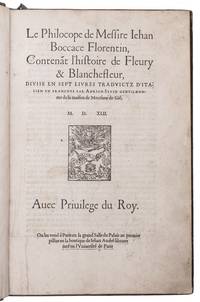
1542réf. 835Paris: Jean André bookseller to the University colophon: printed by Denis Janot 1542. French calf ca. 1760 sewn on 5 supports richly gold-tooled spine with a black morocco label in the 2nd of 6 compartments gold double-fillets on board edges blind triple fillets on boards gilt edges green silk ribbon marker curl-marbled endpapers similar to Wolfe 16 but with red blue orange green and white in that order. Folio 31.5 x 21.5 cm. With Jean Andrés woodcut flaming heart and caged bird device on the title page and 15 woodcut illustrations plus 21 repeats in the text mostly 5.5 x 8 cm each in any of several 4-piece decorative borders including 8 foot pieces each with a different coat of arms; one illustration 13.5 x 8.5 cm with an 8-piece decorative border 5 woodcut decorated initials 2 series plus 1 repeat and many spaces with guide-letters for manuscript initials not filled in. Set in a roman type with shoulder notes and some verses in italic and a large roman for headings. Jean André issue of the extremely influential first French-language edition by Adrien Sevin of Boccaccio's first major work Il filocolo ca. 1336 a prose tale detailing the romantic love and adventures of Florio and Biancafiore based on the ca. 1160 French verse romance Floire et Blancheflor written at the request of Boccaccio's muse "Fiammetta". Boccaccio's version served as the model for Chaucer's more than fifty years later but it is a reworking rather than a translation so it was largely through the present printed translation that Il philocope a precursor of the better known Decameron became known north of the Alps. The fine woodcut illustrations first appeared in Janot's 1540 edition of Amadis de Gaula and after the Philocope also for several other romances. The borders used with them in these works are apparently older for two of the head borders are dated 1520. King François I of France who reigned from 1515 to 1547 greatly admired the Italian Renaissance and encouraged Italian influences in many aspects of French culture. The present book reflects that movement both as a model of French Renaissance prose under Italian influence and as an example of book production using new roman and italic types in the new style introduced under Italian influence in the 1530s.With the small letterpress bookplate and the armorial bookplate of Charles Bouchelet de Vendegies Comte d'Hust 1772- 1851 and a later bookplate of the Swiss collector Albert Natural. With a few mostly marginal defects and early repairs but with three repaired tears in the text one also in a woodcut but so skilfully repaired that it is barely visible in the woodcut. One of the repeated woodcuts has a small abrasion. Otherwise in good condition. The binding has restorations to the hinges and corners and the spine shows some superficial cracks and flaking but nearly all of the tooling remains clear. The very influential first French edition of Boccaccio's first major work with excellent woodcut illustrations.l BMC STC French p. 71 Janot issue; Brun Le livre français illustré p. 158; Mortimer French 105 Janot issue; Rawles Denis Janot . 1976 PhD thesis 164; Renouard Imprimeurs Parisiens 155; USTC 37796 & 92444 8 copies; see 37799 65503 & 92444 for the other issues; cf. Adams B2169-2171 Italian eds. Jean André, bookseller to the University (colophon: printed by Denis Janot), hardcover
réf. LCS-1864065
réf. LCS-18627Précieux, rare et bel exemplaire à grandes marges de Camille Desmoulins avec ex-libris calligraphié. Paris, Gilles Corrozet, 24 février 1542. In-folio de vi ff. et 174 ff. Veau brun, plats encadrés de filets à froid, dos à nerfs orné, coupes décorées, tranches jaspées. Reliure du XVIIe siècle. 310 x 200 mm.
1963réf. 3909Les Heures Claires, Paris 1959-1963. 12 volumes in-folio en feuilles (34 x 26 cm) sous couvertures imprimées rempliées, chemises et étuis décorés de l'éditeur. - 100 AQUARELLES ORIGINALES HORS-TEXTE DE SALVADOR DALI GRAVÉES SUR BOIS EN COULEURS par Raymond Jacquet. Exemplaire de grand luxe : 1 des 150 ex. numérotés sur pur chiffon de Rives filigrané comprenant : Les 6 volumes du texte illustré des 100 aquarelles gravées sur bois en couleurs en hors-texte + LA SUITE COMPLÈTE DES 100 BOIS EN COULEURS.+ LA SUITE COMPLÈTE DU TRAIT GRAVÉ SUR CUIVRE TIRÉ EN BLEU + UNE SUITE DE LA DÉCOMPOSITION DES COULEURS D'UNE PLANCHE POUR CHAQUE VOLUME. Les 6 ouvrages sont en parfait état et bien complets des 100 gravures et des 3 doubles-feuillets de justification numérotés. Les 6 volumes de suites sont collationnés et bien complets en parfaite condition. Les planches belles aux couleurs lumineuses. Les 12 emboîtages sont en parfait état de conservation. Très bel exemplaire du tirage de luxe de cette monumentale et célèbre édition. ÉTAT DE NEUF. (Références : Michler & Lopsinger, 1039 à 1138 ; Field pages 189 à 200). Provenance : acquise en 1963 directement auprès de Joseph Foret et conservée dans la même famille jusqu'à aujourd'hui. Photographies supplémentaires sur demande. - ENGLISH DESCRIPTION: Dante : LA DIVINE COMÉDIE. 100 wood-engraved plates in color. Les Heures Claires, Paris 1959-1963. 12 folio volumes in loose sheets (34 x 26 cm), under folded printed covers, original decorated slipcases of the publisher. Including THE 100 WATERCOLORS OUT OF TEXT BY SALVADOR DALI ENGRAVED ON WOOD IN COLORS by Raymond Jacquet. This one is 1 of 150 deluxe copies numbered on Rives with watermark : The 6 volumes with the Dante's text illustrated with 100 color wood engravings + THE COMPLETE SUITE OF THE 100 COLOR WOOD ENGRAVINGS + THE COMPLETE SUITE OF THE COPPER ENGRAVED LINE ART PRINTED IN BLUE + A SUITE OF THE COLOR "DECOMPOSITIONS" OF ONE PLATE FOR EACH VOLUME. The 6 volumes are in perfect condition and complete with all 100 engravings and the 3 numbered double-page justifications. The 6 volumes of suites have been collated and are complete and in perfect condition. The plates are beautiful with luminous colors. The 12 slipcases are in perfect condition. A very fine and scarce deluxe copy of this monumental and celebrated edition. MINT CONDITION. (References: Michler & Lopsinger, 1039 to 1138; Field pages 189 to 200). More pictures on request.
réf. 101382London but Paris 1757-61. . 5 vols in 6; 8vo 20 x 13cm 5 engraved titles 110 engraved plates 97 head and tail pieces by Gravelot and Boucher among others engraved by Aliamet Bacquoy Lemire and others plus a frontispiece and 20 extra planches libres unsigned but attributed to Gravelot. Contemporary red morocco spines with raised bands gilt in compartments morocco labels lettered in gilt; some labels in contrasting colour. A lovely copy of this beautifully illustrated work finely bound in red morocco and including the charming 'figures libres' here bound in a supplementary volume. Cohen among others praised this great achievement of Gravelot Boucher Cochin and Eisen the best illustrators of the French 18th century. The edition not only shows 115 plates and frontispieces but also includes decorative engraved head- and tail-pieces in the best tradition of book illustration of its time. The Italian text was translated into French by A. Le Macon. Cohen de Ricci 160; Ray 39-41. London [but Paris], 1757-61. hardcover
1554réf. ST19091London: Iohn Wayland at the signe of the Sunne oueragainst the Conduite in Flete-strete. Cum priuilegio per septennium 1554 or 1555. Third or Fourth Edition of the First English Translation of "De Casibus Illustrium Virorum. 340 x 220 mm. 13 1/4 x 8 3/4". 9 p.l. clxiii xxxvi xxxv-xxxvii 1 leaves complete including "A Memorial of such Princes" leaf often lacking at the end; collates as ESTC. Translated from the French version of Laurent de Premierfait by John Lydgate. Attractive 19th century honey-brown morocco by Francis Bedford stamp-signed on front turn-in covers gilt with French fillet frame oblique bouquets at corners raised bands spine compartments with central fleuron framed by geometrical compartments filled with floral tooling gilt lettering gilt-rolled turn-ins marbled endpapers all edges gilt. Title page and Gg4 recto title page of a suppressed supplement dealing with English notables with woodcut title border the top compartment with the Royal Arms termini at sides the pedestal at base with a tablet showing one boy waking another with the motto "Arise for it is day" McKerrow & Ferguson 76a A4 recto with woodcut depicting the Creation of Eve flanked by terminal side-pieces woodcut historiated and floral initials throughout. Printed in black letter. Front pastedown with engraved bookplate of Christopher William Beaumont Pease; rear pastedown with bookplates of John William Pease and Lord Wardington. Chrzanowski 1555b; Pforzheimer 73; Luborsky & Ingram 3178; STC 3178; ESTC S107087. Spine somewhat sunned and dulled extremities very lightly rubbed boards with a couple of faint scratches but the once very handsome binding still attractive. Title leaf and final leaf extended at foot first few and last couple of leaves excluding title and final leaf with small minor repair at upper corner probably pressed and perhaps lightly washed at the time of binding isolated trivial stains but the text still surprisingly fresh remarkably clean and entirely smooth. This is a desirable copy of an important 16th century translation of Boccaccio's study of the vicissitudes of fortune prepared by John Lydgate a poet much influenced by Chaucer. Educated in the Benedictine monastery where he eventually served as prior Lydgate ca. 1370 - 1449/50 was a respected poet whose works DNB tells us "bear the mark of a pious and learned mind." And an indication of his importance is reflected in Chrzanowski's statement that "well into the 16th century the premier poets of England were considered to be Geoffrey Chaucer John Gower and Lydgate." Undertaken ca. 1431 at the request of the duke of Gloucester the 36365 lines here divided into nine books required a massive effort that took until 1438 or 1439 to complete. In the text a parade of notable historical figures pass before "Bochas" Boccaccio telling of the turns of fate that brought their careers and reputations crashing down from a pinnacle. According to DNB Lydgate's interpretation of the work "urges the traditional doctrines of moderation the avoidance of pride and the pursuit of virtue and demonstrates the horror of discord and strife between kinsfolk. This advice though couched in general terms was highly relevant to contemporary princes." This relevance led to popularity: more than 30 manuscripts of the work survive and it was printed previously in 1494 and in 1527. The final leaf here Gg4 contains the title page for "A Memorial of Such Princes as since the Tyme of King Richard the Seconde Haue Been Unfortunate in the Realme of England" intended for issue with "Fall of Princes" but suppressed by Queen Mary. It was finally published as the famous "Mirrour for the Magistrates" in 1559 after Elizabeth I had ascended the throne. The binding here is by the eminent West End bindery of Francis Bedford d. 1883 and was owned by three generations of the Wardington family who created one of the finest private libraries in England. It contains the bookplates of Northumberland banker John William Beaumont Pease 1869-1950 who began the collection; a grandson Christopher Henry Beaumont Pease 2nd Baron Wardington 1924-2005 who was successively Chairman Vice-President and then President of the Friends of the British Library; and a great-grandson the Hon. Christopher William Beaumont Pease b. 1970. The Wardington sales at Sotheby's in London were major bibliophilic events in 2005 and 2006. The very expert extension at the bottoms of the title leaf and the rare final leaf would seem to suggest that these come from another copy the leaves are not facsimiles. In any case every recent copy sold at auction according to RBH lacked one or both of these leaves or had other leaves supplied. This fact plus the fine state of preservation of our copy and its distinguished provenance surely are more than enough to compensate for the volume's one appreciable shortcoming. Iohn Wayland, at the signe of the Sunne oueragainst the Conduite in Flete-strete. Cum priuilegio per septennium unknown books
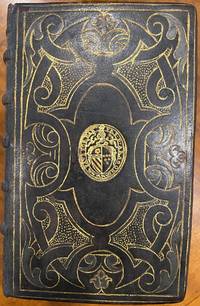
1538réf. 4518Venice: Venice: Bernardino Bindoni 1538. Very good. 8vo 157 x 98 mm. Woodcut printer's device at end. Contemporary Parisian morocco by Wotton's Binder C: interlaced design some open tools painted gray others with pointille tooling central armorial device of Paolo Giordano Orsini with his arms impaling the Medici arms of his future wife motto Isabella and his motto "Pavl Iordan Vrs D. Aragon" spine in six compartments with floral design gilt and gauffered edges sympathetic restorations to spine ends and board edges. ONE OF A VERY SMALL GROUP OF ELABORATE RENAISSANCE BINDINGS EXECUTED IN PARIS FOR PAOLO GIORDANO I ORSINI BY THE THIRD OF WOTTON'S BINDERS "WOTTON BINDER C" AN ESTEEMED CRAFTSMAN WHOSE CLIENTELE INCLUDED MANY IMPORTANT BIBLIOPHILES SUCH AS JEAN GROLIER FRANCOIS I CARDINAL GRANVELLE CHARLES DE LORRAINE MARCUS FUGGER THE "GERMAN GROLIER" AND THOMAS WOTTON THE "ENGLISH GROLIER" AFTER WHOM THE WORKSHOP IS NAMED. It is almost certain that Orsini's bindings were made for him during his only known visit to France in 1556 when he was just fifteen. His was a diplomatic engagement accompanying the apostolic legate Cardinal Carafa to secure an alliance with Henri II against the Spanish. Only thirty of Orsini's Parisian bindings have so far come to light plus two remboite all bound by Wotton Binder C. The books are all printed before 1555 and with two exceptions are in Italian. The bindings either have a bold architectural strapwork decoration as here perhaps based on contemporary French patterns or a "center-and-corner" design. Concerning the armorial device: Orsini impaled his own arms with those of the Medici despite the fact that his marriage to Isabella de' Medici was not celebrated until 1558! This is the device that figures on our binding and all the other surviving examples. Paolo Giordano I Orsini 1541-1585 Duke of Bracciano infamous member of the famous Roman family and one of the most powerful men in Rome was affianced in 1553 to Isabella de'Medici daughter of Grand Duke Cosimo of Tuscany. After they married in 1558 Orsini already immensely wealthy became even richer with grand palaces in Rome Florence and Bracciano. He spent lavishly on paintings sculptures antiquities tapestries and furniture. Orsini is suspected of strangling Isabella in 1571 in reprisal for her infidelity apparently in broad daylight and in the presence of named servants. He is also suspected of ordering in 1581 the murder of Francesco Peretti wife of Vittoria Accoramboni with whom Orsini was himself having an affair. Unfortunately for Orsini Peretti was the nephew of the future Pope Sixtus V and soon found himself wanted not only by the Papal police but the Tuscan police. He took refuge in Venice and then in Abano and Salo with his mistress whom he married in 1585. He died in Salo later that year. Orsini's bindings are greatly prized but are very rare in private ownership indeed the great bibliophile Michael Wittock was unable to acquire one. In 2005 when the present binding came up for auction at Christie's New York we immediately recognized it as being from the Parisian workshop of Wotton Binder C despite the fact that Christie's described it as being "Italian." Happily we were able to secure it at the sale and it passed into the collection of one of our favorite clients; now after twenty years we are pleased to offer the present binding again. Despite the fact that books from Orisini's library almost never come on the open market T. Kimball Brooker was able to secure of them both of which commanded very high prices in the Brookeriana sales : 1. Sotheby's New York 10/11/23 lot 13. Bible in Italian. Venice 1547 Macchi no. 22. Est. $30000 - $40000 unsold. Offered again at Sotheby's Paris 12/17/25 lot 45. Sold for EUR 40640. 2. Sotheby's London 7/11/2025 lot 1709. Paolo Giovio Vita de Leon X Florence 1549 Macchi no. 24. Sold for GBP 25400 now in the Morgan Library. The first penetrating study of Orsini's bindings was made by G.D. Hobson 1931 who correctly assigned them to France not Italy. His work was continued by no less authorities than Tammaro de Marinis 1940 Anthony Hobson French and Italian Collectors 1953 Miriam Foot Henry Davis Gift I pp.152-154 and Appendix V: Bindings by Wotton's Binder III for Other Collectors Federico & Livio Macchi who compiled a list of 24 bindings for which see below. Robin Halwas's amazing self-published article on Orsini's bindings is essential reading "Parisian bindings for Paolo Giordano Orsini 1541-1585". Whereas the compilers of the Brookeriana sale catalogues state that only twenty-six such examples are known Halwas shows that there are thirty plus two remboitage. Our binding which had remained untraced after 2005 is listed his no. 9 and he gives a characteristically impressive provenance history and to him we are much obliged: 1. Paolo Giordano Orsini duca di Bracciano 1541-1585 armorial supralibros lettered "Pavl Iordan Vrs D. Aragon"; 2. Librairie Damascène Morgand Paris; 4. Charles Fairfax Murray 1849-1919; 5. Sotheby's London 17-20 July 1922 lot 132; 6. Leo S. Olschki Florence; 7. Christie's New York 15 December 2005 lot 337 binding described as "contemporary Italian morocco"; 8. Purchased by Michael Laird Rare Books 9. Private Collector USA; 10. Michael Laird Rare Books. THE BINDER: Thomas Wotton 1521-1587 wealthy English squire landowner and sheriff of Kent traveled to Paris with some frequency and there he patronized the leading binders of the day. Indeed on Wotton the posthumous title "the English Grolier" has been bestowed owing to his early adoption of Grolier's "Et Amicorum" formula on the covers of his books. About 140 bindings from Wotton's library have been identified. From the anonymous workshop known as "Wotton Binder C" which was active in the 1540s and 1550s and which was responsible for the present binding from Orsini's library Thomas Wotton commissioned as many as thirty bindings; most recognizable are those that bear the date "1552." § Adams B-2170. Macchi Federico & Livio Macchi "Le legature francesi di Paolo Giordano Orsini d'Aragona: Storia di un personaggio e di una legatura" in: Misinta 45 June 2016 pp.143-149 our binding is listed on p.147 as no. 21. Venice: Bernardino Bindoni unknown
1538réf. 4518Venice: Venice: Bernardino Bindoni 1538. Very good. 8vo 157 x 98 mm. Woodcut printer's device at end. Contemporary Parisian morocco by Wotton's Binder C: interlaced design some open tools painted gray others with pointille tooling central armorial device of Paolo Giordano Orsini with his arms impaling the Medici arms of his future wife motto Isabella and his motto "Pavl Iordan Vrs D. Aragon" spine in six compartments with floral design gilt and gauffered edges sympathetic restorations to spine ends and board edges. ONE OF A VERY SMALL GROUP OF ELABORATE RENAISSANCE BINDINGS EXECUTED IN PARIS FOR PAOLO GIORDANO I ORSINI BY THE THIRD OF WOTTON'S BINDERS "WOTTON BINDER C" AN ESTEEMED CRAFTSMAN WHOSE CLIENTELE INCLUDED MANY IMPORTANT BIBLIOPHILES SUCH AS JEAN GROLIER FRANCOIS I CARDINAL GRANVELLE CHARLES DE LORRAINE MARCUS FUGGER THE "GERMAN GROLIER" AND THOMAS WOTTON THE "ENGLISH GROLIER" AFTER WHOM THE WORKSHOP IS NAMED. It is almost certain that Orsini's bindings were made for him during his only known visit to France in 1556 when he was just fifteen. His was a diplomatic engagement accompanying the apostolic legate Cardinal Carafa to secure an alliance with Henri II against the Spanish. Only thirty of Orsini's Parisian bindings have so far come to light plus two remboite all bound by Wotton Binder C. The books are all printed before 1555 and with two exceptions are in Italian. The bindings either have a bold architectural strapwork decoration as here perhaps based on contemporary French patterns or a "center-and-corner" design. Concerning the armorial device: Orsini impaled his own arms with those of the Medici despite the fact that his marriage to Isabella de' Medici was not celebrated until 1558! This is the device that figures on our binding and all the other surviving examples. Paolo Giordano I Orsini 1541-1585 Duke of Bracciano infamous member of the famous Roman family and one of the most powerful men in Rome was affianced in 1553 to Isabella de'Medici daughter of Grand Duke Cosimo of Tuscany. After they married in 1558 Orsini already immensely wealthy became even richer with grand palaces in Rome Florence and Bracciano. He spent lavishly on paintings sculptures antiquities tapestries and furniture. Orsini is suspected of strangling Isabella in 1571 in reprisal for her infidelity apparently in broad daylight and in the presence of named servants. He is also suspected of ordering in 1581 the murder of Francesco Peretti wife of Vittoria Accoramboni with whom Orsini was himself having an affair. Unfortunately for Orsini Peretti was the nephew of the future Pope Sixtus V and soon found himself wanted not only by the Papal police but the Tuscan police. He took refuge in Venice and then in Abano and Salo with his mistress whom he married in 1585. He died in Salo later that year. Orsini's bindings are greatly prized but are very rare in private ownership indeed the great bibliophile Michael Wittock was unable to acquire one. In 2005 when the present binding came up for auction at Christie's New York we immediately recognized it as being from the Parisian workshop of Wotton Binder C despite the fact that Christie's described it as being "Italian." Happily we were able to secure it at the sale and it passed into the collection of one of our favorite clients; now after twenty years we are pleased to offer the present binding again. Despite the fact that books from Orisini's library almost never come on the open market T. Kimball Brooker was able to secure of them both of which commanded very high prices in the Brookeriana sales : 1. Sotheby's New York 10/11/23 lot 13. Bible in Italian. Venice 1547 Macchi no. 22. Est. $30000 - $40000 unsold. Offered again at Sotheby's Paris 12/17/25 lot 45. Sold for EUR 40640. 2. Sotheby's London 7/11/2025 lot 1709. Paolo Giovio Vita de Leon X Florence 1549 Macchi no. 24. Sold for GBP 25400 now in the Morgan Library. The first penetrating study of Orsini's bindings was made by G.D. Hobson 1931 who correctly assigned them to France not Italy. His work was continued by no less authorities than Tammaro de Marinis 1940 Anthony Hobson French and Italian Collectors 1953 Miriam Foot Henry Davis Gift I pp.152-154 and Appendix V: Bindings by Wotton's Binder III for Other Collectors Federico & Livio Macchi who compiled a list of 24 bindings for which see below. Robin Halwas's amazing self-published article on Orsini's bindings is essential reading "Parisian bindings for Paolo Giordano Orsini 1541-1585". Whereas the compilers of the Brookeriana sale catalogues state that only twenty-six such examples are known Halwas shows that there are thirty plus two remboitage. Our binding which had remained untraced after 2005 is listed his no. 9 and he gives a characteristically impressive provenance history and to him we are much obliged: 1. Paolo Giordano Orsini duca di Bracciano 1541-1585 armorial supralibros lettered "Pavl Iordan Vrs D. Aragon"; 2. Librairie Damascène Morgand Paris; 4. Charles Fairfax Murray 1849-1919; 5. Sotheby's London 17-20 July 1922 lot 132; 6. Leo S. Olschki Florence; 7. Christie's New York 15 December 2005 lot 337 binding described as "contemporary Italian morocco"; 8. Purchased by Michael Laird Rare Books 9. Private Collector USA; 10. Michael Laird Rare Books. THE BINDER: Thomas Wotton 1521-1587 wealthy English squire landowner and sheriff of Kent traveled to Paris with some frequency and there he patronized the leading binders of the day. Indeed on Wotton the posthumous title "the English Grolier" has been bestowed owing to his early adoption of Grolier's "Et Amicorum" formula on the covers of his books. About 140 bindings from Wotton's library have been identified. From the anonymous workshop known as "Wotton Binder C" which was active in the 1540s and 1550s and which was responsible for the present binding from Orsini's library Thomas Wotton commissioned as many as thirty bindings; most recognizable are those that bear the date "1552." § Adams B-2170. Macchi Federico & Livio Macchi "Le legature francesi di Paolo Giordano Orsini d'Aragona: Storia di un personaggio e di una legatura" in: Misinta 45 June 2016 pp.143-149 our binding is listed on p.147 as no. 21. Venice: Bernardino Bindoni unknown books
réf. LCS-18521Exemplaire unique de l’édition originale érotique de Mirabeau imprimé en 1802 orné de 8 dessins érotiques, 10 estampes érotiques en couleurs du XVIIIe siècle et 21 gravures érotiques, reliée en maroquin de l’époque. À Paris, chez L. Duprat, Letellier et Cie, 1802. 4 tomes en 2 volumes in-8 de: I-II : (8) pp. , xx, 304, (4) (dont les 2 dernières blanches); (4) pp. (dont la dernière blanche), 273, (3) (dont la dernière blanche), en tout 1 portrait, 1 frontispice, 1 frontispice en couleurs, 3 dessins, 15 planches en noir et blanc et 7 planches en couleurs / III-IV : (4) pp. (dont la dernière blanche), 243, (3) (dont la dernière blanche); (4) (dont la dernière blanche), 293, (3) (dont la dernière blanche), en tout 4 dessins en noir et 1 dessin à l’encre rouge, 13 planches en noir, 2 planches en couleurs. Maroquin rouge à grain long, double filet estampé à froid encadrant les plats avec anneaux d'angles, dos lisses filetés, filet ondé doré sur les coupes, roulette intérieure dorée, tranches dorées, quelques rousseurs. Reliure de l’époque de Lefebvre. 202 x 123 mm.
réf. LCS-1864066
1620réf. Bv2407The First English Language Edition of Boccaccio"s masterpiece "the dirtiest great book in the Western canon." Two works in one: FIRST ENGLISH EDITION of the second second English edition of the first as virtually always. Quarto. Late 19th-century full dark red morocco gilt raised bands marbled endpapers all edges gilt. Isaac Jaggard 1625 1620. The five year delay of the second volume has summoned various uncertain explanations but by the time it was ready the first printing of the first volume had been exhausted and a new printing produced. No comparable second printing of the second volume has been recorded. The first translation into English of one of the greatest books in all literature to which countless legendary authors -- Shakespeare Chaucer Swift Keats -- are indebted. This anonymous English translation of Boccaccio often ascribed to John Florio is one of a small cluster of imprints to carry the name of Isaac Jaggard joint publisher and printer of Shakespeare's First Folio on the same presses contemporaneous with The First Folio. Described by The New Yorker as "probably the dirtiest great book in the Western canon" The Decameron relates several salacious stories "Wittily discoursed betweene seven Honorable Ladies and three Noble Gentlemen" sheltering in a secluded villa just outside Florence to escape the Black Death tormenting the city. The various tales of love and lust in The Decameron range from the erotic to the tragic. Tales of wit practical jokes and life lessons contribute to the mosaic. In 1559 when the Vatican first produced its Index of Banned Books the Decameron appeared on its first list. The author has even contributed to the Italian language where the word "boccaccesco" we might say "Boccaccio-esque" is used to describe something salacious or lewd. In the end "Boccaccio creates a human panorama of love courage cowardice wit wisdom deceit and folly. If he does not teach the art of living virtuously he does the 'art of living well" Boorstin 266-70. Small ink annotation to front free endpaper pencil bibliographic annotations to first leaf and recto of rear free endpaper the latter signed "Mr. B. Quaritch Ltd". Text generally clean and fresh with only a few spots of light foxing a tiny bit of light marginal dampstaining to a few leaves front inner hinge expertly reinforced. Occasional tiny hole to leaves affecting letters but not sense of text. An excellent copy handsomely bound. Book #Bv2407. $50000. We specialize in Rare Signed and Manuscript Ayn Rand and other Legends and Landmarks. Isaac Jaggard hardcover
1620réf. 128726London: Isaac Jaggard 1620. First edition in English of Boccaccio's masterpiece published by Jaggard published three years prior to his printing of the Shakespeare First Folio. Boccaccio's masterpiece. Folio 2 volumes bound in full morocco by Riviere gilt titles and tooling to the spine all edges gilt errata leaf at end of volume one B1 is a cancellans woodcut titles each with 6 vignettes 98 woodcut vignettes in text chiefly repeating the title vignettes woodcut initials head- and tail-pieces. In near fine condition. First editions are rare. The Decameron is a collection of novellas by the 14th-century Italian author Giovanni Boccaccio 1313–1375. The book is structured as a frame story containing 100 tales told by a group of seven young women and three young men sheltering in a secluded villa just outside Florence to escape the Black Death which was afflicting the city. Boccaccio probably conceived the Decameron after the epidemic of 1348 and completed it by 1353. The various tales of love in The Decameron range from the erotic to the tragic. Tales of wit practical jokes and life lessons contribute to the mosaic. In addition to its literary value and widespread influence for example on Chaucer's The Canterbury Tales it provides a document of life at the time. Written in the vernacular of the Florentine language it is considered a masterpiece of classical early Italian prose. Isaac Jaggard unknown
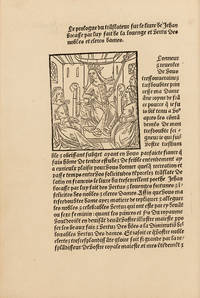
réf. ABAACali25Folio 273 x 192 mm of 144 ll. a-n8 o-p6 q-r8 s-t6 of 34/35 lines. Full light brown morocco covers decorated with a black mosaic pattern of interlacings framed with gilt fillets spine ribbed decorated as such vellum-skin doublures and endpapers gilt edges. Binding signed by Marius Michel. Exceedingly rare first French edition dedicated to Anne of Brittany and first issue of "De la louenge et vertu des nobles et clères dames" by Giovanni Boccaccio printed on the 28th of April 1493 by Antoine Vérard. BMC VIII 79 ; B.n.F. Rés. G-365 ; Brunschwig 280 ; CIBN B-519 ; Fairfax Murray FB 50 ; Goff B-719 ; GW Accurti I 4490 ; HC 3337 ; IGI 1769 ; Macfarlane 25 ; Pell. 2478 et 2478 A ; Hain-Copinger n° 3337 ; Proctor n° 8425 ; Brunet I 990. This copy is the only one complete to appear on the international market since 30 years. The first Latin edition was published in 1473 under the title De Claris mulieribus some famous women in Ulm. "The work written between 1360 and 1362 amplified and modified in the following years contain the biography of 104 renowned ladies of all times from Eve to the Queen Joanna of Naples; it is dedicated to the very beautiful Andrée Acciaiuoli sister of the Grand Seneschal Nicolas Acciaiuoli second wife of an Altavilla Count. The model of Petrarch and of his treaty of Notorious Men greatly influenced Boccaccio as he admitted himself. The narrative vein is expanding there with a certain freedom like in the pages dedicated to the life of the Popess Joan to the voluptuous lengths on the loves of Thisbe to the history of the naïve Paulina Roman woman loved by God Anubis recalling quite closely the tale of Lisette and Angel Gabriel from the Decameron. … As a whole the volume is a compromise between the historical scholarship and the tale a pleasing erudition book aimed not only at men but also women - whom declares Boccaccio as an excuse being used to hear stories have a greater need of it and enjoy themselves with a copious story." T.F. G. Rouville. The volume is illustrated with 11 woodcuts that since repeated form an iconographical cycle of 80 engravings. Most of them measure 87 x 80 mm and represent a queen with a child in her arms 23 times a queen standing with some ladies in front of her 22 times a woman breastfeeding twins in front of a landscape 17 times. Two other engravings come from the Chevalier délibéré printed in 1488. Two engravings of different sizes 140 x 86 mm show a bishop at his writing case topped with a sage and a woman; they come from the "Ars moriendi" printed by Le Rouge for Vérard in 1492. Nine of these engravings were specially executed for this book and are therefore here in first issue. "Extremely rare volume illustrated with a certain number of beautiful woodcuts which are among the most interesting ones from the works published by Vérard". Rahir n°263. Copy including the signs of the first issue: <!-- if !supportLists-->- <!--endif-->The title is printed with the mistake " nouellemet " corrected in the copy of the Pierpont Morgan Library. The Gesamt Katalog Pellechet Polain 2478 and Hain mention " nouuellemet " with two U. <!-- if !supportLists-->- <!--endif-->Leave i4 is signed hIIII. First great Italian prose-writer Giovanni Boccaccio 1313-1375 was very famous in France more than Dante and Petrarch and this since the beginning of printing. He wrote as much for the people who enjoyed the entertaining reading of the Decameron as for the aristocracy who in the De casibus virorum illustrium translated into French Le cas des nobles malheureux found a kind of ethical encyclopedia of the great men from the Antiquity. This first edition was printed by Antoine Vérard who dedicated the work to Anne of Brittany wife of King Charles VIII. It was for the most part due to writers engaged by Anne of Brittany or attracted by the possibility of her patronage as Antoine Vérard could be that literature to the praise and defense of women was promoted in the French court. The title only contains two lines of text. On the back of the title begins the translator's preface suppressed in some copies and supplemented with a miniature. In this copy it is coming with a woodcut showing the Queen Anne of Brittany seated in a throne surrounded by female characters from her suite. On the front of the last leaf the typographical mark of Antoine Vérard. This translation of De Casibus virorum illustrium by Boccaccio was made for Jean de Chanteprime between 1400 and 1409 by Laurent de Premierfait. The latter belongs to a generation of French humanists under the reign of Charles VI re-discovering and celebrating classical literature since Cicero until Petrarch and Boccaccio. He was a scholar Latinist much appreciated by the humanists of his time but what mostly made his glory were the translations into French from Latin or Latin texts versions of originally Greek or Italian texts made for aristocrat sponsors. Bechtel mentions a cut in the word "nouvellement" on the title uncut in our copy and therefore labelled as: "novellement". Précious copy. In half a century only one other complete copy appeared on the public market sold for 35 000 € 30 years ago. Réf : Hôtel Georges V 16 septembre 1988 n° 23 ex. S. Brunschwig.