|
Halsman, Philippe & Salvador Dali
Halsman/Dali
New York: Howard Greenberg Gallery 2004. First edition. Stiff Wraps. Orig. illustrated stiff wrappers. Fine. Unpaginated. 25 x 20.5 cm. Signed and inscribed by Morine Halsman. 16 photographic plates. Unpaginated text by Mary Panzer -- Exhibition catalogue February 5 - March 13 2004. Halsman met Dali in New York in 1941; photographs of Dali and their collaborative effort from 1942 through 1965. Howard Greenberg Gallery unknown
Riferimento per il libraio : 21032

|
|
|
Halsman, Philippe (1906-1979);
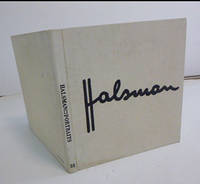
Halsman: Portraits. Selected and Edited by Yvonne Halsman. First edition
New York: McGraw-Hill Book Company 1983. 4to. 31.5 x 33.5cm. Original embossed linen. Illustrated. . The images in this book were selected by his wife Yvonne and his two daughters Irene Halsman Rosenberg and Jane Halsman Bello. Bookplate of Kelly Collins-Beatty.Text below by Mary PanzerCurator of PhotographsNational Portrait Gallery Smithsonian Institution.Philippe Halsman 1906-1979 was born in Riga Latvia. He studied engineering in Dresden before moving to Paris where he set up his photographic studio in 1932. Halsman's bold spontaneous style won him many admirers. His portraits of actors and authors appeared on book jackets and in magazines; he worked with fashion especially hat designs and filled commissions for private clients. By 1936 Halsman was known as one of the best portrait photographers in France.From the 1940s through the 1970s Philippe Halsman's sparkling portraits of celebrities intellectuals and politicians appeared on the covers and pages of the big picture magazines including Look Esquire the Saturday Evening Post Paris Match and especially Life. His work also appeared in advertisements and publicity for clients like Elizabeth Arden cosmetics NBC Simon & Schuster and Ford. Photographers amateur as well as professional admired Halsman's stunning images. In 1958 a poll conducted by Popular Photography named Halsman one of the "World's Ten Greatest Photographers" along with Irving Penn Richard Avedon Ansel Adams Henri Cartier-Bresson Alfred Eisenstaedt Ernst Haas Yousuf Karsh Gjon Mili and Eugene Smith. Altogether Halsman's images form a vivid picture of prosperous American society in the middle years of the twentieth century. "Philippe Halsman: A Retrospective" is the first historical survey of his work.Halsman's career came to a dramatic halt in the summer of 1940 when Hitler's troops invaded Paris. Albert EinsteinHis wife daughter sister and brother-in-law who all held French passports immigrated to America but as a Latvian citizen Philippe Halsman could not obtain a visa. For several long months he waited in Marseilles along with many others who were forced to escape fascist Europe. Finally through the intervention of Albert Einstein who had met Halsman's sister in the 1920s Halsman obtained permission to enter the United States and he arrived in New York in November 1940 with little more than his camera.Halsman's big break came when he met Connie Ford a striking young model who agreed to pose in exchange for prints for her portfolio.Constance Ford When publicists at Elizabeth Arden saw Halsman's photograph of Ford against an American flag they used the image to launch a national campaign for "Victory Red" lipstick. A year later in the fall of 1942 Life asked Halsman to shoot a story on new hat design. To Halsman's delight his portrait of the model smiling through a feathery brim landed on the cover. One hundred more covers followed before the magazine ceased weekly publication in 1972.When Halsman began working for Life the magazine was only six years old and photojournalism was still a new field. Before the existence of Life and its competitors Americans learned about the world from newspapers radio and newsreels. But the new picture magazines published pages filled with bright dramatic photographs bringing Americans vivid information that no other media could match. Frank SinatraIn the spirit of a variety show or a world's fair magazines combined stories about international politics everyday life news events celebrities exotic scenery and humor to prove that "so much of the world so judiciously selected had never been seen before in one place." Today to understand the significance of those great magazines we need only look at the many forms of mass media that have come to replace them. Now we find photographs on television and billboards; in special publications devoted to news people fashion or sports; in newspapers; in museums and galleries; and on the Internet. And ironically the more places there are to see photographs the harder it is to attract viewers. But in 1942 when Philippe Halsman's portrait simply appeared on the cover of Life and immediately reached a large united audience.Surrealism:.In Paris Halsman studied the work of other artists and photographers especially the surrealists from whom he learned to make images that surprised his viewers. By including homely and ultimately disturbing details he gave his subjects memorable tension. Through subtle lighting sharp focus and close cropping he turned formal fashion shots into serious investigations of character. When Halsman posed NBC comedians against bare white paper eliminating all defining context their isolation made them look both frail and funny.Salvidor Dali Most important of all from the surrealists' exploration of the erotic unconscious Halsman learned how to combine glamour sex and wholesome energy in one portrait. This unusual ability made him Life's favorite photographer for sensual stars like Marilyn Monroe and Brigitte Bardot. Halsman's sympathy for surrealism also led to his long productive friendship with Salvador Dali. Halsman met Dali on assignment in 1941 and over the next three decades they became partners on many projects including a series of playful tableaux that had all the disturbing irrationality of dreams or a painting by Dali. Their most notable production was "Dali Atomicus" in which the artist his canvas furniture cats and water all appear suspended in air.Psychological Portraiture:.Over the course of his career Halsman enjoyed comparing his work to that of a good psychologist who regards his subjects with special insight. With his courtly manners and European accent Halsman also fit the popular stereotype at a time when Americans regarded psychology with fascinated skepticism. In fact Halsman was proud of his ability to reveal the character of his sitters. As he explained "It can't be done by pushing the person into position or arranging his head at a certain angle. It must be accomplished by provoking the victim amusing him with jokes lulling him with silence or asking impertinent questions which his best friend would be afraid to voice.".Marilyn MonroeIn the spring of 1952 Halsman put his signature technique to work when Life sent him to Hollywood to photograph Marilyn Monroe. Halsman asked Monroe to stand in a corner and placed his camera directly in front of her. Later he recalled that she looked "as if she had been pushed into the corner cornered with no way to escape." Then Halsman his assistant and Life's reporter staged a "fiery" competition for Monroe's attention. "Surrounded by three admiring men she smiled flirted giggled and wriggled with delight. During the hour I kept her cornered she enjoyed herself royally and I . . . took between 40 and 50 pictures.".In this widely familiar portrait Monroe wears a white evening gown and stands with her back against two walls one dark the other light her eyes half closed and her dark lipsticked mouth partly open. Yet Halsman deftly avoided any explicit representation of the true subject of the picture. Using the euphemistic language of the time Halsman's assistant admired the photographer's ability to make "suggestive" pictures of beautiful women which still showed "good taste" emphasizing "expression" rather than "physical assets." And then the assistant added "Halsman is very adept at provoking the expression he wants.".Jumpology:.In 1950 NBC asked Halsman to photograph many of its popular comedians. Milton Berle Ed Wynn Sid Caesar Groucho Marx Bob Hope Red Skelton and many others came to Halsman's studio where they performed while he captured their antics on film. A single session could generate two or three hundred pictures. When Halsman compared these comic images to more traditional portraits he found that comedians often jumped and always stayed in character. Desperation and good humor finally drove him to ask others to jump for his camera when the Ford Motor Company commissioned him to make an official family photograph in honor of the company's fiftieth anniversary. WindsorsHalsman spent a long tiring session with nine edgy adults and eleven restless children. Afterward Halsman's irrepressible humor inspired him to ask matriarch Mrs. Edsel Ford "May I take a picture of you jumping'" The astonished Mrs. Ford replied "You want me to jump with my high heels" Next her daughter-in-law Mrs. Henry Ford II requested a turn. The "jump" pictures had surprising charm and over the next six years Halsman asked many clients to jump for him. Van Cliburn Edward R. Murrow and Herbert Hoover declined Halsman's invitation but most people realized they had nothing to lose. Some gained considerably like the suddenly buoyant and likable Vice President Richard Nixon who jumped for Halsman in the White House. Halsman claimed the jumps revealed character that was otherwise hidden. "When you ask a person to jump his attention is mostly directed toward the act of jumping and the mask falls so that the real person appears.".Halsman also pursued this project to discover something about himself. "I assure you that often before approaching the person my heart would beat and I would have to fight down all my inhibitions in order to address this request to my subject. At every time when the subject agreed to jump it was for me like a kind of victory." How did Halsman persuade so many to abandon their composure for his camera Somehow he managed to convince each one that the risk was all his own.Like many who escaped Hitler's Europe Philippe Halsman rarely discussed the past. He rightly insisted that his most important work took place in America and in many ways his adopted country became his subject. One typical review noted his patriotic flair praising Halsman's "unsanctimonious and immensely intense portrayal of American bounce." From a historian's perspective it seems clear that Halsman invented a glowing image of the nation as he saw it using light persuasion nerve imagination psychology and experience. This place and these faces are his creation.Halsman's perpetual quest for hidden truth also recalls his personal history as an artist and a refugee. Halsman knew that the effort to establish one's identity had significance far beyond the needs of the celebrity marketplace. "This fascination with the human face has never left me. . . . Every face I see seems to hide and sometimes fleetingly to reveal the mystery of another human being. . . . Capturing this revelation became the goal and passion of my life.". New York: McGraw-Hill Book Company, 1983. hardcover
Riferimento per il libraio : 51-6818
|
|
|
HALSMAN, Philippe
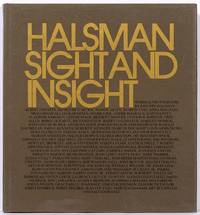
Halsman: Sight and Insight
Garden City New York: Doubleday & Company Inc 1972. Hardcover. Very Good/Very Good. First edition. Quarto. 188pp. Heavily illustrated from black and white photographs. Topedge foxed first couple of pages with old creases and a bit of foxing very good in a rubbed and moderately wrinkled very good dust jacket with a few small bumps paper adhered to the inside of the rear flap. Doubleday & Company, Inc hardcover
Riferimento per il libraio : 609609
|
|
|
Halsman, Philippe (1906-1979);
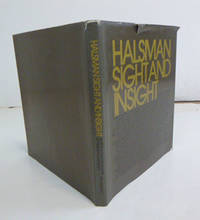
Halsman: Sight and Insight. First edition
New York: Doubleday & Company Inc. 1972. 4to. 26 x 29cm. Original embossed linen and dust-jacket. 186pp. With 200 black and white photographs. Small tears on lower right corners of first 3 pages. Text below by Mary PanzerCurator of PhotographsNational Portrait Gallery Smithsonian Institution.Philippe Halsman 1906-1979 was born in Riga Latvia. He studied engineering in Dresden before moving to Paris where he set up his photographic studio in 1932. Halsman's bold spontaneous style won him many admirers. His portraits of actors and authors appeared on book jackets and in magazines; he worked with fashion especially hat designs and filled commissions for private clients. By 1936 Halsman was known as one of the best portrait photographers in France.From the 1940s through the 1970s Philippe Halsman's sparkling portraits of celebrities intellectuals and politicians appeared on the covers and pages of the big picture magazines including Look Esquire the Saturday Evening Post Paris Match and especially Life. His work also appeared in advertisements and publicity for clients like Elizabeth Arden cosmetics NBC Simon & Schuster and Ford. Photographers amateur as well as professional admired Halsman's stunning images. In 1958 a poll conducted by Popular Photography named Halsman one of the "World's Ten Greatest Photographers" along with Irving Penn Richard Avedon Ansel Adams Henri Cartier-Bresson Alfred Eisenstaedt Ernst Haas Yousuf Karsh Gjon Mili and Eugene Smith. Altogether Halsman's images form a vivid picture of prosperous American society in the middle years of the twentieth century. "Philippe Halsman: A Retrospective" is the first historical survey of his work.Halsman's career came to a dramatic halt in the summer of 1940 when Hitler's troops invaded Paris. Albert EinsteinHis wife daughter sister and brother-in-law who all held French passports immigrated to America but as a Latvian citizen Philippe Halsman could not obtain a visa. For several long months he waited in Marseilles along with many others who were forced to escape fascist Europe. Finally through the intervention of Albert Einstein who had met Halsman's sister in the 1920s Halsman obtained permission to enter the United States and he arrived in New York in November 1940 with little more than his camera.Halsman's big break came when he met Connie Ford a striking young model who agreed to pose in exchange for prints for her portfolio.Constance Ford When publicists at Elizabeth Arden saw Halsman's photograph of Ford against an American flag they used the image to launch a national campaign for "Victory Red" lipstick. A year later in the fall of 1942 Life asked Halsman to shoot a story on new hat design. To Halsman's delight his portrait of the model smiling through a feathery brim landed on the cover. One hundred more covers followed before the magazine ceased weekly publication in 1972.When Halsman began working for Life the magazine was only six years old and photojournalism was still a new field. Before the existence of Life and its competitors Americans learned about the world from newspapers radio and newsreels. But the new picture magazines published pages filled with bright dramatic photographs bringing Americans vivid information that no other media could match. Frank SinatraIn the spirit of a variety show or a world's fair magazines combined stories about international politics everyday life news events celebrities exotic scenery and humor to prove that "so much of the world so judiciously selected had never been seen before in one place." Today to understand the significance of those great magazines we need only look at the many forms of mass media that have come to replace them. Now we find photographs on television and billboards; in special publications devoted to news people fashion or sports; in newspapers; in museums and galleries; and on the Internet. And ironically the more places there are to see photographs the harder it is to attract viewers. But in 1942 when Philippe Halsman's portrait simply appeared on the cover of Life and immediately reached a large united audience.Surrealism:.In Paris Halsman studied the work of other artists and photographers especially the surrealists from whom he learned to make images that surprised his viewers. By including homely and ultimately disturbing details he gave his subjects memorable tension. Through subtle lighting sharp focus and close cropping he turned formal fashion shots into serious investigations of character. When Halsman posed NBC comedians against bare white paper eliminating all defining context their isolation made them look both frail and funny.Salvidor Dali Most important of all from the surrealists' exploration of the erotic unconscious Halsman learned how to combine glamour sex and wholesome energy in one portrait. This unusual ability made him Life's favorite photographer for sensual stars like Marilyn Monroe and Brigitte Bardot. Halsman's sympathy for surrealism also led to his long productive friendship with Salvador Dali. Halsman met Dali on assignment in 1941 and over the next three decades they became partners on many projects including a series of playful tableaux that had all the disturbing irrationality of dreams or a painting by Dali. Their most notable production was "Dali Atomicus" in which the artist his canvas furniture cats and water all appear suspended in air.Psychological Portraiture:.Over the course of his career Halsman enjoyed comparing his work to that of a good psychologist who regards his subjects with special insight. With his courtly manners and European accent Halsman also fit the popular stereotype at a time when Americans regarded psychology with fascinated skepticism. In fact Halsman was proud of his ability to reveal the character of his sitters. As he explained "It can't be done by pushing the person into position or arranging his head at a certain angle. It must be accomplished by provoking the victim amusing him with jokes lulling him with silence or asking impertinent questions which his best friend would be afraid to voice.".Marilyn MonroeIn the spring of 1952 Halsman put his signature technique to work when Life sent him to Hollywood to photograph Marilyn Monroe. Halsman asked Monroe to stand in a corner and placed his camera directly in front of her. Later he recalled that she looked "as if she had been pushed into the corner cornered with no way to escape." Then Halsman his assistant and Life's reporter staged a "fiery" competition for Monroe's attention. "Surrounded by three admiring men she smiled flirted giggled and wriggled with delight. During the hour I kept her cornered she enjoyed herself royally and I . . . took between 40 and 50 pictures.".In this widely familiar portrait Monroe wears a white evening gown and stands with her back against two walls one dark the other light her eyes half closed and her dark lipsticked mouth partly open. Yet Halsman deftly avoided any explicit representation of the true subject of the picture. Using the euphemistic language of the time Halsman's assistant admired the photographer's ability to make "suggestive" pictures of beautiful women which still showed "good taste" emphasizing "expression" rather than "physical assets." And then the assistant added "Halsman is very adept at provoking the expression he wants.".Jumpology:.In 1950 NBC asked Halsman to photograph many of its popular comedians. Milton Berle Ed Wynn Sid Caesar Groucho Marx Bob Hope Red Skelton and many others came to Halsman's studio where they performed while he captured their antics on film. A single session could generate two or three hundred pictures. When Halsman compared these comic images to more traditional portraits he found that comedians often jumped and always stayed in character. Desperation and good humor finally drove him to ask others to jump for his camera when the Ford Motor Company commissioned him to make an official family photograph in honor of the company's fiftieth anniversary. WindsorsHalsman spent a long tiring session with nine edgy adults and eleven restless children. Afterward Halsman's irrepressible humor inspired him to ask matriarch Mrs. Edsel Ford "May I take a picture of you jumping'" The astonished Mrs. Ford replied "You want me to jump with my high heels" Next her daughter-in-law Mrs. Henry Ford II requested a turn. The "jump" pictures had surprising charm and over the next six years Halsman asked many clients to jump for him. Van Cliburn Edward R. Murrow and Herbert Hoover declined Halsman's invitation but most people realized they had nothing to lose. Some gained considerably like the suddenly buoyant and likable Vice President Richard Nixon who jumped for Halsman in the White House. Halsman claimed the jumps revealed character that was otherwise hidden. "When you ask a person to jump his attention is mostly directed toward the act of jumping and the mask falls so that the real person appears.".Halsman also pursued this project to discover something about himself. "I assure you that often before approaching the person my heart would beat and I would have to fight down all my inhibitions in order to address this request to my subject. At every time when the subject agreed to jump it was for me like a kind of victory." How did Halsman persuade so many to abandon their composure for his camera Somehow he managed to convince each one that the risk was all his own.Like many who escaped Hitler's Europe Philippe Halsman rarely discussed the past. He rightly insisted that his most important work took place in America and in many ways his adopted country became his subject. One typical review noted his patriotic flair praising Halsman's "unsanctimonious and immensely intense portrayal of American bounce." From a historian's perspective it seems clear that Halsman invented a glowing image of the nation as he saw it using light persuasion nerve imagination psychology and experience. This place and these faces are his creation.Halsman's perpetual quest for hidden truth also recalls his personal history as an artist and a refugee. Halsman knew that the effort to establish one's identity had significance far beyond the needs of the celebrity marketplace. "This fascination with the human face has never left me. . . . Every face I see seems to hide and sometimes fleetingly to reveal the mystery of another human being. . . . Capturing this revelation became the goal and passion of my life.". New York: Doubleday & Company, Inc., 1972. hardcover
Riferimento per il libraio : 51-6819
|
|
|
Halsman, Philippe (1906-1979)
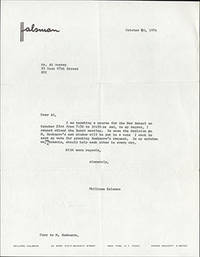
Letter from Philippe Halsman to his co-ternants at 33 West 67th Street NYC : Al Murray and N. Rockmore.
New York: 1974. Printed letter. dated October 20 1974. He cannot attend the board meeting since he is teaching .The Atelier constructed in 1903 at 33 West 67th Street is a historic prewar cooperative building originally designed as artists' studios. Located on the Upper West Side within the landmarked West 67th Street Historic Artist's District the limestone and brick building features distinctive Gothic-inspired architectural details including an intimate lobby with its original cast-iron elevator and electrified gas fixtures on the landings.The building is characterized by its dramatic double-height studios with soaring ceilings and expansive windows designed specifically to provide artists with optimal working conditions. Many apartments retain their original architectural elements including ornate wood paneling baronial fireplaces and gothic wainscoting. Notable past residents include renowned portrait artist Albert Murray and acclaimed artist James William Fosdick whose work appears in the Smithsonian.Today The Atelier operates as a full-service cooperative offering modern amenities while preserving its artistic heritage. The building features a 24-hour doorman a landscaped roof terrace with Central Park views and storage facilities. The cooperative allows 75% financing permits washer/dryers in units and welcomes both pied-à-terres and pets with board approval. Its location provides convenient access to Central Park Lincoln Center and the cultural attractions of the Upper West Side.Text below by Mary PanzerCurator of PhotographsNational Portrait Gallery Smithsonian Institution.Philippe Halsman 1906-1979 was born in Riga Latvia. He studied engineering in Dresden before moving to Paris where he set up his photographic studio in 1932. Halsman's bold spontaneous style won him many admirers. His portraits of actors and authors appeared on book jackets and in magazines; he worked with fashion especially hat designs and filled commissions for private clients. By 1936 Halsman was known as one of the best portrait photographers in France.From the 1940s through the 1970s Philippe Halsman's sparkling portraits of celebrities intellectuals and politicians appeared on the covers and pages of the big picture magazines including Look Esquire the Saturday Evening Post Paris Match and especially Life. His work also appeared in advertisements and publicity for clients like Elizabeth Arden cosmetics NBC Simon & Schuster and Ford. Photographers amateur as well as professional admired Halsman's stunning images. In 1958 a poll conducted by Popular Photography named Halsman one of the "World's Ten Greatest Photographers" along with Irving Penn Richard Avedon Ansel Adams Henri Cartier-Bresson Alfred Eisenstaedt Ernst Haas Yousuf Karsh Gjon Mili and Eugene Smith. Altogether Halsman's images form a vivid picture of prosperous American society in the middle years of the twentieth century. "Philippe Halsman: A Retrospective" is the first historical survey of his work.Halsman's career came to a dramatic halt in the summer of 1940 when Hitler's troops invaded Paris. Albert EinsteinHis wife daughter sister and brother-in-law who all held French passports immigrated to America but as a Latvian citizen Philippe Halsman could not obtain a visa. For several long months he waited in Marseilles along with many others who were forced to escape fascist Europe. Finally through the intervention of Albert Einstein who had met Halsman's sister in the 1920s Halsman obtained permission to enter the United States and he arrived in New York in November 1940 with little more than his camera.Halsman's big break came when he met Connie Ford a striking young model who agreed to pose in exchange for prints for her portfolio.Constance Ford When publicists at Elizabeth Arden saw Halsman's photograph of Ford against an American flag they used the image to launch a national campaign for "Victory Red" lipstick. A year later in the fall of 1942 Life asked Halsman to shoot a story on new hat design. To Halsman's delight his portrait of the model smiling through a feathery brim landed on the cover. One hundred more covers followed before the magazine ceased weekly publication in 1972.When Halsman began working for Life the magazine was only six years old and photojournalism was still a new field. Before the existence of Life and its competitors Americans learned about the world from newspapers radio and newsreels. But the new picture magazines published pages filled with bright dramatic photographs bringing Americans vivid information that no other media could match. Frank SinatraIn the spirit of a variety show or a world's fair magazines combined stories about international politics everyday life news events celebrities exotic scenery and humor to prove that "so much of the world so judiciously selected had never been seen before in one place." Today to understand the significance of those great magazines we need only look at the many forms of mass media that have come to replace them. Now we find photographs on television and billboards; in special publications devoted to news people fashion or sports; in newspapers; in museums and galleries; and on the Internet. And ironically the more places there are to see photographs the harder it is to attract viewers. But in 1942 when Philippe Halsman's portrait simply appeared on the cover of Life and immediately reached a large united audience.Surrealism:.In Paris Halsman studied the work of other artists and photographers especially the surrealists from whom he learned to make images that surprised his viewers. By including homely and ultimately disturbing details he gave his subjects memorable tension. Through subtle lighting sharp focus and close cropping he turned formal fashion shots into serious investigations of character. When Halsman posed NBC comedians against bare white paper eliminating all defining context their isolation made them look both frail and funny.Salvidor Dali Most important of all from the surrealists' exploration of the erotic unconscious Halsman learned how to combine glamour sex and wholesome energy in one portrait. This unusual ability made him Life's favorite photographer for sensual stars like Marilyn Monroe and Brigitte Bardot. Halsman's sympathy for surrealism also led to his long productive friendship with Salvador Dali. Halsman met Dali on assignment in 1941 and over the next three decades they became partners on many projects including a series of playful tableaux that had all the disturbing irrationality of dreams or a painting by Dali. Their most notable production was "Dali Atomicus" in which the artist his canvas furniture cats and water all appear suspended in air.Psychological Portraiture:.Over the course of his career Halsman enjoyed comparing his work to that of a good psychologist who regards his subjects with special insight. With his courtly manners and European accent Halsman also fit the popular stereotype at a time when Americans regarded psychology with fascinated skepticism. In fact Halsman was proud of his ability to reveal the character of his sitters. As he explained "It can't be done by pushing the person into position or arranging his head at a certain angle. It must be accomplished by provoking the victim amusing him with jokes lulling him with silence or asking impertinent questions which his best friend would be afraid to voice.".Marilyn MonroeIn the spring of 1952 Halsman put his signature technique to work when Life sent him to Hollywood to photograph Marilyn Monroe. Halsman asked Monroe to stand in a corner and placed his camera directly in front of her. Later he recalled that she looked "as if she had been pushed into the corner cornered with no way to escape." Then Halsman his assistant and Life's reporter staged a "fiery" competition for Monroe's attention. "Surrounded by three admiring men she smiled flirted giggled and wriggled with delight. During the hour I kept her cornered she enjoyed herself royally and I . . . took between 40 and 50 pictures.".In this widely familiar portrait Monroe wears a white evening gown and stands with her back against two walls one dark the other light her eyes half closed and her dark lipsticked mouth partly open. Yet Halsman deftly avoided any explicit representation of the true subject of the picture. Using the euphemistic language of the time Halsman's assistant admired the photographer's ability to make "suggestive" pictures of beautiful women which still showed "good taste" emphasizing "expression" rather than "physical assets." And then the assistant added "Halsman is very adept at provoking the expression he wants.".Jumpology:.In 1950 NBC asked Halsman to photograph many of its popular comedians. Milton Berle Ed Wynn Sid Caesar Groucho Marx Bob Hope Red Skelton and many others came to Halsman's studio where they performed while he captured their antics on film. A single session could generate two or three hundred pictures. When Halsman compared these comic images to more traditional portraits he found that comedians often jumped and always stayed in character. Desperation and good humor finally drove him to ask others to jump for his camera when the Ford Motor Company commissioned him to make an official family photograph in honor of the company's fiftieth anniversary. WindsorsHalsman spent a long tiring session with nine edgy adults and eleven restless children. Afterward Halsman's irrepressible humor inspired him to ask matriarch Mrs. Edsel Ford "May I take a picture of you jumping'" The astonished Mrs. Ford replied "You want me to jump with my high heels" Next her daughter-in-law Mrs. Henry Ford II requested a turn. The "jump" pictures had surprising charm and over the next six years Halsman asked many clients to jump for him. Van Cliburn Edward R. Murrow and Herbert Hoover declined Halsman's invitation but most people realized they had nothing to lose. Some gained considerably like the suddenly buoyant and likable Vice President Richard Nixon who jumped for Halsman in the White House. Halsman claimed the jumps revealed character that was otherwise hidden. "When you ask a person to jump his attention is mostly directed toward the act of jumping and the mask falls so that the real person appears.".Halsman also pursued this project to discover something about himself. "I assure you that often before approaching the person my heart would beat and I would have to fight down all my inhibitions in order to address this request to my subject. At every time when the subject agreed to jump it was for me like a kind of victory." How did Halsman persuade so many to abandon their composure for his camera Somehow he managed to convince each one that the risk was all his own.Like many who escaped Hitler's Europe Philippe Halsman rarely discussed the past. He rightly insisted that his most important work took place in America and in many ways his adopted country became his subject. One typical review noted his patriotic flair praising Halsman's "unsanctimonious and immensely intense portrayal of American bounce." From a historian's perspective it seems clear that Halsman invented a glowing image of the nation as he saw it using light persuasion nerve imagination psychology and experience. This place and these faces are his creation.Halsman's perpetual quest for hidden truth also recalls his personal history as an artist and a refugee. Halsman knew that the effort to establish one's identity had significance far beyond the needs of the celebrity marketplace. "This fascination with the human face has never left me. . . . Every face I see seems to hide and sometimes fleetingly to reveal the mystery of another human being. . . . Capturing this revelation became the goal and passion of my life.". New York: 1974 hardcover
Riferimento per il libraio : 51-6812
|
|
|
Halsman, Philippe (1906-1979)
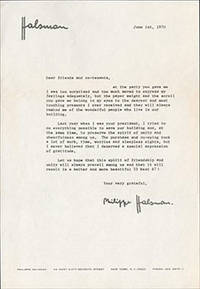
Letter from Philippe Halsman to his co-ternants at 33 West 67th Street NYC where he had been the president.
New York: 1970. Printed letter. dated June 13 1970 .The Atelier constructed in 1903 at 33 West 67th Street is a historic prewar cooperative building originally designed as artists' studios. Located on the Upper West Side within the landmarked West 67th Street Historic Artist's District the limestone and brick building features distinctive Gothic-inspired architectural details including an intimate lobby with its original cast-iron elevator and electrified gas fixtures on the landings.The building is characterized by its dramatic double-height studios with soaring ceilings and expansive windows designed specifically to provide artists with optimal working conditions. Many apartments retain their original architectural elements including ornate wood paneling baronial fireplaces and gothic wainscoting. Notable past residents include renowned portrait artist Albert Murray and acclaimed artist James William Fosdick whose work appears in the Smithsonian.Today The Atelier operates as a full-service cooperative offering modern amenities while preserving its artistic heritage. The building features a 24-hour doorman a landscaped roof terrace with Central Park views and storage facilities. The cooperative allows 75% financing permits washer/dryers in units and welcomes both pied-à-terres and pets with board approval. Its location provides convenient access to Central Park Lincoln Center and the cultural attractions of the Upper West Side.Text below by Mary PanzerCurator of PhotographsNational Portrait Gallery Smithsonian Institution.Philippe Halsman 1906-1979 was born in Riga Latvia. He studied engineering in Dresden before moving to Paris where he set up his photographic studio in 1932. Halsman's bold spontaneous style won him many admirers. His portraits of actors and authors appeared on book jackets and in magazines; he worked with fashion especially hat designs and filled commissions for private clients. By 1936 Halsman was known as one of the best portrait photographers in France.From the 1940s through the 1970s Philippe Halsman's sparkling portraits of celebrities intellectuals and politicians appeared on the covers and pages of the big picture magazines including Look Esquire the Saturday Evening Post Paris Match and especially Life. His work also appeared in advertisements and publicity for clients like Elizabeth Arden cosmetics NBC Simon & Schuster and Ford. Photographers amateur as well as professional admired Halsman's stunning images. In 1958 a poll conducted by Popular Photography named Halsman one of the "World's Ten Greatest Photographers" along with Irving Penn Richard Avedon Ansel Adams Henri Cartier-Bresson Alfred Eisenstaedt Ernst Haas Yousuf Karsh Gjon Mili and Eugene Smith. Altogether Halsman's images form a vivid picture of prosperous American society in the middle years of the twentieth century. "Philippe Halsman: A Retrospective" is the first historical survey of his work.Halsman's career came to a dramatic halt in the summer of 1940 when Hitler's troops invaded Paris. Albert EinsteinHis wife daughter sister and brother-in-law who all held French passports immigrated to America but as a Latvian citizen Philippe Halsman could not obtain a visa. For several long months he waited in Marseilles along with many others who were forced to escape fascist Europe. Finally through the intervention of Albert Einstein who had met Halsman's sister in the 1920s Halsman obtained permission to enter the United States and he arrived in New York in November 1940 with little more than his camera.Halsman's big break came when he met Connie Ford a striking young model who agreed to pose in exchange for prints for her portfolio.Constance Ford When publicists at Elizabeth Arden saw Halsman's photograph of Ford against an American flag they used the image to launch a national campaign for "Victory Red" lipstick. A year later in the fall of 1942 Life asked Halsman to shoot a story on new hat design. To Halsman's delight his portrait of the model smiling through a feathery brim landed on the cover. One hundred more covers followed before the magazine ceased weekly publication in 1972.When Halsman began working for Life the magazine was only six years old and photojournalism was still a new field. Before the existence of Life and its competitors Americans learned about the world from newspapers radio and newsreels. But the new picture magazines published pages filled with bright dramatic photographs bringing Americans vivid information that no other media could match. Frank SinatraIn the spirit of a variety show or a world's fair magazines combined stories about international politics everyday life news events celebrities exotic scenery and humor to prove that "so much of the world so judiciously selected had never been seen before in one place." Today to understand the significance of those great magazines we need only look at the many forms of mass media that have come to replace them. Now we find photographs on television and billboards; in special publications devoted to news people fashion or sports; in newspapers; in museums and galleries; and on the Internet. And ironically the more places there are to see photographs the harder it is to attract viewers. But in 1942 when Philippe Halsman's portrait simply appeared on the cover of Life and immediately reached a large united audience.Surrealism:.In Paris Halsman studied the work of other artists and photographers especially the surrealists from whom he learned to make images that surprised his viewers. By including homely and ultimately disturbing details he gave his subjects memorable tension. Through subtle lighting sharp focus and close cropping he turned formal fashion shots into serious investigations of character. When Halsman posed NBC comedians against bare white paper eliminating all defining context their isolation made them look both frail and funny.Salvidor Dali Most important of all from the surrealists' exploration of the erotic unconscious Halsman learned how to combine glamour sex and wholesome energy in one portrait. This unusual ability made him Life's favorite photographer for sensual stars like Marilyn Monroe and Brigitte Bardot. Halsman's sympathy for surrealism also led to his long productive friendship with Salvador Dali. Halsman met Dali on assignment in 1941 and over the next three decades they became partners on many projects including a series of playful tableaux that had all the disturbing irrationality of dreams or a painting by Dali. Their most notable production was "Dali Atomicus" in which the artist his canvas furniture cats and water all appear suspended in air.Psychological Portraiture:.Over the course of his career Halsman enjoyed comparing his work to that of a good psychologist who regards his subjects with special insight. With his courtly manners and European accent Halsman also fit the popular stereotype at a time when Americans regarded psychology with fascinated skepticism. In fact Halsman was proud of his ability to reveal the character of his sitters. As he explained "It can't be done by pushing the person into position or arranging his head at a certain angle. It must be accomplished by provoking the victim amusing him with jokes lulling him with silence or asking impertinent questions which his best friend would be afraid to voice.".Marilyn MonroeIn the spring of 1952 Halsman put his signature technique to work when Life sent him to Hollywood to photograph Marilyn Monroe. Halsman asked Monroe to stand in a corner and placed his camera directly in front of her. Later he recalled that she looked "as if she had been pushed into the corner cornered with no way to escape." Then Halsman his assistant and Life's reporter staged a "fiery" competition for Monroe's attention. "Surrounded by three admiring men she smiled flirted giggled and wriggled with delight. During the hour I kept her cornered she enjoyed herself royally and I . . . took between 40 and 50 pictures.".In this widely familiar portrait Monroe wears a white evening gown and stands with her back against two walls one dark the other light her eyes half closed and her dark lipsticked mouth partly open. Yet Halsman deftly avoided any explicit representation of the true subject of the picture. Using the euphemistic language of the time Halsman's assistant admired the photographer's ability to make "suggestive" pictures of beautiful women which still showed "good taste" emphasizing "expression" rather than "physical assets." And then the assistant added "Halsman is very adept at provoking the expression he wants.".Jumpology:.In 1950 NBC asked Halsman to photograph many of its popular comedians. Milton Berle Ed Wynn Sid Caesar Groucho Marx Bob Hope Red Skelton and many others came to Halsman's studio where they performed while he captured their antics on film. A single session could generate two or three hundred pictures. When Halsman compared these comic images to more traditional portraits he found that comedians often jumped and always stayed in character. Desperation and good humor finally drove him to ask others to jump for his camera when the Ford Motor Company commissioned him to make an official family photograph in honor of the company's fiftieth anniversary. WindsorsHalsman spent a long tiring session with nine edgy adults and eleven restless children. Afterward Halsman's irrepressible humor inspired him to ask matriarch Mrs. Edsel Ford "May I take a picture of you jumping'" The astonished Mrs. Ford replied "You want me to jump with my high heels" Next her daughter-in-law Mrs. Henry Ford II requested a turn. The "jump" pictures had surprising charm and over the next six years Halsman asked many clients to jump for him. Van Cliburn Edward R. Murrow and Herbert Hoover declined Halsman's invitation but most people realized they had nothing to lose. Some gained considerably like the suddenly buoyant and likable Vice President Richard Nixon who jumped for Halsman in the White House. Halsman claimed the jumps revealed character that was otherwise hidden. "When you ask a person to jump his attention is mostly directed toward the act of jumping and the mask falls so that the real person appears.".Halsman also pursued this project to discover something about himself. "I assure you that often before approaching the person my heart would beat and I would have to fight down all my inhibitions in order to address this request to my subject. At every time when the subject agreed to jump it was for me like a kind of victory." How did Halsman persuade so many to abandon their composure for his camera Somehow he managed to convince each one that the risk was all his own.Like many who escaped Hitler's Europe Philippe Halsman rarely discussed the past. He rightly insisted that his most important work took place in America and in many ways his adopted country became his subject. One typical review noted his patriotic flair praising Halsman's "unsanctimonious and immensely intense portrayal of American bounce." From a historian's perspective it seems clear that Halsman invented a glowing image of the nation as he saw it using light persuasion nerve imagination psychology and experience. This place and these faces are his creation.Halsman's perpetual quest for hidden truth also recalls his personal history as an artist and a refugee. Halsman knew that the effort to establish one's identity had significance far beyond the needs of the celebrity marketplace. "This fascination with the human face has never left me. . . . Every face I see seems to hide and sometimes fleetingly to reveal the mystery of another human being. . . . Capturing this revelation became the goal and passion of my life.". New York: 1970 hardcover
Riferimento per il libraio : 51-6811
|
|
|
Halsman, Philippe
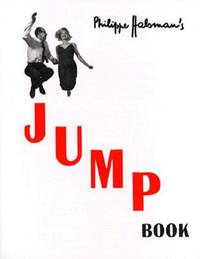
Phililppe Halsman's Jump Book
New York: Simon & Schuster 1959. Book. Very good. Hardcover. Signed and Inscribed By the Author. First Edition 2nd Printing. 94pp. Black boards orange spine with black lettering. Attractive black ink signature and inscription on the preliminary page by Philippe Halsman to Prakapas a New York art gallery owner. There is a touch of toning to the extremities and endpapers otherwise a near fine copy. Unclipped pictorial jacket has the original $3.75 price on the front flap.There is light soiling to the extremities of the DJ a patch of light yellow spots on the rear panel of the DJ minor chips to the edge and a closed tear on the upper front panel. in mylar sleeve. Black and white photographs of celebrities being photographed jumping.Internally the pages and photographs are in excellent condition. Unclipped pictorial jacket shows foxing and triangular chips on the corners. "Philippe Halsman's Jump Book gathers nearly 200 Halsman portraits of famous subjects in midair. These uniquely witty and energetic images of airborne movie stars politicians royalty artists and authors have become an important part of Halsman's photographic legacy. For a period of six years in the mid-1950s Halsman ended his portrait sessions by asking his sitters to jump. Grace Kelly Marilyn Monroe Edward Steichen Audrey Hepburn Robert Oppenheimer John Steinbeck Weegee Aldous Huxley Marc Chagall Salvador Dalí Brigitte Bardot and Groucho Marx all took the leap of faith. It is a tribute to Halsman's powers of persuasion that even Richard Nixon the Duke and Duchess of Windsor and other figures not famed for their spontaneity were talked into "rising" to the challenge." Size: 8 1/2" x 11 1/4". Simon & Schuster Hardcover
Riferimento per il libraio : 034788
|
|
|
Halsman, Philippe (1906-1979)
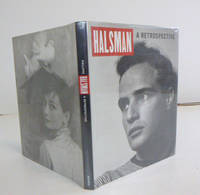
Philippe Halsman: A Retrospective: Photographs from the Halsman Family Collection. First edition.
Boston: Little Brown and Company 1998. Quarto. Cloth in d-j. 26 x 33cm. 212pp. Fully-illustrated after black-and-white photographs arranged alphabetically according to subject. Fine in fine jacket. .Text below by Mary PanzerCurator of PhotographsNational Portrait Gallery Smithsonian Institution.Philippe Halsman 1906-1979 was born in Riga Latvia. He studied engineering in Dresden before moving to Paris where he set up his photographic studio in 1932. Halsman's bold spontaneous style won him many admirers. His portraits of actors and authors appeared on book jackets and in magazines; he worked with fashion especially hat designs and filled commissions for private clients. By 1936 Halsman was known as one of the best portrait photographers in France.From the 1940s through the 1970s Philippe Halsman's sparkling portraits of celebrities intellectuals and politicians appeared on the covers and pages of the big picture magazines including Look Esquire the Saturday Evening Post Paris Match and especially Life. His work also appeared in advertisements and publicity for clients like Elizabeth Arden cosmetics NBC Simon & Schuster and Ford. Photographers amateur as well as professional admired Halsman's stunning images. In 1958 a poll conducted by Popular Photography named Halsman one of the "World's Ten Greatest Photographers" along with Irving Penn Richard Avedon Ansel Adams Henri Cartier-Bresson Alfred Eisenstaedt Ernst Haas Yousuf Karsh Gjon Mili and Eugene Smith. Altogether Halsman's images form a vivid picture of prosperous American society in the middle years of the twentieth century. "Philippe Halsman: A Retrospective" is the first historical survey of his work.Halsman's career came to a dramatic halt in the summer of 1940 when Hitler's troops invaded Paris. Albert EinsteinHis wife daughter sister and brother-in-law who all held French passports immigrated to America but as a Latvian citizen Philippe Halsman could not obtain a visa. For several long months he waited in Marseilles along with many others who were forced to escape fascist Europe. Finally through the intervention of Albert Einstein who had met Halsman's sister in the 1920s Halsman obtained permission to enter the United States and he arrived in New York in November 1940 with little more than his camera.Halsman's big break came when he met Connie Ford a striking young model who agreed to pose in exchange for prints for her portfolio.Constance Ford When publicists at Elizabeth Arden saw Halsman's photograph of Ford against an American flag they used the image to launch a national campaign for "Victory Red" lipstick. A year later in the fall of 1942 Life asked Halsman to shoot a story on new hat design. To Halsman's delight his portrait of the model smiling through a feathery brim landed on the cover. One hundred more covers followed before the magazine ceased weekly publication in 1972.When Halsman began working for Life the magazine was only six years old and photojournalism was still a new field. Before the existence of Life and its competitors Americans learned about the world from newspapers radio and newsreels. But the new picture magazines published pages filled with bright dramatic photographs bringing Americans vivid information that no other media could match. Frank SinatraIn the spirit of a variety show or a world's fair magazines combined stories about international politics everyday life news events celebrities exotic scenery and humor to prove that "so much of the world so judiciously selected had never been seen before in one place." Today to understand the significance of those great magazines we need only look at the many forms of mass media that have come to replace them. Now we find photographs on television and billboards; in special publications devoted to news people fashion or sports; in newspapers; in museums and galleries; and on the Internet. And ironically the more places there are to see photographs the harder it is to attract viewers. But in 1942 when Philippe Halsman's portrait simply appeared on the cover of Life and immediately reached a large united audience.Surrealism:.In Paris Halsman studied the work of other artists and photographers especially the surrealists from whom he learned to make images that surprised his viewers. By including homely and ultimately disturbing details he gave his subjects memorable tension. Through subtle lighting sharp focus and close cropping he turned formal fashion shots into serious investigations of character. When Halsman posed NBC comedians against bare white paper eliminating all defining context their isolation made them look both frail and funny.Salvidor Dali Most important of all from the surrealists' exploration of the erotic unconscious Halsman learned how to combine glamour sex and wholesome energy in one portrait. This unusual ability made him Life's favorite photographer for sensual stars like Marilyn Monroe and Brigitte Bardot. Halsman's sympathy for surrealism also led to his long productive friendship with Salvador Dali. Halsman met Dali on assignment in 1941 and over the next three decades they became partners on many projects including a series of playful tableaux that had all the disturbing irrationality of dreams or a painting by Dali. Their most notable production was "Dali Atomicus" in which the artist his canvas furniture cats and water all appear suspended in air.Psychological Portraiture:.Over the course of his career Halsman enjoyed comparing his work to that of a good psychologist who regards his subjects with special insight. With his courtly manners and European accent Halsman also fit the popular stereotype at a time when Americans regarded psychology with fascinated skepticism. In fact Halsman was proud of his ability to reveal the character of his sitters. As he explained "It can't be done by pushing the person into position or arranging his head at a certain angle. It must be accomplished by provoking the victim amusing him with jokes lulling him with silence or asking impertinent questions which his best friend would be afraid to voice.".Marilyn MonroeIn the spring of 1952 Halsman put his signature technique to work when Life sent him to Hollywood to photograph Marilyn Monroe. Halsman asked Monroe to stand in a corner and placed his camera directly in front of her. Later he recalled that she looked "as if she had been pushed into the corner cornered with no way to escape." Then Halsman his assistant and Life's reporter staged a "fiery" competition for Monroe's attention. "Surrounded by three admiring men she smiled flirted giggled and wriggled with delight. During the hour I kept her cornered she enjoyed herself royally and I . . . took between 40 and 50 pictures.".In this widely familiar portrait Monroe wears a white evening gown and stands with her back against two walls one dark the other light her eyes half closed and her dark lipsticked mouth partly open. Yet Halsman deftly avoided any explicit representation of the true subject of the picture. Using the euphemistic language of the time Halsman's assistant admired the photographer's ability to make "suggestive" pictures of beautiful women which still showed "good taste" emphasizing "expression" rather than "physical assets." And then the assistant added "Halsman is very adept at provoking the expression he wants.".Jumpology:.In 1950 NBC asked Halsman to photograph many of its popular comedians. Milton Berle Ed Wynn Sid Caesar Groucho Marx Bob Hope Red Skelton and many others came to Halsman's studio where they performed while he captured their antics on film. A single session could generate two or three hundred pictures. When Halsman compared these comic images to more traditional portraits he found that comedians often jumped and always stayed in character. Desperation and good humor finally drove him to ask others to jump for his camera when the Ford Motor Company commissioned him to make an official family photograph in honor of the company's fiftieth anniversary. WindsorsHalsman spent a long tiring session with nine edgy adults and eleven restless children. Afterward Halsman's irrepressible humor inspired him to ask matriarch Mrs. Edsel Ford "May I take a picture of you jumping'" The astonished Mrs. Ford replied "You want me to jump with my high heels" Next her daughter-in-law Mrs. Henry Ford II requested a turn. The "jump" pictures had surprising charm and over the next six years Halsman asked many clients to jump for him. Van Cliburn Edward R. Murrow and Herbert Hoover declined Halsman's invitation but most people realized they had nothing to lose. Some gained considerably like the suddenly buoyant and likable Vice President Richard Nixon who jumped for Halsman in the White House. Halsman claimed the jumps revealed character that was otherwise hidden. "When you ask a person to jump his attention is mostly directed toward the act of jumping and the mask falls so that the real person appears.".Halsman also pursued this project to discover something about himself. "I assure you that often before approaching the person my heart would beat and I would have to fight down all my inhibitions in order to address this request to my subject. At every time when the subject agreed to jump it was for me like a kind of victory." How did Halsman persuade so many to abandon their composure for his camera Somehow he managed to convince each one that the risk was all his own.Like many who escaped Hitler's Europe Philippe Halsman rarely discussed the past. He rightly insisted that his most important work took place in America and in many ways his adopted country became his subject. One typical review noted his patriotic flair praising Halsman's "unsanctimonious and immensely intense portrayal of American bounce." From a historian's perspective it seems clear that Halsman invented a glowing image of the nation as he saw it using light persuasion nerve imagination psychology and experience. This place and these faces are his creation.Halsman's perpetual quest for hidden truth also recalls his personal history as an artist and a refugee. Halsman knew that the effort to establish one's identity had significance far beyond the needs of the celebrity marketplace. "This fascination with the human face has never left me. . . . Every face I see seems to hide and sometimes fleetingly to reveal the mystery of another human being. . . . Capturing this revelation became the goal and passion of my life.". Boston: Little, Brown and Company, 1998. hardcover
Riferimento per il libraio : 51-6815
|
|
|
Halsman, Philippe
Philippe Halsman's Jump Book
New York: Harry N. Abrams Inc. 1986. Reprint. Trade paperback. Good. 96 p. Contains: Unspecified. Includes Unspecified. Audience: General/trade. . Harry N. Abrams, Inc. paperback
Riferimento per il libraio : Alibris.0017990 ISBN : 0810923386 9780810923386
|
|
|
Halsman, Philippe
Philippe Halsman : a retrospective : photographs from the Halsman Family collection / edited by Jane Halsman Bello and Steve Bello ; introduction by Mary Panzer
Boston : Little Brown and Company 1998. First Edition. Hardcover. Fine cloth copy in a near-fine very slightly edge-torn dust-wrapper. Remains particularly well-preserved overall; tight bright clean and strong. Physical description; 211 pages : illustrations ; 34 cm. Notes; Includes bibliographical references. Subjects; Exhibitions. American and Russian photographer. Photojournalist. Celebrities. American 20th century. Boston : Little, Brown and Company hardcover
Riferimento per il libraio : 474532 ISBN : 0821223739 9780821223734
|
|
|
HALSMAN, Philippe (1906-1979), [BELLO, Jane Halsman and Steve, editors], [PANZER, Mary, introduction]
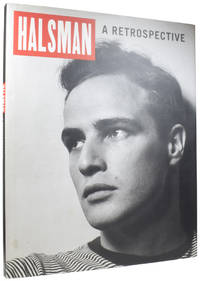
Philippe Halsman A Retrospective: Photographs from the Halsman Family Collection
London: Pavilion 1998. Celebrity Photography FIRST UK EDITION. Quarto 34 x 27cm pp.212. Black and white photographs throughout. Publisher's black cloth with silver titles to spine and brown endpapers. With the photographic dust-jacket priced at £40. Some light markings to jacket and little creasing to endpapers. Near fine. Iconic photos of twentieth-century celebrities including Audrey Hepburn Marlon Brando Lauren Bacall Winston Churchill Jean Cocteau Salvador Dali Albert Einstein Graucho Marx Alfred Hitchcock Ingrid Bergman Grace Kelly John F. Kennedy Sophia Loren Marilyn Monroe Muhammad Ali Vladimir Nabokov Georgia O'Keeffe Bertrand Russell John Steinbeck Jean-Paul Sartre Louis Armstrong Frank Sinatra Elizabeth Taylor and Andy Warhol. London: Pavilion, 1998 unknown
Riferimento per il libraio : 57043
|
|
|
Halsman, Philippe
Philippe Halsman's Jump Book
Andre Deutsch. Collectible - Good. London: Andre Deutsch 1959. 1st printing. 4to. 94pp. Illus. Good book. Good dust jacket. Dust jacket rubbed and edgeworn with small tears at folds. Bookplate inside. Black tape obscuring a line of type on copyright page. celebrities portraits jumping Inquire if you need further information. Andre Deutsch unknown
Riferimento per il libraio : MA04A-04708
|
|
|
Halsman, Philippe [Photographer]
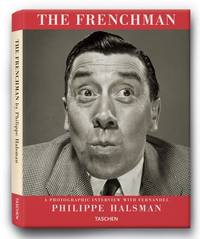
Philippe Halsman: The Frenchman
TASCHEN 2005-10-01. Hardcover. New. New. In shrink wrap. Looks like an interesting title! TASCHEN hardcover
Riferimento per il libraio : Q-3822846414 ISBN : 3822846414 9783822846414
|
|
|
Halsman, Philippe
Philippe Halsman's Jump Book
New York: Simon & Schuster 1959. Second printing. Hardcover. Very Good/Good. Small slim quarto. Warmly inscribed by Philippe Halsman in English and French to a pair of his close friends signing both his name and his wife's dated Dec. 1959 the year of publication. Nice copy in a worn and spotted dustjacket with a number of small chips and tears. <br/><br/> Simon & Schuster hardcover
Riferimento per il libraio : WB16624
|
|
|
Halsman, Philippe
Philippe Halsman: On Page Size
Reader's Digest 1962. Book. About Fine. Soft cover. 1st Edition. This is a small essay on digest size format illustrated with photos by Halsman. Inspired by his meeting someone from Reader's Digest at a dinner party. Stapled wraps. Uncommon. Reader's Digest Paperback
Riferimento per il libraio : 019295
|
|
|
HALSMAN, Philippe (James Hilton)
Photograph: Portrait of James Hilton
no place 1965. Unbound. Fine. Gelatin silver print. Print measures approximately 11" x 14" with relatively wide margins. About fine. Photographer's rubberstamp on verso: "Copyright by Philippe Halsman" and neat pencil notation in an unknown hand: "J. Hilton". Hilton look straight towards the camera. unknown
Riferimento per il libraio : 587569
|
|
|
HALSMAN, Philippe (Angus Wilson)
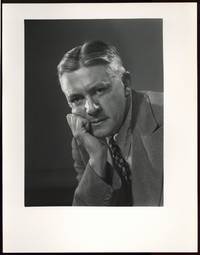
Photograph: Portrait of Angus Wilson
no place 1966. Unbound. Fine. Gelatin silver print. Print measures approximately 11" x 14" with very narrow margins. About fine. Photographer's rubberstamp on verso: "Copyright by Philippe Halsman" and neat pencil notation in an unknown hand: "Angus Wilson 1966." Wilson looks over his right shoulder towards the camera. unknown
Riferimento per il libraio : 587567
|
|
|
Halsman, Philippe (1906-1979)
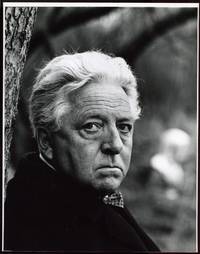
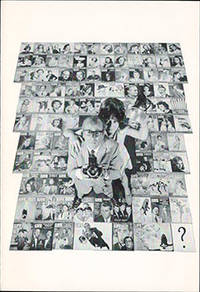
Photograph of Philippe and Yvonne Halsman on New Year's card celebrating the 100th Life cover.
New York: circa 1971. Printed notecard with image and printed text. 30 x 13.5cm.Text below by Mary PanzerCurator of PhotographsNational Portrait Gallery Smithsonian Institution.Philippe Halsman 1906-1979 was born in Riga Latvia. He studied engineering in Dresden before moving to Paris where he set up his photographic studio in 1932. Halsman's bold spontaneous style won him many admirers. His portraits of actors and authors appeared on book jackets and in magazines; he worked with fashion especially hat designs and filled commissions for private clients. By 1936 Halsman was known as one of the best portrait photographers in France.From the 1940s through the 1970s Philippe Halsman's sparkling portraits of celebrities intellectuals and politicians appeared on the covers and pages of the big picture magazines including Look Esquire the Saturday Evening Post Paris Match and especially Life. His work also appeared in advertisements and publicity for clients like Elizabeth Arden cosmetics NBC Simon & Schuster and Ford. Photographers amateur as well as professional admired Halsman's stunning images. In 1958 a poll conducted by Popular Photography named Halsman one of the "World's Ten Greatest Photographers" along with Irving Penn Richard Avedon Ansel Adams Henri Cartier-Bresson Alfred Eisenstaedt Ernst Haas Yousuf Karsh Gjon Mili and Eugene Smith. Altogether Halsman's images form a vivid picture of prosperous American society in the middle years of the twentieth century. "Philippe Halsman: A Retrospective" is the first historical survey of his work.Halsman's career came to a dramatic halt in the summer of 1940 when Hitler's troops invaded Paris. Albert EinsteinHis wife daughter sister and brother-in-law who all held French passports immigrated to America but as a Latvian citizen Philippe Halsman could not obtain a visa. For several long months he waited in Marseilles along with many others who were forced to escape fascist Europe. Finally through the intervention of Albert Einstein who had met Halsman's sister in the 1920s Halsman obtained permission to enter the United States and he arrived in New York in November 1940 with little more than his camera.Halsman's big break came when he met Connie Ford a striking young model who agreed to pose in exchange for prints for her portfolio.Constance Ford When publicists at Elizabeth Arden saw Halsman's photograph of Ford against an American flag they used the image to launch a national campaign for "Victory Red" lipstick. A year later in the fall of 1942 Life asked Halsman to shoot a story on new hat design. To Halsman's delight his portrait of the model smiling through a feathery brim landed on the cover. One hundred more covers followed before the magazine ceased weekly publication in 1972.When Halsman began working for Life the magazine was only six years old and photojournalism was still a new field. Before the existence of Life and its competitors Americans learned about the world from newspapers radio and newsreels. But the new picture magazines published pages filled with bright dramatic photographs bringing Americans vivid information that no other media could match. Frank SinatraIn the spirit of a variety show or a world's fair magazines combined stories about international politics everyday life news events celebrities exotic scenery and humor to prove that "so much of the world so judiciously selected had never been seen before in one place." Today to understand the significance of those great magazines we need only look at the many forms of mass media that have come to replace them. Now we find photographs on television and billboards; in special publications devoted to news people fashion or sports; in newspapers; in museums and galleries; and on the Internet. And ironically the more places there are to see photographs the harder it is to attract viewers. But in 1942 when Philippe Halsman's portrait simply appeared on the cover of Life and immediately reached a large united audience.Surrealism:.In Paris Halsman studied the work of other artists and photographers especially the surrealists from whom he learned to make images that surprised his viewers. By including homely and ultimately disturbing details he gave his subjects memorable tension. Through subtle lighting sharp focus and close cropping he turned formal fashion shots into serious investigations of character. When Halsman posed NBC comedians against bare white paper eliminating all defining context their isolation made them look both frail and funny.Salvidor Dali Most important of all from the surrealists' exploration of the erotic unconscious Halsman learned how to combine glamour sex and wholesome energy in one portrait. This unusual ability made him Life's favorite photographer for sensual stars like Marilyn Monroe and Brigitte Bardot. Halsman's sympathy for surrealism also led to his long productive friendship with Salvador Dali. Halsman met Dali on assignment in 1941 and over the next three decades they became partners on many projects including a series of playful tableaux that had all the disturbing irrationality of dreams or a painting by Dali. Their most notable production was "Dali Atomicus" in which the artist his canvas furniture cats and water all appear suspended in air.Psychological Portraiture:.Over the course of his career Halsman enjoyed comparing his work to that of a good psychologist who regards his subjects with special insight. With his courtly manners and European accent Halsman also fit the popular stereotype at a time when Americans regarded psychology with fascinated skepticism. In fact Halsman was proud of his ability to reveal the character of his sitters. As he explained "It can't be done by pushing the person into position or arranging his head at a certain angle. It must be accomplished by provoking the victim amusing him with jokes lulling him with silence or asking impertinent questions which his best friend would be afraid to voice.".Marilyn MonroeIn the spring of 1952 Halsman put his signature technique to work when Life sent him to Hollywood to photograph Marilyn Monroe. Halsman asked Monroe to stand in a corner and placed his camera directly in front of her. Later he recalled that she looked "as if she had been pushed into the corner cornered with no way to escape." Then Halsman his assistant and Life's reporter staged a "fiery" competition for Monroe's attention. "Surrounded by three admiring men she smiled flirted giggled and wriggled with delight. During the hour I kept her cornered she enjoyed herself royally and I . . . took between 40 and 50 pictures.".In this widely familiar portrait Monroe wears a white evening gown and stands with her back against two walls one dark the other light her eyes half closed and her dark lipsticked mouth partly open. Yet Halsman deftly avoided any explicit representation of the true subject of the picture. Using the euphemistic language of the time Halsman's assistant admired the photographer's ability to make "suggestive" pictures of beautiful women which still showed "good taste" emphasizing "expression" rather than "physical assets." And then the assistant added "Halsman is very adept at provoking the expression he wants.".Jumpology:.In 1950 NBC asked Halsman to photograph many of its popular comedians. Milton Berle Ed Wynn Sid Caesar Groucho Marx Bob Hope Red Skelton and many others came to Halsman's studio where they performed while he captured their antics on film. A single session could generate two or three hundred pictures. When Halsman compared these comic images to more traditional portraits he found that comedians often jumped and always stayed in character. Desperation and good humor finally drove him to ask others to jump for his camera when the Ford Motor Company commissioned him to make an official family photograph in honor of the company's fiftieth anniversary. WindsorsHalsman spent a long tiring session with nine edgy adults and eleven restless children. Afterward Halsman's irrepressible humor inspired him to ask matriarch Mrs. Edsel Ford "May I take a picture of you jumping'" The astonished Mrs. Ford replied "You want me to jump with my high heels" Next her daughter-in-law Mrs. Henry Ford II requested a turn. The "jump" pictures had surprising charm and over the next six years Halsman asked many clients to jump for him. Van Cliburn Edward R. Murrow and Herbert Hoover declined Halsman's invitation but most people realized they had nothing to lose. Some gained considerably like the suddenly buoyant and likable Vice President Richard Nixon who jumped for Halsman in the White House. Halsman claimed the jumps revealed character that was otherwise hidden. "When you ask a person to jump his attention is mostly directed toward the act of jumping and the mask falls so that the real person appears.".Halsman also pursued this project to discover something about himself. "I assure you that often before approaching the person my heart would beat and I would have to fight down all my inhibitions in order to address this request to my subject. At every time when the subject agreed to jump it was for me like a kind of victory." How did Halsman persuade so many to abandon their composure for his camera Somehow he managed to convince each one that the risk was all his own.Like many who escaped Hitler's Europe Philippe Halsman rarely discussed the past. He rightly insisted that his most important work took place in America and in many ways his adopted country became his subject. One typical review noted his patriotic flair praising Halsman's "unsanctimonious and immensely intense portrayal of American bounce." From a historian's perspective it seems clear that Halsman invented a glowing image of the nation as he saw it using light persuasion nerve imagination psychology and experience. This place and these faces are his creation.Halsman's perpetual quest for hidden truth also recalls his personal history as an artist and a refugee. Halsman knew that the effort to establish one's identity had significance far beyond the needs of the celebrity marketplace. "This fascination with the human face has never left me. . . . Every face I see seems to hide and sometimes fleetingly to reveal the mystery of another human being. . . . Capturing this revelation became the goal and passion of my life.". New York: circa 1971 hardcover
Riferimento per il libraio : 51-6804
|
|
|
Halsman, Philippe (1906-1979); Marc Bernheim;
Photographs 3 of Philippe and Yvonne Halsman and Evelyne Bernheim by Marc Bernheim
New York: Circa 1970s. Original photographs. 3 kodak photographs of Yvonne and Philippe Halsman at Marc Bernheim's measuring 9 x13 cm 3½x5¼".•Annoted vers on one fof the three.Text below by Mary PanzerCurator of PhotographsNational Portrait Gallery Smithsonian Institution.Philippe Halsman 1906-1979 was born in Riga Latvia. He studied engineering in Dresden before moving to Paris where he set up his photographic studio in 1932. Halsman's bold spontaneous style won him many admirers. His portraits of actors and authors appeared on book jackets and in magazines; he worked with fashion especially hat designs and filled commissions for private clients. By 1936 Halsman was known as one of the best portrait photographers in France.From the 1940s through the 1970s Philippe Halsman's sparkling portraits of celebrities intellectuals and politicians appeared on the covers and pages of the big picture magazines including Look Esquire the Saturday Evening Post Paris Match and especially Life. His work also appeared in advertisements and publicity for clients like Elizabeth Arden cosmetics NBC Simon & Schuster and Ford. Photographers amateur as well as professional admired Halsman's stunning images. In 1958 a poll conducted by Popular Photography named Halsman one of the "World's Ten Greatest Photographers" along with Irving Penn Richard Avedon Ansel Adams Henri Cartier-Bresson Alfred Eisenstaedt Ernst Haas Yousuf Karsh Gjon Mili and Eugene Smith. Altogether Halsman's images form a vivid picture of prosperous American society in the middle years of the twentieth century. "Philippe Halsman: A Retrospective" is the first historical survey of his work.Halsman's career came to a dramatic halt in the summer of 1940 when Hitler's troops invaded Paris. Albert EinsteinHis wife daughter sister and brother-in-law who all held French passports immigrated to America but as a Latvian citizen Philippe Halsman could not obtain a visa. For several long months he waited in Marseilles along with many others who were forced to escape fascist Europe. Finally through the intervention of Albert Einstein who had met Halsman's sister in the 1920s Halsman obtained permission to enter the United States and he arrived in New York in November 1940 with little more than his camera.Halsman's big break came when he met Connie Ford a striking young model who agreed to pose in exchange for prints for her portfolio.Constance Ford When publicists at Elizabeth Arden saw Halsman's photograph of Ford against an American flag they used the image to launch a national campaign for "Victory Red" lipstick. A year later in the fall of 1942 Life asked Halsman to shoot a story on new hat design. To Halsman's delight his portrait of the model smiling through a feathery brim landed on the cover. One hundred more covers followed before the magazine ceased weekly publication in 1972.When Halsman began working for Life the magazine was only six years old and photojournalism was still a new field. Before the existence of Life and its competitors Americans learned about the world from newspapers radio and newsreels. But the new picture magazines published pages filled with bright dramatic photographs bringing Americans vivid information that no other media could match. Frank SinatraIn the spirit of a variety show or a world's fair magazines combined stories about international politics everyday life news events celebrities exotic scenery and humor to prove that "so much of the world so judiciously selected had never been seen before in one place." Today to understand the significance of those great magazines we need only look at the many forms of mass media that have come to replace them. Now we find photographs on television and billboards; in special publications devoted to news people fashion or sports; in newspapers; in museums and galleries; and on the Internet. And ironically the more places there are to see photographs the harder it is to attract viewers. But in 1942 when Philippe Halsman's portrait simply appeared on the cover of Life and immediately reached a large united audience.Surrealism:.In Paris Halsman studied the work of other artists and photographers especially the surrealists from whom he learned to make images that surprised his viewers. By including homely and ultimately disturbing details he gave his subjects memorable tension. Through subtle lighting sharp focus and close cropping he turned formal fashion shots into serious investigations of character. When Halsman posed NBC comedians against bare white paper eliminating all defining context their isolation made them look both frail and funny.Salvidor Dali Most important of all from the surrealists' exploration of the erotic unconscious Halsman learned how to combine glamour sex and wholesome energy in one portrait. This unusual ability made him Life's favorite photographer for sensual stars like Marilyn Monroe and Brigitte Bardot. Halsman's sympathy for surrealism also led to his long productive friendship with Salvador Dali. Halsman met Dali on assignment in 1941 and over the next three decades they became partners on many projects including a series of playful tableaux that had all the disturbing irrationality of dreams or a painting by Dali. Their most notable production was "Dali Atomicus" in which the artist his canvas furniture cats and water all appear suspended in air.Psychological Portraiture:.Over the course of his career Halsman enjoyed comparing his work to that of a good psychologist who regards his subjects with special insight. With his courtly manners and European accent Halsman also fit the popular stereotype at a time when Americans regarded psychology with fascinated skepticism. In fact Halsman was proud of his ability to reveal the character of his sitters. As he explained "It can't be done by pushing the person into position or arranging his head at a certain angle. It must be accomplished by provoking the victim amusing him with jokes lulling him with silence or asking impertinent questions which his best friend would be afraid to voice.".Marilyn MonroeIn the spring of 1952 Halsman put his signature technique to work when Life sent him to Hollywood to photograph Marilyn Monroe. Halsman asked Monroe to stand in a corner and placed his camera directly in front of her. Later he recalled that she looked "as if she had been pushed into the corner cornered with no way to escape." Then Halsman his assistant and Life's reporter staged a "fiery" competition for Monroe's attention. "Surrounded by three admiring men she smiled flirted giggled and wriggled with delight. During the hour I kept her cornered she enjoyed herself royally and I . . . took between 40 and 50 pictures.".In this widely familiar portrait Monroe wears a white evening gown and stands with her back against two walls one dark the other light her eyes half closed and her dark lipsticked mouth partly open. Yet Halsman deftly avoided any explicit representation of the true subject of the picture. Using the euphemistic language of the time Halsman's assistant admired the photographer's ability to make "suggestive" pictures of beautiful women which still showed "good taste" emphasizing "expression" rather than "physical assets." And then the assistant added "Halsman is very adept at provoking the expression he wants.".Jumpology:.In 1950 NBC asked Halsman to photograph many of its popular comedians. Milton Berle Ed Wynn Sid Caesar Groucho Marx Bob Hope Red Skelton and many others came to Halsman's studio where they performed while he captured their antics on film. A single session could generate two or three hundred pictures. When Halsman compared these comic images to more traditional portraits he found that comedians often jumped and always stayed in character. Desperation and good humor finally drove him to ask others to jump for his camera when the Ford Motor Company commissioned him to make an official family photograph in honor of the company's fiftieth anniversary. WindsorsHalsman spent a long tiring session with nine edgy adults and eleven restless children. Afterward Halsman's irrepressible humor inspired him to ask matriarch Mrs. Edsel Ford "May I take a picture of you jumping'" The astonished Mrs. Ford replied "You want me to jump with my high heels" Next her daughter-in-law Mrs. Henry Ford II requested a turn. The "jump" pictures had surprising charm and over the next six years Halsman asked many clients to jump for him. Van Cliburn Edward R. Murrow and Herbert Hoover declined Halsman's invitation but most people realized they had nothing to lose. Some gained considerably like the suddenly buoyant and likable Vice President Richard Nixon who jumped for Halsman in the White House. Halsman claimed the jumps revealed character that was otherwise hidden. "When you ask a person to jump his attention is mostly directed toward the act of jumping and the mask falls so that the real person appears.".Halsman also pursued this project to discover something about himself. "I assure you that often before approaching the person my heart would beat and I would have to fight down all my inhibitions in order to address this request to my subject. At every time when the subject agreed to jump it was for me like a kind of victory." How did Halsman persuade so many to abandon their composure for his camera Somehow he managed to convince each one that the risk was all his own.Like many who escaped Hitler's Europe Philippe Halsman rarely discussed the past. He rightly insisted that his most important work took place in America and in many ways his adopted country became his subject. One typical review noted his patriotic flair praising Halsman's "unsanctimonious and immensely intense portrayal of American bounce." From a historian's perspective it seems clear that Halsman invented a glowing image of the nation as he saw it using light persuasion nerve imagination psychology and experience. This place and these faces are his creation.Halsman's perpetual quest for hidden truth also recalls his personal history as an artist and a refugee. Halsman knew that the effort to establish one's identity had significance far beyond the needs of the celebrity marketplace. "This fascination with the human face has never left me. . . . Every face I see seems to hide and sometimes fleetingly to reveal the mystery of another human being. . . . Capturing this revelation became the goal and passion of my life.". New York: Circa 1970s hardcover
Riferimento per il libraio : 51-6810
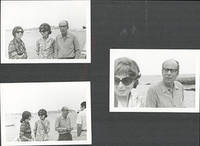
|
|
|
HALSMAN, Philippe (Marian Anderson)
Photograph: Large Portrait of Marian Anderson
Unbound. Fine. Gelatin silver photograph. Measuring approximately 11" x 14". Photographer's rubberstamp on verso: "Copyright by Philippe Halsman" and neat pencil notation in an unknown hand: "1958 / Marian Anderson." Three-quarter length portrait of Anderson dressed in an ornate embroidered brocade jacket standing and facing the camera with her eyes closed and mouth open in song. A fine copy with the image bright and crisp. From the 1940s through the 1970s Halsman's portraits of international figures appeared on the covers of widely circulated magazines such as Look The Saturday Evening Post and Life which published approximately 100 covers by Halsman. The National Portrait Gallery organized the first full exhibition of the photographer's work "Philippe Halsman: A Retrospective" which toured in 2000. His portrait of Anderson is an iconic image taken on January 7 1955 when Anderson became the first African-American to perform with the New York Metropolitan Opera. On that occasion she sang the part of Ulrica in Giuseppe Verdi's Un ballo in Maschera. She is also noted for her dramatic performance at the Lincoln Memorial in 1939 when she was denied the right to sing at the Daughters of the American Revolution Constitution Hall in Washington DC. Eleanor Roosevelt quit her membership in the DAR and arranged for Anderson to sing at the foot of the Lincoln Memorial. In 1961 she performed at President Kennedy's inauguration. An especially large and striking photograph of Anderson. unknown
Riferimento per il libraio : 469852
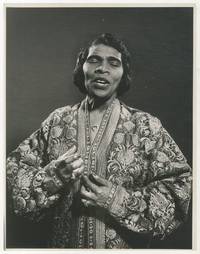
|
|
|
HALSMAN, Philippe (Alfred Eisenstadt)
Photograph: Portrait of Alfred Eisenstadt
no place 1962. Unbound. Fine. Gelatin silver print. Print measures approximately 7¾" x 9¾" printed slightly askew on slightly larger paper. Fine. Photographer's rubberstamp on verso: "Copyright by Philippe Halsman" and neat pencil notation in an unknown hand: "Alfred Eisendstadt 1962."<br /> <br /> A portrait of a legendary photographer made by another. unknown
Riferimento per il libraio : 528205
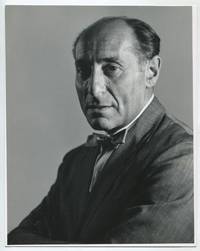
|
|
|
Halsman, Philippe
PICCOLI
Simon 1953. First Edition Stated. Hardback. Very Good Condition/No Dust Jacket. Illus. by Paul Julian . Simon Hardcover
Riferimento per il libraio : 81619
|
|
|
Halsman, Philippe
Piccoli A Fairy Tale
E-051: Simon and Schuster. Very Good in Very Good dust jacket. 1953. First Edition; First Printing. Hardcover. Hardcover. 4to. Simon and Schuster New York 1953. 94 pgs. First Edition/First Printing. DJ has light shelf-wear present to the DJ extremities. Bound in illustrated paper covered cloth boards with titles present to the spine and front board. Boards have light shelf-wear present to the extremities. No ownership marks present. Text is clean and free of marks. Binding tight and solid. An uncommon foray into children's literature by the noted photographer this tale originated as a story he made up for his two young daughters "who wanted to listen to fairy tales. Since he couldn't remember any he invented a tiny creature named Piccoli. He pretended she was living right with the family and they had the most exciting adventures." Illustrator Paul Julian was a noted muralist in the WPA era but later primarily worked as a background artist and sometimes voice actor in animated cartoons for Warner Bros. And UPA Productions. EB; 9.8 X 6.3 X 0.5 inches; 93 pages . Simon and Schuster hardcover
Riferimento per il libraio : 72944
|
|
|
Halsman, Philippe
Piccoli A Fairy Tale
E-051: Simon and Schuster. Very Good in Very Good dust jacket. 1953. First Edition; First Printing. Hardcover. Hardcover. 4to. Simon and Schuster New York 1953. 94 pgs. First Edition/First Printing. DJ has light shelf-wear present to the DJ extremities. Bound in illustrated paper covered cloth boards with titles present to the spine and front board. Boards have light shelf-wear present to the extremities. No ownership marks present. Text is clean and free of marks. Binding tight and solid. An uncommon foray into children's literature by the noted photographer this tale originated as a story he made up for his two young daughters "who wanted to listen to fairy tales. Since he couldn't remember any he invented a tiny creature named Piccoli. He pretended she was living right with the family and they had the most exciting adventures." Illustrator Paul Julian was a noted muralist in the WPA era but later primarily worked as a background artist and sometimes voice actor in animated cartoons for Warner Bros. And UPA Productions. EB; 9.8 X 6.3 X 0.5 inches; 93 pages . Simon and Schuster hardcover
Riferimento per il libraio : 72942
|
|
|
Halsman, Philippe
Piccoli a Fairy Tale;
hardcover. Good. Access codes and supplements are not guaranteed with used items. May be an ex-library book. hardcover
Riferimento per il libraio : 1014315727.G ISBN : 1014315727 9781014315724

|
|
|
Halsman, Philippe
Portraits
McGraw-Hill Companies 1983. Hardcover. Good. Missing dust jacket; Pages can have notes/highlighting. Spine may show signs of wear. ~ ThriftBooks: Read More Spend Less.Dust jacket quality is not guaranteed. McGraw-Hill Companies hardcover
Riferimento per il libraio : G0070256357I3N01 ISBN : 0070256357 9780070256354
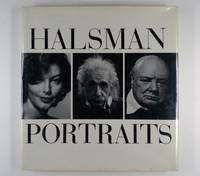
|
|
|
HALSMAN, Philippe
Portraits
New York McGraw-Hill Book Company 1983. 1983. First edition second printing. Folio. Illustrated with 119 b/w photographs. Edited by Yvonne Halsman. Dust jacket price clipped. Fine. Unpaginated. No signatures or bookplates. 1st Edition. Hardcover. Fine/Fine. New York, McGraw-Hill Book Company [1983]. hardcover
Riferimento per il libraio : 302096
|
|
|
Halsman, Philippe (1906-1979)
Surrealist Photograph of Philippe and Yvonne Halsman on a New Year's card being held in sarcophagi by the Cholmonoley Sisters of the Tate Gallery.
New York: 1978. Original photograph: Dated in ink verso. 12 x 16.7.cm. Text below by Mary PanzerCurator of PhotographsNational Portrait Gallery Smithsonian Institution.Philippe Halsman 1906-1979 was born in Riga Latvia. He studied engineering in Dresden before moving to Paris where he set up his photographic studio in 1932. Halsman's bold spontaneous style won him many admirers. His portraits of actors and authors appeared on book jackets and in magazines; he worked with fashion especially hat designs and filled commissions for private clients. By 1936 Halsman was known as one of the best portrait photographers in France.From the 1940s through the 1970s Philippe Halsman's sparkling portraits of celebrities intellectuals and politicians appeared on the covers and pages of the big picture magazines including Look Esquire the Saturday Evening Post Paris Match and especially Life. His work also appeared in advertisements and publicity for clients like Elizabeth Arden cosmetics NBC Simon & Schuster and Ford. Photographers amateur as well as professional admired Halsman's stunning images. In 1958 a poll conducted by Popular Photography named Halsman one of the "World's Ten Greatest Photographers" along with Irving Penn Richard Avedon Ansel Adams Henri Cartier-Bresson Alfred Eisenstaedt Ernst Haas Yousuf Karsh Gjon Mili and Eugene Smith. Altogether Halsman's images form a vivid picture of prosperous American society in the middle years of the twentieth century. "Philippe Halsman: A Retrospective" is the first historical survey of his work.Halsman's career came to a dramatic halt in the summer of 1940 when Hitler's troops invaded Paris. Albert EinsteinHis wife daughter sister and brother-in-law who all held French passports immigrated to America but as a Latvian citizen Philippe Halsman could not obtain a visa. For several long months he waited in Marseilles along with many others who were forced to escape fascist Europe. Finally through the intervention of Albert Einstein who had met Halsman's sister in the 1920s Halsman obtained permission to enter the United States and he arrived in New York in November 1940 with little more than his camera.Halsman's big break came when he met Connie Ford a striking young model who agreed to pose in exchange for prints for her portfolio.Constance Ford When publicists at Elizabeth Arden saw Halsman's photograph of Ford against an American flag they used the image to launch a national campaign for "Victory Red" lipstick. A year later in the fall of 1942 Life asked Halsman to shoot a story on new hat design. To Halsman's delight his portrait of the model smiling through a feathery brim landed on the cover. One hundred more covers followed before the magazine ceased weekly publication in 1972.When Halsman began working for Life the magazine was only six years old and photojournalism was still a new field. Before the existence of Life and its competitors Americans learned about the world from newspapers radio and newsreels. But the new picture magazines published pages filled with bright dramatic photographs bringing Americans vivid information that no other media could match. Frank SinatraIn the spirit of a variety show or a world's fair magazines combined stories about international politics everyday life news events celebrities exotic scenery and humor to prove that "so much of the world so judiciously selected had never been seen before in one place." Today to understand the significance of those great magazines we need only look at the many forms of mass media that have come to replace them. Now we find photographs on television and billboards; in special publications devoted to news people fashion or sports; in newspapers; in museums and galleries; and on the Internet. And ironically the more places there are to see photographs the harder it is to attract viewers. But in 1942 when Philippe Halsman's portrait simply appeared on the cover of Life and immediately reached a large united audience.Surrealism:.In Paris Halsman studied the work of other artists and photographers especially the surrealists from whom he learned to make images that surprised his viewers. By including homely and ultimately disturbing details he gave his subjects memorable tension. Through subtle lighting sharp focus and close cropping he turned formal fashion shots into serious investigations of character. When Halsman posed NBC comedians against bare white paper eliminating all defining context their isolation made them look both frail and funny.Salvidor Dali Most important of all from the surrealists' exploration of the erotic unconscious Halsman learned how to combine glamour sex and wholesome energy in one portrait. This unusual ability made him Life's favorite photographer for sensual stars like Marilyn Monroe and Brigitte Bardot. Halsman's sympathy for surrealism also led to his long productive friendship with Salvador Dali. Halsman met Dali on assignment in 1941 and over the next three decades they became partners on many projects including a series of playful tableaux that had all the disturbing irrationality of dreams or a painting by Dali. Their most notable production was "Dali Atomicus" in which the artist his canvas furniture cats and water all appear suspended in air.Psychological Portraiture:.Over the course of his career Halsman enjoyed comparing his work to that of a good psychologist who regards his subjects with special insight. With his courtly manners and European accent Halsman also fit the popular stereotype at a time when Americans regarded psychology with fascinated skepticism. In fact Halsman was proud of his ability to reveal the character of his sitters. As he explained "It can't be done by pushing the person into position or arranging his head at a certain angle. It must be accomplished by provoking the victim amusing him with jokes lulling him with silence or asking impertinent questions which his best friend would be afraid to voice.".Marilyn MonroeIn the spring of 1952 Halsman put his signature technique to work when Life sent him to Hollywood to photograph Marilyn Monroe. Halsman asked Monroe to stand in a corner and placed his camera directly in front of her. Later he recalled that she looked "as if she had been pushed into the corner cornered with no way to escape." Then Halsman his assistant and Life's reporter staged a "fiery" competition for Monroe's attention. "Surrounded by three admiring men she smiled flirted giggled and wriggled with delight. During the hour I kept her cornered she enjoyed herself royally and I . . . took between 40 and 50 pictures.".In this widely familiar portrait Monroe wears a white evening gown and stands with her back against two walls one dark the other light her eyes half closed and her dark lipsticked mouth partly open. Yet Halsman deftly avoided any explicit representation of the true subject of the picture. Using the euphemistic language of the time Halsman's assistant admired the photographer's ability to make "suggestive" pictures of beautiful women which still showed "good taste" emphasizing "expression" rather than "physical assets." And then the assistant added "Halsman is very adept at provoking the expression he wants.".Jumpology:.In 1950 NBC asked Halsman to photograph many of its popular comedians. Milton Berle Ed Wynn Sid Caesar Groucho Marx Bob Hope Red Skelton and many others came to Halsman's studio where they performed while he captured their antics on film. A single session could generate two or three hundred pictures. When Halsman compared these comic images to more traditional portraits he found that comedians often jumped and always stayed in character. Desperation and good humor finally drove him to ask others to jump for his camera when the Ford Motor Company commissioned him to make an official family photograph in honor of the company's fiftieth anniversary. WindsorsHalsman spent a long tiring session with nine edgy adults and eleven restless children. Afterward Halsman's irrepressible humor inspired him to ask matriarch Mrs. Edsel Ford "May I take a picture of you jumping'" The astonished Mrs. Ford replied "You want me to jump with my high heels" Next her daughter-in-law Mrs. Henry Ford II requested a turn. The "jump" pictures had surprising charm and over the next six years Halsman asked many clients to jump for him. Van Cliburn Edward R. Murrow and Herbert Hoover declined Halsman's invitation but most people realized they had nothing to lose. Some gained considerably like the suddenly buoyant and likable Vice President Richard Nixon who jumped for Halsman in the White House. Halsman claimed the jumps revealed character that was otherwise hidden. "When you ask a person to jump his attention is mostly directed toward the act of jumping and the mask falls so that the real person appears.".Halsman also pursued this project to discover something about himself. "I assure you that often before approaching the person my heart would beat and I would have to fight down all my inhibitions in order to address this request to my subject. At every time when the subject agreed to jump it was for me like a kind of victory." How did Halsman persuade so many to abandon their composure for his camera Somehow he managed to convince each one that the risk was all his own.Like many who escaped Hitler's Europe Philippe Halsman rarely discussed the past. He rightly insisted that his most important work took place in America and in many ways his adopted country became his subject. One typical review noted his patriotic flair praising Halsman's "unsanctimonious and immensely intense portrayal of American bounce." From a historian's perspective it seems clear that Halsman invented a glowing image of the nation as he saw it using light persuasion nerve imagination psychology and experience. This place and these faces are his creation.Halsman's perpetual quest for hidden truth also recalls his personal history as an artist and a refugee. Halsman knew that the effort to establish one's identity had significance far beyond the needs of the celebrity marketplace. "This fascination with the human face has never left me. . . . Every face I see seems to hide and sometimes fleetingly to reveal the mystery of another human being. . . . Capturing this revelation became the goal and passion of my life.". New York: 1978 hardcover
Riferimento per il libraio : 51-6809
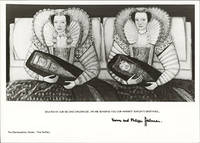
|
|
|
HALSMAN, Philippe
The Frenchman: A Photographic Interview
New York: Simon And Schuster Publishers 1949. Softcover. Very Good. First edition. Quarto. Pictorial wrappers. Wrapper age-toned and rubbed faint dampstain on rear wrapper topedge else very good. This is a photographic interview by the author. Laid in is a typed letter on Halsman's letterhead addressed to author P.K. Thomajan and Signed by renowned photographer "Philippe." Letter contained in the original mailing envelope dated 1950. A nice association copy. Simon And Schuster, Publishers unknown
Riferimento per il libraio : 267219
|
|
|
HALSMAN, PHILIPPE
THE FRENCHMAN a Photographic Interview
NY: SIMON & SCHUSTER. INSCRIBED & SIGNED BY AUTHOR: "FOR JIMMY WITH FOND RECOLLECTION OF THE TIME YOU WORKED FOR ME IN FRIENDSHIP N.Y. OCT. 1249." . Good. PAPERBACK. 1ST. 1949. SIMON & SCHUSTER paperback
Riferimento per il libraio : 048431
|
|
|
HALSMAN, Philippe
The Frenchman: A Photographic Interview
NY:: Simon & Schuster. Very Good. 1949. Paperback. B0007EE3RK . Black and white photographs throughout. No statement of printing paperback. INSCRIBED by Philippe Halsman in 1949. Moderate edge wear and age toning else very good in pictorial wraps. . Simon & Schuster, paperback
Riferimento per il libraio : 73788
|
|
|
Halsman, Philippe
The Frenchman: A Photographic Interview With Fernandel
Taschen 2006-01-28. First Thus. hardcover. New. 6.75x0.50x9.25. Buy with confidence. Excellent Customer Service & Return policy. Taschen hardcover
Riferimento per il libraio : DADAX3822846414 ISBN : 3822846414 9783822846414
|
|
|
HALSMAN, Philippe
The Frenchman: A Photographic Interview
New York: Simon And Schuster 1949. 1949. Cover Title. 8vo. pp. 48 leaves-versos blank. 24 full-page portraits. wrs. extremities slightly worn spine sunned. Soft cover. Very Good. [New York]: Simon And Schuster, [1949]. Paperback
Riferimento per il libraio : PLSeHALS74
|
|
|
Halsman, Philippe ; Harris Auction Galleries
The mask falls : psychological portraits by Philippe Halsman : a retrospective collection of images from the photographer's studio to be sold by public auction Friday November 13 1981 at 7:00 p.m. at Harris Auction Galleries
Baltimore : The Harris Auction Galleries 1981. First Edition. Softcover. Very good paperback copy; edges very slightly dust-dulled and nicked. Remains particularly well-preserved overall; tight bright and clean. Physical description; 108 pages : illustrations ; 23 cm. Subjects; Catalogs. Halsman Phillipe. Portrait photography. Portrait photography Catalogs. Photography. Portraits Photographie Catalogues. Baltimore : The Harris Auction Galleries paperback
Riferimento per il libraio : 408119
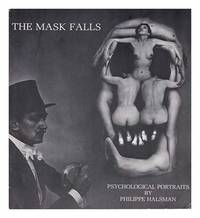
|
|
|
Halsman, Philippe (1906-1979)
The Mask falls : psychological portraits by Philippe Halsman : a retrospective collection of images from the photographer's studio to be sold by public auction Friday November 13 1981 at 7:00 p.m. at Harris Auction Galleries. First edition.
Baltimore: Harris Auction Galleries 1981. 4to. Original wraps. "The Mask Falls: Psychological Portraits by Philippe Halsman" was the title of a 1981 public auction catalog from Harris Auction Galleries in Baltimore MD featuring a collection of Philippe Halsman's famous photographs. The sale offered 249 images arranged by category serving as a retrospective of the photographer's work known for his psychological portraits and innovative "jumpology" technique. .Text below by Mary PanzerCurator of PhotographsNational Portrait Gallery Smithsonian Institution.Philippe Halsman 1906-1979 was born in Riga Latvia. He studied engineering in Dresden before moving to Paris where he set up his photographic studio in 1932. Halsman's bold spontaneous style won him many admirers. His portraits of actors and authors appeared on book jackets and in magazines; he worked with fashion especially hat designs and filled commissions for private clients. By 1936 Halsman was known as one of the best portrait photographers in France.From the 1940s through the 1970s Philippe Halsman's sparkling portraits of celebrities intellectuals and politicians appeared on the covers and pages of the big picture magazines including Look Esquire the Saturday Evening Post Paris Match and especially Life. His work also appeared in advertisements and publicity for clients like Elizabeth Arden cosmetics NBC Simon & Schuster and Ford. Photographers amateur as well as professional admired Halsman's stunning images. In 1958 a poll conducted by Popular Photography named Halsman one of the "World's Ten Greatest Photographers" along with Irving Penn Richard Avedon Ansel Adams Henri Cartier-Bresson Alfred Eisenstaedt Ernst Haas Yousuf Karsh Gjon Mili and Eugene Smith. Altogether Halsman's images form a vivid picture of prosperous American society in the middle years of the twentieth century. "Philippe Halsman: A Retrospective" is the first historical survey of his work.Halsman's career came to a dramatic halt in the summer of 1940 when Hitler's troops invaded Paris. Albert EinsteinHis wife daughter sister and brother-in-law who all held French passports immigrated to America but as a Latvian citizen Philippe Halsman could not obtain a visa. For several long months he waited in Marseilles along with many others who were forced to escape fascist Europe. Finally through the intervention of Albert Einstein who had met Halsman's sister in the 1920s Halsman obtained permission to enter the United States and he arrived in New York in November 1940 with little more than his camera.Halsman's big break came when he met Connie Ford a striking young model who agreed to pose in exchange for prints for her portfolio.Constance Ford When publicists at Elizabeth Arden saw Halsman's photograph of Ford against an American flag they used the image to launch a national campaign for "Victory Red" lipstick. A year later in the fall of 1942 Life asked Halsman to shoot a story on new hat design. To Halsman's delight his portrait of the model smiling through a feathery brim landed on the cover. One hundred more covers followed before the magazine ceased weekly publication in 1972.When Halsman began working for Life the magazine was only six years old and photojournalism was still a new field. Before the existence of Life and its competitors Americans learned about the world from newspapers radio and newsreels. But the new picture magazines published pages filled with bright dramatic photographs bringing Americans vivid information that no other media could match. Frank SinatraIn the spirit of a variety show or a world's fair magazines combined stories about international politics everyday life news events celebrities exotic scenery and humor to prove that "so much of the world so judiciously selected had never been seen before in one place." Today to understand the significance of those great magazines we need only look at the many forms of mass media that have come to replace them. Now we find photographs on television and billboards; in special publications devoted to news people fashion or sports; in newspapers; in museums and galleries; and on the Internet. And ironically the more places there are to see photographs the harder it is to attract viewers. But in 1942 when Philippe Halsman's portrait simply appeared on the cover of Life and immediately reached a large united audience.Surrealism:.In Paris Halsman studied the work of other artists and photographers especially the surrealists from whom he learned to make images that surprised his viewers. By including homely and ultimately disturbing details he gave his subjects memorable tension. Through subtle lighting sharp focus and close cropping he turned formal fashion shots into serious investigations of character. When Halsman posed NBC comedians against bare white paper eliminating all defining context their isolation made them look both frail and funny.Salvidor Dali Most important of all from the surrealists' exploration of the erotic unconscious Halsman learned how to combine glamour sex and wholesome energy in one portrait. This unusual ability made him Life's favorite photographer for sensual stars like Marilyn Monroe and Brigitte Bardot. Halsman's sympathy for surrealism also led to his long productive friendship with Salvador Dali. Halsman met Dali on assignment in 1941 and over the next three decades they became partners on many projects including a series of playful tableaux that had all the disturbing irrationality of dreams or a painting by Dali. Their most notable production was "Dali Atomicus" in which the artist his canvas furniture cats and water all appear suspended in air.Psychological Portraiture:.Over the course of his career Halsman enjoyed comparing his work to that of a good psychologist who regards his subjects with special insight. With his courtly manners and European accent Halsman also fit the popular stereotype at a time when Americans regarded psychology with fascinated skepticism. In fact Halsman was proud of his ability to reveal the character of his sitters. As he explained "It can't be done by pushing the person into position or arranging his head at a certain angle. It must be accomplished by provoking the victim amusing him with jokes lulling him with silence or asking impertinent questions which his best friend would be afraid to voice.".Marilyn MonroeIn the spring of 1952 Halsman put his signature technique to work when Life sent him to Hollywood to photograph Marilyn Monroe. Halsman asked Monroe to stand in a corner and placed his camera directly in front of her. Later he recalled that she looked "as if she had been pushed into the corner cornered with no way to escape." Then Halsman his assistant and Life's reporter staged a "fiery" competition for Monroe's attention. "Surrounded by three admiring men she smiled flirted giggled and wriggled with delight. During the hour I kept her cornered she enjoyed herself royally and I . . . took between 40 and 50 pictures.".In this widely familiar portrait Monroe wears a white evening gown and stands with her back against two walls one dark the other light her eyes half closed and her dark lipsticked mouth partly open. Yet Halsman deftly avoided any explicit representation of the true subject of the picture. Using the euphemistic language of the time Halsman's assistant admired the photographer's ability to make "suggestive" pictures of beautiful women which still showed "good taste" emphasizing "expression" rather than "physical assets." And then the assistant added "Halsman is very adept at provoking the expression he wants.".Jumpology:.In 1950 NBC asked Halsman to photograph many of its popular comedians. Milton Berle Ed Wynn Sid Caesar Groucho Marx Bob Hope Red Skelton and many others came to Halsman's studio where they performed while he captured their antics on film. A single session could generate two or three hundred pictures. When Halsman compared these comic images to more traditional portraits he found that comedians often jumped and always stayed in character. Desperation and good humor finally drove him to ask others to jump for his camera when the Ford Motor Company commissioned him to make an official family photograph in honor of the company's fiftieth anniversary. WindsorsHalsman spent a long tiring session with nine edgy adults and eleven restless children. Afterward Halsman's irrepressible humor inspired him to ask matriarch Mrs. Edsel Ford "May I take a picture of you jumping'" The astonished Mrs. Ford replied "You want me to jump with my high heels" Next her daughter-in-law Mrs. Henry Ford II requested a turn. The "jump" pictures had surprising charm and over the next six years Halsman asked many clients to jump for him. Van Cliburn Edward R. Murrow and Herbert Hoover declined Halsman's invitation but most people realized they had nothing to lose. Some gained considerably like the suddenly buoyant and likable Vice President Richard Nixon who jumped for Halsman in the White House. Halsman claimed the jumps revealed character that was otherwise hidden. "When you ask a person to jump his attention is mostly directed toward the act of jumping and the mask falls so that the real person appears.".Halsman also pursued this project to discover something about himself. "I assure you that often before approaching the person my heart would beat and I would have to fight down all my inhibitions in order to address this request to my subject. At every time when the subject agreed to jump it was for me like a kind of victory." How did Halsman persuade so many to abandon their composure for his camera Somehow he managed to convince each one that the risk was all his own.Like many who escaped Hitler's Europe Philippe Halsman rarely discussed the past. He rightly insisted that his most important work took place in America and in many ways his adopted country became his subject. One typical review noted his patriotic flair praising Halsman's "unsanctimonious and immensely intense portrayal of American bounce." From a historian's perspective it seems clear that Halsman invented a glowing image of the nation as he saw it using light persuasion nerve imagination psychology and experience. This place and these faces are his creation.Halsman's perpetual quest for hidden truth also recalls his personal history as an artist and a refugee. Halsman knew that the effort to establish one's identity had significance far beyond the needs of the celebrity marketplace. "This fascination with the human face has never left me. . . . Every face I see seems to hide and sometimes fleetingly to reveal the mystery of another human being. . . . Capturing this revelation became the goal and passion of my life.". Baltimore: Harris Auction Galleries, 1981. paperback
Riferimento per il libraio : 51-6814
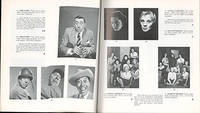
|
|
|
HALTER (Clara) - LEVY (Bernard-Henri) - DENIZOT (René) - FERRY (Luc) - SOLLERS (Philippe) -
Clara Halter - La Règle du jeu -
Paris : La Règle du Jeu, 7ème année : décembre 1996, n°20 - in-8 broché sous couverture illustrée, 76 pages illustrées en couleurs hors texte - bon état -
Riferimento per il libraio : 25359

|
|
|
Halter, Marek ; Philippe Reichenbach Galerie (Paris).
Marek Halter. Philippe Reichenbach : Juin 1966.
Paris : Philippe Reichenbach Galerie 1966. 8vo. 43pp. Glossy softcover with glossy pages. Fair inside pages detached from spine slight scuffing on cover spine minor creasing and markings on cover. B&W and color prints throughout. Library Stamp: Gilbert Galleries San Francisco. Provenance: from the Estate of Judy Stone 1924 –2017 The San Francisco Chronicle’s movie critic who for two decades was a passionate and articulate advocate for the world of cinema outside Hollywood. Judy Stone started at the San Francisco Chronicle in 1961 putting in 10 years as editor of the Datebook section. She began reviewing films for the paper in 1971 favoring arthouse films. She was the youngest of four politically minded children whose eldest brother was the great reporter and gadfly I. F. Stone.She won the Novikoff Award given for "enhancing the public's appreciation of world cinema.†Among her publications are “The Mystery of B. Traven†and "Eye on the World†a collection of her interviews with filmmakers from the 1960s to the 1990s. Paris : Philippe Reichenbach Galerie, 1966. paperback
Riferimento per il libraio : 14-0016
|
|
|
HAMBOURG Maria Morris Francoise Heilbrun Philippe Neagu Nadar
Nadar
New York: The Metropolitan Museum of Art 1995. First edition. Hardcover. 272 pages. Published in conjunction with a show that was held at the Musee d'Orsay in Paris that ran June 7 through September 11 1994 and then at The Metropolitan Museum of Art for a run of April 14 through July 9 1995. Text by Maria Morris Hambourg Francois Heilbrun and Philippe Neagu and with additional contributions by Sylvia Aubenas Andre Jammes Ulrich Keller Sophie Rochard and Andre Rouille. Includes 98 plates and 103 figures. A fine copy in a near fine dust jacket with some fading to the spine. The Metropolitan Museum of Art unknown books
Riferimento per il libraio : 165812 ISBN : 0870997351 9780870997358

|
|
|
Hambourg Maria Morris. ; Nadar Felix ; 1820 1910. ; Heilbrun Francoise. ; Neagu Philippe
Nadar
New York: Metropolitan Museum of Art : Distributed by H.N. Abrams 1995. Hardcover. VG. Pictorial glossy dj; ivory cloth covers. xii 272 pages : illustrations. Nadar whose real name was Felix Tournachon 1820-1910 was a conspicuous even astonishing presence in nineteenth-century France. Engaging and quick-witted he invented himself over and over as a bohemian writer a journalist a romantic utopian a caricaturist a portrait photographer a balloonist an entrepreneur a prophet of aeronautics. The name "Nadar" was on everyone's lips. Today it is Nadar's photography that is remembered. His sitters who were often his friends included the great men and women of his time: Dumas Rossini Baudelaire Sarah Bernhardt Daumier Berlioz George Sand Delacroix. Nadar's legendary name has been attached not only to his original photographs but to reprints copies and a great deal of studio work. For that reason this volume exactingly reproduces some one hundred photographs from the years 1854-60 the period of his earliest and finest photography allowing viewers to become familiar with the subtle light and balanced velvety tones that distinguish Nadar's original work. Accompanying the photographs are essays that shed new light on the many facets of Nadar. Contents as follows: A portrait of Nadar / Maria Morris Hambourg -- Nadar and the art of portrait photography / Françoise Heilbrun -- Nadar and the artistic life of his time / Philippe Néagu -- Sorting out Nadar / Ulrich Keller -- Beyond the portrait beyond the artist / Sylvie Aubenas -- When I was a photographer : the anatomy of a myth / André Rouillé -- The Nadar studio dispersed and recovered / André Jammes. Catalog of an exhibition held at the Musée d'Orsay Paris from June 7-Sept 11 1994; and the Metropolitan Museum of Art New York from April 14-July 9 1995./ Includes bibliographical references p-257-263 and index./ Also issued online. Metropolitan Museum of Art : Distributed by H.N. Abrams hardcover books
Riferimento per il libraio : 180264 ISBN : 0870997351 9780870997358

|
|
|
Hambourg, Maria Morris/ Rosenheim, Jeff L/ Dennett, Alexandra (Contributor)/ Garner, Philippe (Contributor)/ Kirsch, Adam (Contr
Irving Penn – Centennial
Metropolitan Museum of Art 2017. Hardcover. New. 376 pages. 12.25x10.25x2.00 inches. Metropolitan Museum of Art hardcover
Riferimento per il libraio : __1588396185 ISBN : 1588396185 9781588396181
|
|
|
HAMBOURG, Maria Morris & HEILBRUN, Francoise & NEAGU, Philippe
Nadar
New York: Metropolitan Museum of Art 1995. First. paperback. fine. Nadar. Illustrated throughout the text plus 98 plates. 272 pages. 4to stiff pictorial wrappers. New York: Metropolitan Museum of Art 1995. Fine.<br/> <br/> Published in conjunction with the exhibition that took place at the MET.<br/> <br/> Metropolitan Museum of Art unknown
Riferimento per il libraio : 316916 ISBN : 0870997378 9780870997372
|
|
|
Hambourg, Maria Morris; Heilbrun, Francoise; Neagu, Philippe; Nadar, Felix; Musee D'Orsay [Corporate Author]; Metropolitan Museu
Nadar
Harry N Abrams 1995-04-01. Hardcover. New. New. In shrink wrap. Looks like an interesting title! Harry N Abrams hardcover
Riferimento per il libraio : Q-0810964899 ISBN : 0810964899 9780810964891
|
|
|
Hambourg, Maria Morris; Heilbrum, Francoise; Neagu, Philippe
Nadar
Boston: Harry N. Abrams Inc 1995. First Edition. Hardcover. Fine/Fine. Fine in a Fine jacket unclipped no price faded at the spine. Cream cloth with black ink lettering on the spine. Square and firmly bound clean internally. A collection of Nadar's photography with "essays that shed new light on the many facets of Nadar" including a biographical sketch by Maria Morris Hambourg. Harry N. Abrams, Inc hardcover
Riferimento per il libraio : 6570 ISBN : 0810964899 9780810964891
|
|
|
Hambourg, Maria Morris; Franqoise Heilbrun & Philippe Neagu
Nadar Hambourg Maria Morris; Franqoise Heilbrun & Philippe Neagu
Schirmer/Mosel Verlag 1995. 1995. Nadar <br/><br/>Nadar Hambourg Maria Morris; Franqoise Heilbrun & Philippe Neagu Schirmer/Mosel Verlag unknown
Riferimento per il libraio : BN122596 ISBN : 3888144019 9783888144011
|
|
|
HAMEAU Philippe.
Les peintures postglaciaires en Provence.
<p>Inventaire, étude chronologique, stylistique et iconographique.</p> Paris, 1989 C.I.D 124 p., 55 ill., broché. 21 x 29,7
Riferimento per il libraio : 682
|
|
|
Hameau, Philippe
Identités graphiques neuf terrains à graffitis
Éditions universitaires européennes 2019. Paperback. New. 184 pages. French language. 8.66x5.91x0.42 inches. Éditions universitaires européennes paperback
Riferimento per il libraio : 2-6138453557 ISBN : 6138453557 9786138453550
|
|
|
Hameau, Philippe
Passage Transformation et Art Schematique: L'exemple des Peintures Neolithiques du Sud de la France BAR International
paperback. Good. Access codes and supplements are not guaranteed with used items. May be an ex-library book. paperback
Riferimento per il libraio : 1841713104.G ISBN : 1841713104 9781841713106

|
|
|
Hamel - Cuindani Ch. - Goudard Philippe
Partition de la chanson : Sur les cimes neigeuses Petit Casino
Pêle-Mêle Edition 1916
Riferimento per il libraio : 11414
|
|
|
HAMEL, Philippe
La Canalisation du Saint-Laurent : conférence prononcée au Palais Montcalm par le docteur Philippe Hamel sous les auspices de l'Association professionnelle catholique des voyageurs de commerce du Canada, le vendredi, 12 avril 1940, à Québec
Québec 1940
Riferimento per il libraio : 19973
|
|
|
Hameurlain, Abdelkader (Editor)/ Tjoa, A Min (Editor)/ Lamarre, Philippe (Editor)/ Zeitouni, Karine (Editor)
Transactions on Large-scale Data- and Knowledge-centered Systems: Special Issue on Data Management - Principles Technologies and Applications: Vol 44
Springer-Nature New York Inc 2020. Paperback. New. 204 pages. 9.25x6.10x0.46 inches. Springer-Nature New York Inc paperback
Riferimento per il libraio : x-366262270X ISBN : 366262270X 9783662622704

|
|

 Ricevere i risultati per e-mail
 Scaricare i risultati in PDF
 RSS feed
 Link
Link


