|
|
|
Heifetz, Elias
POGROM GESHIKHTE 1919-1920: BAND 1, DI UKRAINISHE SHEHITE IN 1919
Publishers cloth. 8vo. 285 pages. 21 cm. First edition. In Yiddish. History of the Pogroms 1919-1920; Book 1, The Ukrainian Slaughter in 1919. Published by the Educational Committee of the Workmens Circle in New York. An English version was also published the same year. The author, Elias Heifetz, was the chairman of the All-Ukrainian Relief Committee for the Victims of Pogroms, organized under the auspices of the Red Cross; this volume contains a litany of documentation taken by members of the relief commission, lawyers, and others in the Ukraine at the time; includes information in the appendix of pogroms in Ovruch, Proskurov and Felshtin as well as many small villages. Our volume contains endpage bookstamps of the World Jewish Congress (one in English, one in French, a third in Yiddish) ; Yiddish bookstamp remarks that this book was donated for European Jews who were the victims of Hitlerite and fascist terror. Subjects: Jews -- Persecutions - Ukraine. Pogroms - Ukraine. OCLC lists 26 copies. Other than WJC Stamps, very clean and fresh. Very good + condition. (EE-5-19)

|
|
|
Hempel, Johannes, 1891-1964.
DIE ALTHEBRÄISCHE LITERATUR UND IHR HELLENISTISCH-JÜDISCHES NACHLEBEN
Original Cloth. 4to. 203 pages. 30 cm. First edition. In German. 'Ancient Hebrew Literature and its afterlife in Jewish Hellenism. ' with 68 illustrations throughout. Opens with a discussion of Spinoza, Herder, and Uriel da Costa; touches on the literature through archaelogical sites, etc. In the series: Handbuch der Literaturwissenschaft, Bd. 21. The author Johannes Hempel (1891-1964) was a prominent protestant theologican and professor of biblical literature in the Weimar era; he joined the Nazis in 1933 and was a member of the Institute for Research and elimination of Jewish influence on German church life (Institut zur Erforschung und Beseitigung des jüdischen Einflusses auf das deutsche kirchliche Leben) , and served as a war chaplain on the eastern front. He served as a Lutheran pastor after the war, and resumed as a professor in 1955 at Gottingen. With the bookplate and signature (dated 1949, Berlin) of Steven S Schwarszchild (1924-1989) , born in Frankfurt, his family escaped from Nazi Germany in 1939; After receiving ordination from Hebrew Union College in Cincinnati in 1948, Steven Schwarzschild moved to Berlin to serve as a rabbi for the Judische Gemeinde zu Berlin. He stayed in Berlin for over two years and in 1950 moved back to the United States. - LBI (Guide to the Papers of Steven S. Schwarzschild) . Subjects: Hebrew literature - History and criticism. Literatura Hebraica. Oude Testament. Littérature hébraïque - Histoire et critique. Littérature hébraïque - Histoire et critique. Hebrew literature. Criticism, interpretation, etc. Light soiling to cloth, title page previously reinforced with tape; otherwise fresh and clean. Very good condition. (GER-43-54)

|
|
|
Hirschbein, Peretz
DER INTELIGENT: A DRAMA IN DRAY AKTEN
Original Wraps. 12mo. 45 pages. 19 cm. First edition. The Intellectual: A Drama in Three Acts. In Yiddish, but printed with type employing Hebrew diacritics. An early play in Hirschbeyns repertoire, written in his symbolist phase. Subjects: Yiddish drama. OCLC lists 12 copies Wrap corner edgeworn, outer edges lightly aged, binding repaired, otherwise fresh and clean. Good condition. (YID-18-6)

|
|
|
Hirschbein, Peretz
DER INTELIGENT: A DRAMA IN DRAY AKTEN
Original Wraps. 12mo. 45 pages. 19 cm. First edition. The Intellectual: A Drama in Three Acts. In Yiddish, but printed with type employing Hebrew diacritics. An early play in Hirschbeyns repertoire, written in his symbolist phase. OCLC lists 12 copies Subjects: Yiddish drama. Wraps torn, edges frayed, internally fresh. Fair condition. (YID-18-6B)

|
|
|
Hoberman
Bridge of Light. Yiddish Film Between Two Worlds
First edition. Tall octavo, viii + 402 pp. Bound in black and gray boards. Photographs on inner front cover and front free fly and back cover and back free fly. Glossary. Notes on sources. Selected bibliography. Photograph credits. Index
|
|
|
Hofstein, David; Shames, F.
LITERATUR-KENTENISH [COMPLETE IN TWO PARTS]
1st edition. Original boards. 8vo. 89, 111 pages, 23 cm. In Yiddish. Title translates to "Literature-Lore. " Two parts: Ershter teyl: Elementn fun ritm un stil -- Tsveyter tley: Geboy fun Kinstlerishn verk un literarishe zshanren. Hofstein (1889-1952) was a prominent Russian-Yiddish poet. He rose to prominence through his elegies of the Jewish communities that suffered during the White pogroms of 1922, many of which were illustrated by Marc Chagall. He emigrated to Palestine in 1923 as a result of the official banning of Hebrew and subsequent persecution of Hebrew writers. He ultimately returned in 1939 and joined the Communist Party. Hofstein was executed on the Night of the Murdered Poets in 1952, along with 12 other Yiddish writers and artists (Wikipedia, 2019) . SUBJECTS: Yiddish language -- Rhetoric. Poetics. OCLC lists 16 copies worldwide (OCLC: 19306025) . Spine rebacked. Boards are worn and browning. Contents very good. (YID-33-72-EJLXGG'o)
|
|
|
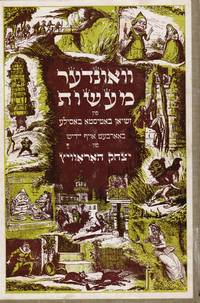
Horowitz, Isac (Adapted Into The Yiddish) ; Giambattista Basile
Gian Battista Basile's Wonder Tales Yiddish Fairy Tales
New York: Farlag Matones. G. 1945. Hardcover. Yiddish text. Giovan Battista shortened Giambattista - Gian Battista Basile's Wonder Tales Adapted into the Yiddish by Isac Horowitz. 135 pages. Illustrated with drawings. Giambattista Basile February 1566 February 1632 was an Italian poet courtier and fairy tale story teller. Giambattista Basile was the author of the first collection of fairy tales . Farlag Matones hardcover
Riferimento per il libraio : 26753
|
|
|
Howe, Irving
World of our fathers [by] Irving Howe, with the assistance of Kenneth Libo
714p Paperback Very good condition
|
|
|
Hurvits, David Ben Shalom Shakhna, Ha-Levi
SEFER HA-MILIM ZSHARGONI-IVRI = YUDISHER LOSHN-KOYDSHER VERTER-BUKH
Later Wraps. 8vo. 112 pages. 21 cm. First edition. In Yiddish and Hebrew. 'Jargon-Hebrew dictionary. Yiddish Holy-Tongue Dictionary. ' Yiddish-Hebrew Dictionary. Subjects: Yiddish language - Dictionaries - Hebrew. Yiddish language. Dictionaries. OCLC lists 8 copies. Scarce. Rebound in later wraps. Pages aged, otherwise fresh. Good condition. (YID-22-47)

|
|
|
Hyman, Bass; Knox, Israel; Shulman, Elias [eds.]
Pinkes - volume 3 [IN YIDDISH] [SERIES]: Pinkes far der Forshung fun der Yiddisher Literatur un Presse
235X155 mm. 519 pages. Hardcover. Cover corners slightly bumped. Gilt cover. Spine slightly bumped. Ex library copy with usual marks. Pages slightly yellowing. Else in good condition.
|
|
|
I, J Singer (Author); Maurice Samuel (Translated from the Yiddish by)
The Brothers Ashkenazi
New York: Alfred A. Knopf Inc. 1936. Book. Good. Decorative Cloth. 3rd Printing Oct. 1936. 8vo or 8° Medium Octavo: 7¾" x 9¾" tall. 642 numbered pages. Solidly bound copy with moderate external wear. Clean text. Book could easily pass as 'very good' considering its age. Moderate foxing on endpapers and page edges. There is no dj. Third printing October 1936. Alfred A. Knopf, Inc. Hardcover
Riferimento per il libraio : 1iCg0016
|
|
|
Ibsen, Henrik
GEZAMELTE DRAMEN. FOUR VOLUMES BOUND IN ONE
Publishers Cloth. 8vo. 107, 149, 137, 134, 122, 133, 91, 120, 88 pages. 22 cm. Second edition. A collection of Ibsen's dramatic work in Yiddish. Collected Plays of Ibsen, four volumes in one, containing nine plays: volume 1. Nora. Di vilde ente - volume 2. Hedda Gabler. Der boymaster - volume 3. Rozmersholm. Di froy fun yam - volume 4. Der klayner Eolf. Yohan Gabriel Borkman. Ven mir toyte ervakhen. With original title pages for each volume, separating each section. Originally published 1910 by Mayzel. Translated by A. Frumkin. Subjects: Ibsen, Henrik, 1828-1906 - Translations into Yiddish. Yiddish Plays. OCLC lists 6 copies of this edition (14 copies of the first edition) . Cloth lightly soiled, writing on backstrip (Ibsen and title in yiddish script) ; internally clean and fresh. Very good + condition. (YID-18-15)

|
|
|
Ibsen, Henrik
GEZAMELTE DRAMEN. HEDDA GABLER. DER BOYMAYSTER
Publishers Cloth. 8vo. 137, 134 pages. 21 cm. First edition. In Yiddish. Dramatic works of Ibsen, including Hedda Gabler and Der Boymayster. Bound in red cloth, with gilt title. Subjects: Ibsen, Henrik, 1828-1906 - Translations into Yiddish. OCLC lists 14 copiees. Light shelf wear to cloth, otherwise clean and fresh. Very good + condition. (YID-18-17)

|
|
|
Ibsen, Henrik
GEZAMELTE DRAMEN: NORA; DI VILDE ENTE
Publishers Cloth. 8vo. 107, 149 pages. 21 cm. First edition. In Yiddish. Dramatic works of Ibsen, including Nora (A Dolls House; translated into Yiddish by the anarchist poet Morris Winchevsky) and Di Vilde Ente (translated into Yiddish by A. Frumkin) . Bound in red cloth, with gilt title. Subjects: Ibsen, Henrik, 1828-1906 - Translations into Yiddish. OCLC lists 25 copies. Clean and fresh. Great condition. (YID-18-16)

|
|
|
Ibsen, Henrik
NORA: ODER A LIALKES HOYZ: A DRAME IN 4 AKTEN
Publishers cloth. 8vo. 107 pages. 20 cm. First appearance? With frontispiece portrait of Ibsen. Nora, or, a Dolls House; a Drama in Four Acts, by Henrik Ibsen, translated into Yiddish by Morris Winchevsky. Undated, ostensibly the first appearance of A Dolls House in Yiddish translation; however, the publisher, Max Maisel, went through at least five print runs of A Dolls House in various years from 1906 until 1920. Bound in yellow cloth, with debossed title and border. Subjects: Yiddish drama. Norwegian drama - Translations into Yiddish. OCLC lists 18 copies encompassing all print runs of Nora individually printed. Light wear to cloth, otherwise fresh and clean. Very good + condition. (YID-18-18)

|
|
|
Ibsen, Henrik
VEN MIR TOYTE ERVAKHEN. A DRAMATISHER EPILOG IN DRAY AKTEN.
Publishers cloth. 12mo. 104 pages. 17 cm. First edition. In Yiddish. When We Dead Awaken; a Dramatic Epilogue in Three Acts. Translated into Yiddish by Avraham Frumkin. Ibsens last play (1899) , first performed in London. Subjects: Yiddish drama - Translations from Norwegian. Norwegian drama - Translations into Yiddish. OCLC lists 9 copies. Light wear to cloth, light soiling to outer edges, internally very clean and fresh. Very good + condition. (YID-18-19)

|
|
|
Icor
IKOR YOR-BUKH 1936. ICOR YEAR BOOK 1936 [THIRD AND FINAL VOLUME PUBLISHED]
1st edition. Original illustrated paper wrappers, 4to. 161 + 23 pages [184 pages total]. 28 cm. ICOR Yearbook 1936. Final Volume Published. In Yiddish and English. Published by the National Executive Committee of the ICOR, Organization for Jewish Colonization in the Soviet Union. Includes photos as well as a 33-page Unzer Flamiger Grus des Land, Vos Hot Befrayt ale Felker: Unzer Flamiger Grus der Ershter Idisher Autonomer Teritorye in der Velt! with approximately 9,000 [Nine Thousand!!!] names listed underneath, organized by city or organization. Other Contents: Rapid Stries of Biro-Bidjan; A Call for a Peoples Delegation to Biro-Bidjan; Declaration of Representatives of Workers Mass Organizations; What is the Race-Theory and Wy does German Fascism Need It; Facts About the U.S.S.R.; A Person Like You Can Get Thousands to Go with You. Subjects: Jews - United States - Periodicals. Jews - Russia (Federation) - Birobidzhan - Periodicals. Jews - Colonization - Russia (Federation) - Birobidzhan - Periodicals. Jewish periodicals - United States. OCLC Number: 27350933. OCLC lists 16 copies. Wear to foot and crown of spine, some light staining, otherwise clean, about Very Good- Condition (YID-16-2D-L'ex)
|
|
|
Idish-Shprekhende Sekssianen Fun Der Sotsialist. Arbayter-Partey Fun Nord-Amerika.
DI NAYE TSAYT. VOL I, NR. 4. (AUGUST 1898)
1st edition. Original Paper Wrappers, Large 8vo, 48 pages. Monthly. Yiddish Socialist monthly which survived from May 1898 (Vol I, Nr. 1) - May 1899 (Vol II, Nr. 1) . 25 cm. From the English-language cover: "A Monthly Magazine devoted to Popular Science, Literature and Socialism, Die Neue Zeit (The New Time) . " Published by the Yiddish-Speaking Section of the Socialist Labor Party of North America. "The harsh and degrading working conditions among the immigrants in....the sweatshops of the needle trade in New York City" led many Jews "to join the radical left wing of the American socialist movement....When [Morris] Hillquit, [Meyer] London, and [Abraham] Cahan left the socialist labor party in 1898, and formed the more moderate socialist party, " others "remained loyal to the revolutionary socialist labor party [SLP]..... In 1913, during the strike of New York City men's tailors, " many in the SLP "supported the tailors against their parent organization, the United Garment Workers of America (UGWA) , which opposed the strike. As a result of the conflict with the UGWA's national officials, the tailors formed their own local organization, the Brotherhood of Tailors, and elected [Joseph] Schlossberg secretary. In 1914 Schlossberg's supporters seceded from the UGWA convention and founded the Amalgamated Clothing Workers of America (ACWA) . " (Melvyn Dubofsky in EJ) . Singerman S35. SUBJECT(S) : Jews -- Periodicals. OCLC lists 4 holdings (UCLA, LOC, NYPL, Brown) . Light wear to wrappers, Very Good Condition. (Y-10-D)

|
|
|
Idish-Shprekhende Sekssianen Fun Der Sotsialist. Arbayter-Partey Fun Nord-Amerika.
DI NAYE TSAYT. VOL I, NR. 6. (JULY 1898)
New York : Idish-shprekhende sekssianen fun der Sotsialist. Arbayter Partey fun Nord-Amerika, 1898. Paper Wrappers, Large 8vo, 48 pages. Monthly. Yiddish Socialist monthly which survived from May 1898 (Vol I, Nr. 1) - May 1899 (Vol II, Nr. 1) . 25 cm. From the English-language cover: "A Monthly Magazine devoted to Popular Science, Literature and Socialism, Die Neue Zeit (The New Time) . " Published by the Yiddish-Speaking Section of the Socialist Labor Party of North America. "The harsh and degrading working conditions among the immigrants in....the sweatshops of the needle trade in New York City" led many Jews "to join the radical left wing of the American socialist movement....When [Morris] Hillquit, [Meyer] London, and [Abraham] Cahan left the socialist labor party in 1898, and formed the more moderate socialist party, " others "remained loyal to the revolutionary socialist labor party [SLP]..... In 1913, during the strike of New York City men's tailors, " many in the SLP "supported the tailors against their parent organization, the United Garment Workers of America (UGWA) , which opposed the strike. As a result of the conflict with the UGWA's national officials, the tailors formed their own local organization, the Brotherhood of Tailors, and elected [Joseph] Schlossberg secretary. In 1914 Schlossberg's supporters seceded from the UGWA convention and founded the Amalgamated Clothing Workers of America (ACWA) . " (Melvyn Dubofsky in EJ) . Singerman S35. SUBJECT(S) : Jews -- Periodicals. OCLC lists 4 holdings (UCLA, LOC, NYPL, Brown) . Edgewear to wrappers, Very Good Condition. (Y-13-D)

|
|
|
Institute Of Jewish Affairs
THE JEWISH COMMUNITIES OF THE WORLD : DEMOGRAPHY, POLITICAL AND ORGANIZATIONAL STATUS, EDUCATION, PRESS.
Very Good Condition; 8vo; 74 pages; Ex Library in good condtion. (Comhist6-17)
|
|
|
International Jewish Labor Bund
BULETIN FUN BUND. 1947-1948. NRS 1-13 [COMPLETE, NO MORE ISSUED]
1st edition. 4to, Original Paper Wrappers, 8 pages each issue, 13 numbers in 12 separate issues, as published. In Yiddish. Title translates as Bulletin of the Bund. Complete run of this early post-Holocaust iteration the Bunds monthly newsletter (also serving Kindred Jewish Socilaist Organizations), reflecting the concerns of its membership of secular Polish Holocaust survivors as well as pre-war immigrants to the US. Full of interesting articles including: Reports and declarations from the World Bund Conference in Brussels, including declarations on Antisemitism the workers movement, etc; The 1947 Socialist conference in Zurich; Bund activity in postwar-Poland, Belgium, Italy, France, Brazil, and Argentina; Jewish Socialists in Rumania; Bund Resolutions on the Camps; German Socialists and the Jewish Question; Professor Hirsh and Palestine; Discussion in the Bun on the Status of Palestine; On the Bundist Youth Movement in Poland; Special Camps; The Bulletin of the Bund [ie this periodical] in the [DP] Camps; Five Years in the Warsaw Ghetto, by Bernard Goldshtein; Bundist Academy in the Gan Eden Camp in New York; A Memorial for the Bund at the Congress of the French Socialists; etc. The General Jewish Labour Bund in Lithuania, Poland and Russia (Yiddish: algemeyner yidisher arbeter-bund in lite, poyln un rusland), generally called The Bund or the Jewish Labour Bund, was a secular Jewish socialist party.... founded in Vilnius on October 7, 1897
..In 1917 the Polish part of the Bund, which dated to the times when Poland was a Russian territory, seceded from the Russian Bund and created a new Polish General Labor Bund which continued to operate in Poland in the years between the two world wars
.The Bund sought to unite all Jewish workers in the Russian Empire into a united socialist party, and also to ally itself with the wider Russian social democratic movement to achieve a democratic and socialist Russia. The Russian Empire then included Lithuania, Latvia, Belarus, Ukraine and most of present-day Poland, areas where the majority of the world's Jews then lived. They hoped to see the Jews achieve a legal minority status in Russia. Of all Jewish political parties of the time, the Bund was the most progressive regarding gender equality, with women making up more than one-third of all members. The Bund actively campaigned against anti-Semitism. It defended Jewish civil and cultural rights and rejected assimilation. However, the close promotion of Jewish sectional interests and support for the concept of Jewish national unity (klal yisrael) was prevented by the socialist universalism of the Bund. The Bund avoided any automatic solidarity with Jews of the middle and upper classes and generally rejected political cooperation with Jewish groups that held religious, Zionist or conservative views. Even the anthem of the Bund, known as "the oath" (di shvue in Yiddish), written in 1902 by Sh. An-ski, contained no explicit reference to Jews or Jewish suffering. At the heart of the vision of the future of the Bund was the idea that there is no contradiction between the national aspect on the one hand and the socialist aspect on the other. As a strictly secular organization, the Bund renounced the Holy Land and the sacred language (Hebrew) and chose to speak Yiddish
.In its early years the Bund had remarkable success, gaining an estimated 30,000 members in 1903 and an estimated 40,000 supporters in 1906, making it the largest socialist group in the Russian Empire
. the Bund was a founding collective member at the RSDLP's first congress in Minsk in March 1898. For the next 5 years, the Bund was recognized as the sole representative of the Jewish workers in the RSDLP, although many Russian socialists of Jewish descent, especially outside of the Pale of Settlement, joined the RSDLP directly
.The Bund generally sided with the party's Menshevik faction led by Julius Martov and against the Bolshevik faction led by Vladimir Lenin during the factional struggles in the run-up to the Russian Revolution of 1917
.In the Polish areas of the [Russian] empire, the Bund was a leading force in the 1905 revolution. At that time the organization probably reached the height of its influence. It called for an improvement in living standards, a more democratic political system and the introduction of equal rights for Jews. At least in the early stages of the first Russian Revolution, the armed groups of the "Bund" were likely the strongest revolutionary force in Western Russia. During the following years, the Bund went into a period of decay
.The Bund eventually came to strongly oppose Zionism, arguing that emigration to Palestine was a form of escapism. The Bund did not advocate separatism. Instead, it focused on culture, rather than a state or a place, as the glue of Jewish nationalism.
. The Bund also promoted the use of Yiddish as a Jewish national language and to some extent opposed the Zionist project of reviving Hebrew. The Bund won converts mainly among Jewish artisans and workers, but also among the growing Jewish intelligentsia. It led a trade union movement of its own. It joined with the Poalei Zion (Labour Zionists) and other groups to form self-defense organisations to protect Jewish communities against pogroms and government troops. During the Russian Revolution of 1905 the Bund headed the revolutionary movement in the Jewish towns, particularly in Belarus and Ukraine
..In 1921, the Communist Bund [in the USSR] dissolved itself and its members sought admission to the Communist Party....Many former Bundists, like Mikhail Liber and David Petrovsky, perished during Stalin's purges in the 1930s. The Polish Bundists continued their activities until 1948. During the latter half of the 20th century the Bundist legacy was represented through the International Jewish Labor Bund, a federation of local Bundist groups around the world
.Among the exiled Bundists who went on with Socialist politics in America was Baruch Charney Vladeck (18861938), elected to the New York Board of Aldermen as a Socialist in 1917
[and] 1937 [and] manager of The Jewish Daily Forward
Moishe Lewis (18881950)....the father of David Lewis (19091981), a leader of the New Democratic Party in Canada
.David Dubinsky (18921982), though never formally a member of the party, had joined the bakers' union, which was controlled by the Bund, and was elected assistant secretary within the union by 1906
..He later became a member of the Socialist Party of America, helped found the American Labor Party in 1936 and was from 1932 till 1966 the leader of the International Ladies' Garment Workers' Union
..under the name Max Goldfarb, David Petrovsky (18861937) was a member of the Central Committee of the Jewish Socialist Federation of America, a member of the Socialist Party of America, and the labor editor of The Forward (Wikipedia). SUBJECT(S): Jews -- United States -- Periodicals. Jewish socialists -- New York (State). Jewish labor unions. OCLC: 234327189. OCLC: 234327189. OCLC-Worldcat lists 6 holdings worldwide (NYPL, NLI, YIVO, Harvard, Yale, USHMM), though some listings may be for partial runs. Light wear, Very Good Condition. Rare and important complete set. (Yid-33-51)
|
|
|
Isaac Bashevis Singer; translated From The Yiddish by The Author and Elizabeth Shub; Illustrated by Maurice Sendak
Zlateh the Goat and Other Stories
E-363. Very Good. Hardcover. Hardcover. 8vo. Published by Harper & Row New York 1966. Xi 90 pgs. Illustrated. First Edition/First Printing. DJ has light shelf-wear present to the DJ extremities lower right corner of the DJ is clipped but price is still present to the top of the front flap. Bound in decorated cloth boards with titles present to the spine and front board. Boards have light shelf-wear present to the extremities. No ownership marks present. Text is clean and free of marks. Binding tight and solid. Nobel laureate Isaac Bashevis Singer introduces readers to the village of Chelm in this Newbery Honor Book. Chelm is a village of fools. The most famous foolsthe oldest and the greatestare the seven Elders. But there are lesser fools too: a silly irresponsible bridegroom; four sisters who mix up their feed in bed one night; a young man who imagines himself dead. Here are seven magical folktales spun by a master storyteller that speak of fools devils schlemiels and even heroeslike Zlateh the goat. ; 8vo 8" - 9" tall . hardcover
Riferimento per il libraio : 67203
|
|
|
Isaac Bashevis Singer; translated From The Yiddish by The Author andElizabeth Shub; Illustrated by Maurice Sendak
Zlateh the Goat and Other Stories
E-091. Hardcover. Very Good. Hardcover. 8vo. Published by Harper & Row New York 1966. Xi 90 pgs. Illustrated. First Edition/First Printing. DJ has light shelf-wear present to the DJ extremities lower right corner of the DJ is clipped but price is still present to the top of the front flap. Bound in decorated cloth boards with titles present to the spine and front board. Boards have light shelf-wear present to the extremities. No ownership marks present. Text is clean and free of marks. Binding tight and solid. Nobel laureate Isaac Bashevis Singer introduces readers to the village of Chelm in this Newbery Honor Book. Chelm is a village of fools. The most famous fools—the oldest and the greatest—are the seven Elders. But there are lesser fools too: a silly irresponsible bridegroom; four sisters who mix up their feed in bed one night; a young man who imagines himself dead. Here are seven magical folktales spun by a master storyteller that speak of fools devils schlemiels and even heroes—like Zlateh the goat.; 8vo 8" - 9" tall . hardcover
Riferimento per il libraio : 74096
|
|
|
ISAAC BASHEVIS SINGER
GIMPEL L'IDIOTA
Prefazione di Henry Miller. Prima edizione italiana. Menda alla sovracoperta<br/>Collana LA GAJA SCIENZA 261<br/>Legatura rilegato in cartonato editoriale con sovracoperta<br/>Formato Ottavo<br/>Num Pagine 569<br/>Traduttore Bruno Oddera<br/>Prima Edizione

|
|
|
ISAAC BASHEVIS SINGER
UN AMICO DI KAFKA
Piccole macchie in sette pagine. Mende all'ultima pagina<br/>Collana LA GAJA SCIENZA 343<br/>Legatura rilegato in cartonato editoriale con sovracoperta<br/>Formato Ottavo<br/>Num Pagine 412<br/>Traduttore Maria Dazzi<br/>Prima Edizione

|
|
|
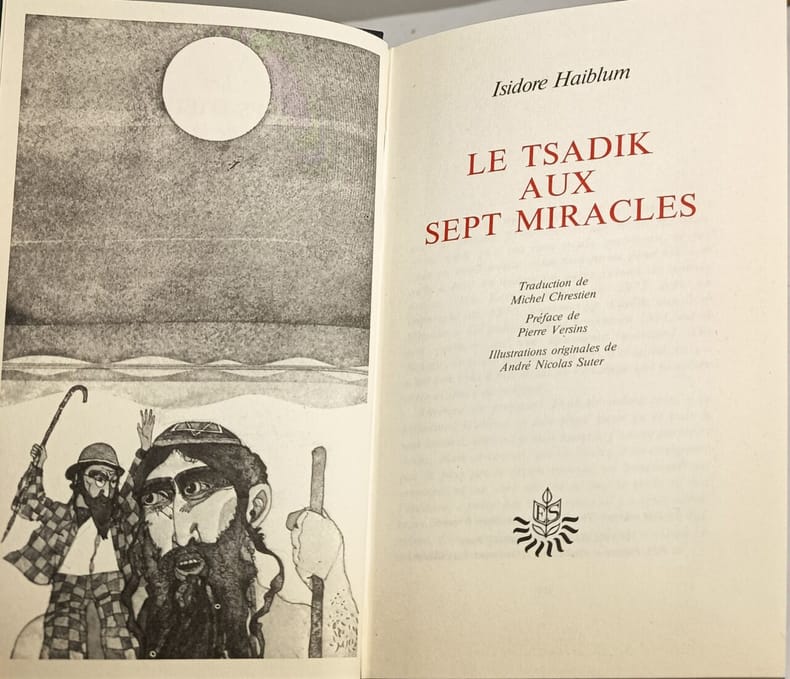
Isidore Haiblum
Les chefs d'oeuvres de la science fiction- Le Tsadik aux sept miracles
Edito-service SA 1975 254 pages in8. 1975. reliure editeur. 254 pages. Dans un futur éloigné l'enquêteur Lund est confronté à une difficulté de taille lorsqu'il détecte l'intervention d'un Tsadik un saint homme faiseur de miracles issu de la tradition juive et doté du pouvoir de voyager dans le temps. Ce roman présenté comme la première science-fiction inspirée du folklore yiddish mêle enquête humour absurde et éléments culturels juifs dans un récit dynamique
Riferimento per il libraio : 7202
|
|
|
ISRAEL ZWI KANNER
FIABE EBRAICHE
<br/>Collana OSCAR NARRATIVA FIABE E LEGGENDE DI TUTTO IL MONDO<br/>Legatura brossura<br/>Formato Sedicesimo<br/>Num Pagine 238<br/>Traduttore Maria Teresa Giannelli<br/>Prima Edizione

|
|
|
Itzik Manger
Medresh Itzik [Yiddish and English]
|
|
|
Jacobs Louis
The Talmudic Argument: A Study in Talmudic Reasoning and Methodology
Cambridge University Press 1984 240 pages 46x549x351cm. 1984. Cartonné jaquette. 240 pages.
Riferimento per il libraio : 100147321
|
|
|
Jacobson, Wolf S.
UEBER DAS KADISH-GEBET [AUTHOR INSCRIBED]
Original Wraps. 8vo. 60 pages. 24 cm. First edition. In German. Author Insribed on title page. An explanation of the Kaddish prayer. The author, Wolf S. Jacobson was a leader of Agudas Yisroel in Berlin between the world wars; he emigrated to Denmark and served as Orthodox Rabbi at Machsike Hadas in Copenhagen; then to Sweden in 1943, and finally to Israel. Subjects: Kaddish. OCLC lists 21 copies. Light soiling to outer edges, overall very fresh and clean. Very good condition. (GER-43-6)

|
|
|
Jaffe, Mordecai
Ten Israeli Poets
28x22 cm., 90 pp., hardcover, slightly stained cover, worn on edges, yellowing spine, worn on edges, tape marks on inner covers, loose inner binding, yellowing pages. else in fair+ condition.
|
|
|
Jewish Encyclopedic Handbooks Central Yiddish Culture Organization (CYCO)
The Jewish People Past and Present Volume 1 and 2
New York: Jewish Encyclopedic Handbooks Central Yiddish Culture Organization CYCO. Fine maroon leatherbound 2 volume set gilt all edges Volume 1 has 430 pp with B/W illustrations; Volume 2 has 430 pp with B/W illustrations. . Fine. Leather Bound. 1946. Jewish Encyclopedic Handbooks Central Yiddish Culture Organization (CYCO hardcover
Riferimento per il libraio : 1116373
|
|
|
Jewish Socialist Federation Of America.
IDISHER YOHR BUKH. VOL I. 1914
Nyu york [New York]: Idisher sotsyalistisher federatsye in Amerika, 1914. Paper Wrappers, 8vo, 110 pages. Annual. Includes illustrations. 23 cm. In Yiddish. Periodical lasted until 1918 issue; Vols II (1915) and later are titled "Idishe yohrbukh. " "In 1908 a Jewish Agitation Bureau was established [by the Socialist Party of America] in order to spread socialism among Yiddish-speaking Jews. Stimulated by immigrants with experience in the East European Bund, the Bureau developed into the Jewish Socialist Federation (J. S. F. ) from 1912, over strong opposition from Abe Cahan and other Yiddish-speaking stalwarts opposed to such "separatism. " Actually the J. S. F. Disavowed any distinct Jewish purpose and attempted only to spread socialism, while it vigorously combated Zionism. Its membership was drawn mainly from immigrants of Bundist background" (Schneier Levenberg in EJ) . SUBJECT(S) : Socialism -- Periodicals. Jews -- New York (State) -- New York -- Periodicals. OCLC lists 6 holdings. Edgewear, rear cover detached. Otherwise good condition with good paper. (AMR-56-14X)

|
|
|
Jewish Socialist Federation Of America.
IDISHER YOHR BUKH. VOL I. 1914
Nyu york [New York]: Idisher sotsyalistisher federatsye in Amerika, 1914. CLoth, 8vo, 110 pages. Annual. Includes illustrations. 23 cm. In Yiddish. Periodical lasted until 1918 issue; Vols II (1915) and later are titled "Idishe yohrbukh. " "In 1908 a Jewish Agitation Bureau was established [by the Socialist Party of America] in order to spread socialism among Yiddish-speaking Jews. Stimulated by immigrants with experience in the East European Bund, the Bureau developed into the Jewish Socialist Federation (J. S. F. ) from 1912, over strong opposition from Abe Cahan and other Yiddish-speaking stalwarts opposed to such "separatism. " Actually the J. S. F. Disavowed any distinct Jewish purpose and attempted only to spread socialism, while it vigorously combated Zionism. Its membership was drawn mainly from immigrants of Bundist background" (Schneier Levenberg in EJ) . SUBJECT(S) : Socialism -- Periodicals. Jews -- New York (State) -- New York -- Periodicals. OCLC lists 6 holdings. Hinges starting, but still good and solid. Good Condition. (AMR-56-14X)

|
|
|
Joffe, Judah, A,; Mark, Yudel
Great Dictionary of the Yiddish Language: Volume II [THIS VOLUME ONLY] [IN YIDDISH]
VOLUME TWO ONLY. IN YIDDISH. 285x230mm. XXXII+588 pages (pagination: 32 + 509-1096). Hardcover. Gilt spine. Spine and cover very slightly worn at edges. Cover slightly stained. Spine slightly loose. Pages slightly yellowing. Else is in good condition.
|
|
|
Joffe, Mordecai
Eretz Israel in the Yiddish Literature [IN YIDDISH].
IN YIDDISH. 230X155 mm. 448 pages. Hardcover with dust-jacket. Jacket yellowing. Jacket edges slightly torn. Cover corners and edges slightly bumped. Spine edges slightly bumped. Stamp on inner cover. Pen inscription on first whitepage. Pages slightly yellowing. Else in good condition.
|
|
|
Johlson, Joseph. Translated From The German by Isaac Leeser
INSTRUCTION IN THE MOSAIC RELIGION
5627 [1867]. Original publisher's boards, 12mo, vi 212 pages. The "Stereotyped" edition, revised, based on the 3rd revised and enlarged edition (The 1st edition was issued in 1830) . With a new preface by Leeser, and including Leeser's original preface (preface to the 1st edition) and, of course, his additions and changes of the preceding 37 years. A work primarily directed at American Jewish juvenile of the early and mid 19th Century. "Leeser's career as a translator also began in Philadelphia in 1830 with the publication of his rendering from German of J. Johlson's Instruction in the Mosaic Religion. Leeser, as part of his ongoing efforts to contribute to the development of Jewish education and culture in America, translated a number of important works into English from German, Spanish, French and Hebrew." (University of Pennsylvania). "Leeser brought with him to Philadelphia his translation of J. Johlson's Instruction in the Mosaic Religion. He had it published there in 1830, appropriately dedicated to his uncle Zalman Rehine. The book is a catechism published in Germany and translated and adapted by Leeser for 'the instruction of the younger...of Israelites of both sexes, who have previously acquired some knowledge of the fundamental part...of their religion.' Leeser undertook its publication because there was a great scarcity of elementary textbooks for Jewish children. It is significant that this Instruction in the Mosaic Religion, Leeser's first issued work, is a textbook of religious instruction for the young, for though Leeser attained distinction as an author, translator, editor, and a national leader of the American Jewish community, he considered himself, first and foremost, an educator." (Jewish Virtual Library). Spine rebacked, lacks blank front endpaper. Ex-library with usual marks, including stamps on title page. Good Condition (AMR-57-6)

|
|
|
Joseph Opatoshu (Translated from Yiddish by Isaac Goldberg)
In Polish Woods
<p>Cantor small name stamp FLEP Pocket intact BPD else content appears as unread and unblemished with dark blue colored cloth covered boards displaying no significant surface/edge wear as shown.</p><p><strong>Synopsis:</strong> In Polish Woods which was first published in its English translation from its original Yiddish in 1938 is a historical novel describing the devolution of the Kotzker dynasty between the age of Napoleon and the Polish Revolt of 1863.</p><p>Author Joseph Opatoshu reflects on the conflicting and even opposite tendencies in development of the Jewish ideology during this era which would largely determine the future of the Jewish people: Hasidism enlightenment and assimilation. </p><p><strong>Insurance & handling is included free. Extra Charges/Fees apply on Shipments Outside The U.S. and Expedited Shipments. Oversize and/or heavy books may require additional fees. Will advise. </strong> Dated 12.08.20J #4223-121720 <strong>Updated 11.5.25</strong> </p> The Jewish Publication Society of America hardcover
Riferimento per il libraio : 4223-121720
|
|
|
Judge, Edward H.
EASTER IN KISHINEV: ANATOMY OF A POGROM?
Publishers cloth. 8vo. X, 186 pages. 24 cm. First edition. In February of 1903, in a small town in the southwestern part of the Russian empire, a peasant stumbled upon the corpse of 14-year-old Mikhail Rybachenko, bruised and covered with stab wounds, in a garden. The murder immediately fueled wild rumors that he had been killed by local Jews in need of his Christian blood to prepare their matzah bread. Panic rumors, grounded in sinister superstitions of Jewish sorcery and ritual murder, quickly spread to nearby towns. By April, they had hit Kishinev - a growing metropolis of 100, 000 inhabitants rife with the unrest of rapid expansion, ethnic rivalry, revolutionary agitation, and anti-Semitism - with full force. The resulting massacre left dozens dead, and hundreds wounded, maimed, widowed, orphaned, or homeless. This is the story of Kishinev. In this extensively researched book, Edward Judge examines these anti-Jewish riots, detailing their background, cause, and aftermath. He traces the evolution of the riots, analyzing the broader impact of imperial policies, urbanization, nationalism, population growth, and revolutionary activism upon the Jewish situation in Russia. Recounting the activities and attitudes of anti-Semitic agitators and Kishinev officials, the book examines the spiral of violence, the inaction of the authorities in the wake of the pogrom, the storm of indignation that followed the pogrom, and the efforts of tsarist officials to counter subsequent negative publicity. Easter in Kishinev also portrays the investigation of the disorders and the trials of the rioters and carefully considers the question of government responsibility for the outbreak of the pogrom. (Publishers Description) Subjects: Jews - Persecutions - Moldova - Chisinau. Massacres - Moldova - Chisinau - History - 20th century. Antisemitism - Moldova - Chisinau - History - 20th century. Kishinev Massacre, Chisinau, Moldova, 1903. Antisemitisme. Pogrom Geschichte 1903 Chisinau (Moldova) - Ethnic relations. Very good condition. (EE-5-16)

|
|
|
Kacenelson-Nachumov, Cypora
Icchok Kacenelson [IN YIDDISH]
145X205 mm. 224 pages. Soft cover. Cover is yellowing, bumped at edges and corners, with aging stains. Glued spine, partly loose. Pages are slightly yellowing. Else in fair condition.
|
|
|
Kaczerginski, S.
IKH BIN GEVEN A PARTIZAN (DI GRINE LEGENDE). 2 Volumes in one book. [AUTHOR INSCRBED]
Good Solid condition.; 8vo; 387 pages; In Yiddish. Not in Robinson & Friedman nor Wolff. Jewish partisan's memoirs of resistance against the Nazis in Poland. Illustrated with many photographs throughout. Inscribed by Kaczerginski in year of publication. Kaczerginski (19081954) was a Yiddish writer and cultural activist. Born in Vilna to a poor family and educated at that citys Talmud Torah, Shmerke (Pol., Szmerke) Kaczerginski lost both his parents during World War I. As a youth, he was involved with outlawed Communist groups and was arrested several times, serving a lengthy prison term. In the 1930s, two of his revolutionary poems became popular in Poland. He wrote short stories with a radical bent and was a correspondent and reporter for literary publications, including the semilegal leftist press in Poland and the New York Communist daily Morgn-frayhayt. Kaczerginski played a key role in shaping the writers and artists group Yung-Vilne; he organized its evening events and was the de facto publisher of its three miscellanies between 1934 and 1936. During the period of Soviet control over Lithuania in 19401941, he was even more active in the field of Yiddish culture, but at the same time experienced his first disappointments with the attitude of the Soviet regime toward Jewish culture. During the first period of Nazi occupation, Kaczerginski wandered through villages and towns posing as a deaf mute; after many difficulties, he ended up in the Vilna ghetto. Kaczerginski was very involved in the ghettos cultural activities. As a leader of its youth club, he wrote its Yugnt-himen (Youth Hymn), a song that immediately became popular. In 1943, he wrote the song Shtiler, shtiler in memory of the mass murders committed at Ponar. Set to music that Aleksander Volkoviski (later known as Aleksander Tamir) had submitted to a contest organized by the ghetto, the song was first heard at an evening performance there and over the years became one of the best-known songs of the Holocaust. With Avrom Sutzkever and others, Kaczerginski became part of a group of forced laborers whom the Germans designated to sort Jewish cultural treasures at YIVO and other locations. Known as the Papir-brigade (Paper Brigade), the groups members risked their lives to hide the most significant items, smuggling them back into the ghetto or entrusting them to non-Jewish acquaintances. Kaczerginski was a member of the Fareynikte Partizaner Organizatsye (United Partisans Organization; FPO), and, since YIVOs building was located outside the ghetto walls, he took part in smuggling weapons into the ghetto. In September 1943, Kaczerginski, along with Avrom and Freydke Sutzkever and other members of the FPO, escaped from the Vilna ghetto as part of an organized group of fighters just before its liquidation. They joined a Soviet partisan unit in the Naroch Forests, where Kaczerginski fought as a partisan until liberation in July 1944. Kaczerginskis books describe the destruction of Vilna, the partisan struggle, and his own experiences during the Holocaust period: Khurbn Vilne (The Destruction of Vilna; 1947), Partizaner geyen (Partisans on the Move; 1947), and Ikh bin geven a partizan (I Was a Partisan; 1952) (YIVO, 2010). Wear to cover and edges, very good condition. (HOLO2-87-3A)
|
|
|
Kagan, Berl
Lexicon of Yiddish Writers [IN YIDDISH]
IN YIDDISH. 285x225 mm. XIV+812 pages. Hardcover. Cover slightly rubbed. Spine edges slightly bumped. Gilt lettering on cover and spine. Pen inscription on first whitepage. Else in good condition.
|
|
|
Kagan, Berl
SEFER HA-PRENUMERANTN: VEGVAYZER TSU PRENUMERIRTE HEBREISHE SEFARIM UN ZAYERE HOTMIM FUN 8,767 KEHILOT IN AYROPE UN TSAFON-AFRIKE.
Cloth; 4to. Xx, 384, xii pages. Nicely bound in dark blue cloth with gilt lettering and spattered edges. Frontispiece portrait of the author's late son, to whom the book is dedicated. In Yiddish, with introduction in both Yiddish and English. Title page in English on verso: Hebrew Subscription Lists, With an Index to 8, 767 Jewish Communities in Europe and North Africa. Includes indices. This work is the fruit of a massive project undertaken by the author, a staff member of the Library of the JTS. It organizes the data culled from tens of thousands of Jewish books over a period of about 150 years. The result is an index of 350, 000 Jews from almost 9, 000 communities who presubscribed for specific books by specific writers, their names having been noted in the books upon publication. Given the destruction of so many records of Jews during the Holocaust, this book is an invaluable tool for scholars and researchers. SUBJECT (S) : Rabbinical literature -- Publishing. Names, Geographical -- Hebrew. Names, Geographical -- Yiddish. Names, Geographical -- Europe, Eastern. Names, Geographical -- Africa, North. Ex-library markings. Slight toning. Very good condition. (CT-9-1A)

|
|
|
Kaganoff, Benzion C.
A DICTIONARY OF JEWISH NAMES AND THEIR HISTORY.
pp. x, 250. Tall 8vo. Original full cloth binding. Original priced dust jacket. Second printing. Hardbound. Very good. The etymology of Jewish names in a concise dictionary format. Useful reference. GENEALOGY 2
|
|
|
Kahan, Salomon
MEKSIKANISHE REFLEKSN: PUBLITSISTISHE UN LITERARISH-KRITISHE FARTSAYKHNUNGEN [AUTHOR INSCRIBED]
1st edition. Original wrappers. 8vo. 306 pages, 23 cm. In Yiddish with alternate Spanish title page. Title translates to Mexican Reflections: Critical Essays on Jewish Subjects. Kahan (18961965) was a prominent Mexican Yiddish essayist and musicologist. He was born in Bialystok but emigrated to Mexico City in 1921, where he was professor of the history of modern civilization at the Mexican National Teachers' College. He was editor of Der Veg and managing editor of Tribuna Israelita. He played an important role in the cultural life of Mexico's Jewish community and collected his many essays on literature, music, and important Jewish and Mexican personalities in five Yiddish volumes, of which the most significant was his Literarishe un Zhurnalistishe Fartseykhnungen ("Literary and Journalistic Sketches, " 1961) . He published an abridged Spanish translation of *Graetz's History of the Jews under the title Historia del pueblo de Israel (Jewish Virtual Library, 2018) . SUBJECTS: Jews -- Mexico. OCLC lists 20 copies worldwide (OCLC: 11002895) . Lengthy inscription from year of publication to previous owner. Edge wear to wrappers. Pages browning. Overall good condition. (YID-41-29)
|
|
|
Kallay, Sharaga Feivel [Kalai, Shraga Feiwel] [Ed.] / Allweil, Arieh [Illustr.]
Boiberke Memorial Book [Bobrka; Prachnik; Boyberke; Bibrka]
RARE memorial volume of the small town Boiberke in eastern Galicia near Lvov (Lemberg) in Hebrew, Yiddish and English. The book is profusely illustrated by the eminent Israeli artist Arieh Allweil (1901-1967). 345x250mm. 38+218 pages. Illustrated yellow board Hardcover with grey cloth spine. Black lettering on spine. Cover yellowing/age-stained. Cover/binding curved. Cover corners worn and slightly peeling. Cover and spine slightly stained. Front cover upper right corner near spine bumped/wrinkled. Binding slightly visible on rear inner cover. [SUMMARY]: This extremely rare memorial of a Jewish community annihilated in the Holocaust is otherwise in good condition. PLEASE NOTE: This item is overweight. We may ask for extra shipping costs.
|
|
|
Kantorowicz, N. [Nachum]
Comunidades Judias Desaparecidas [IN YIDDISH]. [SERIES]: El Judaismo Polaco - Vol. 170.
IN YIDDISH. The first chapter is about the Khazars! 20x14.5mm. 353 pages. Hardcover. Cover and spine slightly age stained. Cover corners slightly bumped. Spine loose. Ex-library copy with usual marks. Several pages slightly stained - NO damage to text. Pages slightly yellowing. Else in good condition.
|
|
|
Kaplan, Israel, editor
FUN LETSTEN CHURBN [FUN LETZTEN KHURBAN / KHURBN / CHURBAN] : TSAYTSHRIFT FÜR GESHIKHTE FUN YIDISHN LEBN BETN NATSI-REZSHIM. FROM THE LAST EXTERMINATION: JOURNAL FOR THE HISTORY OF THE JEWISH PEOPLE DURING THE NAZI REGIME. Nr. 2. Sept. 1946.
Small 8vo; First Edition. Paper Wrappers, small 8vo, 104 pages. Includes 11 photos with captions in English & Yiddish. One of 8000 issued. In Yiddish with English Cover, table of contents, & photo captions. Important journal lasting 10 issues which written & published by Jewish DPs themselves to document crimes and survival in the Holocaust. The publisher's decision to include the English table of contents, probably in part to insure the journal's use in future war crimes trials, makes these first hand accounts especially user-friendly today, almost 60 years later. Robinson & Friedman #1247: "The Historical Commission [was] established in 1945 under the auspices of the Central Committee of Liberated Jews in the U. S. Zone. [It] Ceased operations early in 1949. Details of the activities of the Munich center can be found in No. 1247 [Fun Letsten Churbn]..." Hagit Lavsky notes in the Encyclopedia of the Holocaust (Gutman, ed., 1990, p. 383) that, "Commemoration and documentation projects [by Jewish DPs] included the work of the Tsentraler Historisher Komisiye (Central Historical Commission), established in December 1945 by the Central Committee in Munich, to assist in bringing Nazi criminals to trial. A network of regional committees was set up under the commission's auspices whose task it was to take evidence and collect documentary material, including material on DPs. In August 1946, the commission published the first issue of the monthly FUN LETZTEN HURBAN." Articles include: Guns in the Ghetto of Riga, by I[srael]. Kaplan; Life and Death of Dubno Ghetto, by M. Weisberg; Crying Graves, by A. Weisbrod; Labour camp at Mielec (reports of witnesses), by I. Kohs; Nazi word of honour, by Dr. M. Schatner; At the Ghetto of Czestochow (pages), by W. Gliksman; Jewish Folklore during the Nazi Time, by by I[srael]. Kaplan; Let us keep silent (Being sung in camp); Dwellings of Ghetto (Being sung in camp);Two Nazi Documents (with explanations); List of articles concerning Jewish Life during the Nazi Regime in the Press of Shaarith Ha-Plata; Activity Report; Chronicle. Published under DP-Publications License US-E-3 OMGB, Information Control Division. Very Good+ Condition. (holo2-122-51)

|
|
|
Kaplan, Israel, editor
FUN LETSTEN CHURBN [FUN LETZTEN KHURBAN / KHURBN / CHURBAN] : TSAYTSHRIFT FÜR GESHIKHTE FUN YIDISHN LEBN BETN NATSI-REZSHIM. FROM THE LAST EXTERMINATION: JOURNAL FOR THE HISTORY OF THE JEWISH PEOPLE DURING THE NAZI REGIME. Nr. 4. March 1947.
Small 8vo; First Edition. Paper Wrappers, small 8vo, 112 pages. Includes 10 photos with captions in English & Yiddish, & 2 maps. One of 8000 issued. In Yiddish with English Cover, table of contents, & photo captions. Important journal lasting 10 issues which written & published by Jewish DPs themselves to document crimes and survival in the Holocaust. The publisher's decision to include the English table of contents, probably in part to insure the journal's use in future war crimes trials, makes these first hand accounts especially user-friendly today, almost 60 years later. Robinson & Friedman #1247: "The Historical Commission [was] established in 1945 under the auspices of the Central Committee of Liberated Jews in the U. S. Zone. [It] Ceased operations early in 1949. Details of the activities of the Munich center can be found in No. 1247 [Fun Letsten Churbn]..." Hagit Lavsky notes in the Encyclopedia of the Holocaust (Gutman, ed., 1990, p. 383) that, "Commemoration and documentation projects [by Jewish DPs] included the work of the Tsentraler Historisher Komisiye (Central Historical Commission), established in December 1945 by the Central Committee in Munich, to assist in bringing Nazi criminals to trial. A network of regional committees was set up under the commission's auspices whose task it was to take evidence and collect documentary material, including material on DPs. In August 1946, the commission published the first issue of the monthly FUN LETZTEN HURBAN." Published under DP-Publications License US-E-3 OMGB, Information Control Division. Articles include: The Extermination of Jews in East-Galicia, By Dr. Philip Friedmann; Polish Jewish Soldiers as War Prisoners (Memoirs), by Mendel Lifschitz; Tchernowitz (Cernauti), by Dr. Jakob Ungar; In the forests of White Russia (Eye-Witness Report): a) Around Woloshin, by Mosche Mejerson, b) In the Braslav area, by Mosche Trejster, [&] c) At Radun, by Lieb Lewin; My Experiences During the War (From the Series of Children's Reports), by Daniel Burstin; Lullaby (Ghetto-song); "Buna" (Camp-song); Nazi Documents with Comments; Photographs of the Nazi Period; Bibliographical List of Articles on Jewish Life under the Nazis Published in the Press of the Shaarith Ha-Plata; Report on Activites of the Central Historical Commission; News of the Central Historical Commission. Very Good Condition. (holo2-122-50)
|
|
|
Kaplan, Israel, editor
FUN LETSTEN CHURBN [FUN LETZTEN KHURBAN / KHURBN / CHURBAN] : TSAYTSHRIFT FÜR GESHIKHTE FUN YIDISHN LEBN BETN NATSI-REZSHIM. FROM THE LAST EXTERMINATION: JOURNAL FOR THE HISTORY OF THE JEWISH PEOPLE DURING THE NAZI REGIME. Nr. 5. May 1947.
Small 8vo; First Edition. Paper Wrappers, small 8vo, 106 pages. Includes 11 photos with captions in English & Yiddish. One of 8000 issued. In Yiddish with English Cover, table of contents, & photo captions. Important journal lasting 10 issues which written & published by Jewish DPs themselves to document crimes and survival in the Holocaust. The publisher's decision to include the English table of contents, probably in part to insure the journal's use in future war crimes trials, makes these first hand accounts especially user-friendly today, almost 60 years later. Robinson & Friedman #1247: "The Historical Commission [was] established in 1945 under the auspices of the Central Committee of Liberated Jews in the U. S. Zone. [It] Ceased operations early in 1949. Details of the activities of the Munich center can be found in No. 1247 [Fun Letsten Churbn]..." Hagit Lavsky notes in the Encyclopedia of the Holocaust (Gutman, ed., 1990, p. 383) that, "Commemoration and documentation projects [by Jewish DPs] included the work of the Tsentraler Historisher Komisiye (Central Historical Commission), established in December 1945 by the Central Committee in Munich, to assist in bringing Nazi criminals to trial. A network of regional committees was set up under the commission's auspices whose task it was to take evidence and collect documentary material, including material on DPs. In August 1946, the commission published the first issue of the monthly FUN LETZTEN HURBAN." Published under DP-Publications License US-E-3 OMGB, Information Control Division. Articles include: The con-camp [i.e. concentration camp] prisoners march to Tirol, by I.K. [Israel Kaplan?]; March from Kaufering-camps, by I[sreal]. Kaplan; From Schwabhausen to Dachau, by Dr. L. Goldstein; On the march from Mühlsdorf, by Rabbi Elchanan Person; On the march from Hessenthal, by Dr. Mordchai Glatsetin; From Görlitz to Tirol, by Jakob Rosenbaum; On the March from Wistegiersdorf, by A. Tenenbaum; On the march from Buchenwald, by Israel Segal; Nazi "liberation," b7 Dr. A. Waksberger; My Experiences during the War (from the Series of Children's Reports), by Jakob Lewin; Mama bless me!.. (Camp-song); Oh, potates [sic].. (Ghetto-song), by Hersz Albus; Nazi Documents with translations; Photographs of the Nazi Era; Bibliographical list of articles on Jewish life under the Nazis. [sic] published in the Press of Shaarith Ha-Plata; List of Camps; Report on Activities of the Central Historical Commission; News of the Central Historical Commission. Very Good Condition. A beautiful copy. (HOLO2-122-51C)
|
|
|

 Ricevere i risultati per e-mail
 Scaricare i risultati in PDF
 RSS feed
 Link
Link
