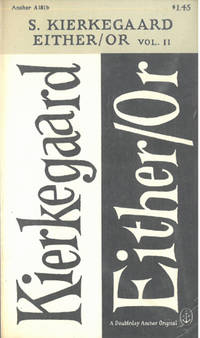
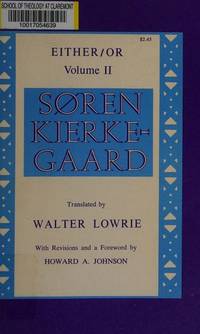
Chez Le Traducteur. Collectible - Acceptable. Chez Le Traducteur 1937. 1st edition. 12mo Paperback. 288pp. French. Fair book. Spineworn. Slightly dampstained. Writing inside. philosophy religion christianity christian Inquire if you need further information. Chez Le Traducteur paperback
United States: Indiana University Press 1968. 5th or later Printing. Soft cover. Very Good. Karen Foget. Book has mild edgewear toned wraps and light foxing to the top pages else clean with no store stamps. <br/> <br/> Indiana University Press paperback
Princeton University Press 1944. Near Fine/Very Good. 8vo navy blue cloth gilt titles blue topstain 577pp. Stated second printing 1944. Unclipped dust jacket 6.00 moderately rubbed to panels small chips to spine edges. Contents clean binding firm. ‘A Mimic-Pathetic-Dialectic Composition An Existential Contribution’ Originally published in 1846 as a postscript to the Philosophical Fragments under the pen name Johannes Cliamcus. Examines the objective and subjective truth of Christianity and Kierkegaard’s concept of truth as subjectivity. A nearly fine copy in a very good dust jacket preserved in mylar. Princeton University Press unknown
<p>Concluding Unscientific Postscript to Philosophical Fragments by Soren Kierkegaard. Two Volume Set; Volume 1: Text; Volume 2: Historical Introduction Supplement Notes and Index. Kierkegaard's Writings Volumes 12.1 and 12.2. Edited and Translated with Introduction and Notes by Howard V. Hong Edna H. Hong. 1992 by Princeton University Press. Hardcover two volumes total 1008 pages: 642 pp Volume 1 366 pp Volume 2.</p> Princeton University Press hardcover
Paperback / softback. New. Contents include: Foreword Editor's Preface Introduction by the Editor Preface Introduction BOOK ONE: The Objective Problem Concerning the Truth of Christianity Introductory Remarks Chapter I: The Historical Point of View 1. The Holy Scriptures 2. The Church 3. The Proof of the Centuries for the Truth of Christianity Chapter II: The Speculative Point of View BOOK TWO: The Subjective Problem The Relation of the Subject to the Truth of Christianity The Problem of Becoming a Christian PART ONE: Something About Lessing Chapter I: An Expression of Gratitude Chapter II: Theses Possibly or Actually Attributable to Lessing 1. The subjective existing thinker has regard to the dialectics of the process of communication 2. The existing subjective thinker is in his existential relation to the truth as negative as he is positive; he has a much humor as he has essential pathos; and he is constantly in process of becoming i.e. he is always striving 3. Lessing has said that accidental historical truths can never serve as proofs for eternal truths of the reason; and that the transition by which it is proposed to base an eternal truth upon historical testimony is a leap 4. Lessing has said that if God held all truth in His right hand and in His left the lifelong pursuit of it he would choose the left hand A. A logical system is possible B. An existential system is possible PART TWO: How the Subjectivity of the Individual Must be Qualified in Order that the Problem May Exist for Him Chapter I: The Task of Becoming Subjective. The conclusion that would be forced upon ethics if the attainment of subjectivity were not the highest task confronting a human being-Considerations left out of account in connection with the closer understanding of this-Examples of thinking directed towards becoming subjective Chapter II: The Subjective Truth Inwardness; Truth is Subjectivity Appendix. A Glance at the Contemporary Effort in Danish Literature Chapter III: Real or Ethical Subjectivity-The Subjective Thinker 1. Existence and Reality 2. Possibility as higher than Reality-Reality as higher than Possibility-Poetic and Intellectual Ideality-Ethical Ideality 3. The Simultaneity of the Individual Factors of Subjectivity in the Existing Subject-The Constrast between this Simultaneity and the Speculative Process 4. The Subjective Thinker-his Task his Form his Style Chapter IV: The Problem of the Fragments: How can an Eternal Happiness be based upon Historical Knowledge Section I. For Orientation in the Plan of the Fragments 1. That the point of departure was taken in the pagan consciousness and why 2. The importance of a preliminary agreement concerning what Christianity is before there can be any question of mediating between Christianity and speculative thought. The absence of such an agreement favors the proposal of medication while at the same time making any mediation illusory; the presence of such an agreement precludes mediation 3. The problem of the Fragments viewed as a problem introductory not to Christianity but to becoming a Christian Section II. The Problem Itself. The eternal happiness of the individual is decided in time through the relationship to something historical which is furthermore of such a character as to oinclude in its composition that which by virtue of its essence cannot become historical and must therefore become such by virtue of the absurd A. Existential Pathos 1. The Initial Expression for Existential Pathos: the absolute direction respect toward the absolute telos expressed in action through the transformation of the individual's existence Aesthetic Pathos-The deceptiveness of the principle of mediation-The medieval monastic movement-The simultaneous maintenance of an absolute relationship to the absolute telos and a relative relationship to the relative ends 2. The Essential Expression for Existential pathos: Suffering-Fortune and misforutne as the expression for an aesthetic view of life in constradistinction to suffering as the expression of a religious view illustrated by reference to the religious discourse-The Reality of suffering humor-The reality of suffering in the last instance as evidence for the possession by the existing individual of a relationship to an eternal happiness-The illusion of religiosity-The category of Anfechtung-The primary ground and significance of the religious suffering: The dying away from the life of immediacy while still remaining in the finite-An edifying divertisement-Humor as an incognito for religiosity 3. The Decisive Expression for existential pathos: Guilt-That the investigation goes backward instead of forward-The eternal recollection of guilt is the highest expression for the relation between the consciousness of guilt and an eternal happiness-Lower expressions for the consciousness of guilt and corresponding forms of satisfaction-Self-imposted penance-Humor-The religiosity of hidden inwardness Intermediate Clause between A and B B. The Dilectical 1. The dialectical contradiction which constitutes the breach: to expect an eternal happiness in time through a relationship to something else in time 2. The dialectical constradiction that an eternal happiness is based upon something historical 3. The dialectical contradiction that the historical fact here in question is not a simple historical fact but is constituted by that which only against its nature can become historical hence by virtue of the absurd Appendix to B. The retroactive effect of the dialectical upon the pathetic and the factor simultaneously present in the pathos a The consciousness of sin b The possibililty of offense c The smart of sympathy Chapter V. Conclusion. About Childish Christianity Appendix. For an Understanding with the Reader First and Last Declaration Notes Index Originally published in 1941. The Princeton Legacy Library uses the latest print-on-demand technology to again make available previously out-of-print books from the distinguished backlist of Princeton University Press. These editions preserve the original texts of these important books while presenting them in durable paperback and hardcover editions. The goal of the Princeton Legacy Library is to vastly increase access to the rich scholarly heritage found in the thousands of books published by Princeton University Press since its founding in 1905. paperback
Grevenberg Verlag 2004. 2004. Softcover. Das Buch über Adler. Gesammelte Werke und Tagebücher. 36. Abt. Bd. 26 <br/><br/>Das Buch über Adler. Gesammelte Werke und Tagebücher. 36. Abt. Bd. 26 Sören Kierkegaard Grevenberg Verlag paperback
Franz Greno 1988. 1988. Hardcover. Der Augenblick : Eine Zeitschrift <br/><br/>Der Augenblick : Eine Zeitschrift Søren Kierkegaard Franz Greno hardcover
De Gruyter 2008. 2008. Deutsche Søren Kierkegaard Edition. Bd. 2: Journale und Aufzeichnungen .: Journale EE FF GG HH JJ KK / hrsg. von Richard Purkarthofer und Heiko Schulz. Mit Übers. von Sabrina Broocks. <br/><br/> De Gruyter unknown
Princeton University Press 1990-11-01. hardcover. Good. 22.9x15.9x4.4. Buy with confidence. Excellent Customer Service & Return policy. Princeton University Press hardcover
Princeton University Press 1987. paperback. Good. 5x1x8. Textbook May Have Highlights Notes and/or Underlining BOOK ONLY-NO ACCESS CODE NO CD Ships with Tracking Princeton University Press paperback
<p>Either/Or Part II Kierkegaard's Writings Volume 4. By Søren Kierkegaard. Edited and Translated with Introduction and Notes by Howard V. Hong Edna H. Hong. 1987 by Princeton University Press. Hardcover 530 pages. Black cloth hardcover without dust jacket.</p> Princeton University Press. hardcover
Paperback / softback. New. A collection of known eyewitness account of the great Danish thinker Soren Kierkegaard 1813-1855. It contains accounts ranging from the writings of Meir Aron Goldschmidt editor of "The Corsair" to the recollections of Kierkegaard's fiancee. paperback

 ?????????
 ?????PDF???
 RSS feed
 ??
??