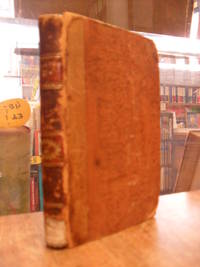
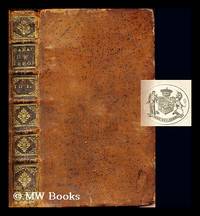
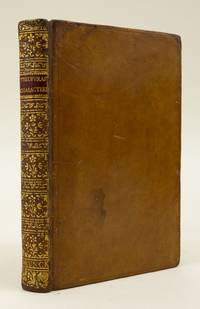
Leiden Lugduni Batavorum Ex officina Elseviriana 1640. 12mo. 1115 index1033 blank p. Modern boards. 13.5 cm Ref: STCN ppn 061216267; Willems 504; Rahir 499; Berghman 1285; Hoffmann 537/38 Details: Elsevier's woodcut printer's mark on the title depicting an old man standing in the shade of a vine-entwined elmtree symbolising the symbiotic relationship between scholar and publisher. The motto is: 'Non solus'. After the index at the end we find: 'Adolphi Vorstii Epistola de obitu V.Cl. Ioannis Meursii ad filium ejus Joannem iuvenem praestantissimum' followed by a short 'epitaphium' for Meursius by his friend A. Buchellius and an elegiac couplet of Nicolaus Heinsius Condition: Title page soiled and a small piece removed from the tip of its right lower corner. Small stamp on the title. 3rd leaf slightly soiled Note: The Greek scholar Theophrastus ca. 370-287 B.C. was a pupil collaborator and successor of Aristotle. He was a scientific researcher rather than a speculative philosophers. Only a small part of Theophrastus' output has been preserved or as Meursius observes at the beginning of this 'liber singularis' of 1640: 'paucis conservatis pleraque interciderunt' 'few works have been saved most have perished'. p. 5 The importance of classification runs through all his extant works including even the brochure known as the Characters' Charaktêres. This collection of 30 descriptive sketches of types of people exhibiting deviations from proper norms of behaviour is nowadays his most famous and most imitated work. § This title of 1640 is the only edition of the last work of the Dutch classicist and historian Johannes Meursius Johannes van Meurs 1579-1639. It consists of 2 parts the first of which p. 1/82 is on the lost works of Theophrastus. Meursius list here 234 works with sources and testimonia. The second part p. 83/111 contains notes and emendations by Meursius on a number of Theophrastus' extant works 'Ioannis Meursii Lectiones Theophrasteae in quibus eorum librorum qui supersunt loca aliquot emendantur'. § Meursius was professor of History and Greek in the university of Leiden from 1610 till 1620. He studied under the genius J.J. Scaliger and is best known for the 'editiones principes' of a number of Byzantine authors that he produced. Meursius' indefatigable labours concerned also the history of ancient Greece and especially Eleusis and the antiquities of Athens and Attica. Meursius laid with his works the foundations of much later learning Provenance: The stamp on the title is a crown with 7 pearls of a Dutch/German/Austrian baron Beneath the crown 2 intertwined initials 'C.C'. or 'C.D' Collation: A-E12 F6 leaf F5 verso and F6 blank Photographs on request hardcover
1802. Stéreotype d'Herhan 2.e Triage Paris Herhan = Oeuvres de La Bruyere Tome Troisième X - 1802 8°. LV 162 S. mit einem kleinen runden Titelkupfer Text: französisch Halbleder-Einband der Zeit mit zwei kleinen lederrückenschildern mit goldener Rückenbeschriftung der Rücken unten mit ca. 2 cm großer Randfehlstelle die Rückenkanten stellenz. leicht berieben sonst ein altersgemäß schönes sauberes Exemplar hhgla Abholung im Ladengeschäft in Frankfurt am Main Nordend ggü. Musterschule möglich. Das spart die Portokosten. Pickup at the store in Frankfurt am Main Nordend close to Musterschule is possible. It saves the shipping costs. unknown
A Paris: chez estienne michallet 1700. First Edition. Hardcover. Worn copy bound in full aniline calf with a leather gilt-blocked label to the spine. Some wear and tear to the spine and panel edges as with age. Provenance; library armorial bookplate with the motto 'sero sed serto'. Edition; Nouv. éd. augmentée. Physical description; 311 pages. Subjects; Theophrastus. Characters A Paris: chez estienne michallet hardcover
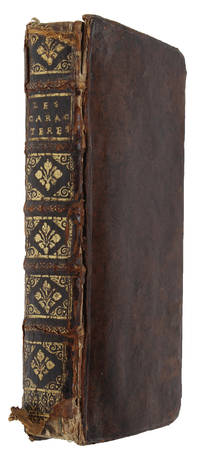
Paris Estienne Michallet 1688. Cont. full calf. 5 raised bands on back back richly gilt all edges of boards gilt. Lacking leather at capitals front-hinge cracked so cords are showing. <br/><br/><em>Second or third printing of the original edition. The title-page states "seconde edition" but it is probably the third printed in the same year as the first and second being a page-by-page re-impression of the second except for the fact that corrections have been made and the errata-leaf is thus not printed in the third. Both the second and third original editions are from the same year and by the same printer as the first. "La seconde édition également impr. en 1688 n'offre que quelques légers changements. et la troisième sous la même date ne qu'une simple réimpression de la seconde." Brunet III:720. This work includes the first French translation of Theophrast's Characters and probably the first translation into any modern language. "Theophraste a eu le grand honneur comme on sait d'être ttraduit au XVIIe siècle par La Bruyère: et c'est pourquoi en France plus que dans tout autre pays en dehors même du cercle des érudits son nom et son opuscule sont populaires." navarre Budé-edition of "Caractères" Paris 1920.Jean de la Bruyère 1639/1644 - 1996 was a very famous French moralist and writer. "C'est au commencement de 1688 que parut la premiere édition des "Caractères de Théophraste traduits du grec ou les Mæurs de ce siècle." L'auteur mettait ses propres observations sur la société moderne sous le patronage d'un ancien." N.B.G. p. 427. The "Characters" gave La Bruyère quite a few enemies and created furor in the learned world. In Denmark Holberg calls him "trivial and simple" Epistle 404. "Mais si en effet la malignité contemporaine applaudissant aux traits satiriques de l'ouvrage a peu contribuer à sa vogue le jugement de la postérité l'a consacré comme un des meilleurs livres de notre langue." N.B.G. p. 427. This work is thus still considered to be one of the greatest French books. Voltaire writes in "Siecle de Louis XIV c. XXXII": "On peut compter parmi les productions d'un genre unique les "Caractères" de La Bruyère. Un style rigide concis nerveaux des expressions pittoresques un usage tout nouveau de la langue mais qui n'en bless pas les règles frappèrent le public". Bruyère's work with the translation really did cause astonishment and had an immense impact on late 17th century Europe and onwards; it created a new literary genre in Europe and the age of Enlightenment was delighted with the short precise characterizations of people and their customs. For an analysis of the contents and the impact on the time of La Bruyère see Nouvelle Biographie Generelle N.B.G. pp. 426-39. Brunet V:798 III:721 Graesse 4:61. </em> hardcover
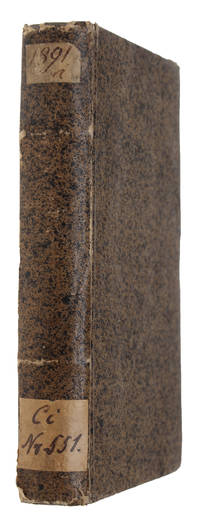
Paris Estienne Michallet Se vend à Bruxelles chez Jean Leonard 1688. Later ca. 1800 cardboardbdg. w. marbled peper. Library-labels on back. Hinges capitals and corners w. traces of use. Occationally brownspotted. 56 226 1 pp. <br/><br/><em>This is the reimpression of the original second edition with the words "Se vend à Bruxelles chez Jean Leonard" on title-page from the same year as the first original edition. "Cette réimpression assez belle a 28 ff. prélim. et 226 pp. de texte plus un f. pour le privilége; l'errata n'y est pas reproduit bien que les corrections qu'il indique n'aient pas été faites dans le texte." Brunet III p.720. This work includes the first French translation of Theophrast's Characters and probably the first translation into any modern language. "Theophraste a eu le grand honneur comme on sait d'être ttraduit au XVIIe siècle par La Bruyère: et c'est pourquoi en France plus que dans tout autre pays en dehors même du cercle des érudits son nom et son opuscule sont populaires." navarre Budé-edition of "Caractères" Paris 1920.Jean de la Bruyère 1639/1644 - 1996 was a very famous French moralist and writer. "C'est au commencement de 1688 que parut la premiere édition des "Caractères de Théophraste traduits du grec ou les Mæurs de ce siècle." L'auteur mettait ses propres observations sur la société moderne sous le patronage d'un ancien." N.B.G. p. 427. The "Characters" gave La Bruyère quite a few enemies and created furor in the learned world. In Denmark Holberg calls him "trivial and simple" Epistle 404. "Mais si en effet la malignité contemporaine applaudissant aux traits satiriques de l'ouvrage a peu contribuer à sa vogue le jugement de la postérité l'a consacré comme un des meilleurs livres de notre langue." N.B.G. p. 427. This work is thus still considered to be one of the greatest French books. Voltaire writes in "Siecle de Louis XIV c. XXXII": "On peut compter parmi les productions d'un genre unique les "Caractères" de La Bruyère. Un style rigide concis nerveaux des expressions pittoresques un usage tout nouveau de la langue mais qui n'en bless pas les règles frappèrent le public". Bruyère's work with the translation really did cause astonishment and had an immense impact on late 17th century Europe and onwards; it created a new litterary genre in Europe and the age of Enlightenment was delighted with the short precise characterisations of people and their customs. For an analysis of the contents and the impact on the time of La Bruyère see Nouvelle Biographie Generelle N.B.G. pp. 426-39. Brunet V:798 III:721 Graesse 4:61. </em> unknown
Amsterdam: F. Changuion 1754. . 2 volumes 12mo 18cm. Vol. 1: pp. viii487; vol. 2: pp. ii580 titles printed in red & black with small woodcut vignette. Contemp. quarter calf marbled boards backstrips with red lettering labels and some gilt line decoration fore- and lower edges uncut. Small clear waterstain to first few leaves of vol. II very good otherwise. Amsterdam: F. Changuion, 1754. hardcover
Perisse frères In-8 416pp. reliure pleine basane époque dos orné décor a froid sur les plats exemplaire de prix - collège de Juilly premier plat orné étiquette ex-libris faibles rousseurs éparses coins frottés unknown
Lugduni Lyon: Excudebat Guichard Julliéron apud Antoine de Harsy 1599. Editio Altera Second Edition; EDITIO PRINCEPS of books 24-28. 173 x 109 mm. 6 7/8 x 4 1/4". 12 p.l. 349 1 pp. 24 leaves.Edited by Isaac Casaubon. <br/> 18th century French polished calf smooth spine gilt in compartments with central floral sprig surrounded by leaf tools gilt lettering of owner's name Brunck at tail of spine red morocco label marbled endpapers older repairs to joints. Printer's device on title page. Text in Greek and Latin. Title page with ink ownership inscription of Bibliothèque Villelufpen and Richard Brunck; isolated ink marginalia in Hebrew Arabic Greek or Latin. Dibdin II 501; STC French 419; Graesse VII 125; USTC 158510. ◆A couple of short scratches and two small water stains to upper board shallow chip to head of spine leaves somewhat browned due to paper quality a couple of tiny rust spots but a very good copy clean and fresh internally in a sound binding.<br/> <br/> From the library of a notable--and perhaps notorious--classical scholar this is an important edition of the Greek philosopher's "Characters" with Isaac Casaubon's revisions to his translation and commentary of 1592 and the addition of five sections printed here for the first time that Casaubon had recently discovered at the Palatine Library. One of the earliest known works of psychology "Characters" contains pithy descriptions of the various types of human foibles noted by the Oxford Companion for their "remarkable vivacity and keenness of observation." A pupil of Aristotle and the master's successor as head of the school of Peripatetic philosophy Theophrastus ca. 371 - ca. 287 B.C. wrote widely on a number of subjects ranging from ethics to physics to botany he is considered the "father" of the last discipline. He would have considered these descriptions of such characters as "The Flattering Man" "The Stupid Man" and "The Oligarch" a minor work but it is one that has weathered the centuries. The present translation and commentary marked a milestone in the life of the great classical scholar Isaac Casaubon 1559-1614. Sandys says "It is not until we reach his commentary on the 'Characters' of Theophrastus 1592 that we find a work that is marked by his distinctive merit an interpretation of a text of the most varied interest founded on wide reading and consummate learning. It was a work that won the highest praise from Scaliger." Dibdin called the commentary "a rich mine of Grecian literature." Former owner Richard François Philippe Brunck 1729-1803 was a classical scholar of considerable note who devoted his leisure to the critical revision of the Greek poets. According to Britannica "He spent considerable sums of money in publishing editions of the Greek classics." Flaunting the established mode of editing and criticism he did not hesitate to make clarifying changes to difficult or inscrutable passages of text--whether these alterations were supported by manuscript authorities or not. Deprived of his royal pension by the French Revolution Brunck was forced to sell portions of his library in 1790 and again in 1801. Excudebat Guichard Julliéron apud Antoine de Harsy unknown

 ?????????
 ?????PDF???
 RSS feed
 ??
??