|
Spain; Ejercito; Artilleria
El Memorial de Artillería en el Cuarto Centenario del Descubrimiento del Nuevo Mundo Classic Reprint Spanish Edition
hardcover. Good. Access codes and supplements are not guaranteed with used items. May be an ex-library book. hardcover
Bookseller reference : 0666225958.G ISBN : 0666225958 9780666225955
|
|
|
SPARACO PIERRE
LES FLOTTES AERIENNES MONDIALES 2 - LES AVIONS BRITANNIQUES
GERARD & CO. 1959. In-12 Carré. Broché. Bon état. Couv. convenable. Dos satisfaisant. Intérieur frais. 155 pages. Nombreuses illustrations en noir et blanc hors texte.
|
|
|
SPARACO PIERRE
LES FLOTTES AERIENNES MONDIALES 2 - LES AVIONS BRITANNIQUES
GERARD & CO. 1959. In-12. Broché. Bon état, Couv. convenable, Dos satisfaisant, Intérieur frais. 155 pages. Nombreuses illustrations en noir et blanc hors texte.. . . . Classification Dewey : 358-Artillerie. Forces aériennes et spatiales
Bookseller reference : R110219301

|
|
|
Splett und Biermann
Die Fußartillerie. Ihre Organisation, Bewaffnung und Ausbildung.
Göschen, Bln. 1912. Mit 35 Abbildungen. Kl.-8°. 137 S. OLwd. Gutes Exemplar.
Bookseller reference : 47341
|
|
|
St. Pölten. - Lichtenstein. - Anton Leopold von Roschmann. - A. v. Portenschlag. - Karl Freyherr von Werner
Konvolut mit 3 Dokumenten. 1) Nro. 8172. Circulare. Ausfindigmachung eines entfremdeten Pferdes von Lichtenstein Husaren. St. Pölten den 3ten November 1807. Anton Leopold von Roschmann K.K.n.d.Regierungsrath und Kreishauptmann. Von dem k.k.n.d. Kreisamte im V.O.W.W. / 2) ...durch Lieferanten oder durch Stellung in Natura wo immer möglich ihre Pferde zu liefern, damit sie sich nicht noch mehrern Bedrängnissen aussetzen mögen. St. Pölten, den 14ten Oktober 1809. In Abwesenheit des Herrn Kreishauptmanns. A. v. Portenschlag, k.k.Kreiskommisär / 3) Circulare. Pferde-Diebstahlsmeldung eines Artillerietransports. St. Pölten, den 8. Dezember 1809. Karl Freyherr von Werner, k.k.n.d. Regierungsrath.
St. Pölten: 1807 und 1809. 32 x 20 cm. 3 OriginalBlatt mit Initiale. Blatt 1 mit einigen alten kleinen Tintenflecken. Blatt 3 mit altem Feuchtrand. Insgesamt gut erhalten.
Bookseller reference : 229014

|
|
|
Staff
Heroic Leningrad: Documents, Sketches and Stories of Its Siege and Relief
Book shows some wear, light brown spots to covers, pages lightly tanned but clean throughout, binding is solid and square, text/interior is clean and free of marking of any kind except as noted below, illustrated with 24 pages of black and white plates. 152 pages. Inside front cover and front end paper contains several inscriptions

|
|
|
Staff Of The Artillery School
JOURNAL OF THE UNITED STATES ARTILLERY VOLUME VI
Virginia: Artillery School Press 1896. First Edition; First Printing. Hardcover. Good in decorative boards. Owner imprint on title page. Front hinge cracked rear hinge starting. Rubbing along panel edges. Artillery School Press hardcover
Bookseller reference : 172368

|
|
|
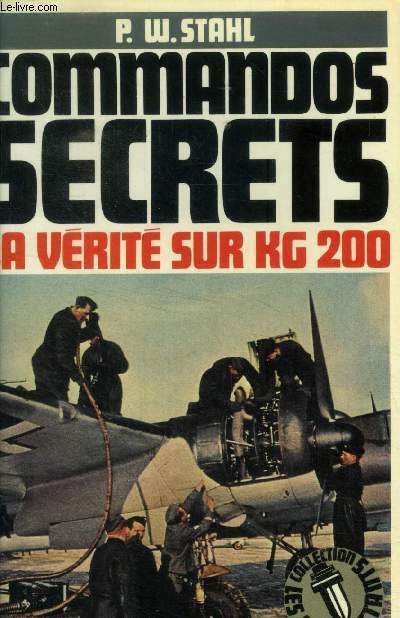
Stahl P.W.
Commandos secrets . La vérité sur le KG 200
Albin michel. 1983. In-8. Broché. Bon état, Couv. convenable, Dos satisfaisant, Intérieur frais. 264 pages - nombreuses photos, plans et fac-similés en noir et blanc dans et hors texte. . . . Classification Dewey : 358-Artillerie. Forces aériennes et spatiales
Bookseller reference : RO40024397
|
|
|
STAHL P.W.
COMMANDOS SECRETS- LA VERITE SUR KG 200
ISBN : 2226018581. ALBIN MICHEL. 1983. In-8 Carré. Broché. Bon état. Couv. convenable. Dos satisfaisant. Intérieur frais. 264 pages- nombreuses photos en noir et blanc hors texte Traduit par F Ponthier

|
|
|
STAHL P.W.
COMMANDOS SECRETS- LA VERITE SUR KG 200
ALBIN MICHEL. 1983. In-8. Broché. Bon état, Couv. convenable, Dos satisfaisant, Intérieur frais. 264 pages- nombreuses photos en noir et blanc hors texte. . . . Classification Dewey : 358-Artillerie. Forces aériennes et spatiales
Bookseller reference : R150196101
|
|
|
STENDENBACH, Heinrich Johann
Heinrich Johann Stendenbach (28. 5. 1887 - 9. 9. 1976). Tagebuch vom Krieg 1914 - 1918. Seiner Tochter Martha Dillmann, geb. Stendenbach (30. 1. 1926 - 8. 11. 2012) gewidmet und von seinem Engel Paul Dillmann (geb. 3. 7. 1957) herausgegeben.
(Privatdruck. Limburg im Mai 2916). 83 Seiten. Mit zahlreichen teils faks. Abbildungen u. Dokumenten. Auf Kunstdruckpapier. OKart.-Einband mit Titelschild. (Geringe Gebrauchsspuren). 30x22 cm
Bookseller reference : 138622

|
|
|
STEWART CHUCK
PILOTES D'AVIONS AGRESSEURS
ISBN : 2731212667. ATLAS. 1992. In-12 Carré. Broché. Bon état. Couv. convenable. Dos satisfaisant. Intérieur frais. 128 pages. Nombreuses photographies en couleurs hors texte. Traduit par François Pernot.
|
|
|
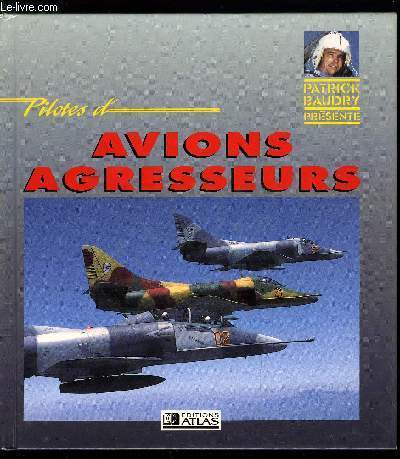
STEWART CHUCK
PILOTES D'AVIONS AGRESSEURS
ATLAS. 1992. In-12. Broché. Bon état, Couv. convenable, Dos satisfaisant, Intérieur frais. 128 pages. Nombreuses photographies en couleurs hors texte.. . . . Classification Dewey : 358-Artillerie. Forces aériennes et spatiales
Bookseller reference : R110219403
|
|
|
Stewart, Dr. H.L.; Booth, Ned; Roberts, T.G.; Breyfogle, W.A.; Du Bois, W.; Angus, M.I.; Bensley, M.; Cox, C.; Bayne, E.G.; Heck, AW2; Thompson, Frances; Winspear, M.
National Home Monthly Magazine, July 1943 - Garfield Weston / Pacific Coast Rangers
48 pages. Features: Cover portrait illustration of female member of the military; Ford ad inside front cover features action photo of troops constructing bridge under fire; Nice half-page colour Pepsi ad features naval officer in uniform and illustration of boys swimming; News of the month includes Dissolution of the Third International (Comintern), and Closing Ranks Against Japan; Editorial on Black Markets and Summer Vacations; Jet Black (short story); The Pacific Coast Rangers - photo-illustrated article includes photos of Lieut.-Col. T.A.H. Taylor, O.B.E., M.C., and Col. M.E. Dopping-Hepenstal; Matilda and the Wolf (short story); Key Men of War - an enormous directory of over 200,000 names is relied upon for expertise which has saved hundreds of lives and brought success to major campaigns; Garfield Weston - article with Karsh photo-portrait; Old-Style Cop (short story); Hollywood news - article with photos including Lenore Aubert; Northern Electric one-page ad features illustration of tank; Five to One (short story); Rare one-page two-colour illustrated ad for General Motors and their "Victory Service; R.C.A.F. half-page recruiting ad features lady in uniform having tea with civilians; Wings on Her Feet - first part of a series on AW2 Heck's experiences in the Air Force; One-page Westinghouse ad entitled "After Victory" includes photo of airman using bombsight and large illustration of large artillery piece in use; Woodbury Powder ad includes photo of beautiful Linda Darnell; "What's In My Lunch Box?" - wartime photo-illustrated article on home food tips; Colour Ritz cracker ad features illustration of naval personnel; Canadian Women Take to the Block Plan - photo-illustrated article explains the Women's Voluntary Service and the block leaders they assign, with particular attention to Mrs. Jack Wilson of Rochester Ave. in Lawrence Park in Toronto; Colour Orange Crush ad; World Sayings; Canadian Pacific Air Lines ad inside back cover includes large illustration of much of the northern hemisphere and heading "Wings over the North... and Beyond!"; Nice Kodak black and white photo ad on back cover shows air crew enjoying photos; and more. Unmarked with moderate wear. A quality copy of this excellent vintage wartime issue. Book

|
|
|
STJERNFELT, B.
Alerte sur le mur de l'Atlantique
1961 Editions Presses de la Cité - 1961 - In-8, cartonnage mauve sous jaquette illustrée en N&B de l'éditeur - 316 p. - Iconographie in et hors-texte en N&B
Bookseller reference : 108709
|
|
|
Stoops, HM Formerly of the Sixth Field Artillery AEF H M A E F
Inked Memories of 1918
LeRoy NY: The Jell-O Company Inc. Good copy cloth spine boards privately printed 30 pp 1 pp introductory text 15 B/W illustrations with text for each sketch . Good. Boards. 1924. The Jell-O Company, Inc. hardcover
Bookseller reference : 13825
|
|
|
Strada, Jacob de
Kunstliche Abriß, allerhand Wasser-, Wind-, Roß- vnd Handt Mühlen, beneben schönen vnd nützlichen Pompen, auch andern Machinen, damit das Wasser in Höhe zuerheben, auch lustige Brunnen vnd Wasserwerck, dergleichen vor diesem nie gesehen worden
... Nunmehr aber durch den Truck publicirt vnd an den Tag gegeben, durch Octauium de Strada à Rosberg ... Erster Theil (von 2). Mit gest. Titelbordüre von M. Merian, großem gest. Wappen von Balthasar Schwan u. 50 doppelblattgr. gest. Tafeln, davon 20 von Balthasar Schwan. Frankfurt am Main, O. de Strada u. L. Iennis, gedruckt von P. Jacobi, 1617. Folio (28,9 x 18,5 cm). 6 (l. w.) Blatt. Marmorierter Pappband um 1800 mit rotem Rückenschild. [13 Warenabbildungen]
Bookseller reference : 6206

|
|
|
STRANSKY (COMMANDANT)
ARMEMENT NUCLEAIRE
ECOLE DE L'AIR - ECOLE MILITAIRE DE L'AIR. 1989. In-4. Broché. Etat d'usage, Couv. convenable, Dos satisfaisant, Intérieur frais. 133 pages photocopiées augmentées de nombreuses figures en noir et blanc - Nombreux surlignements au fluo.. . . . Classification Dewey : 358-Artillerie. Forces aériennes et spatiales
Bookseller reference : R320061638
|
|
|
Strassburg - FRIEDEBURG von
1870 - Die Belagerung von Strassburg: Ein Vortrag gehalten in der militairischen Gesellschaft zu Berlin im Winter 1874 durch von Freideburg, Major im Generalstabe der 5. Division.
Berlin. Gedruckt bie Julius Sittenfeld 1875. 47 Seiten. Originalbroschur. (Gebrauchsspuren). 22x15,5 cm
Bookseller reference : 134674
|
|
|
Strassburg - WAGNER, Reinhold
Geschichte der Belagerung von Strassburg im Jahre 1870. Von Reinhold Wagner Hauptmann im Ingenieur-Corps. Auf Befehl der K. General-Inspection des Ingenieur-Corps u. der Festungen nach amtlichen Quellen bearbeitet. Erster Theil; Zweiter Theil; Dritter Theil - Erste Hälfte und Dritter Theil - Zweite Hälfte (somit komplett in drei Teilen in vier Bänden).
Berlin. F. Schneider & Co. (Goldschmdit & Wilhelmi) 1874 bis 1978. Vier Bände. 834 Seiten und 203 Seiten (mit den Beilagen 1 bis 59) u. mehrere Seiten "Inhaltsverzeichnis". Mit zusammen fünf, teils farbig lithographierten u. vielfach gefalteten Plänen (auf 6 Blättern) und drei lithographierten Ansichten auf drei Tafeln. Breitrandige, unaufgeschnittene Exemplare. Originalbroschuren. (Umschläge etwas fleckig. Ansonsten gutes Exemplar. Ohne den im "Dritten Theil" angegebenen "Atlas, enthaltend 10 Blatt Pläne u. Zeichnungen). 24x16 cm
Bookseller reference : 134670

|
|
|
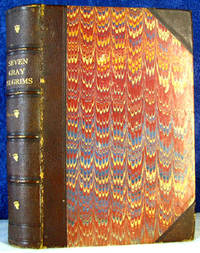
SUBALTERN OF ARTILLERY
The Seven Gray Pilgrims
Boston: A.Williams and Co 1874. First Edition . Hardcover. Very Good/No Jacket. 8vo - over 7¾" - 9¾" Tall. Slight Wear On Edge Of Spine. Marbleized Boards With Leather Spine And Corners. Marbleized Endpapers. Half-Leather. Light Shelfwear. <br/> <br/> A.Williams and Co hardcover
Bookseller reference : 132225
|
|
|
SULZBACH H.
With the German Guns. Four Years on the Western Front 1914-1918. Translated by Richard Tronger. Foreword by Terence Prittle. FIRST ENGLISH EDITION IN THE DUSTWRAPPER
8vo., First English Edition, with plates; cloth, a very good, clean copy in the dustwrapper, the latter lightly creased and frayed at edges. This classic memoir of the Great War was first published in Germany 1935; this is the first edition in English. Ironically the author fought for Britain in WWII. Enser, p.28 (recording the original edition)
|
|
|
Sumter Georgia Flying Artillery
WE THE UNDERSIGNED DO HEREBY TENDER OUR SERVICES SEPARATELY AND INDIVIDUALLY TO THE GOVERNOR OF THE STATE OF GEORGIA AS THE SUMTER FLYING ARTILLERY TO SERVE DURING THE ENTIRE WAR WITH THE UNITED STATES MAY 23 1861
Sumter County GA 1861. Manuscript document 7-1/2" x 25." Neat ink manuscript listing after the prefatory sentence quoted in our title 57 names in the first column and names 58-64 in the second column. Similar flourishes in the names suggest that at least many were written in an identical hand. The two columns are separated by a rule in manuscript. Old folds Very Good.<br/><br/> Allen Sherrod Cutts listed as Captain heads this list of 64 volunteers. Cutts raised this Battery of Artillery at the outbreak of the War. The Battery arrived in Virginia after the First Battle of Bull Run and saw action at the Battle of Dranesville. In 1862 Cutts expanded the Battery to a Battalion the 11th Georgia Artillery Battalion as its commander. <br/> Cutts was promoted to Major Lieutenant Colonel both in 1862 and colonel April 1864. The Battalion served in the Artillery Reserve of the Army of Northern Virginia under General Pendleton in the Seven Days Battles; and it fought at Antietam Fredericksburg Chancellorsville and Gettysburg. After the War Cutts entered politics as a Democrat was mayor of Americus-- the County Seat of Sumter County-- and a member of the Georgia General Assembly.<br/>Speicher THE SUMTER FLYING ARTILLERY 2009. Wikipedia article on Cutts. unknown books
Bookseller reference : 37603
|
|
|
SURIREY de SAINT-REMY Pierre
Mémoires d'Artillerie, où il est traité des mortiers, pétards, arquebuses à croc, mousquets, fusils, & de ce qui peut servir à l'exécution & au service de toutes ces armes ; des bombes, carcasses, grenades, etc. De la Fonte des Pièces, de la Fabrication du Salpêtre & de la Poudre ; des Pontons, des Mines, des Charettes & Chariots, des Chevaux, & généralement de tout ce qui dépend de l’Artillerie tant par Mer que par Terre ; de l’Arrangement des Magasins ; de la Formation des équipages & des Parcs à la suite des Armées & pour les Sièges ; de la Marche des équipages & leur disposition dans un jour de Comba ; la Manière de défendre les Places, & le Devoir des Officiers, &c. Par le Sr. Surirey de Saint-Rémy. Dernière édition, augmentée de nouvelles Matières et de plusieurs Planches
La Haye, Chez Jean Néaulme 1741 2 volumes in-4, plein veau fauve ép., dos à nerfs, caissons ornés, 10- XXIX- 7- 394- VI- 422 pp. Frontispice au burin par Jan van Vianen avec portrait en médaillon du duc du Maine, 6 vignettes en-tête, 5 tableaux repliés et 194 planches, pour la plupart repliées, dont quelques unes signées de Jean Lamsvelt. Reliure fanée : coiffes et coins usés, deux coins enfonçés en pied, un mors fendillée en tête et en pied. Néanmoins solide exemplaire à l’intérieur frais.
Bookseller reference : 53620

|
|
|
Surirey de Saint-Remy, (Pierre)
Memoires d`artillerie, ou il est traite des mortiers, petards, arquebuses a croc, mousquets, fusils, & de ce qui peut servir a l`execution & au service de toutes ces armes; des bombes, carcasses, grenades, &c.
Amsterdam, Mortier, 1702. 2 Bde. 9 Bll., 348 S.; 3 Bll., 386 S., 1 Bl. mit einigen Vignetten in Kupferstich. 1 Kupfer-Frontisp., 179 (teils gefalt, teils doppelblattgr.) Kupfertafeln und 7 gefalt. Tabellen. Gr.-8°. Blindgeprägtes Schweinsldr. der Zeit auf Holzdeckeln (berieben, leicht fleckig und bestoßen, die linke Ecke des hinteren Deckels von Bd. 1 alt ergänzt).
Bookseller reference : 10984

|
|
|
SURIREY DE SAINT-RÉMY (Pierre de)
Mémoires d'Artillerie. Où il est traité des mortiers, pétards, arquebuses à crocs, mousquets, fusils &c. & de ce qui peut servir à l'exécution & au service de toutes ces armes ; des bombes, de la fonte des pièces (..) & généralement de tout ce qui dépend de l'Artillerie tant par Mer que par Terre (..)
À Amsterdam, Chez Pierre Mortier, 1702 2 vol. in-4, [16]-348 pp. et [4]-386-[2] pp., front., pl., tableaux dépl., bradel demi-vélin ivoire (rel. du XXe siècle). Bon exemplaire.
Bookseller reference : 144784
|
|
|
SUSANE (Louis)
Histoire de l'ancienne infanterie française. Atlas.
Paris, Corréard, 1856 petit in-4, 151 planches, bradel demi-percaline verte à coins (rel. de l'époque). Ex-libris Merillon et Roger Magadoux.
Bookseller reference : 220068
|
|
|
SUSANE (Louis)
Histoire de l'artillerie française.
Paris, Hetzel et Cie, 1874 in-12, 444 pp., demi-basane rouge, dos lisse, filets dorés (rel. de l'époque).
Bookseller reference : 143110
|
|
|
SWEETMAN BILL, GUNSTON BILL
ENCYCLOPEDIE DE LA FORCE AERIENNE SOVIETIQUE
ISBN : 2800303360. ELSEVIER SEQUOIA. 1979. In-4 Carré. Relié, Jaquette. Bon état. Couv. convenable. Dos satisfaisant. Intérieur frais. 191 pages. Nombreuses illustrations en couleurs dans et hors texte. Adaptation française de Philippe Grasset.
|
|
|
Tanks; Aircraft; and Artillery
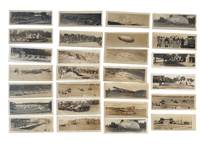
Visual Record of U.S. Army Transition to Armored and Air Power Through Fort Lewis Training Imagery circa 1930s
1930. Boland Marvin D. panoramic photograph archive circa 1930s documenting U.S. Army modernization at Fort Lewis Washington with emphasis on mechanization motorized transport and the expansion of Army Air Corps operations during the interwar period. The material identifies military training exercises mechanized equipment deployment airfield operations and communications infrastructure associated with evolving doctrines of mechanized warfare and air power following World War I. Tanks aircraft transport vehicles barrage balloons and portable radio systems appear throughout coordinated training environments at Fort Lewis.<br /> <br /> Archive comprises 24 silver gelatin panoramic photographs each approximately 7 x 2.5 inches signed "Boland" and produced by Tacoma-based photographer Marvin D. Boland. The photographs depict a range of military activities and equipment at Fort Lewis including formations of biplanes in flight parked aircraft aligned on airfields and a monoplane bearing U.S. Army Air Corps insignia. Several photographs show coordinated aerial exercises and tethered barrage balloons prepared by ground crews. Ground operations include M1 Combat Cars of the 41st Tank Company arranged in formation as well as tanks navigating uneven terrain and obstacle courses under observation. Additional scenes document convoys of transport trucks military ambulances and logistical vehicles. Training activities include soldiers marching in formation constructing field fortifications from stacked logs and operating portable radio equipment. Temporary tent encampments appear throughout indicating mobile training environments and field readiness exercises.<br /> <br /> The photographs record a transitional phase in U.S. military history as the Army expanded beyond traditional infantry tactics toward integrated mechanized and aerial warfare capabilities. Fort Lewis served as a major training site following the establishment of its airfield in 1930 supporting aviation units later active during World War II. The archive concentrates on operational training military infrastructure mechanized transport and aerial coordination during the interwar period. Minor curling and light edge wear; overall very good condition. A visual record of interwar military training mechanization and Army Air Corps development at Fort Lewis. unknown
Bookseller reference : 21568
|
|
|
Taube, Gerhard
Deutsche Eisenbahngeschütze.
Stuttgart, Motorbuch Verlag, 2021, 2017.
Bookseller reference : 254624

|
|
|
Taube, Gerhard
Die schwersten SteilfeuerGeschütze 1914-1945. Geheimwaffen 'Dicke Berta' und 'Karl'.
Stuttgart: Motorbuch 1981. 157 S, zahlr. Abb. Kart.mS. *gutes Expl.*.
Bookseller reference : 279460
|
|
|
Taube, Gerhard
Eisenbahngeschütz DORA. Das größte Geschütz aller Zeiten. 2. Auflage
Stuttgart, Motorbuch Verlag, 1981.
Bookseller reference : 250819

|
|
|
Taube, Gerhard
Eisenbahngeschütz DORA. Das größte Geschütz aller Zeiten. 1. Auflage
Stuttgart, Motorbuch Verlag, 1979.
Bookseller reference : 253690

|
|
|
Taube, Gerhard
Waffen-Arsenal - Band 130: 500 Jahre deutsche Riesenkanonen,
Friedberg, Podzun-Pallas Verlag, 1991. 4°, 47 S. mit zahlreichen s/w-Abbildungen, farbig illustr. original Heft, Erstausgabe auf Innenseite des Rückdeckels unten am Rand ein Mängelexemplarstempel, sonst schönes, sauberes Exemplar (vo3)
Bookseller reference : 11836CB

|
|
|
Tausch, Georg von
Beitrag zur Beantwortung der Frage: Welches ist der zweckmäßigste Kaliber für die Infanterie Feuer Gewehre ? Deutsche Handschrift auf Papier, 91 beschriebene Seiten, 2 weiße Blatt.
München, 1802 / 04. 8° (ca. 18 x 22 cm), orange Pappe der Zeit, etwas Rückenvergoldung, verg. Deckelfileten.
Bookseller reference : 18453
|
|
|
TAYARD CHRISTIAN-HENRI
LE JAGUAR : AVION D'APPUI TACTIQUE ET D'ECOLE DE COMBAT FRANCO-BRITANNIQUE
TOURET. VERS 1975. In-8. Broché. Bon état, Couv. convenable, Dos satisfaisant, Papier jauni. 8 pages. Quelques illustrations en couleurs et noir et blanc, dans et hors texte.. . . . Classification Dewey : 358-Artillerie. Forces aériennes et spatiales
Bookseller reference : R200082521
|
|
|
TAYLERSON, A.W.F
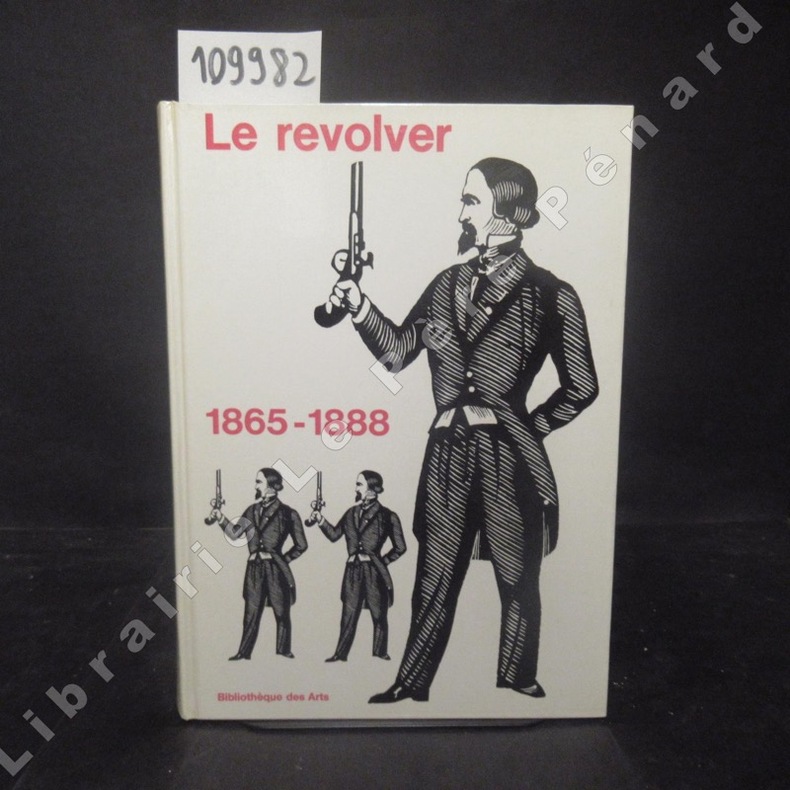
Le revolver, 1865-1888
1968 Editions Bibliothèque des Arts - 1968 - Petit in-4, cartonnage illustré - 281 p. - Reproductions photographiques en N&B hors texte
Bookseller reference : 109982
|
|
|
TAYLOR MICHAEL
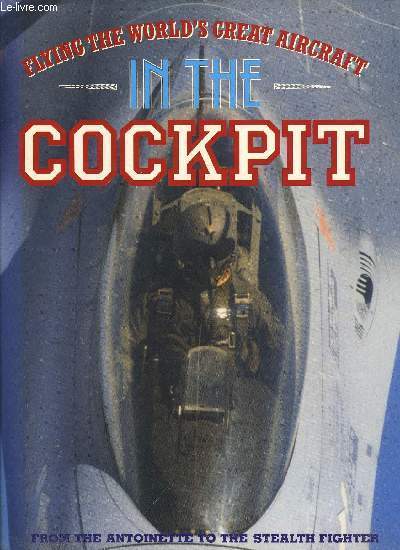
IN THE COCKPIT FLYING THE WORLD'S GREAT AIRCRAFT
ISBN : 1555217435. CHARTWELL BOOKS. 1991. In-4 Carré. Relié, Jaquette. Bon état. Couv. convenable. Dos satisfaisant. Intérieur frais. 320 pages. Nombreuses illustrations en couleurs et noir et blanc dans et hors texte. Ouvrage en anglais.
|
|
|
TAYLOR MICHAEL
IN THE COCKPIT FLYING THE WORLD'S GREAT AIRCRAFT
CHARTWELL BOOKS. 1991. In-4. Relié. Bon état, Couv. convenable, Dos satisfaisant, Intérieur frais. 320 pages. Nombreuses illustrations en couleurs et noir et blanc dans et hors texte.. Avec Jaquette. . . Classification Dewey : 358-Artillerie. Forces aériennes et spatiales
Bookseller reference : R110219510 ISBN : 1555217435
|
|
|
Terrainzeichnen - PILA, F
Planzeichnen, theoretische und praktische Anleitung zum Terrain- und Situationszeichnen mit Berücksichtigung der Terraindarstellung durch Aschattirung unter senkrechter und schräger Beleuchtung nebst historischen Notizen über die Entwicklung des Bergzeichnens und einem Anhange über Zeichnen-Utensilien und Materialien. Für Militairschulen und zum Selbststudium. Von Pila, Feuerwerkslieutenant.
Berlin. Verlag von A. Bath 1880. XIII, 191, (1) Seiten und 8 (von 9) gefalteten u. lithographierten Tafeln mit zahlreichen Abbildungen. Halbleinwand-Einband der Zeit mit marmorierten Deckeln. (Tafel 6 fehlt! Drei Tafeln hinterlegt u. repariert. Teils mit geringeren Gebrauchsspuren). 21x14 cm
Bookseller reference : 133414

|
|
|
The Artillery Sub-Section The General Service The General Service Schools
Tactics and Technique Artillery VOLS. I & II
Fort Leavenworth KS: The General Service Schools Press 1922. TWO VOLUMES. Boards moderately edgeworn. Very little pencil marginalia. ERRATA pages present for both volumes. Folding maps and charts. Three maps in rear pocket of Volume II. A clean and sound set Careful packing and fast efficient shipping including delivery confirmation. Please note: International and Domestic Priority orders for this item will require additional shipping. Hardcover. Very Good/No Jacket. The General Service Schools Press Hardcover
Bookseller reference : 35890
|
|
|
The Coast Artillery Board
Heavy Artillery Materiel Coast Artillery Corps U.S. Army Part I
Journal U.S. Artillery 1941. Hardcover. Good. . Scarce. Textured green cloth boards. Some shelf/age wear. Pages clean. Journal U.S. Artillery hardcover
Bookseller reference : mon0003242931
|
|
|
The Editor
The 303 Lewis Gun
Appears unread. No marks or inscriptions. No creasing to covers. A very clean very tight copy with bright unmarked boards, traces of storage and no bumping to corners. 48 + 28pp. The American invented Lewis gun saw service in the British Army in both World Wars in calibre 0.303inch. The two manuals (the official British Army pamphlet and a privately published booklet) in this reprint give details of the gun and its stripping, assembly, handling and tactical use. With ample illustrations, anyone can now understand the weapon. Very scarce.

|
|
|
The Great War: Royal Army Medical Corps; Captain William John Henry MB ChB; British Army; Royal Garrison Artillery; Wiltshire Re
The Great War Royal Army Medical Corps: A Medical Officer In Charge on the Western Front. Typescript of Diary of Captain William John Henry describing his service attached to the Royal Garrison Artillery Wiltshire Regiment and Rifle Brigade.
Vols 1-3 cover the period 27 August 1915 to 12 July 1916; Vols 4-8 the period between 31 January 1918 and 7 June 1919. On the Western Front in France with leave in Britain. It is hard to do justice to this vivid informative and well-written 250000-word account of the author's First World War service as Medical Officer In Charge attached to three regiments on the Western Front present during the Battle of the Somme Kaiserslacht and Hundred Days Offensive. It is hard to conceive of a better account of the day-to-day activities of a member of the Royal Army Medical Corps on active service during the Great War. The author is observant intelligent and diligent in his duties which involve attending to the wounded being called to certify deaths at all hours of the day or night doing the rounds of the wounded holding sick parade the supervision of field ambulances and the maintenance - and on one occasion the construction under fire - of aidposts. He discusses the conduct of the war describing in detail how he and his colleagues are informed about the forthcoming Battle of the Somme; and discusses the armaments and vehicles involved there are a number of references to the war in the air and describes as a medical man of the effects of poison gas reveals the comments made by a German officer while under interrogation following the capture of a German patrol a 'stunt' which wins the DSO for his colleague Lieut. J. J. Tynan see his 1948 obituary in the Irish Times. He pokes repeated fun at his corps commander ‘Hunter-Bunter’ i.e. Sir Aylmer Gould Hunter-Weston see Oxford DNB and describes 'our review' by Kitchener and the Prince of Connaught. The environment and everyday privations of active duty are described with occasional use of army slang and there are frequent reference to the tangled maze of trenches whose features are named to evoke life back home Edgware Road Kings Road Winchester Street Tube Station Chocolate Corner the Covered Way. Instances of German subterfuge are also described the writer not being well-disposed towards ‘the hun’ ‘bosche’ and ‘Fritz’. There is much gossip and small talk and description of pastimes sightseeing and entertainment while waiting for demobilization he purchases a piano and forms a ‘jazz band’. with mention of his activities while on leave in England. The weather is assiduously described sometimes in eloquent terms 15 March 1916: ‘A damp drizzly morning blossomed into a grand day’ and 30 March 1916: ‘The huns abused this beautiful warm morning by commencing early to shell the Rue de Bois just behind our H.Q.’. There are notes on terrain and other matters and a number of transcriptions of official documents and some statistical tables including two pages of ‘Operation Orders for Gas Beam Attack’ in June 1918. He writer’s attitude to the ‘jolly old war’ is surprisingly positive on demobilization. The eighth and last volume ends with an ‘Envoi’ summing up his feelings regarding his experiences in which he expresses regret that ‘the war is won and done’ stating that it was something he ‘would not have missed for anything’ and noting that the ‘periods of intense activity more than compensated for the monotony and boredom. It caused me to meet and to live with all sorts and conditions of men under all sorts and conditions of environment from the magnificence of the Chateau de Selincourt to the misery of the front line trenches in mud and shellfire where one had to trample over the bodies of dead comrades sometimes inevitably over even the faces of men dead but a few moments men one had seen and talked to day by day to reach a spot ahead where lay ones work the patching up of torn bodies of those still alive. At times it has been ghastly but the ugliness the sordidness the discomfort hunger gas death all these miseries fade from the memory in time from the conscious memory at any rate’. He feels that when most of the survivors have scattered those who are left in the army will soon be ‘seniors looked to for advice and direction by a younger generation who have not had the - to them - enviable experience of serving during the war just over’. His experiences have made little difference to him from a medical point of view: ‘If they are sufficiently sick or wounded to be interesting professionally they are bad enough to require immediate evacuation for hospital treatment. But by being thrown into the company of and being brought in contact professionally and otherwise with all manner of people my knowledge of human nature at least has been extended to a degree that would be impossible in even a lifetime of civilian practice’. The diary is certainly unpublished and no reference to it has been discovered let alone to the original from which it was transcribed. From the condition and appearance of the typescript and the design of the manuscript map by which it is accompanied one would guess that it is a near-contemporaneous transcript in all probability by the diarist himself who may well have destroyed the original as was the practice at the time. The author does not identify himself but internal evidence indicates that he is William John Henry M.B Ch.B graduate of Glasgow University who enlisted in December 1914. The diary begins on 27 August 2015 with Henry having completed his basic training leaving Taunton for Southampton where he embarks on the troop ship the SS Karnak bound for the western front where as a Temporary Lieutenant he serves as Medical Officer attached to the 28th Siege Brigade Royal Garrison Artillery until the beginning of 1916 when promoted to Temporary Captain he exchanges with the 6th Battalion the Wiltshire Regiment he gives his ‘Reasons’ in the entry for 28 January 1916. There is a hiatus in the diary between mid-July 1916 and the beginning of 1918 presumably covering his recuperation from an injury reported in the press see below. By the time of his journey back to France on board the SS Onward in February 1918 Henry has exchanged once again this time with the 11th Battalion Rifle Brigade with which he serves until his demobilization in June 1917. On 15 January 1916 the British Medical Journal reports Henry’s promotion from Temporary Lieutenant to Temporary Captain; and on 4 January 1919 ‘Temp. Capt. W. J. Henry’ features in the same journal among the 8 November 1918 list of those mentioned in despatches. There is a report of Henry’s injury in the Roman Catholic newspaper the Tablet on 5 August 1916: ‘The following names are of wounded officers :— . ‘Captain William J. HENRY M.B. R.A.M.C. attached 6th Wilts R.’ Another report in the RAMC Journal December 1916 gives a few biographical details: ‘Captain William John Henry R.A.M.C. wounded graduated as M. B. and Ch. B. at Glasgow in 1913. He joined the R. A. M. C. as a temporary Lieutenant on 16th December 1914 and became Captain after a year’s service. He was attached to the Wiltshire Regiment.’ There is a similar report in the Glasgow Medical Journal. In 1919 the RAMC Journal contains a reference to ‘W. J. Henry MB attached 11th Battalion Rifle Brigade’. Henry’s identity as author of the diary is confirmed by the entry of 21 January 1916: ‘We had another very enjoyable musical evening with the two Mademoiselles Henry - of all names - of Jacks billet and we parted finally with the best of good wishes. He hopes to have leave soon and I do not expect I shall see him for a long time. As it turned out I ever saw him again. He was killed on the Somme in August 1916. R.I.P.’ Henry does not give much away about himself in the diary: he is a Scot on 24 October 1918 he refers to ‘we Scotsmen’ from the neighbourhood of Glasgow on 28 April 1919 he declares ‘Gartloch is near home’ and a Roman Catholic whose birthday is on 2 October. Each page of the typescript is printed on a separate leaf with a manuscript map in red and black ink on the reverse of one leaf. The numbering of the eight volumes is a typed part of the original text with vols 1-3 covering the period 27 August 1915 to 12 July 1916; and vols 4-8 between 31 January 1918 and 7 June 1919 see above. A total of 345pp 4to closely-typed and single-spaced with around 56 lines to a page. Complete but for six pages missing in vol.3. Paginated in manuscript 1-348 as follows: Vol. 1 pp.1-50: 27 August to 7 December 1915. Vol. 2 pp.51-120: 24 December 1915 to 21 April 1916. Vol. 3 pp.121-177 lacking pp.166-171: 22 April to 12 July 1916. Vol.4 pp.178-221 with unpaginated conclusion on slip cut from top of p.222: 31 January to 13 May 1918. Vol.5 pp.222-250 with two pp.233 and map in red and black on reverse of final leaf: 14 May to 15 July 1918. Vol. 6 pp.251-277: 16 July to 5 September 1918. Vol.7 pp.278-333 with two pp.333 and mispagination making leap from 322 to 324 but with no text lacking here: 22 September 1918 to 28 March 1919. Vol.8 pp.334-348: 15 April to 7 June 1919. Each page is typed on separate leaf with a blank reverse except for p.250 which has the manuscript map in red and black on the reverse of its leaf. Each of the eight sections has its leaves attached with a brass stud. As stated above six pages are lacking and damage to the first leaf has resulted in loss of a few words of text at the beginning of the first entry; a handful of leaves are detached with some creasing and in one case loss to two or three words in a corner; otherwise the paper is aged discoloured and a little worn at the edges but in fair condition with the text entirely legible. The following extracts are an arbitrary selection of the mass of interesting and informative material contained in the eight volumes. Beginning with Henry’s first arrival in France we find him thrown into the thick of it. He writes on 18 February 1916: ‘I slept none too well on this my first night in the trenches. This quietness was all the more remarkable because we had a man killed of D coy by a shot through the head. His condition was so apparent that they did not need to waken me to verify the fact but sent him straight to the shed used as a mortuary near to the cemetery about a quarter of a mile away.’ And the following day: ‘I resumed my tour of inspection and presently a whiz-bang arrived about ten yards away and in bursting it splattered me all over with mud. I wandered on to D coys mess dugout and had tea with Tanner Williams Garthwaite Whitlock and Shapland. There was a lot of quite ineffective bosche sniping going on all the time and Tanner showed me the country around through some periscopes of different sorts and I had a good look at the front of our own line as the hun sees it from a projecting bit of the front line called the “Bird-cage walk†and a massive structure of sandbags it looked.’ Nine days later 27 February he gives a long account of a visit to the soon-to-be-destroyed church at La Gorgue. Earlier in the month 11 February 1916 he gives a description of ‘our review by Lord Kitchener’: ‘K. came along accompanied by Prince Arthur of Connaught with his club foot limp General Monro of the 1st Army and General Bridges commanding the 19th Division. They walked down the line followed by a huge staff and at a greater distance still by a great fleet of motor cars. K. looked enormously Big and burly and seemed in excellent condition. Prince Arthur with his pronounced limp seemed rather hard pressed to keep up the pace for K. with his great long legs made the pace down the line an uncommonly smart one. Unfortunately one cannot see all that one might when the order is “Eyes Front†and as we were trying to look like soldiers we had to stand still much as we would have liked to turn round. We came off parade almost as soon as they had entered their cars and I changed out of the wettest of my things and spent the rest of the evening working out mess bills.’ On 2 March 1916 complains about the mess: ‘The mess here is not particularly satisfactory.’ On 16 March 1916 he evaluates his new mess-mates after stating ‘That single whiz-bang proved more important than I imagined at the time. It satisfied the hun that he had my aidpost “taped†as we call it and he could strafe it at any time he wished without further registration and this he did later in his own good time. . Turner and Gibbs are very childish and grouse about everything or about nothing at all all day long. Lefroy is variable and uncertain while Pritchard is an ex-Guards ranker and is very N.C.O. -like in every way yet he is infinitely to be preferred to the other two. Capt. Smith however is a really splendid man and he almost redeems the mess by his personality.’ On 17 March 1916 he goes off ‘with Bambridge to explore the front line. We tried one trench but it bore away to the right across the La Bassee Road and finally became full of water so we turned about and tried another bearing to the left and it took us to Port Arthur Keep a trench with sides about three feet high and mud about two feet deep. I did a sanitary inspection of Port Arthur which is a reinforced farm house in the midst of a system of trenches and parapets. We left by another and a better trench which took us into Hun Street by which we reached the front line. . Tydmarsh or Tiddles as we called him was in good humour and showed me all sorts of things through periscopes and I had a shot at a hun with a telescopic rifle being probably quite unsuccessful. Then I had a look though a telescope from a snipers post a loophole in the parapet.’ On 21 March 1916 he experiences a heavy enemy bombardment: ‘What an ass I was to write that sentence about the quietness prevailing ! ! ! I had scarcely finished it when the hun started a furious bombardment of the Cheshires to our left and of Neuf Chapelle. From 12 till 1 the air was alive with shells of every kind. Shrapnel bust in mid air with a white puff of smoke and a smokey parabolic trail followed by a most vicious bang. Heavy crumps sang their way along landing with a great cr-r-r-ump throwing up clouds of earth and smoke two to three storeys high. Universal shells containing high explosive and shrapnel mixed were bursting low in the ai with a horrible huge red flare volumes of black smoke and a deafening roar. Nothing of all this fell on our battalion front though hundreds of shells went over and the Cheshires who got it all had only 20 hit and of them only 1 killed. At one point I saw a huge felled tree trunk lifted a good six feet off the ground and fall again. Our brigadier and brigade major were going round our front line at the time and teh show began just before they left our line for the Cheshires. The retaliation of our guns to all this was feeble to a degree.’ During the same month he supervises the building of an aidpost. On 28 March: ‘About 11-15 the hun sent over about twenty whiz-bangs at H.Q. but failed to hit any of our men and of course they were about 250 yards from where the aidpost work was going on. The afternoon was bright but cold with a high wind which quickly dried up the place. No retaliation was asked for the morning shooting as they were only whiz-bangs - 77mm high velocity shrapnel and H.E. field gun shells - and anyhow we probably would not have got any as the gunners are restricted to four rounds per gun per day and they have to account strictly for these four. During the afternoon the aidpost work went well but had to be interrupted for half an hour while the hun shelled us. They gave our working party 12 whiz-bangs all to themselves and scored one direct hit on the derelict house within which the aidpost is built. One huge chunk of shell came plunging through a sheet of corrugated iron with which we had filled a great hole in the wall to protect from the weather the sandbags we were putting up inside but no one was hit. I decided that the huns could see us at work filling sandbags so I found another place where the men were better concealed.’ On 5 April 1916 after a report of an attack on Chocolate Corner: ‘I knocked my people off work and strolled along to H.Q. Here I was telephoned for by the padre to go to Tube Station to see a man who was wounded so I got my corporal Braithwaite and off we went to see the unfortunate. He had a large hole in his head caused by a snipers bullet and a large piece of brain was protruding and he showed signs of a fractured base as well. I tinkered him up and stimulated him with everything I had and got him away as quickly as possible. Then I sent my corporal home and stayed to lunch with Eldred the Padre Matthews and Hunter and Tynan came along later. We had a merry meal’. Also in April a colleague Lieutenant J. J. Tynan pulls two ‘stunts’ for the latter of which he recieves the DSO. The account of the first is given on 8 April 1916 after a description of cases he has had to deal with: ‘After lunch the C.O. told me that he wanted me and my two orderlies to wait behind after the relief tonight as Tynan was going to do a bombing stunt the same one that he was prevented doing by the presence of the large hun working party last night. Tonight he is going to kill the huns in the listening post or to capture them if possible. The listening post is an old bosche communication trench extending between their line and ours the post being about 30 yards in front of their parapet. If the working party is out again he means to bomb down the trench and kill as many as he can.’ The mission is described with Tynan throwing a ‘Mills grenade which burst and killed one hun outright.’ He carries the ‘heavy hun for more than a hundred yards then three of the scouts took him over. A great strapping hun he scaled over 14 stones and much useful information was obtained from him dead though he was. As it turned out the other hun lost himself in the fog and taking the wrong direction he came up to our parapet and was made a prisoner later in the night. . The dead hun proved to belong to the 46th Reserve Jaeger Regiment’. The second of Tynan’s ‘stunts’ for which he will win the DSO takes place on 12 April 1916 and Henry’s account is headed ‘Capture of a German Patrol’ and involves Tynan and twelve scouts. Henry reports the result of the interrogation of the German officer: ‘He expects Verdun to fall in a month and that then the French will break up and the war will finish with a huge German victory. He considered that the English were not soldiers at all but that all Germans were and Tynans suggestion that one Englishman was as good as three huns was answered by a shrug of the shoulders. Regarding the treatment of British prisoners in Germany as described in the Daily Mail he declared it to be a one-sided account and maintained that they had lots of food and football. The officer had been fighting since 1914 and wore the Iron Cross; a question as to how he had obtained it was answered by the one word “braveryâ€. What impressed Tynan most was the obvious patriotism that the man showed and his keenness as a soldier. On the whole he was very favourably impressed by his captive.’ The ‘exploit’ reaches ‘one step higher than his listening post adventure had done’ with the Divisional General sending the message ‘Well done the Wilts! Bridges Major General’. The entry for 1 June 1916 gives a good example of his duties. After holding a sick parade of only fourteen men and returning to his billet to enter up his ‘sick chart’ he ‘wandered to D coy but found no one up yet. At 9 oclock King Parsons and I held a board of inspection on the S.B.Rs. small box respirators of the battalion which took us till 9.4. We found there was not enough rubber sponge material round the goggles to make them gas-tight and not enough padding under the chin for the same purpose. Then I wandered down to H.Q. Quarter-master-sergeants C.Q.M.Ss. about the parafin soap. . After initiating the C.Q.M.Ss. into the mysteries of making the parafin soap I went off on a water hunt. I rode out past B company and about 1 1/4 miles away I found a stream that the C.O. had mentioned yesterday. I came back by Dracourt where brigade H.Q. are and got home about 12.30 after a lovely ride through a beautiful avenue of trees. . The padre Davis and I had tea by ourselves in the garden’. On 23 June 1916 without any previous hint he receives a briefing regarding the forthcoming ‘push’ which is to start the Battle of the Somme. The entry begins: ‘About 10 oclock this morning after sick parade Colonel Johnson D.A.Q.M.G. deputy assistant quarter-master general of the 19th Division came along with two huge plans in relief of the ground over which we are to fight and he gave a most interesting general outline of the whole scheme especially as it affected our division.’ The entry gives a ‘summary’ of Johnson’s ‘discourse’ in ten numbered parts including ‘5th. The artillery preparation will be phenominal sic most careful and thorough’ ‘6th. The advance is to be most carefully regulated and there is to be no going “as far as possible†- as at Loos - but only to definite objectives’ and ‘10th. That aeroplanes are to control the advance by light signals of various kinds’. He continues: ‘A good part of the rest of the day was spent in marking our lines of advance on our trench maps and in completing as far as possible my preparations. There are rumours that the bombardment is to start tomorrow. In the early afternoon there was a violent thunder-storm in the course of which we were interested to see one of our sausages behind our camp calmly break its moorings and whisk away into the clouds making as it appeared straight for the bosche lines. He later reports that it is unmanned and ‘came to earth at Senlis’ Many of our mens bivouacs were washed away by the torrents of water pouring down the hillside. The mess tent was ankle deep’. The following day he goes with Padre Davis ‘up the hill behind the camp whence we had a splendid view of the bosche lines and of a lot of our shells bursting upon them but they were only small stuff. After dinner there was a glorious sunset and as it got darker we admired the spectacle of the flashes of our guns and of the bursting shrapnel over the bosche lines. One curious feature of the configuration of the country here is that scarcely a murmur is to be heard at the camp of the noise of the guns . quite diferent from Flanders and probably due to the hills around. The bombardment proper is expected to start tomorrow. . The guns on our front are now so numerous that they say that each battery will have to deal with only about 30 yards of front - some concentration surely - and with unlimited ammunition at that!!!’ The following day 25 June 1916 ‘some of our heaviest guns started shooting 9-2 12 and 15 inch. . A terrific strafe arose which lasted for an hour. We shelled Contalmaison to pieces and then the guns turned to other targets. The hun retaliated with a lot of heavy stuff on Albert and shrapnel too. We had a splendid view of all this from the camp and the reverberating crashes of the bursting 5-9s in the town and the clouds of smoke and brick dust were colossal while any empty spaces in the air seemed to be filled with bursts of shrapnel and of high-explosive-shrapnel universal shell. It was a very noticeable fact at this time that a German aeroplane was never to be seen. Our lines were so thoroughly patrolled by our flying men that the hun did not have a chance.’ Preparations include ‘thousands of motor lorries that passed in an unending stream up and down the Albert Road’. He reports the ‘persistent rumour that the hun has evacuated his front line and is taking up his position in his second line leaving only some trench mortars and machine guns in front. If this be true then our artillery preparation will be wasted’. The five corps making up the 4th Army from north to south are these; the 10th 3rd 15th 13th and 8th. The 34th Division whih is holding our front line here has on its right the 21st Division then the 32nd then the 36th both of the 10th Corps. . An interesting point Col. Johnson mentioned on Friday was that it is known that the hun has only five spare divisions with which to reinforce his front against our pushing army. To lunch we had two friends of Major Thynnes from the 15th corps on our right but they had little to tell us that we did not already know.’ The following day he acquires ‘a Tommys tunic from Harris’ and has his ‘start sewn on the shoulder straps and also two big new pockets inside. So I now have a complete Tommys outfit boots tunic belt steel helmet and hose tops as per regulations for all officers going into action must have and wear Tommys uniform as they would stand out too prominently and offer too good a target in their own distinctive gear. The colonel had ordered me to wear my red cross armlet or brassard. . As it turned out it was a bad thing for it offered an excellent target to the hun and was the chief cause of my being knocked out later.’ He describes a ‘conference for company commanders’ called by the commanding officer who has ‘just got back from a pow-wow at Brigade himself’ outlining ‘two possible lines of attack that had been mentioned at the C.O.s conference’ ‘As usual he found the Army staff people exceedingly sanguine. They always are before a show. They were so before Loos.’ ‘If what the Army Staff looks for comes about the 34th Division will reach not only their own objectives but ours as well so slight will be the opposition after the bombardment. Then our division will act as advance-guard of General Goughs 5th Army a mixed force of cavalry and light infantry and we shall march up the Bapaume Road in columns of four and billet for the night in Pozieres. On the eve of the battle he writes: ‘We all regard the Bapaume business as a myth.’ But the colonel scoffs at all this and declares that we shall much more probably be employed in helping the 34th Division to take their objectives which are only half way to our own objective - Besantin le Petit.’ On 29 June: ‘A German artillery deserter reports that on the first day of the bombardment we put 600 gas shells into Pozieres which was full of troops and that some hundreds of these were killed. On the other hand prisoners taken in raids vary in their accounts of the effect of the bombardment. Apparently in some cases the dugouts are so deep that the occupants are quite safe. We have some grand big guns close to us here. A 12 inch gun on a railway mounting calmly lobs a 1000 lb. shell into Bapaume ten miles away and there are lots of “Grannies†- 15 inch howitzers and “Mothers†- 9-2 inch howitzers.’ On the eve of the battle he sends one of his corporals ‘to the 57th Field Ambulance to see if any instructions had arrived for I had received no orders from the A.D.M.S. about medical arrangements for the show . He came back with the information that there were to be no R.A.M.C. personnel attached to battalions this time and that the field ambulances were to clear the battle-field. What is to be done now Are the poor devils that are wounded to lie there till the field ambulance is graciously pleased to consider it safe to come and collect them No bearers!! Who is to collect the wounded Am I and my two corporals supposed to collect them without any assistance The regimental stretcher-bearers will be quite busy enough if they do first aid without carrying cases about and I am not going to let them carry stretchers into action as they would be of little use and very much in the way. I thin it is positively criminal of the A.D.M.S. Hinge.’ The night before the advance is bitterly cold: ‘We had no cover. The men lay in the trench and the officers on the grass of the steep embankment. We were all in our fighting kit with no greatcoats and in our short trousers we were bitterly cold. The dew was heavy and there was a 12 inch gun on a railway mounting beside us which fired at Bapaume every fifteen minutes with a blinding flash and a terrific roar. Apart from this gun there was a very heavy strafe on both sides all night and the huns kept asking their people for more retaliation by means of red flares all night but with little apparent result.’ Vol.3 breaks off with p.165 in the middle of the entry for 1 July 1916 and when it resumes on p.172 during the entry for the following day 2 July 1916 it is clear that the missing six pages pp.166-171 have described Henry himself getting wounded ‘All appreciation of touch and sense of position had gone from the leg and foot’. The entry for the following day 3 July 1916 begins: ‘About 1 a.m. I was put on an ambulance for the casuality sic clearing station and to my surprise I found I had a fellow passenger Springett of B coy whom I had not seen at the ambulance at Albert. He had been wounded through the leg and foot and was promised a limp for life.’ After the hiatus the last five volumes continue in similar style as the tide turns in the Allies’ favour. On 21 February 1918 Henry describes ‘the devastated area a desolate plain of shellholes old barbed wire curmbling trenches and war debris of all kinds’ in an area ‘about ten miles west of Chaulnes’: ‘All the way along there were evidences of the bosche retirement all that I had read of in the papers in England. There were trees cut in two in many cases actually felled in others cut through just enough to ensure the death of the tree. Houses had been destroyed by blowing them up or by blowing in the bases of the walls so that the house collapsed and so on.’ On 21 March 1918 at the start of the Ludendorff Offensive he reports a rumour that ‘the bosche . had broken through but that our flanks had closed in on him and we had taken 12000 prisoners’. Three days later 24 March he complains that ‘artillery support was totally absent throughout. We were crumped and crumped and crumed till we were almost deaf and nearly crazy and as jumpy as if we were on springs and all we could give in return in addition to our rifles and a very few Lewis guns were a few a very very few 18 pounder shells - with 18 pounders when he had 8 inch and 5-9s galore.’ On 28 March 1918 he reports another case of German perfidy: ‘One feature of the night was that one of our men caught by the bosche during the counter-attack on Buchoir was made by them to shout out “Stretcher-bearers†at intervals throughout the night. A patrol of the Scotties was captured while trying to reach him and one of ours out on the same errand escaped narrowly from the same fate.’On 17 May 1918 he describes the effects of poison gas: ‘I went for lunch to B coy and there saw some gassed cases and took seven of them to the A.D.S. just beyond Na Poo Corner. Their eyes were still fearfully sore inflamed and practically blind and they were a pitiful little band headed by the worst case of all people the gas sergeant of the company. Of all the diabolical inventions of this war I think mustard gas is the very worst. It can be used only in shells in which it is packed in liquid form. When the shell bursts this venomous liquid is scattered all round and if any of it falls on your person or clothing it burns its way through and if it falls on your eyes it blinds you for life. But its virulence does not end there. What of the liquid falls on to the ground sinks in a little way and then lies dormant but as soon as the warm sun comes out it evaporates slowly and the vapour that rises is only a little less damaging than the liquid itself and causes acute inflammation of the eyes and of the respiratory passages.’ On 13 June 1918: ‘more bosch planes came over and bombed Cite St. Pierre on our left and both lots of gunners were busy all night’. On 30 July 1918 there is a football match betwen officers and sergeants with the officers losing 6-1 ‘even though we had Eassom and Bennett a professional both playing but we had some extraordinarily bad players among the officers to balance that.’ And the following day ‘I went over to Chateau de la Haie about two miles away to see the Volatiles the Canadian Concert Party. They were uncommonly good and had a perfectly wonderful “girl†who not only acted the girl splendidly but did the Vesta Tilly stunt of male impersonations with surprising skill.’ As the war draws to its conclusion the tone lightens with several amusing anecdotes told of ‘Hunter-Bunter’: ‘Our corps commander Hunter Weston is probably the subject of more tales and stories than any other man in the army’. On 6 June 1919 he is present at the departure of his ‘old battalion the 11th R.B.’ saying goodbye to ‘those of my friends who were with what was left of the battalion at the end. These were the Colonel Cotton Bosvile adjutant Jelly Q.M. and the babe Cunningham otherwise Ganymede. I purchased their piano for 200 francs and it became the nucleus of a jazz band which I organised at Fonquevillers and which soon easily outshone any similar organisation in my experience.’ In the final entry he regrets having to exchange ‘that most serviceable colour called Khaki’ for civilian clothes: ‘but I am a soldier no longer my army pay has stopped and so I must conform to convention’. Interspersed between entries are a several ‘NOTES’ with three pages on the terrain in Flanders and two pages giving a detailed description of ‘the guns chiefly in use by our army in the field under nineteen headings from ‘Maxim’ to ‘15 inch Howitzer’. The notes to Vol.2 include a page about the stories told about the early part of the war by ‘Our colonel’ including one on an incident of friendly fire. ‘Colonel Barron’ also describes ‘One piece of unrecorded history’: ‘that on the Marne 15000 Ulhans got in between the left flank of our army and our general headquarters staff - General French and his brass hats and the French troops who were further to the left on the Paris side’. ‘The panic . was indescribable and that day has always been regarded by the staff as the blackest day of the war.’ After this set of notes is a page-long ‘PERSONNEL OF UNITS’ listing ‘Artillery’ and ‘Infantry’ with comments on the former i.e. ‘Lieut. Col. Pollock. sent to England as inefficient 1915’ and ‘Lieut. Hood’: ‘Wounded January by F.A. premature. Two fingers of left hand broken.’’ On 28 January 1916 Henry gives almost a whole page of ‘Reasons for my exchanging from the 28th Siege Brigade R.G.A. to the 6th Battalion the Wiltshire Regiment’ beginning with ‘Colonel Barron was a super-excellent gunner but a most difficult man to live with.’ Transcribed items include an alleged ‘COPY OF A GERMAN DOCUMENT CAPTURED RECENTLY. Notice No 13875’ allegedly written by ‘W. L. O. Twiss Major / General Staff 22 March 1916 beginning: On account of all the able-bodied men having been called to the colours it remains the duty of all those left behind for the sake of the Fatherland to interest themselves in the happiness of the married women and maidens by doubling or even trebling the number of births.’ The entry for 1 April 1918 is followed by nearly two pages of ‘NOTES’ beginning with a list headed ‘On coming out of the line at Domart the battalion mustered 113 other ranks and 5 officers not counting myself. The officer casualties were as follows’. The entry for 15 July 1918 is followed by a two-page ‘COPY OF OPERATION ORDERS FOR GAS BEAM ATTACK’ ‘Secret’ from ‘J. T. Bosvile Capt. and Adjutant 11thS Bn. R. B.’ the first of the two orders beginning: ‘1. A Gas Beam Attack will be carried out tonight or the first night after on which the wind is favourable. Gas will be discharged from trucks Decauville rail head N-36-d-92 62 to N-32-d-69 60.’ and with sections on: Precautions Code Words Zero Hour Lewis Gun Fire etc. Signal Officer Rations. The two orders followed by a full-page copy of a secret document by ‘Wingate Col. A.D.M.S.’ giving a ‘Summary of Sick and Wounded Admitted to 20th Division Medical Units and Evacuated to C.C.S. during the Month of May 1918’. On the back of this page 250 are two original manuscript maps of ‘BOSCHE LINE’ in red and black the first featuring the ‘LENS-LIEVIN ROAD’ and the second the ‘Souchez River’. Vols 1-3 cover the period 27 August 1915 to 12 July 1916; Vols 4-8 the period between 31 January 1918 and 7 June 1919. On the We hardcover
Bookseller reference : 25428
|
|
|
The Honourable Artillery Company; Raikes, Captain G A
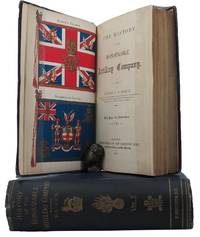
THE HISTORY OF THE HONOURABLE ARTILLERY COMPANY
London: Richard Bentley & Son 1878. In two volumes. Volume I: Pp. xxxii4924publisher's advertisements coloured frontispiece guard 34 plates 1 coloured 2 folding large coloured folding plan tissue guard edges browned tear from lower fold into small portion of image plus 6 folding maps and plans appendices; Volume II: Pp. xl564last advertisement4publisher's advertisements coloured frontispiece guard 48 plates 9 folding 1 with long ragged tear affecting image and lettering without loss 3 folding maps and plans appendices glossary errata; demy 8vo; blue cloth lettered ruled and decorated in gilt spines darkened cloth lightly marked edges rubbed and lightly bruised small splits at head of spines; book label of David Levine Sydney on upper pastedowns light foxing and marginal browning fore-corner of several leaves lightly creased short tear in fore-edge of one leaf in Volume I and light bruising to several others in Volume II; Richard Bentley & Son London 1878. First edition. White p. 197; Sutcliffe 1/p. 465. Richard Bentley & Son unknown
Bookseller reference : 152412
|
|
|
The Honourable Artillery Company; Walker, G Goold
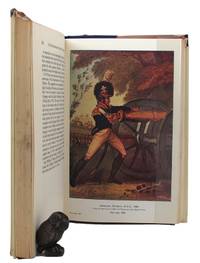
THE HONOURABLE ARTILLERY COMPANY 1537-1947
Aldershot Hants: Gale and Polden Limited 1954. With a Foreword by Field-Marshal The Viscount Alanbrooke. With 5 illustrations in colour and 83 in black and white. Pp. xiv380 coloured frontispiece 4 coloured and 36 black & white plates text illustrations 3 folding maps appendix Rolls of Honour Honours and awards Roll of the Victoria Cross index; demy 8vo; blue cloth spine lettered in gilt gilt regimental badge on upper board; top edges red; dust wrapper worn and lightly soiled with several splits and tears and with loss at lower right hand corner of front panel and head and tail of backstrip; book label of David Levine Sydney on upper pastedown fore-edges of leaves soiled and lightly foxed fore-edges of several leaves towards end lightly creased; Gale and Polden Limited Aldershot Hants 1954. Second edition. White p. 198; Sutcliffe 1/p. 466. Gale and Polden Limited unknown
Bookseller reference : 150328
|
|
|
The Honourable Artillery Company; Hay, Ian [Pseudonym]; Beith, Major-General John Hay
THE ROYAL COMPANY OF ARCHERS 1676-1951: A record of the services rendered in the South African War by members of the Honourable Artillery Company
Edinburgh: William Blackwood and Sons Ltd 1951. Pp. x300last blank frontispiece 35 plates appendices index; cr. 4to; green cloth lettered and ruled in gilt gilt insignia to upper and lower boards cloth slightly marked; book label of David Levine Sydney together with bookseller's sticker on upper pastedown; William Blackwood and Sons Ltd Edinburgh 1951. First edition. White p. 256. William Blackwood and Sons Ltd unknown
Bookseller reference : 150309

|
|
|
The Royal Artillery Institution
Records of the Royal Military Academy
Woolwich: printed at the Royal Artillery Institution 1851. First Edition. Hardcover. Rebound copy bound in cloth with gilt blocked leather label to the front board. Some foxing to the title page. Remains well-preserved overall; tight bright clean and sharp-cornered. Physical description; 152 pages. Subjects; Royal Military Academy. Records. Military Records. British Military. Woolwich: printed at the Royal Artillery Institution hardcover
Bookseller reference : 283009

|
|
|
The Royal Regiment of Artillery
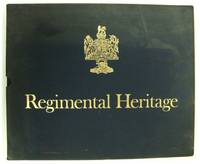
Regimental Heritage: A Pictorial Record of the Paintings and Silver of the Royal Regiment of Artillery
London: Europa Publications Limited 1984. Hardcover oblong quarto 280 x 345 mm original cloth covered boards limited edition 175 from run of 1000 lavishly illustrated throughout in colour and black and white title gilt on spine also on front cover with a gilt crest illustrated end papers. Presented in original slipcase. Very minor foxing to endpapers and water mark to front cover near spine. Slipcase is quite worn and rubbed sunned and scored. Nevetheless the book itself is in very good condition. AD. Limited. Hardcover. Very Good. Used. Europa Publications Limited Hardcover
Bookseller reference : 519347 ISBN : 0946653062 9780946653065
|
|

 Receive by email
 Download as PDF document
 RSS feed
 Permanent link


