|
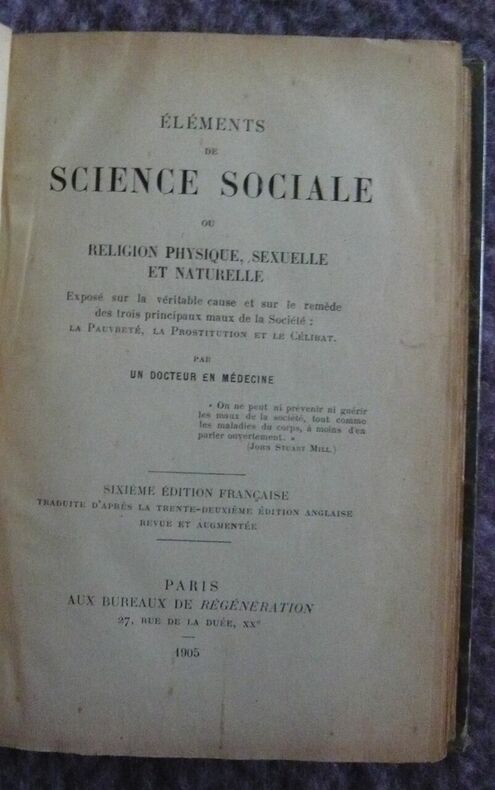
Eléments de science sociale ou religion physique sexuelle et naturelle - exposé sur la véritable cause et sur le remède des trois principaux maux de la Société : la Pauvreté la prostitution et le Célibat par un docteur en médecine
1905. Eléments de science sociale ou religion physique sexuelle et naturelle - exposé sur la véritable cause et sur le remède des trois principaux maux de la Société : la Pauvreté la prostitution et le Célibat par un docteur en médecine
Riferimento per il libraio : 1926
|
|
|
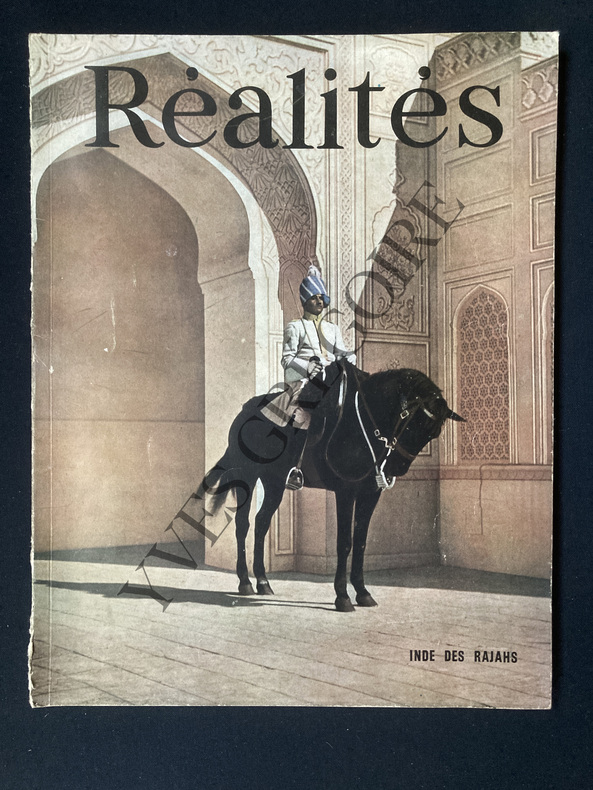
REALITES-N°39-AVRIL 1949
90 PAGES FORMAT 24,5 CM X 31,5 CM-EN COUVERTURE "INDE DES RAJAHS"-SIR STAFFORD CRIPPS, 10P PAR J.R.PECHERAL-INDE DES RAJAHS, 5P-L'ACADEMIE FRANCAISE, 8P PAR HENRI PERRUCHOT, PHOTOS ACADEMICIENS-TRANSFUGES SOVIETIQUES, PHOTO TROTSKI, 8P-LA PASSION SELON REMBRANDT, 4P-REVOLUTION AGRICOLE AUX USA, 9P-LA MODE, 7P, DIOR-FORMULES DE COOPERATION ENTRE CAPITAL ET TRAVAIL, 8P-MARIVAUX TRIOMPHE AU MARIGNY ET AU FRANCAIS, 2P, 4 PHOTOS, MADELEINE RENAUD, MICHELINE BOUDET, ROBERT HIRSCH-PUBLICITES PLEINE PAGE
Riferimento per il libraio : ABE-11725680043
|
|
|
"MALTHUS, T. R.
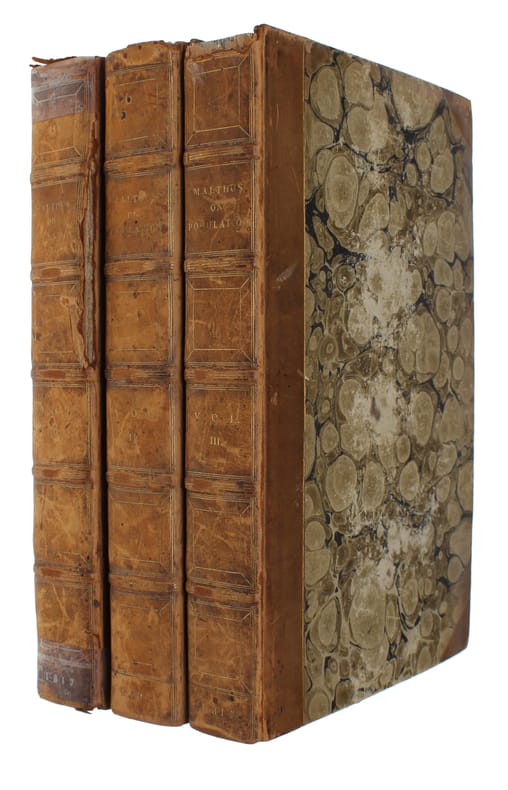
An Essay on the Principle of Population or, a View of its Past and Present Effects on Human Happiness. 3 vols. - [FIFTH EDITION OF ""AN ESSAY ON THE PRINCIPLE OF POPULATION""]
London, John Murray, 1817. 8vo. Bound in three nice uniform contemporary half calf with five raised bands and gilt lettering to spine. Spines with wear. Front board and spine detached from book-block on volume 1. Ex-libris pasted on to pasted down front free end-paper on all three volumes. A fine set.
Riferimento per il libraio : 51078
|
|
|
"MALTHUS, T.R.
Versuch über die Bedingung und die Folgen der Volksvermehrung, aus dem Englischen von Dr. F.H. Hegewisch. 2 Tle. - [DECREASING POPULATION GROWTH]
Altona, J.F. Hammerich, 1807. 8vo. Bound in the two nice cont. uniform cardboardbindings w. marbled paper. Gilt lines and gilt title-labels to spines. Some wear w. minor loss of paper to capitals, hinges and corners. Small hole to paper as well as to leather title-label of spine of volume two. Some brownspotting, but overall a nice and atrractive copy. Lacking the half-tilte for the first book (merely stating ""Erstes Buch""). XVI, 368"" VIII, 358, (1) pp.
Riferimento per il libraio : 36928
|
|
|
(CRABBE, George, Thomas Robert Malthus, and Others)
The Monthly Review; or Literary Journal Enlarged: May to August 1808
London: Sold by T. Becket 1808. Hardcover. Fair. First edition. Volume 56 May to August 1808. Octavo. Contemporary half calf and marbled paper over boards red morocco spine label. The leather is dry and worn front joint is split else a good sound copy. Armorial bookplate of Margaret Smith Burges on the front pastedown. Contains reviews of George Crabbe's "Poems" Jarrold's "Answer" to Malthus's "Essay on the Principle of Population" Malthus's "A Reply to the Essay on Population" and much more. Sold by T. Becket hardcover
Riferimento per il libraio : 385225

|
|
|
(Malthus). Lebrecht, Vittorio
IL MALTHUSISMO E I PROBLEMI SOCIALI: Saggi Critici.
Torino: Ermanno Loescher 1893. 1893. Good. - Small quarto 9-5/8 inches high by 6-3/4 inches wide rebound without original wraps in dark green cloth titled in gilt with decorations in gilt on the spine. The covers are slightly warped & the binding is bumped & rubbed affecting the titling. The head of the spine is chipped & frayed. 167 pages plus errata/corrigenda page. The pastedowns & endpapers are darkened & there is scattered foxing & light staining. Good. <p>First edition. The text is in Italian.<p>The book is inscribed by the author but the inscription & signature have been partially cut off in rebinding.<p>"This interesting work proposes to examine by the light of scientific criticism the theory of Malthus and the principal objections that have been brought against it. The author turns his attention first to pointing out the irrefutability of the biological tendency as Malthus has shown it and the necessity which devolves upon political economy to recognize it as a fundamental law. Lebrecht does not ignore the objections raised by various writers against this tendency; on the contrary he estimates them with praiseworthy impartiality; yet after careful examination he believes that they are not destructive of the theory.He does not deny that the coefficient of procreation is essentially economic and that poverty is one of its potent factors; yet he affirms that the prolific action of poverty can be remedied by moral influences. From a review of the book by Achille Loria and Cornelia H. B. Rogers in "Annals of the American Academy of Political and Social Science Vol. 4 May 1894 p. 134.<p>Rare. Torino: Ermanno Loescher, 1893. paperback
Riferimento per il libraio : 11039
|
|
|
(SHELLEY, Percy Bysshe, TR Malthus, William Edward Parry, et al) T R
The Monthly Review; or Literary Journal Enlarged: January-December 1821 Three volume set
London: J. Porter 1821. Hardcover. Fair. First edition. Volumes 94-96 Complete three volume set for 1821. Octavos. Contemporary half calf and marbled paper boards. Overall scuffing to the spine and boards chipping to the spine backs else a good sound set. Contains reviews of Shelley's "The Cenci A Tragedy" and "Prometheus Unbound" William Edward Parry's two "Journals" of a Voyage for the Discovery of a North-West Passage and a Voyage of Discovery to the Arctic Regions the "Principles of Political Economy" by Malthus "The History of British India" by James Mill and much more. J. Porter hardcover
Riferimento per il libraio : 267479
|
|
|
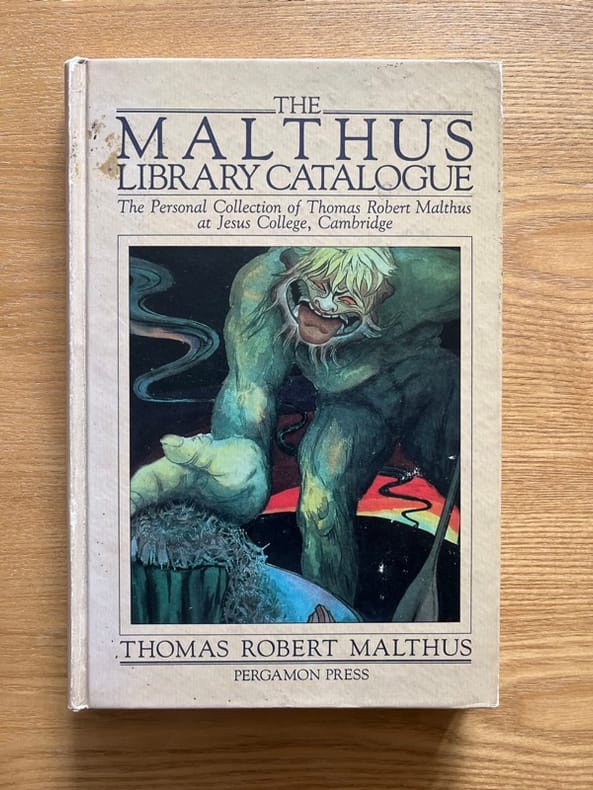
[CATALOGUE - MALTHUS]
The Malthus library catalogue. The personal collection of Thomas Robert Malthus at Jesus College, Cambridge. With invited contributions by John Harrison, Ryotaro Minami, Patricia James, William Petersen, John Pullen, and a preface by Edward Gray
New York, Oxford, Toronto, Pergamon Press, 1983 in-8, LXII-232 pp., portrait-frontispice, portraits in-t., cartonnage à la Bradel, premier plat illustré (reliure de l'éditeur). Petites taches sur la couverture.
Riferimento per il libraio : 240009
|
|
|
[Les Etudes Philosophiques] P. MASSET, J. MOREAU, A. DOZ, J. GRONDIN, R. LEGROS, B. SAINT SERNIN et P. LANTZ
Les ETUDES PHILOSOPHIQUES
Revue trimestrielle fondée en 1926 par Gaston Berger, publiée avec le concours du C.N.R.S. et des Universités de Provence, Bordeaux, Dijon, Grenoble, Montpellier, Nice, Reims et Tours. N° 3 - Juillet-Septembre 1984 : 144 pages, format 155 x 240 mm, brochée, Presses Universitaires de France, bon état
Riferimento per il libraio : LFA-126711207
|
|
|
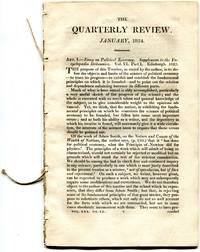
[Malthus, Thomas Robert]; [Book Reviews]
The Quarterly Review: January 1824 Volume XXX No. LX; Essay on Political Economy Volume VI part I.
London: John Murray 1824. Disbound. Good. 8vo. 24 cm x 13.5 cm. 1 298-334 pp. Pamphlet. The Quarterly Review was a British periodical that began in 1809. This is a review of Thomas Malthus' Principles of Political Economy and the writers of this review frequently compare Malthus' work to Adam Smith's The Wealth of Nations. A fascinating look at what Malthus' contemporaries thought of his work a work which would later be praised by J.M. Keynes the twentieth-century economist. This article was once bound in a compendium of the Quarterly review but now lacks boards and wraps. The stitching is present on the side and the final leaf is starting from the stitching. John Murray unknown
Riferimento per il libraio : 000011084
|
|
|
[MALTHUS] SMITH,, Kenneth
THE MALTHUSIAN CONTROVERSY.
London Routledge & Kegan Paul 1951. x350pp. 8vo. Original boards in lightly foxed dustwrapper slight chipping at head of backstrip. Foxed edges and endpapers otherwise a very good crisp copy. First edition. London, Routledge & Kegan Paul 1951. hardcover
Riferimento per il libraio : 122711
|
|
|
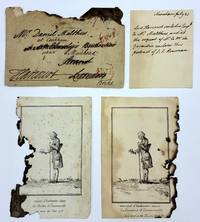
[ROUSSEAU, Jean Jacques]; [MALTHUS, Daniel]; [GIRARDIN, Rene de, Marquis of Vauvray]; MEYER, Georg Friedrich; HARCOURT, George,
INK PORTRAIT OF ROUSSEAU SENT FOLLOWING HIS DEATH BY HIS LAST PUPIL TO THE FATHER OF THOMAS MALTHUS
Original manuscript / ink drawing. c.1779-1788. Pen and ink portrait of Jean Jacques Rousseau in the garden at Ermenonville titled beneath "venant d'herboriser dans les Jardins d'Ermenonville au mois de Juin 1778" along with a printed version of the image signed Mayer Georg Friedrich Meyer engraved by J. M. Moreau in 1779. Each 15 x 10cm. Accompanied by an ink manuscript letter 10.5 x 8cm headed "Nuneham July 21" presenting the images: "Lord Harcourt sends his compts. to Mr. Malthus and at the request of Mr. le Mqs. de Girardin encloses this portrait of J: J: Rousseau". Contained within the original postal cover addressed to Mr. Daniel Malthus redirected from his London address to Cookham signed at the foot by Harcourt under the parliamentary privilege franking system with additional "free" handstamps to the front panel and further postal markings to the reverse the specific types of postal markings on the cover indicate a date range of 1779-1788. The ink portrait engraved portrait and postal cover all have historical burn marks and associated loss as well as toning and light foxing; the letter remains in good order. A fascinating and intimate gift linking several late eighteenth-century intellectuals all connected to the French philosopher Jean Jacques Rousseau in the form of two portraits of the philosopher one ink one engraved sent from Rousseau's last pupil René de Girardin Marquis of Vauvray 1735-1808 via the radically-inclined politician and gardener George Harcourt 2nd Earl Harcourt 1736-1809 to the father of the famous economist Thomas Malthus Daniel Malthus 1730-1800 himself a friend of Rousseau.</p><p>The present portrait depicts Rousseau in the final weeks of his life 'botanizing' in the garden at Ermenonville the first French landscape garden created by his pupil René de Girardin who here sends the portrait. Ermenonville was itself inspired by Rousseau's ideas created by Girardin as an illustration of his philosophical and social beliefs regarding the place of man in nature. Within the garden Girardin began construction of a house for Rousseau modelled after the "Élysée" of Julie in Rousseau's novel <em>La Nouvelle Héloïse</em>. Rousseau himself visited the garden in May 1778 staying in a small thatched cottage where he remained until his death in July that year. Girardin subsequently made a tomb for Rousseau at Ermenonville which became a destination of pilgrimage for his admirers until his body was re-interred at the Pantheon in Paris in October 1794. Following Rousseau's death Girardin and two other of his friends of prepared a complete edition of his works using the manuscripts of some of his most important writings including <em>Les Confessions </em>and <em>Les Rêveries du promeneur solitaire</em> which he had left behind at Ermenonville. This new edition was published in Geneva between 1780 and 1782 and contributed greatly to the spread of Rousseau's ideas throughout France and beyond in the years leading up to the French Revolution.</p><p>The original drawing of Rousseau at Ermenonville was executed by the German artist Georg Friedrich Meyer 1733-1779 who also resided with Girardin at Eremenonville during his final years and where he became well acquainted with Rousseau. Other similar versions of this drawing by Meyer exist one being in the collection of the Fine Art Museum of San Francisco and it is unclear as to whether the present pen and ink drawing is an original work by Meyer or a contemporary copy of the engraving - either way its origin from the hands of Girardin himself provide it with sufficient interest. </p><p>The present two portraits subsequently made their way to the politician George Harcourt 2nd Earl Harcourt previously Viscount Nuneham a supporter of John Wilkes friend of Catherine Macaulay opponent of the war against the American colonies and pioneering garden designer. Here he apparently acted as an intermediary in this distinguished friendship circle sending the pictures on to Daniel Malthus - enlightened gentlemen friend of David Hume and Rousseau and father to Thomas Malthus.</p><p>Daniel Malthus had first become acquainted with Rousseau when he visited him at Môtiers in May 1764. He later invited Rousseau and his wife Thérèse to stay at his estate "The Rookery" near Dorking Surrey during the couple's visit to England in 1766 with Malthus hoping to find them a place to settle nearby. They visited the Malthus home for a day with Hume about three weeks after Thomas's birth but ultimately settled in Derbyshire for the remainder of their visit. Daniel and several family members subsequently went north to visit Rousseau joining him on botanical expeditions - a shared passion. Rousseau and Malthus maintained a lifelong correspondence and botanical exchange with the pair enthusiastically swapping English and French literature botanical specimens and philosophical musings. Later in life Rousseau would divide his personal herbarium among his friends sending parts of it to Daniel who also ultimately purchased his botanical library.</p><p>Daniel Malthus was - like Girardin - a dedicated Rousseauist using like many enlightened families of the period Rousseau's <em>Émile</em> as a guide to the education of his children; as he described in a letter to Rousseau of 1768 his children botanized in their local area went on nature walks carried out farm work and conducted their own little experiments. Indeed in his last known letter to Rousseau he declared "if I am ever known it will be as the friend of Rousseau". He would however ultimately be best known by his progeny Thomas who would go on to famously argue against the writings of the thinkers who proclaimed humanity's perfectibility preferred by his father including Rousseau William Godwin and the Marquis de Condorcet. Regardless of this Daniel keenly supported his adult son's endeavours with Thomas's earlier unorthodox education itself also having played a key role in shaping his knowledge of natural law and mathematics. MacDonald J. Marc "Malthus and the Philanthropists 1764–1859: The Cultural Circulation of Political Economy Botany and Natural Knowledge" Social Sciences 2017 61 4. [Original manuscript / ink drawing]. unknown
Riferimento per il libraio : 1748
|
|
|
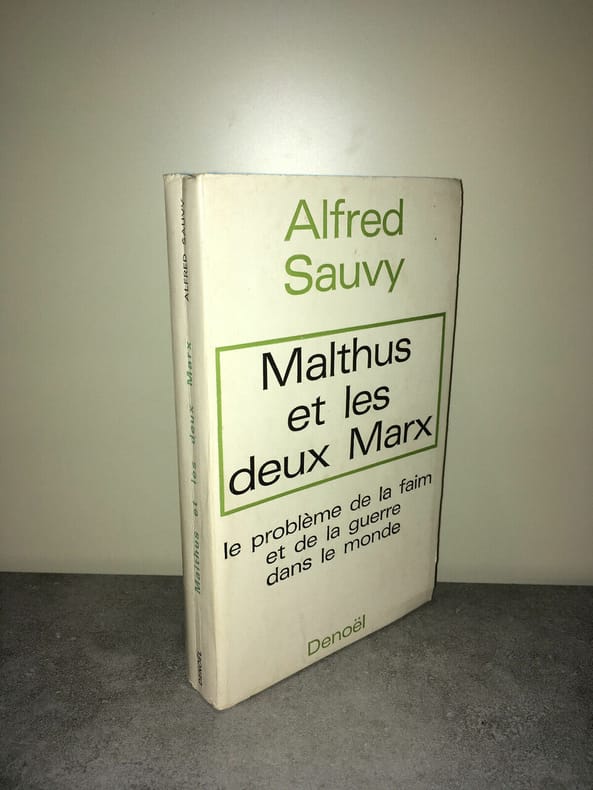
Alfred Sauvy Malthus
LES DEUX MARX la faim ET la guerre dans le monde
éd denoël 1963 1963. Ed° Denoël 1963. Exemplaire en bon état d'usage voir photo
Riferimento per il libraio : 400094443
|
|
|
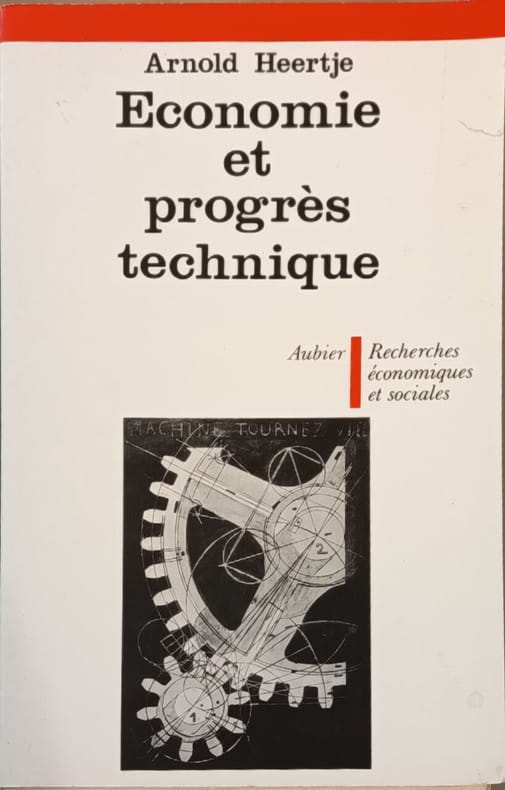
Arnold Heertje
Économie et progrès technique
Aubier 1979 303 pages in8. 1979. broché. 303 pages. Cet ouvrage d'Arnold Heertje traduit de l'anglais explore l'histoire du progrès technique et ses conséquences économiques. Il analyse notamment les théories des économistes classiques comme Adam Smith Malthus Ricardo et la loi de Say
Riferimento per il libraio : 8264
|
|
|
Avec des Remarques sur les Theories de Malthus Et
Nouvelles Idées sur la Population
paperback. Good. Access codes and supplements are not guaranteed with used items. May be an ex-library book. paperback
Riferimento per il libraio : 0243428723.G ISBN : 0243428723 9780243428724
|
|
|
Avery, John/ Condorcet, Jean-Antoine-Nicolas De Caritat/ Godwin, William/ Malthus, T R
Progress Poverty and Population: Re-Reading Condorcet Godwin and Malthus
Frank Cass & Co 1997. Hardcover. New. 1st edition. 151 pages. 9.75x6.50x0.75 inches. Frank Cass & Co hardcover
Riferimento per il libraio : x-0714647500 ISBN : 0714647500 9780714647500
|
|
|
Avery, John/ Condorcet, Jean-Antoine-Nicolas De Caritat/ Godwin, William/ Malthus, T R
Progress Poverty and Population: Re-Reading Condorcet Godwin and Malthus
Frank Cass & Co 1997. Paperback. New. 1st edition. 168 pages. 9.50x6.25x0.75 inches. Frank Cass & Co paperback
Riferimento per il libraio : x-0714644048 ISBN : 0714644048 9780714644042
|
|
|
Baldan Attilio
Teorie Sulla Modernizzazione
Mm 145x220 Brossura editoriale di pp. 278, in buonissimo stato. SPEDIZIONE IN 24 ORE DALLA CONFERMA DELL'ORDINE.
|
|
|
Bentam/Mill/Malthus
The Complete Works of World Great Thoughts <Japanese Version>
Kawaideshobo 1955. Soft Cover. Fine. The book is in fine condition. Kawaideshobo paperback
Riferimento per il libraio : 2111902161001716
|
|
|
BONAR James
Malthus and his work
In 8, pp. VIII + 432. Legatura in p. tl. edit.
|
|
|
By Malthus; Translated by Toshinori Saito
Population Theory Kobunsha Classic New Translation Bunko
Kobunsha N.A. Soft Cover. Fine. Page size: 307p Size: 16cm Bunko size Kobunsha paperback
Riferimento per il libraio : 2080202103702895
|
|
|
Canterbery, E. Ray
The Making Of Economics, Vol. I: The Foundation.
New Jersey/London: World Scientific, 2003. XVII, 285 S. (23 cm) Broschierte Ausgabe
Riferimento per il libraio : 51261
|
|
|
Cecchi, Ettorina
Neo-Malthusianismo pratico (Neo-Maltusianismo pratico)
Mm 145x205 Anatomia e fisiologia degli organi genitali; Fenomeno della generazione; Mezzi scientifici per evitare la gravidanza - Brossura editoriale di pp. ix-207 con illustrazioni in bianco e nero su tavole fuori testo. Fioriture alla copertina e segni di usura ai margini delle carte, dorso reincollato, ma nel complesso buon esemplare. SPEDIZIONE IN 24 ORE DALLA CONFERMA DELL'ORDINE.

|
|
|
Daniel Malthus (1730-1800), father of the political economist T R Malthus (1766-1834), friend and executor of Jean-Jacques Rouss
Daniel Malthus father of the political economist T. R. Malthus. Autograph Signature 'Danl Malthus' on printed Exchequer Receipt completed in manuscript.
His Majesty's Receipt of Exchequer London. 9 February no year . 1p. 8vo. In poor condition aged and worn with loss to edges and holing around the signature. Begins with manuscript text in square brackets: 'The -9 Day of ffebry <.> Received by me Daniel Malthus Execd as P Margin Of the Right Honourable Robert Earl of Northampton One of the Four Tellers of His Majesty's Receipt of Exchequer the Sum of Fifty Pounds .'. The annuity has been raised on 'Rates and Duties upon all Wines imported into Great Britain and for raising a certain Sum of Money for the Service of the year 1745'. According to T. R. Malthus's entry in the Oxford DNB his father 'being an only son of seven children appears to have inherited considerable wealth and property and these independent means enabled him to travel and to cultivate his literary artistic theatrical and scientific interests. He entered Queen's College Oxford in 1747 but did not graduate. He was an admirer of Rousseau who once visited The Rookery when Malthus was an infant. He was said to have published some literary pieces anonymously but the statement by an obituarist that he had translated works from French and German was firmly contradicted by Malthus. He supported the views of the marquis de Condorcet and William Godwin on the perfectibility of mankind but also encouraged his son's publication of opposing views. Aspects of his behaviour—for example the unconventional education he chose for Malthus and his refusal to allow his wife to wear her wedding ring—were regarded as eccentric and perhaps show the influence of Rousseau. He married on 6 May 1752 Henrietta Catherine Graham 1733–1800 his second cousin the daughter of Daniel Graham 1695–1778 apothecary to George II and George III. She can be seen as a young girl with her brother and two sisters in Hogarth's painting The Graham Children 1742 now in the National Gallery London. Malthus was the sixth of their seven children two boys and five girls. His Majesty's Receipt of Exchequer, London. 9 February [ no year ]. unknown
Riferimento per il libraio : 19070
|
|
|
DUFFART (Charles)
Le Malthusisnisme en France et les moyens de le restreindre
Extrait de la revue "ancienne revue des revue" du 1er décembre 1904. Paris, 1904, Aux bureau de la revue. cousu, 26p, 17x26cm, couv bleue, titre typo noir, non massicoté, e.a.s.
Riferimento per il libraio : 1769
|
|
|
Farolfi Bernardino
Capitalismo europeo e rivoluzione borghese 1798/1815
In 8 (21x14) Legatura in tela con sovracopertina illustrata; pp. XV-413; Molto buono

|
|
|
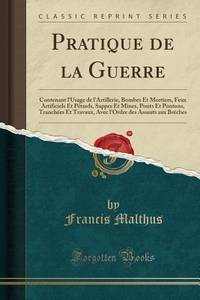
Francis Malthus
Pratique de la Guerre: Contenant l'Usage de l'Artillerie Bombes Et Mortiers Feux Artificiels Et Pétards Sappes Et Mines Ponts Et Pontons Tranchées Et Travaux Avec l'Ordre des Assauts aux Brèc
hardcover. Good. Access codes and supplements are not guaranteed with used items. May be an ex-library book. hardcover
Riferimento per il libraio : 1390024601.G ISBN : 1390024601 9781390024609

|
|
|
Francis Malthus
Pratique de la Guerre: Contenant l'Usage de l'Artillerie Bombes Et Mortiers Feux Artificiels Et Pétards Sappes Et Mines Ponts Et Pontons . Brèches Classic Reprint French Edition
paperback. Good. Access codes and supplements are not guaranteed with used items. May be an ex-library book. paperback
Riferimento per il libraio : 1390024547.G ISBN : 1390024547 9781390024548
|
|
|
GAGLIARDI Ferdinando
Saggio storico-critico sulla dottrina di Malthus. Estratto dal 2o vol. della Rivista Europea diretta in Firenze dal Prof. Angelo De Gubernatis
In 8, pp. 55 + (1). Timbretto di possesso al p. ant. Mancanza del lembo sup. est. del p. ant. D. rifatto. Qualche alone ai margg. delle cc. Br. ed. Nel saggio l'A. ripercorre le posizioni degli economisti che precedettero Malthus sulla questione demografica connessa allo sviluppo delle risorse produttive (Quesnay, Richetti, Genovesi, Beccaria, Verri, Ortes, Filangieri) per poi soffermarsi sulla dottrina dell'economista inglese.
|
|
|
J. M. Poursin, G. Dupuy
Malthus
J. M. Poursin, G. Dupuy Malthus. Bari, Laterza 1974, Copertina cartonata. Tagli sporchi di polvere, pagine leggermente ingiallite. Collana:"Universale Laterza 291". Mediocre (Poor) . <br> <br> <br> 169<br>

|
|
|
John Whishaw (c1764-1840), Secretary to the African Association, friend of Malthus and biographer of Mungo Park [James Loch (178
John Whishaw Autograph Letter Signed from John Whishaw Secretary to the African Association to the Whig MP James Loch regarding the picture galleries of Lord Stafford and Lord Grosvenor also George Canning Lord Brougham and elections.
9 May 1827. 'L. I. Fields' i.e. Lincolns Inn Fields London. 2pp. 12mo. 40 lines. Bifolium. Good on aged paper. The reverse of the second leaf carries half of a red wax seal as well as the address to 'James Loch Esqr Bloomsbury Square'. The letter begins: 'My dear Loch Some friends of mine from the Country are desirous of seeing Lord Stafford's & Lord Grosvenor's pictures some time next week; & they understand that the obtaining of Tickets is not a matter of course but that some little interest is necessary.' He asks for assistance 'with regard to Cleveland House . for Mrs Johnston & party about 5 or 6 persons'. He is going 'to the Cambridge Election' on the following day and thinks that it will be 'very keenly contested'. On his return he hopes 'to attend the Council of the London University' when he hopes 'that Horner's business will be finally & satisfactorily settled'. He has heard 'nothing more about Silk Gowns' but 'Willy Brougham . persists in retaining his appointment and will not be scared into resignation like Plunkett by the Chancery Lawyers.' In the last paragraph he deprecates the news that 'Lord Exeter is to have one of the blue Ribbands though he is no friend of Canning's & indeed closely connected with the high Tory opposition'. This is in his view 'one among many instances of C's weakness & entire dependence upon the higher power.' There is no mention of Loch in Lady Seymour's 'The "Pope" of Holland House Selections from the Correspondence of John Whishaw and his Friends 1813-1840' 1906 and the year 1827 is skirted over. 9 May [1827]. 'L. I. Fields' [i.e. Lincolns Inn Fields, London]. unknown
Riferimento per il libraio : 12697
|
|
|
JOHNSON (Cuthbert W.)
On Liquid Manures. [Sold with:] On the Malthusian Doctrines.
2 works, large 8vo, [4], 39, [1]; 4pp., at the head of the title page of the first work is the contemporary inscription "I paid for 500 for these with the addition of the Malthusian Doctrines", disbound pamphlets. Goldsmiths'-Kress no. 29829 & 30337.
|
|
|
KHALATBARI, PARVIZ
Überbevölkerung in den Entwicklungsländern (Ein Beitrag zur marxistischen Bevölkerungstheorie)
Berlin, Akademie-Verlag, 1968. Kartoniert, 8°, 288 S., Heft Nr. 27 der »Schriften des Instituts für Wirtschaftswissenschaften«, Inhalt: Die Bevölkerungsbewegung in Geschichte und Theorie - Bürgeliche Theorien - Marxistische Betrachtung der Bevölkerungsentwicklung - Die Überbevölkerung in den Entwickliungsstaaten - Probleme der Bevölkerungsstabilisierung
Riferimento per il libraio : B369

|
|
|
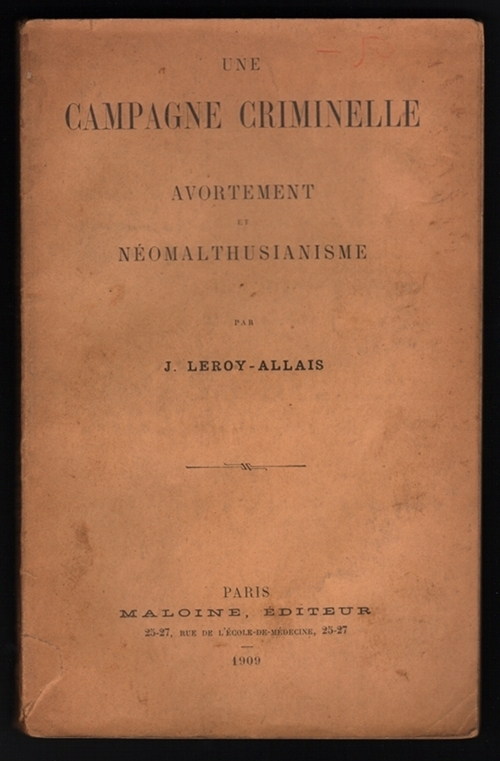
LEROY-ALLAIS , J.
AVORTEMENT ET NEOMALTHUSIANISME
MALOINE, éditeurs, Paris 1909
Riferimento per il libraio : 621
|
|
|
Livi Bacci Massimo
La Trasformazione Demografica Delle società Europee
Mm 125x195 Brossura cucita di pp. 439, in buono stato. SPEDIZIONE IN 24 ORE DALLA CONFERMA DELL'ORDINE.
|
|
|
LORIA ACHILLE
MALTHUS
In-16 (Cm 17 x 10,5), pp. 78, brossura editoriale, sovracoperta editoriale con titolo entro cornice. Una tavola in antiporta. Collana "Profili, 6 ". Quarta edizione. Qualche lieve ingiallitura sparsa. INTONSO - BUONO

|
|
|
Loria Achille
Malthus
br. Un saggio biografico ricco di spunti su Thomas Robert Malthus. Economista, filosofo, demografo, Malthus è stata una delle figure più importanti vissute a cavallo fra il Settecento e l'Ottocento. Considerato il precursore della moderna sociologia, l'accademico inglese è ricordato per aver individuato come causa della povertà una crescita della popolazione molto più rapida di quella delle risorse.
|
|
|
M. T. R. MALTHUS
PRINCIPES D'ECONOMIE POLITIQUE, CONSIDERES SOUS LE RAPPORT DE LEUR APPLICATION PRATIQUE TOME 1 & 2
J. P. AILLAU. 1820. In-8. Broché. Etat passable, Couv. défraîchie, Dos abîmé, Quelques rousseurs. 501+452 pages. Tome premier : Charnières fendues, Manques coiffes. Tome second : Charnières fendues, coiffes abîmées, couverture défraichie.. . . . Classification Dewey : 330-Economie
Riferimento per il libraio : RO30109165
|
|
|
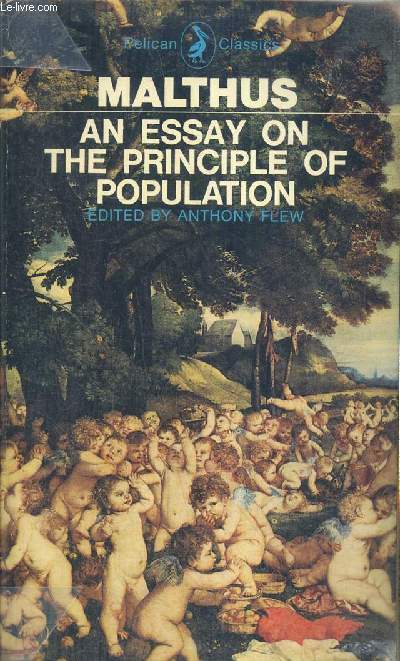
Malthus Thomas Robert
An essay on the principle of population and A summary viw of the principle of population
Penguin Books. 1979. In-12. Broché. Bon état, Couv. convenable, Dos satisfaisant, Papier jauni. 291 pages. Annotation au stylo en page de titre. Texte en anglais.. . . . Classification Dewey : 420-Langue anglaise. Anglo-saxon
Riferimento per il libraio : RO80260974 ISBN : 140400184
|
|
|
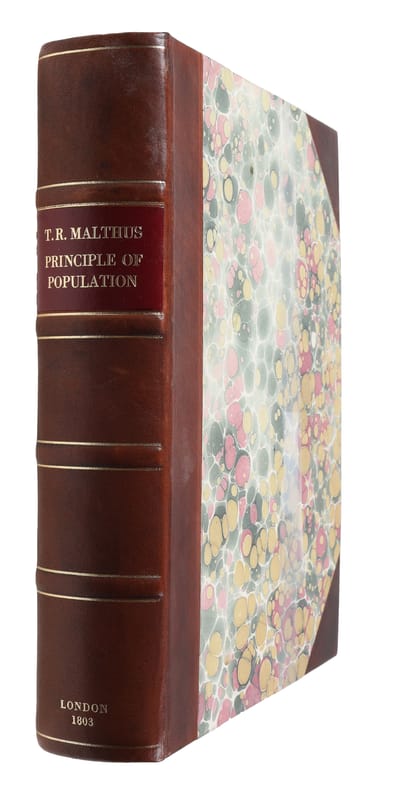
MALTHUS, T.R.
An Essay on the Principle of Population or, a View of its Past and Present Effects on Human Happiness" with an Inquiry into our Prospects Respecting the Future Removal or Mitigation of the Evils which it Occations. A New Edition, very much Enlarged. - [THE MAIN WORK ON POPULATION]
London, Printed for J. Johnson, by T. Bensley, 1803. Large 4to. Later brown hcalf with four raised bands, single gilt lines and red leather title-label to spine. First three and last 14 leaves a bit brownspotted, title-page and last two leaves marginally repaired at hinge, otherwise a very nice, clean, and solid copy. VIII, (4), 610 pp.
Riferimento per il libraio : 62792
|
|
|
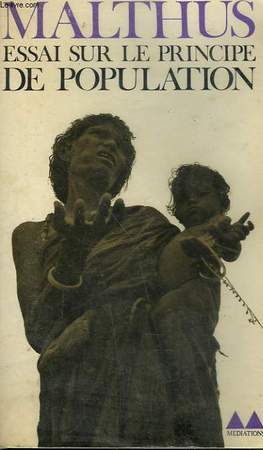
MALTHUS.
ESSAI SUR LE PRINCIPE DE POPULATION. COLLECTION MEDIATIONS N° 23
GONTHIER.. 1964.. In-12. Broché. Bon état, Couv. convenable, Dos satisfaisant, Intérieur frais. 236 pages. 1ère de couverture illustrée en couleurs.. . . . Classification Dewey : 300-SCIENCES SOCIALES
Riferimento per il libraio : R150030669
|
|
|
MALTHUS
ESSAI SUR LE PRINCIPE DE POPULATION
Mediations. 1964. In-12. Broché. Etat d'usage, Couv. légèrement passée, Dos satisfaisant, Intérieur bon état. 236 pages. Page de titre manquante. Petite tache d'encre sur la tranche.. . . . Classification Dewey : 304.6-Démographie
Riferimento per il libraio : RO40084321
|
|
|
Malthus
Essai sur le principe de population
Flammarion. 2010. In-8. Broché. Bon état, Couv. convenable, Dos satisfaisant, Intérieur frais. 284 pages.. . . . Classification Dewey : 301-Sociologie
Riferimento per il libraio : RO30314370
|
|
|
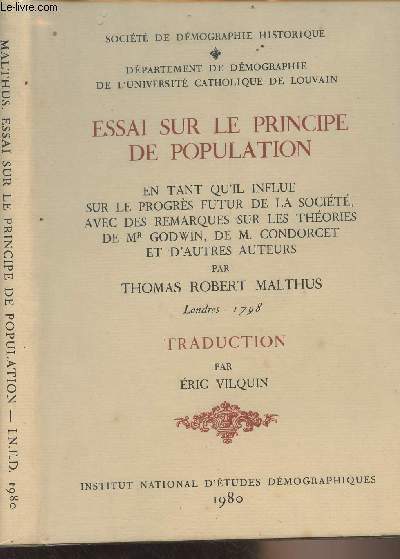
Malthus Thomas Robert
Essai sur le principe de population en tant qu'il influe sur le progrès futur de la société, avec des remarques sur les théories de Mr Godwin, de M.Condorcet et d'autres auteurs - Société de démographie historique
Institut national d'études démographiques. 1980. In-8. Relié. Bon état, Couv. convenable, Dos satisfaisant, Intérieur acceptable. 166 pages. Jaquette convenable.. Avec Jaquette. . . Classification Dewey : 304.6-Démographie
Riferimento per il libraio : R300278306
|
|
|
MALTHUS, T.R.:
Essai sur le principe de population, ou Exposé des effets de cette cause sur le bonheur du genre humain. Suivi de quelques recherches relatives à l'espérence de guérir ou d'adoucir les maux qu'elle entraine. Trad. de l'anglais sur la 5me éd. par P. Prévost et G. Prévost, de Genève. Nouvelle édition revue, corr. et augmentée... Tome 1 (de 2).
Bruxelles, Société Typographique Belge, 1841, in-8°, titre + 430 p., non rogné, brochure originale.
Riferimento per il libraio : 23022aaf
|
|
|
MALTHUS (Thomas Robert).
Essai sur le principe de population, en tant qu'il influe sur le progrès futur de la société. Avec des remarques sur les théories de Mr Godwin, de M. Condorcet et d'autres auteurs. (Londres, 1798).
P., INED, 1980, gr. in-8°, 166 pp, traduction par Eric Vilquin, avant-propos de Jacques Dupâquier, reliure toile crème imprimée de l'éditeur (salie), état correct (Société de démographie historique. Département de démographie de l'Université catholique de Louvain)
Riferimento per il libraio : 104587
|
|
|
MALTHUS (Thomas Robert).
Essai sur le principe de population.
Seghers, 1963, in-8°, 373 pp, préface, introduction et traduction par le docteur Pierre Theil, broché, couv. illustrée, bon état
Riferimento per il libraio : 125826

|
|
|
MALTHUS, T.R.
Essai sur le principe de population, ou Exposé des effets passés at présens de l'action de cette cause sur le bonheur du genre humain suivi de quelques recherches relatives à l'espérance de guérir ou d'adoucir les maux qu'elle entraîne. Traduit ... - [ESTABLISHING DEMOGRAPHY]
Paris & Genève, Chez J.J. Paschoud, 1809. 8vo. Bound in three nice uniform cont. hcalfbdgs. w. gilt backs, red leather title-labels w. gilt lettering and gilt round green tome-labels on backs. Capitals w. a bit of wear. Internally nice and clean. W. half-titles in all three volumes and advertisement-leaf in vol. one. XIII, (1), 424, (5) (6), 395, (1) (4), 392 pp.
Riferimento per il libraio : 31327
|
|
|
MALTHUS (Thomas Robert)
Essai sur le principe de population. Traduit de l'anglais par MM. P. et G. Prevost ( de Genève), précédé d'une introduction par M. Rossi, et d'une notice sur la vie et les ouvrages de l'auteur par C. Comte. Avec les notes des traducteurs et de nouvelles notes par M. J. Garnier. 2e edition
Paris, Guillaumin, 1852 grand in-8, LX-688 pp., portrait, demi-chagrin rouge à coins, dos à nerfs orné, tête dorée (reliure de l'époque).
Riferimento per il libraio : 237568
|
|
|
MALTHUS (Thomas Robert)
Essai sur le principe de population. Traduit de l'anglais par MM. P. et G. Prevost ( de Genève), précédé d'une introduction par M. Rossi, et d'une notice sur la vie et les ouvrages de l'auteur par C. Comte. Avec les notes des traducteurs et de nouvelles notes par M. J. Garnier
Paris, Guillaumin, 1845 grand in-8, LX-687 pp., broché. Dos abîmé. Rousseurs.
Riferimento per il libraio : 244594
|
|

 Ricevere i risultati per e-mail
 Scaricare i risultati in PDF
 RSS feed
 Link
Link