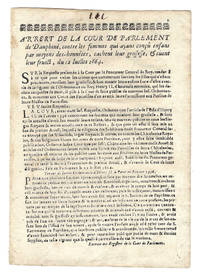
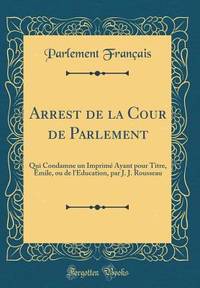
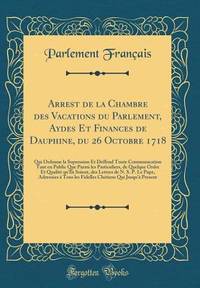
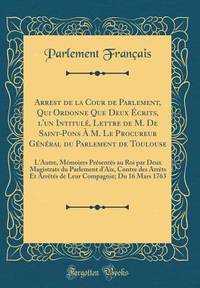
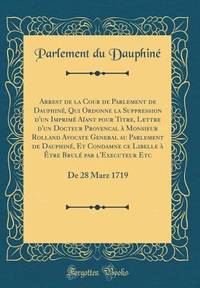
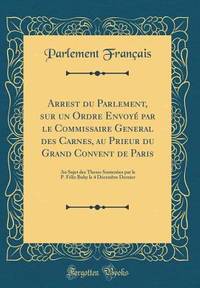
S.l. Grenoble : s. n. 1664. Very good. First edition thus OCLC lists one copy at Yale with the same title but different text and date - 1638; this edition not in OCLC; 8 3/4 x 6 1/4; single leaf removed text to recto only; illustrated with a woodcut border above the title; a small manuscript note to top margin; minor spotting to left margin; in very good condition. Reaffirming a royal edict first issued in 1556 the document dealt with prostitutes or women who had conceived in a dishonest way and concealed their pregnancy and after giving birth killed their infants and burried them or threw them away. The women were to be punished by death the manner of which was to be determined depending on the gruesomeness of the particular case. The paper contained an extract of the original 1556 edict as well which also required all unmarried women to officially declare their pregnancy and ordered the death penalty for any such mother whose infant died before receiving proper baptism regardless if an infanticide had actually occured. In early modern Europe pregnant unmarried women could face punishment for fornication and if they had a miscarriage or the newborn died they could be accused of infanticide but the courts rarely saw such cases as the magistrates were aware of the physicians' limitations in diagnosing and distinguishing a stillbirth a natural-cause death and a murder. It all chaged throughout most of Europe in the 16th century arguably beginning with the above-mentioned 1556 edict in France which was followed by similar ones in England and Germany in the 1600s and the early-1700s. s. n. unknown books
Saintes: De L'Imprimerie de Marie Bichon 1698. 2 pages. Ornamental headpiece. 1 vols. 4to. Disbound. Minor marginal discoloration tear in right margin of first page not affecting text else excellent. 2 pages. Ornamental headpiece. 1 vols. 4to. The law against "Filles & des Femmes qui celent leur grossesse & leurs accouchemens faisant perir leurs enfans durant leur grossesse par des avortemens ou aprés leur accouchement par le fer ou autrement & en l'un & l'autre de ces cas; Il a été imposé des peines trés severes par les Lois divines & humaines soit que l'engrant dont la Femme se fait aborter fût formé ou vivant & animé parce que l'action par laquelle une Femme empêche un Homme d'Ietre formé & animé est un homicide." The decree issued by Dalon Avocat General du Roy this being the an issuance from Saintes. De L'Imprimerie de Marie Bichon unknown

 Receive by email
 Download as PDF document
 RSS feed
 Permanent link