|
Dwight D Eisenhower
Crusade in Europe
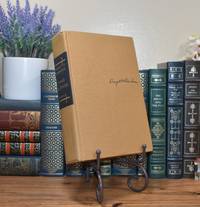
This is a numbered and signed first edition of which this is number 472 of 1426. It lacks the original acetate jacket and the slipcase. It is now in a red custom made slipcase made by Quality Bindery Inc photo. Bound in heavy duty wheat colored buckram. This copy is signed twice as it is an association copy with an inscription for the commander of the Fitzsimons Army Hospital in Denver when President Eisenhower was a heart patient there in 1955 photo. The book is also signed by Eisenhower on the Facsimile of the D-Day Order of the Day photo. In effect the book was signed in 1948 when Ike was a five star general and in 1955 when he was president and commander-in-chief. The book is in good condition. Its only imperfection is the front hinge which is a bit shaken photo otherwise the hinge is firm to feel. Doubleday & Company, Inc. hardcover
Referentie van de boekhandelaar : 58

|
|
|
Dwight D Eisenhower
CRUSADE IN EUROPE
Garden City: Doubleday 1952. Later printing. Hardcover. Later printing with no notice of printing on copyright page published by the original publisher in 1952 four years after the first edition. Brown cloth a few touches of shelf wear else in fine condition. Lacks the jacket. INSCRIBED AND SIGNED BY EISENHOWER. Inscribed by Eisenhower on the half-title. "For T.V. DuBois with best wishes Dwight Eisenhower" T.V. DuBois was a Cincinnati industrialist and the founder of Cincinnati Chemical. Doubleday hardcover
Referentie van de boekhandelaar : 1253306

|
|
|
Dwight D Eisenhower
Crusades in Europe
<p>Doubleday & Company New York 1948. Rare first edition hardback in good condition. The covers are brown boards with Dwight D Eisenhower on the cover. The spine is brown with the title author and publisher in a black box. The front and back flyleafs are a decorative map. The pages are in good condition with no marks tears of folds. There are two small sections on the front and back flyleaf that have been torn away and light discoloration on the title page. The book includes many maps photos and illustrations throughout.</p><p>The book in the photos is the book you are purchasing.</p> Doubleday and Company hardcover
Referentie van de boekhandelaar : 1295

|
|
|
Dwight D Eisenhower
Crusades in Europe
<p>Doubleday & Company New York 1948. Rare first edition hardback in good condition. The covers are brown boards with Dwight D Eisenhower on the cover. The spine is brown with the title author and publisher in a black box. The front and back flyleafs are a decorative map. The pages are in good condition with no marks tears of folds. The book includes many maps photos and illustrations throughout.</p><p>The book in the photos is the book you are purchasing.</p> Doubleday and Company hardcover
Referentie van de boekhandelaar : 1296
|
|
|
Dwight D Eisenhower
Dwight D. Eisenhower Endorses the Boy Scouts Saying They “have done so much for American youth and for the entire nationâ€
6/1/46. <p>Dwight D. Eisenhower became a member of the National Executive Board of the Boy Scouts of America in 1948 but had been a staunch supporter of Scouting ever since his son was a Scout in the 1930s. He would say that “The Boy Scout movement merits the unstinted support of every American who wants to make his country and his world a better place in which to live. Its emphasis on community service and tolerance and world friendship promotes a speedier attainment of the enduring peace among men for which we all strive. By developing among its members both a spirit of sturdiness self-reliance and a realization of the need for cooperative effort in every major enterprise the movement is a prime force in preparing tomorrow’s men for their duty to themselves their country and their world.â€</p><p>Charles D. Hart was a Philadelphia physician best known for the important contributions he made to the Boy Scouts over the course of four decades. In 1946 Hart was Honorary President of the Philadelphia Council of the Boy Scouts of America.</p><p><strong>Typed letter signed</strong> on his War Department Chief of Staff letterhead January 6 1946 to Dr. Hart responding to Hart’s request for a comment about the Boy Scouts. <em>“Thank you for your letter my photograph and a letter for the Boy Scouts of the Philadelphia Council. I am always glad to endorse the Boy Scouts who have done so much for American youth and for the entire nation. I have just sent a statement expressing my high opinion of the Scouts to the national headquarters. A copy of the statement is attached. Please assure the officials and boys of the Philadelphia Council of my continued interest in their success…â€</em></p><p>This is a wonderful sentiment evocative of the many contributions the Boy Scouts have made and Ike’s belief in them.</p> unknown
Referentie van de boekhandelaar : 14159
|
|
|
Dwight D Eisenhower
Eisenhower In Work Meant to Bridge the Gap Between His Military Past and Educational Position Looks to the Future of Warfare and the Emotional Trauma War Inflicts on the Fighting Young Soldiers
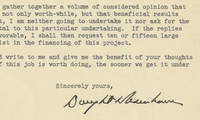
18/12/1948. <blockquote><p>The Founding Letter of the Renowned Eisenhower Center for the Conservation of Human Resources</p></blockquote><p><strong>Yet during the war rejections and discharges of men for mental defects reached a total of more than two million.</strong></p><p><strong>This type of problem would affect industry as well and Ike sought to establish an entity to research causes and solutions</strong></p><p>In December 1948 Eisenhower was called to Washington where he met with Averill Harriman Omar Bradley and Harry Truman. The leadership of the military had not settled on a plan to counter the rising Soviet threat and wanted Ike's opinion on fighting force preparedness. He remained in Washington for these meetings in the first two weeks of December. The immediate threat was Russia and a possible attack. The long term threat was to create a more efficient military. He had been assured that such a job should it require long hours would be compatible with his new job at Columbia University and so he made that real.</p><p>Eisenhower gave thought and consideration on how to present the needs and issues and introduce the concept and program director. This letter/presentation is a product of that and in it Eisenhower also speculates on the role played by education and poverty and ponders whether “industry trade unions the school the church do to help reduce the volume of lossâ€. The recipient was Henry Ford II president of the Ford Motor Company who was one of America’s top industry leaders and well as a personal acquaintance who would become a friend.</p><p>The letter is at its essence how to learn from the failures of fighting force recruitment and support during World War II apply it to the next combat and see how far that lesson could be taken to workplace life and the reintegration.</p><p><strong>Typed letter signed</strong> on his Columbia University letterhead New York December 18 1948 to Ford. <em>“It seems to me that the time has come when the wastage of American resources must be combated along all fronts. There are numbers of organizations directing their efforts toward conservation of natural resources including the soil. Our future prosperity is going to depend directly upon the success of their achievements. There is another sector of the conservation problem however that deserves immediate attention and that so far has not been made the subject of widespread intelligent attack. It is the wastage of manpower through mental and emotional failures.</em></p><p><em>“My own attention was drawn forcibly to the matter during the war particularly in the late months of 1944 when the country found that its ability to supply replacements for the battleline was badly strained. Units had to fight under truly desperate handicaps by reason of lack of manpower. Yet during the war rejections and discharges of men for mental defects reached a total of more than two million. One of the numerous reasons that finally decided me to come to Columbia was the hope of assisting in finding some kind of an answer to this national problem. Obviously in the event of great emergency our manpower will be in limited supply but the basic problem is far broader in scope. Manpower losses of this kind imply tremendous costs and inefficiencies for our economy.</em></p><p><em>“This I believe is a particularly propitious time to begin a down-to-earth study of the matter. There exist today the rejection records of the two million men lost in World War II. Most of them are still alive and they provide therefore a great body of factual information for any group that can organize itself sufficiently well to dig out and correlate the facts. In addition there is available in business corporations an important body of personnel information bearing on civilian maladjustments which invites exploration and evaluation.</em></p><p><em>“It would seem particularly important to find out whether there are common causative factors responsible for these human failures. Numerous questions immediately suggest themselves. Among these are: 1. Are these men generally from the undereducated groups 2. Are they generally urban or rural in origin 3. How do these men spend their leisure time 4 Are they underfed or otherwise definitely underprivileged 5. Do they show a long history of emotional instability or do these defects come out only under fear or other stress 6. What has happened to them Are they now a charge upon society or are they leading useful lives </em><em>7. How accurate were our war-time yardsticks for measuring ""mental deficiency"" 8 What can industry trade unions the school the church do to help reduce the volume of loss Dozens of other questions suggest themselves but the foregoing will indicate some of the specific points I have in mind.</em></p><p><em>“Shortly after coming to Columbia University I detailed a very able young professor Eli Ginzberg to prepare a memorandum which would show the capacity and qualifications of this institution for undertaking a significant study in this area. His report is attached. Although the study of human resources is so important that it would warrant continuing support I have thought it best to propose a limit of five years on this investigation. My thought is that regardless of continuing scientific research into the various aspects of the question we need to develop at an early date helpful practical methods that will contribute much more than past procedures to the efficient utilization of human resources.</em></p><p><em>“The Columbia Deans commented on the enclosed proposal and they were unanimously of the belief that the investigation should be undertaken. Now I am particularly anxious to get the opinions of men who are experienced in business labor agriculture finance the church etc. and I should therefore like to have your reactions to the above suggestions which are amplified in the accompanying memorandum. </em><em>It might be that a large percentage of mentally ineffective manpower is inescapable and is a natural result of our particular civilization. This I do not believe and certainly I will not accept such a conclusion until we have done our best to prove or disprove the case</em></p><p><em>“However until I can gather together a volume of considered opinion that the proposed task is not only worth-while but that beneficial results should flow out of it I am neither going to undertake it nor ask for the financial support vital to this particular undertaking. If the replies are predominantly favorable I shall then request ten or fifteen large organizations to assist in the financing of this project. I wish that you would write to me and give me the benefit of your thoughts on this proposal. If this job is worth doing the sooner we get it under way the better.â€</em></p><p><strong>It comes with the retained response from Ford and the copy of the report sent by Eisenhower to Ford being Ford's copy.</strong></p><p>A few of these letters were sent out and the response was positive so these words heralded the establishment at Columbia of a project originally called The Conservation of Human Resources and later renamed The Eisenhower Center for the Conservation of Human Resources. Dr. Ginzberg ran the project while Eisenhower invigorated it with energy and direction until he left Columbia to run for president. The work provided for a three-pronged approach: 1 a study of inadequacy and maladjustment in civilian and military life 2 a study of the factors contributing to the development of talent and superior performance and 3 changing patterns of work in a dynamic economy. Over the years it has published numerous works a few of which are “The Ineffective Soldier: Lessons for Management and the Nation†“The Changing U.S. Labor Market†“The New Suburbanization: Challenge To The Central City†and “The physician and the poorâ€. The Center remains active today.</p> unknown
Referentie van de boekhandelaar : 21029
|
|
|
Dwight D Eisenhower
Former President Eisenhower Writes Henry Ford II Indicating His View That Automation Does Not Cost Jobs but Encourages Americans to Be Self-Reliant
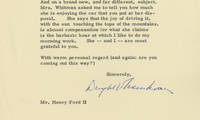
30/01/1962. <blockquote><p>Ford had taken that position as a member of the President's Advisory Committee on Labor-Management Policy</p></blockquote><p> </p><blockquote><p>“I too feel that automation can result in increased productivity if intelligence is applied to the problem and if we encourage the initiative and self-reliance of the American citizen instead as seems to be the case lulling him into letting the central government take over.â€</p></blockquote><p>In the waning days of 1960 President Eisenhower prepared to leave office and hand the presidency to John F. Kennedy. Henry Ford II was a close confidant of Eisenhower’s and during his presidency provided Ike with important assistance. On three occasions Ford lent one of his senior executives Leo Beebe to the U.S. government to supervise the resettlement of refugees and manage similar projects. Beebe became executive vice chairman of Eisenhower’s Committee for Hungarian Refugees in 1956 a need that resulted from the Hungarian Revolution and subsequent flight from the country of many refugees. In addition to his committee work during 1956-1957 while working out of Camp Kilmer in northern New Jersey Beebe oversaw the relocation and resettlement of 35000 Hungarian refugees in the United States eventually finding them permanent residences in this country. In 1959-1960 Beebe organized the U.S. Center for Cuban Refugees in Miami Florida to help with the mass influx of Cuban refugees that fled Castro’s Cuba in 1960 and beyond. Ford backed the refugee aid effort all the way and it was of incalculable importance.</p><p>In 1960 Robert McNamara was President of the Ford Motor Company. Kennedy the President-elect sought to name McNamara Secretary of Defense. Ford agreed to spare McNamara yet another example of his Henry Ford II’s largess.</p><p>The friendship and collaboration of Eisenhower and Ford continued after Ike left office.</p><p>The President's Advisory Committee on Labor-Management Policy which was established by President Kennedy in February 1961 to promote free and responsible collective bargaining industrial peace sound wage and price policies higher standards of living and increased productivity. The Committee also considered policies designed to ensure that American products were competitive in world markets as well as examine the benefits and problems created by automation and other technological advances. Other topics it took on included pensions railroads taxes collective bargaining and economic recovery.</p><p>Henry Ford II president of Ford Motor Company was a member of the committee. The majority report found that automation causes unemployment. Ford dissented saying “Its major premise is the assumption that automation and technological advance are in and of themselves significant causes of unemployment—an assumption that neither history nor an analysis of current unemployment supports…The factual evidence strongly indicates that while automation displaces some individuals from jobs they have held its overall effect is to increase income and expand job opportunities. History teaches us that by and large workers displaced by technological advance have moved rapidly into other employment ultimately to better paying jobs. If…we would help persons displaced by technological advance we must focus our attention not on relief or even training though these properties properly conceived and administered will help - but on creating new jobs for people who seek them and can perform in them.â€</p><p>Eisenhower wrote Ford expressing his agreement with that dissent.</p><p><strong>Typed letter signed</strong> on his letterhead Palm Desert January 30 1962 to Henry Ford II. <em>“Arthur Burns</em> who would later become Chairman of the Federal Reserve <em>sent me a copy of the report of the President's Advisory Committee on Labor-Management Policy After reading it I want to congratulate you on your dissent. I too feel that automation can result in increased productivity if intelligence is applied to the problem and if we encourage the initiative and self-reliance of the American citizen instead as seems to be the case lulling him into letting the central government take over.</em></p><p><em>“And on a brand new and far different subject Mrs. Whitman asked me to tell you how much she is enjoying the car that you put at her disposal. She says that the joy of driving it with the sun touching the tops of the mountains is almost compensation for what she claims is the barbaric hour at which I like to do my morning work. She - and I - are most grateful to you. With warm personal regard and again: are you coming out this wayâ€</em></p><p>A very interesting opinion of Eisenhower expressing that automation is a positive good and helps workers rather than harms them.</p><p><img class=""alignnone wp-image-25018 size-post-window"" src=""https://cdn.raabcollection.com/wp-content/uploads/20231204144051/Folder-site-11-1600x1327.jpg"" alt="""" width=""1600"" height=""1327"" /></p> unknown
Referentie van de boekhandelaar : 26226
|
|
|
Dwight D Eisenhower
From the Russians to Americans: The Gift of State & Peace from Premier Nikita Khrushchev on the First Visit of any Soviet Leader to the US - A Magnificent and Ornately Engraved Long Gun Meant to Convey to the US the Russian Desire that ""The firearms used in the future by our two countries need be no longer than this shotgun for the preservation of world peace""
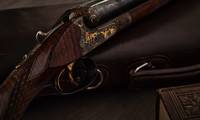
1959. <blockquote><p>Perhaps the most historically important gun to reach the market; Gifts of state are themselves rare as since an Act of Congress in 1978 they have belonged to the nation and not the recipient; The magnificent shotgun another one of which was given to President Eisenhower comes with a copy of the thank you letter from McElroy to Khrushchev</p><p> </p><p>Khrushchev’s visit lessened Cold War tensions and was a major reason the Cold War did not turn hot</p><p> </p><p>""This gun is an embodiment of Nikita Khrushchev's policies in more ways than one: the diplomatic effort to make peace with the West and the domestic reforms aimed to turn the military-industrial second into profitable enterprises operating on open civilian market†says author Aleksei Morozov</p></blockquote><p>https://vimeo.com/1068197728</p><p> </p><p><strong>Provenance</strong></p><p>This gift was given by the craftsmen in Izhevsk to Premier Khrushchev who brought it from Moscow and instructed his foreign policy team to present it to Secretary of Defense Neil McElroy a gift of state meant to symbolize a detente between the two nations. It was retained by McElroy and passed to his son whose heirs sold it directly to us. It has never before been offered for sale and was not known to have survived.</p><p><strong>Rarity</strong></p><p>This is perhaps the most historically significant long gun given its symbolism as a symbolic gift of state between the two dominant 20th powers at a crucial moment in the Cold War ever offered for sale. There are no comparables on the public market. Gifts of state are themselves rare as since an Act of Congress in 1978 they have belonged to the nation and not the recipient</p><p><a href=""https://cdn.raabcollection.com/wp-content/uploads/20231204175833/rifle2.jpg""><img class=""alignnone size-post-window wp-image-20846"" src=""https://cdn.raabcollection.com/wp-content/uploads/20231204175833/rifle2-1600x600.jpg"" alt="""" width=""1600"" height=""600"" /></a></p><p><strong>Historical background</strong></p><p>In September 1959 the Soviet Premier Nikita S. Khrushchev visited the United States for about two weeks. This was the first visit by a Soviet head of state to America and was seen as a momentous occasion absolutely dominating the news at the time. Khrushchev's fundamental purpose in making the trip was to gain a better understanding of what America was and to promote mutual understanding between the Soviet Union and the United States on matters of importance to both. Khrushchev hoped that mutual understanding would eventually lead to peaceful coexistence feeling his visit would be the first step on that road. Dr. Sergei Khrushchev - the son of the late Soviet Premier who made the trip with him and became a U.S. citizen in 1999 - considers this visit to be “the beginning of the mutual interaction of the two worlds.""</p><p>On his trip Khrushchev wanted to talk about politics with President Eisenhower and his senior officials such as Secretary of Defense Neil McElroy: the need for a peace treaty between East Germany and the United States the mutual advantages that would result from the establishment of trade relations between the United States and the Soviet Union and most importantly the necessity of complete and universal disarmament. Even though the U-2 spy-plane incident in May 1960 and Berlin Wall and Cuban Missile Crisis in 1962 were setbacks the ultimate success of Khrushchev's trip the United States in 1959 was increased interaction a lessening of tensions the 1962 Nuclear Test Ban Treaty and a better comprehension of both nations’ core Cold War positions which was a major reason that the Cold War did not turn hot.</p><p>Khrushchev’s hopes to establish a mutual understanding with the United States were embodied not merely by the exchange of views on certain issues so that the two sides understood the position of the other but also understood the reasons each had for their perspectives. In Khrushchev’s mind this mutual understanding also went beyond diplomacy and extended to seeing America's people to letting them see him to becoming familiar with American culture and to experiencing what the United States had to offer. This was the success of the visit which had a significant immediate impact on the Cold War.</p><p><a href=""https://cdn.raabcollection.com/wp-content/uploads/20231204175829/rifle3.jpg""><img class=""alignnone size-post-window wp-image-20847"" src=""https://cdn.raabcollection.com/wp-content/uploads/20231204175829/rifle3-1600x558.jpg"" alt="""" width=""1600"" height=""558"" /></a></p><p>The backdrop for Khrushchev’s visit is essentially a history of the Cold War which often threatened to get hot and lead to a nuclear holocaust. Following World War II the uneasy wartime alliance between the United States and Great Britain on the one hand and the Soviet Union on the other began to unravel. By 1948 the Soviets installed communist governments in the countries of eastern Europe that had been liberated by the Red Army. The Americans and the British feared the permanent Soviet domination of eastern Europe and the threat of Soviet-influenced communist parties coming to power elsewhere. The Soviets on the other hand were determined to maintain control of eastern Europe and intent on spreading communism worldwide. The Cold War had solidified by 1947–48 when U.S. aid provided under the Marshall Plan to Western Europe had brought those countries under American influence. From 1948–53 the Soviets unsuccessfully blockaded the Western-held sectors of West Berlin; the United States and its European allies formed NATO; the Soviets exploded their first atomic warhead thus ending the American monopoly on the atomic bomb; the Chinese communists came to power in mainland China; and the Soviet-supported communist government of North Korea invaded U.S.-supported South Korea in 1950 setting off an indecisive but bloody Korean War that lasted until 1953. Josef Stalin died in 1953 triggering a power struggle in which Khrushchev emerged victorious and by 1956 he had consolidated his authority as First Secretary of the party's Central Committee. He then famously denounced the “excesses†that occurred under Stalin and declared that he sought “peaceful coexistence†with the United States.</p><p>Regarding his trip Khrushchev said he was “curious to have a look at America†and he visited not only Washington D.C. but New York California Pennsylvania Camp David and even a farm in Iowa. The trip took twelve days running from September 15-27 1959. His arrival on the 15th was followed with a motorcade from the airport to downtown Washington. Spectators and several military bands lined the way as Eisenhower Khrushchev and his wife Nina all seated in a convertible waved to the crowds. At the White House they engaged in the first of several meetings both formal and informal. These ran the gamut from frigid sessions at first to - shortly before Khrushchev’s departure - ones that were infused with a spirit of compromise. At a state dinner that first night Eisenhower said “Because of our importance in the world it is vital that we understand each other better.†Khrushchev responded by observing that friendship was necessary “because our two countries are much too strong and we cannot quarrel with each other.â€</p><p>On the 16th in D.C. for a luncheon at the National Press Club Khrushchev declared his ""sincere desire to achieve better relations between our two countries and promote peace all over the world."" On the 18th in a speech to the United Nations General Assembly Khrushchev discussed the damaging effects of the Cold War and the critical role the United Nations must play to achieve peace among the most powerful nations in the world. ""People still live in constant anxiety about peace about their future"" he said ""And how can they not feel this anxiety when now in one part of the world now in another military conflicts flare up and human blood is shed"" He ended his speech with a plea for universal disarmament: ""Let us compete in who builds more homes schools and hospitals for the people; produces more grain milk meat clothing and other consumer goods; and not in who has more hydrogen bombs and rockets. This will be welcomed by all the peoples of the world.""</p><p>Later in the trip in Pittsburgh he told a crowd “I highly value your confidence expressed in the fact that you presented me with a symbolic key of your city. I thank you and assure you that I want to be your friend and will never abuse your trust and with this key I will only open those doors which you allow me to open…†When he left on the 27th he said he has been ""enriched"" by his visit and that his talks with Eisenhower have helped both men “understand each other better.""</p><p><a href=""https://cdn.raabcollection.com/wp-content/uploads/20231204175820/rfile5.jpg""><img class=""alignnone size-post-window wp-image-20849"" src=""https://cdn.raabcollection.com/wp-content/uploads/20231204175820/rfile5-1600x537.jpg"" alt="""" width=""1600"" height=""537"" /></a></p><p>During the trip the Russians presented the Americans with a small number of symbolic gifts - tokens of friendship and good will. Novosti the Russian news agency reported on ""the list of gifts taken by the USSR delegation to America.Along with the traditional names - granular caviar a set of wine and vodka products boxes and nesting dolls - it also included carpets guns sets of LPs books by Mikhail Sholokhov in English and much more."" The gems were the magnificent decorative guns shotguns from the foremost manufacturer in the Soviet Union one presented to the President and one to Secretary of Defense McElroy. An American newspaper reported on October 11 1959 under the headline ""Eisenhower and Khrushchev have successfully negotiated†that: “One of the gifts Khrushchev brought to Eisenhower was a Russian-made double-barreled shotgun. The Soviet prime minister argued that it was superior to the best British shotguns that hunters around the world have long appreciated. The President is a good shooter and each year he finds time to hunt in the fields of Georgia with former Treasury Secretary George M. Humphrey. Half humorously half solemnly Khrushchev said that this is the only weapon that should be left in the world for the pleasure of hunters…those who witnessed it hope that a small platform for mutual understanding has appeared on which to build future negotiations…â€</p><p>Sergei Khrushchev states of his father and Eisenhower that “these two old men without resolving a single specific question made a lot of progress in the most important area the sphere of human understanding of each other. The first glimmers of trust became visible…We had to move away from the image of an enemy. It seems that this first attempt succeeded. Father produced a rather good impression on Americans. He personally believed in the American president’s desire to achieve peace and a good-neighborly relationship. The image of Eisenhower as an evil instigator of war was finally dissipated and what remained was a clever kind somewhat tired person who had seen a great deal in his life.â€</p><p>The guns were the gems of all the gifts. They were a favorite of Khrushchev and he personally selected them as gifts to the two men. In February he had gone to the Izhevsk region of Russia hundreds of miles East of Moscow where they had presented him with the long arms designed by the finest gun designers. The master engraver Avel Lekomtsev ornately carved representative hunting designs. He is considered to be the finest of the period in Russia.</p><p><strong>The artifact</strong></p><p><a href=""https://cdn.raabcollection.com/wp-content/uploads/20231204175815/rifle6.jpg""><img class=""alignnone size-post-window wp-image-20850"" src=""https://cdn.raabcollection.com/wp-content/uploads/20231204175815/rifle6-1600x602.jpg"" alt="""" width=""1600"" height=""602"" /></a></p><p>When the Russians came to US for this important visit they brought to the Secretary of Defense one of these long guns made in Izhevsk by Lekomtsev.</p><p>The metal and wood extensively engraved double barrel hammerless shotgun is in pristine condition. It is a IZH 57 for Izhevsk and the year it was designed.</p><p>The Izhevsk Mechanical Plant which a few years later became one of the most prominent civilian arms producers in the USSR exported shotguns air rifles and pistols under the Baikal brand all over the world. And yet although the maker is better known for mass-made weapons it also turned out a number of one-off samples hand-finished to the best standard — like this Izh-57. The gun is signed by the Master Gunmakers who worked on it a sign of best quality. Those include Master Engraver Avel Lekomtsev one of the best representatives of the Izhevsk Engraving School a group of artisans who blended several decorative to create unique ornamental style and techniques. The gun lists in Russian the maker and engraver: Master Assembler - V. Nesmelov; Stocker - A. Brylov; Engraver - A. Lekomtsev.</p><p>The year the gun itself was created 1959 - the year of the visit is carved into the metal. The gun also lists the bore and choke size - 17/16.5 and 17/16 millimeters - and the gauge - 16. Lekomtzev has engraved a five-pointed star in a shield the mark of Izhevsk Mechanical Plant used in the period. He has also decorated the action with images of the hunt including a gold fox with prey in its teeth scaring away in the thickets two ducks made in gold. The bird in its teeth is made in silver or white gold.</p><p>On the left side of the action a gold-colored pointing dog in the thickets makes a stand above the bird and the dawn in the sky is made using a colored gold method showing the sunrise with a transition from a golden hue below to a more contrasting shade above. The different shades of plumage of the ducks and animals create the impression of a three-dimensional image. The details of the landscapes on both sides of the action are made in silver or white gold.</p><p>Author Aleksei Morozov notes: ""The way Lekomtsev plays with differently colored gold alloys to make the duck stand out on the background of the equally golden fox is a forerunner of the way Leonard Vasev would create perhaps the best internationally known sample of Izhevsk gun school - the Lenin gun made for the 1967 World Expo in Montreal.""</p><p><a href=""https://cdn.raabcollection.com/wp-content/uploads/20231204175810/Gun8.jpg""><img class=""alignnone size-post-window wp-image-20854"" src=""https://cdn.raabcollection.com/wp-content/uploads/20231204175810/Gun8-1600x1067.jpg"" alt="""" width=""1600"" height=""1067"" /></a></p><p>The gun comes with a copy of the letter from McElroy to Khrushchev dated September 18 1959 while Khrushchev was still in America on Secretary of Defense letterhead. It states in part: “I was pleased yesterday to receive two of your representatives who brought with them some attractive gifts as well as a message from you…Of course the shotgun is handsome indeed. It offers evidence of the quality of craftsmanship of which any country could be proud. In thanking you for the shotgun may I fully reciprocate the wish expressed to me by our representatives that the firearms used in the future by our two countries need be no longer than this shotgun for the preservation of world peace and that even the shotgun be used solely for sporting purposes.â€Â McElroy's manuscript papers were donated but the gun was retained.</p><p>The choice of this gun was no triviality. In presenting the gun to McElroy the Soviet emissaries stated it was meant to symbolize Russian hopes that firearms used in the future by our two countries need be no longer than this shotgun for the preservation of world peace and that even the shotgun be used solely for sporting purposes. This token of friendship from the Soviet Union to the United States at a key moment in the Cold War is of enormous historical importance.</p> hardcover
Referentie van de boekhandelaar : 20819
|
|
|
Dwight D Eisenhower
General Dwight D. Eisenhower Guildhall Address in London and the Address Before the Congress in Washington June 1945
Overlook Press. Collectible - Good. Stamford Connecticut : The Overbrook Press 1945. 1st edition. Sm 4to Paperback. 24pp. Good book. Some foxing to pages. world war 1939-1945 speeches Inquire if you need further information. Overlook Press paperback
Referentie van de boekhandelaar : CA13AA-00167
|
|
|
Dwight D Eisenhower
General Dwight D. Eisenhower Supreme Allied Commander in World War II Sends a Copy of His Sleeve Patch in 1945
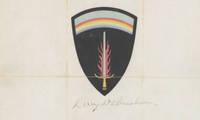
30/10/1945. <p>During World War II Ike received requests for him to send one of his sleeve patches as a souvenir. He never seems to have had one on hand but instead sent a printed color facsimile patch with a description of its meaning below the image and which he signed above the description. The description makes clear that the sword on the insignia “represents avenging justice by which the enemy power will be broken in Nazi-dominated Europeâ€. The black background represents Nazi oppression and the rainbow above is emblematic of hope.</p><p>Miss Martha Wiedermann was one of those who wrote asking for a patch. Eisenhower responded by sending her this <strong>printed color facsimile patch</strong> <strong>signed</strong> above the description. The envelope is still present postmarked October 30 1945 just after hostilities ceased. Affixed to a light board.</p><p>This is just the second Eisenhower sleeve patch we have carried in all these years. The other Ike had sent to his brother.</p><p><img class=""alignnone wp-image-24670 size-post-window"" src=""https://cdn.raabcollection.com/wp-content/uploads/20231204145810/Folder-site-9-1600x1327.jpg"" alt="""" width=""1600"" height=""1327"" /></p> unknown
Referentie van de boekhandelaar : 25708
|
|
|
Dwight D Eisenhower
Ike Nato-Med 1981/1982 Classic Reprint
hardcover. Good. Access codes and supplements are not guaranteed with used items. May be an ex-library book. hardcover
Referentie van de boekhandelaar : 0265952263.G ISBN : 0265952263 9780265952269
|
|
|
Dwight D Eisenhower
Ike Returns to the United States Victorious After V-E Day: Large Signed Photograph of Eisenhower Upon His Arrival Home on June 18 1945 Heading to the White House to Meet with President Truman
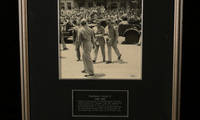
18/06/1945. <blockquote><p>An extraordinary photo and the only one we have ever seen portraying Eisenhower returning home in victory</p></blockquote><p>For the General Dwight D. Eisenhower the Supreme Allied Commander the last two years of the war would be his most challenging. Eisenhower would oversee the gargantuan plan for the invasion of Europe: the largest air sea and land assault in history. He would be the one to give the ultimate order that he knew would send thousands of young men to their deaths. And despite a top-notch staff and talented commanders it would be he alone who would have to shoulder the crushing responsibility of decision making. As June 1944 dawned D-Day approached. On June 1 Ike moved his command post from London to Portsmouth where he lived in a tiny trailer that he christened “my circus wagon.†It was here that he gave the go-ahead for a June 5 landing which was called back due to bad weather. Ike’s meteorologist forecast a brief window of clear weather for June 6. Sensing that it was now or never in the early morning of June 5 Ike gave the order “OK let’s go†for the 6th.</p><p>By late evening June 6 it was clear that Operation Overlord the invasion of Normandy had succeeded. The Allies had put more than 150000 men ashore and the beachheads were littered with Allied tanks and artillery. In late July the Allies would finally achieve a breakout in Normandy and by August 25 Paris would be liberated. The Allies advanced eastward through the autumn of 1944. But hopes to end the war before Christmas were dashed when bad weather set in. And on December 16 as Ike was promoted to the new five-star rank of General of the Army the Germans launched a final attack: the Battle of the Bulge. Initially successful it in the end failed. The Allied offensive picked up again in early spring 1945. In mid-April Ike inspected a concentration camp near Gotha Germany. He was visibly shaken by the horrors he witnessed there. Immediately he summoned reporters and congressional representatives from the United States; he believed firmly that history must have an accurate and permanent record of these unspeakable atrocities. By early May the collapse of the Third Reich was imminent. Just before 3:00 a.m. on May 7 1945 a weary Eisenhower accepted the German unconditional surrender. Someone on Ike’s staff opened a bottle of champagne in a half-hearted attempt to celebrate but it was flat. Exhausted everyone went to bed. But the defeat of Nazi Germany - perhaps the most important victory in modern warfare - was accomplished.</p><p>The month after the German surrender was incredibly busy for Ike. Unending paperwork a flood of congratulations and mountains of correspondence threatened to bury him. Then came the moment Ike longed for - he started back home to the United States. On June 12 he stopped in London for a victory celebration and made a speech in the Guildhall. There he said “Humility must always be the portion of any man who receives acclaim earned in blood of his followers and sacrifices of his friends….He may have written a chapter that will glow forever in the pages of military history. Still even such a man…would sadly face the facts that his honors cannot hide in his memories the crosses marking the resting places of the dead. They cannot soothe the anguish of the widow or the orphan whose husband or father will not return.""</p><p>Then it was on to Washington where he arrived June 18 1945. General George C. Marshall waited with Mrs. Mamie Eisenhower at National Airport for Ike’s arrival. The purpose of the visit was to give General Eisenhower a proper homecoming complete with parades and other celebrations to recognize his remarkable efforts in leading the Allies to victory in Europe. Eisenhower’s plane landed at 11:30 A.M. The group departed from the airport for the Pentagon and Marshall rode with Eisenhower. At the Pentagon Secretary of War Henry L. Stimson greeted Eisenhower and then Ike spoke briefly to thank the many people in the War Department for their support. Eisenhower departed for a grand Victory Parade through the streets of Washington with his staff to the cheers of thousands. It was the greatest ovation ever accorded anyone in the nation's capital. After the parade Eisenhower went to the Capitol for a reception arranged by Congress. He told Congress that the welcome given him was in reality the tribute of a grateful country to the three million U.S. soldiers who helped achieve the victory in Europe. Ike then went to the White House to meet with President Truman and his cabinet and advisors with operations against Japan being the main topic on the agenda. Marshall was with him at the Congressional reception and also at the White House meeting.</p><p>A large 10 by 13 inch<strong> photograph</strong> of Eisenhower with Marshall on their way to meet President Truman at the White House amidst jubilation June 18 1945 the very day Ike returned victorious after V-E Day <strong>signed</strong> by Eisenhower. An extraordinary photo and the only one we have ever seen portraying Eisenhower returning home in victory.</p> unknown
Referentie van de boekhandelaar : 22459
|
|
|
Dwight D Eisenhower
Ike: A Great American Hallmark Editions
New. New. Satisfaction Guaranteed or your money back. unknown
Referentie van de boekhandelaar : 0875290965 ISBN : 0875290965 9780875290966

|
|
|
Dwight D Eisenhower
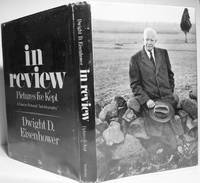
In Review: Pictures I'Ve Kept; A Concise Pictorial Autobiography
NY: Doubleday 1969. Book. Near Fine. Hardcover. Signed by Authors. 1st Edition. 4to - over 9¾. 237 pp. Decorated endpapers. Signed on a tipped in White House carte-de-visite. the story begins with his Kansas boyhood service in the Army rise to General in WW II his presidency and major events and then home to Gettysburg. Doubleday Hardcover
Referentie van de boekhandelaar : kx172
|
|
|
Dwight D Eisenhower
Indian Ocean Cruise 1980 Classic Reprint
hardcover. Good. Access codes and supplements are not guaranteed with used items. May be an ex-library book. hardcover
Referentie van de boekhandelaar : 0266881092.G ISBN : 0266881092 9780266881094
|
|
|
Dwight D Eisenhower
Mandate For a Change 1953-1956 & Waging Peace 1956-1961
Doubleday. Hardcover. Good. Former library book; Pages can have notes/highlighting. Spine may show signs of wear. ~ ThriftBooks: Read More Spend Less.Dust jacket quality is not guaranteed. Doubleday hardcover
Referentie van de boekhandelaar : GB001FV964YI3N10
|
|
|
Dwight D Eisenhower
Mandate For Change
Doubleday & CompanyInc 1963. Book. Fine. Cloth in Box. Signed by Authors. Limited Edition. 8vo - over 7¾ - 9¾" tall. Fine Copy Limited Edition Signed.1/1500 Copies.#1598 Signed By The Author. As New Beautiful Copy In Matching Box. Doubleday & Company,Inc Hardcover
Referentie van de boekhandelaar : 018158
|
|
|
Dwight D Eisenhower
Mandate for Change The White House Years 1953 -- 1956
hardcover. Good. Access codes and supplements are not guaranteed with used items. May be an ex-library book. hardcover
Referentie van de boekhandelaar : 0434225800.G ISBN : 0434225800 9780434225804
|
|
|
Dwight D Eisenhower; Douglas MacArthur; George S Patton; Omar N Bradley
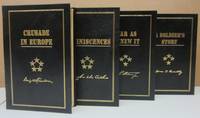
Memoirs of World War II Generals: Crusade in Europe Reminiscences War as I Knew It A Soldier's Story 4 volume set
Norwalk Connecticut: Easton Press 2001. Full Leather. Fine. 24 x 16 cm. Octavo. Four volume set uniformly bound in full black leather with gilt design facsimile signature lettering and foredges. 3 raised bands to spines moire endpapers silk ribbon. A collection of Easton Press published memoirs by four USA generals active during WWII. Titles are: "Crusade in Europe" Dwight D. Eisenhower 559pp. "Reminiscences" Douglas MacArthur438pp. "War as I Knew it" George S. Patton 427pp annotated by Colonel Paul D. Harkins with a new introduciton by Rick Atkinson. "A Soldier's Story" Omar N. Bradley 618pp foreword by Bill Mauldin. Easton Press unknown
Referentie van de boekhandelaar : 75837
|
|
|
Dwight D Eisenhower; Douglas MacArthur; George S Patton, Omar N Bradley
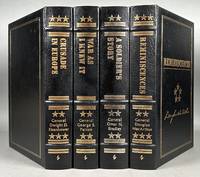
Memoirs of World War II Generals: Crusade in Europe Reminiscences War as I Knew It and A Soldier's Story Four volume set
<p>Four volume set. Black leather with gilt particulars. Three raised bands. Moire endpapers and silk ribbons. All edges gilt. Some loses and rubbing to gilt around covers otherwise this remains a clean set with no previous owners' names affixed bookplates or other defacements.</p><p>6.5 x 9.5 in 16 x 24 cm</p> Easton Press hardcover
Referentie van de boekhandelaar : 10192
|
|
|
Dwight D Eisenhower
NATO Head Dwight D. Eisenhower Announces That He is Going to Turkey for the Official Reception of Turkey into NATO
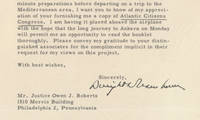
1/3/52. <blockquote><p>Justice Owen J. Roberts resigned from the Supreme Court to advocate for a Federal Union of democracies and to unite one group favoring world government and the other favoring Union of the Democracies</p></blockquote><p>From 1951-52 Eisenhower was the Allied Supreme Commander in Europe which title included the post of head of NATO. In 1952 Turkey joined NATO and Ike traveled to Ankara Turkey to seal with his presence the membership of Turkey in Europe.</p><p>Justice Owen J. Roberts resigned from the Supreme Court in 1945 and was afterwards instrumental in forming the Atlantic Union which would advocate for a Federal Union of Democracies but with a gradual approach to final world union by way of regional unions. Two million people signed a petition that the U.S. and Great Britain unify others wanted to start with the U.S. and Canada. Roberts said that although he approved of NATO he thought it was a fine tradition but could not prevent war and that permanent peace required a federation of likeminded peoples. Nor could the UN be relied upon with the power the Soviets had in that body. In 1952 a new group was formed whose members agreed with Roberts’ views the Atlantic Citizens Congress whose members were drawn partly from the Atlantic Union Committee and partly from outside.</p><p><strong>Typed letter signed</strong> on his letterhead Supreme Headquarters Allied Powers Europe 1 March 1952 to Justice Owen J. Roberts saying he is departing for Turkey and that he is grateful for receiving information on the new Atlantic Citizens organization. <em>“Dear Mr. Justice: Although my schedule is extremely rushed by last minute preparations before departing on a trip to the Mediterranean area I want you to know of my appreciation of your furnishing me a copy of Atlantic Citizens Congress. I am having it placed aboard the airplane with the hope that the long journey to Ankara on Monday will permit me an opportunity to read the booklet thoroughly. Please convey my gratitude to your distinguished associates for the compliment implicit in their request for my views on this project.â€</em></p><p>Eight months later Eisenhower is elected President of the United States.</p><p><img class=""alignnone size-post-window wp-image-25018"" src=""https://cdn.raabcollection.com/wp-content/uploads/20231204144051/Folder-site-11-1600x1327.jpg"" alt="""" width=""1600"" height=""1327"" /></p> unknown
Referentie van de boekhandelaar : 30816
|
|
|
Dwight D Eisenhower (subject); Robert Phillips (photographer)
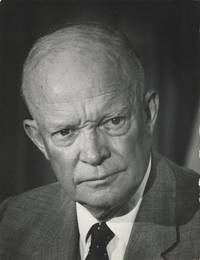
Original oversize portrait photograph of Dwight D. Eisenhower 1957
N.p.: N.p. 1957. Vintage borderless oversize portrait photograph of President Dwight D. Eisenhower 1957. Annotation in manuscript pencil on the verso noting the name of photographer Robert Phillips. <br /> <br /> Noted photojournalist Robert Phillips primarily covered US politics from the mid-1950s to the 1970s. His work is today held by the University of Texas at Austin. <br /> <br /> From the archive of the PIX Agency an American photo house that acted as an intermediary between emigre photographers as well as those still living in Europe and the American magazine and newspaper market between 1935-1969. <br /> <br /> 10.25 x 13.5 inches housed in a 20 x 16 inch 8-ply white mat. Very Good plus. N.p. unknown
Referentie van de boekhandelaar : 162948
|
|
|
Dwight D Eisenhower
Peace With Justice: Selected Addresses Classic Reprint
hardcover. Good. Access codes and supplements are not guaranteed with used items. May be an ex-library book. hardcover
Referentie van de boekhandelaar : 033165332X.G ISBN : 033165332X 9780331653328

|
|
|
Dwight D Eisenhower
Peace with Justice – Selected Addresses of Dwight D. Eisenhower
Columbia Univ Pr 1961. Hardcover. New. 273 pages. 8.66x5.84x0.99 inches. Columbia Univ Pr hardcover
Referentie van de boekhandelaar : x-023102472X ISBN : 023102472X 9780231024723
|
|
|
Dwight D Eisenhower
Peace with Justice: Selected Addresses of Dwight D. Eisenhower
Hardback. New. hardcover
Referentie van de boekhandelaar : A9780231024723 ISBN : 023102472x 9780231024723

|
|
|
Dwight D Eisenhower
President Dwight D. Eisenhower’s Valedictory to Henry Ford II President of the Ford Motor Company
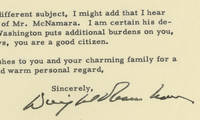
27/12/1960. <p>“I doubt if you realize just how much you have helped me carry on the official work of government…â€</p><p>In the waning days of 1960 Eisenhower prepared to leave office and hand the presidency to John F. Kennedy. Henry Ford II was a close confidant of Eisenhower’s and during his presidency provided Ike with important assistance. So as he said farewell to the presidency Ike wanted to tender to Ford his heart-felt thank you.</p><p>On three occasions Ford lent one of his senior executives Leo Beebe to the U.S. government to supervise the resettlement of refugees and manage similar projects. Beebe became executive vice chairman of Eisenhower’s Committee for Hungarian Refugees in 1956 a need that resulted from the Hungarian Revolution and subsequent flight from the country of many refugees. In addition to his committee work during 1956-1957 while working out of Camp Kilmer in northern New Jersey Beebe oversaw the relocation and resettlement of 35000 Hungarian refugees in the United States eventually finding them permanent residences in this country. In 1959-1960 Beebe organized the U.S. Center for Cuban Refugees in Miami Florida to help with the mass influx of Cuban refugees that fled Castro’s Cuba in 1960 and beyond. Ford backed the refugee aid effort all the way and it was of incalculable importance.</p><p>In 1960 Robert McNamara was President of the Ford Motor Company. Kennedy the President-elect sought to name McNamara Secretary of Defense. Ford agreed to spare McNamara yet another example of his largess.</p><p>Ford Motor Co. required its top executives to use private aircraft for business and personal travel. We see in this letter that he also served Eisenhower by providing private jet transportation to and from meetings.</p><p><strong>Typed letter signed</strong> on White House letterhead Washington December 27 1960 to Henry Ford II. <em>“As the end of my Administration approaches I want once again to express to you and through you to your associates the appreciation I personally feel and which is shared by the members of the White House staff who normally travel with me of the many courtesies that have been extended to us not only during 1960 but through all the years here. I doubt if you realize just how much you have helped me carry on the official work of government by making transportation available to the key personnel who must be with me but are necessarily scattered during any one of the so-called ‘work-vacation’ trips I have taken. I assure you however that without your cooperation it would have been exceedingly difficult for me to carry out my responsibilities and still get some periods of relaxation. I shall be lastingly grateful to you and your officials in the various places we have visited with some regularity and at some length.</em></p><p><em>“On a totally different subject I might add that I hear good reports of Mr. McNamara. I am certain his departure for Washington puts additional burdens on you but as always you are a good citizen.</em></p><p><em>“With best wishes to you and your charming family for a fine 1961 and warm personal regard Sincerely Dwight D. Eisenhower.â€</em></p><p>This letter is the first valedictory of Eisenhower’s we can recall seeing and it remained in the Ford family until 2020. It has never before been offered for sale.</p><p><img class=""alignnone wp-image-25018 size-post-window"" src=""https://cdn.raabcollection.com/wp-content/uploads/20231204144051/Folder-site-11-1600x1327.jpg"" alt="""" width=""1600"" height=""1327"" /></p> unknown
Referentie van de boekhandelaar : 21019
|
|
|
Dwight D Eisenhower
President-elect Dwight D. Eisenhower Tells a Major Supporter That His Contribution Helped Enable Ike to Bring His “Crusade†to the American People
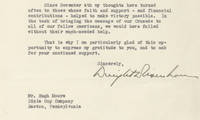
14/01/1953. <blockquote><p>“Since November 4th my thoughts have turned often to those whose faith and support - and financial contributions - helped to make victory possible. In the task of bringing the message of our Crusade to all of our follow Americans we would have failed without their much-needed help.â€</p></blockquote><p>The 1952 United States presidential election was held on Tuesday November 4 1952. Republican Dwight D. Eisenhower won a landslide victory over Illinois Democratic Governor Adlai Stevenson becoming the first Republican president in 20 years. This was the first election since 1928 without an incumbent president on the ballot. Eisenhower was re-elected in 1956 in a rematch with Stevenson.</p><p>The 1952 presidential election campaign was conducted against the backdrop of a “red scare†in which many Americans feared that foreign communist agents were attempting to infiltrate the government. Two years earlier Sen. Joseph R. McCarthy who held that the Roosevelt and Truman administrations amounted to “20 years of treason†claimed that he had a list of State Department employees who were loyal only to the Soviet Union. Though McCarthy offered no evidence to support his charges and revealed only a single name he won a large personal following. The Red Scare the stalemated Korean War and a renewal of inflation handicapped Stevenson who fought a vigorous campaign.</p><p>Eisenhower campaigned tirelessly impressing millions with his warmth and sincerity. His wide friendly grin wartime heroics and middle-class pastimes—he was an avid golfer endeared him to the public and garnered him vast support. On the eve of the election there was a general opinion that the presidential race was close. The final tally however was anything but. Eisenhower won by more than six million votes capturing 39 states and 442 electoral votes to Stevenson’s 9 states and 89 electoral votes. The election was considered a great personal triumph for Eisenhower.</p><p>In the wake of the election Eisenhower thanked his major contributors for their financial support which had enabled him to bring his message to the American people.</p><p><strong>Typed letter signed</strong> on his letterhead New York January 14 1953 to Hugh Moore president of the Dixie Cup Company and a supporter of his. <em>“Dear Mr. Moore: To the thanks you have undoubtedly already received for your generous contribution during the campaign I wish to add my own.</em></p><p><em>“Since November 4th my thoughts have turned often to those whose faith and support - and financial contributions - helped to make victory possible. In the task of bringing the message of our Crusade to all of our fellow Americans we would have failed without their much-needed help. That is why I am particularly glad of this opportunity to express my gratitude to you and to ask for your continued support.â€</em></p><p>It is interesting that Eisenhower saw his election as a crusade and his views as carrying a message.</p><p><img class=""alignnone size-post-window wp-image-25018"" src=""https://cdn.raabcollection.com/wp-content/uploads/20231204144051/Folder-site-11-1600x1327.jpg"" alt="""" width=""1600"" height=""1327"" /></p> unknown
Referentie van de boekhandelaar : 30459
|
|
|
Dwight D Eisenhower
Public Papers of the Presidents of the United States: Dwight D. Eisenhower 1957
National Archives of the U.S 1958. Hardcover. Like New. 4to. Clean unmarked pages. Good binding and cover. Hardcover. Ships daily. National Archives of the U.S hardcover
Referentie van de boekhandelaar : 1012260023
|
|
|
Dwight D Eisenhower; Robert H Ferrell
The Eisenhower Diaries
Easton Press 1989. Hardcover. New. still in shrink wrap full light brown decorated gold leather Easton Press hardcover
Referentie van de boekhandelaar : 260411003
|
|
|
Dwight D Eisenhower; Ferrell, Robert H
THE EISENHOWER DIARIES Easton Press
Norwalk Connecticut: Easton Press 1989. First Edition; First Printing. Hardcover. Fine. Accented in 22kt gold printed on archival paper with gilded edges smyth sewing & concealed muslin joints. Bound In full leather with hubbed spines. A Limited Edition. ; First Easton Press Edition.; 8vo 8" - 9" tall. Easton Press hardcover
Referentie van de boekhandelaar : 85676

|
|
|
Dwight D Eisenhower; Ferrell, Robert H
THE EISENHOWER DIARIES Easton Press
Norwalk Connecticut: Easton Press 1989. First Edition; First Printing. Hardcover. Fine. Accented in 22kt gold printed on archival paper with gilded edges smyth sewing & concealed muslin joints. Bound In full leather with hubbed spines. A Limited Edition. ; First Easton Press Edition.; 8vo 8" - 9" tall. Easton Press hardcover
Referentie van de boekhandelaar : 86143

|
|
|
Dwight D Eisenhower
The First Major Cuban Refugee Program: With Just Four Days Left in Office President Dwight D. Eisenhower Thanks Henry Ford II for Lending Senior Ford Motor Company Personnel to Establish and Run the Cuban Refugee Emergency Center and “making its work a success.â€
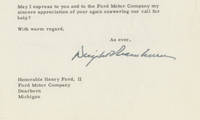
16/01/1961. <blockquote><p>Ike wrote that asked “for help in dealing with this crisis your company at once furnished…the same team - Mr. Leo C. Beebe and Mr. Charles A. Pink - who did so much to make a success of our work…for the Hungarian refugees four years ago.â€</p></blockquote><p>In the wake of the Cuban Revolution in 1959 a Cuban exodus began as the new government allied itself with the Soviet Union and began to introduce communism. Tens of thousands of Cubans left Cuba starting in late 1959 and picking up in 1960 and the United States became the country of first asylum as the Cuban refugees sought and found political refuge here. For the first time the United States Government found it necessary to develop a program to help refugees from another nation in this hemisphere.</p><p>In the forefront of this effort was President Dwight D. Eisenhower who was in the waning days of his administration. In November 1960 Eisenhower directed Tracy S. Voorhees a former Undersecretary of the Army to act as the President's Personal Representative for Cuban Refugees to look into the Cuban refugee situation. To do this and deal with the broader challenges the refugees presented Voorhees reached out for assistance to Henry Ford II of the Ford Motor Company who had been of great help on a similar occasion in the past. In 1956 Ford lent one of his senior executives Leo Beebe to the U.S. government to supervise the resettlement in the U.S. of refugees fleeing Hungary after the failure of the revolution there. Beebe became executive vice chairman of Eisenhower’s Committee for Hungarian Refugees. In addition to his committee work during 1956-1957 while working out of Camp Kilmer in northern New Jersey Beebe and his aide Charles A. Pink a Ford staff member oversaw the relocation and resettlement of 35000 Hungarian refugees in the United States eventually finding them permanent residences in this country.</p><p>In 1960 Ford came through again and provided the services of the experienced Beebe and Pink for the Cuban refugee effort. The Cuban Refugee Emergency Center was established in Miami and became the focal point of refugee registration assistance relief and resettlement as well as coordination of government and independent agencies’ programs. Federal funding provided for the center’s operations record keeping publications coordination of agencies and research on different aspects of the refugee situation as well as for programs. The latter included financial assistance educational loans health care adult education and re-training resettlement and care of unaccompanied children.</p><p>To understand the scope of the effort in the first two years after the Cuban Revolution over 50000 Cubans fled and established new homes in the United States.</p><p><strong>Typed letter signed</strong> on White House letterhead Washington January 16 1961 to Henry Ford II thanking him for again lending a much-needed hand in this critical venture. This letter was written a mere four days before Ike left office and was succeeded by John F. Kennedy. <em>“Tracy Voorhees my representative for the Cuban refugee problem has told me that in response to his request to the Ford Motor Company for help in dealing with this crisis your company at once furnished to him the same team - Mr. Leo C. Beebe and Mr. Charles A. Pink - who did so much to make a success of our work at Camp Kilmer for the Hungarian refugees four years ago.</em></p><p><em>“With their unique experience gained at Kilmer these men have been largely responsible for setting up our Cuban Refugee Emergency Center in Miami and making its work a success. May I express to you and to the Ford Motor Company my</em><br /><em>sincere appreciation of your again answering our call for helpâ€</em></p><p>This letter remained in the Ford family until recently and it has never before been offered for sale.</p> unknown
Referentie van de boekhandelaar : 21214
|
|
|
Dwight D Eisenhower
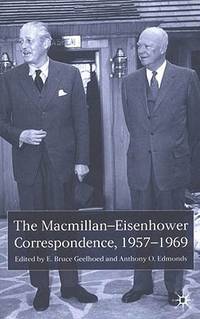
The Macmillan-Eisenhower Correspondence 1957-69
MacMillan pp. ix 436 . Hardback. New. MacMillan hardcover
Referentie van de boekhandelaar : 6514599 ISBN : 1403912939 9781403912930
|
|
|
Dwight D Eisenhower; edited by Louis Galambos and Daun Van Ee
The Papers of Dwight D. Eisenhower The Presidency: The Middle Way Volume XV
Johns Hopkins University Press 1996. Hardcover. As New. 8vo hardcover. No dj grey cloth. Fine condition. Covers and contents crisp clean unworn no marking or writing. Binding square and tight. Johns Hopkins University Press hardcover
Referentie van de boekhandelaar : 1240309.26
|
|
|
Dwight D Eisenhower; edited by Louis Galambos and Daun Van Ee
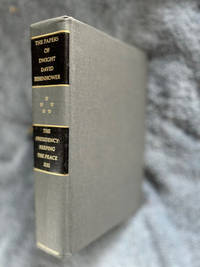
The Papers of Dwight D. Eisenhower The Presidency: Keeping the Peace Volume XXI
<p>Johns Hopkins University Press 2001. Hardcover. As New. 8vo hardcover. No dj grey cloth. Fine condition. Covers and contents crisp clean unworn no marking or writing. Binding square and tight.</p> Johns Hopkins University Press hardcover
Referentie van de boekhandelaar : 1240309.32 ISBN : 0801867185 9780801867187
|
|
|
Dwight D Eisenhower; edited by Louis Galambos and Daun Van Ee
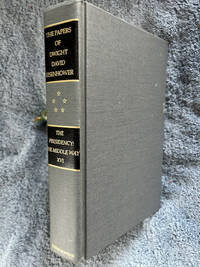
The Papers of Dwight D. Eisenhower The Presidency: The Middle Way Volume XVII
Johns Hopkins University Press 1996. Hardcover. As New. 8vo hardcover. No dj grey cloth. Fine condition. Covers and contents crisp clean unworn no marking or writing. Binding square and tight. Johns Hopkins University Press hardcover
Referentie van de boekhandelaar : 1240309.28
|
|
|
Dwight D Eisenhower; edited by Louis Galambos and Daun Van Ee
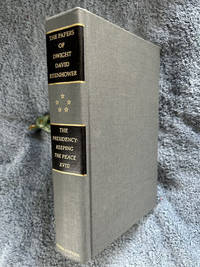
The Papers of Dwight D. Eisenhower The Presidency: Keeping the Peace Volume XIX
<p>Johns Hopkins University Press 2001. Hardcover. As New. 8vo hardcover. No dj grey cloth. Fine condition. Covers and contents crisp clean unworn no marking or writing. Binding square and tight.</p> Johns Hopkins University Press hardcover
Referentie van de boekhandelaar : 1240309.30
|
|
|
Dwight D Eisenhower; edited by Louis Galambos and Daun Van Ee
The Papers of Dwight D. Eisenhower The Presidency: The Middle Way Volume XVI
<p>Johns Hopkins University Press 1996. Hardcover. As New. 8vo hardcover. No dj grey cloth. Fine condition. Covers and contents crisp clean unworn no marking or writing. Binding square and tight.</p> Johns Hopkins University Press hardcover
Referentie van de boekhandelaar : 1240309.27
|
|
|
Dwight D Eisenhower
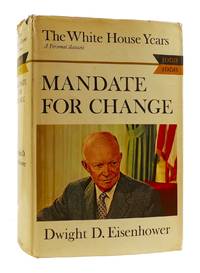
THE WHITE HOUSE YEARS: MANDATE FOR CHANGE 1954-1956
New York: Doubleday 1963. First Edition; First Printing. Hardcover. Very Good in a Very Good dust jacket. Owner imprint on title page. Chip at spine crown. Doubleday hardcover
Referentie van de boekhandelaar : 183989
|
|
|
Dwight D Eisenhower
The White House Years Signed Mandate for Change 1953-1956
Doubleday & Company 1963. Hardcover. Good. Missing dust jacket; Pages can have notes/highlighting. Spine may show signs of wear. ~ ThriftBooks: Read More Spend Less.Dust jacket quality is not guaranteed. Doubleday & Company hardcover
Referentie van de boekhandelaar : GB00IGG5FNWI3N01
|
|
|
Dwight D Eisenhower
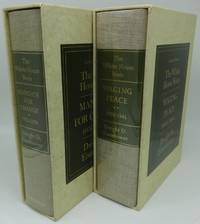
THE WHITE HOUSE YEARS MANDATE FOR CHANGE 1953-1956 AND WAGING PEACE 1956-1961 SIGNED LIMITED EDITION
N.Y.: Doubleday 1963. Very Fine. A very fine two volumes matching number set number 929 of 1500 copies SIGNED BY EISENHOWER. Two volumes: Mandate for Change and Waging Peace. <br /> Slip cases are very fine. No bumped corners to book. No splits no rubbing or chips to slipcases. Doubleday unknown
Referentie van de boekhandelaar : 002699H
|
|
|
Dwight D Eisenhower
The wisdom of Dwight D. Eisenhower: Quotations from Ike's speeches & writings 1939-1969
unknown_binding. Good. Access codes and supplements are not guaranteed with used items. May be an ex-library book. unknown
Referentie van de boekhandelaar : 0962733008.G ISBN : 0962733008 9780962733000
|
|
|
Dwight D Eisenhower
The wisdom of Dwight D. Eisenhower: Quotations from Ike's speeches & writings 1939-1969
Eisenhower Center 1990T. unknown_binding. New. 0.6000 in x 10.8000 in x 7.9000 in. NULL Eisenhower Center unknown
Referentie van de boekhandelaar : mon0000037655 ISBN : 0962733008 9780962733000
|
|
|
Dwight D Eisenhower SIGNED, Marnie Doud Eisenhower SIGNED
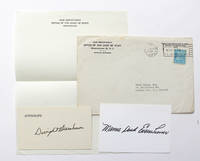
Two Original Autographed Index Cards of US President Dwight D. Eisenhower and his wife Marnie Doud Eisenhower with the Original Envelope from the War Department Office of the Chief of Staff Washington letterhead and postmarked envelope
UK 1947. First Edition . Paper. Good. 48mo - over 3 - 4" tall. Two Original Autographed Index Cards of US President Dwight D. Eisenhower and his wife Marnie Doud Eisenhower with the Original Envelope from the War Department Office of the Chief of Staff Washington letterhead and postmarked envelope. Dated 1947. Dwight David "Ike" Eisenhower 1890 - 1969 was the 34th president of the United States serving from 1953 to 1961. During World War II he was Supreme Commander of the Allied Expeditionary Force in Europe and achieved the five-star rank as General of the Army. Eisenhower planned and supervised two of the most consequential military campaigns of World War II: Operation Torch in the North Africa campaign in 1942-1943 and the invasion of Normandy in 1944. Mary Geneva "Mamie" Eisenhower 1896 -1979 was First Lady of the United States from 1953 to 1961 as the wife of President Dwight D. Eisenhower. Card sizes are 115mm x 65mm and 115mm x 75mm. Condition is good. From the collection of autograph collector Peter Bland. £450 Ref 19234 <br/> <br/> unknown
Referentie van de boekhandelaar : 031091
|
|
|
Dwight D Eisenhower
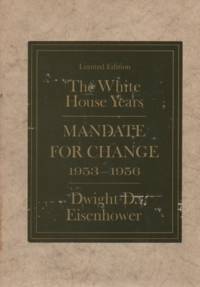
White House Years
Double Day Doran. signed limited. fine/the jackets are fine - the slipcase for vol. 1 is near fine with just a little flecking to the front panel and tiny nick to one foredge of the slipcase for vol.1 -- the slipcase for vol.2 is fine both slipcase are solid. Double Day Doran unknown
Referentie van de boekhandelaar : 1998
|
|
|
Dwight D Eisenhower
White House Years: Waging Peace 1956-1961
Doubleday 2000. Hardcover. Good. Missing dust jacket; Pages can have notes/highlighting. Spine may show signs of wear. ~ ThriftBooks: Read More Spend Less.Dust jacket quality is not guaranteed. Doubleday hardcover
Referentie van de boekhandelaar : G0385038682I3N01 ISBN : 0385038682 9780385038683

|
|
|
Dwight David Eisenhower
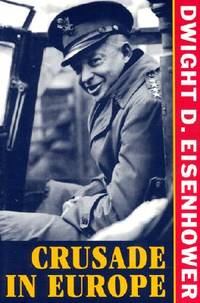
Crusade in Europe
Johns Hopkins Univ Pr 1997. Paperback. New. reprint edition. 559 pages. 8.75x5.75x1.50 inches. Johns Hopkins Univ Pr paperback
Referentie van de boekhandelaar : 1-080185668X ISBN : 080185668X 9780801856686
|
|
|
Dwight David Eisenhower, Daniel D Holt, James W Leyerzapf
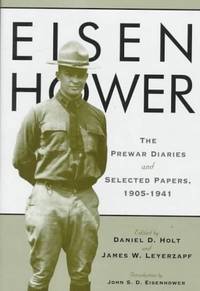
Eisenhower: The Prewar Diaries and Selected Papers 1905-1941
Baltimore: Johns Hopkins University Press 1998. 1st. Hardcover. Very Good/Very Good. Hardcover in a bright unclipped dust jacket 576 pages. Dwight D. Eisenhower's meteoric rise to prominence during World War II was not -- as popular myth would have us believe -- accidental but the logical outcome of years of preparation. Eisenhower had enormous talents opportunities to develop them and an attentive corps of senior officers who watched and encouraged his ascent to high command. The diaries letters and documents assembled in this volume for the first time present a fresh detailed examination of Dwight D. Eisenhower's formative years and the evolution of his genius for organization logistics and strategy. Record # 378789 Johns Hopkins University Press hardcover
Referentie van de boekhandelaar : 378789 ISBN : 0801856744 9780801856747
|
|
|
Dwight David Eisenhower
The Papers of Dwight David Eisenhower: The War Years The Papers of Dwight David Eisenhower 5 vol. set Volumes 1-5
The Johns Hopkins University Pre 1970-05-01. Hardcover. Good. 1.6535 9.2520 6.1024. Five volume set. In good condition. The Johns Hopkins University Pre hardcover
Referentie van de boekhandelaar : mon0003492855 ISBN : 0801810787 9780801810787
|
|
|
Dwight David Eisenhower; Louis Galambos, Daun Van Ee, Alfred D Chandler - Editors
The Papers of Dwight David Eisenhower - 17 Volume Set 1 2 3 4 5 6 7 8 9 0 1112 13 14 15 16 17
Baltimore MD and London: The Johns Hopkins University Press 1996 Book. Very Good . Hardcover. First Edition. A 17 volume set of the Papers of Dwight David Eisenhower with illustations. Volumes 1-5 The War Years; Volume 6: Occupation 1945; Volumes 7 - 9: The Chief of Staff; Volumes 10 and 11: Columbia University; Volumes 12 and 13: NATO and the Campaign of 1952; Volumes 14 -17: The Presidency - The Middle Way. These were published between 1970-1996. Very minor marks; two volumes have an inked name on the flyleafs. Note: shipping within the United States for this heavy set will be $44. . The Johns Hopkins University Press hardcover
Referentie van de boekhandelaar : 107391
|
|

 De zoekresultaten per email ontvangen
 Zoekresultaten downloaden als PDF
 RSS feed
 Permanente link
