|
XAMMAR, Juan Pablo (c. 1593-1666).
Iuris et Facti Responsum De Praerogativis atque Praeeminentiis quibus illustris Vicensis Sedis Archidiaconatus dignitas utitur et gaudet.
Barcelona: Barcinone, ex Typographia Laurentii Deu, iuxta Domum Regiam, 1628. Folio; 19 hojas, sin foliar, más 6 páginas con el encabezamiento " Vicen Salariorum". Cubiertas mudas en cartulina.

|
|
|
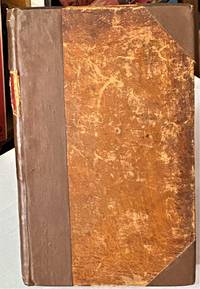
Xavier Bichat; F Gold (translator)
Physiological Researches on Life and Death
Boston: Richardson and Lord 1827. 1827. Translated from the French. Old Ex-Library from Maryland. Fair condition. Foxing and general wear. 2nd edition translated into English. Old library bylaws included warning the reader that late fees may be as much as six and a half cents.<br /> <br /> Marie François Xavier Bichat was a French anatomist and pathologist known as the father of modern histology. Although he worked without a microscope Bichat distinguished 21 types of elementary tissues from which the organs of the human body are composed. Richardson and Lord unknown
Riferimento per il libraio : 66716
|
|
|
XIMENA JURADO, Martín de.
Catálogo de los Obispos de las Iglesias Catedrales de Jaén. Y Anales Eclesiásticos de este Obispado. Edición facsímil de la de Madrid, 1654. Estudio preliminar e índices por José Rodríguez Molina y María José Osorio Pérez.
Granada, 1991. Folio; 7 hs, 559 pp., 18 hs. para el facsímil, con una lámina plegada, y XCVI pp., 1 h. Cubiertas originales.

|
|
|
XIMENES, Miguel.
Primera parte de los meiores romances a lo devino que hasta a ora an salido. El uno en alabança de San Juan Baptista, y una Cancion de Iacob a la hermosura de Rachel, y respuesta de Rachel a Iacob, y una Satira al Nacimiento, con unas redondillas a lo mismo, y un Romance al Santissimo Sacramento. Con un Soneto al Niño Iesus. Reprodución facsímil de la edición de Sevilla, Francisco Aylan, 1629.
Murcia, Antonio Pérez y Gómez, 1963. Un pliego en 4to. de 4 hojas. Impresión en papel de hilo. Edición limitada y numerada de 400 ejemplares. Cubiertas originales.

|
|
|
XIMENEZ, Fray Juan.
Vida del Beato Juan de Ribera recopilada por...
Valencia, en la Imprenta de Joseph de Orga, 1798. 4to.; XXVIII - 592 pp. Ejemplar carente de lámina. Ejemplar carente de encuadernación. Cubiertas provisionales.

|
|
|
XIMÉNEZ SAMANIEGO, Joseph.
Relación de la Vida de la Venerable Madre Sor María de Jesús, Abadesa que fue de el Convento de la Purísima Concepción de la Villa de Ágreda.
Madrid, En la Imprenta de la Causa de la Venerable Madre, 1762. 8vo.; 448 pp. Encuadernación de época, en pergamino.

|
|
|
XIMÉNEZ, Jusepe (c. 1600-1672).
Obras para Teclado. Edición y transcripción de Javier Artigas Pina, José Luis González Uriol y Jesús González López.
Zaragoza, 2006. 4to. mayor apaisado; 224 pp. Cubiertas originales.

|
|
|
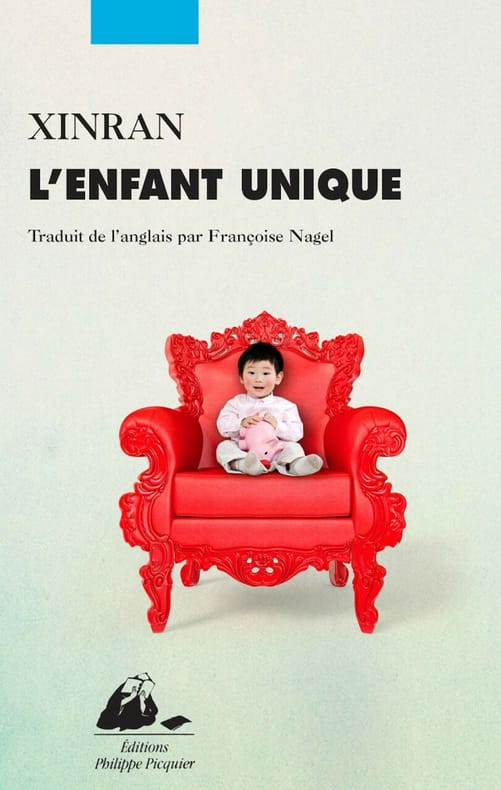
Xinran
L'enfant unique
Editions Philippe Picquier 2016 440 pages 13x3 4x20 4cm. 2016. Broché. 440 pages.
Riferimento per il libraio : 500089176
|
|
|
XXX
Le Gai renoncement: L'affaiblissement de la pensée dans les années 80: L'affaiblissement de la pensée dans les années 80 - Supplément
L'harmattan 1980 175 pages 13 4x1 6x21 4cm. 1980. Broché. 175 pages.
Riferimento per il libraio : 100121911

|
|
|
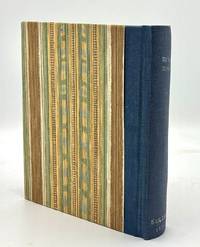
Yaakov ben Yitzchak (or Jacob ben Isaac) Ashkenazi
Chamishah Chumshe Torah 1786; Tseno Ureno im megilot ve-haftarot be-lashon Ashkenaz Tse enah u-re enah benot tsion Pentateuch with Megillat and Patrotas in the Ashkenazi language Tzaina and Rayna Daughters of Zion
Sulzbach: Ze l ben Aharon 1786. Hardcover. Fair. 8vo 8.5 x 7 inches in amateur cloth backed boards mid-20th century fair copy with title page and next leaf in photocopy the leaf after that with damage and loss the remainder of the text in very good condition; last leaf with some edgewear and loss resulting in the loss of some letters. Over 260 leaves seems complete with quite a number of small woodcut illustrations 2.75 x 1.5 inches on average. Tseno Ureno sometimes called the Women's Bible is a Yiddish-language prose work whose structure parallels the weekly Torah portions and Haftorahs used in Jewish prayer services. The book was written by Jacob ben Isaac Ashkenazi 1550–1625 of Janów Lubelski near Lublin Poland and mixes Biblical passages with teachings from Judaism's Oral Torah such as the Talmud's Aggadah and Midrash which are sometimes called "parables allegories short stories anecdotes legends and admonitions" by secular writers. Ze l ben Aharon hardcover
Riferimento per il libraio : h42110
|
|
|
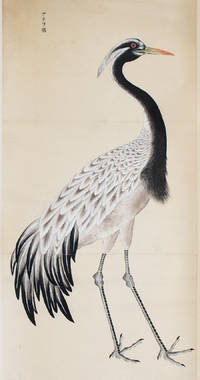
YAMAMOTO Akio or Keigu
Very fine large scroll on high quality paper with 14 extremely beautiful paintings of plants and animals
Scroll 420 x 12000 mm. with elaborate silk brocade endpaper at beginning. Japan: 1880-86. This beautifully rendered scroll of natural history paintings was executed with one exception by Akio or Keigu Yamamoto 1827-1903 Confucian scholar doctor botanist and highly gifted artist. He was born in Kyoto the son of the prominent doctor and botanist Boyo Yamamoto 1778-1859 the direct disciple of Ono Ranzan 1729-1810 the famous professor of botany who wrote a series of classic botanical books. Keigu "continued his father's work in his private school in Osaka and spent his time organizing meetings that were regularly attended by both honzogaku amateurs and Japanese biologists."-Federico Marcon The Knowledge of Nature and the Nature of Knowledge in Early Modern Japan p. 301. Keigu travelled widely throughout Japan drawing plants and animals. He gave botanical instruction to the Meiji emperor and other members of the royal family. Keigu also wrote several standard works on materia medica and left many sketch books and scrolls which entered the Kyoto rare book trade in 1932; some of these were published only in the 1980s. All of his sketch books and scrolls offered valuable and unique information regarding native plants and animals as well as those that had been introduced into Japan. Our scroll contains 14 very finely executed color paintings of plants birds and animals. The paintings are quite unique in their remarkable spaciousness. For instance the image of the octopus is 1410 mm. long. The images include a most unusual morning glory three joined sheets and 1190 mm. long; an edible yellow lily two joined sheets 800 mm.; an ungei flower two joined sheets 795 mm.; a magnificent red toki a now-endangered crane species three joined sheets 765 mm.; a large akowa tsuru another species of crane three joined sheets 815 mm.; a young white crane three joined sheets 935 mm.; a sea lion umiuso painted in many shades of delicate black two joined sheets 545 mm.; a carp two joined sheets 597 mm.; an octopus four joined sheets; a chameleon three joined sheets 844 mm. dated "1880"; a deer antler two sheets 545 mm.; a "Dutch" dog two sheets 545 mm.; a lion seen at exhibitions in Tokyo and Kyoto two sheets 640 mm. with a seal and note stating this was the work of "Ariyoshi" dated "1886"; and two camels two sheets 545 mm. long. Four of the paintings have the signature and seal of Yamamoto and another painting - the final - has the seal only. Three of the paintings have additional text by Yamamoto regarding where seen and painted alternative regional names date etc. Very fine condition preserved in a new wooden box. All but the penultimate painting are the work of Yamamoto. unknown books
Riferimento per il libraio : 6952
|
|
|
YAMAMOTO, Akio (or Keigu)
Very fine large scroll on high quality paper with 14 extremely beautiful paintings of plants and animals
Scroll 420 x 12000 mm. with elaborate silk brocade endpaper at beginning. Japan: 1880-86.<br/> <br/> This beautifully rendered scroll of natural history paintings was executed with one exception by Akio or Keigu Yamamoto 1827-1903 Confucian scholar doctor botanist and highly gifted artist. He was born in Kyoto the son of the prominent doctor and botanist Boyo Yamamoto 1778-1859 the direct disciple of Ono Ranzan 1729-1810 the famous professor of botany who wrote a series of classic botanical books. <br/> <br/> Keigu “continued his father’s work in his private school in Osaka and spent his time organizing meetings that were regularly attended by both honzogaku amateurs and Japanese biologists.â€â€“Federico Marcon The Knowledge of Nature and the Nature of Knowledge in Early Modern Japan p. 301. Keigu travelled widely throughout Japan drawing plants and animals. He gave botanical instruction to the Meiji emperor and other members of the royal family. Keigu also wrote several standard works on materia medica and left many sketch books and scrolls which entered the Kyoto rare book trade in 1932; some of these were published only in the 1980s. All of his sketch books and scrolls offered valuable and unique information regarding native plants and animals as well as those that had been introduced into Japan.<br/> <br/> Our scroll contains 14 very finely executed color paintings of plants birds and animals. The paintings are quite unique in their remarkable spaciousness. For instance the image of the octopus is 1410 mm. long. The images include a most unusual morning glory three joined sheets and 1190 mm. long; an edible yellow lily two joined sheets 800 mm.; an ungei flower two joined sheets 795 mm.; a magnificent red toki a now-endangered crane species three joined sheets 765 mm.; a large akowa tsuru another species of crane three joined sheets 815 mm.; a young white crane three joined sheets 935 mm.; a sea lion umiuso painted in many shades of delicate black two joined sheets 545 mm.; a carp two joined sheets 597 mm.; an octopus four joined sheets; a chameleon three joined sheets 844 mm. dated “1880â€; a deer antler two sheets 545 mm.; a “Dutch†dog two sheets 545 mm.; a lion seen at exhibitions in Tokyo and Kyoto two sheets 640 mm. with a seal and note stating this was the work of “Ariyoshi†dated “1886“; and two camels two sheets 545 mm. long.<br/> <br/> Four of the paintings have the signature and seal of Yamamoto and another painting — the final — has the seal only. Three of the paintings have additional text by Yamamoto regarding where seen and painted alternative regional names date etc. <br/> <br/> Very fine condition preserved in a new wooden box. All but the penultimate painting are the work of Yamamoto. unknown
Riferimento per il libraio : 6952
|
|
|
Yamazaki, Rosen (or Rokawa)
The Ironic Philosophy of Japanese-Americans Nichibei hiniku tetsugaku
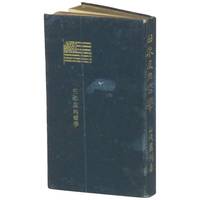
Tokyo: Nihon Shoin 1921. First Edition. A writer for the Rafu Shimpo Japanese newspaper in Los Angeles offers a satirical lexicon of Japanese American terms. The book is reminiscent of Ambrose Bierce's Devil's Dictionary. For example an early entry is for "寫眞çµå©š" shashin kekkon or Picture Marriage: "The Japanese who have always imitated foreign countries in every aspect of their lives are now the only ones in the world with this unique and original invention."<br /> <br /> Picture Marriage is just one example of Yamazaki's commentary on the anti-Japanese climate in the United States at the time. The introduction to this book is by the novelist Ubukata Toshiro.<br /> <br /> OCLC: 673765878 National Diet Library. First edition first printing. A very good copy in thin flexible boards. Boards spotted; lacking the printed white dust jacket. Nihon Shoin unknown
Riferimento per il libraio : 363193
|
|
|
Yamazaki, Rosen (or Rokawa)
The Ironic Philosophy of Japanese-Americans Nichibei hiniku tetsugaku
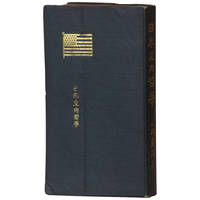
Tokyo: Nihon Shoin 1921. First Edition. A writer for the Rafu Shimpo Japanese newspaper in Los Angeles offers a satirical lexicon of Japanese American terms. The book is reminiscent of Ambrose Bierce's Devil's Dictionary. For example an early entry is for "寫眞çµå©š" shashin kekkon or Picture Marriage: "The Japanese who have always imitated foreign countries in every aspect of their lives are now the only ones in the world with this unique and original invention."<br /> <br /> Picture Marriage is just one example of Yamazaki's commentary on the anti-Japanese climate in the United States at the time. The introduction to this book is by the novelist Ubukata Toshiro.<br /> <br /> OCLC: 673765878 National Diet Library. First edition first printing; the book was reissued in 1922 under a slightly different title. A very good copy in thin flexible boards. Lacking the printed white dust jacket. Nihon Shoin unknown
Riferimento per il libraio : 362511
|
|
|
Yaniv Ben Or
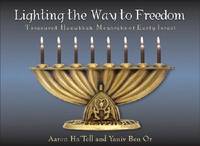
Lighting the Way to Freedom: Treasured Hanukkah Menorahs of Early Israel
hardcover. Good. Access codes and supplements are not guaranteed with used items. May be an ex-library book. hardcover
Riferimento per il libraio : 1932687661.G ISBN : 1932687661 9781932687668
|
|
|
Yankton and Dakota or Sioux Indians
LETTER FROM THE SECRETARY OF THE INTERIOR TRANSMITTING LETTER FROM INDIAN COMMISSIONER CONCERNING TREATIES WITH YANKTON AND DAKOTA OR SIOUX INDIANS AND OTHER PAPERS
53D Cong. 2d Sess.: SED27. 1894. 101pp Disbound some pages loosened else Very Good. SED27. unknown books
Riferimento per il libraio : 13992
|
|
|
Yardley, Joyce
Crazy Cooks and Gold Miners
224 pages. Paints scene after scene of life in the Yukon in the thirties, forties and fifties. Reminds us that life is not really composed of great events, but rather it is a gathering of thousands of moments. Contains several colour plates. Book is unmarked and in good condition but for major leaning of the spine to the right. Book
|
|
|
Ye Qianyu (Or, Yeh Ch'ien-Yu; Born Ye Lunqi (???), Named On Book As Yeh Chien-Yu, Foreword By Consul-General C J Pao; Introducti
China Today In Art Drawings With Prospectus And Inscribed At Length From Artist To William Gropper
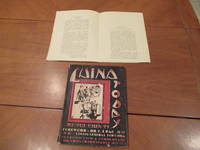
Calcutta India: The Book Emporium / Sasadhar Chakravarty / Kalika Press 1944. 1st Edition 1st Printing. Hardcover. Very Good/Good. 51 Pp. White Boards. First Printing 1944. Very Scarce Worldcat Shows Only Four Institutional Holdings. Light Usage. Dust Jacket Priced Rs 6/- 7S6d. Dust Jacket Worn Small Chips At Edges. Book Inscribed At Length By Yeh Chien-Yu And Dated April 1947 In New York City Ny With Much Additional Text In Chinese And The Artist's Red Stamp. Also With An Extra Set Of Pp. Iii-Vi The Foreword And Introduction Which Apparently Were Used As A Prospectus For The Book.Ye Qianyu Or Yeh Ch'ien-Yü; Born Ye Lunqi ; 1907 -1995 Was A Chinese Painter And Pioneering Manhua Artist. In April 1927Ye Qianyu Together With Fellow Cartoonists Huang Wennong And Lu Shaofei Released A Publication Dedicated To Manhua Called Shanghai Manhua Or Shanghai Sketch. The Original Three Joined By Eight More Artists Including Zhang Guangyu Ding Song And Wang Dunqing Formed The Shanghai Sketch Society Also Translated As Shanghai Cartoon Association In The Autumn Of 1927 China's First Association Dedicated To Manhua. The Association Successfully Relaunched The Shanghai Manhua On 21 April 1928. Ye Drew Several Covers For The Magazine And The Back Page Of The Publication Carried His Comic Strip Mr. Wang. Inspired By The American Strip Bringing Up Father And Portraying The Daily Life Of The Middle And Lower Classes Of Shanghai Mr. Wang Became One Of China's Most Famous Cartoons Eventually Being Made Into 11 Films In The 1930S And 40S. In June 1930 Shanghai Manhua Was Merged Into Modern Pictorial Of Which Ye Became An Editor While Continuing His Mr. Wang Series. When Japan Invaded China And Occupied Shanghai In 1937 Ye Qianyu Together With A Group Of Fellow Shanghai Cartoonists Formed The "National Salvation Cartoon Propaganda Corps" Which Included Well-Known Artists Zhang Leping Lu Zhixiang Te Wei And Hu Kao. Ye's Lover Liang Baibo Was The Only Female Member. It Was Funded By The Kuomintang Government. Ye Went To Hong Kong Prior To Its Fall To The Japanese In December 1941. In 1943 He Temporarily Worked For The Us General Joseph Stilwell As A War Correspondent In India. Throughout His Travels He Drew Many Sketches Of Wartime Scenes Including A Series Entitled Escape From Hong Kong. After The Surrender Of Japan In 1945 Ye Qianyu Went To The United States Where He Held A Series Of Exhibitions To Show And Sell His Artworks. In 1947 Ye Became A Professor At The Beijing Art Academy. When The Cultural Revolution Began In 1966 Ye Qianyu Was Accused Of Being A Kuomintang Kmt Agent And Was Imprisoned For Seven Years. Ye Qianyu Was Politically Rehabilitated In 1979. Ye Qianyu Was Married Three Times. In 1940 Ye Qianyu Met The Dancer Dai Ailian In Hong Kong. Dai Ailian Lived Until 2006 And Is Now Known As The "Mother Of Chinese Ballet". Ye's Last Wife Was Wang Renmei A Famous Actress Who Had Been Previously Married To The "Film Emperor" Jin Yan. Amiya Chandra Chakravarty 1901-1986 Was Literary Secretary To Rabindranath Tagore From 1924 To 1933. He Was Also A Close Associate Of Mahatma Gandhi Walking With Gandhi In The Salt March Of 1930. Following His 1933 Journey With Tagore He Left India To Study At Oxford University And In 1937 Earned A D.Phil. He Moved Back To India In 1940 To Become A Professor Of English At The University Of Calcutta. In 1948 Chakravarty Moved To The Us To Join The Department Of English In Howard University Became A Fellow Of The Institute For Advanced Study In Princeton During 1950-51 And A Professor At Many Universities. He Wrote Both Poetry And Prose And A Number Of Articles In Journals. He Wrote Many Verse Collections In Bengali. His Poetry Reflects Idealism Humanism And A Great Love Of Nature And Beauty. He Served As A Delegate To The United Nations For India Chakaravarty Edited A Number Of English Translations Of Tagore's Works. <br/> <br/> The Book Emporium / Sasadhar Chakravarty / Kalika Press hardcover
Riferimento per il libraio : 049447
|
|
|
Yehudah Bulman Avie Gold Avrohom Kleinkaufman
Ramban - Bereishis Vol. 1: The Torah with Ramban's commentary translated annotated and Elucidated
Mesorah Pubns Ltd 2004. Hardcover. New. 600 pages. 10.25x7.50x1.50 inches. Mesorah Pubns Ltd hardcover
Riferimento per il libraio : 1-1578194253 ISBN : 1578194253 9781578194254
|
|
|
yellow gold
Anthology of Ancient Cultural Words Classification New Edition
commercial stamp office 2016. Soft Cover. Fine. The book is in fine condition. commercial stamp office paperback
Riferimento per il libraio : 2081502111906460 ISBN : 7100097673 9787100097673
|
|
|
yellow gold
Historical Geography and Archeology <Japanese Version>
Qilu Book Company 1982. Soft Cover. Fine. The book is in fine condition. Qilu Book Company paperback
Riferimento per il libraio : 2092902141200621
|
|
|
yellow gold
Research on instructional methods
Chinese book office N.A. Soft Cover. Fine. The book is in fine condition. Chinese book office paperback
Riferimento per il libraio : 2081502111900218 ISBN : 7101083587 9787101083583
|
|
|
yellow gold
Sino-Foreign Traffic and Exchange History Research
Anhui Education Publishing House 2002. Soft Cover. Fine. Number of books: 1 Anhui Education Publishing House paperback
Riferimento per il libraio : 2091502135404845
|
|
|
yellow gold
Zhuangzi and his literature <Japanese Version>
University of Tokyo Book Co. Ltd. 1977. Soft Cover. Fine. Volume: 1 University of Tokyo Book Co., Ltd. paperback
Riferimento per il libraio : 2092902141203145
|
|
|
Yerger, M.C
German Cross in Gold - Holders of the SS and Police- Volume 6: Polizei Division and Police Units,
San Jose, Bender Publishing, 2012.
Riferimento per il libraio : 145677

|
|
|
YI, Hwang 李滉 (or T'OEGYE)
Sheng xue shi tu è–å¸å圖 K: SÅnghak sipto; Ten Diagrams on Sage Learning
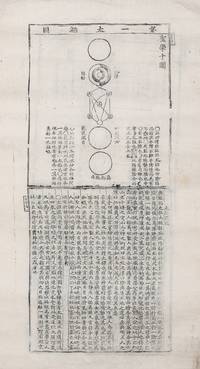
All sheets with woodblock diagrams. Ten woodblock-printed sheets each ca. 1045 x 580 mm. Korea: 18th or 19th century<br /> <BR> <BR> A very rare woodblock-printed broadside edition of the influential SÅnghak sipto by Yi Hwang 1501-71 “Korea’s greatest philosopher.â€â€“Pratt & Rutt Korea. A Historical and Cultural Dictionary Curzon: 1999 p. 517. Yi a child prodigy was a scholar and government official. He served four kings in a number of high positions but his integrity and stand against corruption caused him to be relieved of his posts and sent into exile a number of times.<br /> <BR> <BR> “Yi Hwang better known by his penname T’oegye is generally reputed as Korea’s foremost Neo-Confucian thinker. From the very beginning of the Yi dynasty 1392-1910 the Neo-Confucian doctrine of the Ch’eng-Chu school was the officially sanctioned ideology but with T’oegye it arrived at its full maturity on the peninsula for he was the first to present it with a fully sophisticated and integral grasp of its scope unity and implications. Consequently his teaching became a constant reference point for subsequent generations of Korean Neo-Confucians and his understanding of Chu Hsi’s Zhu Xi’s vision exercised a profound and lasting influence…<br /> <BR> <BR> “One of his last and most important works was the Ten Diagrams on Sage Learning SÅnghak sipdo which he composed for the instruction of young King SÅnjo reigned 1567-1608 in 1568 two years before his death. Considered the summation of T’oegye’s lifetime of learning the Ten Diagrams became one of the classics of the Korean Neo-Confucian tradition: during the course of the Yi dynasty it was reprinted at least twenty-four times and it now circulates in three modern Korean translations…<br /> <BR> <BR> “‘Sage learning’ is a phrase that appears frequently in Neo-Confucian works meant for the instruction of rulers reflecting the view that the essential duty of a ruler is to learn from and emulate ancient sage kings. In terms of its origin the Ten Diagrams is certainly such a work. But T’oegye’s title is ambiguous for ‘sage learning’ also means ‘learning how to become a sage’ that is a fully perfected human being. This is a kind of learning that has to do with not only kings but every human being. Thus the provenance of this work is universal and through the centuries it has served as a basic handbook for generations of serious Neo-Confucians in their endeavor to understand and cultivate the full perfection of their humanity…<br /> <BR> <BR> “This kind of ‘sage learning’ in its full scope is a distinctively Neo-Confucian development. With the Neo-tradition revival of the tradition in the Sung dynasty Confucians finally developed a metaphysical psychological and ascetical framework that could fully describe the status of sagehood and delineate it. Sagehood became a practical goal rather than a theoretical ideal. T’oegye’s object in the Ten Diagrams is to present that framework and path…<br /> <BR> <BR> “Doing this of course amounts to presenting a structured summation of the essence of Ch’eng-Chu theoretical and practical learning. One could devote a large book to this topic; T’oegye compressed it into ten chapters each brief enough to be mounted on a single panel of a ten-paneled screen. Each chapter begins with a diagram and is followed by a text. T’oegye’s own remarks are only a short portion of each chapter. As far as possible he tried to make this a compilation of diagrams and words from other authoritative sources so that the work would clearly represent the cumulative wisdom of the Confucian tradition not just his own private opinion…<br /> <BR> <BR> “The compressed format is not a concession to hasty readers or beginners needing a simple introduction. Quite the opposite; whether as a short book or a screen placed in one’s quarters T’oegye intended this as a work to be lived with and absorbed slowly through repeated reading and leisurely reflection. In that way its compressed contents would unfold gradually and become a part of oneself through the lengthy and personal effort of apprehending its full meaning. The diagrammatic format he chose is ideal for such use for the categories correspondences and relationships suggested by spatial arrangement offer food for reflective thought far beyond the content of the words themselves. T’oegye could expect that the Ten Diagrams would be approached in this way because the Neo-Confucian approach to texts emphasized this kind of repeated reading prolonged reflection and personal assimilation. The theory was that reading should be a process of self-transformation not mere information gathering. T’oegye designed his Ten Diagrams precisely as a tool to be used in such a process.â€â€“Michael C. Kalton “T’oegye’s ‘Ten Diagrams on Sage Learning’: A Korean View of the Essence of Chu Hsi’s Teaching†in The Journal of Korean Studies Vol. 7 1990 pp. 97-99–& see the rest of this wonderful article for the importance of this text which was influential in both Korea and Japan.<br /> <BR> <BR> The titles of the ten chapters are: The Diagram of the Supreme Ultimate The Western Inscription The Elementary Learning The Great Learning The Rules of the White Deer Grotto Academy The Mind Combines and Governs the Nature and Feelings Diagram of the Explanation of Humanity Diagram of the Learning of the Mind-and-Heart Diagram of the Admonition of Mindfulness Studio and Admonition on Rising Early and Retiring Late.<br /> <BR> <BR> As mentioned in Prof. Kalton’s essay these broadsides were intended to be made into a ten-panel standing screen.<br /> <BR> <BR> Fine condition and a remarkable survival. A few minor stains and a little dusty at extremities. We find no broadside edition in WorldCat. unknown
Riferimento per il libraio : 10716
|
|
|
YIN, Liu ?? [or] MING, Liu ??
?? (Fu Zhèng) Uphold Righteousness
Peking No Publisher 1988 Première édition / uvre originale datant du mois de mai de l'année Wùchén (?????), soit mai/juin 1988. Très inspirée du style de Guan Liang (??, 19001986) et de ses disciples. La peinture représente deux artistes vêtus de costumes d'opéra de Pékin (??). Le personnage féminin est une wudan (??) (un rôle féminin martial). Elle porte un costume de soie bleue avec une coiffe élaborée, un maquillage de scène blanc et rouge, et tient une arme. Le personnage masculin est un laosheng (??), c'est-à-dire un personnage de type fonctionnaire/érudit. Une uvre originale attrayante, signée et datée. Le bras de la femme qui tient l'épée présente un léger dommage, la peinture bleue étant estompée. Il y a également trois taches d'encre ou de peinture près du sceau. La peinture est réalisée sur ce qui semble être du papier xuan chinois (??), monté sur un support en carton gris. La peinture mesure 25 cm x 25 cm. Le support en carton mesure 34,5 cm x 34,5 cm. Verso vierge.
Riferimento per il libraio : 5614
|
|
|
YIN, Liu 刘印 [or] MING, Liu 刘明
辅正 Fǔ Zhèng
Peking: No Publisher 1988. First edition / Original art work from 戊辰年五月 or the fifth month of the Wùchén year. ie. May / June 1988. Very much in the style of Guan Liang 关良 1900–1986 and his followers. The painting depicts two performers in Beijing Opera 京剧 costume. The female figure is a wudan æ¦æ—¦ A martial female role. In blue silk costume with an elaborate head dress white and red stage makeup and holding a weapon. The male figure is a laosheng è€ç”Ÿ or official/scholar type. An attractive original work signed and dated. There is slight damage to the woman's sword arm with the blue paint blurred. There are also three spots of ink / paint near to the seal. The painting is on what appears to be Chinese xuan paper 宣纸 mounted onto a grey card backing. Painting is 25cm x 25cm. The backing card is 34/5cm x 34.5cm. Blank to verso. . Première édition / Å’uvre originale datant du mois de mai de l'année Wùchén 戊辰年五月 soit mai/juin 1988. Très inspirée du style de Guan Liang 关良 1900–1986 et de ses disciples. La peinture représente deux artistes vêtus de costumes d'opéra de Pékin 京剧. Le personnage féminin est une wudan æ¦æ—¦ un rôle féminin martial. Elle porte un costume de soie bleue avec une coiffe élaborée un maquillage de scène blanc et rouge et tient une arme. Le personnage masculin est un laosheng è€ç”Ÿ c'est-à -dire un personnage de type fonctionnaire/érudit. Une Å“uvre originale attrayante signée et datée. Le bras de la femme qui tient l'épée présente un léger dommage la peinture bleue étant estompée. Il y a également trois taches d'encre ou de peinture près du sceau. La peinture est réalisée sur ce qui semble être du papier xuan chinois 宣纸 monté sur un support en carton gris. La peinture mesure 25 cm x 25 cm. Le support en carton mesure 345 cm x 345 cm. Verso vierge. No Publisher unknown
Riferimento per il libraio : 5614
|
|
|
Yingling, Jean, Gold, Michael I, Galbraith, Phyllis
Foundations of Your Private Practice Vol. 2 : The Complete Book of Clinical Forms for an Effective Private Practice
Turner Publishing Company. Used - Very Good. Pages intact with possible writing/highlighting. Binding strong with minor wear. Dust jackets/supplements may not be included. Stock photo provided. Product includes identifying sticker. Better World Books: Buy Books. Do Good. Turner Publishing Company unknown
Riferimento per il libraio : 39004388-75 ISBN : 0897931254 9780897931250

|
|
|
YNDURAIN, Francisco (1910-1994).
Los Moriscos y el Teatro de Aragón. "Auto de la destruyción de Troya" y "Comedia pastoril de Torcato". [Reimpresión de la "Revista Segismundo", 1965].
Zaragoza, Institución Fernando el Católico, 1986. 4to. alargado; 175 pp., Con cuatro ilustraciones para la reproducción fotográfica de los textos. Cubiertas originales.

|
|
|
YOSHIWARA Gento or Ryusen
Manuscript on paper entitled on label of upper cover "Kyoinsai seikotsu shinshi" "Kyoinsai's Hands-on Orthopedic Manipulations"
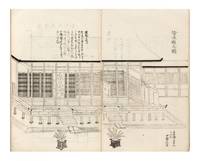
27 folding leaves. 8vo 234 x 158 mm. orig. wrappers manuscript title label on upper cover new stitching. Japan: on final page in trans.: "Copied 1854 by Wakabayashi in today's Tottori Prefecture a member of the Shinshoken." Manipulative therapy has a long history in Japan. "Healing of the sick through rubbing of the body was known to the earliest Japanese physicians who brought the art to a high state of development. Massage was early pre-Nara period linked with the treatment of fractures and bandaging and remained one of the chief factors in the care of the body sharing with mineral baths acupuncture gymnastics and 'deep breathing' in the preliminary development of physical therapy in Japan.The achievements and learning in the practice of massage also contributed to the establishment in the latter part of the 17th century of the 'Seikotsu-Jutsu' which was a system of treatment for fractures and dislocations."-Mestler A Galaxy of Old Japanese Medical Books II pp. 484-85. Gento Yoshiwara d. 1800 was one of the three most important orthopedic specialists in Japan during the final years of the 18th century along with Bunken Kagami and Genka Ninomiya. Yoshiwara whose trade name or mark was "Kyoinsai" studied both Dutch medicine in Nagasaki and Chinese medicine and was greatly influenced by the Chinese Dao yin treatment of massage and exercise. Unlike the works of Kagami and Ninomiya Yoshiwara's most important work - "Seikotsu yoketsu" - remained in manuscript as it was restricted to students of Yoshiwara's school; the present manuscript contains a reworking of that text. The beginning of the main part of the text on the fifth leaf provides the name of Yoshiwara and the location of his school in Hizen province today's Nagasaki Prefecture and the name of two disciples Wada and Abe. The text describes 13 types of treatment in detail including treatments of dislocated shoulders fingers and jaws; spinal stretching dealing with hip problems etc. Many of these treatments have rather fanciful names: "Windmill" "Bear Hug" "Bird's Wing" "Control the Wind" "Crane Feather" "Playing with a Fish" "Worm" "Playing with a Jewel" "Tail of the Bird" "The Snail Method" "Riding on the Dragon" "Swallow's Tail" etc. Some relatively minor worming at the beginning and light marginal dampstaining. ❧ Mestler A Galaxy of Old Japanese Medical Books III p. 152. unknown books
Riferimento per il libraio : 7114
|
|
|
YOSHIWARA Gento or Ryusen
Manuscript on paper entitled on label on upper cover "Seikotsu yoketsu" "Keys to Orthopedic Manipulation"; title on first leaf "Kyoinsai seikotsu yoketsu" "Kyoinsai's Keys to Orthopedic Manipulation"
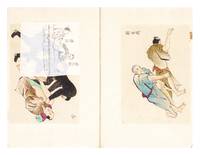
31 finely hand-colored mounted drawings with eight fine black & white brush drawings on slips also pasted on. 36 folding leaves of which 20 are text. 8vo 253 x 180 mm. orig. patterned wrappers manuscript title label on upper cover new stitching. Japan: late Edo. Gento Yoshiwara d. 1800 was one of the three most important orthopedic specialists in Japan during the final years of the 18th century along with Bunken Kagami and Genka Ninomiya. Yoshiwara studied both Dutch medicine in Nagasaki and Chinese medicine being greatly influenced by the Chinese Dao yin treatment of massage and exercise. Unlike the works of Kagami and Ninomiya Yoshiwara's most important work - "Seikotsu yoketsu" - remained in manuscript as it was restricted to students of Yoshiwara's school Ninomiya was a student. Yoshiwara's trade name or mark was "Kyoinsai." Following the 20 leaves of manuscript text which describe 13 types of treatment in detail is a series of 31 finely drawn and hand-colored illustrations of treatments and manipulations including fixing dislocated shoulders fingers and jaws; spinal stretching dealing with hip problems etc. Many of these treatments have rather fanciful names: "Windmill" "Bear Hug" "Bird's Wing" "Control the Wind" "Crane Feather" "Playing with a Fish" "Worm" "Play with a Jewel" "Tail of the Bird" "The Snail Method" "Riding on the Dragon" "Swallow's Tail" etc. An additional eight smaller pasted-on black & white drawings show further treatments. A number of pharmaceutical ointments and plasters are described. In fine and fresh condition although the outer upper corner of all the leaves has been a little nibbled by a mouse. The scribe of this manuscript has used one incorrect character when spelling Yoshiwara's name on the first leaf giving his name as "Yoshio." ❧ Mestler A Galaxy of Old Japanese Medical Books III p. 152. unknown books
Riferimento per il libraio : 6915
|
|
|
Young, H Grady - Compilor or Possibly the Author
Acupuncture
Does not appear to have a title page so the title "Acupuncture" is something I have added. Possibly the title page has been removed but I have no way of knowing. Several sections are credited to H. Grady Young. Several sections are: Historical Highlights of Acupuncture; Understanding Veterinary Acupuncture; The Principle of "Mutation of Energy"; The Great Law of Stimulation and Sedation of Energy; The Principle of Yin and Yang; etc. etc. etc. 10 tabs on page foredges have been added by a previous owner for ten parts of the body. 4to spiral bound 11" tall. 108 pages hand numbered in pen at upper right. Some sections have printed page numbers at bottom or at top as so: 6 4 25 31 6 3 2 2 pages plus many plates with pages unnumbered and also some pages unnumbered. No date however possibly from the mid 70s. A good deal of neat red highlgihting. Tightly bound. Good condition. . unknown
Riferimento per il libraio : 024453
|
|
|
Youngman, William and Alexander Cruden
A complete Concordance to the old and new Testament or a Dictionary and alphabetical Index to the Bible
London, New York, Frederick Warne and Co. ltd., ohne Angaben. 719 Seiten , 26 cm, Hardcover/Pappeinband
Riferimento per il libraio : 39549

|
|
|
YUANWU KEQIN (or, in Japanese: ENGO 圜悟 KOKUGON)
Bukka Engo Zenji Hekiganroku 佛果圜悟禪師碧巖錄 or Hekiganroku or Hekiganshu Emerald or Blue Cliff Record
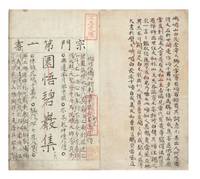
Printed in Chinese with Japanese reading marks. 11 columns per page 21 characters per column. 79; 59; 51; 49; 67 folding leaves. Ten parts in five vols. 8vo 240 x 149 mm. orig. brown wrappers new stitching. Japan: mid-Muromachi ca. 1440-50.<br/> <br/> An extremely rare and important “mid-Muromachi†Gozan-ban edition of The Blue Cliff Record in Chinese: Pi yen lu a collection of Chan Buddhist koan. These were verbal tests used to practice or test a student’s progress in Zen compiled in the Song Dynasty and expanded by the great Northern Song Chan master Yuanwu Keqin 1063-1135 abbot of Tianning Wanshou Chan Monastery in Beijing. The text was first printed in China in 1125 or 1128 and has long been celebrated for both its startling beauty and profound complexity. Around 1140 one of Yuan Wu’s successors Ta Hui destroyed the printing blocks and copies of the Pi yen lu because the work’s rapid and widespread popularity made him fear that its beauty of expression would distract its readers from seeking enlightenment directly within themselves.<br/> <br/> The text was brought back from China by Dogen 1200-53 the Japanese Buddhist priest who was a founder of the Soto school of Zen in Japan. He had studied in China for four or five years and returned to stay at the Kenninji temple where he introduced many texts.<br/> <br/> This text was first printed in Japan about 1336-50 early-Nanbokucho by Gyokuho Shorin at the Kenninji; there is a copy at the National Diet Library. Our edition is a reprint of that first Japanese edition using the same woodblocks with minor changes. A later edition appeared in the Donald and Mary Hyde sale lot 65.<br/> <br/> “For some time Chan monks had been in the habit of extracting snippets from the ‘records’ yulu of past masters isolated them as ‘ancient precedents’ and commenting on them sometimes in verse sometimes in prose. By the mid-eleventh century the core situation was known as a ‘case to be investigated’ or a gong’an. The process was incremental and difficult to stop. Yuanwu’s Emerald Cliff Record for example took a previous eleventh-century collection entitled Master Xuetou’s verses on a hundred old cases and added an introduction and extensive commentary to each ‘case’ sometimes also dropping in comments on the appositeness or more usually inappositeness of the relevant verse so becoming in his turn ‘magistrate.’ A gong’an collection therefore reveals many layers all of them dedicated to undercutting the stability of language while at the same time playing a complex game of competing authorities. Herein lies their fascination.â€â€“Richard Bowring The Religious Traditions of Japan Cambridge U.P. p. 301.<br/> <br/> “Gozan-ban is a general term embracing all those books published by monks of the Zen sect chiefly at the five Zen monasteries at Kamakura and the five at Kyoto over a period of more than 200 years between mid-Kamakura and late Muromachi. The appearance of the printed page in most Gozan editions follows a distinctly Chinese style. The effect is somewhat dense and crowded caused by packing the Chinese characters tightly together with more regard for economy of space than for aesthetic effect. In this the Gozan editions differ markedly from all other early Japanese printed books which are more generously spaced. The reasons for this are twofold: the books tend to be chiefly reprints of Chinese song and Yuan editions and during the fourteenth century many Chinese blockcutters came over from the continent and practised their craft of a semi-commercial basis and on a fairly large scale.â€â€“K.B. Gardner “Centres of Printing in Medieval Japan: late Heian to early Edo period†in British Library Occasional Papers 11. Japanese Studies ed. by Yu-Ying Brown London: 1990 p. 164.<br/> <br/> PROVENANCE: This copy has the seals of Hirokata Yashiro 1758-1841 “Shinobazu Bunkoâ€; Awa no Kuni Bunko; and Goroza Uchino b. 1873 “Kyotei Bunkoâ€. It later belonged to the great collector and bibliographer of early Japanese books Kazuma Kawase 1906-99 and has his seal. The chitsu has Kawase’s manuscript title label stating in trans.: “Gozan-ban. Hekiganroku. Mid-Muromachi edition. Shinobazu Bunko provenance. Kazuma put the title on this label†also with his seal.<br/> <br/> There are four Prefaces: the first is undated the second dated 1300 the third dated 1305 and the fourth is dated 1304.<br/> <br/> Two leaves of manuscript probably written by Yashiro have been inserted at the beginning of Vol. I. They provide a commentary and a sort of title-page the work was issued without a title. Following Part I there are another two leaves of manuscript relating to this text. Following the tenth part are five Afterwards dated 1125 undated 1302 1317 and 1317.<br/> <br/> In fine condition all contained in a modern wooden box. The top of the box has been covered in a most attractive silk brocade. A few natural paper flaws and minor staining. Berkeley has an edition of this text but because of the very vague WorldCat cataloguing it is impossible to tell which exact edition it is.<br/> <br/> ⧠Kornicki Language Scripts and Chinese Texts in East Asia p. 245. unknown
Riferimento per il libraio : 7036
|
|
|
YUANWU KEQIN or in Japanese: ENGO KOKUGON
Bukka Engo Zenji Hekiganroku or Hekiganroku or Hekiganshu Emerald or Blue Cliff Record
Printed in Chinese with Japanese reading marks. 11 columns per page 21 characters per column. 79; 59; 51; 49; 67 folding leaves. Ten parts in five vols. 8vo 240 x 149 mm. orig. brown wrappers new stitching. Japan: mid-Muromachi ca. 1440-50. An extremely rare and important "mid-Muromachi" Gozan-ban edition of The Blue Cliff Record in Chinese: Pi yen lu a collection of Chan Buddhist koan. These were verbal tests used to practice or test a student's progress in Zen compiled in the Song Dynasty and expanded by the great Northern Song Chan master Yuanwu Keqin 1063-1135 abbot of Tianning Wanshou Chan Monastery in Beijing. The text was first printed in China in 1125 or 1128 and has long been celebrated for both its startling beauty and profound complexity. Around 1140 one of Yuan Wu's successors Ta Hui destroyed the printing blocks and copies of the Pi yen lu because the work's rapid and widespread popularity made him fear that its beauty of expression would distract its readers from seeking enlightenment directly within themselves. The text was brought back from China by Dogen 1200-53 the Japanese Buddhist priest who was a founder of the Soto school of Zen in Japan. He had studied in China for four or five years and returned to stay at the Kenninji temple where he introduced many texts. This text was first printed in Japan about 1336-50 early-Nanbokucho by Gyokuho Shorin at the Kenninji; there is a copy at the National Diet Library. Our edition is a reprint of that first Japanese edition using the same woodblocks with minor changes. A later edition appeared in the Donald and Mary Hyde sale lot 65. "For some time Chan monks had been in the habit of extracting snippets from the 'records' yulu of past masters isolated them as 'ancient precedents' and commenting on them sometimes in verse sometimes in prose. By the mid-eleventh century the core situation was known as a 'case to be investigated' or a gong'an. The process was incremental and difficult to stop. Yuanwu's Emerald Cliff Record for example took a previous eleventh-century collection entitled Master Xuetou's verses on a hundred old cases and added an introduction and extensive commentary to each 'case' sometimes also dropping in comments on the appositeness or more usually inappositeness of the relevant verse so becoming in his turn 'magistrate.' A gong'an collection therefore reveals many layers all of them dedicated to undercutting the stability of language while at the same time playing a complex game of competing authorities. Herein lies their fascination."-Richard Bowring The Religious Traditions of Japan Cambridge U.P. p. 301. "Gozan-ban is a general term embracing all those books published by monks of the Zen sect chiefly at the five Zen monasteries at Kamakura and the five at Kyoto over a period of more than 200 years between mid-Kamakura and late Muromachi. The appearance of the printed page in most Gozan editions follows a distinctly Chinese style. The effect is somewhat dense and crowded caused by packing the Chinese characters tightly together with more regard for economy of space than for aesthetic effect. In this the Gozan editions differ markedly from all other early Japanese printed books which are more generously spaced. The reasons for this are twofold: the books tend to be chiefly reprints of Chinese song and Yuan editions and during the fourteenth century many Chinese blockcutters came over from the continent and practised their craft of a semi-commercial basis and on a fairly large scale."-K.B. Gardner "Centres of Printing in Medieval Japan: late Heian to early Edo period" in British Library Occasional Papers 11. Japanese Studies ed. by Yu-Ying Brown London: 1990 p. 164. PROVENANCE: This copy has the seals of Hirokata Yashiro 1758-1841 "Shinobazu Bunko"; Awa no Kuni Bunko; and Goroza Uchino b. 1873 "Kyotei Bunko". It later belonged to the great collector and bibliographer of early Japanese books Kazuma Kawase 1906-99 and has his seal. The chitsu has Kawase's manuscript title label stating in trans.: "Gozan-ban. Hekiganroku. Mid-Muromachi edition. Shinobazu Bunko provenance. Kazuma put the title on this label" also with his seal. There are four Prefaces: the first is undated the second dated 1300 the third dated 1305 and the fourth is dated 1304. Two leaves of manuscript probably written by Yashiro have been inserted at the beginning of Vol. I. They provide a commentary and a sort of title-page the work was issued without a title. Following Part I there are another two leaves of manuscript relating to this text. Following the tenth part are five Afterwards dated 1125 undated 1302 1317 and 1317. In fine condition all contained in a modern wooden box. The top of the box has been covered in a most attractive silk brocade. A few natural paper flaws and minor staining. Berkeley has an edition of this text but because of the very vague WorldCat cataloguing it is impossible to tell which exact edition it is. ❧ Kornicki Language Scripts and Chinese Texts in East Asia p. 245. unknown books
Riferimento per il libraio : 7036
|
|
|
Yukio ashihara, "blood and gold" by Toshio Shimo, "the man of the cat", Nobuo tamahara, "the man of the cat" and "the man of the
Literary circles 7 Volume 10 "works with Rintaro Takeda" Yukio Mishima Japanese Book
Bunshu shunshu NEW 1980. Soft Cover. Fine. KOS01207212 Bunshu shunshu NEW paperback
Riferimento per il libraio : KOS01207212
|
|
|
Yukio Mishima's Naked or Beautiful Movement Cradle Era of Tonko (Izumi Yukimura) Shojiro Shimizu and others
World Naked or Biography Vol.6 October 1959
Kisetsufu shoten 1959. Soft Cover. Fine. Number of books: 1 Kisetsufu shoten paperback
Riferimento per il libraio : 2090202120403424
|
|
|
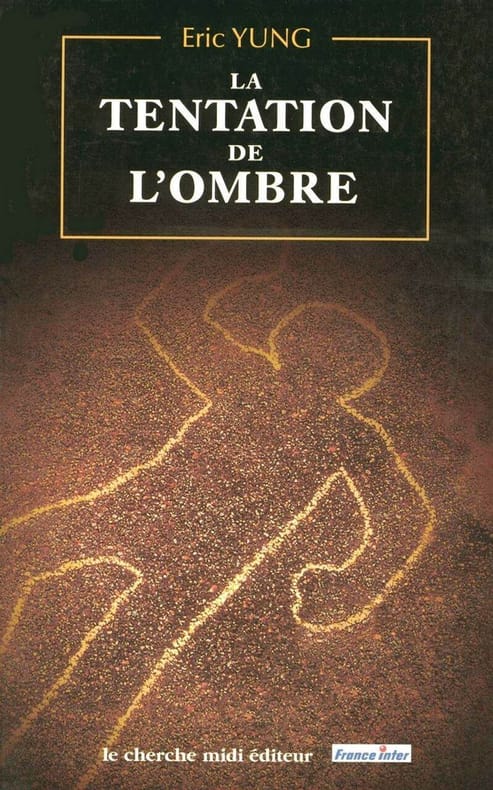
YUNG Éric
La tentation de l'ombre: Récit
Cherche midi 1999 199 pages 15 4x1 8x23 4cm. 1999. Broché. 199 pages.
Riferimento per il libraio : 500057386
|
|
|
Yvonne Brunhammer et al
Jewels of Lalique.
softcover, 224 pages, Illustrated. 26.25cm. ISBN 9782080136312. Showcases jewelry pieces by the designer best known for his glass works, noting his influence on the art nouveau style, use of mythological beings in his art, and material selection. Original.

|
|
|
Yvonne Gold
Teachers Managing Stress & Preventing Burnout
Hardcover. New. New Book; Fast Shipping from UK; Not signed; Not First Edition; First published in 1993. The purpose of this book is to help those who help others. Research has consistently demonstrated that those in the professions particularly helping professions have significantly higher levels of stress and b hardcover
Riferimento per il libraio : ria9780750701587_inp ISBN : 0750701587 9780750701587

|
|
|
Yvonne Gold and Robert A Roth
Teachers Managing Stress & Preventing Burnout
The Falmer Press 1993-02-01. Hardcover. New. In shrink wrap. Looks like an interesting title! The Falmer Press hardcover
Riferimento per il libraio : Q-0750701587 ISBN : 0750701587 9780750701587
|
|
|
Yvonne Gold
Teachers Managing Stress & Preventing Burnout
Hardback. New. "Burnout" and "stress" are recognizable words to individuals in the teaching profession. Based on analysis of the psychological needs of teachers this book aims to provide insights into the nature of stress and burnout outlining a programme for dealing with these issues. hardcover
Riferimento per il libraio : A9780750701587 ISBN : 0750701587 9780750701587
|
|
|
Yvonne Gold and Robert A Roth
Teachers Managing Stress & Preventing Burnout: The Professional Health Solution
Routledge 1993-02-16. 1. hardcover. New. 6.29x0.89x9.46. Buy with confidence. Excellent Customer Service & Return policy. Routledge hardcover
Riferimento per il libraio : DADAX0750701587 ISBN : 0750701587 9780750701587
|
|
|
Yvonne Gold
The Transformational Helping Profession
Pearson Education pp. 304 1st Edition . Hardback. Used. Pearson Education hardcover
Riferimento per il libraio : 6506396 ISBN : 0205195598 9780205195596
|
|
|
YŎNGJO (or YEONGJO) 英祖, King of Korea
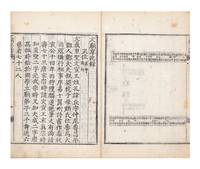
Munmyo hyangsarok 文廟享祀錄 Record of the Sacrifices at the Confucian Temple
Four leaves of illus. 30 folding leaves. Large 8vo 305 x 208 mm. orig. yellow semi-stiff wrappers upper wrappers somewhat soiled both wrappers with some worming new stitching. Korea: 1765.<br /> <br> <br> <br /> First edition of this book published on royal command by King YÅngjo of ChosÅn. The book was compiled by Kim Kwi-ju 金龜柱 1740-86 the older brother of Queen Consort ChÅngsun 1745-1805. The royal Preface is furthermore written in Kim’s standard script calligraphy. Years after the compilation of this book factional intrigue under YÅngjo’s successor ChÅngjo led to Kim being exiled after which he soon died.<br /> <br> <br> Our book outlines sacrifices at the Confucian temple in Seoul including the KyesÅng å•“è–ç¥ and SongjÅl å´‡ç¯€ç¥ shrines. The KyesÅng shrine built in 1669 was the site of sacrifices to the fathers of several Confucian sages including Confucius and Mencius. At the temple as a whole a number of Chinese and Korean Confucian sages and worthies were worshipped. The book contains illustrations outlining the layout of the shrines with the placement of the tablets for the various Confucian scholars marked with their names.<br /> <br> <br> The royal Preface is dated 1765. Ordering the compilation of a record of past exemplars apparently made the king reflect on his own character and actions. He wrote “when I with my shallow learning recite the writings of the sages and worthies but remain unable to learn the Way of the sages and worthies and when I admire the deeds of the sages and worthies but cannot act in their manner it is like knowing what something tastes like but not get to eat it or like knowing the road but being unable to follow it. Even though I might laugh at people of the past why would people of the future not laugh at me tooâ€<br /> <br> <br> Minor worming mostly marginal towards end. See WorldCat 855527023 for a digital copy. unknown
Riferimento per il libraio : 9430
|
|
|
YŎNGJO (or YEONGJO) 英祖, King of Korea
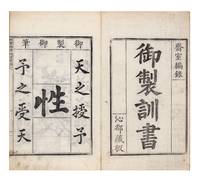
Ŏje hunsŠor Oeje hunseo 御製訓書 Royally Commissioned Exhortations
41 folding leaves. Large 8vo 337 x 206 mm. orig. semi-stiff wrappers new stitching. Korea: Simdo æ²éƒ½ 1756.<br /> <br> <br> <br /> First edition and rare; WorldCat lists only one printed copy at Berkeley. This book of exhortations on good government with striking royal calligraphy was written by King YÅngjo or Yeongjo of ChosÅn 1694-1776 in 1756. At this time YÅngjo was commemorating the death of his father the previous king. According to Fang Chaoying 1908-85 YÅngjo then in his 65th year “could not foresee that he was to live twenty more years and so it appears that he was trying to justify himself in his own mind with regard to posterity as well as to the ancestors whom he expected to face any day†The Asami Library 115. YÅngjo offered three main principles for a king to follow: “to venerate Heaven to love the people and to treat the officials with respect†ibid.<br /> <br> <br> Large standard script characters written by the king himself are reproduced in the beginning of the book. The king’s brush records Confucian assertions such as “the following of human nature is called the Way / the cultivation of the Way is called instruction.†Accepting the Mencian dictum that human nature is inherently good the king continues: “I possess the good human nature / to realize the bright mandate of Heaven.â€<br /> <br> <br> The main text of the book is reproduced in the handwriting of the important scholar-official SÅ MyÅng-Ång or Seo Myeong-eung å¾å‘½è†º 1716-87. SÅ wrote in many genres and had a cosmopolitan outlook. For example he wrote a Preface to one of the major multilingual lexicographical works produced in ChosÅn in the 18th century see Söderblom Saarela “Mandarin over Manchu†379-80.<br /> <br> <br> Very fine and fresh copy beautifully printed.<br /> <br /> <br> <br> References<br /> <br> <br> Fang Chaoying. The Asami Library: A Descriptive Catalog. Edited by Elizabeth Huff. Berkeley: University of California Press 1969.<br /> <br> <br> Söderblom Saarela MÃ¥rten. “Mandarin over Manchu: Court-Sponsored Qing Lexicography and Its Subversion in Korea and Japan.†Harvard Journal of Asiatic Studies 77.2 2017. unknown
Riferimento per il libraio : 9429
|
|
|
Z'graggen, Brigitta
Gedichte.
(um, 1935. Schön illustrierter Leinenband. + Wichtig: Für unsere Kunden in der EU erfolgt der Versand alle 14 Tage verzollt ab Deutschland / Postbank-Konto in Deutschland vorhanden +
Riferimento per il libraio : 13086AB
|
|
|
Z'graggen, Brigitta:
Gedichte.
(um 1935 Schön illustrierter Leinenband.
Riferimento per il libraio : 13086AB
|
|
|
ZABALETA, Juan de (1610-c. 1670).
El dia de fiesta por la mañana y por la tarde en Madrid. Selección, prólogo y notas por Luis Santullano.
México, Editorial Séneca, 1940 ("Primavera y Flor"). 4to. menor, 147 pp., 3 hs. Cubiertas originales.

|
|

 Ricevere i risultati per e-mail
 Scaricare i risultati in PDF
 RSS feed
 Link
Link


