|
[Jesuits; China; Japan; India; Gall, Johann Chrysostomus; Terentius (or Schreck) Johannes
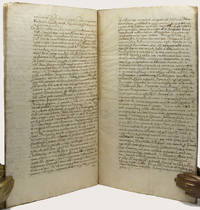
LITERAE P. JO. CHRYSOSTOMI GALL OLYSSIPONAE DATAE. And EXEMPLUM LITERARUM R.P. TERENTII AS R. PATREM JACOBUM KOLLERUM Contemporary Transcripts of two Letters of Two Jesuit Missions in China India and Japan.
Lisbon and Hangzhou China: Manuscripts ca.1623 and 1621. Very Rare A Similar Manuscript Exists in Brussels. We know of no others. The Latin text of both letters is written in a neat uniform cursive hand in brown. Folio leaves 33 x 20.5 cm The transcripts bound in 18th Century stiff blue wrappers the blank paste-downs and endpapers are late 18th century most likely the third quarter between 1745/1753 and 1776 since they contain a clear "lion/vryheit/pro patria" watermark with a crowned GR countermark which resembles Heawood 3148 3149 and 3154. The paper used for the manuscript contains a faint double-headed eagle watermark and it has been reinforced in the gutters. A very pleasing survival very well preserved edges slightly mellowed the wrappers show some signs of wear. VERY RARE MANUSCRIPT TRANSCRIPTS. Chrysostomus Johann Gall 1586-1643 was a German Jesuit and scholar. He left Ingolstadt Germany to teach astronomy mathematics and navigation in Lisbon fro 1620to 1627 before leaving to work in the Jesuit missions in India. The Colégio de Santo Antŕo benefitted from the arrival of many foreign mathematicians and other scholars as Lisbon serves as a gateway for all missionaries departing for Asia. The original letter by Gall was written in Lisbon September 1623 and concerns a newspaper style description of various events including details of the perseution of Christians in Japan particularly the execution of large numbers of the Christian community in Nagasaki in 1622.<br> The second letter in the present work is especially interesting as the original was written by Johannes Terentius also known as Johannes Schreck an Deng Yuhan Hanpo 1576-1630. Terentius was a prominent Jesuit scholar specialized in natural science and mathematics. Before joining the Jesuits as a novice1611 he already enjoyed a grea reputation in Germany as a scholar. In 1621 Terentius left for China to join the Jesuit mission. The original letter by Terentius was written in Hangzhou China on 30 August 1621 to the rector of teh Jesuit College in Munich Jakob Keller 1568-1631. He discusses his journey to China which he started in 1618 his intentions to participate in the planned calendar reform in China and his impressions of the city of Hangzhou which he reached in 1621 Terentius wrote several works on european medicine mathematics and technology in Chinese and together with Johann Adam Schall von Bell and G. Roho introduced European tigonometry and European astronomical instruments to China. In 1629 he began to reform the calendar which J.A. Schall von Bell ocmpleted after Terentius' early death a year later.<br><br>Backer & Sommervogel VII col. 1929-F<br> Manuscripts unknown
Référence libraire : 34518
|
|
|
[JETTE, Jules or Joseph Perron, translated by]
Canotlé Rannaga Kelékak. Délochét Roka
Winnipeg: Free Press No-Rodeneletekteyar 1904. Softcover. Fine. First edition. Slim 24mo. 54pp. Text in Deg Hit'an also knowns as Deg Xinag or Ingalik. Fine in stiff pebbled wrappers. Interestingly the book has several contemporary ink corrections in the text. An uncommon Catholic prayer book and hymnal for the use of the Deg Hit people who live along the lower portion of the Yukon River in Alaska. Free Press No-Rodeneletekteyar unknown
Référence libraire : 551484

|
|
|
[John Murray, Jr? or Thomas Eddy?]
A Brief Account of the New-York Hospital
New York: Printed by Isaac Collins and Son 1804. First Edition. Pamphlet. 4 72pp. Disbound. Includes Historical Sketch of the Institution Charter for Establishing the Hospital Rules and Orders for the Government of the Hospital Rules and Orders Concerning the Library Catalogue of the Books A General Summary of the Number of Patients Admitted into and Discharged from the New-York Hospital List of Officers and List of Members of the Corporation. Name in pen and stamp on title. Soiling and stains throughout. A fair copy. Scarce. Sabin 54481.; Octavo. Printed by Isaac Collins and Son unknown
Référence libraire : 24023
|
|
|
[John or John Joseph Stockdale] Lord St Helens, diplomat, collector, friend of Bentham et al:
Autograph Note third person to John or John Joseph Stockdale bookseller stationer publisher BBTI
No place 30 Aug. 1803. One page 4to minor defects. He asks Stockdale to send "six copies of Sr. B. Boothby's translation of Britannicus by Racine and a copy of the 'Cursory remarks on the State of Parties' see BLC" by the Birmingham coach of "tomorrow". Note: St Helens' original collection of books was destroyed when his house burned down in 1797DNB. WITH: Autograph Note third person one page Malham Water 30 Aug. no year Lord Ribblesdale 1752-1826 asking Stockdale to send "his Newspaper perhaps "LOndon Courant" to Gisburne park from this time". No place, 30 Aug. 1803. unknown
Référence libraire : 4941
|
|
|
[Joseph Ritson, or Richardson]
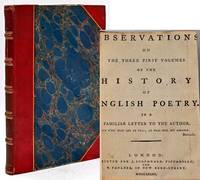
BOUND TO SIZE OBSERVATIONS ON THE THREE FIRST VOLUMES OF THE HISTORY OF ENGLISH POETRY. IN A FAMILIAR LETTER TO THE AUTHOR
London: J. Stockdale; R. Faulder 1782. First Edition. Half Leather. Very Good binding. 8vo.; in an attractive later binding of red half-goat over marbled boards with raised bands with morocco label lettered vertically; with marbled endpapers; 2 49 1 pages.~~A note on this rather interesting binding: we assume that the binder was charged with binding a group of different books to a uniform size -- the title page is trimmed and mounted and all the other leaves are folded neatly to fit the bottom edge and then the leading edge over it. Rather astonishing actually.~~This is Ritson’s first book in which he attacks Thomas Warton’s History of English Poetry in such vitriolic tones -- Warton is a pretender a cheater and a liar -- as to cause quite a contretemps in late 18th century English literary circles. One assumes this actually pleased Ritson as he went on the next year to attack Samuel Johnson and George Steevens. Eventually Ritson went complete mad barricading himself in his rooms at Gray’s Inn and setting fire to a pile of manuscripts. Very Good binding. J. Stockdale; R. Faulder unknown
Référence libraire : 298728
|
|
|
[KAWANABE, Kyosai or KAWANABE KYOSAI SCHOOL]
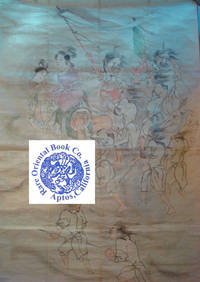
OTOHIME GYORETSU ZU: OTO HIME DAUGHTER OF THE SEA GOD'S PARADE
Japan 1860 n.p. Large sheet 96 x 1m 44 cm. gouachevery clean work no worming or other condition issues painted on 16 joined sheets of Washi paper to make one large sheetfine water-color painting. THIS IS AN ORIGINAL PAINTED ART WORK . . . AM ORIGINAL COLOR PAINTING IN GRAND SIZE . . . FROM JAPAN'S OLDEST MYTHOLOGY: . . . THE KOJIKI & NIHON SHOKI PANTHEON . . . THE ORIGINS OF THE EMPEROR . . . OTOHIME GYO RETSU ZU: . . . THE PROCESSION OF OTOHIME DAUGHTER OF THE SEA GOD . . A stunning color painting by Kyosai. Probably done for a temple donation or as an expression of his faith to Japan's historic heroine. . OTOHIME is a goddess in Japanese mythology and is featured in the Kojiki as well as Nihon Shoki. Also known as "Luminous Jewel". A Japanese goddess the beautiful daughter of the sea-king Ryujin. She married Hoori and gave birth to a son after which she turned into a dragon. . Per the Japanese text brushed on the verso upper left corner: "239 ban dated Ansei 7th Kanoe-Saru-doshi 2 gatsu jojun end of February OTOHIME GYO RETSU ZU" . English: "#239 dated Ansei 7th monkey zodiac year end of Feb.: 1860 . PAINTING TITLE PER VERSO: "THE FIGURE OF PRINCESS OTOHIME'S PROCESSION THE DAUGHTER OF THE SEA GOD" . "Toyotama-hime" Japanese for "Lady Bountiful Soul" better known as Otohime is a goddess in Japanese mythology and is featured in the Kojiki as well as Nihon Shoki. She is the beautiful daughter of Ryujin the "God of the Sea." . A STUNNING ORIGINAL POLYCHROME GOUACHE PAINTING: . This original color watercolor painting shows the lively procession of OTOHIME and her hand maid. She is followed by a flag and umbrella bearer. Also following is a man with a pair of deer antlers good omen a man with a small red offering table with peaches the Wind God and his thunder-drum. Another flag bearer his helper followed by two others one holds a staff the other an offering of golden egg. . The items carries are symbolic good fortune and wealth in terms of deer antlers peaches and the golden egg represent ancient Chinese also used by the Japanese of omens of good fortune and good luck. . THE PAINTING: . Per the Japanese brushed text on the verso there is a number found meaning this panel of several was part of a larger work per the chronology found in Clark see below. . This panel of several paintings was part of a restoration of Zojo-ji temple in Shiba. In 1859 KANO Toei & Kyosai "participates in a repair project at the Zojo-ji temple." See Clark. . Although Kyosai had officially left the Kano school in 1854 by participating in the restoration of Tokugawa's family temple in Shiba he was showing loyalty to the Tokugawa family a good reason to volunteer his skills to the temple. It is also noteworthy that his mentor Kano Toei also participated in the restoration and in all likelihood Kyosai joined his master in a sign of respect and loyalty to him. . Based on this chronology it is clear Kyosai was one of the painters who worked at Zojo-ji temple along with his mentor and master teacher Kano Toei. It was not uncommon at this time for schools to volunteer teachers and students to do temple restoration and art work painting replacing or enhancing paintings and large murals. . This item's date matches the restoration dates for the Zojo-ji temple which began in 1859 and continued into 1860. . This panel was unused in the restoration it may have been a precursor to the final painting which was actually used in the restoration project. It matches the scenes found in Zojo-ji temple restoration. The work is the exact style of others painted by Kyosai and his genre. The caricatures of the people in this painting reflect Kyosai's style exactly the theme of his eccentric humor expressing his love for creativity and the joy of painting. . It is entirely within Kyosai's bizarre character to undertake and devote himself to such a project as illustrating the famous myth of OTOHIME in more than 200 deluxe extra-large-size format paintings. . This restoration project could also have been a 'paying job' for Kyosai as at that time he did not seem to be employed but in 1858 he began to design "Kyoga crazy pictures. It was in 1857 he married Okyo the daughter of a Rimpa painter Suzuki Kiitsu but Okyo died in 1859 and he remarried Tose who died in 1860. . It is more than likely Kyosai being a Buddhist he felt it was his religious obligation to do pennants by contributing to and drawing Buddhist or such traditional images as a way to placate the loss of his wife. . THE STORY OF OTOHIME DAUGHTER OF THE SEA GOD: . Because this work was part of the Zojo-ji temple restoration it cannot be considered a commercial painting one that was casually drawn and put on the market for sale. This was part of a commissioned restoration financed by some benefactor to the temple and most likely supported by the Tokugawa family. . ONE OF JAPAN'S EARLIEST AND MOST FAMOUS MYTHS: . The story of OTOHIME DAUGHTER OF THE SEA GOD is one of Japan's oldest and most famous myths known to all Japanese. Treasured as one of the most important in the ancient pantheon it is found in the earliest writing about the origin of Japan and the Emperor in the KOJIKI and the NIHON SHOKI. . This kind of larger paper illustrated story would take months to complete by It would also take devotion to the subject and focus with responsibility to produce a good number of paints daily. This was something Kyosai could and would do ! . THE ARTIST/PAINTER: This work is unsigned which is expected as part of a larger series of paintings. If this was the work of Kyosai it falls entirely within the dates during his period of work produced when he was 29 years old. . The caricature in the faces and fluid bodies in motion the "flowing" style are his. Although there is no signature and it is a true reflection of Kawanabe's work we are attributing it to him. . Another convincing point is that this kind of painting and meticulous style is also found in his famous instructional showing various 'schools' of painting in his KYOSAI GADEN. See below. . WHO WAS KAWANABE GYOSAI/KYOSAI: 1831-1889: Kawanabe Kyosai was a superb artist in the words of a critic "an individualist and an independent perhaps the last virtuoso in traditional Japanese painting". . Living through the Edo period to the Meiji period Kyosai witnessed Japan transform itself from a feudal country into a modern state. Born at Koga he was the son of a Samurai. His first aesthetic shock was at the age of nine when he picked up a human head apart from a corpse in the Kanda river. . After working for a short time as a boy with Utagawa Kuniyoshi he received his artistic training in the Kano school but soon abandoned the formal traditions for the greater freedom of the popular school. During the political ferment which produced and followed the revolution of 1867 Kyosai attained a reputation as a caricaturist. His very long painting on Makimono" scroll The battle of the farts" may be seen as a caricature of this ferment. . He was arrested three times and imprisoned by the authorities of the Shogunate. Soon after the assumption of effective power by the Emperor a great congress of painters and men of letters was held at which Kyosai was present. . He again expressed his opinion of the new movement in a caricature which had a great popular success but also brought him into the hands of the police this time of the opposite party. After this time he changed his name from Kyo crazy or wild to any one of 19 other "Go" studio names he used. However after the police jailed him he avoided use of "Kyo" but returned back to it with three other "GO" that used the same character "Kyo" crazy & wild such as #7 "Baiga Kyosha" #10 "Kyosai #12 Kyosha Gaishi #16 "Shosho Kyosai" Quoted from Roberts below see that reference for more details. . Kyosai is considered by many to be the greatest successor of Hokusai as well as the first political caricaturist of Japan. His work mirrored his life in its wild and undisciplined nature and occasionally reflected his love of drink. . Color photos are posted to our website. . REFERENCE: . More on OTO HIME: heon-org/articles/o/otohime-html KAWANABE Gyosai later known as Kyosai: Is well collected by world museums I GADAN: 1887 4 vol. set: In this work he outlines and exhibits a wide variety of "styles" of painting. In this work there are several examples of this kind or school of painting. Wikipedia stated about this book: "The most important work about Kyosai's art and life was written by himself: Kyosai Gadan or "Kyosai's Treatise on Painting" half autobiography and half painting manual. WESTERN APPRECIATORS: Many westerners came to visit Kyosai and their memoirs about the artist are valuable. The two important ones both rare were: Emile Etienne Guimet Promenades Japonaises Paris 1880. Josiah Conder: "Paintings and Studies by Kawanabe Kyosai" Tokyo 1911. Conder was a serious student of Japanese art; after some initial rejections he was accepted as Kyosai's pupil and accompanied him for ten years until the master's death. Timothy Clark Demon of painting: the art of Kawanabe Kyosai p.186 chronology and the drawing #21 p.58 is very similar to the pose found in our painting of OTOHIME Toyotama-hime both in pose facial quality hair style and the general perspective. ROBERTS Laurance P.: A DICTIONARY OF JAPANESE ARTISTS: PAINTING SCULPTURE CERAMICS PRINTS LACQUER p.100 stated of him: Kyosai ".was marked by a wild eccentric humor.caricatures of full of fantasy and invention." KAWANABE KYOSAI MEMORIAL MUSEUM. KAWANABE KYOSAI DOKU HON. OTOHIME: Nihon Jinmei Daijiten Toyotama-hime. Tokyo: Shogakukan. 2012. . . unknown
Référence libraire : 36023801
|
|
|
[KITANO], Kikuu (or Shuho)
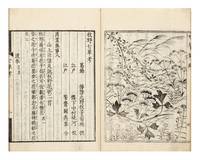
Akino nanakusa ko Thoughts about Seven Herbs in Autumn
One full-page woodcut. .5 29 .5; 15.5 folding leaves. Two vols. 8vo orig. blue wrappers orig. block-printed title labels on upper cover later decorated wrappers later stitching. From the colophon at end of Vol. II: Edo Kyoto & Osaka: Hanabusaya Heikichi et al. 1812.<br /> <br /> <BR> <BR> with:<br /> <br /> <BR> <BR> —. Haru nanakusa ko Thoughts about Seven Herbs in Spring. Three full-page woodcuts & nine smaller woodcuts in the text. .5 36 folding leaves. 8vo orig. blue wrappers as above later decorated wrappers later stitching. From the colophon: Edo: Yamashiroya Sahei 1814.<br /> <BR> <BR> First editions a rare complete set of these two works which are concerned with two important seasonal celebrations. The first of the year is the Festival of Seven Herbs in Spring Nanakusa no sekku a traditional Japanese ritual of eating seven-herb rice porridge on the 7th of January; its consumption would bring longevity and health and ward off evil. The tradition derives from ancient China. The seven herbs are seri Japanese parsley nazuna shepherd’s purse gogyo cudweed hakobera chickweed tahirako nipplewort suzuna turnip and suzushiro daikon radish.<br /> <BR> <BR> The other is the Festival of Seven Autumn Herbs Akino nanakusa less well known then the spring celebration. These herbs are hagi bush clover obana/susuki Japanese pampas grass kuzu kudzu nadeshiko Japanese dianthus ominaeshi Patrinia scabiosifolia fujibakama Eupatorium fortunei and kikyo balloon flower. While many of them have medicinal qualities for this festival they are not for eating but for viewing and admiring.<br /> <BR> <BR> Kikuu Kitano 1762-1831 a native of Sendai came to Edo in the 1780s and opened an antiques gallery that enjoyed great success. In 1804 he purchased a large piece of land in the Mukojima section of Edo where he established a botanic garden today known as the Mukojima Hyakkaen Garden. It is Tokyo’s only surviving garden from the Edo period. There he planted a landscaped orchard of 360 plum trees and other plants including the seven herbs of both spring and autumn selected by Kitano and his literati friends both poets and painters. <br /> <BR> <BR> These works are very beautifully printed using a wide variety of character styles to express meanings and authorship. The first two volumes to be published — on the autumn festival — contain a fine full-page woodcut designed by the author showing all seven herbs. The text contains references to each herb in waka and kanshi Chinese poetry written by Japanese a guide to understanding the nuances of the poetry and the botanical literature.<br /> <BR> <BR> The spring festival volume published two years later describes each of the seven spring herbs and their uses in medicine and gastronomy with many references to the Japanese botanical literature. There is a long passage on how to prepare the springtime porridge. The woodcuts depicting each of the seven herbs are by prominent artists including Kita Busei 1776-1856 and an unidentified woman artist.<br /> <BR> <BR> PROVENANCE: With the seals of Mayori 1829-1906 and Mamichi 1866-1925 Kurokawa prominent father and son book collectors. Their collection was largely concerned with botanical and herbal books; most of the collection was destroyed in the great Kanto earthquake. Our set later entered the collection of Frank Hawley scholar and one of the most discerning collectors of Japanese books and manuscripts. His stamp appears on the first page of text. See R.H. van Gulik’s “In Memoriam. Frank Hawley 1906-1961†in Monumenta Nipponica Vol. 16 No. 3/4 Oct. 1960-Jan. 1961 pp. 434-47.<br /> <BR> <BR> Fine set preserved in a fine chitsu. With some mostly marginal worming much of which has been carefully repaired. unknown
Référence libraire : 8333
|
|
|
[KLONDIKE GOLD RUSH].
Alaska and the Yukon Territory: America her grandeur and her beauty. Part thirteen. . . .
Chicago & New York: Union Book & Publishing Company ca. 1904. Folio. 12 x 13.75 in. pp. 201-216. With photo illustrations throughout. Illustrated printed khaki-coloured softcovers edgewear chipping to head of spine still VG copy. First edition thus of this installment in the bi-monthly “America Her Grandeur†released by Union Book during the opening decade of the 20th Century. This installment focuses on the Alaska and Yukon Territory with excellent gold mining Alaska & Yukon steamships and railroads and more. Although undated the work does specifically mention that the Tenana Railroad will be started in 1905 and that the gold rush had just recently launched with most miners trekking into the Cleary Fairbanks and Ester Creeks in the Fall of 1903. Worldcat locates 3 copies U of GA Clarke Hist. Lib. UTX Austin. Union Book & Publishing Company, paperback
Référence libraire : 61076
|
|
|
[KLONDIKE GOLD RUSH]. LUNG, Edward Burchall; MARTINSEN, Ella Lung
Black Sand and Gold. True Alaska-Yukon gold-rush story. . . As told by her father. . . .
Portland OR: Metropolitan Press 1967. Thick 8vo. 4 419 5 pp. Photo frntsp. numerous photo illusts. Gray-black cloth blue lettering front cover & spine w/ d.j. cover art photo of gold miner minor scuffing toning to fore-edges 1 closed tear upper fore-edge front cover price-clipped still NF/VG- copy w/ former ownership markings on ffep. Alaska Centennial edition of this rousing first-hand account of the early days of the Klondike Gold Rush much of it drawn from the journals and notes of her father and grand father Edward Lung and Clement Lung who joined the stampede from Tacoma WA to the Klondike via Skagway Chilkoot Pass and the Yukon River. He met many of the famed Gold Rush figures including Joaquin Miller and despite the hardships kept a daily diary used in this memoir. See: Kurutz Klondike & Alaska Gold Rushes A Descriptive Bibliography 339b. Metropolitan Press, hardcover
Référence libraire : 63083
|
|
|
[Klondike Gold Rush/discoveries; Queen Victoria Diamond Jubilee; Indian Frontier Rising]
Contributions to Early English Literature. Derived chiefly from Rare Books and Ancient Inedited Manuscripts from the Fifteenth to the Seventeenth Century.
London: For Private Circulation 1849. Book. Very Good. Hardcover. 1st Edition. 4to - over 9¾ - 12" tall. Contemporary half leather over marbled boards with some neat professional restoration to spine corners and hinges. Some toning and foxing to text; old owner's armorial bookplate inside front cover. Otherwise clean tight and unmarked. Very neat -- a sound and handsome copy. . For Private Circulation Hardcover
Référence libraire : 75634h
|
|
|
[Klondike Gold Rush] Gray, Charlotte
Gold Diggers: Striking It Rich in the Klondike.
Berkeley:: Counterpoint 2010. First Printing of the First US Edition. A Fine tight copy in a Fine bright unclipped dust jacket. In the years between 1896 and 1899 thousands of gold seekers journeyed into the remote wilderness of the Yukon Territory in search of quick riches but what many of them found was scurvy frostbite starvation and dysentery. But it was the lure of of Klondike fever that overtook these adventurers from all over the globe to subject themselves to the rowdy and often dangerous frontier towns and mining camps in search of gold. The author tells this Klondike story through the lives of six very different people: a miner a saintly priest a twenty-four year old business woman a British journalist a Northwest Mountie and writer Jack London. Illustrated. Counterpoint, unknown
Référence libraire : 28776

|
|
|
[Klondike Gold Rush/discoveries; Queen Victoria Diamond Jubilee; Indian Frontier Rising]
Illustrated London News. July 3 - December 25 1897 includes the Dec. 25 Supplement "Indian Frontier Rising"also includes Klondike Gold discoveries and Queen Victoria Diamond Jubilee among others
New York: Illustrated London News 1897. Book. Very Good. Hardcover. Folio - over 12 - 15" tall. Half-year run bound in original marbled boards rebacked in leather. Handling and some staining to fore-edge of text. Otherwise clean tight and unmarked. Very neat -- a sound and handsome volume. Spectacular illustrations including numerous fold-outs on the Diamond Jubilee; a good deal including illustrations of the Klondike. Illustrated London News Hardcover
Référence libraire : 75633h
|
|
|
[Klondike - Yukon Gold Rush]
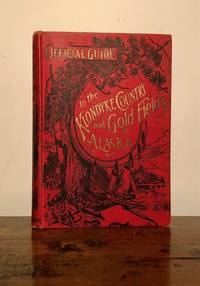
Official Guide to the Klondyke Country and the Gold Fields of Alaska with the Official Maps Klondike
Chicago: W. B. Conkey Co 1897. Hardcover. Good. 8vo. Pp. 296. Frontis. b&w photos. Illustrated with numerous b&w photos on coated paper line drawings in the text and a three-color foldout map of North America tipped in at the front. Red publisher's cloth with titles and illustration in gilt and black. Spine darkened light soiling to covers leaves toned and head edge foxed foldout map lower edge crimped. In addition to presenting "Vivid Descriptions and Thrilling Experiences" the title page claims this is "the most complete and thoroughly exhaustive collection of every known information necessary to a full realization of the immense resources of the gold fields of Alaska and replete with authentic instructions regarding how to get there when to go and what to do when the new Eldorado of the Great Northwest is reached." <p>Verso of the North America map has smaller black-line maps of North American Transportation Co. 1897 Alaska and steamer routes Juneau to Lewes river Yukon River and Tributaries Klondyke River 1896 Alaska gold fields and Northwest gold fields. SMITH: 7533. W. B. Conkey Co hardcover
Référence libraire : 11762
|
|
|
[KLONDIKE -- ALASKA-YUKON GOLD RUSH]. MOORE, Virgil (Ed)
The Klondike News. Output for 1898 $ 40000000. Vol. I No. 1. . . .
Seattle WA: The Shorey Book Store 815 Third Ave. Neelans Litho 1967. Atlas folio. 14.5 x 21.5 in. 36 pp. With lithographed photos text woodcut illustrations throughout including 1 double-page panoramic birds-eye. Lithographed softcovers front cover art w/ gold-tinted embellishments of The Largest Gold Nugget discovered by George W. Carmack from No. 8 El Dorado map on back cover execured by Warren C. Wilkins of the gold stikes in the Yukon chipping edgewear some scuffing closed tear neatly repaired rebacked still VG- copy from the library of Gary Kurutz. First Shorey Book’s edition of this famed Klondike gold rush promotional magazine originally published in Dawson N.W.T. & San Francisco CA which was projected to be published quarterly however Moore and his partners Charles Meadows & Wilkins were later sued in Nov. 1898 and appear to have been driven out of business in the Yukon. The impossibly scarce original publication issued April 1st 1898 touted all of the major gold strikes heretofore made in the Alaska-Yukon Territories the potential for land development nicely illustrated with photographs and copies were embellished with gold ink arching over mushers and gold miners. The last copy to appear at auction was in 1969 in the famed Streeter sale 3586 and the copy used to create this fine lithographed reproduction was oend by Dorothy Pattinson of Fairbanks AK who at the time had loaned it to the Pullen Alaska Museum’s Klondike Exhibit at the Seattle Center Food Circus balcony on the grounds of the 1962 Seattle World’s Fair. Worldcat locates 9 copies of the Shorey facsimile U of Victoria WI Historical Soc. BLM Kenai Peninsula U of AK CWU EWU Western U of Alberta; The legal case documents spelling the demise of Messers. Moore Meadows & Wilkins are held by the Huntington Library HM 27914; Not in Kurutz Klondike & Alaska Gold Rushes. The Shorey Book Store, 815 Third Ave., Neelans Litho, paperback
Référence libraire : 61660
|
|
|
[Klondike Gold Rush] Bronson, William; Reinhardt, Richard
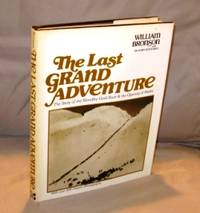
The Last Grand Adventure. The Story of the Klondike Gold Rush & the Opening of Alaska.
<p>New York:: McGraw-Hill 1977. First Printing of the First US Edition. A Fine tight copy in a Fine unclipped dust jacket. Alaska! The Yukon! The Klondike! This volume documents the whole glorious story of the great gold hunt in the last decade of the 19th century with more than 500 rare photographs. Authors Bronson and Reinhardt document the complete story of the monumental gold discovery in Alaska beginning with the gold-laden schooner Excelsior in San Francisco the summer of 1897 to the wind down of the stampede in 1899. Fully illustrated with more than 500 black and white photographs of the era.</p> McGraw-Hill, hardcover
Référence libraire : 25923 ISBN : 0070080143 9780070080140
|
|
|
[KLONDIKE GOLD RUSH -- VANCOUVER, BC]. B C
The queen city of Vancouver the wonderful West. Souvenir edition of “The Daily Province†British Columbia’s greatest newspaper. Latest views of Dawson City and other points of interest in Klondike. Illustrations of the mining shipping salmon fishing lumber agricultural manufacturing and other industries of British Columbia. . . .
Vancouver & Victoria B.C.: Province Publishing Company Ltd. 1898. Folio. 10 x 14 in. 2 63 3 pp. With photo illustrations throughout in colour and black & white plan of Vancouver on last leaf. Textured purple-coloured softcovers decorative silver lettering stamped on front cover yapp fore-edges minor sunning to front cover minor creasing curling front cover edgewear still a VG- copy. First edition of this exceedingly scarce and lavishly illustrated guidebook promoting Vancouver & Victoria B.C. as the primary outfitting stations for the Klondike Gold Rush. Photos depict the military contingent departing to police and restore order in the gold country and even features an interview with F.M. Rattenbury advocating the coastal route to the Klondike via the Chilkoot and White Passes. Many of the photographs depict miners on the trail the Canadian customs house at Chilkoot Pass and Dawson City. Worldcat locates 5 copies Yale UBC Toronto Bancroft Canadian Centre for Architecture; See: Kurutz Klondike & Alaska Gold Rushes A Descriptive Bibliography 480. Province Publishing Company, Ltd., paperback
Référence libraire : 63466
|
|
|
[Klondike Gold Rush] Olive, WHT W H T
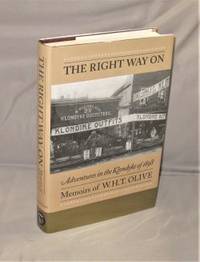
The Right Way On: Adventures in the Klondyke of 1898. Memoirs of W.H.T. Olive.
<p>Langley:: Timberholme Books 1999. First Printing of the First Canadian Edition. A Fine tight copy in a Fine dust jacket . W.H.T. Olive's memoir is his record of the year he spent as manager of the boats for the Bennett Lake & Klondyke Navigation Company in the Yukon Gold Rush of 1898. In the untamed North where travellers had only one thing on their minds Gold! Olive's day-to-day life was nothing but extraordinary. He acted as onboard diplomat for both seasoned prospectors and greenhorns shot the White Horse Rapids and in addition to passengers and their provisions was responsible for two all-important kinds of shipment: mail and liquor. His adventures included rescuing damsels in distress guiding his employer the architect Frank Rattenbury through a disastrous mosquito-infested expedition and defending his strongbox at gunpoint from thieves. Sam Steele of the North West Mounted Police William Ogilvie first commissioner of the Yukon Machine-gun Joe Boyle and the notorious gangster Soapy Smith all make an appearance here. Olive's account of his adventures is complemented by his fond remembrance of the sourdoughs on the trail he met during this short but intense period in history.</p> Timberholme Books, hardcover
Référence libraire : 26762
|
|
|
[Klondike Gold Rush] Minter, Roy
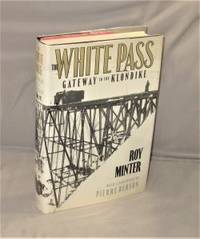
The White Pass: Gateway to the Klondike with a Foreord by Pierre Berton.
Fairbanks:: University of Alaska Press 1987. First Printing of the First US Edition. A Fine tight copy in a Fine dust jacket . By the thousands they came the gold-seekers of 1897 pouring through Alaska’s White and Chilkoot passes on their way to the Klondike and to fortune. Fast behind them came the entrepreneurs the bunco artists and before long the engineers and financiers whose driving ambition was to build a railway through the White Pass’s rocky precipices. This is the epic northern adventure of the men who rushed for gold the workers who toiled in winter storms and thaw-time muck carving the grade and laying rail and the ingenious characters who dreamed schemed promoted and finally built the White Pass and Yukon Railway. University of Alaska Press, unknown
Référence libraire : 26763
|
|
|
[KLONDIKE-YUKON GOLD RUSH -- BRITISH COLUMBIA, CANADA]. GOSNELL, R E[dward].
The year book of British Columbia and manual of provincial information. . . Canadian Yukon and Northern Territory generally. . . .
Victoria B.C.: R.E. Gosnell Agent General 39 Victoria St. 1897. 8vo. 500 7 pp. plus 26 pp. publisher’s illustrated advertisements. Over 50 photo plates 4 maps 2 large folding recto & verso text illustrations. Red pebbled publisher’s cloth black lettering & decorated border front cover gilt & black lettering on spine minor edgewear rubbing ownership stamps & writing on title still VG copy from the library of former California State Librarian Gary Kurutz. First edition thus of this expanded edition of Gosnell’s 1860-1931 noted British Columbia Year Book and was originally self-published by first British Columbia Legislative Librarian and the first Provincial Archivist. Unlike the initial print run for this publication which consisted of only 216 pages this Year Book in reaction to the Klondike Gold Rush excitement expanded with a section on “The Canadian Yukon†with notes drawn from William Ogilvie article by H. Bratnober additional maps and even includes a section on the “Routes into Klondyke.†Also featured are numerous printed photos documenting stampeders on their way into the golden rivers and streams of the North. See: Kurutz Klondike & Alaska Gold Rushes A Descriptive Bibliography 211c. R.E. Gosnell, Agent General, 39, Victoria St., hardcover
Référence libraire : 61925
|
|
|
[KLONDIKE-YUKON GOLD RUSH]. ROBERTSON, William Norrie
Yukon memories. Sourdough tells of chaos and changes in the Klondike Vale.
Toronto: The Hunter-Rose Co. Ltd. 1930. 8vo. 6 359 1 pp. Frontisp. map numerous photo plates. Green publisher’s cloth black lettering slight shelfwear slight foxing & dustsoiling fore-edges w/ d.j. plain brown paper w/ banner title in red & black across upper fore-edge & spine printer’s imprint at foot of spine slight shelfwear NF/NF copy. First edition of this fascinating account by one of the original Klondike sourdoughs who went with a party of 10 in 1898 providing detailed accounts of the early miners those lost in avalanches on the Chilkoot Trail the amount of supplies needed and more. Robertson recounts his life before the Klondike as a champion bicycle racer along with describing hockey matches and skiing competitions in Dawson in 1898 and 1899. This work was compiled according to the author to “attract capitalists to the Yukon Territory.†Scarce in original dustjacket. Kurutz Klondike & Alaska Gold Rushes A Descriptive Bibliography 498. The Hunter-Rose Co., Ltd., hardcover
Référence libraire : 62088
|
|
|
[Künstlerfreund]
Der Künstlerfreund, ein Buch für Chemiker, Mechaniker, Oekonomen, Baumeister, Kupferstecher, Mahler, Bildhauer, Lackirer, Drechsler, Instrumenten- und Geigenmacher, Gold- Silber- und andere Metallarbeiter, Tischler, Zimmerleute, Steinhauer und dergleichen Künstler und Handwerker. Herausgegeben von einem Künstlerfreunde.
Wien, Christoph Peter Rehm, 1793. 8°. 140 S., 6 Bll., Ppbd. d. Zt. m. goldgepr. Rückenschild.
Référence libraire : 48619

|
|
|
[L'Appel]
L'APPEL - N° 33 - Février 1977
Revue mensuelle de combat et de réflexion : 48 pages, format 150 x 210 mm, illustrée, brochée, bon état
Référence libraire : LFA-126738406
|
|
|
[L'Archéologue - Archéologie Nouvelle]
L'ARCHEOLOGUE - ARCHEOLOGIE NOUVELLE - N° 18 - Février 1996
N° 18 (Février 1997) : revue de 66 pages, format 215 x 285 mm, illustrée, brochée couverture couleurs, bon état
Référence libraire : LFA-126746693
|
|
|
[L'Archéologue - Archéologie Nouvelle]
L'ARCHEOLOGUE - ARCHEOLOGIE NOUVELLE - N° 33 - Décembre 1997-Janvier 1998
N° 33 (Décembre 1997-Janvier 1998) : revue de 66 pages, format 215 x 285 mm, illustrée, brochée couverture couleurs, bon état
Référence libraire : LFA-126746736
|
|
|
[L'Archéologue]
L'ARCHEOLOGUE - N° 5 - Avril 1994
N° 5 (Avril 1994) : revue de 66 pages, format 215 x 285 mm, illustrée, brochée couverture couleurs, bon état
Référence libraire : LFA-126746680
|
|
|
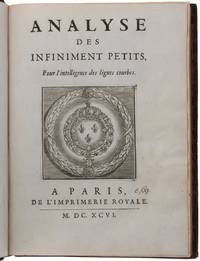
[L'HOPITAL (or L'HOSPITAL), Guillaume Francois Antoine, Marquis de]
Analyse des infiniment petits pour l'intelligence des lignes courbes. Bound with : CARRÉ Louis. Methode pour la mesure des surfaces la dimension des solides leurs centres de pesanteur de percussion et d'oscillation par l'application du calcul intégral
Paris: L'imprimerie Royale; Jean Boudot 1700. First edition. First editions. L'Hôpital's treatise on differential calculus was based on lessons he received from Johann Bernoulli and it was under the influence of Malebranche that some years later appeared the first work on the integral calculus by Louis Carré. Hardcover. THE FIRST BOOKS ON DIFFERENTIAL AND INTEGRAL CALCULUS. <p>A fine sammelband comprising the first editions of the first books on the differential and integral calculus respectively. "In France it was through the Oratorian circle of Nicolas Malebranche that Johann Bernoulli introduced in 1691 the Leibnizian calculus. His lessons to the Marquis de l'Hôpital led to the draft of the first treatise of differential calculus 1696 and it was under the influence of Malebranche that some years later appeared the first works on the integral calculus by Louis Carré in 1700 and Charles René Reyneau in 1708. The spread and acceptance of the Leibnizian calculus was transferred in this way to the wide public" Landmark Writings p. 56. "The importance of L'Hospital's work lay in its dissemination throughout Europe of the concepts and early development of the calculus whose cause L'Hospital advanced as well through his many contacts; these included Christiaan Huygens who is reputed to have learned the calculus from L'Hospital" DSB. Bernoulli's lectures also covered integral calculus but L'Hospital dropped plans to write a continuation to his Analyse des infiniment petits dealing with this subject "in deference to Leibniz who had let him know that he had similar intentions" ibid. Leibniz never wrote such a text however and Bernoulli's lectures on integral calculus remained unpublished until they appeared in his Opera 1742. The task of completing L'Hospital's book was instead taken up by Carré a pupil of Malebranche and assistant to Pierre Varignon from whom he probably learnt calculus. "Following the classical custom his Analyse des infiniment petits starts with a set of definitions and axioms . The difference differential is defined as the infinitely small portion by which a variable quantity increases or decreases continuously. Of the two axioms the first postulates that quantities which differ only by infinitely small amounts may be substituted for one another while the second states that a curve may be thought of as a polygonal line with an infinite number of infinitely small sides such that the angle between adjacent lines determines the curvature of the curve. Following the axioms the basic rules of the differential calculus are given and exemplified. The second chapter applies these rules to the determination of the tangent to a curve in a given point . The third chapter deals with maximum-minimum problems and includes examples drawn from mechanics and geography. Next comes a treatment of points of inflection and cusps. This involves the introduction of higher-order differentials each supposed infinitely small compared to its predecessor. Later chapters deal with evolutes and with caustics. L'Hospital's rule is given in chapter 9" ibid. The tenth and final chapter of the Analyse discusses the methods of Descartes and Johann Hudde. The companion work by Carré is "the first treatise on the integral calculus in any language which is here applied to the determination of the area of superficies surfaces and solids and their centres of gravity problems of percussion oscillation etc." Sotheran. On this last topic the determination of the centres of oscillation of solids Carré made a significant error. This was known to Bernoulli but not publicized at the time and so was propagated into several later calculus texts such as Charles Hayes' Treatise on Fluxions 1704 and Edmund Stone's The Method of Fluxions both Direct and Inverse 1730. Both works are rare on the market: ABPC/RBH list four copies of L'Hospital's book since the Norman copy which realised $6325 in 1998; and only two copies of Carré's work in the last half century. </p> <br /> <p>"Differential and integral calculus are generally considered to have their origins in the works of Newton and Leibniz in the late 17th century although the roots of the subject reach far back into that century and arguably even into antiquity. Leibniz first described his new calculus in a cryptic article more than a decade before the publication of the Analyse. For all practical purposes Leibniz' early papers were not understood until Jakob Bernoulli and his younger brother Johann began studying them in about 1687 and making discoveries of their own using his techniques.</p> <br /> <p>"Bernard de Fontenelle became the secretary of the Académie des Sciences in Paris in 1697 and wrote the eulogy of l'Hôpital for the academy's journal. He said that in 1696 'the Geometry of the Infinitely small was still nothing but a kind of Mystery and so to speak a Cabalistic Science shared among five or six people. They often gave their Solutions in the Journals without revealing the Method that produced them and even when one could discover it it was only a few feeble rays of this Science that had escaped and the clouds immediately closed again.' Later on Montucla went one step further and listed the only people that he believed understood Leibniz' calculus before 1696: Leibniz himself Jakob and Johann Bernoulli Pierre Varignon and l'Hôpital. L'Hôpital's Analyse changed all of this and for much of the 18th century his book served aspiring French mathematicians as their first introduction to the new calculus.</p> <br /> <p>"For all that the Analyse was a popular and successful introduction to the differential calculus it's remarkable that there is no account of the integral calculus in the book. In his Preface l'Hôpital explained why: 'In all of this there is only the first part of Mr. Leibniz' calculus . The other part which we call integral calculus consists in going back from these infinitely small quantities to the magnitudes or the wholes of which they are the differences that is to say in finding their sums. I had also intended to present this. However Mr. Leibniz having written me that he is working on a Treatise titled De Scientiâ infiniti I took care not to deprive the public of such a beautiful Work' p. iii. Unfortunately Leibniz never completed this book On the Science of the Infinite.</p> <br /> <p>"The Analyse consists of ten chapters which l'Hôpital called 'sections.' We consider it to have three parts. The first part an introduction to the differential calculus consists of the first four chapters:</p> <br /> <br /> In which we give the Rules of this calculus. <br /> <br /> Use of the differential calculus for finding the Tangents of all kinds of curved <br /> lines. <br /> <br /> Use of the differential calculus for finding the greatest and the least ordinates to which are reduced questions De maximis & minimis. <br /> <br /> Use of the differential calculus for finding inflection points and cusps.<br /> <br /> <p>"Taken together these chapters provide a thorough introduction to the differential calculus in about 70 pages. The next five chapters are devoted to what can only be described as an advanced text on differential geometry motivated in part by what were then cutting-edge research problems in optics and other fields" Bradley et al. pp. v-vi.</p> <br /> <p>These subsequent chapters no longer mirror the structure of Bernoulli's lectures. Chapter 5 the longest in the Analyse deals with evolutes and involutes including the cycloid and various spirals. Chapters 6-8 are on envelopes of lines and curves i.e. curves that are tangent to every member of a family of lines or curves - this includes the study of caustics in geometrical optics. Chapter 9 contains "the solution of various problems that depend upon the previous Methods;" the first of these is the celebrated rule that we now call L'Hôpital's Rule which was first discovered by Bernoulli. In his final chapter of the Analyse l'Hôpital demonstrates how all of the methods of Descartes and Hudde may be easily derived and justified using Leibniz's differential calculus.</p> <br /> <p>Born into a noble family L'Hospital 1661-1704 abandoned a military career due to poor eyesight to pursue his interest in mathematics. "Some time around 1690 L'Hôpital joined Nicolas Malebranche's circle which was engaged among other things in the study of higher mathematics. It was there in November 1691 that he met the 24-year-old Johann Bernoulli who was visiting Paris and had been invited by Malebranche to present his construction of the catenary at the salon . Bernoulli told Pierre Rémond de Montmort that upon meeting the Marquis he soon found him to be a good enough mathematician with regard to ordinary mathematics but that he knew nothing of the differential calculus other than its name and had not even heard of the integral calculus. L'Hôpital had apparently mastered Fermat's method of finding maxima and minima and told Bernoulli that he had used it to invent a rule for determining the radius of curvature for arbitrary curves. The method was unwieldy and actually could only be used at local extrema of algebraic curves. Bernoulli showed him the formula for the radius of curvature that he had developed with his brother Jakob which employed second-order differentials. Apparently this so impressed the Marquis that he visited Bernoulli the very next day and engaged him as his tutor in the differential and integral calculus.</p> <br /> <p>"Bernoulli tutored the Marquis in his Paris apartment four times a week from late 1691 through the end of July 1692 . In the summer of 1692 Bernoulli accompanied the Marquis to his estate in Oucques near the French city of Blois where he continued giving him tutorials until some time in October . Bernoulli kept copies of his lessons to the Marquis throughout his long and productive career. The first part on the differential calculus was incorporated by l'Hôpital into the first four chapters of the Analyse. Bernoulli himself published the much larger second part concerning the integral calculus in his collected works. Titled Lectiones mathematicae de methodo integralium this treatise bears the subtitle 'written for the use of the Illustrious Marquis de l'Hôpital while the author spent time in Paris in the years 1691 & 1692' . Because Bernoulli chose not to publish this part it was impossible in the 18th century to say how closely l'Hôpital's textbook coincided with Bernoulli's lessons. A comparison finally became possible when Paul Schafheitlin discovered a manuscript copy of the full set of lessons on both the differential and integral calculus in the library of the University of Basel in 1921 . Because the latter part was a near-perfect match to what Bernoulli had published in 1741 he could be quite certain that the first part was essentially the same set of lessons l'Hôpital had used when composing the Analyse .</p> <br /> <p>"Since the appearance of the Lectiones various authors have characterized the Analyse as having essentially been written by Bernoulli. Indeed Bernoulli himself in an angry letter to Varignon of February 26 1707 said that 'to speak frankly Mr. de l'Hôpital had no other part in the production of this book than to have translated into French the material that I gave him for the most part in Latin.' The truth is much more nuanced. The superstructure of l'Hôpital's first four chapters is certainly due to Bernoulli and many of the details are essentially the same in both texts. However l'Hôpital added much in both quantity and quality. For one thing Bernoulli's Lectiones occupied 37 manuscript pages compared to 70 typeset pages for the first four chapters of the Analyse but the Marquis added much more than mere verbiage to Bernoulli's lesson. He was a very talented pedagogue. He organized his material very well extracting general propositions where Bernoulli gave examples and explained matters clearly and in some detail. Furthermore he frequently included many illustrative examples gradually increasing in difficulty generally providing an appropriate level of detail but always leaving some things for readers to work out for themselves" Bradley pp. vii-xi. The last six chapters were not taken directly from Bernoulli's lectures although l'Hôpital has drawn on material provided to him in Bernoulli's letters or in his lessons on the integral calculus.</p> <br /> <p>Louis Carré's 1663-1711 father a prosperous farmer wanted him to become a priest but after having spent three years studying theology in Paris he refused to take holy orders and his father cut off all financial support for his son. Carré managed to avoid poverty by becoming an amanuensis to Malebranche. The group Malebranche had assembled at the Oratory in Paris included Varignon and l'Hôpital among others. Carré spent seven years with Malebranche after which he became a private tutor in Paris specializing in the teaching of women then barred from a university education many of whom were nuns.At this stage Carré seems to have been interested mainly in philosophy and did not take much interest in current mathematical research. However on 4 February 1699 Varignon admitted him as one of his élèves in the Academy of Sciences. This stimulated Carré's interest in mathematics and he began working on his Methode pour Ia mesure des surfaces .</p> <br /> <p>The work is divided into four Sections:</p> <br /> <br /> On the measure i.e. area of surfaces.<br /> On the dimension i.e. volume of solids.3<br /> On centres of gravity.<br /> On centres of percussion and oscillation.<br /> <br /> <p>The centre of percussion is the point on a solid body attached to a pivot where a perpendicular impact will produce no reactive shock at the pivot. The same point is called the centre of oscillation for the body suspended from the pivot as a pendulum meaning that a simple pendulum with all its mass concentrated at that point will have the same period of oscillation. The formula for the centre of oscillation originally derived by Huygens in his Horologium oscillatorium 1673 requires certain integrations to be performed. Carré made an error in calculating the integral for the moment of inertia of a cone suspended from its vertex a mistake that led to an incorrect expression for the centre of oscillation of the cone. Lenore Feigenbaum explains that the story of Carré's mistake and the subsequent propagation of his error in eighteenth-century calculus textbooks "is instructive in several regards: first in showing how some of the methods of the calculus were interpreted and absorbed during the early 18th century; second in shedding light on the nature of the textbook industry of the time; and finally in providing us with a modicum of historical sympathy when we find our own students making the same kind of mistakes."</p> <br /> <p>Between 1701 and 1705 Carré published over a dozen papers on a variety of mathematical and physical subjects which led to him being admitted to the Academy of Sciences as an Associate Mechanician on 15 February 1702 and being promoted to Pensioner on 18 August 1706. This provided him with an income which allowed him to devote himself entirely to his academic studies during the final five years of his life. At age 46 he suffered an attack of dyspepsia from which he died in 1711. </p> <br /> <p>I. Babson Supplement p.30; Honeyman 2006 & 2007; Norman 1345; Sotheran First Supplement 1411; not in Macclesfield. II. Macclesfield 481; Poggendorff I 383-384; Sotheran I 704. Bradley Petrilli & Sandifer. L'Hôpital's Analyse des infiniments petits. An Annotated Translation with Source Material by Johann Bernoulli 2015. Grattan-Guinness ed. Landmark writings in Western mathematics 1640-1940 2005.</p> <br/> <br/> Two works bound in one volume 4to 251 x 186 mm pp. xviii 181 3 with 11 folding engraved plates; pp. xii 115 1 blank and 4 folding engraved plates. Old signature cut from first title and expertly repaired. Contemporary French calf spine gilt with red lettering-piece. Fine copies. / Hardcover. L'imprimerie Royale; Jean Boudot unknown
Référence libraire : 2848
|
|
|
[Langelier (or L'Angelier), Abel (1553?-1610)]
LE TROISIEME TOME DES OEUVRES DE IEAN BACQUET ADVOCAT DU ROY EN LA CHAMBRE DU THRESOR. Title page
Title page to the third volume of works by Bacquet Jean 15.-1597 with large oval printer's device of Abel Langelier or L'Angelier 1553-1610 representing a shepherd kneeling in front of a fire and an angel coming from the sky. On the frame: 'SACRUM PINGUE DABO NEC MACRUM SACRIFICABO'. It might hint to Abel one of the sons of Adam and Eve as the first name of the publisher is Abel. Allegorical figures populate the outer frame. Monogrammed in a shield beneath the representation. l Letterpress and wood engraving on laid paper; total: 352 x 215 mm; despite a light pink shadow on the top left margin in good condition mounted on cardboard decorated with a line frame in black ink. unknown
Référence libraire : #[61708]
|
|
|
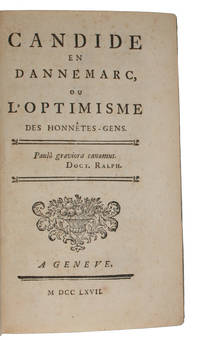
[LAURENS, HENRY-JOSEPH du? - or CHARLES-CLAUDE-FLORENT du CAMPIGNEULLES? - MIMICING VOLTAIRE]
Candide en Dannemarc ou l'optimisme des honnêtes-gens. - CANDIDE IN DENMARK - WITH A SATIRE ON ROUSSEU
Geneve 1767. Original blue cardboard binding with contemporary handwritten paper title-label to spine. Pencil-numbering to inside of boards. A very nice and clean copy. Woodcut vignette to title-page. With the ex-libris of the notes Danish book collector K.F. Plesner to inside of front board. <br/><br/><em>Rare first edition of this interesting anonymously written continuation of Voltaire's Candide which wraps up the adventures of the hero. "Turning his back on both Voltarian satire and scepticism the novelist proposes a moralistic fable - the focal point of which is a rehabilitation of Leibniz's Theory of Optimism. The main body of the novel tells the story of Candide and his new wife the noble Zénoïde in their sumptuous Copenhagen townhouse. Before achieving this happy state however the couple endures various trials and tribulations reminiscent of the newly minted gothic genre. "Candide au Dannemarc" also features a satirical portrait of Jean-Jacques Rousseau." Éduard M. Langille from the introduction to the new edition of "Candide au Dannemarc" edited by him. Voltaire's "Candide" had inspired a sequel that appeared in 1760 which is attributed to Charles-Claude-Florent de Campigneulles but which might be by Henri-Joseph du Laurens. The present work is a direct continuation of that sequel although it ignores the happy ending of the previous work but evidently from the preface it is not written by the same author. It has still not been determined who the actual author is.The part on Rousseau pp. 148-167 in the present work has become quite famous portraying him satirically as trying to make a living in Copenhagen from copying music while plotting to escape to America. The novel ends with Candide leaving Denmark to be the Danish ambassador in Russia.A secoond edition appeared in 1769. </em> paperback
Référence libraire : 45831
|
|
|
[LAW, Thomas] [or possibly George Watterston]
PHILOSOPHY WOMEN PRINTERS Thoughts on Instinctive Impulses WITH Second Thoughts on Instinctive Impulses
Philadelphia: Jane Aitken / "For the Author 1813. First Edition. Hardcover. Good-. Octavo 2 volumes bound together. A DEFECTIVE copy lacking the title page and possibly other blank prelims in volume I with the first text page being the first leaf of the Preface. Collation: iii-v 7-90 blank 1-142 blank. Bound in contemporary full sheep with a black morocco spine label bearing the lone word "Thought." Though defective an otherwise good copy moderately foxed at extremities with mild wear to corners and spine ends; sound. Inked ownership signature of P. Keyes Esq to the first leaf of the Preface. Law was a British-born lawyer who settled in the young United States where he married into George Washington's family and became a significant real estate developer in the early years of the capital city. The two texts are sometimes attributed to Law's partner George Watterston but they are attributed by American Imprints and the LOC to Law. The printer of volume I and possibly volume II was Jane Aitken one of the few women in the printing trade in early 19th century America. She is best known for publishing Charles Thomson's massive English translation of the Septuagint the first published in the western hemisphere. Scarce in commerce. American Imprints 20531; 28918. Jane Aitken / "For the Author hardcover
Référence libraire : 13538
|
|
|
[LAZARILLO DE TORMES]
La Vida de Lazarillo de Tormes, y de sus fortunas y adversidades. Edición, introducción y notas de Julio Cejador Frauca.
Madrid, Espasa Calpe, 1972 ("Clásicos Castellanos"). 4to.; 253 pp., 1 h. Cubiertas originales.

|
|
|
[LINARES, Juan de.].
Cancionero llamado Flor de Enamorados. (Barcelona, 1562). Reimpreso por vez primera del ejemplar único, con un estudio preliminar de Antonio Rodríguez-Moñino y Daniel Devoto.
Valencia, Editorial Castalia, 1954 ("Floresta. Joyas Poéticas Españolas"). 8vo.; LVI pp., 138 hojas, 5 hs. Cubiertas originales. Pérdida de un tercio de la lomera.

|
|
|
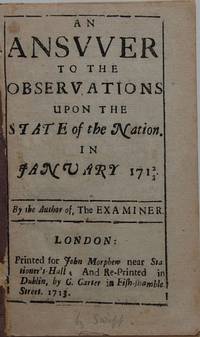
[MANLEY, DELARIVIERE, or Jonathan Swift, or Joseph Browne].
An Answer to the Observations upon the State of the Nation. In January 1712/3. By the author of The Examiner.
Dublin: London: Printed for John Morphew near Stationer’s Hall; and Re-Printed in Dublin by C. Carter in Fish-shamble Street 1713. . 14pp. 12mo. Disbound. First Dublin edition reprinted from the leading article in The Examiner No. 17 27 February 1713. Delariviere Manley and Joseph Browne were the principal editors of the journal at the time with Swift playing a major role as well. Swift has been suggested as a possible author of this article but it is not included in the Teerink/Scouten bibliography. Of this edition ESTC records only the Royal Irish Academy copy in the British Isles and three in the United States. [Dublin:] London: Printed for John Morphew near Stationer’s Hall; and Re-Printed in Dublin, by C. Carter in Fish-shamble Stree unknown
Référence libraire : 13454
|
|
|
[MANLIO, Giovanni Giacomo (Johannes Jacobus MANLIUS or MANLIIS)].
Luminare maius. Cinthius ut totum radiis illuminat orbem. Illuminat latebras sic medicina tuas.Lumen apothecariorum.
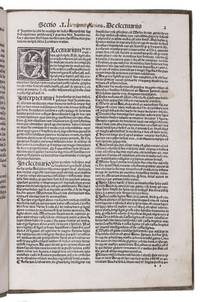
Colophon: Venice: Gregorio de Gregori 1513. Early 20th-century vellum possibly incorporating older materials sewn on 3 recessed supports red spine label. Folio 30.5 x 21 cm. With 13 woodcut decorated initials 6 series plus 8 repeats 4-line typographic Lombarbic initials. Set in rotunda gothic types in 2 columns with a preliminary note in roman type. With contemporary pen decorations in brown ink added to about half of the initials and occasional similar pen decorations in the margins an occasional manuscript paragraph mark some rubrications in brown ink and some initials coloured with a transparent ochre wash. Seventh known copy of an early edition of an important treatise on pharmacology and medical botany by Giovanni Giacomo Manlio di Bosco fl. 1490-post 1500. It is a commentary on ancient Arabic and Greek pharmacological works especially the Arabic treatises of Yuhanna Ibn Masawayh ca. 777-857 a Nestorian Christian physician from Assyria who taught at the academy in Gundeshapur Iran and was personal physician to four caliphs. It gives instructions for preparing numerous medicines indicating the quantities of the ingredients simples each derived from a single plant and describing each ingredient. The present edition includes Manlio's preliminary note addressed to Bernardinus Niger.The title-page indicates that the book also contains Lumen apothecariorum a work by Quirico de Augustis de Tortona of Milan fl. 1486-1497. But it is not present here or in any of the other seven copies we have traced. With contemporary and later marginal manuscript notes. With the text area of B2.7 somewhat browned an occasional small and unobtrusive stain and a few small worm holes in the last few leaves but generally in very good condition. Some of the manuscript notes have been shaved. The binding is slightly dirty and the boards slightly bowed but the binding is still good.l Durling 2938; ICCU 29621 same copy; KVK & WorldCat 5 copies; Emiliano Sordano Il Luminare maius di Manlio del Bosco thesis University of Torino 2010 p. 41; USTC 840112 2 copies; cf. Schelenz Geschichte der Pharmazie p. 414; Wellcome 4017. Gregorio de Gregori, hardcover
Référence libraire : L85CQLCOIXI5
|
|
|
[MANUSCRIPT IN GOLD INK]
Diploma in Canon and Civil Law from the University of Rome now La Sapienza.
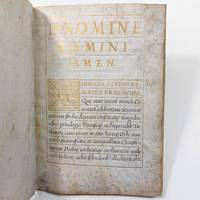
<p><strong>Precious diploma in canon and civil law from the University of Rome calligraphed on vellum with the letterhead and the names of the protagonists written in gold ink.</strong><br /><strong>The document is also entirely underlined and framed in this ink.</strong><br />It was awarded to a certain Guillaume Drouaillet from Dole in Burgundy.</p><p>"<em>IN NOMINE DOMINI AMEN. GLORIOSA STUDIORUM MATER URBS ROMA Quae inter omnes mundi Ciuitates celeberrima Scientiarum omnium studio decorata existit . Dominus Guglielmus Drouaillet. Dolanus in Burgundia . Actum Romae in Gymnasio publico in regione S. Eustachii Anno Domini millesimo sexcentesimo uiges. octavo .</em>"</p><p>At the end of the document are signatures most likely of members of the University of Rome and two additional paragraphs handwritten by two different hands.</p><p>From the library of Bruno Monnier Franc-Comtois bibliophile and owner of the Château de Mantry with iron bookplate on the front flyleaf.</p><p><strong>An interesting testimony to the history of diplomas and writing.</strong></p>
Référence libraire : 19730
|
|
|
[Mariazell]
Hotel ?Gold. Kreuz?, Mariazell, Wienerstrasse 34.
Graz, Lit. Anst. ?Senefelder?, o. J. (um 1900). Lithographierte, einseitig bedruckte Werbekarte (15,1 x 9,9 cm).
Référence libraire : 55766

|
|
|
[Mexico]. Greene Consolidated Gold Company
Mexico
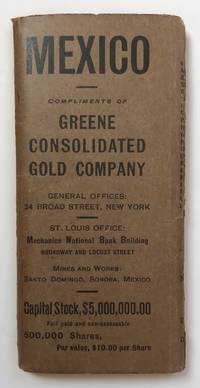
Chicago: Rand McNally 1904. About very good. Folding map approximately 21 x 27.5 inches. Original wallet-style printed wrappers. Light wear to wraps; a few short separations along fold lines. Light tanning. Uncommon cartographic promotional for this early 20th-century mining company with operations near Cananea and Magdalena in the Northern Mexican state of Sonora. The Rand McNally map is overprinted in red to show the locations of Greene Consolidated Gold Company properties as well as major railroad lines across the country. A special inset titled "Topographical Map of the Eastern Portion of the State of Sonora Showing the Operating and Projected Railways with Relation to the Property of the Grene Consolidated Gold Co. and Other Important Mining Districts" provides a magnified view of the region where the company operated and also shows other significant commercial mining ventures in this part of Sonora as well as planned railroad construction in the area. A brief promotional text and additional information about the business are printed on the wrappers which also incorporate a tear-off order form for stock in the company. Rand McNally unknown
Référence libraire : 1269
|
|
|
[MINING -- GOLD]. DAY, Robert P & MERLINO, BA B A
Cordillera at work. Cordillera Corporation Metals Producers. To the Stockholders of Cordillera Corporation. . . Shareholders report and prospectus.
Seattle WA & Fairplay CO: Cordillera Corporation Metals Producers Feb. 12 1953. Two works. 1st -- 4 leaves. Typescript first leaf on letterhead printed in green & black printed signature at end creasing; 2nd -- Folio. 2 pp. Numerous photo illustrations creasing from being folded NF. First editions of this prospectus and shareholder report for the Cordillera Corporation gold mining operation on North Star Mountain Colorado in the early 1950s. The illustrations and text detail how they replaced structures destroyed by lightning strike and the hard-rock mining operations. No copies located in Worldcat. Cordillera Corporation Metals Producers, unknown
Référence libraire : 53406
|
|
|
[Monica Gold Co]
The Monica Mines Company; Gold Mining in Arizona Territory. 1906 Documents
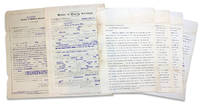
<p>Yavapai County Arizona Territory 1906. Two documents signed and a 4-page retained letter. Closed tears at folds; staining; some losses in margins not affecting text; good.</p> <p>The Monica Mines Co. a.k.a. Monica Gold Co. operated in Kirkland Arizona Territory.</p> <p>Two items here directly relate to the company: an amended placer claim Columbia Placer Mining Claim signed by company agent E.B. Corthell and a retained copy of a four-page letter sent to the company’s board of directors about the troubled mine in Yavapai County.</p> <p>The letter discusses the financial woes of the company and the imminent departure of the company treasurer. Its author Corthell urges that “.the work at the mine be shut down and the Stockholders’ meeting be called to which the financial needs of the Company and its prospects shall be fully and truthfully explained…â€</p> <p>The Mining World reported in 1908 that troubled Monica Mines Co. was in receivership which action was brought by Corthell and other company officials. It was hoped that the mining operations would resume.¹</p> <p>An amended lode claim document is included. It relates to a claim independently purchased by Corthell northwest of the Monica mining claim.</p> <p>Note. 1. The Mining World Chicago Vol. XXIX No. 13 September 26 1908 p494.</p> unknown
Référence libraire : 3726453
|
|
|
[MORONOBU or SUKENOBU SCHOOL]
AMANJAKU DEN: A PERVERSE EROTIC JAPANESE LEGEND. A Bizarre and Unque Erotic Jap
Edo c.1700-50 n.p. Brown & silver covered boards very clean 7 double-page b.w. erotic woodblock illustrations mounted on mica flecked paper 18 x 25 cm. accordion folded illustration size: 31 x 12 cm. FIRST & ONLY UNRECORDED COPY! . . . . A VERY RARE UNRECORDED EARLY BOOK . . . A BIZARRE & UNIQUE EROTIC BOOK . . . UNSIGNED BUT CLEARLY THE WORK OF A MASTER ARTIST . BY SUKENOBU OR HIS :SCHOOL: . A unique and hitherto unfound odd and most unusual erotic book of the early-mid-18th century. One of the most bizarre erotic books ever done in Japan. . The graphically explicit work portrays men and women with genitals on their foreheads engaged in heterosexual and homosexual intercourse. There is no other book with such unusual and strange illustrations. . . THE TITLE: THE LEGEND OF AMANJAKU or AMAN NO JAKU: Chinese Title: TIAN XIE GUI YUN . THE MEANING OF AMANJAKU: Japanese Buddhist literature is abundant with variations on the theme of "Aman-No-Jaku" aka. "Amanjaku" "Manojaku" commonly understood to be a "Heavenly Evil Spirit." . This spirit or demon-like creature in Japanese folklore is usually depicted as being a male during the day and female at night. The demon is usually depicted as a kind of small Oni devil and is thought to be able to provoke a person's darkest desires and instigate him into perpetrating wicked deeds. . Amanjaku is also depicted in Chinese and Japanese mythology the AMANOJAKU is a changeling a water spirit that infiltrates the human world to play cruel tricks on people by reading their minds and twisting their requests or desires to be used against them. . The "AMANOJAKU" is also known the "Lord of the River" and in Japan serves Bishamonten one of the four Deva kings of Buddhism as a minor demon. See Wikipedia below. . In Japanese the term "Amanojaku" also refers to a person who is deliberately contradictory someone who argues for the sake of arguing or can be used in common Japanese conversation to refer to someone who is a "Perverted Demon." . THE ILLUSTRATIONS: THE BUDDHIST THEME:. This work is unusual in that the genitals of common people are located on their foreheads. A symbolist meaning can be in Buddhist concept that sex and sexual hedonism is openly on the minds of 'lay' people. The Buddha and his disciples on the other hand do not have sex organs on their foreheads meaning their organs are covered and in a different usual location. This can symbolize 'self control' over such biological energies. Devout Buddhist disregard sex as a pleasurable pastime and devote themselves to monastic focus. By contrast "lay" people are distracted with hedonistic pleasure a path away from rather than towards the Dharma or teachings of Buddhism. . In a sense this work illustrates the overwhelming force of evil or the "Amanojaku" and how it distracts people from the "Righteous Path" towards the Dharma and the ultimate goal of attaining Nirvana. It can be posited that this work is designed to give understanding to "lay" people by way of visual example of what forces direct their energies away from the Buddhist teachings in an effort to redirect them towards the "Righteous Path" and life style. . EXCEPTIONALLY RARE UNIQUE WORK: . The work is exceptionally RARE unusual and erotic there are no other example showing genitals on the foreheads of any other Japanese book cited anywhere in the bibliographic literature or record. . This work is certainly RARE in subject content and quantity. Though it was woodblock printed and unsigned which was usual for Japanese erotic works which were banned by the Shogun we have not found anything similar or recorded anywhere in the bibliography. Being woodblock printed one assumes there are other copies in existence. The average printing from woodblocks were somewhere between 100-200 copies. However in this instance no others exist. We have the strong feeling the book could have been the production of a famous Japanese illustrator and perhaps financed by a Buddhist temple again there are no known facts about this rarity. . THE EROTIC ILLUSTRATIONS: . Number 1: This work begins showing the Buddha flanked by two of his disciple monks. The title is written in four Japanese Kanji in Kambun & Chinese characters. The Buddha and his two disciples listen to two elderly Buddhist believers: one is a male he has and erect penis on his forehead. The other is a woman she has a vagina on her forehead. Neither the Buddha nor his two disciples monks show genitals on their foreheads. The couple have come to consult with the Buddha about their grievances. . Number 2: Shows a man and a woman in a Tatami matted room both wear lovely 18th century decorated Kimono. They embrace each other and are engaged in making love from their foreheads which show an erect penis and testicles inserted into the woman's forehead where her vagina is located. Adjacent to the young couple is an older woman who has become aroused by the adjacent couple's making love. The old woman uses a dildo tied to a post which she hugs while inserting the dildo into the vagina on her forehead. . Number 3: Shows a couple laying on a blanket their Kimono pulled down and opened and used as a top cover. They engage in love-making and kiss. The man has an erect penis on his forehead the woman a vagina on hers. There is some used Chirishi toilet paper just above her head on the floor used to wipe the love fluids. There is a folded package of yet unused Chirishi in readiness. Chishiri shown in Japanese Shunga erotic prints prints & paintings is an 'erotic symbol' indicative of sexual excitement with lots of love fluids flowing. Ergo the need for paper to clean up the results of erotic love-making. . Number 4 shows an adult man with an erect penis on his forehead penetrating the anus of a younger man who's smaller but erect penis is seen on his forehead as he faces his lover. The younger man has no pubic hair yet indicating his youth. . Adjacent to these two men is a woman in the next room. The door is open she is a secret voyeur of the two men. Her vagina is also on her forehead. A Shogi board and two bowls for stones is located in the front left of the illustration. Gay activities in Japanese society were accepted as a norm and were not especially unusual. However to find graphic examples in Japanese erotic books are exceptionally rare and seldom found. . Number 5: Depicts a fully clothed man on his knees he bends over a sleeping woman. He has a very large erect penis and begins to penetrate a woman with her vagina on her forehead. She is fully clothed and sleeping on a wooden "pillow" which supports her elaborate hair coiffeur. . Number 6: Depicts a lively scene of two men and a woman. One man with a very large and erect penis pulls the woman's arm toward him while she fends him off with a straight arm to his head. A second excited man also with a large and erect penis on his forehead masturbates and ejaculates in ecstasy. The woman has a vagina on her forehead. The scene is likely an intended rape of a young girl. She looks away in an effort not to allow him to pull her close enough to insert his penis into her exposed vagina. . Number 7: Illustrating a lonely old man in bed. He has an erect penis on his forehead and holds a kind of pot with a large opening. He faces down and inserts his penis into the pot for gratification. . THE TEXT: The text in Shunga erotic Japanese books & prints is often an erotic dialogue describing the erotic action. Often these words are onomatopoetic mimicking the sounds of people in orgasm or making comments about making love or the pleasure and good feelings. The size and hardness of the penis or the flavor and the juices of the vagina and its supple feelings of euphoria when engaged in love-making. All wear 18thcentury period Kimono. . MODE AND FASHION OF THE MID-18TH CENTURY: The room furnishing and Kimono of the participants in this work all wear 18th century period Kimono with period decorations. The style of Kimono and room screens reflect this period. . BINDING AND MOUNTING: Binding: The book has probably been rebound sometime after the 1750's with a more recent thin brown decorated paper with a silver chrysanthemum and a Mon family crest with gold and black on both front and rear covers. Each cover has a distinctly different kind of illustration but of the same theme. The corners and edges are a bit worn some loss to the paper as usual for a work from this period. . Mounting: At an earlier time each page was expertly mounted on a stiff Washi hand-made Japanese paper into an accordion folded book. Each illustration is bordered with a rare and stunning crushed oyster-shell powder mixed with rice-glue and overlaid on the border paper. The stunning effect is a rare shimmering pearl-like color and hue with a remarkable effect. This rare and largely unknown effect has been used for print backgrounds by some of the later masters. . This was no ordinary mounting and appropriate for an exceptionally and most unusual RARE book ! . Contents: By and large the contents are clean solid with a two old worm holes for the first 6 of 7 pages. These are small and towards the edge and does not detract from the overall quality of the illustration. On page 7 there are a few center margin old minor worm holes. All of these have been restored when the prints were laid down on the thick Washi paper creating book format. The work is otherwise solid and firm. There are a few 'rubs' on the old Washi paper which was made from very soft Kozo fibers common to any item of this period on this on handmade papers of the period. . CONDITION OF THE WOODBLOCK PRINTS: . These are very early black and white woodcut prints. Each print has an excellent and vivid impression key blocks are black and superbly printed with strong images. The paper is old and has the patina of paper from that age the usual minor mild surface rubbing or thumbing in the lower corners which is common. . We tend to be overly critical of any flaws found on our books and believe it is better to overly describe rather than avoid such discussion any imperfections. Suffice to say by and large this is an excellent item in very nice condition something that any collector or museum would be proud to own. Please review photos posted to our website. . R A R I T Y OF SUBJECT: The placement of the genitals on the forehead gives one a lot of room to theorize on the meaning of such artistic expression. In our 50 years of experience in dealing Japanese woodblock printed books and painted original art this is the first and only example with such imaginative and symbolist expression. With the beginning of the work showing the Buddha and his two disciples lacking any genitals on their foreheads one can simply assume that in a Buddhist way they have given up carnal desire as represented by common people who's foreheads display genitals perhaps meaning that sex is on their minds or they simply view others as sexual objects eager to make love and engage in carnal thoughts and activities. Obviously seeing an erect penis on some man whiles others see what he thinks and feels is an insight to his innermost thoughts and desires. In all cases in this book the men all show an erect penis. The women are a bit more difficult to fathom. Their vaginas are simply visible on their foreheads and no fluids are visible or other evidence of their carnal desire or sexually excited stated. All of the men have public hair adjacent to their sex organs while all women are lacking any pubic hair completely. This is an erotic symbolism giving full view to women's genitals. . "BANNED" or "PROHIBITED" BOOKS: Shun Pon Haru Bon: In the case of this item it is very likely that it was printed in a much smaller discreet quantity than the 200 copies possible off the blocks. Due to the "banned" nature of such books there is no date publisher nor place cited. One is simply left to determine the date and artist by stylistic analysis. It is well-known that during the Tokugawa period 1603-1868 erotic prints and books were "BANNED" or "PROHIBITED" by decree of the Shogun. One of the influencing factors was that during this period some Shoguns were changing their views and being influenced by Christians who entered Japan during this period. The Shogun did not want foreigners and Jesuit missionaries to think that Japan was a crass and base nation. Naturally foreigners soon learned that prostitution was rampant and so this strange logic from the Shogun never had much affect on the Christians and surely not on the Japanese. . The Shogun enforced severe punishments for persons involved in drawing printing carving blocks and publishing erotic books and prints. With out the "Kiwame" or censor's approval seal all such items were "Banned" outright by the Shogun decree. . While these "Prohibited" books and prints were widely circulated in an "underground" society there are ample examples of famous artists taking on commissions to produce erotic books and prints fun or profit. The record and bibliography is loaded with these examples. "Banning" such erotic works simply meant that the number printed were limited to smaller numbers and distribution was done under the table discretely circulating such books privately among collectors. During these times it was not necessary for artists to sign their such artistic creations by-and-large the population had a very good idea who the artist was by being familiar with their style and other works it was simply a "public secret" who the artist was. Often the artist poked fun at the Shogun with political jokes and assumed names to confound any chance of being discovered by the authorities. . Over the centuries this knowledge decreased and is now the domain of the art historian or scholar to identify and determine the actual artist. Stylistic analysis remains the standard method for unsigned works. . THE ARTIST/SCHOOLS: While there are no signatures or seals indicating the artist's name or even his alternate Go studio name we believe this work is part of the "Primitives and First Century of Ukiyo-e School 1660-1765" period. See Lane below. The women's coiffeur is very similar to those found in this period as well as the drawing style technique and genre. It is this cataloger's opinion that this work was likely the creation of one of the Moronobu School masters. Perhaps done by Sukenobu Yoshikiyo Morishige Sugimura Moronobu Kiyonobu Masanobu or others from this period. We believe this work was likely done from around 1710-1750. It was also likely that it was done by one of the artists listed below. . LIKELY ARTIST ATTRIBUTION: . MORONOBU SUKENOBU SCHOOL: Nishikawa Sukenobu 1671 -August 20 1750 often called simply "Sukenobu" was a Japanese printmaker from Kyoto. He was unusual for a Ukiyo-e in being based in the imperial capital of Kyoto. He did prints of actors but gained note for his works concerning women. His Hyakunin Joro Shinasadame: Appreciating 100 Women in two volumes published in 1723 depicted women of all classes from the empress to prostitutes and received favorable results His Hyakunin Joro Shinasadame: Appreciating 100 women in two volumes published in 1723 depicted women of all classes from the empress to prostitutes and received favorable results Leading members of this school were: Nishikawa Sukenobu the founder; Nishikawa Suketada; Kawashima Nobukiyo; Nishikawa Terunobu; and Takagi Sadatake. . NISHIKAWA MORONOBU SCHOOL: Nishikawa Moronobu 1618-July 25 1694 was a Japanese painter and printmaker known for his advancement of the Ukiyo-e woodcut style starting in the 1670s. Leading members of the MORONOBU school were: Nishikawa Moronobu the founder; Hishikawa Morofusa; Hishikawa Moroyoshi; Hishikawa Moronaga; Hishikawa Moroshige; Hishikawa Morohira; and Tamazaki Ryujo. . BIBLIOGRAPHY: . This title is NOT listed in any of the below resources: SHIBUI Kiyoshi. UKIYO-E NAISHI. BIBLIOGRAPHY OF JAPANESE EROTIC ILLUSTRATED WOODBLOCK PRINTED BOOKS. H. KERLEN. CATALOGUE OF PRE-MEIJI JAPANESE BOOKS & MAPS IN PUBLIC COLLECTIONS IN THE NETHERLANDS. Richard Lane: IMAGES FROM THE FLOATING WORLD THE JAPANESE PRINT; pages 28 40-60 show examples of the Ukiyo-e primitives 1660-1765 especially the Moronobu school pp.60-88 et al. . NOT LISTED IN: . KSM SHIBUI Kiyoshi: UKIYO-E NAISI. BIBLIOGRAPHY OF JAPANESE EROTIC ILLUSTRATED WOODBLOCK PRINTED BOOKS. Modern Reading: UKIYO-E NAISHI KERLEN H.: CATALOGUE OF PRE-MEIJI JAPANESE BOOKS & MAPS IN PUBLIC COLLECTIONS IN THE NETHERLANDS. Not in any other usual bibliographies on Japanese E-hon woodblock printed books. . See: WIKIPEDIA:. unknown
Référence libraire : 86003001
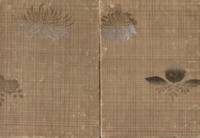
|
|
|
[Mysticism] [Spiritual Transformation] [Esoterica] Gold, E J
Objective Art: Secret Talks Volume XI
Nevada City CA: Gateways 1987. First edition number 61 of 100 signed copies. 4to 83pp recto only. Each page consists of a hand-pulled lithograph by the artist. Signed by Gold at the colophon. Black leatherette cloth boards with gilt lettering on front cover and spine. Lightly bumped at upper corner and head of spine. Near fine. <br /> <br /> One of the more scarce volumes from E.J. Gold's Secret Talks series this being made up entirely of Gold's original art. These books were written by Gold in the 70s and 80s and privately published in a small number and sold on a subscription basis. The series prints talks and writings given by Gold which revolve around the mystical teachings of Gurdjieff. Titles include The Human Biological Machine as a Transformational Apparatus Objective Prayer The Seven Bodies of Man Science of Objective Hypnotism Angelic Invocation and others. <br /> <br /> <br /> Quite an impressive volume as an art book completely hand printed by the artist and a very rare volume in this important mysticism series from Gold. . Gateways unknown
Référence libraire : 6501
|
|
|
[MÁLAGA].
"Testimonio por donde consta estar libre el Oficio de Regidor de Pedro Trujillo y Aguilar de los Censos que el Concejo y Regidores de la Ciudad de Malaga tomaron sobre los Propios y Arbitrios de dicha Ciudad a favor de Doña Leonor Fernandez y Angulo, Viuda de Don Francisco de las Infantas, Veinticuatro de Cordoba, y otros consortes", formado por 10 hojas en folio de papel sellado del año 1692, manuscrito firmado y sellado por los otorgantes el mismo año de 1692. [sigue:] "Quaderno en que esta la Razon de la paga del Oficio de Regidor de Alonso Martinez Caballero" formado por 2 hojas en folio, fechadas en 1639. [sigue:] Una Certificación en en papel sellado de 1644 de la paga referida en el documento anterior con detalle de las cantidades pagadas y recibidas, formado por una hoja. [siguen:] Documentos oficiales manuscritos sobre el Oficio de Regidor Perpetuo y sus actuaciones, pagos al mismo, y asuntos relacionados, con las firmas y sellos de las autoridades que interviene en su redacción, integrados por 19 hojas + 3 hojas + 8 hojas + 4 hojas, fechadas entre 1631 y 1646. [sigue:] "Escritura de Venta del Oficio de Regidor Perpetuo de esta Ciudad de Malaga que compró el Señor Don Pedro Trujillo y Aguilar en el Concurso de Acreedores que se formó a los bienes de Alonso Martinez Caballero por cuya muerte quedo el dicho Oficio". Formado por 32 hojas de papel sellado, con las firmas y sellos notariales, fechado en 1659. [siguen:] Varias cartas de pago del dicho Oficio, con las firmas correspondientes a documentos oficiales. Fechadas en 1660. Integrado por 4 hojas. [sigue:] Reclamaciones de la Real Hacienda a otro Regidor Perpetuo de Malaga, de nombre Juan de Ortega, con firmas y fechadas en 1753. Integrado por 2 hojas de papel sellado. [sigue:] Documento sobre la muerte de dicho Don Juan de Ortega, sus bienes y sus herederos, fechado en 1771. Integrado por otras 2 hojas de papel sellado}.
Legajo de manuscritos de los siglos XVII y XVIII, integrado en conjunto por 92 folios, cosidos de la época. Carpeta.

|
|
|
[Nazi Gold] Taber, George M
Chasing Gold. The Incredible Story of How the Nazis Stole Europe's Bullion.
New York:: Pegasus Books 2014. First Printing of the First US Edition. A Fine tight copy in a Fine unclipped dust jacket. Chasing Gold is the story of how the Nazis attempted to grab Europe’s gold to finance history’s bloodiest war. The story is filled with high drama and close escapes laying bare the palate of human emotions. Walking through the tale are giants of world history as well as ordinary people called upon to undertake heroic action in an extraordinary time. Pegasus Books, unknown
Référence libraire : 29378
|
|
|
[NIEROP, Adriaen van or Simon van MIDDELGEEST?]. WAER-MOND, Yemand van (pseudonym).
Codicille van de Nederlandsche Oorloghe waer in sy eenighe Vrienden Wel-Doenders ende Dienaren in haer principael Testament van date den tweeden Februarij 1609. vergheten zynde . den 12. Martij des selven jaers. Noch een Wellecom-Dicht van het Bestandt. Noch andere ghedichten van bestandighe vrede.
Franc end al" = Amsterdam: Frederijck de Vrije" 1609. Disbound. Small 4to. Poems celebrating the truce with Spain though attributed to a former opponent of the truce with the Dutch poems in textura types and Latin marginal notes in roman. A political pamphlet in verse celebrating peace and dated less than a month before the signing of the Twelve Years' Truce between Spain and the Dutch Republic. The main poem takes the form of a "codicil" to War's "last will and testament." It recites the various legacies both good and bad that the War has left to people on both sides and even to people and countries not directly involved in the fighting. Asher mistakenly lists the present pamphlet as no. 11 in the Bye-Korf series: it was published about six months after the Bye-Korf was banned but later collectors often inserted it and the associated Testament in place of the earlier Testament which should have been Asher 26-28/10. The author place of publication and publisher given on the title-page are all word plays "Yemand van Waer-Mond" for example suggesting "someone of honest mouth." The STCN attributes the pamphlet with a query to Nierop who propagandized against peace in one of the Bye-Korf pamphlets Asher 28/37 but rejoiced in it once it came. Alden & Landis attributes the associated Testament ofte Wtersten Wille to Middelgeest. The poet's four-line verse on the back of the title-page is signed with the motto: "Yet Meer en mocht/Min en docht Niet."A nice view of popular feelings about the Truce just before it formally took effect.With some tears at the fold of the outermost bifolium and only slightly browned otherwise a very good copy.l Asher 26-28/11; Knuttel 1584; Simoni W 34; Tiele 751; OCLC WorldCat 3 copies. Frederijck de Vrije", unknown
Référence libraire : A86ACTMRTZ41
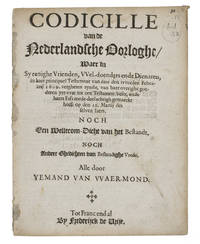
|
|
|
[Nineteenth-century English or American agricultural poetry; Victorian rural verse; provincial literature; working class writing
Nineteenth-century agricultural poetry. Fair copy manuscript of anonymous American poem titled 'Elegy on the death of a Farm Laborer.' With emendations and additions in pencil.
Without place or date. 1840s. 10pp. 8vo. On five leaves torn from a notebook. In fair condition on aged and lightly-worn paper. A creditable effort showing the influence of Gray's 'Elegy' and Goldsmith's 'Deserted Village' describing the unnamed farm hand's funeral and reflecting on the virtues and hardships of the poor. Begins: 'From yonder peaceful and secluded dell Snug in the bosom of th'encircling hills The perfumed Zephyr bears a passing knell And melancholy o'er the Soul distils. It tells us hoary Time's unswerving flight Has snapped the thread of Life's uncertain span; And that grim Death with his relentless might Has swung his sickle through th'abode of man.' Care has been taken in the revision of the text with emendations including several passages deleted and replaced. The poem ends abruptly on the tenth page suggesting that it is not complete: 'Then comes the happy and eventful day When scarce-used clothes once more are brought to view'. Without place or date. [1840s?] hardcover
Référence libraire : 15218
|
|
|
[NIXON, J H or GINNINGS, J T, attributed]
Mount Gambier Hospital south-eastern South Australia c.1870.
Albumen print photograph carte de visite format 63 x 103 mm; verso with a fully contemporary inscription in ink: 'Mount gambier Hospitle'; the print has lost some contrast but is otherwise in good condition as is the mount. This carte was sourced with others taken by travelling photographer J. T. Ginnings. However the State Library of South Australia holds a very similar carte de visite view of the Mount Gambier Hospital that was taken about the same time by Joseph H. Nixon: 'Photograph of the first Mount Gambier Hospital which was established in 1869 and demolished in 1971. The building was designed by Government Architect Robert George Thomas between 1867-69. The hospital was built of stone in the Italian gothic style featuring towers and cloistered verandahs. The two storey stately building had two wings and was typical of the Victorian era with decorative dressings around the doors windows cupolas large ornate chimneys and even featured a widow's walk. The foundation stone was laid in February 1867 by James C Lyon' SLSA B11414. unknown
Référence libraire : 49770
|
|
|
[no author or editor given]
The Jigger Volume 2 No. 1 January 1950
Philadelphia: The Drake Press 1950. Staplebound. Near fine. 16mo 23pp. illustrated. Near fine in the publisher's stapled wraps with only very mild edgewear. A surprisingly scarce booze-centric periodical which appears to be geared towards bartenders or bar owners. Several mildly lewd comics and a number of drink recipes make up the bulk of the contents along with a few liquor advertisements. OCLC records just three partial holdings for "The Jigger" at U. of Rochester Ohio State and Virginia Tech. Scarce in commerce. The Drake Press unknown
Référence libraire : 8858
|
|
|
[OR ET ARGENT]
Projet de décret sur la fabrication et la vente des matières d'or et d'argent. et sur les moyens de vérification du titre de ces matières ; présenté par les comités des contributions publiques et des monnoies
S.l., De l'Imprimerie Nationale, s.d. in-8, 6 pp., dérelié.
Référence libraire : 662050
|
|
|
[ORUGE ET OR]
Robin des bois.
Paris, Edition gp bibliotheque rouge et or, 1950 ; in-8, 165 pp., cartonnage de l'éditeur. Illustrations de Calvo.
Référence libraire : 201223048
|
|
|
[PACIFIC NORTHWEST -- PORTLAND, OR & VANCOUVER, WA MAP]. [FRITSCHE, Wenzel (Pres) & FRITSCHE, Rudolph (Vice-Pres)].
American Map and Reproducing Company’s map of Portland and vicinity.
Portland OR: American Map and Reproducing Company Corner E. Stark & E. 43rd 1912. One double atlas folio colour lithograph map sized 28 x 40.5 professionally mounted on archival linen sized 32 x 45 in. w/ scale of 1:24000 minor edgewear slight age toning at fore-edges and lower corner still a VG bright copy. First edition of this very uncommon Progressive Era map of Portland Oregon in the years between the Lewis & Clark Centennial Exposition and World War I. The map depicts public lands including township range and section grids along with neighborhood and addition place names steam & electric interurban railroads and electric streetcar lines along with parks city limits and radial distances from point in downtown Portland included. Place names included Zion Town the old steel bridge built in 1888 followed by a new Steel bridge which opened later in 1912 the Plank/Old Canyon Road Laurelhurst and others. Of particular interest beyond most maps of Portland during the era this map delineates a significant portion of Vancouver Washington prior to the construction of the Interstate Bridge across Hayden Island as well as inroads into portions of Northwest Portland and Washington County in the Southwest. Fritsche 1877-1928 was an intrepid German-American photo-lithographer architect printer and later photographer who first arrived in New York before coming West to the Pacific Northwest in 1907 where he set up an architecture and engraving firm with his brother Rudolph Fritsche. Wenzel is perhaps best remembered as architect of the historic Henry C. & Wilhemina Bruening House Craftsman bungalow located at 5919 North Williams in Portland’s Humboldt neighborhood erected in 1910. However by 1914 Wenzel had returned to Manhattan with his family including one son and three daughters. Worldcat locates 5 copies U of IL Boston Pub. OHS Reed U of O. American Map and Reproducing Company, [Corner E. Stark & E. 43rd], unknown
Référence libraire : 64223
|
|
|
[Pierce, Stephen - or Simeon Stoddard]
Vermont physician's account book
Waitsfield Vermont 1805. Narrow tall folio approx. 15½" x 6¾" 112 pp. in ink five separately sewn signatures; a few pages loose some pages darkened or chipped at edges; some entries faint. This account book is the record of the practice of either Stephen Pierce or Simeon Stoddard practicing in Waitsfield Vermont between 1795 and 1806. These were the second and third physicians to have settled and practiced in Waitsfield. Most likely it is the record of Pierce who is supposed to have settled in Waitsfield in 1795. The first physician in Waitsfield Moses Heaton remained there only between 1793 and 1796. Depending on the source Pierce was the third physician to practice in Waitsfield and/or the first to practice in Moretown a settlement to the northeast of Waitsfield. He farmed as well as doctored and his farm lay mostly in Moretown his office in Waitsfield. He was a respected and successful physician who served the community in other capacities: as selectman representative delegate to the Constitutional Convention of 1814 and Assistant Judge of the County Court. One source claims that he succeeded Judge Kinne December 1 1814 and served one year and that he was a justice of the peace in Waitsfield. He died either in 1854 after living in Waterbury and Berlin Vermont or he died in Barnard in 1864. See: History of the Town of Waitsfield Vermont 1782-1908 by Matt Bushnell Jones Boston 1909 p. 182. Simeon Stoddard on the other hand was born December 12 1761 either in Saybrook Connecticut or in Waitsfield. On August 19 1784 he married Abiah Thompson who had been born in 1763 in Waitsfield. Some sources state that he moved to Waitsfield from Saybrook in 1794. He served the southwestern area of Waitsfield and died in 1841. This account book records each date of visit the householder's name the relationship of patient to householder the medicine prescribed and its price and the cost of the doctor's visit. The doctor whether it be Stoddard or Pierce treated thirty to forty patients each month and as many as fifty-six in December of 1801. He charged as little as 4 pence and as much as 42 shillings 10 pence for his services. As a comparison the tax on an acre of land in Waitsfield was 2 pence an acre. The poll tax list of 1795 showed fifty voters so the doctor seems to have treated the members of nearly every family. The diseases treated are not stated in the entries made but he seems to have prescribed antimonium tartaricum in many instances and also digitalis. Waitsfield was founded by Col. Benjamin Wait or Waite and others who were granted a charter on February 25 1782. Wait had served under Gen. Jeffery Amherst in the French and Indian Wars and had fought in the Revolutionary War. Both Waitsfield and Moretown are now somewhat renowned as the areas around Mad River a popular ski resort. Mad River has been remarkable from the settling of the area as the source of numerous sudden destructive and deadly floods. The Green Mountains the northern extent of the Appalachians rise just to the west of the town. The doctor records having treated members of the Wait family including Benjamin's wife Martha d. April 3 1804 Ezra Thomas and Gilbert. The family names of the community are listed making this a good source for early settlement history and genealogical research. Among the householders who required the doctor's services are Smolly Skinner Taylor Spalding Hitchcock Parkhurst Carpenter the family had a tannery and potash works Heaton Burdick Johnson Rider Fuller Symonds McNight Chamberlain Atherton Lyon Butterfield Barnave Osgood Foster Hobson Robinson Brun Latimer and Sherman. Many of the names appear often. unknown
Référence libraire : 59752
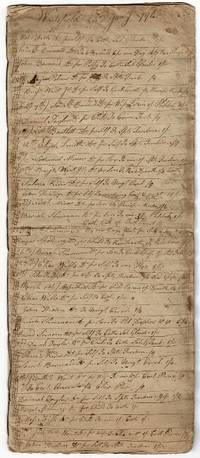
|
|

 Recevoir par e-mail
 Télécharger en PDF
 Flux RSS
 Lien permanent


