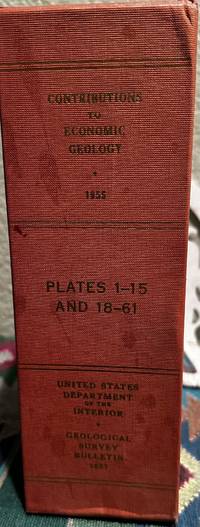
Washington D. C.: United States Department of Interior 1955. burgundy slipcase gilt lettering on spine tie to keep plates inside. very good. 59 foldouts complete package DU1. United States Department of Interior unknown
Two large folio wraps volumes. Staple binding. Three holes in left margin of all pages for binding. Hundreds of foldout designs and drawings. Stiff subject tab dividers throughout. Very light non-circulating depository library stamps. o/w Near Fine slight bit of wrinkled on edge of one cover . Appears to be Unused. . paperback
Washington: 1856. 25 pp issued as 34th Congress 1st Session HED 104; light general age toning self wrappers; appropriations needed to fulfill the stipulations of various treaties the one with the Chickasaws and Choctaws is singled out for special review. - If you are reading this this item is actually physically in our stock and ready for shipment once ordered. We are not bookjackers. Buyer is responsible for any additional duties taxes or fees required by recipient's country. Photos available upon request. Washington: unknown
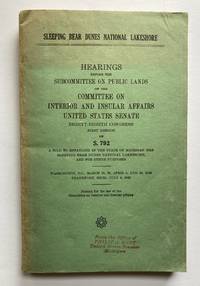
Washington: Goverment Printing Office. Very Good. 1963. Softcover. Transcript of hearings on Senate Bill 792 to establish the Sleeping Bear Dunes National Lakeshore in Western Michigan a 77000 acre park along the Lake Michigan shore. Contains a folding map in front. Original green printed wrappers with black cover lettering. There is a small stamp on lower front wrapper: "From the Office of Philip A. Hart United States Senator Michigan." For many years Phil Hart was a strong advocate for the creation of this National Lakeshore. The spine is sunned however the spine lettering still clear and bright. This is a clean tight and unmarked book. ; Folding Map; 8vo 8" - 9" tall; 435 pages . Goverment Printing Office paperback
Washington DC: U.S. Government Printing Office 1977. Wraps. Good. No dust jacket as issued. Label on back page. iii 262 p. 24 cm. Illustrations. Occasional footnotes. Publication No. 95-12. U.S. Government Printing Office paperback
Washington DC: U. S. Government Printing Office 1973. Presumed First Edition First printing. Wraps. Fair. v 1 890 pages. Statements. Communications. Maps. Illustrations. References. Additional Information. Appendix Some damp stains noted. Project Rio Blanco was an underground nuclear test that took place on May 17 1973 in Rio Blanco County Colorado approximately 36 miles 58 km northwest of Rifle. Three 33-kiloton nuclear devices were detonated nearly simultaneously in a single emplacement well at depths of 5838 6230 and 6689 feet 1779 1899 and 2039 m below ground level. The tests were conducted in fine-grain low-permeability sandstone lenses at the base of the Fort Union Formation and the upper portion of the Mesaverde Formation. This was the third and final natural-gas-reservoir stimulation test in the Plowshare program which was designed to develop peaceful uses for nuclear energy. The two previous tests were Project Gasbuggy in New Mexico and Project Rulison in Colorado. The United States Atomic Energy Commission conducted the test in partnership with CER Geonuclear Corporation and Continental Oil Company. A placard erected in 1976 now marks the site where the test was conducted. The site is accessible via a dirt road Rio Blanco County Route 29. Peaceful nuclear explosions PNEs are nuclear explosions conducted for non-military purposes. Proposed uses include excavation for the building of canals and harbors electrical generation the use of nuclear explosions to drive spacecraft and as a form of wide-area fraking. PNEs were an area of some research from the late 1950s into the 1980s primarily in the United States and Soviet Union. In the U.S. a series of tests were carried out under Project Plowshare. Some of the ideas considered included blasting a new Panama Canal the use of underground explosions to create electricity and a variety of geological studies. The largest of the excavation tests was carried out in the Sedan nuclear test in 1962 which released large amounts of radioactive gas into the air. By the late 1960s public opposition to Plowshare was increasing and a 1970s study of the economics of the concepts suggested they had no practical use. Plowshare saw decreasing interest from the 1960s and was officially canceled in 1977. The Soviet program started a few years after the U.S. efforts and explored many of the same concepts under their Nuclear Explosions for the National Economy program. The program was more extensive eventually conducting 239 nuclear explosions. Some of these tests also released radioactivity including a significant release of plutonium into the groundwater and the polluting of an area near the Volga River. A major part of the program in the 1970s and 80s was the use of very small bombs to produce shock waves as a seismic measuring tool and as part of these experiments two bombs were successfully used to seal blown-out oil wells. The program officially ended in 1988. As part of ongoing arms control efforts both programs came to be controlled by a variety of agreements. Most notable among these is the 1976 Treaty on Underground Nuclear Explosions for Peaceful Purposes PNE Treaty. The Comprehensive Nuclear-Test-Ban Treaty of 1996 prohibits all nuclear explosions regardless of whether they are for peaceful purposes or not. Since that time the topic has been raised several times often as a method of asteroid impact avoidance. U. S. Government Printing Office paperback
Washington DC: U.S. Government Printing Office 1972. Presumed first edition/first printing. Wraps. Good. No dust jacket as issued. Ex-library. Usual library markings noted. Front page creased. iii 89 p.; 24 cm. S.3449 was a bill to authorize and direct the Water Resources Council to coordinate a national program to insure the safety of dams and toher water storage and control structures to provide technical support to state programs for the licensing and inspection of such structures to encourage adequate state safety laws and methods of implementation thereof and for other purposes. This hearing was held in the aftermath of several tragic floods including the Buffalo Creek Valley flood of February 26 1972 in West Virginia which claimed at least 118 lives and the flood in June 1972 in the vacinity of Rapid City South Dakota which killed over 200 people and involved the failure of the Canyon Lake Dam. U.S. Government Printing Office paperback

 検索結果のメールを受信する
 PDFファイルの検索結果をダウンロード
 RSSフィード
 パーマネントリンク