|
Newton, Isaac
Opera quae extant omnia Band 2: Reprint of the edition by Samuel Horsley London 17791785.
frommann-holzboog Verlag e.K. Latin. Hardcover. New. This edition of Newtons 16431727 works has never been replaced altogether to the present day. In spite of Newtons profound impact on natural sciences it should not be overlooked that substantial parts of his writings deal with philosophical and theological problems. Evidence of this can be found in this edition. It contains all of Newtons major theological works. As a religious thinker Newton dealt with Jacob Böhmes writings in the English translation by Sparrow published in 1661. In his interpretation of the apocalypse and the Book of Daniel Newton focuses on Böhmes mystical thought. Content: - Philosophiae naturalis principia mathematica: - Definitiones - De methodo rationum primarum & ultimarum - De inventione orbium ellipticorum parabolicum & hyperbolicorum ex umbilico dato - De inventione orbium ubi umbilicus neuter datur - De inventione matuum in orbibus datis - De corporum ascensu & descensu rectilineo - De inventione orbium in quibus corpora viribus quibuscunque centripetis agitata revolvuntur - De motu corporum in orbibus mobilibus deque motu asidum - De motu corporum in superficiebus datis deque funependulorum motu reciproco - De motu corporum viribus centripetis se mutuo petentium - De corporum sphaericorum viribus attractivis - De corporum non sphaericorum viribus attractivis - De motu corporum minimorum quae viribus centripetis ad singulas magni alicujus corporis partes tendentibus agitantur frommann-holzboog Verlag e.K. hardcover
Bookseller reference : Frommann-9783772827624 ISBN : 3772827624 9783772827624
|
|
|
Newton, Isaac
Opera quae extant omnia Band 4: Reprint of the edition by Samuel Horsley London 17791785.
frommann-holzboog Verlag e.K. English. Hardcover. New. This edition of Newtons 16431727 works has never been replaced altogether to the present day. In spite of Newtons profound impact on natural sciences it should not be overlooked that substantial parts of his writings deal with philosophical and theological problems. Evidence of this can be found in this edition. It contains all of Newtons major theological works. As a religious thinker Newton dealt with Jacob Böhmes writings in the English translation by Sparrow published in 1661. In his interpretation of the apocalypse and the Book of Daniel Newton focuses on Böhmes mystical thought. Content: - Opticks - Letters on various Subjects in Natural Philosophy published from the Originals in the Archives of the Royal Society of London - Letter to Mr. Boyle on the Cause of Gravitation - Tabulae Duae Calorum altera altera Refractionum - De Problematibus Bernouillianis - Propositions for determining the Motion of a Body urged by two Central Forces - Four Letters to Dr. Bentley - Commercium Epistolicum §c. cum recensione praemissae - Additamenta Commercii Epistolici ex Historiae Fluxionum Raphsoni frommann-holzboog Verlag e.K. hardcover
Bookseller reference : Frommann-9783772827648 ISBN : 3772827640 9783772827648
|
|
|
Newton, Isaac
Opera quae extant omnia Band 5: Reprint of the edition by Samuel Horsley London 17791785.
frommann-holzboog Verlag e.K. English. Hardcover. New. This edition of Newtons 16431727 works has never been replaced altogether to the present day. In spite of Newtons profound impact on natural sciences it should not be overlooked that substantial parts of his writings deal with philosophical and theological problems. Evidence of this can be found in this edition. It contains all of Newtons major theological works. As a religious thinker Newton dealt with Jacob Böhmes writings in the English translation by Sparrow published in 1661. In his interpretation of the apocalypse and the Book of Daniel Newton focuses on Böhmes mystical thought. Content: - The Chronolgy of antient Kingdoms amended - A short Chronicle from a MS. the property of the Rev. Dr. Ekins Dean of Carlisle - Observations upon the Prophecies of Holy Writ; particularly the Prophecies of Daniel and the Apocalypse of St. John - An Historical Account of Two Notable Corruptions of Scripture. In a Letter to a Friend frommann-holzboog Verlag e.K. hardcover
Bookseller reference : Frommann-9783772827655 ISBN : 3772827659 9783772827655
|
|
|
Newton, Isaac
Opera quae exstant omnia: Reprint of the edition by Samuel Horsley London 17791785.
frommann-holzboog Verlag e.K. English. Hardcover. New. 2860 p. 145 x 190 cm. This edition of Newtons 16431727 works has never been replaced altogether to the present day. In spite of Newtons profound impact on natural sciences it should not be overlooked that substantial parts of his writings deal with philosophical and theological problems. Evidence of this can be found in this edition. It contains all of Newtons major theological works. As a religious thinker Newton dealt with Jacob Böhmes writings in the English translation by Sparrow published in 1661. In his interpretation of the apocalypse and the Book of Daniel Newton focuses on Böhmes mystical thought. frommann-holzboog Verlag e.K. hardcover
Bookseller reference : Frommann-9783772802317 ISBN : 3772802311 9783772802317
|
|
|
Newton, Isaac
Opera quae extant omnia Band 1: Reprint of the edition by Samuel Horsley London 17791785.
frommann-holzboog Verlag e.K. Latin. Hardcover. New. This edition of Newtons 16431727 works has never been replaced altogether to the present day. In spite of Newtons profound impact on natural sciences it should not be overlooked that substantial parts of his writings deal with philosophical and theological problems. Evidence of this can be found in this edition. It contains all of Newtons major theological works. As a religious thinker Newton dealt with Jacob Böhmes writings in the English translation by Sparrow published in 1661. In his interpretation of the apocalypse and the Book of Daniel Newton focuses on Böhmes mystical thought. Content: - Arithmetica universalis sive de compositione et resolutione arithmetica liber - De analysi per aequationes numero terminorum infinitas - Excerpta Quaedam ex epistolis Newtoni ad series fluxionesque pertinenta - Tractatus de quadratura curvarum - Artis analyticae specimina vel geometria analytica - Methodus differentialis - Enumeratio linearum tertii ordinis - Logistica infinitorum - Samuel Horsleii de geometria fluxionum frommann-holzboog Verlag e.K. hardcover
Bookseller reference : Frommann-9783772827617 ISBN : 3772827616 9783772827617
|
|
|
Newton, Isaac
Opera quae extant omnia Band 3: Reprint of the edition by Samuel Horsley London 17791785.
frommann-holzboog Verlag e.K. Latin. Hardcover. New. This edition of Newtons 16431727 works has never been replaced altogether to the present day. In spite of Newtons profound impact on natural sciences it should not be overlooked that substantial parts of his writings deal with philosophical and theological problems. Evidence of this can be found in this edition. It contains all of Newtons major theological works. As a religious thinker Newton dealt with Jacob Böhmes writings in the English translation by Sparrow published in 1661. In his interpretation of the apocalypse and the Book of Daniel Newton focuses on Böhmes mystical thought. Content: - Regulae philosophandi - Phaenomena - De causis systematis mundami - De quantitate errorum lunarium - De quantitate praecessione aequinoctiorum - De cometis frommann-holzboog Verlag e.K. hardcover
Bookseller reference : Frommann-9783772827631 ISBN : 3772827632 9783772827631
|
|
|
Newton, Isaac
Opera quae exstant omnia
London: Excudebat Joannes Nichols. 1779-1785. Commentariis illustrabat Samuel Horsley. 5 volumes complete quarto format b/w illus. uniformly bound in early 19th-century full brown calf with gilt trim and spine lettering nicely marbled edges light foxing on the endpapers but the text paper is clean. Lacking the half-title pages which were not bound into this set. A former private bookplate and a former institutional bookplate inside the covers and a faint but very neat embossed blindstamp of the former institutional library on the bottom margin of the titlepages. Brunet IV 48. ESTC T18649. Contents: Vol.1 xxii 592 1p. with two double-folded tables. Vol. 2 xxviii 459 1p. Vol 3 437 48p. with 14 plates. Vol.4 617p. with 12 plates page 617 is misnumbered 609. Vol. 5 vii 550p. with 3 double-folded plates. This was the first collected edition of his Latin/English works. Excudebat Joannes Nichols unknown
Bookseller reference : 056522
|
|
|
NEWTON, Isaac
Opera Quae Exstant Omnia
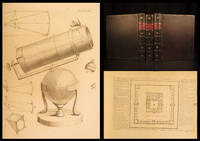
<p><strong>1782 Isaac NEWTON Works OPTICS Ancient Kingdoms Gravity Mundi Systemate Horsley</strong></p><p><em>"Whence arises all that order and beauty we see in the world" </em></p><p>― Isaac Newton<em> Opticks</em></p><p>Few names in the course of the history of science have been as influential as Isaac Newton. His works such as '<em>Opticks'</em> summarized great discoveries and theories concerning light and color reflections color wheel invention of the telescope early theories of the rainbow and Newtonian rings – <strong><u>one of the greatest works on optics</u></strong>. '<em>Opticks'</em> in addition to his other famous treatises were published together in the 1782 collected works of Newton by Samuel Horsley. </p><p>This set of three volumes from the Horsley collected edition includes not only '<em>Opticks'</em> but works such as "<em>Chronology of Ancient Kingdoms</em>" correspondence with Boyle on gravity and "<em>De mundi systemate</em>" or "<em>Systems of the World".</em></p><p>Item number: #25493</p><p>Price: $4950</p><p>NEWTON Isaac</p><p><strong><em>Opera Quae Exstant Omnia</em></strong></p><p>Londini: Excudebat Joannes Nichols 1782-1785.</p><p><u>Details</u>: </p><p><!-- if !supportLists-->· <!--endif-->Collation: 3 volumes</p><p><!-- if !supportLists-->o <!--endif-->Vol. III – 10 174 5 180-242 3 246-437 8 4-48</p><p><!-- if !supportLists-->§ <!--endif-->plates no.2-11</p><p><!-- if !supportLists-->o <!--endif-->Vol. IV – 9 6-264 5 270-617p</p><p><!-- if !supportLists-->§ <!--endif-->12 plates</p><p><!-- if !supportLists-->o <!--endif-->Vol. V – 11 550p</p><p><!-- if !supportLists-->§ <!--endif-->3 folding plates</p><p><!-- if !supportLists-->· <!--endif-->Language: English</p><p><!-- if !supportLists-->· <!--endif-->Binding: Modern Leather; tight and secure</p><p><!-- if !supportLists-->· <!--endif-->Size: ~12in X 9.75in 30.5cm x 24.5cm</p><p>Our Guarantee:</p><p>Very Fast. Very Safe. Free Shipping Worldwide.</p><p>Customer satisfaction is our priority! Notify us with 7 days of receiving and we will offer a full refund without reservation!</p><p>163</p> Joannes Nichols hardcover
Bookseller reference : 25494
|
|
|
Newton, Isaac; Carlos Solis
Optica O Tratado de las Reflexiones Refracciones Inflexiones y Colores de la Luz
Madrid: Ediciones Alfaguara S. A. 1977. Hardcover. Good. 20 x 11.5 cm. Spanish language edition. Translated by Carlos Solis with notes index appendix. A few scattered marginalia. Rubbing to the boards. From the library of Newton scholar Alan E. Shapiro with his bookplate on front fixed endpaper. Ediciones Alfaguara S. A. hardcover
Bookseller reference : 67512
|
|
|
Newton, Isaac
Optical Lectures Read in the Publick Schools of the University of Cambridge . 1669. By . Sir Isaac Newton . Never Before Printed. Translated Into English out of the Original Latin
hardcover. Good. Access codes and supplements are not guaranteed with used items. May be an ex-library book. hardcover
Bookseller reference : 1379786134.G ISBN : 1379786134 9781379786139
|
|
|
Newton, Isaac
Optice Sive De Reflexionibus Refractionibus Et Coloribus Lucis Libri Tres. Latine Reddidit Samuel Clarke Latin Edition
paperback. Good. Access codes and supplements are not guaranteed with used items. May be an ex-library book. paperback
Bookseller reference : 1149228261.G ISBN : 1149228261 9781149228265
|
|
|
NEWTON, Isaac (1643-1727).
Optice: sive de Reflexionibus Refractionibus Inflexionibus et Coloribus Lucis libri tres. Latine reddidit Samuel Clarke . . . Editio novissima.
Lausannae & Geneva: Marci-Michaelis Bousquet & Sociorum 1740. 1740. 4to. iv xxxii 363 1 pp. Half-title engraved frontispiece portrait of Newton engr. Jean-Louis Daudet after Vanderbank title printed in red & black 12 engraved folding plates title vignette of 4 cherubs and a female figure each using an optical instrument representing learning optics/perspective drawn by Delamoncein and engraved by Daudet head & tail pieces and woodcut initial letters drawn by Papillon index; first 11 leaves browned. Contemporary full vellum green leather gilt-stamped spine label edges with decorative red freckling as designed by the binder; foot of spine with faint ink marking "11-". Paper unevenly browned. Verso of title with small ink annotation "=1135="; rear pastedown with another notation "a 20.Luglio 1801." Very good. Third Latin edition edited by Bousquet with a dedication to Joannes Bernoulli. This edition contains the full array of 31 querries. / "Newton's contributions to the science of optics :: his discovery of the unequal refractions of rays of different color his theory of color and his investigations of 'Newton's rings' to mention only a few of the most noteworthy :: place him among the premier contributors to that science. . . . Today we recognize that his work on optics offers unique rewards in its exciting innovative conjunction of physical theory experimental investigation and mathematics and in the revealing glimpse that it provides of a crucial period in the evolution of experimental science." :: Alan E. Shapiro The Optical Papers of Isaac Newton: Volume 1 1984 p. xi. / Jean-Louis Daudet 1695-1756 who made the frontispiece and title vignette was an engraver and print publisher active in Lyon inherited business from his father Etienne Joseph Daudet. He flourished from 1722 till his death in 1756. Thereafter the business continued by his widow in association with his son-in-law Louis Martin Roch Joubert until 1773. / "Newton famously declared that it is not the business of science to make hypotheses. However it's well to remember that this position was formulated in the midst of a bitter dispute with Robert Hooke who had criticized Newton's writings on optics when they were first communicated to the Royal Society in the early 1670's. The essence of Newton's thesis was that white light is composed of a mixture of light of different elementary colors ranging across the visible spectrum which he had demonstrated by decomposing white light into its separate colors and then reassembling those components to produce white light again. However in his description of the phenomena of color Newton originally included some remarks about his corpuscular conception of light perhaps akin to the cogs and flywheels in terms of which James Maxwell was later to conceive of the phenomena of electromagnetism. Hooke interpreted the whole of Newton's optical work as an attempt to legitimize this corpuscular hypothesis and countered with various objections." / "Newton quickly realized his mistake in attaching his theory of colors to any particular hypothesis on the fundamental nature of light and immediately back-tracked arguing that his intent had been only to describe the observable phenomena without regard to any hypotheses as to the cause of the phenomena. Hooke and others continued to criticize Newton's theory of colors by arguing against the corpuscular hypothesis causing Newton to respond more and more angrily that he was making no hypothesis he was describing the way things are and not claiming to explain why they are. This was a bitter lesson for Newton and in addition to initiating a life-long feud with Hooke went a long way toward shaping Newton's rhetoric about what science should be. . ." / "The first edition of The Opticks 1704 contained only 16 queries but when the Latin edition was published in 1706 Newton was emboldened to add seven more which ultimately became Queries 25 through 31 when in the second English edition he added Queries 17 through 24. Of all these one of the most intriguing is Query 28 which begins with the rhetorical question "Are not all Hypotheses erroneous in which Light is supposed to consist of Pression or Motion propagated through a fluid medium" In this query Newton rejects the Cartesian idea of a material substance filling in and comprising the space between particles. Newton preferred an atomistic view believing that all substances were comprised of hard impenetrable particles moving and interacting via innate forces in an empty space as described further in Query 31." :: Newton's Cosmological Queries :: MathPages. / Grace K. Babson Sir Isaac Newton 1950 141; George J. Gray A Bibliography of the Works of Sir Isaac Newton 182; Wallis 182. See: Printing and the Mind of Man 172. Marci-Michaelis Bousquet & Sociorum, 1740. hardcover
Bookseller reference : S13116

|
|
|
NEWTON, ISAAC
Optice: sive de Reflexionibus Refractionibus Inflexionibus & Coloribus Lucis Libri tres. Latine reddidit Samuel Clarke S.T.P. Editio Secunda auctior.
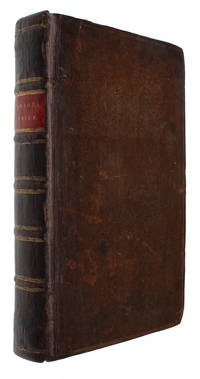
London Impensis Gul. & Joh. Innys 1719 colophon: Londini: Ex Officina Gulielmi Bowyer 1718. 8vo. Contemp. full calf. Corners fronthinge and spineends professionally repaired. Inner hinges reinforced. Gilt lineborders on back. Titlelabel in red leather with gilt lettering. Old owners name stamped on titlepage small.Instead of htitle is bound "Catalogus Librorum prostantium apud Gul. & Joh. Innys" 1 leaf the Cataloque is furthermore bound at end but with a different typography. 2XI1415 pp. and 12 folded engraved plates. Very light brownning to a few margins. Printed on good paper in general fine and clean internally. <br/><br/><em>Scarce second Latin edition of Newton's "Optics: or a Treatise of the Reflections Refractions Inflections and Colours of Light. London 1704." one of the great books in the history of science. "Newton's Optics did for Light what his Principia had done for Gravitation namely placed it on a scientific basis." E.W. Brown. The translation was brought to light "At the request of Newton Dr. Samuel Clarke prepared a Latin edition of his Optics which appeared 1706 and he was generously presented by Sir Isaac with GBP 500 or GBP 100 for each of his five children as a token of the appreciation and gratitude of the author. DeMoivre is said to have secured and taken charge of this translation and to have spared neither time nor trouble in the task. Newton met him every evening at a coffe-house and when they have finished their work he took De Moivre home with him to spend the evening in philosophical conversation."Brewster in his "Newton" 1855"."In the accumulation of optical phenomena from his first paper the short memoir in Philosophical Transaction 1672 until the above book the Optics. 33 years later Newton had gathered explanations to many problems. The rainbow is fully explained and also "Newton's rings" produced by pressing the flat side of a plano-convex glass against a double convex lens of long focal lenght producing rings of alternating brightness and darkness; his explanation was not valid as he did not know optical interference. He speculated on the double refraction of Icelandic spar." Dibner in Heralds of Science No 148 - G.J. Gray No 180. </em> hardcover
Bookseller reference : 38274
|
|
|
NEWTON, Isaac
Optice; sive de reflexionibus refractionibus inflexionibus & coloribus lucis libri tres
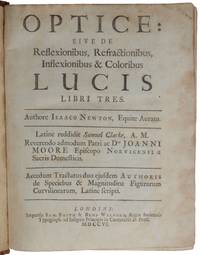
London: Samuel Smith and Benjamin Walford 1706. First edition. <p>First Latin edition of the Opticks the extremely rare first issue with Ss1 in its original state. "Newton's Opticks did for light what his Principia had done for gravitation namely placed it on a scientific basis" Babson. This Latin edition is important for the seven new Queries it contains. In one of these Newton wrote that space is the 'Sensorium of God'. He later changed his mind cancelling the relevant leaf Ss1 in almost all copies although a copy in its uncancelled state found its way to Leibniz who ridiculed Newton's rash statement.</p>. <p>THE VERY RARE FIRST ISSUE WITH THE 'MISSING TANQUAM'</p> . <p>First Latin edition of the Opticks the extremely rare first issue with Ss1 in its original state cancelled in almost all copies. Of Newton's three greatest contributions to science - his theory of gravity his theories of light and colour and the invention of calculus - the first was published for the first time in the Principia 1687 and the other two in the Opticks 1704 "one of the supreme productions of the human mind" Andrade. "Newton's Opticks did for light what his Principia had done for gravitation namely placed it on a scientific basis" Babson p. 66."One of the supreme productions of the human mind" Andrade "All previous philosophers and mathematicians had been sure that white light is pure and simple regarding colors as modifications or qualifications of the white. Newton showed that the opposite is true . Natural white light far from being simple is a compound of many pure elementary colors which can be separated and recombined at will" PMM. The Optice contains translations not only of the Opticks itself but also of the two appended mathematical tracts Tractatus de quadratura curvarum and Enumeratio linearum tertii ordinis. The former is Newton's first publication of his method of fluxions or calculus which he developed in terms of 'prime and ultimate ratios' an early version of the theory of limits; it includes the first published statement of the general binomial theorem and of 'Taylor's theorem' on series expansions. The real importance of this Latin edition is the seven new 'Queries' it contains: "The Queries contain some of Newton's most influential and speculative writing" Gjertsen p. 519. The purpose of the original 16 queries in the Opticks was principally to compensate for the many years' delay between the writing of Opticks and its publication during which many discoveries had been made by Newton and others. Each of the new Queries with one exception is longer than the original 16 taken together. "In the new Queries Newton expressed fundamental views on the nature of light on the nature of bodies on the relation of God to the physical universe and on the presence in nature of a whole range of forces which furnish the activity necessary for the operation of the world and for its permanence. At the last moment he dared even a bit more and inserted three further speculative passages in the Addenda to the volume. The new Queries were the most informative of the speculations that Newton ever published." Westfall p. 644. "This edition is known in two states. In query 20 Newton had written of space: 'Annon spatium universuum sensorium est entis incorporei viventis et intelligentis' Is not infinite space the sensorium of a Being incorporeal living and intelligent. It must have struck Newton that to call space 'the sensorium of God' without any qualification was too bold a claim. Consequently he chose to substitute for page 315 a cancel in which he spoke of infinite space 'spatio infinito' as 'tanquam sensorio suo' which is as it were his sensorium. He failed however to modify the whole edition and copies with the missing tanquam been found in the Babson collection the Bodleian library and Cambridge University Library. But worse from Newton's point of view an uncancelled copy found its way to Leibniz who lost no time in accusing Newton of claiming that space is an organ of God" Gjertsen p. 413. Some of the other added Queries contain remarkably prescient speculations. Query 23 "was an extended version of the speculations on forces that Newton had once planned to insert in the Principia. Heavily indeed overwhelmingly chemical in content it was arguably the most advanced product of seventeenth-century chemistry" Westfall p. 644. "In a remarkable paragraph in Query 22 pp. 320-321 which did not survive into subsequent English editions he compared the force of attraction in proportion to size in particles of light and gross bodies by comparing velocities and radii of curvature of rays of light and projectiles. He concluded that the force of attraction in particles of light is more powerful by a factor of 1015 that is the short-range forces are immensely more powerful than gravity" ibid. p. 646.</p> <br /> <p>"Newton wrote most of the Opticks between 1687 and early 1692. He wrote Book I Parts I and II expounding his new theory of light and colour in 1687. He then appears to have set aside the Opticks for about three years but by the late summer or autumn of 1691 he had considered it - at least for a few months - to be complete. It is most likely that he carried out new research and wrote the remainder of the Opticks - that is Books II and III - in the winter or spring of 1692 or perhaps six months earlier. At some time between late August 1691 and late February 1692 Newton decided to revise the draft significantly. After this effort he brought it close to its published form except for the brief last book on diffraction which Newton called 'inflexion' and the queries which were not prepared for publication until shortly before publication in 1704.</p> <br /> <p>"The composition of Book II in 1690 or 1691 at first went very quickly. Newton made so few changes in the text that he was able to mark up the manuscript of the 'Discourse of Observations' from 1675 for his amanuensis to copy for the Opticks. This formed Parts I and II and much of Part III . After revising the 'Observations' Newton was confronted with a decision on how to end his book. At first he planned to follow this material with a new fourth book or part on diffraction but he was also toying with the idea of a speculative 'Fourth Book'. Newton soon reined in his more speculative tendencies and turned to more empirical optical investigations. He continued experiments on diffraction and also discovered an entirely new phenomenon: coloured rings produced in transparent thick plates. By the autumn of 1691 Newton had completed and written up his investigations of thick plates as Book IV Part I which together with his research on diffraction Book IV Part II was to form the concluding book of the Opticks.</p> <br /> <p>"Between late August 1691 and late February 1692 Newton removed the two parts of the new Book IV from the manuscript and set about revising them. The part on diffraction was troublesome and remained incomplete until shortly before publication. Within six months however he revised the part on the colours of thick plates incorporated it into Book III because of their affinity to those of thin films and essentially put it into its published state. During this revision Newton also introduced his theory of fits - an immaterial vibration to explain the physical cause of periodicity in light that replaced his earlier aetherial and corpuscular vibrations" Shapiro pp. 187-188. </p> <br /> <p>On 15 November 1702 according to a memorandum by the Scottish mathematician and Oxford Professor of Astronomy David Gregory Newton "promised Mr Roberts Mr Fatio Capt. Hally & me to publish his Quadratures his treatise of Light & his treatise of the Curves of the 2d Genre" i.e. cubic curves. The book appeared by 16 February 1704 when Newton presented a copy to the Royal Society" ibid. p. 196.</p> <br /> <p>In the published work "Newton presented his main discoveries and theories concerning light and color in logical order beginning with eight definitions and eight axioms . Eight propositions follow the first stating that 'Lights which differ in Colour differ also in Degrees of Refrangibility.' In appended experiments Newton discussed the appearance of a paper colored half red and half blue when viewed through a prism and showed that a given lens produces red and blue images respectively at different distances. The second proposition incorporates a variety of prism experiments as proof that 'The Light of the Sun consists of Rays differently refrangible.'</p> <br /> <p>"The figure given with experiment 10 of this series illustrates 'two Prisms tied together in the form of a Parallelopiped'. Under specified conditions sunlight entering a darkened room through a small hole F in the shutter would not be refracted by the parallelopiped and would emerge parallel to the incident beam from which it would pass by refraction through a third prism which would by refraction 'cast the usual Colours of the Prism upon the opposite Wall.' Turning the parallelopiped about its axis Newton found that the rays producing the several colors were successively 'taken out of the transmitted Light' by 'total Reflexion'; first 'the Rays which in the third Prism had suffered the greatest Refraction and painted the wall with violet and blew were . taken out of the transmitted Light the rest remaining' then the rays producing green yellow orange and red were 'taken out' as the parallelopiped was rotated yet further. Newton thus experimentally confirmed the 'experimentum crucis' showing that the light emerging from the two prisms 'is compounded of Rays differently Refrangible seeing that the more Refrangible Rays may be taken out while the less Refrangible remain' . In proposition 6 Newton showed that contrary to the opinions of previous writers the sine law of refraction actually holds for each single color. The first part of book I ends with Newton's remarks on the impossibility of improving telescopes by the use of color corrected lenses and his discussion of his consequent invention of the reflecting telescope.</p> <br /> <p>"In the second part of book I Newton dealt with colors produced by reflection and refraction or transmission and with the appearance of colored objects in relation to the color of the light illuminating them. He discussed colored pigments and their mixture and geometrically constructed a color wheel drawing an analogy between the primary colors in a compound color and the "seven Musical Tones or Intervals of the eight Sounds Sol la fa sol la mi fa sol."</p> <br /> <p>"Proposition 9 'Prob. IV. By the discovered Properties of Light to explain the Colours of the Rain-bow' is devoted to the theory of the rainbow. Descartes had developed a geometrical theory but had used a single index of refraction in his computation of the path of light through each raindrop. Newton's discovery of the difference in refrangibility of the different colors composing white light and their separation or dispersion as a consequence of refraction on the other hand permitted him to compute the radii of the bows for the separate colors. He used 108:81 as the index of refraction for red and 109:81 for violet and further took into consideration that the light of the sun does not proceed from a single point. He determined the widths of the primary and secondary bows to be 2°15' and 3°40' respectively and gave a formula for computing the radii of bows of any order n and hence for orders of the rainbow greater than 2 for any given index of refraction .</p> <br /> <p>"Book II which constitutes approximately one third of the Opticks is devoted largely to what would later be called interference effects growing out of the topics Newton first published in his 1675 letter to the Royal Society. Newton's discoveries in this regard would seem to have had their origin in the first experiment that he describes Book II Part 1 Observation 1; he had he reported compressed 'two Prisms hard together that their sides which by chance were a very little convex might somewhere touch one another' as in the figure provided for Experiment 10 of Book I Part 1. He found 'the place in which they touched' to be 'absolutely transparent' as if there had been one 'continued piece of Glass' even though there was total reflection from the rest of the surface; but 'it appeared like a black or dark spot by reason that little or no sensible light was reflected from thence as from other places' . Rotating the two prisms around their common axis Observation 2 produced 'many slender Arcs of Colours' which the prisms being rotated further 'were compleated into Circles or Rings.' In Observation 4 Newton wrote that 'To observe more nicely the order of the Colours . I took two Object-glasses the one a Plano-convex for a fourteen Foot Telescope and the other a large double Convex for one of about fifty Foot; and upon this laying the other with its plane side downwards I pressed them slowly together to make the Colours successively emerge in the middle of the Circles and then slowly lifted the upper Glass from the lower to make them successively vanish again in the same place.' It was thus evident that there was a direct correlation between particular colors of rings and the thickness of the layer of the entrapped air . Furthermore as he noted in Observation 13 'the Circles which the red Light made' were 'manifestly bigger than those which were made by the blue and violet' . He concluded that the rings visible in white light represented a superimposition of the rings of the several colors and that the alternation of light and dark rings for each color must indicate a succession of regions of reflection and transmission of light produced by the thin layer of air between the two glasses . </p> <br /> <p>"Book II Part 2 of the Opticks has a nomogram in which Newton summarized his measures and computations and demonstrated the agreement of his analysis of the ring phenomenon with his earlier conclusions drawn from his prism experiments - 'that whiteness is a dissimilar mixture of all Colours and that Light is a mixture of Rays endued with all those Colours.' The experiments of Book II further confirmed Newton's earlier findings 'that every Ray have its proper and constant degree of Refrangibility connate with it according to which its refraction is ever justly and regularly perform'd' from which he argued that 'it follows that the colorifick Dispositions of Rays are also connate with them and immutable.' The colors of the physical universe are thus derived 'only from the various Mixtures or Separations of Rays by virtue of their different Refrangibility or Reflexibility'; the study of color thus becomes 'a Speculation as truly mathematical as any other part of Opticks.' </p> <br /> <p>"In Part 3 of Book II Newton analyzed 'the permanent Colours of natural Bodies and the Analogy between them and the Colours of thin transparent Plates.' He concluded that the smallest possible subdivisions of matter must be transparent and their dimensions optically determinable. A table accompanying Proposition 10 gives the refractive powers of a variety of substances 'in respect of . Densities.' Proposition 12 contains Newton's conception of 'fits': 'Every Ray of Light in its passage through any refracting Surface is put into a certain transient Constitution or State which in the progress of the Ray returns at equal Intervals and disposes the Ray at every return to be easily transmitted through the next refracting Surface and between the returns to be easily reflected by it.' The succeeding definition is more specific: 'The returns of the disposition of any Ray to be reflected I will call its Fits of easy Reflection and those of its disposition to be transmitted its Fits of easy Transmission and the space it passes between every return and the next return the Interval of its Fits.' The 'fits' of easy reflection and of easy refraction could thus be described as a numerical sequence; if reflection occurs at distances 0 2 4 6 8 . from some central point then refraction or transmission must occur at distances 1 3 5 7 9 . Newton did not attempt to explain this periodicity stating that 'I do not here enquire' into the question of 'what kind of action or disposition this is' . Newton thus integrated the periodicity of light into his theoretical work . His work was moreover based upon extraordinarily accurate measurements - so much so that when Thomas Young 1773-1829 devised an explanation of Newton's rings based on the revived wave theory of light and the new principle of interference he used Newton's own data to compute the wavelengths and wave numbers of the principal colors in the visible spectrum and attained results that are in close agreement with those generally accepted today.</p> <br /> <p>"In Part 4 of Book II Newton addressed himself to 'the Reflexions and Colours of thick transparent polish'd Plates.' This book ends with an analysis of halos around the sun and moon and the computation of their size based on the assumption that they are produced by clouds of water or by hail. This led him to the series of eleven observations that begin the third and final book 'concerning the Inflexions of the Rays of Light and the Colours made thereby' in which Newton took up the class of optical phenomena previously studied by Grimaldi in which 'fringes' are produced at the edges of the shadows of objects illuminated by light 'let into a dark Room through a very small hole.' Newton discussed such fringes surrounding the projected shadows of a hair the edge of a knife and a narrow slit" DSB.</p> <br /> <p>"Since Newton published the Opticks without a complete investigation into diffraction which he had hoped would support a corpuscular theory of light in which light corpuscles were acted on by short-range forces of matter" Shapiro p. 196 "Newton concluded the first edition of the Opticks with a set of sixteen queries introduced 'in order to a further search to be made by others.' He had at one time hoped he might carry the investigations further but was 'interrupted' and wrote that he could not 'now think of taking these things into farther Consideration.' In the eighteenth century and after these queries were considered the most important feature of the Opticks . The original sixteen queries at once go beyond mere experiments on diffraction phenomena. In Query 1 Newton suggested that bodies act on light at a distance to bend the rays; and in Queries 2 and 3 he attempted to link differences in refrangibility with differences in 'flexibility' and the bending that may produce color fringes. In Query 4 he inquired into a single principle that by 'acting variously in various Circumstances' may produce reflection refraction and inflection suggesting that the bending in reflection and refraction begins before the rays 'arrive at the Bodies.' Query 5 concerns the mutual interaction of bodies and light the heat of bodies being said to consist of having 'their parts put into a vibrating motion'; while in Query 6 Newton proposed a reason why black bodies 'conceive heat more easily from Light than those of other Colours.' He then discussed the action between light and 'sulphureous' bodies the causes of heat in friction percussion putrefaction and so forth and defined fire in Query 9 and flame in Query 10 discussing various chemical operations. In Query 11 he extended his speculations on heat and vapors to sun and stars. The last four queries 12 to 16 of the original set deal with vision associated with 'Vibrations' excited by 'the Rays of Light' which cause sight by 'being propagated along the solid Fibres of the optick Nerves into the Brain.' In Query 13 specific wavelengths are associated with each of several colors. In Query 15 Newton discussed binocular vision along with other aspects of seeing while in Query 16 he took up the phenomenon of persistence of vision" DSB.</p> <br /> <p>Newton appended to the Opticks two mathematical tracts of which the first Tractatus de quadratura curvarum is Newton's first published account of the calculus of fluxions. In Newton's time finding the 'quadrature' of a curve meant finding the area enclosed or subtended by it which for us is a problem of integral calculus and for Newton one of the 'inverse method of fluxions'. Newton wrote three extended treatises on fluxions. The first of these 'De analysi per aequationes numero terminorum infinitas' was composed in 1669 and treats Newton's general methods of infinite series. It was not published until 1711 when William Jones included it along with a number of other tracts in his Analysis per quantitatum series. In 'De analysi' however Newton "did not explicitly make use of the fluxionary notation or idea. Instead he used the infinitely small both geometrically and analytically in a manner similar to that found in Barrow and Fermat and extended its applicability by the use of the binomial theorem" Boyer The Concept of Calculus p. 191. It was in the second of Newton's calculus treatises 'De methodus fluxionum' composed in 1671 but not published until 1736 that he first "introduced his characteristic notation and conceptions. Here he regarded his variable quantities as generated by the continuous motion of points lines and planes rather than as aggregates of infinitesimal elements the view which had appeared in 'De analysi'. . In the 'Methodus fluxionum' Newton stated clearly the fundamental problem of the calculus: the relation of quantities being given to find the relation of the fluxions of these; and conversely" ibid. pp. 192-3 i.e. the processes that we call differentiation and integration.</p> <br /> <p>De quadratura was the first of Newton's treatises on fluxions to be published but the last to be composed so that it represents his most mature view of the subject. It was prompted by a letter from David Gregory on 7 November 1691 sending Newton "my method of squaring figures published three years ago but now clarified by examples. If only I might be allowed to know your method too which as I have subsequently gathered differs little from mine." "De quadratura contained the first published statement of the binomial theorem discovered by Newton some forty years before. The text of De quadratura in its published form is in two parts. In the first part Newton in the manner of De analysi demonstrated how infinite series could be deployed to determine the quadrature and rectification of curves. In the second part he returned to the topic of fluxions discussed at greater length in his then unpublished De methodis eventually published as The method of fluxions and infinite series in 1736" Gjertsen p. 579. But perhaps "Newton's most important achievement in his 'De quadratura' was the first explicit enunciation of the Taylor expansion of a general function - Newton deduced the particular 'Maclaurin' form in his Corollary 3 by successive differentiation it would seem and then passed to the general theorem in his Corollary 4" Papers VII pp. 18-19. The expansion was rediscovered by Brook Taylor in 1715.</p> <br /> <p>The second appended mathematical treatise Enumeratio linearum tertii ordinis was composed in summer 1695 although it was based on researches carried out intermittently over the previous three decades. "In some ways the Enumeratio is the most original of Newton's mathematical works. It had no predecessors met with no rivals claiming to have anticipated the results or few even who acknowledged its results" Gjertsen p. 187. Since the inception of analytic geometry - most notably with Descartes's Géométrie 1637 which Newton carefully studied in its Latin translation 1659-61 - European mathematicians became interested in the algebraic representation of plane curves. As Descartes showed and John Wallis further developed conic sections can be represented by second-degree polynomial equations in two variables in Cartesian coordinates as we would say nowadays and they can be divided into circle parabola ellipse and hyperbola. The question naturally arises of how to move a step further and study the graphs of third-degree polynomials. In the Enumeratio Newton gave a classification of cubic curves analogous to the classification of conic sections. He identified 72 species of cubic curves mostly classified in terms of the properties of their diameters and asymptotes. There are in fact 78 species: four were added by James Stirling in his Lineae tertii ordinis Newtonianae 1717 and the remaining two by François Nicole and Nicolas I Bernoulli in the 1730s. Newton uses oblique Cartesian axes something Descartes did not do and has no qualms in using negative coordinates a novelty at the time. Newton also demonstrates deep geometrical insights stating a general theorem according to which all cubic curves can be obtained by centrally projecting the five 'divergent parabolas' very much as all conics can be obtained by projecting the circle; this was proved by Nicole and Alexis-Claude Clairaut in 1731. In the final section of the work Newton shows how the real roots of polynomial equations of degree up to 9 can be found from the points of intersection of cubic curves with lines conics or other cubic curves. Newton gave almost no proofs of his claims but Stirling revealed the methods Newton had used: algebra and infinite series. Newton's published treatise is "a marvellous epitome of results whose subtleties were only just becoming to be understood by mathematicians in the last decade of Newton's life half a century after their initial discovery" Papers VII p. 588 n1.</p> <br /> <p>Gjertsen p. 520 summarizes the content of the seven new Queries added to the Optice as follows:</p> <br /> <br /> 17-18: Double refraction<br /> 19: The 'Phenomena of Light' are not to be explained by 'new Modifications of the Rays'<br /> 20: Objections to wave theory of light and to a dense fluid medium; rejection of hypotheses in natural philosophy; limits of mechanism and a list of fundamental questions; space is the Sensorium of God<br /> 21: Rays of light are 'very small Bodies emitted from Shining substances' a view which allows many of the properties of light to be explained<br /> 22: Bodies and light are interconvertible<br /> 23: Small particles of bodies capable of acting at a distance as can be seen in a number of chemical and physical processes; evidence for the view that 'All Bodies seem to be composed of hard Particles'; Hauksbee's experiments; motion and its need of certain active principles; matter also made in the beginning by God from 'solid massy hard impenetrable moveable Particles' in need of 'certain active Principles'; examples of the divine providence in the universe.<br /> <br /> <p>In Query 20 "the refutation of wave theories of light led Newton into an argument against the possibility of a dense Cartesian ether filling the heavens and thence into an explication of his ultimate objection against conventional mechanical philosophies their tendency to make nature self-sufficient and thus to dispense with God. Some ancient philosophers he argued took atoms the void and the gravity of atoms as the first principles of their philosophy and attributed gravity to some other cause than matter.</p> <br /> <p>'Latter Philosophers banish the Consideration of such a Cause out of natural Philosophy feigning Hypotheses for explaining all things mechanically and referring other Causes to Metaphysicks: Whereas the main Business of natural Philosophy is to argue from Phenomena without feigning Hypotheses and to deduce Causes from Effects till we come to the very first Cause which certainly is not mechanical; and not only to unfold the Mechanism of the World but chiefly to resolve these and such like Questions. What is there in places empty of Matter and whence is it that the Sun and Planets gravitate towards one another without dense Matter between them Whence is it that Nature doth nothing in vain; and whence arises all that Order and Beauty which we see in the World . . . How do the Motions of the Body follow from the Will and whence is the Instinct in Animals Is not infinite Space the Sensorium of a Being Annon Spatium Universum Sensorium est Entis incorporeal living and intelligent who sees the things themselves intimately and thoroughly perceives them and comprehends them wholly by their immediate presence to himself .'</p> <br /> <p>"David Gregory who held an extensive discussion of the new Queries with Newton on 21 December 1705 recorded the interpretation of this passage in a memorandum.</p> <br /> <p>'His Doubt was whether he should put the last Quaere thus. What the space that is empty of body is filled with. The plain truth is that he believes God to be omnipresent in the literal sense; And that as we are sensible of Objects when their Images are brought home within the brain so God must be sensible of every thing being intimately present with every thing: for he supposes that as God is present in space where there is no body he is present in space where a body is also present. But if this way of proposing this his notion be too bold he thinks of doing it thus. What Cause did the Ancients assign of Gravity. He believes that they reckoned God the Cause of it nothing els that is no body being the cause; since every body is heavy.'</p> <br /> <p>"At the last moment after the last moment really Newton decided that he had indeed been too bold. He tried to recall the whole edition; and from all the copies he could lay his hands on he cut out the relevant page and pasted in a new one which asserted not that infinite space is the sensorium of God but that 'there is a Being incorporeal living intelligent omnipresent who in infinite Space as it were in his Sensory tanquam Sensorio suo sees the things themselves intimately .' Alas he failed to alter every copy and one of the originals made its way to Leibniz who did not fail to hold up to ridicule the concept of space as the sensorium of God. In its initial form the passage recalled 'De gravitatione' the beginning of Newton's rebellion against Cartesian philosophy because of its atheistical tendencies. Following the implications of the rebellion he had traveled far. In the Latin edition of the Opticks he gave the fullest exposition of his own conception of nature he would ever put in print before in his old age he tried to placate critics by seeming retreats to more conventional positions.</p> <br /> <p>"In addition to its importance for Newton's philosophy the Latin edition of the Opticks also provided the occasion for a graceful personal relation. Abraham De Moivre saw it through the press. Every evening according to the story Newton would wait for him in a coffeehouse where De Moivre would go as soon as he finished the mathematical lessons with which he supported himself. Newton would take him home and the two would spend the evening in philosophical discussion. De Moivre was one of the young men in London disciples really with whom Newton found companionship possible in a way it had never been in Cambridge. Another young disciple Samuel Clarke translated the Opticks into Latin and received £500 for his pains: £100 for each of his five children" Westfall pp. 646-8.</p> <br /> <p>Babson 137; Honeyman 2326; Poggendorff II 277; Wallis 179. Gjertsen The Newton Handbook 1986. Shapiro 'Newton's Optics' pp. 165-198 in: The Oxford Handbook of the History of Physics Buchwald & Fox eds. 2013. Westfall Never at Rest 1980.</p> <br/> <br/> 4to mm pp. xiv 348 2 24 2 43 recte 47 with 19 engraved plates. Contemporary calf. Samuel Smith and Benjamin Walford unknown
Bookseller reference : 6373
|
|
|
Newton, Isaac,
Opticks
like new. unknown
Bookseller reference : 46376926 ISBN : 1019387491 9781019387498
|
|
|
Newton, Isaac
Opticks
hardcover. Good. Access codes and supplements are not guaranteed with used items. May be an ex-library book. hardcover
Bookseller reference : 3734047951.G ISBN : 3734047951 9783734047954
|
|
|
Newton, Isaac
Opticks
paperback. Good. Access codes and supplements are not guaranteed with used items. May be an ex-library book. paperback
Bookseller reference : 3734047943.G ISBN : 3734047943 9783734047947
|
|
|
Newton, Isaac (1642-1727)
Opticks : or A treatise of the reflexions refractions inflexions and colours of light. Also two treatises of the species and magnitude of curvilinear figures. London Printed for Sam. Smith and Benj. Walford 1704
Bruxelles : Culture et civilisation 1966. Facsimile Edition. Hardcover. Fine copy bound in leatherette with gilt-blocked label. Very well preserved overall; tight bright and clean. Physical description: 144 211 p : illus. Bruxelles : Culture et civilisation hardcover
Bookseller reference : 442032
|
|
|
Newton, Isaac
Opticks English and Latin Edition
cd_rom. Good. Access codes and supplements are not guaranteed with used items. May be an ex-library book. unknown
Bookseller reference : 1891788043.G ISBN : 1891788043 9781891788048
|
|
|
Newton, Isaac,
Opticks or A Treatise Of the Reflections Refractions Inflections and Colours Of Light
like new. unknown
Bookseller reference : 45378382 ISBN : 1016231989 9781016231985
|
|
|
Newton, Isaac
Opticks or A Treatise of the Reflections Refractions Inflections and Colours of Light: 1721
hardcover. Good. Access codes and supplements are not guaranteed with used items. May be an ex-library book. hardcover
Bookseller reference : 1016231989.G ISBN : 1016231989 9781016231985
|
|
|
Newton, Isaac
Opticks Or a Treatise of the Reflexions Refractions Inflexions and Colours of Light . Éd.1704 Sciences French Edition
paperback. Good. Access codes and supplements are not guaranteed with used items. May be an ex-library book. paperback
Bookseller reference : 201259770X.G ISBN : 201259770X 9782012597709
|
|
|
Newton, Isaac
Opticks: Or A Treatise of the Reflections Refractions Inflexions and Colours of Light. Also two Treatises of the Species and Magnitude of Curvilinear Figures
hardcover. Good. Access codes and supplements are not guaranteed with used items. May be an ex-library book. hardcover
Bookseller reference : 1019387491.G ISBN : 1019387491 9781019387498
|
|
|
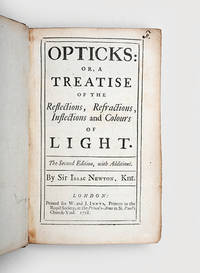
NEWTON, Isaac
Opticks: or a Treatise of the Reflections Refractions Inflections and Colours of Light.
London: printed for W. and J. Innys 1718. His most important work on light with significant revisions Second edition second issue as usual of this seminal study which "did for light what Newton's Principia had done for gravitation namely place it on a scientific basis" Babson. Newton arrived at most of his innovative ideas on colour by about 1668 and Opticks was largely complete by 1692. However when he first expressed his theories in public they provoked hostile criticism. As a result Newton delayed publication until his most vocal critics - especially Robert Hooke - were dead. By the mid-1710s Opticks was established in Britain as the model for blending theoretical speculation and quantitative experimentation. Newton's aim was not to "explain the properties of light by hypotheses but to propose and prove them by reason and experiments" p. 1. The work's greatest achievement is showing that colour is a mathematically definable property. Newton demonstrates that white light is a mixture of infinitely varied coloured rays and that each ray is definable by the angle through which it is refracted. Other topics include colour circles theories of the rainbow and the phenomenon now known as Newton's rings. The textual revisions for this edition demonstrate the development of Newton's experimentation process. The first edition was published in 1704 followed by the Latin translation of 1706. This edition was the first in octavo format. It had a print run of 750 copies and within that two issues. The scarce first issue is dated 1717 on the title page and includes William Bowyer's name in the imprint; copies are recorded both with and without the cancel A2. The second issue as here has a cancel title dated 1718 and only the names of W. and J. Innys Printers to the Royal Society in the imprint; A2 the first two pages of the "Advertisement" is set as the cancel. Octavo 194 x 123 mm pp. viii 382 2 publisher's advertisement. With 12 folding engraved plates woodcut diagram on p. 330 tables in text woodcut head- and tailpieces and initials. Contemporary panelled calf spine with raised bands and early paper label edges sprinkled red. Ownership label of chemist Karol J. Mysels 1914-1998 laid in; occasional tiny marginal notations in contemporary ink to title page and p. 371 and in later pencil to pp. 323 and 328. Extremities restored spine label chipped and browned boards a little splayed contents toned and generally clean: a very good copy in an attractive period binding. Babson 134; ESTC T18663; Gray 176. hardcover
Bookseller reference : 184239
|
|
|
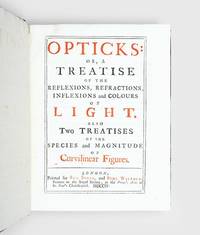
NEWTON, Isaac
Opticks: Or A Treatise of the Reflexions Refractions Inflexions and Colours of Light.
London: Printed for Sam Smith and Benj. Walford 1704. From the family library of a founding member of the Royal Society First edition first issue an exceptionally fresh and unrestored example. This copy comes from the family library of John Evelyn a fellow of the Royal Society alongside Newton for more than 30 years and the author of its first published book. As with many books from the Evelyn family library this copy bears an ink pressmark on the front pastedown in an early 18th-century hand. Evelyn was generally fastidious about annotating the books he acquired and this pressmark bears calligraphic similarities to one found in his copy of Taylor's Symbolon 1674 which he also annotated with his signature and motto. This copy remained in the Evelyn family library until the late 20th century: it entered the private market during the 1977-78 Christie's sales. Evelyn and Newton are among the most famous fellows of the early Royal Society. By 1704 the 84-year-old Evelyn had moved from Deptford to his ancestral home at Wotton in Surrey although his work as a treasurer for the new Greenwich Hospital brought him regularly back to London. A younger generation was now in charge of the Society's direction: in 1703 Newton assumed the presidency and gradually reshaped its work in line with Newtonian science. Evelyn continued to contribute to the Royal Society's intellectual life on his terms well into his 80s: in 1702 he published a paper in the Philosophical Transactions discussing his anatomical tables and he later attended two of the experimental sessions held under Newton's presidency. This first issue of the Opticks lacks Newton's name on the title page. Quarto 241 x 186 mm pp. iv 114 211 = 213 two blank pages left unnumbered. With 19 folding engraved plates tables and diagrams in text title page lettered in red and black. Contemporary panelled calf spine ruled in blind red morocco label to style edges sprinkled red. With custom cloth box. Late 18th-century engraved armorial bookplate of Frederick Evelyn 1734-1812 along with the Christie's sale bookplate. Light rubbing calf smooth and bright slight loss to head of spine and tiny wormhole to foot damp staining to upper margin of several leaves and plates a couple of tiny ink splashes contents otherwise generally crisp: a fresh copy. This copy: lot 1078 The Evelyn Library Part III: M-S Christie's March 1978 p. 62. Babson 132 1; Dibner Heralds of Science 148; ESTC T82019; Gray 174; Grolier/Horblit 79b; Norman 1588; Printing and the Mind of Man 172; Wallis 174. hardcover
Bookseller reference : 189050
|
|
|
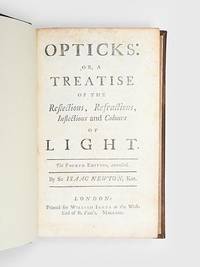
NEWTON, Isaac
Opticks: or a Treatise of the Reflections Refractions Inflections and Colours of Light.
London: Printed for William Innys 1730. The definitive edition of Newton's second great work Fourth edition the final edition to be revised and approved by Newton himself. The Opticks is Newton's definitive study of light the basis for the corpuscular theory of light rays that remained dominant into the 19th century. The Opticks's greatest achievement is showing that colour is a mathematically definable property. Newton demonstrates that white light is a mixture of infinitely varied coloured rays and that each ray is definable by the angle through which it is refracted. Other topics include colour circles theories of the rainbow and the phenomenon now known as Newton's rings. In his later years Newton made a sustained effort to tidy up his scientific legacy. This edition of the Opticks was published three years after his death by his long-time publisher drawing on corrections "by the Author's own Hand" preface. In those three years Newtonian devotees had published the Optical Lectures 1728 that he had delivered at Cambridge in the 1660s making public a work that he had only circulated in manuscript among close friends. The Lectures employed a more mathematical analysis of colour theory than did the Opticks and Innys' fourth edition harmonizes the two works by cross-referencing philosophical propositions in the latter with geometrical demonstrations in the former. Octavo 195 x 123 mm pp. viii 382 2. Complete with terminal advertisement leaf and 12 folding plates. Wood-engraved initials head- and tailpieces. Twentieth-century calf spine ruled and decorated in blind and with red morocco label marbled endpapers edges sprinkled red. Minimal foxing to contents paper flaw to lower outer corner of K1 text unaffected plates crisp: a very good copy indeed. Babson 136; ESTC T69138; Gray 178; Wallis 178. unknown
Bookseller reference : 187897
|
|
|
Newton, Isaac
Opticks: Or a Treatise of the Reflexions Refractions Inflexions and Colours of Light. Also two Treatises of the Species and Magnitude of Curvilinear Figures
hardcover. Good. Access codes and supplements are not guaranteed with used items. May be an ex-library book. hardcover
Bookseller reference : 1379569958.G ISBN : 1379569958 9781379569954
|
|
|
Newton, Isaac
Opticks: Or a Treatise of the Reflections Refractions Inflections and Colours of Light. The Fourth Edition Corrected. By Sir Isaac Newton Knt
hardcover. Good. Access codes and supplements are not guaranteed with used items. May be an ex-library book. hardcover
Bookseller reference : 1379728347.G ISBN : 1379728347 9781379728344
|
|
|
Newton, Isaac
Opticks: Or a Treatise of the Reflections Refractions Inflections and Colours of Light. By Sir Isaac Newton . The Third Edition Corrected
hardcover. Good. Access codes and supplements are not guaranteed with used items. May be an ex-library book. hardcover
Bookseller reference : 137985878X.G ISBN : 137985878X 9781379858782
|
|
|
Newton, Isaac
Opticks: or A Treatise of the Reflections Refractions Inflections and Colours of Light: 1730
hardcover. Good. Access codes and supplements are not guaranteed with used items. May be an ex-library book. hardcover
Bookseller reference : 1015661904.G ISBN : 1015661904 9781015661905
|
|
|
Newton, Isaac
Opticks: Or a Treatise of the Reflections Refractions Inflections and Colours of Light. The Second Edition With Additions. By Sir Isaac Newton Knt
hardcover. Good. Access codes and supplements are not guaranteed with used items. May be an ex-library book. hardcover
Bookseller reference : 1379728339.G ISBN : 1379728339 9781379728337
|
|
|
NEWTON, Isaac
Opticks: or a Treatise of the Reflections Refractions Inflections and Colours of Light
Twelve folding engraved plates. 4 p.l. 382 pp. one leaf of ads. 8vo cont. calf small portions of ends of spine & one corner carefully repaired spine gilt red morocco lettering piece on spine. London: W. Innys 1730.<br/> <br/> Fourth edition and the final edition to be revised by Newton of this great classic. It contains the complete set of 31 Queries which reveal some of Newton’s most influential and speculative writing. Fine crisp copy. Contemporary armorial bookplate of Edward Powell. <br/> <br/> ⧠Babson 136. unknown
Bookseller reference : 1220

|
|
|
Newton, Isaac Sir, 1642-1727
Opticks; Or a Treatise of the Reflections Inflections and Colours of Light; Volume 1718
Wentworth Press 2016. Hardcover. New. Wentworth Press hardcover
Bookseller reference : Atlantic-9781372405228 ISBN : 1372405224 9781372405228
|
|
|
Newton, Isaac Sir, 1642-1727
Opticks; Or a Treatise of the Reflections Inflections and Colours of Light; Volume 1718
Wentworth Press 2016. Hardcover. New. Wentworth Press hardcover
Bookseller reference : Atlantic-9781372405228 ISBN : 1372405224 9781372405228
|
|
|
Newton, Isaac (Verf); Abendroth, William (Hrsg)
Optik oder Abhandlung über Spiegelungen Brechungen Beugungen und Farben des Lichts. 1704. I. Buch & II. und III. Buch. Zusammen in 2 Bänden =komplett. Übersetzt u. hrsg. von William Abendroth. Mit zusammen 58 Textabbildungen.
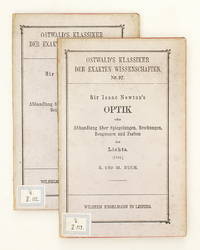
Wilhelm Engelmann Leipzig 1898. Kl.-Oktav 190 x 120 mm Org.-Pappband 132; 156 S. moit einem Portraitfrontispiece in erstem Band umseitig farbiger Schnitt sehr leichte Gebrauchspuren aber insgesamt gut erhalten. Ostwald's Klassiker der exakten Wissenschaften; 96 97. - First German edition / Erste deutsche Ausgabe. - Inhalt / content: Vorwort zur ersten Auflage - Vorwort zur zweiten Auflage - Das erste Buch der Optik: Erster Theil: Definitionen - Axiome - Propositionen I-VIII - Zweiter Theil: Prop. I-XI - Anmerkungen. Das zweite Buch der Optik: Erster Theil: Beobachtungen über Reflexionen Brechungen und Farben dünner durchsichtiger Körper - Zweiter Theil: Bemerkungen zu den vorhergehenden Beobachtungen - Dritter Theil: Ueber die dauernden Farben der natürlichen Körper und die Analogie zwischen ihnen und den Farben dünner durchsichtiger Blättchen Prop. I-XX - Vierter Theil: Beobachtungen über Reflexionen und Farben dicker durchsichtiger geschliffener Platten - Das dritte Buch der Optik: Beobachtungen über Beugungen der Lichtstrahlen und die dadurch entstehenden Farben - Anmerkungen zum II. und III. Buche - Berichtigung zu Heft 96. - 604 SOD Ostwald's Klassiker der exakten Wissenschaften; 96 97. - First German edition / Erste deutsche Ausgabe. - Inhalt / content: Vorwort zur ersten Auflage - Vorwort zur zweiten Auflage - Das erste Buch der Optik: Erster Theil: Definitionen - Axiome - Propositionen I-VIII - Zweiter Theil: Prop. I-XI - Anmerkungen. Das zweite Buch der Optik: Erster Theil: Beobachtungen über Reflexionen Brechungen und Farben dünner durchsichtiger Körper - Zweiter Theil: Bemerkungen zu den vorhergehenden Beobachtungen - Dritter Theil: Ueber die dauernden Farben der natürlichen Körper und die Analogie zwischen ihnen und den Farben dünner durchsichtiger Blättchen Prop. I-XX - Vierter Theil: Beobachtungen über Reflexionen und Farben dicker durchsichtiger geschliffener Platten - Das dritte Buch der Optik: Beobachtungen über Beugungen der Lichtstrahlen und die dadurch entstehenden Farben - Anmerkungen zum II. und III. Buche - Berichtigung zu Heft 96. - 604 SOD Wilhelm Engelmann, Leipzig, 1898. unknown
Bookseller reference : 000282
|
|
|
Newton, Isaac
Optik: oder Abhandlung über Spiegelungen Brechungen Beugungen und Farben des Lichts German Edition
hardcover. Good. Access codes and supplements are not guaranteed with used items. May be an ex-library book. hardcover
Bookseller reference : 3528085061.G ISBN : 3528085061 9783528085063
|
|
|
Newton, Isaac
Optik: oder Abhandlung über Spiegelungen Brechungen Beugungen und Farben des Lichts Edition Vieweg 1 German Edition
paperback. Good. Access codes and supplements are not guaranteed with used items. May be an ex-library book. paperback
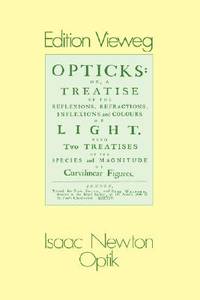
Bookseller reference : 3540415319.G ISBN : 3540415319 9783540415312
|
|
|
Newton, Isaac
Optique de Newton. Tome 1 Éd.1787 Sciences French Edition
paperback. Good. Access codes and supplements are not guaranteed with used items. May be an ex-library book. paperback
Bookseller reference : 2012597718.G ISBN : 2012597718 9782012597716
|
|
|
Newton, Isaac
Optique De Newton Traduction Nouvelle Faite par Marat Sur La Dern. Édit. Originale. Dédiée Au Roi Par M. Beauzée . French Edition
hardcover. Good. Access codes and supplements are not guaranteed with used items. May be an ex-library book. hardcover
Bookseller reference : 0341108200.G ISBN : 0341108200 9780341108207
|
|
|
Newton, Isaac
Osoule Riazie Falsafeye Tabiee
Nashreney 2016. Paperback. New. 690 pages. Persian Farsi language. 9.61x6.69x1.73 inches. Nashreney paperback
Bookseller reference : 2-9641854526 ISBN : 9641854526 9789641854524
|
|
|
Newton, Isaac
Philosophiæ Naturalis Principia Mathematica Vol. 4 Classic Reprint Latin Edition
paperback. Good. Access codes and supplements are not guaranteed with used items. May be an ex-library book. paperback
Bookseller reference : 139011788X.G ISBN : 139011788X 9781390117882
|
|
|
Newton, Isaac
Philosophiæ Naturalis Principia Mathematica Vol. 1 Classic Reprint Latin Edition
paperback. Good. Access codes and supplements are not guaranteed with used items. May be an ex-library book. paperback
Bookseller reference : 0332016412.G ISBN : 0332016412 9780332016412
|
|
|
Newton, Isaac
Philosophiæ Naturalis Principia Mathematica Vol. 2 Classic Reprint Latin Edition
hardcover. Good. Access codes and supplements are not guaranteed with used items. May be an ex-library book. hardcover
Bookseller reference : 0428727808.G ISBN : 0428727808 9780428727802
|
|
|
Newton, Isaac
Philosophiæ Naturalis Principia Mathematica Vol. 2 Classic Reprint Latin Edition
paperback. Good. Access codes and supplements are not guaranteed with used items. May be an ex-library book. paperback
Bookseller reference : 0428167101.G ISBN : 0428167101 9780428167103
|
|
|
Newton, Isaac,
Philosophiæ Naturalis Principia Mathematica Revision IV - Volume IIi
new. unknown
Bookseller reference : 34858638-n ISBN : 172518348x 9781725183483
|
|
|
Newton, Isaac,
Philosophiæ Naturalis Principia Mathematica Revision IV - Volume IIi
like new. unknown
Bookseller reference : 34858638 ISBN : 172518348x 9781725183483
|
|
|
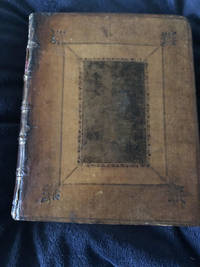
NEWTON, Isaac
Philosophiae Naturalis Principia Mathematica
<p>RARE 1726 THIRD EDITION OF NEWTON'S PRINCIPIA THE LAST EDITION PUBLISHED IN HIS LIFETIME EDITED BY NEWTON HIMSELF THE BASIS FOR ALL SUBSEQUENT EDITIONS. ONE OF ONLY 1250 COPIES PRINTED. AT 300 FAR FEWER REMAIN! London: Guil. & Joh. Innys Regiae Societatis typographos 1726. Quarto 240 x 192 mm. Lauded by Albert Einstein as "perhaps the greatest intellectual stride that has ever been granted to any man to make" Newton's Principia is arguably the most influential book in history. Grounded on the premise that virtually everything in the universe is amenable to scientific understanding this transformative milestone abounding with interdisciplinary impact "is generally described as the greatest work in the history of science. Copernicus Galileo and Kepler had certainly shown the way; but where they described the phenomena they observed Newton explained the underlying universal laws. The Principia provided the greatest synthesis of the cosmos proving finally its physical unity. Newton showed that the important and dramatic aspects of nature that were subject to the universal law of gravitation could be explained in mathematical terms with a single physical theory. With him the separation of the natural and supernatural of sublunar and superlunar worlds disappeared. The same laws of gravitation and motion rule everywhere; for the first time a single mathematical law could explain the motion of objects on earth as well as the phenomena of the heavens. The whole cosmos is composed of inter-connecting parts influencing each other according to these laws. It was this grand conception that produced a general revolution in human thought equaled perhaps only by that following Darwin's Origin of Species… Newton is generally regarded as one of the greatest mathematicians of all time and the founder of mathematical physics. It was the final irrevocable break with a medieval conception based on Greek and Roman cosmology and a scholastic system derived from the medieval interpretation of Aristotle. Newton's universe almost independent of the spiritual order ushered in the age of rationalism scientific determinism and the acceptance of a mechanistic view of nature" PMM 161. Dissatisfied with the first two editions of his own masterpiece London 1687; Amsterdam 1723 Newton towards the end of his life "gave one last effort to the Principia. It is clear that he regarded the Principia rather than the Opticks as his masterwork. He worked over the Principia without end to hone its language to a perfect expression of his ideas… . Perhaps a serious illness in 1722 reminded him that he could not delay forever. We know only that the printing of an edition more sumptuous than either of the others began in the fall of 1723." Westfall The Life of Isaac Newton. With portrait engraving by Vertue bound before first text leaf and numerous illustrations in text. Complete with the privilege leaf half-title dedication leaf index and ad leaf. 240 x 192 mm. 18th-century paneled calf gilt-lettered spine rebacked hinges cracked but holding. Frontispiece caption trimmed with some loss to artists' signatures minor foxing and toning but a very good crisp copy. Engraved armorial bookplate of the Earl of Hopetoun. Third edition revised and expanded edited by Henry Pemberton M.D. F.R.S. contains a new preface by Newton and many alterations and clarifications the scholium on fluxions chief among them. Sir Isaac Newton died on March 31 1727 at the age of 84 one year after his treasured edition was published. This Third Edition of his Principia is the final definitive statement of the man who invented calculus determined the composition of light and discovered the laws of gravity and motion which govern the universe the founder of modern science Sir Isaac Newton. Book #vBC4008. $26000. We specialize in rare Ayn Rand and other legends and landmarks.</p> Guil. & Joh. Innys hardcover
Bookseller reference : vBC4008
|
|
|
Newton, Isaac,
Philosophiae Naturalis Principia Mathematica
like new. unknown
Bookseller reference : 45482248 ISBN : 1017391882 9781017391886
|
|
|
Newton, Isaac, 1642-1727
PHILOSOPHIAE NATURALIS PRINCIPIA MATHEMATICA
Bruxelles: Culture et Civilisation 1965. Impression anastaltique. Hardcover. Quarto 510 pages. In Very Good condition. Spine is brown tan with gold print on red banners. Boards in tan cloth. Illustrated: b&w diagrams one folded plate. Facsimile of edition published by Jussu Societatis Regiæ ac Typis Josephi Streater. Prostat apud plures Bibliopolas London 1686. Text in Latin. <br /> <br /> Oversized books. Additional postage necessary for expedited/international orders. Economy International shipping unavailable due to size/weight restrictions. For international/expedited customers please inquire for rates.<br /> <br /> <p>NOTE: Shelved in Netdesk office Case #1. 1404286. FP New Rockville Stock. Culture et Civilisation hardcover
Bookseller reference : 1404286
|
|
|
Newton, Isaac,
Philosophiae Naturalis Principia Mathematica
like new. unknown
Bookseller reference : 45383840 ISBN : 1015587607 9781015587601
|
|

 Receive by email
 Download as PDF document
 RSS feed
 Permanent link


