|
|
|
UNZER TSAYT. SOTSYALISTISHE HOYDESH-SHRIFT. [UNZER CAJT] Vol I (1927), Nrs. 3 & 4.
Varshe [Warsaw]: Farlag "di Velt", 1928. Paper Wrappers, 8vo, 95 pages. Monthly Bundist periodical ran from Vol. I, Nr, 1 (Oct. 1927) to 1932. 23 cm. In Yiddish. Unobtrusive Bund rubber stamp on some volumes. For example, Levin (1977) reports that it was in UNZER TSAYT that the very first reports of the Bund's split over the National Question with the Russian Social Democrats were published (in 1927). The Bund in Poland, here providing its unique Polish Jewish Socialist anti-Zionist perspective. The General Jewish Labour Bund in Lithuania, Poland and Russia (Yiddish: algemeyner yidisher arbeter-bund in lite, poyln un rusland), generally called The Bund or the Jewish Labour Bund, was a secular Jewish socialist party.... founded in Vilnius on October 7, 1897
..In 1917 the Polish part of the Bund, which dated to the times when Poland was a Russian territory, seceded from the Russian Bund and created a new Polish General Labor Bund which continued to operate in Poland in the years between the two world wars
.The Bund sought to unite all Jewish workers in the Russian Empire into a united socialist party, and also to ally itself with the wider Russian social democratic movement to achieve a democratic and socialist Russia. The Russian Empire then included Lithuania, Latvia, Belarus, Ukraine and most of present-day Poland, areas where the majority of the world's Jews then lived. They hoped to see the Jews achieve a legal minority status in Russia. Of all Jewish political parties of the time, the Bund was the most progressive regarding gender equality, with women making up more than one-third of all members. The Bund actively campaigned against anti-Semitism. It defended Jewish civil and cultural rights and rejected assimilation. However, the close promotion of Jewish sectional interests and support for the concept of Jewish national unity (klal yisrael) was prevented by the socialist universalism of the Bund. The Bund avoided any automatic solidarity with Jews of the middle and upper classes and generally rejected political cooperation with Jewish groups that held religious, Zionist or conservative views. Even the anthem of the Bund, known as "the oath" (di shvue in Yiddish), written in 1902 by Sh. An-ski, contained no explicit reference to Jews or Jewish suffering. At the heart of the vision of the future of the Bund was the idea that there is no contradiction between the national aspect on the one hand and the socialist aspect on the other. As a strictly secular organization, the Bund renounced the Holy Land and the sacred language (Hebrew) and chose to speak Yiddish
.In its early years the Bund had remarkable success, gaining an estimated 30,000 members in 1903 and an estimated 40,000 supporters in 1906, making it the largest socialist group in the Russian Empire
. the Bund was a founding collective member at the RSDLP's first congress in Minsk in March 1898. For the next 5 years, the Bund was recognized as the sole representative of the Jewish workers in the RSDLP, although many Russian socialists of Jewish descent, especially outside of the Pale of Settlement, joined the RSDLP directly
.The Bund generally sided with the party's Menshevik faction led by Julius Martov and against the Bolshevik faction led by Vladimir Lenin during the factional struggles in the run-up to the Russian Revolution of 1917
.In the Polish areas of the [Russian] empire, the Bund was a leading force in the 1905 revolution. At that time the organization probably reached the height of its influence. It called for an improvement in living standards, a more democratic political system and the introduction of equal rights for Jews. At least in the early stages of the first Russian Revolution, the armed groups of the "Bund" were likely the strongest revolutionary force in Western Russia. During the following years, the Bund went into a period of decay
.The Bund eventually came to strongly oppose Zionism, arguing that emigration to Palestine was a form of escapism. The Bund did not advocate separatism. Instead, it focused on culture, rather than a state or a place, as the glue of Jewish nationalism.
. The Bund also promoted the use of Yiddish as a Jewish national language and to some extent opposed the Zionist project of reviving Hebrew. The Bund won converts mainly among Jewish artisans and workers, but also among the growing Jewish intelligentsia. It led a trade union movement of its own. It joined with the Poalei Zion (Labour Zionists) and other groups to form self-defense organisations to protect Jewish communities against pogroms and government troops. During the Russian Revolution of 1905 the Bund headed the revolutionary movement in the Jewish towns, particularly in Belarus and Ukraine
..In 1921, the Communist Bund [in the USSR] dissolved itself and its members sought admission to the Communist Party....Many former Bundists, like Mikhail Liber and David Petrovsky, perished during Stalin's purges in the 1930s. The Polish Bundists continued their activities until 1948. During the latter half of the 20th century the Bundist legacy was represented through the International Jewish Labor Bund, a federation of local Bundist groups around the world
.Among the exiled Bundists who went on with Socialist politics in America was Baruch Charney Vladeck (18861938), elected to the New York Board of Aldermen as a Socialist in 1917
[and] 1937 [and] manager of The Jewish Daily Forward
Moishe Lewis (18881950)....the father of David Lewis (19091981), a leader of the New Democratic Party in Canada
.David Dubinsky (18921982), though never formally a member of the party, had joined the bakers' union, which was controlled by the Bund, and was elected assistant secretary within the union by 1906
..He later became a member of the Socialist Party of America, helped found the American Labor Party in 1936 and was from 1932 till 1966 the leader of the International Ladies' Garment Workers' Union
..under the name Max Goldfarb, David Petrovsky (18861937) was a member of the Central Committee of the Jewish Socialist Federation of America, a member of the Socialist Party of America, and the labor editor of The Forward (Wikipedia). SUBJECT(S) : Jews -- Poland -- Periodicals. Jewish labor unions -- Periodicals. Socialism and Judaism -- Periodicals. Yiddish literature -- Poland -- Periodicals. OCLC Number: 642969688. OCLC lists only 4 runs (Arizona State, Stanford, LOC, U of Washington), all of which appear to be incomplete. Nr. 3-4 was printed as Nr. 3 (Dec. 15, 1927), but then has Nr. 4 (Dec. 20, 1927) on a superimposed lable--not sure if Nr. 3 actually existed or in what form. Interestingly, evey copy of this issue that we have ever seen has had pages 1-6 removed, perhaps by the publisher and related to the re-issuing as a later number. We offer pages 1-6 here in facimile. Good Condition. (Y-1-10) xx
|
|
|
UNZER TSAYT. SOTSYALISTISHE HOYDESH-SHRIFT. [UNZER CAJT] 1928, Nrs. 2, 3/4, 5, 8/9, 10
Original Paper Wrappers, 8vo, ca. 100 pages. Monthly Bundist periodical ran from Vol. I, Nr, 1 (Oct. 1927) to 1932. 23 cm. In Yiddish. Unobtrusive Bund rubber stamp. Levin (1977) reports that it was in UNZER TSAYT that the very first reports of the Bund's split over the National Question with the Russian Social Democrats were published (in 1927). The Bund in Poland, here providing its unique Polish Jewish Socialist anti-Zionist perspective. The General Jewish Labour Bund in Lithuania, Poland and Russia (Yiddish: algemeyner yidisher arbeter-bund in lite, poyln un rusland), generally called The Bund or the Jewish Labour Bund, was a secular Jewish socialist party.... founded in Vilnius on October 7, 1897
..In 1917 the Polish part of the Bund, which dated to the times when Poland was a Russian territory, seceded from the Russian Bund and created a new Polish General Labor Bund which continued to operate in Poland in the years between the two world wars
.The Bund sought to unite all Jewish workers in the Russian Empire into a united socialist party, and also to ally itself with the wider Russian social democratic movement to achieve a democratic and socialist Russia. The Russian Empire then included Lithuania, Latvia, Belarus, Ukraine and most of present-day Poland, areas where the majority of the world's Jews then lived. They hoped to see the Jews achieve a legal minority status in Russia. Of all Jewish political parties of the time, the Bund was the most progressive regarding gender equality, with women making up more than one-third of all members. The Bund actively campaigned against anti-Semitism. It defended Jewish civil and cultural rights and rejected assimilation. However, the close promotion of Jewish sectional interests and support for the concept of Jewish national unity (klal yisrael) was prevented by the socialist universalism of the Bund. The Bund avoided any automatic solidarity with Jews of the middle and upper classes and generally rejected political cooperation with Jewish groups that held religious, Zionist or conservative views. Even the anthem of the Bund, known as "the oath" (di shvue in Yiddish), written in 1902 by Sh. An-ski, contained no explicit reference to Jews or Jewish suffering. At the heart of the vision of the future of the Bund was the idea that there is no contradiction between the national aspect on the one hand and the socialist aspect on the other. As a strictly secular organization, the Bund renounced the Holy Land and the sacred language (Hebrew) and chose to speak Yiddish
.In its early years the Bund had remarkable success, gaining an estimated 30,000 members in 1903 and an estimated 40,000 supporters in 1906, making it the largest socialist group in the Russian Empire
. the Bund was a founding collective member at the RSDLP's first congress in Minsk in March 1898. For the next 5 years, the Bund was recognized as the sole representative of the Jewish workers in the RSDLP, although many Russian socialists of Jewish descent, especially outside of the Pale of Settlement, joined the RSDLP directly
.The Bund generally sided with the party's Menshevik faction led by Julius Martov and against the Bolshevik faction led by Vladimir Lenin during the factional struggles in the run-up to the Russian Revolution of 1917
.In the Polish areas of the [Russian] empire, the Bund was a leading force in the 1905 revolution. At that time the organization probably reached the height of its influence. It called for an improvement in living standards, a more democratic political system and the introduction of equal rights for Jews. At least in the early stages of the first Russian Revolution, the armed groups of the "Bund" were likely the strongest revolutionary force in Western Russia. During the following years, the Bund went into a period of decay
.The Bund eventually came to strongly oppose Zionism, arguing that emigration to Palestine was a form of escapism. The Bund did not advocate separatism. Instead, it focused on culture, rather than a state or a place, as the glue of Jewish nationalism.
. The Bund also promoted the use of Yiddish as a Jewish national language and to some extent opposed the Zionist project of reviving Hebrew. The Bund won converts mainly among Jewish artisans and workers, but also among the growing Jewish intelligentsia. It led a trade union movement of its own. It joined with the Poalei Zion (Labour Zionists) and other groups to form self-defense organisations to protect Jewish communities against pogroms and government troops. During the Russian Revolution of 1905 the Bund headed the revolutionary movement in the Jewish towns, particularly in Belarus and Ukraine
..In 1921, the Communist Bund [in the USSR] dissolved itself and its members sought admission to the Communist Party....Many former Bundists, like Mikhail Liber and David Petrovsky, perished during Stalin's purges in the 1930s. The Polish Bundists continued their activities until 1948. During the latter half of the 20th century the Bundist legacy was represented through the International Jewish Labor Bund, a federation of local Bundist groups around the world
.Among the exiled Bundists who went on with Socialist politics in America was Baruch Charney Vladeck (18861938), elected to the New York Board of Aldermen as a Socialist in 1917
[and] 1937 [and] manager of The Jewish Daily Forward
Moishe Lewis (18881950)....the father of David Lewis (19091981), a leader of the New Democratic Party in Canada
.David Dubinsky (18921982), though never formally a member of the party, had joined the bakers' union, which was controlled by the Bund, and was elected assistant secretary within the union by 1906
..He later became a member of the Socialist Party of America, helped found the American Labor Party in 1936 and was from 1932 till 1966 the leader of the International Ladies' Garment Workers' Union
..under the name Max Goldfarb, David Petrovsky (18861937) was a member of the Central Committee of the Jewish Socialist Federation of America, a member of the Socialist Party of America, and the labor editor of The Forward (Wikipedia). SUBJECT(S) : Jews -- Poland -- Periodicals. Jewish labor unions -- Periodicals. Socialism and Judaism -- Periodicals. Yiddish literature -- Poland -- Periodicals. OCLC Number: 642969688. OCLC lists only 4 runs (Arizona State, Stanford, LOC, U of Washington), all of which appear to be incomplete. Use wear, paper brwoning but not fragile. Good Condition. (y-1-11)
|
|
|
UNZER TSAYT. SOTSYALISTISHE HOYDESH-SHRIFT. [UNZER CAJT] 1929, NRS. 1/2, 3, 4/5 (COMPLETE THIS VOLUME)
Original Paper Wrappers, 8vo, ca. 100 pages. Monthly Bundist periodical ran from Vol. I, Nr, 1 (Oct. 1927) to 1932. 23 cm. In Yiddish. Unobtrusive Bund rubber stamp. Levin (1977) reports that it was in UNZER TSAYT that the very first reports of the Bund's split over the National Question with the Russian Social Democrats were published (in 1927). The Bund in Poland, here providing its unique Polish Jewish Socialist anti-Zionist perspective. The General Jewish Labour Bund in Lithuania, Poland and Russia (Yiddish: algemeyner yidisher arbeter-bund in lite, poyln un rusland), generally called The Bund or the Jewish Labour Bund, was a secular Jewish socialist party.... founded in Vilnius on October 7, 1897
..In 1917 the Polish part of the Bund, which dated to the times when Poland was a Russian territory, seceded from the Russian Bund and created a new Polish General Labor Bund which continued to operate in Poland in the years between the two world wars
.The Bund sought to unite all Jewish workers in the Russian Empire into a united socialist party, and also to ally itself with the wider Russian social democratic movement to achieve a democratic and socialist Russia. The Russian Empire then included Lithuania, Latvia, Belarus, Ukraine and most of present-day Poland, areas where the majority of the world's Jews then lived. They hoped to see the Jews achieve a legal minority status in Russia. Of all Jewish political parties of the time, the Bund was the most progressive regarding gender equality, with women making up more than one-third of all members. The Bund actively campaigned against anti-Semitism. It defended Jewish civil and cultural rights and rejected assimilation. However, the close promotion of Jewish sectional interests and support for the concept of Jewish national unity (klal yisrael) was prevented by the socialist universalism of the Bund. The Bund avoided any automatic solidarity with Jews of the middle and upper classes and generally rejected political cooperation with Jewish groups that held religious, Zionist or conservative views. Even the anthem of the Bund, known as "the oath" (di shvue in Yiddish), written in 1902 by Sh. An-ski, contained no explicit reference to Jews or Jewish suffering. At the heart of the vision of the future of the Bund was the idea that there is no contradiction between the national aspect on the one hand and the socialist aspect on the other. As a strictly secular organization, the Bund renounced the Holy Land and the sacred language (Hebrew) and chose to speak Yiddish
.In its early years the Bund had remarkable success, gaining an estimated 30,000 members in 1903 and an estimated 40,000 supporters in 1906, making it the largest socialist group in the Russian Empire
. the Bund was a founding collective member at the RSDLP's first congress in Minsk in March 1898. For the next 5 years, the Bund was recognized as the sole representative of the Jewish workers in the RSDLP, although many Russian socialists of Jewish descent, especially outside of the Pale of Settlement, joined the RSDLP directly
.The Bund generally sided with the party's Menshevik faction led by Julius Martov and against the Bolshevik faction led by Vladimir Lenin during the factional struggles in the run-up to the Russian Revolution of 1917
.In the Polish areas of the [Russian] empire, the Bund was a leading force in the 1905 revolution. At that time the organization probably reached the height of its influence. It called for an improvement in living standards, a more democratic political system and the introduction of equal rights for Jews. At least in the early stages of the first Russian Revolution, the armed groups of the "Bund" were likely the strongest revolutionary force in Western Russia. During the following years, the Bund went into a period of decay
.The Bund eventually came to strongly oppose Zionism, arguing that emigration to Palestine was a form of escapism. The Bund did not advocate separatism. Instead, it focused on culture, rather than a state or a place, as the glue of Jewish nationalism.
. The Bund also promoted the use of Yiddish as a Jewish national language and to some extent opposed the Zionist project of reviving Hebrew. The Bund won converts mainly among Jewish artisans and workers, but also among the growing Jewish intelligentsia. It led a trade union movement of its own. It joined with the Poalei Zion (Labour Zionists) and other groups to form self-defense organisations to protect Jewish communities against pogroms and government troops. During the Russian Revolution of 1905 the Bund headed the revolutionary movement in the Jewish towns, particularly in Belarus and Ukraine
..In 1921, the Communist Bund [in the USSR] dissolved itself and its members sought admission to the Communist Party....Many former Bundists, like Mikhail Liber and David Petrovsky, perished during Stalin's purges in the 1930s. The Polish Bundists continued their activities until 1948. During the latter half of the 20th century the Bundist legacy was represented through the International Jewish Labor Bund, a federation of local Bundist groups around the world
.Among the exiled Bundists who went on with Socialist politics in America was Baruch Charney Vladeck (18861938), elected to the New York Board of Aldermen as a Socialist in 1917
[and] 1937 [and] manager of The Jewish Daily Forward
Moishe Lewis (18881950)....the father of David Lewis (19091981), a leader of the New Democratic Party in Canada
.David Dubinsky (18921982), though never formally a member of the party, had joined the bakers' union, which was controlled by the Bund, and was elected assistant secretary within the union by 1906
..He later became a member of the Socialist Party of America, helped found the American Labor Party in 1936 and was from 1932 till 1966 the leader of the International Ladies' Garment Workers' Union
..under the name Max Goldfarb, David Petrovsky (18861937) was a member of the Central Committee of the Jewish Socialist Federation of America, a member of the Socialist Party of America, and the labor editor of The Forward (Wikipedia). SUBJECT(S) : Jews -- Poland -- Periodicals. Jewish labor unions -- Periodicals. Socialism and Judaism -- Periodicals. Yiddish literature -- Poland -- Periodicals. OCLC Number: 642969688. OCLC lists only runs (Arizona State, Stanford, LOC, U of Washington), all of which appear to be incomplete. Very light wear, a beautiful set! Very Good Condition. (Y-1-12) xx
|
|
|
V PIELGRZYMKA 1997 W FOTOGRAFIACH I HOMILIACH. Z Czym Idziemy w Nowe Tysiaclecie.
(Codice RE/3779) Square octavo, 132 pp. First edition. Polish text, colour illustrations. Hardcover, fine. ~~~ SPEDIZIONE IN ITALIA SEMPRE TRACCIATA

|
|
|
VECCHIA E NUOVA PIANIFICAZIONE ECONOMICA IN POLONIA. Traduzione di Dario Tosi. A cura di Tosi Dario, Vitello Vincenzo.
In-8, brossura, sovracoperta, pp. 333. Volume della collana: Saggi di economia e scienze sociali n. 2. In buono stato (good copy).

|
|
|
Vicende della chiesa cattolica di amendue i riti nella Polonia e nella Russia da Caterina II sino a' giorni nostri di libri cinque preceduti da un rapido cenno sull'origine e suelle relazioni della chiesa russa con la santa sede sino a' tempi di Pietro il Grande per un sacerdote dell'oratorio. versione italiana.
Sc. G.
|
|
|
Vie économique du Royaume de Pologne. Royaume du Congrès de 1815. Ier volume, IIIe fascicule de l’Encyclopédie Polonaise, publiée par le Comité des publications encyclopédiques sur la Pologne.
Fribourg - Lausanne, Publications Encyclopédiques sur la Pologne 1917, 245x165mm, 210pages, broché. Bon état.
書籍販売業者の参照番号
: 57997

|
|
|
Vie économique de la Pologne prussienne. Ier volume, VIe fascicule de l’Encyclopédie Polonaise, publiée par le Comité des publications encyclopédiques sur la Pologne.
Fribourg - Lausanne, Publications Encyclopédiques sur la Pologne 1917, 245x165mm, XVI- 205pages, broché.
書籍販売業者の参照番号
: 57998

|
|
|
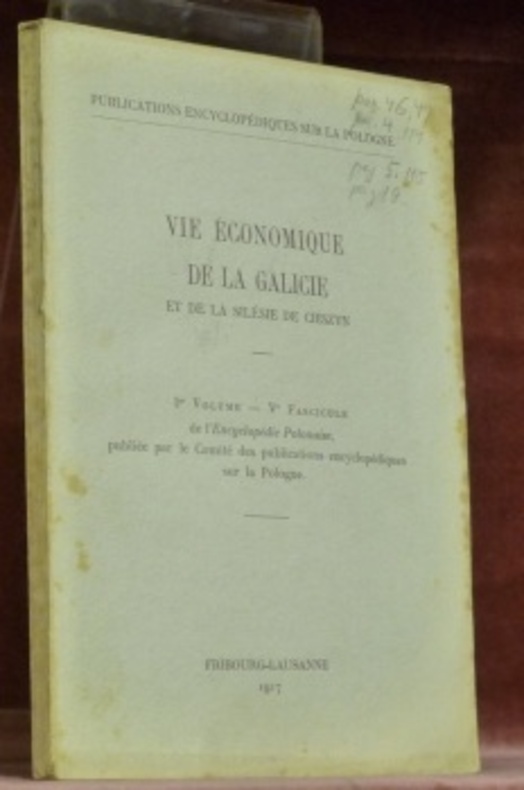
Vie économique de la Galicie et de la Silésie de Cieszyn. Ier volume, Ve fascicule de l’Encyclopédie Polonaise, publiée par le Comité des publications encyclopédiques sur la Pologne.
Fribourg - Lausanne, Publications Encyclopédiques sur la Pologne 1917, 245x165mm, 151pages, broché.
書籍販売業者の参照番号
: 57999
|
|
|
Vie (Le) d'Italia. Rivista mensile del Touring Club Italiano. Organo ufficiale dell'Ente Nazionale per le Industrie Turistiche. Anno XXXVI: NN. 1-12. (Segnaliamo: Nuova ferrovia da Civitavecchia a Orte; ferrovia in Val di Fiemme - Maschere e burattini a Bologna - Escursione del T.C.I. in Sardegna e Corsica - Sulle strade còrse - Navi romane nel lago di Nemi - Riforma dei trasporti collettivi a Roma - L'Istituto Naz. di Ottica in Arcetri - Sviluppi del Porto di Genova - La Val di Chiana e le sue acque - Il Palazzo Pretorio a Figline Val d'Arno - Bagni di Lucca - Val di Nievole - L'Accademia Navale di Livorno - Arte italiana in Polonia - L'Imperiale di Pesaro - Gli Ingegneri militari italiani all'estero - Come nasce un centro balneare - Bagnara di Calabria - Trieste nel fervore delle nuove opere - Vecchie città ed edifici nuovi - Genesi e sviluppo della bonifica in Italia - Una città scomparsa: Misa (presso Marzabotto) - La Triennale di Arti Decorative a Monza - L'Idroscalo di Milano - La nuova stazione viaggiatori di Milano - La bicicletta moderna - L'Isola di Lagosta, ecc.).
Milano, T.C.I., 1930, annata completa in 12 fasc., raccolti in volume unico, in-8, t. tela coeva, titolo e filettature oro al dorso, pp. 960 in numerazione continua + 616 (Vita del Touring - Notizie ed echi). Con numerose ill. in b.n. e pubblicità d'epoca.
|
|
|
Vie (Le) del Mondo. Rivista mensile della Consociazione Turistica Italiana. Anno V, N. 12. (PESTALOZZA C., Cina e Giappone - MASIA M., L'Arabia Saudiana - GOBBI BELCREDI A. M., Aspetti e risorse della Polonia - GILBERTI R., Italiani nel Brasile - WORMSTALL M., Le Colonie tedesche).
Milano, C.T.I., 1937, in-8, br., pp. XII, (125). Copertina e 4 tavv. a col., numerose ill. fotografiche in b.n., cartine e pubblicità.
|
|
|
Warschau - Land: Russland (= General-Karte von Mittel-Europa 1:200 000. 30. 39? 52?)
Wien, Kaiserlich-K?nigliches Milit?r-Geographisches Institut, 1914. Hochformat, ca. 34 x 55 cm, Ausgabe: mehrf?rbig; Zustand: gut +
書籍販売業者の参照番号
: A111-111

|
|
|
Warschau - Land: Russland (= General-Karte von Mittel-Europa 1:200 000. 30. 39? 52?)
Wien, Kaiserlich-K?nigliches Milit?r-Geographisches Institut, 1890. Hochformat, ca. 34 x 55 cm, gefaltet zu 4 Segmenten, Ausgabe: mehrf?rbig; Zustand: gut +
書籍販売業者の参照番号
: A141-1195

|
|
|
Wladydlaw Hasior. XXXV biennale de Venize, 1970, section polonaise
22x23 cm, brossura illustrata; pp. (16), numerose tavole nel testo, testo in francese

|
|
|
Wystawa ksiazki i ilustracji. Luty - marzec 1962. Centralne Biuro Wystaw Artystycznych.
Warszawa. (1962). 36 nicht nummerierte Textseiten u. 85 Bildseiten auf Kunstdruckpapier. Zweifarbiger Originalumschlag. (Einband teils berieben u. etwas fleckig. Papier teils gebräunt). 22x23 cm
書籍販売業者の参照番号
: 15869
|
|
|
XXV LE-YOVL HESHRAYIM VE-CHOMESH [SPECIAL ISSUE OF HA-SHOMER HA-TSA? IR : ? ITON HA-BOGRIM SHEL HISTADRUT "HA-SHOMER HA-TSA? IR."]
1st edition. Original photographic paper wrappers, 4to, 44 + [1] pages. Ha-Shomer ha-Za'ir newspaper, special issue for the twenty-fifth Jubilee, 1913-1938. Beautiful modernist design, both in font and use of photos, which appear throughout. The bi-weekly began in 1927 and ceased publication in 1939. SUBJECT (S) : Labor Zionists -- Poland -- Periodicals. Labor Zionists. OCLC appears to list 4 holdings of at least one issue (NYPL, Stanford, YIVO, OSU) , with unclear issue runs. Heavy wear to wrappers, but no loss of text, paper inside shows toning, as expected, but paper and internal binding remain solid ant strong. Good Condition Thus. (KH-9-12)
|
|
|
YUGNT-VEKER. ORGAN FUN YUGNT-BUND "TSUKUNFT" IN POYLN. NEW SERIES. BROKEN RUN OF THE FIRST ISSUES FOLLOWING LIBERATION (INCLUDING ALL OF THE 1ST 9 ISSUES! ) . RUNNING NRS. 1-9, 11/12, 15, 16; & 1949 (PARIS) NRS. 1 & 2
Varsha [i. E. Warsaw] & Paris: Tsukunft, 1946-49. Paper Wrappers, 4to (tabloid format) , 24 pages each issue. Many issues include photos or illustrations on cover. This Yiddish Socialist bi-monthly newspaper for Young people ran from Dec. 1, 1922 until sometime in 1949, in various formats at different times. Very interesting vision of a postwar world of Jewish Socialism by the surviving rememnant in Poland, clearly expressing the Bund position of Dokeit ("thereness") , remaining to build Jewish life within a socialist framework with other nationalities, rather than Zionism; this even on Polish soil in the immediate of the aftermath of the Shoah. SUBJECT(S) : Jewish socialists -- Poland -- Periodicals. Jewish youth -- Poland -- Periodicals. Jews -- Poland -- Periodicals. OCLC lists only 1 holding (NYPL) . Newsprint, so paper is brown, but for the most part very solid. What wear there is is at the extreme margins, with, no text loss (Y-28A)
|
|
|
YUGNT-VEKER. ORGAN FUN YUGNT-BUND "TSUKUNFT" IN POYLN. NEW SERIES. COMPLETE RUN OF THE POST-LIBERATION INCARNATION RUNNING NRS. 1-16; & 1949 (PARIS) NRS. 1 & 2
Varsha [i. E. Warsaw] & Paris: Tsukunft, 1946-49. Paper Wrappers, 4to (tabloid format) , 24 pages each issue. Many issues include photos or illustrations on cover. This Yiddish Socialist bi-monthly newspaper for Young people ran from Dec. 1, 1922 until sometime in 1949, in various formats at different times. Very interesting vision of a postwar world of Jewish Socialism by the surviving rememnant in Poland, clearly expressing the Bund position of Dokeit ("thereness") , remaining to build Jewish life within a socialist framework with other nationalities, rather than Zionism; this even on Polish soil in the immediate of the aftermath of the Shoah. SUBJECT(S) : Jewish socialists -- Poland -- Periodicals. Jewish youth -- Poland -- Periodicals. Jews -- Poland -- Periodicals. OCLC lists only 1 holding (NYPL) . Newsprint, so paper is brown, but for the most part very solid. What wear there is is at the extreme margins, with, no text loss (Y-28A)
|
|
|
YUGNT-VEKER. ORGAN FUN YUGNT-BUND "TSUKUNFT" IN POYLN. NEW SERIES. NR. 1. FIRST ISSUE IN ITS POST WAR CONFIGURATION, AND THE ONLY ISSUE PUBLISHED IN 1946,
Varsha [i. E. Warsaw]: Tsukunft, 1946. Paper Wrappers, 4to (tabloid format) , 24 pages. Photos on cover. This Yiddish Socialist bi-monthly newspaper for Young people ran from Dec. 1, 1922 until sometime in 1948, in various formats at different times. Very interesting vision of a postwar world of Jewish Socialism by the surviving rememnant in Poland, clearly expressing the Bund position of Dokeit ("thereness") , remaining to build Jewish life within a socialist framework with other nationalities, rather than Zionism; this even on Polish soil in the immediate of the aftermath of the Shoah. SUBJECT(S) : Jewish socialists -- Poland -- Periodicals. Jewish youth -- Poland -- Periodicals. Jews -- Poland -- Periodicals. OCLC lists only 1 holding (NYPL) . Newsprint, so paper is brown, but for the most part very solid. What wear there is is at the extreme margins, with, no text loss (Y-28A)
|
|
|
YUGNT-VEKER. ORGAN FUN YUGNT-BUND "TSUKUNFT" IN POYLN. NEW SERIES NRS. 1-9. 1ST 9 ISSUES IN ITS POST WAR CONFIGURATION. LOOSE ISSUES: 1947: NRS. 1 (2) , 2(3) , 3(4) , 4 (5) , 7-8 (8-9) , 11/12, 16;
Varsha [i. E. Warsaw] & Paris: Tsukunft, 1946-49. Paper Wrappers, 4to (tabloid format) , 24 pages each issue. Many issues include photos or illustrations on cover. This Yiddish Socialist bi-monthly newspaper for Young people ran from Dec. 1, 1922 until sometime in 1948, in various formats at different times. Very interesting vision of a postwar world of Jewish Socialism by the surviving rememnant in Poland, clearly expressing the Bund position of Dokeit ("thereness") , remaining to build Jewish life within a socialist framework with other nationalities, rather than Zionism; this even on Polish soil in the immediate of the aftermath of the Shoah. 1946 saw only one issue, as reflected by the running issue numbers, in paranteses following the issue number for 1947, above. SUBJECT(S) : Jewish socialists -- Poland -- Periodicals. Jewish youth -- Poland -- Periodicals. Jews -- Poland -- Periodicals. OCLC lists only 1 holding (NYPL) . Newsprint, so paper is brown, but for the most part very solid. What wear there is is at the extreme margins, with, no text loss (Y-28A) Price per issue
|
|
|
YUGNT-VEKER. ORGAN GEVIDMET DI INTERESN FUN DER ARBAYTER-YUGNT. [JUGNT-WEKER]. LOOSE ISSUES: NR. 20 (VOL IV, NR. 5, JULY 25, 1925) , 23 (VOL IV, NR. 8, NOV. 20, 1925) ; NR. 37 (VOL. 5, NR. 11, OCT. 5, 1926)
Varsha [i. E. Warsaw]: Di Welt, 1925-26. Paper Wrappers, 8vo (pamphlet format) , ca. 36 pages each issue. This Yiddish Socialist Monthly/Semimonthly magazine for Young people ran from Dec. 1, 1922 until sometime in 1948. In addition to these issues from 1925-26 out of Warsaw, the journal was later published instead in Lodz and Paris, and was edited, in succession, by L. Hechtman, J. Mendelsohn, J. Gutgold, & L. Blit. SUBJECT(S) : Jewish socialists -- Poland -- Periodicals. Jewish youth -- Poland -- Periodicals. Jews -- Poland -- Periodicals. OCLC lists only 1 holding (NYPL) . Very Good Condition. (Y-27) Price is per issue
|
|
|
YUGNT-VEKER. ORGAN GEVIDMET DI INTERESN FUN DER ARBAYTER-YUGNT. 83 ISSUES FROM 1927-37, INCLUDING COMPLETE RUNS OF 1927 & 1928.
Varsha [i. E. Warsaw]: Di Welt, 1927-37. Paper Wrappers or Cloth, 4to (tabloid format) , 16 pages each issue. Partially Bound in Cloth. Many with photos or Socialist Realism illustrations on cover. This Yiddish Socialist bi-monthly newspaper for Young people ran from Dec. 1, 1922 until sometime in 1948, in various formats at different times. In addition to these issues from 1922-1937 out of Warsaw, the journal was later published instead in Lodz and Paris, and was edited, in succession, by L. Hechtman, J. Mendelsohn, J. Gutgold, & L. Blit. Issues present here are: 1927 [1(38) - 24(60) ]; 1928[1(61) - 24(84) ]; 1929 [ 2(86) -5(89) , 7(91) -10(94) , 12(96) , 13(97) , 16(100) , 18(102) , 19(103) , 21(105) , 22(106) , 25(109) ]; 1930 [2(111) -14(123) , 20(129) ]; 1934 [21(232) ]; 1931[7 (141) , 16(15) , 17(151) ]; 1937[6 (299) ]. SUBJECT(S) : Jewish socialists -- Poland -- Periodicals. Jewish youth -- Poland -- Periodicals. Jews -- Poland -- Periodicals. OCLC lists only 1 holding (NYPL) . Bound volume (1927-1928) has heavily worn boards. All are printed on newsprint, so paper is brown, sometimes fragile, sometimes not, generally not split at the binding but sometimes so. In any case, all wear is at the extreme margins, with, remarkably, no text loss whatsoever. (Y-28)

|
|
|
YUGNT-VEKER. ORGAN GEVIDMET DI INTERESN FUN DER ARBAYTER-YUGNT. SEPT 15 1922 ZAMLHEFT
Varsha [i. E. Warsaw]: Di Welt, 1922. Paper Wrappers, 4to (tabloid format) , 16 pages. This Yiddish Socialist bi-monthly newspaper for Young people ran from Dec. 1, 1922 until sometime in 1948, in various formats at different times. The journal was later published in Lodz and Paris, and was edited, in succession, by L. Hechtman, J. Mendelsohn, J. Gutgold, & L. Blit. SUBJECT(S) : Jewish socialists -- Poland -- Periodicals. Jewish youth -- Poland -- Periodicals. Jews -- Poland -- Periodicals. OCLC lists only 1 holding (NYPL) . Newsprint, so paper is brown & fragile, butall wear is at the extreme margins, with, remarkably, no text loss whatsoever. (Y-28)
|
|
|
YUGNT-VEKER. ORGAN GEVIDMET DI INTERESN FUN DER ARBAYTER-YUGNT. Loose Issues:
Nrs. 75(1928, Nr. 15); 92 (1929, Nr 8), 103 (1929, Nr. 19), 105 (1929, Nr. 21), 106 (1929, Nr. 22), 112 (1930, Nr 3), 114 (1930, Nr. 5), 115 (1930, Nr. 6), 118 (1930, Nr. 9), 119 (1930, Nr. 10), 120 (1930, Nr. 11), & 129 (1930, Nr. 20). Varsha [i. E. Warsaw]: Di Welt, 1929-30. Paper Wrappers, 4to (tabloid format) , 16 pages each issue. Many with photos or Socialist Realism illustrations on cover. This Yiddish Socialist bi-monthly newspaper for Young people ran from Dec. 1, 1922 until sometime in 1948, in various formats at different times. In addition to these issues from 1929-1930 out of Warsaw, the journal was later published in Lodz and Paris, and was edited, in succession, by L. Hechtman, J. Mendelsohn, J. Gutgold, & L. Blit. Issues present here are: SUBJECT(S) : Jewish socialists -- Poland -- Periodicals. Jewish youth -- Poland -- Periodicals. Jews -- Poland -- Periodicals. OCLC lists only 1 holding (NYPL) . Newsprint, so paper is brown, but solid, not split at the binding. In any case, all wear is at the extreme margins, with, remarkably, no text loss whatsoever. Good Condition(Y-28) . Price is per issue
|
|
|
Zamosc - Land: Russland (= General-Karte von Mittel-Europa 1:200 000. 56. 41? 51?)
Wien, Kaiserlich-K?nigliches Milit?r-Geographisches Institut, 1914. Hochformat, ca. 34 x 55 cm, gefaltet zu 8 Segmenten, Ausgabe: Zustand: gut +
書籍販売業者の参照番号
: A111-135

|
|
|
Zamosc - Land: Russland (= General-Karte von Mittel-Europa 1:200 000. 56. 41? 51?)
Wien, Kaiserlich-K?nigliches Milit?r-Geographisches Institut, 1889. Hochformat, ca. 34 x 55 cm, gefaltet zu 8 Segmenten, Ausgabe: mehrf?rbig; Zustand: gut +
書籍販売業者の参照番号
: A141-1209

|
|
|
ZEITSCHRIFT der Historischen Gesellschaft für die Provinz Posen. Jahrgang 7.
Posen, 1892. (6) 491 (70) S. Lwd der Zeit.
書籍販売業者の参照番号
: 3450099
|
|
|
Ziemia Krakowska.
Krakow, Wydawnictwo Artystyczno-Graficzne, 1965, in-4, tela editoriale celeste con filetto sul piatto anteriore e titolo in oro sul dorso, pp. 52, [4] + 132 carte di illustrazioni fotografiche in nero. Bella descrizione del territorio intorno a Cracovia.

|
|
|
Zwiazek Polskich Artystow Plastykow Centralne Biuro Wystaw Artystycznuch. Wloska grafika wspolczesna. Wybor z III Biennale w Wenecii.
Riccamente ill. b/n f.t.; R. C6.
|
|
|
"[REPUBLIC OF POLAND. MINISTRY OF FOREIGN AFFAIRS]. [Jan Karski].
THE MASS EXTERMINATION of JEWS in GERMAN OCCUPIED POLAND. Note addressed to the Governments of the United Nations on December 10th, 1942, and other documents. - [INFORMING THE WEST OF THE HOLOCAUST]
London, New York, Melbourne (printed in Great Britain), Published on behalf of the Polish Ministry of Foreign Affairs, (1943). 8vo. Stapled as issued. Title-page printed in red. Stapels with rust, slightly affecting surrounding paper. A very fine, near mint, copy. 16 pp.
書籍販売業者の参照番号
: 60182
|
|
|
"[REPUBLIC OF POLAND. MINISTRY OF FOREIGN AFFAIRS]. [Jan Karski].
THE MASS EXTERMINATION of JEWS in GERMAN OCCUPIED POLAND. Note addressed to the Governments of the United Nations on December 10th, 1942, and other documents. - [INFORMING THE WEST OF THE HOLOCAUST]
London, New York, Melbourne (printed in Great Britain), Published on behalf of the Polish Ministry of Foreign Affairs, (1943). 8vo. Stapled as issued. Title-page printed in red. Stapels with rust, slightly affecting surrounding paper. A very fine, near mint, copy. 16 pp.
書籍販売業者の参照番号
: 60436
|
|
|
(Almanach). -
Nouvelles Etrennes Fribourgeoises - 41ème année - 1907.
Fribourg, Fragnière, 1907, in-8°, XCII (92 p.) + 132 p. + 16 p. de pub., broché, dos abîmé.
書籍販売業者の参照番号
: 3584aaf
|
|
|
(CARBONE - MINIERE - COMBUSTIBILI FOSSILI - POLONIA)
Robur - Unione delle Miniere Altoslesiane - Katowice, Polonia. Carbone - Mattonelle - Coke.
Varsavia, Soc. An. Tipografica e Editrice Praca, s.d. (1930 circa). Catalogo della ditta Robur, la più importante impresa carbonifera della Polonia. Dall’indice: L’esportazione del nostro carbone; La nostra organizzazione. In 16mo a catalogo (cm. 17,5); brossura originale illustrata, con titolo al piatto; pp. 22, (2). Con 16 illustrazioni in bianco e nero nel testo e una tabella con l’Elenco delle dimensioni dei grani in m/m di: Carbone, Mattonelle e Coke. Buono stato di conservazione. Ax
|
|
|
(Collectif) / Franciszek Starowieysk
Franciszek Starowieyski (1930-2009). Amitiés parisiennes 1683 - 1693, catalogue de l'exposition présentée du 16 avril au 15 juin 2014, Panstwowa Galerie Sztuki, Varsovie, 2014, bilingue polonais - français
24,8 cm X 32,5 cm, 178 pp, reliure cartonnée et illustrée. Très grand nombre de reproductions couleurs d'oeuvres de Starowieyski et de photographies couleurs et N&B.
書籍販売業者の参照番号
: BA844

|
|
|
(Collectif)
FRERES d'ARMES
Une plaquette de 36 pages, format 180 x 230 mm, illustrée, brochée, publiée en 1944, His Majesty's Stationnery Office, bon état
書籍販売業者の参照番号
: LFA-126730920
|
|
|
(Collectif)
Le GUIDE du ROUTARD : POLOGNE, REPUBLIQUE TCHEQUE, SLOVAQUIE
Un ouvrage de 672 pages, format 115 x 190 mm, illustré de plans, broché couverture couleurs, publié en 2004, Hachette, bon état
書籍販売業者の参照番号
: LFA-126744988
|
|
|
(Collectif).
LES PREVERBES DANS LES LANGUES D'EUROPE.Introduction à l'étude de la préverbation.Textes réunis par André Rousseau.
Villeneuve d'Ascq, Presses Universitaires du Septentrion, collection "Travaux et Recherches", 1995, 1 broché. in-8 de 391-(4) pages ;
書籍販売業者の参照番号
: 20006
|
|
|
(Collectif)
PARIS-MATCH PARIS MATCH MATCH
N° 46 - 18 mai 1939 - numéro complet - bon état
書籍販売業者の参照番号
: LFA-126742150
|
|
|
(Collectif)
PARIS-MATCH PARIS MATCH MATCH
N° 66 - 5 octobre 1939 - numéro complet - bon état
書籍販売業者の参照番号
: LFA-126742152
|
|
|
(DI TONDO Franco) -
La nazione polacca e l'Unità d'Italia. Catalogo - almanacco dedicato alla fraternità italo - polacca in occasione della Mostra storica “Italia e Polonia nel Risorgimento” nel Centenario dell'Unità d'Italia e dell'Insurrezione polacca del 1863.
Roma, 1963, album in 16mo quadrato (cm. 19 x 19,5) brossura muta con sovraccoperta illustrata, pp. 130 con numerose illustrazioni e tavole nel testo.

|
|
|
(Estoile, de L', P.).
Journal des choses mémorables advenues durant le règne de Henry III, Roy de France, et de Pologne. Edition nouvelle, augmentée de plusieurs Pièces curieuses, (par Jacob le Duchat et Denis Godefroi)& enrichie de Figures & de Notes pour éclaircir les endroits les plus difficiles.
Cologne, chez les Heritiers de Pierre Marteau, 1720, 4 parti in 2 volumi, in-8, legatura coeva in tutta pelle, con dorso a 5 nervi, doppio tassello (uno mancante al vol. I), titolo e fregi oro, sguardie in carta marmorizzata, tagli spruzzati e nastrino, pp. (10), 538, (26) - (2), 516, (26). Con 11 ritratti incisi in rame da Harrewyn, 2 tavole f.t., marca tipografica ripetuta ai frontespizi, testate e finalini. Spellature ai dorsi, mancanze alle cuffie; carta di qualità non uniforme: alcuni quaderni lievemente bruniti. (Barbier, II, n. 9009).

|
|
|
(GAULOT Paul) Général DE BRANDT.
Aventures d'un Polonais au service de la France (Guerre d'Espagne).
Paris, Henri Gautier 1896, in-8 broché, couverture illustrée, n° 8 de la collection Bibliotheque de Souvenirs et Récits Militaires dirigée par Paul GAULOT, pages 225 à 256 (pagination continue). Carte et gravures.
書籍販売業者の参照番号
: 1366
|
|
|
(Glücksman, Rafal)
Canaletto. The Painter of Warsaw.
(Warschau), Pánstwowy Instytut Wydawniczy 1954. 4°, 37 S., mit 4 mont. Farbtaf. u. 117 ganzseit. Abb., OPp. m. ill. OU., an diesem Gebrauchsspuren, Vorsätze u. Spiegel gebr., innen frisch. In Englisch.
書籍販売業者の参照番号
: EEzz6902
|
|
|
(Holocaust: Poland; Majdanek; Soviet Trial)
Majdanek: Rozprawa Przed Specjalnym Sadem Karnym w Lublinie Court Proceedings of the Special Criminal Court in Lublin
Krakow: Spóldzielnia Wydawnicza "Czytelnik" Czytelnik Publishing Cooperative 1945. First edition. Softcover. g to von-. Octavo 8 1/4 x 6". 93pp. 13 leaves of double sided photographic plates interleaved and unpaginated. Illustrated tan red and black wrappers with black lettering on the front cover. Photographic b/w frontispiece. Spóldzielnia Wydawnicza "Czytelnik."<br /> <br /> Possibly an earlier publication on lower quality paper compare to a slightly smaller publication by the "Library of the Union of Polish Patriots in the USSR" Biblioteczka Zwiazku Patriotów Polskich w ZSRR with the same text in different layout. That publication issued on higher quality paper and with twenty-eight photogravures three more than in this publication with twelve photographs appearing in both publications though in lesser quality here.<br /> <br /> Court Proceedings of the Polish-Soviet Special Criminal Court established in Lublin in August 1944 in order to investigate the crimes committed by the Germans in the Majdanek extermination camp. Despite the importance of this document it must be mentioned that the Commission made erroneous assumptions regarding the duration of the camp and the number of people killed at Majdanek. The Publishing cooperative "Czytelnik" was established behind Soviet front lines in 1944. It became the first post-World War II. publisher in Poland.<br /> <br /> The total numbers of the victims is still controversial: In this report 1.5 million victims of different nationalities were counted however according to the latest researches there were 79000 victims 59000 of whom were Jews See: Kranz T.: "Bookkeeping of Death and Prisoner Mortality at Majdanek." pp. 81-110. In: Silberklang D. Ed.: Yad Vashem Studies. Vol. 35:1. Jerusalem 2007.<br /> <br /> Illustrated with 25 pages of b/w photographic reproductions including a frontispiece on 13 double-sided interleaved plates altogether thirty-two photographs depicting members of the Commission Nazi guards now prisoners who used to run the camp and survivors alike testifying before the Commission. Also includes views of the actual concentration camp piles of suitcases Zyklon B poison gas pellets gas chambers ovens and survivors amid corpses.<br /> <br /> Wrappers with some chipping rubbing creasing and/or closed tears to extremities. Small stain on the back cover and side edge of book block. Verso of frontispiece with a vertical crease. Some pages throughout with some light age toning or small water spots. Overall text and images clear and vibrant. Wrappers in good interior in very good- condition overall. One of two editions of this work published in Moscow and Krakow in 1945. It is not certain which was released first. Each has different wrappers size pagination and publishers. Spóldzielnia Wydawnicza "Czytelnik" (Czytelnik Publishing Cooperative) unknown
書籍販売業者の参照番号
: 47189
|
|
|
(Jt) Chipkin, Israel S.
TWENTY-FIVE YEARS OF JEWISH EDUCATION IN THE UNITED STATES.
12mo. Iv, 27-116 pages. SUBJECT (S) : Jews - education - United States. "Reprinted from the American Jewish year book 5697." Light water damage throughout - pages are wrinkled and dye from covers has run on end papers, small tears at ends of spine, front hinge broken, ex library. Readable. Good condition. (AMR-24-11)
|
|
|
(Jt) Grade, Chaim
DER MENTSH FUN FAYER: LIDER UN POEMES [AUTHOR INSCRIBED]
Original Cloth. 4to. 159 pages. 27 cm. First edition. In Yiddish. Inscribed by Grade in year of publication. Poems by Chaim Grade. "Der mentsh fun fayer (The Man of Fire; 1962) includes a moving elegy for the murdered Soviet Yiddish writers, lyrics about the American landscape, and the haunting voice of the dead who impress upon him the obligation to keep their memory alive. " - YIVO Encyclopedia. Published by Cyco-Tsiko, printed by Shulsinger Bros. With four illustrations and cover design by Benn. Attractively printed and bound. Subjects: Yiddish poetry. Chaim Grade. Light soiling to edges of binding, otherwise very fresh and clean. Very good condition. (YID-21-47)

|
|
|
(Jt) Kraus, Adolf.
REMINISCENCES AND COMMENTS: THE IMMIGRANT, THE CITIZEN, A PUBLIC OFFICE, THE JEW.
8vo. Xii, 244 pages. Second printing. Tissued frontispiece portrait of the author. Illustrated with plates. Index. Autobiography of Kraus, a Jew who immigrated to the U. S. From Bohemia at the age of 15. Covers missing, ex library. End papers chipped. Internally sound. Good condition. (AM-24-7)
|
|
|
(Jt) Kraus, Adolf.
REMINISCENCES AND COMMENTS: THE IMMIGRANT, THE CITIZEN, A PUBLIC OFFICE, THE JEW.
8vo. Xii, 244 pages. Second printing. Tissued frontispiece portrait of the author. Illustrated with plates. Index. Autobiography of Kraus, a Jew who immigrated to the U. S. From Bohemia at the age of 15. Covers missing, light water stain throughout. Ex library with blindstamps. Good condition. (AM-24-8)
|
|
|
(Jt) Minkoff, N. B.
VEGN M. BASINS ANTOLOGYE "AMERIKANER YIDISHER POEZYE"
Original Wraps. 8vo. [164-176] [i. E. 12] pages. 23 cm. First separate edition. In Yiddish. Offprint from Inzikh Numer 56 (Dec. 1940) , p. 164-176. A review and critique of Moyshe (Morris) Bassin's anthology of American Yiddish poetry - Amerikaner Yidishe Poezye (1940) . Contains the bookstamp of the author, Minkoff. Nahum Baruch Minkoff (1893-1958) was a Yiddish writer, poet, literary historian and critic, editor of the Yiddish literary monthly Zukunft and one of the founders of the In Zikh group of Yiddish poets. Subjects: Yiddish poetry. Bassin, Morris, 1889-1963. Amerikaner yidishe poezye. OCLC lists 5 copies (Nypl, Illinois, HUC, CJH, JTSA) . Light soiling and edge wear to wraps, internally clean and fresh. Condition. (YID-21-39) xx

|
|
|
(JT) Weiner, Miriam.
JEWISH ROOTS IN POLAND : PAGES FROM THE PAST AND ARCHIVAL INVENTORIES.
4to. Xx, 446 Pages. Thoroughly illustrated. First edition. SUBJECT (S) : Jews Poland genealogy archival resources catalogs; Jews Poland history archival resources catalogs; Holocaust, Jewish (1939-1945) Poland archival resources; Archival resources Poland catalogs. ISBN: 0965650804. In dust jacket. Fine condition. (ComHist-9-15)
|
|
|

 検索結果のメールを受信する
 PDFファイルの検索結果をダウンロード
 RSSフィード
 パーマネントリンク


