|
|
|
DUFLOS Pilothée François (Parigi, 1710 - Lyon, 1746)
Il tempio di Antonino e Faustina
Acquaforte, 1745 circa, firmata in lastra. Magnifica prova, con pieni margini, in perfetto stato di conservazione.Opera tratta dalle “Varie Vedute di Roma Antica, e Moderna. Disegnate e Intagliate da Celebri Autori” stampata in Roma “a spese di Fausto Amidei”, 1748.La raccolta, in 4° oblungo, viene pubblicata da Fausto Amidei in varie edizioni dal 1745 al 1750, e da Giovanni Bouchard nel 1752. Conteneva frontespizio inciso e 93/96 tavole, delle quali 47 firmate Piranesi in lastra ed altre da Giraud, Carloni, Nicole, Mogalli, Bellicard, Le Geay, ed Anesi.Opere giovanili del Piranesi, appena giunto a Roma dove fu allievo della bottega di Giuseppe Vasi. Vasi lavora alle sue vedute, che presentate come raccolta, prenderanno dal 1747 il nome delle 'Magnificenze di Roma'; agli inizi dell’opera Piranesi lo affianca, ma, almeno dal 1744, produce sue proprie vedutine, che nel 1745 formano il nucleo più importante delle 'Varie Vedute di Roma antica e moderna disegnate e intagliate da celebri autori' per il libraio ed editore Amidei. Etching, around 1745, signed in plate. A very good impression with full margins, in perfect condition.Taken from the “Varie Vedute di Roma Antica, e Moderna. Disegnate e Intagliate da Celebri Autori” printe in Rome by Fausto Amidei, 1748.The collection, in 4th oblong, is published by Fausto Amidei in various editions from 1745 to 1750, and by Giovanni Bouchard in 1752. It contained an engraved frontispiece and 93/96 plates, of which 47 signed by Piranesi and others by Giraud, Carloni, Nicole, Mogalli, Bellicard, Le Geay, and Anesi.Early works by Piranesi, who had just arrived in Rome where he was a student of the workshop of Giuseppe Vasi. Vasi’s works will take the name of the 'Magnificenze di Roma'; from 1747; at the beginning of the work Piranesi joined him, but, at least since 1744, he produced his own views, which in 1745 formed the most important nucleus of the 'Varie Vedute di Roma antica e moderna disegnate e intagliate da celebri autori' for the bookseller and editor Amidei.

|
|
|
DUFLOS Pilothée François (Parigi, 1710 - Lyon, 1746)
Palazzo de Cesari sul Monte Palatino, con la Chiesa di S. Maria Liberatrice in Campo Vaccino
Acquaforte, 1745 circa, firmata in lastra. Magnifica prova, con pieni margini, in perfetto stato di conservazione.Opera tratta dalle “Varie Vedute di Roma Antica, e Moderna. Disegnate e Intagliate da Celebri Autori” stampata in Roma “a spese di Fausto Amidei”, 1748.La raccolta, in 4° oblungo, viene pubblicata da Fausto Amidei in varie edizioni dal 1745 al 1750, e da Giovanni Bouchard nel 1752. Conteneva frontespizio inciso e 93/96 tavole, delle quali 47 firmate Piranesi in lastra ed altre da Giraud, Carloni, Nicole, Mogalli, Bellicard, Le Geay, ed Anesi.Opere giovanili del Piranesi, appena giunto a Roma dove fu allievo della bottega di Giuseppe Vasi. Vasi lavora alle sue vedute, che presentate come raccolta, prenderanno dal 1747 il nome delle 'Magnificenze di Roma'; agli inizi dell’opera Piranesi lo affianca, ma, almeno dal 1744, produce sue proprie vedutine, che nel 1745 formano il nucleo più importante delle 'Varie Vedute di Roma antica e moderna disegnate e intagliate da celebri autori' per il libraio ed editore Amidei. Etching, around 1745, signed in plate. A very good impression with full margins, in perfect condition.Taken from the “Varie Vedute di Roma Antica, e Moderna. Disegnate e Intagliate da Celebri Autori” printe in Rome by Fausto Amidei, 1748.The collection, in 4th oblong, is published by Fausto Amidei in various editions from 1745 to 1750, and by Giovanni Bouchard in 1752. It contained an engraved frontispiece and 93/96 plates, of which 47 signed by Piranesi and others by Giraud, Carloni, Nicole, Mogalli, Bellicard, Le Geay, and Anesi.Early works by Piranesi, who had just arrived in Rome where he was a student of the workshop of Giuseppe Vasi. Vasi’s works will take the name of the 'Magnificenze di Roma'; from 1747; at the beginning of the work Piranesi joined him, but, at least since 1744, he produced his own views, which in 1745 formed the most important nucleus of the 'Varie Vedute di Roma antica e moderna disegnate e intagliate da celebri autori' for the bookseller and editor Amidei .

|
|
|
DUFLOS Pilothée François (Parigi, 1710 - Lyon, 1746)
Porta Maggiore con il condotto dell'Acqua Claudia
Acquaforte, 1745 circa, firmata in lastra. Magnifica prova, con pieni margini, in perfetto stato di conservazione.Opera tratta dalle “Varie Vedute di Roma Antica, e Moderna. Disegnate e Intagliate da Celebri Autori” stampata in Roma “a spese di Fausto Amidei”, 1748.La raccolta, in 4° oblungo, viene pubblicata da Fausto Amidei in varie edizioni dal 1745 al 1750, e da Giovanni Bouchard nel 1752. Conteneva frontespizio inciso e 93/96 tavole, delle quali 47 firmate Piranesi in lastra ed altre da Giraud, Carloni, Nicole, Mogalli, Bellicard, Le Geay, ed Anesi.Opere giovanili del Piranesi, appena giunto a Roma dove fu allievo della bottega di Giuseppe Vasi. Vasi lavora alle sue vedute, che presentate come raccolta, prenderanno dal 1747 il nome delle 'Magnificenze di Roma'; agli inizi dell’opera Piranesi lo affianca, ma, almeno dal 1744, produce sue proprie vedutine, che nel 1745 formano il nucleo più importante delle 'Varie Vedute di Roma antica e moderna disegnate e intagliate da celebri autori' per il libraio ed editore Amidei. Etching, around 1745, signed in plate. A very good impression with full margins, in perfect condition.Taken from the “Varie Vedute di Roma Antica, e Moderna. Disegnate e Intagliate da Celebri Autori” printe in Rome by Fausto Amidei, 1748.The collection, in 4th oblong, is published by Fausto Amidei in various editions from 1745 to 1750, and by Giovanni Bouchard in 1752. It contained an engraved frontispiece and 93/96 plates, of which 47 signed by Piranesi and others by Giraud, Carloni, Nicole, Mogalli, Bellicard, Le Geay, and Anesi.Early works by Piranesi, who had just arrived in Rome where he was a student of the workshop of Giuseppe Vasi. Vasi’s works will take the name of the 'Magnificenze di Roma'; from 1747; at the beginning of the work Piranesi joined him, but, at least since 1744, he produced his own views, which in 1745 formed the most important nucleus of the 'Varie Vedute di Roma antica e moderna disegnate e intagliate da celebri autori' for the bookseller and editor Amidei .

|
|
|
DUFLOS Pilothée François (Parigi, 1710 - Lyon, 1746)
Tempio del Sole e della Luna
Acquaforte, 1745 circa, firmata in lastra. Magnifica prova, con pieni margini, in perfetto stato di conservazione.Opera tratta dalle “Varie Vedute di Roma Antica, e Moderna. Disegnate e Intagliate da Celebri Autori” stampata in Roma “a spese di Fausto Amidei”, 1748.La raccolta, in 4° oblungo, viene pubblicata da Fausto Amidei in varie edizioni dal 1745 al 1750, e da Giovanni Bouchard nel 1752. Conteneva frontespizio inciso e 93/96 tavole, delle quali 47 firmate Piranesi in lastra ed altre da Giraud, Carloni, Nicole, Mogalli, Bellicard, Le Geay, ed Anesi.Opere giovanili del Piranesi, appena giunto a Roma dove fu allievo della bottega di Giuseppe Vasi. Vasi lavora alle sue vedute, che presentate come raccolta, prenderanno dal 1747 il nome delle 'Magnificenze di Roma'; agli inizi dell’opera Piranesi lo affianca, ma, almeno dal 1744, produce sue proprie vedutine, che nel 1745 formano il nucleo più importante delle 'Varie Vedute di Roma antica e moderna disegnate e intagliate da celebri autori' per il libraio ed editore Amidei. Etching, around 1745, signed in plate. A very good impression with full margins, in perfect condition.Taken from the “Varie Vedute di Roma Antica, e Moderna. Disegnate e Intagliate da Celebri Autori” printe in Rome by Fausto Amidei, 1748.The collection, in 4th oblong, is published by Fausto Amidei in various editions from 1745 to 1750, and by Giovanni Bouchard in 1752. It contained an engraved frontispiece and 93/96 plates, of which 47 signed by Piranesi and others by Giraud, Carloni, Nicole, Mogalli, Bellicard, Le Geay, and Anesi.Early works by Piranesi, who had just arrived in Rome where he was a student of the workshop of Giuseppe Vasi. Vasi’s works will take the name of the 'Magnificenze di Roma'; from 1747; at the beginning of the work Piranesi joined him, but, at least since 1744, he produced his own views, which in 1745 formed the most important nucleus of the 'Varie Vedute di Roma antica e moderna disegnate e intagliate da celebri autori' for the bookseller and editor Amidei .

|
|
|
Dufour A. H. dis.
Plan du palais du Vatican
Pianta del palazzo del Vaticano

|
|
|
Dufour A. H. dis. – Dufour M. inc.
Campagne du Rome
Carta geografica con itinerari stradali di Roma e zone limitrofe. Piega editoriale

|
|
|
Dufour A. H. dis. – Reynaud inc.
Plan des vestiges de Rome antique
Pianta delle rovine di Roma antica

|
|
|
Dufour A. H. dis. – Sengteller inc.
Forum Romain
Pianta del Foro Romano

|
|
|
Dufour A. H. dis. – Sengteller inc.
Plan de Rome d’apres Mr. Letarouilly
Pianta planimetrica della città. Piega editoriale

|
|
|
Dufour A. H. dis. – Sengteller inc.
Plan du Forum Romanum restaurè
Pianta dell’antico Foro Romano

|
|
|
DUFOUR, Pierre.
Histoire de la prostitution chez tous les peuples du monde depuis l'Antiquite la plus reculee jusqu’à nos jours. T. I : Grèce Antique et Rome.
in-12, 367 pages, frontispice, broche, couverture illustree plastifiee. (REimpression anastatique). Bel exemplaire. [CA33-1] [F]
|
|
|
DUGGAN Alfred
Caio Giulio Cesare
Traduzione di Anacleto Benedetti. Introduzione di Leone Bortone. In-16° gr., pp. 197 (5) (8) cat. edit. Bross. lucida con alette, ritr. b/n di Cesare entro medaglione al piatto ant., soldati romani b/n al piatto post., tit. bianco su riquadro arancio al piatto ant., tit. nero al ds. Segni del tempo alla brossura, dorso leggermente scolorito. Tagli fioriti. Macchie di umidità alle sguardie. sottolin. e note a matita, altrim. ottimo.
|
|
|
DUGGAN Alfred -
Caio Giulio Cesare.
Bologna, Cappelli, 1964, 16mo brossura con copertina illustrata, pp. 197 (Biografie, 88).

|
|
|
Duggan, Christopher
Il Popolo del Duce
Mm 140x210 NUOVO - Esprimere gratitudine, avanzare una supplica, dimostrare la propria fede, chiedere favori, in un ventaglio inesauribile di circostanze e occasioni. Per il compleanno e l'onomastico del Duce; con la richiesta di un incontro; dopo che aveva pronunciato un discorso importante; quando un membro della sua famiglia era malato, o si voleva che facesse da padrino a un figlio; in occasione degli anniversari del fascismo o di una crisi internazionale; perfino quando lo scrivente aveva fatto un sogno significativo. Durante il ventennio migliaia di italiani impugnarono la penna per scrivere al loro capo carismatico. I mittenti erano di tutte le estrazioni sociali ed età. Erano soldati, contadini, massaie, bambini, preti, studenti, artigiani. Molti scrivevano per chiedere un aiuto economico, ma in moltissimi per esprimere al loro leader ammirazione incondizionata, fino al desiderio amoroso o all'adorazione religiosa: per tanti il culto del Duce non fu soltanto il prodotto della propaganda ma un attaccamento profondamente sentito. Christopher Duggan ricostruisce il ventennio dagli albori dello squadrismo sino alla caduta del regime, attraverso una documentazione fatta di lettere e diari privati inediti, resoconti giornalistici, programmi radio, canzoni popolari. La straordinaria relazione intima che moltissimi italiani intrattennero con Mussolini racconta una storia emotiva dell'Italia fascista che corre sotterranea e parallela lungo i binari degli avvenimenti storici. I Robinson / Letture. Brossura editoriale con bandelle, pagine XXI-528. Opera in stato di nuovo, solo un timbro dell'Editore alla prima carta bianca. SPEDIZIONE IN 24 ORE DALLA CONFERMA DELL'ORDINE.
|
|
|
Duggan,Alfred
Family Favourites
This is the story of Elagabalus, named after the Syrian Sun god and sky-stone. At thirteen years he led his army victoriously against the might of the Emperor of Rome. He was a god-like young man: strong, beautiful, charming, and beloved of his soldiers. Once established as Emperor though, his family sought to influence him, but he rejected them, and they, like the Senate, became his deadly enemies. Through the story of this unusual and outrageous man we see the background of third century AD Roman Empire - the power of family and dynastic ties, and the struggle between autocratic ruler and his advisers. Book
|
|
|
DUKER, Carolus Andreas (1670-1752) - Philologue, historien et juriste
L'Annaeus Florus epitome rerum Romanum
LA HAYE, Samuel Luchtmans - 1744 - Reliure plein vélin doré - Plats aux Armes de la ville d' Amsterdam & Ecoinçons dorés - Dos lisse avec 5 reprises des Armoiries - Filets verts servant de fermoir - Fort in-8 de 858 pages + Index in Florum, Index Rerum & Verborum & index Scriptorum Veterum + Errata 122 pages = Lucius Ampelius Ex Bibliotheca Cl. Salmasii 39 pages -- bien complet de la carte dépliante de l'empire romain - frontispice gravé d'après un desssin de van der My - Feuillet d'ex-proemium gravé pour le jeune Léonard Beels - Très bel exemplaire
|
|
|
DUMAS, J
Le problème foncier en Angleterre mis en regard du problème agraire au IVe siècle de Rome. Avec une préface de Yves Guyot.
Paris, Durand et Pedone-Lauriel, 1893. V, 337 S. Halbleder (Stempel auf Titel, Rücken fehlt).
書籍販売業者の参照番号
: 3462328
|
|
|
DUMAX V.
Rome durant le carême, la semaine sainte et les fêtes de Paques, Correspondance d'un pèlerin (extraits d'un journal de voyage)
328pp., br.orig. (dos restauré), 19cm., rousseurs dans le texte, peu courant
|
|
|
DUMAX V.
Rome durant le carême, la semaine sainte et les fêtes de Paques, Correspondance d'un pèlerin (extraits d'un journal de voyage)
Paris, Palmé 1859 328pp., br.orig. (dos restauré), 19cm., rousseurs dans le texte, peu courant
書籍販売業者の参照番号
: R48522
|
|
|
DUMEZIL (Georges)
Déesses latines et mythes védiques.
Bruxelles Latomus 1956 Grand in-8 broché, 123 pp. (Coll. Latomus, 25).
書籍販売業者の参照番号
: 606382
|
|
|
DUMEZIL Georges
Loki. Collection : Les Dieux et les hommes, volume 1.
Paris, Editions Maisonneuve, 1948. 14 x 21, 293 pp., broché, état moyen (quelques traits au crayon dans les marges, couverture défraîchie).
書籍販売業者の参照番号
: 72267
|
|
|
DUMEZIL, Georges
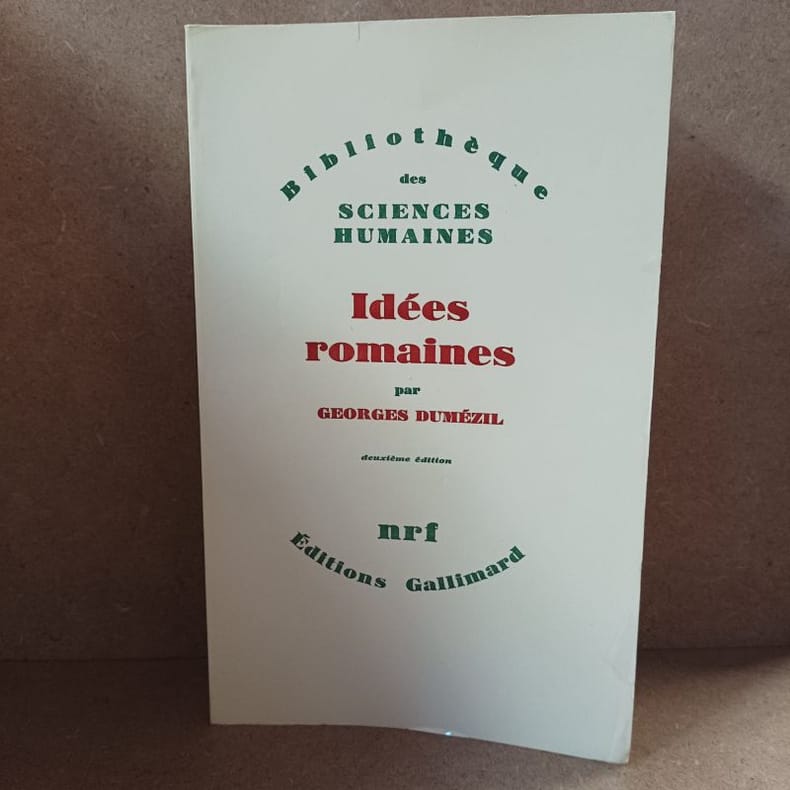
Idées romaines
1979 - broché - Editions Gallimard nrf - Collection Bibliothèque des sciences humaines - 1979 - In-8 (22,5 x 14 cm) broché - 306 pages
書籍販売業者の参照番号
: 742
|
|
|
DUMONT E.
Histoire romaine (3 volumes). Histoire universelle : tomes IV, V, VI.
Paris, Chamerot, 1843. "11 x 18, 3 volumes, 510 + 513 + 565 pages, reliure dos cuir, tranches mouchetées, état moyen (bords et coins émoussés; assez peu de rousseurs dans l'ensemble; pages de faux-titre découpées)."
書籍販売業者の参照番号
: 98031
|
|
|
Dumont, Jacques
Les animaux dans l'Antiquité grecque
8vo, br. 474 pp.
|
|
|
Dumont, M. E.
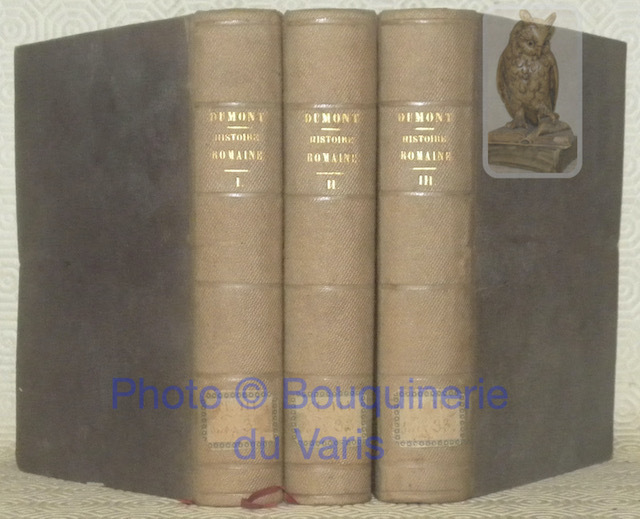
Histoire romaine. 3 Volumes complets.
Paris, Chamerot 1843, 180x110mm, 510 + 513 + 565pages, percaline de l’époque, auteur et titre dorés au dos, petite étiquette de cotation au bas du dos, cachet de bibliothèque sur page de titre.
書籍販売業者の参照番号
: 95555
|
|
|
Dumézil (Georges)
La religion romaine archaïque, avec un appendice sur la religion des Étrusques.
Paris Payot 1987 Fort in-8 br., 700 pp, Index. (Bibliothèque Historique).
書籍販売業者の参照番号
: 606381

|
|
|
DUMÉZIL (Georges).
Naissance de Rome (Jupiter, Mars, Quirinus, II).
Gallimard, 1944, in-12, 221 pp, broché, bon état
書籍販売業者の参照番号
: 51995

|
|
|
Dumézil Georges; Jesi F. (cur.)
La religione romana arcaica. Miti, leggende, realtà della vita religiosa romana. Con un'appendice sulla religione degli etruschi
brossura Georges Dumézil fu docente di civiltà indeuropea al College de France a partire dal 1948. Proprio la sua perizia nel muoversi nelle aree delle diverse culture antiche lo porta a non abbracciare la teoria che vede la religione dei romani come una semplice prosecuzione di quella dei greci. Essa fu una forma di culto complessa e originale, anche se mediata da altre culture.

|
|
|
Dumézil, Georges
La Religione Romana Arcaica. Miti Leggende Realtà della Vita religiosa Romana con un'Appendice sulla Religione degli Etruschi
Mm 175x245 "Collana Storica Rizzoli" - Volume in copertina rigida rilegato in tela, sovraccoperta editoriale, 615 pagine. Edizione italiana e traduzione di Furio Jesi. Margini ingialliti ,peraltro il volume è in ottime condizioni nelle sue legature ben salde. Spedizione in 24 ore dalla conferma dell'ordine.
|
|
|
DUNANT, Sarah;
IN HET GEZELSCHAP VAN DE COURTISANE,
Amsterdam/ Antwerpen, Archipel, 2006 Gebonden, rood linnen onder geillustreerde papieromslag, 135 x 220mm., 381pp. ISBN 9063052219.
書籍販売業者の参照番号
: 20194
|
|
|
Dunaune
Rome/Colonne élevèe a l'Empereur Phocas

|
|
|
Duncan-Jones, Richard
MONEY AND GOVERNMENT IN THE ROMAN EMPIRE
Very light edgewear to corners of wraps. ; 0.69 x 8.96 x 6 Inches; 320 pages; This book discusses minting and financial policy in the first three centuries of the Roman Empire. By studying Roman coin-survivals in a wider context, the author uncovers important facts about the origin of coin hoards of the Principate. The resulting analyses use extensive coin material collected for the first time. Dr. Duncan-Jones builds up a picture of minting, financial policy and monetary circulation that adds substantially to our knowledge and that stands as the only study of its kind for this period.
|
|
|
Duncan-Jones, Richard
Money and Government in the Roman Empire
8vo, 320 pages; This book discusses minting and financial policy in the first three centuries of the Roman Empire. By studying Roman coin-survivals in a wider context, the author uncovers important facts about the origin of coin hoards of the Principate. The resulting analyses use extensive coin material collected for the first time. Dr. Duncan-Jones builds up a picture of minting, financial policy and monetary circulation that adds substantially to our knowledge and that stands as the only study of its kind for this period.
|
|
|
Duncan-Jones, Richard
THE ECONOMY OF THE ROMAN EMPIRE Quantitative Studies
No internal indication of former library status, but remnants of label stuck to spine with tape stains. Some ink underlining in the table of contents and introduction (4-5 pp) with number inked to ffep, some foxing to textblock, errata sheet glued to title, else Very Good. ; Xvi, 396pp. ; 396 pages
|
|
|
DUNKER Balthasar Anton (Halle 1746- Berna 1807)
Veduta della Chiesa di S. Pietro di Roma dalla parte di Ponte Molle…
Panoramo di Roma da Ponte Milvio, con la cupola di San Pietro. Acquaforte e bulino, 1776 circa, da un dipinto di Jacob Philip Hackert, datato 1776.L'opera è edita dal fratello di Hackert, Georg Abraham, che aveva una bottega calcografica in Roma a Piazza di Spagna. Le figure in primo piano sono incise da Giovanni Volpato, come dimostra la scritta in basso a destra "J. Volpato caelum applic. Romae".Magnifica prova, impressa su carta vergata cova, rifilata al rame, in ottimo stato di conservazione.Opera non comune. Panoramo di Roma da Ponte Milvio, con la cupola di San Pietro. Acquaforte e bulino, 1776 circa, da un dipinto di Jacob Philip Hackert, datato 1776.L'opera è edita dal fratello di Hackert, Georg Abraham, che aveva una bottega calcografica in Roma a Piazza di Spagna. Le figure in primo piano sono incise da Giovanni Volpato, come dimostra la scritta in basso a destra "J. Volpato caelum applic. Romae".Magnifica prova, impressa su carta vergata cova, rifilata al rame, in ottimo stato di conservazione.Opera non comune.

|
|
|
Dunlop, John.
HISTORY OF ROMAN LITERATURE FROM ITS EARLIEST PERIOD TO THE AUGUSTAN AGE. In Two Volumes. From the Last London Edition.
Two volumes. 354; 286; 60 (2) [Appendix] + Publisher's advertisements. Deckle edged, uncut. Foxed. Original boards and label binding, worn, but presentable. Scarce. As a youth John Colin Dunlop was studious and retired in disposition. He was admitted an advocate in 1807, but was only nominally at the bar. The first edition of his well-known 'History of Fiction' was published at Edinburgh in 1814. Dunlop was appointed Sheriff Depute of the Shire of Renfrew, in 1816. This office he retained until his death. In 1823 he produced the first two volumes of this 'History of Roman Literature' which is noticeable for useful abstracts of the writings described, and illustrations drawn from modern European literatures. He died at Edinburgh in February 1842. "People sometimes wondered how so feeble and so retired a creature could venture as a penal magistrate among the strong sailors of Greenock or the ill fed rebels of precarious Paisley; but he did his duty among them very well. (In appearance he was exceedingly like a little, old, gray cuddy) a nice kindly body, with a clear, soft Scotch voice" - Henry Cockburn. **PRICE JUST REDUCED! W118
|
|
|
Dunston, A. J.
ESSAYS ON ROMAN CULTURE The Todd Memorial Lectures
Dustjacket has shelfwear and rubbing. Very minor edgewear to extremities. ; Contents: Augustus the Patrician--E. T. Salmon; Lucius Sulla: the Deadly Reformer--E. Badian; On Reading a Horatian Satire: An Interpretation of Sermones 2.6--C. O. Brink; The Character of the Romans in their History and their Literature--F. Adcock; The Initiation of Aeneas--J. Sheppard; A Roman Post Mortem: An Inquest on the Fall of the Roman Republic--R. Syme; The Emperor and his Clients--Harold Mattingly; The Aristocratic Epoch in Latin Literature--R. E. Smith. ; 223 pages
|
|
|
DUPATY (Jean-Baptiste).
Lettres su l'Italie.
Béziers, Bouquet, 1824, 1 br., première de couverture manquante, exemplaire à relier. in-8 de 402 pp., exemplaire à pleine marges ;
書籍販売業者の参照番号
: 13392
|
|
|
DUPERAC Etienne (1525-1604)
(Roma Antica)
Pianta archeologica a proiezione verticale con elevazione dei soli monumenti antichi. Disegnata ed incisa da Etienne Duperac per l’editore Antonio Lafreri. Si tratta di un’elegante rappresentazione della pianta archeologica, che mostra in alzato prospettico i monumenti principali. La morfologia segue quella della pianta del Bufalini (1551), ma per l’orografia, molto ben delineata, anche quella del Paciotto (1557) edita sempre da Lafreri. La pianta è inserita in alcuni esemplari dello Speculum Romanae Magnificentiae dell’editore francese. La lastra è descritta nel catalogo del Lafreri (n. 113), come “Roma con tutti gli edificii che hoggi si vegono in piede et che se ne può veder vestigie”. Quindi è inclusa nell’inventario di Stefano Duchetti del 1581 (n. 31) come “Roma con li monti dif.o Imperaiale” ed infine compare nel catalogo di Pietro de Nobili (inv. 1585, n. 32, come “La Roma antiqua de Stefano imperiale”, che la ristampa invariata aggiungendo il proprio excudit. Figura anche nell’atto della divisione della tipografia de Nobili del 30 maggio 1589, dove la lastra, denominata “Roma in pianta imperiale”, passa al figlio Pietro Paolo. Il primo stato della lastra era stato congetturato da Destombes sulla base dell’evidente integrazione nella data MDLXXIII, dove l’ultimo numerale è addossato alla parola seguente, suggerendo che sia stato aggiunto successivamente. Durante lo studio per questa pubblicazione abbiamo riscontrato l’esistenza di una prova della pianta con la data 1572 nella collezione della Bibliothèque Nationale de France. Oltre alla differenza nella data, la prima stesura dell’opera si distingue per la dedica allo STVDIOSO LECTORI preceduta dal termine TIPOGRAPHUS – ovvero Antonio Lafreri – che, nella ristampa del 1573, verrà sostituito dalla firma STEPHANUS DU PERAC ARCHITET. Nel lato sinistro, al centro, si legge: STEPHANUS DU PERAC ARCHITET STVDIOSO LECTORI. En tibi lector nuc prodit specimen, seu perfecta urbis antquae imago ex piscis illis monumentis scriptorum veterum, et cunctis quae ad hunc usq[ue] diem superesse videntur reliquijs, et parietibus quam acuratissime delineata: quecumque oculis nostri subiecta esse possunt exigua tabella comprehendens; opus ut immensum sanè, sic nec minus antiquitatis omnigenae studiosis apprime necessarium, his recentibus formis aencis, typis exaratum impensa Antonij lafrerij Anno MDLXXIII Hoc fruere libens et Vale. Nell’angolo inferiore destro, in un cartiglio, è incisa una legenda numerica di 89 rimandi a luoghi notabili, distribuita su tre colonne. Segue l’iscrizione: DE VESTIGITS URBIS ANTIQUAE EPIGRAMA: Quam brevis haec presens oculis sit carta requiris Urbem dum modico continet in spatio Desine mirari: vestigia maxima claudit Quae modo ROMA potens subijcit his oculis. Antiquae monstrans Urbis signacula promptè Dum numeris certis cuncta notata signat Discuta mira solers: novanu sint prima vetustis: Anue vetusta novis nunc manifesta patent. Nella tavola sono fornite ulteriori indicazioni toponomastiche. Orientazione nei quattro lati al centro con il nome dei punti cardinali: SEPTENTRIO, MERIDIES, ORIENS, OCIDENS, il nord è a sinistra.Acquaforte e bulino in ottime condizioni di conservazione. Esemplare nel secondo stato di tre, con la dedica che inizia con "STEPHANUS DU PERAC ARCHITET STVDIOSO LECTORI" (cfr. Bifolco-Ronca p. 2354).Altra Bibliografia:Alberti (2009): p. 153, n. 33; Frutaz (1962): n. XXI e tav. 36; Hülsen (1915): X, pp. 58-59, nn. 51-52; Hülsen (1921): p. 142, n. 1a-b; Hülsen (1933): p. 107, X; Lincoln (2000): p. 185; Marigliani (2016): n. XI.6; Pagani (2008): pp. 15, 374; Pagani (2011): p. 133; Rubach (2016): n. 259; Scaccia Scarafoni (1939: n. 17. Alberti (2009): p. 153, n. 33; Frutaz (1962): n. XXI e tav. 36; Hülsen (1915): X, pp. 58-59, nn. 51-52; Hülsen (1921): p. 142, n. 1a-b; Hülsen (1933): p. 107, X; Lincoln (2000): p. 185; Marigliani (2016): n. XI.6; Pagani (2008): pp. 15, 374; Pagani ... Pianta archeologica a proiezione verticale con elevazione dei soli monumenti antichi. Disegnata ed incisa da Etienne Duperac per l’editore Antonio Lafreri. Si tratta di un’elegante rappresentazione della pianta archeologica, che mostra in alzato prospettico i monumenti principali. La morfologia segue quella della pianta del Bufalini (1551), ma per l’orografia, molto ben delineata, anche quella del Paciotto (1557) edita sempre da Lafreri. La pianta è inserita in alcuni esemplari dello Speculum Romanae Magnificentiae dell’editore francese. La lastra è descritta nel catalogo del Lafreri (n. 113), come “Roma con tutti gli edificii che hoggi si vegono in piede et che se ne può veder vestigie”. Quindi è inclusa nell’inventario di Stefano Duchetti del 1581 (n. 31) come “Roma con li monti dif.o Imperaiale” ed infine compare nel catalogo di Pietro de Nobili (inv. 1585, n. 32, come “La Roma antiqua de Stefano imperiale”, che la ristampa invariata aggiungendo il proprio excudit. Figura anche nell’atto della divisione della tipografia de Nobili del 30 maggio 1589, dove la lastra, denominata “Roma in pianta imperiale”, passa al figlio Pietro Paolo. Il primo stato della lastra era stato congetturato da Destombes sulla base dell’evidente integrazione nella data MDLXXIII, dove l’ultimo numerale è addossato alla parola seguente, suggerendo che sia stato aggiunto successivamente. Durante lo studio per questa pubblicazione abbiamo riscontrato l’esistenza di una prova della pianta con la data 1572 nella collezione della Bibliothèque Nationale de France. Oltre alla differenza nella data, la prima stesura dell’opera si distingue per la dedica allo STVDIOSO LECTORI preceduta dal termine TIPOGRAPHUS – ovvero Antonio Lafreri – che, nella ristampa del 1573, verrà sostituito dalla firma STEPHANUS DU PERAC ARCHITET. Nel lato sinistro, al centro, si legge: STEPHANUS DU PERAC ARCHITET STVDIOSO LECTORI. En tibi lector nuc prodit specimen, seu perfecta urbis antquae imago ex piscis illis monumentis scriptorum veterum, et cunctis quae ad hunc usq[ue] diem superesse videntur reliquijs, et parietibus quam acuratissime delineata: quecumque oculis nostri subiecta esse possunt exigua tabella comprehendens; opus ut immensum sanè, sic nec minus antiquitatis omnigenae studiosis apprime necessarium, his recentibus formis aencis, typis exaratum impensa Antonij lafrerij Anno MDLXXIII Hoc fruere libens et Vale. Nell’angolo inferiore destro, in un cartiglio, è incisa una legenda numerica di 89 rimandi a luoghi notabili, distribuita su tre colonne. Segue l’iscrizione: DE VESTIGITS URBIS ANTIQUAE EPIGRAMA: Quam brevis haec presens oculis sit carta requiris Urbem dum modico continet in spatio Desine mirari: vestigia maxima claudit Quae modo ROMA potens subijcit his oculis. Antiquae monstrans Urbis signacula promptè Dum numeris certis cuncta notata signat Discuta mira solers: novanu sint prima vetustis: Anue vetusta novis nunc manifesta patent. Nella tavola sono fornite ulteriori indicazioni toponomastiche. Orientazione nei quattro lati al centro con il nome dei punti cardinali: SEPTENTRIO, MERIDIES, ORIENS, OCIDENS, il nord è a sinistra.Acquaforte e bulino in ottime condizioni di conservazione. Esemplare nel secondo stato di tre, con la dedica che inizia con "STEPHANUS DU PERAC ARCHITET STVDIOSO LECTORI" (cfr. Bifolco-Ronca p. 2354).LiteratureAlberti (2009): p. 153, n. 33; Frutaz (1962): n. XXI e tav. 36; Hülsen (1915): X, pp. 58-59, nn. 51-52; Hülsen (1921): p. 142, n. 1a-b; Hülsen (1933): p. 107, X; Lincoln (2000): p. 185; Marigliani (2016): n. XI.6; Pagani (2008): pp. 15, 374; Pagani (2011): p. 133; Rubach (2016): n. 259; Scaccia Scarafoni (1939: n. 17. Alberti (2009): p. 153, n. 33; Frutaz (1962): n. XXI e tav. 36; Hülsen (1915): X, pp. 58-59, nn. 51-52; Hülsen (1921): p. 142, n. 1a-b; Hülsen (1933): p. 107, X; Lincoln (2000): p. 185; Marigliani (2016): n. XI.6; Pagani (2008): pp. 15, 374; Pagani (2011): p... Bifolco Ronca (2018): tav. 1212, II/III

|
|
|
DUPERAC Etienne (1525-1604)
(Vestigia dell'Antoniana…)
Veduta tratta dall'opera I vestigi dell'antichità di Roma raccolti et ritratti in perspettiva da Stefano Du Perac parisino, pubblicata per la prima volta a Roma nel 1575 da Lorenzo Vaccari. Il volume consta di quaranta fogli tutti di tavole: il primo funge da frontespizio; nel secondo è ospitata la dedica a “Giacomo Buoncompagni governator generale di Santa Chiesa”. Étienne Du Pérac vi palesa le proprie intenzioni e in particolare sottolinea che “sarà dunque utile il libro […] et grato, et accetto agli studiosi dell’antichità per la diligenza che io ho usata in rappresentare fedelmente i residui della Romana grandezza”. Si affida poi all’ “autorità e virtù” del dedicatario perché possa favorire l’opera “bisognosa di molto lume” a causa dell’“oscurità dell’auttore”. In realtà, quando pubblica il libro, Étienne du Pérac è a Roma da oltre quindici anni, ed è noto se non altro per aver fornito la propria opera all’erudito veronese Onofrio Panvinio e aver dato alle stampe nel 1574 la pianta archeologica Urbis Romae Sciographia, ricostruzione topografica della Roma antica, cui sarebbe seguita, nel 1577, la pianta della Roma moderna, la Nova urbis Romae descriptio. Certo il mercato dell’editoria antiquaria era piuttosto affollato: nello stesso 1575 esce ad esempio per iniziativa di un altro francese, lo stampatore Antonio Lafreri (Antoine Lafréry), con il quale peraltro lo stesso Du Perac collabora, la raccolta iconografica Speculum Romanae Magnificentiae, che riunisce, incise da vari artisti, molte più immagini de I vestigi, non seguendo un’impostazione topografica e non, limitandosi agli edifici antichi ma inserendone di moderni nonché un repertorio di statue. Qui Du Pérac, partendo dal Campidoglio, scandisce il suo itinerario in trentanove tappe: in calce a ogni pagina una didascalia di poche righe fornisce le informazioni essenziali sugli edifici e le rovine. Non si tratta però di raffigurazioni di singoli monumenti, né tanto meno di ricostruzioni ideali, ma di vere e proprie vedute: immagini di grande qualità, paragonabili a quelle edite nel 1551 dall’incisore fiammingo Hieronymus Cock. Etienne Du Pérac o Duperac, nativo di Bordeaux o Parigi, si trasferisce presto a Venezia, dove apprende l’arte dell’incisione realizzando vari soggetti da Tiziano, principalmente per l’editore Giovanni Francesco Camocio. Arriva a Roma nel 1559 dove si dedica allo studio dell’architettura e delle antichità, con particolare attenzione alle opere di Michelangelo. A Roma conosce Onofrio Panvinio, archeologo ed antiquario, che lo influenza e lo introduce allo studio delle antichità romane. Come tutti gli artisti provenienti dal Nord Europa, rimane affascinato dalla maestosità delle rovine romane, decidendo di studiarle e raffigurarle. Le precedenti rappresentazioni dei monumenti di Roma, ad esempio quelle eseguite da Hieronimus Cock intorno al 1550, erano pittoriche ed arricchite da elementi di fantasia. La notevole importanza delle vedute di Roma del Duperac sta nel fatto che furono rappresentate con assoluta precisione archeologica e topografica, tanto da essere oggi studiate con grande attenzione dagli studiosi di archeologia, poiché spesso rappresentano monumenti e siti oggi andati perduti. L'opera ebbe ben 8 edizioni successive, alcune a cura della tipografia De Rossi. Incisione in rame, in ottimo stato di conservazione. View taken from the work I vestigi dell'antichità di Roma raccolti et ritratti in perspettiva da Stefano Du Perac parisino, published for the first time in Rome in 1575 by Lorenzo Vaccari. The volume consists of forty plates: the first serves as a frontispiece; the second contains the dedication to "Giacomo Buoncompagni governator generale di Santa Chiesa". Étienne Du Pérac expresses his intentions and in particular emphasizes that "the book [...] will therefore be useful and grateful, and accepted by scholars of antiquity for the diligence I have used in faithfully representing the remains of Roman grandeur". He then relies on the "authority and virtue" of the dedicatee so that he can encourage the work "in need of much light" because of the "obscurity of the author". When he published the book, Étienne du Pérac had been in Rome for more than fifteen years, and was known, if only for having supplied his work to the Veronese scholar Onofrio Panvinio and for having printed in 1574 the archaeological map Urbis Romae Sciographia, a topographical reconstruction of ancient Rome, which would be followed, in 1577, by the map of modern Rome, the Nova urbis Romae descriptio. Certainly the market of antiquarian publishing was quite crowded: in the same year 1575, for example, another Frenchman, the printer Antonio Lafreri (Antoine Lafréry), with whom Du Perac also collaborated, published the iconographic collection Speculum Romanae Magnificentiae, which brought together, engraved by various artists, many more images than I vestigi, not following a topographical approach and not limiting himself to ancient buildings but including modern ones as well as a repertoire of statues. Here Du Pérac, starting from the Capitol, outlines his itinerary in thirty-nine stages: at the bottom of each page a caption of a few lines provides essential information about the buildings and ruins. However, these are not representations of individual monuments, nor ideal reconstructions, but real views: images of great quality, comparable to those published in 1551 by the Flemish engraver Hieronymus Cock. Etienne Du Pérac or Duperac, born in Bordeaux or Paris, soon moved to Venice, where he learned the art of engraving by making various subjects from Titian, mainly for the publisher Giovanni Francesco Camocio. He arrived in Rome in 1559 where he devoted himself to the study of architecture and antiquities, with particular attention to the works of Michelangelo. In Rome he knows Onofrio Panvinio, archaeologist and antiquarian, who influences him and introduces him to the study of Roman antiquities. As all the artists coming from Northern Europe, he remains fascinated by the majesty of the Roman ruins, deciding to study and represent them. The previous representations of the monuments of Rome, for example those made by Hieronimus Cock around 1550, were pictorial and enriched with fantasy elements. The remarkable importance of the views of Rome by Duperac lies in the fact that they were represented with absolute archaeological and topographical precision, so as to be studied today with great attention by scholars of archaeology, since they often represent monuments and sites now lost. The work had 8 subsequent editions, some by the De Rossi printing house. Copper engraving, in excellent condition.

|
|
|
DUPERAC Etienne (1525-1604)
Disegno della colonna Antonina che è alta CLXXV. Piedi, e hebbe CCVI gradi per montarui su nella cima, questa colonna fu da
Veduta tratta dall'opera I vestigi dell'antichità di Roma raccolti et ritratti in perspettiva da Stefano Du Perac parisino, pubblicata per la prima volta a Roma nel 1575 da Lorenzo Vaccari. Il volume consta di quaranta fogli tutti di tavole: il primo funge da frontespizio; nel secondo è ospitata la dedica a “Giacomo Buoncompagni governator generale di Santa Chiesa”. Étienne Du Pérac vi palesa le proprie intenzioni e in particolare sottolinea che “sarà dunque utile il libro […] et grato, et accetto agli studiosi dell’antichità per la diligenza che io ho usata in rappresentare fedelmente i residui della Romana grandezza”. Si affida poi all’ “autorità e virtù” del dedicatario perché possa favorire l’opera “bisognosa di molto lume” a causa dell’“oscurità dell’auttore”. In realtà, quando pubblica il libro, Étienne du Pérac è a Roma da oltre quindici anni, ed è noto se non altro per aver fornito la propria opera all’erudito veronese Onofrio Panvinio e aver dato alle stampe nel 1574 la pianta archeologica Urbis Romae Sciographia, ricostruzione topografica della Roma antica, cui sarebbe seguita, nel 1577, la pianta della Roma moderna, la Nova urbis Romae descriptio. Certo il mercato dell’editoria antiquaria era piuttosto affollato: nello stesso 1575 esce ad esempio per iniziativa di un altro francese, lo stampatore Antonio Lafreri (Antoine Lafréry), con il quale peraltro lo stesso Du Perac collabora, la raccolta iconografica Speculum Romanae Magnificentiae, che riunisce, incise da vari artisti, molte più immagini de I vestigi, non seguendo un’impostazione topografica e non, limitandosi agli edifici antichi ma inserendone di moderni nonché un repertorio di statue. Qui Du Pérac, partendo dal Campidoglio, scandisce il suo itinerario in trentanove tappe: in calce a ogni pagina una didascalia di poche righe fornisce le informazioni essenziali sugli edifici e le rovine. Non si tratta però di raffigurazioni di singoli monumenti, né tanto meno di ricostruzioni ideali, ma di vere e proprie vedute: immagini di grande qualità, paragonabili a quelle edite nel 1551 dall’incisore fiammingo Hieronymus Cock. Etienne Du Pérac o Duperac, nativo di Bordeaux o Parigi, si trasferisce presto a Venezia, dove apprende l’arte dell’incisione realizzando vari soggetti da Tiziano, principalmente per l’editore Giovanni Francesco Camocio. Arriva a Roma nel 1559 dove si dedica allo studio dell’architettura e delle antichità, con particolare attenzione alle opere di Michelangelo. A Roma conosce Onofrio Panvinio, archeologo ed antiquario, che lo influenza e lo introduce allo studio delle antichità romane. Come tutti gli artisti provenienti dal Nord Europa, rimane affascinato dalla maestosità delle rovine romane, decidendo di studiarle e raffigurarle. Le precedenti rappresentazioni dei monumenti di Roma, ad esempio quelle eseguite da Hieronimus Cock intorno al 1550, erano pittoriche ed arricchite da elementi di fantasia. La notevole importanza delle vedute di Roma del Duperac sta nel fatto che furono rappresentate con assoluta precisione archeologica e topografica, tanto da essere oggi studiate con grande attenzione dagli studiosi di archeologia, poiché spesso rappresentano monumenti e siti oggi andati perduti. L'opera ebbe ben 8 edizioni successive, alcune a cura della tipografia De Rossi. Incisione in rame, in ottimo stato di conservazione. View taken from the work I vestigi dell'antichità di Roma raccolti et ritratti in perspettiva da Stefano Du Perac parisino, published for the first time in Rome in 1575 by Lorenzo Vaccari. The volume consists of forty plates: the first serves as a frontispiece; the second contains the dedication to "Giacomo Buoncompagni governator generale di Santa Chiesa". Étienne Du Pérac expresses his intentions and in particular emphasizes that "the book [...] will therefore be useful and grateful, and accepted by scholars of antiquity for the diligence I have used in faithfully representing the remains of Roman grandeur". He then relies on the "authority and virtue" of the dedicatee so that he can encourage the work "in need of much light" because of the "obscurity of the author". When he published the book, Étienne du Pérac had been in Rome for more than fifteen years, and was known, if only for having supplied his work to the Veronese scholar Onofrio Panvinio and for having printed in 1574 the archaeological map Urbis Romae Sciographia, a topographical reconstruction of ancient Rome, which would be followed, in 1577, by the map of modern Rome, the Nova urbis Romae descriptio. Certainly the market of antiquarian publishing was quite crowded: in the same year 1575, for example, another Frenchman, the printer Antonio Lafreri (Antoine Lafréry), with whom Du Perac also collaborated, published the iconographic collection Speculum Romanae Magnificentiae, which brought together, engraved by various artists, many more images than I vestigi, not following a topographical approach and not limiting himself to ancient buildings but including modern ones as well as a repertoire of statues. Here Du Pérac, starting from the Capitol, outlines his itinerary in thirty-nine stages: at the bottom of each page a caption of a few lines provides essential information about the buildings and ruins. However, these are not representations of individual monuments, nor ideal reconstructions, but real views: images of great quality, comparable to those published in 1551 by the Flemish engraver Hieronymus Cock. Etienne Du Pérac or Duperac, born in Bordeaux or Paris, soon moved to Venice, where he learned the art of engraving by making various subjects from Titian, mainly for the publisher Giovanni Francesco Camocio. He arrived in Rome in 1559 where he devoted himself to the study of architecture and antiquities, with particular attention to the works of Michelangelo. In Rome he knows Onofrio Panvinio, archaeologist and antiquarian, who influences him and introduces him to the study of Roman antiquities. As all the artists coming from Northern Europe, he remains fascinated by the majesty of the Roman ruins, deciding to study and represent them. The previous representations of the monuments of Rome, for example those made by Hieronimus Cock around 1550, were pictorial and enriched with fantasy elements. The remarkable importance of the views of Rome by Duperac lies in the fact that they were represented with absolute archaeological and topographical precision, so as to be studied today with great attention by scholars of archaeology, since they often represent monuments and sites now lost. The work had 8 subsequent editions, some by the De Rossi printing house. Copper engraving, in excellent condition.

|
|
|
DUPERAC Etienne (1525-1604)
Parte del monte Quirinale che guarda verso Ponente…
Veduta tratta dall'opera I vestigi dell'antichità di Roma raccolti et ritratti in perspettiva da Stefano Du Perac parisino, pubblicata per la prima volta a Roma nel 1575 da Lorenzo Vaccari. Il volume consta di quaranta fogli tutti di tavole: il primo funge da frontespizio; nel secondo è ospitata la dedica a “Giacomo Buoncompagni governator generale di Santa Chiesa”. Étienne Du Pérac vi palesa le proprie intenzioni e in particolare sottolinea che “sarà dunque utile il libro […] et grato, et accetto agli studiosi dell’antichità per la diligenza che io ho usata in rappresentare fedelmente i residui della Romana grandezza”. Si affida poi all’ “autorità e virtù” del dedicatario perché possa favorire l’opera “bisognosa di molto lume” a causa dell’“oscurità dell’auttore”. In realtà, quando pubblica il libro, Étienne du Pérac è a Roma da oltre quindici anni, ed è noto se non altro per aver fornito la propria opera all’erudito veronese Onofrio Panvinio e aver dato alle stampe nel 1574 la pianta archeologica Urbis Romae Sciographia, ricostruzione topografica della Roma antica, cui sarebbe seguita, nel 1577, la pianta della Roma moderna, la Nova urbis Romae descriptio. Certo il mercato dell’editoria antiquaria era piuttosto affollato: nello stesso 1575 esce ad esempio per iniziativa di un altro francese, lo stampatore Antonio Lafreri (Antoine Lafréry), con il quale peraltro lo stesso Du Perac collabora, la raccolta iconografica Speculum Romanae Magnificentiae, che riunisce, incise da vari artisti, molte più immagini de I vestigi, non seguendo un’impostazione topografica e non, limitandosi agli edifici antichi ma inserendone di moderni nonché un repertorio di statue. Qui Du Pérac, partendo dal Campidoglio, scandisce il suo itinerario in trentanove tappe: in calce a ogni pagina una didascalia di poche righe fornisce le informazioni essenziali sugli edifici e le rovine. Non si tratta però di raffigurazioni di singoli monumenti, né tanto meno di ricostruzioni ideali, ma di vere e proprie vedute: immagini di grande qualità, paragonabili a quelle edite nel 1551 dall’incisore fiammingo Hieronymus Cock. Etienne Du Pérac o Duperac, nativo di Bordeaux o Parigi, si trasferisce presto a Venezia, dove apprende l’arte dell’incisione realizzando vari soggetti da Tiziano, principalmente per l’editore Giovanni Francesco Camocio. Arriva a Roma nel 1559 dove si dedica allo studio dell’architettura e delle antichità, con particolare attenzione alle opere di Michelangelo. A Roma conosce Onofrio Panvinio, archeologo ed antiquario, che lo influenza e lo introduce allo studio delle antichità romane. Come tutti gli artisti provenienti dal Nord Europa, rimane affascinato dalla maestosità delle rovine romane, decidendo di studiarle e raffigurarle. Le precedenti rappresentazioni dei monumenti di Roma, ad esempio quelle eseguite da Hieronimus Cock intorno al 1550, erano pittoriche ed arricchite da elementi di fantasia. La notevole importanza delle vedute di Roma del Duperac sta nel fatto che furono rappresentate con assoluta precisione archeologica e topografica, tanto da essere oggi studiate con grande attenzione dagli studiosi di archeologia, poiché spesso rappresentano monumenti e siti oggi andati perduti. L'opera ebbe ben 8 edizioni successive, alcune a cura della tipografia De Rossi. Incisione in rame, in ottimo stato di conservazione. View taken from the work I vestigi dell'antichità di Roma raccolti et ritratti in perspettiva da Stefano Du Perac parisino, published for the first time in Rome in 1575 by Lorenzo Vaccari. The volume consists of forty plates: the first serves as a frontispiece; the second contains the dedication to "Giacomo Buoncompagni governator generale di Santa Chiesa". Étienne Du Pérac expresses his intentions and in particular emphasizes that "the book [...] will therefore be useful and grateful, and accepted by scholars of antiquity for the diligence I have used in faithfully representing the remains of Roman grandeur". He then relies on the "authority and virtue" of the dedicatee so that he can encourage the work "in need of much light" because of the "obscurity of the author". When he published the book, Étienne du Pérac had been in Rome for more than fifteen years, and was known, if only for having supplied his work to the Veronese scholar Onofrio Panvinio and for having printed in 1574 the archaeological map Urbis Romae Sciographia, a topographical reconstruction of ancient Rome, which would be followed, in 1577, by the map of modern Rome, the Nova urbis Romae descriptio. Certainly the market of antiquarian publishing was quite crowded: in the same year 1575, for example, another Frenchman, the printer Antonio Lafreri (Antoine Lafréry), with whom Du Perac also collaborated, published the iconographic collection Speculum Romanae Magnificentiae, which brought together, engraved by various artists, many more images than I vestigi, not following a topographical approach and not limiting himself to ancient buildings but including modern ones as well as a repertoire of statues. Here Du Pérac, starting from the Capitol, outlines his itinerary in thirty-nine stages: at the bottom of each page a caption of a few lines provides essential information about the buildings and ruins. However, these are not representations of individual monuments, nor ideal reconstructions, but real views: images of great quality, comparable to those published in 1551 by the Flemish engraver Hieronymus Cock. Etienne Du Pérac or Duperac, born in Bordeaux or Paris, soon moved to Venice, where he learned the art of engraving by making various subjects from Titian, mainly for the publisher Giovanni Francesco Camocio. He arrived in Rome in 1559 where he devoted himself to the study of architecture and antiquities, with particular attention to the works of Michelangelo. In Rome he knows Onofrio Panvinio, archaeologist and antiquarian, who influences him and introduces him to the study of Roman antiquities. As all the artists coming from Northern Europe, he remains fascinated by the majesty of the Roman ruins, deciding to study and represent them. The previous representations of the monuments of Rome, for example those made by Hieronimus Cock around 1550, were pictorial and enriched with fantasy elements. The remarkable importance of the views of Rome by Duperac lies in the fact that they were represented with absolute archaeological and topographical precision, so as to be studied today with great attention by scholars of archaeology, since they often represent monuments and sites now lost. The work had 8 subsequent editions, some by the De Rossi printing house. Copper engraving, in excellent condition.

|
|
|
DUPERAC Etienne (1525-1604)
Urbis Romae Sciographia ex Antiquis Monumentis Accuratiss Delineata
Pianta archeologica a proiezione verticale con alzato incisa da Etienne Duperac per l’editore Lorenzo Vaccari. Ricostruzione ideale della Roma Antica eseguita dal Duperac dopo un serio esame della pianta Severiana e della pianta archeologica di Pirro Ligorio, il maggiore studioso dei monumenti antichi di Roma dell’epoca. All’interno della città, è delineato ciascun edificio, riportando i nomi di quelli principali; questi includono il Colosseo, il Pantheon, le Terme di Diocleziano e il Circo Massimo. Fuori città sono contrassegnati le tenute di campagna (per esempio, i Giardini di Domiziano), i monumenti funerari (come i Mausolei di Adriano e di Augusto, ed i circhi di Nerone e Adriano). La lastra è stata intagliata dall’incisore ed editore parigino Étienne Dupérac, che si fece chiamare Stephanus durante il suo periodo di lavoro a Roma (1569-1582). Nella dedica a Carlo IX, l’autore stesso spiega come questa carta sia il frutto di quindici anni di studio di tutte le rovine e dei monumenti della Roma Antica e dei testi letterari correlati. In particolare, viene riportato un dettagliato resoconto della scoperta della pianta Severiana, i cui resti furono scoperti nella chiesa dei SS. Cosma e Damiano nel 1562. Hülsen segnala come unico esemplare originale conosciuto quello conservato al British Museum, che reca il nome dello stampatore Francesco Villamena. Inoltre, aggiunge che, nel catalogo della stamperia dei Vaccari è annoverata la “Roma antica d’otto fogli reali, intagliata per mano di Stefano Duperach Parisino”, a lui sconosciuta. Frutaz obietta giustamente che la tiratura di Villamena sia solo una ristampa, databile ai primi del ‘600, quando l’editore era attivo a Roma. Nelle nostre ricerche, abbiamo finalmente rinvenuto un esemplare originale della pianta, finora sconosciuto, che è assolutamente da identificarsi con la “Roma antica d’otto fogli reali” del catalogo Vaccari, citata da Hülsen. Infatti l’esemplare, conservato nella collezione cartografica della Newberry Library di Chicago, reca proprio l’imprint di Lorenzo Vaccari, editore anche della raccolta I Vestigi dell’Antichità di Roma Raccolti et Ritratti in Perspettiva con ogni diligentia da Stefano Dv Perac Parisino (1575). Tra il 1649 ed il 1660, Gian Giacomo de Rossi ne pubblica una ristampa, utilizzando i medesimi rami (presumibilmente acquisiti dalla bottega del Villamena), ma aggiungendo scene dell’Antica Roma e una legenda tipografica con 159 richiami a monumenti. L’opera è descritta nell’ultimo catalogo della tipografia de Rossi, redatto da Lorenzo Filippo nel 1735 (p. 16, n. 1) come “Roma Antica di Stefano du Perac Parigino intagliata a bulino da Francesco Villamena co’ trionfi de Romani antichi, intagliati a bulino da Jacopo Lauro in dodici fogli reali grandi”. Dunque le tavole aggiuntive dei trionfi sono, secondo il catalogo, incise da Giacomo Lauro. Tale attribuzione viene respinta da Ashby e quindi da Hollstein, che attribuisce la lastre a Peter de Jode. La tipografia de Rossi fu venduta da Lorenzo Filippo, costituendo il fondo principale della neonata (1738) Calcografia Camerale (poi Regia, quindi Nazionale e oggi Istituto Centrale per la Grafica), luogo in cui sono ancora conservati i rami originali, erroneamente sotto il nome di Francesco Villamena. In alto, lungo il bordo superiore, è impresso il titolo: URBIS ROMAE SCIOGRAPHIA EX ANTIQUIS MONUMENTIS ACCURATISS. DELINEATA. A sinistra lo stemma con la sigla S.P.Q.R. (Senatus Populus Que Romanus). Nel cartiglio in basso a destra, con la raffigurazione dei gemelli Romolo e Remo, troviamo incisa la dedica: KAROLO IX GALLIARUM REGI CHRISTIANISSIMO STEPHANUS DU PERAC PARISIENSIS Quanta fuerit veteris illius popuki R. potentia atque amplitudo, karole regu[m] maxime, omnes sciunt:quae autem ipsius urbis, antiquis temporibus, maiestas ac pulchritudo, non alinde melius ac certius cognosci potest, quam ex admirabilibus veterum aedifitioru[m] vestigiis, q... Vertical projection archaeological map, engraved by Etienne Duperac for the publisher Lorenzo Vaccari. Ideal reconstruction of Ancient Rome carried out by Duperac after a serious examination of the Severian map and the archaeological work by Pirro Ligorio, the greatest scholar of ancient monuments in Rome at the time. Inside the city, each building is outlined with the names of the main ones; these include the Colosseum, the Pantheon, the Baths of Diocletian and the Circus Maximus. Outside the city are marked the country estates (for example, the Gardens of Domitian), the funerary monuments (such as the Mausoleums of Hadrian and Augustus, and the circuses of Nero and Hadrian). The plate was carved by the Parisian engraver and publisher Étienne Dupérac, who called himself Stephanus during his period of work in Rome (1569-1582). In the dedication to Charles IX, the author himself explains how this work is the result of fifteen years of study of all the ruins and monuments of Ancient Rome and related literary texts. In particular, a detailed account is given of the discovery of the Severian map, the remains of which were discovered in the church of Saints Cosma and Damiano in 1562. Hülsen reports as the only known original example the one preserved at the British Museum, which bears the name of the printer Francesco Villamena. Furthermore, he adds that the catalogue of the Vaccari print shop includes the "Roma antica d’otto fogli reali, intagliata per mano di Stefano Duperach Parisino”, unknown to him. Frutaz rightly objects that the Villamena's edition is only a reprint, datable to the early 17th century, when the publisher was active in Rome. In our research, we finally found an original example of the map, hitherto unknown, which is absolutely to be identified with the "Ancient Rome of eight royal sheets" of the Vaccari catalogue, quoted by Hülsen. In fact the exemplar, preserved in the cartographic collection of the Newberry Library of Chicago, bears the imprint of Lorenzo Vaccari, publisher also of the collection I Vestigi dell'Antichità di Roma Raccolti et Ritratti in Perspettiva con ogni diligentia by Stefano Dv Perac Parisino (1575). Between 1649 and 1660, Gian Giacomo de Rossi published a reprint, using the same plates(presumably acquired from the Villamena workshop), but adding scenes from Ancient Rome and a typographical legend with 159 references to monuments. The work is described in the last catalogue of de Rossi's printing house, edited by Lorenzo Filippo in 1735 (p. 16, n. 1) as "Roma Antica di Stefano du Perac Parigino intagliata a bulino da Francesco Villamena co’ trionfi de Romani antichi, intagliati a bulino da Jacopo Lauro in dodici fogli reali grandi”. So the additional plates of the triumphs are, according to the catalogue, engraved by Giacomo Lauro. This attribution is rejected by Ashby and then by Hollstein, who attributes the plate to Peter de Jode. The de Rossi printing house was sold by Lorenzo Filippo, constituting the main fund of the newborn (1738) Calcografia Camerale (later Regia, then Nazionale and now Istituto Centrale per la Grafica), where the original plates are still preserved, mistakenly under the name of Francesco Villamena. Example of the third state of four (cfr. Bifolco-Ronca, p. 2359) with the imprint Cura et Tipis Io. Iacobi de Rubeis in Romae ad Templ. Stae. Mae. De Pace cum Privil. Sum. Pont. Excudebat Romae Io. Iacob. De Rubeis. Etching with engraving, a very good example of the De Rossi edition, with decorations and the key-numbers on the lower part; minor repairs perfectly realized, otherwise in excellent condition. Literature Bifolco-Ronca, Cartografia e topografia italiana del XVI secolo, pp. 2358-59, tav. 1214, III/IV; Destombes (1970): n. 96; Caldana (2013): n. I.12; Frutaz (1962): n. XXII e tavv. 37-50; Grelle Iusco (1996): pp. 172, 379; Hollstein (1952): IX, p. 202, nn. 403-414; Hülsen (1915): XI, pp. 60-62, nn. 56-59; Mostra Bergamo (2016): n. 72; Sca...

|
|
|
DUPERAC Etienne (1525-1604)
Vestigi del monumento overo mole d'Adriano....
Veduta tratta dall'opera I vestigi dell'antichità di Roma raccolti et ritratti in perspettiva da Stefano Du Perac parisino, pubblicata per la prima volta a Roma nel 1575 da Lorenzo Vaccari. Il volume consta di quaranta fogli tutti di tavole: il primo funge da frontespizio; nel secondo è ospitata la dedica a “Giacomo Buoncompagni governator generale di Santa Chiesa”. Étienne Du Pérac vi palesa le proprie intenzioni e in particolare sottolinea che “sarà dunque utile il libro […] et grato, et accetto agli studiosi dell’antichità per la diligenza che io ho usata in rappresentare fedelmente i residui della Romana grandezza”. Si affida poi all’ “autorità e virtù” del dedicatario perché possa favorire l’opera “bisognosa di molto lume” a causa dell’“oscurità dell’auttore”. In realtà, quando pubblica il libro, Étienne du Pérac è a Roma da oltre quindici anni, ed è noto se non altro per aver fornito la propria opera all’erudito veronese Onofrio Panvinio e aver dato alle stampe nel 1574 la pianta archeologica Urbis Romae Sciographia, ricostruzione topografica della Roma antica, cui sarebbe seguita, nel 1577, la pianta della Roma moderna, la Nova urbis Romae descriptio. Certo il mercato dell’editoria antiquaria era piuttosto affollato: nello stesso 1575 esce ad esempio per iniziativa di un altro francese, lo stampatore Antonio Lafreri (Antoine Lafréry), con il quale peraltro lo stesso Du Perac collabora, la raccolta iconografica Speculum Romanae Magnificentiae, che riunisce, incise da vari artisti, molte più immagini de I vestigi, non seguendo un’impostazione topografica e non, limitandosi agli edifici antichi ma inserendone di moderni nonché un repertorio di statue. Qui Du Pérac, partendo dal Campidoglio, scandisce il suo itinerario in trentanove tappe: in calce a ogni pagina una didascalia di poche righe fornisce le informazioni essenziali sugli edifici e le rovine. Non si tratta però di raffigurazioni di singoli monumenti, né tanto meno di ricostruzioni ideali, ma di vere e proprie vedute: immagini di grande qualità, paragonabili a quelle edite nel 1551 dall’incisore fiammingo Hieronymus Cock. Etienne Du Pérac o Duperac, nativo di Bordeaux o Parigi, si trasferisce presto a Venezia, dove apprende l’arte dell’incisione realizzando vari soggetti da Tiziano, principalmente per l’editore Giovanni Francesco Camocio. Arriva a Roma nel 1559 dove si dedica allo studio dell’architettura e delle antichità, con particolare attenzione alle opere di Michelangelo. A Roma conosce Onofrio Panvinio, archeologo ed antiquario, che lo influenza e lo introduce allo studio delle antichità romane. Come tutti gli artisti provenienti dal Nord Europa, rimane affascinato dalla maestosità delle rovine romane, decidendo di studiarle e raffigurarle. Le precedenti rappresentazioni dei monumenti di Roma, ad esempio quelle eseguite da Hieronimus Cock intorno al 1550, erano pittoriche ed arricchite da elementi di fantasia. La notevole importanza delle vedute di Roma del Duperac sta nel fatto che furono rappresentate con assoluta precisione archeologica e topografica, tanto da essere oggi studiate con grande attenzione dagli studiosi di archeologia, poiché spesso rappresentano monumenti e siti oggi andati perduti. L'opera ebbe ben 8 edizioni successive, alcune a cura della tipografia De Rossi. Incisione in rame, in ottimo stato di conservazione. View taken from the work I vestigi dell'antichità di Roma raccolti et ritratti in perspettiva da Stefano Du Perac parisino, published for the first time in Rome in 1575 by Lorenzo Vaccari. The volume consists of forty plates: the first serves as a frontispiece; the second contains the dedication to "Giacomo Buoncompagni governator generale di Santa Chiesa". Étienne Du Pérac expresses his intentions and in particular emphasizes that "the book [...] will therefore be useful and grateful, and accepted by scholars of antiquity for the diligence I have used in faithfully representing the remains of Roman grandeur". He then relies on the "authority and virtue" of the dedicatee so that he can encourage the work "in need of much light" because of the "obscurity of the author". When he published the book, Étienne du Pérac had been in Rome for more than fifteen years, and was known, if only for having supplied his work to the Veronese scholar Onofrio Panvinio and for having printed in 1574 the archaeological map Urbis Romae Sciographia, a topographical reconstruction of ancient Rome, which would be followed, in 1577, by the map of modern Rome, the Nova urbis Romae descriptio. Certainly the market of antiquarian publishing was quite crowded: in the same year 1575, for example, another Frenchman, the printer Antonio Lafreri (Antoine Lafréry), with whom Du Perac also collaborated, published the iconographic collection Speculum Romanae Magnificentiae, which brought together, engraved by various artists, many more images than I vestigi, not following a topographical approach and not limiting himself to ancient buildings but including modern ones as well as a repertoire of statues. Here Du Pérac, starting from the Capitol, outlines his itinerary in thirty-nine stages: at the bottom of each page a caption of a few lines provides essential information about the buildings and ruins. However, these are not representations of individual monuments, nor ideal reconstructions, but real views: images of great quality, comparable to those published in 1551 by the Flemish engraver Hieronymus Cock. Etienne Du Pérac or Duperac, born in Bordeaux or Paris, soon moved to Venice, where he learned the art of engraving by making various subjects from Titian, mainly for the publisher Giovanni Francesco Camocio. He arrived in Rome in 1559 where he devoted himself to the study of architecture and antiquities, with particular attention to the works of Michelangelo. In Rome he knows Onofrio Panvinio, archaeologist and antiquarian, who influences him and introduces him to the study of Roman antiquities. As all the artists coming from Northern Europe, he remains fascinated by the majesty of the Roman ruins, deciding to study and represent them. The previous representations of the monuments of Rome, for example those made by Hieronimus Cock around 1550, were pictorial and enriched with fantasy elements. The remarkable importance of the views of Rome by Duperac lies in the fact that they were represented with absolute archaeological and topographical precision, so as to be studied today with great attention by scholars of archaeology, since they often represent monuments and sites now lost. The work had 8 subsequent editions, some by the De Rossi printing house. Copper engraving, in excellent condition.

|
|
|
DUPERAC Etienne (1525-1604)
Vestigi dell'arco di Settimio Severo…
Veduta tratta dall'opera I vestigi dell'antichità di Roma raccolti et ritratti in perspettiva da Stefano Du Perac parisino, pubblicata per la prima volta a Roma nel 1575 da Lorenzo Vaccari. Il volume consta di quaranta fogli tutti di tavole: il primo funge da frontespizio; nel secondo è ospitata la dedica a “Giacomo Buoncompagni governator generale di Santa Chiesa”. Étienne Du Pérac vi palesa le proprie intenzioni e in particolare sottolinea che “sarà dunque utile il libro […] et grato, et accetto agli studiosi dell’antichità per la diligenza che io ho usata in rappresentare fedelmente i residui della Romana grandezza”. Si affida poi all’ “autorità e virtù” del dedicatario perché possa favorire l’opera “bisognosa di molto lume” a causa dell’“oscurità dell’auttore”. In realtà, quando pubblica il libro, Étienne du Pérac è a Roma da oltre quindici anni, ed è noto se non altro per aver fornito la propria opera all’erudito veronese Onofrio Panvinio e aver dato alle stampe nel 1574 la pianta archeologica Urbis Romae Sciographia, ricostruzione topografica della Roma antica, cui sarebbe seguita, nel 1577, la pianta della Roma moderna, la Nova urbis Romae descriptio. Certo il mercato dell’editoria antiquaria era piuttosto affollato: nello stesso 1575 esce ad esempio per iniziativa di un altro francese, lo stampatore Antonio Lafreri (Antoine Lafréry), con il quale peraltro lo stesso Du Perac collabora, la raccolta iconografica Speculum Romanae Magnificentiae, che riunisce, incise da vari artisti, molte più immagini de I vestigi, non seguendo un’impostazione topografica e non, limitandosi agli edifici antichi ma inserendone di moderni nonché un repertorio di statue. Qui Du Pérac, partendo dal Campidoglio, scandisce il suo itinerario in trentanove tappe: in calce a ogni pagina una didascalia di poche righe fornisce le informazioni essenziali sugli edifici e le rovine. Non si tratta però di raffigurazioni di singoli monumenti, né tanto meno di ricostruzioni ideali, ma di vere e proprie vedute: immagini di grande qualità, paragonabili a quelle edite nel 1551 dall’incisore fiammingo Hieronymus Cock. Etienne Du Pérac o Duperac, nativo di Bordeaux o Parigi, si trasferisce presto a Venezia, dove apprende l’arte dell’incisione realizzando vari soggetti da Tiziano, principalmente per l’editore Giovanni Francesco Camocio. Arriva a Roma nel 1559 dove si dedica allo studio dell’architettura e delle antichità, con particolare attenzione alle opere di Michelangelo. A Roma conosce Onofrio Panvinio, archeologo ed antiquario, che lo influenza e lo introduce allo studio delle antichità romane. Come tutti gli artisti provenienti dal Nord Europa, rimane affascinato dalla maestosità delle rovine romane, decidendo di studiarle e raffigurarle. Le precedenti rappresentazioni dei monumenti di Roma, ad esempio quelle eseguite da Hieronimus Cock intorno al 1550, erano pittoriche ed arricchite da elementi di fantasia. La notevole importanza delle vedute di Roma del Duperac sta nel fatto che furono rappresentate con assoluta precisione archeologica e topografica, tanto da essere oggi studiate con grande attenzione dagli studiosi di archeologia, poiché spesso rappresentano monumenti e siti oggi andati perduti. L'opera ebbe ben 8 edizioni successive, alcune a cura della tipografia De Rossi. Incisione in rame, in ottimo stato di conservazione. View taken from the work I vestigi dell'antichità di Roma raccolti et ritratti in perspettiva da Stefano Du Perac parisino, published for the first time in Rome in 1575 by Lorenzo Vaccari. The volume consists of forty plates: the first serves as a frontispiece; the second contains the dedication to "Giacomo Buoncompagni governator generale di Santa Chiesa". Étienne Du Pérac expresses his intentions and in particular emphasizes that "the book [...] will therefore be useful and grateful, and accepted by scholars of antiquity for the diligence I have used in faithfully representing the remains of Roman grandeur". He then relies on the "authority and virtue" of the dedicatee so that he can encourage the work "in need of much light" because of the "obscurity of the author". When he published the book, Étienne du Pérac had been in Rome for more than fifteen years, and was known, if only for having supplied his work to the Veronese scholar Onofrio Panvinio and for having printed in 1574 the archaeological map Urbis Romae Sciographia, a topographical reconstruction of ancient Rome, which would be followed, in 1577, by the map of modern Rome, the Nova urbis Romae descriptio. Certainly the market of antiquarian publishing was quite crowded: in the same year 1575, for example, another Frenchman, the printer Antonio Lafreri (Antoine Lafréry), with whom Du Perac also collaborated, published the iconographic collection Speculum Romanae Magnificentiae, which brought together, engraved by various artists, many more images than I vestigi, not following a topographical approach and not limiting himself to ancient buildings but including modern ones as well as a repertoire of statues. Here Du Pérac, starting from the Capitol, outlines his itinerary in thirty-nine stages: at the bottom of each page a caption of a few lines provides essential information about the buildings and ruins. However, these are not representations of individual monuments, nor ideal reconstructions, but real views: images of great quality, comparable to those published in 1551 by the Flemish engraver Hieronymus Cock. Etienne Du Pérac or Duperac, born in Bordeaux or Paris, soon moved to Venice, where he learned the art of engraving by making various subjects from Titian, mainly for the publisher Giovanni Francesco Camocio. He arrived in Rome in 1559 where he devoted himself to the study of architecture and antiquities, with particular attention to the works of Michelangelo. In Rome he knows Onofrio Panvinio, archaeologist and antiquarian, who influences him and introduces him to the study of Roman antiquities. As all the artists coming from Northern Europe, he remains fascinated by the majesty of the Roman ruins, deciding to study and represent them. The previous representations of the monuments of Rome, for example those made by Hieronimus Cock around 1550, were pictorial and enriched with fantasy elements. The remarkable importance of the views of Rome by Duperac lies in the fact that they were represented with absolute archaeological and topographical precision, so as to be studied today with great attention by scholars of archaeology, since they often represent monuments and sites now lost. The work had 8 subsequent editions, some by the De Rossi printing house. Copper engraving, in excellent condition.

|
|
|
DUPERAC Etienne (1525-1604)
Vestigii d'uno Amphiteatro, nominato da gli Antichi Castrense...
Veduta tratta dall'opera I vestigi dell'antichità di Roma raccolti et ritratti in perspettiva da Stefano Du Perac parisino, pubblicata per la prima volta a Roma nel 1575 da Lorenzo Vaccari. Il volume consta di quaranta fogli tutti di tavole: il primo funge da frontespizio; nel secondo è ospitata la dedica a “Giacomo Buoncompagni governator generale di Santa Chiesa”. Étienne Du Pérac vi palesa le proprie intenzioni e in particolare sottolinea che “sarà dunque utile il libro […] et grato, et accetto agli studiosi dell’antichità per la diligenza che io ho usata in rappresentare fedelmente i residui della Romana grandezza”. Si affida poi all’ “autorità e virtù” del dedicatario perché possa favorire l’opera “bisognosa di molto lume” a causa dell’“oscurità dell’auttore”. In realtà, quando pubblica il libro, Étienne du Pérac è a Roma da oltre quindici anni, ed è noto se nonaltro per aver fornito la propria opera all’erudito veronese Onofrio Panvinio e aver dato alle stampe nel 1574 la pianta archeologica Urbis Romae Sciographia, ricostruzione topografica della Roma antica, cui sarebbe seguita, nel 1577, la pianta della Roma moderna, la Nova urbis Romae descriptio. Certo il mercato dell’editoria antiquaria era piuttosto affollato: nello stesso 1575 esce ad esempio per iniziativa di un altro francese, lo stampatore Antonio Lafreri (Antoine Lafréry), con il quale peraltro lo stesso Du Perac collabora, la raccolta iconografica Speculum Romanae Magnificentiae, che riunisce, incise da vari artisti, molte più immagini de I vestigi, non seguendo un’impostazione topografica e non, limitandosi agli edifici antichi ma inserendone di moderni nonché un repertorio di statue. Qui Du Pérac, partendo dal Campidoglio, scandisce il suo itinerario in trentanove tappe: in calce a ogni pagina una didascalia di poche righe fornisce le informazioni essenziali sugli edifici e le rovine. Non si tratta però di raffigurazioni di singoli monumenti, né tanto meno di ricostruzioni ideali, ma di vere e proprie vedute: immagini di grande qualità, paragonabili a quelle edite nel 1551 dall’incisore fiammingo Hieronymus Cock. Etienne Du Pérac o Duperac, nativo di Bordeaux o Parigi, si trasferisce presto a Venezia, dove apprende l’arte dell’incisione realizzando vari soggetti da Tiziano, principalmente per l’editore Giovanni Francesco Camocio. Arriva a Roma nel 1559 dove si dedica allo studio dell’architettura e delle antichità, con particolare attenzione alle opere di Michelangelo. A Roma conosce Onofrio Panvinio, archeologo ed antiquario, che lo influenza e lo introduce allo studio delle antichità romane. Come tutti gli artisti provenienti dal Nord Europa, rimane affascinato dalla maestosità delle rovine romane, decidendo di studiarle e raffigurarle. Le precedenti rappresentazioni dei monumenti di Roma, ad esempio quelle eseguite da Hieronimus Cock intorno al 1550, erano pittoriche ed arricchite da elementi di fantasia. La notevole importanza delle vedute di Roma del Duperac sta nel fatto che furono rappresentate con assoluta precisione archeologica e topografica, tanto da essere oggi studiate con grande attenzione dagli studiosi di archeologia, poiché spesso rappresentano monumenti e siti oggi andati perduti. L'opera ebbe ben 8 edizioni successive, alcune a cura della tipografia De Rossi. Incisione in rame, in ottimo stato di conservazione. View taken from the work I vestigi dell'antichità di Roma raccolti et ritratti in perspettiva da Stefano Du Perac parisino, published for the first time in Rome in 1575 by Lorenzo Vaccari. The volume consists of forty plates: the first serves as a frontispiece; the second contains the dedication to "Giacomo Buoncompagni governator generale di Santa Chiesa". Étienne Du Pérac expresses his intentions and in particular emphasizes that "the book [...] will therefore be useful and grateful, and accepted by scholars of antiquity for the diligence I have used in faithfully representing the remains of Roman grandeur". He then relies on the "authority and virtue" of the dedicatee so that he can encourage the work "in need of much light" because of the "obscurity of the author". When he published the book, Étienne du Pérac had been in Rome for more than fifteen years, and was known, if only for having supplied his work to the Veronese scholar Onofrio Panvinio and for having printed in 1574 the archaeological map Urbis Romae Sciographia, a topographical reconstruction of ancient Rome, which would be followed, in 1577, by the map of modern Rome, the Nova urbis Romae descriptio. Certainly the market of antiquarian publishing was quite crowded: in the same year 1575, for example, another Frenchman, the printer Antonio Lafreri (Antoine Lafréry), with whom Du Perac also collaborated, published the iconographic collection Speculum Romanae Magnificentiae, which brought together, engraved by various artists, many more images than I vestigi, not following a topographical approach and not limiting himself to ancient buildings but including modern ones as well as a repertoire of statues. Here Du Pérac, starting from the Capitol, outlines his itinerary in thirty-nine stages: at the bottom of each page a caption of a few lines provides essential information about the buildings and ruins. However, these are not representations of individual monuments, nor ideal reconstructions, but real views: images of great quality, comparable to those published in 1551 by the Flemish engraver Hieronymus Cock. Etienne Du Pérac or Duperac, born in Bordeaux or Paris, soon moved to Venice, where he learned the art of engraving by making various subjects from Titian, mainly for the publisher Giovanni Francesco Camocio. He arrived in Rome in 1559 where he devoted himself to the study of architecture and antiquities, with particular attention to the works of Michelangelo. In Rome he knows Onofrio Panvinio, archaeologist and antiquarian, who influences him and introduces him to the study of Roman antiquities. As all the artists coming from Northern Europe, he remains fascinated by the majesty of the Roman ruins, deciding to study and represent them. The previous representations of the monuments of Rome, for example those made by Hieronimus Cock around 1550, were pictorial and enriched with fantasy elements. The remarkable importance of the views of Rome by Duperac lies in the fact that they were represented with absolute archaeological and topographical precision, so as to be studied today with great attention by scholars of archaeology, since they often represent monuments and sites now lost. The work had 8 subsequent editions, some by the De Rossi printing house. Copper engraving, in excellent condition.

|
|
|
DUPERAC Etienne (1525-1604)
Vestigii delle Terme di Antonino Caracalla, dalla parte di fuora…
Veduta tratta dall'opera I vestigi dell'antichità di Roma raccolti et ritratti in perspettiva da Stefano Du Perac parisino, pubblicata per la prima volta a Roma nel 1575 da Lorenzo Vaccari. Il volume consta di quaranta fogli tutti di tavole: il primo funge da frontespizio; nel secondo è ospitata la dedica a “Giacomo Buoncompagni governator generale di Santa Chiesa”. Étienne Du Pérac vi palesa le proprie intenzioni e in particolare sottolinea che “sarà dunque utile il libro […] et grato, et accetto agli studiosi dell’antichità per la diligenza che io ho usata in rappresentare fedelmente i residui della Romana grandezza”. Si affida poi all’ “autorità e virtù” del dedicatario perché possa favorire l’opera “bisognosa di molto lume” a causa dell’“oscurità dell’auttore”. In realtà, quando pubblica il libro, Étienne du Pérac è a Roma da oltre quindici anni, ed è noto se non altro per aver fornito la propria opera all’erudito veronese Onofrio Panvinio e aver dato alle stampe nel 1574 la pianta archeologica Urbis Romae Sciographia, ricostruzione topografica della Roma antica, cui sarebbe seguita, nel 1577, la pianta della Roma moderna, la Nova urbis Romae descriptio. Certo il mercato dell’editoria antiquaria era piuttosto affollato: nello stesso 1575 esce ad esempio per iniziativa di un altro francese, lo stampatore Antonio Lafreri (Antoine Lafréry), con il quale peraltro lo stesso Du Perac collabora, la raccolta iconografica Speculum Romanae Magnificentiae, che riunisce, incise da vari artisti, molte più immagini de I vestigi, non seguendo un’impostazione topografica e non, limitandosi agli edifici antichi ma inserendone di moderni nonché un repertorio di statue. Qui Du Pérac, partendo dal Campidoglio, scandisce il suo itinerario in trentanove tappe: in calce a ogni pagina una didascalia di poche righe fornisce le informazioni essenziali sugli edifici e le rovine. Non si tratta però di raffigurazioni di singoli monumenti, né tanto meno di ricostruzioni ideali, ma di vere e proprie vedute: immagini di grande qualità, paragonabili a quelle edite nel 1551 dall’incisore fiammingo Hieronymus Cock. Etienne Du Pérac o Duperac, nativo di Bordeaux o Parigi, si trasferisce presto a Venezia, dove apprende l’arte dell’incisione realizzando vari soggetti da Tiziano, principalmente per l’editore Giovanni Francesco Camocio. Arriva a Roma nel 1559 dove si dedica allo studio dell’architettura e delle antichità, con particolare attenzione alle opere di Michelangelo. A Roma conosce Onofrio Panvinio, archeologo ed antiquario, che lo influenza e lo introduce allo studio delle antichità romane. Come tutti gli artisti provenienti dal Nord Europa, rimane affascinato dalla maestosità delle rovine romane, decidendo di studiarle e raffigurarle. Le precedenti rappresentazioni dei monumenti di Roma, ad esempio quelle eseguite da Hieronimus Cock intorno al 1550, erano pittoriche ed arricchite da elementi di fantasia. La notevole importanza delle vedute di Roma del Duperac sta nel fatto che furono rappresentate con assoluta precisione archeologica e topografica, tanto da essere oggi studiate con grande attenzione dagli studiosi di archeologia, poiché spesso rappresentano monumenti e siti oggi andati perduti. L'opera ebbe ben 8 edizioni successive, alcune a cura della tipografia De Rossi. Incisione in rame, in ottimo stato di conservazione. View taken from the work I vestigi dell'antichità di Roma raccolti et ritratti in perspettiva da Stefano Du Perac parisino, published for the first time in Rome in 1575 by Lorenzo Vaccari. The volume consists of forty plates: the first serves as a frontispiece; the second contains the dedication to "Giacomo Buoncompagni governator generale di Santa Chiesa". Étienne Du Pérac expresses his intentions and in particular emphasizes that "the book [...] will therefore be useful and grateful, and accepted by scholars of antiquity for the diligence I have used in faithfully representing the remains of Roman grandeur". He then relies on the "authority and virtue" of the dedicatee so that he can encourage the work "in need of much light" because of the "obscurity of the author". When he published the book, Étienne du Pérac had been in Rome for more than fifteen years, and was known, if only for having supplied his work to the Veronese scholar Onofrio Panvinio and for having printed in 1574 the archaeological map Urbis Romae Sciographia, a topographical reconstruction of ancient Rome, which would be followed, in 1577, by the map of modern Rome, the Nova urbis Romae descriptio. Certainly the market of antiquarian publishing was quite crowded: in the same year 1575, for example, another Frenchman, the printer Antonio Lafreri (Antoine Lafréry), with whom Du Perac also collaborated, published the iconographic collection Speculum Romanae Magnificentiae, which brought together, engraved by various artists, many more images than I vestigi, not following a topographical approach and not limiting himself to ancient buildings but including modern ones as well as a repertoire of statues. Here Du Pérac, starting from the Capitol, outlines his itinerary in thirty-nine stages: at the bottom of each page a caption of a few lines provides essential information about the buildings and ruins. However, these are not representations of individual monuments, nor ideal reconstructions, but real views: images of great quality, comparable to those published in 1551 by the Flemish engraver Hieronymus Cock. Etienne Du Pérac or Duperac, born in Bordeaux or Paris, soon moved to Venice, where he learned the art of engraving by making various subjects from Titian, mainly for the publisher Giovanni Francesco Camocio. He arrived in Rome in 1559 where he devoted himself to the study of architecture and antiquities, with particular attention to the works of Michelangelo. In Rome he knows Onofrio Panvinio, archaeologist and antiquarian, who influences him and introduces him to the study of Roman antiquities. As all the artists coming from Northern Europe, he remains fascinated by the majesty of the Roman ruins, deciding to study and represent them. The previous representations of the monuments of Rome, for example those made by Hieronimus Cock around 1550, were pictorial and enriched with fantasy elements. The remarkable importance of the views of Rome by Duperac lies in the fact that they were represented with absolute archaeological and topographical precision, so as to be studied today with great attention by scholars of archaeology, since they often represent monuments and sites now lost. The work had 8 subsequent editions, some by the De Rossi printing house. Copper engraving, in excellent condition. Robert Dusmenil, Peintre Graveur Francais, vol. VIII, pp. 92-99, 1-40; Reed & Wallace, Italian Etchers of the Renaissance & Barocque, p. 83,84.

|
|
|
DUPERAC Etienne (1525-1604)
Vestigii delle Terme di Antonino Caracalla, della parte dentro qualle era un Atriolo…
Veduta tratta dall'opera I vestigi dell'antichità di Roma raccolti et ritratti in perspettiva da Stefano Du Perac parisino, pubblicata per la prima volta a Roma nel 1575 da Lorenzo Vaccari. Il volume consta di quaranta fogli tutti di tavole: il primo funge da frontespizio; nel secondo è ospitata la dedica a “Giacomo Buoncompagni governator generale di Santa Chiesa”. Étienne Du Pérac vi palesa le proprie intenzioni e in particolare sottolinea che “sarà dunque utile il libro […] et grato, et accetto agli studiosi dell’antichità per la diligenza che io ho usata in rappresentare fedelmente i residui della Romana grandezza”. Si affida poi all’ “autorità e virtù” del dedicatario perché possa favorire l’opera “bisognosa di molto lume” a causa dell’“oscurità dell’auttore”. In realtà, quando pubblica il libro, Étienne du Pérac è a Roma da oltre quindici anni, ed è noto se non altro per aver fornito la propria opera all’erudito veronese Onofrio Panvinio e aver dato alle stampe nel 1574 la pianta archeologica Urbis Romae Sciographia, ricostruzione topografica della Roma antica, cui sarebbe seguita, nel 1577, la pianta della Roma moderna, la Nova urbis Romae descriptio. Certo il mercato dell’editoria antiquaria era piuttosto affollato: nello stesso 1575 esce ad esempio per iniziativa di un altro francese, lo stampatore Antonio Lafreri (Antoine Lafréry), con il quale peraltro lo stesso Du Perac collabora, la raccolta iconografica Speculum Romanae Magnificentiae, che riunisce, incise da vari artisti, molte più immagini de I vestigi, non seguendo un’impostazione topografica e non, limitandosi agli edifici antichi ma inserendone di moderni nonché un repertorio di statue. Qui Du Pérac, partendo dal Campidoglio, scandisce il suo itinerario in trentanove tappe: in calce a ogni pagina una didascalia di poche righe fornisce le informazioni essenziali sugli edifici e le rovine. Non si tratta però di raffigurazioni di singoli monumenti, né tanto meno di ricostruzioni ideali, ma di vere e proprie vedute: immagini di grande qualità, paragonabili a quelle edite nel 1551 dall’incisore fiammingo Hieronymus Cock. Etienne Du Pérac o Duperac, nativo di Bordeaux o Parigi, si trasferisce presto a Venezia, dove apprende l’arte dell’incisione realizzando vari soggetti da Tiziano, principalmente per l’editore Giovanni Francesco Camocio. Arriva a Roma nel 1559 dove si dedica allo studio dell’architettura e delle antichità, con particolare attenzione alle opere di Michelangelo. A Roma conosce Onofrio Panvinio, archeologo ed antiquario, che lo influenza e lo introduce allo studio delle antichità romane. Come tutti gli artisti provenienti dal Nord Europa, rimane affascinato dalla maestosità delle rovine romane, decidendo di studiarle e raffigurarle. Le precedenti rappresentazioni dei monumenti di Roma, ad esempio quelle eseguite da Hieronimus Cock intorno al 1550, erano pittoriche ed arricchite da elementi di fantasia. La notevole importanza delle vedute di Roma del Duperac sta nel fatto che furono rappresentate con assoluta precisione archeologica e topografica, tanto da essere oggi studiate con grande attenzione dagli studiosi di archeologia, poiché spesso rappresentano monumenti e siti oggi andati perduti. L'opera ebbe ben 8 edizioni successive, alcune a cura della tipografia De Rossi. Incisione in rame, in ottimo stato di conservazione. View taken from the work I vestigi dell'antichità di Roma raccolti et ritratti in perspettiva da Stefano Du Perac parisino, published for the first time in Rome in 1575 by Lorenzo Vaccari. The volume consists of forty plates: the first serves as a frontispiece; the second contains the dedication to "Giacomo Buoncompagni governator generale di Santa Chiesa". Étienne Du Pérac expresses his intentions and in particular emphasizes that "the book [...] will therefore be useful and grateful, and accepted by scholars of antiquity for the diligence I have used in faithfully representing the remains of Roman grandeur". He then relies on the "authority and virtue" of the dedicatee so that he can encourage the work "in need of much light" because of the "obscurity of the author". When he published the book, Étienne du Pérac had been in Rome for more than fifteen years, and was known, if only for having supplied his work to the Veronese scholar Onofrio Panvinio and for having printed in 1574 the archaeological map Urbis Romae Sciographia, a topographical reconstruction of ancient Rome, which would be followed, in 1577, by the map of modern Rome, the Nova urbis Romae descriptio. Certainly the market of antiquarian publishing was quite crowded: in the same year 1575, for example, another Frenchman, the printer Antonio Lafreri (Antoine Lafréry), with whom Du Perac also collaborated, published the iconographic collection Speculum Romanae Magnificentiae, which brought together, engraved by various artists, many more images than I vestigi, not following a topographical approach and not limiting himself to ancient buildings but including modern ones as well as a repertoire of statues. Here Du Pérac, starting from the Capitol, outlines his itinerary in thirty-nine stages: at the bottom of each page a caption of a few lines provides essential information about the buildings and ruins. However, these are not representations of individual monuments, nor ideal reconstructions, but real views: images of great quality, comparable to those published in 1551 by the Flemish engraver Hieronymus Cock. Etienne Du Pérac or Duperac, born in Bordeaux or Paris, soon moved to Venice, where he learned the art of engraving by making various subjects from Titian, mainly for the publisher Giovanni Francesco Camocio. He arrived in Rome in 1559 where he devoted himself to the study of architecture and antiquities, with particular attention to the works of Michelangelo. In Rome he knows Onofrio Panvinio, archaeologist and antiquarian, who influences him and introduces him to the study of Roman antiquities. As all the artists coming from Northern Europe, he remains fascinated by the majesty of the Roman ruins, deciding to study and represent them. The previous representations of the monuments of Rome, for example those made by Hieronimus Cock around 1550, were pictorial and enriched with fantasy elements. The remarkable importance of the views of Rome by Duperac lies in the fact that they were represented with absolute archaeological and topographical precision, so as to be studied today with great attention by scholars of archaeology, since they often represent monuments and sites now lost. The work had 8 subsequent editions, some by the De Rossi printing house. Copper engraving, in excellent condition.

|
|
|
DUPERAC Etienne (1525-1604)
Vestigii delle Therme di Dioclitiano, dalla parte di fuori qual risguarda verso Libecchio et Roma…
Veduta tratta dall'opera I vestigi dell'antichità di Roma raccolti et ritratti in perspettiva da Stefano Du Perac parisino, pubblicata per la prima volta a Roma nel 1575 da Lorenzo Vaccari. Il volume consta di quaranta fogli tutti di tavole: il primo funge da frontespizio; nel secondo è ospitata la dedica a “Giacomo Buoncompagni governator generale di Santa Chiesa”. Étienne Du Pérac vi palesa le proprie intenzioni e in particolare sottolinea che “sarà dunque utile il libro […] et grato, et accetto agli studiosi dell’antichità per la diligenza che io ho usata in rappresentare fedelmente i residui della Romana grandezza”. Si affida poi all’ “autorità e virtù” del dedicatario perché possa favorire l’opera “bisognosa di molto lume” a causa dell’“oscurità dell’auttore”. In realtà, quando pubblica il libro, Étienne du Pérac è a Roma da oltre quindici anni, ed è noto se non altro per aver fornito la propria opera all’erudito veronese Onofrio Panvinio e aver dato alle stampe nel 1574 la pianta archeologica Urbis Romae Sciographia, ricostruzione topografica della Roma antica, cui sarebbe seguita, nel 1577, la pianta della Roma moderna, la Nova urbis Romae descriptio. Certo il mercato dell’editoria antiquaria era piuttosto affollato: nello stesso 1575 esce ad esempio per iniziativa di un altro francese, lo stampatore Antonio Lafreri (Antoine Lafréry), con il quale peraltro lo stesso Du Perac collabora, la raccolta iconografica Speculum Romanae Magnificentiae, che riunisce, incise da vari artisti, molte più immagini de I vestigi, non seguendo un’impostazione topografica e non, limitandosi agli edifici antichi ma inserendone di moderni nonché un repertorio di statue. Qui Du Pérac, partendo dal Campidoglio, scandisce il suo itinerario in trentanove tappe: in calce a ogni pagina una didascalia di poche righe fornisce le informazioni essenziali sugli edifici e le rovine. Non si tratta però di raffigurazioni di singoli monumenti, né tanto meno di ricostruzioni ideali, ma di vere e proprie vedute: immagini di grande qualità, paragonabili a quelle edite nel 1551 dall’incisore fiammingo Hieronymus Cock. Etienne Du Pérac o Duperac, nativo di Bordeaux o Parigi, si trasferisce presto a Venezia, dove apprende l’arte dell’incisione realizzando vari soggetti da Tiziano, principalmente per l’editore Giovanni Francesco Camocio. Arriva a Roma nel 1559 dove si dedica allo studio dell’architettura e delle antichità, con particolare attenzione alle opere di Michelangelo. A Roma conosce Onofrio Panvinio, archeologo ed antiquario, che lo influenza e lo introduce allo studio delle antichità romane. Come tutti gli artisti provenienti dal Nord Europa, rimane affascinato dalla maestosità delle rovine romane, decidendo di studiarle e raffigurarle. Le precedenti rappresentazioni dei monumenti di Roma, ad esempio quelle eseguite da Hieronimus Cock intorno al 1550, erano pittoriche ed arricchite da elementi di fantasia. La notevole importanza delle vedute di Roma del Duperac sta nel fatto che furono rappresentate con assoluta precisione archeologica e topografica, tanto da essere oggi studiate con grande attenzione dagli studiosi di archeologia, poiché spesso rappresentano monumenti e siti oggi andati perduti. L'opera ebbe ben 8 edizioni successive, alcune a cura della tipografia De Rossi. Incisione in rame, in ottimo stato di conservazione. View taken from the work I vestigi dell'antichità di Roma raccolti et ritratti in perspettiva da Stefano Du Perac parisino, published for the first time in Rome in 1575 by Lorenzo Vaccari. The volume consists of forty plates: the first serves as a frontispiece; the second contains the dedication to "Giacomo Buoncompagni governator generale di Santa Chiesa". Étienne Du Pérac expresses his intentions and in particular emphasizes that "the book [...] will therefore be useful and grateful, and accepted by scholars of antiquity for the diligence I have used in faithfully representing the remains of Roman grandeur". He then relies on the "authority and virtue" of the dedicatee so that he can encourage the work "in need of much light" because of the "obscurity of the author". When he published the book, Étienne du Pérac had been in Rome for more than fifteen years, and was known, if only for having supplied his work to the Veronese scholar Onofrio Panvinio and for having printed in 1574 the archaeological map Urbis Romae Sciographia, a topographical reconstruction of ancient Rome, which would be followed, in 1577, by the map of modern Rome, the Nova urbis Romae descriptio. Certainly the market of antiquarian publishing was quite crowded: in the same year 1575, for example, another Frenchman, the printer Antonio Lafreri (Antoine Lafréry), with whom Du Perac also collaborated, published the iconographic collection Speculum Romanae Magnificentiae, which brought together, engraved by various artists, many more images than I vestigi, not following a topographical approach and not limiting himself to ancient buildings but including modern ones as well as a repertoire of statues. Here Du Pérac, starting from the Capitol, outlines his itinerary in thirty-nine stages: at the bottom of each page a caption of a few lines provides essential information about the buildings and ruins. However, these are not representations of individual monuments, nor ideal reconstructions, but real views: images of great quality, comparable to those published in 1551 by the Flemish engraver Hieronymus Cock. Etienne Du Pérac or Duperac, born in Bordeaux or Paris, soon moved to Venice, where he learned the art of engraving by making various subjects from Titian, mainly for the publisher Giovanni Francesco Camocio. He arrived in Rome in 1559 where he devoted himself to the study of architecture and antiquities, with particular attention to the works of Michelangelo. In Rome he knows Onofrio Panvinio, archaeologist and antiquarian, who influences him and introduces him to the study of Roman antiquities. As all the artists coming from Northern Europe, he remains fascinated by the majesty of the Roman ruins, deciding to study and represent them. The previous representations of the monuments of Rome, for example those made by Hieronimus Cock around 1550, were pictorial and enriched with fantasy elements. The remarkable importance of the views of Rome by Duperac lies in the fact that they were represented with absolute archaeological and topographical precision, so as to be studied today with great attention by scholars of archaeology, since they often represent monuments and sites now lost. The work had 8 subsequent editions, some by the De Rossi printing house. Copper engraving, in excellent condition.

|
|
|
DUPERAC Etienne (1525-1604)
Vestigii duna porta de la Citta, chiamata Antichamente porta Nervia, hora detta Porta maggiore…
Veduta tratta dall'opera I vestigi dell'antichità di Roma raccolti et ritratti in perspettiva da Stefano Du Perac parisino, pubblicata per la prima volta a Roma nel 1575 da Lorenzo Vaccari. Il volume consta di quaranta fogli tutti di tavole: il primo funge da frontespizio; nel secondo è ospitata la dedica a “Giacomo Buoncompagni governator generale di Santa Chiesa”. Étienne Du Pérac vi palesa le proprie intenzioni e in particolare sottolinea che “sarà dunque utile il libro […] et grato, et accetto agli studiosi dell’antichità per la diligenza che io ho usata in rappresentare fedelmente i residui della Romana grandezza”. Si affida poi all’ “autorità e virtù” del dedicatario perché possa favorire l’opera “bisognosa di molto lume” a causa dell’“oscurità dell’auttore”. In realtà, quando pubblica il libro, Étienne du Pérac è a Roma da oltre quindici anni, ed è noto se non altro per aver fornito la propria opera all’erudito veronese Onofrio Panvinio e aver dato alle stampe nel 1574 la pianta archeologica Urbis Romae Sciographia, ricostruzione topografica della Roma antica, cui sarebbe seguita, nel 1577, la pianta della Roma moderna, la Nova urbis Romae descriptio. Certo il mercato dell’editoria antiquaria era piuttosto affollato: nello stesso 1575 esce ad esempio per iniziativa di un altro francese, lo stampatore Antonio Lafreri (Antoine Lafréry), con il quale peraltro lo stesso Du Perac collabora, la raccolta iconografica Speculum Romanae Magnificentiae, che riunisce, incise da vari artisti, molte più immagini de I vestigi, non seguendo un’impostazione topografica e non, limitandosi agli edifici antichi ma inserendone di moderni nonché un repertorio di statue. Qui Du Pérac, partendo dal Campidoglio, scandisce il suo itinerario in trentanove tappe: in calce a ogni pagina una didascalia di poche righe fornisce le informazioni essenziali sugli edifici e le rovine. Non si tratta però di raffigurazioni di singoli monumenti, né tanto meno di ricostruzioni ideali, ma di vere e proprie vedute: immagini di grande qualità, paragonabili a quelle edite nel 1551 dall’incisore fiammingo Hieronymus Cock. Etienne Du Pérac o Duperac, nativo di Bordeaux o Parigi, si trasferisce presto a Venezia, dove apprende l’arte dell’incisione realizzando vari soggetti da Tiziano, principalmente per l’editore Giovanni Francesco Camocio. Arriva a Roma nel 1559 dove si dedica allo studio dell’architettura e delle antichità, con particolare attenzione alle opere di Michelangelo. A Roma conosce Onofrio Panvinio, archeologo ed antiquario, che lo influenza e lo introduce allo studio delle antichità romane. Come tutti gli artisti provenienti dal Nord Europa, rimane affascinato dalla maestosità delle rovine romane, decidendo di studiarle e raffigurarle. Le precedenti rappresentazioni dei monumenti di Roma, ad esempio quelle eseguite da Hieronimus Cock intorno al 1550, erano pittoriche ed arricchite da elementi di fantasia. La notevole importanza delle vedute di Roma del Duperac sta nel fatto che furono rappresentate con assoluta precisione archeologica e topografica, tanto da essere oggi studiate con grande attenzione dagli studiosi di archeologia, poiché spesso rappresentano monumenti e siti oggi andati perduti. L'opera ebbe ben 8 edizioni successive, alcune a cura della tipografia De Rossi. Incisione in rame, in ottimo stato di conservazione. View taken from the work I vestigi dell'antichità di Roma raccolti et ritratti in perspettiva da Stefano Du Perac parisino, published for the first time in Rome in 1575 by Lorenzo Vaccari. The volume consists of forty plates: the first serves as a frontispiece; the second contains the dedication to "Giacomo Buoncompagni governator generale di Santa Chiesa". Étienne Du Pérac expresses his intentions and in particular emphasizes that "the book [...] will therefore be useful and grateful, and accepted by scholars of antiquity for the diligence I have used in faithfully representing the remains of Roman grandeur". He then relies on the "authority and virtue" of the dedicatee so that he can encourage the work "in need of much light" because of the "obscurity of the author". When he published the book, Étienne du Pérac had been in Rome for more than fifteen years, and was known, if only for having supplied his work to the Veronese scholar Onofrio Panvinio and for having printed in 1574 the archaeological map Urbis Romae Sciographia, a topographical reconstruction of ancient Rome, which would be followed, in 1577, by the map of modern Rome, the Nova urbis Romae descriptio. Certainly the market of antiquarian publishing was quite crowded: in the same year 1575, for example, another Frenchman, the printer Antonio Lafreri (Antoine Lafréry), with whom Du Perac also collaborated, published the iconographic collection Speculum Romanae Magnificentiae, which brought together, engraved by various artists, many more images than I vestigi, not following a topographical approach and not limiting himself to ancient buildings but including modern ones as well as a repertoire of statues. Here Du Pérac, starting from the Capitol, outlines his itinerary in thirty-nine stages: at the bottom of each page a caption of a few lines provides essential information about the buildings and ruins. However, these are not representations of individual monuments, nor ideal reconstructions, but real views: images of great quality, comparable to those published in 1551 by the Flemish engraver Hieronymus Cock. Etienne Du Pérac or Duperac, born in Bordeaux or Paris, soon moved to Venice, where he learned the art of engraving by making various subjects from Titian, mainly for the publisher Giovanni Francesco Camocio. He arrived in Rome in 1559 where he devoted himself to the study of architecture and antiquities, with particular attention to the works of Michelangelo. In Rome he knows Onofrio Panvinio, archaeologist and antiquarian, who influences him and introduces him to the study of Roman antiquities. As all the artists coming from Northern Europe, he remains fascinated by the majesty of the Roman ruins, deciding to study and represent them. The previous representations of the monuments of Rome, for example those made by Hieronimus Cock around 1550, were pictorial and enriched with fantasy elements. The remarkable importance of the views of Rome by Duperac lies in the fact that they were represented with absolute archaeological and topographical precision, so as to be studied today with great attention by scholars of archaeology, since they often represent monuments and sites now lost. The work had 8 subsequent editions, some by the De Rossi printing house. Copper engraving, in excellent condition. Robert Dusmenil, Peintre Graveur Francais, vol. VIII, pp. 92-99, 1-40; Reed & Wallace, Italian Etchers of the Renaissance & Barocque, p. 83,84.

|
|
|

 検索結果のメールを受信する
 PDFファイルの検索結果をダウンロード
 RSSフィード
 パーマネントリンク


