|
|
|
DUPERAC Etienne (1525-1604)
Vestigii et parte del monte Palatino verso mezzogiorno…
Veduta tratta dall'opera I vestigi dell'antichità di Roma raccolti et ritratti in perspettiva da Stefano Du Perac parisino, pubblicata per la prima volta a Roma nel 1575 da Lorenzo Vaccari. Il volume consta di quaranta fogli tutti di tavole: il primo funge da frontespizio; nel secondo è ospitata la dedica a “Giacomo Buoncompagni governator generale di Santa Chiesa”. Étienne Du Pérac vi palesa le proprie intenzioni e in particolare sottolinea che “sarà dunque utile il libro […] et grato, et accetto agli studiosi dell’antichità per la diligenza che io ho usata in rappresentare fedelmente i residui della Romana grandezza”. Si affida poi all’ “autorità e virtù” del dedicatario perché possa favorire l’opera “bisognosa di molto lume” a causa dell’“oscurità dell’auttore”. In realtà, quando pubblica il libro, Étienne du Pérac è a Roma da oltre quindici anni, ed è noto se non altro per aver fornito la propria opera all’erudito veronese Onofrio Panvinio e aver dato alle stampe nel 1574 la pianta archeologica Urbis Romae Sciographia, ricostruzione topografica della Roma antica, cui sarebbe seguita, nel 1577, la pianta della Roma moderna, la Nova urbis Romae descriptio. Certo il mercato dell’editoria antiquaria era piuttosto affollato: nello stesso 1575 esce ad esempio per iniziativa di un altro francese, lo stampatore Antonio Lafreri (Antoine Lafréry), con il quale peraltro lo stesso Du Perac collabora, la raccolta iconografica Speculum Romanae Magnificentiae, che riunisce, incise da vari artisti, molte più immagini de I vestigi, non seguendo un’impostazione topografica e non, limitandosi agli edifici antichi ma inserendone di moderni nonché un repertorio di statue. Qui Du Pérac, partendo dal Campidoglio, scandisce il suo itinerario in trentanove tappe: in calce a ogni pagina una didascalia di poche righe fornisce le informazioni essenziali sugli edifici e le rovine. Non si tratta però di raffigurazioni di singoli monumenti, né tanto meno di ricostruzioni ideali, ma di vere e proprie vedute: immagini di grande qualità, paragonabili a quelle edite nel 1551 dall’incisore fiammingo Hieronymus Cock. Etienne Du Pérac o Duperac, nativo di Bordeaux o Parigi, si trasferisce presto a Venezia, dove apprende l’arte dell’incisione realizzando vari soggetti da Tiziano, principalmente per l’editore Giovanni Francesco Camocio. Arriva a Roma nel 1559 dove si dedica allo studio dell’architettura e delle antichità, con particolare attenzione alle opere di Michelangelo. A Roma conosce Onofrio Panvinio, archeologo ed antiquario, che lo influenza e lo introduce allo studio delle antichità romane. Come tutti gli artisti provenienti dal Nord Europa, rimane affascinato dalla maestosità delle rovine romane, decidendo di studiarle e raffigurarle. Le precedenti rappresentazioni dei monumenti di Roma, ad esempio quelle eseguite da Hieronimus Cock intorno al 1550, erano pittoriche ed arricchite da elementi di fantasia. La notevole importanza delle vedute di Roma del Duperac sta nel fatto che furono rappresentate con assoluta precisione archeologica e topografica, tanto da essere oggi studiate con grande attenzione dagli studiosi di archeologia, poiché spesso rappresentano monumenti e siti oggi andati perduti. L'opera ebbe ben 8 edizioni successive, alcune a cura della tipografia De Rossi. Incisione in rame, in ottimo stato di conservazione. View taken from the work I vestigi dell'antichità di Roma raccolti et ritratti in perspettiva da Stefano Du Perac parisino, published for the first time in Rome in 1575 by Lorenzo Vaccari. The volume consists of forty plates: the first serves as a frontispiece; the second contains the dedication to "Giacomo Buoncompagni governator generale di Santa Chiesa". Étienne Du Pérac expresses his intentions and in particular emphasizes that "the book [...] will therefore be useful and grateful, and accepted by scholars of antiquity for the diligence I have used in faithfully representing the remains of Roman grandeur". He then relies on the "authority and virtue" of the dedicatee so that he can encourage the work "in need of much light" because of the "obscurity of the author". When he published the book, Étienne du Pérac had been in Rome for more than fifteen years, and was known, if only for having supplied his work to the Veronese scholar Onofrio Panvinio and for having printed in 1574 the archaeological map Urbis Romae Sciographia, a topographical reconstruction of ancient Rome, which would be followed, in 1577, by the map of modern Rome, the Nova urbis Romae descriptio. Certainly the market of antiquarian publishing was quite crowded: in the same year 1575, for example, another Frenchman, the printer Antonio Lafreri (Antoine Lafréry), with whom Du Perac also collaborated, published the iconographic collection Speculum Romanae Magnificentiae, which brought together, engraved by various artists, many more images than I vestigi, not following a topographical approach and not limiting himself to ancient buildings but including modern ones as well as a repertoire of statues. Here Du Pérac, starting from the Capitol, outlines his itinerary in thirty-nine stages: at the bottom of each page a caption of a few lines provides essential information about the buildings and ruins. However, these are not representations of individual monuments, nor ideal reconstructions, but real views: images of great quality, comparable to those published in 1551 by the Flemish engraver Hieronymus Cock. Etienne Du Pérac or Duperac, born in Bordeaux or Paris, soon moved to Venice, where he learned the art of engraving by making various subjects from Titian, mainly for the publisher Giovanni Francesco Camocio. He arrived in Rome in 1559 where he devoted himself to the study of architecture and antiquities, with particular attention to the works of Michelangelo. In Rome he knows Onofrio Panvinio, archaeologist and antiquarian, who influences him and introduces him to the study of Roman antiquities. As all the artists coming from Northern Europe, he remains fascinated by the majesty of the Roman ruins, deciding to study and represent them. The previous representations of the monuments of Rome, for example those made by Hieronimus Cock around 1550, were pictorial and enriched with fantasy elements. The remarkable importance of the views of Rome by Duperac lies in the fact that they were represented with absolute archaeological and topographical precision, so as to be studied today with great attention by scholars of archaeology, since they often represent monuments and sites now lost. The work had 8 subsequent editions, some by the De Rossi printing house. Copper engraving, in excellent condition. Robert Dusmenil, Peintre Graveur Francais, vol. VIII, pp. 92-99, 1-40; Reed & Wallace, Italian Etchers of the Renaissance & Barocque, p. 83,84.

|
|
|
DUPERAC Etienne (1525-1604)
Vestigij d'una parte del monte Aventino…
Veduta tratta dall'opera I vestigi dell'antichità di Roma raccolti et ritratti in perspettiva da Stefano Du Perac parisino, pubblicata per la prima volta a Roma nel 1575 da Lorenzo Vaccari. Il volume consta di quaranta fogli tutti di tavole: il primo funge da frontespizio; nel secondo è ospitata la dedica a “Giacomo Buoncompagni governator generale di Santa Chiesa”. Étienne Du Pérac vi palesa le proprie intenzioni e in particolare sottolinea che “sarà dunque utile il libro […] et grato, et accetto agli studiosi dell’antichità per la diligenza che io ho usata in rappresentare fedelmente i residui della Romana grandezza”. Si affida poi all’ “autorità e virtù” del dedicatario perché possa favorire l’opera “bisognosa di molto lume” a causa dell’“oscurità dell’auttore”. In realtà, quando pubblica il libro, Étienne du Pérac è a Roma da oltre quindici anni, ed è noto se non altro per aver fornito la propria opera all’erudito veronese Onofrio Panvinio e aver dato alle stampe nel 1574 la pianta archeologica Urbis Romae Sciographia, ricostruzione topografica della Roma antica, cui sarebbe seguita, nel 1577, la pianta della Roma moderna, la Nova urbis Romae descriptio. Certo il mercato dell’editoria antiquaria era piuttosto affollato: nello stesso 1575 esce ad esempio per iniziativa di un altro francese, lo stampatore Antonio Lafreri (Antoine Lafréry), con il quale peraltro lo stesso Du Perac collabora, la raccolta iconografica Speculum Romanae Magnificentiae, che riunisce, incise da vari artisti, molte più immagini de I vestigi, non seguendo un’impostazione topografica e non, limitandosi agli edifici antichi ma inserendone di moderni nonché un repertorio di statue. Qui Du Pérac, partendo dal Campidoglio, scandisce il suo itinerario in trentanove tappe: in calce a ogni pagina una didascalia di poche righe fornisce le informazioni essenziali sugli edifici e le rovine. Non si tratta però di raffigurazioni di singoli monumenti, né tanto meno di ricostruzioni ideali, ma di vere e proprie vedute: immagini di grande qualità, paragonabili a quelle edite nel 1551 dall’incisore fiammingo Hieronymus Cock. Etienne Du Pérac o Duperac, nativo di Bordeaux o Parigi, si trasferisce presto a Venezia, dove apprende l’arte dell’incisione realizzando vari soggetti da Tiziano, principalmente per l’editore Giovanni Francesco Camocio. Arriva a Roma nel 1559 dove si dedica allo studio dell’architettura e delle antichità, con particolare attenzione alle opere di Michelangelo. A Roma conosce Onofrio Panvinio, archeologo ed antiquario, che lo influenza e lo introduce allo studio delle antichità romane. Come tutti gli artisti provenienti dal Nord Europa, rimane affascinato dalla maestosità delle rovine romane, decidendo di studiarle e raffigurarle. Le precedenti rappresentazioni dei monumenti di Roma, ad esempio quelle eseguite da Hieronimus Cock intorno al 1550, erano pittoriche ed arricchite da elementi di fantasia. La notevole importanza delle vedute di Roma del Duperac sta nel fatto che furono rappresentate con assoluta precisione archeologica e topografica, tanto da essere oggi studiate con grande attenzione dagli studiosi di archeologia, poiché spesso rappresentano monumenti e siti oggi andati perduti. L'opera ebbe ben 8 edizioni successive, alcune a cura della tipografia De Rossi. Incisione in rame, in ottimo stato di conservazione. View taken from the work I vestigi dell'antichità di Roma raccolti et ritratti in perspettiva da Stefano Du Perac parisino, published for the first time in Rome in 1575 by Lorenzo Vaccari. The volume consists of forty plates: the first serves as a frontispiece; the second contains the dedication to "Giacomo Buoncompagni governator generale di Santa Chiesa". Étienne Du Pérac expresses his intentions and in particular emphasizes that "the book [...] will therefore be useful and grateful, and accepted by scholars of antiquity for the diligence I have used in faithfully representing the remains of Roman grandeur". He then relies on the "authority and virtue" of the dedicatee so that he can encourage the work "in need of much light" because of the "obscurity of the author". When he published the book, Étienne du Pérac had been in Rome for more than fifteen years, and was known, if only for having supplied his work to the Veronese scholar Onofrio Panvinio and for having printed in 1574 the archaeological map Urbis Romae Sciographia, a topographical reconstruction of ancient Rome, which would be followed, in 1577, by the map of modern Rome, the Nova urbis Romae descriptio. Certainly the market of antiquarian publishing was quite crowded: in the same year 1575, for example, another Frenchman, the printer Antonio Lafreri (Antoine Lafréry), with whom Du Perac also collaborated, published the iconographic collection Speculum Romanae Magnificentiae, which brought together, engraved by various artists, many more images than I vestigi, not following a topographical approach and not limiting himself to ancient buildings but including modern ones as well as a repertoire of statues. Here Du Pérac, starting from the Capitol, outlines his itinerary in thirty-nine stages: at the bottom of each page a caption of a few lines provides essential information about the buildings and ruins. However, these are not representations of individual monuments, nor ideal reconstructions, but real views: images of great quality, comparable to those published in 1551 by the Flemish engraver Hieronymus Cock. Etienne Du Pérac or Duperac, born in Bordeaux or Paris, soon moved to Venice, where he learned the art of engraving by making various subjects from Titian, mainly for the publisher Giovanni Francesco Camocio. He arrived in Rome in 1559 where he devoted himself to the study of architecture and antiquities, with particular attention to the works of Michelangelo. In Rome he knows Onofrio Panvinio, archaeologist and antiquarian, who influences him and introduces him to the study of Roman antiquities. As all the artists coming from Northern Europe, he remains fascinated by the majesty of the Roman ruins, deciding to study and represent them. The previous representations of the monuments of Rome, for example those made by Hieronimus Cock around 1550, were pictorial and enriched with fantasy elements. The remarkable importance of the views of Rome by Duperac lies in the fact that they were represented with absolute archaeological and topographical precision, so as to be studied today with great attention by scholars of archaeology, since they often represent monuments and sites now lost. The work had 8 subsequent editions, some by the De Rossi printing house. Copper engraving, in excellent condition.

|
|
|
DUPERAC Etienne (1525-1604)
Vestigij del circo di Caracalla…
Veduta tratta dall'opera I vestigi dell'antichità di Roma raccolti et ritratti in perspettiva da Stefano Du Perac parisino, pubblicata per la prima volta a Roma nel 1575 da Lorenzo Vaccari. Il volume consta di quaranta fogli tutti di tavole: il primo funge da frontespizio; nel secondo è ospitata la dedica a “Giacomo Buoncompagni governator generale di Santa Chiesa”. Étienne Du Pérac vi palesa le proprie intenzioni e in particolare sottolinea che “sarà dunque utile il libro […] et grato, et accetto agli studiosi dell’antichità per la diligenza che io ho usata in rappresentare fedelmente i residui della Romana grandezza”. Si affida poi all’ “autorità e virtù” del dedicatario perché possa favorire l’opera “bisognosa di molto lume” a causa dell’“oscurità dell’auttore”. In realtà, quando pubblica il libro, Étienne du Pérac è a Roma da oltre quindici anni, ed è noto se non altro per aver fornito la propria opera all’erudito veronese Onofrio Panvinio e aver dato alle stampe nel 1574 la pianta archeologica Urbis Romae Sciographia, ricostruzione topografica della Roma antica, cui sarebbe seguita, nel 1577, la pianta della Roma moderna, la Nova urbis Romae descriptio. Certo il mercato dell’editoria antiquaria era piuttosto affollato: nello stesso 1575 esce ad esempio per iniziativa di un altro francese, lo stampatore Antonio Lafreri (Antoine Lafréry), con il quale peraltro lo stesso Du Perac collabora, la raccolta iconografica Speculum Romanae Magnificentiae, che riunisce, incise da vari artisti, molte più immagini de I vestigi, non seguendo un’impostazione topografica e non, limitandosi agli edifici antichi ma inserendone di moderni nonché un repertorio di statue. Qui Du Pérac, partendo dal Campidoglio, scandisce il suo itinerario in trentanove tappe: in calce a ogni pagina una didascalia di poche righe fornisce le informazioni essenziali sugli edifici e le rovine. Non si tratta però di raffigurazioni di singoli monumenti, né tanto meno di ricostruzioni ideali, ma di vere e proprie vedute: immagini di grande qualità, paragonabili a quelle edite nel 1551 dall’incisore fiammingo Hieronymus Cock. Etienne Du Pérac o Duperac, nativo di Bordeaux o Parigi, si trasferisce presto a Venezia, dove apprende l’arte dell’incisione realizzando vari soggetti da Tiziano, principalmente per l’editore Giovanni Francesco Camocio. Arriva a Roma nel 1559 dove si dedica allo studio dell’architettura e delle antichità, con particolare attenzione alle opere di Michelangelo. A Roma conosce Onofrio Panvinio, archeologo ed antiquario, che lo influenza e lo introduce allo studio delle antichità romane. Come tutti gli artisti provenienti dal Nord Europa, rimane affascinato dalla maestosità delle rovine romane, decidendo di studiarle e raffigurarle. Le precedenti rappresentazioni dei monumenti di Roma, ad esempio quelle eseguite da Hieronimus Cock intorno al 1550, erano pittoriche ed arricchite da elementi di fantasia. La notevole importanza delle vedute di Roma del Duperac sta nel fatto che furono rappresentate con assoluta precisione archeologica e topografica, tanto da essere oggi studiate con grande attenzione dagli studiosi di archeologia, poiché spesso rappresentano monumenti e siti oggi andati perduti. L'opera ebbe ben 8 edizioni successive, alcune a cura della tipografia De Rossi. Incisione in rame, in ottimo stato di conservazione. View taken from the work I vestigi dell'antichità di Roma raccolti et ritratti in perspettiva da Stefano Du Perac parisino, published for the first time in Rome in 1575 by Lorenzo Vaccari. The volume consists of forty plates: the first serves as a frontispiece; the second contains the dedication to "Giacomo Buoncompagni governator generale di Santa Chiesa". Étienne Du Pérac expresses his intentions and in particular emphasizes that "the book [...] will therefore be useful and grateful, and accepted by scholars of antiquity for the diligence I have used in faithfully representing the remains of Roman grandeur". He then relies on the "authority and virtue" of the dedicatee so that he can encourage the work "in need of much light" because of the "obscurity of the author". When he published the book, Étienne du Pérac had been in Rome for more than fifteen years, and was known, if only for having supplied his work to the Veronese scholar Onofrio Panvinio and for having printed in 1574 the archaeological map Urbis Romae Sciographia, a topographical reconstruction of ancient Rome, which would be followed, in 1577, by the map of modern Rome, the Nova urbis Romae descriptio. Certainly the market of antiquarian publishing was quite crowded: in the same year 1575, for example, another Frenchman, the printer Antonio Lafreri (Antoine Lafréry), with whom Du Perac also collaborated, published the iconographic collection Speculum Romanae Magnificentiae, which brought together, engraved by various artists, many more images than I vestigi, not following a topographical approach and not limiting himself to ancient buildings but including modern ones as well as a repertoire of statues. Here Du Pérac, starting from the Capitol, outlines his itinerary in thirty-nine stages: at the bottom of each page a caption of a few lines provides essential information about the buildings and ruins. However, these are not representations of individual monuments, nor ideal reconstructions, but real views: images of great quality, comparable to those published in 1551 by the Flemish engraver Hieronymus Cock. Etienne Du Pérac or Duperac, born in Bordeaux or Paris, soon moved to Venice, where he learned the art of engraving by making various subjects from Titian, mainly for the publisher Giovanni Francesco Camocio. He arrived in Rome in 1559 where he devoted himself to the study of architecture and antiquities, with particular attention to the works of Michelangelo. In Rome he knows Onofrio Panvinio, archaeologist and antiquarian, who influences him and introduces him to the study of Roman antiquities. As all the artists coming from Northern Europe, he remains fascinated by the majesty of the Roman ruins, deciding to study and represent them. The previous representations of the monuments of Rome, for example those made by Hieronimus Cock around 1550, were pictorial and enriched with fantasy elements. The remarkable importance of the views of Rome by Duperac lies in the fact that they were represented with absolute archaeological and topographical precision, so as to be studied today with great attention by scholars of archaeology, since they often represent monuments and sites now lost. The work had 8 subsequent editions, some by the De Rossi printing house. Copper engraving, in excellent condition.

|
|
|
DUPERAC Etienne (1525-1604)
Vestigij delle Terme di Costantino…
Veduta tratta dall'opera I vestigi dell'antichità di Roma raccolti et ritratti in perspettiva da Stefano Du Perac parisino, pubblicata per la prima volta a Roma nel 1575 da Lorenzo Vaccari. Il volume consta di quaranta fogli tutti di tavole: il primo funge da frontespizio; nel secondo è ospitata la dedica a “Giacomo Buoncompagni governator generale di Santa Chiesa”. Étienne Du Pérac vi palesa le proprie intenzioni e in particolare sottolinea che “sarà dunque utile il libro […] et grato, et accetto agli studiosi dell’antichità per la diligenza che io ho usata in rappresentare fedelmente i residui della Romana grandezza”. Si affida poi all’ “autorità e virtù” del dedicatario perché possa favorire l’opera “bisognosa di molto lume” a causa dell’“oscurità dell’auttore”. In realtà, quando pubblica il libro, Étienne du Pérac è a Roma da oltre quindici anni, ed è noto se non altro per aver fornito la propria opera all’erudito veronese Onofrio Panvinio e aver dato alle stampe nel 1574 la pianta archeologica Urbis Romae Sciographia, ricostruzione topografica della Roma antica, cui sarebbe seguita, nel 1577, la pianta della Roma moderna, la Nova urbis Romae descriptio. Certo il mercato dell’editoria antiquaria era piuttosto affollato: nello stesso 1575 esce ad esempio per iniziativa di un altro francese, lo stampatore Antonio Lafreri (Antoine Lafréry), con il quale peraltro lo stesso Du Perac collabora, la raccolta iconografica Speculum Romanae Magnificentiae, che riunisce, incise da vari artisti, molte più immagini de I vestigi, non seguendo un’impostazione topografica e non, limitandosi agli edifici antichi ma inserendone di moderni nonché un repertorio di statue. Qui Du Pérac, partendo dal Campidoglio, scandisce il suo itinerario in trentanove tappe: in calce a ogni pagina una didascalia di poche righe fornisce le informazioni essenziali sugli edifici e le rovine. Non si tratta però di raffigurazioni di singoli monumenti, né tanto meno di ricostruzioni ideali, ma di vere e proprie vedute: immagini di grande qualità, paragonabili a quelle edite nel 1551 dall’incisore fiammingo Hieronymus Cock. Etienne Du Pérac o Duperac, nativo di Bordeaux o Parigi, si trasferisce presto a Venezia, dove apprende l’arte dell’incisione realizzando vari soggetti da Tiziano, principalmente per l’editore Giovanni Francesco Camocio. Arriva a Roma nel 1559 dove si dedica allo studio dell’architettura e delle antichità, con particolare attenzione alle opere di Michelangelo. A Roma conosce Onofrio Panvinio, archeologo ed antiquario, che lo influenza e lo introduce allo studio delle antichità romane. Come tutti gli artisti provenienti dal Nord Europa, rimane affascinato dalla maestosità delle rovine romane, decidendo di studiarle e raffigurarle. Le precedenti rappresentazioni dei monumenti di Roma, ad esempio quelle eseguite da Hieronimus Cock intorno al 1550, erano pittoriche ed arricchite da elementi di fantasia. La notevole importanza delle vedute di Roma del Duperac sta nel fatto che furono rappresentate con assoluta precisione archeologica e topografica, tanto da essere oggi studiate con grande attenzione dagli studiosi di archeologia, poiché spesso rappresentano monumenti e siti oggi andati perduti. L'opera ebbe ben 8 edizioni successive, alcune a cura della tipografia De Rossi. Incisione in rame, in ottimo stato di conservazione. View taken from the work I vestigi dell'antichità di Roma raccolti et ritratti in perspettiva da Stefano Du Perac parisino, published for the first time in Rome in 1575 by Lorenzo Vaccari. The volume consists of forty plates: the first serves as a frontispiece; the second contains the dedication to "Giacomo Buoncompagni governator generale di Santa Chiesa". Étienne Du Pérac expresses his intentions and in particular emphasizes that "the book [...] will therefore be useful and grateful, and accepted by scholars of antiquity for the diligence I have used in faithfully representing the remains of Roman grandeur". He then relies on the "authority and virtue" of the dedicatee so that he can encourage the work "in need of much light" because of the "obscurity of the author". When he published the book, Étienne du Pérac had been in Rome for more than fifteen years, and was known, if only for having supplied his work to the Veronese scholar Onofrio Panvinio and for having printed in 1574 the archaeological map Urbis Romae Sciographia, a topographical reconstruction of ancient Rome, which would be followed, in 1577, by the map of modern Rome, the Nova urbis Romae descriptio. Certainly the market of antiquarian publishing was quite crowded: in the same year 1575, for example, another Frenchman, the printer Antonio Lafreri (Antoine Lafréry), with whom Du Perac also collaborated, published the iconographic collection Speculum Romanae Magnificentiae, which brought together, engraved by various artists, many more images than I vestigi, not following a topographical approach and not limiting himself to ancient buildings but including modern ones as well as a repertoire of statues. Here Du Pérac, starting from the Capitol, outlines his itinerary in thirty-nine stages: at the bottom of each page a caption of a few lines provides essential information about the buildings and ruins. However, these are not representations of individual monuments, nor ideal reconstructions, but real views: images of great quality, comparable to those published in 1551 by the Flemish engraver Hieronymus Cock. Etienne Du Pérac or Duperac, born in Bordeaux or Paris, soon moved to Venice, where he learned the art of engraving by making various subjects from Titian, mainly for the publisher Giovanni Francesco Camocio. He arrived in Rome in 1559 where he devoted himself to the study of architecture and antiquities, with particular attention to the works of Michelangelo. In Rome he knows Onofrio Panvinio, archaeologist and antiquarian, who influences him and introduces him to the study of Roman antiquities. As all the artists coming from Northern Europe, he remains fascinated by the majesty of the Roman ruins, deciding to study and represent them. The previous representations of the monuments of Rome, for example those made by Hieronimus Cock around 1550, were pictorial and enriched with fantasy elements. The remarkable importance of the views of Rome by Duperac lies in the fact that they were represented with absolute archaeological and topographical precision, so as to be studied today with great attention by scholars of archaeology, since they often represent monuments and sites now lost. The work had 8 subsequent editions, some by the De Rossi printing house. Copper engraving, in excellent condition.

|
|
|
DUPERAC Etienne (1525-1604)
Vestigij et parte del monte Palatino verso mezzogiorno …
Veduta tratta dall'opera I vestigi dell'antichità di Roma raccolti et ritratti in perspettiva da Stefano Du Perac parisino, pubblicata per la prima volta a Roma nel 1575 da Lorenzo Vaccari. Il volume consta di quaranta fogli tutti di tavole: il primo funge da frontespizio; nel secondo è ospitata la dedica a “Giacomo Buoncompagni governator generale di Santa Chiesa”. Étienne Du Pérac vi palesa le proprie intenzioni e in particolare sottolinea che “sarà dunque utile il libro […] et grato, et accetto agli studiosi dell’antichità per la diligenza che io ho usata in rappresentare fedelmente i residui della Romana grandezza”. Si affida poi all’ “autorità e virtù” del dedicatario perché possa favorire l’opera “bisognosa di molto lume” a causa dell’“oscurità dell’auttore”. In realtà, quando pubblica il libro, Étienne du Pérac è a Roma da oltre quindici anni, ed è noto se non altro per aver fornito la propria opera all’erudito veronese Onofrio Panvinio e aver dato alle stampe nel 1574 la pianta archeologica Urbis Romae Sciographia, ricostruzione topografica della Roma antica, cui sarebbe seguita, nel 1577, la pianta della Roma moderna, la Nova urbis Romae descriptio. Certo il mercato dell’editoria antiquaria era piuttosto affollato: nello stesso 1575 esce ad esempio per iniziativa di un altro francese, lo stampatore Antonio Lafreri (Antoine Lafréry), con il quale peraltro lo stesso Du Perac collabora, la raccolta iconografica Speculum Romanae Magnificentiae, che riunisce, incise da vari artisti, molte più immagini de I vestigi, non seguendo un’impostazione topografica e non, limitandosi agli edifici antichi ma inserendone di moderni nonché un repertorio di statue. Qui Du Pérac, partendo dal Campidoglio, scandisce il suo itinerario in trentanove tappe: in calce a ogni pagina una didascalia di poche righe fornisce le informazioni essenziali sugli edifici e le rovine. Non si tratta però di raffigurazioni di singoli monumenti, né tanto meno di ricostruzioni ideali, ma di vere e proprie vedute: immagini di grande qualità, paragonabili a quelle edite nel 1551 dall’incisore fiammingo Hieronymus Cock. Etienne Du Pérac o Duperac, nativo di Bordeaux o Parigi, si trasferisce presto a Venezia, dove apprende l’arte dell’incisione realizzando vari soggetti da Tiziano, principalmente per l’editore Giovanni Francesco Camocio. Arriva a Roma nel 1559 dove si dedica allo studio dell’architettura e delle antichità, con particolare attenzione alle opere di Michelangelo. A Roma conosce Onofrio Panvinio, archeologo ed antiquario, che lo influenza e lo introduce allo studio delle antichità romane. Come tutti gli artisti provenienti dal Nord Europa, rimane affascinato dalla maestosità delle rovine romane, decidendo di studiarle e raffigurarle. Le precedenti rappresentazioni dei monumenti di Roma, ad esempio quelle eseguite da Hieronimus Cock intorno al 1550, erano pittoriche ed arricchite da elementi di fantasia. La notevole importanza delle vedute di Roma del Duperac sta nel fatto che furono rappresentate con assoluta precisione archeologica e topografica, tanto da essere oggi studiate con grande attenzione dagli studiosi di archeologia, poiché spesso rappresentano monumenti e siti oggi andati perduti. L'opera ebbe ben 8 edizioni successive, alcune a cura della tipografia De Rossi. Incisione in rame, in ottimo stato di conservazione. View taken from the work I vestigi dell'antichità di Roma raccolti et ritratti in perspettiva da Stefano Du Perac parisino, published for the first time in Rome in 1575 by Lorenzo Vaccari. The volume consists of forty plates: the first serves as a frontispiece; the second contains the dedication to "Giacomo Buoncompagni governator generale di Santa Chiesa". Étienne Du Pérac expresses his intentions and in particular emphasizes that "the book [...] will therefore be useful and grateful, and accepted by scholars of antiquity for the diligence I have used in faithfully representing the remains of Roman grandeur". He then relies on the "authority and virtue" of the dedicatee so that he can encourage the work "in need of much light" because of the "obscurity of the author". When he published the book, Étienne du Pérac had been in Rome for more than fifteen years, and was known, if only for having supplied his work to the Veronese scholar Onofrio Panvinio and for having printed in 1574 the archaeological map Urbis Romae Sciographia, a topographical reconstruction of ancient Rome, which would be followed, in 1577, by the map of modern Rome, the Nova urbis Romae descriptio. Certainly the market of antiquarian publishing was quite crowded: in the same year 1575, for example, another Frenchman, the printer Antonio Lafreri (Antoine Lafréry), with whom Du Perac also collaborated, published the iconographic collection Speculum Romanae Magnificentiae, which brought together, engraved by various artists, many more images than I vestigi, not following a topographical approach and not limiting himself to ancient buildings but including modern ones as well as a repertoire of statues. Here Du Pérac, starting from the Capitol, outlines his itinerary in thirty-nine stages: at the bottom of each page a caption of a few lines provides essential information about the buildings and ruins. However, these are not representations of individual monuments, nor ideal reconstructions, but real views: images of great quality, comparable to those published in 1551 by the Flemish engraver Hieronymus Cock. Etienne Du Pérac or Duperac, born in Bordeaux or Paris, soon moved to Venice, where he learned the art of engraving by making various subjects from Titian, mainly for the publisher Giovanni Francesco Camocio. He arrived in Rome in 1559 where he devoted himself to the study of architecture and antiquities, with particular attention to the works of Michelangelo. In Rome he knows Onofrio Panvinio, archaeologist and antiquarian, who influences him and introduces him to the study of Roman antiquities. As all the artists coming from Northern Europe, he remains fascinated by the majesty of the Roman ruins, deciding to study and represent them. The previous representations of the monuments of Rome, for example those made by Hieronimus Cock around 1550, were pictorial and enriched with fantasy elements. The remarkable importance of the views of Rome by Duperac lies in the fact that they were represented with absolute archaeological and topographical precision, so as to be studied today with great attention by scholars of archaeology, since they often represent monuments and sites now lost. The work had 8 subsequent editions, some by the De Rossi printing house. Copper engraving, in excellent condition. Robert Dusmenil, Peintre Graveur Francais, vol. VIII, pp. 92-99, 1-40; Reed & Wallace, Italian Etchers of the Renaissance & Barocque, p. 83,84.

|
|
|
DUPERROUX (Comte).
Lettres sur les principales villes d'Italie, écrites à sa mère par le Comte D.**, en 1813.
Grenoble, Allier, 1828, 1 pleine percaline, pièce detitre au dos.. in-8, f.t., titre, 1 ff.n.c. (avant-propos), 128 pp., quelques rousseurs ;
Referentie van de boekhandelaar : 5596
|
|
|
DUPLAY, Maurice. - BONARDI, Pierre.
Héliogabale. Orgies romaines. 14e Edition.
Paris, Les Editions de France 1935, 185x120mm, IV - 276pages, broché. Bon état.
Referentie van de boekhandelaar : 95211

|
|
|
DUPONT (Florence).
Les Monstres de Sénèque. Pour une dramaturgie de la tragédie romaine.
Belin, 1995, in-8°, 255 pp, biblio, index, broché, bon état (Coll. l'Antiquité au présent)
Referentie van de boekhandelaar : 104068

|
|
|
DUPONT (Florence).-
Rome, ville sans origine. L'Enéide : un grand récit du métissage ?
2011 Paris, Gallimard, NRF (Collection "Le Promeneur"), 2011, in 8° broché, 203 pages ; couvetrure illustrée ; ex-libris.
Referentie van de boekhandelaar : 81117
|
|
|
Dupont de Nemours, Pierre-Samuel
Discorso di Lisia contro i membri degli ex Comitati di saluite pubblica e di sicurezza Generale
16mo br.soprac.fig. A cura di S.Luzzatto. Nota di L.Canfora. In appendice Contro Erastotene. Testo francese a fronte. cm.12x17, pp.93, Coll.La Città Antica. texte a front en français.
|
|
|
DUPONT DE SAINT PIERRE P
Mortori e quadrije

|
|
|
Dupont De Saint Pierre P.
Sonetti romaneschi
Seconda edizione. Ex Libris di prec. appartenenza. Fino ad ora conservati inediti dal loro autore. In buono stato
|
|
|
DUPONT DE SAINT PIERRE, P.
LASSAMO PARLA' ER POPOLO - SONETTI ROMANESCHI
In 16°, pp 198 - 118. Mezza tela con titoli in oro al dorso, conservata la brossura originale del primo volume, pubblicato nel 1910 e comprendente cinque raccolte in vernacolo, mentre i "Sonetti romaneschi" sono del 1896 (seconda edizione). Molto buono lo stato di conservazione.

|
|
|
DUPONT Florence
L'affaire Milon, meurtre sur la voie Appienne.
Paris, Denoël, 1987. 15 x 23, 292 pp., broché, bon état.
Referentie van de boekhandelaar : 81680
|
|
|
Dupont Florence
La vita quotidiana nella Roma repubblicana
br. Un affascinante viaggio attraverso le varie dimensioni che delineano il ritratto del cittadino della Roma repubblicana. Dall'atteggiamento del civis romano di fronte alla scelta tra libertà o morte fino ai giochi dell'amore e del banchetto, Dupont ci restituisce la vita di tutti i giorni di più di duemila anni fa, intrecciando il gusto del racconto con l'uso fedele delle fonti antiche. Florence Dupont, storica del mondo antico, insegna all'Università di Paris VII.

|
|
|
Dupont Florence
La vita quotidiana nella Roma repubblicana.
pp. 324, in 8°, rilegatura editoriale in t.t. con sopracoperta, collana "Storia e Società", fioriture al taglio ma nuovo.
|
|
|
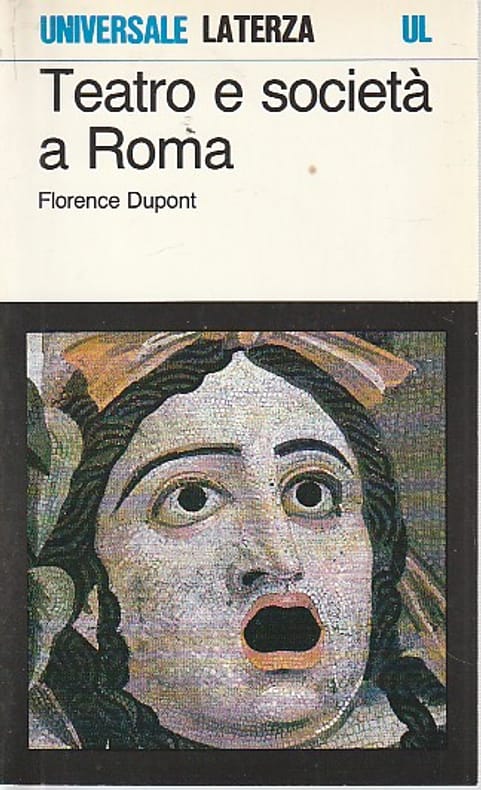
DUPONT Florence
Teatro e società a Roma
Lingua italiana, Universale Laterza, 1991,125 pp., brossura editore, condizioni buone.
Referentie van de boekhandelaar : 65400
|
|
|
DUPONT Florence - ELOI Thierry
L'érotisme masculin dans la Rome Antique.
Couverture souple. Broché. 347 pages.
Referentie van de boekhandelaar : 203963

|
|
|
DUPONT Florence - Éloi Thierry
L'Érotisme masculin dans la Rome Antique
Paris Belin 2001 nombreux passages soulignés au crayon mine ( Effaçable )
Referentie van de boekhandelaar : 32532
|
|
|
Dupont, Florence.
L’acteur-roi ou Le théâtre à Rome. Collection Realia.
Paris, Les Belles Lettres 1985, 210x135mm, 462pages, broché. Couverture illustrée à rabats.
Referentie van de boekhandelaar : 95995

|
|
|
Dupont,Joseph
Etude sur l'ager publicus en droit romain de la propriété des biens communaux en droit coutumier et en droit français,thése pour le doctorat
1868 TOULOUSE IMP.CAILLOL et BAYLAC,1868,IN8 broché,183p,dos muet effrangé avec petits manques,trés rare,pas au CCF.
Referentie van de boekhandelaar : 22857

|
|
|
DUPOUY (Auguste).
Rome et les Lettres Latines.
Armand Colin, 1924, in-12, 216 pp, biblio, reliure pleine toile écrue, pièce de titre basane grenat, couv. conservées (rel. de l'époque), bon état (Coll. Armand Colin)
Referentie van de boekhandelaar : 100853
|
|
|
DUPOUY (Auguste).-
Rome et les lettres latines. 2e édition corrigée.
P., A. Colin (Collection Armand Colin), 1935, in 12 broché, 220 pages.
Referentie van de boekhandelaar : 26484
|
|
|
DUPOUY Auguste
Horace.
Broch?. 267 pages. Manque au dos.
|
|
|
DUPOUY Auguste
Horace. Collection : Les heures antiques, N° 3.
Paris, Bernard Grasset, 1928. 12 x 19, 267 pp., broché, non coupé, bon état.
Referentie van de boekhandelaar : 82254
|
|
|
DUPRAZ, Louis.
De l’Association de Tibère au Principat à la Naissance du Christ. Trois Etudes. I. Les Avenues militaires de l’association de Tibère au Principat. II. L’année de la Naissance du Christ. III. Le recensement de P. Sulpicius Quirinus et la création de la province procuratorienne de Judée. Coll. Studia Friburgensia, Nouvelle Série, 43.
Fribourg, Editions Universitaires 1966, 235x160mm, X - 267pages, broché. Bel exemplaire.
Referentie van de boekhandelaar : 21477

|
|
|
Duran fils
Rome/Ancienne Ecole des Beaux arts

|
|
|
DURAND-CLAYE M. Alfred (1841-1888).
Etude sur la stabilité de la coupole projetée par Bramante pour la Basilique de Saint-Pierre de Rome.
Esemplare completo delle 2 grandi tavole incise poste al fondo fuori testo; la prima riassume in sezione i calcoli della stabilità evidenziati con linee bicolori; la seconda è uno spaccato frontale e in pianta della Cupola. 26 figure incise in nero nel testo su due colonne. Rarissima pubblicazione, splendido esemplare in veste totalmente editoriale. Brossura cartacea editoriale a stampa, pp. 16, 2 tavole fuori testo, In 4° grande (36,6 x 28 cm.)
|
|
|
DURANT (Will).
Histoire de la civilisation. VII-IX. Rome.
Payot, 1949-1950, 3 vol. in-8°, 304, 336 et 294 pp, traduction de Jacques Marty, 2 cartes, biblio, notes, broché, couv. illustrée, bon état (Coll. Bibliothèque historique)
Referentie van de boekhandelaar : 112001
|
|
|
Durant W.
Caesar and Christ. A History of Roman Civilization and of Christianity from their beginnings to A.D. 325. Second Printing.
New York, Simon & Schuster, 1944, in-8, tela edit., titolo oro, pp. XVI, 751. Con 39 ill. in b.n. f.t., una carta piegata e bibliografia.
|
|
|
Durant W.
Caesar un Christus. Eine Kultur Geschichte Roms und des Christentums von den Anfagen bis zum Jahre 325 n. Chr.
Bern, Francke Verlag, (1959), in-8, tela editoriale, sovraccoperta, custodia, pp. 736. Con 32 tavole e 3 carte.
|
|
|
Durant W.
Storia della civiltà. Cesare e Cristo. Con 425 illustrazioni nel testo e 40 tavole fuori testo in nero e a colori.
(Milano), Mondadori, (1957), in-4, tela edit., pp. X, 889, (5). Terzo volume della "Storia della Civiltà". Legatura allentata.
|
|
|
DURANT Will
Rome. Le principat. César et le Christ - 2.
Couverture rigide. Reliure club. 391 pages.
Referentie van de boekhandelaar : 11700
|
|
|
DURANT Will
Rome. Les origines. La République. César et le Christ- 1.
Couverture rigide. Reliure club. 391 pages.
Referentie van de boekhandelaar : 11698
|
|
|
DURANT WILL
STORIA DELLA CIVILTà L'ETà della REPUBBLICA
In 8°; 410, (4) pp. Legatura in similpelle con sopraccoperta editoriale. Volume terzo tomo primo "Cesare e Cristo" della collana , Storia della civiltà, il mondo antico". Preludio Etrusco e storia romana fino a Cristo e alla fine della Repubblica Romana. Ottimo esemplare come nuovo.
|
|
|
DURANT WILL
TEORIA DELLA CIVILTà, I SECOLI DELL'IMPERO
In 8°; 501, (3) pp. Legatura in similpelle con sopraccoperta editoriale. Volume terzo tomo secondo "Cesare e Cristo" della collana , "Storia della civiltà, il mondo antico". Da Augusto al 192 d.c. Ottimo esemplare come nuovo.
|
|
|
DURANT Will et Ariel
La renaissance. Prélude. La renaissance Florentine. Splendeurs Italiennes. La renaissance à Rome. Débacle et finale
Cercle du Bibliophile 1963, 3 volumes reliure éditeur, tétes dorées. 444 + 428 + 370 pages. Iconographie. Histoire de la civilisation en ITALIE de 1304 à 1576. 3 volumes bien complets qui constituents les tomes 14, 15 et 16 de l'HISTOIRE DE LA CIVILISATION. Parfait état.
|
|
|
DURANT Will et Ariel
La renaissance. Prélude. La renaissance Florentine. Splendeurs Italiennes. La renaissance à Rome. Débacle et finale
Cercle du Bibliophile Cercle du Bibliophile 1963, 3 volumes reliure éditeur, tétes dorées. 444 + 428 + 370 pages. Iconographie. Histoire de la civilisation en ITALIE de 1304 à 1576. 3 volumes bien complets qui constituents les tomes 14, 15 et 16 de l'HISTOIRE DE LA CIVILISATION. Parfait état.
Referentie van de boekhandelaar : 9996715
|
|
|
Durant, Will
Caesar und Christus. Eine Kulturgeschichte Roms und des Christentums von den Anfängen bis zum Jahre 325 n.Chr. Mit 35 Bildern auf 32 Tafeln und 3 Karten.
Bern, Francke 1959. Gr.8°. 736 S. OLwd. Wenige farbige Anstreichungen. (=Kulturgeschichte der Menschheit Band 3).
Referentie van de boekhandelaar : 2728AB
|
|
|
DURANTE C
ACQUARELLI. Poesie romanesche
ILL. DA A CAPANNA Segni a lapis

|
|
|
DURANTE C
ACQUARELLI. Poesie romanesche
ILL DI BELLI

|
|
|
DURANTE CHECCO
ACQUARELLI
Poesie romanesche. Pref. di Ceccarius. Roma Blasi 1954. In 16°; pp. 96, con 3 tavv. a col. ft. da acquarelli di A. Capanna; leg. similpelle recente con titt. in oro al dorso. Unito: DURANTE CHECCO - ER NEGOZZIO CHIUSO AR GIANNICOLO E ALTRE POESIE. Roma Blasi sd.; pp. 24, con una caricatura di Onorato all’antip. Unito: DURANTE CHECCO - LA RIVINCITA DI PONTE MOLLO (Romolo e Lucullo; lumache; il pane; la giostra dei polli). Roma 1962; pp. 16, con una caricatura di Onorato all’antip. e ill. nt. di Belli.
|
|
|
Durante Checco
Acquerelli – poesie Romanesche – pref. di Ceccarius . Acquerelli di Aristide Capanna – dialetto
Ottima copia
|
|
|
DURANTE Checco (Roma, 1893 - 1976).
Er negozzio chiuso, Ar Giannicolo, e altre poesie.
In-16°, leg. in bross. spillata, pp. 23(1). Francesco Durante, poeta e attore dialettale romano, fu nella compagnia di Ettore Petrolini dal 1918 al 1928, prima di fondarne una propria. Buon esemplare.
|
|
|
DURANTE Checco.
Acquarelli. Poesie romanesche. Roma, Blasi, 1950.
16°, br. edit., pp.96. Ritratto dell’Autore e 3 tavv. a colori f.t. Prima edizione.
|
|
|
DURANTE Checco.
I miei ricordi. Roma, Tip. Don Guanella, s.d. (1973).
8°, br. edit., soprac. ill., pp. 316 ritratto all’antiporta e disegni n.t. di Belli, Mastroianni, Kremos, Onorato. Bella ediz. su carta forte.
|
|
|
DURANTE Checco.
I miei ricordi. Roma, Tip. Don Guanella, s.d. (1973).
8°, br. edit., soprac. ill., pp. 316 ritratto all’antiporta e disegni n.t. di Belli, Mastroianni, Kremos, Onorato. Bella ediz. su carta forte. Dedica autografa dell’Autore.
|
|
|
DURANTE, Checco
Acquarelli. Poesie romanesche
95 pp.; 17 cm. Bross. edit. con sovrac. Ex libris all'interno della copertina
|
|
|
DURANTE, Checco
Acquarelli. Poesie romanesche
94 pp., tavv. a colori f.t., riproducenti acquarelli di Aristide Capanna; 16,5 cm. Bross. edit. con sovrac. Sovrac. con tracce d'uso e alcuni strappi
|
|
|
Durante, Checco
I miei ricordi ; Le mie poesie
Durante, Checco I miei ricordi ; Le mie poesie. Roma, 1973, 315 p. : ill. ; 21 cm Dedica autografa dell'autore alla tavola di controfrontespizio (0000000042886)

|
|
|

 De zoekresultaten per email ontvangen
 Zoekresultaten downloaden als PDF
 RSS feed
 Permanente link


