|
|
|
CLARKE, Martin L
Bruto l'uomo che uccise Cesare. Traduzione di Eva Collini
1 Vol. In-8 t.edit., tit.oro al dorso, sovracpt.ill pag. XVII-198 alc.ill.f.t PROG 14750 CATT_ATT 25
|
|
|
CLASON, Octavius
Zur Frage über die Zusammensetzung der Curien und ihrer Comitien.
Rostock, Adler, 1871. 70 S. OBroschur.
书商的参考编号 : 3438507
|
|
|
Claude Moatti
Roma antica tra mito e scoperta
Traduzione di Carlo Montrésor, edizione italiana curata da Martine Buysschaert, pagine patinate, profusamente illustrate ed in ottimo stato di conservazione, brossura editoriale illustrata, lucida, flessibile e con lievissimi ed inevitabili segni di usura. Numero pagine 200 USATO

|
|
|
Claude Mossé
La colonisation dans l'Antiquité
Fernand Nathan 1970 191 pages in8. 1970. broché. 191 pages. Ouvrage historique de Claude Mossé publié en 1970 chez Fernand Nathan analysant les phénomènes de colonisation dans l'Antiquité grecque et romaine. Le livre propose une comparaison entre les domaines grec et latin ainsi qu'entre les moitiés occidentale et orientale de l'empire romain présentée comme particulièrement réussie
书商的参考编号 : 11396

|
|
|
CLAUDE MOSSÉ
LE DOTTRINE POLITICHE IN GRECIA
A CURA DI ENRICO DE MAS Con i confronti antologici di: Th. A. Sinclair, B. Constant, B. Croce, G. Sartori, G. Fassò, G. Mosca, M. Untersteiner, L. Strauss, A. Koyré, Ch. H. Macllwain, F. Adorno, J. Tourchard. CASA EDIT1973 MAI SFOGLIATO

|
|
|
CLAUDE NICOLET
DES ORDRES A ROME
brocché - x _ pp - édditions - 19
书商的参考编号 : 19658
|
|
|
Claudia Pandolfi
Garum. «Si può dire che non ci sia alcun liquido, all'infuori dei profumi, che abbia preso a costare di più»
"Che cosa era il 'garum'? Sicuramente, una salsa di pesce, molto pregiata, presente sulle tavole dei ricchi e dei buongustai dell'antica Roma. Petronio, nella coreografica 'Cena di Trimalchione', descrive il trionfo di pietanze varie, ai cui angoli quattro statuette facevano colare da piccoli otri 'garum' al pepe sopra dei pesci, che sembravano così nuotare in una sorta di canale. Su come il 'garum' fosse preparato le fonti non sono univoche, e spesso tendono a confonderlo o ad assimilarlo con condimenti analoghi, denominati 'liquamen' e 'muria'. Attraverso un'analisi dei testi letterari, dei trattati medici e dei manuali di cucina tramandati dall'antichità, il libro ricostruisce la complessa storia di questa misteriosa salsa, che, nelle sue varianti - non ultima la colatura di alici di Cetara - sembra godere oggi di una rinnovata fortuna in diversi contesti gastronomici". Autori: Claudia Pandolfi.

|
|
|
Claudia Salvatori
Il sole invincibile
La storia dell'imperatore Eliogabalo, poi afflitto da damnatio memoriae, in un romanzo della scrittrice Claudia Salvatori che cerca di sviscerare la vita di uno dei più noti imperatori romani. Ottimamente conservato, sovraccoperta leggermente spiegazzata.
|
|
|
CLAUDIANUS CL(audius) ( ClAUDIEN )
CL. CLAUDIANUS EX OPTIMORUM CODICUM FIDE
Bassani Ex typographia Jo. Antonii Remondini 1722 1 vol. in-12 ( 14 x 8 cm ) ( poids = 150 g ) 264 pp. ( dont t. ) . En latin . Contient : C. Claudiani vita ex Petro Crinito , Ex Volaterrano ; De Claudiano ejusque scriptis testimonia ; Cl. Claudiani operum index ; De raptu Proserpinae ; In Rufinum ; In Eutropium ; De bello Gildonico ; De bello Getico vel Pollentiaco vel De victoria Stiliconis contra Alaricum ; De tertio consulatu Honorii Augusti Panegyris ; De quarto consulatu Honorii Augusti Panegyris ; De sexto consulatu Honorii Augusti Panegyris ; De consulatu Mallii Theodori Panegyris ; De Probini et Olybrii fratrum consulatu ; De laudibus Stiliconis ; Laus Serenae reginae ; De nuptiis Honorii et Mariae ; In nuptias Honorii Augusti et Mariae ; Epithalamium Palladii & Celerinae ; Gigantomachia ; Epigrammata ; Anonymi Poetae laudes Herculis . Au titre , marque typographique de Giovanni Antonio Remondini ; une lettrine , culs-de-lampe . Plein vélin de l' époque . Dos lisse , nom de l' auteur à l' encre . Bon état . Petit travail de vers à la reliure . ( Collat. complet )
书商的参考编号 : 625
|
|
|
CLAUDIEN (Claudius Claudianus) - [Theodor Poelmann]
Cl. Claudianus Theod. Pulmanni Craneburgii diligentia, & fide summa, è vetustis codicibus restitutus.
rouen Beauvais 1611 in-16 plein-VELIN un volume, reliure janséniste d'époque en plein vélin ivoire parcheminé à fermeture à cordonnet (sans les cordonnets) (jansenist's binding full vellum) in-16 (8,5 x 12,4 cm), dos long (spine without raised band), titre manuscrit à l'encre brune en haut du dos (handwritten title on the spine), plats muets (cover without text), tranches lisses (smooth edges), Texte en Latin, sans illustration (no illustration) excepté la marque de l'imprimeur gravée sur bois (engraving wood) en noir sur la page de titre + bandeaux et lettrines gravées suir bois en noir, 384 pages, 1611 Rothomagi apud Romanum de Beauvais Editeur,
书商的参考编号 : 18572
|
|
|
Claudio Colaiacomo
Il giro di Roma in 501 luoghi La città come non l'avete mai vista
Coperta illustrata a colori e con ordinari segni del tempo, tagli regolari, pagine ben salde alla costa e con naturale minima imbrunitura ai margini, libro completamente fruibile, n. 198 della collana "Grandi Manuali Newton", presenti numerose illustrazioni in bianco e nero (quelle della tavole fuori testo sono di Serena Effect), prima edizione, numero pagine 478 USATO

|
|
|
Claudio Foti
Defixiones. Le tavolette magiche nell'antica Roma
Questo saggio passa in rassegna aspetti poco noti al grande pubblico della magia nel periodo greco-romano avvalendosi di testi scritti, in un arco di tempo che va dal 776 a.C. fino alla fine dell'Impero Romano (476 d.C). Ma cosa si intende per magia? La definizione in se stessa è più problematica di quanto si pensi e spesso sono necessarie decine di pagine di speculazioni filosofiche solo per introdurre l'argomento. È fondamentale che un testo che si rivolga a non studiosi della materia e persino a profani della stessa, riesca a sintetizzare i temi trattati, senza alcun dogma, permettendo così al lettore di elaborare la sua idea personale. Dobbiamo però partire da un assunto spesso ignorato o dato per scontato: la magia antica basava i suoi riti richiamando forze ed entità per lo più malevole. Esse ne costituivano il fulcro, senza cui i riti non potevano essere attuati. Tale pratica troverà la sua massima espressione attraverso l'utilizzazione delle Tavolette Maledette. Nel libro, dapprima analizzeremo l'aspetto magico di Roma, i riti e le superstizioni, poi andremo a scoprire chi erano gli stregoni e le streghe dell'epoca nonché le leggi promulgate per arrestare il fenomeno magico a livello sociale. Successivamente ci inoltreremo nell'affascinante e poco conosciuto campo delle Defixiones. Queste saranno affrontate e sviscerate attraverso vari criteri, tra cui il materiale di costruzione, la provenienza geografica e il tipo di magia. Autori: Claudio Foti.

|
|
|
Claudio Foti
I sette talismani di Roma antica
Nell’antica Roma ai tempi in cui il Tevere era ancora giovane si mormorava dell’esistenza di sette oggetti: i Pignora Imperii. Oggetti totemici che la proteggevano e la difendevano da sempre, che da sempre vegliavano sulla sua superiorità che andava espandendosi in tutto il mondo conosciuto. Pignora Imperii dunque, ma cosa si cela dietro questo bizzarro nome? Roma aveva veramente sette talismani che la proteggevano o si tratta solo di leggende arcaiche? Come erano fatti e quale era la storia di questi oggetti magici? Da dove venivano e come e quando sono arrivati nella Città Eterna? In questo libro scoprirete le risposte che sembrano così difficili da trovare e conoscerete la storia poco nota, ma tremendamente importante di questi oggetti fatali che avevano il compito di proteggere la città di Remo e Romolo. Le leggendarie gesta di Numa Pompilio e dell’Ancile, l’invincibile Quadriga dei Veienti, il regale Scettro di Priamo, il famoso Ago di Cibele, le preziose Ceneri di Oreste, la Veste di Iliona e il misterioso Palladio torneranno alla vita. Autori: Claudio Foti.

|
|
|
Claudio Rendina
Alla scoperta di Roma Oltre duecento «cartoline romane» che rivelano gli aspetti meno noti, i luoghi scomparsi, i personaggi, i racconti e i segreti di una città dalla storia millenaria
bross. edit. ill. con bandelle, minima macchia al taglio davanti - numerose illustrazioni in b.n. nel testo

|
|
|
Claudio Rendina
Guida insolita ai misteri, ai segreti, alle leggende e alle curiosità del Tevere Il fiume di Roma
Brossura cartonata con alette, coperta illustrata a colori al piatto anteriore e con ordinari segni del tempo ai margini, alle punte e alle cuffie. Tagli regolari, pagine ben salde alla costa e con naturale imbrunitura, libro completamente furibile, n. 124 della collana "Tradizioni italiane", presenti illustrazioni in nero nel testo, impaginazione e ricerca iconografica di Alberto Tagliaferri e Valerio Varriale, prima edizione nella collana, numero pagine 511 USATO

|
|
|
Claudio Rendina
Guida insolita del Tevere Il fiume di Roma Il corso del fiume dalle sorgenti alla foce tra natura e archeologia, storia e urbanistica: il bacino fluviale, la flora, la fauna, gli affluenti, l'Aniene, le cascate, i laghi, le spiagge, i porti
continua dal front.: ...la navigazione, gli arsenali, i molini, le inondazioni, i muraglioni, i lungotevere, i ponti, i fiumaroli, i circoli sportivi - cartone edit. con titoli al piatto e al dorso e sovrac. ill. - numerose illustrazioni in b.n. nel testo

|
|
|
Claudio Rendina
Il Vaticano - Storia e segreti
Copertina edit. rigida rossa con sovracc. Il sacro e il profano in due millenni della Santa Sede: vicende religiose, politiche e finanziarie di uno Stato in perenne equilibrio tra sanità e autoritarismo, dogmatismo e vocazione, mecenatismo e sete di potere numero pagine: 452 formato: 15.5x22.5 stato conservazione: Buono collana: Quest'Italia - Collana di storia, arte e folclore, 101
|
|
|
Claudio Rendina
Le chiese di Roma
Volume numero 7 appartenente alla collana biblioteca de Il Messaggero. Copertina a cura di Alessandro Tiburtini. Sovraccoperta stanca agli angoli e ai margini, così come all'estremità del dorso. Legatura rossa con titoli bianchi sia al dorso che al piatto superiore, leggermente stanca agli angoli e all'estremità del dorso. Pagina ben salde alla cerniera, con ampio margine, lievemente brunite, così come i tagli. Numero pagine 383. USATO

|
|
|
Clausing, Roth
THE ROMAN COLONATE The Theories of its Origin
With an introduction by Vladimir G. Simkhovitch. Looks at the development of the institution of the Roman colonate and its intimate connection with the decline of ancient civilization and persistance through most of the Middle Ages. ; Studies in History, Economics, and Public Law, V. 117, No. 1, Whole No. 260; 333 pages
|
|
|
Clauss, Manfred
Einführung in die alte Geschichte,
München, C. H. Beck (= C. H. Beck Studium), 1993. 8°. 217 S. mit s/w-Abbildungen und Karten, original Kartonage (Paperback), Erstausgabe zwei zarte Längsfalten auf Buchrücken, kleiner Nummernvermerk oben links auf Innendeckel, Seite 15/16 unten mit kleinem Eckknick, sonst schönes, sauberes Exemplar.
书商的参考编号 : 16006CB

|
|
|
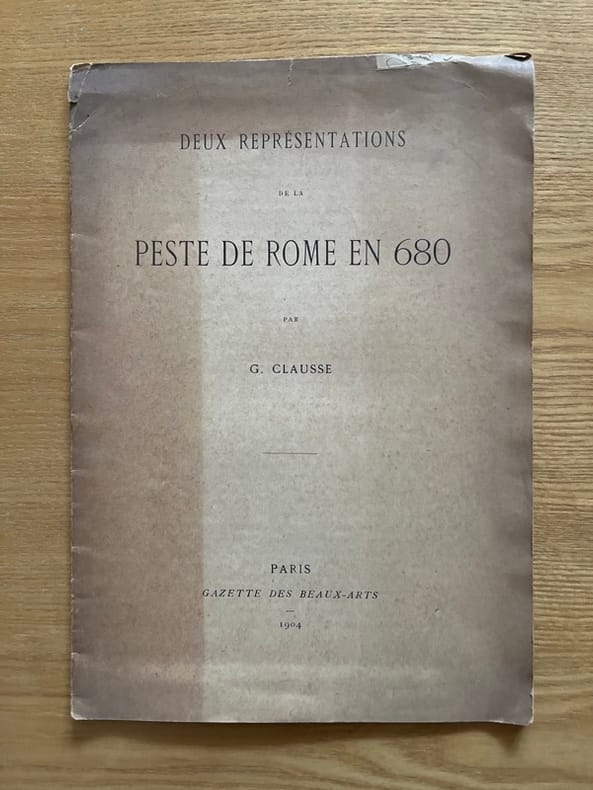
CLAUSSE (Gustave).
Deux représentations de la peste à Rome en 680.
Paris, Gazette des Beaux-Arts, 1904 in-4, 15 pp., ill. in-t., broché. Manque de papier sur la couverture. Envoi.
书商的参考编号 : 243030
|
|
|
CLAUSSE Arnould
La littérature latine par les textes, à l'usage des trois classes supérieures des athénées, lycées et collèges.
Bruxelles, Maison d'Edition A. De Boeck, 1951. "16 x 21, 272 pp., broché, état moyen (couverture défraîchie; papier jauni)."
书商的参考编号 : 39304
|
|
|
CLAUSSE, Gustave
Les monuments du christianisme au moyen-âge : les marbriers romains et le mobilier presbytéral
Paris, Ernest Leroux 1897 In-4 27,5 x 18 cm. Broché, couverture beige, titre en noir sur le dos et le premier plat, X-526 pp., 75 dessins dans et hors-texte, notes en bas de page, table des matières. Couverture piquée, intérieur très frais, pages non coupées.
书商的参考编号 : 103090
|
|
|
CLAUSSE, Gustave
Les monuments du christianisme au moyen-âge : les marbriers romains et le mobilier presbytéral
Paris, Ernest Leroux 1897 In-4 27,5 x 18 cm. Reliure demi-basane havane à coins, dos lisse ornés de filets dorés et à froid, couverture beige, titre en noir sur le dos et le premier plat, X-526 pp., 75 dessins dans et hors-texte, notes en bas de page, table des matières. Accrocs en tête de dos.
书商的参考编号 : 115881
|
|
|
Clausse, Gustave
Les San Gallo: Architectes, Peintres, Sculpteurs, Medailleurs - XVe et XVIe Siecles - Tome Second - Antonio da San Gallo (Le Jeune) [THIS VOLUME ONLY]
THIS VOLUME ONLY. 19x28 cm. 433 pages. Softcover. Cover slightly stained. Back cover slightly creased. Cover corners slightly chafed. Spine slightly chafed. Pages are age stained. Several page edges slightly bent. Else in good condition. PLEASE NOTE: This item is overweight. We may ask for extra shipping costs.
|
|
|
CLAVEL (Monique) et Pierre LEVEQUE.
Villes et structures urbaines dans l'Occident romain.
Armand Colin, 1971, in-12, 359 pp, biblio, index, broché, bon état (Coll. U2)
书商的参考编号 : 7444
|
|
|
Clavel Bernard
Brutus
ALBIN MICHEL 2001 416 pages 14 9x22 5x3 7cm. 2001. Broché. 416 pages. Le roman raconte le voyage d'un taureau camarguais nommé Brutus prisonnier sur une barge remontant le Rhône vers Lugdunum (Lyon) capitale des Gaules à l'époque romaine où les Chrétiens sont persécutés. L'histoire évoque également l'amour et la complicité entre un jeune garçon et l'animal ainsi que les thèmes de fraternité et d'entraide entre les hommes
书商的参考编号 : 12143

|
|
|
CLAVEL Victor
ARNAULD DE BRESCIA et les Romains du XIIème Siècle (avec une carte de Rome)
Paris L. Hachette et Cie 1868 in-8 demi-chagrin un volume, reliure demi-chagrin marron foncé in-octavo Editeur (binding half shagreen in-8 Editor) (22 x 14 cm), Reliure d'Epoque, dos 5 nerfs (spine with raised bands) décoré or et à froid (gilt and blind-stamping decoration), titre frappé or (gilt title) avec un filet "or" de part et d'autre du titre, entre-nerf orné d'un double filet or en encadrement dans un filet large mat en encadrement, le tout encadré d'un filet or, filet à froid de part et d'autre des nerfs, percale marron décorée à froid sur les plats (plaques spéciales Editeur) (blind-stamping green percale on the cover), toutes tranches lisses, ouvrage orné d'un grand plan dépliant hors-texte en noir de ROME gravée par P. Mea, IX +428 pages, 1868 à Paris Librairie de L. Hachette et Cie Editeur,
书商的参考编号 : 20746
|
|
|
CLEBERT, J.-P.
Provence antique. T.I-II.
2 volumes grand in-8°, 279-281 pages, ill. hors texte N&B, fig. et cartes in-t., notes, index, broche, couverture illustree plast. à rabats. Bel ensemble [CA-11] T. I : Des origines à la conquête romaine.- T. II : L’époque gallo-romaine.
|
|
|
CLEEVE Hendrick van (Anversa 1524 - 1589)
Belvedere Romanonum
Veduta tratta dalla raccolta Ruinarum varii prospectus, ruriumque aliquot delineationes pubblicato da Philip Galle con incisioni tratte da disegni di Hendrick van Cleve o Cliven III. Figlio e allievo di William van Cleve, si trasferisce in Italia nella metà del XVI secolo; oltre ad un dipinto raffigurante una veduta di Roma, datato 1550, realizza un cospicuo numero di disegni che serviranno come modelli per l’opera incisa, realizzata al ritorno ad Anversa e pubblicata nel 1587. Le vedute, che raffigurano principalmente Roma ma anche altre città europee, recano in basso l’iscrizione “Henri. Cliven. inven." o "Henri Cliven pingebat" che ne attestano la derivazione ma non l'autografia. È certo che Hendrick viaggiò in Italia. Gli studiosi non sono d'accordo sui tempi del suo soggiorno, che alcuni collocano prima del 1551, anno in cui divenne maestro della Gilda, mentre altri lo collocano tra il 1551 e il 1555, data in cui si sposò. In Italia fece molti disegni di vedute di montagne, edifici e paesaggi urbani, che poi utilizzò nelle sue opere. Sulla base dei suoi disegni noti di città italiane, probabilmente trascorse del tempo a Roma, Firenze e Napoli. Hendrick van Cleve era un artista di paesaggio, creando sia vedute topografiche che paesaggi immaginari. I suoi paesaggi sono in stile italianizzante e tipicamente raffigurano ampie vedute con rovine che possono essere o meno interamente immaginarie. Le rovine sono di solito una compilazione di elementi caratteristici dell'architettura classica. Alcune sono basate su rovine esistenti che possono essere identificate, mentre altre sono costruzioni completamente di fantasia dell’artista. I disegni di Hendrik van Cleve furono quindi usati dai tipografi contemporanei di Anversa. Due serie di stampe secondo i disegni di van Cleve furono pubblicate dal famoso incisore ed editore Philips Galle. La prima serie, Regionem, rurium, fundormumq[ue], varii atove amoeni prospectus fu pubblicata nel 1587. Consiste di 10 tavole che raffigurano principalmente paesaggi pastorali immaginari con rovine. Hendrik van Cleve è menzionato come disegnatore su ogni stampa e Philip Galle come incisore. La seconda serie intitolata Ruinarum varii prospectus, ruriumq[ue] aliquot delineationes non è datata ma fu probabilmente pubblicata intorno allo stesso periodo della prima. Le 38 stampe mostrano vedute mediterranee. Non è chiaro chi abbia inciso questa serie. La firma con il monogramma di H. van Cleve appare su tutte le 38 incisioni, ad eccezione dell'incisione n. 22 della serie. Anche la firma di Philip Galle appare su tutte le incisioni mentre quella di suo figlio Theodoor appare solo su una. Anche Hendrick van Cleve stesso potrebbe essere stato l'incisore della serie. Incisione al bulino, bella impressione su carta vergata coeva, in ottimo stato di conservazione. A nice view taken from the rare Ruinarum vari prospectus ruriumq. Aliquot delinationes. Hendrick van Cleve or Cliven III, son and pupil of William van Cleve, moved to Italy in the second half of the XVI century; besides a painting depicting a view of Rome (1550), he realized a considerable amount of drawing which he afterwards used as preparatory for the engravings he realized in Antwerp and published by Philip Galle in 1587. The views, whose main subject is Rome but there are also other European cities, bear the inscription “Henri. Cliven. inven" or "Henri Cliven pingebat" on lower part, which testify their origin, but not necessarily the fact that he realized them. It is certain that Hendrick travelled to Italy. Scholars disagree about the timing of his stay in Italy. Some place it before 1551, the year in which he became a master of the Guild, while others place it between 1551 and 1555, the date on which he got married. In Italy he made many drawings of mountain views, buildings and cityscapes, which he later used in his works. Based on his known drawings of Italian cities, he likely spent time in Rome, Florence and Naples. Hendrick van Cleve was a landscape artist. He created topographical views as well as imaginary landscapes. His landscapes are in the Italianising style and typically depict wide views with ruins that may or may not be entirely imaginary. The ruins are usually a compilation of characteristic elements from classical architecture. Some are based on existing ruins which can be identified. Others are completely fabricated constructions Hendrik van Cleve's drawings were used by contemporary printmakers in Antwerp as designs. Two series of prints after van Cleve's designs were published by the renowned engraver and publisher, Philips Galle. The first series, Regionem, rurium, fundormumq[ue], varii atove amoeni prospectus was published in 1587. It consists of 10 plates that mainly depict imaginary pastoral landscapes with ruins. Hendrik van Cleve is mentioned as the designer on each print and Philip Galle as the engraver. The second series entitled Ruinarum varii prospectus, ruriumq[ue] aliquot delineationes is undated but was likely published around the same time as the first one. The 38 prints show Mediterranean views. It is not clear who engraved this series. H. van Cleve's signature and monogram appear on all 38 engravings with the exception of engraving n.22 of the set which lacks the monogram. Philip Galle's signature also appears on all the engravings while that of his son Theodoor appears on engraving only. Hendrick van Cleve III may also have been the engraver as his monogram is present on the print. Engraving, with fine later hand colour, some paper fold perfectly restored, otherwise good conditions. Hollstein, F. W. H. Dutch and Flemish Etchings, Engravings, and Woodcuts, v.4, pl.170, n.1-38 and v.7, p.80, n.423-460.

|
|
|
CLEEVE Hendrick van (Anversa 1524 - 1589)
Burgus Romae
Veduta tratta dalla raccolta Ruinarum varii prospectus, ruriumque aliquot delineationes pubblicata da Philip Galle con incisioni tratte da disegni di Hendrick van Cleve o Cliven III. Figlio e allievo di William van Cleve, si trasferisce in Italia nella metà del XVI secolo. Oltre ad un dipinto raffigurante una veduta di Roma, datato 1550, realizza un cospicuo numero di disegni che serviranno come modelli per l’opera incisa, realizzata al ritorno ad Anversa e pubblicata nel 1587. Le vedute, che raffigurano principalmente Roma ma anche altre città europee, recano in basso le iscrizioni “Henri. Cliven. inven.” o “Henri Cliven pingebat”, che ne attestano la derivazione, ma non l'autografia. È certo che Hendrick viaggiò in Italia. Gli studiosi non sono d'accordo sui tempi del suo soggiorno: alcuni lo collocano prima del 1551, anno in cui divenne maestro della Gilda, altri tra il 1551 e il 1555, data in cui si sposò. In Italia fece molti disegni di vedute di montagne, edifici e paesaggi urbani, che poi utilizzò nelle sue opere. Sulla base dei suoi disegni noti di città italiane, probabilmente trascorse del tempo a Roma, Firenze e Napoli. Hendrick van Cleve era un artista di paesaggio, creava sia vedute topografiche sia paesaggi immaginari. Questi sono in stile italianizzante, raffigurano ampie vedute con rovine che possono essere o meno interamente immaginarie. Le rovine sono di solito una compilazione di elementi caratteristici dell'architettura classica; alcune sono basate su rovine esistenti che possono essere identificate, altre sono costruzioni completamente di fantasia dell’artista. I disegni di Hendrik van Cleve furono, quindi, usati dai tipografi contemporanei di Anversa. Due serie di stampe, secondo i disegni di van Cleve, furono pubblicate dal famoso incisore ed editore Philips Galle. La prima serie, Regionem, rurium, fundormumq[ue], varii atove amoeni prospectus, pubblicata nel 1587, comprende 10 tavole che raffigurano principalmente paesaggi pastorali immaginari con rovine. Hendrik van Cleve è menzionato come disegnatore su ogni stampa e Philip Galle come incisore. La seconda serie intitolata Ruinarum varii prospectus, ruriumq[ue] aliquot delineationes non è datata, ma fu, probabilmente, pubblicata nello stesso periodo della prima. Le 38 stampe mostrano vedute mediterranee, non è chiaro chi abbia inciso questa serie. La firma con il monogramma di H. van Cleve appare su tutte le 38 incisioni, ad eccezione della n° 22. La firma di Philip Galle appare su tutte le incisioni mentre quella di suo figlio Theodoor si vede solo su una. Anche Hendrick van Cleve stesso potrebbe essere stato l'incisore della serie. Incisione al bulino, bella impressione su carta vergata coeva, in ottimo stato di conservazione. A nice view taken from the rare Ruinarum vari prospectus ruriumq. Aliquot delinationes. Hendrick van Cleve or Cliven III, son and pupil of William van Cleve, moved to Italy in the second half of the XVI century; besides a painting depicting a view of Rome (1550), he realized a considerable amount of drawing which he afterwards used as preparatory for the engravings he realized in Antwerp and published by Philip Galle in 1587. The views, whose main subject is Rome but there are also other European cities, bear the inscription “Henri. Cliven. Inven” or “Henri Cliven pingebat” on lower part, which testify their origin, but not necessarily the fact that he realized them. It is certain that Hendrick travelled to Italy. Scholars disagree about the timing of his stay in Italy. Some place it before 1551, the year in which he became a master of the Guild, while others place it between 1551 and 1555, the date on which he got married. In Italy he made many drawings of mountain views, buildings and cityscapes, which he later used in his works. Based on his known drawings of Italian cities, he likely spent time in Rome, Florence and Naples. Hendrick van Cleve was a landscape artist. He created topographical views as well as imaginary landscapes. His landscapes are in the Italianising style and typically depict wide views with ruins that may or may not be entirely imaginary. The ruins are usually a compilation of characteristic elements from classical architecture. Some are based on existing ruins which can be identified. Others are completely fabricated constructions Hendrik van Cleve’s drawings were used by contemporary printmakers in Antwerp as designs. Two series of prints after van Cleve's designs were published by the renowned engraver and publisher, Philips Galle. The first series, Regionem, rurium, fundormumq[ue], varii atove amoeni prospectus was published in 1587. It consists of 10 plates that mainly depict imaginary pastoral landscapes with ruins. Hendrik van Cleve is mentioned as the designer on each print and Philip Galle as the engraver. The second series entitled Ruinarum varii prospectus, ruriumq[ue] aliquot delineationes is undated but was likely published around the same time as the first one. The 38 prints show Mediterranean views. It is not clear who engraved this series. H. van Cleve’s signature and monogram appear on all 38 engravings with the exception of engraving n.22 of the set which lacks the monogram. Philip Galle’s signature also appears on all the engravings while that of his son Theodoor appears on engraving only. Hendrick van Cleve III may also have been the engraver as his monogram is present on the print. Engraving, good impression on contemporary laid paper, in very good conditions.

|
|
|
CLEEVE Hendrick van (Anversa 1524 - 1589)
Castellum S. Angeli
Veduta tratta dalla raccolta Ruinarum varii prospectus, ruriumque aliquot delineationes pubblicato da Philip Galle con incisioni tratte da disegni di Hendrick van Cleve o Cliven III. Figlio e allievo di William van Cleve, si trasferisce in Italia nella metà del XVI secolo; oltre ad un dipinto raffigurante una veduta di Roma, datato 1550, realizza un cospicuo numero di disegni che serviranno come modelli per l’opera incisa, realizzata al ritorno ad Anversa e pubblicata nel 1587. Le vedute, che raffigurano principalmente Roma ma anche altre città europee, recano in basso l’iscrizione “Henri. Cliven. inven." o "Henri Cliven pingebat" che ne attestano la derivazione ma non l'autografia. È certo che Hendrick viaggiò in Italia. Gli studiosi non sono d'accordo sui tempi del suo soggiorno, che alcuni collocano prima del 1551, anno in cui divenne maestro della Gilda, mentre altri lo collocano tra il 1551 e il 1555, data in cui si sposò. In Italia fece molti disegni di vedute di montagne, edifici e paesaggi urbani, che poi utilizzò nelle sue opere. Sulla base dei suoi disegni noti di città italiane, probabilmente trascorse del tempo a Roma, Firenze e Napoli. Hendrick van Cleve era un artista di paesaggio, creando sia vedute topografiche che paesaggi immaginari. I suoi paesaggi sono in stile italianizzante e tipicamente raffigurano ampie vedute con rovine che possono essere o meno interamente immaginarie. Le rovine sono di solito una compilazione di elementi caratteristici dell'architettura classica. Alcune sono basate su rovine esistenti che possono essere identificate, mentre altre sono costruzioni completamente di fantasia dell’artista. I disegni di Hendrik van Cleve furono quindi usati dai tipografi contemporanei di Anversa. Due serie di stampe secondo i disegni di van Cleve furono pubblicate dal famoso incisore ed editore Philips Galle. La prima serie, Regionem, rurium, fundormumq[ue], varii atove amoeni prospectus fu pubblicata nel 1587. Consiste di 10 tavole che raffigurano principalmente paesaggi pastorali immaginari con rovine. Hendrik van Cleve è menzionato come disegnatore su ogni stampa e Philip Galle come incisore. La seconda serie intitolata Ruinarum varii prospectus, ruriumq[ue] aliquot delineationes non è datata ma fu probabilmente pubblicata intorno allo stesso periodo della prima. Le 38 stampe mostrano vedute mediterranee. Non è chiaro chi abbia inciso questa serie. La firma con il monogramma di H. van Cleve appare su tutte le 38 incisioni, ad eccezione dell'incisione n. 22 della serie. Anche la firma di Philip Galle appare su tutte le incisioni mentre quella di suo figlio Theodoor appare solo su una. Anche Hendrick van Cleve stesso potrebbe essere stato l'incisore della serie. Incisione al bulino, bella impressione su carta vergata coeva, in ottimo stato di conservazione. A nice view taken from the rare Ruinarum vari prospectus ruriumq. Aliquot delinationes. Hendrick van Cleve or Cliven III, son and pupil of William van Cleve, moved to Italy in the second half of the XVI century; besides a painting depicting a view of Rome (1550), he realized a considerable amount of drawing which he afterwards used as preparatory for the engravings he realized in Antwerp and published by Philip Galle in 1587. The views, whose main subject is Rome but there are also other European cities, bear the inscription “Henri. Cliven. inven" or "Henri Cliven pingebat" on lower part, which testify their origin, but not necessarily the fact that he realized them. It is certain that Hendrick travelled to Italy. Scholars disagree about the timing of his stay in Italy. Some place it before 1551, the year in which he became a master of the Guild, while others place it between 1551 and 1555, the date on which he got married. In Italy he made many drawings of mountain views, buildings and cityscapes, which he later used in his works. Based on his known drawings of Italian cities, he likely spent time in Rome, Florence and Naples. Hendrick van Cleve was a landscape artist. He created topographical views as well as imaginary landscapes. His landscapes are in the Italianising style and typically depict wide views with ruins that may or may not be entirely imaginary. The ruins are usually a compilation of characteristic elements from classical architecture. Some are based on existing ruins which can be identified. Others are completely fabricated constructions Hendrik van Cleve's drawings were used by contemporary printmakers in Antwerp as designs. Two series of prints after van Cleve's designs were published by the renowned engraver and publisher, Philips Galle. The first series, Regionem, rurium, fundormumq[ue], varii atove amoeni prospectus was published in 1587. It consists of 10 plates that mainly depict imaginary pastoral landscapes with ruins. Hendrik van Cleve is mentioned as the designer on each print and Philip Galle as the engraver. The second series entitled Ruinarum varii prospectus, ruriumq[ue] aliquot delineationes is undated but was likely published around the same time as the first one. The 38 prints show Mediterranean views. It is not clear who engraved this series. H. van Cleve's signature and monogram appear on all 38 engravings with the exception of engraving n.22 of the set which lacks the monogram. Philip Galle's signature also appears on all the engravings while that of his son Theodoor appears on engraving only. Hendrick van Cleve III may also have been the engraver as his monogram is present on the print. Engraving, good impression on contemporary laid paper, very good conditions. Hollstein, F. W. H. Dutch and Flemish Etchings, Engravings, and Woodcuts, v.4, pl.170, n.1-38 and v.7, p.80, n.423-460.

|
|
|
CLEEVE Hendrick van (Anversa 1524 - 1589)
Castellum S. Angeli
Veduta tratta dalla raccolta Ruinarum varii prospectus, ruriumque aliquot delineationes pubblicato da Philip Galle con incisioni tratte da disegni di Hendrick van Cleve o Cliven III. Figlio e allievo di William van Cleve, si trasferisce in Italia nella metà del XVI secolo; oltre ad un dipinto raffigurante una veduta di Roma, datato 1550, realizza un cospicuo numero di disegni che serviranno come modelli per l’opera incisa, realizzata al ritorno ad Anversa e pubblicata nel 1587. Le vedute, che raffigurano principalmente Roma ma anche altre città europee, recano in basso l’iscrizione “Henri. Cliven. inven." o "Henri Cliven pingebat" che ne attestano la derivazione ma non l'autografia. È certo che Hendrick viaggiò in Italia. Gli studiosi non sono d'accordo sui tempi del suo soggiorno, che alcuni collocano prima del 1551, anno in cui divenne maestro della Gilda, mentre altri lo collocano tra il 1551 e il 1555, data in cui si sposò. In Italia fece molti disegni di vedute di montagne, edifici e paesaggi urbani, che poi utilizzò nelle sue opere. Sulla base dei suoi disegni noti di città italiane, probabilmente trascorse del tempo a Roma, Firenze e Napoli. Hendrick van Cleve era un artista di paesaggio, creando sia vedute topografiche che paesaggi immaginari. I suoi paesaggi sono in stile italianizzante e tipicamente raffigurano ampie vedute con rovine che possono essere o meno interamente immaginarie. Le rovine sono di solito una compilazione di elementi caratteristici dell'architettura classica. Alcune sono basate su rovine esistenti che possono essere identificate, mentre altre sono costruzioni completamente di fantasia dell’artista. I disegni di Hendrik van Cleve furono quindi usati dai tipografi contemporanei di Anversa. Due serie di stampe secondo i disegni di van Cleve furono pubblicate dal famoso incisore ed editore Philips Galle. La prima serie, Regionem, rurium, fundormumq[ue], varii atove amoeni prospectus fu pubblicata nel 1587. Consiste di 10 tavole che raffigurano principalmente paesaggi pastorali immaginari con rovine. Hendrik van Cleve è menzionato come disegnatore su ogni stampa e Philip Galle come incisore. La seconda serie intitolata Ruinarum varii prospectus, ruriumq[ue] aliquot delineationes non è datata ma fu probabilmente pubblicata intorno allo stesso periodo della prima. Le 38 stampe mostrano vedute mediterranee. Non è chiaro chi abbia inciso questa serie. La firma con il monogramma di H. van Cleve appare su tutte le 38 incisioni, ad eccezione dell'incisione n. 22 della serie. Anche la firma di Philip Galle appare su tutte le incisioni mentre quella di suo figlio Theodoor appare solo su una. Anche Hendrick van Cleve stesso potrebbe essere stato l'incisore della serie. Incisione al bulino, finemente colorata a mano, alcune pieghe di carta perfettamente restaurate, per il resto in buono stato di conservazione. A nice view taken from the rare Ruinarum vari prospectus ruriumq. Aliquot delinationes. Hendrick van Cleve or Cliven III, son and pupil of William van Cleve, moved to Italy in the second half of the XVI century; besides a painting depicting a view of Rome (1550), he realized a considerable amount of drawing which he afterwards used as preparatory for the engravings he realized in Antwerp and published by Philip Galle in 1587. The views, whose main subject is Rome but there are also other European cities, bear the inscription “Henri. Cliven. inven" or "Henri Cliven pingebat" on lower part, which testify their origin, but not necessarily the fact that he realized them. It is certain that Hendrick travelled to Italy. Scholars disagree about the timing of his stay in Italy. Some place it before 1551, the year in which he became a master of the Guild, while others place it between 1551 and 1555, the date on which he got married. In Italy he made many drawings of mountain views, buildings and cityscapes, which he later used in his works. Based on his known drawings of Italian cities, he likely spent time in Rome, Florence and Naples. Hendrick van Cleve was a landscape artist. He created topographical views as well as imaginary landscapes. His landscapes are in the Italianising style and typically depict wide views with ruins that may or may not be entirely imaginary. The ruins are usually a compilation of characteristic elements from classical architecture. Some are based on existing ruins which can be identified. Others are completely fabricated constructions Hendrik van Cleve's drawings were used by contemporary printmakers in Antwerp as designs. Two series of prints after van Cleve's designs were published by the renowned engraver and publisher, Philips Galle. The first series, Regionem, rurium, fundormumq[ue], varii atove amoeni prospectus was published in 1587. It consists of 10 plates that mainly depict imaginary pastoral landscapes with ruins. Hendrik van Cleve is mentioned as the designer on each print and Philip Galle as the engraver. The second series entitled Ruinarum varii prospectus, ruriumq[ue] aliquot delineationes is undated but was likely published around the same time as the first one. The 38 prints show Mediterranean views. It is not clear who engraved this series. H. van Cleve's signature and monogram appear on all 38 engravings with the exception of engraving n.22 of the set which lacks the monogram. Philip Galle's signature also appears on all the engravings while that of his son Theodoor appears on engraving only. Hendrick van Cleve III may also have been the engraver as his monogram is present on the print. Engraving, with fine later hand colour, some paper fold perfectly restored, otherwise good conditions. Hollstein, F. W. H. Dutch and Flemish Etchings, Engravings, and Woodcuts, v.4, pl.170, n.1-38 and v.7, p.80, n.423-460.

|
|
|
CLEEVE Hendrick van (Anversa 1524 - 1589)
Colisei prospectus
Veduta tratta dalla raccolta Ruinarum varii prospectus, ruriumque aliquot delineationes pubblicato da Philip Galle con incisioni tratte da disegni di Hendrick van Cleve o Cliven III. Figlio e allievo di William van Cleve, si trasferisce in Italia nella metà del XVI secolo; oltre ad un dipinto raffigurante una veduta di Roma, datato 1550, realizza un cospicuo numero di disegni che serviranno come modelli per l’opera incisa, realizzata al ritorno ad Anversa e pubblicata nel 1587. Le vedute, che raffigurano principalmente Roma ma anche altre città europee, recano in basso l’iscrizione “Henri. Cliven. inven." o "Henri Cliven pingebat" che ne attestano la derivazione ma non l'autografia. È certo che Hendrick viaggiò in Italia. Gli studiosi non sono d'accordo sui tempi del suo soggiorno, che alcuni collocano prima del 1551, anno in cui divenne maestro della Gilda, mentre altri lo collocano tra il 1551 e il 1555, data in cui si sposò. In Italia fece molti disegni di vedute di montagne, edifici e paesaggi urbani, che poi utilizzò nelle sue opere. Sulla base dei suoi disegni noti di città italiane, probabilmente trascorse del tempo a Roma, Firenze e Napoli. Hendrick van Cleve era un artista di paesaggio, creando sia vedute topografiche che paesaggi immaginari. I suoi paesaggi sono in stile italianizzante e tipicamente raffigurano ampie vedute con rovine che possono essere o meno interamente immaginarie. Le rovine sono di solito una compilazione di elementi caratteristici dell'architettura classica. Alcune sono basate su rovine esistenti che possono essere identificate, mentre altre sono costruzioni completamente di fantasia dell’artista. I disegni di Hendrik van Cleve furono quindi usati dai tipografi contemporanei di Anversa. Due serie di stampe secondo i disegni di van Cleve furono pubblicate dal famoso incisore ed editore Philips Galle. La prima serie, Regionem, rurium, fundormumq[ue], varii atove amoeni prospectus fu pubblicata nel 1587. Consiste di 10 tavole che raffigurano principalmente paesaggi pastorali immaginari con rovine. Hendrik van Cleve è menzionato come disegnatore su ogni stampa e Philip Galle come incisore. La seconda serie intitolata Ruinarum varii prospectus, ruriumq[ue] aliquot delineationes non è datata ma fu probabilmente pubblicata intorno allo stesso periodo della prima. Le 38 stampe mostrano vedute mediterranee. Non è chiaro chi abbia inciso questa serie. La firma con il monogramma di H. van Cleve appare su tutte le 38 incisioni, ad eccezione dell'incisione n. 22 della serie. Anche la firma di Philip Galle appare su tutte le incisioni mentre quella di suo figlio Theodoor appare solo su una. Anche Hendrick van Cleve stesso potrebbe essere stato l'incisore della serie. Incisione al bulino, bella impressione su carta vergata coeva, in ottimo stato di conservazione. A nice view taken from the rare Ruinarum vari prospectus ruriumq. Aliquot delinationes. Hendrick van Cleve or Cliven III, son and pupil of William van Cleve, moved to Italy in the second half of the XVI century; besides a painting depicting a view of Rome (1550), he realized a considerable amount of drawing which he afterwards used as preparatory for the engravings he realized in Antwerp and published by Philip Galle in 1587. The views, whose main subject is Rome but there are also other European cities, bear the inscription “Henri. Cliven. inven" or "Henri Cliven pingebat" on lower part, which testify their origin, but not necessarily the fact that he realized them. It is certain that Hendrick travelled to Italy. Scholars disagree about the timing of his stay in Italy. Some place it before 1551, the year in which he became a master of the Guild, while others place it between 1551 and 1555, the date on which he got married. In Italy he made many drawings of mountain views, buildings and cityscapes, which he later used in his works. Based on his known drawings of Italian cities, he likely spent time in Rome, Florence and Naples. Hendrick van Cleve was a landscape artist. He created topographical views as well as imaginary landscapes. His landscapes are in the Italianising style and typically depict wide views with ruins that may or may not be entirely imaginary. The ruins are usually a compilation of characteristic elements from classical architecture. Some are based on existing ruins which can be identified. Others are completely fabricated constructions Hendrik van Cleve's drawings were used by contemporary printmakers in Antwerp as designs. Two series of prints after van Cleve's designs were published by the renowned engraver and publisher, Philips Galle. The first series, Regionem, rurium, fundormumq[ue], varii atove amoeni prospectus was published in 1587. It consists of 10 plates that mainly depict imaginary pastoral landscapes with ruins. Hendrik van Cleve is mentioned as the designer on each print and Philip Galle as the engraver. The second series entitled Ruinarum varii prospectus, ruriumq[ue] aliquot delineationes is undated but was likely published around the same time as the first one. The 38 prints show Mediterranean views. It is not clear who engraved this series. H. van Cleve's signature and monogram appear on all 38 engravings with the exception of engraving n.22 of the set which lacks the monogram. Philip Galle's signature also appears on all the engravings while that of his son Theodoor appears on engraving only. Hendrick van Cleve III may also have been the engraver as his monogram is present on the print. Engraving, good impression on contemporary laid paper, very good conditions. Hollstein, F. W. H. Dutch and Flemish Etchings, Engravings, and Woodcuts, v.4, pl.170, n.1-38 and v.7, p.80, n.423-460.

|
|
|
CLEEVE Hendrick van (Anversa 1524 - 1589)
Colisei prospectus.
Veduta inserita nella raccolta "Ruinarum varii prospectus, ruriumque aliquot delineationes". Hendrick van Cleve o Cliven III, figlio e allievo di William van Cleve, si trasferisce in Italia nella metà del XVI secolo; oltre ad un dipinto raffigurante una veduta di Roma, datato 1550, realizza un cospicuo numero di disegni che serviranno come modelli per l’opera incisa, realizzata al ritorno ad Anversa e pubblicata da Philip Galle nel 1587. Le vedute, che raffigurano principalmente Roma ma anche altre città europee, recano in basso l’iscrizione “Henri. Cliven. inven." o "Henri Cliven pingebat" che ne attestano la derivazione ma non l'autografia. Incisione al bulino, bella impressione su carta vergata coeva, in ottimo stato di conservazione. Hendrick van Cleve or Cliven III, son and pupil of William van Cleve, moved to Italy in the second half of the XVI century; besides a painting depicting a view of Rome (1550), he realized a considerable amount of drawing which he afterwards used as preparatory for the engravings he realized in Antwerp and published by Philip Galle in 1587. The views, whose main subject is Rome but there are also other European cities, bear the inscription “Henri. Cliven. inven." or "Henri Cliven pingebat" on lower part, which testify their origin, but not necessarily the fact that he realized them. Engraving, good impression on contemporary laid pape, very good conditions. Hollstein, 6

|
|
|
CLEEVE Hendrick van (Anversa 1524 - 1589)
Colisei prospectus.
Veduta tratta dalla raccolta Ruinarum varii prospectus, ruriumque aliquot delineationes pubblicato da Philip Galle con incisioni tratte da disegni di Hendrick van Cleve o Cliven III. Figlio e allievo di William van Cleve, si trasferisce in Italia nella metà del XVI secolo; oltre ad un dipinto raffigurante una veduta di Roma, datato 1550, realizza un cospicuo numero di disegni che serviranno come modelli per l’opera incisa, realizzata al ritorno ad Anversa e pubblicata nel 1587. Le vedute, che raffigurano principalmente Roma ma anche altre città europee, recano in basso l’iscrizione “Henri. Cliven. inven." o "Henri Cliven pingebat" che ne attestano la derivazione ma non l'autografia. È certo che Hendrick viaggiò in Italia. Gli studiosi non sono d'accordo sui tempi del suo soggiorno, che alcuni collocano prima del 1551, anno in cui divenne maestro della Gilda, mentre altri lo collocano tra il 1551 e il 1555, data in cui si sposò. In Italia fece molti disegni di vedute di montagne, edifici e paesaggi urbani, che poi utilizzò nelle sue opere. Sulla base dei suoi disegni noti di città italiane, probabilmente trascorse del tempo a Roma, Firenze e Napoli. Hendrick van Cleve era un artista di paesaggio, creando sia vedute topografiche che paesaggi immaginari. I suoi paesaggi sono in stile italianizzante e tipicamente raffigurano ampie vedute con rovine che possono essere o meno interamente immaginarie. Le rovine sono di solito una compilazione di elementi caratteristici dell'architettura classica. Alcune sono basate su rovine esistenti che possono essere identificate, mentre altre sono costruzioni completamente di fantasia dell’artista. I disegni di Hendrik van Cleve furono quindi usati dai tipografi contemporanei di Anversa. Due serie di stampe secondo i disegni di van Cleve furono pubblicate dal famoso incisore ed editore Philips Galle. La prima serie, Regionem, rurium, fundormumq[ue], varii atove amoeni prospectus fu pubblicata nel 1587. Consiste di 10 tavole che raffigurano principalmente paesaggi pastorali immaginari con rovine. Hendrik van Cleve è menzionato come disegnatore su ogni stampa e Philip Galle come incisore. La seconda serie intitolata Ruinarum varii prospectus, ruriumq[ue] aliquot delineationes non è datata ma fu probabilmente pubblicata intorno allo stesso periodo della prima. Le 38 stampe mostrano vedute mediterranee. Non è chiaro chi abbia inciso questa serie. La firma con il monogramma di H. van Cleve appare su tutte le 38 incisioni, ad eccezione dell'incisione n. 22 della serie. Anche la firma di Philip Galle appare su tutte le incisioni mentre quella di suo figlio Theodoor appare solo su una. Anche Hendrick van Cleve stesso potrebbe essere stato l'incisore della serie. Incisione al bulino, bella impressione su carta vergata coeva, in ottimo stato di conservazione. A nice view taken from the rare Ruinarum vari prospectus ruriumq. Aliquot delinationes. Hendrick van Cleve or Cliven III, son and pupil of William van Cleve, moved to Italy in the second half of the XVI century; besides a painting depicting a view of Rome (1550), he realized a considerable amount of drawing which he afterwards used as preparatory for the engravings he realized in Antwerp and published by Philip Galle in 1587. The views, whose main subject is Rome but there are also other European cities, bear the inscription “Henri. Cliven. inven" or "Henri Cliven pingebat" on lower part, which testify their origin, but not necessarily the fact that he realized them. It is certain that Hendrick travelled to Italy. Scholars disagree about the timing of his stay in Italy. Some place it before 1551, the year in which he became a master of the Guild, while others place it between 1551 and 1555, the date on which he got married. In Italy he made many drawings of mountain views, buildings and cityscapes, which he later used in his works. Based on his known drawings of Italian cities, he likely spent time in Rome, Florence and Naples. Hendrick van Cleve was a landscape artist. He created topographical views as well as imaginary landscapes. His landscapes are in the Italianising style and typically depict wide views with ruins that may or may not be entirely imaginary. The ruins are usually a compilation of characteristic elements from classical architecture. Some are based on existing ruins which can be identified. Others are completely fabricated constructions Hendrik van Cleve's drawings were used by contemporary printmakers in Antwerp as designs. Two series of prints after van Cleve's designs were published by the renowned engraver and publisher, Philips Galle. The first series, Regionem, rurium, fundormumq[ue], varii atove amoeni prospectus was published in 1587. It consists of 10 plates that mainly depict imaginary pastoral landscapes with ruins. Hendrik van Cleve is mentioned as the designer on each print and Philip Galle as the engraver. The second series entitled Ruinarum varii prospectus, ruriumq[ue] aliquot delineationes is undated but was likely published around the same time as the first one. The 38 prints show Mediterranean views. It is not clear who engraved this series. H. van Cleve's signature and monogram appear on all 38 engravings with the exception of engraving n.22 of the set which lacks the monogram. Philip Galle's signature also appears on all the engravings while that of his son Theodoor appears on engraving only. Hendrick van Cleve III may also have been the engraver as his monogram is present on the print. Engraving, with fine later hand colour, some paper fold perfectly restored, otherwise good conditions. Hollstein, F. W. H. Dutch and Flemish Etchings, Engravings, and Woodcuts, v.4, pl.170, n.1-38 and v.7, p.80, n.423-460.

|
|
|
CLEEVE Hendrick van (Anversa 1524 - 1589)
Coliseum Romanum
Veduta tratta dalla raccolta Ruinarum varii prospectus, ruriumque aliquot delineationes pubblicata da Philip Galle con incisioni tratte da disegni di Hendrick van Cleve o Cliven III. Figlio e allievo di William van Cleve, si trasferisce in Italia nella metà del XVI secolo. Oltre ad un dipinto raffigurante una veduta di Roma, datato 1550, realizza un cospicuo numero di disegni che serviranno come modelli per l’opera incisa, realizzata al ritorno ad Anversa e pubblicata nel 1587. Le vedute, che raffigurano principalmente Roma ma anche altre città europee, recano in basso le iscrizioni “Henri. Cliven. inven.” o “Henri Cliven pingebat”, che ne attestano la derivazione, ma non l'autografia. È certo che Hendrick viaggiò in Italia. Gli studiosi non sono d'accordo sui tempi del suo soggiorno: alcuni lo collocano prima del 1551, anno in cui divenne maestro della Gilda, altri tra il 1551 e il 1555, data in cui si sposò. In Italia fece molti disegni di vedute di montagne, edifici e paesaggi urbani, che poi utilizzò nelle sue opere. Sulla base dei suoi disegni noti di città italiane, probabilmente trascorse del tempo a Roma, Firenze e Napoli. Hendrick van Cleve era un artista di paesaggio, creava sia vedute topografiche sia paesaggi immaginari. Questi sono in stile italianizzante, raffigurano ampie vedute con rovine che possono essere o meno interamente immaginarie. Le rovine sono di solito una compilazione di elementi caratteristici dell'architettura classica; alcune sono basate su rovine esistenti che possono essere identificate, altre sono costruzioni completamente di fantasia dell’artista. I disegni di Hendrik van Cleve furono, quindi, usati dai tipografi contemporanei di Anversa. Due serie di stampe, secondo i disegni di van Cleve, furono pubblicate dal famoso incisore ed editore Philips Galle. La prima serie, Regionem, rurium, fundormumq[ue], varii atove amoeni prospectus, pubblicata nel 1587, comprende 10 tavole che raffigurano principalmente paesaggi pastorali immaginari con rovine. Hendrik van Cleve è menzionato come disegnatore su ogni stampa e Philip Galle come incisore. La seconda serie intitolata Ruinarum varii prospectus, ruriumq[ue] aliquot delineationes non è datata, ma fu, probabilmente, pubblicata nello stesso periodo della prima. Le 38 stampe mostrano vedute mediterranee, non è chiaro chi abbia inciso questa serie. La firma con il monogramma di H. van Cleve appare su tutte le 38 incisioni, ad eccezione della n° 22. La firma di Philip Galle appare su tutte le incisioni mentre quella di suo figlio Theodoor si vede solo su una. Anche Hendrick van Cleve stesso potrebbe essere stato l'incisore della serie. Incisione al bulino, bella impressione su carta vergata coeva, in ottimo stato di conservazione. A nice view taken from the rare Ruinarum vari prospectus ruriumq. Aliquot delinationes. Hendrick van Cleve or Cliven III, son and pupil of William van Cleve, moved to Italy in the second half of the XVI century; besides a painting depicting a view of Rome (1550), he realized a considerable amount of drawing which he afterwards used as preparatory for the engravings he realized in Antwerp and published by Philip Galle in 1587. The views, whose main subject is Rome but there are also other European cities, bear the inscription “Henri. Cliven. Inven” or “Henri Cliven pingebat” on lower part, which testify their origin, but not necessarily the fact that he realized them. It is certain that Hendrick travelled to Italy. Scholars disagree about the timing of his stay in Italy. Some place it before 1551, the year in which he became a master of the Guild, while others place it between 1551 and 1555, the date on which he got married. In Italy he made many drawings of mountain views, buildings and cityscapes, which he later used in his works. Based on his known drawings of Italian cities, he likely spent time in Rome, Florence and Naples. Hendrick van Cleve was a landscape artist. He created topographical views as well as imaginary landscapes. His landscapes are in the Italianising style and typically depict wide views with ruins that may or may not be entirely imaginary. The ruins are usually a compilation of characteristic elements from classical architecture. Some are based on existing ruins which can be identified. Others are completely fabricated constructions Hendrik van Cleve’s drawings were used by contemporary printmakers in Antwerp as designs. Two series of prints after van Cleve's designs were published by the renowned engraver and publisher, Philips Galle. The first series, Regionem, rurium, fundormumq[ue], varii atove amoeni prospectus was published in 1587. It consists of 10 plates that mainly depict imaginary pastoral landscapes with ruins. Hendrik van Cleve is mentioned as the designer on each print and Philip Galle as the engraver. The second series entitled Ruinarum varii prospectus, ruriumq[ue] aliquot delineationes is undated but was likely published around the same time as the first one. The 38 prints show Mediterranean views. It is not clear who engraved this series. H. van Cleve’s signature and monogram appear on all 38 engravings with the exception of engraving n.22 of the set which lacks the monogram. Philip Galle’s signature also appears on all the engravings while that of his son Theodoor appears on engraving only. Hendrick van Cleve III may also have been the engraver as his monogram is present on the print. Engraving, good impression on contemporary laid paper, in very good conditions. Hollstein, F. W. H. Dutch and Flemish Etchings, Engravings, and Woodcuts, v.4, pl.170, n.1-38 and v.7, p.80, n.423-460.

|
|
|
CLEEVE Hendrick van (Anversa 1524 - 1589)
Farnesiorum palatium
Veduta tratta dalla raccolta Ruinarum varii prospectus, ruriumque aliquot delineationes pubblicata da Philip Galle con incisioni tratte da disegni di Hendrick van Cleve o Cliven III. Figlio e allievo di William van Cleve, si trasferisce in Italia nella metà del XVI secolo. Oltre ad un dipinto raffigurante una veduta di Roma, datato 1550, realizza un cospicuo numero di disegni che serviranno come modelli per l’opera incisa, realizzata al ritorno ad Anversa e pubblicata nel 1587. Le vedute, che raffigurano principalmente Roma ma anche altre città europee, recano in basso le iscrizioni “Henri. Cliven. inven.” o “Henri Cliven pingebat”, che ne attestano la derivazione, ma non l'autografia. È certo che Hendrick viaggiò in Italia. Gli studiosi non sono d'accordo sui tempi del suo soggiorno: alcuni lo collocano prima del 1551, anno in cui divenne maestro della Gilda, altri tra il 1551 e il 1555, data in cui si sposò. In Italia fece molti disegni di vedute di montagne, edifici e paesaggi urbani, che poi utilizzò nelle sue opere. Sulla base dei suoi disegni noti di città italiane, probabilmente trascorse del tempo a Roma, Firenze e Napoli. Hendrick van Cleve era un artista di paesaggio, creava sia vedute topografiche sia paesaggi immaginari. Questi sono in stile italianizzante, raffigurano ampie vedute con rovine che possono essere o meno interamente immaginarie. Le rovine sono di solito una compilazione di elementi caratteristici dell'architettura classica; alcune sono basate su rovine esistenti che possono essere identificate, altre sono costruzioni completamente di fantasia dell’artista. I disegni di Hendrik van Cleve furono, quindi, usati dai tipografi contemporanei di Anversa. Due serie di stampe, secondo i disegni di van Cleve, furono pubblicate dal famoso incisore ed editore Philips Galle. La prima serie, Regionem, rurium, fundormumq[ue], varii atove amoeni prospectus, pubblicata nel 1587, comprende 10 tavole che raffigurano principalmente paesaggi pastorali immaginari con rovine. Hendrik van Cleve è menzionato come disegnatore su ogni stampa e Philip Galle come incisore. La seconda serie intitolata Ruinarum varii prospectus, ruriumq[ue] aliquot delineationes non è datata, ma fu, probabilmente, pubblicata nello stesso periodo della prima. Le 38 stampe mostrano vedute mediterranee, non è chiaro chi abbia inciso questa serie. La firma con il monogramma di H. van Cleve appare su tutte le 38 incisioni, ad eccezione della n° 22. La firma di Philip Galle appare su tutte le incisioni mentre quella di suo figlio Theodoor si vede solo su una. Anche Hendrick van Cleve stesso potrebbe essere stato l'incisore della serie. Incisione al bulino, bella impressione su carta vergata coeva, in ottimo stato di conservazione. A nice view taken from the rare Ruinarum vari prospectus ruriumq. Aliquot delinationes. Hendrick van Cleve or Cliven III, son and pupil of William van Cleve, moved to Italy in the second half of the XVI century; besides a painting depicting a view of Rome (1550), he realized a considerable amount of drawing which he afterwards used as preparatory for the engravings he realized in Antwerp and published by Philip Galle in 1587. The views, whose main subject is Rome but there are also other European cities, bear the inscription “Henri. Cliven. Inven” or “Henri Cliven pingebat” on lower part, which testify their origin, but not necessarily the fact that he realized them. It is certain that Hendrick travelled to Italy. Scholars disagree about the timing of his stay in Italy. Some place it before 1551, the year in which he became a master of the Guild, while others place it between 1551 and 1555, the date on which he got married. In Italy he made many drawings of mountain views, buildings and cityscapes, which he later used in his works. Based on his known drawings of Italian cities, he likely spent time in Rome, Florence and Naples. Hendrick van Cleve was a landscape artist. He created topographical views as well as imaginary landscapes. His landscapes are in the Italianising style and typically depict wide views with ruins that may or may not be entirely imaginary. The ruins are usually a compilation of characteristic elements from classical architecture. Some are based on existing ruins which can be identified. Others are completely fabricated constructions Hendrik van Cleve’s drawings were used by contemporary printmakers in Antwerp as designs. Two series of prints after van Cleve's designs were published by the renowned engraver and publisher, Philips Galle. The first series, Regionem, rurium, fundormumq[ue], varii atove amoeni prospectus was published in 1587. It consists of 10 plates that mainly depict imaginary pastoral landscapes with ruins. Hendrik van Cleve is mentioned as the designer on each print and Philip Galle as the engraver. The second series entitled Ruinarum varii prospectus, ruriumq[ue] aliquot delineationes is undated but was likely published around the same time as the first one. The 38 prints show Mediterranean views. It is not clear who engraved this series. H. van Cleve’s signature and monogram appear on all 38 engravings with the exception of engraving n.22 of the set which lacks the monogram. Philip Galle’s signature also appears on all the engravings while that of his son Theodoor appears on engraving only. Hendrick van Cleve III may also have been the engraver as his monogram is present on the print. Engraving, good impression on contemporary laid paper, in very good conditions. Hollstein, F. W. H. Dutch and Flemish Etchings, Engravings, and Woodcuts, v.4, pl.170, n.1-38 and v.7, p.80, n.423-460.

|
|
|
CLEEVE Hendrick van (Anversa 1524 - 1589)
Forum Boarium Romae
Veduta tratta dalla raccolta Ruinarum varii prospectus, ruriumque aliquot delineationes pubblicato da Philip Galle con incisioni tratte da disegni di Hendrick van Cleve o Cliven III. Figlio e allievo di William van Cleve, si trasferisce in Italia nella metà del XVI secolo; oltre ad un dipinto raffigurante una veduta di Roma, datato 1550, realizza un cospicuo numero di disegni che serviranno come modelli per l’opera incisa, realizzata al ritorno ad Anversa e pubblicata nel 1587. Le vedute, che raffigurano principalmente Roma ma anche altre città europee, recano in basso l’iscrizione “Henri. Cliven. inven." o "Henri Cliven pingebat" che ne attestano la derivazione ma non l'autografia. È certo che Hendrick viaggiò in Italia. Gli studiosi non sono d'accordo sui tempi del suo soggiorno, che alcuni collocano prima del 1551, anno in cui divenne maestro della Gilda, mentre altri lo collocano tra il 1551 e il 1555, data in cui si sposò. In Italia fece molti disegni di vedute di montagne, edifici e paesaggi urbani, che poi utilizzò nelle sue opere. Sulla base dei suoi disegni noti di città italiane, probabilmente trascorse del tempo a Roma, Firenze e Napoli. Hendrick van Cleve era un artista di paesaggio, creando sia vedute topografiche che paesaggi immaginari. I suoi paesaggi sono in stile italianizzante e tipicamente raffigurano ampie vedute con rovine che possono essere o meno interamente immaginarie. Le rovine sono di solito una compilazione di elementi caratteristici dell'architettura classica. Alcune sono basate su rovine esistenti che possono essere identificate, mentre altre sono costruzioni completamente di fantasia dell’artista. I disegni di Hendrik van Cleve furono quindi usati dai tipografi contemporanei di Anversa. Due serie di stampe secondo i disegni di van Cleve furono pubblicate dal famoso incisore ed editore Philips Galle. La prima serie, Regionem, rurium, fundormumq[ue], varii atove amoeni prospectus fu pubblicata nel 1587. Consiste di 10 tavole che raffigurano principalmente paesaggi pastorali immaginari con rovine. Hendrik van Cleve è menzionato come disegnatore su ogni stampa e Philip Galle come incisore. La seconda serie intitolata Ruinarum varii prospectus, ruriumq[ue] aliquot delineationes non è datata ma fu probabilmente pubblicata intorno allo stesso periodo della prima. Le 38 stampe mostrano vedute mediterranee. Non è chiaro chi abbia inciso questa serie. La firma con il monogramma di H. van Cleve appare su tutte le 38 incisioni, ad eccezione dell'incisione n. 22 della serie. Anche la firma di Philip Galle appare su tutte le incisioni mentre quella di suo figlio Theodoor appare solo su una. Anche Hendrick van Cleve stesso potrebbe essere stato l'incisore della serie. Incisione al bulino, bella impressione su carta vergata coeva, in ottimo stato di conservazione. A nice view taken from the rare Ruinarum vari prospectus ruriumq. Aliquot delinationes. Hendrick van Cleve or Cliven III, son and pupil of William van Cleve, moved to Italy in the second half of the XVI century; besides a painting depicting a view of Rome (1550), he realized a considerable amount of drawing which he afterwards used as preparatory for the engravings he realized in Antwerp and published by Philip Galle in 1587. The views, whose main subject is Rome but there are also other European cities, bear the inscription “Henri. Cliven. inven" or "Henri Cliven pingebat" on lower part, which testify their origin, but not necessarily the fact that he realized them. It is certain that Hendrick travelled to Italy. Scholars disagree about the timing of his stay in Italy. Some place it before 1551, the year in which he became a master of the Guild, while others place it between 1551 and 1555, the date on which he got married. In Italy he made many drawings of mountain views, buildings and cityscapes, which he later used in his works. Based on his known drawings of Italian cities, he likely spent time in Rome, Florence and Naples. Hendrick van Cleve was a landscape artist. He created topographical views as well as imaginary landscapes. His landscapes are in the Italianising style and typically depict wide views with ruins that may or may not be entirely imaginary. The ruins are usually a compilation of characteristic elements from classical architecture. Some are based on existing ruins which can be identified. Others are completely fabricated constructions Hendrik van Cleve's drawings were used by contemporary printmakers in Antwerp as designs. Two series of prints after van Cleve's designs were published by the renowned engraver and publisher, Philips Galle. The first series, Regionem, rurium, fundormumq[ue], varii atove amoeni prospectus was published in 1587. It consists of 10 plates that mainly depict imaginary pastoral landscapes with ruins. Hendrik van Cleve is mentioned as the designer on each print and Philip Galle as the engraver. The second series entitled Ruinarum varii prospectus, ruriumq[ue] aliquot delineationes is undated but was likely published around the same time as the first one. The 38 prints show Mediterranean views. It is not clear who engraved this series. H. van Cleve's signature and monogram appear on all 38 engravings with the exception of engraving n.22 of the set which lacks the monogram. Philip Galle's signature also appears on all the engravings while that of his son Theodoor appears on engraving only. Hendrick van Cleve III may also have been the engraver as his monogram is present on the print. Engraving, with fine later hand colour, some paper fold perfectly restored, otherwise good conditions. Hollstein, F. W. H. Dutch and Flemish Etchings, Engravings, and Woodcuts, v.4, pl.170, n.1-38 and v.7, p.80, n.423-460.

|
|
|
CLEEVE Hendrick van (Anversa 1524 - 1589)
Forum SS. Apostolorum
Veduta tratta dalla raccolta Ruinarum varii prospectus, ruriumque aliquot delineationes pubblicato da Philip Galle con incisioni tratte da disegni di Hendrick van Cleve o Cliven III. Figlio e allievo di William van Cleve, si trasferisce in Italia nella metà del XVI secolo; oltre ad un dipinto raffigurante una veduta di Roma, datato 1550, realizza un cospicuo numero di disegni che serviranno come modelli per l’opera incisa, realizzata al ritorno ad Anversa e pubblicata nel 1587. Le vedute, che raffigurano principalmente Roma ma anche altre città europee, recano in basso l’iscrizione “Henri. Cliven. inven." o "Henri Cliven pingebat" che ne attestano la derivazione ma non l'autografia. È certo che Hendrick viaggiò in Italia. Gli studiosi non sono d'accordo sui tempi del suo soggiorno, che alcuni collocano prima del 1551, anno in cui divenne maestro della Gilda, mentre altri lo collocano tra il 1551 e il 1555, data in cui si sposò. In Italia fece molti disegni di vedute di montagne, edifici e paesaggi urbani, che poi utilizzò nelle sue opere. Sulla base dei suoi disegni noti di città italiane, probabilmente trascorse del tempo a Roma, Firenze e Napoli. Hendrick van Cleve era un artista di paesaggio, creando sia vedute topografiche che paesaggi immaginari. I suoi paesaggi sono in stile italianizzante e tipicamente raffigurano ampie vedute con rovine che possono essere o meno interamente immaginarie. Le rovine sono di solito una compilazione di elementi caratteristici dell'architettura classica. Alcune sono basate su rovine esistenti che possono essere identificate, mentre altre sono costruzioni completamente di fantasia dell’artista. I disegni di Hendrik van Cleve furono quindi usati dai tipografi contemporanei di Anversa. Due serie di stampe secondo i disegni di van Cleve furono pubblicate dal famoso incisore ed editore Philips Galle. La prima serie, Regionem, rurium, fundormumq[ue], varii atove amoeni prospectus fu pubblicata nel 1587. Consiste di 10 tavole che raffigurano principalmente paesaggi pastorali immaginari con rovine. Hendrik van Cleve è menzionato come disegnatore su ogni stampa e Philip Galle come incisore. La seconda serie intitolata Ruinarum varii prospectus, ruriumq[ue] aliquot delineationes non è datata ma fu probabilmente pubblicata intorno allo stesso periodo della prima. Le 38 stampe mostrano vedute mediterranee. Non è chiaro chi abbia inciso questa serie. La firma con il monogramma di H. van Cleve appare su tutte le 38 incisioni, ad eccezione dell'incisione n. 22 della serie. Anche la firma di Philip Galle appare su tutte le incisioni mentre quella di suo figlio Theodoor appare solo su una. Anche Hendrick van Cleve stesso potrebbe essere stato l'incisore della serie. Incisione al bulino, bella impressione su carta vergata coeva, in ottimo stato di conservazione. A nice view taken from the rare Ruinarum vari prospectus ruriumq. Aliquot delinationes. Hendrick van Cleve or Cliven III, son and pupil of William van Cleve, moved to Italy in the second half of the XVI century; besides a painting depicting a view of Rome (1550), he realized a considerable amount of drawing which he afterwards used as preparatory for the engravings he realized in Antwerp and published by Philip Galle in 1587. The views, whose main subject is Rome but there are also other European cities, bear the inscription “Henri. Cliven. inven" or "Henri Cliven pingebat" on lower part, which testify their origin, but not necessarily the fact that he realized them. It is certain that Hendrick travelled to Italy. Scholars disagree about the timing of his stay in Italy. Some place it before 1551, the year in which he became a master of the Guild, while others place it between 1551 and 1555, the date on which he got married. In Italy he made many drawings of mountain views, buildings and cityscapes, which he later used in his works. Based on his known drawings of Italian cities, he likely spent time in Rome, Florence and Naples. Hendrick van Cleve was a landscape artist. He created topographical views as well as imaginary landscapes. His landscapes are in the Italianising style and typically depict wide views with ruins that may or may not be entirely imaginary. The ruins are usually a compilation of characteristic elements from classical architecture. Some are based on existing ruins which can be identified. Others are completely fabricated constructions Hendrik van Cleve's drawings were used by contemporary printmakers in Antwerp as designs. Two series of prints after van Cleve's designs were published by the renowned engraver and publisher, Philips Galle. The first series, Regionem, rurium, fundormumq[ue], varii atove amoeni prospectus was published in 1587. It consists of 10 plates that mainly depict imaginary pastoral landscapes with ruins. Hendrik van Cleve is mentioned as the designer on each print and Philip Galle as the engraver. The second series entitled Ruinarum varii prospectus, ruriumq[ue] aliquot delineationes is undated but was likely published around the same time as the first one. The 38 prints show Mediterranean views. It is not clear who engraved this series. H. van Cleve's signature and monogram appear on all 38 engravings with the exception of engraving n.22 of the set which lacks the monogram. Philip Galle's signature also appears on all the engravings while that of his son Theodoor appears on engraving only. Hendrick van Cleve III may also have been the engraver as his monogram is present on the print. Engraving, with fine later hand colour, some paper fold perfectly restored, otherwise good conditions. Hollstein, F. W. H. Dutch and Flemish Etchings, Engravings, and Woodcuts, v.4, pl.170, n.1-38 and v.7, p.80, n.423-460.

|
|
|
CLEEVE Hendrick van (Anversa 1524 - 1589)
Hostia
Veduta tratta dalla raccolta Ruinarum varii prospectus, ruriumque aliquot delineationes pubblicato da Philip Galle con incisioni tratte da disegni di Hendrick van Cleve o Cliven III. Figlio e allievo di William van Cleve, si trasferisce in Italia nella metà del XVI secolo; oltre ad un dipinto raffigurante una veduta di Roma, datato 1550, realizza un cospicuo numero di disegni che serviranno come modelli per l’opera incisa, realizzata al ritorno ad Anversa e pubblicata nel 1587. Le vedute, che raffigurano principalmente Roma ma anche altre città europee, recano in basso l’iscrizione “Henri. Cliven. inven." o "Henri Cliven pingebat" che ne attestano la derivazione ma non l'autografia. È certo che Hendrick viaggiò in Italia. Gli studiosi non sono d'accordo sui tempi del suo soggiorno, che alcuni collocano prima del 1551, anno in cui divenne maestro della Gilda, mentre altri lo collocano tra il 1551 e il 1555, data in cui si sposò. In Italia fece molti disegni di vedute di montagne, edifici e paesaggi urbani, che poi utilizzò nelle sue opere. Sulla base dei suoi disegni noti di città italiane, probabilmente trascorse del tempo a Roma, Firenze e Napoli. Hendrick van Cleve era un artista di paesaggio, creando sia vedute topografiche che paesaggi immaginari. I suoi paesaggi sono in stile italianizzante e tipicamente raffigurano ampie vedute con rovine che possono essere o meno interamente immaginarie. Le rovine sono di solito una compilazione di elementi caratteristici dell'architettura classica. Alcune sono basate su rovine esistenti che possono essere identificate, mentre altre sono costruzioni completamente di fantasia dell’artista. I disegni di Hendrik van Cleve furono quindi usati dai tipografi contemporanei di Anversa. Due serie di stampe secondo i disegni di van Cleve furono pubblicate dal famoso incisore ed editore Philips Galle. La prima serie, Regionem, rurium, fundormumq[ue], varii atove amoeni prospectus fu pubblicata nel 1587. Consiste di 10 tavole che raffigurano principalmente paesaggi pastorali immaginari con rovine. Hendrik van Cleve è menzionato come disegnatore su ogni stampa e Philip Galle come incisore. La seconda serie intitolata Ruinarum varii prospectus, ruriumq[ue] aliquot delineationes non è datata ma fu probabilmente pubblicata intorno allo stesso periodo della prima. Le 38 stampe mostrano vedute mediterranee. Non è chiaro chi abbia inciso questa serie. La firma con il monogramma di H. van Cleve appare su tutte le 38 incisioni, ad eccezione dell'incisione n. 22 della serie. Anche la firma di Philip Galle appare su tutte le incisioni mentre quella di suo figlio Theodoor appare solo su una. Anche Hendrick van Cleve stesso potrebbe essere stato l'incisore della serie. Incisione al bulino, bella impressione su carta vergata coeva, in ottimo stato di conservazione. A nice view taken from the rare Ruinarum vari prospectus ruriumq. Aliquot delinationes. Hendrick van Cleve or Cliven III, son and pupil of William van Cleve, moved to Italy in the second half of the XVI century; besides a painting depicting a view of Rome (1550), he realized a considerable amount of drawing which he afterwards used as preparatory for the engravings he realized in Antwerp and published by Philip Galle in 1587. The views, whose main subject is Rome but there are also other European cities, bear the inscription “Henri. Cliven. inven" or "Henri Cliven pingebat" on lower part, which testify their origin, but not necessarily the fact that he realized them. It is certain that Hendrick travelled to Italy. Scholars disagree about the timing of his stay in Italy. Some place it before 1551, the year in which he became a master of the Guild, while others place it between 1551 and 1555, the date on which he got married. In Italy he made many drawings of mountain views, buildings and cityscapes, which he later used in his works. Based on his known drawings of Italian cities, he likely spent time in Rome, Florence and Naples. Hendrick van Cleve was a landscape artist. He created topographical views as well as imaginary landscapes. His landscapes are in the Italianising style and typically depict wide views with ruins that may or may not be entirely imaginary. The ruins are usually a compilation of characteristic elements from classical architecture. Some are based on existing ruins which can be identified. Others are completely fabricated constructions Hendrik van Cleve's drawings were used by contemporary printmakers in Antwerp as designs. Two series of prints after van Cleve's designs were published by the renowned engraver and publisher, Philips Galle. The first series, Regionem, rurium, fundormumq[ue], varii atove amoeni prospectus was published in 1587. It consists of 10 plates that mainly depict imaginary pastoral landscapes with ruins. Hendrik van Cleve is mentioned as the designer on each print and Philip Galle as the engraver. The second series entitled Ruinarum varii prospectus, ruriumq[ue] aliquot delineationes is undated but was likely published around the same time as the first one. The 38 prints show Mediterranean views. It is not clear who engraved this series. H. van Cleve's signature and monogram appear on all 38 engravings with the exception of engraving n.22 of the set which lacks the monogram. Philip Galle's signature also appears on all the engravings while that of his son Theodoor appears on engraving only. Hendrick van Cleve III may also have been the engraver as his monogram is present on the print. Engraving, with fine later hand colour, some paper fold perfectly restored, otherwise good conditions. Hollstein, F. W. H. Dutch and Flemish Etchings, Engravings, and Woodcuts, v.4, pl.170, n.1-38 and v.7, p.80, n.423-460.

|
|
|
CLEEVE Hendrick van (Anversa 1524 - 1589)
Palatini montis prospectus
Veduta tratta dalla raccolta Ruinarum varii prospectus, ruriumque aliquot delineationes pubblicato da Philip Galle con incisioni tratte da disegni di Hendrick van Cleve o Cliven III. Figlio e allievo di William van Cleve, si trasferisce in Italia nella metà del XVI secolo; oltre ad un dipinto raffigurante una veduta di Roma, datato 1550, realizza un cospicuo numero di disegni che serviranno come modelli per l’opera incisa, realizzata al ritorno ad Anversa e pubblicata nel 1587. Le vedute, che raffigurano principalmente Roma ma anche altre città europee, recano in basso l’iscrizione “Henri. Cliven. inven." o "Henri Cliven pingebat" che ne attestano la derivazione ma non l'autografia. È certo che Hendrick viaggiò in Italia. Gli studiosi non sono d'accordo sui tempi del suo soggiorno, che alcuni collocano prima del 1551, anno in cui divenne maestro della Gilda, mentre altri lo collocano tra il 1551 e il 1555, data in cui si sposò. In Italia fece molti disegni di vedute di montagne, edifici e paesaggi urbani, che poi utilizzò nelle sue opere. Sulla base dei suoi disegni noti di città italiane, probabilmente trascorse del tempo a Roma, Firenze e Napoli. Hendrick van Cleve era un artista di paesaggio, creando sia vedute topografiche che paesaggi immaginari. I suoi paesaggi sono in stile italianizzante e tipicamente raffigurano ampie vedute con rovine che possono essere o meno interamente immaginarie. Le rovine sono di solito una compilazione di elementi caratteristici dell'architettura classica. Alcune sono basate su rovine esistenti che possono essere identificate, mentre altre sono costruzioni completamente di fantasia dell’artista. I disegni di Hendrik van Cleve furono quindi usati dai tipografi contemporanei di Anversa. Due serie di stampe secondo i disegni di van Cleve furono pubblicate dal famoso incisore ed editore Philips Galle. La prima serie, Regionem, rurium, fundormumq[ue], varii atove amoeni prospectus fu pubblicata nel 1587. Consiste di 10 tavole che raffigurano principalmente paesaggi pastorali immaginari con rovine. Hendrik van Cleve è menzionato come disegnatore su ogni stampa e Philip Galle come incisore. La seconda serie intitolata Ruinarum varii prospectus, ruriumq[ue] aliquot delineationes non è datata ma fu probabilmente pubblicata intorno allo stesso periodo della prima. Le 38 stampe mostrano vedute mediterranee. Non è chiaro chi abbia inciso questa serie. La firma con il monogramma di H. van Cleve appare su tutte le 38 incisioni, ad eccezione dell'incisione n. 22 della serie. Anche la firma di Philip Galle appare su tutte le incisioni mentre quella di suo figlio Theodoor appare solo su una. Anche Hendrick van Cleve stesso potrebbe essere stato l'incisore della serie. Incisione al bulino, bella impressione su carta vergata coeva, in ottimo stato di conservazione. A nice view taken from the rare Ruinarum vari prospectus ruriumq. Aliquot delinationes. Hendrick van Cleve or Cliven III, son and pupil of William van Cleve, moved to Italy in the second half of the XVI century; besides a painting depicting a view of Rome (1550), he realized a considerable amount of drawing which he afterwards used as preparatory for the engravings he realized in Antwerp and published by Philip Galle in 1587. The views, whose main subject is Rome but there are also other European cities, bear the inscription “Henri. Cliven. inven" or "Henri Cliven pingebat" on lower part, which testify their origin, but not necessarily the fact that he realized them. It is certain that Hendrick travelled to Italy. Scholars disagree about the timing of his stay in Italy. Some place it before 1551, the year in which he became a master of the Guild, while others place it between 1551 and 1555, the date on which he got married. In Italy he made many drawings of mountain views, buildings and cityscapes, which he later used in his works. Based on his known drawings of Italian cities, he likely spent time in Rome, Florence and Naples. Hendrick van Cleve was a landscape artist. He created topographical views as well as imaginary landscapes. His landscapes are in the Italianising style and typically depict wide views with ruins that may or may not be entirely imaginary. The ruins are usually a compilation of characteristic elements from classical architecture. Some are based on existing ruins which can be identified. Others are completely fabricated constructions Hendrik van Cleve's drawings were used by contemporary printmakers in Antwerp as designs. Two series of prints after van Cleve's designs were published by the renowned engraver and publisher, Philips Galle. The first series, Regionem, rurium, fundormumq[ue], varii atove amoeni prospectus was published in 1587. It consists of 10 plates that mainly depict imaginary pastoral landscapes with ruins. Hendrik van Cleve is mentioned as the designer on each print and Philip Galle as the engraver. The second series entitled Ruinarum varii prospectus, ruriumq[ue] aliquot delineationes is undated but was likely published around the same time as the first one. The 38 prints show Mediterranean views. It is not clear who engraved this series. H. van Cleve's signature and monogram appear on all 38 engravings with the exception of engraving n.22 of the set which lacks the monogram. Philip Galle's signature also appears on all the engravings while that of his son Theodoor appears on engraving only. Hendrick van Cleve III may also have been the engraver as his monogram is present on the print. Engraving, with fine later hand colour, some paper fold perfectly restored, otherwise good conditions. Hollstein, F. W. H. Dutch and Flemish Etchings, Engravings, and Woodcuts, v.4, pl.170, n.1-38 and v.7, p.80, n.423-460.

|
|
|
CLEEVE Hendrick van (Anversa 1524 - 1589)
Pons quatuor capitum
Veduta tratta dalla raccolta Ruinarum varii prospectus, ruriumque aliquot delineationes pubblicato da Philip Galle con incisioni tratte da disegni di Hendrick van Cleve o Cliven III. Figlio e allievo di William van Cleve, si trasferisce in Italia nella metà del XVI secolo; oltre ad un dipinto raffigurante una veduta di Roma, datato 1550, realizza un cospicuo numero di disegni che serviranno come modelli per l’opera incisa, realizzata al ritorno ad Anversa e pubblicata nel 1587. Le vedute, che raffigurano principalmente Roma ma anche altre città europee, recano in basso l’iscrizione “Henri. Cliven. inven." o "Henri Cliven pingebat" che ne attestano la derivazione ma non l'autografia. È certo che Hendrick viaggiò in Italia. Gli studiosi non sono d'accordo sui tempi del suo soggiorno, che alcuni collocano prima del 1551, anno in cui divenne maestro della Gilda, mentre altri lo collocano tra il 1551 e il 1555, data in cui si sposò. In Italia fece molti disegni di vedute di montagne, edifici e paesaggi urbani, che poi utilizzò nelle sue opere. Sulla base dei suoi disegni noti di città italiane, probabilmente trascorse del tempo a Roma, Firenze e Napoli. Hendrick van Cleve era un artista di paesaggio, creando sia vedute topografiche che paesaggi immaginari. I suoi paesaggi sono in stile italianizzante e tipicamente raffigurano ampie vedute con rovine che possono essere o meno interamente immaginarie. Le rovine sono di solito una compilazione di elementi caratteristici dell'architettura classica. Alcune sono basate su rovine esistenti che possono essere identificate, mentre altre sono costruzioni completamente di fantasia dell’artista. I disegni di Hendrik van Cleve furono quindi usati dai tipografi contemporanei di Anversa. Due serie di stampe secondo i disegni di van Cleve furono pubblicate dal famoso incisore ed editore Philips Galle. La prima serie, Regionem, rurium, fundormumq[ue], varii atove amoeni prospectus fu pubblicata nel 1587. Consiste di 10 tavole che raffigurano principalmente paesaggi pastorali immaginari con rovine. Hendrik van Cleve è menzionato come disegnatore su ogni stampa e Philip Galle come incisore. La seconda serie intitolata Ruinarum varii prospectus, ruriumq[ue] aliquot delineationes non è datata ma fu probabilmente pubblicata intorno allo stesso periodo della prima. Le 38 stampe mostrano vedute mediterranee. Non è chiaro chi abbia inciso questa serie. La firma con il monogramma di H. van Cleve appare su tutte le 38 incisioni, ad eccezione dell'incisione n. 22 della serie. Anche la firma di Philip Galle appare su tutte le incisioni mentre quella di suo figlio Theodoor appare solo su una. Anche Hendrick van Cleve stesso potrebbe essere stato l'incisore della serie. Incisione al bulino, bella impressione su carta vergata coeva, in ottimo stato di conservazione. A nice view taken from the rare Ruinarum vari prospectus ruriumq. Aliquot delinationes. Hendrick van Cleve or Cliven III, son and pupil of William van Cleve, moved to Italy in the second half of the XVI century; besides a painting depicting a view of Rome (1550), he realized a considerable amount of drawing which he afterwards used as preparatory for the engravings he realized in Antwerp and published by Philip Galle in 1587. The views, whose main subject is Rome but there are also other European cities, bear the inscription “Henri. Cliven. inven" or "Henri Cliven pingebat" on lower part, which testify their origin, but not necessarily the fact that he realized them. It is certain that Hendrick travelled to Italy. Scholars disagree about the timing of his stay in Italy. Some place it before 1551, the year in which he became a master of the Guild, while others place it between 1551 and 1555, the date on which he got married. In Italy he made many drawings of mountain views, buildings and cityscapes, which he later used in his works. Based on his known drawings of Italian cities, he likely spent time in Rome, Florence and Naples. Hendrick van Cleve was a landscape artist. He created topographical views as well as imaginary landscapes. His landscapes are in the Italianising style and typically depict wide views with ruins that may or may not be entirely imaginary. The ruins are usually a compilation of characteristic elements from classical architecture. Some are based on existing ruins which can be identified. Others are completely fabricated constructions Hendrik van Cleve's drawings were used by contemporary printmakers in Antwerp as designs. Two series of prints after van Cleve's designs were published by the renowned engraver and publisher, Philips Galle. The first series, Regionem, rurium, fundormumq[ue], varii atove amoeni prospectus was published in 1587. It consists of 10 plates that mainly depict imaginary pastoral landscapes with ruins. Hendrik van Cleve is mentioned as the designer on each print and Philip Galle as the engraver. The second series entitled Ruinarum varii prospectus, ruriumq[ue] aliquot delineationes is undated but was likely published around the same time as the first one. The 38 prints show Mediterranean views. It is not clear who engraved this series. H. van Cleve's signature and monogram appear on all 38 engravings with the exception of engraving n.22 of the set which lacks the monogram. Philip Galle's signature also appears on all the engravings while that of his son Theodoor appears on engraving only. Hendrick van Cleve III may also have been the engraver as his monogram is present on the print. Engraving, good impression on contemporary laid paper, very good conditions. Hollstein, F. W. H. Dutch and Flemish Etchings, Engravings, and Woodcuts, v.4, pl.170, n.1-38 and v.7, p.80, n.423-460.

|
|
|
CLEEVE Hendrick van (Anversa 1524 - 1589)
S. Maria Rotunda
Veduta tratta dalla raccolta Ruinarum varii prospectus, ruriumque aliquot delineationes pubblicata da Philip Galle con incisioni tratte da disegni di Hendrick van Cleve o Cliven III. Figlio e allievo di William van Cleve, si trasferisce in Italia nella metà del XVI secolo. Oltre ad un dipinto raffigurante una veduta di Roma, datato 1550, realizza un cospicuo numero di disegni che serviranno come modelli per l’opera incisa, realizzata al ritorno ad Anversa e pubblicata nel 1587. Le vedute, che raffigurano principalmente Roma ma anche altre città europee, recano in basso le iscrizioni “Henri. Cliven. inven.” o “Henri Cliven pingebat”, che ne attestano la derivazione, ma non l'autografia. È certo che Hendrick viaggiò in Italia. Gli studiosi non sono d'accordo sui tempi del suo soggiorno: alcuni lo collocano prima del 1551, anno in cui divenne maestro della Gilda, altri tra il 1551 e il 1555, data in cui si sposò. In Italia fece molti disegni di vedute di montagne, edifici e paesaggi urbani, che poi utilizzò nelle sue opere. Sulla base dei suoi disegni noti di città italiane, probabilmente trascorse del tempo a Roma, Firenze e Napoli. Hendrick van Cleve era un artista di paesaggio, creava sia vedute topografiche sia paesaggi immaginari. Questi sono in stile italianizzante, raffigurano ampie vedute con rovine che possono essere o meno interamente immaginarie. Le rovine sono di solito una compilazione di elementi caratteristici dell'architettura classica; alcune sono basate su rovine esistenti che possono essere identificate, altre sono costruzioni completamente di fantasia dell’artista. I disegni di Hendrik van Cleve furono, quindi, usati dai tipografi contemporanei di Anversa. Due serie di stampe, secondo i disegni di van Cleve, furono pubblicate dal famoso incisore ed editore Philips Galle. La prima serie, Regionem, rurium, fundormumq[ue], varii atove amoeni prospectus, pubblicata nel 1587, comprende 10 tavole che raffigurano principalmente paesaggi pastorali immaginari con rovine. Hendrik van Cleve è menzionato come disegnatore su ogni stampa e Philip Galle come incisore. La seconda serie intitolata Ruinarum varii prospectus, ruriumq[ue] aliquot delineationes non è datata, ma fu, probabilmente, pubblicata nello stesso periodo della prima. Le 38 stampe mostrano vedute mediterranee, non è chiaro chi abbia inciso questa serie. La firma con il monogramma di H. van Cleve appare su tutte le 38 incisioni, ad eccezione della n° 22. La firma di Philip Galle appare su tutte le incisioni mentre quella di suo figlio Theodoor si vede solo su una. Anche Hendrick van Cleve stesso potrebbe essere stato l'incisore della serie. Incisione al bulino, bella impressione su carta vergata coeva, in ottimo stato di conservazione. A nice view taken from the rare Ruinarum vari prospectus ruriumq. Aliquot delinationes. Hendrick van Cleve or Cliven III, son and pupil of William van Cleve, moved to Italy in the second half of the XVI century; besides a painting depicting a view of Rome (1550), he realized a considerable amount of drawing which he afterwards used as preparatory for the engravings he realized in Antwerp and published by Philip Galle in 1587. The views, whose main subject is Rome but there are also other European cities, bear the inscription “Henri. Cliven. Inven” or “Henri Cliven pingebat” on lower part, which testify their origin, but not necessarily the fact that he realized them. It is certain that Hendrick travelled to Italy. Scholars disagree about the timing of his stay in Italy. Some place it before 1551, the year in which he became a master of the Guild, while others place it between 1551 and 1555, the date on which he got married. In Italy he made many drawings of mountain views, buildings and cityscapes, which he later used in his works. Based on his known drawings of Italian cities, he likely spent time in Rome, Florence and Naples. Hendrick van Cleve was a landscape artist. He created topographical views as well as imaginary landscapes. His landscapes are in the Italianising style and typically depict wide views with ruins that may or may not be entirely imaginary. The ruins are usually a compilation of characteristic elements from classical architecture. Some are based on existing ruins which can be identified. Others are completely fabricated constructions Hendrik van Cleve’s drawings were used by contemporary printmakers in Antwerp as designs. Two series of prints after van Cleve's designs were published by the renowned engraver and publisher, Philips Galle. The first series, Regionem, rurium, fundormumq[ue], varii atove amoeni prospectus was published in 1587. It consists of 10 plates that mainly depict imaginary pastoral landscapes with ruins. Hendrik van Cleve is mentioned as the designer on each print and Philip Galle as the engraver. The second series entitled Ruinarum varii prospectus, ruriumq[ue] aliquot delineationes is undated but was likely published around the same time as the first one. The 38 prints show Mediterranean views. It is not clear who engraved this series. H. van Cleve’s signature and monogram appear on all 38 engravings with the exception of engraving n.22 of the set which lacks the monogram. Philip Galle’s signature also appears on all the engravings while that of his son Theodoor appears on engraving only. Hendrick van Cleve III may also have been the engraver as his monogram is present on the print. Engraving, good impression on contemporary laid paper, in very good conditions. Hollstein, F. W. H. Dutch and Flemish Etchings, Engravings, and Woodcuts, v.4, pl.170, n.1-38 and v.7, p.80, n.423-460.

|
|
|
CLEEVE Hendrick van (Anversa 1524 - 1589)
S. Petri templum, Romae
Veduta tratta dalla raccolta Ruinarum varii prospectus, ruriumque aliquot delineationes pubblicato da Philip Galle con incisioni tratte da disegni di Hendrick van Cleve o Cliven III. Figlio e allievo di William van Cleve, si trasferisce in Italia nella metà del XVI secolo; oltre ad un dipinto raffigurante una veduta di Roma, datato 1550, realizza un cospicuo numero di disegni che serviranno come modelli per l’opera incisa, realizzata al ritorno ad Anversa e pubblicata nel 1587. Le vedute, che raffigurano principalmente Roma ma anche altre città europee, recano in basso l’iscrizione “Henri. Cliven. inven." o "Henri Cliven pingebat" che ne attestano la derivazione ma non l'autografia. È certo che Hendrick viaggiò in Italia. Gli studiosi non sono d'accordo sui tempi del suo soggiorno, che alcuni collocano prima del 1551, anno in cui divenne maestro della Gilda, mentre altri lo collocano tra il 1551 e il 1555, data in cui si sposò. In Italia fece molti disegni di vedute di montagne, edifici e paesaggi urbani, che poi utilizzò nelle sue opere. Sulla base dei suoi disegni noti di città italiane, probabilmente trascorse del tempo a Roma, Firenze e Napoli. Hendrick van Cleve era un artista di paesaggio, creando sia vedute topografiche che paesaggi immaginari. I suoi paesaggi sono in stile italianizzante e tipicamente raffigurano ampie vedute con rovine che possono essere o meno interamente immaginarie. Le rovine sono di solito una compilazione di elementi caratteristici dell'architettura classica. Alcune sono basate su rovine esistenti che possono essere identificate, mentre altre sono costruzioni completamente di fantasia dell’artista. I disegni di Hendrik van Cleve furono quindi usati dai tipografi contemporanei di Anversa. Due serie di stampe secondo i disegni di van Cleve furono pubblicate dal famoso incisore ed editore Philips Galle. La prima serie, Regionem, rurium, fundormumq[ue], varii atove amoeni prospectus fu pubblicata nel 1587. Consiste di 10 tavole che raffigurano principalmente paesaggi pastorali immaginari con rovine. Hendrik van Cleve è menzionato come disegnatore su ogni stampa e Philip Galle come incisore. La seconda serie intitolata Ruinarum varii prospectus, ruriumq[ue] aliquot delineationes non è datata ma fu probabilmente pubblicata intorno allo stesso periodo della prima. Le 38 stampe mostrano vedute mediterranee. Non è chiaro chi abbia inciso questa serie. La firma con il monogramma di H. van Cleve appare su tutte le 38 incisioni, ad eccezione dell'incisione n. 22 della serie. Anche la firma di Philip Galle appare su tutte le incisioni mentre quella di suo figlio Theodoor appare solo su una. Anche Hendrick van Cleve stesso potrebbe essere stato l'incisore della serie. Incisione al bulino, bella impressione su carta vergata coeva, in ottimo stato di conservazione. A nice view taken from the rare Ruinarum vari prospectus ruriumq. Aliquot delinationes. Hendrick van Cleve or Cliven III, son and pupil of William van Cleve, moved to Italy in the second half of the XVI century; besides a painting depicting a view of Rome (1550), he realized a considerable amount of drawing which he afterwards used as preparatory for the engravings he realized in Antwerp and published by Philip Galle in 1587. The views, whose main subject is Rome but there are also other European cities, bear the inscription “Henri. Cliven. inven" or "Henri Cliven pingebat" on lower part, which testify their origin, but not necessarily the fact that he realized them. It is certain that Hendrick travelled to Italy. Scholars disagree about the timing of his stay in Italy. Some place it before 1551, the year in which he became a master of the Guild, while others place it between 1551 and 1555, the date on which he got married. In Italy he made many drawings of mountain views, buildings and cityscapes, which he later used in his works. Based on his known drawings of Italian cities, he likely spent time in Rome, Florence and Naples. Hendrick van Cleve was a landscape artist. He created topographical views as well as imaginary landscapes. His landscapes are in the Italianising style and typically depict wide views with ruins that may or may not be entirely imaginary. The ruins are usually a compilation of characteristic elements from classical architecture. Some are based on existing ruins which can be identified. Others are completely fabricated constructions Hendrik van Cleve's drawings were used by contemporary printmakers in Antwerp as designs. Two series of prints after van Cleve's designs were published by the renowned engraver and publisher, Philips Galle. The first series, Regionem, rurium, fundormumq[ue], varii atove amoeni prospectus was published in 1587. It consists of 10 plates that mainly depict imaginary pastoral landscapes with ruins. Hendrik van Cleve is mentioned as the designer on each print and Philip Galle as the engraver. The second series entitled Ruinarum varii prospectus, ruriumq[ue] aliquot delineationes is undated but was likely published around the same time as the first one. The 38 prints show Mediterranean views. It is not clear who engraved this series. H. van Cleve's signature and monogram appear on all 38 engravings with the exception of engraving n.22 of the set which lacks the monogram. Philip Galle's signature also appears on all the engravings while that of his son Theodoor appears on engraving only. Hendrick van Cleve III may also have been the engraver as his monogram is present on the print. Engraving, good impression on contemporary laid paper, very good conditions. Hollstein, F. W. H. Dutch and Flemish Etchings, Engravings, and Woodcuts, v.4, pl.170, n.1-38 and v.7, p.80, n.423-460.

|
|
|
CLEEVE Hendrick van (Anversa 1524 - 1589)
Thermae Caracallae
Veduta tratta dalla raccolta Ruinarum varii prospectus, ruriumque aliquot delineationes pubblicato da Philip Galle con incisioni tratte da disegni di Hendrick van Cleve o Cliven III. Figlio e allievo di William van Cleve, si trasferisce in Italia nella metà del XVI secolo; oltre ad un dipinto raffigurante una veduta di Roma, datato 1550, realizza un cospicuo numero di disegni che serviranno come modelli per l’opera incisa, realizzata al ritorno ad Anversa e pubblicata nel 1587. Le vedute, che raffigurano principalmente Roma ma anche altre città europee, recano in basso l’iscrizione “Henri. Cliven. inven." o "Henri Cliven pingebat" che ne attestano la derivazione ma non l'autografia. È certo che Hendrick viaggiò in Italia. Gli studiosi non sono d'accordo sui tempi del suo soggiorno, che alcuni collocano prima del 1551, anno in cui divenne maestro della Gilda, mentre altri lo collocano tra il 1551 e il 1555, data in cui si sposò. In Italia fece molti disegni di vedute di montagne, edifici e paesaggi urbani, che poi utilizzò nelle sue opere. Sulla base dei suoi disegni noti di città italiane, probabilmente trascorse del tempo a Roma, Firenze e Napoli. Hendrick van Cleve era un artista di paesaggio, creando sia vedute topografiche che paesaggi immaginari. I suoi paesaggi sono in stile italianizzante e tipicamente raffigurano ampie vedute con rovine che possono essere o meno interamente immaginarie. Le rovine sono di solito una compilazione di elementi caratteristici dell'architettura classica. Alcune sono basate su rovine esistenti che possono essere identificate, mentre altre sono costruzioni completamente di fantasia dell’artista. I disegni di Hendrik van Cleve furono quindi usati dai tipografi contemporanei di Anversa. Due serie di stampe secondo i disegni di van Cleve furono pubblicate dal famoso incisore ed editore Philips Galle. La prima serie, Regionem, rurium, fundormumq[ue], varii atove amoeni prospectus fu pubblicata nel 1587. Consiste di 10 tavole che raffigurano principalmente paesaggi pastorali immaginari con rovine. Hendrik van Cleve è menzionato come disegnatore su ogni stampa e Philip Galle come incisore. La seconda serie intitolata Ruinarum varii prospectus, ruriumq[ue] aliquot delineationes non è datata ma fu probabilmente pubblicata intorno allo stesso periodo della prima. Le 38 stampe mostrano vedute mediterranee. Non è chiaro chi abbia inciso questa serie. La firma con il monogramma di H. van Cleve appare su tutte le 38 incisioni, ad eccezione dell'incisione n. 22 della serie. Anche la firma di Philip Galle appare su tutte le incisioni mentre quella di suo figlio Theodoor appare solo su una. Anche Hendrick van Cleve stesso potrebbe essere stato l'incisore della serie. Incisione al bulino, bella impressione su carta vergata coeva, in ottimo stato di conservazione. A nice view taken from the rare Ruinarum vari prospectus ruriumq. Aliquot delinationes. Hendrick van Cleve or Cliven III, son and pupil of William van Cleve, moved to Italy in the second half of the XVI century; besides a painting depicting a view of Rome (1550), he realized a considerable amount of drawing which he afterwards used as preparatory for the engravings he realized in Antwerp and published by Philip Galle in 1587. The views, whose main subject is Rome but there are also other European cities, bear the inscription “Henri. Cliven. inven" or "Henri Cliven pingebat" on lower part, which testify their origin, but not necessarily the fact that he realized them. It is certain that Hendrick travelled to Italy. Scholars disagree about the timing of his stay in Italy. Some place it before 1551, the year in which he became a master of the Guild, while others place it between 1551 and 1555, the date on which he got married. In Italy he made many drawings of mountain views, buildings and cityscapes, which he later used in his works. Based on his known drawings of Italian cities, he likely spent time in Rome, Florence and Naples. Hendrick van Cleve was a landscape artist. He created topographical views as well as imaginary landscapes. His landscapes are in the Italianising style and typically depict wide views with ruins that may or may not be entirely imaginary. The ruins are usually a compilation of characteristic elements from classical architecture. Some are based on existing ruins which can be identified. Others are completely fabricated constructions Hendrik van Cleve's drawings were used by contemporary printmakers in Antwerp as designs. Two series of prints after van Cleve's designs were published by the renowned engraver and publisher, Philips Galle. The first series, Regionem, rurium, fundormumq[ue], varii atove amoeni prospectus was published in 1587. It consists of 10 plates that mainly depict imaginary pastoral landscapes with ruins. Hendrik van Cleve is mentioned as the designer on each print and Philip Galle as the engraver. The second series entitled Ruinarum varii prospectus, ruriumq[ue] aliquot delineationes is undated but was likely published around the same time as the first one. The 38 prints show Mediterranean views. It is not clear who engraved this series. H. van Cleve's signature and monogram appear on all 38 engravings with the exception of engraving n.22 of the set which lacks the monogram. Philip Galle's signature also appears on all the engravings while that of his son Theodoor appears on engraving only. Hendrick van Cleve III may also have been the engraver as his monogram is present on the print. Engraving, good impression on contemporary laid paper, very good conditions. Hollstein, F. W. H. Dutch and Flemish Etchings, Engravings, and Woodcuts, v.4, pl.170, n.1-38 and v.7, p.80, n.423-460.

|
|
|
CLEEVE Hendrick van (Anversa 1524 - 1589)
Thermae Diocletiani
Veduta tratta dalla raccolta Ruinarum varii prospectus, ruriumque aliquot delineationes pubblicata da Philip Galle con incisioni tratte da disegni di Hendrick van Cleve o Cliven III. Figlio e allievo di William van Cleve, si trasferisce in Italia nella metà del XVI secolo. Oltre ad un dipinto raffigurante una veduta di Roma, datato 1550, realizza un cospicuo numero di disegni che serviranno come modelli per l’opera incisa, realizzata al ritorno ad Anversa e pubblicata nel 1587. Le vedute, che raffigurano principalmente Roma ma anche altre città europee, recano in basso le iscrizioni “Henri. Cliven. inven.” o “Henri Cliven pingebat”, che ne attestano la derivazione, ma non l'autografia. È certo che Hendrick viaggiò in Italia. Gli studiosi non sono d'accordo sui tempi del suo soggiorno: alcuni lo collocano prima del 1551, anno in cui divenne maestro della Gilda, altri tra il 1551 e il 1555, data in cui si sposò. In Italia fece molti disegni di vedute di montagne, edifici e paesaggi urbani, che poi utilizzò nelle sue opere. Sulla base dei suoi disegni noti di città italiane, probabilmente trascorse del tempo a Roma, Firenze e Napoli. Hendrick van Cleve era un artista di paesaggio, creava sia vedute topografiche sia paesaggi immaginari. Questi sono in stile italianizzante, raffigurano ampie vedute con rovine che possono essere o meno interamente immaginarie. Le rovine sono di solito una compilazione di elementi caratteristici dell'architettura classica; alcune sono basate su rovine esistenti che possono essere identificate, altre sono costruzioni completamente di fantasia dell’artista. I disegni di Hendrik van Cleve furono, quindi, usati dai tipografi contemporanei di Anversa. Due serie di stampe, secondo i disegni di van Cleve, furono pubblicate dal famoso incisore ed editore Philips Galle. La prima serie, Regionem, rurium, fundormumq[ue], varii atove amoeni prospectus, pubblicata nel 1587, comprende 10 tavole che raffigurano principalmente paesaggi pastorali immaginari con rovine. Hendrik van Cleve è menzionato come disegnatore su ogni stampa e Philip Galle come incisore. La seconda serie intitolata Ruinarum varii prospectus, ruriumq[ue] aliquot delineationes non è datata, ma fu, probabilmente, pubblicata nello stesso periodo della prima. Le 38 stampe mostrano vedute mediterranee, non è chiaro chi abbia inciso questa serie. La firma con il monogramma di H. van Cleve appare su tutte le 38 incisioni, ad eccezione della n° 22. La firma di Philip Galle appare su tutte le incisioni mentre quella di suo figlio Theodoor si vede solo su una. Anche Hendrick van Cleve stesso potrebbe essere stato l'incisore della serie. Incisione al bulino, bella impressione su carta vergata coeva, in ottimo stato di conservazione. A nice view taken from the rare Ruinarum vari prospectus ruriumq. Aliquot delinationes. Hendrick van Cleve or Cliven III, son and pupil of William van Cleve, moved to Italy in the second half of the XVI century; besides a painting depicting a view of Rome (1550), he realized a considerable amount of drawing which he afterwards used as preparatory for the engravings he realized in Antwerp and published by Philip Galle in 1587. The views, whose main subject is Rome but there are also other European cities, bear the inscription “Henri. Cliven. Inven” or “Henri Cliven pingebat” on lower part, which testify their origin, but not necessarily the fact that he realized them. It is certain that Hendrick travelled to Italy. Scholars disagree about the timing of his stay in Italy. Some place it before 1551, the year in which he became a master of the Guild, while others place it between 1551 and 1555, the date on which he got married. In Italy he made many drawings of mountain views, buildings and cityscapes, which he later used in his works. Based on his known drawings of Italian cities, he likely spent time in Rome, Florence and Naples. Hendrick van Cleve was a landscape artist. He created topographical views as well as imaginary landscapes. His landscapes are in the Italianising style and typically depict wide views with ruins that may or may not be entirely imaginary. The ruins are usually a compilation of characteristic elements from classical architecture. Some are based on existing ruins which can be identified. Others are completely fabricated constructions Hendrik van Cleve’s drawings were used by contemporary printmakers in Antwerp as designs. Two series of prints after van Cleve's designs were published by the renowned engraver and publisher, Philips Galle. The first series, Regionem, rurium, fundormumq[ue], varii atove amoeni prospectus was published in 1587. It consists of 10 plates that mainly depict imaginary pastoral landscapes with ruins. Hendrik van Cleve is mentioned as the designer on each print and Philip Galle as the engraver. The second series entitled Ruinarum varii prospectus, ruriumq[ue] aliquot delineationes is undated but was likely published around the same time as the first one. The 38 prints show Mediterranean views. It is not clear who engraved this series. H. van Cleve’s signature and monogram appear on all 38 engravings with the exception of engraving n.22 of the set which lacks the monogram. Philip Galle’s signature also appears on all the engravings while that of his son Theodoor appears on engraving only. Hendrick van Cleve III may also have been the engraver as his monogram is present on the print. Engraving, good impression on contemporary laid paper, in very good conditions. Hollstein, F. W. H. Dutch and Flemish Etchings, Engravings, and Woodcuts, v.4, pl.170, n.1-38 and v.7, p.80, n.423-460.

|
|
|
CLEEVE Hendrick van (Anversa 1524 - 1589)
Thermae Diocletiani
Veduta tratta dalla raccolta Ruinarum varii prospectus, ruriumque aliquot delineationes pubblicato da Philip Galle con incisioni tratte da disegni di Hendrick van Cleve o Cliven III. Figlio e allievo di William van Cleve, si trasferisce in Italia nella metà del XVI secolo; oltre ad un dipinto raffigurante una veduta di Roma, datato 1550, realizza un cospicuo numero di disegni che serviranno come modelli per l’opera incisa, realizzata al ritorno ad Anversa e pubblicata nel 1587. Le vedute, che raffigurano principalmente Roma ma anche altre città europee, recano in basso l’iscrizione “Henri. Cliven. inven." o "Henri Cliven pingebat" che ne attestano la derivazione ma non l'autografia. È certo che Hendrick viaggiò in Italia. Gli studiosi non sono d'accordo sui tempi del suo soggiorno, che alcuni collocano prima del 1551, anno in cui divenne maestro della Gilda, mentre altri lo collocano tra il 1551 e il 1555, data in cui si sposò. In Italia fece molti disegni di vedute di montagne, edifici e paesaggi urbani, che poi utilizzò nelle sue opere. Sulla base dei suoi disegni noti di città italiane, probabilmente trascorse del tempo a Roma, Firenze e Napoli. Hendrick van Cleve era un artista di paesaggio, creando sia vedute topografiche che paesaggi immaginari. I suoi paesaggi sono in stile italianizzante e tipicamente raffigurano ampie vedute con rovine che possono essere o meno interamente immaginarie. Le rovine sono di solito una compilazione di elementi caratteristici dell'architettura classica. Alcune sono basate su rovine esistenti che possono essere identificate, mentre altre sono costruzioni completamente di fantasia dell’artista. I disegni di Hendrik van Cleve furono quindi usati dai tipografi contemporanei di Anversa. Due serie di stampe secondo i disegni di van Cleve furono pubblicate dal famoso incisore ed editore Philips Galle. La prima serie, Regionem, rurium, fundormumq[ue], varii atove amoeni prospectus fu pubblicata nel 1587. Consiste di 10 tavole che raffigurano principalmente paesaggi pastorali immaginari con rovine. Hendrik van Cleve è menzionato come disegnatore su ogni stampa e Philip Galle come incisore. La seconda serie intitolata Ruinarum varii prospectus, ruriumq[ue] aliquot delineationes non è datata ma fu probabilmente pubblicata intorno allo stesso periodo della prima. Le 38 stampe mostrano vedute mediterranee. Non è chiaro chi abbia inciso questa serie. La firma con il monogramma di H. van Cleve appare su tutte le 38 incisioni, ad eccezione dell'incisione n. 22 della serie. Anche la firma di Philip Galle appare su tutte le incisioni mentre quella di suo figlio Theodoor appare solo su una. Anche Hendrick van Cleve stesso potrebbe essere stato l'incisore della serie. Incisione al bulino, bella impressione su carta vergata coeva, in ottimo stato di conservazione. A nice view taken from the rare Ruinarum vari prospectus ruriumq. Aliquot delinationes. Hendrick van Cleve or Cliven III, son and pupil of William van Cleve, moved to Italy in the second half of the XVI century; besides a painting depicting a view of Rome (1550), he realized a considerable amount of drawing which he afterwards used as preparatory for the engravings he realized in Antwerp and published by Philip Galle in 1587. The views, whose main subject is Rome but there are also other European cities, bear the inscription “Henri. Cliven. inven" or "Henri Cliven pingebat" on lower part, which testify their origin, but not necessarily the fact that he realized them. It is certain that Hendrick travelled to Italy. Scholars disagree about the timing of his stay in Italy. Some place it before 1551, the year in which he became a master of the Guild, while others place it between 1551 and 1555, the date on which he got married. In Italy he made many drawings of mountain views, buildings and cityscapes, which he later used in his works. Based on his known drawings of Italian cities, he likely spent time in Rome, Florence and Naples. Hendrick van Cleve was a landscape artist. He created topographical views as well as imaginary landscapes. His landscapes are in the Italianising style and typically depict wide views with ruins that may or may not be entirely imaginary. The ruins are usually a compilation of characteristic elements from classical architecture. Some are based on existing ruins which can be identified. Others are completely fabricated constructions Hendrik van Cleve's drawings were used by contemporary printmakers in Antwerp as designs. Two series of prints after van Cleve's designs were published by the renowned engraver and publisher, Philips Galle. The first series, Regionem, rurium, fundormumq[ue], varii atove amoeni prospectus was published in 1587. It consists of 10 plates that mainly depict imaginary pastoral landscapes with ruins. Hendrik van Cleve is mentioned as the designer on each print and Philip Galle as the engraver. The second series entitled Ruinarum varii prospectus, ruriumq[ue] aliquot delineationes is undated but was likely published around the same time as the first one. The 38 prints show Mediterranean views. It is not clear who engraved this series. H. van Cleve's signature and monogram appear on all 38 engravings with the exception of engraving n.22 of the set which lacks the monogram. Philip Galle's signature also appears on all the engravings while that of his son Theodoor appears on engraving only. Hendrick van Cleve III may also have been the engraver as his monogram is present on the print. Engraving, good impression on contemporary laid paper, very good conditions. Hollstein, F. W. H. Dutch and Flemish Etchings, Engravings, and Woodcuts, v.4, pl.170, n.1-38 and v.7, p.80, n.423-460.

|
|
|
CLEMENCE J.
La nouvelle Gergovie ?
France, Imprimerie Générale, 1933 16 x 24, 21 pp., 1 carte dépliante, broché, bon état.
书商的参考编号 : 14166
|
|
|
Clemens VIII
OMNIBUS ET SINGULIS COLLEGIALIBUS BACCALAUREIS COLLEGII SERAPH. D. BONAVENTURAE a fel. Rec. Sixto V erecti pro eorum laurea...
In folio piegato in quattro (16x23 cm) di 8 pagine, la seconda e l'ultima bianche. In barbe. Stemma papale al frontespizio. Decreto riproposto con stemma e nome del papa Clemente VIII anche se questi era morto l'anno precedente (V. Catalogo Palatino Bncf Firenze). Il Seraphicum o Collegio di S. Bonaventura, fu fondato a Roma nel 1587 da Sisto V, con sede nel convento generalizio dei Ss. XII Apostoli.
|
|
|

 ?????????
 ?????PDF???
 RSS feed
 ??
??


